


All Exams > Electrical Engineering (EE) > 3 Months Preparation for GATE Electrical > All Questions
All questions of Logic: Deduction and Induction for Electrical Engineering (EE) Exam
Statements: Some tables are TVs. Some TVs are radios.Conclusions:- Some tables are radios.
- Some radios are tables.
- All radios are TVs.
- All TVs are tables.
- a)Only II and IV follow
- b)All follow
- c)Only I and III follow
- d)None of these
Correct answer is option 'D'. Can you explain this answer?
Statements: Some tables are TVs. Some TVs are radios.
Conclusions:
- Some tables are radios.
- Some radios are tables.
- All radios are TVs.
- All TVs are tables.
a)
Only II and IV follow
b)
All follow
c)
Only I and III follow
d)
None of these
 | Anmol Mehta answered |
Statements and Conclusions
Statements and Conclusions is an important topic in reasoning. In this topic, a statement is given and based on that statement, a conclusion is to be drawn. The conclusion may or may not be correct, depending on the statement. The following is a detailed explanation of the given question.
Given Statements:
- Some tables are TVs.
- Some TVs are radios.
Conclusions:
- Some tables are radios.
- Some radios are tables.
- All radios are TVs.
- All TVs are tables.
Explanation:
To solve this question, we need to analyze the given statements and draw appropriate conclusions from them. Let us consider each conclusion one by one.
Conclusion 1: Some tables are radios.
This conclusion may or may not be true. We know that some tables are TVs and some TVs are radios. However, we cannot say for sure that some tables are radios. It is possible that all tables that are TVs are not radios. Hence, this conclusion does not follow.
Conclusion 2: Some radios are tables.
This conclusion may or may not be true. We know that some tables are TVs and some TVs are radios. Hence, it is possible that some radios are tables. However, we cannot say for sure that some radios are tables. Hence, this conclusion does not follow.
Conclusion 3: All radios are TVs.
This conclusion cannot be true. We know that only some TVs are radios. Hence, it is not possible that all radios are TVs. Hence, this conclusion does not follow.
Conclusion 4: All TVs are tables.
This conclusion cannot be true. We know that only some tables are TVs. Hence, it is not possible that all TVs are tables. Hence, this conclusion does not follow.
Hence, none of the given conclusions follow.
Answer: Option D) None of these.
Statements and Conclusions is an important topic in reasoning. In this topic, a statement is given and based on that statement, a conclusion is to be drawn. The conclusion may or may not be correct, depending on the statement. The following is a detailed explanation of the given question.
Given Statements:
- Some tables are TVs.
- Some TVs are radios.
Conclusions:
- Some tables are radios.
- Some radios are tables.
- All radios are TVs.
- All TVs are tables.
Explanation:
To solve this question, we need to analyze the given statements and draw appropriate conclusions from them. Let us consider each conclusion one by one.
Conclusion 1: Some tables are radios.
This conclusion may or may not be true. We know that some tables are TVs and some TVs are radios. However, we cannot say for sure that some tables are radios. It is possible that all tables that are TVs are not radios. Hence, this conclusion does not follow.
Conclusion 2: Some radios are tables.
This conclusion may or may not be true. We know that some tables are TVs and some TVs are radios. Hence, it is possible that some radios are tables. However, we cannot say for sure that some radios are tables. Hence, this conclusion does not follow.
Conclusion 3: All radios are TVs.
This conclusion cannot be true. We know that only some TVs are radios. Hence, it is not possible that all radios are TVs. Hence, this conclusion does not follow.
Conclusion 4: All TVs are tables.
This conclusion cannot be true. We know that only some tables are TVs. Hence, it is not possible that all TVs are tables. Hence, this conclusion does not follow.
Hence, none of the given conclusions follow.
Answer: Option D) None of these.

How is Meera's mother's mother's daughter-in-law's daughter related to Meera?- a)Niece
- b)Sister
- c)Sister-in-law
- d)Aunt
Correct answer is option 'B'. Can you explain this answer?
How is Meera's mother's mother's daughter-in-law's daughter related to Meera?
a)
Niece
b)
Sister
c)
Sister-in-law
d)
Aunt
 | Elite Coaching Classes answered |
Meera's mother's mother is Meera's grandmother. Her grandmother's daughter-in-law is Meera's mother. The mother's daughter is Meera's sister. Therefore, Meera's mother's mother's daughter-in-law's daughter is Meera's sister.
Statements: All aeroplanes are trains. Some trains are chairs.Conclusions:- Some aeroplanes are chairs.
- Some chairs are aeroplanes.
- Some chairs are trains.
- Some trains are aeroplanes.
- a)None follows
- b)Only I and II follow
- c)Only II and III follow
- d)Only III and IV follow
- e)All follow
Correct answer is option 'D'. Can you explain this answer?
Statements: All aeroplanes are trains. Some trains are chairs.
Conclusions:
- Some aeroplanes are chairs.
- Some chairs are aeroplanes.
- Some chairs are trains.
- Some trains are aeroplanes.
a)
None follows
b)
Only I and II follow
c)
Only II and III follow
d)
Only III and IV follow
e)
All follow
 | Alok Verma answered |
Explanation:
Since the middle term 'trains' is not distributed even once in the/premises, no definite conclusion follows. However, III is the converse of the second premise while IV is the converse of the first premise. So, both of them hold.
Each of the 10 persons namely A, Q, R, Z, M, N, P, B, K and L are wearing a shirt. The colour of each shirt is one out of blue, green and red. There are ten chairs placed in a row. The chairs are consecutively numbered 1, 2, 3, 4...9 and 10 from left to right in that order. These ten persons have to sit on the chairs such that there is only one person in each chair. The number of persons wearing a green and a blue shirt is 2 and 3 respectively.Additional Information:
1. No two persons wearing blue shirts sit on consecutively numbered chairs.
2. Among the persons wearing red shirts, exactly three persons always are sitting together while the remaining two never.
3. A person wearing a blue shirt and a person wearing a green shirt never is sitting on consecutively numbered chairs.
4. A person wearing a green shirt cannot sit on chairs numbered 2 or 9.
5. Persons wearing red shirts are not sitting at extreme ends.The following table provides information about the six different seating arrangements namely I, II, III, IV, V and VI of the ten persons done by Mr. Crazy. He observed that out of all the seating arrangements done by him, there is one arrangement that is not consistent with the information stated under "Additional Information".
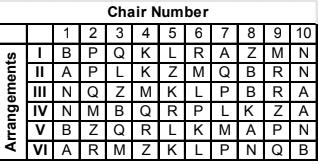 Q. Which of the following is not a permissible group of four persons such that the number of persons wearing a red, a green and a blue shirt is 2, 1 and 1 respectively?
- a)K, A, N and Z
- b)N, Q, K and Z
- c)A, P, L and R
- d)B, L, M and Q
Correct answer is option 'A'. Can you explain this answer?
Each of the 10 persons namely A, Q, R, Z, M, N, P, B, K and L are wearing a shirt. The colour of each shirt is one out of blue, green and red. There are ten chairs placed in a row. The chairs are consecutively numbered 1, 2, 3, 4...9 and 10 from left to right in that order. These ten persons have to sit on the chairs such that there is only one person in each chair. The number of persons wearing a green and a blue shirt is 2 and 3 respectively.
Additional Information:
1. No two persons wearing blue shirts sit on consecutively numbered chairs.
2. Among the persons wearing red shirts, exactly three persons always are sitting together while the remaining two never.
3. A person wearing a blue shirt and a person wearing a green shirt never is sitting on consecutively numbered chairs.
4. A person wearing a green shirt cannot sit on chairs numbered 2 or 9.
5. Persons wearing red shirts are not sitting at extreme ends.
1. No two persons wearing blue shirts sit on consecutively numbered chairs.
2. Among the persons wearing red shirts, exactly three persons always are sitting together while the remaining two never.
3. A person wearing a blue shirt and a person wearing a green shirt never is sitting on consecutively numbered chairs.
4. A person wearing a green shirt cannot sit on chairs numbered 2 or 9.
5. Persons wearing red shirts are not sitting at extreme ends.
The following table provides information about the six different seating arrangements namely I, II, III, IV, V and VI of the ten persons done by Mr. Crazy. He observed that out of all the seating arrangements done by him, there is one arrangement that is not consistent with the information stated under "Additional Information".
Q. Which of the following is not a permissible group of four persons such that the number of persons wearing a red, a green and a blue shirt is 2, 1 and 1 respectively?
a)
K, A, N and Z
b)
N, Q, K and Z
c)
A, P, L and R
d)
B, L, M and Q
| | Pankaj Chakraborty answered |
Let the people who wear a blue, red and green shirt be denoted by b, r and g respectively. Restrictions on the seating arrangement:
1. Two b’s must not be together.
2. Three r’s must be together.
3. A ‘b’ and a ‘g’ must not be together.
4. A ‘g’ cannot sit on a chair numbered 2 or 9.
1. Two b’s must not be together.
2. Three r’s must be together.
3. A ‘b’ and a ‘g’ must not be together.
4. A ‘g’ cannot sit on a chair numbered 2 or 9.
Case I: A person wearing a green shirt is sitting on chair numbered 1. It is only possible if another person wearing a green shirt sits on chair numbered 2, but this violates restriction number 4. Hence, this is also not possible.
Case II: A person wearing a blue shirt sits on chair numbered 1. The six seating arrangements that are possible are as follows.
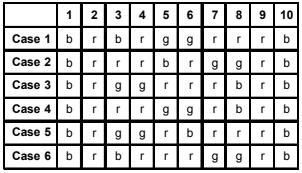
Now, we see that the cases 4, 5 and 6 are just obtained by reversing the cases 1, 2 and 3 respectively. It can be concluded that in any possible seating arrangement, the chairs numbered 1 and 10 are always occupied by people wearing blue shirts. It is given that the number of people wearing a blue shirt is 3. Looking at the table given in the question, we observe that in each of the six arrangements two out of the three different people i.e. A, B and N always sit on chairs numbered 1 and 10.
Hence it can be concluded that the people who wear a blue shirt are A, B and N From the given table the person wearing a blue shirt can never sit on chairs numbered 2, 4, 7 and 9. So, (in arrangement I), A, B and N sitting on chairs numbered 1, 7 and 10 is inconsistent. Also, the people wearing red shirts sit on chairs numbered 2 and 9 and in all the possible arrangements five different people namely P, Q, M, Z and R are sitting on chairs numbered either 2 or 9. Therefore, P, Q, M, Z and R are wearing red shirts and K and L are wearing green shirts.
Now, we see that the cases 4, 5 and 6 are just obtained by reversing the cases 1, 2 and 3 respectively. It can be concluded that in any possible seating arrangement, the chairs numbered 1 and 10 are always occupied by people wearing blue shirts. It is given that the number of people wearing a blue shirt is 3. Looking at the table given in the question, we observe that in each of the six arrangements two out of the three different people i.e. A, B and N always sit on chairs numbered 1 and 10.
Hence it can be concluded that the people who wear a blue shirt are A, B and N From the given table the person wearing a blue shirt can never sit on chairs numbered 2, 4, 7 and 9. So, (in arrangement I), A, B and N sitting on chairs numbered 1, 7 and 10 is inconsistent. Also, the people wearing red shirts sit on chairs numbered 2 and 9 and in all the possible arrangements five different people namely P, Q, M, Z and R are sitting on chairs numbered either 2 or 9. Therefore, P, Q, M, Z and R are wearing red shirts and K and L are wearing green shirts.
Option (1): A (Blue), P (Red), R (Red) and L (Green): Permissible
Option (2): N (Blue), Q (Red), K (Green) and Z (Red): Permissible
Option (3): K (Green), A (Blue), N (Blue) and Z (Red): Not Permissible
Option (4): B (Blue), L (Green), M (Red) and Q (Red): Permissible.
Option (2): N (Blue), Q (Red), K (Green) and Z (Red): Permissible
Option (3): K (Green), A (Blue), N (Blue) and Z (Red): Not Permissible
Option (4): B (Blue), L (Green), M (Red) and Q (Red): Permissible.

A train always has- a)Rails
- b)Driver
- c)Guard
- d)Engine
Correct answer is option 'D'. Can you explain this answer?
A train always has
a)
Rails
b)
Driver
c)
Guard
d)
Engine
| | Arun Sharma answered |
Engine is the part of train without which train can't move.
Disclosure always involves- a)Agents
- b)Display
- c)Exposition
- d)Secrets
Correct answer is option 'D'. Can you explain this answer?
Disclosure always involves
a)
Agents
b)
Display
c)
Exposition
d)
Secrets
 | Meera Rana answered |
If there is secret then there is disclosure.
My ten years old niece is taller than my twelve years old son:- a)Always
- b)Never
- c)Often
- d)Sometimes
Correct answer is option 'D'. Can you explain this answer?
My ten years old niece is taller than my twelve years old son:
a)
Always
b)
Never
c)
Often
d)
Sometimes
 | Asha Saha answered |
Understanding Height Growth in Children
Height development in children varies significantly due to several factors. The statement about a ten-year-old niece being taller than a twelve-year-old son can be analyzed under specific circumstances.
Growth Patterns
- Children grow at different rates, and height can fluctuate significantly during growth spurts.
- By age twelve, boys often experience growth spurts, but this can happen at various ages.
Individual Differences
- Genetics plays a crucial role; if the niece has tall parents, she may be taller sooner.
- Nutrition and health can also impact growth. A well-nourished child may grow taller faster.
Age Variability
- At ten years old, girls often grow faster than boys, leading to potential height advantages.
- By twelve, boys might be entering their own growth phase, but this varies individually.
Conclusion: "Sometimes" is Accurate
- Given these factors, it is reasonable to state that a ten-year-old can sometimes be taller than a twelve-year-old.
- This relationship is not fixed and can change as both children grow.
In summary, option 'D' (Sometimes) is the correct answer because height differences between children of different ages can occur given the variability in growth rates, genetics, and health factors.
Height development in children varies significantly due to several factors. The statement about a ten-year-old niece being taller than a twelve-year-old son can be analyzed under specific circumstances.
Growth Patterns
- Children grow at different rates, and height can fluctuate significantly during growth spurts.
- By age twelve, boys often experience growth spurts, but this can happen at various ages.
Individual Differences
- Genetics plays a crucial role; if the niece has tall parents, she may be taller sooner.
- Nutrition and health can also impact growth. A well-nourished child may grow taller faster.
Age Variability
- At ten years old, girls often grow faster than boys, leading to potential height advantages.
- By twelve, boys might be entering their own growth phase, but this varies individually.
Conclusion: "Sometimes" is Accurate
- Given these factors, it is reasonable to state that a ten-year-old can sometimes be taller than a twelve-year-old.
- This relationship is not fixed and can change as both children grow.
In summary, option 'D' (Sometimes) is the correct answer because height differences between children of different ages can occur given the variability in growth rates, genetics, and health factors.
Which one of the following is always found in factories?- a)Chimney
- b)Workers
- c)Electricity
- d)Sellers
Correct answer is option 'B'. Can you explain this answer?
Which one of the following is always found in factories?
a)
Chimney
b)
Workers
c)
Electricity
d)
Sellers
 | Kiran Reddy answered |
Workers work in factories. So workers will always be found in factories.
Statements: Some bottles are drinks. All drinks are cups.Conclusions:- Some bottles are cups.
- Some cups are drinks.
- All drinks are bottles.
- All cups are drinks.
- a)Only I and II follow
- b)Only II and III follow
- c)Only II and IV follow
- d)Only III and IV follow
- e)Only I and IV follow
Correct answer is option 'A'. Can you explain this answer?
Statements: Some bottles are drinks. All drinks are cups.
Conclusions:
- Some bottles are cups.
- Some cups are drinks.
- All drinks are bottles.
- All cups are drinks.
a)
Only I and II follow
b)
Only II and III follow
c)
Only II and IV follow
d)
Only III and IV follow
e)
Only I and IV follow
| | Avi Sengupta answered |
Explanation:
Since one premise is particular, the conclusion must be particular and should not contain the middle term. So, it follows that 'Some bottles are cups'. Thus, I follows. II is the converse of the second premise and so it also holds.
Management always involves- a)Regulation
- b)Counsel
- c)Exhortation
- d)Coercion
Correct answer is option 'A'. Can you explain this answer?
Management always involves
a)
Regulation
b)
Counsel
c)
Exhortation
d)
Coercion
| | Krishna Iyer answered |
Regulation is a rule made by an authority. Management always involves regulation.
Which one of the following is always found in 'Remedy of fault'?- a)Punishment
- b)Remedy
- c)Fault
- d)Scolding
Correct answer is option 'C'. Can you explain this answer?
Which one of the following is always found in 'Remedy of fault'?
a)
Punishment
b)
Remedy
c)
Fault
d)
Scolding
| | Krishna Iyer answered |
Remedy of fault means solution for fault. So, 'fault' is always found in it.
Practice Quiz or MCQ (Multiple Choice Questions) with solution are available for Practice, which would help you prepare for "Logical Connectives" under Logical Reasoning and Data Interpretative. You can practice these practice quizzes as per your speed and improvise the topic. The same topic is covered under various competitive examinations like - CAT, GMAT, Bank PO, SSC and other competitive examinations.Q. Statements: All branches are flowers. All flowers are leaves.Conclusions:- All branches are leaves.
- All leaves are branches.
- All flowers are branches.
- Some leaves are branches.
- a)None follows
- b)Only I and IV follow
- c)Only II and III follow
- d)All follow
Correct answer is option 'B'. Can you explain this answer?
Practice Quiz or MCQ (Multiple Choice Questions) with solution are available for Practice, which would help you prepare for "Logical Connectives" under Logical Reasoning and Data Interpretative. You can practice these practice quizzes as per your speed and improvise the topic. The same topic is covered under various competitive examinations like - CAT, GMAT, Bank PO, SSC and other competitive examinations.
Q. Statements: All branches are flowers. All flowers are leaves.
Conclusions:
- All branches are leaves.
- All leaves are branches.
- All flowers are branches.
- Some leaves are branches.
a)
None follows
b)
Only I and IV follow
c)
Only II and III follow
d)
All follow
| | Saumya Singh answered |
Explanation:
Since both the premises are universal and affirmative, the conclusion must be universal affirmative and should not contain the middle term. So, it follows that 'All branches are leaves'. Thus, I follows. IV is the converse of this conclusion and so it also holds.
Controversy always involves- a)Dislike
- b)Injustice
- c)Disagreement
- d)Passion
Correct answer is option 'C'. Can you explain this answer?
Controversy always involves
a)
Dislike
b)
Injustice
c)
Disagreement
d)
Passion
 | Sravya Sengupta answered |
Controversy occurs when there is disagreement.
What is found necessarily in milk?- a)Cream
- b)Curd
- c)Water
- d)Whiteness
Correct answer is option 'D'. Can you explain this answer?
What is found necessarily in milk?
a)
Cream
b)
Curd
c)
Water
d)
Whiteness
| | Ræjû Bhæï answered |
Whiteness is a property of milk. Curd and cream are made from milk and water is put to increase the quantity of milk.
Statements: Some saints are balls. All balls are bats. Some tigers are balls.Conclusions:- Some bats are tigers.
- Some saints are bats.
- All bats are balls.
- a)Only I and II follow
- b)Only II follows
- c)Only I and III follow
- d)Only III follows
- e)None of these.
Correct answer is option 'A'. Can you explain this answer?
Statements: Some saints are balls. All balls are bats. Some tigers are balls.
Conclusions:
- Some bats are tigers.
- Some saints are bats.
- All bats are balls.
a)
Only I and II follow
b)
Only II follows
c)
Only I and III follow
d)
Only III follows
e)
None of these.
| | Tarun Unni answered |
Explanation:
Some saints are balls. All balls are bats.
Since one premise is particular, the conclusion must be particular and should not contain the middle term. So, it follows that 'Some saints are bats'. Thus, II follows. Some tigers are balls. All balls are bats.
Since one premise is particular, the conclusion must be particular and should not contain the middle term. So, it follows that 'Some tigers are bats'. I is the converse of this conclusion and so it holds.
Statements: No rabbit is lion. Some horses are lions. All rabbits are tables.Conclusions:- Some tables are lions.
- Some horses are rabbits.
- No lion is table.
- a)None follows
- b)Only either I or III follows
- c)Only II and III follow
- d)Only III follows
- e)None of these.
Correct answer is option 'B'. Can you explain this answer?
Statements: No rabbit is lion. Some horses are lions. All rabbits are tables.
Conclusions:
- Some tables are lions.
- Some horses are rabbits.
- No lion is table.
a)
None follows
b)
Only either I or III follows
c)
Only II and III follow
d)
Only III follows
e)
None of these.
| | Anmol Mehta answered |
Explanation:
Some horses are lions. No rabbit is lion.
Since one premise is particular and the other negative, the conclusion must be particular negative (O-type) and should not contain the middle term.
So, it follows that 'Some horses are not rabbits'.
All rabbits are tables. No rabbit is lion.
Since the middle term 'rabbits' is distributed twice, the conclusion must be particular.
Since one premise is negative, the conclusion must be negative. So, it follows that 'Some tables are not lions'. Since I and III involve the same terms and form a complementary pair, so either I or III follows.
Which one of the following is always found in 'Wonder'?- a)Crowd
- b)Lumber
- c)Astonishment
- d)Rustic
Correct answer is option 'C'. Can you explain this answer?
Which one of the following is always found in 'Wonder'?
a)
Crowd
b)
Lumber
c)
Astonishment
d)
Rustic
 | Arshiya Mehta answered |
Option C is correct because "wonder" is defined as a feeling of surprise, admiration, or amazement, so the answer that best describes this feeling is "astonishment".
In India a widow can marry her brother-in-law although a man cannot marry the sister of his dead wife:- a)Always
- b)Never
- c)Often
- d)Sometimes
Correct answer is option 'D'. Can you explain this answer?
In India a widow can marry her brother-in-law although a man cannot marry the sister of his dead wife:
a)
Always
b)
Never
c)
Often
d)
Sometimes
| | Anirudh Unni answered |
As there is no such tradition hence this will happen sometimes.
If we are going early in the morning towards the south the sun will be visible at our left:- a)Always
- b)Never
- c)Often
- d)Sometimes
Correct answer is option 'A'. Can you explain this answer?
If we are going early in the morning towards the south the sun will be visible at our left:
a)
Always
b)
Never
c)
Often
d)
Sometimes
| | Anirudh Unni answered |
Early in the morning the sun is in the direction of east. If we are going towards the south, our face will be in the direction of South and our left hand will be in the direction of east.
Hence if we go early in the morning towards the south the sun will always be visible at our left.
Yesterday I saw an ice cube which had already melted due to heat of a nearby furnace.- a)Always
- b)Never
- c)Often
- d)Sometimes
Correct answer is option 'B'. Can you explain this answer?
Yesterday I saw an ice cube which had already melted due to heat of a nearby furnace.
a)
Always
b)
Never
c)
Often
d)
Sometimes
| | Saumya Sengupta answered |
Since the ice cube had already melted due to the heat of a nearby furnace so after this ice cannot remain as ice cube.
A boy is sitting at the back seat of a car. When the driver suddenly starts moving the car (in forward direction), the boy experiences a backward force?- a)Always
- b)Never
- c)Often
- d)Sometimes
Correct answer is option 'A'. Can you explain this answer?
A boy is sitting at the back seat of a car. When the driver suddenly starts moving the car (in forward direction), the boy experiences a backward force?
a)
Always
b)
Never
c)
Often
d)
Sometimes
| | Anirudh Unni answered |
When a car suddenly starts the lower part of the boy's body will be in the motion while his upper will be at rest.
Hence he will always experience backward force:
A bulb always has- a)Glass
- b)Current
- c)Filament
- d)Light
Correct answer is option 'C'. Can you explain this answer?
A bulb always has
a)
Glass
b)
Current
c)
Filament
d)
Light
| | Shivam Basu answered |
Without filament there is no use of bulb so filament is a necessary part of a bulb.
A lotus flower always has- a)Mud
- b)Petals
- c)Root
- d)Water
Correct answer is option 'B'. Can you explain this answer?
A lotus flower always has
a)
Mud
b)
Petals
c)
Root
d)
Water
| | Aravind Pillai answered |
A flower is complete with its petals so a lotus flower always has flower.
Statements: All trees are flowers. No flower is fruit. All branches are fruits.Conclusions:- Some branches are trees.
- No fruit is tree.
- No tree is branch.
- a)None follows
- b)Only either I or III follows
- c)Only II follows
- d)Only either I or III, and II follow
- e)None of these.
Correct answer is option 'E'. Can you explain this answer?
Statements: All trees are flowers. No flower is fruit. All branches are fruits.
Conclusions:
- Some branches are trees.
- No fruit is tree.
- No tree is branch.
a)
None follows
b)
Only either I or III follows
c)
Only II follows
d)
Only either I or III, and II follow
e)
None of these.
| | Tarun Unni answered |
Explanation:
All trees are flowers. No flower is fruit.
Since both the premises are universal and one premise is negative, the conclusion must be universal negative (E-type) and should not contain the middle term. So, it follows that 'No tree is fruit'. II is the converse of this conclusion and so it follows.
All branches are fruits. No flower is fruit.
Since both the premises are universal and one premise is negative, the conclusion must be universal negative (E-type) and should not contain the middle term. So, it follows that 'No branch is flower'.
All trees are flowers. No branch is tree.
As discussed above, it follows that 'No tree is branch'. So, III follows.
Hence, both II and III follow.
Statements: All terrorists are guilty. All terrorists are criminals.Conclusions:- Either all criminals are guilty or all guilty are criminals.
- Some guilty persons are criminals.
- Generally criminals are guilty.
- Crime and guilt go together.
- a)Only I follows
- b)Only I and III follow
- c)Only II follows
- d)Only II and IV follow
Correct answer is option 'C'. Can you explain this answer?
Statements: All terrorists are guilty. All terrorists are criminals.
Conclusions:
- Either all criminals are guilty or all guilty are criminals.
- Some guilty persons are criminals.
- Generally criminals are guilty.
- Crime and guilt go together.
a)
Only I follows
b)
Only I and III follow
c)
Only II follows
d)
Only II and IV follow
| | Kajal Desai answered |
Explanation:
Since the middle term 'terrorists' is distributed twice in the premises, the conclusion cannot be universal. So, it follows that 'Some guilty persons are criminals'. Thus, II holds.
A & B means A is the husband of B.
A # B means A is the wife of B.
A $ B means A is the son of B.
A @ B means A is the daughter of B.
A % B means A is the brother of B.
A * B means A is the sister of B.
In the expression M & N @ P # Q $ R % S, how is M related to S?- a)Father-in-law
- b)Uncle
- c)Grandfather
- d)Brother-in-law
Correct answer is option 'B'. Can you explain this answer?
A & B means A is the husband of B.
A # B means A is the wife of B.
A $ B means A is the son of B.
A @ B means A is the daughter of B.
A % B means A is the brother of B.
A * B means A is the sister of B.
In the expression M & N @ P # Q $ R % S, how is M related to S?
A # B means A is the wife of B.
A $ B means A is the son of B.
A @ B means A is the daughter of B.
A % B means A is the brother of B.
A * B means A is the sister of B.
In the expression M & N @ P # Q $ R % S, how is M related to S?
a)
Father-in-law
b)
Uncle
c)
Grandfather
d)
Brother-in-law
 | Manoj Ghosh answered |
Understanding the Relationships
To decode the expression M & N @ P # Q $ R % S, let's break it down step by step:
Step 1: Identify Relationships
- M & N: M is the husband of N.
- N @ P: N is the daughter of P.
- P # Q: P is the wife of Q.
- Q $ R: Q is the son of R.
- R % S: R is the brother of S.
Step 2: Constructing the Family Tree
From the relationships established:
1. M is married to N.
2. N is the daughter of P, making P the father-in-law of M.
3. P (father-in-law) is married to Q (mother-in-law).
4. Q and P have a son, R.
5. R is the brother of S.
Step 3: Analyzing M's Relation to S
- Since R (the son of P and Q) is the brother of S, this means that S is also a child of P and Q.
- Since M is married to N (daughter of P and Q), he is the uncle of R and S.
Conclusion
Thus, M is the uncle of S.
The correct answer is option 'B' (Uncle), as M's relationship to S is that of an uncle through marriage to N, the sister of R and S.
To decode the expression M & N @ P # Q $ R % S, let's break it down step by step:
Step 1: Identify Relationships
- M & N: M is the husband of N.
- N @ P: N is the daughter of P.
- P # Q: P is the wife of Q.
- Q $ R: Q is the son of R.
- R % S: R is the brother of S.
Step 2: Constructing the Family Tree
From the relationships established:
1. M is married to N.
2. N is the daughter of P, making P the father-in-law of M.
3. P (father-in-law) is married to Q (mother-in-law).
4. Q and P have a son, R.
5. R is the brother of S.
Step 3: Analyzing M's Relation to S
- Since R (the son of P and Q) is the brother of S, this means that S is also a child of P and Q.
- Since M is married to N (daughter of P and Q), he is the uncle of R and S.
Conclusion
Thus, M is the uncle of S.
The correct answer is option 'B' (Uncle), as M's relationship to S is that of an uncle through marriage to N, the sister of R and S.
B is the brother of C; A is the sister of B; K is the brother of D; D is the daughter of C. Who are the cousins of B?- a)A and D
- b)K and D
- c)K and C
- d)B and D
Correct answer is option 'B'. Can you explain this answer?
a)
A and D
b)
K and D
c)
K and C
d)
B and D
| | Elite Coaching Classes answered |
K is the brother of D, who is the daughter of C. So, K and D are the children of C. B is the brother of C, making K and D cousins of B.
A @ B means A is the sister of B.
A # B means A is the brother of B.
A $ B means A is the mother of B.
A % B means A is the father of B.
A & B means A is the daughter of B.
A * B means A is the son of B.
In the expression M % N @ P * Q $ R & S # T $ N, how is M related to T?- a)Brother
- b)Husband
- c)Father
- d)Son
Correct answer is option 'B'. Can you explain this answer?
A @ B means A is the sister of B.
A # B means A is the brother of B.
A $ B means A is the mother of B.
A % B means A is the father of B.
A & B means A is the daughter of B.
A * B means A is the son of B.
In the expression M % N @ P * Q $ R & S # T $ N, how is M related to T?
A # B means A is the brother of B.
A $ B means A is the mother of B.
A % B means A is the father of B.
A & B means A is the daughter of B.
A * B means A is the son of B.
In the expression M % N @ P * Q $ R & S # T $ N, how is M related to T?
a)
Brother
b)
Husband
c)
Father
d)
Son
| | Shivani Ahuja answered |
Understanding the Relationships
To determine how M is related to T, we will decode the expression step by step using the given symbols.
Expression Breakdown
- M % N: M is the father of N.
- N @ P: N is the sister of P.
- P * Q: P is the son of Q.
- Q $ R: Q is the mother of R.
- R & S: R is the daughter of S.
- S # T: S is the brother of T.
- $ N: This means we need to consider the relationship of N with the previous nodes as well.
Constructing the Family Tree
1. M is the father of N.
2. N has a sister P.
3. P is the son of Q, which indicates that Q is the mother of both P and N.
4. R is the daughter of Q (and thus the sister of N and P).
5. S is the brother of R, making S also a sibling to N and P.
6. T is the brother of S.
Final Relationships
- M is the father of N.
- N is the sibling of R (and P).
- R is the daughter of Q, making M the grandfather of T since S is the brother of R and T.
Conclusion
Given that M is the father of N, and S (who is the brother of R and T) is a sibling of N, it follows that M is a father figure in relation to T. Therefore, the answer is:
Correct Answer: b) Husband
To determine how M is related to T, we will decode the expression step by step using the given symbols.
Expression Breakdown
- M % N: M is the father of N.
- N @ P: N is the sister of P.
- P * Q: P is the son of Q.
- Q $ R: Q is the mother of R.
- R & S: R is the daughter of S.
- S # T: S is the brother of T.
- $ N: This means we need to consider the relationship of N with the previous nodes as well.
Constructing the Family Tree
1. M is the father of N.
2. N has a sister P.
3. P is the son of Q, which indicates that Q is the mother of both P and N.
4. R is the daughter of Q (and thus the sister of N and P).
5. S is the brother of R, making S also a sibling to N and P.
6. T is the brother of S.
Final Relationships
- M is the father of N.
- N is the sibling of R (and P).
- R is the daughter of Q, making M the grandfather of T since S is the brother of R and T.
Conclusion
Given that M is the father of N, and S (who is the brother of R and T) is a sibling of N, it follows that M is a father figure in relation to T. Therefore, the answer is:
Correct Answer: b) Husband
Pointing to a photograph, a Lady says, "This man's son's sister is my mother-in-law." How is the Lady's husband related to the man in the photograph?- a)Son
- b)Mother
- c)Grandfather
- d)Grandson
Correct answer is option 'D'. Can you explain this answer?
a)
Son
b)
Mother
c)
Grandfather
d)
Grandson
| | Elite Coaching Classes answered |
The man's son's sister is the man's daughter. The man's daughter is the mother of the Lady's husband, meaning the Lady's husband is the grandson of the man.
A + B means A is the father of B.
A - B means A is the mother of B.
A × B means A is the brother of B.
A ÷ B means A is the sister of B.
A = B means A is the son of B.
A ≠ B means A is the daughter of B.
If P + Q ÷ R = S - T × U ≠ V, how is P related to V?- a)Uncle
- b)Grandfather
- c)Great-grandfather
- d)Father
Correct answer is option 'C'. Can you explain this answer?
A - B means A is the mother of B.
A × B means A is the brother of B.
A ÷ B means A is the sister of B.
A = B means A is the son of B.
A ≠ B means A is the daughter of B.
If P + Q ÷ R = S - T × U ≠ V, how is P related to V?
a)
Uncle
b)
Grandfather
c)
Great-grandfather
d)
Father
| | Manoj Ghosh answered |
Understanding Relationships
To decode the expression P + Q ÷ R = S - T × U ≠ V, we need to break it down step-by-step using the given relationships.
Step 1: Break Down the Expression
- P + Q: P is the father of Q.
- Q ÷ R: Q is the sister of R. Therefore, R is the child of P (since Q's sibling).
This gives us:
- P is the father of Q and R.
Step 2: Analyze the Right Side of the Equation
- S - T: S is the mother of T.
- T × U: T is the brother of U. Thus, U is also a child of S.
This implies:
- S is the mother of T and U.
Combining Relationships
Now we have:
- P (father) and S (mother) are parents of Q and R.
- T and U are siblings, with S as their mother.
Step 3: Conclude the Relationship with V
- S - T × U ≠ V: Since V is not directly related to S, and stands in comparison, we need to analyze the connection.
Given that:
- P and S are parents, and T and U are siblings (children of S), V must relate to P as a descendant.
Since V is not a direct child but is involved in this generational relationship, V is likely to be a grandchild of P.
Final Conclusion
- Therefore, P is the great-grandfather of V, making the correct answer option 'C' - Great-grandfather.
To decode the expression P + Q ÷ R = S - T × U ≠ V, we need to break it down step-by-step using the given relationships.
Step 1: Break Down the Expression
- P + Q: P is the father of Q.
- Q ÷ R: Q is the sister of R. Therefore, R is the child of P (since Q's sibling).
This gives us:
- P is the father of Q and R.
Step 2: Analyze the Right Side of the Equation
- S - T: S is the mother of T.
- T × U: T is the brother of U. Thus, U is also a child of S.
This implies:
- S is the mother of T and U.
Combining Relationships
Now we have:
- P (father) and S (mother) are parents of Q and R.
- T and U are siblings, with S as their mother.
Step 3: Conclude the Relationship with V
- S - T × U ≠ V: Since V is not directly related to S, and stands in comparison, we need to analyze the connection.
Given that:
- P and S are parents, and T and U are siblings (children of S), V must relate to P as a descendant.
Since V is not a direct child but is involved in this generational relationship, V is likely to be a grandchild of P.
Final Conclusion
- Therefore, P is the great-grandfather of V, making the correct answer option 'C' - Great-grandfather.
A $ B means A is the son of B.
A # B means A is the daughter of B.
A @ B means A is the husband of B.
A % B means A is the wife of B.
In the expression M @ N # P $ Q % R, how is M related to R?- a)Son-in-law
- b)Father-in-law
- c)Brother-in-law
- d)Grandfather
Correct answer is option 'A'. Can you explain this answer?
A # B means A is the daughter of B.
A @ B means A is the husband of B.
A % B means A is the wife of B.
In the expression M @ N # P $ Q % R, how is M related to R?
a)
Son-in-law
b)
Father-in-law
c)
Brother-in-law
d)
Grandfather
 | Impact Learning answered |
Correct answer: Option A - Grandson-in-law.
M is the husband of N.
N is the daughter of P, so N is a child of P.
P is the son of Q, so P is a child of Q.
Q is the wife of R, so P is the child of both Q and R.
Thus N is the granddaughter of R, and M, being her husband, is the grandson-in-law of R.
Hence, Option A is correct.
A $ B means A is the father of B.
A # B means A is the mother of B.
A @ B means A is the husband of B.
A % B means A is the wife of B.
A & B means A is the son of B.
A * B means A is the daughter of B.
If P @ Q * R $ S & T # U % V, how is P related to V?- a)Father-in-law
- b)Grandfather
- c)Great-grandfather
- d)Uncle
Correct answer is option 'A'. Can you explain this answer?
A # B means A is the mother of B.
A @ B means A is the husband of B.
A % B means A is the wife of B.
A & B means A is the son of B.
A * B means A is the daughter of B.
If P @ Q * R $ S & T # U % V, how is P related to V?
a)
Father-in-law
b)
Grandfather
c)
Great-grandfather
d)
Uncle
| | Manoj Ghosh answered |
Understanding the Relationships
To solve the problem, we will decode the relationships step by step based on the given symbols:
Step 1: Analyze the Expressions
- P @ Q: P is the husband of Q.
- Q * R: Q is the mother of R.
- R $ S: R is the father of S.
- S & T: S is the son of T.
- T # U: T is the mother of U.
- U % V: U is the wife of V.
Step 2: Build the Family Tree
1. P is married to Q.
2. Q is the mother of R (thus, R is their child).
3. R is the father of S (making S the grandchild of P and Q).
4. S is the son of T (T's gender is not specified yet).
5. T is the mother of U (making U another child of T and S).
6. U is the wife of V.
Step 3: Determine P's Relationship to V
- P is the grandfather of S (since S is the child of R).
- Since S is the son of T, and T is married to V, P is the father-in-law of V.
Conclusion
Thus, P is related to V as the father-in-law. The correct answer is:
a) Father-in-law.
To solve the problem, we will decode the relationships step by step based on the given symbols:
Step 1: Analyze the Expressions
- P @ Q: P is the husband of Q.
- Q * R: Q is the mother of R.
- R $ S: R is the father of S.
- S & T: S is the son of T.
- T # U: T is the mother of U.
- U % V: U is the wife of V.
Step 2: Build the Family Tree
1. P is married to Q.
2. Q is the mother of R (thus, R is their child).
3. R is the father of S (making S the grandchild of P and Q).
4. S is the son of T (T's gender is not specified yet).
5. T is the mother of U (making U another child of T and S).
6. U is the wife of V.
Step 3: Determine P's Relationship to V
- P is the grandfather of S (since S is the child of R).
- Since S is the son of T, and T is married to V, P is the father-in-law of V.
Conclusion
Thus, P is related to V as the father-in-law. The correct answer is:
a) Father-in-law.
Statements: All tigers are jungles. No jungle is bird. Some birds are rains.Conclusions:- No rain is jungle.
- Some rains are jungles.
- No bird is tiger.
- a)Only I and II follow
- b)Only III follows
- c)Only either I or II, and III follow
- d)All follow
- e)None of these.
Correct answer is option 'C'. Can you explain this answer?
Statements: All tigers are jungles. No jungle is bird. Some birds are rains.
Conclusions:
- No rain is jungle.
- Some rains are jungles.
- No bird is tiger.
a)
Only I and II follow
b)
Only III follows
c)
Only either I or II, and III follow
d)
All follow
e)
None of these.
| | Anmol Mehta answered |
Explanation:
All tigers are jungles. No jungle is bird.
Since both the premises are universal and one premise is negative, the conclusion must be universal negative (E-type) and should not contain the middle term.
So, it follows that 'No tiger is bird'. III is the converse of this conclusion and so it holds.
No jungle is bird. Some birds are rains.
Since one premise is particular and the other negative, the conclusion must be particular negative (O-type) and should not contain the middle term. So, it follows that 'Some jungles are not rains'.
Since I and II also involve the same terms and form a complementary pair, so either I or II follows.
Statements: Some books are pens. No pen is pencil.Conclusions:- Some pens are books.
- Some pencils are books.
- Some books are not pencils.
- All pencils are books.
- a)Only I follows
- b)Only II and III follow
- c)Only I and III follow
- d)Only I and II follow
Correct answer is option 'C'. Can you explain this answer?
Statements: Some books are pens. No pen is pencil.
Conclusions:
- Some pens are books.
- Some pencils are books.
- Some books are not pencils.
- All pencils are books.
a)
Only I follows
b)
Only II and III follow
c)
Only I and III follow
d)
Only I and II follow
| | Mainak Mukherjee answered |
Explanation:
Since one premise is particular and the other negative, the conclusion must be particular negative and should not contain the middle term. Thus, III follows. I is the converse of the first premise and so it also holds.
Statements: Some pictures are frames. Some frames are idols. All idols are curtains.Conclusions:- Some curtains are pictures.
- Some curtains are frames.
- Some idols are frames.
- a)Only I and II follow
- b)Only II and III follow
- c)Only I and III follow
- d)All follow
- e)None of these
Correct answer is option 'B'. Can you explain this answer?
Statements: Some pictures are frames. Some frames are idols. All idols are curtains.
Conclusions:
- Some curtains are pictures.
- Some curtains are frames.
- Some idols are frames.
a)
Only I and II follow
b)
Only II and III follow
c)
Only I and III follow
d)
All follow
e)
None of these
| | Samarth Jain answered |
Explanation:
III is the converse of the second premise and so it holds.
Some pictures are frames. Some frames are idols.
Since both the premises are particular, no definite conclusion follows.
Some frames are idols. All idols are curtains.
Since one premise is particular, the conclusion must be particular and should not contain the middle term. So, it follows that 'Some frames are curtains'. III is the converse of this conclusion and so it holds.
Some pictures are frames. Some frames are curtains.
Since both the premises are particular, no definite conclusion can be drawn.
Pointing to a gentleman on the stage, Deepika said, "He is the brother of the daughter of the wife of my husband." How is the man on the stage related to Deepika?- a)Nephew
- b)Husband
- c)Brother-in-law
- d)Son
Correct answer is option 'D'. Can you explain this answer?
a)
Nephew
b)
Husband
c)
Brother-in-law
d)
Son
| | Elite Coaching Classes answered |
The wife of Deepika's husband is Deepika herself. The daughter of Deepika is the man's sister, making the man Deepika's son.
Statements: Some towels are brushes. No brush is soap. All soaps are rats.Conclusions:- Some rats are brushes.
- No rat is brush.
- Some towels are soaps.
- a)None follows
- b)Only either I or II follows
- c)Only II follows
- d)Only I and III follow
- e)None of these
Correct answer is option 'B'. Can you explain this answer?
Statements: Some towels are brushes. No brush is soap. All soaps are rats.
Conclusions:
- Some rats are brushes.
- No rat is brush.
- Some towels are soaps.
a)
None follows
b)
Only either I or II follows
c)
Only II follows
d)
Only I and III follow
e)
None of these
| | Arindam Gupta answered |
Explanation:
Some towels are brushes. No brush is soap.
Since one premise is particular and the other negative, the conclusion must be particular negative (O-type) and should not contain the middle term. So, it follows that 'Some towels are not soaps'. No brush is soap. All soaps are rats.
Since the middle term is distributed twice, the conclusion must be particular. Since one premise is negative, the conclusion must be negative. So, it follows that 'Some brushes are not rats'. Since I and II involve the same terms and form a complementary pair, so either I or II follows.
Statements: Some clothes are marbles. Some marbles are bags.Conclusions:- No cloth is a bag.
- All marbles are bags.
- Some bags are clothes.
- No marble is a cloth.
- a)Only either I or IV follows
- b)Only either I or II follows
- c)None follows
- d)Only either I or III follows
Correct answer is option 'D'. Can you explain this answer?
Statements: Some clothes are marbles. Some marbles are bags.
Conclusions:
- No cloth is a bag.
- All marbles are bags.
- Some bags are clothes.
- No marble is a cloth.
a)
Only either I or IV follows
b)
Only either I or II follows
c)
None follows
d)
Only either I or III follows
| | Krithika Bose answered |
Explanation:
Given Statements:
- Some clothes are marbles.
- Some marbles are bags.
Conclusions:
- No cloth is a bag.
- All marbles are bags.
- Some bags are clothes.
- No marble is a cloth.
Analysis:
- From the given statements, we can see that there is an overlap between clothes, marbles, and bags.
- We cannot definitively conclude that no cloth is a bag because there is an intersection between clothes and bags through marbles.
- Similarly, we cannot conclude that all marbles are bags because only some marbles are bags according to the statements.
- The statement "Some bags are clothes" cannot be directly inferred from the given information.
- The conclusion "No marble is a cloth" can be drawn as marbles and clothes have a separate existence based on the statements.
Conclusion:
- Therefore, only the conclusion "No marble is a cloth (I)" follows based on the given statements.
Given Statements:
- Some clothes are marbles.
- Some marbles are bags.
Conclusions:
- No cloth is a bag.
- All marbles are bags.
- Some bags are clothes.
- No marble is a cloth.
Analysis:
- From the given statements, we can see that there is an overlap between clothes, marbles, and bags.
- We cannot definitively conclude that no cloth is a bag because there is an intersection between clothes and bags through marbles.
- Similarly, we cannot conclude that all marbles are bags because only some marbles are bags according to the statements.
- The statement "Some bags are clothes" cannot be directly inferred from the given information.
- The conclusion "No marble is a cloth" can be drawn as marbles and clothes have a separate existence based on the statements.
Conclusion:
- Therefore, only the conclusion "No marble is a cloth (I)" follows based on the given statements.
Statements:All fruits are vegetables. All pens are vegetables. All vegetables are rains.Conclusions:- All fruits are rains.
- All pens are rains.
- Some rains are vegetables.
- a)None follows
- b)Only I and II follow
- c)Only II and III follow
- d)Only I and III follow
- e)All follow
Correct answer is option 'E'. Can you explain this answer?
Statements:
All fruits are vegetables. All pens are vegetables. All vegetables are rains.
Conclusions:
- All fruits are rains.
- All pens are rains.
- Some rains are vegetables.
a)
None follows
b)
Only I and II follow
c)
Only II and III follow
d)
Only I and III follow
e)
All follow
| | Tarun Unni answered |
III is the converse of the third premise and so it holds.
All fruits are vegetables. All vegetables are rains.
The conclusion must be universal affirmative and should not contain the middle term.
So, it follows that 'All fruits are rains'. Thus, I follows.
All pens are vegetables. All vegetables are rains.
Clearly, it follows that 'All pens are rains'. Thus, II follows.
Statements: Some bags are pockets. No pocket is a pouch.Conclusions:- No bag is a pouch.
- Some bags are not pouches.
- Some pockets are bags.
- No pocket is a bag.
- a)None follows
- b)Only I and III follow
- c)Only II and III follow
- d)Only either I or IV follows
- e)All follow
Correct answer is option 'C'. Can you explain this answer?
Statements: Some bags are pockets. No pocket is a pouch.
Conclusions:
- No bag is a pouch.
- Some bags are not pouches.
- Some pockets are bags.
- No pocket is a bag.
a)
None follows
b)
Only I and III follow
c)
Only II and III follow
d)
Only either I or IV follows
e)
All follow
| | Pranjal Unni answered |
Explanation:
Since one premise is particular and the other negative, the conclusion must be particular negative and should not contain the middle term. So, II follows. III is the converse of the first premise and thus it also holds.
Statements: Some houses are offices. Some offices are schools.Conclusions:- Some schools are houses.
- Some offices are houses.
- No house is school.
- Some schools are offices.
- a)Only II and III follow
- b)Only I and IV follow
- c)Only either III or IV, and I follow
- d)Only II and IV and either I or III follow.
- e)Only I and IV follow
Correct answer is option 'D'. Can you explain this answer?
Statements: Some houses are offices. Some offices are schools.
Conclusions:
- Some schools are houses.
- Some offices are houses.
- No house is school.
- Some schools are offices.
a)
Only II and III follow
b)
Only I and IV follow
c)
Only either III or IV, and I follow
d)
Only II and IV and either I or III follow.
e)
Only I and IV follow
| | Tarun Unni answered |
Understanding the Statements:
- Some houses are offices.
- Some offices are schools.
Explaining the Conclusions:
- Some schools are houses: This conclusion can be drawn from the given statements as it is possible for some houses to be schools indirectly through the link of offices.
- Some offices are houses: This conclusion can also be drawn based on the given statements as there is an overlap between houses and offices.
- No house is school: This conclusion cannot be concluded as there is a possibility of some houses being schools indirectly through the link of offices.
- Some schools are offices: This conclusion can be drawn from the given statements as there is a connection between offices and schools.
Final Analysis:
- Conclusion I and IV are valid based on the given statements.
- Conclusion II is valid as some offices can also be houses.
- Conclusion III is not valid as there is a possibility of some houses being schools indirectly through the link of offices.
- Therefore, the correct answer is option 'D' where conclusions II, IV, and either I or III follow.
Statements: Some uniforms are covers. All covers are papers. All papers are bags.Conclusions:- All covers are bags.
- Some bags are covers, papers and uniforms.
- Some uniforms are not papers.
- a)Only I follows
- b)Only I and II follow
- c)Only III follows
- d)All I, II and III follow
- e)None of these.
Correct answer is option 'B'. Can you explain this answer?
Statements: Some uniforms are covers. All covers are papers. All papers are bags.
Conclusions:
- All covers are bags.
- Some bags are covers, papers and uniforms.
- Some uniforms are not papers.
a)
Only I follows
b)
Only I and II follow
c)
Only III follows
d)
All I, II and III follow
e)
None of these.
| | Akash Majumdar answered |
Explanation:
Some uniforms are covers. All covers are papers.
Since one premise is particular, the conclusion must be particular and should not contain the middle term. So, it follows that 'Some uniforms are papers'. All covers are papers. All papers are bags.
Since both the premises are universal and affirmative, the conclusion must be universal affirmative (A-type) and should not contain the middle term. So, it follows that 'All covers are bags'. Thus, I follows. The converse of this conclusion i.e. 'Some bags are covers' also holds.
Some uniforms are covers. All covers are bags.
Since one premise is particular, the conclusion must be particular and should not contain the middle term. So, it follows that 'Some uniforms are bags', The converse of this conclusion i.e. 'Some bags are uniforms' also holds.
Further, the converse of the third premise i.e. 'Some bags are papers' holds.
Now, II is the cumulative result of the conclusions 'Some bags are covers', 'Some bags are papers' and 'Some bags are uniforms'. Thus, II follows.
Statements: Some hills are rivers. Some rivers are deserts. All deserts are roads.Conclusions: - Some roads are rivers.
- Some roads are hills.
- Some deserts are hills.
- a)None follows
- b)Only I follows
- c)Only I and II follow
- d)Only II and III follow
- e)All follow
Correct answer is option 'B'. Can you explain this answer?
Statements: Some hills are rivers. Some rivers are deserts. All deserts are roads.
Conclusions:
- Some roads are rivers.
- Some roads are hills.
- Some deserts are hills.
a)
None follows
b)
Only I follows
c)
Only I and II follow
d)
Only II and III follow
e)
All follow
| | Jatin Yadav answered |
Explanation:
Some hills are rivers. Some rivers are deserts.
Since both the premises are particular, no definite conclusion follows.
Some rivers are deserts. All deserts are roads.
Since one premise is particular, the conclusion must be particular and shouldn't contain the middle term. So, it follows that 'Some rivers are roads'. I is the converse of this conclusion and so it holds.
Some hills are rivers. Some rivers are roads.
Again, since both the premises are particular, no definite conclusion follows.
Statements: All politicians are honest. All honest are fair.Conclusions:- Some honest are politicians.
- No honest is politician.
- Some fair are politicians.
- All fair are politicians.
- a)None follows.
- b)Only I follows.
- c)Only I and II follow.
- d)Only I and III follow
Correct answer is option 'D'. Can you explain this answer?
Statements: All politicians are honest. All honest are fair.
Conclusions:
- Some honest are politicians.
- No honest is politician.
- Some fair are politicians.
- All fair are politicians.
a)
None follows.
b)
Only I follows.
c)
Only I and II follow.
d)
Only I and III follow
| | Jatin Yadav answered |
Clearly, it follows that 'All politicians are fair'. I is the converse of the first premise, while III is the converse of the above conclusion. So, both I and III hold.
M is the father of O, and P is the son of N. Q is the brother of M. If O is the sister of P, how is N related to Q?- a)Sister-in-law
- b)Sister
- c)Mother-in-law
- d)Mother
Correct answer is option 'A'. Can you explain this answer?
M is the father of O, and P is the son of N. Q is the brother of M. If O is the sister of P, how is N related to Q?
a)
Sister-in-law
b)
Sister
c)
Mother-in-law
d)
Mother
| | Rhea Gutgutia answered |
Understanding the Relationships
To determine how N is related to Q, let's break down the relationships provided in the question.
Key Relationships
- M is the father of O.
- P is the son of N.
- Q is the brother of M.
- O is the sister of P.
Analyzing the Relationships
1. M and O's Relationship:
- M is the father of O. Thus, O is M's child.
2. P and N's Relationship:
- P is the son of N. This means N is P's parent.
3. O and P's Relationship:
- O is the sister of P. Therefore, both O and P share the same parents.
4. Q and M's Relationship:
- Q is the brother of M. This makes Q O's uncle (since Q is M's brother).
Connecting N to Q
Since O is the sister of P, and P is the son of N, we can infer the following:
- O (daughter of M) is the sibling of P (son of N).
- This implies that N is the mother of P, and hence, N is also the mother of O (since O is P's sister).
Since Q is M's brother, and M is the father of O, N (being the mother of O) is related to Q as Q's sister-in-law.
Conclusion
Thus, N is related to Q as his sister-in-law. Therefore, the correct answer is:
- a) Sister-in-law.
To determine how N is related to Q, let's break down the relationships provided in the question.
Key Relationships
- M is the father of O.
- P is the son of N.
- Q is the brother of M.
- O is the sister of P.
Analyzing the Relationships
1. M and O's Relationship:
- M is the father of O. Thus, O is M's child.
2. P and N's Relationship:
- P is the son of N. This means N is P's parent.
3. O and P's Relationship:
- O is the sister of P. Therefore, both O and P share the same parents.
4. Q and M's Relationship:
- Q is the brother of M. This makes Q O's uncle (since Q is M's brother).
Connecting N to Q
Since O is the sister of P, and P is the son of N, we can infer the following:
- O (daughter of M) is the sibling of P (son of N).
- This implies that N is the mother of P, and hence, N is also the mother of O (since O is P's sister).
Since Q is M's brother, and M is the father of O, N (being the mother of O) is related to Q as Q's sister-in-law.
Conclusion
Thus, N is related to Q as his sister-in-law. Therefore, the correct answer is:
- a) Sister-in-law.
A & B means A is the brother of B.
A * B means A is the sister of B.
A + B means A is the father of B.
A - B means A is the mother of B.
A ÷ B means A is the son of B.
If P + Q & R ÷ S - T * U, how is P related to U?- a)Grandfather
- b)Uncle
- c)Father
- d)Brother
Correct answer is option 'A'. Can you explain this answer?
A * B means A is the sister of B.
A + B means A is the father of B.
A - B means A is the mother of B.
A ÷ B means A is the son of B.
If P + Q & R ÷ S - T * U, how is P related to U?
a)
Grandfather
b)
Uncle
c)
Father
d)
Brother
 | Knowledge Centre answered |
P + Q → P is the father of Q
Q & R → Q is the brother of R
→ So P is also R’s father.
→ So P is also R’s father.
R ÷ S → R is the son of S
→ So S is R’s mother.
→ So S is R’s mother.
S - T → S is the mother of T
→ So T is also child of S (and P).
→ So T is also child of S (and P).
T * U → T is the sister of U
→ So U is also child of P and S.
→ So U is also child of P and S.
Therefore, P is the father of U.
Looking at a drawing of a Gentleman, Pinku said, "His mother is the wife of my father's son. Brothers and sisters, I have none." At whose drawing was Pinku looking?- a)Father
- b)Son
- c)Son-in-law
- d)None of these
Correct answer is option 'B'. Can you explain this answer?
a)
Father
b)
Son
c)
Son-in-law
d)
None of these
| | Elite Coaching Classes answered |
Since Pinku has no brother or sister, he is his father's only son. Now, the wife of my father's son is "my wife." So, Pinku's wife is the Gentleman's mother, meaning the man is Pinku's son.
A Boy said to a Woman, "Your mother's husband's sister is my aunt!! How is the Woman related to the Boy?- a)Sister
- b)Mother
- c)Mother-in-law
- d)All of the above
Correct answer is option 'A'. Can you explain this answer?
a)
Sister
b)
Mother
c)
Mother-in-law
d)
All of the above
| | Elite Coaching Classes answered |
Your mother's husband is your father, and your father's sister is your aunt. So, the Woman's aunt is also the Boy's aunt, meaning the Woman is the Boy's sister.
Each of the 10 persons namely A, Q, R, Z, M, N, P, B, K and L are wearing a shirt. The colour of each shirt is one out of blue, green and red. There are ten chairs placed in a row. The chairs are consecutively numbered 1, 2, 3, 4...9 and 10 from left to right in that order. These ten persons have to sit on the chairs such that there is only one person in each chair. The number of persons wearing a green and a blue shirt is 2 and 3 respectively.Additional Information:
1. No two persons wearing blue shirts sit on consecutively numbered chairs.
2. Among the persons wearing red shirts, exactly three persons always are sitting together while the remaining two never.
3. A person wearing a blue shirt and a person wearing a green shirt never is sitting on consecutively numbered chairs.
4. A person wearing a green shirt cannot sit on chairs numbered 2 or 9.
5. Persons wearing red shirts are not sitting at extreme ends.The following table provides information about the six different seating arrangements namely I, II, III, IV, V and VI of the ten persons done by Mr. Crazy. He observed that out of all the seating arrangements done by him, there is one arrangement that is not consistent with the information stated under "Additional Information".
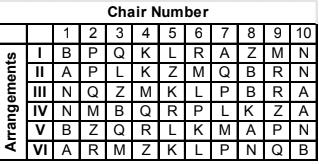 Q. Which of the following persons is wearing a green shirt?
- a)A
- b)K
- c)R
- d)P
Correct answer is option 'B'. Can you explain this answer?
Each of the 10 persons namely A, Q, R, Z, M, N, P, B, K and L are wearing a shirt. The colour of each shirt is one out of blue, green and red. There are ten chairs placed in a row. The chairs are consecutively numbered 1, 2, 3, 4...9 and 10 from left to right in that order. These ten persons have to sit on the chairs such that there is only one person in each chair. The number of persons wearing a green and a blue shirt is 2 and 3 respectively.
Additional Information:
1. No two persons wearing blue shirts sit on consecutively numbered chairs.
2. Among the persons wearing red shirts, exactly three persons always are sitting together while the remaining two never.
3. A person wearing a blue shirt and a person wearing a green shirt never is sitting on consecutively numbered chairs.
4. A person wearing a green shirt cannot sit on chairs numbered 2 or 9.
5. Persons wearing red shirts are not sitting at extreme ends.
1. No two persons wearing blue shirts sit on consecutively numbered chairs.
2. Among the persons wearing red shirts, exactly three persons always are sitting together while the remaining two never.
3. A person wearing a blue shirt and a person wearing a green shirt never is sitting on consecutively numbered chairs.
4. A person wearing a green shirt cannot sit on chairs numbered 2 or 9.
5. Persons wearing red shirts are not sitting at extreme ends.
The following table provides information about the six different seating arrangements namely I, II, III, IV, V and VI of the ten persons done by Mr. Crazy. He observed that out of all the seating arrangements done by him, there is one arrangement that is not consistent with the information stated under "Additional Information".
Q. Which of the following persons is wearing a green shirt?
a)
A
b)
K
c)
R
d)
P
| | Tanishq Sengupta answered |
Let the people who wear a blue, red and green shirt be denoted by b, r and g respectively. Restrictions on the seating arrangement:
1. Two b’s must not be together.
2. Three r’s must be together.
3. A ‘b’ and a ‘g’ must not be together.
4. A ‘g’ cannot sit on a chair numbered 2 or 9.
1. Two b’s must not be together.
2. Three r’s must be together.
3. A ‘b’ and a ‘g’ must not be together.
4. A ‘g’ cannot sit on a chair numbered 2 or 9.
Case I: A person wearing a green shirt is sitting on chair numbered 1. It is only possible if another person wearing a green shirt sits on chair numbered 2, but this violates restriction number 4. Hence, this is also not possible.
Case II: A person wearing a blue shirt sits on chair numbered 1. The six seating arrangements that are possible are as follows.
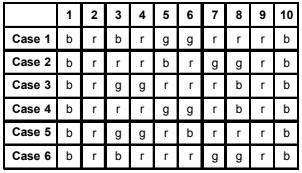
Now, we see that the cases 4, 5 and 6 are just obtained by reversing the cases 1, 2 and 3 respectively. It can be concluded that in any possible seating arrangement, the chairs numbered 1 and 10 are always occupied by people wearing blue shirts. It is given that the number of people wearing a blue shirt is 3. Looking at the table given in the question, we observe that in each of the six arrangements two out of the three different people i.e. A, B and N always sit on chairs numbered 1 and 10.
Hence it can be concluded that the people who wear a blue shirt are A, B and N From the given table the person wearing a blue shirt can never sit on chairs numbered 2, 4, 7 and 9. So, (in arrangement I), A, B and N sitting on chairs numbered 1, 7 and 10 is inconsistent. Also, the people wearing red shirts sit on chairs numbered 2 and 9 and in all the possible arrangements five different people namely P, Q, M, Z and R are sitting on chairs numbered either 2 or 9. Therefore, P, Q, M, Z and R are wearing red shirts and K and L are wearing green shirts. K and L are wearing green shirts. Hence, K is the answer.
Now, we see that the cases 4, 5 and 6 are just obtained by reversing the cases 1, 2 and 3 respectively. It can be concluded that in any possible seating arrangement, the chairs numbered 1 and 10 are always occupied by people wearing blue shirts. It is given that the number of people wearing a blue shirt is 3. Looking at the table given in the question, we observe that in each of the six arrangements two out of the three different people i.e. A, B and N always sit on chairs numbered 1 and 10.
Hence it can be concluded that the people who wear a blue shirt are A, B and N From the given table the person wearing a blue shirt can never sit on chairs numbered 2, 4, 7 and 9. So, (in arrangement I), A, B and N sitting on chairs numbered 1, 7 and 10 is inconsistent. Also, the people wearing red shirts sit on chairs numbered 2 and 9 and in all the possible arrangements five different people namely P, Q, M, Z and R are sitting on chairs numbered either 2 or 9. Therefore, P, Q, M, Z and R are wearing red shirts and K and L are wearing green shirts. K and L are wearing green shirts. Hence, K is the answer.
Chapter doubts & questions for Logic: Deduction and Induction - 3 Months Preparation for GATE Electrical 2026 is part of Electrical Engineering (EE) exam preparation. The chapters have been prepared according to the Electrical Engineering (EE) exam syllabus. The Chapter doubts & questions, notes, tests & MCQs are made for Electrical Engineering (EE) 2026 Exam. Find important definitions, questions, notes, meanings, examples, exercises, MCQs and online tests here.
Chapter doubts & questions of Logic: Deduction and Induction - 3 Months Preparation for GATE Electrical in English & Hindi are available as part of Electrical Engineering (EE) exam. Download more important topics, notes, lectures and mock test series for Electrical Engineering (EE) Exam by signing up for free.
3 Months Preparation for GATE Electrical676 videos|1399 docs|882 tests |
