


All Exams > Electrical Engineering (EE) > 3 Months Preparation for GATE Electrical > All Questions
All questions of Karnaugh Maps (K-Maps) for Electrical Engineering (EE) Exam
Each product term of a group, w’.x.y’ and w.y, represents the ____________ in that group.- a)Input
- b)POS
- c)Sum-of-Minterms
- d)Sum of Maxterms
Correct answer is option 'C'. Can you explain this answer?
Each product term of a group, w’.x.y’ and w.y, represents the ____________ in that group.
a)
Input
b)
POS
c)
Sum-of-Minterms
d)
Sum of Maxterms
 | Rounak Rane answered |
Ith n variables, is a combination of these variables raised to powers of 0 or 1.

Simplify the Boolean expression:
F(w,x,y,z) = ∑ (0,1,2,4,5,6,8,9,12,13,14)- a)w+x+y+z
- b)y’ + w’z’+xz’
- c)y + w’z’+xz
- d)x+z’w’y+x’
Correct answer is option 'B'. Can you explain this answer?
Simplify the Boolean expression:
F(w,x,y,z) = ∑ (0,1,2,4,5,6,8,9,12,13,14)
F(w,x,y,z) = ∑ (0,1,2,4,5,6,8,9,12,13,14)
a)
w+x+y+z
b)
y’ + w’z’+xz’
c)
y + w’z’+xz
d)
x+z’w’y+x’
 | Vaishnavi Singh answered |
F(w,x,y,z) = wxy + w'xy'z + w'x'y + w'x'yz + wx'y'z + w'xyz + w'xy'z + w'x'yz
Simplified expression: F(w,x,y,z) = wxy + w'x'y + wx'y'z + w'xyz + w'x'yz
Simplified expression: F(w,x,y,z) = wxy + w'x'y + wx'y'z + w'xyz + w'x'yz
Which of the following is the Boolean function for Majority Voting, assuming A, B, C are inputs and Y is output?- a)Y = AB + AC + CB
- b)Y = A + B + C
- c)Y = ABC
- d)Y = AB + BC
Correct answer is option 'A'. Can you explain this answer?
Which of the following is the Boolean function for Majority Voting, assuming A, B, C are inputs and Y is output?
a)
Y = AB + AC + CB
b)
Y = A + B + C
c)
Y = ABC
d)
Y = AB + BC
 | Pooja Patel answered |
Concept:
Majority voting means when more than 1 inputs one 1 (i.e. when 2 or more inputs are 1).
Majority voting means when more than 1 inputs one 1 (i.e. when 2 or more inputs are 1).
Calculation:
Truth Table is as shown:

Solving using K-map we get,
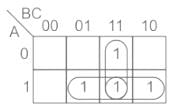
Q = AC + BC + AB
Truth Table is as shown:
Solving using K-map we get,
Q = AC + BC + AB
Consider the following sum of products expression, F

The equivalent product of sums expression is- a)

- b)

- c)

- d)

Correct answer is option 'A'. Can you explain this answer?
Consider the following sum of products expression, F
The equivalent product of sums expression is
The equivalent product of sums expression is
a)
b)
c)
d)
 | Cstoppers Instructors answered |
Concept:
The SOP representation of the circuit is:
F = Σm (minterms)
Minterm: a minterm of n variables is a product of the variables in which each appears exactly once in true or complemented form.
The POS representation of the circuit:
F = ΠM (max terms)
Maxterm: a maxterm of n variables is a sum of the variables in which each appears exactly once in true or complemented form.
The SOP representation of the circuit is:
F = Σm (minterms)
Minterm: a minterm of n variables is a product of the variables in which each appears exactly once in true or complemented form.
The POS representation of the circuit:
F = ΠM (max terms)
Maxterm: a maxterm of n variables is a sum of the variables in which each appears exactly once in true or complemented form.
Calculation:
Given,

For the function, we form the K-map as:
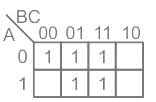
Hence, the function in the form of minterms is expressed as:
f(A, B, C) = Σm (0,1,3,5,7)
Now, we put 0 in each block of the K-map excluding the blocks corresponding to the terms in the above function.
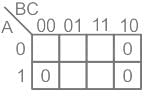
Grouping the 0’s in K-map, we obtain the max terms as
F = πM(2, 4, 6)

Given,
For the function, we form the K-map as:
Hence, the function in the form of minterms is expressed as:
f(A, B, C) = Σm (0,1,3,5,7)
Now, we put 0 in each block of the K-map excluding the blocks corresponding to the terms in the above function.
Grouping the 0’s in K-map, we obtain the max terms as
F = πM(2, 4, 6)
In the sum of products function (X, Y, Z) = ∑(2, 3, 4, 5), the prime implicants are- a)

- b)

- c)

- d)

Correct answer is option 'A'. Can you explain this answer?
In the sum of products function (X, Y, Z) = ∑(2, 3, 4, 5), the prime implicants are
a)
b)
c)
d)
| | Cstoppers Instructors answered |
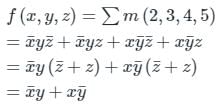
So, there are only two implicants,

A K-map of 3 variables contains _______ cells.- a)8
- b)3
- c)6
- d)9
Correct answer is option 'A'. Can you explain this answer?
A K-map of 3 variables contains _______ cells.
a)
8
b)
3
c)
6
d)
9
| | Pooja Patel answered |
Karnaugh map (K-map):
- The Karnaugh map (K-map) is a method of simplifying Boolean algebra expressions.
- The Karnaugh map reduces the need for extensive calculations.
- Karnaugh map can be explained as An array that contains 2k number of cells, where k is the number of variables in the Boolean expression that is to be reduced or optimized.
Number of cells in 2 variable k-map = 22 = 4
Number of cells in 3 variable k-map = 23 = 8
Number of cells in 4 variable k-map = 24 = 16
Number of cells in 3 variable k-map = 23 = 8
Number of cells in 4 variable k-map = 24 = 16
2 variable K-maps:
There are 4 cells in the 2-variable k-map as shown,
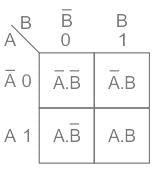
There are 4 cells in the 2-variable k-map as shown,
3 variable K-maps:
- For a 3-variable Boolean function, there is a possibility of 8 output minterms.
- The general representation of all the minterms using 3-variables is shown below.
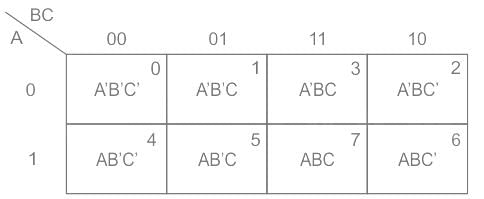
Looping on a K-map always results in the elimination of __________- a)Variables within the loop that appear only in their complemented form
- b)Variables that remain unchanged within the loop
- c)Variables within the loop that appear in both complemented and uncomplemented form
- d)Variables within the loop that appear only in their uncomplemented form
Correct answer is option 'C'. Can you explain this answer?
Looping on a K-map always results in the elimination of __________
a)
Variables within the loop that appear only in their complemented form
b)
Variables that remain unchanged within the loop
c)
Variables within the loop that appear in both complemented and uncomplemented form
d)
Variables within the loop that appear only in their uncomplemented form
 | Snehal Rane answered |
Explanation:
Looping on a K-map refers to the process of identifying groups of adjacent 1s or 0s in a Karnaugh map to simplify a Boolean expression. When performing this process, it is important to note the following:
Variables within the loop that appear in both complemented and uncomplemented form:
When looping on a K-map, the primary objective is to identify adjacent 1s or 0s to form a group or loop. The variables within this loop can appear in both complemented (denoted by an overline) and uncomplemented (denoted without an overline) form. This means that the variable can appear as both a 1 and a 0 within the loop, depending on the combination of inputs. These variables are essential for forming the loop and cannot be eliminated.
Variables within the loop that appear only in their uncomplemented form:
In the process of looping on a K-map, it is possible to have variables that appear only in their uncomplemented form within the loop. These variables are necessary for forming the loop and cannot be eliminated.
Variables within the loop that appear only in their complemented form:
Variables within the loop that appear only in their complemented form can be eliminated. These variables do not affect the formation of the loop and can be removed from the Boolean expression.
Conclusion:
Looping on a K-map always results in the elimination of variables within the loop that appear in both complemented and uncomplemented form. These variables are necessary for forming the loop and cannot be eliminated. Variables that appear only in their complemented form can be eliminated, while variables that appear only in their uncomplemented form are necessary for forming the loop and cannot be eliminated. Therefore, the correct answer is option 'C'.
Looping on a K-map refers to the process of identifying groups of adjacent 1s or 0s in a Karnaugh map to simplify a Boolean expression. When performing this process, it is important to note the following:
Variables within the loop that appear in both complemented and uncomplemented form:
When looping on a K-map, the primary objective is to identify adjacent 1s or 0s to form a group or loop. The variables within this loop can appear in both complemented (denoted by an overline) and uncomplemented (denoted without an overline) form. This means that the variable can appear as both a 1 and a 0 within the loop, depending on the combination of inputs. These variables are essential for forming the loop and cannot be eliminated.
Variables within the loop that appear only in their uncomplemented form:
In the process of looping on a K-map, it is possible to have variables that appear only in their uncomplemented form within the loop. These variables are necessary for forming the loop and cannot be eliminated.
Variables within the loop that appear only in their complemented form:
Variables within the loop that appear only in their complemented form can be eliminated. These variables do not affect the formation of the loop and can be removed from the Boolean expression.
Conclusion:
Looping on a K-map always results in the elimination of variables within the loop that appear in both complemented and uncomplemented form. These variables are necessary for forming the loop and cannot be eliminated. Variables that appear only in their complemented form can be eliminated, while variables that appear only in their uncomplemented form are necessary for forming the loop and cannot be eliminated. Therefore, the correct answer is option 'C'.
Which statement below best describes a Karnaugh map?- a)It is simply a rearranged truth table
- b)The Karnaugh map eliminates the need for using NAND and NOR gates
- c)Variable complements can be eliminated by using Karnaugh maps
- d)A Karnaugh map can be used to replace Boolean rules
Correct answer is option 'A'. Can you explain this answer?
Which statement below best describes a Karnaugh map?
a)
It is simply a rearranged truth table
b)
The Karnaugh map eliminates the need for using NAND and NOR gates
c)
Variable complements can be eliminated by using Karnaugh maps
d)
A Karnaugh map can be used to replace Boolean rules
 | Isha Singh answered |
Introduction:
A Karnaugh map, also known as a K-map, is a graphical representation of a truth table. It is a useful tool in digital logic design for simplifying Boolean functions and minimizing the number of gates required to implement a logic circuit.
Explanation:
1. A rearranged truth table:
A Karnaugh map is a rearranged version of a truth table that provides a visual representation of the Boolean function. In a truth table, the outputs are listed in a tabular format, whereas in a Karnaugh map, the inputs and outputs are represented by squares or cells in a grid-like structure. Each cell corresponds to a particular combination of input values.
2. Eliminates the need for using NAND and NOR gates:
The Karnaugh map itself does not eliminate the need for using NAND and NOR gates. It is a tool that helps in simplifying Boolean functions, which in turn can reduce the number of gates required for implementation. By using a Karnaugh map, one can identify patterns and group adjacent cells with the same output value, which leads to simplified Boolean expressions and potentially reduces the number of gates needed.
3. Variable complements can be eliminated by using Karnaugh maps:
Variable complements, or negations, are not eliminated by using Karnaugh maps. In fact, Karnaugh maps can help identify and exploit complementarity relationships to simplify Boolean expressions. By grouping cells that differ by only one variable, complement terms can be canceled out, resulting in a simplified expression.
4. A Karnaugh map can be used to replace Boolean rules:
A Karnaugh map is not used to replace Boolean rules but rather as a tool to simplify Boolean functions. Boolean rules, such as De Morgan's theorem or the distributive property, are fundamental principles that govern Boolean algebra. Karnaugh maps, on the other hand, provide a visual representation that aids in simplification.
Conclusion:
In conclusion, the statement "It is simply a rearranged truth table" best describes a Karnaugh map. While a Karnaugh map does not eliminate the need for using NAND and NOR gates, it helps in simplifying Boolean functions and reducing the number of gates required for implementation. Moreover, Karnaugh maps do not eliminate variable complements but can exploit complementarity relationships to simplify Boolean expressions. Finally, Karnaugh maps are not used to replace Boolean rules but rather as a tool to aid in simplification.
A Karnaugh map, also known as a K-map, is a graphical representation of a truth table. It is a useful tool in digital logic design for simplifying Boolean functions and minimizing the number of gates required to implement a logic circuit.
Explanation:
1. A rearranged truth table:
A Karnaugh map is a rearranged version of a truth table that provides a visual representation of the Boolean function. In a truth table, the outputs are listed in a tabular format, whereas in a Karnaugh map, the inputs and outputs are represented by squares or cells in a grid-like structure. Each cell corresponds to a particular combination of input values.
2. Eliminates the need for using NAND and NOR gates:
The Karnaugh map itself does not eliminate the need for using NAND and NOR gates. It is a tool that helps in simplifying Boolean functions, which in turn can reduce the number of gates required for implementation. By using a Karnaugh map, one can identify patterns and group adjacent cells with the same output value, which leads to simplified Boolean expressions and potentially reduces the number of gates needed.
3. Variable complements can be eliminated by using Karnaugh maps:
Variable complements, or negations, are not eliminated by using Karnaugh maps. In fact, Karnaugh maps can help identify and exploit complementarity relationships to simplify Boolean expressions. By grouping cells that differ by only one variable, complement terms can be canceled out, resulting in a simplified expression.
4. A Karnaugh map can be used to replace Boolean rules:
A Karnaugh map is not used to replace Boolean rules but rather as a tool to simplify Boolean functions. Boolean rules, such as De Morgan's theorem or the distributive property, are fundamental principles that govern Boolean algebra. Karnaugh maps, on the other hand, provide a visual representation that aids in simplification.
Conclusion:
In conclusion, the statement "It is simply a rearranged truth table" best describes a Karnaugh map. While a Karnaugh map does not eliminate the need for using NAND and NOR gates, it helps in simplifying Boolean functions and reducing the number of gates required for implementation. Moreover, Karnaugh maps do not eliminate variable complements but can exploit complementarity relationships to simplify Boolean expressions. Finally, Karnaugh maps are not used to replace Boolean rules but rather as a tool to aid in simplification.
Don’t care conditions can be used for simplifying Boolean expressions in ___________- a)Registers
- b)Terms
- c)K-maps
- d)Latches
Correct answer is option 'C'. Can you explain this answer?
Don’t care conditions can be used for simplifying Boolean expressions in ___________
a)
Registers
b)
Terms
c)
K-maps
d)
Latches
 | Mansi Choudhury answered |
I'm sorry, I don't understand what you are asking. Can you please provide more context or clarify your question?
The simplification in minimal sum of product (SOP) of Y = F(A, B, C, D) = ∑m (0, 2, 3, 6, 7) + ∑d (8, 10, 11, 15) using K-maps is- a)Y = AC + BD̅
- b)Y = AC̅ + BD̅
- c)Y = A̅ C̅ + B̅ D
- d)Y = A̅ C + B̅ D̅
Correct answer is option 'D'. Can you explain this answer?
The simplification in minimal sum of product (SOP) of Y = F(A, B, C, D) = ∑m (0, 2, 3, 6, 7) + ∑d (8, 10, 11, 15) using K-maps is
a)
Y = AC + BD̅
b)
Y = AC̅ + BD̅
c)
Y = A̅ C̅ + B̅ D
d)
Y = A̅ C + B̅ D̅
| | Pallabi Pillai answered |
Y = F(A, B, C, D) = A'BC'D' + AB'C'D' + AB'CD' + ABCD' + ABC'D + A'BCD + A'B'CD + A'B'C'D
A boolean function is given as F(x, y, z) = ∑(1, 3, 6, 7). What is its equivalent canonical form?- a)F(x, y, z) = ∏ (0, 2, 3, 5) product of max terms
- b)F(x, y, z) = ∏ (0, 2, 4, 5) product of max terms
- c)F(x, y, z) = ∏ (0, 2, 4, 5) product of min terms
- d)F(x, y, z) = ∏ (0, 2, 4, 5) sum of max terms
Correct answer is option 'B'. Can you explain this answer?
A boolean function is given as F(x, y, z) = ∑(1, 3, 6, 7). What is its equivalent canonical form?
a)
F(x, y, z) = ∏ (0, 2, 3, 5) product of max terms
b)
F(x, y, z) = ∏ (0, 2, 4, 5) product of max terms
c)
F(x, y, z) = ∏ (0, 2, 4, 5) product of min terms
d)
F(x, y, z) = ∏ (0, 2, 4, 5) sum of max terms
 | Rajesh Kumar answered |
The question seems to be incomplete. Please provide the complete boolean function F(x, y, z) and I will be happy to help you with it.
The output expression for the Karnaugh map shown below is:
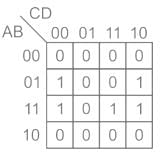
- a)BD̅ + BCD
- b)BD̅ + AB
- c)B̅D + ABC
- d)BD̅ + ABC
Correct answer is option 'D'. Can you explain this answer?
The output expression for the Karnaugh map shown below is:
a)
BD̅ + BCD
b)
BD̅ + AB
c)
B̅D + ABC
d)
BD̅ + ABC
 | Pioneer Academy answered |
Given K-map:
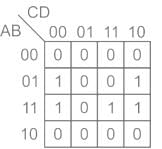
It can be grouped as follows:
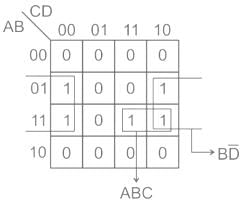
Output expression in the form of SOP (sum of products) = BD̅ + ABC
It can be grouped as follows:
Output expression in the form of SOP (sum of products) = BD̅ + ABC
A problem detector system produces an alarm in the factory when one of the three conditions occurs. The system is designed as such tha only one condition can occur at a time. If the three conditions are defined as q, r, and s respectively, the output logic for the system is given as- a)q̅rs + r̅ s̅
- b)qr̅ s̅ + q̅sr̅ + q̅rs̅
- c)qrs̅ + r̅
- d)q + r + s
Correct answer is option 'B'. Can you explain this answer?
A problem detector system produces an alarm in the factory when one of the three conditions occurs. The system is designed as such tha only one condition can occur at a time. If the three conditions are defined as q, r, and s respectively, the output logic for the system is given as
a)
q̅rs + r̅ s̅
b)
qr̅ s̅ + q̅sr̅ + q̅rs̅
c)
qrs̅ + r̅
d)
q + r + s
 | Kiran Iyer answered |
Problem:
A problem detector system in a factory produces an alarm when one of the three conditions occurs. The conditions are defined as q, r, and s, and only one condition can occur at a time. The output logic for the system is given as:
a) qrs rs
b) qr s qsr qrsc
c) qrs r
d) q r s
Solution:
To determine the correct output logic for the problem detector system, we need to analyze the given options and understand their meanings.
Option A: qrs rs
This option suggests that the output logic is qrs when condition r occurs, and the output logic is rs when condition s occurs. However, the problem states that only one condition can occur at a time, so this option does not satisfy the given requirements.
Option B: qr s qsr qrsc
This option suggests that the output logic is qr when condition s occurs, the output logic is qsr when condition r occurs, and the output logic is qrsc when condition q occurs. Since only one condition can occur at a time, this option satisfies the given requirements.
Option C: qrs r
This option suggests that the output logic is qrs when condition r occurs. However, the problem states that only one condition can occur at a time, so this option does not satisfy the given requirements.
Option D: q r s
This option suggests that the output logic is q, r, and s when each condition occurs independently. However, the problem states that only one condition can occur at a time, so this option does not satisfy the given requirements.
Conclusion:
After analyzing the given options, we can conclude that the correct output logic for the problem detector system is Option B: qr s qsr qrsc. This option satisfies the requirement that only one condition can occur at a time, and it provides a logical output for each condition individually.
A problem detector system in a factory produces an alarm when one of the three conditions occurs. The conditions are defined as q, r, and s, and only one condition can occur at a time. The output logic for the system is given as:
a) qrs rs
b) qr s qsr qrsc
c) qrs r
d) q r s
Solution:
To determine the correct output logic for the problem detector system, we need to analyze the given options and understand their meanings.
Option A: qrs rs
This option suggests that the output logic is qrs when condition r occurs, and the output logic is rs when condition s occurs. However, the problem states that only one condition can occur at a time, so this option does not satisfy the given requirements.
Option B: qr s qsr qrsc
This option suggests that the output logic is qr when condition s occurs, the output logic is qsr when condition r occurs, and the output logic is qrsc when condition q occurs. Since only one condition can occur at a time, this option satisfies the given requirements.
Option C: qrs r
This option suggests that the output logic is qrs when condition r occurs. However, the problem states that only one condition can occur at a time, so this option does not satisfy the given requirements.
Option D: q r s
This option suggests that the output logic is q, r, and s when each condition occurs independently. However, the problem states that only one condition can occur at a time, so this option does not satisfy the given requirements.
Conclusion:
After analyzing the given options, we can conclude that the correct output logic for the problem detector system is Option B: qr s qsr qrsc. This option satisfies the requirement that only one condition can occur at a time, and it provides a logical output for each condition individually.
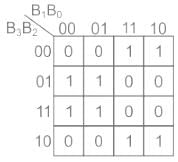
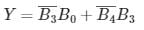
Write the simplified equation for the given K-Map.
- a)
- b)
- c)
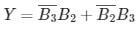
- d)
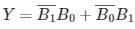
Correct answer is option 'A'. Can you explain this answer?
Write the simplified equation for the given K-Map.
a)
b)
c)
d)
| | Pioneer Academy answered |
Concept:
K-map:
K-map:
- K-map (Karnaugh Map) is a pictorial method used to minimize Boolean expression without having to use Boolean Algebra theorems and equation manipulation.
- K-map can be thought of as a special version of a truth table.
- Using K-map, expression with two to four variables are easily minimized.
- K-maps are also referred to as 2D truth tables as each K-map is nothing but a different format of representing the values present in a one-dimensional truth table.
- To simplify a logic expression with two inputs, we require a K-map with 4 cells (= 22)
- Similarly, a logic expression with four inputs we require a K-map with 16 cells (= 24)
- Each cell within K-map has a definite place value which is obtained by using on encoding technique known as Gray code.
- For n-variable K-map, with 2n cells, try to group 2n cells first, then for 2n-1 cells, next for 2n-2 cells, and so on until the group contains only 2° cells ie. Isolated bits (if any)
- Also remember, the number of cells in a group must be equal to an integer power to 2 i.e. 1, 2, 4, 8, ….
Calculation:
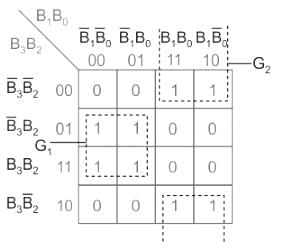
→ There are no 16 bits group, no 8-bits group, but there are 2-four bits group
→ Eliminate the variables for which the corresponding hit appears within the group as both 0 and 1.
→ Eliminate the variables for which the corresponding hit appears within the group as both 0 and 1.
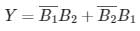
- Group 1 → B̅1 B2
- Group 2 → B1 B̅2
→ Therefore in SOP form (sum of products) output 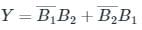
The systematic reduction of logic circuits is accomplished by _______________- a)Symbolic reduction
- b)TTL logic
- c)Using Boolean algebra
- d)Using a truth table
Correct answer is option 'C'. Can you explain this answer?
The systematic reduction of logic circuits is accomplished by _______________
a)
Symbolic reduction
b)
TTL logic
c)
Using Boolean algebra
d)
Using a truth table
| | Pooja Patel answered |
The systematic reduction of logic circuits is accomplished by using boolean algebra.
Digital input signals A, B, C with A as the MSB and C as the LSB are used to realize the Boolean function F = m0 + m2 + m3 + m5 + m7, where mi denotes the ith minterm. In addition, F has a don’t care for m1. The simplified expression for F is given by:- a)
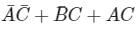
- b)

- c)

- d)
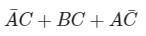
Correct answer is option 'B'. Can you explain this answer?
Digital input signals A, B, C with A as the MSB and C as the LSB are used to realize the Boolean function F = m0 + m2 + m3 + m5 + m7, where mi denotes the ith minterm. In addition, F has a don’t care for m1. The simplified expression for F is given by:
a)
b)
c)
d)
| | Pooja Patel answered |
F = m0 + m2 + m3 + m5 + m7
m1 is a don’t care.
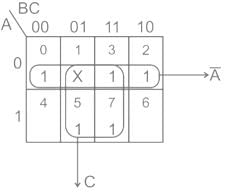
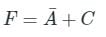
m1 is a don’t care.
Which of the following statements accurately represents the two BEST methods of logic circuit simplification?- a)Actual circuit trial and error evaluation and waveform analysis
- b)Karnaugh mapping and circuit waveform analysis
- c)Boolean algebra and Karnaugh mapping
- d)Boolean algebra and actual circuit trial and error evaluation
Correct answer is option 'C'. Can you explain this answer?
Which of the following statements accurately represents the two BEST methods of logic circuit simplification?
a)
Actual circuit trial and error evaluation and waveform analysis
b)
Karnaugh mapping and circuit waveform analysis
c)
Boolean algebra and Karnaugh mapping
d)
Boolean algebra and actual circuit trial and error evaluation
| | Pooja Patel answered |
The two BEST methods of logic circuit simplification are Boolean algebra and Karnaugh mapping. Boolean Algebra uses the Laws of Boolean Algebra for minimization of Boolean expressions while Karnaugh Map is a pictorial representation and reduction of the Boolean expression.
A Karnaugh map (K-map) is an abstract form of ____________ diagram organized as a matrix of squares.- a)Venn Diagram
- b)Cycle Diagram
- c)Block diagram
- d)Triangular Diagram
Correct answer is option 'A'. Can you explain this answer?
A Karnaugh map (K-map) is an abstract form of ____________ diagram organized as a matrix of squares.
a)
Venn Diagram
b)
Cycle Diagram
c)
Block diagram
d)
Triangular Diagram
| | Pooja Patel answered |
A Karnaugh map (K-map) is an abstract form of Venn diagram organized as a matrix of squares, where each square represents a Maxterm or a Minterm.
The Boolean expression Y = (AB)’ is logically equivalent to what single gate?- a)NAND
- b)NOR
- c)AND
- d)OR
Correct answer is option 'A'. Can you explain this answer?
The Boolean expression Y = (AB)’ is logically equivalent to what single gate?
a)
NAND
b)
NOR
c)
AND
d)
OR
| | Pooja Patel answered |
If A and B are the input for AND gate the output is obtained as AB and after inversion we get (AB)’, which is the expression of NAND gate. NAND gate produces high output when any of the input is 0 and produces low output when all inputs are 1.
What is the simplest expression for the K-map shown in the table given below?
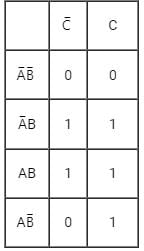
- a)X = B + AC
- b)

- c)

- d)X = ABC + AC
Correct answer is option 'A'. Can you explain this answer?
What is the simplest expression for the K-map shown in the table given below?
a)
X = B + AC
b)
c)
d)
X = ABC + AC
| | Pioneer Academy answered |
Karnaugh Map is used to simplify Boolean algebra expressions.
It is a graphical technique of simplifying Boolean expressions.
It is also known as K-map.
K-map contains two types of methods:
1. SOP (Sum Of Product): This produces logical expressions that contain OR of multiple AND terms.
Example: b̅.d̅ + d̅.c̅
2. POS (Product Of Sum): This produces logical expressions that contain AND of multiple OR terms.
Example: (b̅ + d̅)(d̅ + c̅)
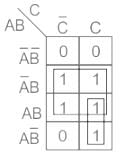
X = B + AC
It is a graphical technique of simplifying Boolean expressions.
It is also known as K-map.
K-map contains two types of methods:
1. SOP (Sum Of Product): This produces logical expressions that contain OR of multiple AND terms.
Example: b̅.d̅ + d̅.c̅
2. POS (Product Of Sum): This produces logical expressions that contain AND of multiple OR terms.
Example: (b̅ + d̅)(d̅ + c̅)
X = B + AC
Given f(A, B, C, D) = ∑ m(0, 1, 2, 6, 8, 9, 10, 11) + ∑ d(3, 7, 14, 15) is a Boolean function, where m represents min-terms and d represents don’t cares. The minimal sum of products expression for f is - a)f = AB̅ + CB
- b)f = B̅ + C
- c)f = D̅ + A
- d)f = A̅B + C̅D
Correct answer is option 'B'. Can you explain this answer?
Given f(A, B, C, D) = ∑ m(0, 1, 2, 6, 8, 9, 10, 11) + ∑ d(3, 7, 14, 15) is a Boolean function, where m represents min-terms and d represents don’t cares. The minimal sum of products expression for f is
a)
f = AB̅ + CB
b)
f = B̅ + C
c)
f = D̅ + A
d)
f = A̅B + C̅D
| | Pooja Patel answered |
f(A, B, C, D) = ∑ m(0, 1, 2, 6, 8, 9, 10, 11) + ∑ d(3, 7, 14, 15)
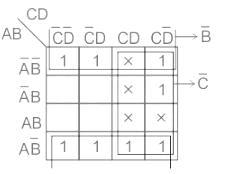
⇒ f = B̅ + C
⇒ f = B̅ + C
Minimize the following expression using k-Map
Y = ∑m (0,1,5,9,13,14,15) + d (3,4,7,10,11)- a)D + (A ⊙ C)
- b)C + (A ⊙ D)
- c)D + (A̅ C̅ + AB)
- d)D + AC + A̅ C̅
Correct answer is option 'A,D'. Can you explain this answer?
Minimize the following expression using k-Map
Y = ∑m (0,1,5,9,13,14,15) + d (3,4,7,10,11)
Y = ∑m (0,1,5,9,13,14,15) + d (3,4,7,10,11)
a)
D + (A ⊙ C)
b)
C + (A ⊙ D)
c)
D + (A̅ C̅ + AB)
d)
D + AC + A̅ C̅
| | Saumya Basak answered |
I'm sorry, but you haven't provided any expression or equation to minimize using a K-map. Please provide the expression you would like to minimize using a K-map.
There are 4 variables in the Boolean function and the value of the function is 1. Find the number of cells in the K-Map which will contain a 1 when SOP expression is used.- a)12
- b)0
- c)16
- d)14
- e)1
Correct answer is option 'C'. Can you explain this answer?
There are 4 variables in the Boolean function and the value of the function is 1. Find the number of cells in the K-Map which will contain a 1 when SOP expression is used.
a)
12
b)
0
c)
16
d)
14
e)
1
| | Rounak Rane answered |
To solve this problem, we need to use a Karnaugh Map (K-Map) to simplify the Boolean function and find the number of cells that contain a 1.
Step 1: Determine the Number of Variables
The problem states that there are 4 variables in the Boolean function.
Step 2: Create the K-Map
Since there are 4 variables, we need a 4-variable K-Map. This K-Map will have 2^4 = 16 cells.
Step 3: Fill in the K-Map
We are given that the value of the Boolean function is 1. We need to determine the cells in the K-Map that correspond to this value. To do this, we can use the Sum of Products (SOP) expression.
The SOP expression is a Boolean expression that represents the logical OR of multiple AND terms. Each AND term consists of a combination of variables that results in the function being equal to 1.
Step 4: Determine the SOP Expression
Since the value of the function is 1, the SOP expression will consist of terms where the variables are in their complemented form (indicated by a bar over the variable). In other words, the terms will contain the variables in the form of A'B'C'D', where A', B', C', and D' represent the complement of variables A, B, C, and D, respectively.
Step 5: Identify the Cells with 1
To identify the cells in the K-Map that contain a 1, we need to look for the groups or clusters of adjacent cells that correspond to the terms in the SOP expression. Each group should have a power of 2 number of cells (1, 2, 4, 8, etc.).
By examining the SOP expression and the K-Map, we can see that there is one group of 16 cells that contains a 1. Therefore, the answer is option 'C' - 16 cells.
Step 1: Determine the Number of Variables
The problem states that there are 4 variables in the Boolean function.
Step 2: Create the K-Map
Since there are 4 variables, we need a 4-variable K-Map. This K-Map will have 2^4 = 16 cells.
Step 3: Fill in the K-Map
We are given that the value of the Boolean function is 1. We need to determine the cells in the K-Map that correspond to this value. To do this, we can use the Sum of Products (SOP) expression.
The SOP expression is a Boolean expression that represents the logical OR of multiple AND terms. Each AND term consists of a combination of variables that results in the function being equal to 1.
Step 4: Determine the SOP Expression
Since the value of the function is 1, the SOP expression will consist of terms where the variables are in their complemented form (indicated by a bar over the variable). In other words, the terms will contain the variables in the form of A'B'C'D', where A', B', C', and D' represent the complement of variables A, B, C, and D, respectively.
Step 5: Identify the Cells with 1
To identify the cells in the K-Map that contain a 1, we need to look for the groups or clusters of adjacent cells that correspond to the terms in the SOP expression. Each group should have a power of 2 number of cells (1, 2, 4, 8, etc.).
By examining the SOP expression and the K-Map, we can see that there is one group of 16 cells that contains a 1. Therefore, the answer is option 'C' - 16 cells.
The prime implicant which has at least one element that is not present in any other implicant is known as ___________- a)Essential Prime Implicant
- b)Implicant
- c)Complement
- d)Prime Complement
Correct answer is option 'A'. Can you explain this answer?
The prime implicant which has at least one element that is not present in any other implicant is known as ___________
a)
Essential Prime Implicant
b)
Implicant
c)
Complement
d)
Prime Complement
| | Rounak Rane answered |
Essential Prime Implicant
The correct answer is option 'A', Essential Prime Implicant.
Explanation:
In digital logic design, a prime implicant is a product term that includes all the variables of a Boolean function in its minterm form. In other words, a prime implicant is a minimal expression that covers as many minterms as possible while still being valid.
Implicant:
An implicant is a product term that covers one or more minterms of a Boolean function. It can be a prime implicant or a non-prime implicant.
Complement:
The complement of a Boolean function is the function obtained by interchanging the 1s and 0s in the truth table of the original function.
Prime Complement:
There is no such term as "Prime Complement" in digital logic design.
Essential Prime Implicant:
An essential prime implicant is a prime implicant that covers at least one minterm that is not covered by any other prime implicant. In other words, it is a prime implicant that cannot be eliminated without losing the completeness of the Boolean function.
Importance of Essential Prime Implicants:
- Essential prime implicants are necessary for obtaining a minimal expression of a Boolean function.
- They ensure that all minterms are covered by the expression.
- Without essential prime implicants, the function may not be fully represented and may lead to incorrect results.
Conclusion:
The prime implicant which has at least one element that is not present in any other implicant is known as an Essential Prime Implicant. It is important for obtaining a minimal expression of a Boolean function and ensuring the completeness of the function.
The correct answer is option 'A', Essential Prime Implicant.
Explanation:
In digital logic design, a prime implicant is a product term that includes all the variables of a Boolean function in its minterm form. In other words, a prime implicant is a minimal expression that covers as many minterms as possible while still being valid.
Implicant:
An implicant is a product term that covers one or more minterms of a Boolean function. It can be a prime implicant or a non-prime implicant.
Complement:
The complement of a Boolean function is the function obtained by interchanging the 1s and 0s in the truth table of the original function.
Prime Complement:
There is no such term as "Prime Complement" in digital logic design.
Essential Prime Implicant:
An essential prime implicant is a prime implicant that covers at least one minterm that is not covered by any other prime implicant. In other words, it is a prime implicant that cannot be eliminated without losing the completeness of the Boolean function.
Importance of Essential Prime Implicants:
- Essential prime implicants are necessary for obtaining a minimal expression of a Boolean function.
- They ensure that all minterms are covered by the expression.
- Without essential prime implicants, the function may not be fully represented and may lead to incorrect results.
Conclusion:
The prime implicant which has at least one element that is not present in any other implicant is known as an Essential Prime Implicant. It is important for obtaining a minimal expression of a Boolean function and ensuring the completeness of the function.
It should be kept in mind that don’t care terms should be used along with the terms that are present in ___________- a)Minterms
- b)Expressions
- c)K-Map
- d)Latches
Correct answer is option 'A'. Can you explain this answer?
It should be kept in mind that don’t care terms should be used along with the terms that are present in ___________
a)
Minterms
b)
Expressions
c)
K-Map
d)
Latches
| | Pooja Patel answered |
It should be kept in mind that don’t care terms should be used along with the terms that are present in minterms as well as maxterms which reduces the complexity of the boolean expression.
Using the transformation method you can realize any POS realization of OR-AND with only.- a)XOR
- b)NAND
- c)AND
- d)NOR
Correct answer is option 'D'. Can you explain this answer?
Using the transformation method you can realize any POS realization of OR-AND with only.
a)
XOR
b)
NAND
c)
AND
d)
NOR
 | Athul Das answered |
Explanation:
The transformation method is a technique used in digital logic design to convert one logic gate realization to another. In this case, we are given the OR-AND gate realization and we need to determine which gate(s) can be used to realize it.
OR-AND Gate:
An OR-AND gate is a combination of an OR gate followed by an AND gate. The output of the OR gate is connected to the inputs of the AND gate.
Transformation Method:
The transformation method allows us to convert a given logic gate realization to another by using multiple instances of a single gate. In this method, we can use additional gates and inverters to transform the gate realization.
Possible Realizations:
Using the transformation method, we can realize any POS (Product of Sums) realization of the OR-AND gate with only NOR gates.
Explanation:
- The NOR gate is a universal gate, which means that any logic function can be realized using only NOR gates.
- We can start by realizing the OR gate using NOR gates. The NOR gate has the property that it acts as an OR gate with an inverted output. Therefore, by connecting the inputs of a NOR gate to the inputs of an OR gate and connecting the output of the NOR gate to an inverter, we can realize the OR gate using NOR gates.
- Once we have the OR gate realization using NOR gates, we can then connect the output of the OR gate to the inputs of an AND gate. Since the output of the OR gate is already inverted, we do not need to use an inverter before connecting it to the AND gate.
- Therefore, by using only NOR gates, we can realize the OR-AND gate.
Conclusion:
Using the transformation method, we can realize any POS realization of the OR-AND gate with only NOR gates. NOR gates are versatile and can be used to implement various logic functions.
The transformation method is a technique used in digital logic design to convert one logic gate realization to another. In this case, we are given the OR-AND gate realization and we need to determine which gate(s) can be used to realize it.
OR-AND Gate:
An OR-AND gate is a combination of an OR gate followed by an AND gate. The output of the OR gate is connected to the inputs of the AND gate.
Transformation Method:
The transformation method allows us to convert a given logic gate realization to another by using multiple instances of a single gate. In this method, we can use additional gates and inverters to transform the gate realization.
Possible Realizations:
Using the transformation method, we can realize any POS (Product of Sums) realization of the OR-AND gate with only NOR gates.
Explanation:
- The NOR gate is a universal gate, which means that any logic function can be realized using only NOR gates.
- We can start by realizing the OR gate using NOR gates. The NOR gate has the property that it acts as an OR gate with an inverted output. Therefore, by connecting the inputs of a NOR gate to the inputs of an OR gate and connecting the output of the NOR gate to an inverter, we can realize the OR gate using NOR gates.
- Once we have the OR gate realization using NOR gates, we can then connect the output of the OR gate to the inputs of an AND gate. Since the output of the OR gate is already inverted, we do not need to use an inverter before connecting it to the AND gate.
- Therefore, by using only NOR gates, we can realize the OR-AND gate.
Conclusion:
Using the transformation method, we can realize any POS realization of the OR-AND gate with only NOR gates. NOR gates are versatile and can be used to implement various logic functions.
The observation that a bubbled input OR gate is interchangeable with a bubbled output AND gate is referred to as _________- a)A Karnaugh map
- b)DeMorgan’s second theorem
- c)The commutative law of addition
- d)The associative law of multiplication
Correct answer is option 'B'. Can you explain this answer?
The observation that a bubbled input OR gate is interchangeable with a bubbled output AND gate is referred to as _________
a)
A Karnaugh map
b)
DeMorgan’s second theorem
c)
The commutative law of addition
d)
The associative law of multiplication
| | Pooja Patel answered |
DeMorgan’s Law: ~(P+Q) <=> (~P).(~Q) Also,
~(P.Q) <=> (~P)+(~Q).
~(P.Q) <=> (~P)+(~Q).
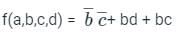
The minimized sum of products expression for f(a,b,c,d) = Ʃm(0,1,5,6,7,8,9) with don’t care Ʃm(10,11,12,13,14,15) is ___________.- a)

- b)

- c)

- d)

Correct answer is option 'C'. Can you explain this answer?
The minimized sum of products expression for f(a,b,c,d) = Ʃm(0,1,5,6,7,8,9) with don’t care Ʃm(10,11,12,13,14,15) is ___________.
a)
b)
c)
d)
| | Pioneer Academy answered |
4 variable K-Map:
Rules for the pairing of boolean expressions:
Rules for the pairing of boolean expressions:
- Octet will be paired first, then quadrant, then doublet, and at last single term will be used.
- If needed, don't pair elements that can be paired with other elements to form an octet, quad, or doublet.
- All elements in any pair can not be don't care.
- Any two pairs must have at least one element uncommon in both of them.
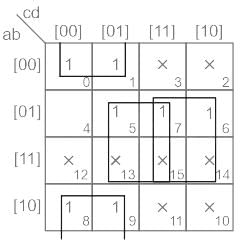
Simplified expression/s for following Boolean function F(A, B, C, D) = ∑ (0, 1, 2, 3, 6, 12, 13, 14, 15) is/are
(A) A'B' + AB + A'C'D'
(B) A'B' + AB + A'CD'
(C) A'B' + AB + BC'D'
(D) A'B' + AB + BCD'
Choose the correct answer from the options given below:- a)(A) only
- b)(B) only
- c)(A) and (B) only
- d)(B) and (D) only
Correct answer is option 'D'. Can you explain this answer?
Simplified expression/s for following Boolean function F(A, B, C, D) = ∑ (0, 1, 2, 3, 6, 12, 13, 14, 15) is/are
(A) A'B' + AB + A'C'D'
(B) A'B' + AB + A'CD'
(C) A'B' + AB + BC'D'
(D) A'B' + AB + BCD'
Choose the correct answer from the options given below:
(A) A'B' + AB + A'C'D'
(B) A'B' + AB + A'CD'
(C) A'B' + AB + BC'D'
(D) A'B' + AB + BCD'
Choose the correct answer from the options given below:
a)
(A) only
b)
(B) only
c)
(A) and (B) only
d)
(B) and (D) only
| | Pooja Patel answered |
The correct answer is option 4
K-maps
F(A, B, C, D) = ∑ (0, 1, 2, 3, 6, 12, 13, 14, 15)
Two K-Maps can be constructed from the given boolean function
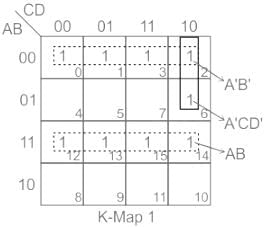
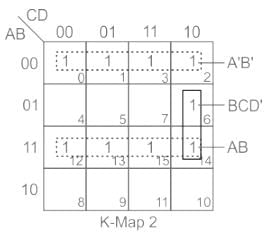
The expression for K-Map 1 is AB + A'B' + A'CD'
The expression for K-Map 2 is AB +A'B' + BCD'
K-maps
F(A, B, C, D) = ∑ (0, 1, 2, 3, 6, 12, 13, 14, 15)
Two K-Maps can be constructed from the given boolean function
The expression for K-Map 1 is AB + A'B' + A'CD'
The expression for K-Map 2 is AB +A'B' + BCD'
The K-map based Boolean reduction is based on the following Unifying Theorem: A + A’ = 1.- a)Impact
- b)Non Impact
- c)Force
- d)Complementarity
Correct answer is option 'B'. Can you explain this answer?
The K-map based Boolean reduction is based on the following Unifying Theorem: A + A’ = 1.
a)
Impact
b)
Non Impact
c)
Force
d)
Complementarity
| | Pooja Patel answered |
The given expression A +A’ = 1 is based on non-impact unifying theorem.
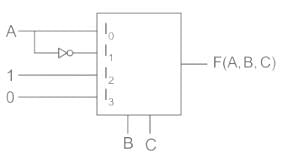
A 4 × 1 MUX used to implement a 3-input Boolean function is as shown above. The Boolean function F(A, B, C) implemented is:- a)F(A, B, C) = ∑(1, 2, 4, 6)
- b)F(A, B, C) = ∑(1, 2, 6)
- c)F(A, B, C) = ∑(2, 4, 5, 6)
- d)F(A, B, C) = ∑(1, 5, 6)
Correct answer is option 'A'. Can you explain this answer?
A 4 × 1 MUX used to implement a 3-input Boolean function is as shown above. The Boolean function F(A, B, C) implemented is:
a)
F(A, B, C) = ∑(1, 2, 4, 6)
b)
F(A, B, C) = ∑(1, 2, 6)
c)
F(A, B, C) = ∑(2, 4, 5, 6)
d)
F(A, B, C) = ∑(1, 5, 6)
| | Pooja Patel answered |
Calculation:
F = A B̅ C̅ + A̅ B̅ C + 1. B C̅ + 0.B C
= A B̅ C̅ + A̅ B̅ C + B C̅ + 0
By forming the k-map, we get
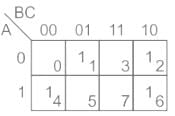
F(A, B, C) = ∑ (1, 2, 4, 6)
F = A B̅ C̅ + A̅ B̅ C + 1. B C̅ + 0.B C
= A B̅ C̅ + A̅ B̅ C + B C̅ + 0
By forming the k-map, we get
F(A, B, C) = ∑ (1, 2, 4, 6)
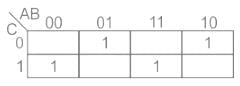
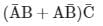
A combination circuit has inputs A, B and C, its K-map is given below. The output of circuit is given by
- a)

- b)
- c)

- d)A ⊕ B ⊕ C
Correct answer is option 'D'. Can you explain this answer?
A combination circuit has inputs A, B and C, its K-map is given below. The output of circuit is given by
a)
b)
c)
d)
A ⊕ B ⊕ C
| | Pooja Patel answered |
Karnaugh map (K-map):
- The Karnaugh map (K-map) is a method of simplifying Boolean algebra expressions.
- The Karnaugh map reduces the need for extensive calculations.
- Karnaugh map can be explained as An array that contains 2k number of cells, where k is the number of variables in the Boolean expression that is to be reduced or optimized.
Number of cells in 2 variable k-map = 22 = 4
Number of cells in 3 variable k-map = 23 = 8
Number of cells in 4 variable k-map = 24 = 16
Number of cells in 3 variable k-map = 23 = 8
Number of cells in 4 variable k-map = 24 = 16
2 variable K-maps:
There are 4 cells in the 2-variable k-map as shown,
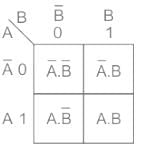
3 variable K-maps:
There are 4 cells in the 2-variable k-map as shown,
3 variable K-maps:
- For a 3-variable Boolean function, there is a possibility of 8 output minterms.
- The general representation of all the minterms using 3-variables is shown below.
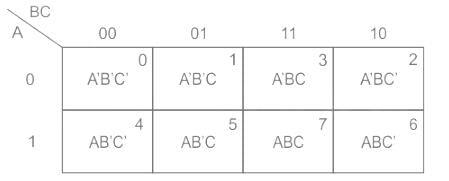
From the given K-map, the simplified Boolean expression is
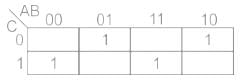
F = C A̅ B̅ + C̅ A̅ B + CAB + C̅ A B̅
= C̅ (A̅ B + A B̅) + C (A̅ B̅ + AB)
= A ⊕ B ⊕ C
F = C A̅ B̅ + C̅ A̅ B + CAB + C̅ A B̅
= C̅ (A̅ B + A B̅) + C (A̅ B̅ + AB)
= A ⊕ B ⊕ C
There are ______ cells in a 4-variable K-map.- a)12
- b)16
- c)18
- d)8
Correct answer is option 'B'. Can you explain this answer?
There are ______ cells in a 4-variable K-map.
a)
12
b)
16
c)
18
d)
8
 | Divya Nair answered |
Explanation:
A Karnaugh map, also known as a K-map, is a graphical method used to simplify Boolean algebra expressions. It is commonly used in digital electronics and logic design.
A 4-variable K-map is a table with 4 variables, each variable representing a column or a row. Each cell in the K-map represents a combination of the variables.
Step 1: Determine the number of cells in a 4-variable K-map
To determine the number of cells in a 4-variable K-map, we need to find the number of possible combinations for the 4 variables.
For each variable, there are two possible values: 0 or 1. Therefore, for 4 variables, there are 2^4 = 16 possible combinations.
Step 2: Represent the 4-variable K-map
To represent the 4-variable K-map, we need a table with 4 variables. Each variable is represented by a column or a row.
For example, let's represent the 4-variable K-map with variables A, B, C, and D:
```
| CD
AB | 00 01 11 10
---+------------
00 |
01 |
11 |
10 |
```
Step 3: Fill in the cells of the K-map
To fill in the cells of the K-map, we assign values to the variables and fill in the corresponding cell.
For example, let's fill in the cells for the following Boolean expression:
F(A, B, C, D) = A'B'CD' + A'BC'D' + AB'C'D + ABCD
```
| CD
AB | 00 01 11 10
---+------------
00 | 1 0 0 1
01 | 1 0 1 1
11 | 0 1 1 0
10 | 1 0 0 0
```
Step 4: Count the number of cells
By counting the number of cells in the K-map, we can determine the number of cells in a 4-variable K-map.
In this example, there are 16 cells in the 4-variable K-map.
Therefore, the correct answer is option 'B' - 16.
A Karnaugh map, also known as a K-map, is a graphical method used to simplify Boolean algebra expressions. It is commonly used in digital electronics and logic design.
A 4-variable K-map is a table with 4 variables, each variable representing a column or a row. Each cell in the K-map represents a combination of the variables.
Step 1: Determine the number of cells in a 4-variable K-map
To determine the number of cells in a 4-variable K-map, we need to find the number of possible combinations for the 4 variables.
For each variable, there are two possible values: 0 or 1. Therefore, for 4 variables, there are 2^4 = 16 possible combinations.
Step 2: Represent the 4-variable K-map
To represent the 4-variable K-map, we need a table with 4 variables. Each variable is represented by a column or a row.
For example, let's represent the 4-variable K-map with variables A, B, C, and D:
```
| CD
AB | 00 01 11 10
---+------------
00 |
01 |
11 |
10 |
```
Step 3: Fill in the cells of the K-map
To fill in the cells of the K-map, we assign values to the variables and fill in the corresponding cell.
For example, let's fill in the cells for the following Boolean expression:
F(A, B, C, D) = A'B'CD' + A'BC'D' + AB'C'D + ABCD
```
| CD
AB | 00 01 11 10
---+------------
00 | 1 0 0 1
01 | 1 0 1 1
11 | 0 1 1 0
10 | 1 0 0 0
```
Step 4: Count the number of cells
By counting the number of cells in the K-map, we can determine the number of cells in a 4-variable K-map.
In this example, there are 16 cells in the 4-variable K-map.
Therefore, the correct answer is option 'B' - 16.
Each “1” entry in a K-map square represents ________- a)A HIGH for each input truth table condition that produces a HIGH output
- b)A HIGH output on the truth table for all LOW input combinations
- c)A LOW output for all possible HIGH input conditions
- d)A DON’T CARE condition for all possible input truth table combinations
Correct answer is option 'A'. Can you explain this answer?
Each “1” entry in a K-map square represents ________
a)
A HIGH for each input truth table condition that produces a HIGH output
b)
A HIGH output on the truth table for all LOW input combinations
c)
A LOW output for all possible HIGH input conditions
d)
A DON’T CARE condition for all possible input truth table combinations
| | Pooja Patel answered |
Each “1” entry in a K-map square represents a HIGH for each input truth table condition that produces a HIGH output. Thus, it represents a minterm.
Which of the examples below expresses the commutative law of multiplication?- a)A + B = B + A
- b)A • B = B + A
- c)A • (B • C) = (A • B) • C
- d)A • B = B • A
Correct answer is option 'D'. Can you explain this answer?
Which of the examples below expresses the commutative law of multiplication?
a)
A + B = B + A
b)
A • B = B + A
c)
A • (B • C) = (A • B) • C
d)
A • B = B • A
| | Pooja Patel answered |
The commutative law of multiplication is (A * B) = (B * A).
The commutative law of addition is (A + B) = (B + A).
The commutative law of addition is (A + B) = (B + A).
If we group four 1’s from the adjacent cells of a K-map, then the group is called:- a)quad
- b)byte
- c)nibble
- d)word
Correct answer is option 'A'. Can you explain this answer?
If we group four 1’s from the adjacent cells of a K-map, then the group is called:
a)
quad
b)
byte
c)
nibble
d)
word
| | Pooja Patel answered |
K- map:
- It is a graphical representation and can be used to minimize the logical expression with '0', '1', and don't care.
- In K - map, a group of 8 cells is called an octet, it will eliminates 3 variables in given expression. (23 = 8)
- A group of 4 cells is called a quad, it will eliminate 2 variables. (22 = 4)
- Similarly, a group of 2m cells will eliminate 'm' variables. Therefore, the final expression will contain 'n-m' literals. where 'n' is the number of variables in a boolean function.
How many variables do 16 squares eliminate?- a)7
- b)4
- c)11
- d)1
Correct answer is option 'B'. Can you explain this answer?
How many variables do 16 squares eliminate?
a)
7
b)
4
c)
11
d)
1
| | Pooja Patel answered |
Concept:
The K-map is a graphical method that provides a systematic method for simplifying and manipulating the Boolean expressions or to convert a truth table to its corresponding logic circuit in a simple, orderly process.
In an 'n' variable K map, there are 2n cells.
The K-map is a graphical method that provides a systematic method for simplifying and manipulating the Boolean expressions or to convert a truth table to its corresponding logic circuit in a simple, orderly process.
In an 'n' variable K map, there are 2n cells.
Application:
For 16 cells, we have 4 variables.
The K map will give an output of 1, when all the cells have a 1, i.e. if all the input combinations give an output of 1, the maximum number of inputs can be simplified to give an output of 1.
This is explained with the following K map:
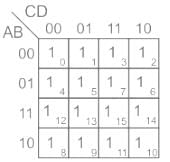
Since the K map forms a pair of 16, it can be eliminated giving an output:
Y = 1
Since the output contains no input variables (A, B, C, or D), all the four variables are simplified/eliminated.
For 16 cells, we have 4 variables.
The K map will give an output of 1, when all the cells have a 1, i.e. if all the input combinations give an output of 1, the maximum number of inputs can be simplified to give an output of 1.
This is explained with the following K map:
Since the K map forms a pair of 16, it can be eliminated giving an output:
Y = 1
Since the output contains no input variables (A, B, C, or D), all the four variables are simplified/eliminated.
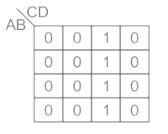
Which is the simplified expression for the output corresponding to the given K map?
- a)AB
- b)BD
- c)CD
- d)AC
Correct answer is option 'C'. Can you explain this answer?
Which is the simplified expression for the output corresponding to the given K map?
a)
AB
b)
BD
c)
CD
d)
AC
| | Pooja Patel answered |
Concept:
The K-map is a graphical method that provides a systematic method for simplifying and manipulating the Boolean expressions or to convert a truth table to its corresponding logic circuit in a simple, orderly process.
In an 'n' variable K map, there are 2n cells.
For 4 variables there will be 24 = 16 cells as shown:
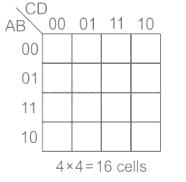
The Karnaugh map uses the following rules for the simplification of expressions by grouping together adjacent cells containing ones.
The K-map is a graphical method that provides a systematic method for simplifying and manipulating the Boolean expressions or to convert a truth table to its corresponding logic circuit in a simple, orderly process.
In an 'n' variable K map, there are 2n cells.
For 4 variables there will be 24 = 16 cells as shown:
The Karnaugh map uses the following rules for the simplification of expressions by grouping together adjacent cells containing ones.
- Groups must not include any cell containing a zero.
- Groups may be horizontal or vertical, but not diagonal.
- Groups must contain 1, 2, 4, 8, or in general 2n cells. That is if n = 1, a group will contain two 1's since 21 = 2, if n = 2, a group will contain four 1's since 22 = 4 and so on.
- Groups may overlap.
- Groups may wrap around the table. The leftmost cell in a row may be grouped with the rightmost cell and the top cell in a column may be grouped with the bottom cell.
Analysis:
In the given K map groups of one can be formed as shown:
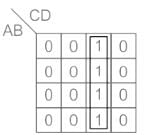
∴ The minimized expression is CD
In the given K map groups of one can be formed as shown:
∴ The minimized expression is CD
Each “0” entry in a K-map square represents _______________- a)A HIGH for each input truth table condition that produces a HIGH output
- b)A HIGH output on the truth table for all LOW input combinations
- c)A LOW output for all possible HIGH input conditions
- d)A DON’T CARE condition for all possible input truth table combinations
Correct answer is option 'C'. Can you explain this answer?
Each “0” entry in a K-map square represents _______________
a)
A HIGH for each input truth table condition that produces a HIGH output
b)
A HIGH output on the truth table for all LOW input combinations
c)
A LOW output for all possible HIGH input conditions
d)
A DON’T CARE condition for all possible input truth table combinations
| | Pooja Patel answered |
Each “0” entry in a K-map square represents a LOW output for all possible HIGH input conditions. Thus, it represents Maxterm.
Product-of-Sums expressions can be implemented using ___________- a)2-level OR-AND logic circuits
- b)2-level NOR logic circuits
- c)2-level XOR logic circuits
- d)Both 2-level OR-AND and NOR logic circuits
Correct answer is option 'D'. Can you explain this answer?
Product-of-Sums expressions can be implemented using ___________
a)
2-level OR-AND logic circuits
b)
2-level NOR logic circuits
c)
2-level XOR logic circuits
d)
Both 2-level OR-AND and NOR logic circuits
| | Pooja Patel answered |
Product-of-Sums expressions can be implemented using 2-level OR-AND & NOR logic circuits.
Each group of adjacent Minterms (group size in powers of twos) corresponds to a possible product term of the given ___________- a)Function
- b)Value
- c)Set
- d)Word
Correct answer is option 'A'. Can you explain this answer?
Each group of adjacent Minterms (group size in powers of twos) corresponds to a possible product term of the given ___________
a)
Function
b)
Value
c)
Set
d)
Word
| | Pooja Patel answered |
Each group of adjacent Minterms (group size in powers of twos) corresponds to a possible product term of the given function.
Which among the given expressions is the Product of Sum form?- a)(b+c)(a+b)
- b)ac-bd
- c)ab+cd
- d)ab(cd)
Correct answer is option 'A'. Can you explain this answer?
Which among the given expressions is the Product of Sum form?
a)
(b+c)(a+b)
b)
ac-bd
c)
ab+cd
d)
ab(cd)
| | Pooja Patel answered |
Product of sum (POS) expression:
It is equivalent to logical OR-AND function which gives the AND product of two or more OR sums to produce on output.
Example:
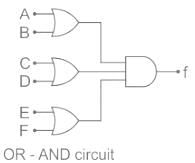
The output function will be:
F = (A + B) (C + D) (E + F)
∴ (b+c)(a+b) is the product of sum expression.
It is equivalent to logical OR-AND function which gives the AND product of two or more OR sums to produce on output.
Example:
The output function will be:
F = (A + B) (C + D) (E + F)
∴ (b+c)(a+b) is the product of sum expression.
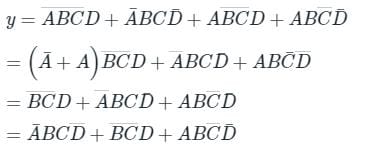
 can be minimized to




The K-map given below represents the bit G2 for a 4-bit Binary (B4B3B2B1) to Gray (G4G3G2G1) converter. What will be the expression of G2?
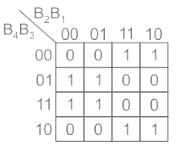
- a)B3 ⊕ B1
- b)B3 ⊕ B4
- c)B3 ⊕ B2
- d)B2 ⊕ B4
Correct answer is option 'C'. Can you explain this answer?
The K-map given below represents the bit G2 for a 4-bit Binary (B4B3B2B1) to Gray (G4G3G2G1) converter. What will be the expression of G2?
a)
B3 ⊕ B1
b)
B3 ⊕ B4
c)
B3 ⊕ B2
d)
B2 ⊕ B4
| | Pooja Patel answered |
Forming pair's of 4 in the K-map is as shown:
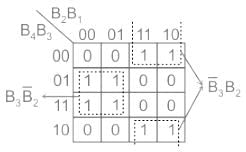
The simplified expression for G2 will be:
G2 = B3B̅2 + B̅3 B2
G2 = B3 ⊕ B2
The simplified expression for G2 will be:
G2 = B3B̅2 + B̅3 B2
G2 = B3 ⊕ B2
Which of the following expressions is in the sum-of-products form?- a)(A + B)(C + D)
- b)(A * B)(C * D)
- c)A* B *(CD)
- d)A * B + C * D
Correct answer is option 'D'. Can you explain this answer?
Which of the following expressions is in the sum-of-products form?
a)
(A + B)(C + D)
b)
(A * B)(C * D)
c)
A* B *(CD)
d)
A * B + C * D
| | Pooja Patel answered |
Sum of product means that it is the sum of all product terms. Thus, the number is multiplied first and then it is added: A * B + C * D.
Chapter doubts & questions for Karnaugh Maps (K-Maps) - 3 Months Preparation for GATE Electrical 2026 is part of Electrical Engineering (EE) exam preparation. The chapters have been prepared according to the Electrical Engineering (EE) exam syllabus. The Chapter doubts & questions, notes, tests & MCQs are made for Electrical Engineering (EE) 2026 Exam. Find important definitions, questions, notes, meanings, examples, exercises, MCQs and online tests here.
Chapter doubts & questions of Karnaugh Maps (K-Maps) - 3 Months Preparation for GATE Electrical in English & Hindi are available as part of Electrical Engineering (EE) exam. Download more important topics, notes, lectures and mock test series for Electrical Engineering (EE) Exam by signing up for free.
3 Months Preparation for GATE Electrical676 videos|1399 docs|882 tests |
