


All Exams > Electrical Engineering (EE) > 3 Months Preparation for GATE Electrical > All Questions
All questions of Complex variables for Electrical Engineering (EE) Exam
The quadratic approximation of (x) = x3 - 3x2 - 5 at the point x = 0 is- a)3x2 − 6x − 5
- b)−3x2 − 5
- c)−3x2 + 6x − 5
- d)3x2 – 5
Correct answer is option 'B'. Can you explain this answer?
The quadratic approximation of (x) = x3 - 3x2 - 5 at the point x = 0 is
a)
3x2 − 6x − 5
b)
−3x2 − 5
c)
−3x2 + 6x − 5
d)
3x2 – 5
 | Gate Funda answered |
Concept:
The Taylor's series expansion of f(x) about origin (i.e x = 0) is given by
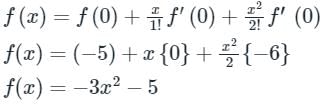
f(x) = f(0) + x × f′(0) + x2/2! × f"(0)+.....
The Taylor's series expansion of f(x) about origin (i.e x = 0) is given by
f(x) = f(0) + x × f′(0) + x2/2! × f"(0)+.....
It is also called Maclaurin's series.
Calculation:
Calculation:
f(x) = x3 - 3x2-5
f(0) = 03 - 3 × 02 - 5 = - 5
f'(0) = 3x2 - 6x = 0
f"(0) = 6x - 6 = - 6
The quadratic approximation of f(x) at the point x = 0 is

If the principal part of the Laurent’s series vanishes, then the Laurent’s series reduces to- a)Cauchy’s series
- b)Maclaurin’s series
- c)Taylor’s series
- d)None of the above
Correct answer is option 'C'. Can you explain this answer?
If the principal part of the Laurent’s series vanishes, then the Laurent’s series reduces to
a)
Cauchy’s series
b)
Maclaurin’s series
c)
Taylor’s series
d)
None of the above
 | Engineers Adda answered |
Taylor Series:
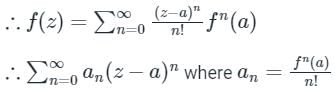
If f(z) is analytic inside a circle 'C', centre at z = a, and radius 'r', then for all z inside 'C'; the Taylor series is given by-

Laurent Series:
If f(z) is analytic at every point inside and on the boundary of a ring shaped region 'R' bounded by two concentric circle C1 and C2 having centre at 'a' & respective radii r1 and r2 (r1 > r2).

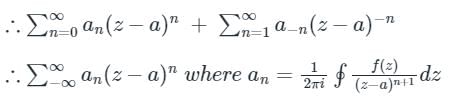
The negative part of Laurent's series i.e is called the singular part, and if that vanishes the terms that remain will be
 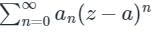 , which is nothing but Taylor series.
Laurent Series:
If f(z) is analytic at every point inside and on the boundary of a ring shaped region 'R' bounded by two concentric circle C1 and C2 having centre at 'a' & respective radii r1 and r2 (r1 > r2).
The negative part of Laurent's series i.e
is called the singular part, and if that vanishes the terms that remain will be , which is nothing but Taylor series.What is the expansion of y = sin-1 x?- a)

- b)

- c)

- d)None of the above
Correct answer is option 'C'. Can you explain this answer?
What is the expansion of y = sin-1 x?
a)
b)
c)
d)
None of the above
 | Sanya Agarwal answered |
Concept:
Binomial expansion of (1 - x)-n is given by
(1 - x)-n = 1 + nx +
Formula used:
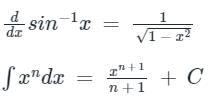
Calculation:
Given,
y = sin-1 x
 ....(1)
Using the above binomial expansion formula

Integrating both sides with respect to x,
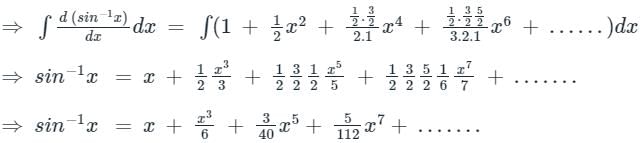
Hence, option c is the correct answer.
(1 - x)-n = 1 + nx +
Formula used:
Calculation:
Given,
y = sin-1 x
....(1)Using the above binomial expansion formula
Integrating both sides with respect to x,
Hence, option c is the correct answer.
The residue of the function f (z) = 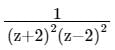 at z = 2 is
- a)

- b)

- c)1/16
- d)1/32
Correct answer is option 'A'. Can you explain this answer?
The residue of the function f (z) = at z = 2 is
at z = 2 isa)
b)
c)
1/16
d)
1/32
| | Sanya Agarwal answered |

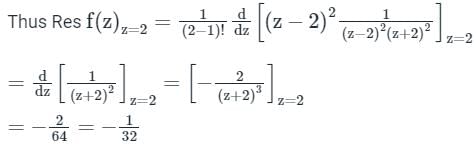
Here we have n = 2 and a = 2
Let f(z) =  if C is a counter clock wise path in the z plane such that |z - i| = 2, then the value of
 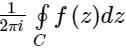 is____
- a)0
- b)1
- c)π/2
- d)-π
Correct answer is option 'A'. Can you explain this answer?
Let f(z) = if C is a counter clock wise path in the z plane such that |z - i| = 2, then the value of is____
if C is a counter clock wise path in the z plane such that |z - i| = 2, then the value of is____a)
0
b)
1
c)
π/2
d)
-π
| | Sanya Agarwal answered |
Concept:
Cauchy’s Theorem:
If f(z) is an analytic function and f’(z) is continuous at each point within and on a closed curve C, then
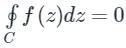
Calculation:
Given:
C: |z - i| = 2
The above path is a circle with a radius of 2 and center as (0, 1). The graph of the circle is given below,
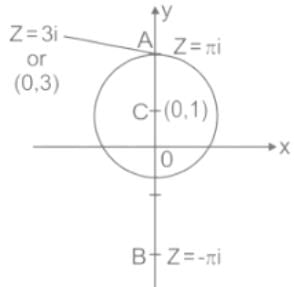
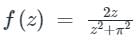
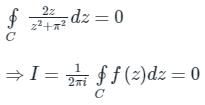
⇒ After putting the denominator as zero, the poles will be 'z = ± πi '. These pole points A and B are outside of the given circle as shown above. So, the complex function f(z) will be an analytic function for all points inside the circle.
⇒ After putting the denominator as zero, the poles will be 'z = ± πi '. These pole points A and B are outside of the given circle as shown above. So, the complex function f(z) will be an analytic function for all points inside the circle.
By Cauchy’s Theorem (Using equation (1))
Integration of the complex function f (z) =  in the counterclockwise direction, around |z – 1| = 1, is
- a)-πi
- b)0
- c)πi
- d)2πi
Correct answer is option 'C'. Can you explain this answer?
Integration of the complex function f (z) = in the counterclockwise direction, around |z – 1| = 1, is
in the counterclockwise direction, around |z – 1| = 1, isa)
-πi
b)
0
c)
πi
d)
2πi
| | Sanya Agarwal answered |
Concept:
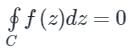
Cauchy’s Theorem:
If f(z) is an analytic function and f’(z) is continuous at each point within and on a closed curve C, then
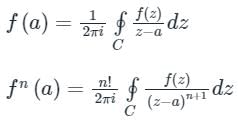
Cauchy’s Integral Formula:
If f(z) is an analytic function within a closed curve and if a is any point within C, then
Residue Theorem:
If f(z) is analytic in a closed curve C except at a finite number of singular points within C, then
 = 2πi × [sum of residues at the singualr points with in C]
Formula to find residue:
Residue Theorem:
If f(z) is analytic in a closed curve C except at a finite number of singular points within C, then
= 2πi × [sum of residues at the singualr points with in C]Formula to find residue:
1. If f(z) has a simple pole at z = a, then

2. If f(z) has a pole of order n at z = a, then

Application:
Given function is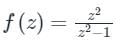
2. If f(z) has a pole of order n at z = a, then
Application:
Given function is
Poles: z = 1, -1
|z – 1| = 1
⇒ |x – 1 + iy| = 1
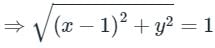
The given region is a circle with the centre at (1, 0) and the radius is 1.
|z – 1| = 1
⇒ |x – 1 + iy| = 1
The given region is a circle with the centre at (1, 0) and the radius is 1.
Only pole z = 1, lies within the given region.
Residue at z = 1 is, 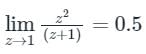
The value of the integral = 2πi × 0.5 = πi
The value of the integral = 2πi × 0.5 = πi
The residues of a complex function X (z) = 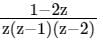 at its poles are
- a)1/2,
 and 1
and 1 - b)1/2,
 and −1
 - c)12, 1 and

- d)1/2, −1 and 3/2
Correct answer is option 'C'. Can you explain this answer?
The residues of a complex function X (z) = at its poles are
at its poles area)
1/2, and 1
and 1b)
1/2, and −1
and −1c)
12, 1 and
d)
1/2, −1 and 3/2
| | Sanya Agarwal answered |
Concept:
Residue Theorem: If f(z) is analytic in a closed curve C except at a finite number of singular points within C, then
 f(z)dz = 2πi × [sum of residues at the singualr points with in C]
Formula to find residue:
1. If f(z) has a simple pole at z = a, then

2. If f(z) has a pole of order n at z = a, then

Calculation:
Given:
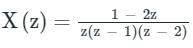
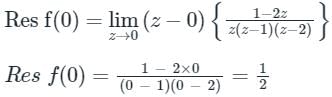
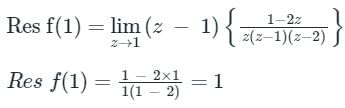
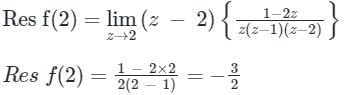
Poles are simple and located at z = 0, z = 1, and z = 2

At z = 0, the residue is:
At z = 1, the residue is:
At z = 2, the residue is:
2. If f(z) has a pole of order n at z = a, then
Calculation:
Given:
Poles are simple and located at z = 0, z = 1, and z = 2
At z = 0, the residue is:
At z = 1, the residue is:
At z = 2, the residue is:
The Laurent series expansion of the function 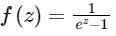 valid in the region 0 < |z| < 2, is given by
- a)

- b)

- c)

- d)

Correct answer is option 'C'. Can you explain this answer?
The Laurent series expansion of the function valid in the region 0 < |z| < 2, is given by
valid in the region 0 < |z| < 2, is given bya)
b)
c)
d)
| | Sanya Agarwal answered |
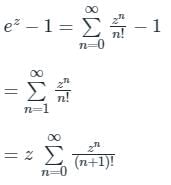
ex – 1 has a zero at ‘0’ of multiplicity one and hence f(z) has pole at 0 of order 1. So, the Laurent series f(z) is given by
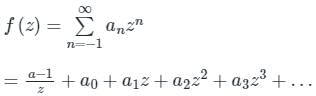
Since (ez – 1) f(z) = 1

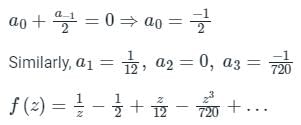
By comparing both the sides,
a-1 = 1
The function f(z) of complex variable z = x + iy, where i = √−1, is given as f(z) = (x3 – 3xy2) + i v(x,y). For this function to be analytic, v(x,y) should be- a)(3xy2 – y3) + constant
- b)(3x2y2 – y3) + constant
- c)(x3 – 3x2y) + constant
- d)(3x2y – y3) + constant
Correct answer is option 'D'. Can you explain this answer?
The function f(z) of complex variable z = x + iy, where i = √−1, is given as f(z) = (x3 – 3xy2) + i v(x,y). For this function to be analytic, v(x,y) should be
a)
(3xy2 – y3) + constant
b)
(3x2y2 – y3) + constant
c)
(x3 – 3x2y) + constant
d)
(3x2y – y3) + constant
| | Sanvi Kapoor answered |
Concept:
f(z) = u + iv
u = real part
v = imaginary part
f(z) = u + iv
u = real part
v = imaginary part
If f(z) is an analytic function
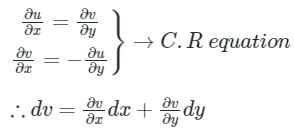
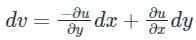
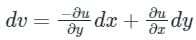 (This is an exact differential equation)
(This is an exact differential equation)Calculation:
Given,
u = x3 – 3xy2
∂u/∂x = 3x2 − 3y2
∂u/∂y = −6xy
Given,
u = x3 – 3xy2
∂u/∂x = 3x2 − 3y2
∂u/∂y = −6xy
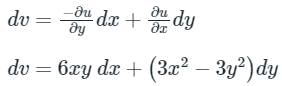
It is an exact differential equation the solution is obtained by treating y as constant in the first term and in the second term only that part is integrated which is not containing x.
Integrating the above equation
v = 3x2y − y3 + constant
v = 3x2y − y3 + constant
C is a closed path in the z-plane given by |z| = 3. The value of the integral 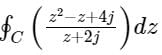 is
is- a)-4π (1 + j2)
- b)4π (3 – j2)
- c)-4π (3 + j2)
- d)4π (1 – j2)
Correct answer is option 'C'. Can you explain this answer?
C is a closed path in the z-plane given by |z| = 3. The value of the integral is
isa)
-4π (1 + j2)
b)
4π (3 – j2)
c)
-4π (3 + j2)
d)
4π (1 – j2)
| | Sanya Agarwal answered |
Concept:
If f(z) is analytic within and on a closed curve, and if ‘a’ is any point within C then according to Cauchy Integral formula:
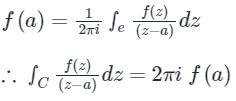
Application:
|z| = 3
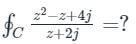
Pole z = -2j, which lies Inside the given C i.e. |z| = 3
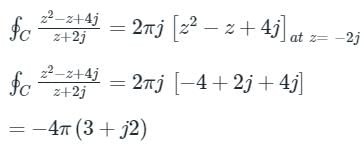
∴ Using the Cauchy Integral formula, we get:
If f(z) is analytic within and on a closed curve, and if ‘a’ is any point within C then according to Cauchy Integral formula:
Application:
|z| = 3
Pole z = -2j, which lies Inside the given C i.e. |z| = 3
∴ Using the Cauchy Integral formula, we get:
A harmonic function is analytic if it satisfies the Laplace equation. If u(x, y) = 2x2 − 2y2 + 4xy is a harmonic function, then its conjugate harmonic function v(x, y) is- a)4xy − 2x2 + 2y2 + constant
- b)4y2 − 4xy + constant
- c)2x2 − 2y2 + xy + constant
- d)−4xy + 2y2 − 2x2 + constant
Correct answer is option 'A'. Can you explain this answer?
A harmonic function is analytic if it satisfies the Laplace equation. If u(x, y) = 2x2 − 2y2 + 4xy is a harmonic function, then its conjugate harmonic function v(x, y) is
a)
4xy − 2x2 + 2y2 + constant
b)
4y2 − 4xy + constant
c)
2x2 − 2y2 + xy + constant
d)
−4xy + 2y2 − 2x2 + constant
 | Sharmila Gupta answered |
To determine if the function u(x, y) = 2x^2 satisfies the Laplace equation and is therefore analytic, we need to calculate its Laplacian.
The Laplacian of a function u(x, y) is given by the second partial derivatives with respect to x and y:
∇²u = ∂²u/∂x² + ∂²u/∂y²
Let's calculate the partial derivatives of u(x, y):
∂u/∂x = 4x
∂²u/∂x² = 4
∂u/∂y = 0
∂²u/∂y² = 0
Now, let's calculate the Laplacian:
∇²u = ∂²u/∂x² + ∂²u/∂y² = 4 + 0 = 4
Since the Laplacian of u(x, y) = 2x^2 is equal to 4 and not zero, it does not satisfy the Laplace equation. Therefore, u(x, y) = 2x^2 is not analytic.
The Laplacian of a function u(x, y) is given by the second partial derivatives with respect to x and y:
∇²u = ∂²u/∂x² + ∂²u/∂y²
Let's calculate the partial derivatives of u(x, y):
∂u/∂x = 4x
∂²u/∂x² = 4
∂u/∂y = 0
∂²u/∂y² = 0
Now, let's calculate the Laplacian:
∇²u = ∂²u/∂x² + ∂²u/∂y² = 4 + 0 = 4
Since the Laplacian of u(x, y) = 2x^2 is equal to 4 and not zero, it does not satisfy the Laplace equation. Therefore, u(x, y) = 2x^2 is not analytic.
A function f of the complex variable z = x + i y, is given as f(x, y) = u(x, y) + i v(x, y), where u(x, y) = 2kxy and v(x, y) = x2 – y2. The value of k, for which the function is analytic is _____
Correct answer is between '-1.1,-0.9'. Can you explain this answer?
A function f of the complex variable z = x + i y, is given as f(x, y) = u(x, y) + i v(x, y), where u(x, y) = 2kxy and v(x, y) = x2 – y2. The value of k, for which the function is analytic is _____
 | Partho Singh answered |
To find the function f(z), we need to find the expressions for both u(x, y) and v(x, y).
Given that u(x, y) = 2kxy, we can find the expression for u(x, y) in terms of z:
u(x, y) = 2kxy = 2k(x)(iy) = 2kxiy
Similarly, given that v(x, y) = x^2, we can find the expression for v(x, y) in terms of z:
v(x, y) = x^2 = (x)(x) = (x)(-i)(-i) = (x)(-iy)(-iy) = (-ix)(-iy) = -ixy
Therefore, the function f(z) is given by:
f(z) = u(x, y) + iv(x, y) = 2kxiy - ixy = (2kx - i)x(iy - 1)
So, the function f(z) is f(z) = (2kx - i)x(iy - 1).
Given that u(x, y) = 2kxy, we can find the expression for u(x, y) in terms of z:
u(x, y) = 2kxy = 2k(x)(iy) = 2kxiy
Similarly, given that v(x, y) = x^2, we can find the expression for v(x, y) in terms of z:
v(x, y) = x^2 = (x)(x) = (x)(-i)(-i) = (x)(-iy)(-iy) = (-ix)(-iy) = -ixy
Therefore, the function f(z) is given by:
f(z) = u(x, y) + iv(x, y) = 2kxiy - ixy = (2kx - i)x(iy - 1)
So, the function f(z) is f(z) = (2kx - i)x(iy - 1).
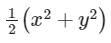
f(z) = u(x, y) + iv(x, y) is an analytic function of complex variable z = x + iy. If v = xy then u(x, y) equals- a)x2 + y2
- b)x2 – y2
- c)
- d)
Correct answer is option 'D'. Can you explain this answer?
f(z) = u(x, y) + iv(x, y) is an analytic function of complex variable z = x + iy. If v = xy then u(x, y) equals
a)
x2 + y2
b)
x2 – y2
c)
d)
 | Pioneer Academy answered |
Concept:
if f(z) = u(x, y) + iv(x, y) is an analytic function then Cauchy-Riemann condition will be satisfied.

Calculation:
Given:
v = xy
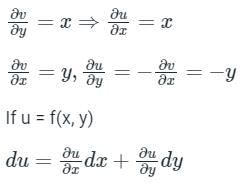
du = xdx - ydy
Integrating both sides
Calculation:
Given:
v = xy
du = xdx - ydy
Integrating both sides
∫du = ∫ (x)dx − ∫ ydy
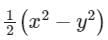
u = 1/2(x2−y2)
u = 1/2(x2−y2)
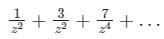
Expand the function 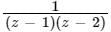 in Laurent’s series for 1 < |z| < 2
- a)
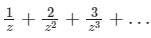
- b)

- c)
- d)None of the above
Correct answer is option 'B'. Can you explain this answer?
Expand the function in Laurent’s series for 1 < |z| < 2
in Laurent’s series for 1 < |z| < 2a)
b)
c)
d)
None of the above
 | Gate Gurus answered |
Concept:
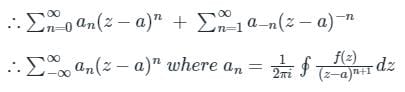
Laurent Series:
If f(z) is analytic at every point inside and on the boundary of a ring-shaped region 'R' bounded by two concentric circle C1 and C2 having centre at 'a' & respective radii r1 and r2 (r1 > r2).

Calculation:
Laurent Series:
If f(z) is analytic at every point inside and on the boundary of a ring-shaped region 'R' bounded by two concentric circle C1 and C2 having centre at 'a' & respective radii r1 and r2 (r1 > r2).
Calculation:
Given:
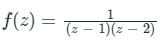 and 1 < |z| < 2
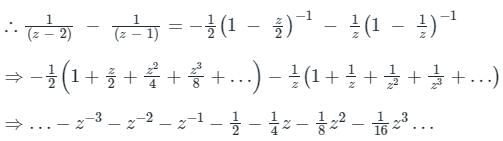
Here region of convergence is 1 < |z| and |z| < 2

The closed loop line integral 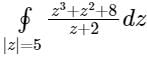 evaluated counter-clockwise, is
- a)+8jπ
- b)-8jπ
- c)-4jπ
- d)+4jπ
Correct answer is option 'A'. Can you explain this answer?
The closed loop line integral evaluated counter-clockwise, is
evaluated counter-clockwise, isa)
+8jπ
b)
-8jπ
c)
-4jπ
d)
+4jπ
| | Gate Funda answered |
Concept:
Residue Theorem:
If f(z) is analytic in a closed curve C except at a finite number of singular points within C, then
Residue Theorem:
If f(z) is analytic in a closed curve C except at a finite number of singular points within C, then
∫cf(z) dz = 2πj × [sum of residues at the singular points within C]
Formula to find residue:
1. If f(z) has a simple pole at z = a, then
Resf(α) =  a[(z−α)f(z)]
a[(z−α)f(z)]2. If f(z) has a pole of order n at z = a, then

Calculation:
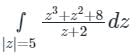
z + 2 = 0 z = -2 |z| = 2 < 5
f(x) is not analytic at z = -2
By Cauchy’s residue theorem
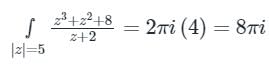
 f(x) dz = 2πi × (sum of residues)
At z = -2
Residue of f(x) = 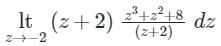
= -8 + 4 + 8 = 4
If f(z) = u + iv is an analytic function of z = x + iy and u – v = ex (cosy - siny), then f(z) in terms of z is- a)e−z2 + (1 + i)c
- b)e- z + (1 + i)c
- c)ez + (1 + i)c
- d)e- 2z + (1 + i)c
Correct answer is option 'C'. Can you explain this answer?
If f(z) = u + iv is an analytic function of z = x + iy and u – v = ex (cosy - siny), then f(z) in terms of z is
a)
e−z2 + (1 + i)c
b)
e- z + (1 + i)c
c)
ez + (1 + i)c
d)
e- 2z + (1 + i)c
 | Pranavi Gupta answered |
And v are real-valued functions, then the Cauchy-Riemann equations must hold:
∂u/∂x = ∂v/∂y
and
∂u/∂y = -∂v/∂x
Conversely, if these equations hold for a given function f(z), then it is analytic.
∂u/∂x = ∂v/∂y
and
∂u/∂y = -∂v/∂x
Conversely, if these equations hold for a given function f(z), then it is analytic.
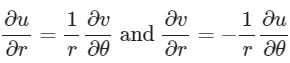
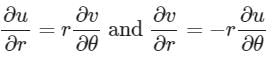
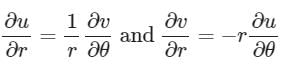
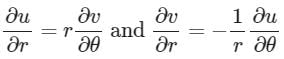
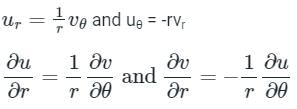
Polar form of the Cauchy-Riemann equations is- a)
- b)
- c)
- d)
Correct answer is option 'A'. Can you explain this answer?
Polar form of the Cauchy-Riemann equations is
a)
b)
c)
d)
| | Sanya Agarwal answered |
Cauchy-Riemann equations:
Rectangular form:
f(z) = u(x, y) + f v(x, y)
f(z) to be analytic it needs to satisfy Cauchy Riemann equations
ux = vy, uy = -vx

Polar form:
The values of the integral  along a closed contour c in anti-clockwise direction for
(i) the point z0 = 2 inside the contour c, and
(ii) the point z0 = 2 outside the contour c, respectively, are- a)(i) 2.72, (ii) 0
- b)(i) 7.39, (ii) 0
- c)(i) 0, (ii) 2.72
- d)(i) 0, (ii) 7.39
Correct answer is option 'B'. Can you explain this answer?
The values of the integral along a closed contour c in anti-clockwise direction for
(i) the point z0 = 2 inside the contour c, and
(ii) the point z0 = 2 outside the contour c, respectively, are
along a closed contour c in anti-clockwise direction for(i) the point z0 = 2 inside the contour c, and
(ii) the point z0 = 2 outside the contour c, respectively, are
a)
(i) 2.72, (ii) 0
b)
(i) 7.39, (ii) 0
c)
(i) 0, (ii) 2.72
d)
(i) 0, (ii) 7.39
| | Sanya Agarwal answered |
Given that 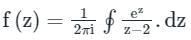 The singular point is at z = 2.
The singular point is at z = 2.If z = 2 is lies inside of the contour then the value of f(z) = Residue of f(z) at z = 2
∴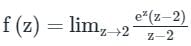
= e2 = 7.39
If z = 2 is lies outside of the contour, it means that the given function is analytic.
Then the value of f(z) = 0
∴
= e2 = 7.39
If z = 2 is lies outside of the contour, it means that the given function is analytic.
Then the value of f(z) = 0
The value of  , where C is the boundary of |z - i| = 1, is
- a)2πi
- b)4πi
- c)0
- d)πi
Correct answer is option 'C'. Can you explain this answer?
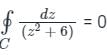
The value of , where C is the boundary of |z - i| = 1, is
, where C is the boundary of |z - i| = 1, isa)
2πi
b)
4πi
c)
0
d)
πi
| | Sanya Agarwal answered |
Concept:
Cauchy's theorem: If f(z) is an analytic function and f'(z) is continuous at each point within and on a closed curve C, or if the simple closed curve does not contain any singular point of f(z) then,
 f(z) dz = 0
Cauchy's theorem: If f(z) is an analytic function and f'(z) is continuous at each point within and on a closed curve C, or if the simple closed curve does not contain any singular point of f(z) then,
f(z) dz = 0Given,
The integral is where C is |z -i| = 1
The integral is
where C is |z -i| = 1Now, for point singularity consider Z2 + 6 = 0
Therefore point of singularity is a = ± √6i
For |z -i| = 1 we have,
radius r = 1, centre c = (0,1),
a = ± √6i is out of circle,
By Cauchy's Integral Formula We have,
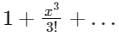
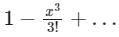
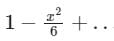
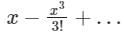
The series expansion of sinx/x near origin is- a)
- b)
- c)
- d)
Correct answer is option 'C'. Can you explain this answer?
The series expansion of sinx/x near origin is
a)
b)
c)
d)
| | Engineers Adda answered |
Concept:
Taylor series:
The Taylor series of a real or complex-valued function f (x) that is infinitely differentiable at a real or complex number ‘a’ is the power series.
Expression of Taylor series is:

Calculation:
Calculation:
Given:
We have to find the series expansion of sinx/x near origin, or a = 0.
Let f(x) = sin x
f(0) = sin (0) = 0,
f'(0) = cos (0) = 1,
f''(0) = -sin(0) = 0,
f'''(0) = -1 .... so on
Putting all the values in Taylor series expansion, we get:
Series expansion of sin x will be:
sinx = x − x3/3!+…
Therefore the series expansion of sin x/x near origin will be:
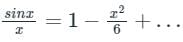
sinx = x − x3/3!+…
Therefore the series expansion of sin x/x near origin will be:
The number of integral solutions of  is
is- a)4
- b)5
- c)3
- d)6
Correct answer is option 'B'. Can you explain this answer?
The number of integral solutions of is
isa)
4
b)
5
c)
3
d)
6
| | Sanya Agarwal answered |

4x + 8 ≥ x2 + 8
∴ x2 – 4x ≤ 0
x(x – 4) ≤ 0 → (1)
Clearly the integral solution of (1) are 0, 1, 2, 3 and 4
∴ Total 5 values of x satisfies (1)
The residue at the singular point z = -2 of f (z) = 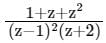
- a)1/2
- b)1/3
- c)4/3
- d)3/2
Correct answer is option 'B'. Can you explain this answer?
The residue at the singular point z = -2 of f (z) =
a)
1/2
b)
1/3
c)
4/3
d)
3/2
| | Sanya Agarwal answered |
Residue Theorem:
If f(z) is analytic in a closed curve C except at a finite number of singular points within C, then
 f(z)dz = 2πi × [sum of residues at the singualr points with in C]
Formula to find residue:
1. If f(z) has a simple pole at z = a, then

2. If f(z) has a pole of order n at z = a, then

Calculation:
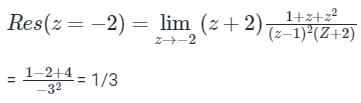
1. If f(z) has a simple pole at z = a, then
2. If f(z) has a pole of order n at z = a, then
Calculation:
The value of  where contour D is |z| = 2
- a)

- b)

- c)

- d)0
Correct answer is option 'A'. Can you explain this answer?
The value of where contour D is |z| = 2
where contour D is |z| = 2a)
b)
c)
d)
0
| | Sanya Agarwal answered |
 has its poles at z = -1
and contour |z| = 2 is a circle of radius 2, centre (0, 0)
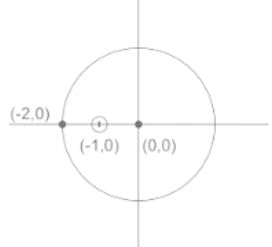
So
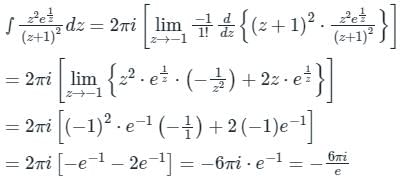
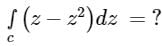 where c is the upper half of the circle |z| = 1.
- a)-2/3
- b)2/3
- c)3/2
- d)-3/2
Correct answer is option 'B'. Can you explain this answer?
where c is the upper half of the circle |z| = 1.a)
-2/3
b)
2/3
c)
3/2
d)
-3/2
| | Gate Gurus answered |
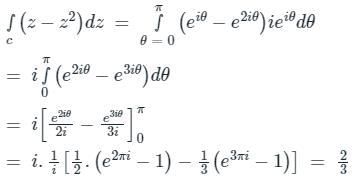
Given counter c is the circle, |z| = 1
⇒ z = eiθ ⇒ dz = ieiθdθ
Now, for upper half of the circle, 0 ≤ θ ≤ π
Let (-1 - j), (3 - j), (3 + j) and (-1 + j) be the vertices of a rectangle C in the complex plane. Assuming that C is traversed in counter-clockwise direction, the value of the countour integral 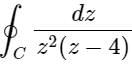 is
is- a)0
- b)jπ/16
- c)jπ/2
- d)-jπ/8
Correct answer is option 'D'. Can you explain this answer?
Let (-1 - j), (3 - j), (3 + j) and (-1 + j) be the vertices of a rectangle C in the complex plane. Assuming that C is traversed in counter-clockwise direction, the value of the countour integral is
isa)
0
b)
jπ/16
c)
jπ/2
d)
-jπ/8
 | Vertex Academy answered |
Concept:
Residue Theorem:
If f(z) is analytic in a closed curve C except at a finite number of singular points within C, then
∫cf(z) dz = 2πj × [sum of residues at the singular points within C]
Formula to find residue:
1. If f(z) has a simple pole at z = a, then

2. If f(z) has a pole of order n at z = a, then

Application:
Given (-1 - j), (3 - j), (3 + j) and (-1 + j) are the vertices of a rectangle C in the complex plane
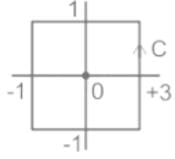
f(z) from the given data is,
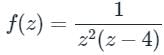
2. If f(z) has a pole of order n at z = a, then
Application:
Given (-1 - j), (3 - j), (3 + j) and (-1 + j) are the vertices of a rectangle C in the complex plane
f(z) from the given data is,
Poleas of f(z) is
z = 0 of order n = 2, lies in side the closed curve.
z = 4 of order n = 1, lies outside the closed curve.
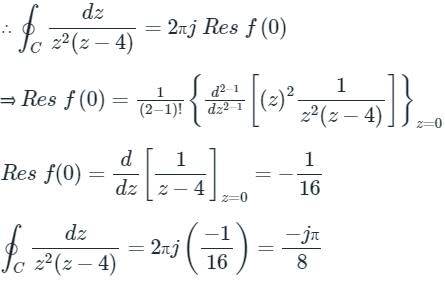
The value of the contour integral in the complex plane
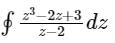
along the contour |z| = 3, taken counterclockwise is- a)-18πi
- b)0
- c)14πi
- d)48πi
Correct answer is option 'C'. Can you explain this answer?
The value of the contour integral in the complex plane
along the contour |z| = 3, taken counterclockwise is
along the contour |z| = 3, taken counterclockwise is
a)
-18πi
b)
0
c)
14πi
d)
48πi
| | Sanvi Kapoor answered |
Concept:
For a given complex function with poles, the complex integral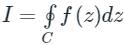 is given by
is given byResidue theorem as;
 Cf(z)dz = 2π i × {Sum of residue of poles in side or onC}
Cf(z)dz = 2π i × {Sum of residue of poles in side or onC}Calculation:
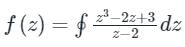
Contour: |z|= 3
Simple pole, z = 2 and it is lies inside the contour.
Residue of f(z) at z = 2 is,
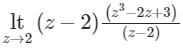 = 23 − 2(2) + 3 = 7
f(z) = 2πi(7) = 14πi
Contour: |z|= 3
Simple pole, z = 2 and it is lies inside the contour.
Residue of f(z) at z = 2 is,
= 23 − 2(2) + 3 = 7f(z) = 2πi(7) = 14πi
The real part of an analytic function f(z) where z = x + iy is given by e-y cos (x). The imaginary part of f(z) is- a)ey cos (x)
- b)e-y sin (x)
- c)-ey sin (x)
- d)-e-y sin (x)
Correct answer is option 'B'. Can you explain this answer?
The real part of an analytic function f(z) where z = x + iy is given by e-y cos (x). The imaginary part of f(z) is
a)
ey cos (x)
b)
e-y sin (x)
c)
-ey sin (x)
d)
-e-y sin (x)
 | Raghavendra Sengupta answered |
The real part of an analytic function f(z) is given by e^(-y) * cos(x). We are required to find the imaginary part of f(z).
To find the imaginary part of f(z), we can make use of the Cauchy-Riemann equations. According to these equations, if f(z) is an analytic function, then it satisfies the following conditions:
∂u/∂x = ∂v/∂y (1)
∂u/∂y = -∂v/∂x (2)
where u(x, y) is the real part of f(z) and v(x, y) is the imaginary part of f(z).
Let's differentiate the given real part of f(z) with respect to x and y:
∂u/∂x = -e^(-y) * sin(x) (3)
∂u/∂y = -e^(-y) * cos(x) (4)
Comparing equations (1) and (3), we can see that:
∂v/∂y = -e^(-y) * sin(x) (5)
Comparing equations (2) and (4), we can see that:
∂v/∂x = e^(-y) * cos(x) (6)
Now, integrating equation (5) with respect to y, we get:
v(x, y) = -e^(-y) * sin(x) + g(x) (7)
where g(x) is an arbitrary function of x.
Next, substituting equation (7) into equation (6), we can solve for g(x):
∂v/∂x = e^(-y) * cos(x) (6)
e^(-y) * cos(x) = e^(-y) * cos(x) + g'(x) (8)
g'(x) = 0 (9)
Since g'(x) = 0, it implies that g(x) is a constant.
Therefore, the imaginary part of f(z) is given by:
v(x, y) = -e^(-y) * sin(x) + C (10)
where C is a constant.
Comparing equation (10) with the given options, we can see that the correct answer is option B, i.e., e^(-y) * sin(x).
To find the imaginary part of f(z), we can make use of the Cauchy-Riemann equations. According to these equations, if f(z) is an analytic function, then it satisfies the following conditions:
∂u/∂x = ∂v/∂y (1)
∂u/∂y = -∂v/∂x (2)
where u(x, y) is the real part of f(z) and v(x, y) is the imaginary part of f(z).
Let's differentiate the given real part of f(z) with respect to x and y:
∂u/∂x = -e^(-y) * sin(x) (3)
∂u/∂y = -e^(-y) * cos(x) (4)
Comparing equations (1) and (3), we can see that:
∂v/∂y = -e^(-y) * sin(x) (5)
Comparing equations (2) and (4), we can see that:
∂v/∂x = e^(-y) * cos(x) (6)
Now, integrating equation (5) with respect to y, we get:
v(x, y) = -e^(-y) * sin(x) + g(x) (7)
where g(x) is an arbitrary function of x.
Next, substituting equation (7) into equation (6), we can solve for g(x):
∂v/∂x = e^(-y) * cos(x) (6)
e^(-y) * cos(x) = e^(-y) * cos(x) + g'(x) (8)
g'(x) = 0 (9)
Since g'(x) = 0, it implies that g(x) is a constant.
Therefore, the imaginary part of f(z) is given by:
v(x, y) = -e^(-y) * sin(x) + C (10)
where C is a constant.
Comparing equation (10) with the given options, we can see that the correct answer is option B, i.e., e^(-y) * sin(x).
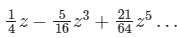
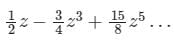
Find the Laurent expansion of f(z) =  in the region 1 < z + 1 < 3
- a)

- b)

- c)

- d)

Correct answer is option 'D'. Can you explain this answer?
Find the Laurent expansion of f(z) = in the region 1 < z + 1 < 3
in the region 1 < z + 1 < 3a)
b)
c)
d)
| | Gate Gurus answered |
Calculation:
Let z +1 = u ⇒ z = u – 1
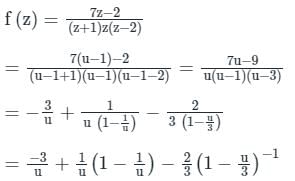
Given 1 < z + 1 < 3
⇒ 1 < u < 3
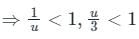
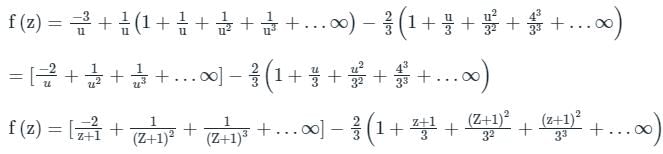
Let z +1 = u ⇒ z = u – 1
Given 1 < z + 1 < 3
⇒ 1 < u < 3


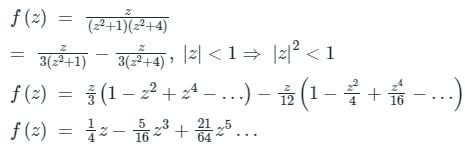
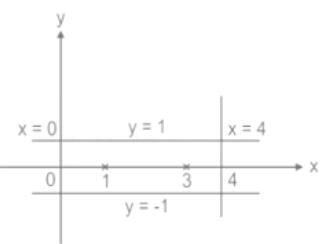
Evaluate 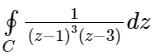 where C is the rectangular region defined by x = 0, x = 4, y = -1 and y = 1
- a)1
- b)0
- c)

- d)π (3 + 2i)
Correct answer is option 'B'. Can you explain this answer?
Evaluate where C is the rectangular region defined by x = 0, x = 4, y = -1 and y = 1
where C is the rectangular region defined by x = 0, x = 4, y = -1 and y = 1a)
1
b)
0
c)
d)
π (3 + 2i)
| | Sanvi Kapoor answered |
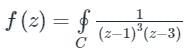
(z - 1)3 (z - 3) = 0
⇒ z = 1, z = 3
The function has a simple pole at z = 3 and has a multiple pole at z = 1
Both z = 1, and z = 3 are inside the region C
According to Cauchy’s Residue theorem
 f (z)dz = 2πi [sum of the residues at the poles in side ′C′]
If z = a is a pole of order ‘m’, then residue of f(z) at z = a is,
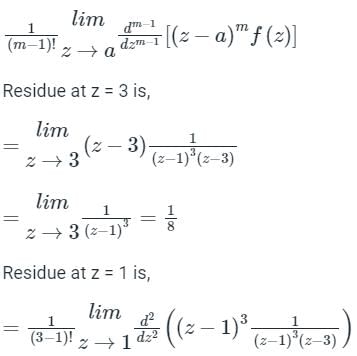
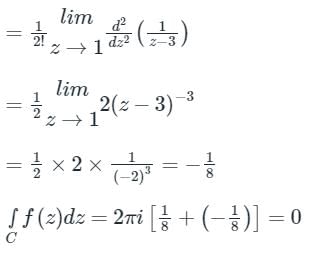
f (z)dz = 2πi [sum of the residues at the poles in side ′C′]If z = a is a pole of order ‘m’, then residue of f(z) at z = a is,
Which of the following function f(z), of the complex variable z, is NOT analytic at all the points of the complex plane?- a)f(z) = z2
- b)f(z) = ez
- c)f(z) = sin z
- d)f(z) = log z
Correct answer is option 'D'. Can you explain this answer?
Which of the following function f(z), of the complex variable z, is NOT analytic at all the points of the complex plane?
a)
f(z) = z2
b)
f(z) = ez
c)
f(z) = sin z
d)
f(z) = log z
 | Sneha Nair answered |
Analytic Functions in Complex Analysis
An analytic function is a complex function that is differentiable at every point in its domain.
If a function is analytic at all the points in the complex plane, then it is called an entire function.
If a function is not analytic at any point in its domain, then it is called a non-analytic function.
Out of the given options, the function f(z) = log z is not analytic at all the points in the complex plane.
Explanation
The function f(z) = log z is not analytic at z = 0 and any other point where z is negative or zero.
The reason for this is that the complex logarithm is a multivalued function. For any non-zero complex number z, there are infinitely many complex numbers w such that ez = w. So, we define the complex logarithm as follows:
log z = ln |z| + i arg(z)
where arg(z) is any angle whose tangent is the imaginary part divided by the real part of z.
However, when z is negative or zero, arg(z) is not well-defined, and so log z is not analytic at these points.
Hence, the function f(z) = log z is not analytic at all the points in the complex plane.
An analytic function is a complex function that is differentiable at every point in its domain.
If a function is analytic at all the points in the complex plane, then it is called an entire function.
If a function is not analytic at any point in its domain, then it is called a non-analytic function.
Out of the given options, the function f(z) = log z is not analytic at all the points in the complex plane.
Explanation
The function f(z) = log z is not analytic at z = 0 and any other point where z is negative or zero.
The reason for this is that the complex logarithm is a multivalued function. For any non-zero complex number z, there are infinitely many complex numbers w such that ez = w. So, we define the complex logarithm as follows:
log z = ln |z| + i arg(z)
where arg(z) is any angle whose tangent is the imaginary part divided by the real part of z.
However, when z is negative or zero, arg(z) is not well-defined, and so log z is not analytic at these points.
Hence, the function f(z) = log z is not analytic at all the points in the complex plane.
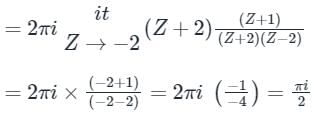
The value of the integral  dz in counter clockwise direction around a circle C of radius 1 with center at the point z = −2 is
- a)πi/2
- b)2πi
- c)

- d)– 2πi
Correct answer is option 'A'. Can you explain this answer?
The value of the integral dz in counter clockwise direction around a circle C of radius 1 with center at the point z = −2 is
dz in counter clockwise direction around a circle C of radius 1 with center at the point z = −2 isa)
πi/2
b)
2πi
c)
d)
– 2πi
| | Pioneer Academy answered |
Given that,
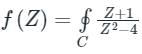
C : |Z – (-2)| = 1
⇒ C : |Z + 2| = 1
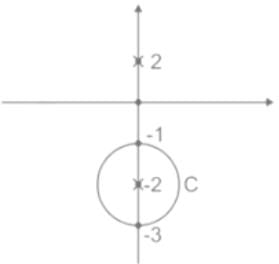
poles of f(Z) are z2 – 4 = 0
⇒ Z = ±2
Z = 2 is lies outside the curve C.
f(Z) = 2πi [residue at Z = -2]
The only function among the following that is analytic, is- a)f(z) = Re(z)
- b)f(z) =

- c)f(z) = Im (z)
- d)f(z) = sin(z)
Correct answer is option 'D'. Can you explain this answer?
The only function among the following that is analytic, is
a)
f(z) = Re(z)
b)
f(z) =
c)
f(z) = Im (z)
d)
f(z) = sin(z)
| | Pioneer Academy answered |
i) f(z) = Re(z) = Re(x + iy) = x
here u = x, v = 0
ux = 1, vy = 0
f(z) is not satisfying CR equations Hence f(z) is not analytic.
ii) f(z) = z̅ = x - fy
u = x, v = -y
ux = 1, vy = -1
ux ≠ vy
f(x) is not satisfying CR equations.
Hence f(z) is not analytic
iii) f(z) = Im (z) = Im (x + iy) = y
u = 0, v = y
ux = 0, vy = 1
f(x) is not satisfying CR equations.
Hence f(z) is not analytic
iv) f(z) = sin z = (x + iy)
= sin x cos iy + cos x sin iy
= sin x cos hy + i cos x sin hy
u = sin x cos hy, v = cos x sin hy
ux = cos x cos hy
vy = cos x cos hy
uy = sin x sin hy
vx = - sin x sin hy
ux = vy and uy = - vx
f(z) is satisfying CR equation.
Hence f(z) is analytic.
The value of the integral 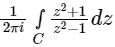 where z is a complex number and C is a unit circle with centre at 1 + 0j in the complex plane is __________ .
Correct answer is '1'. Can you explain this answer?
The value of the integral where z is a complex number and C is a unit circle with centre at 1 + 0j in the complex plane is __________ .
where z is a complex number and C is a unit circle with centre at 1 + 0j in the complex plane is __________ .| | Sanya Agarwal answered |
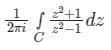
Simple poles, z = ±1
According to Cauchy’s residue theorem,
 f(z)dz = 2πi [sum of residues]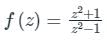
At, z = +1, residue is
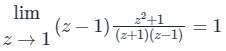
At, z = -1 residue is zero as z = -1 lies outside the curve C.

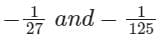
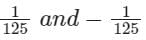
The residues of a function f(z) = 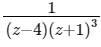 are:
are:- a)
- b)
- c)
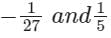
- d)
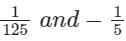
Correct answer is option 'B'. Can you explain this answer?
The residues of a function f(z) = are:
are:a)
b)
c)
d)
| | Sanya Agarwal answered |
Concept:
For simple poles at z = a, b, c…
Residue of
For simple poles at z = a, b, c…
Residue of
For multiple poles at z = a, a, a … n times
{Residue of
Calculation:
Given, f (z) =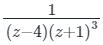
For a simple pole at z = 4
Residue of
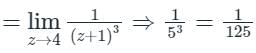
For multiple pole (n = 3) at z = -1
Residue will be
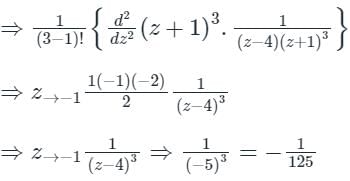
{Residue of
Calculation:
Given, f (z) =
For a simple pole at z = 4
Residue of
For multiple pole (n = 3) at z = -1
Residue will be
Evaluate the line integral  (x + 4iy2)dz where c is the line x = 2y and x varies from 0 to 1 and z = x + iy
- a)

- b)

- c)

- d)

Correct answer is option 'B'. Can you explain this answer?
Evaluate the line integral (x + 4iy2)dz where c is the line x = 2y and x varies from 0 to 1 and z = x + iy
(x + 4iy2)dz where c is the line x = 2y and x varies from 0 to 1 and z = x + iya)
b)
c)
d)
| | Sanya Agarwal answered |
Calculation:
z = x + iy ⇒ dz = dx + i dy
given line is x = 2y ⇒ dy/dx = 1/2
lets substitute y in terms of x
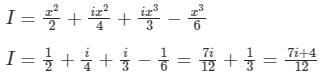
I = ∫ x + i x2 (dx + i/2 dx)
I = ∫ x dx + i/2 x dx + i x2 dx - x2/2 dx
In the Laurent series expression of 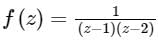 valid for 0 < |z - 1|< 1, the co-efficient of 1/(z−1)is
- a)-2
- b)-1
- c)0
- d)1
Correct answer is option 'B'. Can you explain this answer?
In the Laurent series expression of valid for 0 < |z - 1|< 1, the co-efficient of 1/(z−1)is
valid for 0 < |z - 1|< 1, the co-efficient of 1/(z−1)isa)
-2
b)
-1
c)
0
d)
1
| | Sanya Agarwal answered |
Concept:
Laurentz Series is obtained by the arrangement and manipulation of standard series or expansions, i.e.
(1 - x)-1 = 1 + x + x2 + x3 + …… |x| < 1
(1 + x)-1 = 1 – x + x2 – x3 + ….. |x| < 1
(1 - x)-2 = 1 + 2x + 3x2 + ….. |x| < 1
(1 + x)-2 1 – 2x + 3x2 – 4x2 + …. |x| < 1
Observe that in all the expansions; |x| should be less than 1.
∴ We need to manipulate the variable to satisfy the above condition.
Calculation:
Given:
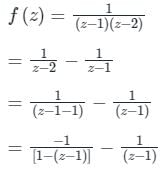
= -1 [1 - (z - 1)]-1 - [z - 1]-1
= -[z - 1]-1 - [1 + (z - 1) + (z - 1)2 + (z - 1)3 +…]
Co-efficient of 1z−1 is -1
= -1 [1 - (z - 1)]-1 - [z - 1]-1
= -[z - 1]-1 - [1 + (z - 1) + (z - 1)2 + (z - 1)3 +…]
Co-efficient of 1z−1 is -1
Given z = x +iy, i = √-1 C is a circle of radius 2 with the centre at the origin. If the contour C is traversed anticlockwise, then the value of the integral 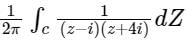 is ________ (round off to one decimal place.)
Correct answer is '0.2'. Can you explain this answer?
Given z = x +iy, i = √-1 C is a circle of radius 2 with the centre at the origin. If the contour C is traversed anticlockwise, then the value of the integral is ________ (round off to one decimal place.)
is ________ (round off to one decimal place.)| | Pioneer Academy answered |
Concept:
if f(z) is analytic in closed curve C except at a finite number of singular points within C then
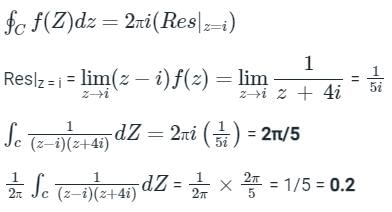
f(Z)dz = 2πi × [sum of residues at singular points within C]Calculation:
Given:

Singular points: z = i, -4i
C is a circle of radius 2, only z = i will lie inside the circle
If f(z) is analytic in a simply connected domain D, then for every closed path C and D- a)
- b)
- c)
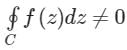
- d)
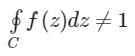
Correct answer is option 'B'. Can you explain this answer?
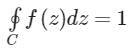
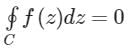
If f(z) is analytic in a simply connected domain D, then for every closed path C and D
a)
b)
c)
d)
| | Pioneer Academy answered |
Cauchy's Theorem:
If f(z) is single-valued and an analytic function of z and f'(z) is continuous at each point within and on the closed curve c, then according to the theorem, 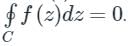
Cauchy's Integral Formula:
For Simple Pole:
If f(z) is analytic within and on a closed curve c and if a (simple pole) is any point within c, then
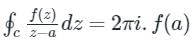
For Multiple Pole:
Cauchy's Integral Formula:
For Simple Pole:
If f(z) is analytic within and on a closed curve c and if a (simple pole) is any point within c, then
For Multiple Pole:
If f(z) is analytic within and on a closed curve c, and if a (multiple poles) are points within c, then

The value of ∮1/z2 dz, where the contour is the unit circle traversed clockwise, is- a)-2πi
- b)0
- c)2πi
- d)4πi
Correct answer is option 'B'. Can you explain this answer?
The value of ∮1/z2 dz, where the contour is the unit circle traversed clockwise, is
a)
-2πi
b)
0
c)
2πi
d)
4πi
 | Swati Patel answered |
To evaluate the integral of 1/z^2 dz, we can use the Cauchy's Integral Formula, which states that for a function f(z) that is analytic within and on a simple closed contour C, and a point a inside C,
f(a) = (1/2πi) ∮C [f(z)/(z-a)] dz.
In this case, f(z) = 1 and a = 0. The contour C is the unit circle traversed clockwise.
Applying the formula, we have:
1 = (1/2πi) ∮C [1/(z-0)] dz
= (1/2πi) ∮C 1/z dz.
The integral of 1/z with respect to z along the unit circle traversed clockwise is equal to -2πi. Therefore,
1 = (1/2πi) (-2πi)
= -1.
So, the value of 1/z^2 dz, where the contour is the unit circle traversed clockwise, is -1.
f(a) = (1/2πi) ∮C [f(z)/(z-a)] dz.
In this case, f(z) = 1 and a = 0. The contour C is the unit circle traversed clockwise.
Applying the formula, we have:
1 = (1/2πi) ∮C [1/(z-0)] dz
= (1/2πi) ∮C 1/z dz.
The integral of 1/z with respect to z along the unit circle traversed clockwise is equal to -2πi. Therefore,
1 = (1/2πi) (-2πi)
= -1.
So, the value of 1/z^2 dz, where the contour is the unit circle traversed clockwise, is -1.
The Residue of for z = ia is
- a)1/4α3
- b)−i/4α3
- c)−1/4α3
- d)i/4α3
Correct answer is option 'B'. Can you explain this answer?
The Residue of for z = ia is
for z = ia isa)
1/4α3
b)
−i/4α3
c)
−1/4α3
d)
i/4α3
| | Vertex Academy answered |
Cauchy's Residue Theorem:
Residue of f(z):
Residue of f(z) is denoted as Res[f(z) : z = z0]
z0 is a simple pole of the function f(z)
If f(z) = p(z) / q(z)
Where, p(z), q(z) are polynomials
Then residue is,
Res[f(z) : z = z0] = 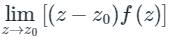
If f(z) has a pole of order 'm' at z = z0 then
If f(z) has a pole of order 'm' at z = z0 then
Res [f(z) : z = z0] =
Calculation:
Calculation:
Given,

Pole of f(z) has order "2"

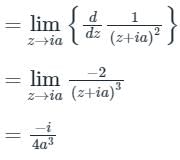
Pole of f(z) has order "2"
The value of the integral

evaluated using contour integration and the residue theorem is- a)-π sin (1)/e
- b)-π cos (1)/e
- c)sin (1)/e
- d)cos (1)/e
Correct answer is option 'A'. Can you explain this answer?
The value of the integral
evaluated using contour integration and the residue theorem is
evaluated using contour integration and the residue theorem is
a)
-π sin (1)/e
b)
-π cos (1)/e
c)
sin (1)/e
d)
cos (1)/e
 | Naroj Boda answered |
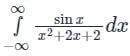
Concept:
Cauchy Integral Theorem:
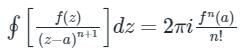
Where z = a be any point inside the close region.
Cauchy’s Residue Theorem:
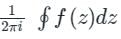 = Sum of Residue at Pole or singularity with in the region
= Sum of Residue at Pole or singularity with in the regionRes at z = a

Calculation:
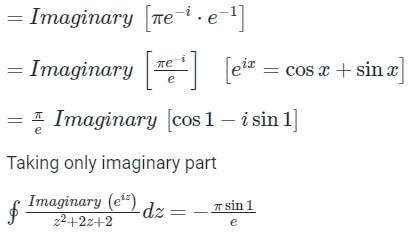
We know that eix = cos x + i sin x
Let x replace by z.
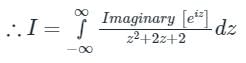
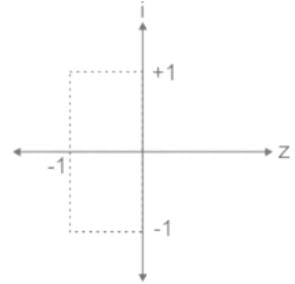
Now, z2 + 2z + 2 = 0 then roots of z are:

Calculation:
We know that eix = cos x + i sin x
Let x replace by z.
Now, z2 + 2z + 2 = 0 then roots of z are:
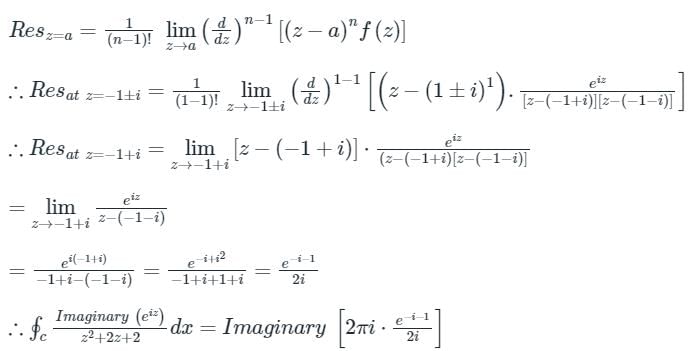
z = -1 ± i is the only pole lying in f(z) > 0
Here n = 1
If f(z) has a pole of order n at z = a, then residue of function f(z) at a is- a)
- b)

- c)
- d)
Correct answer is option 'D'. Can you explain this answer?
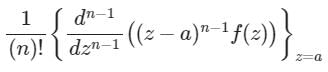
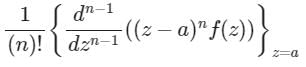
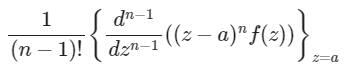
If f(z) has a pole of order n at z = a, then residue of function f(z) at a is
a)
b)
c)
d)
| | Sanya Agarwal answered |
Residue Theorem:
If f(z) is analytic in a closed curve C except at a finite number of singular points within C, then
 f(z) dz = 2πi × [sum of residues at the singualr points with in C]
f(z) dz = 2πi × [sum of residues at the singualr points with in C]Formula to find residue:
1. If f(z) has a simple pole at z = a, then

2. If f(z) has a pole of order n at z = a, then

Important Points:
1. If f(z) has a simple pole at z = a, then
2. If f(z) has a pole of order n at z = a, then
Important Points:
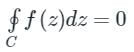
Cauchy’s Theorem:
If f(z) is an analytic function and f’(z) is continuous at each point within and on a closed curve C, then
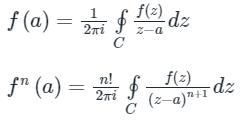
Cauchy’s Integral Formula:
If f(z) is an analytic function within a closed curve and if a is any point within C, then
Cauchy’s Integral Formula:
If f(z) is an analytic function within a closed curve and if a is any point within C, then
Evaluate  along the straight line joining the points (0, 0) and (3, 1)
- a)

- b)

- c)

- d)

Correct answer is option 'C'. Can you explain this answer?
Evaluate along the straight line joining the points (0, 0) and (3, 1)
along the straight line joining the points (0, 0) and (3, 1)a)
b)
c)
d)
| | Gate Gurus answered |
Concept:
Integral of a complex function f(z) is given
∫ f(z) dz = ∫ (udx -vdy) + i ∫ (vdx + udy)
Noting f(z) = u(x, y) + i v(x, y) and dz = dx + i dy;
Calculation:
Given Along the straight line joining the points (0, 0) and (3, 1);
The equation of straight line will be x = 3y
⇒ dx = 3 dy ⇒ dz = (3 + i) dy;
Along the line x = 3y, the complex number z will be
z = x + iy = 3y + iy = (3 + i) y

Substituting both in the integral,
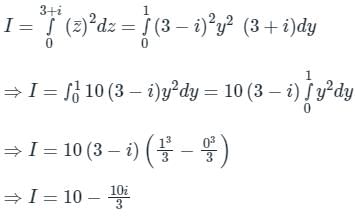
Substituting both in the integral,
If f (z) = u + iv is an analytic function, then- a)u is harmonic function
- b)v is harmonic function
- c)Both u and v are harmonic functions
- d)Both u and v are not harmonic functions
Correct answer is option 'C'. Can you explain this answer?
If f (z) = u + iv is an analytic function, then
a)
u is harmonic function
b)
v is harmonic function
c)
Both u and v are harmonic functions
d)
Both u and v are not harmonic functions
 | Rishika Sen answered |
Explanation:
To understand why option C is the correct answer, let's first define what it means for a function to be analytic.
An analytic function is a complex-valued function that is differentiable at every point within its domain. In other words, the function has a derivative at each point within its domain.
Given that f(z) = u + iv is an analytic function, we can conclude the following:
Harmonic Functions:
A harmonic function is a real-valued function that satisfies Laplace's equation, which states that the sum of the second-order partial derivatives of the function is equal to zero. In other words, if u is a harmonic function, then it satisfies ∇²u = 0, where ∇² is the Laplacian operator.
Similarly, if v is a harmonic function, then it satisfies ∇²v = 0.
Derivatives of Analytic Functions:
Since f(z) is an analytic function, it means that both u and v have continuous first-order partial derivatives. This allows us to use the Cauchy-Riemann equations.
The Cauchy-Riemann equations relate the partial derivatives of u and v. They state that if f(z) = u + iv is an analytic function, then the following conditions must hold:
1. ∂u/∂x = ∂v/∂y
2. ∂u/∂y = -∂v/∂x
From these equations, we can see that the real part (u) and the imaginary part (v) of an analytic function are related to each other.
Conclusion:
Based on the above information, we can conclude that both u and v are harmonic functions. This is because if u and v are related to each other through the Cauchy-Riemann equations, and f(z) is an analytic function, then both u and v must satisfy Laplace's equation.
Therefore, the correct answer is option C: Both u and v are harmonic functions.
To understand why option C is the correct answer, let's first define what it means for a function to be analytic.
An analytic function is a complex-valued function that is differentiable at every point within its domain. In other words, the function has a derivative at each point within its domain.
Given that f(z) = u + iv is an analytic function, we can conclude the following:
Harmonic Functions:
A harmonic function is a real-valued function that satisfies Laplace's equation, which states that the sum of the second-order partial derivatives of the function is equal to zero. In other words, if u is a harmonic function, then it satisfies ∇²u = 0, where ∇² is the Laplacian operator.
Similarly, if v is a harmonic function, then it satisfies ∇²v = 0.
Derivatives of Analytic Functions:
Since f(z) is an analytic function, it means that both u and v have continuous first-order partial derivatives. This allows us to use the Cauchy-Riemann equations.
The Cauchy-Riemann equations relate the partial derivatives of u and v. They state that if f(z) = u + iv is an analytic function, then the following conditions must hold:
1. ∂u/∂x = ∂v/∂y
2. ∂u/∂y = -∂v/∂x
From these equations, we can see that the real part (u) and the imaginary part (v) of an analytic function are related to each other.
Conclusion:
Based on the above information, we can conclude that both u and v are harmonic functions. This is because if u and v are related to each other through the Cauchy-Riemann equations, and f(z) is an analytic function, then both u and v must satisfy Laplace's equation.
Therefore, the correct answer is option C: Both u and v are harmonic functions.
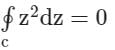
Let z = x + iy be a complex variable. Consider that contour integration is performed along the unit circle in anticlockwise direction. Which one of the following statements is Not True?- a)The residue of z/z2 - 1 at z = 1 is 1/2
- b)
- c)
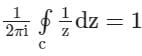
- d)
 (Complex conjugate of z) is an analytical function
Correct answer is option 'D'. Can you explain this answer?
Let z = x + iy be a complex variable. Consider that contour integration is performed along the unit circle in anticlockwise direction. Which one of the following statements is Not True?
a)
The residue of z/z2 - 1 at z = 1 is 1/2
b)
c)
d)
(Complex conjugate of z) is an analytical function| | Vertex Academy answered |
Residue of

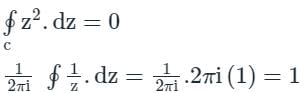
z = x + iy and = x − iy i.e.u = x and v = − y
ux = 1 and vy = −1
uX ≠ vy → is not Analytic Analytic
z = x + iy and
= x − iy i.e.u = x and v = − yux = 1 and vy = −1
uX ≠ vy →
is not Analytic AnalyticIf u = x2 – y2, then the conjugate harmonic function is- a)2xy
- b)x2 + y2
- c)y2 – x2
- d)-x2 – y2
Correct answer is option 'A'. Can you explain this answer?
If u = x2 – y2, then the conjugate harmonic function is
a)
2xy
b)
x2 + y2
c)
y2 – x2
d)
-x2 – y2
| | Sanya Agarwal answered |
Concept:
If two functions u and v satisfy Cauchy-Riemann equations, then they are said to be harmonic conjugates with respect to each other.
Cauchy-Riemann equations are
vy = ux
vx = - uy
vy = ux
vx = - uy
Calculation:
Given u = x2 – y2, let v be the harmonic conjugate.
By Cauchy-Riemann equations,
vy = ux = 2x; vx = - uy = - (-2y) = 2y;
We have dv = vx dx + vy dy
⇒ dv = 2y dx + 2x dy = d(2xy)
⇒ v = 2xy + k or v = 2xy
∴ The conjugate harmonic function is 2xy
∴ The conjugate harmonic function is 2xy
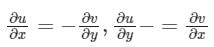
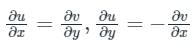
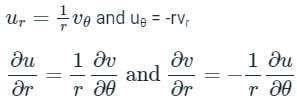
The Cauchy Riemann equations for f(z) = u(x, y) + iv(x, y) to be analytic are:- a)
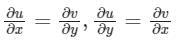
- b)
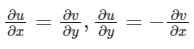
- c)
- d)

Correct answer is option 'B'. Can you explain this answer?
The Cauchy Riemann equations for f(z) = u(x, y) + iv(x, y) to be analytic are:
a)
b)
c)
d)
| | Sanvi Kapoor answered |
Concept:
Cauchy-Riemann equations:
Rectangular form:
f(z) = u(x, y) + f v(x, y)
f(z) to be analytic it needs to satisfy Cauchy Riemann equations
ux = vy, uy = -vx
Polar form:
f(z) = u(r, θ) + f v(r, θ)
Polar form:
f(z) = u(r, θ) + f v(r, θ)
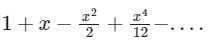
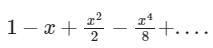
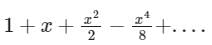
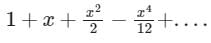
The Maclaurin's series expansion of esin x is- a)
- b)
- c)
- d)
Correct answer is option 'C'. Can you explain this answer?
The Maclaurin's series expansion of esin x is
a)
b)
c)
d)
| | Sanya Agarwal answered |
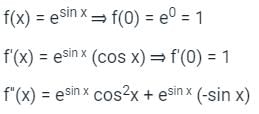
f''(0) = 1
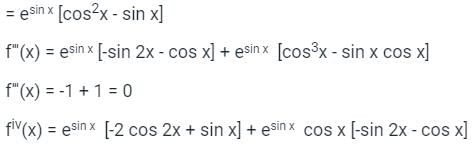
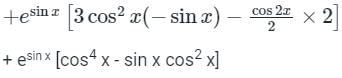
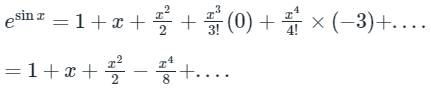
fiv(0) = -2 -1 -1 + 1 = -3
Substitue in Maclaurin Series
Which of the following statements is FALSE?- a)If a sequence X of real numbers converges to a real number and has two convergent subsequences X' and X" whose limits are not equal, then X is divergent.
- b)A Cauchy sequence of real numbers is unbounded.
- c)If a sequence (xn) of real number converges to a real number x, then any subsequence (xnK) of (xn) also converges to x.
- d)A bounded sequence of real numbers has a convergent subsequence.
Correct answer is option 'B'. Can you explain this answer?
Which of the following statements is FALSE?
a)
If a sequence X of real numbers converges to a real number and has two convergent subsequences X' and X" whose limits are not equal, then X is divergent.
b)
A Cauchy sequence of real numbers is unbounded.
c)
If a sequence (xn) of real number converges to a real number x, then any subsequence (xnK) of (xn) also converges to x.
d)
A bounded sequence of real numbers has a convergent subsequence.
| | Sanya Agarwal answered |
All the statements given are verified by different theorems,
Theorem: If a sequence converges then all subsequences converge and all convergent subsequences converge to the same limit (Option 3)
Theorem: Every bounded sequence has a convergent subsequence (Option 4)
Theorem: If {an}n∈N is a sequence that either has a subsequence that diverges or two convergent subsequences with different limits then {an}n∈N is divergent (Option 1)
Theorem:
1) A sequence {an} of real numbers is called a Cauchy sequence if for each ϵ > 0 there is a number N ∈ N so that if m, n > N then |an − am| < ϵ.
2) If a real sequence {an} converges, then for every ε > 0, there exists N ∈ N such that |an − am| < ε ∀ n,m ≥ N
3) Convergent sequences are Cauchy sequences.
A Cauchy sequence of real numbers is bounded (Option 2 is false)
A sequence is a convergent sequence if and only if it is a Cauchy sequence.
Chapter doubts & questions for Complex variables - 3 Months Preparation for GATE Electrical 2026 is part of Electrical Engineering (EE) exam preparation. The chapters have been prepared according to the Electrical Engineering (EE) exam syllabus. The Chapter doubts & questions, notes, tests & MCQs are made for Electrical Engineering (EE) 2026 Exam. Find important definitions, questions, notes, meanings, examples, exercises, MCQs and online tests here.
Chapter doubts & questions of Complex variables - 3 Months Preparation for GATE Electrical in English & Hindi are available as part of Electrical Engineering (EE) exam. Download more important topics, notes, lectures and mock test series for Electrical Engineering (EE) Exam by signing up for free.
3 Months Preparation for GATE Electrical676 videos|1399 docs|882 tests |
