


All Exams > Electrical Engineering (EE) > 3 Months Preparation for GATE Electrical > All Questions
All questions of Controllers & Compensators for Electrical Engineering (EE) Exam
Direction: The following item consists of two statements, one labelled as ‘Statement (I)’ and the other as ‘Statement (II)’. Examine these two statements carefully and select the answers to these items using the code given below:Statement I: For type-II or higher systems, lead compensator may be used.
Statement II: Lead compensator increases the margin of stability.- a)Both Statement I and Statement II are individually true and Statement II is the correct explanation of Statement I
- b)Both Statement I and Statement II are individually true but Statement II is not the correct explanation of Statement I
- c)Statement I is true but Statement II is false
- d)Statement I is false but Statement II is true
Correct answer is option 'A'. Can you explain this answer?
Direction: The following item consists of two statements, one labelled as ‘Statement (I)’ and the other as ‘Statement (II)’. Examine these two statements carefully and select the answers to these items using the code given below:
Statement I: For type-II or higher systems, lead compensator may be used.
Statement II: Lead compensator increases the margin of stability.
Statement II: Lead compensator increases the margin of stability.
a)
Both Statement I and Statement II are individually true and Statement II is the correct explanation of Statement I
b)
Both Statement I and Statement II are individually true but Statement II is not the correct explanation of Statement I
c)
Statement I is true but Statement II is false
d)
Statement I is false but Statement II is true
 | Pioneer Academy answered |
In general, there are two situations in which compensation is required.
- In the first case, the system is absolutely unstable, and the compensation is required to stabilize it as well as to achieve a specified performance.
- In the second case, the system is stable, but the compensation is required to obtain the desired performance.
The systems which are of type-2 or higher are usually absolutely unstable. For type-2 or higher systems, only the lead compensator is required because only the lead compensator improves the margin of stability.
Both Statement I and Statement II are individually true and Statement II is the correct explanation of Statement I
Note: In type-1 and type-0 systems, stable operation is always possible if the gain is sufficiently reduced. In such cases, any of the three compensators, lead, lag, lag-lead may be used to obtain the desired performance.
Both Statement I and Statement II are individually true and Statement II is the correct explanation of Statement I
Note: In type-1 and type-0 systems, stable operation is always possible if the gain is sufficiently reduced. In such cases, any of the three compensators, lead, lag, lag-lead may be used to obtain the desired performance.

In the phase lead compensation network, the phase of ______ leads the phase of ______.- a)input voltage, output voltage
- b)input voltage, input voltage
- c)output voltage, input voltage
- d)output voltage, output voltage
Correct answer is option 'C'. Can you explain this answer?
In the phase lead compensation network, the phase of ______ leads the phase of ______.
a)
input voltage, output voltage
b)
input voltage, input voltage
c)
output voltage, input voltage
d)
output voltage, output voltage
 | Machine Experts answered |
Lead compensator:
Transfer function:
Transfer function:
If it is in the form of  then a < 1
then a < 1If it is in the form of  then a > b
In the frequency domain,

Phase angle, ∠G (jω) = tan−1ωαT − tan−1ωT
then a > bIn the frequency domain,
Phase angle, ∠G (jω) = tan−1ωαT − tan−1ωT
ϕ = tan-1 ωaT – tan-1 ωT
As a > 1 always (from the definition), ϕ is positive
Hence, it is clear that the phase of output voltage leads the phase of the input voltage.
As a > 1 always (from the definition), ϕ is positive
Hence, it is clear that the phase of output voltage leads the phase of the input voltage.
Which of the following is NOT the disadvantage of lag compensator in a control system?- a)In lag compensator, the attenuation offered by it shifts the gain crossover frequency to a lower point, thereby decreasing the bandwidth.
- b)The lag network offers a reduction in bandwidth, and this gives shorter rise time and settling time and so the transient response.
- c)A lag compensator somewhat acts as a proportional plus integral controller, hence adversely affects the stability of the system.
- d)Though the system response is longer due to decreased bandwidth, the response is quite slow
Correct answer is option 'B'. Can you explain this answer?
Which of the following is NOT the disadvantage of lag compensator in a control system?
a)
In lag compensator, the attenuation offered by it shifts the gain crossover frequency to a lower point, thereby decreasing the bandwidth.
b)
The lag network offers a reduction in bandwidth, and this gives shorter rise time and settling time and so the transient response.
c)
A lag compensator somewhat acts as a proportional plus integral controller, hence adversely affects the stability of the system.
d)
Though the system response is longer due to decreased bandwidth, the response is quite slow
 | Zoya Sharma answered |
Advantages of Lag Compensator:
- A phase lag network offers high gain at low frequency. Thus, it performs the function of a low pass filter.
- The introduction of this network increases the steady-state performance of the system.
- The lag network offers a reduction in bandwidth and this provides longer rise time and settling time and so the transient response.
- The angular contribution of the pole is more than that of the compensator zero because the pole dominates the zero in the lag compensator.
Advantages of Lead Compensator:
- It improves the damping of the overall system.
- The enhanced damping of the system supports less overshoot along with less rise time and settling time. Therefore, the transient response gets improved.
- The addition of a lead network improves the phase margin.
- A system with a lead network provides a quick response as it increases bandwidth thereby providing a faster response.
- Lead networks do not disturb the steady-state error of the system.
- It maximizes the velocity constant of the system.


The compensator required to improve the steady state response of a system is- a)Lag
- b)Lead
- c)Lag-lead
- d)Zero
Correct answer is option 'A'. Can you explain this answer?
The compensator required to improve the steady state response of a system is
a)
Lag
b)
Lead
c)
Lag-lead
d)
Zero
 | Ravi Singh answered |
Lag compensator:
Transfer function:
Transfer function:
If it is in the form of  then a < 1
then a < 1If it is in the form of  then a > b
Maximum phase lag frequency:
ωm = 1√Ta
Maximum phase lag::
then a > bMaximum phase lag frequency:
ωm = 1√Ta
Maximum phase lag::
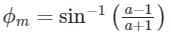
ϕm is negative
Pole zero plot:
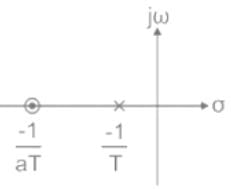
The pole is nearer to the origin.
Filter: It is a low pass filter (LPF)
Effect on the system:
Filter: It is a low pass filter (LPF)
Effect on the system:
- Rise time and settling time increases and Bandwidth decreases
- The transient response becomes slower
- The steady-state response is improved
- Stability decreases
What is the full form of PID?- a)Proportional Integral Derivative
- b)Proportional Integral Device
- c)Programmable Integral Device
- d)Programmable Integral Derivative
Correct answer is option 'A'. Can you explain this answer?
What is the full form of PID?
a)
Proportional Integral Derivative
b)
Proportional Integral Device
c)
Programmable Integral Device
d)
Programmable Integral Derivative
 | Pooja Patel answered |
Proportion + Integral + Derivative (PID):
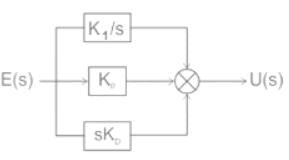
The PID controller produces on output, which is the combination of outputs of proportional, integral, and derivative controllers.
This is defined in terms of differential equations as:

Applying Laplace transform, we get:

Transfer function will be:

Integral control:

It is the control mode where the controller Output is proportional to the integral of the error with respect to time.
Applying Laplace transform, we get:
Transfer function will be:
Integral control:
It is the control mode where the controller Output is proportional to the integral of the error with respect to time.
Integral controller output = k × integral of error with time, i.e.
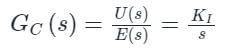
Proportional + Derivate:
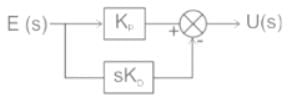
Proportional + Derivate:
The additive combination of proportional & Derivative control is known as P-D control.
Overall transfer function for a PD controller is given by:

It is equivalent to a High-pass filter.
It is equivalent to a High-pass filter.
Given a badly underdamped control system, the type of cascade compensator to be used to improve its damping is- a)phase-lag
- b)phase-lead-lag
- c)phase-lead
- d)notch filter
Correct answer is option 'C'. Can you explain this answer?
Given a badly underdamped control system, the type of cascade compensator to be used to improve its damping is
a)
phase-lag
b)
phase-lead-lag
c)
phase-lead
d)
notch filter
 | Yash Patel answered |
Phase Lead Compensator:
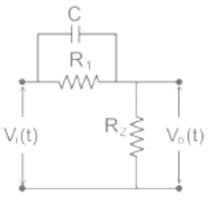
- A lead compensator provides a positive phase shift for increasing the value of frequencies from 0 to ∞.
- It is also known as a differentiator circuit.
- For a lead network, zero is nearer to the origin.
- It is used to improve the transient response of the system.
- It increases the damping of the system.
Phase Lag Compensator:
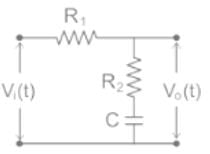
- A lead compensator provides a negative phase shift for increasing the value of frequencies from 0 to ∞.
- It is also known as an integrator circuit.
- For a lag network, pole is nearer to the origin.
- It is used to improve the steady state response of the system.
- It decreases the steady-state error of the system.
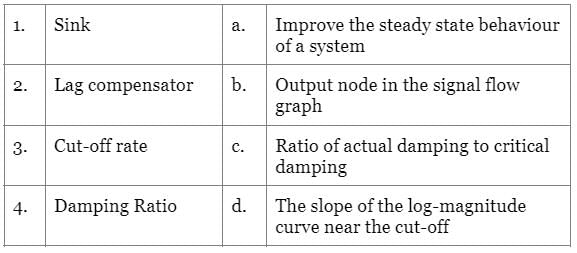
Match the following :-
- a)1 - b, 2 - a, 3 - d, 4 - c
- b)1 - a, 2 - b, 3 - c, 4 - d
- c)1 - c, 2 - d, 3 - b, 4 - a
- d)1 - a, 2 - d, 3 - c, 4 - b
Correct answer is option 'A'. Can you explain this answer?
Match the following :-
a)
1 - b, 2 - a, 3 - d, 4 - c
b)
1 - a, 2 - b, 3 - c, 4 - d
c)
1 - c, 2 - d, 3 - b, 4 - a
d)
1 - a, 2 - d, 3 - c, 4 - b
| | Machine Experts answered |
Sink node:
- A local sink is a node of a directed graph with no exiting edges, also called a terminal.
- It is the output node in the signal flow graph. It is a node, which has only incoming branches.
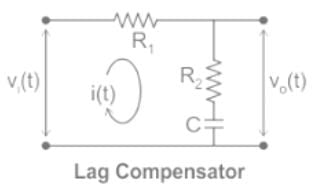
Lag Compensator:
- Phase lag network offers high gain at low frequency.
- Thus, it performs the function of a low pass filter.
- The introduction of this network increases the steady-state performance of the system.
Damping Ratio:
- The damping ratio gives the level of damping in the control system related to critical damping.
- The damping ratio is defined as the ratio of actual damping to the critical damping of the system.
- It is the ratio of the damping coefficient of a differential equation of a system to the damping coefficient of critical damping.
- ζ = actual damping / critical damping
Cut-off rate: It is the slope of the log-magnitude curve near the cut-off region of the Bode-plot.
Consider the following statements regarding a control system:(a) Addition of pole to left half of s-plane reduce the relative stability(b) Addition of zero to left half of s-plane increase the damping factor(c) Integral controller reduces the steady state error(d) Derivate controller cannot be used in isolationWhich of the above statements are true?- a)(a) & (c) only
- b)(b) & (d) only
- c)(a), (b), (d) only
- d)All (a), (b), (c), (d)
Correct answer is option 'D'. Can you explain this answer?
Consider the following statements regarding a control system:
(a) Addition of pole to left half of s-plane reduce the relative stability
(b) Addition of zero to left half of s-plane increase the damping factor
(c) Integral controller reduces the steady state error
(d) Derivate controller cannot be used in isolation
Which of the above statements are true?
a)
(a) & (c) only
b)
(b) & (d) only
c)
(a), (b), (d) only
d)
All (a), (b), (c), (d)
| | Pooja Patel answered |
(a) Addition of pole reduces stability
Consider system =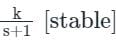
Adding Pole [say at origin]

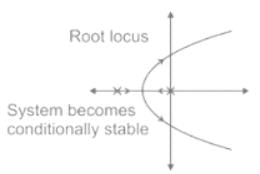
(b) Addition of zero increase ξ
Consider system with Transfer function
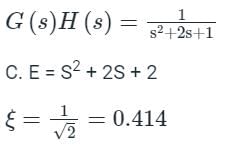
Now add one zero to left half say at -2
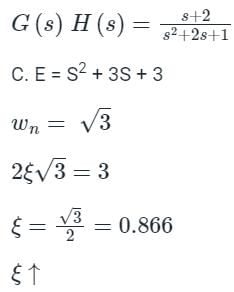
(c) Integral controller adds one pole at origin
Now add one zero to left half say at -2
(c) Integral controller adds one pole at origin
As type of system increase steady state error reduce
(d) Derivative controllers are not used Alone because with sudden changes in the system the derivative controller will compensate the output fast therefore in long term effects the isolated controller will produce huge steady state errors.
Phase lead compensation- a)increases bandwidth and increases steady-state error
- b)decreases bandwidth and decreases steady-state error
- c)will not affect bandwidth but decreases steady-state error
- d)increases bandwidth but will not affect steady-state error
Correct answer is option 'D'. Can you explain this answer?
Phase lead compensation
a)
increases bandwidth and increases steady-state error
b)
decreases bandwidth and decreases steady-state error
c)
will not affect bandwidth but decreases steady-state error
d)
increases bandwidth but will not affect steady-state error
 | Aman Datta answered |
Phase lead compensation is a technique used in control systems to improve the performance of the system. It involves adding a lead compensator to the open-loop transfer function of the system. The lead compensator introduces a phase lead at a specific frequency, which helps to increase the overall phase margin of the system.
Effect on Bandwidth:
Adding a phase lead compensator increases the bandwidth of the system. The bandwidth of a system is the range of frequencies over which the system can respond effectively. By introducing a phase lead at a specific frequency, the phase lead compensator helps to extend the range of frequencies over which the system can operate accurately. This increase in bandwidth allows the system to respond more quickly to changes in the input signal.
Effect on Steady-State Error:
Steady-state error is a measure of the difference between the desired output and the actual output of a system when the input signal is constant. Adding a phase lead compensator does not have a direct effect on the steady-state error of the system. The steady-state error is mainly determined by other factors such as the type of system (e.g., type 0, type 1, etc.), the presence of disturbances, and the gain of the system.
Conclusion:
Based on the given options, the correct answer is option 'D' - adding a phase lead compensator increases the bandwidth but will not affect the steady-state error. This is because the phase lead compensator primarily improves the system's stability and response time by increasing the phase margin and bandwidth. However, it does not directly influence the steady-state error, which is determined by other factors.
Effect on Bandwidth:
Adding a phase lead compensator increases the bandwidth of the system. The bandwidth of a system is the range of frequencies over which the system can respond effectively. By introducing a phase lead at a specific frequency, the phase lead compensator helps to extend the range of frequencies over which the system can operate accurately. This increase in bandwidth allows the system to respond more quickly to changes in the input signal.
Effect on Steady-State Error:
Steady-state error is a measure of the difference between the desired output and the actual output of a system when the input signal is constant. Adding a phase lead compensator does not have a direct effect on the steady-state error of the system. The steady-state error is mainly determined by other factors such as the type of system (e.g., type 0, type 1, etc.), the presence of disturbances, and the gain of the system.
Conclusion:
Based on the given options, the correct answer is option 'D' - adding a phase lead compensator increases the bandwidth but will not affect the steady-state error. This is because the phase lead compensator primarily improves the system's stability and response time by increasing the phase margin and bandwidth. However, it does not directly influence the steady-state error, which is determined by other factors.
Assertion (A): Introduction of phase lag network in forward path increases the phase shift.
Reason (R): A phase lag network has pole nearer to the imaginary axis as compared to zero.- a)Both A and R are true and R is a correct explanation of A.
- b)Both A and R are true but R is not a correct explanation of A.
- c)A is true but R is false.
- d)A is false but R is true.
Correct answer is option 'D'. Can you explain this answer?
Assertion (A): Introduction of phase lag network in forward path increases the phase shift.
Reason (R): A phase lag network has pole nearer to the imaginary axis as compared to zero.
Reason (R): A phase lag network has pole nearer to the imaginary axis as compared to zero.
a)
Both A and R are true and R is a correct explanation of A.
b)
Both A and R are true but R is not a correct explanation of A.
c)
A is true but R is false.
d)
A is false but R is true.
 | Mira Mukherjee answered |
Understanding Phase Lag Networks
In control systems, the behavior of phase lag networks is crucial for understanding their effects on system stability and response.
Assertion (A)
- The assertion claims that introducing a phase lag network in the forward path increases the phase shift.
- This statement is false because a phase lag network actually decreases the phase shift in a system.
- Phase lag networks introduce a delay in the response, leading to a reduction in the overall phase.
Reason (R)
- The reason states that a phase lag network has a pole nearer to the imaginary axis compared to a zero.
- This statement is true as phase lag networks are characterized by having a specific configuration of poles and zeros that influences the phase response.
- The pole being closer to the imaginary axis signifies that it contributes less to the phase shift than a zero would, validating the nature of phase lag networks.
Conclusion
- Since Assertion (A) is false and Reason (R) is true, the correct option is D: "A is false but R is true."
- Understanding these concepts helps in designing systems with desired stability and performance characteristics.
Key Takeaway
- In control systems, it is essential to recognize the implications of phase lag networks on phase shifts to ensure effective system design and analysis.
In control systems, the behavior of phase lag networks is crucial for understanding their effects on system stability and response.
Assertion (A)
- The assertion claims that introducing a phase lag network in the forward path increases the phase shift.
- This statement is false because a phase lag network actually decreases the phase shift in a system.
- Phase lag networks introduce a delay in the response, leading to a reduction in the overall phase.
Reason (R)
- The reason states that a phase lag network has a pole nearer to the imaginary axis compared to a zero.
- This statement is true as phase lag networks are characterized by having a specific configuration of poles and zeros that influences the phase response.
- The pole being closer to the imaginary axis signifies that it contributes less to the phase shift than a zero would, validating the nature of phase lag networks.
Conclusion
- Since Assertion (A) is false and Reason (R) is true, the correct option is D: "A is false but R is true."
- Understanding these concepts helps in designing systems with desired stability and performance characteristics.
Key Takeaway
- In control systems, it is essential to recognize the implications of phase lag networks on phase shifts to ensure effective system design and analysis.
A phase lead compensation network- a)speeds up the dynamic response
- b)decreases the system bandwidth
- c)reduces the steady state error
- d)is applied when error constants are specified
Correct answer is option 'D'. Can you explain this answer?
A phase lead compensation network
a)
speeds up the dynamic response
b)
decreases the system bandwidth
c)
reduces the steady state error
d)
is applied when error constants are specified
 | Sarthak Sharma answered |
Phase Lead Compensation Network: Explanation of Answer D
Introduction:
Phase lead compensation is a type of frequency domain compensation technique used in control systems to stabilize the closed-loop system, increase its phase margin, and improve its transient response. A phase lead compensation network is a circuit that introduces a phase lead in the transfer function of the plant to improve its stability and performance.
Answer Explanation:
The correct answer is option D, which states that the phase lead compensation network is applied when error constants are specified.
Explanation:
Error constants are the steady-state errors of a control system, which indicate the difference between the desired output and the actual output of the system. The error constants are used to measure the accuracy and precision of the control system. The phase lead compensation network is used to reduce the steady-state error of the system, which means that the output of the system will be closer to the desired output. Therefore, the phase lead compensation network is applied when error constants are specified to achieve better accuracy and precision of the system.
Other Options:
Option A: Speeding up the dynamic response is the purpose of phase lag compensation, which introduces a phase lag in the transfer function of the plant to reduce the overshoot and the settling time of the system.
Option B: Decreasing the system bandwidth is the purpose of low-pass filters, which attenuate the high-frequency components of the input signal to reduce the noise and the distortion in the output signal.
Option C: Reducing the steady-state error is the purpose of integral compensation, which introduces an integrator in the transfer function of the plant to eliminate the steady-state error of the system.
Conclusion:
In conclusion, the phase lead compensation network is applied when error constants are specified to reduce the steady-state error of the control system. The other options are not correct because they describe different compensation techniques with different purposes.
Introduction:
Phase lead compensation is a type of frequency domain compensation technique used in control systems to stabilize the closed-loop system, increase its phase margin, and improve its transient response. A phase lead compensation network is a circuit that introduces a phase lead in the transfer function of the plant to improve its stability and performance.
Answer Explanation:
The correct answer is option D, which states that the phase lead compensation network is applied when error constants are specified.
Explanation:
Error constants are the steady-state errors of a control system, which indicate the difference between the desired output and the actual output of the system. The error constants are used to measure the accuracy and precision of the control system. The phase lead compensation network is used to reduce the steady-state error of the system, which means that the output of the system will be closer to the desired output. Therefore, the phase lead compensation network is applied when error constants are specified to achieve better accuracy and precision of the system.
Other Options:
Option A: Speeding up the dynamic response is the purpose of phase lag compensation, which introduces a phase lag in the transfer function of the plant to reduce the overshoot and the settling time of the system.
Option B: Decreasing the system bandwidth is the purpose of low-pass filters, which attenuate the high-frequency components of the input signal to reduce the noise and the distortion in the output signal.
Option C: Reducing the steady-state error is the purpose of integral compensation, which introduces an integrator in the transfer function of the plant to eliminate the steady-state error of the system.
Conclusion:
In conclusion, the phase lead compensation network is applied when error constants are specified to reduce the steady-state error of the control system. The other options are not correct because they describe different compensation techniques with different purposes.
The action of a PD controller is to- a)increase the rise time and steady state error of the system.
- b)reduce the rise time and increase the steady error of the system.
- c)maintain a constant value of rise time and reduce the steady state error of the system.
- d)reduce the rise time and maintain a constant value of steady state error of the system.
Correct answer is option 'D'. Can you explain this answer?
The action of a PD controller is to
a)
increase the rise time and steady state error of the system.
b)
reduce the rise time and increase the steady error of the system.
c)
maintain a constant value of rise time and reduce the steady state error of the system.
d)
reduce the rise time and maintain a constant value of steady state error of the system.
 | Athul Banerjee answered |
Understanding PD Controllers
A Proportional-Derivative (PD) controller plays a crucial role in control systems by adjusting the output based on the current error and the rate of change of that error.
Key Characteristics of PD Controllers:
- Rise Time Reduction:
- PD controllers effectively reduce the rise time of a system. This means the system will reach its setpoint faster, improving responsiveness.
- Steady-State Error Maintenance:
- While a PD controller can help in speeding up the system response, it does not eliminate steady-state error. The steady-state error remains constant, which is a characteristic of systems controlled solely by PD controllers.
Why Option D is Correct:
- Reduction in Rise Time:
- The derivative action predicts future behavior and thus helps in adjusting the control output preemptively. This proactive approach results in a quicker response time.
- Constant Steady-State Error:
- The proportional term addresses the immediate error, but without an integral component, the steady-state error remains unaffected. Thus, the steady-state error is maintained at its original level.
Conclusion:
In summary, a PD controller is effective in enhancing system dynamics by reducing rise time while keeping the steady-state error constant. This makes option 'D' the correct choice, as it accurately reflects the impact of a PD controller on system performance.
A Proportional-Derivative (PD) controller plays a crucial role in control systems by adjusting the output based on the current error and the rate of change of that error.
Key Characteristics of PD Controllers:
- Rise Time Reduction:
- PD controllers effectively reduce the rise time of a system. This means the system will reach its setpoint faster, improving responsiveness.
- Steady-State Error Maintenance:
- While a PD controller can help in speeding up the system response, it does not eliminate steady-state error. The steady-state error remains constant, which is a characteristic of systems controlled solely by PD controllers.
Why Option D is Correct:
- Reduction in Rise Time:
- The derivative action predicts future behavior and thus helps in adjusting the control output preemptively. This proactive approach results in a quicker response time.
- Constant Steady-State Error:
- The proportional term addresses the immediate error, but without an integral component, the steady-state error remains unaffected. Thus, the steady-state error is maintained at its original level.
Conclusion:
In summary, a PD controller is effective in enhancing system dynamics by reducing rise time while keeping the steady-state error constant. This makes option 'D' the correct choice, as it accurately reflects the impact of a PD controller on system performance.
The pole-zero plot shown below represents a
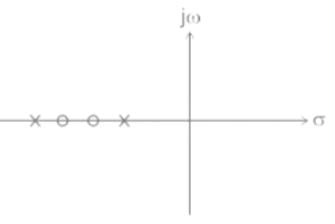
- a)Lag-lead compensating network
- b)PD controller
- c)PID controller
- d)None of the above
Correct answer is option 'A'. Can you explain this answer?
The pole-zero plot shown below represents a
a)
Lag-lead compensating network
b)
PD controller
c)
PID controller
d)
None of the above
| | Zoya Sharma answered |
Concept:
The speed of response and, the steady-state error can be simultaneously improved if both phase-lag and phase-lead compensation networks are used. However, instead of using two separate lag and lead networks, a single network combining both can be used.
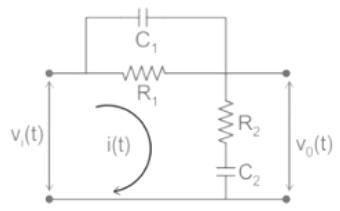
The speed of response and, the steady-state error can be simultaneously improved if both phase-lag and phase-lead compensation networks are used. However, instead of using two separate lag and lead networks, a single network combining both can be used.
Lag-lead compensator:
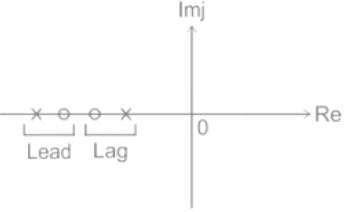
In the lag-lead compensator network, the lag compensator is nearer to the origin.
In the lag-lead compensator network, the lag compensator is nearer to the origin.
Lead-lag compensator:
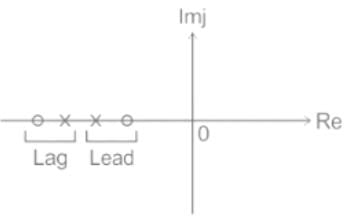
In the lead-lag compensator network, the lead compensator is nearer to the origin.
A first order dynamic linear system with a proportional controller exhibits an offset to a unit step input. The offset can be reduced by- a)increasing the proportional gain
- b)adding derivative mode
- c)adding integral mode
- d)decreasing the porportional gain
Correct answer is option 'C'. Can you explain this answer?
A first order dynamic linear system with a proportional controller exhibits an offset to a unit step input. The offset can be reduced by
a)
increasing the proportional gain
b)
adding derivative mode
c)
adding integral mode
d)
decreasing the porportional gain
 | Kritika Gupta answered |
One of the disadvantage of a proportional controller is that it exhibits a permanent residual error at its operating point known as offset and
given by The offset can be
reduced by adding integral mode.
given by
The offset can bereduced by adding integral mode.
Which of the following is not correct with respect to a phase-lead compensation network?- a)It increases system bandwidth
- b)It increases gain at higher frequencies
- c)It is used when fast transient response is required
- d)It is used when decrease rapidly near crossover frequency
Correct answer is option 'D'. Can you explain this answer?
Which of the following is not correct with respect to a phase-lead compensation network?
a)
It increases system bandwidth
b)
It increases gain at higher frequencies
c)
It is used when fast transient response is required
d)
It is used when decrease rapidly near crossover frequency
 | Shivam Das answered |
Understanding Phase-Lead Compensation
Phase-lead compensation is a technique used in control systems to improve stability and performance. Let's analyze why option 'D' is incorrect.
Key Characteristics of Phase-Lead Compensation:
- Increases System Bandwidth:
- Phase-lead compensation increases the bandwidth of the system. This allows the system to respond more quickly to changes in input.
- Increases Gain at Higher Frequencies:
- It provides an increase in gain at higher frequencies, which enhances the system's ability to track fast changes in input signals.
- Fast Transient Response:
- This compensation technique is particularly beneficial when fast transient responses are desired. It reduces the settling time and improves the overall responsiveness of the system.
Why Option 'D' is Incorrect:
- Decrease Rapidly Near Crossover Frequency:
- This statement is misleading. In a phase-lead compensation network, the phase margin is increased, and the gain does not decrease rapidly near the crossover frequency. Instead, the network is designed to maintain or even enhance the gain within the crossover region, leading to a more stable and responsive system.
Conclusion:
In summary, phase-lead compensation is characterized by its ability to enhance system performance. It does not lead to a rapid decrease in gain near the crossover frequency, making option 'D' the incorrect statement.
Phase-lead compensation is a technique used in control systems to improve stability and performance. Let's analyze why option 'D' is incorrect.
Key Characteristics of Phase-Lead Compensation:
- Increases System Bandwidth:
- Phase-lead compensation increases the bandwidth of the system. This allows the system to respond more quickly to changes in input.
- Increases Gain at Higher Frequencies:
- It provides an increase in gain at higher frequencies, which enhances the system's ability to track fast changes in input signals.
- Fast Transient Response:
- This compensation technique is particularly beneficial when fast transient responses are desired. It reduces the settling time and improves the overall responsiveness of the system.
Why Option 'D' is Incorrect:
- Decrease Rapidly Near Crossover Frequency:
- This statement is misleading. In a phase-lead compensation network, the phase margin is increased, and the gain does not decrease rapidly near the crossover frequency. Instead, the network is designed to maintain or even enhance the gain within the crossover region, leading to a more stable and responsive system.
Conclusion:
In summary, phase-lead compensation is characterized by its ability to enhance system performance. It does not lead to a rapid decrease in gain near the crossover frequency, making option 'D' the incorrect statement.
If r = 1 in the G(s) =  then the compensator can give the minimum phase at a frequency of
- a)
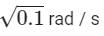
- b)0.777 rad / s
- c)1 rad / s
- d)

Correct answer is option 'D'. Can you explain this answer?
If r = 1 in the G(s) = then the compensator can give the minimum phase at a frequency of
then the compensator can give the minimum phase at a frequency ofa)
b)
0.777 rad / s
c)
1 rad / s
d)
| | Machine Experts answered |
Concept:
Lead and Lag compensators:
Gc(s) = (1 + aTs) / (1 + Ts) where a and T > 0, a > 1 (lead) & a < 1 (lag)
∠Gc(s) = ϕ = tan-1 ωaT – tan-1 ωT
ωm is the geometric mean of the two corner frequencies 1/T and 1/aT
ωm = 1/T√α
Lead and Lag compensators:
Gc(s) = (1 + aTs) / (1 + Ts) where a and T > 0, a > 1 (lead) & a < 1 (lag)
∠Gc(s) = ϕ = tan-1 ωaT – tan-1 ωT
ωm is the geometric mean of the two corner frequencies 1/T and 1/aT
ωm = 1/T√α
Calculations:
Given Gc(s) =
r = 1
By substituting r value we get Gc(s) =
Here T = 1 and a = 0.1

Given Gc(s) =
r = 1
By substituting r value we get Gc(s) =
Here T = 1 and a = 0.1
The transfer function  represents a
- a)lag network
- b)lead network
- c)lag-lead network
- d)proportional controller
Correct answer is option 'A'. Can you explain this answer?
The transfer function represents a
represents aa)
lag network
b)
lead network
c)
lag-lead network
d)
proportional controller
| | Zoya Sharma answered |
Concept:
Lag compensator:
Transfer function:
If it is in the form of then a < 1
If it is in the form of then a > b
Maximum phase lag frequency:
ωm = 1/T√a
Maximum phase lag: ϕm = sin−1(α−1/α+1)
ϕm is negative
Pole zero plot:
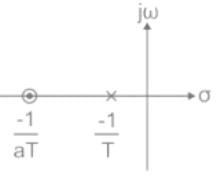
The pole is nearer to the origin.
Given:
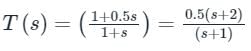
Zero = -2
Pole = -1
Analysis:
The pole-zero plot of T(s) is as shown:
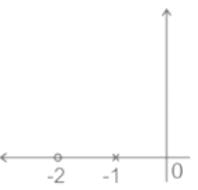
Since the pole is closer to the origin than zero.
It is a lag compensator.
Lag compensator:
Transfer function:
If it is in the form of
then a < 1If it is in the form of
then a > bMaximum phase lag frequency:
ωm = 1/T√a
Maximum phase lag: ϕm = sin−1(α−1/α+1)
ϕm is negative
Pole zero plot:
The pole is nearer to the origin.
Given:
Zero = -2
Pole = -1
Analysis:
The pole-zero plot of T(s) is as shown:
Since the pole is closer to the origin than zero.
It is a lag compensator.
A system employing proportional plus error rate control is shown in figure below.
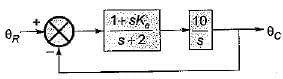
The value of error rate control (Ke) and 2% settling time for a damping ratio of 0.5 are respectively- a)0.116 and 2.53 sec
- b)0.265 and 0.116 sec
- c)0.116 and 0.265 sec
- d)0.265 and 2.53 se
Correct answer is option 'A'. Can you explain this answer?
A system employing proportional plus error rate control is shown in figure below.
The value of error rate control (Ke) and 2% settling time for a damping ratio of 0.5 are respectively
The value of error rate control (Ke) and 2% settling time for a damping ratio of 0.5 are respectively
a)
0.116 and 2.53 sec
b)
0.265 and 0.116 sec
c)
0.116 and 0.265 sec
d)
0.265 and 2.53 se
 | Prisha Sen answered |
The forward path gain of the given system is:
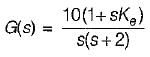
∴ Characteristic equation is
1 + G(s)H(s) = 0
or
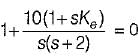
or, s2 + (2 + 10 Ke)s +10 = 0
Here,
ωn = √10 rad/s
and 2ξωn = (2 + 10Ke)
Given, ξ = 0.5
So, 2 x 0.5 x √10 = (2 + 10Ke)
or,
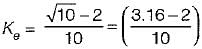
= 1.16/10 = 0.116
Also, 2% settling time

∴ Characteristic equation is
1 + G(s)H(s) = 0
or
or, s2 + (2 + 10 Ke)s +10 = 0
Here,
ωn = √10 rad/s
and 2ξωn = (2 + 10Ke)
Given, ξ = 0.5
So, 2 x 0.5 x √10 = (2 + 10Ke)
or,
= 1.16/10 = 0.116
Also, 2% settling time
Which of the following is a correct statement?- a)PI controllers improves steady state response
- b)PD controllers improves transient response
- c)Both (a) & (b)
- d)None of these
Correct answer is option 'C'. Can you explain this answer?
Which of the following is a correct statement?
a)
PI controllers improves steady state response
b)
PD controllers improves transient response
c)
Both (a) & (b)
d)
None of these
| | Pooja Patel answered |
Concept:
Proportional + Derivate(PD):
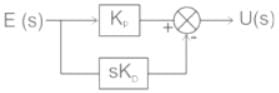
The additive combination of proportional & Derivative control is known as P-D control.
Proportional + Derivate(PD):
The additive combination of proportional & Derivative control is known as P-D control.
The overall transfer function for a PD controller is given by:
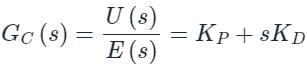
PD controller is nothing but a differentiator (or) a High Pass Filter.
PD controller is nothing but a differentiator (or) a High Pass Filter.
The frequency of noise is very high.
So this high pass filter will allow noise into the system which results in noise amplification.
PD Controllers reduce the response time and thus improve transient response
Effects of Proportional Derivative (PD) controllers:
- Decreases the type of the system by one
- Reduces the rise time and settling time
- It has high sensitivity.
- Rise time and settling time decreases and Bandwidth increases
- The speed of response is increased i.e. the transient response is improved
- Improves gain margin, phase margin, and resonant peak
- Increases the input noise
- Improves the stability
Proportional Integral Controller:
This controller resembles the combination of the proportional and integral controller.
The structure of this controller is shown below:
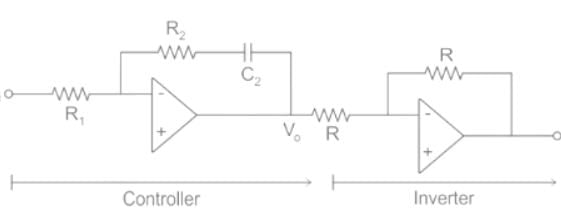
This is used to decrease the steady-state error without affecting the stability of the system.
The transfer function is defined as:
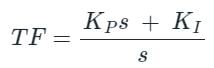
Analysis:
Analysis:
The transfer function of the system is calculated as:
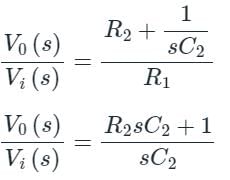
Disadvantages: Slow reaction to the disturbances.
Disadvantages: Slow reaction to the disturbances.
Advantages:
- It provides the zero control error
- It is insensitive to the interference of the measurement channel.
- PI Controllers increase the type of the system and thus reduce steady-state error and improve steady state
response
Which of the following statements is incorrect?- a)Lead compensator is used to reduce the settling time.
- b)Lag compensator is used to reduce the steady state error.
- c)Lead compensator may increase the order of a system.
- d)Lag compensator always stabilizes an unstable system.
Correct answer is option 'D'. Can you explain this answer?
Which of the following statements is incorrect?
a)
Lead compensator is used to reduce the settling time.
b)
Lag compensator is used to reduce the steady state error.
c)
Lead compensator may increase the order of a system.
d)
Lag compensator always stabilizes an unstable system.
| | Pooja Patel answered |
Concept:
- Lag Compensation adds a pole at origin (or for low frequencies).
- Lag Compensation to reduce the steady-state error of the system.
- An unstable system is a system that has at least one pole at the right side of the s-plane.
- So, even if we add a lag compensator to an unstable system, it will remain unstable.
Explanation:
If an already unstable system has a CLTP =
If an already unstable system has a CLTP =
After using a lag compensator the CLTP = 
The system is still unstable.
The system is still unstable.
Lag-lead compensation is a:- a)Increases bandwidth
- b)Attenuation
- c)Increases damping factor
- d)Second order
Correct answer is option 'D'. Can you explain this answer?
Lag-lead compensation is a:
a)
Increases bandwidth
b)
Attenuation
c)
Increases damping factor
d)
Second order
| | Zoya Sharma answered |
Lag-Lead compensation is a second order control system which has lead and lag compensation both and thus has combined effect of both lead and lag compensation this is obtained by the differential equation.
PID controllers are tuned on the frequency response of the closed-loop system by- a)using the open-loop gain corresponding to marginal stability
- b)using the maximum amplitude of response
- c)using maximum value of phase
- d)using minimum value of phase
Correct answer is option 'A'. Can you explain this answer?
PID controllers are tuned on the frequency response of the closed-loop system by
a)
using the open-loop gain corresponding to marginal stability
b)
using the maximum amplitude of response
c)
using maximum value of phase
d)
using minimum value of phase
| | Aashna Dey answered |
Frequency Response of Closed-Loop System
The frequency response of a control system is the measurement of the system's response to a sinusoidal input signal at varying frequencies. It is an essential tool for analyzing the stability and performance of the closed-loop system.
A PID controller is a popular type of feedback controller that uses three terms: proportional, integral, and derivative, to control the system's output. It is necessary to tune the PID controller's parameters to achieve the desired performance and stability.
Tuning a PID Controller
There are various methods for tuning a PID controller, but the most common method is to use the frequency response of the closed-loop system. The following are the steps involved in tuning a PID controller:
1. Determine the Open-Loop Gain
The open-loop gain is the gain of the system when the feedback loop is opened. It is necessary to determine the open-loop gain of the system at the frequency corresponding to the marginal stability. The marginal stability is the frequency at which the system is just stable or unstable.
2. Calculate the Phase Margin
The phase margin is the amount of phase lag that the system can tolerate before becoming unstable. It is necessary to calculate the phase margin of the system at the frequency corresponding to the marginal stability.
3. Adjust the PID Parameters
The proportional, integral, and derivative parameters of the PID controller are adjusted based on the open-loop gain and phase margin. The proportional parameter is adjusted to achieve the desired response amplitude, the integral parameter is adjusted to eliminate the steady-state error, and the derivative parameter is adjusted to reduce the overshoot and settling time.
Why Option A is Correct?
The option A is correct because the open-loop gain corresponding to marginal stability is the most critical parameter for tuning a PID controller. The open-loop gain determines the system's gain margin, which is the amount of gain that the system can tolerate before becoming unstable. The gain margin is directly related to the stability and performance of the system. Therefore, tuning the PID controller based on the open-loop gain corresponding to marginal stability is the most effective method for achieving the desired performance and stability.
The frequency response of a control system is the measurement of the system's response to a sinusoidal input signal at varying frequencies. It is an essential tool for analyzing the stability and performance of the closed-loop system.
A PID controller is a popular type of feedback controller that uses three terms: proportional, integral, and derivative, to control the system's output. It is necessary to tune the PID controller's parameters to achieve the desired performance and stability.
Tuning a PID Controller
There are various methods for tuning a PID controller, but the most common method is to use the frequency response of the closed-loop system. The following are the steps involved in tuning a PID controller:
1. Determine the Open-Loop Gain
The open-loop gain is the gain of the system when the feedback loop is opened. It is necessary to determine the open-loop gain of the system at the frequency corresponding to the marginal stability. The marginal stability is the frequency at which the system is just stable or unstable.
2. Calculate the Phase Margin
The phase margin is the amount of phase lag that the system can tolerate before becoming unstable. It is necessary to calculate the phase margin of the system at the frequency corresponding to the marginal stability.
3. Adjust the PID Parameters
The proportional, integral, and derivative parameters of the PID controller are adjusted based on the open-loop gain and phase margin. The proportional parameter is adjusted to achieve the desired response amplitude, the integral parameter is adjusted to eliminate the steady-state error, and the derivative parameter is adjusted to reduce the overshoot and settling time.
Why Option A is Correct?
The option A is correct because the open-loop gain corresponding to marginal stability is the most critical parameter for tuning a PID controller. The open-loop gain determines the system's gain margin, which is the amount of gain that the system can tolerate before becoming unstable. The gain margin is directly related to the stability and performance of the system. Therefore, tuning the PID controller based on the open-loop gain corresponding to marginal stability is the most effective method for achieving the desired performance and stability.
Phase lead occurs at: - a) low frequency regions
- b)high frequency regions
- c)moderate frequencies
- d)very low frequency regions
Correct answer is option 'B'. Can you explain this answer?
Phase lead occurs at:
a)
low frequency regions
b)
high frequency regions
c)
moderate frequencies
d)
very low frequency regions
| | Devansh Das answered |
Understanding Phase Lead
Phase lead is a concept often discussed in control systems and signal processing. It has a significant impact on the stability and performance of systems.
What is Phase Lead?
- Phase lead refers to the situation where the output of a system responds to an input signal with a phase that is ahead of the input signal.
- This phenomenon can be introduced through various techniques, including the use of compensators.
Occurrence of Phase Lead
- Phase lead occurs primarily at high frequency regions. The reason for this can be attributed to the characteristics of system components and their responses to fast-changing signals.
Why High Frequencies?
- At high frequencies, the reactive components (like capacitors and inductors) dominate the system’s behavior.
- These reactive components can store and release energy quickly, leading to a situation where the output can react more swiftly than the input.
Implications of Phase Lead
- A system exhibiting phase lead can improve transient response, increase system stability, and enhance overall performance.
- However, excessive phase lead can also lead to instability if not properly controlled.
Conclusion
In summary, phase lead is prevalent at high frequency regions due to the dominant behavior of reactive components, which can enhance the system's performance but also requires careful management to maintain stability. Understanding this concept is crucial for electrical engineers working with dynamic systems.
Phase lead is a concept often discussed in control systems and signal processing. It has a significant impact on the stability and performance of systems.
What is Phase Lead?
- Phase lead refers to the situation where the output of a system responds to an input signal with a phase that is ahead of the input signal.
- This phenomenon can be introduced through various techniques, including the use of compensators.
Occurrence of Phase Lead
- Phase lead occurs primarily at high frequency regions. The reason for this can be attributed to the characteristics of system components and their responses to fast-changing signals.
Why High Frequencies?
- At high frequencies, the reactive components (like capacitors and inductors) dominate the system’s behavior.
- These reactive components can store and release energy quickly, leading to a situation where the output can react more swiftly than the input.
Implications of Phase Lead
- A system exhibiting phase lead can improve transient response, increase system stability, and enhance overall performance.
- However, excessive phase lead can also lead to instability if not properly controlled.
Conclusion
In summary, phase lead is prevalent at high frequency regions due to the dominant behavior of reactive components, which can enhance the system's performance but also requires careful management to maintain stability. Understanding this concept is crucial for electrical engineers working with dynamic systems.
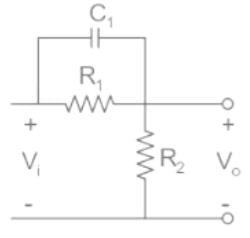
Which of the following is true for the network shown below -
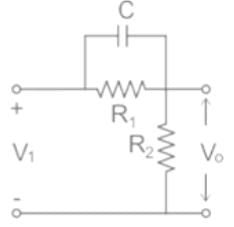
- a)Lead compensator
- b)Lag compensator
- c)Lead-lag compensator
- d)None of the above
Correct answer is option 'A'. Can you explain this answer?
Which of the following is true for the network shown below -
a)
Lead compensator
b)
Lag compensator
c)
Lead-lag compensator
d)
None of the above
| | Yash Patel answered |
In general, the lead and lag compensator is represented by the below transfer function
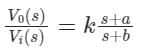
If a > b then that is lag compensator because pole comes first.
If a < b then that is the lead compensator since zero comes first.
Analysis:
Lead compensator:
1) When sinusoidal input applied to this it produces sinusoidal output with the phase lead input.
2) It speeds up the Transient response and increases the margin for stability.
A circuit diagram is as shown:
Response is:
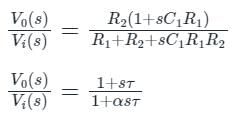
Lead constant α =

The input of a controller is- a)Sensed signal
- b)Error signal
- c)Desired variable value
- d)Signal of fixed amplitude not dependent on desired variable value
Correct answer is option 'B'. Can you explain this answer?
The input of a controller is
a)
Sensed signal
b)
Error signal
c)
Desired variable value
d)
Signal of fixed amplitude not dependent on desired variable value
| | Kritika Gupta answered |
Input of a controller is the error signal.
- The input of a controller is the signal that is used to determine the corrective action to be taken in order to achieve the desired system behavior. This input is typically referred to as the error signal.
The error signal represents the difference between the desired value and the actual value of a certain variable.
- In a control system, there is usually a desired value or setpoint that the system should achieve. The error signal is calculated by subtracting this desired value from the actual value of the variable being controlled. It represents the deviation or error between the desired and actual values.
The error signal provides the necessary information for the controller to respond accordingly.
- By analyzing the error signal, the controller can determine the corrective action that needs to be applied in order to minimize the error and bring the system closer to the desired value. This corrective action is typically in the form of an output signal from the controller that influences the system's behavior.
The error signal is used in various types of controllers, such as proportional, integral, and derivative controllers.
- Proportional controllers use the error signal directly to produce an output signal that is proportional to the error. Integral controllers integrate the error signal over time to provide a corrective action that accumulates until the error is minimized. Derivative controllers use the rate of change of the error signal to anticipate future changes and adjust the system's behavior accordingly.
The error signal is a fundamental component in control system design and analysis.
- It is used to tune the controller parameters, evaluate the performance of the control system, and analyze the stability and robustness of the system. By analyzing the error signal, engineers can make adjustments to the control system to improve its performance and ensure that it meets the desired specifications.
In conclusion, the input of a controller is the error signal, which represents the difference between the desired value and the actual value of the controlled variable. This error signal is used by the controller to determine the corrective action that needs to be applied in order to minimize the error and achieve the desired system behavior.
- The input of a controller is the signal that is used to determine the corrective action to be taken in order to achieve the desired system behavior. This input is typically referred to as the error signal.
The error signal represents the difference between the desired value and the actual value of a certain variable.
- In a control system, there is usually a desired value or setpoint that the system should achieve. The error signal is calculated by subtracting this desired value from the actual value of the variable being controlled. It represents the deviation or error between the desired and actual values.
The error signal provides the necessary information for the controller to respond accordingly.
- By analyzing the error signal, the controller can determine the corrective action that needs to be applied in order to minimize the error and bring the system closer to the desired value. This corrective action is typically in the form of an output signal from the controller that influences the system's behavior.
The error signal is used in various types of controllers, such as proportional, integral, and derivative controllers.
- Proportional controllers use the error signal directly to produce an output signal that is proportional to the error. Integral controllers integrate the error signal over time to provide a corrective action that accumulates until the error is minimized. Derivative controllers use the rate of change of the error signal to anticipate future changes and adjust the system's behavior accordingly.
The error signal is a fundamental component in control system design and analysis.
- It is used to tune the controller parameters, evaluate the performance of the control system, and analyze the stability and robustness of the system. By analyzing the error signal, engineers can make adjustments to the control system to improve its performance and ensure that it meets the desired specifications.
In conclusion, the input of a controller is the error signal, which represents the difference between the desired value and the actual value of the controlled variable. This error signal is used by the controller to determine the corrective action that needs to be applied in order to minimize the error and achieve the desired system behavior.
Addition of zero at origin:- a)Improvement in transient response
- b)Reduction in steady state error
- c)Reduction is settling time
- d)Increase in damping constant
Correct answer is option 'A'. Can you explain this answer?
Addition of zero at origin:
a)
Improvement in transient response
b)
Reduction in steady state error
c)
Reduction is settling time
d)
Increase in damping constant
| | Zoya Sharma answered |
Stability of the system can be determined by various factors and for a good control system the stability of the system must be more and this can be increased by adding zero to the system and improves the transient response.
An R-C network has the transfer function
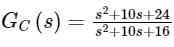
The network could be used as
1. lead compensator
2. lag compensator
3. lag-lead compensator
Which of the above is/are correct?- a)1 only
- b)2 only
- c)3 only
- d)1, 2 and 3
Correct answer is option 'C'. Can you explain this answer?
An R-C network has the transfer function
The network could be used as
1. lead compensator
2. lag compensator
3. lag-lead compensator
Which of the above is/are correct?
The network could be used as
1. lead compensator
2. lag compensator
3. lag-lead compensator
Which of the above is/are correct?
a)
1 only
b)
2 only
c)
3 only
d)
1, 2 and 3
| | Ravi Singh answered |
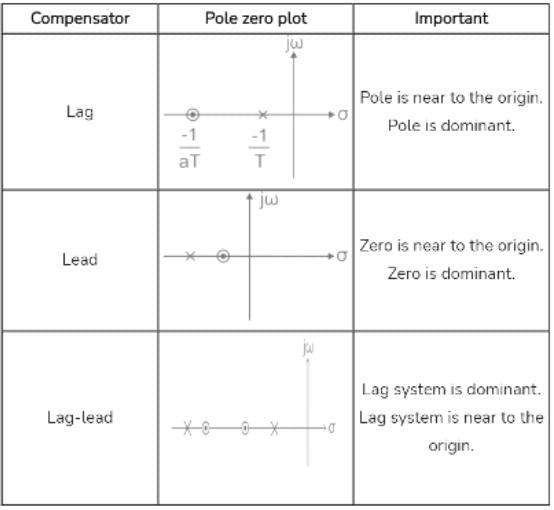
Application:
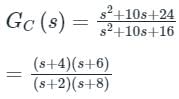
Poles: s = -2, -8
Zeros: s = -4, -6
The pole-zero plot of the above transfer function is shown below.
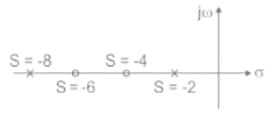
The above pole-zero represents that the given system is a lag-lead compensator.
Rate compensation:- a)Increases bandwidth
- b)Attenuation
- c)Increases damping factor
- d)Second order
Correct answer is option 'C'. Can you explain this answer?
Rate compensation:
a)
Increases bandwidth
b)
Attenuation
c)
Increases damping factor
d)
Second order
| | Zoya Sharma answered |
Damping factor is increased for reducing the oscillations and increasing the stability and speed of response which are the essential requirements of the control system and damping factor is increased by the rate compensation.
Derivative error compensation:- a)Improvement in transient response
- b)Reduction in steady state error
- c)Reduction is settling time
- d)Increase in damping constant
Correct answer is option 'D'. Can you explain this answer?
Derivative error compensation:
a)
Improvement in transient response
b)
Reduction in steady state error
c)
Reduction is settling time
d)
Increase in damping constant
 | Sanchita Choudhary answered |
Understanding Derivative Error Compensation
Derivative error compensation is a technique used in control systems to enhance performance. It primarily focuses on improving the system's response characteristics.
Key Effects of Derivative Compensation
- Improvement in Transient Response: Derivative compensation helps in anticipating future errors, allowing the system to react more swiftly to changes, thereby improving the transient response.
- Reduction in Steady State Error: While derivative control does not directly eliminate steady-state errors, it can contribute to a more responsive system, indirectly aiding in achieving a desired steady-state condition.
- Reduction in Settling Time: By enhancing the system’s responsiveness, derivative compensation can lead to a quicker settling time, allowing the system to stabilize faster after disturbances.
- Increase in Damping Constant: This is the correct answer. Derivative compensation effectively increases the damping in the system. A higher damping constant reduces overshoot and oscillations, leading to a more stable system. This improved damping reduces the risk of instability and ensures that the system settles into its desired state without excessive oscillation.
Conclusion
In summary, while all options present valid points regarding the benefits of derivative error compensation, option 'D' highlights the most crucial aspect: the increase in the damping constant. This leads to better stability and overall performance in control systems.
Derivative error compensation is a technique used in control systems to enhance performance. It primarily focuses on improving the system's response characteristics.
Key Effects of Derivative Compensation
- Improvement in Transient Response: Derivative compensation helps in anticipating future errors, allowing the system to react more swiftly to changes, thereby improving the transient response.
- Reduction in Steady State Error: While derivative control does not directly eliminate steady-state errors, it can contribute to a more responsive system, indirectly aiding in achieving a desired steady-state condition.
- Reduction in Settling Time: By enhancing the system’s responsiveness, derivative compensation can lead to a quicker settling time, allowing the system to stabilize faster after disturbances.
- Increase in Damping Constant: This is the correct answer. Derivative compensation effectively increases the damping in the system. A higher damping constant reduces overshoot and oscillations, leading to a more stable system. This improved damping reduces the risk of instability and ensures that the system settles into its desired state without excessive oscillation.
Conclusion
In summary, while all options present valid points regarding the benefits of derivative error compensation, option 'D' highlights the most crucial aspect: the increase in the damping constant. This leads to better stability and overall performance in control systems.
Assertion (A): Stepping motors are compatible with modern digital systems.
Reason (R): The nature of command is in the forms of pulses.- a)Both A and R are true and R is a correct explanation of A.
- b)Both A and R are true but R is not a correct explanation of A.
- c)A is true but R is false.
- d)A is false but R is true.
Correct answer is option 'A'. Can you explain this answer?
Assertion (A): Stepping motors are compatible with modern digital systems.
Reason (R): The nature of command is in the forms of pulses.
Reason (R): The nature of command is in the forms of pulses.
a)
Both A and R are true and R is a correct explanation of A.
b)
Both A and R are true but R is not a correct explanation of A.
c)
A is true but R is false.
d)
A is false but R is true.
| | Sushant Mehta answered |
Since the nature of command is in the form of pulses, therefore stepping motors are compatible with modern digital systems.
Derivative output compensation:- a)Improvement in transient response
- b)Reduction in steady state error
- c)Reduction is settling time
- d)Increase in damping constant
Correct answer is option 'C'. Can you explain this answer?
Derivative output compensation:
a)
Improvement in transient response
b)
Reduction in steady state error
c)
Reduction is settling time
d)
Increase in damping constant
| | Nitin Chawla answered |
Derivative output compensation is a technique used in control systems to improve the performance of a system by reducing settling time. It is a part of PID (Proportional-Integral-Derivative) control, where the derivative term is used to compensate for the rate of change of the error signal.
Derivative output compensation has several benefits, including:
1. Improvement in transient response:
Transient response refers to the behavior of a system when it is subjected to a sudden change in its input or setpoint. The derivative term in PID control helps in predicting the future behavior of the system based on the rate of change of the error signal. By compensating for this rate of change, the system can respond more quickly to changes in the input, resulting in an improved transient response.
2. Reduction in steady-state error:
Steady-state error is the difference between the desired output and the actual output of a system when it has reached a stable operating condition. The derivative term in PID control can help in reducing the steady-state error by adjusting the control signal based on the rate of change of the error signal. By compensating for this rate of change, the system can make fine adjustments to the control signal, reducing the steady-state error.
3. Reduction in settling time:
Settling time is the time taken by a system to reach and stay within a specified range of the desired output after a change in the input. The derivative term in PID control can help in reducing the settling time by anticipating the future behavior of the system based on the rate of change of the error signal. By compensating for this rate of change, the system can respond more quickly to changes in the input, resulting in a reduced settling time.
4. Increase in damping constant:
The damping constant is a measure of the system's ability to resist oscillations. The derivative term in PID control provides a damping effect by counteracting rapid changes in the error signal. By compensating for the rate of change of the error signal, the system can increase its damping constant and reduce oscillations, resulting in a more stable response.
In conclusion, derivative output compensation in control systems provides several benefits, including improvement in transient response, reduction in steady-state error, reduction in settling time, and an increase in the damping constant. These benefits contribute to the overall performance and stability of the system.
Derivative output compensation has several benefits, including:
1. Improvement in transient response:
Transient response refers to the behavior of a system when it is subjected to a sudden change in its input or setpoint. The derivative term in PID control helps in predicting the future behavior of the system based on the rate of change of the error signal. By compensating for this rate of change, the system can respond more quickly to changes in the input, resulting in an improved transient response.
2. Reduction in steady-state error:
Steady-state error is the difference between the desired output and the actual output of a system when it has reached a stable operating condition. The derivative term in PID control can help in reducing the steady-state error by adjusting the control signal based on the rate of change of the error signal. By compensating for this rate of change, the system can make fine adjustments to the control signal, reducing the steady-state error.
3. Reduction in settling time:
Settling time is the time taken by a system to reach and stay within a specified range of the desired output after a change in the input. The derivative term in PID control can help in reducing the settling time by anticipating the future behavior of the system based on the rate of change of the error signal. By compensating for this rate of change, the system can respond more quickly to changes in the input, resulting in a reduced settling time.
4. Increase in damping constant:
The damping constant is a measure of the system's ability to resist oscillations. The derivative term in PID control provides a damping effect by counteracting rapid changes in the error signal. By compensating for the rate of change of the error signal, the system can increase its damping constant and reduce oscillations, resulting in a more stable response.
In conclusion, derivative output compensation in control systems provides several benefits, including improvement in transient response, reduction in steady-state error, reduction in settling time, and an increase in the damping constant. These benefits contribute to the overall performance and stability of the system.
Lag compensation leads to:- a)Increases bandwidth
- b)Attenuation
- c)Increases damping factor
- d)Second order
Correct answer is option 'B'. Can you explain this answer?
Lag compensation leads to:
a)
Increases bandwidth
b)
Attenuation
c)
Increases damping factor
d)
Second order
| | Nandita Bajaj answered |
Understanding Lag Compensation
Lag compensation is a technique used in control systems to improve stability and performance. It modifies the system's frequency response by introducing additional poles and zeros.
Impact on Bandwidth and Damping
- Increases Bandwidth: Lag compensation typically does not increase bandwidth; instead, it may actually reduce bandwidth. This is because the phase lag introduced can limit the range of frequencies over which the system can respond effectively.
- Attenuation: Lag compensation leads to attenuation of higher frequency signals. This is due to the additional poles introduced by the lag compensator, which causes a reduction in gain at higher frequencies. As a result, the system may not respond effectively to rapid changes in input signals.
- Increases Damping Factor: While lag compensation can improve stability, it does not inherently increase the damping factor. The damping factor is a measure of how oscillations in a system decay after a disturbance. Lag compensation focuses more on phase margin and stability than on directly modifying the damping characteristics.
- Second Order Systems: Lag compensators are often designed for first-order systems, and while they can be applied to second-order systems, they do not specifically classify as second-order systems themselves.
Conclusion
In conclusion, the correct option is B) Attenuation. Lag compensation can reduce high-frequency gain, which leads to the attenuation of these frequencies. Understanding the implications of lag compensation is vital for designing effective control systems that meet stability and performance criteria.
Lag compensation is a technique used in control systems to improve stability and performance. It modifies the system's frequency response by introducing additional poles and zeros.
Impact on Bandwidth and Damping
- Increases Bandwidth: Lag compensation typically does not increase bandwidth; instead, it may actually reduce bandwidth. This is because the phase lag introduced can limit the range of frequencies over which the system can respond effectively.
- Attenuation: Lag compensation leads to attenuation of higher frequency signals. This is due to the additional poles introduced by the lag compensator, which causes a reduction in gain at higher frequencies. As a result, the system may not respond effectively to rapid changes in input signals.
- Increases Damping Factor: While lag compensation can improve stability, it does not inherently increase the damping factor. The damping factor is a measure of how oscillations in a system decay after a disturbance. Lag compensation focuses more on phase margin and stability than on directly modifying the damping characteristics.
- Second Order Systems: Lag compensators are often designed for first-order systems, and while they can be applied to second-order systems, they do not specifically classify as second-order systems themselves.
Conclusion
In conclusion, the correct option is B) Attenuation. Lag compensation can reduce high-frequency gain, which leads to the attenuation of these frequencies. Understanding the implications of lag compensation is vital for designing effective control systems that meet stability and performance criteria.
For the network shown in the figure below, the frequency (in rad/s) at which the maximum phase lag occurs is, ___________.
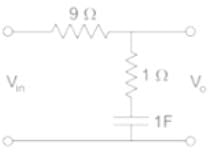
Correct answer is between '0.30,0.33'. Can you explain this answer?
For the network shown in the figure below, the frequency (in rad/s) at which the maximum phase lag occurs is, ___________.
| | Pioneer Academy answered |
Given circuit is a lag compensator and transfer function is given as

On comparison we get, T = 1
βT = 10 ⇒ β = 10
The frequency at which maximum lead occurs is ωm = 1/T√β

On comparison we get, T = 1
βT = 10 ⇒ β = 10
The frequency at which maximum lead occurs is ωm = 1/T√β
For the following network to work as lag compensator, the value of R2 would be
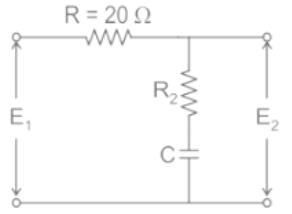
- a)R2 ≥ 20 Ω
- b)R2 ≤ 10 Ω
- c)
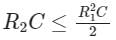
- d)Any value of R2
Correct answer is option 'D'. Can you explain this answer?
For the following network to work as lag compensator, the value of R2 would be
a)
R2 ≥ 20 Ω
b)
R2 ≤ 10 Ω
c)
d)
Any value of R2
| | Pooja Patel answered |
Lead compensator:
Transfer function:
Transfer function:
If it is in the form of  then a < 1
then a < 1If it is in the form of  then a > b
Maximum phase lag frequency: ωm = 1√Ta
Maximum phase lag::
then a > bMaximum phase lag frequency: ωm = 1√Ta
Maximum phase lag::
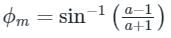
ϕm is positive
Pole zero plot:
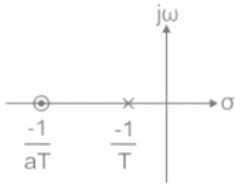
The pole is nearer to the origin.
Filter: It is a low pass filter (LPF)
Effect on the system:
The pole is nearer to the origin.
Filter: It is a low pass filter (LPF)
Effect on the system:
- Rise time and settling time increases and Bandwidth decreases
- The transient response becomes slower
- The steady-state response is improved
- Stability decreases
Application:
The equivalent Laplace transform network for the given network is,
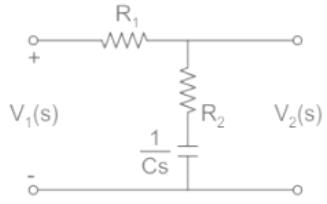
The equivalent Laplace transform network for the given network is,
By applying voltage division,
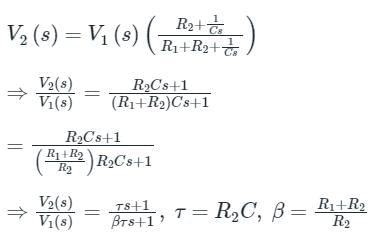 The above system to be lag compensator, β > 1
The above system to be lag compensator, β > 1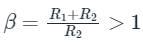
⇒ R1 > 0
Therefore, at any value of R2 the given system acts as lag compensator.
Which of the following properties is/are not exhibited by a phase lead network?
1. The velocity constant is usually increased.
2. The slope of the magnitude curve is reduced at the gain cross over frequency.
3. The bandwidth is reduced.
4. The response becomes faster.- a)1, 2, 3 and 4 only
- b)2 and 3 only
- c)3 only
- d)1 only
Correct answer is option 'C'. Can you explain this answer?
Which of the following properties is/are not exhibited by a phase lead network?
1. The velocity constant is usually increased.
2. The slope of the magnitude curve is reduced at the gain cross over frequency.
3. The bandwidth is reduced.
4. The response becomes faster.
1. The velocity constant is usually increased.
2. The slope of the magnitude curve is reduced at the gain cross over frequency.
3. The bandwidth is reduced.
4. The response becomes faster.
a)
1, 2, 3 and 4 only
b)
2 and 3 only
c)
3 only
d)
1 only
 | Anoushka Choudhury answered |
Due to a phase lead network, bandwidth is increased. Hence, option (d) is correct.
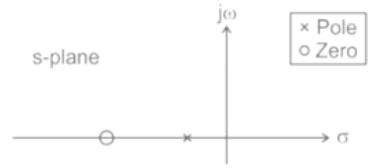
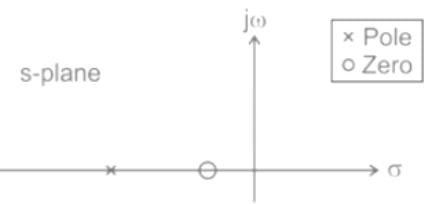
Which of the following can be the pole-zero configuration of a phase-lag controller (lag compensator)?- a)
- b)
- c)
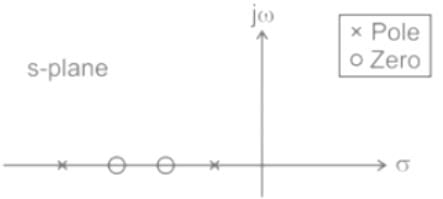
- d)
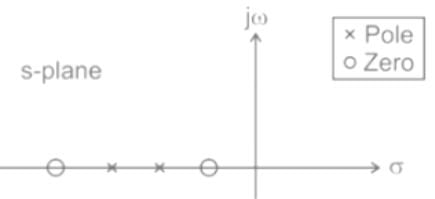
Correct answer is option 'A'. Can you explain this answer?
Which of the following can be the pole-zero configuration of a phase-lag controller (lag compensator)?
a)
b)
c)
d)
| | Machine Experts answered |
Let H(f) be TF of phase-lag controller
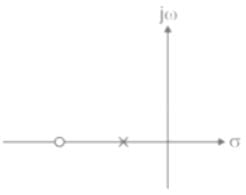
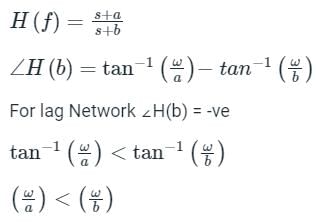
b < a
Pole is near to j ω axis than zero
Consider the following statements related to compensators used in control system applications:
1. When transient response is satisfactory and steady state characteristics are not satisfactory, normally lag compensation is employed.
2. Phase lag network is used to increase system stability and maintain velocity gain constant.
3. The capacitance is not used to fabricate a lag network.Which of these statements is/are correct?- a)1 and 3 only
- b)1, 2 and 3
- c)1 only
- d)1 and 2 only
Correct answer is option 'C'. Can you explain this answer?
Consider the following statements related to compensators used in control system applications:
1. When transient response is satisfactory and steady state characteristics are not satisfactory, normally lag compensation is employed.
2. Phase lag network is used to increase system stability and maintain velocity gain constant.
3. The capacitance is not used to fabricate a lag network.
1. When transient response is satisfactory and steady state characteristics are not satisfactory, normally lag compensation is employed.
2. Phase lag network is used to increase system stability and maintain velocity gain constant.
3. The capacitance is not used to fabricate a lag network.
Which of these statements is/are correct?
a)
1 and 3 only
b)
1, 2 and 3
c)
1 only
d)
1 and 2 only
| | Naveen Mukherjee answered |
Lag compensator is used to reduce steady-state error, therefore statement-1 is true.
As lag compensator reduces steady state error therefore, statement-2 is false.
Statement-3 is also false because capacitance is used to fabricate a lag network.
As lag compensator reduces steady state error therefore, statement-2 is false.
Statement-3 is also false because capacitance is used to fabricate a lag network.
The magnitude plot of a rational transfer function G(s) with real coefficients is shown below. Which of the following compensators has such a magnitude plot?
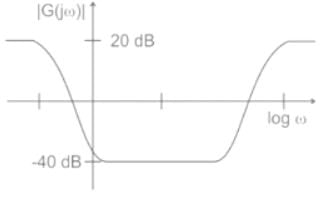
- a)Lead compensator
- b)Lag compensator
- c)Lag-Lead compensator
- d)None of the above
Correct answer is option 'C'. Can you explain this answer?
The magnitude plot of a rational transfer function G(s) with real coefficients is shown below. Which of the following compensators has such a magnitude plot?
a)
Lead compensator
b)
Lag compensator
c)
Lag-Lead compensator
d)
None of the above
| | Pioneer Academy answered |
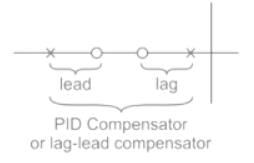
A system with impulse response is essentially a _______ compensator and used as a ________ filter.- a)Integral, Comb
- b)Lead, high-pass
- c)Lag, low-pass
- d)Proportional, all pass
Correct answer is option 'C'. Can you explain this answer?
A system with impulse response is essentially a _______ compensator and used as a ________ filter.
a)
Integral, Comb
b)
Lead, high-pass
c)
Lag, low-pass
d)
Proportional, all pass
| | Isha Singh answered |
Understanding Impulse Response
An impulse response characterizes how a system responds to a brief input signal (the impulse). It is a crucial concept in system analysis, particularly in the field of signal processing and control systems.
Lag Compensator
- A lag compensator is designed to improve the stability of a system while introducing a certain amount of phase lag.
- It is particularly useful in low-frequency applications where it enhances the steady-state error without significantly affecting the transient response.
Low-Pass Filter
- A low-pass filter allows signals with a frequency lower than a certain cutoff frequency to pass through while attenuating higher frequencies.
- The lag compensator functions similarly to a low-pass filter as it reduces the system's sensitivity to high-frequency noise and disturbances.
Connection Between Impulse Response, Lag Compensator, and Low-Pass Filter
- The impulse response of a lag compensator exhibits a gradual decay, indicative of its low-pass filtering characteristics.
- By limiting the bandwidth of the system, it ensures that only lower frequencies are amplified, making it effective in reducing high-frequency noise.
Conclusion
Thus, a system with impulse response is essentially a lag compensator and is used as a low-pass filter. This combination allows for better control of system dynamics while maintaining stability and performance in the desired frequency range.
An impulse response characterizes how a system responds to a brief input signal (the impulse). It is a crucial concept in system analysis, particularly in the field of signal processing and control systems.
Lag Compensator
- A lag compensator is designed to improve the stability of a system while introducing a certain amount of phase lag.
- It is particularly useful in low-frequency applications where it enhances the steady-state error without significantly affecting the transient response.
Low-Pass Filter
- A low-pass filter allows signals with a frequency lower than a certain cutoff frequency to pass through while attenuating higher frequencies.
- The lag compensator functions similarly to a low-pass filter as it reduces the system's sensitivity to high-frequency noise and disturbances.
Connection Between Impulse Response, Lag Compensator, and Low-Pass Filter
- The impulse response of a lag compensator exhibits a gradual decay, indicative of its low-pass filtering characteristics.
- By limiting the bandwidth of the system, it ensures that only lower frequencies are amplified, making it effective in reducing high-frequency noise.
Conclusion
Thus, a system with impulse response is essentially a lag compensator and is used as a low-pass filter. This combination allows for better control of system dynamics while maintaining stability and performance in the desired frequency range.
If the transfer function of a compensator is represented as: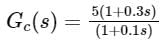
How much maximum phase shift can it add to the system?- a)20°
- b)45°
- c)30°
- d)60°
Correct answer is option 'C'. Can you explain this answer?
If the transfer function of a compensator is represented as:
How much maximum phase shift can it add to the system?
a)
20°
b)
45°
c)
30°
d)
60°
| | Machine Experts answered |
Concept:
The standard phase lead compensating network is given as:
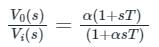
The standard phase lead compensating network is given as:
Maximum phase Occurs at
ωm = 1/T√α
Maximum phase (ϕm)
sinϕm = 1−α/1+α
ωm = 1/T√α
Maximum phase (ϕm)
sinϕm = 1−α/1+α
Calculation:
Given:
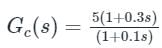
a = 3 and T = 0.1
∵ a > 1
It is a Lead compensator.
Maximum phase lead is given as:
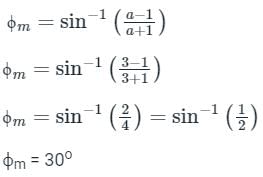
Given:
a = 3 and T = 0.1
∵ a > 1
It is a Lead compensator.
Maximum phase lead is given as:
Lead compensation leads to:- a)Increases bandwidth
- b)Attenuation
- c)Increases damping factor
- d)Second order
Correct answer is option 'A'. Can you explain this answer?
Lead compensation leads to:
a)
Increases bandwidth
b)
Attenuation
c)
Increases damping factor
d)
Second order
| | Pallabi Pillai answered |
Lead compensation is a technique used in control systems to improve the performance of a system. It involves adding a lead compensator to the system to increase its bandwidth, which refers to the range of frequencies over which the system can effectively respond.
- Lead compensation increases the bandwidth of a system, allowing it to respond to a wider range of frequencies. This is because the lead compensator introduces a pole and a zero in the transfer function of the system, which results in a phase shift that enhances the system's frequency response.
- By increasing the bandwidth, lead compensation helps the system to respond more quickly to changes in the input signal. This can be particularly useful in applications where fast response times are required, such as in robotics or high-speed control systems.
- Lead compensation also helps to improve the stability of a system by increasing the damping factor. The damping factor is a measure of the system's ability to resist oscillations or overshoot in response to a disturbance. By increasing the damping factor, lead compensation reduces the likelihood of instability or oscillations in the system.
- Lead compensation is often used in second-order control systems, where the transfer function of the system has a second-order polynomial. In these systems, the lead compensator can be designed to introduce additional phase lead and increase the system's stability and performance.
In summary, lead compensation is a technique used in control systems to increase the bandwidth, improve stability, and enhance the performance of a system. By introducing a pole and a zero in the transfer function, lead compensation increases the system's frequency response and damping factor, leading to faster response times and improved stability.
- Lead compensation increases the bandwidth of a system, allowing it to respond to a wider range of frequencies. This is because the lead compensator introduces a pole and a zero in the transfer function of the system, which results in a phase shift that enhances the system's frequency response.
- By increasing the bandwidth, lead compensation helps the system to respond more quickly to changes in the input signal. This can be particularly useful in applications where fast response times are required, such as in robotics or high-speed control systems.
- Lead compensation also helps to improve the stability of a system by increasing the damping factor. The damping factor is a measure of the system's ability to resist oscillations or overshoot in response to a disturbance. By increasing the damping factor, lead compensation reduces the likelihood of instability or oscillations in the system.
- Lead compensation is often used in second-order control systems, where the transfer function of the system has a second-order polynomial. In these systems, the lead compensator can be designed to introduce additional phase lead and increase the system's stability and performance.
In summary, lead compensation is a technique used in control systems to increase the bandwidth, improve stability, and enhance the performance of a system. By introducing a pole and a zero in the transfer function, lead compensation increases the system's frequency response and damping factor, leading to faster response times and improved stability.
The transfer function C(s) of a compensator is given below.
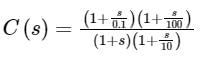 The frequency range in which the phase (lead) introduced by the compensator reaches the maximum is
- a)0.1 < ω < 1
- b)1 < ω < 10
- c)10 < ω < 100
- d)ω > 100
Correct answer is option 'A'. Can you explain this answer?
The transfer function C(s) of a compensator is given below.
The frequency range in which the phase (lead) introduced by the compensator reaches the maximum is
a)
0.1 < ω < 1
b)
1 < ω < 10
c)
10 < ω < 100
d)
ω > 100
| | Machine Experts answered |
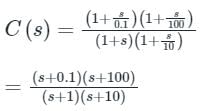
Pole zero diagram of the above transfer function is
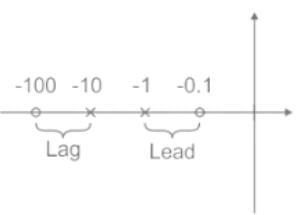
It represents a standard lead lag compensator. For a lead lag compensator, maximum lead occurs at initial frequency.
So, maximum lead occurs at 0.1 < ω < 1.
A compensator with the transfer function G(s) =  can give maximum gain of
- a)-20 dB
- b)-10 dB
- c)0 dB
- d)20 dB
Correct answer is option 'C'. Can you explain this answer?
A compensator with the transfer function G(s) = can give maximum gain of
can give maximum gain ofa)
-20 dB
b)
-10 dB
c)
0 dB
d)
20 dB
| | Pooja Patel answered |
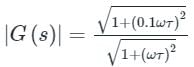
For all ω Numerator is less than Denominator maximum value of |G(s)| occurs at ω = 0
|G(s)|max = 1
In dB, 20 log (1) = 0 dB
The Transfer Function of lead and lag compensators have _____ and ______ phase angles respectively which the system ______ and ______ respectively.- a)-ve, -ve, slower, faster
- b)+ve, +ve, slower, faster
- c)+ve, -ve, faster, slower
- d)-ve, +ve, faster, slower
Correct answer is option 'C'. Can you explain this answer?
The Transfer Function of lead and lag compensators have _____ and ______ phase angles respectively which the system ______ and ______ respectively.
a)
-ve, -ve, slower, faster
b)
+ve, +ve, slower, faster
c)
+ve, -ve, faster, slower
d)
-ve, +ve, faster, slower
| | Machine Experts answered |
Concept:
We know:
Hc(s) = s+as+b;
when α = zero/pole = α/b is greater than 1 i.e., α > 1 then it is lag compensator.
else when α < 1, then it is lead compensator.
Calculation:
For lead compensator: Hc(s) = s+a/s+b
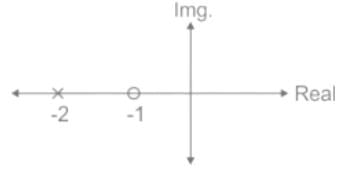
ϕ = tan−1(ω/1) − tan−1(ω/2)
i.e., phase angle will be positive for ω > 0
similarly, for lag compensator: Hc(s) = s+2/s+1
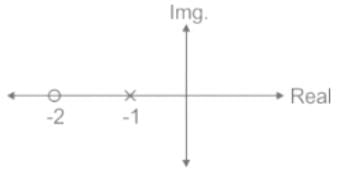
We know:
Hc(s) = s+as+b;
when α = zero/pole = α/b is greater than 1 i.e., α > 1 then it is lag compensator.
else when α < 1, then it is lead compensator.
Calculation:
For lead compensator: Hc(s) = s+a/s+b
ϕ = tan−1(ω/1) − tan−1(ω/2)
i.e., phase angle will be positive for ω > 0
similarly, for lag compensator: Hc(s) = s+2/s+1
ϕ = tan−1(ω/2) −tan−1(ω)
i.e. phase angle is negative for ω > 0.
Now,
For lead compensator, gain crossover frequency (ωgc) increase which causes an increase in B.W. and hence the speed of the system improves.
For lag compensator; Gain crossover frequency (ωpc) decreases which causes decreases in B.W. and hence speed of the system decreases.
i.e. phase angle is negative for ω > 0.
Now,
For lead compensator, gain crossover frequency (ωgc) increase which causes an increase in B.W. and hence the speed of the system improves.
For lag compensator; Gain crossover frequency (ωpc) decreases which causes decreases in B.W. and hence speed of the system decreases.
Addition of zeros in a transfer function causes- a)lag compensator
- b)lead compensator
- c)lead-lag compensator
- d)none of the above
Correct answer is option 'B'. Can you explain this answer?
Addition of zeros in a transfer function causes
a)
lag compensator
b)
lead compensator
c)
lead-lag compensator
d)
none of the above
| | Bijoy Mehta answered |
Pole-zero plot for lead and lag compensators are shown below.
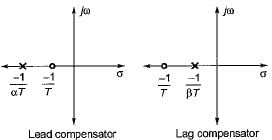
Since zero is close to origin in a lead compensator, therefore addition of zero in a transfer function will cause lead compensator.
Since zero is close to origin in a lead compensator, therefore addition of zero in a transfer function will cause lead compensator.
The transfer function of a PID controller is given by as ω tends to zero
- a)Magnitude of G(jω) tends to zero and phase angle of G(jω) tends to infinity
- b)Magnitude of G(jω) tends to infinity and phase angle of G(jω) tends to zero
- c)Magnitude of G(jω) tends to infinity and phase angle of G(jω) tends to +90°
- d)Magnitude of G(jω) tends to zero and phase angle of G(jω) tends to +90°
Correct answer is option 'C'. Can you explain this answer?
The transfer function of a PID controller is given byas ω tends to zero
as ω tends to zeroa)
Magnitude of G(jω) tends to zero and phase angle of G(jω) tends to infinity
b)
Magnitude of G(jω) tends to infinity and phase angle of G(jω) tends to zero
c)
Magnitude of G(jω) tends to infinity and phase angle of G(jω) tends to +90°
d)
Magnitude of G(jω) tends to zero and phase angle of G(jω) tends to +90°
 | Cstoppers Instructors answered |
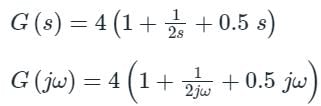
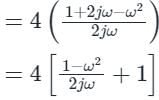
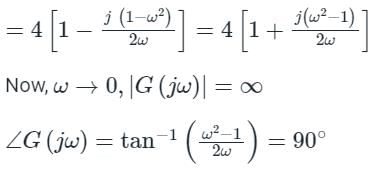
The maximum phase shift that can be obtained by using a lead compensator with transfer function Gc(s) =  equal to
- a)15°
- b)30°
- c)45°
- d)60°
Correct answer is option 'B'. Can you explain this answer?
The maximum phase shift that can be obtained by using a lead compensator with transfer function Gc(s) = equal to
equal toa)
15°
b)
30°
c)
45°
d)
60°
| | Yash Patel answered |
The standard T/F of the compensator is

Maximum phase lead
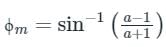
Maximum phase lead frequency,
ωm = 1/T√a
Calculation:
The given transfer function is,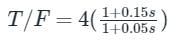
By comparing both transfer functions,
aT = 0.15
T = 0.05
a = 3
Maximum phase lead
Maximum phase lead
Maximum phase lead frequency,
ωm = 1/T√a
Calculation:
The given transfer function is,
By comparing both transfer functions,
aT = 0.15
T = 0.05
a = 3
Maximum phase lead
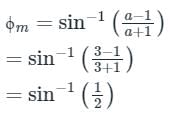
= sin-1 (0.5)
ϕm = 30°
The input to a controller is- a)servo-signal
- b)desired variable signal
- c)sensed-signal.
- d)error signal
Correct answer is option 'D'. Can you explain this answer?
The input to a controller is
a)
servo-signal
b)
desired variable signal
c)
sensed-signal.
d)
error signal
| | Surbhi Chopra answered |
For any type of controller, the input is always an error signal.
Phase lag controller:- a)Improvement in transient response
- b)Reduction in steady state error
- c)Reduction is settling time
- d)Increase in damping constant
Correct answer is option 'B'. Can you explain this answer?
Phase lag controller:
a)
Improvement in transient response
b)
Reduction in steady state error
c)
Reduction is settling time
d)
Increase in damping constant
| | Zoya Sharma answered |
Phase lag controller is the integral controller that creates the phase lag and does not affect the value of the damping factor and that tries to reduce the steady state error.
Chapter doubts & questions for Controllers & Compensators - 3 Months Preparation for GATE Electrical 2026 is part of Electrical Engineering (EE) exam preparation. The chapters have been prepared according to the Electrical Engineering (EE) exam syllabus. The Chapter doubts & questions, notes, tests & MCQs are made for Electrical Engineering (EE) 2026 Exam. Find important definitions, questions, notes, meanings, examples, exercises, MCQs and online tests here.
Chapter doubts & questions of Controllers & Compensators - 3 Months Preparation for GATE Electrical in English & Hindi are available as part of Electrical Engineering (EE) exam. Download more important topics, notes, lectures and mock test series for Electrical Engineering (EE) Exam by signing up for free.
3 Months Preparation for GATE Electrical676 videos|1399 docs|882 tests |
