


All Exams > Electrical Engineering (EE) > 3 Months Preparation for GATE Electrical > All Questions
All questions of Control Systems for Electrical Engineering (EE) Exam
Can you explain the answer of this question below:
The sum of the gains of the feedback paths in the signal flow graph shown in fig. is
 A: af + be + cd
B: af + be + cd+abef + bcdeC: af + be + cd + abef + abcdefD: af + be + cd + cbef + bcde + abcdefThe answer is a.
 | Phanindra Varma N answered |
Answer is B because ut can form only individual loop gains

The block diagram of a system is shown in fig.The closed loop transfer function of this system is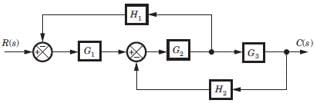
a)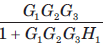 b)
b) 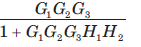 c)
c) 
d) 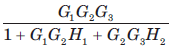
Correct answer is 'D'. Can you explain this answer?
a)
b)
c)
d)
Correct answer is 'D'. Can you explain this answer?
 | Nitya Ahuja answered |
Consider the block diagram as SFG. There are two feedback loop -G1G2H1 and -G2G3H2 and one forward path G1G2 G3 . So (D) is correct option.
The gain C(s)/R(s) of the signal flow graph shown in fig.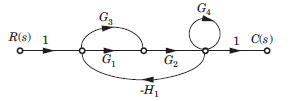
- a)
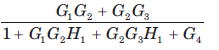
- b)
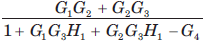
- c)
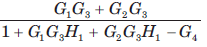
- d)
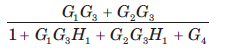
Correct answer is option 'B'. Can you explain this answer?
The gain C(s)/R(s) of the signal flow graph shown in fig.
a)
b)
c)
d)
 | Pie Academy answered |
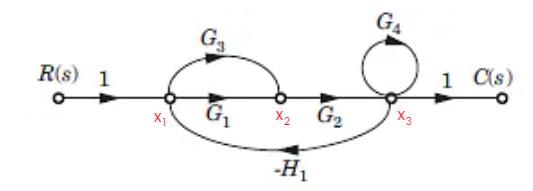
X1 = 1 - H1
X2 = (G1 + G3) X1 - X3H1
X3 = X2G2 + G4
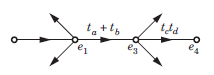
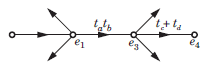
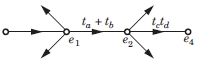
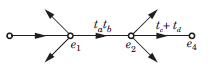
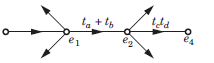
For the signal flow graph shown in fig. an equivalent graph is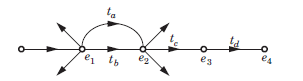
- a)
- b)
- c)
- d)
Correct answer is option 'C'. Can you explain this answer?
For the signal flow graph shown in fig. an equivalent graph is
a)
b)
c)
d)
 | Aim It Academy answered |
While writing the transfer function of this signal flow graph,
e2= tae1 + tbe1 = (ta+ tb) e1
Then, signal flow graph will lokk like this:
In the signal flow graph of figure y/x equalsa) 3b) 2c) 5/2d) None of the aboveCorrect answer is option 'B'. Can you explain this answer?
 | Aditya Deshmukh answered |
The answer is b.
P1 = 5 x 2 x 1 = 10
P1 = 5 x 2 x 1 = 10
L1 = - 4
Y/X = 10/1-(-4) = 2
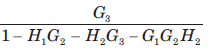
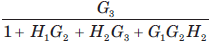
For the system shown in fig. transfer function C(s) R(s) is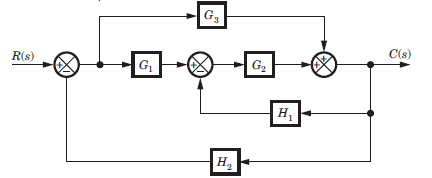
- a)
- b)

- c)
- d)

Correct answer is option 'B'. Can you explain this answer?
For the system shown in fig. transfer function C(s) R(s) is
a)
b)
c)
d)
 | Gate Gurus answered |
Consider the block diagram as a SFG. Two forward path G1G2 and G3 and three loops -G1G2 H2, -G2H1, -G3 H2
There are no nontouching loop. So (B) is correct.
There are no nontouching loop. So (B) is correct.
For the block diagram shown in fig. the numerator of transfer function is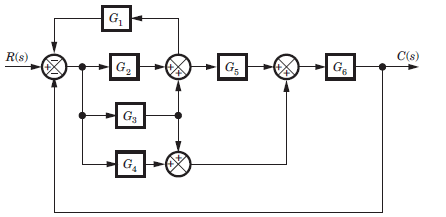
- a)

- b)

- c)

- d)none of these
Correct answer is option 'A'. Can you explain this answer?
For the block diagram shown in fig. the numerator of transfer function is
a)
b)
c)
d)
none of these
 | Zoya Sharma answered |
SFG
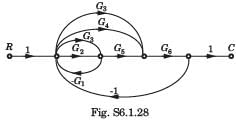
P1 = G2G5G6 , P2 = G3G5G6, P3 = G3G6 , P4 = G4G6
If any path is deleted, there would not be any loop.
Hence Δ1 = Δ2 = Δ3 = Δ4 = 1

P1 = G2G5G6 , P2 = G3G5G6, P3 = G3G6 , P4 = G4G6
If any path is deleted, there would not be any loop.
Hence Δ1 = Δ2 = Δ3 = Δ4 = 1
A Routh table is shown in fig. The location of pole on RHP, LHP and imaginary axis are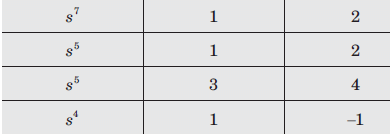
- a)1, 2, 4
- b)1, 6, 0
- c)1, 0, 6
- d)None of the above
Correct answer is 'A'. Can you explain this answer?
A Routh table is shown in fig. The location of pole on RHP, LHP and imaginary axis are
a)
1, 2, 4
b)
1, 6, 0
c)
1, 0, 6
d)
None of the above
 | Jaya Yadav answered |
If the system is given with the unbounded input then nothing can be clarified for the stability of the system.
A ufb control system has a forward path transfer function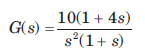 If the system is subjected to an input r(t) = 1 + t + 1/2 t2 , t > 0the steady state error of the system will be
- a)0
- b)0.1
- c)10
- d)∞
Correct answer is option 'C'. Can you explain this answer?
A ufb control system has a forward path transfer function
If the system is subjected to an input r(t) = 1 + t + 1/2 t2 , t > 0the steady state error of the system will be
a)
0
b)
0.1
c)
10
d)
∞
| | Lekshmi Kulkarni answered |
System is type 2. Therefore error due to 1+t would be zero and due to  would be
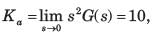
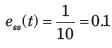
Note that you may calculate error from the formula
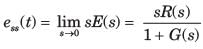
would be Note that you may calculate error from the formula



The principle of homogeneity and superposition are applied to:a)Linear time variant systemsb)Nonlinear time invariant systemsc)Linear time invariant systemsd)Nonlinear time invariant systemsCorrect answer is 'C'. Can you explain this answer?
| | Aditya Deshmukh answered |
Superposition theorem states that for two signals, additive and homogeneity property must be satisfied and that is applicable for the Linear time variant (LTI) systems.
Direction: The following item consists of two statements, one labelled as ‘Statement (I)’ and the other as ‘Statement (II)’. Examine these two statements carefully and select the answers to these items using the code given below:Statement I: For type-II or higher systems, lead compensator may be used.
Statement II: Lead compensator increases the margin of stability.- a)Both Statement I and Statement II are individually true and Statement II is the correct explanation of Statement I
- b)Both Statement I and Statement II are individually true but Statement II is not the correct explanation of Statement I
- c)Statement I is true but Statement II is false
- d)Statement I is false but Statement II is true
Correct answer is option 'A'. Can you explain this answer?
Direction: The following item consists of two statements, one labelled as ‘Statement (I)’ and the other as ‘Statement (II)’. Examine these two statements carefully and select the answers to these items using the code given below:
Statement I: For type-II or higher systems, lead compensator may be used.
Statement II: Lead compensator increases the margin of stability.
Statement II: Lead compensator increases the margin of stability.
a)
Both Statement I and Statement II are individually true and Statement II is the correct explanation of Statement I
b)
Both Statement I and Statement II are individually true but Statement II is not the correct explanation of Statement I
c)
Statement I is true but Statement II is false
d)
Statement I is false but Statement II is true
 | Pioneer Academy answered |
In general, there are two situations in which compensation is required.
- In the first case, the system is absolutely unstable, and the compensation is required to stabilize it as well as to achieve a specified performance.
- In the second case, the system is stable, but the compensation is required to obtain the desired performance.
The systems which are of type-2 or higher are usually absolutely unstable. For type-2 or higher systems, only the lead compensator is required because only the lead compensator improves the margin of stability.
Both Statement I and Statement II are individually true and Statement II is the correct explanation of Statement I
Note: In type-1 and type-0 systems, stable operation is always possible if the gain is sufficiently reduced. In such cases, any of the three compensators, lead, lag, lag-lead may be used to obtain the desired performance.
Both Statement I and Statement II are individually true and Statement II is the correct explanation of Statement I
Note: In type-1 and type-0 systems, stable operation is always possible if the gain is sufficiently reduced. In such cases, any of the three compensators, lead, lag, lag-lead may be used to obtain the desired performance.
The output of the feedback control system must be a function of:- a)Reference input
- b)Reference output
- c)Output and feedback signal
- d)Input and feedback signal
Correct answer is option 'D'. Can you explain this answer?
The output of the feedback control system must be a function of:
a)
Reference input
b)
Reference output
c)
Output and feedback signal
d)
Input and feedback signal
| | Athira Reddy answered |
Explanation: In a feedback control system, the output is determined by a combination of the input signal and the feedback signal. The input signal is the desired output or reference, while the feedback signal is a portion of the actual output that is fed back into the system to compare with the input. This comparison helps the system to adjust its output to minimize the error between the input and the actual output. By considering both the input and feedback signals, the system can continuously adapt and achieve the desired output.
The steady-state error of a feedback control system with an acceleration input becomes finite in a- a)type-3 system
- b)type-2 system
- c)type-1 system
- d)type-0 system
Correct answer is option 'B'. Can you explain this answer?
The steady-state error of a feedback control system with an acceleration input becomes finite in a
a)
type-3 system
b)
type-2 system
c)
type-1 system
d)
type-0 system
 | Raj Choudhary answered |
Steady state error with an acceleration input having an amplitude of A is given by

where,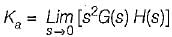
Hence, if the type of the system = 2, then Ka = some non-zero value or finite value due to which we will get some finite vaiue of Ka.
where,
Hence, if the type of the system = 2, then Ka = some non-zero value or finite value due to which we will get some finite vaiue of Ka.
For which of the following values of K, the feedback system shown in the below figure is stable?
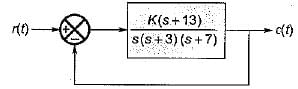
- a)K < 0
- b)K > 0
- c)0 < K < 54
- d)0 < K < 70
Correct answer is option 'D'. Can you explain this answer?
For which of the following values of K, the feedback system shown in the below figure is stable?
a)
K < 0
b)
K > 0
c)
0 < K < 54
d)
0 < K < 70
 | Rhea Reddy answered |
The characteristic equation is
1 + G (s) H (s) = 0
or,
1 + G (s) H (s) = 0
or,
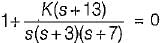
or, s3 + 10s2 + (21 + K )s + 13 K= 0
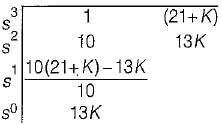
For stability, 13K > 0 or K > 0
Also,

or, K < 70
Hence, 0 < K< 70 (For stability).
Assertion (A): If the number of zeros are less than the number of poles (i.e. Z < P), we say that there are zeros at infinity and the order of such zeros is P-Z
Reason (R): The value of the transfer function becomes zero for s tends to zero.- a)Both A and R are true and R is a correct explanation of A.
- b)Both A and R are true but R is not a correct explanation of A.
- c)A is true but R is false.
- d)A is false but R is true.
Correct answer is option 'C'. Can you explain this answer?
Assertion (A): If the number of zeros are less than the number of poles (i.e. Z < P), we say that there are zeros at infinity and the order of such zeros is P-Z
Reason (R): The value of the transfer function becomes zero for s tends to zero.
Reason (R): The value of the transfer function becomes zero for s tends to zero.
a)
Both A and R are true and R is a correct explanation of A.
b)
Both A and R are true but R is not a correct explanation of A.
c)
A is true but R is false.
d)
A is false but R is true.
 | Uday Kumar answered |
For Z < P,
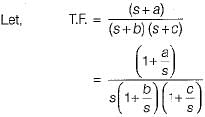
∴ Here, number of zeros = 1 and no. of poles = 2
∴ P - Z = 1
When s →∞, transfer function becomes zero. Thus, there is one zero (P - Z = 1) at infinity. Thus, assertion is true.
Since value of transfer function becomes zero as s →∞ therefore, reason is false.
∴ Here, number of zeros = 1 and no. of poles = 2
∴ P - Z = 1
When s →∞, transfer function becomes zero. Thus, there is one zero (P - Z = 1) at infinity. Thus, assertion is true.
Since value of transfer function becomes zero as s →∞ therefore, reason is false.
Consider the List I and List II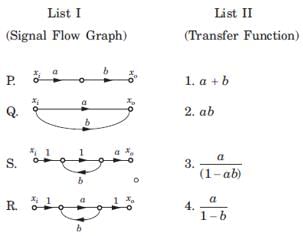 The correct match is
- a)2 1 3 4
- b)2 1 4 3
- c)1 2 4 3
- d)1 2 3 4
Correct answer is option 'B'. Can you explain this answer?
Consider the List I and List II
The correct match is
a)
2 1 3 4
b)
2 1 4 3
c)
1 2 4 3
d)
1 2 3 4
 | Om Pillai answered |
P. P1 = ab, Δ = 1, L = 0 ,T = ab
Q1 P1 = a, P2 = 6 , Δ = 1, L = Δk = 0,T = a+b
R. P1 = a, L1 = b, Δ = 1 - b, Δ1 =1,
S. P1 = a, L1 = ab, Δ = 1 - ab, Δ1 = 1,
Q1 P1 = a, P2 = 6 , Δ = 1, L = Δk = 0,T = a+b
R. P1 = a, L1 = b, Δ = 1 - b, Δ1 =1,
S. P1 = a, L1 = ab, Δ = 1 - ab, Δ1 = 1,
The negative feedback closed-loop system was subjected to 15V. The system has a forward gain of 2 and a feedback gain of 0.5. Determine the output voltage and the error voltage.- a)15V, 10V
- b)6V, 5V
- c)15V, 7.5V
- d)5V, 10V
Correct answer is option 'C'. Can you explain this answer?
The negative feedback closed-loop system was subjected to 15V. The system has a forward gain of 2 and a feedback gain of 0.5. Determine the output voltage and the error voltage.
a)
15V, 10V
b)
6V, 5V
c)
15V, 7.5V
d)
5V, 10V
 | Starcoders answered |
The negative feedback closed-loop system, subjected to 15V, has a forward gain of 2 and a feedback gain of 0.5.
- The output voltage is calculated as the product of the forward gain and the effective input voltage.
- The effective input voltage is the difference between the input voltage and the feedback voltage.
To find the output voltage:
- Calculate the feedback voltage: Output Voltage multiplied by Feedback Gain.
- Effective input = Input voltage - Feedback voltage.
- Output voltage = Forward gain x Effective input voltage.
After solving, the output voltage is 15V and the error voltage is 7.5V.
Consider the following statements regarding the characteristic equation of a system given by:
s4 + 5s3 + 25+10 = 0
1. The system is unstable.
2. The system is stable.
3. Number of roots with zero real part - 0
4. Number of roots with positive real part - 4
5. Number of roots with negative real part = 2
Which of the above statements are correct?- a)2 and 3
- b)1 and 3
- c)2, 3 and 4
- d)1, 3 and 5
Correct answer is option 'D'. Can you explain this answer?
Consider the following statements regarding the characteristic equation of a system given by:
s4 + 5s3 + 25+10 = 0
1. The system is unstable.
2. The system is stable.
3. Number of roots with zero real part - 0
4. Number of roots with positive real part - 4
5. Number of roots with negative real part = 2
Which of the above statements are correct?
s4 + 5s3 + 25+10 = 0
1. The system is unstable.
2. The system is stable.
3. Number of roots with zero real part - 0
4. Number of roots with positive real part - 4
5. Number of roots with negative real part = 2
Which of the above statements are correct?
a)
2 and 3
b)
1 and 3
c)
2, 3 and 4
d)
1, 3 and 5
 | Anirban Gupta answered |
The Routh’s array is
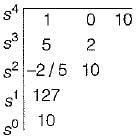
Since there are two sign changes in first column of Routh’s array, therefore the system is unstable.
Number of roots with positive real part = 2
Number of roots with negative real part = 2
Number of roots with zero real part = 0
Since there are two sign changes in first column of Routh’s array, therefore the system is unstable.
Number of roots with positive real part = 2
Number of roots with negative real part = 2
Number of roots with zero real part = 0
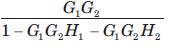
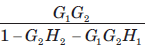
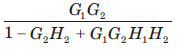
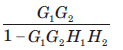

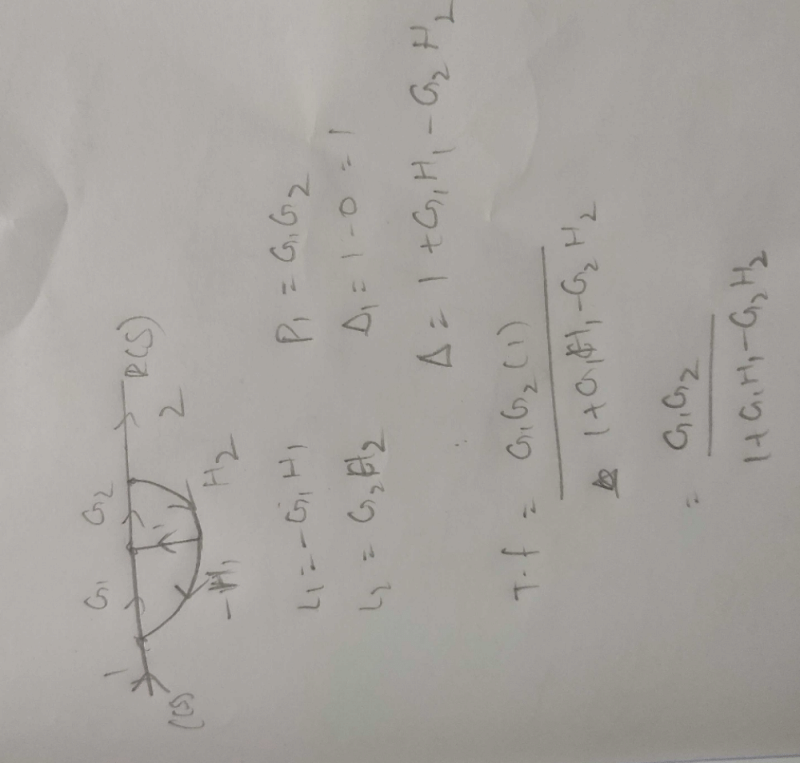
In the phase lead compensation network, the phase of ______ leads the phase of ______.- a)input voltage, output voltage
- b)input voltage, input voltage
- c)output voltage, input voltage
- d)output voltage, output voltage
Correct answer is option 'C'. Can you explain this answer?
In the phase lead compensation network, the phase of ______ leads the phase of ______.
a)
input voltage, output voltage
b)
input voltage, input voltage
c)
output voltage, input voltage
d)
output voltage, output voltage
 | Machine Experts answered |
Lead compensator:
Transfer function:
Transfer function:
If it is in the form of  then a < 1
then a < 1If it is in the form of  then a > b
In the frequency domain,

Phase angle, ∠G (jω) = tan−1ωαT − tan−1ωT
then a > bIn the frequency domain,
Phase angle, ∠G (jω) = tan−1ωαT − tan−1ωT
ϕ = tan-1 ωaT – tan-1 ωT
As a > 1 always (from the definition), ϕ is positive
Hence, it is clear that the phase of output voltage leads the phase of the input voltage.
As a > 1 always (from the definition), ϕ is positive
Hence, it is clear that the phase of output voltage leads the phase of the input voltage.
If the constant 'k' is negative, then what would be its contribution to the phase plot:- a)90 degrees
- b)45 degrees
- c)180 degrees
- d)0 degree
Correct answer is option 'C'. Can you explain this answer?
If the constant 'k' is negative, then what would be its contribution to the phase plot:
a)
90 degrees
b)
45 degrees
c)
180 degrees
d)
0 degree
 | Cstoppers Instructors answered |
Polar plot:
- The polar plot of a transfer function G(jω) is the plot of the magnitude of G(jω) versus the phase angle of G(jω) as ω is varied from 0 to positive infinity.
- For all pole systems, type indicates the starting point of the polar plot and order indicates the ending point of the polar plot.
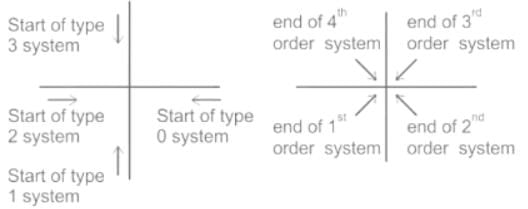
- As seen from the above figure, when a zero is added the type decreases, and the end of the polar plot shifts by +90°.
- When a pole is added, the type of the system increases, and hence the end of the polar plot shifts by -90°.
Calculation:
Let the transfer function be:
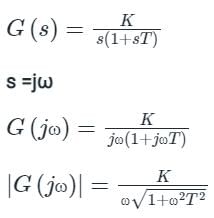
Let the transfer function be:
The total phase shift will be:
∠G(jω)H(jω) = -90° - tan-1(ωT) - 180° ----(1)
From equation (1) we can say that constant K has no contribution to the phase plot.
Hence K contributes 180° to the phase plot.
So option (c) is the correct answer.
∠G(jω)H(jω) = -90° - tan-1(ωT) - 180° ----(1)
From equation (1) we can say that constant K has no contribution to the phase plot.
Hence K contributes 180° to the phase plot.
So option (c) is the correct answer.
The transfer function of a system is 
The system is then which one of the following?- a)Non-minimum phase function
- b)Low-pass system
- c)Second-order system
- d)None of the above
Correct answer is option 'D'. Can you explain this answer?
The transfer function of a system is
The system is then which one of the following?
The system is then which one of the following?
a)
Non-minimum phase function
b)
Low-pass system
c)
Second-order system
d)
None of the above
 | Ashutosh Majumdar answered |
Since one pole (s .= 1) lies in RH s-plane, therefore the system is unstable.
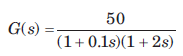


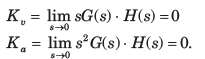
Consider a feedback system with gain margin of about 30. At what point does Nyquist plot crosses negative real axis?- a)-3
- b)-0.3
- c)-30
- d)-0.03
Correct answer is option 'B'. Can you explain this answer?
Consider a feedback system with gain margin of about 30. At what point does Nyquist plot crosses negative real axis?
a)
-3
b)
-0.3
c)
-30
d)
-0.03
| | Sharmila Kulkarni answered |
Nyquist Plot and Gain Margin
Nyquist plot is a graphical representation of a system's frequency response. It is used to analyze the stability of a feedback system. The Nyquist plot is a plot of the frequency response of a system in the complex plane. The gain margin of a feedback system is the amount of gain that the system can handle before it becomes unstable. It is defined as the amount of gain that causes the Nyquist plot to cross the negative real axis.
Answer Explanation
Given that the gain margin of the feedback system is about 30, we can determine at what point the Nyquist plot crosses the negative real axis by using the Nyquist stability criterion. The Nyquist stability criterion states that the number of encirclements of the -1 point in the Nyquist plot is equal to the number of unstable poles of the closed-loop transfer function.
Since the gain margin is about 30, the Nyquist plot will cross the negative real axis at a point where the magnitude of the complex number is equal to 1/30. This is because the gain margin is the reciprocal of the point where the Nyquist plot crosses the negative real axis. Therefore, the Nyquist plot will cross the negative real axis at a frequency of -0.3, which corresponds to a magnitude of 1/30.
Thus, the correct answer is option B, -0.3.
Nyquist plot is a graphical representation of a system's frequency response. It is used to analyze the stability of a feedback system. The Nyquist plot is a plot of the frequency response of a system in the complex plane. The gain margin of a feedback system is the amount of gain that the system can handle before it becomes unstable. It is defined as the amount of gain that causes the Nyquist plot to cross the negative real axis.
Answer Explanation
Given that the gain margin of the feedback system is about 30, we can determine at what point the Nyquist plot crosses the negative real axis by using the Nyquist stability criterion. The Nyquist stability criterion states that the number of encirclements of the -1 point in the Nyquist plot is equal to the number of unstable poles of the closed-loop transfer function.
Since the gain margin is about 30, the Nyquist plot will cross the negative real axis at a point where the magnitude of the complex number is equal to 1/30. This is because the gain margin is the reciprocal of the point where the Nyquist plot crosses the negative real axis. Therefore, the Nyquist plot will cross the negative real axis at a frequency of -0.3, which corresponds to a magnitude of 1/30.
Thus, the correct answer is option B, -0.3.
Which of the following is the correct statement?
A minimum phase network is one whose transfer function has- a)zeros in the right hand s-plane and poles in the left hand s-plane.
- b)zeros and poles in the left hand s-plane.
- c)zeros in the left hand s-plane and poles in the right hand s-plane.
- d)arbitrary distribution of zeros and poles in the S-plane.
Correct answer is option 'B'. Can you explain this answer?
Which of the following is the correct statement?
A minimum phase network is one whose transfer function has
A minimum phase network is one whose transfer function has
a)
zeros in the right hand s-plane and poles in the left hand s-plane.
b)
zeros and poles in the left hand s-plane.
c)
zeros in the left hand s-plane and poles in the right hand s-plane.
d)
arbitrary distribution of zeros and poles in the S-plane.
 | Anjali Choudhury answered |
Explanation:
Minimum Phase Network:
A minimum phase network is a type of linear time-invariant (LTI) system in which all the zeroes and poles of the transfer function lie in the left-half of the s-plane. The transfer function of a minimum phase network is a causal and stable function that can be factored into a product of two terms: a minimum phase term and a delay term. The minimum phase term has all its zeroes and poles in the left-half of the s-plane, while the delay term has a pole at the origin.
Transfer Function:
The transfer function of a minimum phase network is given by:
H(s) = e^(-Ds) * G(s)
where D is a positive constant, G(s) is the minimum phase transfer function, and e^(-Ds) is the delay term. The transfer function H(s) can be expressed as a product of the minimum phase term G(s) and the delay term e^(-Ds). The minimum phase term G(s) is a causal and stable function that has all its zeroes and poles in the left-half of the s-plane. The delay term e^(-Ds) is a non-causal and unstable function that has a pole at the origin.
Properties of Minimum Phase Network:
The following are some of the properties of a minimum phase network:
- All the zeroes and poles of the transfer function lie in the left-half of the s-plane.
- The step response of a minimum phase network is faster than that of a non-minimum phase network with the same magnitude response.
- The phase response of a minimum phase network is always less than or equal to the phase response of a non-minimum phase network with the same magnitude response.
- The impulse response of a minimum phase network decays faster than that of a non-minimum phase network with the same magnitude response.
Answer:
Option 'B' is the correct statement. A minimum phase network is one whose transfer function has zeros and poles in the left-hand s-plane.
Minimum Phase Network:
A minimum phase network is a type of linear time-invariant (LTI) system in which all the zeroes and poles of the transfer function lie in the left-half of the s-plane. The transfer function of a minimum phase network is a causal and stable function that can be factored into a product of two terms: a minimum phase term and a delay term. The minimum phase term has all its zeroes and poles in the left-half of the s-plane, while the delay term has a pole at the origin.
Transfer Function:
The transfer function of a minimum phase network is given by:
H(s) = e^(-Ds) * G(s)
where D is a positive constant, G(s) is the minimum phase transfer function, and e^(-Ds) is the delay term. The transfer function H(s) can be expressed as a product of the minimum phase term G(s) and the delay term e^(-Ds). The minimum phase term G(s) is a causal and stable function that has all its zeroes and poles in the left-half of the s-plane. The delay term e^(-Ds) is a non-causal and unstable function that has a pole at the origin.
Properties of Minimum Phase Network:
The following are some of the properties of a minimum phase network:
- All the zeroes and poles of the transfer function lie in the left-half of the s-plane.
- The step response of a minimum phase network is faster than that of a non-minimum phase network with the same magnitude response.
- The phase response of a minimum phase network is always less than or equal to the phase response of a non-minimum phase network with the same magnitude response.
- The impulse response of a minimum phase network decays faster than that of a non-minimum phase network with the same magnitude response.
Answer:
Option 'B' is the correct statement. A minimum phase network is one whose transfer function has zeros and poles in the left-hand s-plane.
Which of the following is NOT the disadvantage of lag compensator in a control system?- a)In lag compensator, the attenuation offered by it shifts the gain crossover frequency to a lower point, thereby decreasing the bandwidth.
- b)The lag network offers a reduction in bandwidth, and this gives shorter rise time and settling time and so the transient response.
- c)A lag compensator somewhat acts as a proportional plus integral controller, hence adversely affects the stability of the system.
- d)Though the system response is longer due to decreased bandwidth, the response is quite slow
Correct answer is option 'B'. Can you explain this answer?
Which of the following is NOT the disadvantage of lag compensator in a control system?
a)
In lag compensator, the attenuation offered by it shifts the gain crossover frequency to a lower point, thereby decreasing the bandwidth.
b)
The lag network offers a reduction in bandwidth, and this gives shorter rise time and settling time and so the transient response.
c)
A lag compensator somewhat acts as a proportional plus integral controller, hence adversely affects the stability of the system.
d)
Though the system response is longer due to decreased bandwidth, the response is quite slow
| | Zoya Sharma answered |
Advantages of Lag Compensator:
- A phase lag network offers high gain at low frequency. Thus, it performs the function of a low pass filter.
- The introduction of this network increases the steady-state performance of the system.
- The lag network offers a reduction in bandwidth and this provides longer rise time and settling time and so the transient response.
- The angular contribution of the pole is more than that of the compensator zero because the pole dominates the zero in the lag compensator.
Advantages of Lead Compensator:
- It improves the damping of the overall system.
- The enhanced damping of the system supports less overshoot along with less rise time and settling time. Therefore, the transient response gets improved.
- The addition of a lead network improves the phase margin.
- A system with a lead network provides a quick response as it increases bandwidth thereby providing a faster response.
- Lead networks do not disturb the steady-state error of the system.
- It maximizes the velocity constant of the system.


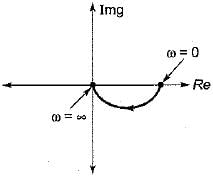
The inverse polar plot of the open loop transfer function, 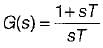 will be re presented by
- a)
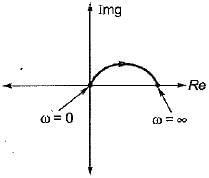
- b)
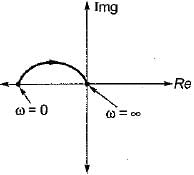
- c)
- d)
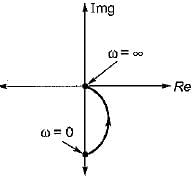
Correct answer is option 'A'. Can you explain this answer?
The inverse polar plot of the open loop transfer function, will be re presented by
will be re presented bya)
b)
c)
d)
 | Lavanya Menon answered |
Given, G(s) = (1+sT)/(sT)
The inverse polar plot of G(jω) is the polar plot of 1/G(jω)
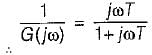
Thus,
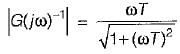
and
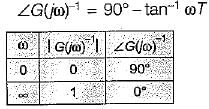
Hence, inverse polar plot will be as show below,
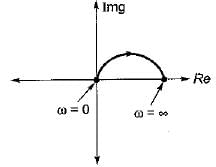
The inverse polar plot of G(jω) is the polar plot of 1/G(jω)
Thus,
and
Hence, inverse polar plot will be as show below,
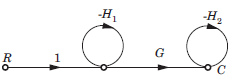

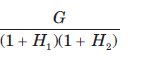
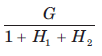
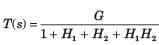
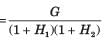
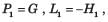

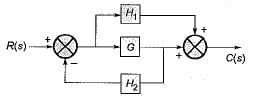
The transfer function C(s)/R(s) for the system described by the block diagram shown below is given by:
- a)

- b)

- c)

- d)None of these
Correct answer is option 'C'. Can you explain this answer?
The transfer function C(s)/R(s) for the system described by the block diagram shown below is given by:
a)
b)
c)
d)
None of these
| | Rhea Reddy answered |
On shifting the take-off point beyond block G, we have the reduced block diagram as shown below:
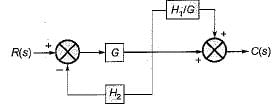
On further reducing the above block diagram, we get the block diagram as shown below.
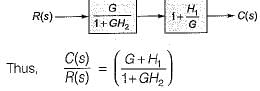
On further reducing the above block diagram, we get the block diagram as shown below.
Assuming zero initial condition, the response y(t) of the system given below to a unit step input u(t) is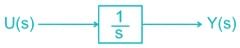
- a)u(t)
- b)t.u(t)
- c)t2/2.u(t)
- d)e-tu(t)
Correct answer is option 'B'. Can you explain this answer?
Assuming zero initial condition, the response y(t) of the system given below to a unit step input u(t) is
a)
u(t)
b)
t.u(t)
c)
t2/2.u(t)
d)
e-tu(t)
| | Luminary Institute answered |
Laplace transform of u(t) is given by
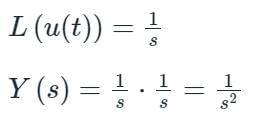
Taking Inverse Laplace transform
y(t) = t.u(t)
The compensator required to improve the steady state response of a system is- a)Lag
- b)Lead
- c)Lag-lead
- d)Zero
Correct answer is option 'A'. Can you explain this answer?
The compensator required to improve the steady state response of a system is
a)
Lag
b)
Lead
c)
Lag-lead
d)
Zero
| | Cstoppers Instructors answered |
Lag compensator:
Transfer function:
Transfer function:
If it is in the form of  then a < 1
then a < 1If it is in the form of  then a > b
Maximum phase lag frequency:
ωm = 1√Ta
Maximum phase lag::
then a > bMaximum phase lag frequency:
ωm = 1√Ta
Maximum phase lag::
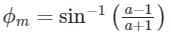
ϕm is negative
Pole zero plot:
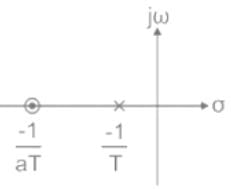
The pole is nearer to the origin.
Filter: It is a low pass filter (LPF)
Effect on the system:
Filter: It is a low pass filter (LPF)
Effect on the system:
- Rise time and settling time increases and Bandwidth decreases
- The transient response becomes slower
- The steady-state response is improved
- Stability decreases
For the system shown in the figure, Y(s)/X(s) = _________. (Answer in integer )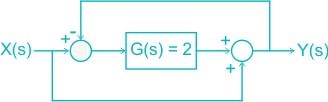
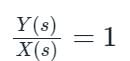
Correct answer is between '0.95,1.05'. Can you explain this answer?
For the system shown in the figure, Y(s)/X(s) = _________. (Answer in integer )
| | Cstoppers Instructors answered |
The circuit is redrawn as shown:
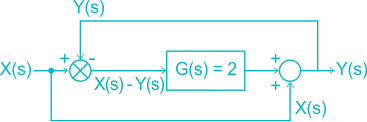
[X(s) – Y(s)] G(s) + X(s) = Y(s)
Given G(s) = 2
(X(s) – Y(s)) 2 + X(s) = Y(s)
= 2 X(s) + X(s) = Y(s) + 2Y(s)
= 3 X(s) = 3 Y(s)
If a system has an open loop transfer function 1-s / 1+s, then the gain of the system at frequency of 1 rad/s will be- a)1
- b)1/2
- c)Zero
- d)-1
Correct answer is option 'D'. Can you explain this answer?
If a system has an open loop transfer function 1-s / 1+s, then the gain of the system at frequency of 1 rad/s will be
a)
1
b)
1/2
c)
Zero
d)
-1
| | Anuj Rane answered |
Open Loop Transfer Function
The open loop transfer function of a system represents the relationship between the input and output of a system without any feedback. It is denoted by G(s) and is expressed as the ratio of the Laplace transform of the output to the Laplace transform of the input.
G(s) = Y(s) / X(s)
Where:
G(s) - open loop transfer function
Y(s) - Laplace transform of the output
X(s) - Laplace transform of the input
Given Transfer Function
In this question, the given open loop transfer function is 1 - s / 1 + s.
Frequency Response of a System
To determine the gain of a system at a specific frequency, we substitute jω for s in the transfer function, where ω represents the angular frequency in radians per second.
G(jω) = Y(jω) / X(jω)
To find the gain at a specific frequency, we substitute ω = 1 rad/s in the transfer function and evaluate the expression.
Gain at Frequency ω = 1 rad/s
Substituting ω = 1 rad/s in the transfer function:
G(j1) = Y(j1) / X(j1)
Calculating the Gain
G(j1) = (1 - j) / (1 + j)
To calculate the gain, we need to find the modulus of this complex number.
|G(j1)| = sqrt((1 - j)^2) / sqrt((1 + j)^2)
Simplifying the expression:
|G(j1)| = sqrt(1^2 + (-1)^2) / sqrt(1^2 + 1^2)
|G(j1)| = sqrt(1 + 1) / sqrt(1 + 1)
|G(j1)| = sqrt(2) / sqrt(2)
|G(j1)| = 1
Hence, the gain of the system at a frequency of 1 rad/s is 1.
Conclusion
The correct answer is option 'A' - 1. The gain of the system at a frequency of 1 rad/s is 1.
The open loop transfer function of a system represents the relationship between the input and output of a system without any feedback. It is denoted by G(s) and is expressed as the ratio of the Laplace transform of the output to the Laplace transform of the input.
G(s) = Y(s) / X(s)
Where:
G(s) - open loop transfer function
Y(s) - Laplace transform of the output
X(s) - Laplace transform of the input
Given Transfer Function
In this question, the given open loop transfer function is 1 - s / 1 + s.
Frequency Response of a System
To determine the gain of a system at a specific frequency, we substitute jω for s in the transfer function, where ω represents the angular frequency in radians per second.
G(jω) = Y(jω) / X(jω)
To find the gain at a specific frequency, we substitute ω = 1 rad/s in the transfer function and evaluate the expression.
Gain at Frequency ω = 1 rad/s
Substituting ω = 1 rad/s in the transfer function:
G(j1) = Y(j1) / X(j1)
Calculating the Gain
G(j1) = (1 - j) / (1 + j)
To calculate the gain, we need to find the modulus of this complex number.
|G(j1)| = sqrt((1 - j)^2) / sqrt((1 + j)^2)
Simplifying the expression:
|G(j1)| = sqrt(1^2 + (-1)^2) / sqrt(1^2 + 1^2)
|G(j1)| = sqrt(1 + 1) / sqrt(1 + 1)
|G(j1)| = sqrt(2) / sqrt(2)
|G(j1)| = 1
Hence, the gain of the system at a frequency of 1 rad/s is 1.
Conclusion
The correct answer is option 'A' - 1. The gain of the system at a frequency of 1 rad/s is 1.
What is the full form of PID?- a)Proportional Integral Derivative
- b)Proportional Integral Device
- c)Programmable Integral Device
- d)Programmable Integral Derivative
Correct answer is option 'A'. Can you explain this answer?
What is the full form of PID?
a)
Proportional Integral Derivative
b)
Proportional Integral Device
c)
Programmable Integral Device
d)
Programmable Integral Derivative
| | Jaya Datta answered |
Understanding PID Control
PID stands for Proportional Integral Derivative, which is a fundamental control mechanism widely used in industrial control systems. Let’s break down the components:
1. Proportional (P)
- The proportional term produces an output value that is proportional to the current error value.
- The main function is to reduce the overall error by adjusting the control output relative to the error.
- A higher proportional gain results in a larger change in the output for a given error.
2. Integral (I)
- The integral term is concerned with the accumulation of past errors.
- It integrates the error over time, thus addressing any residual steady-state error that may remain after the proportional response.
- This helps eliminate the offset that can occur with a purely proportional controller.
3. Derivative (D)
- The derivative term predicts future error based on its rate of change.
- It acts as a damping factor, improving system stability by counteracting the rate of change of the error.
- This helps to reduce overshoot and oscillations in the control response.
Application of PID Controllers
- PID controllers are utilized in various applications, including temperature control, speed control of motors, and pressure control.
- They are favored for their simplicity and effectiveness in providing a stable control response.
In summary, the full form of PID is Proportional Integral Derivative, and each component plays a crucial role in achieving precise control in dynamic systems. This method has become a standard in engineering due to its versatility and reliability.
PID stands for Proportional Integral Derivative, which is a fundamental control mechanism widely used in industrial control systems. Let’s break down the components:
1. Proportional (P)
- The proportional term produces an output value that is proportional to the current error value.
- The main function is to reduce the overall error by adjusting the control output relative to the error.
- A higher proportional gain results in a larger change in the output for a given error.
2. Integral (I)
- The integral term is concerned with the accumulation of past errors.
- It integrates the error over time, thus addressing any residual steady-state error that may remain after the proportional response.
- This helps eliminate the offset that can occur with a purely proportional controller.
3. Derivative (D)
- The derivative term predicts future error based on its rate of change.
- It acts as a damping factor, improving system stability by counteracting the rate of change of the error.
- This helps to reduce overshoot and oscillations in the control response.
Application of PID Controllers
- PID controllers are utilized in various applications, including temperature control, speed control of motors, and pressure control.
- They are favored for their simplicity and effectiveness in providing a stable control response.
In summary, the full form of PID is Proportional Integral Derivative, and each component plays a crucial role in achieving precise control in dynamic systems. This method has become a standard in engineering due to its versatility and reliability.
The open loop transfer function of a unity gain negative feedback system is given as
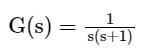
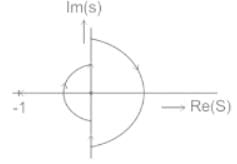
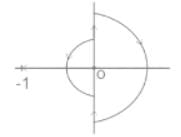
The Nyquist contour in the ��-plane encloses the entire right half plane and a small neighbourhood around the origin in the left half plane, as shown in the figure below. The number of encirclements of the point (−1 + j0) by the Nyquist plot of G(s), corresponding to the Nyquist contour, is denoted as N. Then N equals to
- a)0
- b)1
- c)2
- d)3
Correct answer is option 'B'. Can you explain this answer?
The open loop transfer function of a unity gain negative feedback system is given as
The Nyquist contour in the ��-plane encloses the entire right half plane and a small neighbourhood around the origin in the left half plane, as shown in the figure below. The number of encirclements of the point (−1 + j0) by the Nyquist plot of G(s), corresponding to the Nyquist contour, is denoted as N. Then N equals to
The Nyquist contour in the ��-plane encloses the entire right half plane and a small neighbourhood around the origin in the left half plane, as shown in the figure below. The number of encirclements of the point (−1 + j0) by the Nyquist plot of G(s), corresponding to the Nyquist contour, is denoted as N. Then N equals to
a)
0
b)
1
c)
2
d)
3
| | Zoya Sharma answered |
Concept
N = P - 2
N = no. of encirclements of )-1, 0) critical point by the Nyquist plot.
P = no. of right half of s-plane of G(s) H(s) as F(s)
z = no. of lright half of s-plane of CLTF as zero of F(s)
For stability z = 0
N - P = 0
N = P
for Nyquist stability criteria
Calculation
Open loop function:
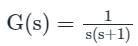
Close loop transfer function =
Close loop transfer function =
no pole in right hand side
z = 0, P ⇒ 1
N = 1 - 0
N = 1
no. of oncirclements N = 1
The time required for the response curve to reach and stay within the specified 2-5% of final value is referred to as :- a)Peak time
- b)Rise time
- c)Settling time
- d)Peak overshoot time
Correct answer is option 'C'. Can you explain this answer?
The time required for the response curve to reach and stay within the specified 2-5% of final value is referred to as :
a)
Peak time
b)
Rise time
c)
Settling time
d)
Peak overshoot time
| | Siddharth Malhotra answered |
Understanding Settling Time
Settling time is a critical parameter in control systems, particularly in the field of Electronics and Communication Engineering (ECE). It indicates how quickly a system can stabilize after a disturbance or a change in input.
Definition of Settling Time
- Settling time is defined as the time required for the system’s response curve to reach and remain within a specified percentage (usually 2-5%) of its final value after a step input is applied.
Importance of Settling Time
- Performance Indicator: Settling time is crucial for assessing the performance of control systems. A shorter settling time means the system responds quickly and efficiently to changes.
- Stability: It indicates how well the system can stabilize after fluctuations or disturbances, ensuring reliability in applications.
Comparison with Other Time Parameters
- Peak Time: This is the time it takes for the response to reach its first peak. It does not account for how long it takes to settle.
- Rise Time: This measures the time required for the response to rise from a specified lower percentage to a specified upper percentage of the final value.
- Peak Overshoot Time: This refers to the amount by which the response exceeds the final value before settling down.
Conclusion
- Settling time is key to evaluating a system's performance and stability. It ensures that after an input change, the system not only responds but also stays within acceptable limits of the final value, providing a clear indication of how effectively the system performs in real-world applications. Understanding this concept is essential for designing efficient control systems in ECE.
Settling time is a critical parameter in control systems, particularly in the field of Electronics and Communication Engineering (ECE). It indicates how quickly a system can stabilize after a disturbance or a change in input.
Definition of Settling Time
- Settling time is defined as the time required for the system’s response curve to reach and remain within a specified percentage (usually 2-5%) of its final value after a step input is applied.
Importance of Settling Time
- Performance Indicator: Settling time is crucial for assessing the performance of control systems. A shorter settling time means the system responds quickly and efficiently to changes.
- Stability: It indicates how well the system can stabilize after fluctuations or disturbances, ensuring reliability in applications.
Comparison with Other Time Parameters
- Peak Time: This is the time it takes for the response to reach its first peak. It does not account for how long it takes to settle.
- Rise Time: This measures the time required for the response to rise from a specified lower percentage to a specified upper percentage of the final value.
- Peak Overshoot Time: This refers to the amount by which the response exceeds the final value before settling down.
Conclusion
- Settling time is key to evaluating a system's performance and stability. It ensures that after an input change, the system not only responds but also stays within acceptable limits of the final value, providing a clear indication of how effectively the system performs in real-world applications. Understanding this concept is essential for designing efficient control systems in ECE.
Consider the following statements related to Routh-Hurwitz criterion of determining the stability of a system:
1. It is applicable if the characteristic equation has real coefficients, complex ternrivS or exponential functions of s.
2. The criterion can be applied to any stability boundaries in complex plane, such as the unit circle in the z-plane.
3. The number of changes of signs in the elements of the first column equals the number of roots with negative real parts.
Which of these statements is/are not correct?- a)2 and 3 oniy .
- b)1, 2 and 3
- c)1 only
- d)1 and 2 only
Correct answer is option 'B'. Can you explain this answer?
Consider the following statements related to Routh-Hurwitz criterion of determining the stability of a system:
1. It is applicable if the characteristic equation has real coefficients, complex ternrivS or exponential functions of s.
2. The criterion can be applied to any stability boundaries in complex plane, such as the unit circle in the z-plane.
3. The number of changes of signs in the elements of the first column equals the number of roots with negative real parts.
Which of these statements is/are not correct?
1. It is applicable if the characteristic equation has real coefficients, complex ternrivS or exponential functions of s.
2. The criterion can be applied to any stability boundaries in complex plane, such as the unit circle in the z-plane.
3. The number of changes of signs in the elements of the first column equals the number of roots with negative real parts.
Which of these statements is/are not correct?
a)
2 and 3 oniy .
b)
1, 2 and 3
c)
1 only
d)
1 and 2 only
 | Athul Banerjee answered |
• Routh-Hurwitz criterion is not applicable if characteristic equation has coefficients which are exponential or complex.
• It is not applied in z-piane because z-piane having unit circle is the stability boundary of discrete-data system.
• Statement-3 is also false because no. of sign change in 1st column of Routh’s array indicates the number of roots with positive real part or roots lying in RH s-plane.
• It is not applied in z-piane because z-piane having unit circle is the stability boundary of discrete-data system.
• Statement-3 is also false because no. of sign change in 1st column of Routh’s array indicates the number of roots with positive real part or roots lying in RH s-plane.
Given a badly underdamped control system, the type of cascade compensator to be used to improve its damping is- a)phase-lag
- b)phase-lead-lag
- c)phase-lead
- d)notch filter
Correct answer is option 'C'. Can you explain this answer?
Given a badly underdamped control system, the type of cascade compensator to be used to improve its damping is
a)
phase-lag
b)
phase-lead-lag
c)
phase-lead
d)
notch filter
 | Yash Patel answered |
Phase Lead Compensator:
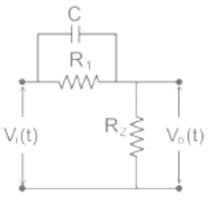
- A lead compensator provides a positive phase shift for increasing the value of frequencies from 0 to ∞.
- It is also known as a differentiator circuit.
- For a lead network, zero is nearer to the origin.
- It is used to improve the transient response of the system.
- It increases the damping of the system.
Phase Lag Compensator:
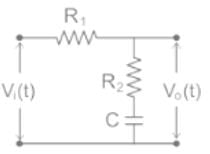
- A lead compensator provides a negative phase shift for increasing the value of frequencies from 0 to ∞.
- It is also known as an integrator circuit.
- For a lag network, pole is nearer to the origin.
- It is used to improve the steady state response of the system.
- It decreases the steady-state error of the system.
Match the following :-
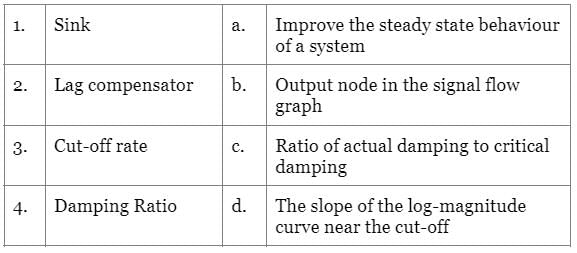
- a)1 - b, 2 - a, 3 - d, 4 - c
- b)1 - a, 2 - b, 3 - c, 4 - d
- c)1 - c, 2 - d, 3 - b, 4 - a
- d)1 - a, 2 - d, 3 - c, 4 - b
Correct answer is option 'A'. Can you explain this answer?
Match the following :-
a)
1 - b, 2 - a, 3 - d, 4 - c
b)
1 - a, 2 - b, 3 - c, 4 - d
c)
1 - c, 2 - d, 3 - b, 4 - a
d)
1 - a, 2 - d, 3 - c, 4 - b
| | Machine Experts answered |
Sink node:
- A local sink is a node of a directed graph with no exiting edges, also called a terminal.
- It is the output node in the signal flow graph. It is a node, which has only incoming branches.
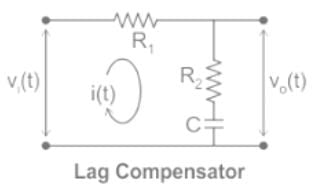
Lag Compensator:
- Phase lag network offers high gain at low frequency.
- Thus, it performs the function of a low pass filter.
- The introduction of this network increases the steady-state performance of the system.
Damping Ratio:
- The damping ratio gives the level of damping in the control system related to critical damping.
- The damping ratio is defined as the ratio of actual damping to the critical damping of the system.
- It is the ratio of the damping coefficient of a differential equation of a system to the damping coefficient of critical damping.
- ζ = actual damping / critical damping
Cut-off rate: It is the slope of the log-magnitude curve near the cut-off region of the Bode-plot.
Consider the following statements regarding a control system:(a) Addition of pole to left half of s-plane reduce the relative stability(b) Addition of zero to left half of s-plane increase the damping factor(c) Integral controller reduces the steady state error(d) Derivate controller cannot be used in isolationWhich of the above statements are true?- a)(a) & (c) only
- b)(b) & (d) only
- c)(a), (b), (d) only
- d)All (a), (b), (c), (d)
Correct answer is option 'D'. Can you explain this answer?
Consider the following statements regarding a control system:
(a) Addition of pole to left half of s-plane reduce the relative stability
(b) Addition of zero to left half of s-plane increase the damping factor
(c) Integral controller reduces the steady state error
(d) Derivate controller cannot be used in isolation
Which of the above statements are true?
a)
(a) & (c) only
b)
(b) & (d) only
c)
(a), (b), (d) only
d)
All (a), (b), (c), (d)
| | Cstoppers Instructors answered |
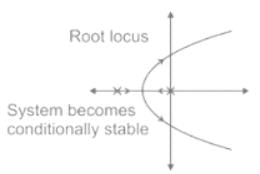
(a) Addition of pole reduces stability
Consider system =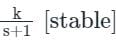
Adding Pole [say at origin]

(b) Addition of zero increase ξ
Consider system with Transfer function
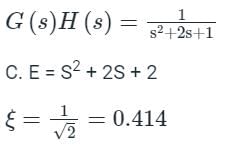
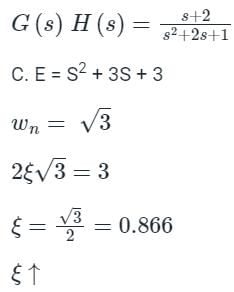
Now add one zero to left half say at -2
(c) Integral controller adds one pole at origin
Now add one zero to left half say at -2
(c) Integral controller adds one pole at origin
As type of system increase steady state error reduce
(d) Derivative controllers are not used Alone because with sudden changes in the system the derivative controller will compensate the output fast therefore in long term effects the isolated controller will produce huge steady state errors.
The characteristic equation of a second order discrete-data system is given by:
F(z) = z2+ z+ 0.25 = 0
The above system is- a)stable
- b)marginally stable
- c)unstable
- d)asymptotically stable
Correct answer is option 'A'. Can you explain this answer?
The characteristic equation of a second order discrete-data system is given by:
F(z) = z2+ z+ 0.25 = 0
The above system is
F(z) = z2+ z+ 0.25 = 0
The above system is
a)
stable
b)
marginally stable
c)
unstable
d)
asymptotically stable
 | Nilesh Joshi answered |
For a second order discrete- data system given by:
F(z) = a2z2 + a1z + a0 = 0
to be stable, the necessary and sufficient conditions are:
F(1) > 0
F(-1) > 0 and |a0| < a2
Here, F(z) = z2 + z + 0.25
So, = 0.25, a1 = 1, a2 = 1
Thus, F(1) - 12+ 1 + 0.25 = 2.25 > 0
F(-1) = 1 -1 + 0.25 = 0.25 > 0
and la0l = 0.25 < a2 = 1 Since ail the conditions are satisfied, therefore given system is stable.
F(z) = a2z2 + a1z + a0 = 0
to be stable, the necessary and sufficient conditions are:
F(1) > 0
F(-1) > 0 and |a0| < a2
Here, F(z) = z2 + z + 0.25
So, = 0.25, a1 = 1, a2 = 1
Thus, F(1) - 12+ 1 + 0.25 = 2.25 > 0
F(-1) = 1 -1 + 0.25 = 0.25 > 0
and la0l = 0.25 < a2 = 1 Since ail the conditions are satisfied, therefore given system is stable.
The characteristic equation of a closed loop control system is given by:
s2 + 2s +10 + K(s2 + 6s + 10) = 0
The angle of asymptotes for the root loci for K > 0 are given by- a)180°, 360°
- b)90°, 270°
- c)90°, 180°
- d)none of these
Correct answer is option 'D'. Can you explain this answer?
The characteristic equation of a closed loop control system is given by:
s2 + 2s +10 + K(s2 + 6s + 10) = 0
The angle of asymptotes for the root loci for K > 0 are given by
s2 + 2s +10 + K(s2 + 6s + 10) = 0
The angle of asymptotes for the root loci for K > 0 are given by
a)
180°, 360°
b)
90°, 270°
c)
90°, 180°
d)
none of these
| | Saumya Basak answered |
Given, s2 + 2s + 10 + K(s2 + 6s + 10) = 0
or,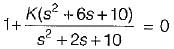
or, 1 + G(s)H(s) = 0
Thus, G(s)H(s) =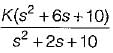
Here, number of open loop poles, P = 2. Number of open loop zero, Z = 2
∴ P - Z = 0.
Angle of asymptotes are given by:
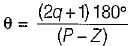
Sines P - Z= 0, therefore there are no angle of asymptotes for the root locus of the given system.
or,
or, 1 + G(s)H(s) = 0
Thus, G(s)H(s) =
Here, number of open loop poles, P = 2. Number of open loop zero, Z = 2
∴ P - Z = 0.
Angle of asymptotes are given by:
Sines P - Z= 0, therefore there are no angle of asymptotes for the root locus of the given system.
Which one of the following options correctly describes the locations of the roots of the equation s4 + s2 + 1 = 0 on the complex plane?- a)Four left half plane (LHP) roots
- b)One right half plane (RHP) root, one LHP root and two roots on the imaginary axis
- c)Two RHP roots and two LHP roots
- d)All four roots are on the imaginary axis
Correct answer is option 'C'. Can you explain this answer?
Which one of the following options correctly describes the locations of the roots of the equation s4 + s2 + 1 = 0 on the complex plane?
a)
Four left half plane (LHP) roots
b)
One right half plane (RHP) root, one LHP root and two roots on the imaginary axis
c)
Two RHP roots and two LHP roots
d)
All four roots are on the imaginary axis
| | Shlok Sengupta answered |
The roots of the equation s^4 + s^2 + 1 = 0 on the complex plane can be described as follows:
Explanation:
To find the roots of the equation s^4 + s^2 + 1 = 0, we can rearrange it as follows:
s^4 + s^2 + 1 = 0
(s^2 + 1)^2 - s^2 = 0
(s^2 + 1 + s)(s^2 + 1 - s) = 0
This equation can be further simplified into two quadratic equations:
s^2 + 1 + s = 0 (Equation 1)
s^2 + 1 - s = 0 (Equation 2)
Roots of Equation 1:
To find the roots of Equation 1, we can use the quadratic formula:
s = (-b ± √(b^2 - 4ac)) / (2a)
For Equation 1, a = 1, b = 1, and c = 1. Substituting these values into the quadratic formula, we get:
s = (-1 ± √(1 - 4(1)(1))) / (2(1))
s = (-1 ± √(-3)) / 2
Since the discriminant (√(-3)) is imaginary, the roots of Equation 1 will also be imaginary. Therefore, Equation 1 has two roots on the imaginary axis.
Roots of Equation 2:
Similarly, using the quadratic formula for Equation 2, we get:
s = (1 ± √(1 - 4(1)(1))) / (2(1))
s = (1 ± √(-3)) / 2
Again, since the discriminant (√(-3)) is imaginary, the roots of Equation 2 will also be imaginary. Therefore, Equation 2 has two roots on the imaginary axis.
Conclusion:
In total, the equation s^4 + s^2 + 1 = 0 has four roots on the complex plane. Two of these roots are on the right half plane (RHP) and the other two roots are on the left half plane (LHP).
Explanation:
To find the roots of the equation s^4 + s^2 + 1 = 0, we can rearrange it as follows:
s^4 + s^2 + 1 = 0
(s^2 + 1)^2 - s^2 = 0
(s^2 + 1 + s)(s^2 + 1 - s) = 0
This equation can be further simplified into two quadratic equations:
s^2 + 1 + s = 0 (Equation 1)
s^2 + 1 - s = 0 (Equation 2)
Roots of Equation 1:
To find the roots of Equation 1, we can use the quadratic formula:
s = (-b ± √(b^2 - 4ac)) / (2a)
For Equation 1, a = 1, b = 1, and c = 1. Substituting these values into the quadratic formula, we get:
s = (-1 ± √(1 - 4(1)(1))) / (2(1))
s = (-1 ± √(-3)) / 2
Since the discriminant (√(-3)) is imaginary, the roots of Equation 1 will also be imaginary. Therefore, Equation 1 has two roots on the imaginary axis.
Roots of Equation 2:
Similarly, using the quadratic formula for Equation 2, we get:
s = (1 ± √(1 - 4(1)(1))) / (2(1))
s = (1 ± √(-3)) / 2
Again, since the discriminant (√(-3)) is imaginary, the roots of Equation 2 will also be imaginary. Therefore, Equation 2 has two roots on the imaginary axis.
Conclusion:
In total, the equation s^4 + s^2 + 1 = 0 has four roots on the complex plane. Two of these roots are on the right half plane (RHP) and the other two roots are on the left half plane (LHP).
Which of the following is not true regarding addition of a pole to the forward-path transfer function?- a)Maximum overshoot of the closed-loop system is increased.
- b)Rise time of the step response is increased.
- c)Stability of the system is increased.
- d)Bandwidth of the system is reduced.
Correct answer is option 'C'. Can you explain this answer?
Which of the following is not true regarding addition of a pole to the forward-path transfer function?
a)
Maximum overshoot of the closed-loop system is increased.
b)
Rise time of the step response is increased.
c)
Stability of the system is increased.
d)
Bandwidth of the system is reduced.
| | Sandeep Chatterjee answered |
With addition of a pole to the forward-path transfer function, bandwidth will reduce.
Since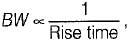 therefore rise time will increase.
Since rise time therefore stability will decrease.
Since
therefore rise time will increase.Since rise time
therefore stability will decrease.Consider the characteristic equation of a control system given by s3 + (K + 0.5)s2 + 4Ks + 50 = 0. Find the value of the frequency if the system has sustained oscillations for a given K.- a)ω = 50 rad/sec
- b)ω = 25 rad/sec
- c)ω = 3.63 rad/sec
- d)ω = 4.63 rad/sec
Correct answer is option 'C'. Can you explain this answer?
Consider the characteristic equation of a control system given by s3 + (K + 0.5)s2 + 4Ks + 50 = 0. Find the value of the frequency if the system has sustained oscillations for a given K.
a)
ω = 50 rad/sec
b)
ω = 25 rad/sec
c)
ω = 3.63 rad/sec
d)
ω = 4.63 rad/sec
| | Adarsh Chauhan answered |
To find the value of the frequency for sustained oscillations, we need to find the roots of the characteristic equation. The characteristic equation is given by:
s^3 + (0.5K)s^2 + 4Ks + 50 = 0
To find the roots, we can use the Routh-Hurwitz stability criterion. The Routh-Hurwitz table for this characteristic equation is as follows:
1 4K
0.5K 50
(-0.5K*50)/(4K) = -12.5K
From the Routh-Hurwitz table, we can see that for sustained oscillations to occur, we must have at least one sign change in the first column of the table. In this case, since the first column has two positive values (1 and 0.5K), there are no sign changes.
Therefore, the system does not have sustained oscillations for any value of K.
s^3 + (0.5K)s^2 + 4Ks + 50 = 0
To find the roots, we can use the Routh-Hurwitz stability criterion. The Routh-Hurwitz table for this characteristic equation is as follows:
1 4K
0.5K 50
(-0.5K*50)/(4K) = -12.5K
From the Routh-Hurwitz table, we can see that for sustained oscillations to occur, we must have at least one sign change in the first column of the table. In this case, since the first column has two positive values (1 and 0.5K), there are no sign changes.
Therefore, the system does not have sustained oscillations for any value of K.
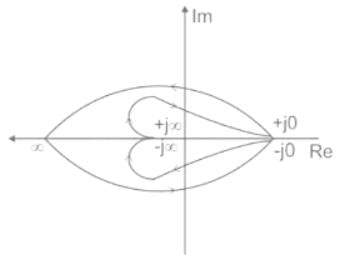
From the below given Nyquist plot, calculate the number of open-loop poles on the right-hand side of the s-plane for the closed-loop system to be stable.
- a)1
- b)2
- c)0
- d)-1
Correct answer is option 'A'. Can you explain this answer?
From the below given Nyquist plot, calculate the number of open-loop poles on the right-hand side of the s-plane for the closed-loop system to be stable.
a)
1
b)
2
c)
0
d)
-1
| | Ravi Singh answered |
Principle arguments
- It states that if there are “P” poles and “Z” zeroes for a closed, random selected path then the corresponding G(s)H(s) plane encircles the origin with P – Z times.
- Encirclements in s – plane and GH – plane are shown below.
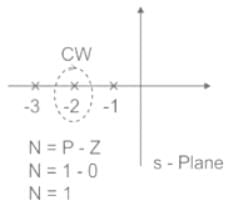
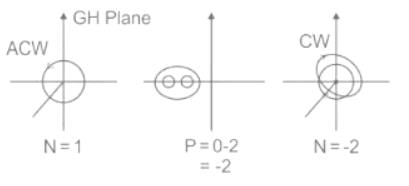
- In GH plane Anti clockwise encirclements are taken as positive and clockwise encirclements are taken as negative.
It is applied to the total RH plane by selecting a closed path with r = ∞
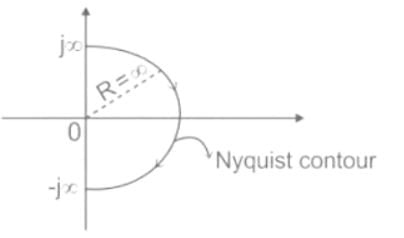
Nyquist stability completely deals with the right half of s – plane.
N(0, 0) = P – Z
N(0, 0): Number of encirclements around critical point (- 1, 0)
N(0, 0) = P – Z
N(0, 0): Number of encirclements around critical point (- 1, 0)
P: Open loop poles
Z: Open-loop zeroes.
Note:
1) To get the Closed-loop stability we require 1 + GH plane but available is GH plane, hence the origin is shifted to “-1” to get the closed-loop stability.
2) To become the system stable there should not be any closed-loop pole in the right of s – plane.
3) The closed-loop pole is the same as that of the zeroes of Characteristic Equation which must be zero in the right. i.e, Z = 0
N = P is the criteria.
Calculation:
From the given Nyquist plot there is one encirclement about ( -1, 0 ) in the Anti-clockwise direction.
So, N = 1
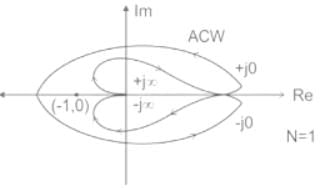
Now to satisfy the stability criteria N should be equal to P.
N = P = 1
So the number of open-loop poles in the Right-hand side of the system is 1.
Introduction of feedback to a system- a)increases the stability
- b)decreases the stability
- c)has no effect on stability
- d)none of the above
Correct answer is option 'D'. Can you explain this answer?
Introduction of feedback to a system
a)
increases the stability
b)
decreases the stability
c)
has no effect on stability
d)
none of the above
 | Pranjal Basu answered |
Introduction of feed back to a system will increase the stability if negative feedback is introduced while it will reduce the stability if positive feedback is introduced.
Chapter doubts & questions for Control Systems - 3 Months Preparation for GATE Electrical 2026 is part of Electrical Engineering (EE) exam preparation. The chapters have been prepared according to the Electrical Engineering (EE) exam syllabus. The Chapter doubts & questions, notes, tests & MCQs are made for Electrical Engineering (EE) 2026 Exam. Find important definitions, questions, notes, meanings, examples, exercises, MCQs and online tests here.
Chapter doubts & questions of Control Systems - 3 Months Preparation for GATE Electrical in English & Hindi are available as part of Electrical Engineering (EE) exam. Download more important topics, notes, lectures and mock test series for Electrical Engineering (EE) Exam by signing up for free.
3 Months Preparation for GATE Electrical676 videos|1399 docs|882 tests |
