


All Exams > OPSC OCS (Odisha) > 6 Months Preparation Course for OPSC > All Questions
All questions of Territorial States and First Magadha Empire for OPSC OCS (Odisha) Exam
Consider the following statements:- The rivalry between Magadha and Avanti ended with the Shishunaga dynasty's conquest of Avanti.
- Mahapadma Nanda expanded the Magadhan empire by conquering Kalinga and claiming to be the sole sovereign.
- Alexander the Great invaded the Magadhan empire but was repelled by the Nanda dynasty.
How many of the statements given above are correct?- a)Only one
- b)Only two
- c)All three
- d)None
Correct answer is option 'B'. Can you explain this answer?
Consider the following statements:
- The rivalry between Magadha and Avanti ended with the Shishunaga dynasty's conquest of Avanti.
- Mahapadma Nanda expanded the Magadhan empire by conquering Kalinga and claiming to be the sole sovereign.
- Alexander the Great invaded the Magadhan empire but was repelled by the Nanda dynasty.
How many of the statements given above are correct?
a)
Only one
b)
Only two
c)
All three
d)
None
 | Snehal Kumar answered |
Analysis of Statements
To assess the correctness of the statements regarding historical events involving the Magadhan empire, let’s examine each one closely.
Statement 1: The rivalry between Magadha and Avanti ended with the Shishunaga dynasty's conquest of Avanti.
- This statement is correct. The Shishunaga dynasty did indeed conquer Avanti, marking the end of the rivalry between the two kingdoms. This conquest was integral to the rise of Magadha as a prominent power.
Statement 2: Mahapadma Nanda expanded the Magadhan empire by conquering Kalinga and claiming to be the sole sovereign.
- This statement is partially correct. Mahapadma Nanda did expand the Magadhan empire significantly, but there is no definitive historical evidence that he conquered Kalinga as part of his expansion. While he claimed to be the sole sovereign, the specifics of his conquests can vary in historical accounts.
Statement 3: Alexander the Great invaded the Magadhan empire but was repelled by the Nanda dynasty.
- This statement is incorrect. Alexander did invade parts of India, but he never directly confronted the Nanda dynasty. Instead, he faced resistance from local rulers such as King Porus and did not reach Magadha.
Conclusion
In summary, only one statement (the first) is entirely correct, while the second statement has some inaccuracies regarding Kalinga, and the third is incorrect. Therefore, the correct answer is option b) Only two statements can be deemed partially correct when considering the context of the claims made.
To assess the correctness of the statements regarding historical events involving the Magadhan empire, let’s examine each one closely.
Statement 1: The rivalry between Magadha and Avanti ended with the Shishunaga dynasty's conquest of Avanti.
- This statement is correct. The Shishunaga dynasty did indeed conquer Avanti, marking the end of the rivalry between the two kingdoms. This conquest was integral to the rise of Magadha as a prominent power.
Statement 2: Mahapadma Nanda expanded the Magadhan empire by conquering Kalinga and claiming to be the sole sovereign.
- This statement is partially correct. Mahapadma Nanda did expand the Magadhan empire significantly, but there is no definitive historical evidence that he conquered Kalinga as part of his expansion. While he claimed to be the sole sovereign, the specifics of his conquests can vary in historical accounts.
Statement 3: Alexander the Great invaded the Magadhan empire but was repelled by the Nanda dynasty.
- This statement is incorrect. Alexander did invade parts of India, but he never directly confronted the Nanda dynasty. Instead, he faced resistance from local rulers such as King Porus and did not reach Magadha.
Conclusion
In summary, only one statement (the first) is entirely correct, while the second statement has some inaccuracies regarding Kalinga, and the third is incorrect. Therefore, the correct answer is option b) Only two statements can be deemed partially correct when considering the context of the claims made.

Consider the following statements:- Magadha's earliest capital was Pataliputra.
- Rajgir, surrounded by five hills, served as a strategic and impregnable capital for Magadha.
- The agricultural fertility of Magadha was due to its location in the arid regions of the Gangetic plain.
How many of the statements given above are correct?- a)Only two
- b)Only one
- c)All three
- d)None
Correct answer is option 'B'. Can you explain this answer?
Consider the following statements:
- Magadha's earliest capital was Pataliputra.
- Rajgir, surrounded by five hills, served as a strategic and impregnable capital for Magadha.
- The agricultural fertility of Magadha was due to its location in the arid regions of the Gangetic plain.
How many of the statements given above are correct?
a)
Only two
b)
Only one
c)
All three
d)
None
 | Master Training Institute answered |
- Magadha's earliest capital was Rajgir, not Pataliputra, making statement 1 incorrect.
- Statement 2 is correct as Rajgir's geographical positioning made it a fortified and strategically significant capital.
- The agricultural fertility of Magadha was due to its location in the immensely fertile alluvial soil of the middle Gangetic plain, not arid regions, so statement 3 is incorrect.
Name the kingdom which first used elephants in wars?- a)Champa
- b)Magadha
- c)Kosala
- d)Avanti
Correct answer is option 'B'. Can you explain this answer?
Name the kingdom which first used elephants in wars?
a)
Champa
b)
Magadha
c)
Kosala
d)
Avanti
 | Disha Desai answered |
Magadha: The Kingdom that First Used Elephants in Wars
Introduction:
The use of elephants in warfare was a significant military strategy employed by several ancient kingdoms. The kingdom that first utilized elephants in wars was Magadha, an ancient Indian kingdom that played a crucial role in shaping the history and culture of India.
Magadha: An Ancient Indian Kingdom:
Magadha was an influential and prosperous kingdom located in the eastern part of ancient India. It emerged as a prominent power during the 6th century BCE and reached its zenith under the rule of the Mauryan Empire.
The Introduction of Elephants in Wars:
The use of elephants in warfare was a revolutionary military tactic that Magadha introduced. Elephants provided a significant advantage on the battlefield due to their sheer size, strength, and intimidating presence. They were capable of trampling infantry and breaking enemy formations, instilling fear and confusion among the enemy ranks.
Advantages of Elephants in Wars:
The use of elephants conferred several advantages to Magadha in warfare. Some of these advantages include:
1. Intimidation: The sheer size and strength of elephants intimidated enemy soldiers, often causing them to retreat or lose morale.
2. Mobility and Speed: Despite their large size, elephants were surprisingly agile and fast, allowing Magadha's army to move swiftly across the battlefield.
3. Versatility: Elephants could be trained to perform various tasks on the battlefield, such as charging enemy lines, carrying archers or soldiers on their backs, or even acting as mobile platforms for launching projectiles.
4. Psychological Impact: The sight and sound of charging elephants created panic and chaos among enemy forces, disrupting their formations and rendering them vulnerable to attacks.
Significance of Elephants in Magadha's Military Supremacy:
The use of elephants played a pivotal role in Magadha's military supremacy. Their deployment in battles allowed Magadha to conquer and subdue neighboring kingdoms, expanding its territory and influence. The strategic advantage provided by elephants proved instrumental in establishing Magadha as a dominant power in ancient India.
Conclusion:
Magadha, an ancient Indian kingdom, was the first to utilize elephants in wars. The introduction of elephants revolutionized warfare tactics and provided Magadha with a significant military advantage. The use of elephants played a crucial role in Magadha's military supremacy and contributed to its expansion and dominance in ancient India.
Introduction:
The use of elephants in warfare was a significant military strategy employed by several ancient kingdoms. The kingdom that first utilized elephants in wars was Magadha, an ancient Indian kingdom that played a crucial role in shaping the history and culture of India.
Magadha: An Ancient Indian Kingdom:
Magadha was an influential and prosperous kingdom located in the eastern part of ancient India. It emerged as a prominent power during the 6th century BCE and reached its zenith under the rule of the Mauryan Empire.
The Introduction of Elephants in Wars:
The use of elephants in warfare was a revolutionary military tactic that Magadha introduced. Elephants provided a significant advantage on the battlefield due to their sheer size, strength, and intimidating presence. They were capable of trampling infantry and breaking enemy formations, instilling fear and confusion among the enemy ranks.
Advantages of Elephants in Wars:
The use of elephants conferred several advantages to Magadha in warfare. Some of these advantages include:
1. Intimidation: The sheer size and strength of elephants intimidated enemy soldiers, often causing them to retreat or lose morale.
2. Mobility and Speed: Despite their large size, elephants were surprisingly agile and fast, allowing Magadha's army to move swiftly across the battlefield.
3. Versatility: Elephants could be trained to perform various tasks on the battlefield, such as charging enemy lines, carrying archers or soldiers on their backs, or even acting as mobile platforms for launching projectiles.
4. Psychological Impact: The sight and sound of charging elephants created panic and chaos among enemy forces, disrupting their formations and rendering them vulnerable to attacks.
Significance of Elephants in Magadha's Military Supremacy:
The use of elephants played a pivotal role in Magadha's military supremacy. Their deployment in battles allowed Magadha to conquer and subdue neighboring kingdoms, expanding its territory and influence. The strategic advantage provided by elephants proved instrumental in establishing Magadha as a dominant power in ancient India.
Conclusion:
Magadha, an ancient Indian kingdom, was the first to utilize elephants in wars. The introduction of elephants revolutionized warfare tactics and provided Magadha with a significant military advantage. The use of elephants played a crucial role in Magadha's military supremacy and contributed to its expansion and dominance in ancient India.
Consider the following statements:- The Mahajanapadas were large territorial states that formed before the rise of the Magadha Empire.
- The use of iron for weapons and agricultural tools was crucial for the development of the Mahajanapadas.
- The Kingdom of Kashi was absorbed by Magadha during the expansion of the Magadha Empire.
How many of the statements given above are correct?- a)All three
- b)Only two
- c)Only one
- d)None
Correct answer is option 'C'. Can you explain this answer?
Consider the following statements:
- The Mahajanapadas were large territorial states that formed before the rise of the Magadha Empire.
- The use of iron for weapons and agricultural tools was crucial for the development of the Mahajanapadas.
- The Kingdom of Kashi was absorbed by Magadha during the expansion of the Magadha Empire.
How many of the statements given above are correct?
a)
All three
b)
Only two
c)
Only one
d)
None
| | Master Training Institute answered |
- The Mahajanapadas were large territorial states that formed before the rise of the Magadha Empire.
This statement is incorrect. The Mahajanapadas were indeed large territorial states, but many of them were contemporaneous with the rise of the Magadha Empire rather than preceding it. Magadha was one of the most prominent Mahajanapadas. - The use of iron for weapons and agricultural tools was crucial for the development of the Mahajanapadas.
This statement is correct. The introduction of iron technology played a significant role in the agricultural productivity and military capabilities of the Mahajanapadas, contributing to their expansion and development. - The Kingdom of Kashi was absorbed by Magadha during the expansion of the Magadha Empire.
This statement is incorrect. According to historical sources, the Kingdom of Kashi was actually conquered by the Kingdom of Kosala, not Magadha.
Based on this analysis:
- Statement 1: Incorrect
- Statement 2: Correct
- Statement 3: Incorrect
Therefore,Right Answer- Option C
Consider the following pairs:
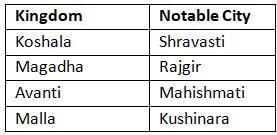
How many of the above pairs are correctly matched?- a)Only one pair
- b)Only two pairs
- c)Three pairs
- d)All four pairs
Correct answer is option 'D'. Can you explain this answer?
Consider the following pairs:
How many of the above pairs are correctly matched?
How many of the above pairs are correctly matched?
a)
Only one pair
b)
Only two pairs
c)
Three pairs
d)
All four pairs
 | Lakshya Ias answered |
- Shravasti was an important city in the kingdom of Koshala.
- Rajgir was indeed a capital and notable city of Magadha.
- Mahishmati, although less frequently mentioned, was part of the southern region of Avanti.
- Kushinara was the capital of the Mallas and is significant for being the place where Gautama Buddha passed away.
Consider the following pairs:
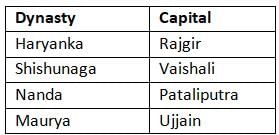
How many of the above pairs are correctly matched?- a)Only one pair
- b)Only two pairs
- c)Three pairs
- d)All four pairs
Correct answer is option 'C'. Can you explain this answer?
Consider the following pairs:
How many of the above pairs are correctly matched?
How many of the above pairs are correctly matched?
a)
Only one pair
b)
Only two pairs
c)
Three pairs
d)
All four pairs
 | Upsc Toppers answered |
- The Haryanka dynasty indeed had Rajgir as its capital.
- The Shishunaga dynasty had Vaishali as one of its capitals.
- The Nanda dynasty had its capital at Pataliputra.
- The Maurya dynasty had its capital at Pataliputra, not Ujjain, making pair 4 incorrect.
Consider the following statements:- The use of coins and the rise of towns were crucial for the economic prosperity of Magadha.
- The Shishunaga dynasty moved the capital of Magadha from Rajgir to Pataliputra.
- Bimbisara's policy of conquest and aggression was primarily focused on expanding Magadha's territory south of the Ganges River.
How many of the statements given above are correct?- a)Only two
- b)Only one
- c)All three
- d)None
Correct answer is option 'B'. Can you explain this answer?
Consider the following statements:
- The use of coins and the rise of towns were crucial for the economic prosperity of Magadha.
- The Shishunaga dynasty moved the capital of Magadha from Rajgir to Pataliputra.
- Bimbisara's policy of conquest and aggression was primarily focused on expanding Magadha's territory south of the Ganges River.
How many of the statements given above are correct?
a)
Only two
b)
Only one
c)
All three
d)
None
 | Future Foundation Institute answered |
- The economic prosperity of Magadha was indeed bolstered by the use of coins and the rise of towns, making statement 1 correct.
- The Shishunaga dynasty did not move the capital to Pataliputra; it was later under the Maurya dynasty that Pataliputra became a significant capital, making statement 2 incorrect.
- Bimbisara's policy of conquest and aggression was not limited to south of the Ganges River; his expansions included the conquest of Anga and alliances with other states, rendering statement 3 incorrect.
Consider the following statements:- The military innovations of Magadha, including the use of a war engine and a mace-attached chariot, were developed during Ajatashatru's reign.
- The expansion of the Magadha empire under the Nandas was limited to the eastern regions of India.
- Pataliputra's selection as a capital was due to its defensible location, surrounded by rivers, which made it easily defensible from attacks.
How many of the statements given above are correct?- a)Only one
- b)Only two
- c)All three
- d)None
Correct answer is option 'B'. Can you explain this answer?
Consider the following statements:
- The military innovations of Magadha, including the use of a war engine and a mace-attached chariot, were developed during Ajatashatru's reign.
- The expansion of the Magadha empire under the Nandas was limited to the eastern regions of India.
- Pataliputra's selection as a capital was due to its defensible location, surrounded by rivers, which made it easily defensible from attacks.
How many of the statements given above are correct?
a)
Only one
b)
Only two
c)
All three
d)
None
 | Valor Academy answered |
- Ajatashatru is indeed credited with military innovations such as the war engine and a mace-attached chariot, which he used in his conquests, making statement 1 correct.
- The expansion under the Nandas was not limited to the eastern regions; they also expanded westwards and southwards, notably conquering Kalinga, making statement 2 incorrect.
- The strategic selection of Pataliputra as a capital was indeed due to its location, surrounded by rivers, which provided natural defenses, so statement 3 is correct.
Consider the following pairs: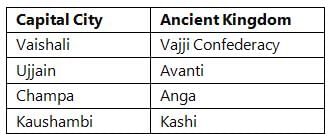
How many of the above pairs are correctly matched?- a)Only one pair
- b)Only two pairs
- c)Three pairs
- d)All four pairs
Correct answer is option 'C'. Can you explain this answer?
Consider the following pairs:
How many of the above pairs are correctly matched?
a)
Only one pair
b)
Only two pairs
c)
Three pairs
d)
All four pairs
 | BT Educators answered |
- Vaishali was indeed the capital of the Vajji Confederacy, making pair 1 correct.
- Ujjain was the capital of Avanti, so pair 2 is correct.
- Champa was the capital of Anga, which means pair 3 is correct.
- Kaushambi was the capital of Vatsa, not Kashi, making pair 4 incorrect.
Consider the following pairs:
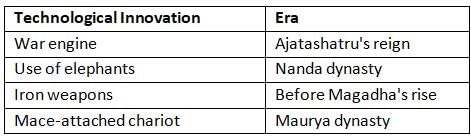
How many of the above pairs are correctly matched?- a)Only one pair
- b)Only two pairs
- c)Three pairs
- d)All four pairs
Correct answer is option 'B'. Can you explain this answer?
Consider the following pairs:
How many of the above pairs are correctly matched?
How many of the above pairs are correctly matched?
a)
Only one pair
b)
Only two pairs
c)
Three pairs
d)
All four pairs
| | Lakshya Ias answered |
- The war engine was indeed used during Ajatashatru's reign.
- The use of elephants was prominent before the Nanda dynasty, especially in Magadha's military, making pair 2 incorrect as it suggests it started with the Nandas.
- Iron weapons were indeed used before and during the rise of Magadha, making pair 3 correct.
- The mace-attached chariot was used during Ajatashatru's reign, not the Maurya dynasty, making pair 4 incorrect.
Consider the following pairs:
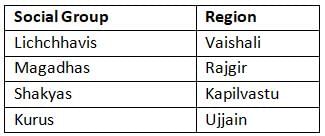
How many of the above pairs are correctly matched?- a)Only one pair
- b)Only two pairs
- c)Three pairs
- d)All four pairs
Correct answer is option 'C'. Can you explain this answer?
Consider the following pairs:
How many of the above pairs are correctly matched?
How many of the above pairs are correctly matched?
a)
Only one pair
b)
Only two pairs
c)
Three pairs
d)
All four pairs
| | Lakshya Ias answered |
- The Lichchhavis were indeed associated with Vaishali.
- The Magadhas were associated with the region around Rajgir.
- The Shakyas were based around Kapilvastu.
- The Kurus were associated with regions in modern-day Uttar Pradesh, not Ujjain, making pair 4 incorrect.
Chapter doubts & questions for Territorial States and First Magadha Empire - 6 Months Preparation Course for OPSC 2026 is part of OPSC OCS (Odisha) exam preparation. The chapters have been prepared according to the OPSC OCS (Odisha) exam syllabus. The Chapter doubts & questions, notes, tests & MCQs are made for OPSC OCS (Odisha) 2026 Exam. Find important definitions, questions, notes, meanings, examples, exercises, MCQs and online tests here.
Chapter doubts & questions of Territorial States and First Magadha Empire - 6 Months Preparation Course for OPSC in English & Hindi are available as part of OPSC OCS (Odisha) exam. Download more important topics, notes, lectures and mock test series for OPSC OCS (Odisha) Exam by signing up for free.
6 Months Preparation Course for OPSC636 videos|2472 docs|801 tests |
