


All Exams > OPSC OCS (Odisha) > 6 Months Preparation Course for OPSC > All Questions
All questions of Introduction to Physiographic Regions for OPSC OCS (Odisha) Exam
Many places in India are famous for particular minerals. Which of these pairs are correctly matched?1. Zawar : Uranium2. Khetri : Copper3. Balaghat : Manganese4. Jaduguda : ZincSelect the correct answer using the codes given below.- a)1 and 2 only
- b)1 and 3 only
- c)1 and 4 only
- d)2 and 3 only
Correct answer is option 'D'. Can you explain this answer?
Many places in India are famous for particular minerals. Which of these pairs are correctly matched?
1. Zawar : Uranium
2. Khetri : Copper
3. Balaghat : Manganese
4. Jaduguda : Zinc
Select the correct answer using the codes given below.
a)
1 and 2 only
b)
1 and 3 only
c)
1 and 4 only
d)
2 and 3 only
 | Ankita Jawale answered |
Khatri nagar which is located 10 km far from khatri known as 'Tamba project (copper project ) khatri nagar was built by Hindustan copper Limited which is a public sector under the "Government of India" and user his jurisdiction. India contributes 2 % in worlds copper production.
Balaghat distric of M.P is famous for production of manganese . About 80% of the manganese production in India comes from Balaghat. zawar is famous for zinc mines created by Hindustan Zinc Limited.
Balaghat distric of M.P is famous for production of manganese . About 80% of the manganese production in India comes from Balaghat. zawar is famous for zinc mines created by Hindustan Zinc Limited.

The direction of wind around a low pressure in northern hemisphere is:- a)Clockwise
- b)Perpendicular to isobars
- c)Anti-clock wise
- d)Parallel to isobars
Correct answer is option 'C'. Can you explain this answer?
The direction of wind around a low pressure in northern hemisphere is:
a)
Clockwise
b)
Perpendicular to isobars
c)
Anti-clock wise
d)
Parallel to isobars
 | Shreya Mehta answered |
Low pressure systems are characterized by rising air that cools and condenses to form clouds and precipitation. As air rises in a low pressure system, it creates a region of lower pressure at the surface. Air flows from areas of higher pressure to areas of lower pressure, so in the Northern Hemisphere, air flows towards a low pressure system in a counterclockwise direction.
Explanation:
Coriolis Effect:
The Coriolis Effect is an important factor in the movement of air around low pressure systems. The Coriolis Effect is a result of the Earth's rotation on its axis, which causes objects in the Northern Hemisphere to be deflected to the right of their intended path. This means that air flowing towards a low pressure system in the Northern Hemisphere will be deflected to the right, causing it to flow in a counterclockwise direction around the low pressure system.
Rising Air:
As air rises in a low pressure system, it creates a region of lower pressure at the surface. Air flows from areas of higher pressure to areas of lower pressure, so in the Northern Hemisphere, air flows towards a low pressure system. This air is deflected to the right by the Coriolis Effect, causing it to flow in a counterclockwise direction around the low pressure system.
Conclusion:
In conclusion, the direction of wind around a low pressure system in the Northern Hemisphere is counterclockwise. This is due to the Coriolis Effect, which causes air to be deflected to the right in the Northern Hemisphere. As air flows towards a low pressure system, it is deflected to the right, causing it to flow in a counterclockwise direction around the low pressure system.
Explanation:
Coriolis Effect:
The Coriolis Effect is an important factor in the movement of air around low pressure systems. The Coriolis Effect is a result of the Earth's rotation on its axis, which causes objects in the Northern Hemisphere to be deflected to the right of their intended path. This means that air flowing towards a low pressure system in the Northern Hemisphere will be deflected to the right, causing it to flow in a counterclockwise direction around the low pressure system.
Rising Air:
As air rises in a low pressure system, it creates a region of lower pressure at the surface. Air flows from areas of higher pressure to areas of lower pressure, so in the Northern Hemisphere, air flows towards a low pressure system. This air is deflected to the right by the Coriolis Effect, causing it to flow in a counterclockwise direction around the low pressure system.
Conclusion:
In conclusion, the direction of wind around a low pressure system in the Northern Hemisphere is counterclockwise. This is due to the Coriolis Effect, which causes air to be deflected to the right in the Northern Hemisphere. As air flows towards a low pressure system, it is deflected to the right, causing it to flow in a counterclockwise direction around the low pressure system.
Days and nights are equal throughout the globe when the sun is above: - a)Poles
- b)Equator
- c)Tropic of Cancer
- d)Tropic of Capricorn
Correct answer is option 'B'. Can you explain this answer?
Days and nights are equal throughout the globe when the sun is above:
a)
Poles
b)
Equator
c)
Tropic of Cancer
d)
Tropic of Capricorn
 | Saanvi Reddy answered |
Explanation: An equinox is an astronomical event in which the plane of Earth's equator passes through the center of the Sun, which occurs twice each year, around 20 March and 23 September. On an equinox, day and night are of approximately equal duration all over the planet
A piece of land surrounded by water from all sides in an ocean, sea, lake or river, is called- a)Estuary
- b)An island
- c)Peninsula
- d)None of these
Correct answer is option 'B'. Can you explain this answer?
A piece of land surrounded by water from all sides in an ocean, sea, lake or river, is called
a)
Estuary
b)
An island
c)
Peninsula
d)
None of these
 | Alok Verma answered |
A piece of land that is completely surrounded by water on all sides is known as an island.
A peninsula is a piece of land that is bordered by water on three sides but connected to the mainland. Peninsulas are formed through a gradual rise in water level, surrounding land at low elevation.
A peninsula is a piece of land that is bordered by water on three sides but connected to the mainland. Peninsulas are formed through a gradual rise in water level, surrounding land at low elevation.
An estuary is a partially enclosed coastal body of brackish water with one or more rivers or streams flowing into it, and with a free connection to the open sea.
Temperature increases in ________- a)Stratosphere
- b)Thermosphere
- c)Both (a) & (b)
- d)None of these
Correct answer is option 'C'. Can you explain this answer?
Temperature increases in ________
a)
Stratosphere
b)
Thermosphere
c)
Both (a) & (b)
d)
None of these
| | Sandip Jadhav answered |
In stratosphere the ozone layer is present which absorbs UV radiations coming from sun, results in increase of temperature up to 4 degree Celsius.
In case of thermosphere (ionosphere) gas molecules are present which absorbs X Ray's and UV rays causing temp. rise upto 1480 degree Celsius.
In case of thermosphere (ionosphere) gas molecules are present which absorbs X Ray's and UV rays causing temp. rise upto 1480 degree Celsius.
Which of the following is/are not characteristics of El nino?- a)Increased surface pressure over the Indian Ocean, Australia and Indonesia
- b)Rise in warm air near Peru
- c)Fall in air pressure over eastern and central Pacific ocean and Tahiti.
- d)Below-average sea surface temperatures across the east-central Equatorial Pacific
Correct answer is option 'D'. Can you explain this answer?
Which of the following is/are not characteristics of El nino?
a)
Increased surface pressure over the Indian Ocean, Australia and Indonesia
b)
Rise in warm air near Peru
c)
Fall in air pressure over eastern and central Pacific ocean and Tahiti.
d)
Below-average sea surface temperatures across the east-central Equatorial Pacific
| | Puja Sengupta answered |
Explanation: Below-average sea surface temperatures across the east-central Equatorial Pacific is a characteristic of La Nina which is anti El-Nino.
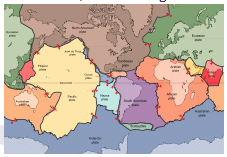
The largest of all plates is _____ plate.- a)Eurasian
- b)North American
- c)Pacific
- d)None of these
Correct answer is option 'C'. Can you explain this answer?
The largest of all plates is _____ plate.
a)
Eurasian
b)
North American
c)
Pacific
d)
None of these
 | Vaibhav Chauhan answered |
Explanation: The Pacific Plate is an oceanic tectonic plate that lies beneath the Pacific Ocean. At 103 million square kilometers, it is the largest tectonic plate.
The earth reaches its perihelion in:- a)October
- b)September
- c)July
- d)January
Correct answer is option 'D'. Can you explain this answer?
The earth reaches its perihelion in:
a)
October
b)
September
c)
July
d)
January
| | Sanchita Bose answered |
Explanation: When the earth is closest to the sun (perihelion), around 3rd January each year
With reference to International Date Line (IDL), consider the following statements:1. A traveller crossing the International Date Line from east to west gains a day and while crossing the dateline from west to east he loses a day.2. The International Date Line I the mid-Pacific curves from the normal 180-degree meridian at the Bering Strait, Fiji, Tonga and other islands to prevent confusion of the day and date in some of the groups that are cut through by the meridian. Which of the statements given above is/are correct?- a) 1 only
- b) Neither 1 nor 2
- c) 2 only
- d)Both 1 and 2
Correct answer is option 'D'. Can you explain this answer?
With reference to International Date Line (IDL), consider the following statements:
1. A traveller crossing the International Date Line from east to west gains a day and while crossing the dateline from west to east he loses a day.
2. The International Date Line I the mid-Pacific curves from the normal 180-degree meridian at the Bering Strait, Fiji, Tonga and other islands to prevent confusion of the day and date in some of the groups that are cut through by the meridian.
Which of the statements given above is/are correct?
a)
1 only
b)
Neither 1 nor 2
c)
2 only
d)
Both 1 and 2
| | Sonal Basak answered |
- Crossing the International Date Line from east to west, you gain a day. From west to east, you lose a day. This is due to the way time zones are structured globally.
- The International Date Line isn't a straight line. It deviates around the Bering Strait, Fiji, Tonga, and other islands to avoid splitting countries or islands into different days, minimizing confusion.
- Both statements are accurate, confirming why the correct answer is D: Both 1 and 2.
- The International Date Line isn't a straight line. It deviates around the Bering Strait, Fiji, Tonga, and other islands to avoid splitting countries or islands into different days, minimizing confusion.
- Both statements are accurate, confirming why the correct answer is D: Both 1 and 2.
Correct answer is D.
Consider the following towns:1. Karachi2. Dhaka3. Mandalay4. JodhpurWhich of the following is the correct order of the towns from north to south ?- a)4 1 2 3
- b)4 3 2 1
- c)1 2 3 4
- d)4 2 3 1
Correct answer is option 'A'. Can you explain this answer?
Consider the following towns:
1. Karachi
2. Dhaka
3. Mandalay
4. Jodhpur
Which of the following is the correct order of the towns from north to south ?
a)
4 1 2 3
b)
4 3 2 1
c)
1 2 3 4
d)
4 2 3 1
| | Saanvi Mehta answered |
To accurately determine the order from north to south, we should verify the latitudes once more:
- Mandalay, Myanmar: Latitude approximately 21.98° N
- Dhaka, Bangladesh: Latitude approximately 23.81° N
- Karachi, Pakistan: Latitude approximately 24.86° N
- Jodhpur, India: Latitude approximately 26.29° N
Correct order from north to south:
- Jodhpur (26.29° N) - The northernmost town.
- Karachi (24.86° N) - Further south than Jodhpur but north of Dhaka.
- Dhaka (23.81° N) - Further south than Karachi.
- Mandalay (21.98° N) - The southernmost town.
So, the correct order from north to south is:
- Jodhpur
- Karachi
- Dhaka
- Mandalay
Consider the following statements about forests soils :1. They are rich in humus2. They are deficient in phosphorous and potashWhich of the statements given above is/are correct ?- a)1 only
- b)2 only
- c)Neither 1 nor 2
- d)Both 1 and 2
Correct answer is option 'D'. Can you explain this answer?
Consider the following statements about forests soils :
1. They are rich in humus
2. They are deficient in phosphorous and potash
Which of the statements given above is/are correct ?
a)
1 only
b)
2 only
c)
Neither 1 nor 2
d)
Both 1 and 2
| | Akash Majumdar answered |
Explanation:
1. Rich in humus:
- Forest soils are typically rich in organic matter, including humus, which is formed from the decomposition of plant and animal materials.
- Humus helps to improve soil structure, fertility, and moisture retention, making forest soils ideal for supporting diverse plant and animal life.
2. Deficient in phosphorous and potash:
- While forest soils are generally nutrient-rich due to the presence of organic matter, they can be deficient in certain essential nutrients like phosphorous and potash.
- Phosphorous and potash are important for plant growth and development, and their deficiency can limit the productivity of forest ecosystems.
Conclusion:
Both statements are correct. Forest soils are rich in humus but may be deficient in phosphorous and potash, highlighting the importance of nutrient management in forest ecosystems.
1. Rich in humus:
- Forest soils are typically rich in organic matter, including humus, which is formed from the decomposition of plant and animal materials.
- Humus helps to improve soil structure, fertility, and moisture retention, making forest soils ideal for supporting diverse plant and animal life.
2. Deficient in phosphorous and potash:
- While forest soils are generally nutrient-rich due to the presence of organic matter, they can be deficient in certain essential nutrients like phosphorous and potash.
- Phosphorous and potash are important for plant growth and development, and their deficiency can limit the productivity of forest ecosystems.
Conclusion:
Both statements are correct. Forest soils are rich in humus but may be deficient in phosphorous and potash, highlighting the importance of nutrient management in forest ecosystems.
Which among the following is known as ” Doctor Wind”?- a)Loo
- b)Chinook
- c)Harmattan
- d)None of the above
Correct answer is option 'C'. Can you explain this answer?
Which among the following is known as ” Doctor Wind”?
a)
Loo
b)
Chinook
c)
Harmattan
d)
None of the above
| | Aravind Basu answered |
Answer: c
Explanation: The Harmattan is a dry and dusty northeasterly trade wind which blows from the Sahara Desert over the West African subcontinent into the Gulf of Guinea between the end of November and the middle of March (winter)
Which one of the following is the source region for the formation of air masses?- a) The Equatorial forest
- b) The Himalayas
- c) The Siberian Plain
- d)The Deccan Plateau
Correct answer is option 'C'. Can you explain this answer?
Which one of the following is the source region for the formation of air masses?
a)
The Equatorial forest
b)
The Himalayas
c)
The Siberian Plain
d)
The Deccan Plateau
 | Kanala Rajeswari answered |
Freebase. West West Siberian plain. The West Siberian plain, also known as Zapadno-sibirskaya Ravnina, is a large plain that occupies the western portion of siberia between the Ural Mountains in the west and the Yenisei River in the east, and by the Altay Mountains on the southeast.
Salinity is expressed as the amount of salt in grams dissolved in sea water per- a)10 gm
- b)1,000 gm
- c)100 gm
- d)10,000 gm
Correct answer is option 'B'. Can you explain this answer?
Salinity is expressed as the amount of salt in grams dissolved in sea water per
a)
10 gm
b)
1,000 gm
c)
100 gm
d)
10,000 gm
| | Vaibhav Chauhan answered |
Explanation: Salinity is the term used to define the total content of dissolved salts in sea water (Table 13.4). It is calculated as the amount of salt (in gm) dissolved in 1,000 gm (1 kg) of seawater. It is usually expressed as parts per thousand (o/oo) or ppt.
The International Date-line passes through the:- a)Bering Strait
- b)Florida Strait
- c)Gibraltar Strait
- d)Malacca Strait
Correct answer is option 'A'. Can you explain this answer?
The International Date-line passes through the:
a)
Bering Strait
b)
Florida Strait
c)
Gibraltar Strait
d)
Malacca Strait
| | S R Khan answered |
The International Date Line passes through the Bering Strait between the Diomede Island.
The sun is directly overhead at noon on 21st June at:- a) The equator
- b) 23.5° S
- c) 23.5° N
- d) 66.5° N
Correct answer is option 'C'. Can you explain this answer?
The sun is directly overhead at noon on 21st June at:
a)
The equator
b)
23.5° S
c)
23.5° N
d)
66.5° N
 | Rohit Jain answered |
The correct option is Option C.
At that time, sun's rays are overhead at the tropic of cancer (23.5°N). The Tropic of Cancer passes through the middle of India. It remains till the end of May in India. Before summer solstice i.e., 21st June, monsoon starts in India which brings a cooling effect to the climate of India.
At that time, sun's rays are overhead at the tropic of cancer (23.5°N). The Tropic of Cancer passes through the middle of India. It remains till the end of May in India. Before summer solstice i.e., 21st June, monsoon starts in India which brings a cooling effect to the climate of India.
With reference to laterite soil, consider the following statements:1. They are the result of intense leaching.2. They are poor in organic matter.Which of the statements given above is/are correct?- a) 1 only
- b) 2 only
- c) Both 1 and 2
- d) Neither 1 nor 2
Correct answer is option 'C'. Can you explain this answer?
With reference to laterite soil, consider the following statements:
1. They are the result of intense leaching.
2. They are poor in organic matter.
Which of the statements given above is/are correct?
a)
1 only
b)
2 only
c)
Both 1 and 2
d)
Neither 1 nor 2
| | Divya Mukherjee answered |
Laterite Soil:
Laterite soil is a type of soil that is commonly found in tropical regions. It is formed by the weathering of rocks in hot and wet climates. Here, we will analyze the given statements about laterite soil.
Statement 1: They are the result of intense leaching.
Leaching refers to the process of removal of soluble substances from the soil by percolating water. In the case of laterite soil, the intense leaching process is one of the primary factors responsible for its formation. The heavy rainfall in tropical regions causes the downward movement of water through the soil, taking away the soluble nutrients and minerals along with it. This leaching process leaves behind a residual soil that is laterite in nature.
Statement 2: They are poor in organic matter.
Laterite soils are known to be poor in organic matter. This is because the hot and humid climate of tropical regions accelerates the decomposition of organic matter, leading to a fast rate of nutrient cycling. As a result, the organic matter content in laterite soils is low compared to other soil types. The low organic matter content also affects the soil fertility, as organic matter plays a crucial role in retaining moisture, improving soil structure, and providing essential nutrients to plants.
Explanation of the Correct Answer:
The correct answer is option C, which means both statements 1 and 2 are correct. Laterite soils are indeed the result of intense leaching, as explained earlier. Additionally, they are also poor in organic matter due to the fast decomposition rate in the tropical climate. Therefore, both statements accurately describe the characteristics of laterite soils.
Conclusion:
Laterite soils are unique soil types found in tropical regions. They are formed as a result of intense leaching and are poor in organic matter. Understanding the characteristics of laterite soil is important for agricultural practices and land management in these regions.
Laterite soil is a type of soil that is commonly found in tropical regions. It is formed by the weathering of rocks in hot and wet climates. Here, we will analyze the given statements about laterite soil.
Statement 1: They are the result of intense leaching.
Leaching refers to the process of removal of soluble substances from the soil by percolating water. In the case of laterite soil, the intense leaching process is one of the primary factors responsible for its formation. The heavy rainfall in tropical regions causes the downward movement of water through the soil, taking away the soluble nutrients and minerals along with it. This leaching process leaves behind a residual soil that is laterite in nature.
Statement 2: They are poor in organic matter.
Laterite soils are known to be poor in organic matter. This is because the hot and humid climate of tropical regions accelerates the decomposition of organic matter, leading to a fast rate of nutrient cycling. As a result, the organic matter content in laterite soils is low compared to other soil types. The low organic matter content also affects the soil fertility, as organic matter plays a crucial role in retaining moisture, improving soil structure, and providing essential nutrients to plants.
Explanation of the Correct Answer:
The correct answer is option C, which means both statements 1 and 2 are correct. Laterite soils are indeed the result of intense leaching, as explained earlier. Additionally, they are also poor in organic matter due to the fast decomposition rate in the tropical climate. Therefore, both statements accurately describe the characteristics of laterite soils.
Conclusion:
Laterite soils are unique soil types found in tropical regions. They are formed as a result of intense leaching and are poor in organic matter. Understanding the characteristics of laterite soil is important for agricultural practices and land management in these regions.
Which of the following INCORRECT about cirrus clouds?- a) They formed at high altitudes
- b) They are thin and detatched clouds
- c) They are white and grey in colour
- d) None of the above
Correct answer is option 'C'. Can you explain this answer?
Which of the following INCORRECT about cirrus clouds?
a)
They formed at high altitudes
b)
They are thin and detatched clouds
c)
They are white and grey in colour
d)
None of the above
 | Preethi Shah answered |
Cirrus clouds are thin and detached clouds that form at high altitudes. They are composed of ice crystals and are typically white or light grey in color. However, option C states that they are white and grey in color, which is incorrect.
Explanation:
Cirrus clouds are high-level clouds that form above 20,000 feet (6,000 meters) in the atmosphere. They are often found in the upper troposphere and the lower stratosphere. These clouds are composed of ice crystals due to the extremely cold temperatures at these altitudes.
Cirrus clouds are characterized by their thin and wispy appearance. They have a fibrous or hair-like structure, which gives them a unique appearance in the sky. These clouds are often described as being "feathery" or "curly."
Although cirrus clouds are typically white or light grey in color, their appearance can vary depending on several factors such as the angle of the sun, the presence of other clouds, and the size and shape of the ice crystals within the cloud. Under certain lighting conditions, cirrus clouds can appear pink, orange, or even purple.
Cirrus clouds are commonly associated with fair weather conditions, but they can also indicate the approach of a warm front or an upper-level disturbance. They are often the first sign of an approaching weather system.
In summary, cirrus clouds are thin and detached clouds that form at high altitudes. They are composed of ice crystals and can appear white, light grey, or even have a tint of color depending on various factors. Option C, which states that they are white and grey in color, is incorrect.
Explanation:
Cirrus clouds are high-level clouds that form above 20,000 feet (6,000 meters) in the atmosphere. They are often found in the upper troposphere and the lower stratosphere. These clouds are composed of ice crystals due to the extremely cold temperatures at these altitudes.
Cirrus clouds are characterized by their thin and wispy appearance. They have a fibrous or hair-like structure, which gives them a unique appearance in the sky. These clouds are often described as being "feathery" or "curly."
Although cirrus clouds are typically white or light grey in color, their appearance can vary depending on several factors such as the angle of the sun, the presence of other clouds, and the size and shape of the ice crystals within the cloud. Under certain lighting conditions, cirrus clouds can appear pink, orange, or even purple.
Cirrus clouds are commonly associated with fair weather conditions, but they can also indicate the approach of a warm front or an upper-level disturbance. They are often the first sign of an approaching weather system.
In summary, cirrus clouds are thin and detached clouds that form at high altitudes. They are composed of ice crystals and can appear white, light grey, or even have a tint of color depending on various factors. Option C, which states that they are white and grey in color, is incorrect.
Albedo is the fraction of solar energy reflected from the Earth back into space. Consider the following :1. Fresh snow2. Ocean ice3. Rivers on high mountains.The correct order of their Albedo is:- a)1 > 2 > 3
- b)2 > 3 > 1
- c)2 > 1 > 3
- d)1 > 3 > 2
Correct answer is option 'A'. Can you explain this answer?
Albedo is the fraction of solar energy reflected from the Earth back into space. Consider the following :
1. Fresh snow
2. Ocean ice
3. Rivers on high mountains.
The correct order of their Albedo is:
a)
1 > 2 > 3
b)
2 > 3 > 1
c)
2 > 1 > 3
d)
1 > 3 > 2
| | Saanvi Mehta answered |
Answer: a)
Explanation: High-frequency radiowaves are reflected from the E layer. D layer is the lowest of the ionosphere layers, which absorbs the highest amount of harsh x-ray radiation. During the night, there is a minimal amount of ionization taking place. There is a high amount of energy dissipation because of rapid collisions of the ions. During day time all three- D, E and F layer are present, but D layer does not help in communication. This is because its density is greatly reduced. The D layer is normally not dense enough to reflect the radio waves. However, the E layer is, so the VLF signals go through the D layer, bounce off the E layer, and go back down through the D layer to the ground. The signals lose energy as they penetrate through the D layer and hence radios pick up weaker signals from the transmitter during the day.
Consider the following statements:- Seamount is a mountain with pointed summits, rising from the seafloor.
- Seamounts are of coral origin.
Which of the above statements is/ are correct?- a) Only 1
- b) Only 2
- c) Both 1 & 2
- d) None of the above
Correct answer is option 'B'. Can you explain this answer?
Consider the following statements:
- Seamount is a mountain with pointed summits, rising from the seafloor.
- Seamounts are of coral origin.
Which of the above statements is/ are correct?
a)
Only 1
b)
Only 2
c)
Both 1 & 2
d)
None of the above
| | Akshara Chavan answered |
Answer: b)
Explanation: Seamount is a mountain with pointed summits, rising from the seafloor that does not reach the surface of the ocean. Seamounts are volcanic in origin.
Which of the following statements is NOT correct?- a) The continental shelf is the extended margin of a continent.
- b) It is the shallowest part of the ocean.
- c) It has an average gradient of 3° or even less.
- d) None of the above
Correct answer is option 'C'. Can you explain this answer?
Which of the following statements is NOT correct?
a)
The continental shelf is the extended margin of a continent.
b)
It is the shallowest part of the ocean.
c)
It has an average gradient of 3° or even less.
d)
None of the above
| | Hrishikesh Iyer answered |
Answer: c)
Explanation: The continental shelf is the extended margin of each continent occupied by relatively shallow seas and gulfs. It is the shallowest part of the ocean showing an average gradient of 1° or even less. The shelf typically ends at a very steep slope, called the shelf break.
Upward and downward movement of ocean water is known as the :- a) Tide
- b) Current
- c) Wave
- d) None of the above
Correct answer is option 'C'. Can you explain this answer?
Upward and downward movement of ocean water is known as the :
a)
Tide
b)
Current
c)
Wave
d)
None of the above
| | Dhruba Ghoshal answered |
Tides
Tides refer to the regular rise and fall of ocean water. The rise and fall of ocean water are caused by the gravitational force of the moon and the sun on the Earth's oceans. The gravitational force of the moon is stronger on the side of the Earth facing the moon, and weaker on the opposite side of the Earth. This causes a bulge of water on the side facing the moon, and a bulge of water on the opposite side of the Earth.
High Tide
High tide refers to the point in time when ocean water is at its highest level. This occurs when the gravitational force of the moon and the sun are in alignment, creating a stronger gravitational pull on the Earth's oceans. High tide occurs twice a day, roughly every 12 hours and 25 minutes.
Low Tide
Low tide refers to the point in time when ocean water is at its lowest level. This occurs when the gravitational force of the moon and the sun are not in alignment, creating a weaker gravitational pull on the Earth's oceans. Low tide also occurs twice a day, roughly every 12 hours and 25 minutes.
Importance of Tides
Tides are important for a variety of reasons. They affect navigation and shipping, as the depth of water changes with the tides. They also affect marine life, as many marine organisms rely on the tides for feeding and breeding. Tides can also be harnessed for renewable energy, such as tidal power.
Conclusion
Tides refer to the regular rise and fall of ocean water, caused by the gravitational force of the moon and the sun on the Earth's oceans. High tide and low tide occur twice a day, roughly every 12 hours and 25 minutes. Tides are important for navigation, marine life, and renewable energy.
Tides refer to the regular rise and fall of ocean water. The rise and fall of ocean water are caused by the gravitational force of the moon and the sun on the Earth's oceans. The gravitational force of the moon is stronger on the side of the Earth facing the moon, and weaker on the opposite side of the Earth. This causes a bulge of water on the side facing the moon, and a bulge of water on the opposite side of the Earth.
High Tide
High tide refers to the point in time when ocean water is at its highest level. This occurs when the gravitational force of the moon and the sun are in alignment, creating a stronger gravitational pull on the Earth's oceans. High tide occurs twice a day, roughly every 12 hours and 25 minutes.
Low Tide
Low tide refers to the point in time when ocean water is at its lowest level. This occurs when the gravitational force of the moon and the sun are not in alignment, creating a weaker gravitational pull on the Earth's oceans. Low tide also occurs twice a day, roughly every 12 hours and 25 minutes.
Importance of Tides
Tides are important for a variety of reasons. They affect navigation and shipping, as the depth of water changes with the tides. They also affect marine life, as many marine organisms rely on the tides for feeding and breeding. Tides can also be harnessed for renewable energy, such as tidal power.
Conclusion
Tides refer to the regular rise and fall of ocean water, caused by the gravitational force of the moon and the sun on the Earth's oceans. High tide and low tide occur twice a day, roughly every 12 hours and 25 minutes. Tides are important for navigation, marine life, and renewable energy.
Which of the following comes under the phenomena of mass movement?1. Soil creep2. Weathering3. LandslideSelect the correct answer using the codes given below.- a)1 and 2 only
- b)2 and 3 only
- c)1 and 3 only
- d)1, 2 and 3
Correct answer is option 'C'. Can you explain this answer?
Which of the following comes under the phenomena of mass movement?
1. Soil creep
2. Weathering
3. Landslide
Select the correct answer using the codes given below.
a)
1 and 2 only
b)
2 and 3 only
c)
1 and 3 only
d)
1, 2 and 3
| | Kajal Chopra answered |
Phenomena of Mass Movement
Mass movement is the movement of a large mass of rock, soil, or debris down a slope or a cliff. It is caused by different factors like gravity, weathering, and erosion. The different types of mass movement are landslides, rockfalls, debris flows, soil creep, and mudflows.
Types of Mass Movement
1. Soil Creep
Soil creep is a type of mass movement where the soil slowly moves downhill under the influence of gravity. It is characterized by the slow, imperceptible movement of soil down a slope. The movement is caused by the expansion and contraction of the soil due to temperature changes, freeze-thaw cycles, and wetting and drying.
2. Landslide
A landslide is a type of mass movement where a mass of rock, soil, or debris suddenly moves downhill. It is caused by different factors like heavy rain, earthquakes, human activities, and volcanic eruptions. Landslides can be very destructive and can cause damage to property and loss of life.
3. Weathering
Weathering is the process of breaking down rocks and minerals into smaller pieces. It is caused by different factors like temperature changes, freeze-thaw cycles, and chemical reactions. Weathering can weaken the rock and make it more susceptible to mass movement.
Conclusion
The correct answer is option C, i.e., 1 and 3 only. Soil creep and landslides are the types of mass movement, while weathering is a process that can weaken the rock and make it more prone to mass movement. Understanding the different types of mass movement and their causes is important for predicting and mitigating their effects.
Mass movement is the movement of a large mass of rock, soil, or debris down a slope or a cliff. It is caused by different factors like gravity, weathering, and erosion. The different types of mass movement are landslides, rockfalls, debris flows, soil creep, and mudflows.
Types of Mass Movement
1. Soil Creep
Soil creep is a type of mass movement where the soil slowly moves downhill under the influence of gravity. It is characterized by the slow, imperceptible movement of soil down a slope. The movement is caused by the expansion and contraction of the soil due to temperature changes, freeze-thaw cycles, and wetting and drying.
2. Landslide
A landslide is a type of mass movement where a mass of rock, soil, or debris suddenly moves downhill. It is caused by different factors like heavy rain, earthquakes, human activities, and volcanic eruptions. Landslides can be very destructive and can cause damage to property and loss of life.
3. Weathering
Weathering is the process of breaking down rocks and minerals into smaller pieces. It is caused by different factors like temperature changes, freeze-thaw cycles, and chemical reactions. Weathering can weaken the rock and make it more susceptible to mass movement.
Conclusion
The correct answer is option C, i.e., 1 and 3 only. Soil creep and landslides are the types of mass movement, while weathering is a process that can weaken the rock and make it more prone to mass movement. Understanding the different types of mass movement and their causes is important for predicting and mitigating their effects.
River rejuvenation can occur due to:1. Uplift of land over which the river is flowing.2. Rise in sea-level.Which of the statements given above is/are correct?- a)1 only
- b)2 only
- c)Both 1 and 2
- d)Neither 1 nor 2
Correct answer is option 'A'. Can you explain this answer?
River rejuvenation can occur due to:
1. Uplift of land over which the river is flowing.
2. Rise in sea-level.
Which of the statements given above is/are correct?
a)
1 only
b)
2 only
c)
Both 1 and 2
d)
Neither 1 nor 2
| | Krish Nambiar answered |
Answer: a)
Explanation: Easy one. Ladkah region receives very low rainfall and is an example of cold desert.
Tropical cyclones do not form over equator. This is because1. Equator is a zone of wind convergence.2. The temperature over equator is too high.3. There are no fronts over equator.Select the correct answer using the codes given below.- a) 1 and 2 only
- b) 1 and 3 only
- c) 2 and 3 only
- d) None of the above
Correct answer is option 'D'. Can you explain this answer?
Tropical cyclones do not form over equator. This is because
1. Equator is a zone of wind convergence.
2. The temperature over equator is too high.
3. There are no fronts over equator.
Select the correct answer using the codes given below.
a)
1 and 2 only
b)
1 and 3 only
c)
2 and 3 only
d)
None of the above
| | Sonal Basak answered |
Answer: d)
Explanation: Tropical cyclone does not form over the equator because the coriolis force is zero at the equator. Even though equator is a zone of wind convergence, it has nothing to do with tropical cyclone as such. Temperature is highest north and south of equator and not exactly at equator. Fronts are required for formation of temperate cyclone and not tropical ones. So even though statement 3 is correct it is not a reason.
With reference to ownership of forests in India, consider the following statements:1. Most of the forests are owned by corporate bodies.2. A negligible portion of less than one percent is privately owned.Which of the statements given above is/are correct?- a)1 only
- b)2 only
- c)Both 1 and 2
- d)Neither 1 nor 2
Correct answer is option 'B'. Can you explain this answer?
With reference to ownership of forests in India, consider the following statements:
1. Most of the forests are owned by corporate bodies.
2. A negligible portion of less than one percent is privately owned.
Which of the statements given above is/are correct?
a)
1 only
b)
2 only
c)
Both 1 and 2
d)
Neither 1 nor 2
| | Srestha Bajaj answered |
Answer: b)
Explanation: Beaches in coastal areas are a depositional landform and not erosional. A wave-cut platform is the narrow flat area often found at the base of a sea cliff. They along with capes and bays are erosional landform.
Western Ghats run through many states in India. Which of the following is not among them?- a)Andhra Pradesh
- b)Gujarat
- c)Kerala
- d)Both (a) and (b)
Correct answer is option 'A'. Can you explain this answer?
Western Ghats run through many states in India. Which of the following is not among them?
a)
Andhra Pradesh
b)
Gujarat
c)
Kerala
d)
Both (a) and (b)
| | Anand Verma answered |
Answer: a)
Explanation: Both are notable points about forest soils. The top layers of forest soils are rich in humus.
A deep, long and wide trough or basin with very steep concave high walls at its head as well as in sides is known as:- a)Cirque
- b)Glacial valley
- c)Lateral Moraine
- d)Esker
Correct answer is option 'A'. Can you explain this answer?
A deep, long and wide trough or basin with very steep concave high walls at its head as well as in sides is known as:
a)
Cirque
b)
Glacial valley
c)
Lateral Moraine
d)
Esker
| | Pritam Shah answered |
Explanation: A deep, long and wide trough or basin with very steep concave high walls at its head as well as in sides is known as:
The North Atlantic Sea route is regarded as an important internationsl trade route because- a)It is the oldest sea route
- b)It connects two industrially developed parts of the world
- c)Trade winds will help the shipping
- d)There are lesser number of sea storms in this waterway
Correct answer is option 'B'. Can you explain this answer?
The North Atlantic Sea route is regarded as an important internationsl trade route because
a)
It is the oldest sea route
b)
It connects two industrially developed parts of the world
c)
Trade winds will help the shipping
d)
There are lesser number of sea storms in this waterway
 | UPSC Achievers answered |
-The Northern Sea Route, especially the Northeast Passage, is a shipping lane officially defined by Russian legislation between the Atlantic Ocean and the Pacific Ocean specifically running along the Russian Arctic coast from Murmansk on the Barents Sea, along Siberia, to the Bering Strait and the Far East.
- The North Atlantic Sea route is regarded as an important international trade route because it connects two industrially developed parts of the world.
Which one of the following is the highest cloud in the sky?- a)Cirrus
- b)Stratus
- c)Nimbus
- d)Cumulus
Correct answer is option 'A'. Can you explain this answer?
Which one of the following is the highest cloud in the sky?
a)
Cirrus
b)
Stratus
c)
Nimbus
d)
Cumulus
| | Shounak Malik answered |
Explanation: Cirrus clouds are formed at high altitudes (8,000 - 12,000m). They are thin and detatched clouds having a feathery appearance. They are always white in colour.
Consider the following statements and identify the right ones.
i ) The gradual dissipation of the frontal zone is called frontogensis.
ii) The process by which two air masses of different physical characteristics are brought together is frontolysis.- a)i only
- b)ii only
- c)Both
- d)None
Correct answer is option 'D'. Can you explain this answer?
Consider the following statements and identify the right ones.
i ) The gradual dissipation of the frontal zone is called frontogensis.
ii) The process by which two air masses of different physical characteristics are brought together is frontolysis.
i ) The gradual dissipation of the frontal zone is called frontogensis.
ii) The process by which two air masses of different physical characteristics are brought together is frontolysis.
a)
i only
b)
ii only
c)
Both
d)
None
| | Dishani Sarkar answered |
Explanation: The gradual dissipation of the frontal zone is called frontolysis. The process by which two air masses of different physical characteristics are brought together is Frontogensis and it leads to the formation of a temperate cyclone.
Which of the following factors affect the distribution of temperature of ocean water?- a) Latitude
- b) Unequal distribution of land and water
- c) Prevailing wind
- d) All of the above
Correct answer is option 'D'. Can you explain this answer?
Which of the following factors affect the distribution of temperature of ocean water?
a)
Latitude
b)
Unequal distribution of land and water
c)
Prevailing wind
d)
All of the above
 | Vaishnavi Das answered |
Factors affecting the distribution of temperature of ocean water
The temperature of ocean water is influenced by various factors such as:
1. Latitude:
The temperature of ocean water varies with latitude. The equator receives more direct sunlight and thus, the ocean water near the equator is warmer. As we move towards the poles, the angle of incidence of sunlight decreases, resulting in cooler water temperatures.
2. Unequal distribution of land and water:
The distribution of temperature of ocean water is also affected by the unequal distribution of land and water. Land heats up and cools down faster than water, which means that areas with more land experience greater temperature fluctuations than areas with more water.
3. Prevailing wind:
The direction of prevailing winds can also affect the temperature of ocean water. Winds blowing from the land to the sea (onshore winds) can cause the surface water to warm up, while winds blowing from the sea to the land (offshore winds) can cause the surface water to cool down.
4. Ocean currents:
Ocean currents play a significant role in the distribution of temperature of ocean water. Warm currents carry warm water from the equator towards the poles, while cold currents carry cold water from the poles towards the equator. This results in a global pattern of ocean water temperature.
Conclusion:
All of the above factors (latitude, unequal distribution of land and water, prevailing wind, and ocean currents) affect the distribution of temperature of ocean water. The complex interplay of these factors determines the temperature of ocean water in a particular region, and also influences the climate of the surrounding land areas.
The temperature of ocean water is influenced by various factors such as:
1. Latitude:
The temperature of ocean water varies with latitude. The equator receives more direct sunlight and thus, the ocean water near the equator is warmer. As we move towards the poles, the angle of incidence of sunlight decreases, resulting in cooler water temperatures.
2. Unequal distribution of land and water:
The distribution of temperature of ocean water is also affected by the unequal distribution of land and water. Land heats up and cools down faster than water, which means that areas with more land experience greater temperature fluctuations than areas with more water.
3. Prevailing wind:
The direction of prevailing winds can also affect the temperature of ocean water. Winds blowing from the land to the sea (onshore winds) can cause the surface water to warm up, while winds blowing from the sea to the land (offshore winds) can cause the surface water to cool down.
4. Ocean currents:
Ocean currents play a significant role in the distribution of temperature of ocean water. Warm currents carry warm water from the equator towards the poles, while cold currents carry cold water from the poles towards the equator. This results in a global pattern of ocean water temperature.
Conclusion:
All of the above factors (latitude, unequal distribution of land and water, prevailing wind, and ocean currents) affect the distribution of temperature of ocean water. The complex interplay of these factors determines the temperature of ocean water in a particular region, and also influences the climate of the surrounding land areas.
Which one of the following process is responsible for transforming liquid into vapour?- a) Condensation
- b) Transpiration
- c) Evaporation
- d) Precipitation
Correct answer is option 'A'. Can you explain this answer?
Which one of the following process is responsible for transforming liquid into vapour?
a)
Condensation
b)
Transpiration
c)
Evaporation
d)
Precipitation
| | Rohit Jain answered |
Evaporation happens when a liquid substance becomes a gas. When water is heated, it evaporates. The molecules move and vibrate so quickly that they escape into the atmosphere as molecules of water vapor.
Erosion in coastal areas forms different types of landform. Which of the following is/are erosional landform of coastal areas?1. wave-cut platforms2. Beaches3. Capes and baysSelect the correct answer using the codes given below.- a)1 and 2 only
- b)1 and 3 only
- c)2 and 3 only
- d)1, 2 and 3
Correct answer is option 'C'. Can you explain this answer?
Erosion in coastal areas forms different types of landform. Which of the following is/are erosional landform of coastal areas?
1. wave-cut platforms
2. Beaches
3. Capes and bays
Select the correct answer using the codes given below.
a)
1 and 2 only
b)
1 and 3 only
c)
2 and 3 only
d)
1, 2 and 3
 | Harshitha Yadav answered |
Erosional Landforms in Coastal Areas
Erosion in coastal areas is a natural process that leads to the formation of various landforms. Some of the erosional landforms of coastal areas are:
1. Wave-cut platforms:
Wave-cut platforms are flat surfaces formed due to the continuous erosion of the base of a cliff by the action of waves. The waves erode the rock at the base of the cliff, causing it to retreat. This creates a flat platform at the base of the cliff.
2. Capes and bays:
Capes and bays are also formed due to the erosion of coastal areas by the action of waves. A cape is a narrow, rocky promontory that juts out into the sea, while a bay is an indentation in the coastline. The constant erosion by waves can cause the coastline to be irregular, forming capes and bays.
3. Beaches:
Beaches are also formed due to erosion in coastal areas. The waves erode the rock and sand along the coast, creating a sloping surface that leads to the sea. The eroded material is then deposited on the shore, forming a beach.
Conclusion:
Thus, the correct answer is option C, which includes wave-cut platforms and capes and bays, as they are formed due to erosion in coastal areas. Beaches, although formed due to erosion, are not strictly an erosional landform as they are also formed due to the deposition of eroded material.
Erosion in coastal areas is a natural process that leads to the formation of various landforms. Some of the erosional landforms of coastal areas are:
1. Wave-cut platforms:
Wave-cut platforms are flat surfaces formed due to the continuous erosion of the base of a cliff by the action of waves. The waves erode the rock at the base of the cliff, causing it to retreat. This creates a flat platform at the base of the cliff.
2. Capes and bays:
Capes and bays are also formed due to the erosion of coastal areas by the action of waves. A cape is a narrow, rocky promontory that juts out into the sea, while a bay is an indentation in the coastline. The constant erosion by waves can cause the coastline to be irregular, forming capes and bays.
3. Beaches:
Beaches are also formed due to erosion in coastal areas. The waves erode the rock and sand along the coast, creating a sloping surface that leads to the sea. The eroded material is then deposited on the shore, forming a beach.
Conclusion:
Thus, the correct answer is option C, which includes wave-cut platforms and capes and bays, as they are formed due to erosion in coastal areas. Beaches, although formed due to erosion, are not strictly an erosional landform as they are also formed due to the deposition of eroded material.
The world grasslands are useful for many economic activities like :1. Pastoral farming2. Wheat cultivation3. Safari tourismSelect the correct answer using the codes given below.- a)1 and 2 only
- b)1 and 3 only
- c)2 and 3 only
- d)1, 2 and 3
Correct answer is option 'D'. Can you explain this answer?
The world grasslands are useful for many economic activities like :
1. Pastoral farming
2. Wheat cultivation
3. Safari tourism
Select the correct answer using the codes given below.
a)
1 and 2 only
b)
1 and 3 only
c)
2 and 3 only
d)
1, 2 and 3
| | Milan Kulkarni answered |
Answer: d)
Explanation: All the above are feature of western ghats. The hill ranges of eastern ghats have no structural or topographic continuity.
Consider the following statements about occluded front.- It occurs when an air mass is fully lifted above the land surface.
- It occurs in middle latitudes.
Which of the above statements is/ are correct?- a) Only 1
- b) Only 2
- c) Both 1 & 2
- d) None of the above
Correct answer is option 'C'. Can you explain this answer?
Consider the following statements about occluded front.
- It occurs when an air mass is fully lifted above the land surface.
- It occurs in middle latitudes.
Which of the above statements is/ are correct?
a)
Only 1
b)
Only 2
c)
Both 1 & 2
d)
None of the above
| | Avik Majumdar answered |
Explanation:
1. Correct Statement:
An occluded front occurs when a fast-moving cold front catches up to a slow-moving warm front. The warm air mass is lifted above the cooler air mass, creating an occlusion. This lifting of the warm air results in the formation of clouds and precipitation.
2. Correct Statement:
Occluded fronts commonly occur in middle latitudes where there are sharp temperature contrasts between air masses. These fronts are often associated with strong winds and stormy weather conditions.
Therefore, both statements are correct. An occluded front does not occur when an air mass is fully lifted above the land surface but rather when warm air is lifted above a colder air mass in middle latitudes.
1. Correct Statement:
An occluded front occurs when a fast-moving cold front catches up to a slow-moving warm front. The warm air mass is lifted above the cooler air mass, creating an occlusion. This lifting of the warm air results in the formation of clouds and precipitation.
2. Correct Statement:
Occluded fronts commonly occur in middle latitudes where there are sharp temperature contrasts between air masses. These fronts are often associated with strong winds and stormy weather conditions.
Therefore, both statements are correct. An occluded front does not occur when an air mass is fully lifted above the land surface but rather when warm air is lifted above a colder air mass in middle latitudes.
Cyclones are called “Willy-Willies” in- a) Australia
- b) China
- c) India
- d) Canada
Correct answer is option 'A'. Can you explain this answer?
Cyclones are called “Willy-Willies” in
a)
Australia
b)
China
c)
India
d)
Canada
| | Hrishikesh Iyer answered |
Answer: a)
Explanation: They are known as Cyclones in the Indian Ocean, Hurricanes in the Atlantic, Typhoons in the Western Pacific and South China Sea, and Willy-willies in the Western Australia.
With reference to insolation, consider the following statements:1. Equator receives less insolation than tropics.2. At the same latitude the insolation is more over the oceans than over the continents.Which of the statements given above is/are correct?- a)1 only
- b)2 only
- c)Both 1 and 2
- d)Neither 1 nor 2
Correct answer is option 'A'. Can you explain this answer?
With reference to insolation, consider the following statements:
1. Equator receives less insolation than tropics.
2. At the same latitude the insolation is more over the oceans than over the continents.
Which of the statements given above is/are correct?
a)
1 only
b)
2 only
c)
Both 1 and 2
d)
Neither 1 nor 2
| | Sarthak Mukherjee answered |
Understanding Insolation
Insolation refers to the amount of solar radiation received by a specific area over a certain period. It plays a crucial role in climate and weather patterns.
Statement 1: Equator Receives Less Insolation than Tropics
- The statement is incorrect.
- The equator generally receives more insolation than the tropics due to its direct exposure to sunlight throughout the year.
- Tropical regions, while they receive significant sunlight, do not have the same intensity of solar rays as those directly at the equator.
Statement 2: At the Same Latitude, Insolation is More Over Oceans than Continents
- The statement is correct.
- Oceans have a higher heat capacity than land, which means they absorb and retain heat more effectively.
- This results in a more moderated climate, leading to consistent insolation levels compared to the more variable temperatures found over land.
Conclusion
- The correct answer is option 'A' because only the second statement is true.
- The equator, with its position directly under the sun, receives more insolation compared to the surrounding tropical regions, while oceans tend to have higher insolation levels than continents at the same latitude.
Understanding these points is vital for studies related to geography and climate science, especially in the context of UPSC examinations.
Insolation refers to the amount of solar radiation received by a specific area over a certain period. It plays a crucial role in climate and weather patterns.
Statement 1: Equator Receives Less Insolation than Tropics
- The statement is incorrect.
- The equator generally receives more insolation than the tropics due to its direct exposure to sunlight throughout the year.
- Tropical regions, while they receive significant sunlight, do not have the same intensity of solar rays as those directly at the equator.
Statement 2: At the Same Latitude, Insolation is More Over Oceans than Continents
- The statement is correct.
- Oceans have a higher heat capacity than land, which means they absorb and retain heat more effectively.
- This results in a more moderated climate, leading to consistent insolation levels compared to the more variable temperatures found over land.
Conclusion
- The correct answer is option 'A' because only the second statement is true.
- The equator, with its position directly under the sun, receives more insolation compared to the surrounding tropical regions, while oceans tend to have higher insolation levels than continents at the same latitude.
Understanding these points is vital for studies related to geography and climate science, especially in the context of UPSC examinations.
Consider the following statements:- About 90 per cent of the total volume of water is found below the thermocline in the deep ocean.
- In thermocline zone, temperatures approach 0° C
Which of the above statements is/ are NOT correct?- a) Only 1
- b)None of the these
- c) Both 1 & 2
- d)Only 2
Correct answer is option 'D'. Can you explain this answer?
Consider the following statements:
- About 90 per cent of the total volume of water is found below the thermocline in the deep ocean.
- In thermocline zone, temperatures approach 0° C
Which of the above statements is/ are NOT correct?
a)
Only 1
b)
None of the these
c)
Both 1 & 2
d)
Only 2
| | Akanksha Ahuja answered |
Sure, let's break down each statement:
- About 90 per cent of the total volume of water is found below the thermocline in the deep ocean.
This statement is generally correct. The thermocline is a layer in the ocean where temperature changes rapidly with depth. Below the thermocline is the deep ocean, where temperatures are more uniform. So, most of the water volume in the ocean is indeed found below the thermocline.
- In the thermocline zone, temperatures approach 0°C.
This statement is not correct. The thermocline is characterized by a rapid change in temperature with depth, but it does not necessarily approach 0°C. The temperature in the thermocline can vary depending on factors such as location, depth, and season.
Therefore, the correct answer is:
- Only 2.
Which of the following has the highest proportion of water?- a)Groundwater
- b)Lakes
- c)Atmosphere
- d)Biosphere
Correct answer is option 'A'. Can you explain this answer?
Which of the following has the highest proportion of water?
a)
Groundwater
b)
Lakes
c)
Atmosphere
d)
Biosphere
| | Sonal Basak answered |
Answer: a)
Explanation: Groundwater 0.68%, Lakes 0.01%, Soil Moisture 0.005%, Atmosphere 0.001%, Streams and Rivers 0.0001%, Biosphere 0.00004%.
Ports in Western Europe are ice free while those in Canada at the same latitude are frozen. This is because:- a)Effect of continentality on the Canadian ports due to huge landmass of North America.
- b)Western Europe is touched by warm Gulf Stream current.
- c)Many industries in the western coastal Europe increase its temperature.
- d)Both (a) and (b)
Correct answer is option 'B'. Can you explain this answer?
Ports in Western Europe are ice free while those in Canada at the same latitude are frozen. This is because:
a)
Effect of continentality on the Canadian ports due to huge landmass of North America.
b)
Western Europe is touched by warm Gulf Stream current.
c)
Many industries in the western coastal Europe increase its temperature.
d)
Both (a) and (b)
| | Srestha Bajaj answered |
Answer: b)
Explanation: Please go through the India Physical map for hills, rivers, passes etc. Lushai hills are also called Mizo hills, so that can give a hint that Mizo hills should be south of Naga hills.
The Inter Tropical Convergence Zone normally occurs:- a) Near the Equator
- b) Near the Tropic of Cancer
- c) Near the Tropic of Capricorn
- d) Near the Arctic Circle
Correct answer is option 'A'. Can you explain this answer?
The Inter Tropical Convergence Zone normally occurs:
a)
Near the Equator
b)
Near the Tropic of Cancer
c)
Near the Tropic of Capricorn
d)
Near the Arctic Circle
| | Vandana Deshpande answered |
The Inter Tropical Convergence Zone (ITCZ) is a belt of low pressure that circles the Earth, generally near the Equator, where the trade winds of the Northern and Southern Hemispheres come together. It is also known as the Equatorial Convergence Zone (ECZ).
Location of ITCZ
The ITCZ normally occurs near the Equator, where the sun is directly overhead and the surface heating is maximum. The location of the ITCZ varies with the season and the position of the sun. During the summer months, the ITCZ shifts northward towards the Tropic of Cancer, and during the winter months, it shifts southward towards the Tropic of Capricorn.
Factors affecting ITCZ
The position of the ITCZ is influenced by various factors, including:
1. Solar heating: The ITCZ is formed due to the intense solar heating near the Equator, which causes the warm, moist air to rise and form clouds.
2. Earth's rotation: The rotation of the Earth causes the trade winds to curve, which leads to the convergence of air masses at the Equator.
3. Ocean currents: The ocean currents play a significant role in the formation and movement of the ITCZ. The warm ocean currents near the Equator provide the necessary moisture to fuel the convection process.
4. Landmasses: The presence of landmasses can affect the position and intensity of the ITCZ. For example, the ITCZ shifts northward during the summer months in the Northern Hemisphere due to the heating of the Asian landmass.
Importance of ITCZ
The ITCZ plays a crucial role in the global climate system, as it is responsible for the formation of the tropical rainforests and the distribution of rainfall in the tropics. The ITCZ also affects the global atmospheric circulation, as the rising air masses in the ITCZ create low pressure, which drives the trade winds and the Hadley cell circulation.
Location of ITCZ
The ITCZ normally occurs near the Equator, where the sun is directly overhead and the surface heating is maximum. The location of the ITCZ varies with the season and the position of the sun. During the summer months, the ITCZ shifts northward towards the Tropic of Cancer, and during the winter months, it shifts southward towards the Tropic of Capricorn.
Factors affecting ITCZ
The position of the ITCZ is influenced by various factors, including:
1. Solar heating: The ITCZ is formed due to the intense solar heating near the Equator, which causes the warm, moist air to rise and form clouds.
2. Earth's rotation: The rotation of the Earth causes the trade winds to curve, which leads to the convergence of air masses at the Equator.
3. Ocean currents: The ocean currents play a significant role in the formation and movement of the ITCZ. The warm ocean currents near the Equator provide the necessary moisture to fuel the convection process.
4. Landmasses: The presence of landmasses can affect the position and intensity of the ITCZ. For example, the ITCZ shifts northward during the summer months in the Northern Hemisphere due to the heating of the Asian landmass.
Importance of ITCZ
The ITCZ plays a crucial role in the global climate system, as it is responsible for the formation of the tropical rainforests and the distribution of rainfall in the tropics. The ITCZ also affects the global atmospheric circulation, as the rising air masses in the ITCZ create low pressure, which drives the trade winds and the Hadley cell circulation.
Which of the following are characteristic feature of Eastern Ghats?1. Structural unity of hills2. Physiographic continuity of hills3. Steep sided, flat topped topographySelect the correct answer using the codes given below.- a)1 and 2 only
- b)2 and 3 only
- c)3 only
- d)None
Correct answer is option 'A'. Can you explain this answer?
Which of the following are characteristic feature of Eastern Ghats?
1. Structural unity of hills
2. Physiographic continuity of hills
3. Steep sided, flat topped topography
Select the correct answer using the codes given below.
a)
1 and 2 only
b)
2 and 3 only
c)
3 only
d)
None
| | Meghana Shah answered |
Answer: a)
Explanation: Albedo is a measure of the reflectivity of the earth’s surface. Ice, especially with snow on top of it, has a high albedo: most sunlight hitting the surface bounces back towards space
Which of the following affects atmospheric pressure?- a)Altitude
- b)Temperature
- c)Earth rotation
- d)All the above
Correct answer is option 'D'. Can you explain this answer?
Which of the following affects atmospheric pressure?
a)
Altitude
b)
Temperature
c)
Earth rotation
d)
All the above
| | Raksha Das answered |
Atmospheric Pressure
Factors affecting Atmospheric Pressure
Conclusion
Atmospheric pressure is the force exerted by the weight of the atmosphere on the surface of the earth or any object in it. It is measured in units of pressure such as millibars or inches of mercury.
Factors affecting Atmospheric Pressure
- Altitude: Atmospheric pressure decreases as altitude increases. As we go higher up in the atmosphere, the air becomes less dense, and the pressure exerted by it on the surface decreases. At sea level, atmospheric pressure is around 1013 millibars, while at the top of Mount Everest, it is around 300 millibars.
- Temperature: Temperature also affects atmospheric pressure. As the air gets warmer, it expands and becomes less dense, leading to a decrease in pressure. Similarly, as the air gets colder, it contracts and becomes denser, leading to an increase in pressure.
- Earth rotation: The rotation of the earth also affects atmospheric pressure. Due to the earth's rotation, the air near the equator is heated more than the air near the poles. This causes the air to rise near the equator and sink near the poles, leading to differences in pressure.
Conclusion
Thus, all the above factors - altitude, temperature, and earth rotation - affect atmospheric pressure. Understanding these factors is crucial in predicting weather patterns and monitoring changes in the atmosphere.
The lava cone of a volcano is having steep sloping sides. Which of these can be said about the volcano?1. The lava must have been highly fluid.2. It must have high silica content.3. The volcano must have been explosive.Select the correct answer using the codes given below.- a)1 and 2 only
- b)1 and 3 only
- c)1, 2 and 3
- d)2 and 3 only
Correct answer is option 'D'. Can you explain this answer?
The lava cone of a volcano is having steep sloping sides. Which of these can be said about the volcano?
1. The lava must have been highly fluid.
2. It must have high silica content.
3. The volcano must have been explosive.
Select the correct answer using the codes given below.
a)
1 and 2 only
b)
1 and 3 only
c)
1, 2 and 3
d)
2 and 3 only
| | Shreya Mehta answered |
If the lava is fluid, it will flow quickly and form a gentle slope. If the slope formed is steep, the lava must have been viscous. Viscous lava has high silica content and such volcanoes are explosive.
Punjab and Haryana exploit more than 85% of ground water for irrigation. This is due to:1. Low surface water availability.2. Impact of Green revolution.3. Change in cropping pattern with an increased preference for rice.Select the correct answer using the codes given below.- a)1 and 2 only
- b)1 and 3 only
- c)2 and 3 only
- d)1, 2 and 3
Correct answer is option 'B'. Can you explain this answer?
Punjab and Haryana exploit more than 85% of ground water for irrigation. This is due to:
1. Low surface water availability.
2. Impact of Green revolution.
3. Change in cropping pattern with an increased preference for rice.
Select the correct answer using the codes given below.
a)
1 and 2 only
b)
1 and 3 only
c)
2 and 3 only
d)
1, 2 and 3
| | Sandeep Mukherjee answered |
Answer: b)
Explanation: Western Europe is touched by warm Gulf Stream current. On the other hand the Canadian region is touched by the cold Labrador Current. The effect of continentality is felt in the interior region of continents and not the coastal areas.
Consider the following statements:- Spring tides occur twice a month.
- There is a seven day interval between the spring tides and neap tides.
Which of the above statements is/ are NOT correct?- a) Only 1
- b) Only 2
- c)Neither 1 nor 2
- d)Both 1 & 2
Correct answer is option 'C'. Can you explain this answer?
Consider the following statements:
- Spring tides occur twice a month.
- There is a seven day interval between the spring tides and neap tides.
Which of the above statements is/ are NOT correct?
a)
Only 1
b)
Only 2
c)
Neither 1 nor 2
d)
Both 1 & 2
 | Divey Sethi answered |
Rather, the term is derived from the concept of the tide "springing forth." Spring tides occur twice each lunar month all year long without regard to the season. Neap tides, which also occur twice a month, happen when the sun and moon are at right angles to each other. Statement 1 is correct.
There is a seven day interval between the spring tides and neap tides. At this time the sun and moon are at right angles to each other and the forces of the sun and moon tend to counteract one another. Statement 2 is correct.
Which of the following is a metamorphic rock?- a)Slate
- b)Sandstone
- c)Peat
- d) Limestone
Correct answer is option 'A'. Can you explain this answer?
Which of the following is a metamorphic rock?
a)
Slate
b)
Sandstone
c)
Peat
d)
Limestone
| | Gitanjali Bajaj answered |
Explanation: Sedimentary rock turns into a different kind of metamorphic rock -limestone turns into travertine or marble, and shale turns into slate, and sandstone turns into quartzite. Even though slate is a metamorphic rock, it still looks a lot like a sedimentary rock - it is still in thin layers.
Monsoon in India is said to be essentially pulsating in nature. This means- a) They are influenced by jet streams.
- b) They occur in wet spells of few days duration at a time.
- c) Ocean current like el-nino impacts the monsoon
- d) None
Correct answer is option 'B'. Can you explain this answer?
Monsoon in India is said to be essentially pulsating in nature. This means
a)
They are influenced by jet streams.
b)
They occur in wet spells of few days duration at a time.
c)
Ocean current like el-nino impacts the monsoon
d)
None
| | Sonal Basak answered |
Answer: b)
Explanation: They occur in wet spells of few days duration at a time.
The eastern hills or Purvanchal is a beautiful landscape in the northeast region of India. Three famous hill ranges are –1. Naga Hills2. Patkai bum3. Lushai hillsThe correct arrangement of these hills from north to south is:- a)1 2 3
- b)1 3 2
- c)2 3 1
- d)2 1 3
Correct answer is option 'D'. Can you explain this answer?
The eastern hills or Purvanchal is a beautiful landscape in the northeast region of India. Three famous hill ranges are –
1. Naga Hills
2. Patkai bum
3. Lushai hills
The correct arrangement of these hills from north to south is:
a)
1 2 3
b)
1 3 2
c)
2 3 1
d)
2 1 3
 | Asha Kaur answered |
D is the correct option.
Patkai Bum – Border between Arunachal Pradesh and Myanmar.
Naga Hills. Manipuri Hills – Border between Manipur and Myanmar.It is located in India extending into Myanmar which forms a divide between India and Myanmar.
The Lushai Hills are a mountain range in Mizoram and Tripura, India. The range is part of the Patkai range system and its highest point is 2,157 m high Phawngpui, also known as 'Blue Mountain'.
Patkai Bum – Border between Arunachal Pradesh and Myanmar.
Naga Hills. Manipuri Hills – Border between Manipur and Myanmar.It is located in India extending into Myanmar which forms a divide between India and Myanmar.
The Lushai Hills are a mountain range in Mizoram and Tripura, India. The range is part of the Patkai range system and its highest point is 2,157 m high Phawngpui, also known as 'Blue Mountain'.
Chapter doubts & questions for Introduction to Physiographic Regions - 6 Months Preparation Course for OPSC 2026 is part of OPSC OCS (Odisha) exam preparation. The chapters have been prepared according to the OPSC OCS (Odisha) exam syllabus. The Chapter doubts & questions, notes, tests & MCQs are made for OPSC OCS (Odisha) 2026 Exam. Find important definitions, questions, notes, meanings, examples, exercises, MCQs and online tests here.
Chapter doubts & questions of Introduction to Physiographic Regions - 6 Months Preparation Course for OPSC in English & Hindi are available as part of OPSC OCS (Odisha) exam. Download more important topics, notes, lectures and mock test series for OPSC OCS (Odisha) Exam by signing up for free.
6 Months Preparation Course for OPSC636 videos|2472 docs|801 tests |
