


All Exams > OPSC OCS (Odisha) > 6 Months Preparation Course for OPSC > All Questions
All questions of The Freedom Struggle and Modern Nationalism for OPSC OCS (Odisha) Exam


Arrange the following in the chronological order:(i) Sadler Commission(ii) Raleigh Commission(iii) Wood’s Despatch(iv) Hunter CommissionChoose the correct answer from the codes given below:- a)ii, iv, i and iii
- b)iii, i, ii and iv
- c)iii, iv, ii and i
- d)iv, ii, i and iii
Correct answer is option 'C'. Can you explain this answer?
Arrange the following in the chronological order:
(i) Sadler Commission
(ii) Raleigh Commission
(iii) Wood’s Despatch
(iv) Hunter Commission
Choose the correct answer from the codes given below:
a)
ii, iv, i and iii
b)
iii, i, ii and iv
c)
iii, iv, ii and i
d)
iv, ii, i and iii
 | Aspire Academy answered |
(iii) Wood’s Despatch (1854): Wood's Despatch was issued in 1854 by Sir Charles Wood, the then President of the Board of Control of the East India Company. It is considered the first comprehensive plan for the development of education in India and laid the foundation for modern education in the country.
(iv) Hunter Commission (1882-83): The Hunter Commission, also known as the Indian Education Commission, was appointed in 1882 under Sir William Hunter. It focused on improving elementary and secondary education and emphasized mass education.
(ii) Raleigh Commission (1902): The Raleigh Commission was appointed in 1902 to review the condition of Indian universities. Its recommendations led to the Indian Universities Act of 1904.
(i) Sadler Commission (1917-19): The Sadler Commission, formed in 1917, studied the problems of the Calcutta University and suggested reforms to improve higher education in India. It recommended a 12-year schooling system before university education.
Which is the correct chronological order of the following events?(i) Simla Conference(ii) Formation of the Azad Hind Government at Singapore by S.C. Bose(iii)Gandhi-Jinnah Talks(iv) Naval Mutiny(v) INA TrialsChoose the answer from the codes given below the lists:- a)i, iii, ii, iv & v
- b)ii, iii, i, v & iv
- c)ii, i, iv, iii & v
- d)i, iii, ii, v & iv
Correct answer is option 'B'. Can you explain this answer?
Which is the correct chronological order of the following events?
(i) Simla Conference
(ii) Formation of the Azad Hind Government at Singapore by S.C. Bose
(iii)Gandhi-Jinnah Talks
(iv) Naval Mutiny
(v) INA TrialsChoose the answer from the codes given below the lists:
a)
i, iii, ii, iv & v
b)
ii, iii, i, v & iv
c)
ii, i, iv, iii & v
d)
i, iii, ii, v & iv
 | Aravind Menon answered |
On 21 October 1943, Bose announced the formation of the Provisional Government of Azad Hind (Free India), with himself as the Head of State, Prime Minister and Minister of War.
The Provisional Government not only enabled Bose to negotiate with the Japanese on an equal footing but also facilitated the mobilisation of Indians in East Asia to join and support the INA. Soon after the announcement, the Provisional Government received recognition from various countries.
To discuss these proposals with Indian leaders, Wavell summoned them to a conference in Simla on 25 June
1945.Gandhi-Jinnah talks of 1944
After his release Gandhi proposed talks with Jinnah on his two-nation theory and negotiating on issue of partition. The CR formula acted as the basis for the negotiations. Gandhi and Jinnah met in September 1944 to ease the deadlock. Gandhi offered the CR formula as his proposal to Jinnah.
The
Royal Indian Navy mutiny or
revolt, also called the
1946 Naval Uprising,
[1]
was an insurrection of Indian naval ratings, soldiers, police personnel and civilians against the British government in India. From the initial flashpoint in Bombay, the revolt spread and found support throughout
British India
, from
Karachi
to
Calcutta
, and ultimately came to involve over 20,000 sailors in 78 ships and shore establishments.
Match the following: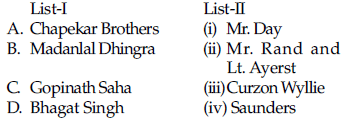 codes;
- a)A-iv, B-ii, C-iii, D-i
- b)A-ii, B-iv, C-i, D-iii
- c)A-iii, B-i, C-ii, D-iv
- d)A-ii, B-iii, C-i, D-iv
Correct answer is option 'D'. Can you explain this answer?
Match the following:
codes;
a)
A-iv, B-ii, C-iii, D-i
b)
A-ii, B-iv, C-i, D-iii
c)
A-iii, B-i, C-ii, D-iv
d)
A-ii, B-iii, C-i, D-iv
 | Master Training Institute answered |
The correct option is D.
On December 17, 1927, Bhagat Singh and Shivaram Rajguru shot and killed assistant superintendent of police John Saunders.
Gopi Nath Saha shot dead another Englishman Mr. E. Day on 12 January, 1924. Later he was arrested and sentenced to death.
Dhingra shot Sir Curzon-Wyllie, an India Office official, at close range.
In Pune, it resulted in a completely different monument: one that commemorates the Chapekar brothers ( Damodar Hari , Balkrishna Hari and Vasudeo Hari) who killed WC Rand, an Indian Civil Service officer and the chairman of the Special Plague Committee.
On December 17, 1927, Bhagat Singh and Shivaram Rajguru shot and killed assistant superintendent of police John Saunders.
Gopi Nath Saha shot dead another Englishman Mr. E. Day on 12 January, 1924. Later he was arrested and sentenced to death.
Dhingra shot Sir Curzon-Wyllie, an India Office official, at close range.
In Pune, it resulted in a completely different monument: one that commemorates the Chapekar brothers ( Damodar Hari , Balkrishna Hari and Vasudeo Hari) who killed WC Rand, an Indian Civil Service officer and the chairman of the Special Plague Committee.
Which British viceroy helped intensify discontent against foreign rule by the early 1880’s?- a)Ripon
- b)Lytton
- c)Dufferin
- d)Northbrook
Correct answer is option 'B'. Can you explain this answer?
Which British viceroy helped intensify discontent against foreign rule by the early 1880’s?
a)
Ripon
b)
Lytton
c)
Dufferin
d)
Northbrook
 | Debanshi Mukherjee answered |
**British Viceroy Lord Lytton and the Intensification of Discontent Against Foreign Rule**
**Introduction:**
During the early 1880s, British rule in India faced increasing discontent and resistance from the Indian population. One of the key figures responsible for intensifying this discontent was Lord Lytton, who served as the Viceroy of India from 1876 to 1880. Lytton's policies and actions during his tenure significantly contributed to the growing dissatisfaction among Indians towards foreign rule.
**Policies and Actions:**
1. **The Vernacular Press Act:** In 1878, Lord Lytton introduced the Vernacular Press Act, which sought to control the Indian press. This act imposed strict regulations and censorship on vernacular newspapers, effectively curbing freedom of the press. The act was widely seen as an attack on the freedom of expression and a means to suppress dissenting voices, further fueling resentment among the Indian population.
2. **The Arms Act:** Under Lytton's administration, the Arms Act was passed in 1878. This act aimed to disarm the Indian population, making it more difficult for them to resist British rule. The act was perceived as an infringement on the right to bear arms and an attempt to weaken the Indian populace. It contributed to the growing sense of frustration and anger towards foreign rule.
3. **The Afghan Wars:** Lord Lytton's aggressive policies towards Afghanistan also led to increased discontent among Indians. In an attempt to counter Russian influence in the region, Lytton initiated the Second Anglo-Afghan War in 1878. The war resulted in a British victory but at a significant cost, both in terms of lives lost and financial resources expended. The Indian population resented being dragged into a conflict that seemed to serve British imperial interests rather than their own.
4. **Famine Relief Policies:** Lord Lytton's handling of the Great Famine of 1876-78 further exacerbated discontent. His administration's response to the famine was criticized for being inadequate and insensitive, leading to widespread suffering and loss of life. Many Indians felt that the British government prioritized its own interests over the welfare of the Indian people.
**Conclusion:**
Lord Lytton's tenure as Viceroy of India played a significant role in intensifying discontent against foreign rule. His policies and actions, such as the Vernacular Press Act, the Arms Act, aggressive military interventions, and inadequate famine relief measures, contributed to growing resentment and resistance among the Indian population. These factors laid the foundation for the Indian independence movement that would gain momentum in the coming decades.
**Introduction:**
During the early 1880s, British rule in India faced increasing discontent and resistance from the Indian population. One of the key figures responsible for intensifying this discontent was Lord Lytton, who served as the Viceroy of India from 1876 to 1880. Lytton's policies and actions during his tenure significantly contributed to the growing dissatisfaction among Indians towards foreign rule.
**Policies and Actions:**
1. **The Vernacular Press Act:** In 1878, Lord Lytton introduced the Vernacular Press Act, which sought to control the Indian press. This act imposed strict regulations and censorship on vernacular newspapers, effectively curbing freedom of the press. The act was widely seen as an attack on the freedom of expression and a means to suppress dissenting voices, further fueling resentment among the Indian population.
2. **The Arms Act:** Under Lytton's administration, the Arms Act was passed in 1878. This act aimed to disarm the Indian population, making it more difficult for them to resist British rule. The act was perceived as an infringement on the right to bear arms and an attempt to weaken the Indian populace. It contributed to the growing sense of frustration and anger towards foreign rule.
3. **The Afghan Wars:** Lord Lytton's aggressive policies towards Afghanistan also led to increased discontent among Indians. In an attempt to counter Russian influence in the region, Lytton initiated the Second Anglo-Afghan War in 1878. The war resulted in a British victory but at a significant cost, both in terms of lives lost and financial resources expended. The Indian population resented being dragged into a conflict that seemed to serve British imperial interests rather than their own.
4. **Famine Relief Policies:** Lord Lytton's handling of the Great Famine of 1876-78 further exacerbated discontent. His administration's response to the famine was criticized for being inadequate and insensitive, leading to widespread suffering and loss of life. Many Indians felt that the British government prioritized its own interests over the welfare of the Indian people.
**Conclusion:**
Lord Lytton's tenure as Viceroy of India played a significant role in intensifying discontent against foreign rule. His policies and actions, such as the Vernacular Press Act, the Arms Act, aggressive military interventions, and inadequate famine relief measures, contributed to growing resentment and resistance among the Indian population. These factors laid the foundation for the Indian independence movement that would gain momentum in the coming decades.

Which of the following clauses was/were not included in the Gandhi-Irwin Pact?
(i) Withdrawing all ordinances and ending prosecutions;
(ii) Release of all kinds of political prisoners;
(iii)Restoration of the confiscated property of the Satyagrahis;
(iv) Permitting peaceful picketing of liquor, opium and foreign cloth shops;
(v) Permitting all the Indians to collect or manufacture salt, free of duty.
Choose the answer from the codes given below:- a)only ii
- b)i & ii
- c)ii & v
- d)only i
Correct answer is option 'C'. Can you explain this answer?
Which of the following clauses was/were not included in the Gandhi-Irwin Pact?
(i) Withdrawing all ordinances and ending prosecutions;
(ii) Release of all kinds of political prisoners;
(iii)Restoration of the confiscated property of the Satyagrahis;
(iv) Permitting peaceful picketing of liquor, opium and foreign cloth shops;
(v) Permitting all the Indians to collect or manufacture salt, free of duty.
Choose the answer from the codes given below:
(i) Withdrawing all ordinances and ending prosecutions;
(ii) Release of all kinds of political prisoners;
(iii)Restoration of the confiscated property of the Satyagrahis;
(iv) Permitting peaceful picketing of liquor, opium and foreign cloth shops;
(v) Permitting all the Indians to collect or manufacture salt, free of duty.
Choose the answer from the codes given below:
a)
only ii
b)
i & ii
c)
ii & v
d)
only i
 | Devansh Mukherjee answered |
C) i and iii
The earliest public association in modem India was the Landholders’ Society founded in- a)1835
- b)1836
- c)1838
- d)1837
Correct answer is option 'C'. Can you explain this answer?
The earliest public association in modem India was the Landholders’ Society founded in
a)
1835
b)
1836
c)
1838
d)
1837
| | Bhaskar Sengupta answered |
Society, which was established in Bengal in 1838. This society aimed to protect the interests of the landed gentry and promote their rights and privileges. It played a significant role in advocating for the rights of landowners and influencing government policies related to land reforms. The Landholders Society was one of the first organized efforts by the Indian elite to form a public association and assert their influence in colonial India.
- Statement I: The early nationalists within the Indian National Congress focused on immediate constitutional reforms to bring about self-government.
- Statement II: The demand for self-government was inspired by the models of dominion status granted to colonies like Canada and Australia.
Which one of the following is correct in respect of the above statements?- a)Both Statement-I and Statement-II are correct but Statement-II is not the correct explanation for Statement-I
- b)Both Statement-I and Statement-II are correct and Statement-II is the correct explanation for Statement-I
- c)Statement-I is correct but Statement-II is incorrect
- d)Statement-I is incorrect but Statement-II is correct
Correct answer is option 'B'. Can you explain this answer?
- Statement I: The early nationalists within the Indian National Congress focused on immediate constitutional reforms to bring about self-government.
- Statement II: The demand for self-government was inspired by the models of dominion status granted to colonies like Canada and Australia.
Which one of the following is correct in respect of the above statements?
a)
Both Statement-I and Statement-II are correct but Statement-II is not the correct explanation for Statement-I
b)
Both Statement-I and Statement-II are correct and Statement-II is the correct explanation for Statement-I
c)
Statement-I is correct but Statement-II is incorrect
d)
Statement-I is incorrect but Statement-II is correct
 | Lakshya Ias answered |
- Statement I- Correct : The early nationalists within the Indian National Congress (INC) did indeed focus on immediate constitutional reforms to bring about self-government. They aimed to get more power for Indians in the colonial administration through reforms in the British political structure in India.
- Statement II- Correct : The demand for self-government was inspired by the models of dominion status granted to colonies like Canada and Australia. The early nationalists in the INC looked at these models as potential frameworks for India. Dominion status meant self-governance with allegiance to the British Crown, which was a system that the early nationalists hoped to achieve for India.
- Both statements are correct: the early nationalists sought reforms, and the dominion models influenced their demands, making Statement-II the correct explanation for Statement-I.
Therefore,Correct Answer- Option B
Consider the following statements:- The Indian National Congress (INC) was founded with the aim of establishing a democratic and nationalist movement in India.
- A.O. Hume is credited with the foundation of the INC as a measure to prevent any possible uprising against the British rule.
How many of the statements given above are correct?- a)Only 1
- b)Only 2
- c)Both 1 and 2
- d)None
Correct answer is option 'C'. Can you explain this answer?
Consider the following statements:
- The Indian National Congress (INC) was founded with the aim of establishing a democratic and nationalist movement in India.
- A.O. Hume is credited with the foundation of the INC as a measure to prevent any possible uprising against the British rule.
How many of the statements given above are correct?
a)
Only 1
b)
Only 2
c)
Both 1 and 2
d)
None
 | EduRev UPSC answered |
- The INC was indeed founded with the goal of creating a democratic and nationalist movement, aiming to politically educate people and unify them over a common economic and political program.
- The 'safety valve' theory suggests that A.O. Hume played a significant role in the foundation of the INC to prevent potential uprisings, by providing a peaceful avenue for the expression of grievances.
Arrange the following events in the correct chronologicalorder:(1) Repeal of the Vernacular Press Act.(2) Appointment of the first Famine Commission(3) Passing of the Ilbert Bill(4) Passing of the first Indian Factory ActSelect the answer from the codes given below:- a)2, 4, 1 & 3
- b)2, 1, 3 & 4
- c)4, 2, 1 & 3
- d)4, 2, 3 & 1
Correct answer is option 'A'. Can you explain this answer?
Arrange the following events in the correct chronologicalorder:
(1) Repeal of the Vernacular Press Act.
(2) Appointment of the first Famine Commission
(3) Passing of the Ilbert Bill
(4) Passing of the first Indian Factory Act
Select the answer from the codes given below:
a)
2, 4, 1 & 3
b)
2, 1, 3 & 4
c)
4, 2, 1 & 3
d)
4, 2, 3 & 1
| | Amar Nair answered |
The correct chronological order will be as follows -
(2) Appointment of the first Famine Commission
(4) Passing of the first Indian Factory Act
(1) Repeal of the Vernacular Press Act.
(3) Passing of the Ilbert Bill
(2) Appointment of the first Famine Commission
(4) Passing of the first Indian Factory Act
(1) Repeal of the Vernacular Press Act.
(3) Passing of the Ilbert Bill
Arrange the following organisations in chronological order:(1) East India Association in London(2) Landholders’ Society at Calcutta(3) Madras Native Association(4) Bengal British Indian Society(5) British Indian AssociationChoose the answer from the codes given below:- a)2, 3, 1, 4 & 5
- b)1, 4, 3, 5 & 2
- c)3, 5, 4, 1 & 2
- d)2, 4, 5, 3 & 1
Correct answer is option 'D'. Can you explain this answer?
Arrange the following organisations in chronological order:
(1) East India Association in London
(2) Landholders’ Society at Calcutta
(3) Madras Native Association
(4) Bengal British Indian Society
(5) British Indian Association
Choose the answer from the codes given below:
a)
2, 3, 1, 4 & 5
b)
1, 4, 3, 5 & 2
c)
3, 5, 4, 1 & 2
d)
2, 4, 5, 3 & 1
| | Kajal Chopra answered |
In 1831, Dwarkanath Tagore had established the “Landholders Society” along with Prasanna Kumar Tagore, Radhakanta Deb, Ramkamal Sen and Bhabani Charan Charan Mitra. It was followed by British India Society in 1839. Then the Madras Native Association was formed in 1852. The British Indian Association was established on 31 October 1851. Its formation was a major event of 19th century India. After this The East India Association was founded by Dadabhai Naoroji in 1866, in collaboration with Indians and retired British.
“Reserved Subjects” under the Dyarchy in the provinces were administered by the Governor and his Executive council. Which of the following were included in them?(i) Law and order (ii) Land Revenue(iii) Agriculture (iv) Education(v) Industries (vi) IrrigationSelect the answer from the codes below:- a)i, ii, iii and v
- b)i, ii and v
- c)i, ii and vi
- d)i, ii v and vi
Correct answer is option 'C'. Can you explain this answer?
“Reserved Subjects” under the Dyarchy in the provinces were administered by the Governor and his Executive council. Which of the following were included in them?
(i) Law and order
(ii) Land Revenue
(iii) Agriculture
(iv) Education
(v) Industries
(vi) Irrigation
Select the answer from the codes below:
a)
i, ii, iii and v
b)
i, ii and v
c)
i, ii and vi
d)
i, ii v and vi
| | Akanksha Bose answered |
Under the Dyarchy in the provinces during the British Raj in India, certain subjects were reserved and administered by the Governor and his Executive Council. These reserved subjects were crucial for the functioning and stability of the province. Let's examine the options given and determine which subjects were included in the reserved list.
(i) Law and order: This subject was undoubtedly included in the reserved subjects. Maintaining law and order was a key responsibility of the colonial administration, and it remained under their direct control.
(ii) Land Revenue: Land revenue collection was an important source of income for the colonial government. Therefore, it was also included in the reserved subjects and administered by the Governor and his Executive Council.
(iii) Agriculture: Agriculture, being the backbone of the Indian economy, was of great importance. However, agriculture was not reserved and remained a transferred subject under the Dyarchy. It was administered by the Indian ministers.
(iv) Education: Education was not a reserved subject under the Dyarchy. Instead, it was a transferred subject, which means it was administered by the Indian ministers and not directly controlled by the Governor and his Executive Council.
(v) Industries: Industries were included in the reserved subjects. The colonial government aimed to strengthen and control the industrial sector for its own benefit, and therefore, it was administered by the Governor and his Executive Council.
(vi) Irrigation: Like agriculture, irrigation was also a transferred subject. It was administered by the Indian ministers and not directly controlled by the Governor and his Executive Council.
Based on the above analysis, the correct answer is option (c) - (i) law and order, (ii) land revenue, and (vi) irrigation. These subjects were included in the reserved list and administered by the Governor and his Executive Council.
(i) Law and order: This subject was undoubtedly included in the reserved subjects. Maintaining law and order was a key responsibility of the colonial administration, and it remained under their direct control.
(ii) Land Revenue: Land revenue collection was an important source of income for the colonial government. Therefore, it was also included in the reserved subjects and administered by the Governor and his Executive Council.
(iii) Agriculture: Agriculture, being the backbone of the Indian economy, was of great importance. However, agriculture was not reserved and remained a transferred subject under the Dyarchy. It was administered by the Indian ministers.
(iv) Education: Education was not a reserved subject under the Dyarchy. Instead, it was a transferred subject, which means it was administered by the Indian ministers and not directly controlled by the Governor and his Executive Council.
(v) Industries: Industries were included in the reserved subjects. The colonial government aimed to strengthen and control the industrial sector for its own benefit, and therefore, it was administered by the Governor and his Executive Council.
(vi) Irrigation: Like agriculture, irrigation was also a transferred subject. It was administered by the Indian ministers and not directly controlled by the Governor and his Executive Council.
Based on the above analysis, the correct answer is option (c) - (i) law and order, (ii) land revenue, and (vi) irrigation. These subjects were included in the reserved list and administered by the Governor and his Executive Council.
Consider the following pairs:
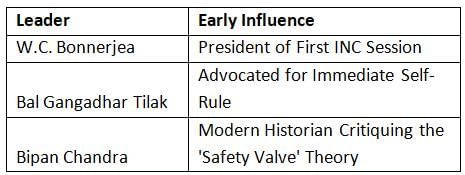
How many of the above pairs are correctly matched?- a)Only one pair
- b)All three pairs
- c)Only two pairs
- d)None of the pairs
Correct answer is option 'B'. Can you explain this answer?
Consider the following pairs:
How many of the above pairs are correctly matched?
How many of the above pairs are correctly matched?
a)
Only one pair
b)
All three pairs
c)
Only two pairs
d)
None of the pairs
 | Gathe Jayant answered |
Correct answer is perhaps c as all the pairs are correctly match
In which of the following provinces was ‘Bicameralism’ introduced for the first time in 1935?(i) Bengal(ii) Punjab(iii) U.P.(iv) Bihar(v) Central provinces(vi) AssamChoose the correct answer from the codes below:- a)All of them
- b)i, ii, iii and iv
- c)ii, iii, v and iv
- d)i, iii, iv and vi
Correct answer is option 'D'. Can you explain this answer?
In which of the following provinces was ‘Bicameralism’ introduced for the first time in 1935?
(i) Bengal
(ii) Punjab
(iii) U.P.
(iv) Bihar
(v) Central provinces
(vi) Assam
Choose the correct answer from the codes below:
a)
All of them
b)
i, ii, iii and iv
c)
ii, iii, v and iv
d)
i, iii, iv and vi
| | Divyansh Yadav answered |
The correct answer is option 'D': (i) Bengal, (iii) U.P., (iv) Bihar, and (vi) Assam.
Bicameralism refers to a system of government where the legislative body is divided into two separate chambers. In India, bicameralism was introduced for the first time in 1935 with the Government of India Act, 1935. This act provided for the establishment of a bicameral legislature in certain provinces.
Let's look at each province mentioned in the options:
(i) Bengal:
Under the Government of India Act, 1935, Bengal was one of the provinces where bicameralism was introduced. The legislature in Bengal consisted of two chambers - the Legislative Assembly and the Legislative Council.
(iii) U.P. (Uttar Pradesh):
U.P. was another province where bicameralism was introduced in 1935. The Legislative Assembly and the Legislative Council constituted the bicameral legislature of U.P.
(iv) Bihar:
Bihar was also one of the provinces where bicameralism was introduced in 1935. Similar to Bengal and U.P., Bihar had a Legislative Assembly and a Legislative Council.
(vi) Assam:
Assam was the fourth province where bicameralism was introduced in 1935. The Legislative Assembly and the Legislative Council formed the bicameral legislature in Assam.
Therefore, the correct answer is option 'D': (i) Bengal, (iii) U.P., (iv) Bihar, and (vi) Assam. These provinces saw the introduction of bicameralism for the first time in 1935 under the Government of India Act.
Bicameralism refers to a system of government where the legislative body is divided into two separate chambers. In India, bicameralism was introduced for the first time in 1935 with the Government of India Act, 1935. This act provided for the establishment of a bicameral legislature in certain provinces.
Let's look at each province mentioned in the options:
(i) Bengal:
Under the Government of India Act, 1935, Bengal was one of the provinces where bicameralism was introduced. The legislature in Bengal consisted of two chambers - the Legislative Assembly and the Legislative Council.
(iii) U.P. (Uttar Pradesh):
U.P. was another province where bicameralism was introduced in 1935. The Legislative Assembly and the Legislative Council constituted the bicameral legislature of U.P.
(iv) Bihar:
Bihar was also one of the provinces where bicameralism was introduced in 1935. Similar to Bengal and U.P., Bihar had a Legislative Assembly and a Legislative Council.
(vi) Assam:
Assam was the fourth province where bicameralism was introduced in 1935. The Legislative Assembly and the Legislative Council formed the bicameral legislature in Assam.
Therefore, the correct answer is option 'D': (i) Bengal, (iii) U.P., (iv) Bihar, and (vi) Assam. These provinces saw the introduction of bicameralism for the first time in 1935 under the Government of India Act.
Which of the following statements is/are not true about the Non-Cooperation and Khilafat Movement?
(i) At the Vijayawada session of the AICC (April, 1921), the “Tilak Swaraj Fund” was started to finance the Non-Cooperation Movement.
(ii) At the same session, it was decided to enroll one crore members in the Congress by the end of June 1921.(iii) At the Karachi Khilafat Conference in July 1921 the Ali brothers called on the Muslims to resign from the army, and hence they were jailed by the British in November, 1921.
(iv) Some Khilafat members like Hasrat Mohani began demanding complete independence by the end of 1921.
(v) The Jamia Millia Islamia was started in Delhi in 1921.Select the answer from the codes given below:- a)only iv
- b)iii & iv
- c)only v
- d)iv & v
Correct answer is option 'C'. Can you explain this answer?
Which of the following statements is/are not true about the Non-Cooperation and Khilafat Movement?
(i) At the Vijayawada session of the AICC (April, 1921), the “Tilak Swaraj Fund” was started to finance the Non-Cooperation Movement.
(ii) At the same session, it was decided to enroll one crore members in the Congress by the end of June 1921.
(i) At the Vijayawada session of the AICC (April, 1921), the “Tilak Swaraj Fund” was started to finance the Non-Cooperation Movement.
(ii) At the same session, it was decided to enroll one crore members in the Congress by the end of June 1921.
(iii) At the Karachi Khilafat Conference in July 1921 the Ali brothers called on the Muslims to resign from the army, and hence they were jailed by the British in November, 1921.
(iv) Some Khilafat members like Hasrat Mohani began demanding complete independence by the end of 1921.
(v) The Jamia Millia Islamia was started in Delhi in 1921.
(iv) Some Khilafat members like Hasrat Mohani began demanding complete independence by the end of 1921.
(v) The Jamia Millia Islamia was started in Delhi in 1921.
Select the answer from the codes given below:
a)
only iv
b)
iii & iv
c)
only v
d)
iv & v
| | Ankita Sarkar answered |
The correct option is C.
Jamia Millia Islamia is a Central University located in Jamia Nagar, New Delhi, India.Originally established at Aligarh, United Provinces (present day Uttar Pradesh, India) during the British Raj in 1920, it moved to its current location in Okhla in 1935. It was given the deemed status by University Grants Commission in 1962. On 26 December 1988, it became a central university.
Jamia Millia Islamia is a Central University located in Jamia Nagar, New Delhi, India.Originally established at Aligarh, United Provinces (present day Uttar Pradesh, India) during the British Raj in 1920, it moved to its current location in Okhla in 1935. It was given the deemed status by University Grants Commission in 1962. On 26 December 1988, it became a central university.
Which is the correct sequence of the following events?(i) Formation of the Interim Government by the Congress;(ii) Cabinet Mission;(iii)Direct Action Day by the Muslim League;(iv) Recall of Lord Wavell and appointment of Lord Mountabatten as the Viceroy(v) Joining of the League in the Interin Government.Select the answer from the codes below:- a)ii, iii, i, v & iv
- b)ii, i, iii, iv & v
- c)ii, iii, i, iv & v
- d)ii, i, iii, v & iv
Correct answer is option 'A'. Can you explain this answer?
Which is the correct sequence of the following events?
(i) Formation of the Interim Government by the Congress;
(ii) Cabinet Mission;
(iii)Direct Action Day by the Muslim League;
(iv) Recall of Lord Wavell and appointment of Lord Mountabatten as the Viceroy
(v) Joining of the League in the Interin Government.
Select the answer from the codes below:
a)
ii, iii, i, v & iv
b)
ii, i, iii, iv & v
c)
ii, iii, i, iv & v
d)
ii, i, iii, v & iv
| | Rounak Kapoor answered |
The correct sequence of events is as follows:
(i) Formation of the Interim Government by the Congress;
(ii) Cabinet Mission;
(iii) Direct Action Day by the Muslim League;
(iv) Recall of Lord Wavell and appointment of Lord Mountbatten as the Viceroy
(v) Joining of the League in the Interim Government.
Let's break down each event and understand the sequence in detail:
Formation of the Interim Government by the Congress:
After the failure of the Cripps Mission in 1942, the Congress decided to launch the Quit India Movement. As a result, several Congress leaders were arrested and imprisoned. In order to maintain the administration and provide governance, the Congress formed an Interim Government in September 1946. This government was headed by Jawaharlal Nehru and had members from both the Congress and the Muslim League.
Cabinet Mission:
The Cabinet Mission was sent to India in 1946 by the British government to propose a plan for the transfer of power from British rule to Indian hands. The mission recommended the formation of a united India with a federal structure, where power would be shared between the central government and regional provinces. The plan also allowed for the creation of separate Muslim-majority provinces if the leaders agreed.
Direct Action Day by the Muslim League:
On August 16, 1946, the Muslim League called for a Direct Action Day to protest against the rejection of their demand for a separate Muslim-majority state called Pakistan. This led to widespread violence and communal clashes between Hindus and Muslims in several cities, particularly in Calcutta (now Kolkata).
Recall of Lord Wavell and appointment of Lord Mountbatten as the Viceroy:
Due to the deteriorating communal situation and the inability to find a political solution, Lord Wavell was recalled as the Viceroy of India in 1947. He was replaced by Lord Mountbatten, who was given the task of overseeing the transfer of power and the partition of India.
Joining of the League in the Interim Government:
After the formation of the Interim Government, the Muslim League initially boycotted it. However, in October 1946, they joined the Interim Government with the aim of safeguarding the interests of the Muslim community and ensuring the creation of Pakistan.
Therefore, the correct sequence of events is (ii) Cabinet Mission, (iii) Direct Action Day by the Muslim League, (i) Formation of the Interim Government by the Congress, (iv) Recall of Lord Wavell and appointment of Lord Mountbatten as the Viceroy, and (v) Joining of the League in the Interim Government.
(i) Formation of the Interim Government by the Congress;
(ii) Cabinet Mission;
(iii) Direct Action Day by the Muslim League;
(iv) Recall of Lord Wavell and appointment of Lord Mountbatten as the Viceroy
(v) Joining of the League in the Interim Government.
Let's break down each event and understand the sequence in detail:
Formation of the Interim Government by the Congress:
After the failure of the Cripps Mission in 1942, the Congress decided to launch the Quit India Movement. As a result, several Congress leaders were arrested and imprisoned. In order to maintain the administration and provide governance, the Congress formed an Interim Government in September 1946. This government was headed by Jawaharlal Nehru and had members from both the Congress and the Muslim League.
Cabinet Mission:
The Cabinet Mission was sent to India in 1946 by the British government to propose a plan for the transfer of power from British rule to Indian hands. The mission recommended the formation of a united India with a federal structure, where power would be shared between the central government and regional provinces. The plan also allowed for the creation of separate Muslim-majority provinces if the leaders agreed.
Direct Action Day by the Muslim League:
On August 16, 1946, the Muslim League called for a Direct Action Day to protest against the rejection of their demand for a separate Muslim-majority state called Pakistan. This led to widespread violence and communal clashes between Hindus and Muslims in several cities, particularly in Calcutta (now Kolkata).
Recall of Lord Wavell and appointment of Lord Mountbatten as the Viceroy:
Due to the deteriorating communal situation and the inability to find a political solution, Lord Wavell was recalled as the Viceroy of India in 1947. He was replaced by Lord Mountbatten, who was given the task of overseeing the transfer of power and the partition of India.
Joining of the League in the Interim Government:
After the formation of the Interim Government, the Muslim League initially boycotted it. However, in October 1946, they joined the Interim Government with the aim of safeguarding the interests of the Muslim community and ensuring the creation of Pakistan.
Therefore, the correct sequence of events is (ii) Cabinet Mission, (iii) Direct Action Day by the Muslim League, (i) Formation of the Interim Government by the Congress, (iv) Recall of Lord Wavell and appointment of Lord Mountbatten as the Viceroy, and (v) Joining of the League in the Interim Government.
Racial bitterness of the British was clearly seen in the passing of the Vernacular Press Act which gagged public opinion in India. This Act was passed in- a)1875
- b)1876
- c)1877
- d)1878
Correct answer is option 'D'. Can you explain this answer?
Racial bitterness of the British was clearly seen in the passing of the Vernacular Press Act which gagged public opinion in India. This Act was passed in
a)
1875
b)
1876
c)
1877
d)
1878
 | Muskaan Mehta answered |
**Answer:**
The Vernacular Press Act was passed in 1878, making option D the correct answer. This Act was a clear manifestation of the racial bitterness of the British towards the Indian population.
**Background:**
During the colonial period, the British sought to control and manipulate public opinion in India. The Vernacular Press Act was one such legislation that aimed to suppress the Indian press, which was seen as a powerful tool for mobilizing public opinion against British rule.
**Explanation:**
The passing of the Vernacular Press Act in 1878 can be understood through the following points:
1. **Racial Bitterness:** The British administration in India harbored a deep sense of racial superiority and resentment towards the Indian population. They considered themselves as the "civilizing" force and believed that they had the right to control and manipulate public opinion in India.
2. **Suppression of the Press:** The Indian press played a crucial role in shaping public opinion and providing a platform for dissent against British rule. This Act was a direct attempt to suppress the Indian press by imposing stringent regulations and restrictions.
3. **Gagging Public Opinion:** The Vernacular Press Act gave the colonial government the power to scrutinize and censor any content published in Indian-language newspapers. It required publishers to provide a security deposit and obtain a license, making it easier for the government to control and suppress dissenting voices.
4. **Targeting Vernacular Press:** The Act specifically targeted the vernacular press, which published newspapers in local Indian languages. The British believed that the vernacular press was more effective in reaching the masses and mobilizing public opinion against colonial rule. By targeting the vernacular press, the British sought to limit the dissemination of nationalist ideas and movements.
5. **Impact and Criticism:** The Vernacular Press Act faced significant criticism from Indian nationalists and intellectuals who saw it as a direct assault on the freedom of the press and the right to free speech. It further fueled anti-British sentiments and resistance movements, as Indians saw it as yet another oppressive measure by the colonial government.
In conclusion, the Vernacular Press Act was a clear manifestation of the racial bitterness of the British towards the Indian population. It aimed to suppress public opinion and control the narrative in India, allowing the colonial government to consolidate its power and maintain control over the Indian population.
The Vernacular Press Act was passed in 1878, making option D the correct answer. This Act was a clear manifestation of the racial bitterness of the British towards the Indian population.
**Background:**
During the colonial period, the British sought to control and manipulate public opinion in India. The Vernacular Press Act was one such legislation that aimed to suppress the Indian press, which was seen as a powerful tool for mobilizing public opinion against British rule.
**Explanation:**
The passing of the Vernacular Press Act in 1878 can be understood through the following points:
1. **Racial Bitterness:** The British administration in India harbored a deep sense of racial superiority and resentment towards the Indian population. They considered themselves as the "civilizing" force and believed that they had the right to control and manipulate public opinion in India.
2. **Suppression of the Press:** The Indian press played a crucial role in shaping public opinion and providing a platform for dissent against British rule. This Act was a direct attempt to suppress the Indian press by imposing stringent regulations and restrictions.
3. **Gagging Public Opinion:** The Vernacular Press Act gave the colonial government the power to scrutinize and censor any content published in Indian-language newspapers. It required publishers to provide a security deposit and obtain a license, making it easier for the government to control and suppress dissenting voices.
4. **Targeting Vernacular Press:** The Act specifically targeted the vernacular press, which published newspapers in local Indian languages. The British believed that the vernacular press was more effective in reaching the masses and mobilizing public opinion against colonial rule. By targeting the vernacular press, the British sought to limit the dissemination of nationalist ideas and movements.
5. **Impact and Criticism:** The Vernacular Press Act faced significant criticism from Indian nationalists and intellectuals who saw it as a direct assault on the freedom of the press and the right to free speech. It further fueled anti-British sentiments and resistance movements, as Indians saw it as yet another oppressive measure by the colonial government.
In conclusion, the Vernacular Press Act was a clear manifestation of the racial bitterness of the British towards the Indian population. It aimed to suppress public opinion and control the narrative in India, allowing the colonial government to consolidate its power and maintain control over the Indian population.
Match List-I with List-II and select the answer from the codes given below the lists: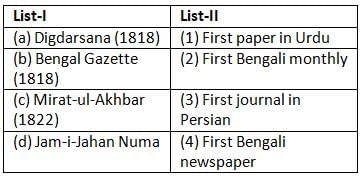
Codes- a)a-4, b-2, c-1, d-3
- b)a-2, b-4, c-1, d-3
- c)a-4, b-2, c-3, d-1
- d)a-2, b-4, c-3, d-1
Correct answer is option 'D'. Can you explain this answer?
Match List-I with List-II and select the answer from the codes given below the lists:
Codes
a)
a-4, b-2, c-1, d-3
b)
a-2, b-4, c-1, d-3
c)
a-4, b-2, c-3, d-1
d)
a-2, b-4, c-3, d-1
| | Aspire Academy answered |
- Digdarsana was the first Bengali monthly magazine, focusing on social and cultural topics. Hence, it matches with "First Bengali monthly."
- The Bengal Gazette (also known as Hicky's Bengal Gazette) is considered the first Bengali newspaper. Hence, it matches with "First Bengali newspaper."
- Mirat-ul-Akhbar was a Persian-language journal published by Raja Ram Mohan Roy. It is notable for being the first journal in Persian, which is why it matches with "First journal in Persian."
- Jam-i-Jahan Numa was the first Urdu newspaper. Hence, it matches with "First paper in Urdu."
Match List-I with List-II and choose the answer from the codes given below the lists: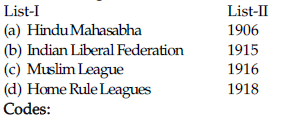
- a)a-2, b-4, c-1, d-3
- b)a-2, b-1, c-4, d-3
- c)a-3, b-2, c-4, d-1
- d)a-4, b-1, c-3, d-2
Correct answer is option 'A'. Can you explain this answer?
Match List-I with List-II and choose the answer from the codes given below the lists:
a)
a-2, b-4, c-1, d-3
b)
a-2, b-1, c-4, d-3
c)
a-3, b-2, c-4, d-1
d)
a-4, b-1, c-3, d-2
| | Deepika Deep answered |
Ya option A.... We can answer it as we know Muslim league was formed during the swadeshi movement orr we can say after bengal partition for their representation so 1906....and home rule league was during 1916 when tilak released from tha jail... So by elimination we cam go for option A
The llbert Bill controversy came up during the viceroyalty of- a)Ripon
- b)Lytton
- c)Dufferin
- d)Northbrook
Correct answer is option 'A'. Can you explain this answer?
The llbert Bill controversy came up during the viceroyalty of
a)
Ripon
b)
Lytton
c)
Dufferin
d)
Northbrook
 | Debolina Chakraborty answered |
**The Ilbert Bill controversy during the viceroyalty of Ripon**
The Ilbert Bill controversy refers to a significant event during the viceroyalty of Lord Ripon (1880-1884) in colonial India. The controversy revolved around the attempt to introduce a bill that aimed to reform the Indian legal system, particularly the criminal jurisdiction of British and Indian judges.
**Introduction to the Ilbert Bill**
During British colonial rule, there was a clear distinction between British and Indian subjects, particularly in matters of law and governance. Under existing laws, Indian judges were not allowed to try European offenders, while British judges had jurisdiction over both European and Indian offenders.
The Ilbert Bill, named after its author, Sir Courtenay Ilbert, who was the legal member of the Viceroy's Council, sought to address this discriminatory practice by allowing Indian judges to try European offenders in certain cases. The bill aimed to bring about equality before the law, challenging the prevailing racial hierarchy and promoting a more equitable legal system.
**The Controversy**
The introduction of the Ilbert Bill faced strong opposition from the European community in India, especially the Anglo-Indian community, which consisted of people of British descent born in India. They vehemently opposed the idea of Indian judges having jurisdiction over European offenders, fearing that it would undermine their privileged status and lead to a loss of power and influence.
The controversy quickly escalated, with the European community organizing protests, demonstrations, and even forming anti-Ilbert associations. They argued that allowing Indian judges to try European offenders would compromise British supremacy, create an unsafe environment for Europeans, and result in an erosion of their legal rights.
**Response and Reforms**
Despite the opposition, Lord Ripon and the Viceroy's Council stood firm in their support for the Ilbert Bill. They saw it as a necessary step towards ending racial discrimination and promoting equality under the law. However, in order to mitigate the opposition, certain compromises were made.
One of the compromises was the inclusion of a clause that allowed European offenders to claim a trial by jury, which was typically composed of their peers. This provision was included to address the concerns of the European community about being judged solely by Indian judges.
**Outcome of the Controversy**
Finally, after a long and heated debate, the Ilbert Bill was passed in 1883. However, the bill was significantly diluted from its original form due to the compromises made. The provision allowing Indian judges to try European offenders was limited to cases where the offender was of lower rank or the victim was an Indian. This compromise undermined the original intent of the bill, but it was still considered a step forward in promoting equality before the law.
The Ilbert Bill controversy highlighted the deep-seated racial prejudices prevalent during British colonial rule in India. It also brought attention to the need for legal reforms that would challenge discriminatory practices and promote a more just and equitable society. While the Ilbert Bill did not fully achieve its goals, it laid the groundwork for future reforms in the Indian legal system.
The Ilbert Bill controversy refers to a significant event during the viceroyalty of Lord Ripon (1880-1884) in colonial India. The controversy revolved around the attempt to introduce a bill that aimed to reform the Indian legal system, particularly the criminal jurisdiction of British and Indian judges.
**Introduction to the Ilbert Bill**
During British colonial rule, there was a clear distinction between British and Indian subjects, particularly in matters of law and governance. Under existing laws, Indian judges were not allowed to try European offenders, while British judges had jurisdiction over both European and Indian offenders.
The Ilbert Bill, named after its author, Sir Courtenay Ilbert, who was the legal member of the Viceroy's Council, sought to address this discriminatory practice by allowing Indian judges to try European offenders in certain cases. The bill aimed to bring about equality before the law, challenging the prevailing racial hierarchy and promoting a more equitable legal system.
**The Controversy**
The introduction of the Ilbert Bill faced strong opposition from the European community in India, especially the Anglo-Indian community, which consisted of people of British descent born in India. They vehemently opposed the idea of Indian judges having jurisdiction over European offenders, fearing that it would undermine their privileged status and lead to a loss of power and influence.
The controversy quickly escalated, with the European community organizing protests, demonstrations, and even forming anti-Ilbert associations. They argued that allowing Indian judges to try European offenders would compromise British supremacy, create an unsafe environment for Europeans, and result in an erosion of their legal rights.
**Response and Reforms**
Despite the opposition, Lord Ripon and the Viceroy's Council stood firm in their support for the Ilbert Bill. They saw it as a necessary step towards ending racial discrimination and promoting equality under the law. However, in order to mitigate the opposition, certain compromises were made.
One of the compromises was the inclusion of a clause that allowed European offenders to claim a trial by jury, which was typically composed of their peers. This provision was included to address the concerns of the European community about being judged solely by Indian judges.
**Outcome of the Controversy**
Finally, after a long and heated debate, the Ilbert Bill was passed in 1883. However, the bill was significantly diluted from its original form due to the compromises made. The provision allowing Indian judges to try European offenders was limited to cases where the offender was of lower rank or the victim was an Indian. This compromise undermined the original intent of the bill, but it was still considered a step forward in promoting equality before the law.
The Ilbert Bill controversy highlighted the deep-seated racial prejudices prevalent during British colonial rule in India. It also brought attention to the need for legal reforms that would challenge discriminatory practices and promote a more just and equitable society. While the Ilbert Bill did not fully achieve its goals, it laid the groundwork for future reforms in the Indian legal system.
Arrange the following in the historical sequence:
(i) Escape of Subhas Chandra Bose from India;
(ii) Celebration of the “Deliverance Day” by the Muslim League;
(iii)Resignation of the Congress Ministries;
(iv) Lahore Resolution of the League demanding separate state for Muslims;
(v) “Quit India” Resolution by the Congress
Choose the correct answer from the codes below:
- a)iii, iv, ii, i & v
- b)iii, i, ii, iv & v
- c)iii, ii, iv, i & v
- d)iii, iv, i, ii & v
Correct answer is option 'C'. Can you explain this answer?
Arrange the following in the historical sequence:
(i) Escape of Subhas Chandra Bose from India;
(ii) Celebration of the “Deliverance Day” by the Muslim League;
(iii)Resignation of the Congress Ministries;
(iv) Lahore Resolution of the League demanding separate state for Muslims;
(v) “Quit India” Resolution by the Congress
Choose the correct answer from the codes below:
(i) Escape of Subhas Chandra Bose from India;
(ii) Celebration of the “Deliverance Day” by the Muslim League;
(iii)Resignation of the Congress Ministries;
(iv) Lahore Resolution of the League demanding separate state for Muslims;
(v) “Quit India” Resolution by the Congress
Choose the correct answer from the codes below:
a)
iii, iv, ii, i & v
b)
iii, i, ii, iv & v
c)
iii, ii, iv, i & v
d)
iii, iv, i, ii & v
 | Mihir Chakraborty answered |
The correct answer is option C: iii, ii, iv, i, v. Let's understand the historical sequence of events:
(i) Resignation of the Congress Ministries:
The sequence begins with the resignation of the Congress Ministries. In response to the failure of the Cripps Mission in 1942, the Congress decided to launch the Quit India Movement. As a part of this movement, the Congress Ministries resigned from power in various provinces in August 1942.
(ii) Celebration of the Deliverance Day by the Muslim League:
After the resignation of Congress Ministries, the Muslim League celebrated Deliverance Day on October 22, 1942. This day was observed as a victory for the League as they believed that the resignation of the Congress Ministries would pave the way for the creation of a separate state for Muslims.
(iii) Lahore Resolution of the League demanding a separate state for Muslims:
Next in chronological order is the Lahore Resolution of the Muslim League. This resolution, also known as the Pakistan Resolution, was passed on March 23, 1940. It demanded the creation of independent states for Muslims in British India.
(iv) Escape of Subhas Chandra Bose from India:
After the Lahore Resolution, Subhas Chandra Bose, who was a prominent leader of the Indian National Congress, escaped from India in 1941 to seek international support for India's independence struggle. He formed the Indian National Army (INA) in collaboration with the Japanese during World War II.
(v) Quit India Resolution by the Congress:
The last event in the sequence is the Quit India Resolution passed by the Congress in August 1942. This resolution called for the immediate end of British rule in India and launched a mass civil disobedience movement against the colonial government.
Therefore, the correct historical sequence of events is iii, ii, iv, i, v.
(i) Resignation of the Congress Ministries:
The sequence begins with the resignation of the Congress Ministries. In response to the failure of the Cripps Mission in 1942, the Congress decided to launch the Quit India Movement. As a part of this movement, the Congress Ministries resigned from power in various provinces in August 1942.
(ii) Celebration of the Deliverance Day by the Muslim League:
After the resignation of Congress Ministries, the Muslim League celebrated Deliverance Day on October 22, 1942. This day was observed as a victory for the League as they believed that the resignation of the Congress Ministries would pave the way for the creation of a separate state for Muslims.
(iii) Lahore Resolution of the League demanding a separate state for Muslims:
Next in chronological order is the Lahore Resolution of the Muslim League. This resolution, also known as the Pakistan Resolution, was passed on March 23, 1940. It demanded the creation of independent states for Muslims in British India.
(iv) Escape of Subhas Chandra Bose from India:
After the Lahore Resolution, Subhas Chandra Bose, who was a prominent leader of the Indian National Congress, escaped from India in 1941 to seek international support for India's independence struggle. He formed the Indian National Army (INA) in collaboration with the Japanese during World War II.
(v) Quit India Resolution by the Congress:
The last event in the sequence is the Quit India Resolution passed by the Congress in August 1942. This resolution called for the immediate end of British rule in India and launched a mass civil disobedience movement against the colonial government.
Therefore, the correct historical sequence of events is iii, ii, iv, i, v.
There were some immediate factors that led to the birth of the Indian National Congress in 1885. Which of the following was not one such factor?- a)The Arms Act of 1878 and the Vernacular Press Act.
- b)The Second Anglo-Afghan War, 1870-80.
- c)The holding of the imperial durbar at Delhi in 1877 when Indian was struck by famine.
- d)llbert Bill controversy, 1883.
Correct answer is option 'B'. Can you explain this answer?
There were some immediate factors that led to the birth of the Indian National Congress in 1885. Which of the following was not one such factor?
a)
The Arms Act of 1878 and the Vernacular Press Act.
b)
The Second Anglo-Afghan War, 1870-80.
c)
The holding of the imperial durbar at Delhi in 1877 when Indian was struck by famine.
d)
llbert Bill controversy, 1883.
 | Jatin Ghosh answered |
Explanation:
The birth of the Indian National Congress in 1885 was a result of several immediate and long-term factors. The immediate factors were the events that occurred in the preceding decade, which laid the foundation for the formation of the Congress. The long-term factors were the historical, social, and cultural conditions of India that contributed to the rise of nationalism.
Immediate factors that led to the birth of the Indian National Congress were:
The Arms Act of 1878 and the Vernacular Press Act: These two acts were passed by the British government to restrict the freedom of the press and the possession of arms by Indians. These acts were seen as an attack on the fundamental rights of Indians and led to widespread protests.
The holding of the imperial durbar at Delhi in 1877 when Indian was struck by famine: The imperial durbar was a grand ceremony organized by the British government to proclaim Queen Victoria as the Empress of India. However, the ceremony was held at a time when India was struck by a severe famine, and the British government's indifference to the suffering of Indians was seen as a sign of its callousness and lack of concern for the welfare of its subjects.
Ilbert Bill controversy, 1883: The Ilbert Bill was a proposed law that would have allowed Indian judges to preside over cases involving Europeans. However, the proposal was opposed by the European community in India, who saw it as a threat to their privilege and status. The controversy led to widespread protests by Indians and highlighted the discriminatory policies of the British government.
However, the Second Anglo-Afghan War, 1870-80, was not an immediate factor that led to the birth of the Indian National Congress. The war was fought between the British Empire and the Emirate of Afghanistan over control of Afghanistan. While the war had significant political and strategic implications for the British Empire, it did not directly impact the Indian population or contribute to the rise of nationalism in India.
The birth of the Indian National Congress in 1885 was a result of several immediate and long-term factors. The immediate factors were the events that occurred in the preceding decade, which laid the foundation for the formation of the Congress. The long-term factors were the historical, social, and cultural conditions of India that contributed to the rise of nationalism.
Immediate factors that led to the birth of the Indian National Congress were:
The Arms Act of 1878 and the Vernacular Press Act: These two acts were passed by the British government to restrict the freedom of the press and the possession of arms by Indians. These acts were seen as an attack on the fundamental rights of Indians and led to widespread protests.
The holding of the imperial durbar at Delhi in 1877 when Indian was struck by famine: The imperial durbar was a grand ceremony organized by the British government to proclaim Queen Victoria as the Empress of India. However, the ceremony was held at a time when India was struck by a severe famine, and the British government's indifference to the suffering of Indians was seen as a sign of its callousness and lack of concern for the welfare of its subjects.
Ilbert Bill controversy, 1883: The Ilbert Bill was a proposed law that would have allowed Indian judges to preside over cases involving Europeans. However, the proposal was opposed by the European community in India, who saw it as a threat to their privilege and status. The controversy led to widespread protests by Indians and highlighted the discriminatory policies of the British government.
However, the Second Anglo-Afghan War, 1870-80, was not an immediate factor that led to the birth of the Indian National Congress. The war was fought between the British Empire and the Emirate of Afghanistan over control of Afghanistan. While the war had significant political and strategic implications for the British Empire, it did not directly impact the Indian population or contribute to the rise of nationalism in India.
- Statement I: A.O. Hume played a crucial role in the formation of the Indian National Congress to serve as a safety valve for the discontent among Indians.
- Statement II: The Safety Valve Theory suggests that the Indian National Congress (INC) was created to offer a peaceful means for Indians to express their rising discontent and to avert a potential violent revolution.
Which one of the following is correct in respect of the above statements?- a)Both Statement-I and Statement-II are correct and Statement-II is the correct explanation for Statement-I
- b)Both Statement-I and Statement-II are correct but Statement-II is not the correct explanation for Statement-I
- c)Statement-I is correct but Statement-II is incorrect
- d)Statement-I is incorrect but Statement-II is correct
Correct answer is option 'A'. Can you explain this answer?
- Statement I: A.O. Hume played a crucial role in the formation of the Indian National Congress to serve as a safety valve for the discontent among Indians.
- Statement II: The Safety Valve Theory suggests that the Indian National Congress (INC) was created to offer a peaceful means for Indians to express their rising discontent and to avert a potential violent revolution.
Which one of the following is correct in respect of the above statements?
a)
Both Statement-I and Statement-II are correct and Statement-II is the correct explanation for Statement-I
b)
Both Statement-I and Statement-II are correct but Statement-II is not the correct explanation for Statement-I
c)
Statement-I is correct but Statement-II is incorrect
d)
Statement-I is incorrect but Statement-II is correct
 | Garima Choudhary answered |
Understanding the Statements
The two statements relate to the formation of the Indian National Congress (INC) and the context surrounding its establishment.
Statement I: A.O. Hume's Role
- A.O. Hume, a retired British civil servant, indeed played a vital role in founding the INC in 1885.
- His intention was to create a platform for the expression of Indian political aspirations, allowing educated Indians to voice their concerns.
- Hume's involvement can be viewed as an attempt to channel rising discontent among Indians in a non-revolutionary manner.
Statement II: Safety Valve Theory
- The safety valve theory posits that the British government encouraged the formation of the INC to mitigate potential unrest and rebellion.
- By providing a legitimate political forum, the British aimed to absorb and placate the growing frustration and demands of Indian nationalists.
- This theory suggests a strategic move by colonial authorities to maintain control by offering a controlled outlet for political expression.
Correctness of the Statements
- Both statements are accurate in their assertions regarding Hume's involvement and the British intention behind the INC's formation.
- Statement II serves as a correct explanation for Statement I, highlighting the colonial strategy to prevent unrest.
Conclusion
- Therefore, the correct answer is option 'A': Both Statement-I and Statement-II are correct, and Statement-II is the correct explanation for Statement-I.
- This reflects the nuanced understanding of colonial strategies and the emergence of nationalist movements in India.
The two statements relate to the formation of the Indian National Congress (INC) and the context surrounding its establishment.
Statement I: A.O. Hume's Role
- A.O. Hume, a retired British civil servant, indeed played a vital role in founding the INC in 1885.
- His intention was to create a platform for the expression of Indian political aspirations, allowing educated Indians to voice their concerns.
- Hume's involvement can be viewed as an attempt to channel rising discontent among Indians in a non-revolutionary manner.
Statement II: Safety Valve Theory
- The safety valve theory posits that the British government encouraged the formation of the INC to mitigate potential unrest and rebellion.
- By providing a legitimate political forum, the British aimed to absorb and placate the growing frustration and demands of Indian nationalists.
- This theory suggests a strategic move by colonial authorities to maintain control by offering a controlled outlet for political expression.
Correctness of the Statements
- Both statements are accurate in their assertions regarding Hume's involvement and the British intention behind the INC's formation.
- Statement II serves as a correct explanation for Statement I, highlighting the colonial strategy to prevent unrest.
Conclusion
- Therefore, the correct answer is option 'A': Both Statement-I and Statement-II are correct, and Statement-II is the correct explanation for Statement-I.
- This reflects the nuanced understanding of colonial strategies and the emergence of nationalist movements in India.
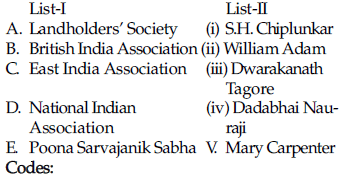
Which code gives the correct pairing of the following lists?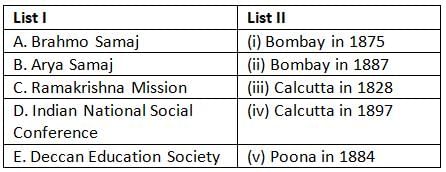
Codes:- a)A-ii, B-iv, C-iii, D-i, E-v
- b)A-iv, B-iii, C-v, D-i, E-ii
- c)A-iii, B-ii, C-iv, D-v, E-i
- d)A-iii, B-i, C-iv, D-ii, E-V
Correct answer is option 'D'. Can you explain this answer?
Which code gives the correct pairing of the following lists?
Codes:
a)
A-ii, B-iv, C-iii, D-i, E-v
b)
A-iv, B-iii, C-v, D-i, E-ii
c)
A-iii, B-ii, C-iv, D-v, E-i
d)
A-iii, B-i, C-iv, D-ii, E-V
| | Aspire Academy answered |
- Brahmo Samaj was founded by Raja Ram Mohan Roy in Calcutta in 1828. It played a major role in social reform, particularly the abolition of practices like Sati.
- The Arya Samaj was founded by Dayanand Saraswati in Bombay in 1875. It was a Hindu reform movement that emphasized a return to the teachings of the Vedas.
- The Ramakrishna Mission was founded by Swami Vivekananda in Calcutta in 1897 to promote social welfare and spiritual values based on the teachings of his guru, Ramakrishna Paramahamsa.
- The Indian National Social Conference was held in Bombay in 1887 and was closely associated with the Indian National Congress, focusing on social reform alongside political discussions.
- The Deccan Education Society was founded in Poona in 1884 by leaders like G.G. Agarkar and Bal Gangadhar Tilak to promote education and social reform.
Hence, the correct answer is Option D.
Which code gives the correct matching of the following lists?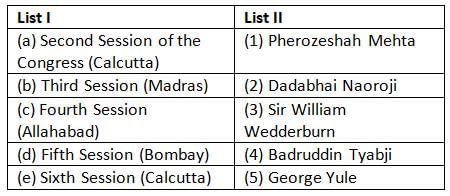
Codes:- a)a-2, b-4, c-5, d-3, e-1
- b)a-2, b-1, c-3, d-4, e-5
- c)a-3, b-2, c-1, d-4, e-5
- d)a-1, b-5, c-3, d-2, e-4
Correct answer is option 'A'. Can you explain this answer?
Which code gives the correct matching of the following lists?
Codes:
a)
a-2, b-4, c-5, d-3, e-1
b)
a-2, b-1, c-3, d-4, e-5
c)
a-3, b-2, c-1, d-4, e-5
d)
a-1, b-5, c-3, d-2, e-4
| | Jhanvi Rane answered |
A is the correct option.
- Dada bhai Nauroji was the president of the second session of the Congress at Calcutta.
- Badruddin Tyyabdin was the president of the third session of the Congress at Madras.
- George Yule was the president of the fourth session of the Congress at Allahabad.
- Sir William Bedderbum was the president of the fifth session of the Congress at Bombay.
- Pherozeshah Mehta was the president of the sixth session of the Congress at Calcutta.
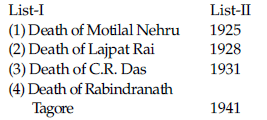
Match the following: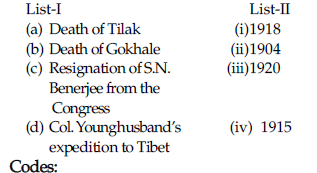
- a)a-iii, b-iv, c-i, d-ii
- b)a-iv, b-i, c-ii, d-iii
- c)a-iv, b-iii, c-i, d-ii
- d)a-iii, b-i, c-iv, d-ii
Correct answer is option 'A'. Can you explain this answer?
Match the following:
a)
a-iii, b-iv, c-i, d-ii
b)
a-iv, b-i, c-ii, d-iii
c)
a-iv, b-iii, c-i, d-ii
d)
a-iii, b-i, c-iv, d-ii
| | Aspire Academy answered |
- Bal Gangadhar Tilak was a prominent leader of the Indian freedom movement. He passed away on August 1, 1920, marking the end of an era in India's fight for independence. This event is correctly matched with 1920 (iii).
- Gopal Krishna Gokhale, another leading figure in the Indian independence struggle and a mentor to Mahatma Gandhi, died on February 19, 1915. He was known for his moderate approach in seeking reforms under British rule. This is correctly matched with 1915 (iv).
- Surendranath Banerjee, one of the earliest leaders of the Indian National Congress, resigned from the Congress in 1918 due to ideological differences, particularly concerning the Montagu-Chelmsford Reforms. This event is correctly matched with 1918 (i).
- Colonel Francis Younghusband led a British military expedition to Tibet in 1904, which was a significant event aimed at asserting British influence in the region amidst concerns over Russian expansion. This is correctly matched with 1904 (ii).
Consider the following statements:- The British Indian Government was supportive of the Indian National Congress in its early years, seeing it as a means to channel nationalist sentiments.
- The government attempted to divide nationalist ranks by fostering divisions based on religion, using a 'carrot and stick' approach.
How many of the statements given above are correct?- a)Only 1
- b)Only 2
- c)Both 1 and 2
- d)None
Correct answer is option 'B'. Can you explain this answer?
Consider the following statements:
- The British Indian Government was supportive of the Indian National Congress in its early years, seeing it as a means to channel nationalist sentiments.
- The government attempted to divide nationalist ranks by fostering divisions based on religion, using a 'carrot and stick' approach.
How many of the statements given above are correct?
a)
Only 1
b)
Only 2
c)
Both 1 and 2
d)
None
 | Mainak Mukherjee answered |
Incorrect Statement Explanation:
The British Indian Government was not supportive of the Indian National Congress in its early years. In fact, the government viewed the Indian National Congress with suspicion and as a threat to British colonial rule in India. The Congress was seen as a platform for Indian nationalist sentiments and demands for self-governance, which went against British interests.
Correct Statement Explanation:
The British Indian Government did attempt to divide nationalist ranks by fostering divisions based on religion. This was a tactic used to weaken the Indian National Congress and the broader nationalist movement. The government employed a "carrot and stick" approach, offering incentives to certain religious or ethnic groups while using repression and coercion against others. This strategy aimed to create disunity and prevent a united front against British rule.
The British Indian Government was not supportive of the Indian National Congress in its early years. In fact, the government viewed the Indian National Congress with suspicion and as a threat to British colonial rule in India. The Congress was seen as a platform for Indian nationalist sentiments and demands for self-governance, which went against British interests.
Correct Statement Explanation:
The British Indian Government did attempt to divide nationalist ranks by fostering divisions based on religion. This was a tactic used to weaken the Indian National Congress and the broader nationalist movement. The government employed a "carrot and stick" approach, offering incentives to certain religious or ethnic groups while using repression and coercion against others. This strategy aimed to create disunity and prevent a united front against British rule.
Consider the following pairs:
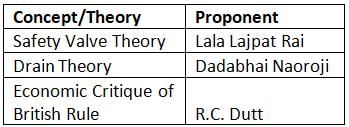
How many of the above pairs are correctly matched?- a)Only one pair
- b)Only two pairs
- c)All three pairs
- d)None of the pairs
Correct answer is option 'C'. Can you explain this answer?
Consider the following pairs:
How many of the above pairs are correctly matched?
How many of the above pairs are correctly matched?
a)
Only one pair
b)
Only two pairs
c)
All three pairs
d)
None of the pairs
 | K.L Institute answered |
- Lala Lajpat Rai was among the nationalist leaders who supported the 'safety valve' theory regarding the founding of the INC.
- Dadabhai Naoroji introduced the Drain Theory to highlight the economic exploitation of India by Britain.
- R.C. Dutt provided a detailed economic critique of British rule, particularly focusing on its impact on India's economy and agriculture.
Assertion (A): The early nationalists were successful in creating a broad public opinion against British rule.Reason (R): They highlighted the economic exploitation of India through the drain theory and criticized British economic policies.In the context of the above, which one of the following is correct?- a)Both A and R are true, and R is the correct explanation of A.
- b)Both A and R are true, but R is not the correct explanation of A.
- c)A is true, but R is false.
- d)A is false, but R is true.
Correct answer is option 'A'. Can you explain this answer?
Assertion (A): The early nationalists were successful in creating a broad public opinion against British rule.
Reason (R): They highlighted the economic exploitation of India through the drain theory and criticized British economic policies.
In the context of the above, which one of the following is correct?
a)
Both A and R are true, and R is the correct explanation of A.
b)
Both A and R are true, but R is not the correct explanation of A.
c)
A is true, but R is false.
d)
A is false, but R is true.
| | Shounak Malik answered |
Explanation:
Early Nationalists and Creation of Public Opinion:
- The early nationalists in India were successful in creating a broad public opinion against British rule by highlighting the various injustices and exploitative practices of the British colonial administration.
- They worked towards awakening the masses and garnering support for the freedom struggle through various means such as newspapers, pamphlets, public speeches, and social reform movements.
Drain Theory and Criticism of British Economic Policies:
- One of the key strategies employed by the early nationalists was to highlight the economic exploitation of India by the British through the drain theory.
- The drain theory outlined how the British were siphoning off resources from India to Britain, leading to economic stagnation and poverty in India.
- Additionally, the early nationalists criticized British economic policies that were detrimental to the Indian economy, such as high tariffs and discriminatory trade practices.
Explanation of Assertion and Reason:
- Both Assertion (A) and Reason (R) are true in this context.
- The early nationalists indeed succeeded in creating a broad public opinion against British rule by focusing on various aspects of exploitation, including economic exploitation through the drain theory and criticism of British economic policies.
- Therefore, Reason (R) is the correct explanation of Assertion (A) as the highlighting of economic exploitation played a significant role in shaping public opinion against British rule.
Therefore, option 'A' is the correct answer.
Early Nationalists and Creation of Public Opinion:
- The early nationalists in India were successful in creating a broad public opinion against British rule by highlighting the various injustices and exploitative practices of the British colonial administration.
- They worked towards awakening the masses and garnering support for the freedom struggle through various means such as newspapers, pamphlets, public speeches, and social reform movements.
Drain Theory and Criticism of British Economic Policies:
- One of the key strategies employed by the early nationalists was to highlight the economic exploitation of India by the British through the drain theory.
- The drain theory outlined how the British were siphoning off resources from India to Britain, leading to economic stagnation and poverty in India.
- Additionally, the early nationalists criticized British economic policies that were detrimental to the Indian economy, such as high tariffs and discriminatory trade practices.
Explanation of Assertion and Reason:
- Both Assertion (A) and Reason (R) are true in this context.
- The early nationalists indeed succeeded in creating a broad public opinion against British rule by focusing on various aspects of exploitation, including economic exploitation through the drain theory and criticism of British economic policies.
- Therefore, Reason (R) is the correct explanation of Assertion (A) as the highlighting of economic exploitation played a significant role in shaping public opinion against British rule.
Therefore, option 'A' is the correct answer.
Assertion (A): The early nationalists failed to draw the masses into the freedom movement.Reason (R): They focused on petitions and constitutional reforms, believing in British justice and goodwill.In the context of the above, which one of the following is correct?- a)Both A and R are true, and R is the correct explanation of A.
- b)Both A and R are true, but R is not the correct explanation of A.
- c)A is true, but R is false.
- d)A is false, but R is true.
Correct answer is option 'A'. Can you explain this answer?
Assertion (A): The early nationalists failed to draw the masses into the freedom movement.
Reason (R): They focused on petitions and constitutional reforms, believing in British justice and goodwill.
In the context of the above, which one of the following is correct?
a)
Both A and R are true, and R is the correct explanation of A.
b)
Both A and R are true, but R is not the correct explanation of A.
c)
A is true, but R is false.
d)
A is false, but R is true.
| | Nishanth Goyal answered |
Assertion (A) and Reason (R) Analysis:
Assertion (A): The early nationalists failed to draw the masses into the freedom movement.
- The assertion is true as the early nationalists, who focused on petitions and constitutional reforms, did not effectively mobilize the masses for the freedom movement.
Reason (R): They focused on petitions and constitutional reforms, believing in British justice and goodwill.
- The reason is also true as the early nationalists primarily believed in negotiating with the British through petitions and seeking reforms within the existing system, rather than engaging in mass mobilization and agitation.
Explanation:
- The assertion and reason are related as the reason provides an explanation for why the early nationalists failed to involve the masses in the freedom movement. By relying on petitions and expecting British justice and goodwill, they did not adopt more radical or mass-oriented approaches that could have sparked a larger movement.
Conclusion:
- In this context, option 'A' is correct as both the assertion and reason are true, and the reason indeed provides the correct explanation for the assertion. The early nationalists' focus on petitions and constitutional reforms, while overlooking mass mobilization, hindered their ability to draw the masses into the freedom movement.
Assertion (A): The early nationalists failed to draw the masses into the freedom movement.
- The assertion is true as the early nationalists, who focused on petitions and constitutional reforms, did not effectively mobilize the masses for the freedom movement.
Reason (R): They focused on petitions and constitutional reforms, believing in British justice and goodwill.
- The reason is also true as the early nationalists primarily believed in negotiating with the British through petitions and seeking reforms within the existing system, rather than engaging in mass mobilization and agitation.
Explanation:
- The assertion and reason are related as the reason provides an explanation for why the early nationalists failed to involve the masses in the freedom movement. By relying on petitions and expecting British justice and goodwill, they did not adopt more radical or mass-oriented approaches that could have sparked a larger movement.
Conclusion:
- In this context, option 'A' is correct as both the assertion and reason are true, and the reason indeed provides the correct explanation for the assertion. The early nationalists' focus on petitions and constitutional reforms, while overlooking mass mobilization, hindered their ability to draw the masses into the freedom movement.
Match List I and List II and select the answer from the codes given below the lists: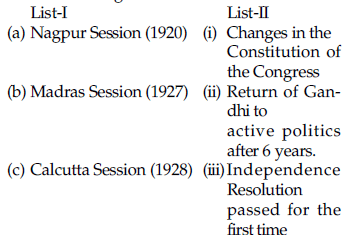
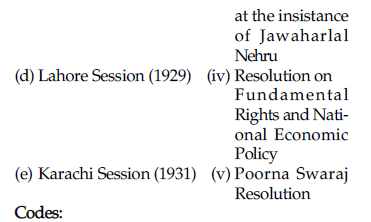
- a)a-i, b-ii, c-iii, d-v, e-iv
- b)a-iv, b-ii, c-iii, d-v, e-i
- c)a-i, b-iii, c-ii, d-v, e-iv
- d) a-iv, b-iii, c-ii, d-v, e-i
Correct answer is option 'C'. Can you explain this answer?
Match List I and List II and select the answer from the codes given below the lists:
a)
a-i, b-ii, c-iii, d-v, e-iv
b)
a-iv, b-ii, c-iii, d-v, e-i
c)
a-i, b-iii, c-ii, d-v, e-iv
d)
a-iv, b-iii, c-ii, d-v, e-i
 | Palak Patel answered |
The correct option is Option C.
The December, 1920 Nagpur session of Congress was known widely as the program of Non - Cooperation Khilafat Movement was adopted and even there was a decision for the participation in the Council Elections.
During the Madras Session in December 1927, young leaders like Jawahar Lal Nehru had proposed the resolution for complete independence which was however defeated and the action of Jawahar Lal was not appreciated by Gandhi.
In December 1928, the Congress session was held in Kolkata and Mohandas Gandhi proposed a resolution that called for the British to grant dominion status to India within two years. The All India Congress Committee voted 118 to 45 in its favour (the 45 votes came from supporters of a complete break from the British).
The Indian National Congress, on 19 December 1929, passed the historic 'Purna Swaraj' – (total independence) resolution – at its Lahore session. A public declaration was made on 26 January 1930 – a day which the Congress Party urged Indians to celebrate as 'Independence Day'.
In 1931, the Congress met at Karachi. It approved the Gandhi-Irwin Pact. The most significant contribution of the Karachi session was a resolution it passed on Fundamental Rights and Economic Policy.
Match the following: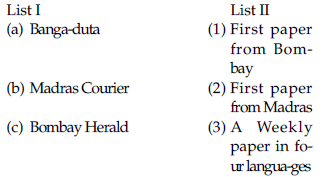
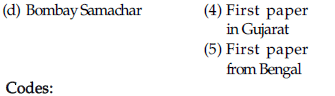
- a)a-5, b-2, c-4, d-1
- b)a-3, b-2, c-1 d-4
- c)a-4, b-2, c-1, d-3
- d)a-3, b-2, c-1, d-5
Correct answer is option 'B'. Can you explain this answer?
Match the following:
a)
a-5, b-2, c-4, d-1
b)
a-3, b-2, c-1 d-4
c)
a-4, b-2, c-1, d-3
d)
a-3, b-2, c-1, d-5
| | Aspire Academy answered |
- Banga-duta, while known as an early newspaper from Bengal, is historically significant for its multilingual nature. It was published in four languages — Bengali, Persian, Hindi, and English. Thus, it matches with (3), "A Weekly paper in four languages."
- Madras Courier was indeed the first newspaper published from Madras (now Chennai) in 1785. It was primarily focused on colonial news and was influential in South India. Hence, it matches with (2), "First paper from Madras."
- Bombay Herald, started in 1790, was one of the earliest newspapers in the Bombay Presidency, making it the first paper from Bombay (now Mumbai). Hence, it matches with (1).
- Bombay Samachar, launched in 1822, is not only one of the oldest newspapers in India but also the first paper in Gujarat. It was published in Gujarati, catering to the local population. Hence, it matches with (4), "First paper in Gujarat."
Consider the following statements:- The early nationalists introduced the "drain theory" to articulate how wealth was being extracted from India to Britain.
- The Indian Councils Act of 1892 significantly increased the powers of legislative councils in India, especially in financial matters.
How many of the statements given above are correct?- a)Only 1
- b)Only 2
- c)Both 1 and 2
- d)None
Correct answer is option 'A'. Can you explain this answer?
Consider the following statements:
- The early nationalists introduced the "drain theory" to articulate how wealth was being extracted from India to Britain.
- The Indian Councils Act of 1892 significantly increased the powers of legislative councils in India, especially in financial matters.
How many of the statements given above are correct?
a)
Only 1
b)
Only 2
c)
Both 1 and 2
d)
None
| | Shounak Malik answered |
Explanation:
Statement 1: The early nationalists did introduce the "drain theory" to explain how wealth was being extracted from India to Britain. This theory highlighted the economic exploitation by the British colonial rulers and gained popularity among Indian nationalists during the late 19th and early 20th centuries. Therefore, this statement is correct.
Statement 2: The Indian Councils Act of 1892 did not significantly increase the powers of legislative councils in India, especially in financial matters. It was a relatively minor piece of legislation that made limited changes to the composition and functioning of the legislative councils. The real increase in powers came with subsequent acts like the Indian Councils Act of 1909 and the Government of India Act of 1919. Therefore, this statement is incorrect.
Therefore, only statement 1 is correct, and the correct answer is option 'A' (Only 1).
Statement 1: The early nationalists did introduce the "drain theory" to explain how wealth was being extracted from India to Britain. This theory highlighted the economic exploitation by the British colonial rulers and gained popularity among Indian nationalists during the late 19th and early 20th centuries. Therefore, this statement is correct.
Statement 2: The Indian Councils Act of 1892 did not significantly increase the powers of legislative councils in India, especially in financial matters. It was a relatively minor piece of legislation that made limited changes to the composition and functioning of the legislative councils. The real increase in powers came with subsequent acts like the Indian Councils Act of 1909 and the Government of India Act of 1919. Therefore, this statement is incorrect.
Therefore, only statement 1 is correct, and the correct answer is option 'A' (Only 1).
Match List I with List II and select the answer from the codes given below the lists: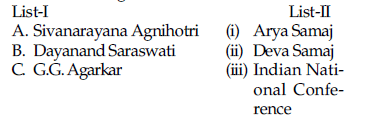
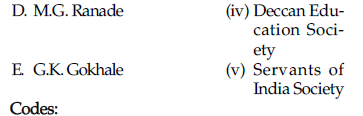
- a)A-iv, B-iii, C-v, D-ii, E-i
- b)A-iii, B-ii, C-i, D-v, E-iv
- c)A-ii, B-i, C-iv, D-iii, E-v
- d)A-iv, B-i, C-ii, D-v, E-iii
Correct answer is option 'C'. Can you explain this answer?
Match List I with List II and select the answer from the codes given below the lists:
a)
A-iv, B-iii, C-v, D-ii, E-i
b)
A-iii, B-ii, C-i, D-v, E-iv
c)
A-ii, B-i, C-iv, D-iii, E-v
d)
A-iv, B-i, C-ii, D-v, E-iii
| | Aspire Academy answered |
- Sivanarayana Agnihotri was the founder of the Deva Samaj, a religious and social reform movement in India.
- Dayanand Saraswati founded the Arya Samaj in 1875 to promote Vedic principles and reform Hinduism.
- G.G. Agarkar was one of the founding members of the Deccan Education Society, which was established in 1884 to promote education in India.
- M.G. Ranade was actively involved in the Indian National Conference, a precursor to the Indian National Congress, which sought to address national issues.
- Gopal Krishna Gokhale founded the Servants of India Society in 1905, aiming to train people to dedicate themselves to the service of India and its people.
Hence, the correct answer is Option C.
Which of the following statements are correct about Moderate Nationalists? 1. The early nationalists, led by Dada Naoroji and RC Dutt put forwarded the drain theory to explain British exploitation in India 2. The moderates were failed to create an all India public opinion against the British rule in India Choose from the following options.- a)1 Only
- b)2 Only
- c)Both of them
- d)Neither of them
Correct answer is option 'B'. Can you explain this answer?
Which of the following statements are correct about Moderate Nationalists?
1. The early nationalists, led by Dada Naoroji and RC Dutt put forwarded the drain theory to explain British exploitation in India
2. The moderates were failed to create an all India public opinion against the British rule in India
Choose from the following options.
a)
1 Only
b)
2 Only
c)
Both of them
d)
Neither of them
| | Suresh Reddy answered |
- The early nationalists, led by Dadabhai Naoroji, R.C. Dutt, Dinshaw Wacha and others, carefully analyzed the political economy of British rule in India and put forward the "drain theory" to explain British exploitation of India.
- They opposed transforming a basically self-sufficient Indian economy into a colonial economy (i.e., a supplier of raw materials and foodstuff, an importer of finished goods and a field of investment for British capital).
- Thus, the Moderates created an all-India public opinion that British rule in India was the major cause of India's poverty and economic backwardness.
- Statement I: The aim of the Indian National Congress during its initial years was to establish a platform for all Indians to unite and articulate their political and economic demands.
- Statement II: The formation of the INC was primarily a response to the British economic policies that were seen as detrimental to the economic interests of Indians.
Which one of the following is correct in respect of the above statements?- a)Both Statement-I and Statement-II are correct and Statement-II is the correct explanation for Statement-I
- b)Both Statement-I and Statement-II are correct but Statement-II is not the correct explanation for Statement-I
- c)Statement-I is correct but Statement-II is incorrect
- d)Statement-I is incorrect but Statement-II is correct
Correct answer is option 'B'. Can you explain this answer?
- Statement I: The aim of the Indian National Congress during its initial years was to establish a platform for all Indians to unite and articulate their political and economic demands.
- Statement II: The formation of the INC was primarily a response to the British economic policies that were seen as detrimental to the economic interests of Indians.
Which one of the following is correct in respect of the above statements?
a)
Both Statement-I and Statement-II are correct and Statement-II is the correct explanation for Statement-I
b)
Both Statement-I and Statement-II are correct but Statement-II is not the correct explanation for Statement-I
c)
Statement-I is correct but Statement-II is incorrect
d)
Statement-I is incorrect but Statement-II is correct
| | Jaideep Roy answered |
Explanation:
Statement I:
- The aim of the Indian National Congress during its initial years was indeed to establish a platform for all Indians to unite and articulate their political and economic demands.
- The INC was founded in 1885 by A.O. Hume, Dadabhai Naoroji, Dinshaw Wacha, and others with the goal of promoting a common platform for Indians to voice their concerns and grievances.
- The INC played a crucial role in bringing together people from diverse backgrounds and regions to work towards common goals such as self-governance and social reform.
Statement II:
- The formation of the INC was indeed a response to the British economic policies that were seen as detrimental to the economic interests of Indians.
- The INC emerged at a time when Indians were facing economic exploitation under British colonial rule, such as high taxes, discriminatory tariffs, and lack of economic opportunities.
- By advocating for economic reforms and representing the interests of Indians, the INC aimed to address these economic challenges and promote Indian economic development.
Therefore, both Statement-I and Statement-II are correct, but Statement-II is not the correct explanation for Statement-I as the formation of the INC had broader goals beyond just responding to British economic policies.
Statement I:
- The aim of the Indian National Congress during its initial years was indeed to establish a platform for all Indians to unite and articulate their political and economic demands.
- The INC was founded in 1885 by A.O. Hume, Dadabhai Naoroji, Dinshaw Wacha, and others with the goal of promoting a common platform for Indians to voice their concerns and grievances.
- The INC played a crucial role in bringing together people from diverse backgrounds and regions to work towards common goals such as self-governance and social reform.
Statement II:
- The formation of the INC was indeed a response to the British economic policies that were seen as detrimental to the economic interests of Indians.
- The INC emerged at a time when Indians were facing economic exploitation under British colonial rule, such as high taxes, discriminatory tariffs, and lack of economic opportunities.
- By advocating for economic reforms and representing the interests of Indians, the INC aimed to address these economic challenges and promote Indian economic development.
Therefore, both Statement-I and Statement-II are correct, but Statement-II is not the correct explanation for Statement-I as the formation of the INC had broader goals beyond just responding to British economic policies.
Assertion (A): The Indian Councils Act of 1892 was criticized by nationalist leaders.Reason (R): It significantly increased the representation and powers of Indians in the legislative councils.In the context of the above, which one of the following is correct?- a)Both A and R are true, and R is the correct explanation of A.
- b)Both A and R are true, but R is not the correct explanation of A.
- c)A is true, but R is false.
- d)A is false, but R is true.
Correct answer is option 'C'. Can you explain this answer?
Assertion (A): The Indian Councils Act of 1892 was criticized by nationalist leaders.
Reason (R): It significantly increased the representation and powers of Indians in the legislative councils.
In the context of the above, which one of the following is correct?
a)
Both A and R are true, and R is the correct explanation of A.
b)
Both A and R are true, but R is not the correct explanation of A.
c)
A is true, but R is false.
d)
A is false, but R is true.
| | Neha Khanna answered |
Explanation:
Indian Councils Act of 1892:
- The Indian Councils Act of 1892, also known as the Morley-Minto Reforms, was introduced by the British government in India.
- It aimed to increase Indian representation in the legislative councils and give Indians a larger role in the governance of the country.
Criticism by Nationalist Leaders:
- Nationalist leaders criticized the Indian Councils Act of 1892 for various reasons.
- They felt that the reforms were not sufficient and did not meet the demands of the Indian people for greater participation in the legislative process.
- Nationalist leaders believed that the Act did not go far enough in granting Indians equal representation and decision-making power in the legislative councils.
- They argued that the Act maintained significant British control over the legislative process and did not adequately address the aspirations of the Indian population for self-governance.
Assertion and Reason Analysis:
- The assertion that the Indian Councils Act of 1892 was criticized by nationalist leaders is true.
- The reason given, that it significantly increased the representation and powers of Indians in the legislative councils, is false.
- In reality, while the Act did increase Indian representation to some extent, nationalist leaders felt that it fell short of their expectations and demands for greater empowerment and self-governance.
Therefore, option 'C' is the correct choice as the Assertion is true but the Reason is false.
Indian Councils Act of 1892:
- The Indian Councils Act of 1892, also known as the Morley-Minto Reforms, was introduced by the British government in India.
- It aimed to increase Indian representation in the legislative councils and give Indians a larger role in the governance of the country.
Criticism by Nationalist Leaders:
- Nationalist leaders criticized the Indian Councils Act of 1892 for various reasons.
- They felt that the reforms were not sufficient and did not meet the demands of the Indian people for greater participation in the legislative process.
- Nationalist leaders believed that the Act did not go far enough in granting Indians equal representation and decision-making power in the legislative councils.
- They argued that the Act maintained significant British control over the legislative process and did not adequately address the aspirations of the Indian population for self-governance.
Assertion and Reason Analysis:
- The assertion that the Indian Councils Act of 1892 was criticized by nationalist leaders is true.
- The reason given, that it significantly increased the representation and powers of Indians in the legislative councils, is false.
- In reality, while the Act did increase Indian representation to some extent, nationalist leaders felt that it fell short of their expectations and demands for greater empowerment and self-governance.
Therefore, option 'C' is the correct choice as the Assertion is true but the Reason is false.
Indians realized that the British wanted to monopolize the higher grades of services in the administration when the government reduced the maximum age limit for sitting in the l.C.S. examination from 21 years to 19 in- a)1875
- b)1878
- c)1880
- d)1882
Correct answer is option 'B'. Can you explain this answer?
Indians realized that the British wanted to monopolize the higher grades of services in the administration when the government reduced the maximum age limit for sitting in the l.C.S. examination from 21 years to 19 in
a)
1875
b)
1878
c)
1880
d)
1882
| | Gowri Chopra answered |
The character act of 1833 had provided for the holding of the competitive exams in London for thr recruitment to higher sevice under the company. Yhe british bureaucracy in india was opposed to the entry of Indians into the civil services. Lord Lytton was also one of the same and wanted to close the doors of convenanted services to the indian altogether. Having failed to do so he took steps calculated to discourage Indians from competing for the said examination by lowering te maximum age from 21 to 19 years in 1878.
Find out the correct pairing of the following lists from the codes given below the lists: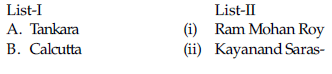
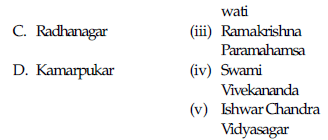
- a)A-ii, B-iv, C-i, D-iiii
- b)A-v, B-iii, C-iv, D-ii
- c)A-iv, B-ii, C-iii, D-i
- d)A-iii, B-iv, C-ii, D-i
Correct answer is option 'A'. Can you explain this answer?
Find out the correct pairing of the following lists from the codes given below the lists:
a)
A-ii, B-iv, C-i, D-iiii
b)
A-v, B-iii, C-iv, D-ii
c)
A-iv, B-ii, C-iii, D-i
d)
A-iii, B-iv, C-ii, D-i
| | Aspire Academy answered |
- Tankara is the birthplace of Dayanand Saraswati, who founded the Arya Samaj movement.
- Calcutta is associated with Swami Vivekananda, who was born and raised there and founded the Ramakrishna Mission.
- Radhanagar is the birthplace of Raja Ram Mohan Roy, the founder of the Brahmo Samaj and a social reformer.
- Kamarpukur is the birthplace of Ramakrishna Paramahamsa, the spiritual leader who greatly influenced Swami Vivekananda.
Hence, the correct answer is Option A.
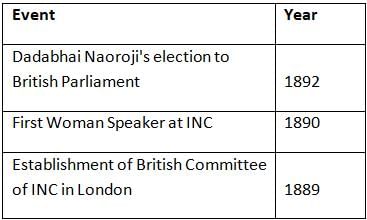
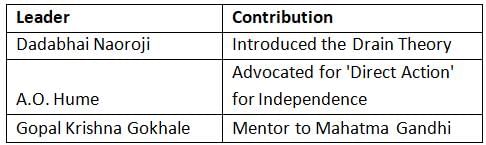
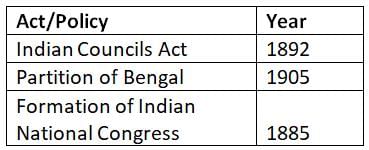
Chapter doubts & questions for The Freedom Struggle and Modern Nationalism - 6 Months Preparation Course for OPSC 2026 is part of OPSC OCS (Odisha) exam preparation. The chapters have been prepared according to the OPSC OCS (Odisha) exam syllabus. The Chapter doubts & questions, notes, tests & MCQs are made for OPSC OCS (Odisha) 2026 Exam. Find important definitions, questions, notes, meanings, examples, exercises, MCQs and online tests here.
Chapter doubts & questions of The Freedom Struggle and Modern Nationalism - 6 Months Preparation Course for OPSC in English & Hindi are available as part of OPSC OCS (Odisha) exam. Download more important topics, notes, lectures and mock test series for OPSC OCS (Odisha) Exam by signing up for free.
6 Months Preparation Course for OPSC636 videos|2472 docs|801 tests |
