


All Exams > OPSC OCS (Odisha) > 6 Months Preparation Course for OPSC > All Questions
All questions of The Northern India (800-1200 A.D.) for OPSC OCS (Odisha) Exam
Which choice gives the correct historical order of the following Rashtrakuta kings?I. Krishna III
II Indra III
III. Amoghavarsa-I
IV Dhruva
V. Krishna-I
VI Dantidurga- a)VI, V, IV, III, II, I
- b)I, II, III, V, IV, VI
- c)II, III, I, IV, V, VI
- d)IV, V, VI, III, II,I
Correct answer is option 'A'. Can you explain this answer?
Which choice gives the correct historical order of the following Rashtrakuta kings?
I. Krishna III
II Indra III
III. Amoghavarsa-I
IV Dhruva
V. Krishna-I
VI Dantidurga
II Indra III
III. Amoghavarsa-I
IV Dhruva
V. Krishna-I
VI Dantidurga
a)
VI, V, IV, III, II, I
b)
I, II, III, V, IV, VI
c)
II, III, I, IV, V, VI
d)
IV, V, VI, III, II,I
| | Pooja Kumari answered |
Option A is correct

Whose kingdom was visited by Al-Masudi, an Arab traveller of the early 10th century A.D.?- a)Indra-III
- b)Dharmapala
- c)Mihira Bhoja
- d)Lakshmana Sena
Correct answer is option 'A'. Can you explain this answer?
Whose kingdom was visited by Al-Masudi, an Arab traveller of the early 10th century A.D.?
a)
Indra-III
b)
Dharmapala
c)
Mihira Bhoja
d)
Lakshmana Sena
 | Sameer Nambiar answered |
A is the correct option.The Arab traveller, al Masudi, visited Kannauj in the early tenth century and wrote that "the king of Kannauj was the natural enemy of the king of the Deccan : that he kept a large army and was surrounded by smaller kings always ready to go to war."
Which of the following books was written by Bhoja Paramara?- a)Ayurveda-Sarvasva
- b)Samarangan-Sutradhara
- c)Vyavahara-Samuktchaya
- d)All of the above.
Correct answer is option 'D'. Can you explain this answer?
Which of the following books was written by Bhoja Paramara?
a)
Ayurveda-Sarvasva
b)
Samarangan-Sutradhara
c)
Vyavahara-Samuktchaya
d)
All of the above.
 | Lakshya Ias answered |
Bhoja Paramara, one of the greatest rulers of the Paramara dynasty, was also a renowned scholar and patron of arts and literature. He is credited with writing several works across diverse fields:
- Ayurveda-Sarvasva: A treatise on Ayurveda (Indian traditional medicine).
- Samarangana-Sutradhara: A detailed work on architecture and engineering, including a section on building construction and town planning.
- Vyavahara-Samuktchaya: A work on jurisprudence and legal procedures.
This demonstrates Bhoja's wide-ranging intellectual contributions, covering medicine, architecture, and law.
Therefore, Correct Answer - Option D
Therefore, Correct Answer - Option D
Why did Jaychandra not help Prithviraja Chauhan on his war against Gori?- a)Jaychandra was engaged in a war against the Chandelas.
- b)Jayachandra thought if the power of the Chauhan’s were destroyed it would clear the way for his own supremacy in the North.
- c)Jayachandra’s offer of help was rejected by Prithviraja Chauhan.
- d)Jayachandra’s army was very small.
Correct answer is option 'B'. Can you explain this answer?
Why did Jaychandra not help Prithviraja Chauhan on his war against Gori?
a)
Jaychandra was engaged in a war against the Chandelas.
b)
Jayachandra thought if the power of the Chauhan’s were destroyed it would clear the way for his own supremacy in the North.
c)
Jayachandra’s offer of help was rejected by Prithviraja Chauhan.
d)
Jayachandra’s army was very small.
 | Academic Studio answered |
Jayachandra, the ruler of the Gahadvala dynasty, did not assist Prithviraja Chauhan against Muhammad Ghori due to their intense rivalry. Jayachandra saw Prithviraja as a political competitor and believed that Prithviraja’s defeat would pave the way for his own dominance in northern India. This lack of unity among Indian rulers significantly contributed to Muhammad Ghori's success in establishing control over the region.
Therefore, Correct Answer - Option B
Who was the builder of the Martanda temple in Kashmir ?- a)Lalitaditya Muktapida
- b)Durlabhavarman
- c)Avantivarman
- d)Jayapala Vinayaditya
Correct answer is option 'A'. Can you explain this answer?
Who was the builder of the Martanda temple in Kashmir ?
a)
Lalitaditya Muktapida
b)
Durlabhavarman
c)
Avantivarman
d)
Jayapala Vinayaditya
 | Anshul Verma answered |
Builder of the Martanda Temple in Kashmir
The builder of the Martanda temple in Kashmir was Lalitaditya Muktapida. He was a powerful ruler of the Karkota dynasty who reigned over Kashmir during the 8th century.
Significance of Martanda Temple
The Martanda temple, also known as the Sun Temple, is one of the most important ancient temples in Kashmir. It is dedicated to the Hindu deity Surya, the Sun God, and is considered a masterpiece of Kashmiri temple architecture.
Lalitaditya Muktapida
Lalitaditya Muktapida was a great patron of art and architecture. During his reign, he undertook several ambitious building projects, including the construction of the Martanda temple. He was known for his military conquests as well as his patronage of the arts.
Legacy of Lalitaditya Muktapida
Lalitaditya Muktapida is remembered as one of the greatest rulers of Kashmir. His reign is considered a golden age in the history of Kashmir, marked by prosperity, cultural flourishing, and architectural marvels like the Martanda temple.
In conclusion, the Martanda temple in Kashmir was built by the renowned ruler Lalitaditya Muktapida, who left behind a lasting legacy of architectural splendor and cultural richness in the region.
The builder of the Martanda temple in Kashmir was Lalitaditya Muktapida. He was a powerful ruler of the Karkota dynasty who reigned over Kashmir during the 8th century.
Significance of Martanda Temple
The Martanda temple, also known as the Sun Temple, is one of the most important ancient temples in Kashmir. It is dedicated to the Hindu deity Surya, the Sun God, and is considered a masterpiece of Kashmiri temple architecture.
Lalitaditya Muktapida
Lalitaditya Muktapida was a great patron of art and architecture. During his reign, he undertook several ambitious building projects, including the construction of the Martanda temple. He was known for his military conquests as well as his patronage of the arts.
Legacy of Lalitaditya Muktapida
Lalitaditya Muktapida is remembered as one of the greatest rulers of Kashmir. His reign is considered a golden age in the history of Kashmir, marked by prosperity, cultural flourishing, and architectural marvels like the Martanda temple.
In conclusion, the Martanda temple in Kashmir was built by the renowned ruler Lalitaditya Muktapida, who left behind a lasting legacy of architectural splendor and cultural richness in the region.
Who of the following Pala king founded the Vikramasila University?- a)Mahipala
- b)Gopala
- c)Devapala
- d)Dharmapala
Correct answer is option 'D'. Can you explain this answer?
Who of the following Pala king founded the Vikramasila University?
a)
Mahipala
b)
Gopala
c)
Devapala
d)
Dharmapala
 | Anjana Nair answered |
Dharmapala (ruled 8th century) was the second ruler of the Pala Empire of Bengal region in the Indian Subcontinent. He was the son and successor of Gopala, the founder of the Pala Dynasty.
The struggle for the supremacy of northern India among three leading ruling dynasties of India viz, the Palas, Pratiharas and the Rashtrakutas towards the close of the 8th century is known as Tripartite struggle. What was the bone of contention between the three during that period?- a)Control of trade with Suvarnadweep
- b)Control of Bengal
- c)Control of Kanauj
- d)Trade with South-East Asia
Correct answer is option 'C'. Can you explain this answer?
The struggle for the supremacy of northern India among three leading ruling dynasties of India viz, the Palas, Pratiharas and the Rashtrakutas towards the close of the 8th century is known as Tripartite struggle. What was the bone of contention between the three during that period?
a)
Control of trade with Suvarnadweep
b)
Control of Bengal
c)
Control of Kanauj
d)
Trade with South-East Asia
| | Shounak Malik answered |
The Tripartite Struggle for control of northern India took placein the ninth century. The struggle was between the PratiharaEmpire, the Pala Empire and the Rashtrakuta Empire.Towards the end of the successor of Nagabhata II of the Gurjara-Pratihara dynasty, successfully attacked Kanauj and established control there.
“The Hindus believe that there is no country like theirs, no King like theirs, no religion like theirs, no science like theirs. If they travelled and mixed with other nations, they would soon change their mind, for their ancestors were not so narrow minded as the present generation.” In this the author is referring to which period of the Hindu generation?- a)Early 10th Century
- b)Early 9th Century
- c)Early 11th Century
- d)Early 12th Century
Correct answer is option 'C'. Can you explain this answer?
“The Hindus believe that there is no country like theirs, no King like theirs, no religion like theirs, no science like theirs. If they travelled and mixed with other nations, they would soon change their mind, for their ancestors were not so narrow minded as the present generation.” In this the author is referring to which period of the Hindu generation?
a)
Early 10th Century
b)
Early 9th Century
c)
Early 11th Century
d)
Early 12th Century
| | Sumbul Parveen answered |
Correct ans is C
When Mahmud of Ghazni attacked Somnath, the Chalukya or Solanki ruler of Gujarat was- a)Kumarpala
- b)Somesvara
- c)Bhima
- d)Jayasimha Siddharaja
Correct answer is option 'C'. Can you explain this answer?
When Mahmud of Ghazni attacked Somnath, the Chalukya or Solanki ruler of Gujarat was
a)
Kumarpala
b)
Somesvara
c)
Bhima
d)
Jayasimha Siddharaja
 | Vikas Choudhury answered |
The Chalukya or Solanki ruler of Gujarat at the time of Mahmud of Ghazni's attack on Somnath was Bhima.
Mahmud of Ghazni was a ruler of the Ghaznavid Empire, which was a Muslim dynasty that ruled parts of present-day Afghanistan, Pakistan, and northern India in the 11th and 12th centuries. In 1025, Mahmud of Ghazni launched an attack on the city of Somnath, which was located on the western coast of India in present-day Gujarat. The city was an important center of Hindu worship and was known for its rich cultural and economic significance.
At the time of the attack, the ruler of Gujarat was Bhima, who was a member of the Chalukya or Solanki dynasty. The Chalukyas were a Hindu dynasty that ruled over parts of present-day Gujarat and Rajasthan in western India from the 10th to the 13th centuries. Bhima was known for his strong and able administration, and he successfully defended Gujarat against several invasions and attacks during his reign. However, he was unable to prevent the destruction of Somnath by Mahmud of Ghazni, and the city was plundered and its temple was razed to the ground.
Which one of the following was the first to wrest the control of Kanauj from Dharmapala?- a)Pratihara ruler Vatsaraja
- b)Rashtrakuta ruler Govinda III
- c)Rashtrakuta king Dhurva
- d)Pratihara king Nagabhatta III
Correct answer is option 'A'. Can you explain this answer?
Which one of the following was the first to wrest the control of Kanauj from Dharmapala?
a)
Pratihara ruler Vatsaraja
b)
Rashtrakuta ruler Govinda III
c)
Rashtrakuta king Dhurva
d)
Pratihara king Nagabhatta III
 | Sahana Menon answered |
Answer:
Pratihara ruler Vatsaraja was the first to wrest the control of Kanauj from Dharmapala.
Explanation:
- Kanauj was an important political center during the early medieval period.
- Dharmapala was the ruler of Kanauj in the 8th century.
- Pratihara rulers were one of the major powers in North India during that time.
- Vatsaraja was a powerful ruler of the Pratihara dynasty who reigned from 775 to 805 CE.
- He defeated Dharmapala and took control of Kanauj.
- This victory established the Pratihara dynasty as a major power in North India and they continued to dominate the region for several centuries.
- The Rashtrakutas were also a powerful dynasty during that time and they had conflicts with the Pratiharas over the control of Kanauj.
- Govinda III and Dhruva were two powerful Rashtrakuta rulers who had conflicts with the Pratihara rulers over Kanauj.
- But it was Vatsaraja who was the first to wrest the control of Kanauj from Dharmapala.
Pratihara ruler Vatsaraja was the first to wrest the control of Kanauj from Dharmapala.
Explanation:
- Kanauj was an important political center during the early medieval period.
- Dharmapala was the ruler of Kanauj in the 8th century.
- Pratihara rulers were one of the major powers in North India during that time.
- Vatsaraja was a powerful ruler of the Pratihara dynasty who reigned from 775 to 805 CE.
- He defeated Dharmapala and took control of Kanauj.
- This victory established the Pratihara dynasty as a major power in North India and they continued to dominate the region for several centuries.
- The Rashtrakutas were also a powerful dynasty during that time and they had conflicts with the Pratiharas over the control of Kanauj.
- Govinda III and Dhruva were two powerful Rashtrakuta rulers who had conflicts with the Pratihara rulers over Kanauj.
- But it was Vatsaraja who was the first to wrest the control of Kanauj from Dharmapala.
Which factor brings out clearly the feudal nature of regional states from 800 to 1200 A.D.?- a)The practice of sub-infeudation.
- b)Part of the revenue was sent to the king.
- c)To break the oath of loyalty to the king was regarded as an atrocious crime.
- d)King granted land to officers and select holders like Brahmanas.
Correct answer is option 'A'. Can you explain this answer?
Which factor brings out clearly the feudal nature of regional states from 800 to 1200 A.D.?
a)
The practice of sub-infeudation.
b)
Part of the revenue was sent to the king.
c)
To break the oath of loyalty to the king was regarded as an atrocious crime.
d)
King granted land to officers and select holders like Brahmanas.
 | Sanjana Saha answered |
The factor that clearly brings out the feudal nature of regional states from 800 to 1200 A.D. is the practice of sub-infeudation.
Explanation:
- Sub-infeudation refers to the process in which a vassal would divide their land and grant portions of it to their own vassals, creating a hierarchical system of land ownership.
- This practice was prevalent during the feudal period, where the king or lord would grant land to a vassal in exchange for their loyalty and military service.
- The vassal would then sub-infeudate their land, granting smaller portions of it to their own vassals, who in turn would owe them loyalty and military service.
- This created a complex web of feudal relationships, with each vassal owing allegiance to their immediate superior and ultimately to the king or lord.
- The vassals held their land as a fief, which was a hereditary right, and they had the power to govern and collect revenue from their own vassals.
- The vassals were responsible for providing military support to their superior in times of war and maintaining law and order in their territories.
- In return, the vassals received protection and support from their superior, who had the authority to settle disputes and provide justice.
- This hierarchical structure of land ownership and loyalty clearly reflects the feudal nature of regional states during this period.
In contrast, the other options do not adequately capture the feudal nature of regional states during this time:
- Part of the revenue being sent to the king was a common practice in feudal systems, but it does not specifically highlight the sub-infeudation and hierarchical land ownership characteristic of feudalism.
- The idea of breaking the oath of loyalty to the king being regarded as an atrocious crime is a general characteristic of feudal systems, but it does not directly address the sub-infeudation aspect.
- The granting of land to officers and select holders like Brahmanas by the king is a practice that can be found in feudal systems, but it does not explicitly emphasize the sub-infeudation and hierarchical land ownership that define feudalism.
Therefore, option A, the practice of sub-infeudation, is the factor that brings out clearly the feudal nature of regional states from 800 to 1200 A.D.
Explanation:
- Sub-infeudation refers to the process in which a vassal would divide their land and grant portions of it to their own vassals, creating a hierarchical system of land ownership.
- This practice was prevalent during the feudal period, where the king or lord would grant land to a vassal in exchange for their loyalty and military service.
- The vassal would then sub-infeudate their land, granting smaller portions of it to their own vassals, who in turn would owe them loyalty and military service.
- This created a complex web of feudal relationships, with each vassal owing allegiance to their immediate superior and ultimately to the king or lord.
- The vassals held their land as a fief, which was a hereditary right, and they had the power to govern and collect revenue from their own vassals.
- The vassals were responsible for providing military support to their superior in times of war and maintaining law and order in their territories.
- In return, the vassals received protection and support from their superior, who had the authority to settle disputes and provide justice.
- This hierarchical structure of land ownership and loyalty clearly reflects the feudal nature of regional states during this period.
In contrast, the other options do not adequately capture the feudal nature of regional states during this time:
- Part of the revenue being sent to the king was a common practice in feudal systems, but it does not specifically highlight the sub-infeudation and hierarchical land ownership characteristic of feudalism.
- The idea of breaking the oath of loyalty to the king being regarded as an atrocious crime is a general characteristic of feudal systems, but it does not directly address the sub-infeudation aspect.
- The granting of land to officers and select holders like Brahmanas by the king is a practice that can be found in feudal systems, but it does not explicitly emphasize the sub-infeudation and hierarchical land ownership that define feudalism.
Therefore, option A, the practice of sub-infeudation, is the factor that brings out clearly the feudal nature of regional states from 800 to 1200 A.D.
What was the supreme contribution of the Palas of Bengal?- a)Dipankara and Shantarakshita introduced Buddhism in Tibet.
- b)Checkmating the ambitions of the Pratiharas.
- c)Making Vikramashila a great centre of education.
- d)Sending of Buddhist scholars to Sailendra empire.
Correct answer is option 'A'. Can you explain this answer?
What was the supreme contribution of the Palas of Bengal?
a)
Dipankara and Shantarakshita introduced Buddhism in Tibet.
b)
Checkmating the ambitions of the Pratiharas.
c)
Making Vikramashila a great centre of education.
d)
Sending of Buddhist scholars to Sailendra empire.
| | Aashna Nambiar answered |
The reign of King Trisong Detsen, which began about 755 CE, Buddhismbecame the official religion of the Tibetan people. The King also invited famousBuddhist teachers such as Shantarakshita and Padmasambhava to Tibet. He is credited with building Samye, the first monastery in Tibet, in the late 8th century.
Which of the following kings was the founder of Gahadavala dynasty with Kanyakubja as its seat of power?- a)Jaya Chandra
- b)Vijay Chandra
- c)Chandradeva
- d)Govinda
Correct answer is option 'C'. Can you explain this answer?
Which of the following kings was the founder of Gahadavala dynasty with Kanyakubja as its seat of power?
a)
Jaya Chandra
b)
Vijay Chandra
c)
Chandradeva
d)
Govinda
| | Moumita Menon answered |
Founder of the Gahadavala Dynasty
The Gahadavala dynasty, which ruled northern India, particularly around Kanyakubja (modern-day Kannauj), was established in the 11th century. The founder of this dynasty is widely recognized as Chandradeva.
Key Contributions of Chandradeva
- Establishment of Power: Chandradeva laid the foundation for the Gahadavala dynasty, marking the beginning of a significant political era in northern India.
- Seat of Power: Kanyakubja, a prominent historical city, served as the seat of the Gahadavala dynasty. This city was known for its cultural and political importance during that period.
Successors and Expansion
- Following Chandradeva, his successors, such as Govinda and Vijay Chandradeva, expanded the influence of the dynasty. They were instrumental in consolidating power and maintaining the legacy established by Chandradeva.
Historical Significance
- The Gahadavala dynasty played a crucial role in the political landscape of northern India, especially during the time when they faced challenges from neighboring kingdoms and invasions.
- The dynasty is also noted for its contributions to art, architecture, and literature, particularly in the region surrounding Kanyakubja.
In summary, Chandradeva is acknowledged as the founder of the Gahadavala dynasty, with Kanyakubja as its base of power, setting the stage for a dynasty that significantly influenced the history of northern India.
The Gahadavala dynasty, which ruled northern India, particularly around Kanyakubja (modern-day Kannauj), was established in the 11th century. The founder of this dynasty is widely recognized as Chandradeva.
Key Contributions of Chandradeva
- Establishment of Power: Chandradeva laid the foundation for the Gahadavala dynasty, marking the beginning of a significant political era in northern India.
- Seat of Power: Kanyakubja, a prominent historical city, served as the seat of the Gahadavala dynasty. This city was known for its cultural and political importance during that period.
Successors and Expansion
- Following Chandradeva, his successors, such as Govinda and Vijay Chandradeva, expanded the influence of the dynasty. They were instrumental in consolidating power and maintaining the legacy established by Chandradeva.
Historical Significance
- The Gahadavala dynasty played a crucial role in the political landscape of northern India, especially during the time when they faced challenges from neighboring kingdoms and invasions.
- The dynasty is also noted for its contributions to art, architecture, and literature, particularly in the region surrounding Kanyakubja.
In summary, Chandradeva is acknowledged as the founder of the Gahadavala dynasty, with Kanyakubja as its base of power, setting the stage for a dynasty that significantly influenced the history of northern India.
The feudatories during 800-1200 A.D. had a number of minor obligations and privileges but one of them is the most revealing which one is that?- a)The title of feudatories varied according to their ranks.
- b)Attendence at the court on days like king’s birthday was bounden duty of the feudatories.
- c)The military obligation of the feudatories grew in importance as the time passed by.
- d)The feudatories were permitted to use various symbols of dignity and royalty.
Correct answer is option 'D'. Can you explain this answer?
The feudatories during 800-1200 A.D. had a number of minor obligations and privileges but one of them is the most revealing which one is that?
a)
The title of feudatories varied according to their ranks.
b)
Attendence at the court on days like king’s birthday was bounden duty of the feudatories.
c)
The military obligation of the feudatories grew in importance as the time passed by.
d)
The feudatories were permitted to use various symbols of dignity and royalty.
 | Pooja Yadav answered |
The correct option is D as The feudatories were permitted to use various symbols of dignity and royalty. Is one of the most revealing.
Which one of the following offered the most successful resistance against Mahmud of Ghazni?- a)The Chandela king Vidyadhara
- b)Jayapala
- c)The king of Thaneswar
- d)Harshadeva
Correct answer is option 'A'. Can you explain this answer?
Which one of the following offered the most successful resistance against Mahmud of Ghazni?
a)
The Chandela king Vidyadhara
b)
Jayapala
c)
The king of Thaneswar
d)
Harshadeva
 | Capstone Ias Learning answered |
The Chandela king Vidyadhara offered the most successful resistance against Mahmud of Ghazni during his campaigns in India. Vidyadhara is known for his military strength and strategic defense, particularly during Mahmud's attempt to invade the Chandela territories. Mahmud could not achieve a decisive victory over Vidyadhara, and the Chandelas remained a strong power in central India even after Mahmud's invasions.
Therefore, Correct Answer - Option A
What was the name of the Kashmir king who defeated and dethroned a king of Kanauj belonging to the Ayudha family?- a)Lalitaditya Muktapida
- b)Jayapala Vinayaditya
- c)Avantivarman
- d)None of these
Correct answer is option 'B'. Can you explain this answer?
What was the name of the Kashmir king who defeated and dethroned a king of Kanauj belonging to the Ayudha family?
a)
Lalitaditya Muktapida
b)
Jayapala Vinayaditya
c)
Avantivarman
d)
None of these
 | K.L Institute answered |
Jayapida or Vinayaditya was the grandson of Lalitaditya Muktapida, the greatest ruler of the Karkota dynasty. He is credited for many adventures. It is stated that he defeated and dethroned Vajrayudha, the king of Kanauj.
Therefore, Correct Answer - Option B
Which parts of India were dominated by the Pratihara empire from the middle of the 9th century A.D. till the middle of the 10th century A.D.?- a)Western and Northern India
- b)Deccan
- c)Deccan and Eastern India
- d)Eastern and Northern India
Correct answer is option 'A'. Can you explain this answer?
Which parts of India were dominated by the Pratihara empire from the middle of the 9th century A.D. till the middle of the 10th century A.D.?
a)
Western and Northern India
b)
Deccan
c)
Deccan and Eastern India
d)
Eastern and Northern India
 | Upasana Mehta answered |
A is the correct option.The Gurjara-Pratihara dynasty was an imperial power during the Late Classical period on the Indian subcontinent, that ruled much of Northern and westrn India from the mid-8th to the 11th century. They ruled first at Ujjain and later at Kannauj(the western part).
Between the 9th and 11th centuries A.D., the most important ruling dynasty in the northernwestern India was the Hindu Shahis. Who was the founder of this dynasty?- a)Kamahi
- b)Kalles
- c)Bhima
- d)Samand
Correct answer is option 'B'. Can you explain this answer?
Between the 9th and 11th centuries A.D., the most important ruling dynasty in the northernwestern India was the Hindu Shahis. Who was the founder of this dynasty?
a)
Kamahi
b)
Kalles
c)
Bhima
d)
Samand
| | Priya Sengupta answered |
Founder of Hindu Shahi Dynasty
The Hindu Shahi dynasty was an important ruling dynasty in northwestern India between the 9th and 11th centuries A.D. The founder of this dynasty was Kalles, who was also known as Kallar or Kallaraja. He was the first ruler of the Shahi dynasty and established his rule in the Kabul Valley in the early 9th century.
Kalles was a descendant of the ancient Hindu king Porus, who had fought against Alexander the Great in the 4th century B.C. He was also related to the famous Gupta dynasty of India, which had ruled during the Golden Age of Indian history.
Kalles' Reign
Kalles was a powerful ruler who expanded his kingdom by conquering neighboring territories. He established his capital at Kapisa, near modern-day Kabul, and built a magnificent palace there. He also constructed several temples and other public buildings.
During his reign, Kalles maintained friendly relations with the neighboring Arab caliphates and was a patron of the arts and sciences. He was known for his love of music and poetry and was a great admirer of the works of the famous Indian poet Kalidasa.
Kalles was succeeded by his son Bhima, who continued to expand the Shahi dynasty's territories. Under Bhima's rule, the Shahi dynasty reached its height of power and prosperity.
Conclusion
In conclusion, Kalles was the founder of the Hindu Shahi dynasty, which was an important ruling dynasty in northwestern India between the 9th and 11th centuries A.D. He was a powerful ruler who expanded his kingdom and was known for his patronage of the arts and sciences. His reign marked the beginning of a golden age in Indian history, which lasted for several centuries.
The Hindu Shahi dynasty was an important ruling dynasty in northwestern India between the 9th and 11th centuries A.D. The founder of this dynasty was Kalles, who was also known as Kallar or Kallaraja. He was the first ruler of the Shahi dynasty and established his rule in the Kabul Valley in the early 9th century.
Kalles was a descendant of the ancient Hindu king Porus, who had fought against Alexander the Great in the 4th century B.C. He was also related to the famous Gupta dynasty of India, which had ruled during the Golden Age of Indian history.
Kalles' Reign
Kalles was a powerful ruler who expanded his kingdom by conquering neighboring territories. He established his capital at Kapisa, near modern-day Kabul, and built a magnificent palace there. He also constructed several temples and other public buildings.
During his reign, Kalles maintained friendly relations with the neighboring Arab caliphates and was a patron of the arts and sciences. He was known for his love of music and poetry and was a great admirer of the works of the famous Indian poet Kalidasa.
Kalles was succeeded by his son Bhima, who continued to expand the Shahi dynasty's territories. Under Bhima's rule, the Shahi dynasty reached its height of power and prosperity.
Conclusion
In conclusion, Kalles was the founder of the Hindu Shahi dynasty, which was an important ruling dynasty in northwestern India between the 9th and 11th centuries A.D. He was a powerful ruler who expanded his kingdom and was known for his patronage of the arts and sciences. His reign marked the beginning of a golden age in Indian history, which lasted for several centuries.
Amoghavarsha-I, the famous Rashtrakuta ruler, was the author ofI. Sibakasindamani
II. Gita Govind
III. Kavirajamarga
IV. Ratnamalika- a)I, III
- b)I, II, III
- c)I, II, III, IV
- d)III, IV
Correct answer is option 'D'. Can you explain this answer?
Amoghavarsha-I, the famous Rashtrakuta ruler, was the author of
I. Sibakasindamani
II. Gita Govind
III. Kavirajamarga
IV. Ratnamalika
II. Gita Govind
III. Kavirajamarga
IV. Ratnamalika
a)
I, III
b)
I, II, III
c)
I, II, III, IV
d)
III, IV
| | Ankita Kulkarni answered |
Amoghavarsha-I was one of the most famous Rashtrakuta rulers who ruled from 814 CE to 878 CE. He was a great patron of literature and encouraged the development of Sanskrit literature in his court.
The correct answer is option D, which means that Amoghavarsha-I was the author of Kavirajamarga and Ratnamalika.
Kavirajamarga:
• Kavirajamarga is a Sanskrit text written by Amoghavarsha-I in the 9th century CE.
• It is the earliest known work on literary criticism in Kannada and is considered as a landmark in the history of Kannada literature.
• The text deals with the principles of poetry, grammar, and rhetoric and provides guidelines for literary composition.
Ratnamalika:
• Ratnamalika is a collection of 21 Sanskrit poems written by Amoghavarsha-I.
• The poems are dedicated to various deities and are known for their lyrical beauty and philosophical depth.
• The poems are also significant for their contribution to the development of early medieval Indian poetry.
Sibakasindamani and Gita Govind are not attributed to Amoghavarsha-I. Sibakasindamani is a Tamil epic written by the Jain monk Tirutakkatevar in the 10th century CE, while Gita Govind is a Sanskrit poem written by the 12th-century poet Jayadeva.
The correct answer is option D, which means that Amoghavarsha-I was the author of Kavirajamarga and Ratnamalika.
Kavirajamarga:
• Kavirajamarga is a Sanskrit text written by Amoghavarsha-I in the 9th century CE.
• It is the earliest known work on literary criticism in Kannada and is considered as a landmark in the history of Kannada literature.
• The text deals with the principles of poetry, grammar, and rhetoric and provides guidelines for literary composition.
Ratnamalika:
• Ratnamalika is a collection of 21 Sanskrit poems written by Amoghavarsha-I.
• The poems are dedicated to various deities and are known for their lyrical beauty and philosophical depth.
• The poems are also significant for their contribution to the development of early medieval Indian poetry.
Sibakasindamani and Gita Govind are not attributed to Amoghavarsha-I. Sibakasindamani is a Tamil epic written by the Jain monk Tirutakkatevar in the 10th century CE, while Gita Govind is a Sanskrit poem written by the 12th-century poet Jayadeva.
Which one of the following statements about the role of Jayachandra Gahadavala during Muhammad Gori’s invasion of India is correct?- a)He invited Gori to invade India and attack Prithviraja Chauhan.
- b)He did not ally himself with Prithviraja when Muhammad of Gori invaded India.
- c)He bought his peace with Gori by promising not to support Prithviraja.
- d)At that time Jaychandra was himself busy setting the score with the Chandelas
Correct answer is option 'B'. Can you explain this answer?
Which one of the following statements about the role of Jayachandra Gahadavala during Muhammad Gori’s invasion of India is correct?
a)
He invited Gori to invade India and attack Prithviraja Chauhan.
b)
He did not ally himself with Prithviraja when Muhammad of Gori invaded India.
c)
He bought his peace with Gori by promising not to support Prithviraja.
d)
At that time Jaychandra was himself busy setting the score with the Chandelas
 | Atharva Chaudhary answered |
Role of Jayachandra Gahadavala during Muhammad Gori's invasion of India
Background: Muhammad Gori was a ruler of the Ghurid dynasty who invaded India multiple times in the 12th century. His most significant invasion was in 1191 when he attacked the kingdom of Prithviraja Chauhan.
Statement: He did not ally himself with Prithviraja when Muhammad of Gori invaded India.
Explanation:
- Jayachandra Gahadavala was a king of the Gahadavala dynasty, which ruled over parts of present-day Uttar Pradesh and Bihar in the 12th century.
- When Muhammad Gori invaded India in 1191, Prithviraja Chauhan, the king of Delhi, was one of his main targets.
- Prithviraja sent messages to other kings in the region, including Jayachandra, seeking their help in repelling the invasion.
- However, Jayachandra did not respond to Prithviraja's call for help and did not ally himself with him against Gori.
- According to some historical accounts, Jayachandra may have even facilitated Gori's invasion by not guarding the important routes to Delhi, which allowed Gori's army to march unopposed.
- It is unclear why Jayachandra did not support Prithviraja, but some historians speculate that he may have had a rivalry with Prithviraja or may have wanted to expand his own territory by aligning with Gori.
- In any case, Jayachandra's decision not to support Prithviraja proved to be a costly mistake, as Gori defeated Prithviraja in the Battle of Tarain and established the Delhi Sultanate in India.
Conclusion:
In conclusion, the correct statement about the role of Jayachandra Gahadavala during Muhammad Gori's invasion of India is that he did not ally himself with Prithviraja when Gori attacked. This decision may have been a result of personal rivalry or ambition, but it ultimately allowed Gori to conquer northern India and establish a new dynasty.
Background: Muhammad Gori was a ruler of the Ghurid dynasty who invaded India multiple times in the 12th century. His most significant invasion was in 1191 when he attacked the kingdom of Prithviraja Chauhan.
Statement: He did not ally himself with Prithviraja when Muhammad of Gori invaded India.
Explanation:
- Jayachandra Gahadavala was a king of the Gahadavala dynasty, which ruled over parts of present-day Uttar Pradesh and Bihar in the 12th century.
- When Muhammad Gori invaded India in 1191, Prithviraja Chauhan, the king of Delhi, was one of his main targets.
- Prithviraja sent messages to other kings in the region, including Jayachandra, seeking their help in repelling the invasion.
- However, Jayachandra did not respond to Prithviraja's call for help and did not ally himself with him against Gori.
- According to some historical accounts, Jayachandra may have even facilitated Gori's invasion by not guarding the important routes to Delhi, which allowed Gori's army to march unopposed.
- It is unclear why Jayachandra did not support Prithviraja, but some historians speculate that he may have had a rivalry with Prithviraja or may have wanted to expand his own territory by aligning with Gori.
- In any case, Jayachandra's decision not to support Prithviraja proved to be a costly mistake, as Gori defeated Prithviraja in the Battle of Tarain and established the Delhi Sultanate in India.
Conclusion:
In conclusion, the correct statement about the role of Jayachandra Gahadavala during Muhammad Gori's invasion of India is that he did not ally himself with Prithviraja when Gori attacked. This decision may have been a result of personal rivalry or ambition, but it ultimately allowed Gori to conquer northern India and establish a new dynasty.
Which of the following can be considered as the causes for the decline of trade and commerce in North India between 750 & 1200 A.D.
I. Decrease in the use of coins.
II. Emergence of a wide variety of local weights and measures.
III. Unstable political conditions.
IV. Availability of little surplus production.
V. Decline of the Roman and Sassanid empires.- a)I, II, III
- b)II, III, IV, V
- c)I, III, IV, V
- d)I, II, III, IV, V
Correct answer is option 'D'. Can you explain this answer?
Which of the following can be considered as the causes for the decline of trade and commerce in North India between 750 & 1200 A.D.
I. Decrease in the use of coins.
II. Emergence of a wide variety of local weights and measures.
III. Unstable political conditions.
IV. Availability of little surplus production.
V. Decline of the Roman and Sassanid empires.
I. Decrease in the use of coins.
II. Emergence of a wide variety of local weights and measures.
III. Unstable political conditions.
IV. Availability of little surplus production.
V. Decline of the Roman and Sassanid empires.
a)
I, II, III
b)
II, III, IV, V
c)
I, III, IV, V
d)
I, II, III, IV, V
| | Gowri Kumar answered |
- 1200 CE?
1. The invasions of the Turks and Afghans in the 11th and 12th centuries, which disrupted trade routes and caused insecurity among merchants.
2. The decline of the Gupta Empire in the 6th century, which led to political fragmentation and reduced the protection of trade.
3. The decline of Buddhism in North India, which reduced the demand for goods associated with Buddhist pilgrimage sites.
4. The growth of maritime trade routes that bypassed North India and connected South India with Southeast Asia and the Middle East.
5. The emergence of regional kingdoms and local trade networks that favored local production and distribution over long-distance trade.
1. The invasions of the Turks and Afghans in the 11th and 12th centuries, which disrupted trade routes and caused insecurity among merchants.
2. The decline of the Gupta Empire in the 6th century, which led to political fragmentation and reduced the protection of trade.
3. The decline of Buddhism in North India, which reduced the demand for goods associated with Buddhist pilgrimage sites.
4. The growth of maritime trade routes that bypassed North India and connected South India with Southeast Asia and the Middle East.
5. The emergence of regional kingdoms and local trade networks that favored local production and distribution over long-distance trade.
It is said that Vakpati Munja defeated a Chalukya king six times. What was his name?- a)Krishnaraja
- b)Tailapa II
- c)Bhoja
- d)Siddharaja
Correct answer is option 'B'. Can you explain this answer?
It is said that Vakpati Munja defeated a Chalukya king six times. What was his name?
a)
Krishnaraja
b)
Tailapa II
c)
Bhoja
d)
Siddharaja
| | Mihir Mehta answered |
Explanation:
Background:
Vakpati Munja was a ruler of the Paramara dynasty in Malwa. He is known for his military exploits and his conflicts with the Chalukya kings.
Defeat of Chalukya King:
- Vakpati Munja defeated a Chalukya king six times in battle.
- The Chalukya king who was defeated by Vakpati Munja six times was Tailapa II.
Importance of the Defeats:
- Vakpati Munja's victories over Tailapa II were significant as they showcased his military prowess and strategic acumen.
- These victories also demonstrated the strength and power of the Paramara dynasty under Vakpati Munja's rule.
Legacy of Vakpati Munja:
- Vakpati Munja's victories over the Chalukya king contributed to the expansion and consolidation of the Paramara dynasty's territories.
- His military successes further solidified his reputation as a formidable ruler in the region.
Conclusion:
In conclusion, Vakpati Munja's defeats of the Chalukya king Tailapa II six times exemplify his skill as a military leader and the strength of the Paramara dynasty under his rule. These victories played a crucial role in shaping the history of the region during that period.
Background:
Vakpati Munja was a ruler of the Paramara dynasty in Malwa. He is known for his military exploits and his conflicts with the Chalukya kings.
Defeat of Chalukya King:
- Vakpati Munja defeated a Chalukya king six times in battle.
- The Chalukya king who was defeated by Vakpati Munja six times was Tailapa II.
Importance of the Defeats:
- Vakpati Munja's victories over Tailapa II were significant as they showcased his military prowess and strategic acumen.
- These victories also demonstrated the strength and power of the Paramara dynasty under Vakpati Munja's rule.
Legacy of Vakpati Munja:
- Vakpati Munja's victories over the Chalukya king contributed to the expansion and consolidation of the Paramara dynasty's territories.
- His military successes further solidified his reputation as a formidable ruler in the region.
Conclusion:
In conclusion, Vakpati Munja's defeats of the Chalukya king Tailapa II six times exemplify his skill as a military leader and the strength of the Paramara dynasty under his rule. These victories played a crucial role in shaping the history of the region during that period.
Who of the following destroyed the Pala supremacy in Bengal?- a)Dhruva
- b)Vijayasena
- c)Govinda III
- d) Rajendra Chola I
Correct answer is option 'B'. Can you explain this answer?
Who of the following destroyed the Pala supremacy in Bengal?
a)
Dhruva
b)
Vijayasena
c)
Govinda III
d)
Rajendra Chola I
 | Pranjal Chatterjee answered |
Destroying Pala Supremacy in Bengal
Introduction:
The Pala dynasty was a powerful dynasty that ruled over Bengal and Bihar from the 8th to the 12th century. However, their supremacy was destroyed by various factors, including invasion and internal conflict. In this context, the following discussion explains who destroyed the Pala supremacy in Bengal.
Vijayasena:
Vijayasena was one of the most significant kings of the Sena dynasty that ruled over Bengal from the 11th to the 12th century. He was the son of the founder of the dynasty, Samantasena. Vijayasena's reign was marked by various achievements, including his conquest of the Gaur region and his patronage of the arts and literature. However, he is also known for his role in destroying the Pala supremacy in Bengal.
The Decline of the Palas:
The decline of the Pala dynasty began in the 10th century, when they were weakened by various factors, including internal conflict, invasion, and economic decline. By the 11th century, the Palas had lost much of their power and influence, and their kingdom was in a state of decline.
The Rise of the Senas:
The Sena dynasty arose as a powerful force in Bengal in the 11th century, with their capital at Nadia. They were a martial people who were known for their military prowess and their ability to resist invasion. Under Vijayasena's leadership, the Senas expanded their kingdom and became a significant power in the region.
The Role of Vijayasena:
Vijayasena played a crucial role in the destruction of the Pala supremacy in Bengal. He launched a series of military campaigns against the Palas, defeating them in battle and driving them out of Bengal. He also captured their capital, Vikramapura, and made it his own capital.
Conclusion:
In conclusion, it was Vijayasena of the Sena dynasty who destroyed the Pala supremacy in Bengal. His military campaigns and conquests weakened the Palas and paved the way for the Senas to emerge as a significant power in the region.
Introduction:
The Pala dynasty was a powerful dynasty that ruled over Bengal and Bihar from the 8th to the 12th century. However, their supremacy was destroyed by various factors, including invasion and internal conflict. In this context, the following discussion explains who destroyed the Pala supremacy in Bengal.
Vijayasena:
Vijayasena was one of the most significant kings of the Sena dynasty that ruled over Bengal from the 11th to the 12th century. He was the son of the founder of the dynasty, Samantasena. Vijayasena's reign was marked by various achievements, including his conquest of the Gaur region and his patronage of the arts and literature. However, he is also known for his role in destroying the Pala supremacy in Bengal.
The Decline of the Palas:
The decline of the Pala dynasty began in the 10th century, when they were weakened by various factors, including internal conflict, invasion, and economic decline. By the 11th century, the Palas had lost much of their power and influence, and their kingdom was in a state of decline.
The Rise of the Senas:
The Sena dynasty arose as a powerful force in Bengal in the 11th century, with their capital at Nadia. They were a martial people who were known for their military prowess and their ability to resist invasion. Under Vijayasena's leadership, the Senas expanded their kingdom and became a significant power in the region.
The Role of Vijayasena:
Vijayasena played a crucial role in the destruction of the Pala supremacy in Bengal. He launched a series of military campaigns against the Palas, defeating them in battle and driving them out of Bengal. He also captured their capital, Vikramapura, and made it his own capital.
Conclusion:
In conclusion, it was Vijayasena of the Sena dynasty who destroyed the Pala supremacy in Bengal. His military campaigns and conquests weakened the Palas and paved the way for the Senas to emerge as a significant power in the region.
Which one of the following did not rule over Kashmir between 800 A.D. and 1200 A.D.?- a)The Utpala dynasty
- b)The Lohara dynasty
- c)The Karnata dynasty
- d)The Karkotaka dynasty
Correct answer is option 'C'. Can you explain this answer?
Which one of the following did not rule over Kashmir between 800 A.D. and 1200 A.D.?
a)
The Utpala dynasty
b)
The Lohara dynasty
c)
The Karnata dynasty
d)
The Karkotaka dynasty
 | Ias Masters answered |
The Karnata dynasty did not rule over Kashmir between 800 A.D. and 1200 A.D. The major dynasties that ruled Kashmir during this period include:
- The Karkotaka dynasty: They ruled from the 7th to the 9th century A.D. and were prominent during the early medieval period of Kashmir’s history. The famous ruler Lalitaditya Muktapida belonged to this dynasty.
- The Utpala dynasty: They succeeded the Karkotaka dynasty and ruled Kashmir during the 9th and 10th centuries A.D. Their reign included significant rulers such as Avantivarman, known for his contributions to the development of agriculture and irrigation.
- The Lohara dynasty: This dynasty ruled Kashmir from the 11th to the 12th centuries A.D. They were successors to the Utpala dynasty. Prominent rulers like Harsha of the Lohara dynasty are well-known in Kashmiri history.
Therefore, Correct Answer : Option C
Which two Buddhist monks of the Pala period are responsible for the introduction of Buddhism in Tibet?I. Atisha Dipankara
II. Santarakshita
III. Dharmarajika
IV. Asvaghosa- a)I, II, III
- b)I, II
- c)II, IV
- d)III, IV
Correct answer is option 'B'. Can you explain this answer?
Which two Buddhist monks of the Pala period are responsible for the introduction of Buddhism in Tibet?
I. Atisha Dipankara
II. Santarakshita
III. Dharmarajika
IV. Asvaghosa
II. Santarakshita
III. Dharmarajika
IV. Asvaghosa
a)
I, II, III
b)
I, II
c)
II, IV
d)
III, IV
| | Deepika Ahuja answered |
In the 8th century Buddhism really took hold in Tibet. Trisong Detsen invited Indian Buddhist scholars to his court, and Tibetan Buddhists today trace their oldest spiritual roots to the Indian masters Padmasambhāva (8th century) and Śāntarakṣita (725–788), who founded the Nyingma, The Ancient Ones, the oldest school of Tibetan Buddhism. At this early time also, from the south came the influence of scholars under the Pāla dynasty in the Indian state of Magadha. They had achieved a blend of Mahāyāna and Vajrayāna that has come to characterize all forms of Tibetan Buddhism. Their teaching in sutra centered on The Abhisamayālankāra, a 4th-century Yogācārin text, but prominent among them were the Mādhyamika scholars Śāntarakṣita and Atisha Dipankara.
Which of the following Orissa type of Nagara styles of temples are found at Bhuvaneswar?I. Mukteswara Temple
II. Lingaraja Temple
III. Parasurameswara Temple
IV. Jagannath Temple- a)I, II, III
- b)II, III, IV
- c)III, IV
- d)I, III
Correct answer is option 'A'. Can you explain this answer?
Which of the following Orissa type of Nagara styles of temples are found at Bhuvaneswar?
I. Mukteswara Temple
II. Lingaraja Temple
III. Parasurameswara Temple
IV. Jagannath Temple
II. Lingaraja Temple
III. Parasurameswara Temple
IV. Jagannath Temple
a)
I, II, III
b)
II, III, IV
c)
III, IV
d)
I, III
| | Rhea Reddy answered |
I. Mukteswara Temple - Found at Bhubaneswar
Mukteswara Temple is an important example of the Orissa type of Nagara style of temples, located in Bhubaneswar, Odisha. Built-in the 10th century, it is known for its elaborate and intricate carvings and sculptures. The temple is dedicated to Lord Shiva and is considered a gem of Odisha architecture.
II. Lingaraja Temple - Found at Bhubaneswar
Lingaraja Temple is another significant temple of the Orissa type of Nagara style, located in Bhubaneswar, Odisha. Built-in the 11th century, it is one of the oldest and largest temples in the city, dedicated to Lord Shiva. The temple complex is adorned with beautiful architecture and numerous smaller shrines.
III. Parasurameswara Temple - Found at Bhubaneswar
Parasurameswara Temple is a small but important example of the Orissa type of Nagara style, situated in Bhubaneswar, Odisha. Constructed in the 7th century, it is one of the oldest temples in the city, dedicated to Lord Shiva. The temple features intricate carvings and sculptures and is considered an important heritage site in Odisha.
IV. Jagannath Temple - Not found at Bhubaneswar (found at Puri)
Jagannath Temple, while an iconic temple in Odisha, is not located in Bhubaneswar. Instead, it is situated in the coastal town of Puri. Constructed in the 12th century, it is a significant temple of the Orissa type of Nagara style, dedicated to Lord Jagannath, an incarnation of Lord Vishnu. The temple is famous for its annual Rath Yatra (Chariot Festival) and is one of the Char Dham pilgrimage sites in India.
In conclusion, Mukteswara Temple, Lingaraja Temple, and Parasurameswara Temple are the Orissa type of Nagara style temples found in Bhubaneswar. Jagannath Temple, although a prominent example of the same architectural style, is located in Puri, Odisha.
Mukteswara Temple is an important example of the Orissa type of Nagara style of temples, located in Bhubaneswar, Odisha. Built-in the 10th century, it is known for its elaborate and intricate carvings and sculptures. The temple is dedicated to Lord Shiva and is considered a gem of Odisha architecture.
II. Lingaraja Temple - Found at Bhubaneswar
Lingaraja Temple is another significant temple of the Orissa type of Nagara style, located in Bhubaneswar, Odisha. Built-in the 11th century, it is one of the oldest and largest temples in the city, dedicated to Lord Shiva. The temple complex is adorned with beautiful architecture and numerous smaller shrines.
III. Parasurameswara Temple - Found at Bhubaneswar
Parasurameswara Temple is a small but important example of the Orissa type of Nagara style, situated in Bhubaneswar, Odisha. Constructed in the 7th century, it is one of the oldest temples in the city, dedicated to Lord Shiva. The temple features intricate carvings and sculptures and is considered an important heritage site in Odisha.
IV. Jagannath Temple - Not found at Bhubaneswar (found at Puri)
Jagannath Temple, while an iconic temple in Odisha, is not located in Bhubaneswar. Instead, it is situated in the coastal town of Puri. Constructed in the 12th century, it is a significant temple of the Orissa type of Nagara style, dedicated to Lord Jagannath, an incarnation of Lord Vishnu. The temple is famous for its annual Rath Yatra (Chariot Festival) and is one of the Char Dham pilgrimage sites in India.
In conclusion, Mukteswara Temple, Lingaraja Temple, and Parasurameswara Temple are the Orissa type of Nagara style temples found in Bhubaneswar. Jagannath Temple, although a prominent example of the same architectural style, is located in Puri, Odisha.
Which of the statements on Amoghavarsha is not correct?- a)He was the author of Kavirajamarga and Prashnottaramalika.
- b)He extended his influence over Bihar and Bengal.
- c)He shifted his influence over Bihar and Bengal.
- d)He was defeated by Chalukyas.
Correct answer is option 'D'. Can you explain this answer?
Which of the statements on Amoghavarsha is not correct?
a)
He was the author of Kavirajamarga and Prashnottaramalika.
b)
He extended his influence over Bihar and Bengal.
c)
He shifted his influence over Bihar and Bengal.
d)
He was defeated by Chalukyas.
| | Nishanth Chaudhary answered |
Incorrect Statement on Amoghavarsha:
Explanation:
- Statement on Authorship: Amoghavarsha was indeed the author of Kavirajamarga and Prashnottaramalika. These literary works showcase his contributions to Kannada literature.
- Extension of Influence: Amoghavarsha extended his influence over regions such as Bihar and Bengal, expanding the reach of the Rashtrakuta Empire.
- Shifting of Influence: However, it is not accurate to say that he shifted his influence over Bihar and Bengal. Instead, he expanded his empire to encompass these territories.
- Defeat by Chalukyas: The statement that Amoghavarsha was defeated by the Chalukyas is incorrect. In fact, Amoghavarsha was a notable ruler of the Rashtrakuta dynasty and his reign was characterized by stability and prosperity.
Therefore, the correct answer is option 'D', as Amoghavarsha was not defeated by the Chalukyas.
Explanation:
- Statement on Authorship: Amoghavarsha was indeed the author of Kavirajamarga and Prashnottaramalika. These literary works showcase his contributions to Kannada literature.
- Extension of Influence: Amoghavarsha extended his influence over regions such as Bihar and Bengal, expanding the reach of the Rashtrakuta Empire.
- Shifting of Influence: However, it is not accurate to say that he shifted his influence over Bihar and Bengal. Instead, he expanded his empire to encompass these territories.
- Defeat by Chalukyas: The statement that Amoghavarsha was defeated by the Chalukyas is incorrect. In fact, Amoghavarsha was a notable ruler of the Rashtrakuta dynasty and his reign was characterized by stability and prosperity.
Therefore, the correct answer is option 'D', as Amoghavarsha was not defeated by the Chalukyas.
Which statement on Lakshmana Sena is not correct?- a)He was a devout Vaishnava.
- b)He was a great conqueror and probably he defeated the rulers of Kamarupa, Kalinga and Kashi.
- c)Aibak defeated him in 1208 A.D.
- d)Jayadeva, the author of Gita Govinda and Dhoyi, the author of thePavanadura, adorned his court.
Correct answer is option 'C'. Can you explain this answer?
Which statement on Lakshmana Sena is not correct?
a)
He was a devout Vaishnava.
b)
He was a great conqueror and probably he defeated the rulers of Kamarupa, Kalinga and Kashi.
c)
Aibak defeated him in 1208 A.D.
d)
Jayadeva, the author of Gita Govinda and Dhoyi, the author of thePavanadura, adorned his court.
| | Ameya Banerjee answered |
Incorrect Statement:
c) Aibak defeated him in 1208 A.D.
Explanation:
Lakshmana Sena was a prominent ruler of the Sena dynasty in Bengal during the 12th century. He was known for his military campaigns and cultural patronage.
Devout Vaishnava:
Lakshmana Sena was indeed a devout Vaishnava, known for his devotion to Lord Vishnu.
Great Conqueror:
Lakshmana Sena was a great conqueror who expanded his kingdom through military conquests. He is believed to have defeated the rulers of Kamarupa, Kalinga, and Kashi among others.
Court Poets:
Jayadeva, the renowned poet and author of Gita Govinda, and Dhoyi, the author of Pavanadura, were known to have adorned his court. They contributed significantly to the cultural and literary development during his reign.
Defeat by Aibak:
The statement that Aibak defeated Lakshmana Sena in 1208 A.D. is not correct. Aibak was a prominent ruler of the Delhi Sultanate, but there is no historical evidence to suggest that he defeated Lakshmana Sena. In fact, Lakshmana Sena's reign continued beyond 1208 A.D. and he played a significant role in the political landscape of Bengal during that time.
In conclusion, while Lakshmana Sena was indeed a devout Vaishnava, a great conqueror, and had renowned poets in his court, the claim of his defeat by Aibak in 1208 A.D. is not historically accurate.
c) Aibak defeated him in 1208 A.D.
Explanation:
Lakshmana Sena was a prominent ruler of the Sena dynasty in Bengal during the 12th century. He was known for his military campaigns and cultural patronage.
Devout Vaishnava:
Lakshmana Sena was indeed a devout Vaishnava, known for his devotion to Lord Vishnu.
Great Conqueror:
Lakshmana Sena was a great conqueror who expanded his kingdom through military conquests. He is believed to have defeated the rulers of Kamarupa, Kalinga, and Kashi among others.
Court Poets:
Jayadeva, the renowned poet and author of Gita Govinda, and Dhoyi, the author of Pavanadura, were known to have adorned his court. They contributed significantly to the cultural and literary development during his reign.
Defeat by Aibak:
The statement that Aibak defeated Lakshmana Sena in 1208 A.D. is not correct. Aibak was a prominent ruler of the Delhi Sultanate, but there is no historical evidence to suggest that he defeated Lakshmana Sena. In fact, Lakshmana Sena's reign continued beyond 1208 A.D. and he played a significant role in the political landscape of Bengal during that time.
In conclusion, while Lakshmana Sena was indeed a devout Vaishnava, a great conqueror, and had renowned poets in his court, the claim of his defeat by Aibak in 1208 A.D. is not historically accurate.
Which of the following temples of the Nagara style are located at Khajuraho?I. Devi Jagadamba
II. Kandariya Mahadeva
III. Parsvanatha
IV. Duladeo- a)I, II, III
- b)III, IV
- c)II, III, IV
- d)I, II, III, IV
Correct answer is option 'D'. Can you explain this answer?
Which of the following temples of the Nagara style are located at Khajuraho?
I. Devi Jagadamba
II. Kandariya Mahadeva
III. Parsvanatha
IV. Duladeo
II. Kandariya Mahadeva
III. Parsvanatha
IV. Duladeo
a)
I, II, III
b)
III, IV
c)
II, III, IV
d)
I, II, III, IV
 | Shounak Desai answered |
The correct option is D.
All of these temples of the Nagara style are located at Khajuraho
All of these temples of the Nagara style are located at Khajuraho
Which of the following points regarding achievements of the Pala is incorrect?- a)The Pala style of sculpture was adapted in Bengal and Tibet and this in course of time influenced the art of Burma, Indo-China and Indonesia.
- b)The famous Buddhist missionaries of this period were Dharmapala and Atisha Dipankara.
- c)It was in the Pala period that Buddhism developed its own tantrics which degenerated into magic.
- d)The Palas were able to revive the vigour of Buddhism.
Correct answer is option 'D'. Can you explain this answer?
Which of the following points regarding achievements of the Pala is incorrect?
a)
The Pala style of sculpture was adapted in Bengal and Tibet and this in course of time influenced the art of Burma, Indo-China and Indonesia.
b)
The famous Buddhist missionaries of this period were Dharmapala and Atisha Dipankara.
c)
It was in the Pala period that Buddhism developed its own tantrics which degenerated into magic.
d)
The Palas were able to revive the vigour of Buddhism.
 | Arnav Malik answered |
The Pala period was a period of excellence in architecture and sculpture. The stupas at Naianda display how the Gupta style continued to exist as a model in arc Mtecture during the Palas. Chandraprabha, the prince of Bikrampur, was a student of Sil Rakshit. Chandraprabha is famous by the name ‘Atisa Dipankara’.
Bengal passed from Palas to the control of a new dynasty, the Senas. Where did the Senas come from?- a)Orissa
- b)Central India
- c)Kamrupa
- d)The Deccan
Correct answer is option 'D'. Can you explain this answer?
Bengal passed from Palas to the control of a new dynasty, the Senas. Where did the Senas come from?
a)
Orissa
b)
Central India
c)
Kamrupa
d)
The Deccan
| | Tejas Verma answered |
D is the correct option.Sena Dynasty ruled Bengal for little over a century (c 1097-1225). Sena rule in Bengal is that the whole of Bengal was brought under a single rule .Senas came to Bengal along with some invaders from the Deccan.
What was the name of the Gurjara Pratihara king whose court was adorned by Raja Sekhar?- a)Mahipala, a grandson of Bhuja
- b)Mahendrapala
- c)Nagabhatta II
- d)Mihira Bhoja
Correct answer is option 'A'. Can you explain this answer?
What was the name of the Gurjara Pratihara king whose court was adorned by Raja Sekhar?
a)
Mahipala, a grandson of Bhuja
b)
Mahendrapala
c)
Nagabhatta II
d)
Mihira Bhoja
 | Master Training Institute answered |
The Gurjara Pratihara king whose court was graced by Raja Sekhar was Mahipala, a grandson of Bhuja. He played a significant role in the cultural and political landscape of his time.
- Mahipala's reign is noted for its patronage of arts and literature.
- His court attracted many scholars, including the renowned poet Raja Sekhar.
- This period is often regarded as a golden age for the Gurjara Pratihara dynasty.
Who of the following Rashtrakuta king invaded north India?- a)Krishna III
- b)Govinda III
- c)Dhruva
- d)Amoghavarsha
- e)All of the above
Correct answer is option 'E'. Can you explain this answer?
Who of the following Rashtrakuta king invaded north India?
a)
Krishna III
b)
Govinda III
c)
Dhruva
d)
Amoghavarsha
e)
All of the above
 | Arshiya Mehta answered |
All of the following Rashtrakuta kings invaded North India:
a) Krishna III
b) Govinda III
c) Dhruva
d) Amoghavarsha
The Rashtrakuta dynasty was a royal Indian dynasty that ruled over a large empire in the Deccan region of southern India and parts of central and northern India from the 8th to the 10th centuries. The Rashtrakutas were known for their military prowess and expansionist policies, and they frequently invaded and conquered new territories. Krishna III, Govinda III, Dhruva, and Amoghavarsha were all Rashtrakuta kings who are known to have invaded North India at some point in their reigns.
Which one of the following was the greatest ruler of the Pratihara dynasty?- a)Mihira Bhoja
- b)Dantidurga
- c)Nagabhatta II
- d)Vatsaraja
Correct answer is option 'A'. Can you explain this answer?
Which one of the following was the greatest ruler of the Pratihara dynasty?
a)
Mihira Bhoja
b)
Dantidurga
c)
Nagabhatta II
d)
Vatsaraja
 | Rohit Datta answered |
Mihira Bhoja: The Greatest Ruler of the Pratihara dynasty
Military Achievements:
- Mihira Bhoja, also known as Bhoja I, was one of the greatest rulers of the Pratihara dynasty.
- He was a formidable military leader who successfully defended his kingdom against numerous invasions from the Arab and Turkic forces.
- Mihira Bhoja's military prowess and strategic acumen allowed him to expand his kingdom and establish the Pratihara dynasty as a dominant power in northern India.
Patronage of Arts and Culture:
- Mihira Bhoja was a great patron of arts and culture, supporting scholars, poets, and artists in his court.
- He was particularly known for his support of the Sanskrit language and literature, leading to a flourishing of intellectual and artistic endeavors during his reign.
- His patronage of the arts helped create a rich cultural legacy that endured long after his rule.
Administrative Reforms:
- Mihira Bhoja was also known for his administrative acumen, implementing several reforms that strengthened the governance of his kingdom.
- He established a well-organized administrative system that helped in the efficient management of his vast empire.
- His reforms laid the foundation for the stability and prosperity of the Pratihara dynasty during his reign.
In conclusion, Mihira Bhoja's military achievements, patronage of arts and culture, and administrative reforms make him the greatest ruler of the Pratihara dynasty. His contributions not only secured the kingdom but also led to a golden age of cultural and intellectual flourishing.
Military Achievements:
- Mihira Bhoja, also known as Bhoja I, was one of the greatest rulers of the Pratihara dynasty.
- He was a formidable military leader who successfully defended his kingdom against numerous invasions from the Arab and Turkic forces.
- Mihira Bhoja's military prowess and strategic acumen allowed him to expand his kingdom and establish the Pratihara dynasty as a dominant power in northern India.
Patronage of Arts and Culture:
- Mihira Bhoja was a great patron of arts and culture, supporting scholars, poets, and artists in his court.
- He was particularly known for his support of the Sanskrit language and literature, leading to a flourishing of intellectual and artistic endeavors during his reign.
- His patronage of the arts helped create a rich cultural legacy that endured long after his rule.
Administrative Reforms:
- Mihira Bhoja was also known for his administrative acumen, implementing several reforms that strengthened the governance of his kingdom.
- He established a well-organized administrative system that helped in the efficient management of his vast empire.
- His reforms laid the foundation for the stability and prosperity of the Pratihara dynasty during his reign.
In conclusion, Mihira Bhoja's military achievements, patronage of arts and culture, and administrative reforms make him the greatest ruler of the Pratihara dynasty. His contributions not only secured the kingdom but also led to a golden age of cultural and intellectual flourishing.
“On having made some progress, I began to show them the elements on which this science rests............. They thought me to be a sorcerer and when speaking of me to their leading men in their native tongue, they spoke of me as the sea....- a)Marco Polo
- b)Al-Masudi
- c)Alberuni
- d)Sulaiman
Correct answer is option 'C'. Can you explain this answer?
“On having made some progress, I began to show them the elements on which this science rests............. They thought me to be a sorcerer and when speaking of me to their leading men in their native tongue, they spoke of me as the sea....
a)
Marco Polo
b)
Al-Masudi
c)
Alberuni
d)
Sulaiman
| | Kaavya Dey answered |
C is the correct option. Abu Rayhan al-Biruni was an Iranian scholar and polymath during the Islamic Golden Age. He has been variously called as the "founder of Indology", "Father of Comparative Religion", "Father of modern geodesy", and the first anthropologist. The above sentence was quoted by im.
Which fact regarding the Senas of Bengal is not correct?- a)Ballala Sena introduced social reforms and revived orthodox Hindu rites.
- b)Bhalla Sena probably founded Kulinism, a system of nobility.
- c)The last ruler of the dynasty was Keshava Sena.
- d)They never experienced the terror of Islamic invaders.
Correct answer is option 'D'. Can you explain this answer?
Which fact regarding the Senas of Bengal is not correct?
a)
Ballala Sena introduced social reforms and revived orthodox Hindu rites.
b)
Bhalla Sena probably founded Kulinism, a system of nobility.
c)
The last ruler of the dynasty was Keshava Sena.
d)
They never experienced the terror of Islamic invaders.
| | Abhay Mukherjee answered |
Incorrect Fact: They never experienced the terror of Islamic invaders
Explanation:
Ballala Sena's Social Reforms:
- Ballala Sena did introduce social reforms and revived orthodox Hindu rites during his rule.
- He was known for his efforts to promote Hindu culture and traditions in Bengal.
Bhalla Sena and Kulinism:
- Bhalla Sena is credited with founding Kulinism, a system of nobility based on Brahmin genealogy.
- This system played a significant role in the social structure of Bengal during that time.
Last Ruler of the Dynasty:
- The last ruler of the Sena dynasty was Lakshmana Sena, not Keshava Sena.
- Lakshmana Sena ruled Bengal until the dynasty was eventually overthrown by the Muslim conquest.
Islamic Invasions:
- The Senas of Bengal did indeed face the terror of Islamic invaders during their rule.
- The invasion of Bengal by Muslims led to the downfall of the Sena dynasty and the establishment of Muslim rule in the region.
In conclusion, the statement that the Senas of Bengal never experienced the terror of Islamic invaders is not correct. They did face invasions by Muslim forces, which eventually led to the end of their rule in Bengal.
Explanation:
Ballala Sena's Social Reforms:
- Ballala Sena did introduce social reforms and revived orthodox Hindu rites during his rule.
- He was known for his efforts to promote Hindu culture and traditions in Bengal.
Bhalla Sena and Kulinism:
- Bhalla Sena is credited with founding Kulinism, a system of nobility based on Brahmin genealogy.
- This system played a significant role in the social structure of Bengal during that time.
Last Ruler of the Dynasty:
- The last ruler of the Sena dynasty was Lakshmana Sena, not Keshava Sena.
- Lakshmana Sena ruled Bengal until the dynasty was eventually overthrown by the Muslim conquest.
Islamic Invasions:
- The Senas of Bengal did indeed face the terror of Islamic invaders during their rule.
- The invasion of Bengal by Muslims led to the downfall of the Sena dynasty and the establishment of Muslim rule in the region.
In conclusion, the statement that the Senas of Bengal never experienced the terror of Islamic invaders is not correct. They did face invasions by Muslim forces, which eventually led to the end of their rule in Bengal.
What was the name of the Gurjara Pratihara king who defeated the Pala king Devapala?- a)Mahendrapala I
- b)Vatsraja
- c)bhoja
- d)Nagabhatta
Correct answer is option 'C'. Can you explain this answer?
What was the name of the Gurjara Pratihara king who defeated the Pala king Devapala?
a)
Mahendrapala I
b)
Vatsraja
c)
bhoja
d)
Nagabhatta
| | Ias Masters answered |
King Bhoja, also known as Mihira Bhoja, was a Gurjara Pratihara ruler who defeated the Palas of Bengal.
Which parts of India were dominated by the Pala empire from the middle of the 8th century A.D. till the middle of the 9th century A.D.- a)Eastern India and Deccan
- b)Eastern and Northern India
- c)Eastern and Western India
- d)Northern India
Correct answer is option 'B'. Can you explain this answer?
Which parts of India were dominated by the Pala empire from the middle of the 8th century A.D. till the middle of the 9th century A.D.
a)
Eastern India and Deccan
b)
Eastern and Northern India
c)
Eastern and Western India
d)
Northern India
| | Saranya Roy answered |
The Pala Empire was a powerful Buddhist dynasty that ruled over a significant portion of Eastern India from the middle of the 8th century A.D. till the middle of the 9th century A.D. The empire was known for its artistic, literary, and architectural achievements, and it played a significant role in promoting Buddhism in the region.
Parts of India Dominated by the Pala Empire
The Pala Empire was primarily centered in Eastern India, with its capital at Pataliputra (modern-day Patna). However, the empire's influence extended beyond its heartland, and it controlled vast territories in other parts of the country as well.
The following parts of India were dominated by the Pala Empire from the middle of the 8th century A.D. till the middle of the 9th century A.D.:
- Eastern India: The Pala Empire's core territory was in Eastern India, which included present-day Bihar, West Bengal, and parts of Odisha. The empire's capital, Pataliputra, was located in Bihar, and the region was the center of the empire's economic, cultural, and political life.
- Northern India: The Pala Empire's influence extended to Northern India, including present-day Uttar Pradesh and parts of Uttarakhand. The empire's expansion into this region was facilitated by its military prowess, and it established several military outposts to maintain control.
Conclusion
In conclusion, the Pala Empire dominated Eastern and Northern India from the middle of the 8th century A.D. till the middle of the 9th century A.D. The empire's core territory was in Eastern India, and it extended its influence to Northern India as well. The Pala Empire's legacy can still be seen in the region's art, literature, and architecture, and it played a significant role in promoting Buddhism in the region.
Parts of India Dominated by the Pala Empire
The Pala Empire was primarily centered in Eastern India, with its capital at Pataliputra (modern-day Patna). However, the empire's influence extended beyond its heartland, and it controlled vast territories in other parts of the country as well.
The following parts of India were dominated by the Pala Empire from the middle of the 8th century A.D. till the middle of the 9th century A.D.:
- Eastern India: The Pala Empire's core territory was in Eastern India, which included present-day Bihar, West Bengal, and parts of Odisha. The empire's capital, Pataliputra, was located in Bihar, and the region was the center of the empire's economic, cultural, and political life.
- Northern India: The Pala Empire's influence extended to Northern India, including present-day Uttar Pradesh and parts of Uttarakhand. The empire's expansion into this region was facilitated by its military prowess, and it established several military outposts to maintain control.
Conclusion
In conclusion, the Pala Empire dominated Eastern and Northern India from the middle of the 8th century A.D. till the middle of the 9th century A.D. The empire's core territory was in Eastern India, and it extended its influence to Northern India as well. The Pala Empire's legacy can still be seen in the region's art, literature, and architecture, and it played a significant role in promoting Buddhism in the region.
Who of the following was the founder of the Rashtrakuta kingdom?- a)Krishna I
- b)Valabharaja
- c)Indra I
- d)Dantidurga
Correct answer is option 'D'. Can you explain this answer?
Who of the following was the founder of the Rashtrakuta kingdom?
a)
Krishna I
b)
Valabharaja
c)
Indra I
d)
Dantidurga
| | Poulomi Nair answered |
The Elichpur clan was a feudatory of the Badami Chalukyas, and during the rule of Dantidurga, it overthrew Chalukya Kirtivarman II and went on to build an empire with the Gulbarga region in modern Karnataka as its base. This clan came to be known as the Rashtrakutas of Manyakheta, rising to power in South India in 753.
What was the name of the Pratihara king who defeated the Pala king Dharmapala of Bengal in the battle of Monghyr?- a)Nagabhatta I
- b)Nagabhatta II
- c)Mahendra pala
- d)Mihira Bhoja
Correct answer is option 'B'. Can you explain this answer?
What was the name of the Pratihara king who defeated the Pala king Dharmapala of Bengal in the battle of Monghyr?
a)
Nagabhatta I
b)
Nagabhatta II
c)
Mahendra pala
d)
Mihira Bhoja
 | Innovative Classes answered |
The correct answer is B: Nagabhatta II.
- Nagabhatta II was a prominent ruler of the Pratihara dynasty.
- He is known for his military prowess and expansion of the Pratihara empire.
- During his reign, he successfully defeated the Pala king Dharmapala at the battle of Monghyr, establishing Pratihara dominance.
- This victory was crucial as it asserted the Pratihara power in northern India, countering the influence of the Palas from Bengal.
What was the name of the Pratihara king who was defeated by Govind -IIIrd of the Rashtrakuta dynasty?- a)Mihira Bhoja
- b)Nagabhatta II
- c)Mahipala
- d)Vijayapala
Correct answer is option 'B'. Can you explain this answer?
What was the name of the Pratihara king who was defeated by Govind -IIIrd of the Rashtrakuta dynasty?
a)
Mihira Bhoja
b)
Nagabhatta II
c)
Mahipala
d)
Vijayapala
 | Goel UPSC Coaching Center answered |
- Govind III, a prominent ruler of the Rashtrakuta dynasty, defeated Nagabhatta II of the Pratihara dynasty.
- The conflict between the Pratiharas and Rashtrakutas was part of the tripartite struggle for control over northern India, including the region around Kannauj.
- Nagabhatta II's defeat was significant because it demonstrated the Rashtrakutas' military prowess and temporarily weakened the Pratiharas.
- This victory allowed Govind III to assert dominance over the northern territories during his reign.
Therefore , Correct Answer : Option B
Which one of the following was the second Pratihara king to defeat Dharmapala and drive away his protege from Kanauj?- a)Rambhadra
- b)Vatsaraja
- c)Bhoja I
- d)Nagabhatta II
Correct answer is option 'D'. Can you explain this answer?
Which one of the following was the second Pratihara king to defeat Dharmapala and drive away his protege from Kanauj?
a)
Rambhadra
b)
Vatsaraja
c)
Bhoja I
d)
Nagabhatta II
 | Lohit Matani answered |
- Vatsaraja was an early Pratihara ruler who successfully challenged the Palas and asserted control over Kanauj for a time by defeating Dharmapala.
- Nagabhatta II later re-established and expanded Pratihara authority; he defeated Dharmapala and expelled Dharmapala's protégé, Chakrayudha, from Kanauj, securing the city for the Pratiharas.
- Because Nagabhatta II followed Vatsaraja in defeating Dharmapala and removing his nominee from Kanauj, he is identified as the second Pratihara king to do so.
Therefore, the correct option is D.
Which one of the following Rashtrakuta king built the famous rock-out temple of Shiva at Ellora?- a)Indra I
- b)Krishna III
- c)Krishna I
- d)Indra III
Correct answer is option 'C'. Can you explain this answer?
Which one of the following Rashtrakuta king built the famous rock-out temple of Shiva at Ellora?
a)
Indra I
b)
Krishna III
c)
Krishna I
d)
Indra III
| | Anjana Nair answered |
Rashtrakuta king, krishna-1 had built the kailash temple of ellora. It is considered as the wonder of rock-out architecture.
Match the early medieval Indian rulers with their ruling dynasties:(A) Gahadvala (I) Nagabhatta I
(B) Paramaras (II) Chandradeva
(C) Guvara Pratiharas (III) Yasovarman
(D) Chandelas (IV) Upendra- a)(A-I) (B-II) (C-III) (D-IV)
- b)(A-II) (B-IV) (C-I) (D-III)
- c)(A-IV) (B-I) (C-II) (D-III)
- d)(A-III) (B-II) (C-I) (D-IV)
Correct answer is option 'B'. Can you explain this answer?
Match the early medieval Indian rulers with their ruling dynasties:
(A) Gahadvala (I) Nagabhatta I
(B) Paramaras (II) Chandradeva
(C) Guvara Pratiharas (III) Yasovarman
(D) Chandelas (IV) Upendra
(B) Paramaras (II) Chandradeva
(C) Guvara Pratiharas (III) Yasovarman
(D) Chandelas (IV) Upendra
a)
(A-I) (B-II) (C-III) (D-IV)
b)
(A-II) (B-IV) (C-I) (D-III)
c)
(A-IV) (B-I) (C-II) (D-III)
d)
(A-III) (B-II) (C-I) (D-IV)
| | Sanvi Kapoor answered |
Correct Answer :- B
Explanation : a) Chandradeva, who belonged to Rathore clan of Rajput warriors, established the Gahadavala dynasty. He was the founder of the Gahadwala dynasty at Kannauj.
b) The Paramara Dynasty was founded by a chief called Upendra (Krishanaraja) at the beginning of the 9th century. The capital of Paramaras initially was Ujjain which later was replaced by Dhara. They were able to rule till 1305 when Malwa was conquered finally by Alauddin Khilji.
c) The Gurjara Pratihara dynasty (or Pratihara Dynasty) was founded by Nagabhata I who was the ruler of the kingdom of Avanti in between 730-760 AD. His capital was Ujjain. He defeated an invasion by the Arabs from Sindh and captured Kathiawar, Malwa, Gujarat and many parts of Rajaputana.
d) The Chandelas initially ruled as feudatories of the Gurjara-Pratiharas of Kanyakubja (Kannauj). The 10th century Chandela ruler Yashovarman became practically independent, although he continued to acknowledge the Pratihara suzerainty. By the time of his successor Dhanga, the Chandelas had become a sovereign power.
Match the following dynasties with their seat when Mahmud of Ghazni invaded India: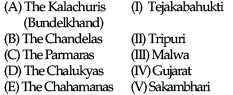
- a)(A-II) (B-I) (C-III) (D-IV) (E-V)
- b)(A-I) (B-II) (C-III) (D-IV) (E-V)
- c)(A-III) (B-II) (C-I) (D-V) (E-IV)
- d)(A-V) (B-I) (C-II) (D-IV) (E-III)
Correct answer is option 'A'. Can you explain this answer?
Match the following dynasties with their seat when Mahmud of Ghazni invaded India:
a)
(A-II) (B-I) (C-III) (D-IV) (E-V)
b)
(A-I) (B-II) (C-III) (D-IV) (E-V)
c)
(A-III) (B-II) (C-I) (D-V) (E-IV)
d)
(A-V) (B-I) (C-II) (D-IV) (E-III)
 | EduRev UPSC answered |
Dynasties and Their Seats:
- The Kalachuris → (II) Tripuri
The Kalachuris ruled from Tripuri (modern Tewar in Madhya Pradesh). They were a major power in central India during Mahmud’s invasions. - The Chandelas → (I) Tejakabahukti
The Chandelas ruled from Tejakabahukti (modern Khajuraho) in Bundelkhand. This region is famous for its temple architecture. - The Paramaras → (III) Malwa
The Paramaras, under rulers like Bhoja, ruled from Malwa, with their capital at Dhar. - The Chalukyas → (IV) Gujarat
The Chalukyas (Solankis) ruled from Anhilwara (modern Patan) in Gujarat. - The Chahamanas → (V) Sakambhari
The Chahamanas (Chauhans) ruled from Sakambhari (modern Sambhar in Rajasthan) during this period.
Therefore, Correct Answer- Option A
Which one of the following statements about the Pala empire is incorrect?- a)The Pala empire was founded by Gopala in 750 A.D.
- b)The greatest king of the Pala dynasty was Dharmapala.
- c)After the death of Dharmapala, the Pala empire disintegrated.
- d)The pala empire was revived in the eleventh century and continued till the early thirteenth century.
Correct answer is option 'C'. Can you explain this answer?
Which one of the following statements about the Pala empire is incorrect?
a)
The Pala empire was founded by Gopala in 750 A.D.
b)
The greatest king of the Pala dynasty was Dharmapala.
c)
After the death of Dharmapala, the Pala empire disintegrated.
d)
The pala empire was revived in the eleventh century and continued till the early thirteenth century.
| | Academic Studio answered |
The empire began disintegrating after the death of Devapala, not Dharmapala. Devapala was one of the greatest rulers of the Pala dynasty, and after his death, his successor Narayanapala lost control of regions like Assam and Orissa. The Pala empire disintegrated into smaller kingdoms during the reign of Vigrahapala II.
Which of the following were the Rajput clans of Agni-kula?- a)Pratiharas, Tomars, Paramaras, Gahadavalas
- b)Pratiharas, Chalukyas, Tomars, Paramaras
- c)Pratiharas, Gahadavalas, Chalukyas, and Tomars
- d)Pratiharas, Paramaras, Chalukyas and Chahmanas (Chauhans)
Correct answer is option 'D'. Can you explain this answer?
Which of the following were the Rajput clans of Agni-kula?
a)
Pratiharas, Tomars, Paramaras, Gahadavalas
b)
Pratiharas, Chalukyas, Tomars, Paramaras
c)
Pratiharas, Gahadavalas, Chalukyas, and Tomars
d)
Pratiharas, Paramaras, Chalukyas and Chahmanas (Chauhans)
| | Ias Masters answered |
- The Agnivanshi lineage (Agnivansha or Agnikula) is one of the three lineages into which the Rajput clans are divided, the others being the Suryavanshi (descended from Surya, the sun god) and the Chandravanshi (descended from Chandra, the moon god).
- The Rajput clans traditionally considered to be of the Agni-kula lineage include the Pratiharas, Paramaras, Chalukyas, and Chahmanas (Chauhans).
Therefore, Coorect Answer - Option D
During the reign of which one of the following kings, the Chola king Rajendra I is said to have invaded Bengal?- a)Dharmapala
- b)Devapala
- c)Mahipala
- d)Nayapala
Correct answer is option 'C'. Can you explain this answer?
During the reign of which one of the following kings, the Chola king Rajendra I is said to have invaded Bengal?
a)
Dharmapala
b)
Devapala
c)
Mahipala
d)
Nayapala
| | Anjali Chavan answered |
Chola King Rajendra I's Invasion of Bengal during the Reign of Mahipala
During the reign of Mahipala, the Chola king Rajendra I is said to have invaded Bengal. Rajendra I was one of the most powerful and successful rulers of the Chola dynasty, which was one of the dominant powers in South India during the medieval period.
1. The Chola Dynasty
The Chola dynasty was one of the longest-ruling dynasties in the history of South India. It had its origins in the region around modern-day Tamil Nadu and Andhra Pradesh. The Cholas are known for their naval power, administrative efficiency, and patronage of arts and culture.
2. Rajendra I's Reign
Rajendra I ascended the throne in 1014 CE after the death of his father, Rajaraja Chola I. He continued the expansionist policies of his predecessor and launched several military campaigns to extend the boundaries of the Chola empire.
3. Invasion of Bengal
During his reign, Rajendra I is said to have invaded Bengal, which was ruled by Mahipala. Bengal was known for its wealth and resources, and its strategic location made it an attractive target for conquest.
4. Reasons for the Invasion
There could be several reasons for Rajendra I's invasion of Bengal:
- Economic Motives: Bengal was known for its fertile lands, abundant natural resources, and thriving trade networks. The Chola empire, with its naval power, sought to control these economic resources and gain access to valuable commodities.
- Expansionist Ambitions: Rajendra I aimed to extend the boundaries of the Chola empire and establish his authority over new territories. Bengal, with its strategic location and rich resources, presented an opportunity for expansion.
- Political Rivalry: It is possible that there were political rivalries or conflicts between the Chola and Bengal kings, which may have led to the invasion.
5. Outcome of the Invasion
The exact details and outcome of Rajendra I's invasion of Bengal are not well-documented. It is believed that the Cholas were able to establish their control over parts of Bengal, although the extent and duration of their rule are unclear. Bengal continued to be a center of power and influence, with subsequent dynasties ruling the region.
In conclusion, the Chola king Rajendra I is said to have invaded Bengal during the reign of Mahipala. The reasons for the invasion could be economic motives, expansionist ambitions, or political rivalries. However, the details and outcome of the invasion are not well-documented in historical records.
During the reign of Mahipala, the Chola king Rajendra I is said to have invaded Bengal. Rajendra I was one of the most powerful and successful rulers of the Chola dynasty, which was one of the dominant powers in South India during the medieval period.
1. The Chola Dynasty
The Chola dynasty was one of the longest-ruling dynasties in the history of South India. It had its origins in the region around modern-day Tamil Nadu and Andhra Pradesh. The Cholas are known for their naval power, administrative efficiency, and patronage of arts and culture.
2. Rajendra I's Reign
Rajendra I ascended the throne in 1014 CE after the death of his father, Rajaraja Chola I. He continued the expansionist policies of his predecessor and launched several military campaigns to extend the boundaries of the Chola empire.
3. Invasion of Bengal
During his reign, Rajendra I is said to have invaded Bengal, which was ruled by Mahipala. Bengal was known for its wealth and resources, and its strategic location made it an attractive target for conquest.
4. Reasons for the Invasion
There could be several reasons for Rajendra I's invasion of Bengal:
- Economic Motives: Bengal was known for its fertile lands, abundant natural resources, and thriving trade networks. The Chola empire, with its naval power, sought to control these economic resources and gain access to valuable commodities.
- Expansionist Ambitions: Rajendra I aimed to extend the boundaries of the Chola empire and establish his authority over new territories. Bengal, with its strategic location and rich resources, presented an opportunity for expansion.
- Political Rivalry: It is possible that there were political rivalries or conflicts between the Chola and Bengal kings, which may have led to the invasion.
5. Outcome of the Invasion
The exact details and outcome of Rajendra I's invasion of Bengal are not well-documented. It is believed that the Cholas were able to establish their control over parts of Bengal, although the extent and duration of their rule are unclear. Bengal continued to be a center of power and influence, with subsequent dynasties ruling the region.
In conclusion, the Chola king Rajendra I is said to have invaded Bengal during the reign of Mahipala. The reasons for the invasion could be economic motives, expansionist ambitions, or political rivalries. However, the details and outcome of the invasion are not well-documented in historical records.
What was the name of the Chandela king who joined the coalition formed by Andapala Shahi in 1008 A.D. to repeal the invasion of Mahmud of Ghazni?- a)Dhanja
- b)Kiritivarmana
- c)Harshadeva
- d)Ganda
Correct answer is option 'D'. Can you explain this answer?
What was the name of the Chandela king who joined the coalition formed by Andapala Shahi in 1008 A.D. to repeal the invasion of Mahmud of Ghazni?
a)
Dhanja
b)
Kiritivarmana
c)
Harshadeva
d)
Ganda
| | Capstone Ias Learning answered |
Ganda, a Chandela king, joined the coalition led by Anandapala Shahi in 1008 A.D. to resist the invasion of Mahmud of Ghazni. This coalition included several rulers from northwestern and central India, aiming to defend their territories against Mahmud's aggressive campaigns. Despite their combined efforts, Mahmud defeated the coalition in the Battle of Waihind, marking a significant victory for him in his invasions of India.
Therefore, Correct Answer - Option D
Which one of the following Rashtrakuta kings defeated Pratihara ruler Nagabhata I?- a)Indra III
- b)Krishna III
- c)Amoghavarsha I
- d)Govinda III
Correct answer is option 'D'. Can you explain this answer?
Which one of the following Rashtrakuta kings defeated Pratihara ruler Nagabhata I?
a)
Indra III
b)
Krishna III
c)
Amoghavarsha I
d)
Govinda III
| | Lakshya Ias answered |
- Govinda III reigned approximately from 793 to 814 and led extensive northern campaigns.
- In these campaigns he defeated the Gurjara-Pratihara ruler Nagabhata II, thereby extending Rashtrakuta influence into parts of northern India.
- The reign of Nagabhata II is dated roughly c. 805-833, and contemporary records and inscriptions attribute his defeat in the north to the military successes of Govinda III.
Hence the correct choice is D.
Chapter doubts & questions for The Northern India (800-1200 A.D.) - 6 Months Preparation Course for OPSC 2026 is part of OPSC OCS (Odisha) exam preparation. The chapters have been prepared according to the OPSC OCS (Odisha) exam syllabus. The Chapter doubts & questions, notes, tests & MCQs are made for OPSC OCS (Odisha) 2026 Exam. Find important definitions, questions, notes, meanings, examples, exercises, MCQs and online tests here.
Chapter doubts & questions of The Northern India (800-1200 A.D.) - 6 Months Preparation Course for OPSC in English & Hindi are available as part of OPSC OCS (Odisha) exam. Download more important topics, notes, lectures and mock test series for OPSC OCS (Odisha) Exam by signing up for free.
6 Months Preparation Course for OPSC636 videos|2472 docs|801 tests |
