


All Exams > OPSC OCS (Odisha) > 6 Months Preparation Course for OPSC > All Questions
All questions of The Delhi Sultanate for OPSC OCS (Odisha) Exam
What was the period of rule of Qutb-ud-din Aibak?- a)1206-1210 A.D.
- b)1208-1212 A.D.
- c)1210-1214 A.D.
- d)1220-1225 A.D.
Correct answer is option 'A'. Can you explain this answer?
What was the period of rule of Qutb-ud-din Aibak?
a)
1206-1210 A.D.
b)
1208-1212 A.D.
c)
1210-1214 A.D.
d)
1220-1225 A.D.
 | Sanvi Kapoor answered |
Qutb al-Din Aibak was a general of the Ghurid king Mu'izz ad-Din Muhammad Ghori from 1206-1210 A.D.. He was in-charge of the Ghurid territories in northern India, and after Mu'izz ad-Din's death, he became the ruler of an independent kingdom that evolved into the Delhi Sultanate ruled by the Mamluk dynasty.


What was the name of the south Indian ruler who defeated the army of Ala-ud-din Khalji in 1303?- a)Pratap Rudra II
- b)Raja Karan
- c)Maladeva
- d)Raja Rama Chandra
Correct answer is option 'A'. Can you explain this answer?
What was the name of the south Indian ruler who defeated the army of Ala-ud-din Khalji in 1303?
a)
Pratap Rudra II
b)
Raja Karan
c)
Maladeva
d)
Raja Rama Chandra
 | Amit Sharma answered |
Pratāparudra, also known as Rudradeva II, was the last ruler of the Kakatiya dynasty of India. He ruled the eastern part of Deccan, with his capital at Warangal. Prataparudra succeeded his grandmother Rudramadevi as the Kakatiya monarch. He defeated the first invasion of the army of Ala uddin Khilji in 1303. It was in Karimnagar district. But later in 1310 or so Khilji defeated the kakatiyas - Prataprudra surrendered and made a pact to pay heavy ransoms.
The first Muslim incursion on Deccan occurred during the reign of- a)Jalaluddin Khalji
- b)Ala-ud-din Khalji
- c)Balban
- d)Muhammad-bin-Tughlaq
Correct answer is option 'A'. Can you explain this answer?
The first Muslim incursion on Deccan occurred during the reign of
a)
Jalaluddin Khalji
b)
Ala-ud-din Khalji
c)
Balban
d)
Muhammad-bin-Tughlaq
 | Kabir Verma answered |
The First Muslim incursion on the deccan occurred during the reign of Jalaluddin Khalji. Jalal-ud-din Khalji (r. 1290-1296; died 19 July 1296) was the founder and first Sultan of the Khalji dynasty that ruled the Delhi Sultanate from 1290 to 1320.
Which one of the following sultans refused to speak to common people?- a)Iltutmish
- b)Balban
- c)Ala-ud-din Khalji
- d)Firoz Tughlaq
Correct answer is option 'B'. Can you explain this answer?
Which one of the following sultans refused to speak to common people?
a)
Iltutmish
b)
Balban
c)
Ala-ud-din Khalji
d)
Firoz Tughlaq
 | Ashwin Choudhury answered |
Iltutmish:
Iltutmish was the third Sultan of Delhi and ruled from 1211 to 1236. He was known for his administrative reforms and military prowess. Despite being a powerful ruler, Iltutmish was known for his accessibility and willingness to engage with common people. He often held open court sessions, where people from all walks of life could approach him and present their grievances.
Balban:
Balban, also known as Ghiyasuddin Balban, was the ninth Sultan of Delhi and ruled from 1266 to 1287. Unlike his predecessor, Balban was known for his strict and authoritarian rule. He believed in the absolute authority of the Sultan and maintained a strict hierarchy in society. Balban refused to speak to common people directly and preferred to communicate through his nobles and courtiers. This approach was aimed at maintaining his image as a powerful and unapproachable ruler.
Ala-ud-din Khalji:
Ala-ud-din Khalji was the second ruler of the Khalji dynasty and ruled from 1296 to 1316. He was known for his military campaigns and administrative reforms. While he was a stern ruler, Ala-ud-din Khalji did not refuse to speak to common people. In fact, he encouraged a system called the "Door of Complaints" where anyone could approach him with their grievances. He also implemented various economic and social policies to benefit the common people.
Firoz Tughlaq:
Firoz Tughlaq was the third Sultan of the Tughlaq dynasty and ruled from 1351 to 1388. He is known for his architectural projects and his focus on welfare policies. Firoz Tughlaq was known for his accessibility and willingness to engage with common people. He often held public audience sessions where anyone could approach him directly and present their grievances. He also implemented various welfare measures such as free hospitals, free education, and pensions for the poor.
Therefore, the correct answer is option 'B' - Balban, as he was the Sultan who refused to speak to common people directly and preferred to communicate through intermediaries.
Iltutmish was the third Sultan of Delhi and ruled from 1211 to 1236. He was known for his administrative reforms and military prowess. Despite being a powerful ruler, Iltutmish was known for his accessibility and willingness to engage with common people. He often held open court sessions, where people from all walks of life could approach him and present their grievances.
Balban:
Balban, also known as Ghiyasuddin Balban, was the ninth Sultan of Delhi and ruled from 1266 to 1287. Unlike his predecessor, Balban was known for his strict and authoritarian rule. He believed in the absolute authority of the Sultan and maintained a strict hierarchy in society. Balban refused to speak to common people directly and preferred to communicate through his nobles and courtiers. This approach was aimed at maintaining his image as a powerful and unapproachable ruler.
Ala-ud-din Khalji:
Ala-ud-din Khalji was the second ruler of the Khalji dynasty and ruled from 1296 to 1316. He was known for his military campaigns and administrative reforms. While he was a stern ruler, Ala-ud-din Khalji did not refuse to speak to common people. In fact, he encouraged a system called the "Door of Complaints" where anyone could approach him with their grievances. He also implemented various economic and social policies to benefit the common people.
Firoz Tughlaq:
Firoz Tughlaq was the third Sultan of the Tughlaq dynasty and ruled from 1351 to 1388. He is known for his architectural projects and his focus on welfare policies. Firoz Tughlaq was known for his accessibility and willingness to engage with common people. He often held public audience sessions where anyone could approach him directly and present their grievances. He also implemented various welfare measures such as free hospitals, free education, and pensions for the poor.
Therefore, the correct answer is option 'B' - Balban, as he was the Sultan who refused to speak to common people directly and preferred to communicate through intermediaries.
During Firuz Tughlaq’s long reign of 40 years, there was only one rebellion by a noble. Who was he?- a)Ulug Khan
- b)Khan-i-Jahan Maqbul
- c)Malik Shamsuddin Damghani
- d)Malik Kafur
Correct answer is option 'C'. Can you explain this answer?
During Firuz Tughlaq’s long reign of 40 years, there was only one rebellion by a noble. Who was he?
a)
Ulug Khan
b)
Khan-i-Jahan Maqbul
c)
Malik Shamsuddin Damghani
d)
Malik Kafur
| | Kabir Verma answered |
The system of tax extraction from peasants and sharing among Muslim nobility led to rampant corruption, arrests, execution and rebellion. For example, in the reign of Firoz Shah Tughlaq, a Muslim noble named Shamsaldin Damghani entered into a contract over the iqta' of Gujarat, promising an enormous sums of annual tribute while entering the contract in 1377 AD. He then attempted to force collect the amount deploying his cotorie of Muslim amirs, but failed.
Even the amount he did manage to collect, he paid nothing to Delhi. Shamsaldin Damghani and Muslim nobility of Gujarat then declared rebellion and separation from Delhi Sultanate. However, the soldiers and peasants of Gujarat refused to fight the war for the Muslim nobility. Shamsaldin Damghani was killed.
During the reign of which Delhi Sultan did the “Chahalgani” or “Chalisa’ come into existence?- a)Balban
- b)Razia
- c)Iltutmish
- d)Alauddin Khilji
Correct answer is option 'C'. Can you explain this answer?
During the reign of which Delhi Sultan did the “Chahalgani” or “Chalisa’ come into existence?
a)
Balban
b)
Razia
c)
Iltutmish
d)
Alauddin Khilji
| | Amit Sharma answered |
The third ruler of Slave dynasty, Shams-ud-din Iltutmish formed Turkan-i-Chahalgani or Chalisa (a group of 40 powerful Turkish nobles). These were Turkish amirs (nobles) who advised and helped the Sultan in administering the Sultanate.
Name the Abbasid Caliph who probably conferred on Mahmud of Ghazni, the title of ‘Sultan’ for the first time in the Islamic history.- a)Al-Nasir
- b)Qadir
- c)Al-Muqtafi
- d)Al-Qaim
Correct answer is option 'B'. Can you explain this answer?
Name the Abbasid Caliph who probably conferred on Mahmud of Ghazni, the title of ‘Sultan’ for the first time in the Islamic history.
a)
Al-Nasir
b)
Qadir
c)
Al-Muqtafi
d)
Al-Qaim
| | Juhi Basak answered |
Sultan Mahmud of Ghazni was born on Nov. 2, 971 in Ghazne, located in northern Kabul, Afghanistan. his family name, or surname, was Ibn Sebuk Tegin. According to an ethics book written about him, Sebuk Tegin was a Turk from the "Barsahians" who became Muslim when he went to the country Samanis. When he rejected the dominance of the Samanis rulers and established his own state in Ghazne, he went on to raise his son Mahmud as his heir. As a result, Mahmud is considered the first example of a well-educated sultan. And he was conferred this title by Qadir.
Match the following: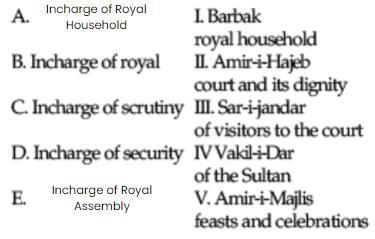
- a)(A-I) (B-II) (C-III) (D-IV) (E-V)
- b)(A-IV) (B-I) (C-II) (D-III) (E-V)
- c)(A-IV) (B-II) (C-III) (D-I) (E-V)
- d)(A-I) (B-II) (C-IV) (D-III) (E-V)]
Correct answer is option 'B'. Can you explain this answer?
Match the following:
a)
(A-I) (B-II) (C-III) (D-IV) (E-V)
b)
(A-IV) (B-I) (C-II) (D-III) (E-V)
c)
(A-IV) (B-II) (C-III) (D-I) (E-V)
d)
(A-I) (B-II) (C-IV) (D-III) (E-V)]
 | Future Foundation Institute answered |
B is the correct option.
- Vakil-i-dar was incharge of the royal household.
- Amir-i-barbak was the superintendent of the royal court.
- Amir-i-hajib kept an eye on all visitors to the court and presented them before the sovereign according to court etiquette.
- sar-i-jandar was the officer of personal body-gaurds (jandars) to the Sultan.
- Amir-i-majlis organised the meetings of royal assembly and special celebrations.
Which sultan in order to forestall conspiracies banned banquets and assemblies and peppered the country with his spies?- a)Balban
- b)Ala-ud-din Khalji
- c)Muhammad-bin-Tughlaq
- d)Iltutmish
Correct answer is option 'B'. Can you explain this answer?
Which sultan in order to forestall conspiracies banned banquets and assemblies and peppered the country with his spies?
a)
Balban
b)
Ala-ud-din Khalji
c)
Muhammad-bin-Tughlaq
d)
Iltutmish
 | Pranab Patel answered |
The correct answer is b) Ala-ud-din Khalji.
Ala-ud-din Khalji was a powerful and influential sultan of the Khalji dynasty who ruled the Delhi Sultanate from 1296 to 1316 AD. He is known for his strong and autocratic rule. To maintain his power and control, he took several measures, including banning banquets and assemblies and establishing an extensive spy network throughout the country.
Below are the details explaining why Ala-ud-din Khalji banned banquets and assemblies and peppered the country with his spies:
**Banquets and Assemblies Ban:**
- Ala-ud-din Khalji banned banquets and assemblies as a measure to prevent conspiracies against his rule.
- Banquets and assemblies were often attended by nobles, courtiers, and other influential people who could potentially plot against the sultan.
- By banning these gatherings, Khalji aimed to eliminate the possibility of secret meetings and discussions that could undermine his authority.
- This ban helped him to control and monitor the activities of the nobles and prevent any organized opposition.
**Establishment of Spy Network:**
- Ala-ud-din Khalji established an extensive spy network in order to gather information and keep a close watch on his subjects.
- He appointed spies and informers known as "Barids" who were responsible for collecting intelligence from different parts of the kingdom.
- These spies were spread throughout the country and reported directly to the sultan.
- The spies provided valuable information about any potential conspiracies, rebellions, or threats to the sultan's rule.
- The intelligence gathered by the spies helped Khalji to take preemptive actions against his enemies and maintain a strong grip on power.
**Reasons for these measures:**
- Ala-ud-din Khalji faced several challenges to his rule, including internal opposition from powerful nobles, external invasions, and rebellions in different parts of the kingdom.
- He implemented these measures to consolidate his power, suppress any dissent, and prevent any organized resistance against his rule.
- By banning banquets and assemblies, he eliminated the opportunities for nobles and other influential people to gather and plan against him.
- The establishment of a spy network helped him to identify and neutralize potential threats before they could become significant challenges to his rule.
In conclusion, Ala-ud-din Khalji banned banquets and assemblies and established a spy network as measures to maintain his power, suppress dissent, and prevent conspiracies against his rule. These measures were aimed at consolidating his authority and ensuring stability in the Delhi Sultanate.
Ala-ud-din Khalji was a powerful and influential sultan of the Khalji dynasty who ruled the Delhi Sultanate from 1296 to 1316 AD. He is known for his strong and autocratic rule. To maintain his power and control, he took several measures, including banning banquets and assemblies and establishing an extensive spy network throughout the country.
Below are the details explaining why Ala-ud-din Khalji banned banquets and assemblies and peppered the country with his spies:
**Banquets and Assemblies Ban:**
- Ala-ud-din Khalji banned banquets and assemblies as a measure to prevent conspiracies against his rule.
- Banquets and assemblies were often attended by nobles, courtiers, and other influential people who could potentially plot against the sultan.
- By banning these gatherings, Khalji aimed to eliminate the possibility of secret meetings and discussions that could undermine his authority.
- This ban helped him to control and monitor the activities of the nobles and prevent any organized opposition.
**Establishment of Spy Network:**
- Ala-ud-din Khalji established an extensive spy network in order to gather information and keep a close watch on his subjects.
- He appointed spies and informers known as "Barids" who were responsible for collecting intelligence from different parts of the kingdom.
- These spies were spread throughout the country and reported directly to the sultan.
- The spies provided valuable information about any potential conspiracies, rebellions, or threats to the sultan's rule.
- The intelligence gathered by the spies helped Khalji to take preemptive actions against his enemies and maintain a strong grip on power.
**Reasons for these measures:**
- Ala-ud-din Khalji faced several challenges to his rule, including internal opposition from powerful nobles, external invasions, and rebellions in different parts of the kingdom.
- He implemented these measures to consolidate his power, suppress any dissent, and prevent any organized resistance against his rule.
- By banning banquets and assemblies, he eliminated the opportunities for nobles and other influential people to gather and plan against him.
- The establishment of a spy network helped him to identify and neutralize potential threats before they could become significant challenges to his rule.
In conclusion, Ala-ud-din Khalji banned banquets and assemblies and established a spy network as measures to maintain his power, suppress dissent, and prevent conspiracies against his rule. These measures were aimed at consolidating his authority and ensuring stability in the Delhi Sultanate.
Whom did Mahmud of Ghazni defeat to conquer and annex Peshawar and Punjab?- a)Hindushahis
- b)Ghurids
- c)Arabs
- d)Karkotas
Correct answer is option 'A'. Can you explain this answer?
Whom did Mahmud of Ghazni defeat to conquer and annex Peshawar and Punjab?
a)
Hindushahis
b)
Ghurids
c)
Arabs
d)
Karkotas
 | Dhruba Dasgupta answered |
Mahmud of Ghazni was a prominent ruler of the Ghaznavid Empire from 997 to 1030. He is known for his numerous invasions into the Indian subcontinent, during which he conquered and annexed various territories. One of his notable conquests was the annexation of Peshawar and Punjab.
The answer to the question is option 'A' - Hindushahis. Mahmud of Ghazni defeated the Hindushahis to conquer and annex Peshawar and Punjab.
The Hindushahis were a dynasty that ruled over the region of Gandhara, which included Peshawar and parts of Punjab, from the 9th to the 10th century. They were of Hindu origin and had managed to maintain their independence for several centuries. However, Mahmud of Ghazni saw their territories as a valuable addition to his expanding empire and launched a series of invasions to conquer them.
To understand this conquest in more detail, let's break it down into key points:
1. Mahmud's invasions: Mahmud of Ghazni launched a total of 17 expeditions into the Indian subcontinent between 1000 and 1027. These invasions were primarily aimed at plundering the wealth and resources of the region and expanding the influence of the Ghaznavid Empire.
2. The Battle of Peshawar: Mahmud's conquest of Peshawar is often associated with the Battle of Peshawar, which took place in 1001. The Hindushahi ruler Jayapala led a resistance against Mahmud's forces but was defeated. As a result, Peshawar came under the control of Mahmud.
3. Annexation of Punjab: After conquering Peshawar, Mahmud set his sights on Punjab. He launched several campaigns into the region, defeating various local rulers and annexing their territories. The exact timeline and details of these campaigns may vary, but ultimately Mahmud succeeded in bringing Punjab under his rule.
4. Legacy of Mahmud's conquests: Mahmud's conquest of Peshawar and Punjab had significant implications for the region. It marked the beginning of Ghaznavid rule in these territories and established a Muslim presence in the area. The Ghaznavids played a crucial role in the spread of Islam in the Indian subcontinent.
In conclusion, Mahmud of Ghazni defeated the Hindushahis to conquer and annex Peshawar and Punjab. His conquests were part of his larger ambition to expand the Ghaznavid Empire and establish Muslim rule in the Indian subcontinent.
The answer to the question is option 'A' - Hindushahis. Mahmud of Ghazni defeated the Hindushahis to conquer and annex Peshawar and Punjab.
The Hindushahis were a dynasty that ruled over the region of Gandhara, which included Peshawar and parts of Punjab, from the 9th to the 10th century. They were of Hindu origin and had managed to maintain their independence for several centuries. However, Mahmud of Ghazni saw their territories as a valuable addition to his expanding empire and launched a series of invasions to conquer them.
To understand this conquest in more detail, let's break it down into key points:
1. Mahmud's invasions: Mahmud of Ghazni launched a total of 17 expeditions into the Indian subcontinent between 1000 and 1027. These invasions were primarily aimed at plundering the wealth and resources of the region and expanding the influence of the Ghaznavid Empire.
2. The Battle of Peshawar: Mahmud's conquest of Peshawar is often associated with the Battle of Peshawar, which took place in 1001. The Hindushahi ruler Jayapala led a resistance against Mahmud's forces but was defeated. As a result, Peshawar came under the control of Mahmud.
3. Annexation of Punjab: After conquering Peshawar, Mahmud set his sights on Punjab. He launched several campaigns into the region, defeating various local rulers and annexing their territories. The exact timeline and details of these campaigns may vary, but ultimately Mahmud succeeded in bringing Punjab under his rule.
4. Legacy of Mahmud's conquests: Mahmud's conquest of Peshawar and Punjab had significant implications for the region. It marked the beginning of Ghaznavid rule in these territories and established a Muslim presence in the area. The Ghaznavids played a crucial role in the spread of Islam in the Indian subcontinent.
In conclusion, Mahmud of Ghazni defeated the Hindushahis to conquer and annex Peshawar and Punjab. His conquests were part of his larger ambition to expand the Ghaznavid Empire and establish Muslim rule in the Indian subcontinent.
Who was the court poet of Mahmud of Ghazni and author of Shah Namah?- a)Firdausi
- b)Ibn Batutah
- c)Alberuni
- d)Maulana Khwajagi
Correct answer is option 'A'. Can you explain this answer?
Who was the court poet of Mahmud of Ghazni and author of Shah Namah?
a)
Firdausi
b)
Ibn Batutah
c)
Alberuni
d)
Maulana Khwajagi
 | Upsc Toppers answered |
Court Poet of Mahmud of Ghazni and Author of Shah Namah
- Firdausi: He was the court poet of Mahmud of Ghazni and the author of the famous Persian epic poem Shah Namah.
The recognition of Caliph’s authority by the Delhi sultans at the most meant- a)That the Sultan was a vassal of the Caliph
- b)That the Sultan was not the real ruler
- c)Subordination of the Sultan’s sovereignty to that of the Caliph
- d)That the Sultan was the supreme judicial authority subject only to the tenets of the Shariat
Correct answer is option 'D'. Can you explain this answer?
The recognition of Caliph’s authority by the Delhi sultans at the most meant
a)
That the Sultan was a vassal of the Caliph
b)
That the Sultan was not the real ruler
c)
Subordination of the Sultan’s sovereignty to that of the Caliph
d)
That the Sultan was the supreme judicial authority subject only to the tenets of the Shariat
 | Poonam Shukla answered |
C
Which of the following regions of northern India was not included in the empire of Ala-ud-din Khalji?- a)Punjab
- b)Sindh
- c)Kashmir
- d)Malwa
Correct answer is option 'C'. Can you explain this answer?
Which of the following regions of northern India was not included in the empire of Ala-ud-din Khalji?
a)
Punjab
b)
Sindh
c)
Kashmir
d)
Malwa
 | Asha Kumar answered |
Ala-ud-din Khalji was the second ruler of the Khalji dynasty in India. He ruled from 1296 to 1316 CE and expanded the boundaries of his empire through several military campaigns. He conquered a large part of northern India, including Delhi, Gujarat, and parts of Rajasthan, Madhya Pradesh, and Uttar Pradesh. However, the region of Kashmir was not included in his empire.
Ala-ud-din Khalji made several unsuccessful attempts to conquer Kashmir. The rulers of Kashmir, who were then under the control of the Shah Miri dynasty, managed to resist the invasion attempts of the Khalji army. The difficult terrain and harsh weather conditions of the region made it challenging for the invaders to launch a successful attack on Kashmir. As a result, the region of Kashmir remained independent during the reign of Ala-ud-din Khalji.
In summary, Ala-ud-din Khalji could not conquer the region of Kashmir, and it remained outside the boundaries of his empire.
Dr. Ishwari Prasad writes, “He always behaved like a well bred oriental monarch. His sense of kingly dignity was so great that he never ap-peared but in full dress ever before his private servants. He never laughed aloud nor joked in his durbar nor did he permit any one to indulge in laughter or amusement in his presence”. Who is that king?- a)Balban
- b)Ala-ud-din Khalji
- c)Muhammad-bin-Tughlaq
- d)Mubarak Shah
Correct answer is option 'A'. Can you explain this answer?
Dr. Ishwari Prasad writes, “He always behaved like a well bred oriental monarch. His sense of kingly dignity was so great that he never ap-peared but in full dress ever before his private servants. He never laughed aloud nor joked in his durbar nor did he permit any one to indulge in laughter or amusement in his presence”. Who is that king?
a)
Balban
b)
Ala-ud-din Khalji
c)
Muhammad-bin-Tughlaq
d)
Mubarak Shah
 | Anjali Desai answered |
Explanation:
Balban:
- The king described in the passage is Balban.
- He behaved like a well bred oriental monarch, displaying a sense of kingly dignity.
- Balban always appeared in full dress before his private servants, emphasizing his royal status.
Characteristics of Balban:
- Balban never laughed aloud or joked in his durbar, maintaining a serious and dignified demeanor.
- He did not permit anyone to indulge in laughter or amusement in his presence, further showcasing his strict and authoritative nature.
Conclusion:
Balban's regal behavior and strict demeanor set him apart as a ruler who commanded respect and authority. His emphasis on maintaining a sense of kingly dignity and seriousness in his court reflected his belief in upholding the status and power of the monarchy.
Balban:
- The king described in the passage is Balban.
- He behaved like a well bred oriental monarch, displaying a sense of kingly dignity.
- Balban always appeared in full dress before his private servants, emphasizing his royal status.
Characteristics of Balban:
- Balban never laughed aloud or joked in his durbar, maintaining a serious and dignified demeanor.
- He did not permit anyone to indulge in laughter or amusement in his presence, further showcasing his strict and authoritative nature.
Conclusion:
Balban's regal behavior and strict demeanor set him apart as a ruler who commanded respect and authority. His emphasis on maintaining a sense of kingly dignity and seriousness in his court reflected his belief in upholding the status and power of the monarchy.
Which of the following is correct?- a)Iltutmish gave the Turkish kingdom legal status.
- b)Iltutmish recaptured Bayna and Thangir.
- c)Iltutmish reconquered Nagaur in Jodhpur.
- d)Iltutmish failed to recapture Varanasi.
- e)All of the above.
Correct answer is option 'E'. Can you explain this answer?
Which of the following is correct?
a)
Iltutmish gave the Turkish kingdom legal status.
b)
Iltutmish recaptured Bayna and Thangir.
c)
Iltutmish reconquered Nagaur in Jodhpur.
d)
Iltutmish failed to recapture Varanasi.
e)
All of the above.
 | Kunal Mukherjee answered |
Iltutmish was a prominent ruler of the Delhi Sultanate in medieval India. He is known for his military campaigns and administrative reforms during his reign from 1211 to 1236. Among the given options, all of them are correct.
1. Iltutmish gave the Turkish kingdom legal status:
- Iltutmish was a Turkish slave who rose to power and established the Delhi Sultanate. By giving the Turkish kingdom legal status, he solidified the position of the Turks as the ruling elite in the Delhi Sultanate.
2. Iltutmish recaptured Bayna and Thangir:
- Bayna and Thangir were territories that had been previously lost by the Delhi Sultanate. Iltutmish successfully recaptured these territories, demonstrating his military prowess and expanding the empire's territories.
3. Iltutmish reconquered Nagaur in Jodhpur:
- Nagaur was a strategic city in the region of Jodhpur, and it had been previously captured by the Rajputs. Iltutmish led a successful campaign to reconquer Nagaur, further expanding the influence of the Delhi Sultanate in Rajasthan.
4. Iltutmish failed to recapture Varanasi:
- Varanasi, also known as Kashi, was a significant city in the eastern part of the Delhi Sultanate. Iltutmish attempted to recapture Varanasi but was unsuccessful. This failure highlights the limitations of his military campaigns and the resilience of the local powers in the region.
Therefore, all of the given options are correct. Iltutmish's reign was marked by territorial expansion, military achievements, and administrative reforms. He played a crucial role in shaping the Delhi Sultanate and consolidating Turkish rule in India.
1. Iltutmish gave the Turkish kingdom legal status:
- Iltutmish was a Turkish slave who rose to power and established the Delhi Sultanate. By giving the Turkish kingdom legal status, he solidified the position of the Turks as the ruling elite in the Delhi Sultanate.
2. Iltutmish recaptured Bayna and Thangir:
- Bayna and Thangir were territories that had been previously lost by the Delhi Sultanate. Iltutmish successfully recaptured these territories, demonstrating his military prowess and expanding the empire's territories.
3. Iltutmish reconquered Nagaur in Jodhpur:
- Nagaur was a strategic city in the region of Jodhpur, and it had been previously captured by the Rajputs. Iltutmish led a successful campaign to reconquer Nagaur, further expanding the influence of the Delhi Sultanate in Rajasthan.
4. Iltutmish failed to recapture Varanasi:
- Varanasi, also known as Kashi, was a significant city in the eastern part of the Delhi Sultanate. Iltutmish attempted to recapture Varanasi but was unsuccessful. This failure highlights the limitations of his military campaigns and the resilience of the local powers in the region.
Therefore, all of the given options are correct. Iltutmish's reign was marked by territorial expansion, military achievements, and administrative reforms. He played a crucial role in shaping the Delhi Sultanate and consolidating Turkish rule in India.
Which of the following is not correct ?- a)At the time of his accession Qutab-ud-din Aibak had to deal with the Turkish rivals like Tajuddin Yilduz and Nasiruddin Qubacha.
- b)At the time of his accession Qutab-ud-din had to deal with the Gahadwals who had regained most of their power in Farrukhabad and Badaun.
- c)At the time of his accession Qutab-ud-din had to deal with the Chauhans who had conquered Delhi in 1206 A.D.
- d)At the time of his accession Qutab-ud-Aibak had to deal with the Chandelas who had recovered Kalinjar in 1206 A.D.
Correct answer is option 'C'. Can you explain this answer?
Which of the following is not correct ?
a)
At the time of his accession Qutab-ud-din Aibak had to deal with the Turkish rivals like Tajuddin Yilduz and Nasiruddin Qubacha.
b)
At the time of his accession Qutab-ud-din had to deal with the Gahadwals who had regained most of their power in Farrukhabad and Badaun.
c)
At the time of his accession Qutab-ud-din had to deal with the Chauhans who had conquered Delhi in 1206 A.D.
d)
At the time of his accession Qutab-ud-Aibak had to deal with the Chandelas who had recovered Kalinjar in 1206 A.D.
| | Prateek Dasgupta answered |
The correct option is C.
All the other statements are correct.
All the other statements are correct.
During the Delhi Sultanate, the designation 'Muqaddam or Chaudhari' was used for- a)village headman
- b)revenue officials
- c)village accountant
- d)More than one of the above
Correct answer is option 'A'. Can you explain this answer?
During the Delhi Sultanate, the designation 'Muqaddam or Chaudhari' was used for
a)
village headman
b)
revenue officials
c)
village accountant
d)
More than one of the above
| | Meera Kapoor answered |
Provincial Government during Delhi Sultanate:
- Iqtas, the provinces under the Delhi Sultanate were initially under the dominion of the nobles.
- Muqtis or Walis was the name given to the governors of the provinces who were responsible for maintaining law and order and collecting land revenue.
- The provinces were further divided into Shiqs, which were under the control of the Shiqdar.
- The Shiqs were further divided into Pargana, comprising a number of villages and was headed by the Amil.
- The village remained the basic unit of administration and its headman was called Chaudhri or Muqaddam.
- Patwari was the village accountant.
Who was the first Caliph as well as the founder of the Umayyad dynasty of the Caliphate?- a)Walid
- b)Muwabiya
- c)Hazrat Ibrahim
- d)None of the above
Correct answer is option 'B'. Can you explain this answer?
Who was the first Caliph as well as the founder of the Umayyad dynasty of the Caliphate?
a)
Walid
b)
Muwabiya
c)
Hazrat Ibrahim
d)
None of the above
| | Aruna Singh answered |
The Umayyads were the first Muslim dynasty, established in 661 in Damascus. Their dynasty succeeded the leadership of the first four caliphs Abū BakrʿUmar I, ʿUthmān, and ʿAlī. It was established by Muʿāwiyah ibn Abī Sufyān, a native of Mecca and a contemporary of the Prophet Muḥammad.
Who was known as “Lakh Buksh”?- a)Aibak
- b)Iltutmish
- c)Balban
- d)Raziya
Correct answer is option 'A'. Can you explain this answer?
Who was known as “Lakh Buksh”?
a)
Aibak
b)
Iltutmish
c)
Balban
d)
Raziya
| | Bhaskar Sengupta answered |
Explanation:
- Lakh Buksh was the title given to Qutubuddin Aibak, the first Sultan of Delhi, by his master and patron, Muhammad Ghori.
- He was given this title because of his generosity in distributing money among his soldiers and subjects.
- Qutubuddin Aibak was a Turkic slave who rose to power as the commander-in-chief of Muhammad Ghori's army in India.
- After Muhammad Ghori’s death, Qutubuddin Aibak declared himself the Sultan of Delhi and established the Slave dynasty in India.
- He was a capable ruler who consolidated his power and expanded his kingdom by conquering several neighboring territories.
- He also built several landmarks in Delhi, including the Qutub Minar, which is a UNESCO World Heritage Site.
- Qutubuddin Aibak died in 1210 AD while playing Chaugan, a popular polo-like game, and was succeeded by his son-in-law, Iltutmish.
What the word ‘Khalji Revolution’ stands for?- a)Change in the recial composition of the rulers.
- b)Dynastic change from Ilbaris to the Khaljis.
- c)Creation of heterogenous nobility and revolutionary administrative changes.
- d)All of the above.
Correct answer is option 'D'. Can you explain this answer?
What the word ‘Khalji Revolution’ stands for?
a)
Change in the recial composition of the rulers.
b)
Dynastic change from Ilbaris to the Khaljis.
c)
Creation of heterogenous nobility and revolutionary administrative changes.
d)
All of the above.
 | Bhavana Yadav answered |
The Khalji Revolution:
The Khalji Revolution refers to a series of significant changes that took place during the reign of the Khalji dynasty in medieval India. These changes were diverse and encompassed various aspects of political, social, and administrative structures. The correct answer to the question is option 'D', which states that the Khalji Revolution consisted of all of the above mentioned changes. Let's delve into each of these changes in detail:
Change in the racial composition of the rulers:
During the Khalji period, there was a notable shift in the racial composition of the ruling elite. The Khaljis were of Turkish origin, and their rise to power marked a change from the previous Ilbari dynasty, which was of Central Asian origin. This transition led to a change in the cultural and ethnic background of the rulers, which had an impact on the courtly practices and policies.
Dynastic change from Ilbaris to the Khaljis:
The Khalji Revolution also involved a dynastic change, with the Khaljis replacing the Ilbaris as the ruling dynasty in Delhi. Jalal ud-Din Firuz Khalji, the founder of the Khalji dynasty, overthrew the last ruler of the Ilbari dynasty, Muiz ud-Din Qaiqabad. This shift in power marked a significant turning point in the political history of medieval India.
Creation of a heterogeneous nobility and revolutionary administrative changes:
One of the key aspects of the Khalji Revolution was the creation of a diverse and heterogeneous nobility. The Khalji rulers, recognizing the importance of maintaining a loyal and efficient administrative system, recruited individuals from various backgrounds and regions into their administration. This inclusivity led to the formation of a cosmopolitan and diverse nobility, comprising both Muslims and Hindus.
Alongside the formation of a heterogeneous nobility, the Khaljis also implemented revolutionary administrative changes. They introduced various administrative reforms, such as the appointment of trusted officials in key administrative positions, decentralization of power to provinces, and improvement in revenue administration. These changes aimed to strengthen the central authority and enhance governance across the empire.
Conclusion:
In conclusion, the Khalji Revolution encompassed a range of changes, including a shift in the racial composition of rulers, a dynastic change from Ilbaris to the Khaljis, and the creation of a heterogeneous nobility along with revolutionary administrative reforms. Each of these changes played a significant role in shaping the socio-political landscape of medieval India during the Khalji period.
The Khalji Revolution refers to a series of significant changes that took place during the reign of the Khalji dynasty in medieval India. These changes were diverse and encompassed various aspects of political, social, and administrative structures. The correct answer to the question is option 'D', which states that the Khalji Revolution consisted of all of the above mentioned changes. Let's delve into each of these changes in detail:
Change in the racial composition of the rulers:
During the Khalji period, there was a notable shift in the racial composition of the ruling elite. The Khaljis were of Turkish origin, and their rise to power marked a change from the previous Ilbari dynasty, which was of Central Asian origin. This transition led to a change in the cultural and ethnic background of the rulers, which had an impact on the courtly practices and policies.
Dynastic change from Ilbaris to the Khaljis:
The Khalji Revolution also involved a dynastic change, with the Khaljis replacing the Ilbaris as the ruling dynasty in Delhi. Jalal ud-Din Firuz Khalji, the founder of the Khalji dynasty, overthrew the last ruler of the Ilbari dynasty, Muiz ud-Din Qaiqabad. This shift in power marked a significant turning point in the political history of medieval India.
Creation of a heterogeneous nobility and revolutionary administrative changes:
One of the key aspects of the Khalji Revolution was the creation of a diverse and heterogeneous nobility. The Khalji rulers, recognizing the importance of maintaining a loyal and efficient administrative system, recruited individuals from various backgrounds and regions into their administration. This inclusivity led to the formation of a cosmopolitan and diverse nobility, comprising both Muslims and Hindus.
Alongside the formation of a heterogeneous nobility, the Khaljis also implemented revolutionary administrative changes. They introduced various administrative reforms, such as the appointment of trusted officials in key administrative positions, decentralization of power to provinces, and improvement in revenue administration. These changes aimed to strengthen the central authority and enhance governance across the empire.
Conclusion:
In conclusion, the Khalji Revolution encompassed a range of changes, including a shift in the racial composition of rulers, a dynastic change from Ilbaris to the Khaljis, and the creation of a heterogeneous nobility along with revolutionary administrative reforms. Each of these changes played a significant role in shaping the socio-political landscape of medieval India during the Khalji period.
Which of the following is correct?- a)Balban believed that unalloyed despotism alone could exact obedience from his subjects and ensure the security of the state.
- b)Balban instituted the Sijda and Poibos in the court.
- c)In order to destroy the power of the Forty, Balban appointed them to high posts and transferred them to distant parts of the kingdom.
- d)Balban placed the secret reporters, under the Government and commanders.
- e)All of the above.
Correct answer is option 'E'. Can you explain this answer?
Which of the following is correct?
a)
Balban believed that unalloyed despotism alone could exact obedience from his subjects and ensure the security of the state.
b)
Balban instituted the Sijda and Poibos in the court.
c)
In order to destroy the power of the Forty, Balban appointed them to high posts and transferred them to distant parts of the kingdom.
d)
Balban placed the secret reporters, under the Government and commanders.
e)
All of the above.
| | Ashwin Choudhury answered |
Introduction:
Balban was a ruler of the Delhi Sultanate in the 13th century. He implemented several strategies and policies to consolidate his power and maintain the stability of his kingdom. The correct option among the given choices is (e) All of the above. Let's discuss each option in detail.
Balban's belief in unalloyed despotism:
- Balban believed that unalloyed despotism, or absolute power, was necessary to ensure obedience from his subjects and maintain the security of the state.
- He believed that a strong and centralized authority was essential to prevent any rebellion or internal strife.
- Balban adopted a strict and authoritarian approach towards governance, aiming to establish an iron-fisted rule over his subjects.
Institution of Sijda and Poibos:
- Balban instituted the Sijda and Poibos as a means of asserting his authority and demanding respect from his courtiers and subjects.
- Sijda was the act of prostration, where individuals had to bow down before the king to show submission and reverence.
- Poibos referred to the act of kissing the king's feet, symbolizing loyalty and obedience.
- These rituals were part of the elaborate court etiquette and helped Balban establish his dominance and superiority over his courtiers.
Appointment and transfer of the Forty:
- The Forty were a group of powerful nobles who held significant influence and were potential threats to Balban's authority.
- In order to neutralize their power and prevent any rebellion, Balban appointed them to high posts and transferred them to distant parts of the kingdom.
- By doing so, Balban effectively dispersed their power and reduced the chances of them forming alliances or challenging his rule.
- This strategy helped Balban maintain control over the nobles and ensured the stability of his kingdom.
Placement of secret reporters:
- Balban placed secret reporters under the government and commanders to keep a close watch on the activities and loyalty of his officials.
- These secret reporters acted as spies, reporting any signs of disloyalty or rebellion to the king.
- By having a network of informers, Balban could effectively monitor the actions of his officials and prevent any conspiracies against his rule.
- This measure further strengthened Balban's control over his administration and helped him maintain stability in his kingdom.
Conclusion:
In conclusion, all the given options are correct. Balban's belief in unalloyed despotism, institution of Sijda and Poibos, appointment and transfer of the Forty, and placement of secret reporters were all strategies employed by him to consolidate his power, ensure obedience, and maintain the security and stability of his kingdom.
Balban was a ruler of the Delhi Sultanate in the 13th century. He implemented several strategies and policies to consolidate his power and maintain the stability of his kingdom. The correct option among the given choices is (e) All of the above. Let's discuss each option in detail.
Balban's belief in unalloyed despotism:
- Balban believed that unalloyed despotism, or absolute power, was necessary to ensure obedience from his subjects and maintain the security of the state.
- He believed that a strong and centralized authority was essential to prevent any rebellion or internal strife.
- Balban adopted a strict and authoritarian approach towards governance, aiming to establish an iron-fisted rule over his subjects.
Institution of Sijda and Poibos:
- Balban instituted the Sijda and Poibos as a means of asserting his authority and demanding respect from his courtiers and subjects.
- Sijda was the act of prostration, where individuals had to bow down before the king to show submission and reverence.
- Poibos referred to the act of kissing the king's feet, symbolizing loyalty and obedience.
- These rituals were part of the elaborate court etiquette and helped Balban establish his dominance and superiority over his courtiers.
Appointment and transfer of the Forty:
- The Forty were a group of powerful nobles who held significant influence and were potential threats to Balban's authority.
- In order to neutralize their power and prevent any rebellion, Balban appointed them to high posts and transferred them to distant parts of the kingdom.
- By doing so, Balban effectively dispersed their power and reduced the chances of them forming alliances or challenging his rule.
- This strategy helped Balban maintain control over the nobles and ensured the stability of his kingdom.
Placement of secret reporters:
- Balban placed secret reporters under the government and commanders to keep a close watch on the activities and loyalty of his officials.
- These secret reporters acted as spies, reporting any signs of disloyalty or rebellion to the king.
- By having a network of informers, Balban could effectively monitor the actions of his officials and prevent any conspiracies against his rule.
- This measure further strengthened Balban's control over his administration and helped him maintain stability in his kingdom.
Conclusion:
In conclusion, all the given options are correct. Balban's belief in unalloyed despotism, institution of Sijda and Poibos, appointment and transfer of the Forty, and placement of secret reporters were all strategies employed by him to consolidate his power, ensure obedience, and maintain the security and stability of his kingdom.
Which one of the following statements about the nature of the Muslim state in India during the Sultanate period is not correct?- a)It was based not on the idea of equality but on the notion of privileges and power.
- b)It was militaristic and aristocratic.
- c)No deviations from the Islamic law were allowed.
- d)There was a kind of tacit sharing of power between the rural Hindu aristocracy and the city-based administration.
Correct answer is option 'C'. Can you explain this answer?
Which one of the following statements about the nature of the Muslim state in India during the Sultanate period is not correct?
a)
It was based not on the idea of equality but on the notion of privileges and power.
b)
It was militaristic and aristocratic.
c)
No deviations from the Islamic law were allowed.
d)
There was a kind of tacit sharing of power between the rural Hindu aristocracy and the city-based administration.
| | Sanjana Saha answered |
Incorrect Statement about Muslim State in India during Sultanate Period
During the Sultanate period in India, the Muslim state was characterized by certain features that distinguished it from the earlier Indian political systems. However, one of the following statements about the nature of the Muslim state in India during the Sultanate period is not correct:
Deviation from Islamic Law Was Not Allowed
The statement that is not correct is 'No deviations from the Islamic law were allowed.' This statement is incorrect because the Muslim state in India during the Sultanate period was not a monolithic entity that followed a single interpretation of Islamic law. Rather, it was a complex system that was influenced by various factors, such as the regional culture, the nature of the ruling dynasty, and the nature of the local society.
Features of Muslim State in India during Sultanate Period
The Muslim state in India during the Sultanate period was characterized by the following features:
1. Privileges and Power
The Muslim state was based not on the idea of equality but on the notion of privileges and power. The Muslim rulers and aristocracy enjoyed certain privileges, such as exemption from taxation and the right to own land and property.
2. Militaristic and Aristocratic
The Muslim state was militaristic and aristocratic, with a focus on warfare and conquest. The Muslim rulers maintained large armies and engaged in frequent wars, which enabled them to expand their territories and exercise their power over the local population.
3. Tacit Sharing of Power
There was a kind of tacit sharing of power between the rural Hindu aristocracy and the city-based administration. The Muslim rulers often relied on the support of the local Hindu elites to maintain their power and control over the population.
4. Legal System
The legal system of the Muslim state was based on Islamic law, which was administered by qazis or Islamic judges. However, the interpretation and application of Islamic law varied depending on the local context and the ruling dynasty.
Conclusion
In conclusion, the nature of the Muslim state in India during the Sultanate period was complex and multifaceted, with various features that distinguished it from the earlier Indian political systems. While the Muslim state was based on the notion of privileges and power, it also involved a kind of tacit sharing of power between the Muslim rulers and the local Hindu elites. Moreover, while the legal system of the Muslim state was based on Islamic law, it was not a monolithic entity that followed a single interpretation of Islamic law.
During the Sultanate period in India, the Muslim state was characterized by certain features that distinguished it from the earlier Indian political systems. However, one of the following statements about the nature of the Muslim state in India during the Sultanate period is not correct:
Deviation from Islamic Law Was Not Allowed
The statement that is not correct is 'No deviations from the Islamic law were allowed.' This statement is incorrect because the Muslim state in India during the Sultanate period was not a monolithic entity that followed a single interpretation of Islamic law. Rather, it was a complex system that was influenced by various factors, such as the regional culture, the nature of the ruling dynasty, and the nature of the local society.
Features of Muslim State in India during Sultanate Period
The Muslim state in India during the Sultanate period was characterized by the following features:
1. Privileges and Power
The Muslim state was based not on the idea of equality but on the notion of privileges and power. The Muslim rulers and aristocracy enjoyed certain privileges, such as exemption from taxation and the right to own land and property.
2. Militaristic and Aristocratic
The Muslim state was militaristic and aristocratic, with a focus on warfare and conquest. The Muslim rulers maintained large armies and engaged in frequent wars, which enabled them to expand their territories and exercise their power over the local population.
3. Tacit Sharing of Power
There was a kind of tacit sharing of power between the rural Hindu aristocracy and the city-based administration. The Muslim rulers often relied on the support of the local Hindu elites to maintain their power and control over the population.
4. Legal System
The legal system of the Muslim state was based on Islamic law, which was administered by qazis or Islamic judges. However, the interpretation and application of Islamic law varied depending on the local context and the ruling dynasty.
Conclusion
In conclusion, the nature of the Muslim state in India during the Sultanate period was complex and multifaceted, with various features that distinguished it from the earlier Indian political systems. While the Muslim state was based on the notion of privileges and power, it also involved a kind of tacit sharing of power between the Muslim rulers and the local Hindu elites. Moreover, while the legal system of the Muslim state was based on Islamic law, it was not a monolithic entity that followed a single interpretation of Islamic law.
Which of the following is incorrect ?- a)The victory of Iltutmish against Tajuddin Yilduz made the Sultanate of Delhi a sovereign state in fact though not in theory.
- b)Iltutmish saved the Delhi Sultanate from the menace of the Mongols by ceding to them the Punjab.
- c)Iltutmish made a vigorous assault on Bhakkar which so much terrified Qubacha that he threw himself in the Indus and was drowned.
- d)Iltutmish saved the Delhi Sultanate from the menace of Mongols by refusing to give shelter to Jalal-ud-din Mangbarni of Khwarism who was being pursued by the Mongols.
Correct answer is option 'B'. Can you explain this answer?
Which of the following is incorrect ?
a)
The victory of Iltutmish against Tajuddin Yilduz made the Sultanate of Delhi a sovereign state in fact though not in theory.
b)
Iltutmish saved the Delhi Sultanate from the menace of the Mongols by ceding to them the Punjab.
c)
Iltutmish made a vigorous assault on Bhakkar which so much terrified Qubacha that he threw himself in the Indus and was drowned.
d)
Iltutmish saved the Delhi Sultanate from the menace of Mongols by refusing to give shelter to Jalal-ud-din Mangbarni of Khwarism who was being pursued by the Mongols.
 | Avi Sengupta answered |
Incorrect Statement: Option B
The statement in option B claims that "Iltutmish saved the Delhi Sultanate from the menace of the Mongols by ceding to them the Punjab." This is incorrect for several reasons:
Historical Context
- Iltutmish ruled from 1211 to 1236 and is credited with consolidating the Delhi Sultanate.
- The Mongol invasions were a significant threat during his reign, but Iltutmish did not cede Punjab to them.
Correct Actions by Iltutmish
- Instead of ceding territory, Iltutmish took proactive measures against Mongol incursions.
- He fortified the defenses of the Sultanate and engaged in military campaigns to repel Mongol forces.
Refusal to Shelter Jalal-ud-din Mangbarni
- Iltutmish's strategy included not providing refuge to Jalal-ud-din Mangbarni, a Khwarizmian prince fleeing the Mongols.
- This refusal showcased his intent to avoid drawing Mongol wrath further upon his territories.
Significance of Iltutmish’s Reign
- Under Iltutmish, the Delhi Sultanate emerged as a stable and sovereign entity, overcoming both external and internal challenges.
- His victories against Tajuddin Yilduz and Qubacha further solidified the Sultanate's power and independence.
In summary, option B is incorrect as Iltutmish did not save the Sultanate by ceding territory to the Mongols; instead, he defended it through military prowess and strategic decisions.
The statement in option B claims that "Iltutmish saved the Delhi Sultanate from the menace of the Mongols by ceding to them the Punjab." This is incorrect for several reasons:
Historical Context
- Iltutmish ruled from 1211 to 1236 and is credited with consolidating the Delhi Sultanate.
- The Mongol invasions were a significant threat during his reign, but Iltutmish did not cede Punjab to them.
Correct Actions by Iltutmish
- Instead of ceding territory, Iltutmish took proactive measures against Mongol incursions.
- He fortified the defenses of the Sultanate and engaged in military campaigns to repel Mongol forces.
Refusal to Shelter Jalal-ud-din Mangbarni
- Iltutmish's strategy included not providing refuge to Jalal-ud-din Mangbarni, a Khwarizmian prince fleeing the Mongols.
- This refusal showcased his intent to avoid drawing Mongol wrath further upon his territories.
Significance of Iltutmish’s Reign
- Under Iltutmish, the Delhi Sultanate emerged as a stable and sovereign entity, overcoming both external and internal challenges.
- His victories against Tajuddin Yilduz and Qubacha further solidified the Sultanate's power and independence.
In summary, option B is incorrect as Iltutmish did not save the Sultanate by ceding territory to the Mongols; instead, he defended it through military prowess and strategic decisions.
Which of the following statements is incorrect in connection with the political situation obtaining at the time of the accession of Iltutmish to the throne of Delhi ?- a)The Punjab was hostile to Iltutmish, Qubacha had suiled Lahore.
- b)Yilduz alone was supporting Iltutmish.
- c)Bengal and Bihar had served their connection with Delhi
- d)The Rajput rulers who has been defeated by Muhammad of Gaur had repudiated their allegiance to Delhi.
Correct answer is option 'B'. Can you explain this answer?
Which of the following statements is incorrect in connection with the political situation obtaining at the time of the accession of Iltutmish to the throne of Delhi ?
a)
The Punjab was hostile to Iltutmish, Qubacha had suiled Lahore.
b)
Yilduz alone was supporting Iltutmish.
c)
Bengal and Bihar had served their connection with Delhi
d)
The Rajput rulers who has been defeated by Muhammad of Gaur had repudiated their allegiance to Delhi.
| | Mohit Sengupta answered |
The incorrect statement in connection with the political situation at the time of Iltutmish's accession to the throne of Delhi is option B: Yilduz alone was supporting Iltutmish.
Explanation:
1. The Punjab was hostile to Iltutmish, Qubacha had suiled Lahore:
- This statement is correct. When Iltutmish ascended the throne, the Punjab region was hostile towards him. The governor of Lahore, Qubacha, had declared his independence and refused to acknowledge Iltutmish's authority.
2. Bengal and Bihar had severed their connection with Delhi:
- This statement is correct. Before Iltutmish's accession, the governors of Bengal and Bihar had declared their independence and severed their connection with Delhi. They were ruling their territories independently.
3. The Rajput rulers who had been defeated by Muhammad of Gaur had repudiated their allegiance to Delhi:
- This statement is correct. Prior to Iltutmish's accession, Muhammad of Gaur, a powerful ruler in the region, had defeated several Rajput rulers who were under the influence of Delhi. These defeated Rajput rulers repudiated their allegiance to Delhi and sought their own independence.
4. Yilduz alone was supporting Iltutmish:
- This statement is incorrect. Yilduz was not supporting Iltutmish. In fact, Yilduz was a rival claimant to the throne of Delhi. He was a son of Qutbuddin Aibak, the previous ruler of Delhi, and he contested Iltutmish's claim to the throne. Yilduz sought support from various factions to establish his own rule.
Overall, the incorrect statement is option B because Yilduz was not supporting Iltutmish.
Explanation:
1. The Punjab was hostile to Iltutmish, Qubacha had suiled Lahore:
- This statement is correct. When Iltutmish ascended the throne, the Punjab region was hostile towards him. The governor of Lahore, Qubacha, had declared his independence and refused to acknowledge Iltutmish's authority.
2. Bengal and Bihar had severed their connection with Delhi:
- This statement is correct. Before Iltutmish's accession, the governors of Bengal and Bihar had declared their independence and severed their connection with Delhi. They were ruling their territories independently.
3. The Rajput rulers who had been defeated by Muhammad of Gaur had repudiated their allegiance to Delhi:
- This statement is correct. Prior to Iltutmish's accession, Muhammad of Gaur, a powerful ruler in the region, had defeated several Rajput rulers who were under the influence of Delhi. These defeated Rajput rulers repudiated their allegiance to Delhi and sought their own independence.
4. Yilduz alone was supporting Iltutmish:
- This statement is incorrect. Yilduz was not supporting Iltutmish. In fact, Yilduz was a rival claimant to the throne of Delhi. He was a son of Qutbuddin Aibak, the previous ruler of Delhi, and he contested Iltutmish's claim to the throne. Yilduz sought support from various factions to establish his own rule.
Overall, the incorrect statement is option B because Yilduz was not supporting Iltutmish.
The most serious sectarian conflict between the Sunnis and the Shias occurred during the reign of- a)Raziya
- b)Balban
- c)Ala-ud-din-Khalji
- d)Firuz Tughlaq
Correct answer is option 'A'. Can you explain this answer?
The most serious sectarian conflict between the Sunnis and the Shias occurred during the reign of
a)
Raziya
b)
Balban
c)
Ala-ud-din-Khalji
d)
Firuz Tughlaq
| | Ashwini Verma answered |
**The most serious sectarian conflict between the Sunnis and the Shias occurred during the reign of Raziya.**
**Background**
- Raziya Sultan was the daughter of Sultan Iltutmish, who ruled the Delhi Sultanate in the 13th century.
- She became the Sultan of Delhi in 1236, succeeding her father after his death.
- Raziya was the first and only woman to rule the Delhi Sultanate, which made her reign highly controversial and challenged the prevailing patriarchal norms of the time.
**Conflict between Sunnis and Shias**
- The conflict between Sunnis and Shias can be traced back to the early days of Islam and the succession of the Prophet Muhammad.
- After the death of the Prophet, there was a disagreement over who should lead the Muslim community, with one group supporting Abu Bakr (Sunni) and another supporting Ali (Shia).
- This initial disagreement led to a long-standing sectarian divide between Sunnis and Shias, with differences in beliefs and practices.
**Challenges faced by Raziya**
- Raziya faced numerous challenges during her reign, including opposition from the conservative Sunni nobility who were not accepting of a female ruler.
- Raziya, being a woman and a Shia ruler, faced significant resistance and hostility from the Sunni majority.
- The Sunni nobles viewed her rule as a threat to their power and authority, and they sought to undermine her legitimacy.
**Sectarian Conflict during Raziya's Reign**
- The sectarian conflict during Raziya's reign was primarily fueled by the opposition of the Sunni nobility to her rule.
- They used the difference in her religious affiliation as a tool to delegitimize her and incite sectarian tensions.
- The conflict escalated to the point where there were widespread riots and violence between Sunnis and Shias in Delhi and other parts of the Sultanate.
**Outcome and Legacy**
- Despite her efforts to maintain peace and stability, Raziya was eventually overthrown by a coalition of nobles in 1240.
- Her reign was short-lived, but it had a significant impact on the sectarian divide in the Delhi Sultanate.
- The conflict between Sunnis and Shias during her reign highlighted the deep-rooted sectarian tensions within the Muslim community in India.
- The legacy of this conflict continued to shape the religious dynamics in the region for centuries to come.
In conclusion, the most serious sectarian conflict between Sunnis and Shias occurred during the reign of Raziya Sultan, the only woman to rule the Delhi Sultanate. The conflict was primarily fueled by the opposition of the Sunni nobility to her rule, and it had a lasting impact on the religious dynamics of the region.
**Background**
- Raziya Sultan was the daughter of Sultan Iltutmish, who ruled the Delhi Sultanate in the 13th century.
- She became the Sultan of Delhi in 1236, succeeding her father after his death.
- Raziya was the first and only woman to rule the Delhi Sultanate, which made her reign highly controversial and challenged the prevailing patriarchal norms of the time.
**Conflict between Sunnis and Shias**
- The conflict between Sunnis and Shias can be traced back to the early days of Islam and the succession of the Prophet Muhammad.
- After the death of the Prophet, there was a disagreement over who should lead the Muslim community, with one group supporting Abu Bakr (Sunni) and another supporting Ali (Shia).
- This initial disagreement led to a long-standing sectarian divide between Sunnis and Shias, with differences in beliefs and practices.
**Challenges faced by Raziya**
- Raziya faced numerous challenges during her reign, including opposition from the conservative Sunni nobility who were not accepting of a female ruler.
- Raziya, being a woman and a Shia ruler, faced significant resistance and hostility from the Sunni majority.
- The Sunni nobles viewed her rule as a threat to their power and authority, and they sought to undermine her legitimacy.
**Sectarian Conflict during Raziya's Reign**
- The sectarian conflict during Raziya's reign was primarily fueled by the opposition of the Sunni nobility to her rule.
- They used the difference in her religious affiliation as a tool to delegitimize her and incite sectarian tensions.
- The conflict escalated to the point where there were widespread riots and violence between Sunnis and Shias in Delhi and other parts of the Sultanate.
**Outcome and Legacy**
- Despite her efforts to maintain peace and stability, Raziya was eventually overthrown by a coalition of nobles in 1240.
- Her reign was short-lived, but it had a significant impact on the sectarian divide in the Delhi Sultanate.
- The conflict between Sunnis and Shias during her reign highlighted the deep-rooted sectarian tensions within the Muslim community in India.
- The legacy of this conflict continued to shape the religious dynamics in the region for centuries to come.
In conclusion, the most serious sectarian conflict between Sunnis and Shias occurred during the reign of Raziya Sultan, the only woman to rule the Delhi Sultanate. The conflict was primarily fueled by the opposition of the Sunni nobility to her rule, and it had a lasting impact on the religious dynamics of the region.
What was the name of the Sultan who ascended the throne of Delhi after the death of Balban?- a)Jalaluddin Khalji
- b)Nasir-ud-din Mahmud
- c)Aram Shah
- d)Mubarak Shah
Correct answer is option 'A'. Can you explain this answer?
What was the name of the Sultan who ascended the throne of Delhi after the death of Balban?
a)
Jalaluddin Khalji
b)
Nasir-ud-din Mahmud
c)
Aram Shah
d)
Mubarak Shah
 | Gitanjali Khanna answered |
The Sultan Nasir-ud-din felt him indispensable. As Nasir-ud-din had no heir to the throne, he had nominated Balban to be his successor. Nasir-ud-din Mahmud died in 1266 and Balban ascended the throne by assuming the title of Ghiyasuddin Balban.
Chapter doubts & questions for The Delhi Sultanate - 6 Months Preparation Course for OPSC 2026 is part of OPSC OCS (Odisha) exam preparation. The chapters have been prepared according to the OPSC OCS (Odisha) exam syllabus. The Chapter doubts & questions, notes, tests & MCQs are made for OPSC OCS (Odisha) 2026 Exam. Find important definitions, questions, notes, meanings, examples, exercises, MCQs and online tests here.
Chapter doubts & questions of The Delhi Sultanate - 6 Months Preparation Course for OPSC in English & Hindi are available as part of OPSC OCS (Odisha) exam. Download more important topics, notes, lectures and mock test series for OPSC OCS (Odisha) Exam by signing up for free.
6 Months Preparation Course for OPSC636 videos|2472 docs|801 tests |
