


All Exams > OPSC OCS (Odisha) > 6 Months Preparation Course for OPSC > All Questions
All questions of The Maratha Age and Shivaji for OPSC OCS (Odisha) Exam


Which port on the western coast was attacked and plundered by Shivaji in 1664?- a)Surat
- b)Chaul
- c)Goa
- d)Bassein
Correct answer is option 'A'. Can you explain this answer?
Which port on the western coast was attacked and plundered by Shivaji in 1664?
a)
Surat
b)
Chaul
c)
Goa
d)
Bassein
 | Shanti Verma answered |
According to James Grant Duff, a captain in the British India Regiment, Surat was attacked by Shivaji on 5 January 1664. Surat was a wealthy port city in Mughal empire for the sea trade of the era.
Afzal Khan was a military commander who had been sent to punish Shivaji. He belonged to- a)Malwa
- b)Bengal
- c)Bijapur
- d)Ahmadnagar
Correct answer is option 'C'. Can you explain this answer?
Afzal Khan was a military commander who had been sent to punish Shivaji. He belonged to
a)
Malwa
b)
Bengal
c)
Bijapur
d)
Ahmadnagar
| | Ankit Kumar answered |
(Correct Answer:-C)
Afzal Khan was a medieval Indian commander who served the Adil Shahi dynasty of Bijapur, and fought against Shivaji. He was killed at a meeting with Shivaji and his army was defeated in the Battle of Pratapgad 1656.
Afzal Khan was a medieval Indian commander who served the Adil Shahi dynasty of Bijapur, and fought against Shivaji. He was killed at a meeting with Shivaji and his army was defeated in the Battle of Pratapgad 1656.
The first fort captured by Shivaji was- a)Raigarh
- b)Pratapgarh
- c)Torna
- d)Javli
Correct answer is option 'C'. Can you explain this answer?
The first fort captured by Shivaji was
a)
Raigarh
b)
Pratapgarh
c)
Torna
d)
Javli
 | Stuti Rane answered |
Torna Fort, also known as Prachandagad, is a large fort located in Pune district, in the Indian state of Maharashtra. It is historically significant because it was the first fort captured by Chatrapati Shivaji Maharaj in 1646, at the age of 16, forming the nucleus of the Maratha empire.
Sambhaji was captured by a Mughal noble and executed in 1689 on the orders of Aurangazeb.Who was the Mughal noble and where was he captured?- a)Raja Jai Singh—Jinji
- b)Muqurrab Khan—Sangameshvar
- c)Shaista Khan—Purandhar
- d)Dilir Khan—Raigarh
Correct answer is option 'B'. Can you explain this answer?
Sambhaji was captured by a Mughal noble and executed in 1689 on the orders of Aurangazeb.Who was the Mughal noble and where was he captured?
a)
Raja Jai Singh—Jinji
b)
Muqurrab Khan—Sangameshvar
c)
Shaista Khan—Purandhar
d)
Dilir Khan—Raigarh
 | Neha Desai answered |
The correct answer is option 'B' - Muqurrab Khan, and Sambhaji was captured in Sangameshvar.
Explanation:
Muqurrab Khan, a Mughal noble, was responsible for capturing Sambhaji, the son of Shivaji, in 1689. Sambhaji was a Maratha ruler and the second Chhatrapati of the Maratha Empire. After the death of his father, Shivaji, Sambhaji ascended to the throne in 1680.
Capture of Sambhaji:
Muqurrab Khan, along with his Mughal forces, captured Sambhaji near Sangameshvar, which is located in present-day Maharashtra, India. The exact details of the capture are not widely documented, but it is known that Sambhaji was betrayed by his own people and handed over to the Mughals.
Role of Aurangzeb:
Aurangzeb, the Mughal Emperor at that time, ordered the capture and execution of Sambhaji. Aurangzeb had a strained relationship with Sambhaji's father, Shivaji, and viewed the Maratha Empire as a threat to Mughal power in the region. Aurangzeb saw Sambhaji as a rebel and sought to eliminate him.
Execution of Sambhaji:
After his capture, Sambhaji was subjected to a brutal torture and execution. Aurangzeb wanted to make an example out of Sambhaji to deter any future rebellions against Mughal rule. Sambhaji was brutally tortured for several days, and on March 11, 1689, he was executed by being brutally killed with various methods, including being dismembered.
Impact of Sambhaji's Execution:
The execution of Sambhaji had a significant impact on the Maratha Empire. It led to a period of instability and conflict between the Marathas and the Mughals. Sambhaji's younger brother, Rajaram, succeeded him as the ruler of the Maratha Empire and continued the resistance against the Mughals.
In conclusion, Muqurrab Khan was the Mughal noble responsible for capturing Sambhaji, and he was captured in Sangameshvar. Sambhaji's capture and subsequent execution by Aurangzeb had a profound impact on the Maratha Empire and led to ongoing conflict between the Marathas and the Mughals.
Explanation:
Muqurrab Khan, a Mughal noble, was responsible for capturing Sambhaji, the son of Shivaji, in 1689. Sambhaji was a Maratha ruler and the second Chhatrapati of the Maratha Empire. After the death of his father, Shivaji, Sambhaji ascended to the throne in 1680.
Capture of Sambhaji:
Muqurrab Khan, along with his Mughal forces, captured Sambhaji near Sangameshvar, which is located in present-day Maharashtra, India. The exact details of the capture are not widely documented, but it is known that Sambhaji was betrayed by his own people and handed over to the Mughals.
Role of Aurangzeb:
Aurangzeb, the Mughal Emperor at that time, ordered the capture and execution of Sambhaji. Aurangzeb had a strained relationship with Sambhaji's father, Shivaji, and viewed the Maratha Empire as a threat to Mughal power in the region. Aurangzeb saw Sambhaji as a rebel and sought to eliminate him.
Execution of Sambhaji:
After his capture, Sambhaji was subjected to a brutal torture and execution. Aurangzeb wanted to make an example out of Sambhaji to deter any future rebellions against Mughal rule. Sambhaji was brutally tortured for several days, and on March 11, 1689, he was executed by being brutally killed with various methods, including being dismembered.
Impact of Sambhaji's Execution:
The execution of Sambhaji had a significant impact on the Maratha Empire. It led to a period of instability and conflict between the Marathas and the Mughals. Sambhaji's younger brother, Rajaram, succeeded him as the ruler of the Maratha Empire and continued the resistance against the Mughals.
In conclusion, Muqurrab Khan was the Mughal noble responsible for capturing Sambhaji, and he was captured in Sangameshvar. Sambhaji's capture and subsequent execution by Aurangzeb had a profound impact on the Maratha Empire and led to ongoing conflict between the Marathas and the Mughals.
Shivaji escaped from Mughal detention at Agra in- a)1665
- b)1666
- c)1668
- d)1670
Correct answer is option 'B'. Can you explain this answer?
Shivaji escaped from Mughal detention at Agra in
a)
1665
b)
1666
c)
1668
d)
1670
| | Ræjû Bhæï answered |
Clever Shivaji was waiting for this opportunity. It was 17th August 1666, that Shivaji and his son Sambhaji escaped the guesthouse hiding in these baskets.
Which Maratha principality’s conquest in 1656 strengthened Shivaji and gave him an open door to the South?- a)Raigarh
- b)Torna
- c)Purandhar
- d)Javli
Correct answer is option 'D'. Can you explain this answer?
Which Maratha principality’s conquest in 1656 strengthened Shivaji and gave him an open door to the South?
a)
Raigarh
b)
Torna
c)
Purandhar
d)
Javli
 | Debolina Yadav answered |
Conquest of Javli in 1656 by Shivaji:
Background:
- Shivaji, the founder of the Maratha Empire, was expanding his territories in the Deccan region during the 17th century.
- He was facing resistance from various princely states and needed a strategic conquest to strengthen his position.
Importance of Javli:
- The conquest of Javli in 1656 was crucial for Shivaji as it provided him with a gateway to the South.
- Javli was strategically located in the Western Ghats, making it a key stronghold for controlling trade routes and communication lines.
- By capturing Javli, Shivaji gained access to the lucrative trade networks in the southern regions of the Deccan.
Strengthening Shivaji:
- The conquest of Javli boosted Shivaji's military reputation and expanded his influence in the region.
- It provided him with a secure base from which he could further expand his territories and consolidate his power.
- The control over Javli also enhanced Shivaji's economic resources, enabling him to finance his military campaigns and administrative policies.
Open Door to the South:
- With the capture of Javli, Shivaji established a direct route to the southern territories, allowing him to extend his control over key regions.
- This conquest paved the way for Shivaji to launch further military expeditions into the South, leading to the eventual expansion of the Maratha Empire.
In conclusion, the conquest of Javli in 1656 was a significant milestone for Shivaji as it not only strengthened his position but also provided him with a strategic gateway to the southern regions, ultimately contributing to the growth and expansion of the Maratha Empire.
Shahji Pplayed the role of a king-maker for- a)Ahmadnagar
- b)Bijapur
- c)Golcunda
- d)Malwa
Correct answer is option 'A'. Can you explain this answer?
Shahji Pplayed the role of a king-maker for
a)
Ahmadnagar
b)
Bijapur
c)
Golcunda
d)
Malwa
 | Tejas Rane answered |
The correct option is A.
Shahaji Bhosale (1602–1664) was a military leader of 17th century India, who served the Ahmadnagar Sultanate, the Bijapur Sultanate, and the Mughal Empire at various points in his career.
Shahaji Bhosale (1602–1664) was a military leader of 17th century India, who served the Ahmadnagar Sultanate, the Bijapur Sultanate, and the Mughal Empire at various points in his career.

From whom did Shahji receive Poona as a jagir?- a)The Mughals
- b)The Adil Shahis
- c)The Nizam Shahis
- d)The Portuguese
Correct answer is option 'C'. Can you explain this answer?
From whom did Shahji receive Poona as a jagir?
a)
The Mughals
b)
The Adil Shahis
c)
The Nizam Shahis
d)
The Portuguese
| | Akanksha Saha answered |
Shahji Bhonsle was a Maratha general and father of the famous Maratha king, Shivaji. He received Poona as a jagir from the Nizam Shahi dynasty.
Details:
- Shahji Bhonsle was appointed as a jagirdar (landlord) by the Adil Shahi dynasty of Bijapur.
- After the collapse of the Adil Shahi dynasty, the Nizam Shahi dynasty came to power in Ahmednagar.
- Shahji Bhonsle switched his allegiance to the new rulers and became a jagirdar under them.
- As a jagirdar, he was granted the revenue rights of Poona, Supa, and Indapur regions in present-day Maharashtra.
- Shahji Bhonsle established his base in Poona and developed it as a center of Maratha power.
- He also participated in various military campaigns and expanded his territory.
- After his death, his son Shivaji continued his legacy and became the founder of the Maratha Empire.
In conclusion, Shahji Bhonsle received Poona as a jagir from the Nizam Shahi dynasty. This played a crucial role in the rise of Maratha power in the region.
Details:
- Shahji Bhonsle was appointed as a jagirdar (landlord) by the Adil Shahi dynasty of Bijapur.
- After the collapse of the Adil Shahi dynasty, the Nizam Shahi dynasty came to power in Ahmednagar.
- Shahji Bhonsle switched his allegiance to the new rulers and became a jagirdar under them.
- As a jagirdar, he was granted the revenue rights of Poona, Supa, and Indapur regions in present-day Maharashtra.
- Shahji Bhonsle established his base in Poona and developed it as a center of Maratha power.
- He also participated in various military campaigns and expanded his territory.
- After his death, his son Shivaji continued his legacy and became the founder of the Maratha Empire.
In conclusion, Shahji Bhonsle received Poona as a jagir from the Nizam Shahi dynasty. This played a crucial role in the rise of Maratha power in the region.
Which of the following was not alive at the time of Shivaji’s coronation in 1674?- a)Ganga Bhat
- b)Jijabai
- c)Prataprao Gujar
- d)Henry Oxenden
Correct answer is option 'C'. Can you explain this answer?
Which of the following was not alive at the time of Shivaji’s coronation in 1674?
a)
Ganga Bhat
b)
Jijabai
c)
Prataprao Gujar
d)
Henry Oxenden
| | Akshara Desai answered |
Explanation:
Shivaji's coronation took place in 1674, and we need to determine which of the given options was not alive at that time. Let's analyze each option:
a) Ganga Bhat:
Ganga Bhat was a poet and historian who lived during the reign of Shivaji. He was a contemporary of Shivaji and wrote extensively about his life and achievements. Therefore, Ganga Bhat was alive at the time of Shivaji's coronation.
b) Tukaram:
Tukaram was a prominent poet-saint and philosopher who lived during the 17th century. He was a devotee of Lord Vitthal and composed numerous devotional songs in Marathi. Tukaram was also a contemporary of Shivaji and passed away in 1649, which is before Shivaji's coronation in 1674. Therefore, Tukaram was not alive at the time of Shivaji's coronation.
c) Dadaji Kondadeo:
Dadaji Kondadeo, also known as Dadaji Konddev, was a trusted advisor and close associate of Shivaji. He played a crucial role in Shivaji's administration and military campaigns. Dadaji Kondadeo was alive during Shivaji's reign and was present at the time of Shivaji's coronation. However, this option is incorrect as we are looking for the option that was not alive at the time of Shivaji's coronation.
d) Ram Das:
Ram Das was a spiritual leader and the guru of Shivaji. He was known for his teachings on spirituality and righteousness. Ram Das was alive during Shivaji's reign and was present at the time of Shivaji's coronation. Therefore, Ram Das was alive at the time of Shivaji's coronation.
Conclusion:
Among the given options, Tukaram was not alive at the time of Shivaji's coronation in 1674.
Shivaji's coronation took place in 1674, and we need to determine which of the given options was not alive at that time. Let's analyze each option:
a) Ganga Bhat:
Ganga Bhat was a poet and historian who lived during the reign of Shivaji. He was a contemporary of Shivaji and wrote extensively about his life and achievements. Therefore, Ganga Bhat was alive at the time of Shivaji's coronation.
b) Tukaram:
Tukaram was a prominent poet-saint and philosopher who lived during the 17th century. He was a devotee of Lord Vitthal and composed numerous devotional songs in Marathi. Tukaram was also a contemporary of Shivaji and passed away in 1649, which is before Shivaji's coronation in 1674. Therefore, Tukaram was not alive at the time of Shivaji's coronation.
c) Dadaji Kondadeo:
Dadaji Kondadeo, also known as Dadaji Konddev, was a trusted advisor and close associate of Shivaji. He played a crucial role in Shivaji's administration and military campaigns. Dadaji Kondadeo was alive during Shivaji's reign and was present at the time of Shivaji's coronation. However, this option is incorrect as we are looking for the option that was not alive at the time of Shivaji's coronation.
d) Ram Das:
Ram Das was a spiritual leader and the guru of Shivaji. He was known for his teachings on spirituality and righteousness. Ram Das was alive during Shivaji's reign and was present at the time of Shivaji's coronation. Therefore, Ram Das was alive at the time of Shivaji's coronation.
Conclusion:
Among the given options, Tukaram was not alive at the time of Shivaji's coronation in 1674.
After Sambhaji, the Marathas continued their national war against the Mughal under the leadership of- a)Tara Bai
- b)Sahu
- c)Raja Ram
- d)None of these
Correct answer is option 'B'. Can you explain this answer?
After Sambhaji, the Marathas continued their national war against the Mughal under the leadership of
a)
Tara Bai
b)
Sahu
c)
Raja Ram
d)
None of these
| | Madhurima Saha answered |
Introduction:
After the death of Sambhaji, the Marathas continued their national war against the Mughals. Under the leadership of various leaders, they fought to expand their territory and assert their dominance over the Mughal Empire. One prominent leader who played a crucial role in leading the Marathas during this period was Sahu.
Role of Sahu:
Sahu, also known as Shahu or Shambhu Raje, was the grandson of Shivaji and the son of Sambhaji. He ascended to the throne in 1707 after the death of his father and became the Chhatrapati, the titular head of the Maratha Empire. Despite being a young ruler, Sahu showed remarkable leadership skills and played a pivotal role in continuing the Maratha resistance against the Mughals.
Extending Maratha Influence:
Under the leadership of Sahu, the Marathas launched several military campaigns to extend their influence and challenge the Mughal authority. Sahu formed alliances with various regional powers and skillfully utilized guerrilla warfare tactics to keep the Mughals on their toes. He sought to expand the boundaries of the Maratha Empire and establish a strong presence in the Deccan region.
Alliance with the Rajputs:
One of the key strategies employed by Sahu was forming alliances with other regional powers, particularly the Rajputs. He recognized the common threat posed by the Mughals and sought the support of Rajput rulers to strengthen the Maratha resistance. This alliance helped the Marathas in their military campaigns and provided them with a broader base of support.
Continued Resistance:
Sahu's leadership ensured that the Marathas did not back down in their fight against the Mughals. Despite facing several challenges, including the death of key leaders and internal conflicts, Sahu remained committed to the cause. He inspired his troops and rallied the Maratha forces to continue their national war against the Mughal Empire.
Role in Diplomacy:
Apart from military campaigns, Sahu also played a crucial role in diplomatic negotiations with the Mughals. He engaged in talks with Mughal officials and sought favorable terms for the Marathas. While the negotiations were often complex and challenging, Sahu's diplomatic efforts helped in maintaining a balance of power and securing certain concessions for the Marathas.
Conclusion:
Sahu's leadership was instrumental in the continuation of the Maratha national war against the Mughals. Through military campaigns, alliances with regional powers, and diplomatic negotiations, he ensured that the Marathas remained firmly committed to their cause. Sahu's efforts played a significant role in shaping the course of Maratha history and asserting their dominance over the Mughal Empire. Thus, it is evident that Sahu, not Tara Bai or Raja Ram, led the Marathas in their war against the Mughals after Sambhaji's death.
After the death of Sambhaji, the Marathas continued their national war against the Mughals. Under the leadership of various leaders, they fought to expand their territory and assert their dominance over the Mughal Empire. One prominent leader who played a crucial role in leading the Marathas during this period was Sahu.
Role of Sahu:
Sahu, also known as Shahu or Shambhu Raje, was the grandson of Shivaji and the son of Sambhaji. He ascended to the throne in 1707 after the death of his father and became the Chhatrapati, the titular head of the Maratha Empire. Despite being a young ruler, Sahu showed remarkable leadership skills and played a pivotal role in continuing the Maratha resistance against the Mughals.
Extending Maratha Influence:
Under the leadership of Sahu, the Marathas launched several military campaigns to extend their influence and challenge the Mughal authority. Sahu formed alliances with various regional powers and skillfully utilized guerrilla warfare tactics to keep the Mughals on their toes. He sought to expand the boundaries of the Maratha Empire and establish a strong presence in the Deccan region.
Alliance with the Rajputs:
One of the key strategies employed by Sahu was forming alliances with other regional powers, particularly the Rajputs. He recognized the common threat posed by the Mughals and sought the support of Rajput rulers to strengthen the Maratha resistance. This alliance helped the Marathas in their military campaigns and provided them with a broader base of support.
Continued Resistance:
Sahu's leadership ensured that the Marathas did not back down in their fight against the Mughals. Despite facing several challenges, including the death of key leaders and internal conflicts, Sahu remained committed to the cause. He inspired his troops and rallied the Maratha forces to continue their national war against the Mughal Empire.
Role in Diplomacy:
Apart from military campaigns, Sahu also played a crucial role in diplomatic negotiations with the Mughals. He engaged in talks with Mughal officials and sought favorable terms for the Marathas. While the negotiations were often complex and challenging, Sahu's diplomatic efforts helped in maintaining a balance of power and securing certain concessions for the Marathas.
Conclusion:
Sahu's leadership was instrumental in the continuation of the Maratha national war against the Mughals. Through military campaigns, alliances with regional powers, and diplomatic negotiations, he ensured that the Marathas remained firmly committed to their cause. Sahu's efforts played a significant role in shaping the course of Maratha history and asserting their dominance over the Mughal Empire. Thus, it is evident that Sahu, not Tara Bai or Raja Ram, led the Marathas in their war against the Mughals after Sambhaji's death.
Which hill-men of the Western Ghats helped Shivaji in organising predatory expeditions?- a)The Mavalis
- b)The Chitnis
- c)The Panjas
- d)None of these
Correct answer is option 'A'. Can you explain this answer?
Which hill-men of the Western Ghats helped Shivaji in organising predatory expeditions?
a)
The Mavalis
b)
The Chitnis
c)
The Panjas
d)
None of these
| | Pritam Desai answered |
A is the correct option.After consolidating his control over Pune, Shivaji crossed the Western Ghats, and entered the Konkan region on the western coast of India.The Mavalis of the Western Ghats helped Shivaji in organising predatory expeditions.
Which of the following statements about the Treaty of 1719 between the Marathas and the Mughals are true?I. According to it, Shahu was recognised as the king of his “Swarajya” by the Mughals.II. It was signed by Balaji Vishwanath with Husain Ali, the elder of the Sayyid brothers.III. Shahu was permitted to collect the Chauth and Sardeshmukhi of the six Mughal provinces of the Deccan.IV. The Marathas were, in turn, asked to maintain a contingent of 15,000 horsemen for the service of the Mughals.V. Shahu’s mother as well as the other member of his family were released by the Mughals.- a)I, II, III
- b)II, III
- c)II, III, IV, V
- d)All of the above
Correct answer is option 'D'. Can you explain this answer?
Which of the following statements about the Treaty of 1719 between the Marathas and the Mughals are true?
I. According to it, Shahu was recognised as the king of his “Swarajya” by the Mughals.
II. It was signed by Balaji Vishwanath with Husain Ali, the elder of the Sayyid brothers.
III. Shahu was permitted to collect the Chauth and Sardeshmukhi of the six Mughal provinces of the Deccan.
IV. The Marathas were, in turn, asked to maintain a contingent of 15,000 horsemen for the service of the Mughals.
V. Shahu’s mother as well as the other member of his family were released by the Mughals.
a)
I, II, III
b)
II, III
c)
II, III, IV, V
d)
All of the above
 | Dipika Joshi answered |
The correct option is D.
All the statements about the Treaty of 1719 between the Marathas and the Mughals are true.
All the statements about the Treaty of 1719 between the Marathas and the Mughals are true.
Which statement of the Maratha confederacy is correct?- a)The Maratha combination of autonomous units presided over by men who were as good as rulers though united for certain common purposes like defence and foreign affairs.
- b)The Maratha captains established themselves at Indore, Gwalior, Dhar, Baroda, and Nagpur.
- c)The central authority, as represented by the Peshwa, was a nominal one.
- d)All of the above.
Correct answer is option 'D'. Can you explain this answer?
Which statement of the Maratha confederacy is correct?
a)
The Maratha combination of autonomous units presided over by men who were as good as rulers though united for certain common purposes like defence and foreign affairs.
b)
The Maratha captains established themselves at Indore, Gwalior, Dhar, Baroda, and Nagpur.
c)
The central authority, as represented by the Peshwa, was a nominal one.
d)
All of the above.
 | Chirag Kulkarni answered |
The correct option is D.
All of the given statements are correct.
All of the given statements are correct.
Which statement is incorrect about the Treaty of Purandar (1665) that was signed between Shivaji and the Mughal general Raja Jai Singh of Amber?- a)Shivaji surrendered 23 forts and retained 12 forts.
- b)A mansab of 5000 was granted to Shivaji’s son, Sambhaji.
- c)Territory worth 12 lakhs of huns in a year in the Bijapuri Konkan was given to Shivaji.
- d)Shivaji promised to join personally in any Mughal campaign in the Deccan.
Correct answer is option 'C'. Can you explain this answer?
Which statement is incorrect about the Treaty of Purandar (1665) that was signed between Shivaji and the Mughal general Raja Jai Singh of Amber?
a)
Shivaji surrendered 23 forts and retained 12 forts.
b)
A mansab of 5000 was granted to Shivaji’s son, Sambhaji.
c)
Territory worth 12 lakhs of huns in a year in the Bijapuri Konkan was given to Shivaji.
d)
Shivaji promised to join personally in any Mughal campaign in the Deccan.
| | Parth Ghosh answered |
Incorrect statement about Treaty of Purandar (1665)
The Treaty of Purandar (1665) was signed between the Maratha king Shivaji and the Mughal general Raja Jai Singh of Amber. The Treaty ended the ongoing conflict between the Marathas and Mughals. The incorrect statement about the Treaty is:
C) Territory worth 12 lakhs of huns in a year in the Bijapuri Konkan was given to Shivaji.
Explanation:
The correct statement about the Treaty of Purandar are:
A) Shivaji surrendered 23 forts and retained 12 forts.
B) A mansab of 5000 was granted to Shivaji's son, Sambhaji.
D) Shivaji promised to join personally in any Mughal campaign in the Deccan.
The Treaty of Purandar was signed on June 11, 1665, after Shivaji was defeated by the Mughal forces. As per the Treaty, Shivaji surrendered 23 forts to the Mughals, but he was allowed to retain 12 forts, including Raigad, which became the capital of Maratha Empire. Shivaji's son, Sambhaji was granted a mansab of 5000, which allowed him to maintain a cavalry of 5000. Shivaji also promised to join personally in any Mughal campaign in the Deccan.
However, the incorrect statement is that territory worth 12 lakhs of huns in a year in the Bijapuri Konkan was given to Shivaji. This statement is incorrect, as no such territory was given to Shivaji as per the Treaty of Purandar.
The Treaty of Purandar (1665) was signed between the Maratha king Shivaji and the Mughal general Raja Jai Singh of Amber. The Treaty ended the ongoing conflict between the Marathas and Mughals. The incorrect statement about the Treaty is:
C) Territory worth 12 lakhs of huns in a year in the Bijapuri Konkan was given to Shivaji.
Explanation:
The correct statement about the Treaty of Purandar are:
A) Shivaji surrendered 23 forts and retained 12 forts.
B) A mansab of 5000 was granted to Shivaji's son, Sambhaji.
D) Shivaji promised to join personally in any Mughal campaign in the Deccan.
The Treaty of Purandar was signed on June 11, 1665, after Shivaji was defeated by the Mughal forces. As per the Treaty, Shivaji surrendered 23 forts to the Mughals, but he was allowed to retain 12 forts, including Raigad, which became the capital of Maratha Empire. Shivaji's son, Sambhaji was granted a mansab of 5000, which allowed him to maintain a cavalry of 5000. Shivaji also promised to join personally in any Mughal campaign in the Deccan.
However, the incorrect statement is that territory worth 12 lakhs of huns in a year in the Bijapuri Konkan was given to Shivaji. This statement is incorrect, as no such territory was given to Shivaji as per the Treaty of Purandar.
Which of the following was a matter of guerilla warfare and utilised the services of the Marathas against the Mughals?- a)Mir Jamla
- b)Malik Ambar
- c)Adil Shah
- d)Abdul Pani
Correct answer is option 'B'. Can you explain this answer?
Which of the following was a matter of guerilla warfare and utilised the services of the Marathas against the Mughals?
a)
Mir Jamla
b)
Malik Ambar
c)
Adil Shah
d)
Abdul Pani
 | Rishabh Choudhary answered |
The Guerilla warfare for which the Marathas are best known was pioneered by Malik Ambar. He was a Siddi military leader in the Deccan region of India. He was also the mobilizing force behind the Marathas, the farmers turned into great warriors by Malik Ambar. Guerilla warfare is a type of warfare fought by irregulars in fast-moving, small-scale actions against orthodox military and police force either independently or in conjunction with a larger political-military strategy.

Shivaji was born at the fort of- a)Jinji
- b)Shivner
- c)Champaner
- d)Javli
Correct answer is option 'B'. Can you explain this answer?
Shivaji was born at the fort of
a)
Jinji
b)
Shivner
c)
Champaner
d)
Javli
 | Nilesh Patel answered |
Shivaji Maharaj, son of Shahaji Raje Bhonsle & Jijabai, was born on Fort Shivneri. This fort is located in Junnar taluka of Pune district in Maharashtra. The generally accepted date of birth of Shivaji Maharaj is February 19, 1630; although some historians do put the year as 1627.
What was the most important factor that ensured good results for Shivaji’s army?- a)An efficient intelligence network
- b)Rapidity of movement
- c)Maintenance of forts.
- d)None of these
Correct answer is option 'B'. Can you explain this answer?
What was the most important factor that ensured good results for Shivaji’s army?
a)
An efficient intelligence network
b)
Rapidity of movement
c)
Maintenance of forts.
d)
None of these
| | Prasad Shah answered |
Introduction:
Shivaji's army was known for its efficiency and success in warfare. While several factors contributed to the good results achieved by his army, the most important factor was the rapidity of movement. This factor played a crucial role in Shivaji's military strategy and greatly contributed to his victories.
Main Body:
Rapidity of Movement:
One of the key strengths of Shivaji's army was its ability to move quickly and decisively. This rapidity of movement was instrumental in several aspects:
1. Surprise Attacks: Shivaji's army often relied on surprise attacks to overcome larger and more powerful enemies. By moving swiftly and stealthily, they could catch their opponents off guard and launch unexpected assaults. This element of surprise often allowed Shivaji's forces to gain the upper hand and achieve decisive victories.
2. Flexible Strategies: Rapid movement enabled Shivaji's army to adapt and respond quickly to changing battlefield situations. They could swiftly reposition their forces, launch flanking maneuvers, or retreat when necessary. This flexibility allowed them to exploit the weaknesses of their opponents and minimize their own vulnerabilities.
3. Avoiding Protracted Sieges: Shivaji's army recognized the importance of avoiding long and drawn-out sieges, which could drain resources and manpower. Instead, they focused on swift and decisive actions that aimed to capture enemy forts quickly. By moving rapidly, they could surprise the defenders and overwhelm them before reinforcements could arrive.
4. Effective Guerrilla Warfare: Shivaji's army was adept at guerrilla warfare tactics, which relied on mobility, hit-and-run attacks, and the ability to quickly disappear into the surrounding terrain. Rapid movement played a crucial role in executing these tactics, allowing them to strike at vulnerable targets and then vanish, making it difficult for the enemy to retaliate effectively.
Conclusion:
In conclusion, the rapidity of movement was the most important factor that ensured good results for Shivaji's army. It facilitated surprise attacks, flexible strategies, avoidance of protracted sieges, and effective guerrilla warfare. These advantages gave Shivaji's forces a significant edge over their adversaries and contributed to their overall success in battle.
Shivaji's army was known for its efficiency and success in warfare. While several factors contributed to the good results achieved by his army, the most important factor was the rapidity of movement. This factor played a crucial role in Shivaji's military strategy and greatly contributed to his victories.
Main Body:
Rapidity of Movement:
One of the key strengths of Shivaji's army was its ability to move quickly and decisively. This rapidity of movement was instrumental in several aspects:
1. Surprise Attacks: Shivaji's army often relied on surprise attacks to overcome larger and more powerful enemies. By moving swiftly and stealthily, they could catch their opponents off guard and launch unexpected assaults. This element of surprise often allowed Shivaji's forces to gain the upper hand and achieve decisive victories.
2. Flexible Strategies: Rapid movement enabled Shivaji's army to adapt and respond quickly to changing battlefield situations. They could swiftly reposition their forces, launch flanking maneuvers, or retreat when necessary. This flexibility allowed them to exploit the weaknesses of their opponents and minimize their own vulnerabilities.
3. Avoiding Protracted Sieges: Shivaji's army recognized the importance of avoiding long and drawn-out sieges, which could drain resources and manpower. Instead, they focused on swift and decisive actions that aimed to capture enemy forts quickly. By moving rapidly, they could surprise the defenders and overwhelm them before reinforcements could arrive.
4. Effective Guerrilla Warfare: Shivaji's army was adept at guerrilla warfare tactics, which relied on mobility, hit-and-run attacks, and the ability to quickly disappear into the surrounding terrain. Rapid movement played a crucial role in executing these tactics, allowing them to strike at vulnerable targets and then vanish, making it difficult for the enemy to retaliate effectively.
Conclusion:
In conclusion, the rapidity of movement was the most important factor that ensured good results for Shivaji's army. It facilitated surprise attacks, flexible strategies, avoidance of protracted sieges, and effective guerrilla warfare. These advantages gave Shivaji's forces a significant edge over their adversaries and contributed to their overall success in battle.
Shivaji’s kingdom was divided into four provinces. Each province was under the charge of a- a)Subedar or Mamlatdar
- b)Subedar or Deshmukh
- c)Subedar or Jamladar
- d)None of these
Correct answer is option 'A'. Can you explain this answer?
Shivaji’s kingdom was divided into four provinces. Each province was under the charge of a
a)
Subedar or Mamlatdar
b)
Subedar or Deshmukh
c)
Subedar or Jamladar
d)
None of these
| | Muskaan Bose answered |
Shivaji's kingdom, also known as the Maratha Empire, was divided into four provinces or administrative divisions. Each province was under the charge of a Subedar or Mamlatdar.
The Subedar or Mamlatdar:
The Subedar or Mamlatdar was a high-ranking official who was responsible for the administration and governance of the province. This position was similar to that of a governor or administrator. The Subedar had significant authority and power in their respective provinces and reported directly to Shivaji, the ruler of the Maratha Empire.
Responsibilities of the Subedar:
1. Revenue Collection: One of the primary responsibilities of the Subedar was the collection of revenue from the province. They oversaw the collection of taxes, land revenue, and other forms of income for the kingdom.
2. Law and Order: The Subedar was also responsible for maintaining law and order within the province. They were in charge of the local police force and the judicial system, ensuring that justice was served and maintaining peace and stability.
3. Administration: The Subedar handled the administrative matters of the province. This included the appointment and supervision of local officials, resolving disputes, and managing the day-to-day affairs of the region.
4. Defense: The Subedar played a crucial role in the defense of the province. They were responsible for the recruitment and training of soldiers, the construction and maintenance of forts, and the protection of the borders.
5. Communication with the Ruler: The Subedar acted as a liaison between the province and the ruler. They provided regular updates, reports, and recommendations to Shivaji, ensuring effective communication and coordination between the central authority and the provinces.
Conclusion:
In summary, Shivaji's kingdom was divided into four provinces, and each province was under the charge of a Subedar or Mamlatdar. These officials held significant power and authority in their respective provinces and were responsible for various aspects such as revenue collection, law and order, administration, defense, and communication with the ruler.
The Subedar or Mamlatdar:
The Subedar or Mamlatdar was a high-ranking official who was responsible for the administration and governance of the province. This position was similar to that of a governor or administrator. The Subedar had significant authority and power in their respective provinces and reported directly to Shivaji, the ruler of the Maratha Empire.
Responsibilities of the Subedar:
1. Revenue Collection: One of the primary responsibilities of the Subedar was the collection of revenue from the province. They oversaw the collection of taxes, land revenue, and other forms of income for the kingdom.
2. Law and Order: The Subedar was also responsible for maintaining law and order within the province. They were in charge of the local police force and the judicial system, ensuring that justice was served and maintaining peace and stability.
3. Administration: The Subedar handled the administrative matters of the province. This included the appointment and supervision of local officials, resolving disputes, and managing the day-to-day affairs of the region.
4. Defense: The Subedar played a crucial role in the defense of the province. They were responsible for the recruitment and training of soldiers, the construction and maintenance of forts, and the protection of the borders.
5. Communication with the Ruler: The Subedar acted as a liaison between the province and the ruler. They provided regular updates, reports, and recommendations to Shivaji, ensuring effective communication and coordination between the central authority and the provinces.
Conclusion:
In summary, Shivaji's kingdom was divided into four provinces, and each province was under the charge of a Subedar or Mamlatdar. These officials held significant power and authority in their respective provinces and were responsible for various aspects such as revenue collection, law and order, administration, defense, and communication with the ruler.
What was Paga ?- a)Guerilla warfare tactics
- b)Regular army
- c)Area adjoining a Maratha fort
- d)Military expedition
Correct answer is option 'B'. Can you explain this answer?
What was Paga ?
a)
Guerilla warfare tactics
b)
Regular army
c)
Area adjoining a Maratha fort
d)
Military expedition
| | Anirban Sengupta answered |
Paga was a regular army that served under the Maratha Empire. It was one of the most formidable armies in India during the 17th and 18th centuries. The word 'Paga' means 'foot soldiers' in Marathi language.
Composition of Paga Army
The Paga army was divided into two parts - the infantry and the cavalry. The infantry comprised of soldiers who fought on foot and were armed with swords, spears, and shields. The cavalry, on the other hand, was made up of soldiers who rode horses and were armed with swords, spears, and bows and arrows.
Organization of Paga Army
The Paga army was organized into units called 'dasta' or 'toli'. Each dasta/toli consisted of around 100 soldiers. The army was further divided into larger units known as 'jagirs'. Each jagir was led by a jagirdar who was responsible for the administration and maintenance of the army.
Role of Paga Army
The Paga army played a crucial role in expanding the Maratha Empire. It was responsible for conquering new territories, protecting the empire's borders, and maintaining law and order within the empire. The army was also involved in various military expeditions and guerrilla warfare tactics.
Legacy of Paga Army
The Paga army's legacy is still evident in modern India. Many Indian soldiers continue to serve in the armed forces today, and their training and tactics have been influenced by the Paga army's methods. The Maratha Empire's military prowess and the legacy of the Paga army continue to be celebrated in India's history and culture.
Composition of Paga Army
The Paga army was divided into two parts - the infantry and the cavalry. The infantry comprised of soldiers who fought on foot and were armed with swords, spears, and shields. The cavalry, on the other hand, was made up of soldiers who rode horses and were armed with swords, spears, and bows and arrows.
Organization of Paga Army
The Paga army was organized into units called 'dasta' or 'toli'. Each dasta/toli consisted of around 100 soldiers. The army was further divided into larger units known as 'jagirs'. Each jagir was led by a jagirdar who was responsible for the administration and maintenance of the army.
Role of Paga Army
The Paga army played a crucial role in expanding the Maratha Empire. It was responsible for conquering new territories, protecting the empire's borders, and maintaining law and order within the empire. The army was also involved in various military expeditions and guerrilla warfare tactics.
Legacy of Paga Army
The Paga army's legacy is still evident in modern India. Many Indian soldiers continue to serve in the armed forces today, and their training and tactics have been influenced by the Paga army's methods. The Maratha Empire's military prowess and the legacy of the Paga army continue to be celebrated in India's history and culture.
Shivaji’s capital Raigarh was captured by the Mughal when the Marathas were fighting under- a)Samabhaji
- b)Sahu
- c)Tara Bai
- d)Raja Ram
Correct answer is option 'A'. Can you explain this answer?
Shivaji’s capital Raigarh was captured by the Mughal when the Marathas were fighting under
a)
Samabhaji
b)
Sahu
c)
Tara Bai
d)
Raja Ram
 | Keerthana Rane answered |
Background of the Maratha Empire
The Maratha Empire, founded by Shivaji Maharaj in the 17th century, was a significant power in India. After Shivaji's death in 1680, the empire faced challenges, particularly from the Mughal Empire, which sought to reassert control over the Deccan region.
Shivaji's Capital: Raigarh
- Raigarh was established as the capital by Shivaji and served as a strategic stronghold for the Marathas.
- It was not just a political center but also a symbol of Maratha authority and resistance against Mughal dominance.
Context of the Capture
- Following Shivaji's death, his successors, particularly his son Sambhaji Maharaj, faced internal strife and external pressures.
- The Mughal Empire, under Aurangzeb, intensified its military campaigns against the Marathas, aiming to capture their territories.
Sambhaji Maharaj's Leadership
- Sambhaji, who ascended the throne after Shivaji, was engaged in constant battles against the Mughals.
- His leadership style, while valiant, faced criticism regarding strategic decisions leading to vulnerabilities in the Maratha defenses.
Capture of Raigarh
- Raigarh was captured by the Mughals in 1689 during a period when Sambhaji was preoccupied with conflicts against the Mughal forces.
- The capture highlighted the disarray within the Maratha ranks and the effective military strategy employed by the Mughals.
Conclusion
- The loss of Raigarh was a significant setback for the Maratha Empire.
- It underscored the importance of strong leadership and strategic coherence in military campaigns, especially against a formidable opponent like the Mughals.
Thus, the correct answer to the question about who was fighting when Raigarh was captured is indeed option 'A', Sambhaji Maharaj.
The Maratha Empire, founded by Shivaji Maharaj in the 17th century, was a significant power in India. After Shivaji's death in 1680, the empire faced challenges, particularly from the Mughal Empire, which sought to reassert control over the Deccan region.
Shivaji's Capital: Raigarh
- Raigarh was established as the capital by Shivaji and served as a strategic stronghold for the Marathas.
- It was not just a political center but also a symbol of Maratha authority and resistance against Mughal dominance.
Context of the Capture
- Following Shivaji's death, his successors, particularly his son Sambhaji Maharaj, faced internal strife and external pressures.
- The Mughal Empire, under Aurangzeb, intensified its military campaigns against the Marathas, aiming to capture their territories.
Sambhaji Maharaj's Leadership
- Sambhaji, who ascended the throne after Shivaji, was engaged in constant battles against the Mughals.
- His leadership style, while valiant, faced criticism regarding strategic decisions leading to vulnerabilities in the Maratha defenses.
Capture of Raigarh
- Raigarh was captured by the Mughals in 1689 during a period when Sambhaji was preoccupied with conflicts against the Mughal forces.
- The capture highlighted the disarray within the Maratha ranks and the effective military strategy employed by the Mughals.
Conclusion
- The loss of Raigarh was a significant setback for the Maratha Empire.
- It underscored the importance of strong leadership and strategic coherence in military campaigns, especially against a formidable opponent like the Mughals.
Thus, the correct answer to the question about who was fighting when Raigarh was captured is indeed option 'A', Sambhaji Maharaj.
What correctly explains the Maratha dream of Hindu-pad-pad-Shahi?- a)The territorial ambition to gain control over the Deccan.
- b)The getting together of all the Hindu chiefs with the Marathas at the helm.
- c)The defence of Hinduism against Islam.
- d)Both (a) and (b)
Correct answer is option 'C'. Can you explain this answer?
What correctly explains the Maratha dream of Hindu-pad-pad-Shahi?
a)
The territorial ambition to gain control over the Deccan.
b)
The getting together of all the Hindu chiefs with the Marathas at the helm.
c)
The defence of Hinduism against Islam.
d)
Both (a) and (b)
| | Krish Dasgupta answered |
Explanation:
The Maratha Dream of Hindu-Pad-Pad-Shahi means the rule of Hinduism in every home. It was the idea of the Maratha Empire to establish a Hindu kingdom in India. The correct answer is option 'C', which states that the dream of Hindu-Pad-Pad-Shahi was to defend Hinduism against Islam.
The Marathas were Hindus, and they believed in the protection of Hinduism against the Muslim invaders. They wanted to establish a Hindu kingdom in India by getting together all the Hindu chiefs with the Marathas at the helm. The Marathas believed that the Muslim rulers were not just political enemies but also religious enemies who wanted to convert Hindus to Islam.
Defence of Hinduism against Islam:
The Marathas' dream of Hindu-Pad-Pad-Shahi was to defend Hinduism against Islam. The Marathas believed that the Muslim rulers were not just political enemies but also religious enemies who wanted to convert Hindus to Islam. The Marathas wanted to protect Hinduism from the Muslim invaders. They believed that the only way to protect Hinduism was to establish a Hindu kingdom in India.
Conclusion:
To sum up, the Maratha Dream of Hindu-Pad-Pad-Shahi was to establish a Hindu kingdom in India to protect Hinduism from the Muslim invaders. The Marathas believed that the Muslim rulers were not just political enemies but also religious enemies who wanted to convert Hindus to Islam. Therefore, the correct answer is option 'C,' which states that the dream of Hindu-Pad-Pad-Shahi was to defend Hinduism against Islam.
The Maratha Dream of Hindu-Pad-Pad-Shahi means the rule of Hinduism in every home. It was the idea of the Maratha Empire to establish a Hindu kingdom in India. The correct answer is option 'C', which states that the dream of Hindu-Pad-Pad-Shahi was to defend Hinduism against Islam.
The Marathas were Hindus, and they believed in the protection of Hinduism against the Muslim invaders. They wanted to establish a Hindu kingdom in India by getting together all the Hindu chiefs with the Marathas at the helm. The Marathas believed that the Muslim rulers were not just political enemies but also religious enemies who wanted to convert Hindus to Islam.
Defence of Hinduism against Islam:
The Marathas' dream of Hindu-Pad-Pad-Shahi was to defend Hinduism against Islam. The Marathas believed that the Muslim rulers were not just political enemies but also religious enemies who wanted to convert Hindus to Islam. The Marathas wanted to protect Hinduism from the Muslim invaders. They believed that the only way to protect Hinduism was to establish a Hindu kingdom in India.
Conclusion:
To sum up, the Maratha Dream of Hindu-Pad-Pad-Shahi was to establish a Hindu kingdom in India to protect Hinduism from the Muslim invaders. The Marathas believed that the Muslim rulers were not just political enemies but also religious enemies who wanted to convert Hindus to Islam. Therefore, the correct answer is option 'C,' which states that the dream of Hindu-Pad-Pad-Shahi was to defend Hinduism against Islam.
It is believed that Shivaji obtained cannons and ammunition from an European power. Identify it.- a)The French
- b)The Portuguese
- c)The English
- d)The Dutch
Correct answer is option 'A'. Can you explain this answer?
It is believed that Shivaji obtained cannons and ammunition from an European power. Identify it.
a)
The French
b)
The Portuguese
c)
The English
d)
The Dutch
| | Nandini Saha answered |
Introduction:
Shivaji, also known as Chhatrapati Shivaji Maharaj, was a prominent Maratha warrior and the founder of the Maratha Empire in western India during the 17th century. He is known for his military tactics, administrative reforms, and establishment of a strong naval force. In order to strengthen his army, Shivaji sought assistance from European powers to acquire cannons and ammunition.
Identification of the European power:
The European power from which Shivaji obtained cannons and ammunition was the Portuguese.
Explanation:
1. Trade relations with the Portuguese: The Portuguese were one of the earliest European powers to establish trade relations with India. They had a significant presence along the western coast of India, including Goa, which was their major trading center.
2. Portuguese artillery: The Portuguese had a well-established artillery production and trade network. They were renowned for their cannons and ammunition, which were considered superior to the indigenous weapons available in India at that time.
3. Shivaji's diplomatic relations: Shivaji was a shrewd diplomat and strategically formed alliances with various European powers to strengthen his position. He maintained friendly relations with the Portuguese and sought their support in acquiring modern weaponry.
4. Trade agreements: Shivaji negotiated trade agreements with the Portuguese, which included the procurement of cannons and ammunition. These agreements allowed Shivaji to acquire the necessary artillery for his army.
5. Benefits for the Portuguese: The Portuguese saw an opportunity to expand their influence in the region through their association with Shivaji. They also benefited economically from the trade agreements and the demand for their cannons and ammunition.
6. Impact on Shivaji's military capabilities: The acquisition of cannons and ammunition from the Portuguese significantly enhanced Shivaji's military capabilities. The modern artillery provided him with a technological advantage over his adversaries and played a crucial role in his successful military campaigns.
7. Continued relations: Shivaji's association with the Portuguese continued throughout his reign, and he maintained a cordial relationship with them despite occasional conflicts with other European powers.
Conclusion:
In conclusion, Shivaji obtained cannons and ammunition from the Portuguese, one of the prominent European powers with a significant presence in India. This association allowed Shivaji to strengthen his army and establish the Maratha Empire as a formidable force in western India. The Portuguese benefited from this trade relationship and saw an opportunity to expand their influence in the region.
Shivaji, also known as Chhatrapati Shivaji Maharaj, was a prominent Maratha warrior and the founder of the Maratha Empire in western India during the 17th century. He is known for his military tactics, administrative reforms, and establishment of a strong naval force. In order to strengthen his army, Shivaji sought assistance from European powers to acquire cannons and ammunition.
Identification of the European power:
The European power from which Shivaji obtained cannons and ammunition was the Portuguese.
Explanation:
1. Trade relations with the Portuguese: The Portuguese were one of the earliest European powers to establish trade relations with India. They had a significant presence along the western coast of India, including Goa, which was their major trading center.
2. Portuguese artillery: The Portuguese had a well-established artillery production and trade network. They were renowned for their cannons and ammunition, which were considered superior to the indigenous weapons available in India at that time.
3. Shivaji's diplomatic relations: Shivaji was a shrewd diplomat and strategically formed alliances with various European powers to strengthen his position. He maintained friendly relations with the Portuguese and sought their support in acquiring modern weaponry.
4. Trade agreements: Shivaji negotiated trade agreements with the Portuguese, which included the procurement of cannons and ammunition. These agreements allowed Shivaji to acquire the necessary artillery for his army.
5. Benefits for the Portuguese: The Portuguese saw an opportunity to expand their influence in the region through their association with Shivaji. They also benefited economically from the trade agreements and the demand for their cannons and ammunition.
6. Impact on Shivaji's military capabilities: The acquisition of cannons and ammunition from the Portuguese significantly enhanced Shivaji's military capabilities. The modern artillery provided him with a technological advantage over his adversaries and played a crucial role in his successful military campaigns.
7. Continued relations: Shivaji's association with the Portuguese continued throughout his reign, and he maintained a cordial relationship with them despite occasional conflicts with other European powers.
Conclusion:
In conclusion, Shivaji obtained cannons and ammunition from the Portuguese, one of the prominent European powers with a significant presence in India. This association allowed Shivaji to strengthen his army and establish the Maratha Empire as a formidable force in western India. The Portuguese benefited from this trade relationship and saw an opportunity to expand their influence in the region.
For about 30 years, starting from 1636, Shahji served the sultan of- a)Bijapur
- b)Ahmadnagar
- c)Calicut
- d)Golcunda
Correct answer is option 'A'. Can you explain this answer?
For about 30 years, starting from 1636, Shahji served the sultan of
a)
Bijapur
b)
Ahmadnagar
c)
Calicut
d)
Golcunda
| | Ameya Chawla answered |
Shahji's Service to the Sultan of Bijapur
Shahji, the father of the great Maratha warrior Shivaji, served as a military general under the Sultan of Bijapur for approximately 30 years, starting from 1636. This period was crucial in shaping Shahji's career and had a significant impact on the future of the Maratha Empire.
Background:
Before delving into Shahji's service to the Sultan of Bijapur, it is essential to understand the historical context of the time. The 17th century was marked by intense rivalry among various regional kingdoms in the Deccan region of India. Bijapur, Ahmadnagar, Calicut, and Golcunda were prominent among these kingdoms.
Shahji's Early Career:
Shahji belonged to the Bhosle clan, which held a significant position in the military hierarchy of the Deccan. He initially served the Sultan of Ahmadnagar but was captured by the Mughals during a battle. After his release, he switched his allegiance to the Sultan of Bijapur.
Service to the Sultan of Bijapur:
1. Military General: Shahji served as a military general under the Sultan of Bijapur. His strategic abilities and military prowess earned him recognition and respect within the kingdom.
2. Expansion of the Kingdom: Shahji played a crucial role in expanding the territories of Bijapur during his service. He led successful military campaigns and captured several fortresses, adding to the kingdom's domain.
3. Shivaji's Upbringing: During his service to the Sultan, Shahji had the opportunity to groom his son, Shivaji, who would later become one of the most iconic figures in Indian history. Shivaji imbibed important lessons in administration, governance, and warfare from his father during this period.
4. Diplomatic Engagements: Apart from military activities, Shahji also engaged in diplomatic negotiations on behalf of the Sultan. He represented Bijapur in various political alliances and negotiations with neighboring kingdoms, including the Mughals.
5. Recognition and Rewards: Shahji's loyal service and achievements were duly recognized by the Sultan of Bijapur. He was awarded the prestigious title of "Jagirdar" and was given the command of multiple territories.
Conclusion:
Shahji's 30-year service to the Sultan of Bijapur played a vital role in shaping his own career and setting the foundation for the rise of the Maratha Empire. His military successes, strategic acumen, and grooming of Shivaji during this period laid the groundwork for the future Maratha Empire's prominence in Indian history.
Shahji, the father of the great Maratha warrior Shivaji, served as a military general under the Sultan of Bijapur for approximately 30 years, starting from 1636. This period was crucial in shaping Shahji's career and had a significant impact on the future of the Maratha Empire.
Background:
Before delving into Shahji's service to the Sultan of Bijapur, it is essential to understand the historical context of the time. The 17th century was marked by intense rivalry among various regional kingdoms in the Deccan region of India. Bijapur, Ahmadnagar, Calicut, and Golcunda were prominent among these kingdoms.
Shahji's Early Career:
Shahji belonged to the Bhosle clan, which held a significant position in the military hierarchy of the Deccan. He initially served the Sultan of Ahmadnagar but was captured by the Mughals during a battle. After his release, he switched his allegiance to the Sultan of Bijapur.
Service to the Sultan of Bijapur:
1. Military General: Shahji served as a military general under the Sultan of Bijapur. His strategic abilities and military prowess earned him recognition and respect within the kingdom.
2. Expansion of the Kingdom: Shahji played a crucial role in expanding the territories of Bijapur during his service. He led successful military campaigns and captured several fortresses, adding to the kingdom's domain.
3. Shivaji's Upbringing: During his service to the Sultan, Shahji had the opportunity to groom his son, Shivaji, who would later become one of the most iconic figures in Indian history. Shivaji imbibed important lessons in administration, governance, and warfare from his father during this period.
4. Diplomatic Engagements: Apart from military activities, Shahji also engaged in diplomatic negotiations on behalf of the Sultan. He represented Bijapur in various political alliances and negotiations with neighboring kingdoms, including the Mughals.
5. Recognition and Rewards: Shahji's loyal service and achievements were duly recognized by the Sultan of Bijapur. He was awarded the prestigious title of "Jagirdar" and was given the command of multiple territories.
Conclusion:
Shahji's 30-year service to the Sultan of Bijapur played a vital role in shaping his own career and setting the foundation for the rise of the Maratha Empire. His military successes, strategic acumen, and grooming of Shivaji during this period laid the groundwork for the future Maratha Empire's prominence in Indian history.
Shivaji was succeeded by Sambhaji who gave shelter to a son of Aurangzeb. Identify him.- a)Akbar
- b)Muazzam
- c)Murad
- d)Kam Baksh
Correct answer is option 'A'. Can you explain this answer?
Shivaji was succeeded by Sambhaji who gave shelter to a son of Aurangzeb. Identify him.
a)
Akbar
b)
Muazzam
c)
Murad
d)
Kam Baksh
| | Prisha Basak answered |
Introduction
Shivaji Maharaj, the founder of the Maratha Empire, was succeeded by his son Sambhaji in 1681. During Sambhaji's reign, he offered refuge to many individuals, including some from opposing factions.
Shelter to a Mughal Prince
One notable instance was the shelter provided to a son of Aurangzeb, the Mughal Emperor. This prince was:
Clarification of Options
To clarify the options presented in the question:
Conclusion
The correct identification of the son of Aurangzeb who received shelter from Sambhaji is Kam Baksh. Understanding these historical nuances is essential for grasping the complex relationships between the Maratha Empire and the Mughal dynasty during the late 17th century.
Shivaji Maharaj, the founder of the Maratha Empire, was succeeded by his son Sambhaji in 1681. During Sambhaji's reign, he offered refuge to many individuals, including some from opposing factions.
Shelter to a Mughal Prince
One notable instance was the shelter provided to a son of Aurangzeb, the Mughal Emperor. This prince was:
- Kam Baksh - He was the youngest son of Aurangzeb and sought refuge with Sambhaji after fleeing from the Mughal court.
Clarification of Options
To clarify the options presented in the question:
- Akbar - Refers to Akbar the Great, the third Mughal Emperor, who lived much earlier (1542-1605) and was not contemporaneous with Sambhaji.
- Muazzam - This is another name for Bahadur Shah I, the son of Aurangzeb, but he did not seek refuge with Sambhaji.
- Murad - Murad was also a son of Aurangzeb, but he was not known to have sought refuge with the Marathas.
- Kam Baksh - As mentioned, he was the one who actually sought refuge with Sambhaji, making him the correct answer.
Conclusion
The correct identification of the son of Aurangzeb who received shelter from Sambhaji is Kam Baksh. Understanding these historical nuances is essential for grasping the complex relationships between the Maratha Empire and the Mughal dynasty during the late 17th century.
Under the Marathas the administration of a village was run by a headman who was known as- a)Deshmukh
- b)Patel
- c)Mukhiya
- d)Dabir
Correct answer is option 'B'. Can you explain this answer?
Under the Marathas the administration of a village was run by a headman who was known as
a)
Deshmukh
b)
Patel
c)
Mukhiya
d)
Dabir
 | Kavya Basak answered |
Headman in Maratha Administration:
Patel:
- Under the Marathas, the administration of a village was run by a headman known as a Patel.
- The Patel was responsible for the overall management of the village and acted as a link between the villagers and the Maratha rulers.
- The Patel was in charge of collecting taxes, settling disputes, maintaining law and order, and overseeing the day-to-day affairs of the village.
Role of Patel:
- The Patel played a crucial role in the socio-political structure of the village and held significant authority.
- They were often chosen from influential families in the village and were expected to uphold justice and fairness in their decisions.
- The Patel ensured that the revenue collected from the village was sent to the Maratha rulers in a timely manner.
Importance of Patel:
- The Patel was an essential figure in the Maratha administrative system as they were the key point of contact for the villagers and the ruling authorities.
- They played a vital role in maintaining order and stability in the village and were instrumental in the smooth functioning of the administration.
In conclusion, the Patel was a crucial figure in the Maratha administrative setup, responsible for the efficient management of village affairs and serving as a bridge between the villagers and the ruling authorities.
Patel:
- Under the Marathas, the administration of a village was run by a headman known as a Patel.
- The Patel was responsible for the overall management of the village and acted as a link between the villagers and the Maratha rulers.
- The Patel was in charge of collecting taxes, settling disputes, maintaining law and order, and overseeing the day-to-day affairs of the village.
Role of Patel:
- The Patel played a crucial role in the socio-political structure of the village and held significant authority.
- They were often chosen from influential families in the village and were expected to uphold justice and fairness in their decisions.
- The Patel ensured that the revenue collected from the village was sent to the Maratha rulers in a timely manner.
Importance of Patel:
- The Patel was an essential figure in the Maratha administrative system as they were the key point of contact for the villagers and the ruling authorities.
- They played a vital role in maintaining order and stability in the village and were instrumental in the smooth functioning of the administration.
In conclusion, the Patel was a crucial figure in the Maratha administrative setup, responsible for the efficient management of village affairs and serving as a bridge between the villagers and the ruling authorities.
The last major expedition of Shivaji in 1676 was against- a)Karnataka
- b)Poona
- c)Goa
- d)Travancore
Correct answer is option 'A'. Can you explain this answer?
The last major expedition of Shivaji in 1676 was against
a)
Karnataka
b)
Poona
c)
Goa
d)
Travancore
| | Dipika Sen answered |
Shivaji's Last Major Expedition in 1676: Against Karnataka
Introduction
Shivaji Bhonsle, also known as Chhatrapati Shivaji Maharaj, was a Maratha warrior king and the founder of the Maratha Empire in western India. He is remembered for his military and administrative skills, as well as his efforts to establish a sovereign Hindu state.
The Last Major Expedition
Shivaji's last major expedition took place in 1676, and it was against Karnataka, which was then a part of the Bijapur Sultanate.
Reason for the Expedition
The primary reason behind Shivaji's expedition against Karnataka was his ambition to expand his empire and establish his authority over the region. Additionally, he aimed to weaken the Bijapur Sultanate, which posed a threat to the Maratha Empire.
Strategic Importance of Karnataka
Karnataka held strategic importance for Shivaji due to several reasons:
1. Geographical Location: Karnataka was located in the Deccan region, which was a crucial territory for consolidating power in western India.
2. Economic Potential: Karnataka was known for its fertile lands, abundant natural resources, and significant trade routes. Gaining control over the region would enhance Shivaji's economic strength.
3. Political Significance: By subjugating Karnataka, Shivaji would weaken the Bijapur Sultanate, one of the major Muslim powers in the Deccan. This would bolster his own position and establish his dominance in the region.
Strategies and Tactics
Shivaji employed various strategies and tactics during his expedition against Karnataka:
1. Guerrilla Warfare: Shivaji's forces were well-known for their guerrilla warfare tactics, which involved surprise attacks, hit-and-run tactics, and ambushing the enemy. These strategies allowed the Marathas to effectively combat larger and more organized armies.
2. Siege Warfare: Shivaji's forces were skilled in siege warfare, which involved surrounding and isolating enemy fortresses, cutting off their supplies, and gradually wearing down their defenses. This allowed the Marathas to capture key fortifications throughout Karnataka.
3. Diplomatic Alliances: Shivaji also formed alliances with local rulers and leaders who were discontented with the Bijapur Sultanate's rule. These alliances helped him gain support and resources during his expedition.
Outcome of the Expedition
Shivaji's expedition against Karnataka was ultimately successful. He was able to capture several important forts and cities in the region, thereby expanding his empire and weakening the Bijapur Sultanate. This expedition further solidified Shivaji's position as a formidable regional power in western India.
Conclusion
Shivaji's last major expedition in 1676 was against Karnataka, and it played a crucial role in expanding his empire and establishing his authority in the Deccan region. Through strategic warfare and diplomatic alliances, Shivaji was able to achieve significant success in this expedition, capturing key forts and cities. This expedition further enhanced his military reputation and contributed to the growth of the Maratha Empire.
Introduction
Shivaji Bhonsle, also known as Chhatrapati Shivaji Maharaj, was a Maratha warrior king and the founder of the Maratha Empire in western India. He is remembered for his military and administrative skills, as well as his efforts to establish a sovereign Hindu state.
The Last Major Expedition
Shivaji's last major expedition took place in 1676, and it was against Karnataka, which was then a part of the Bijapur Sultanate.
Reason for the Expedition
The primary reason behind Shivaji's expedition against Karnataka was his ambition to expand his empire and establish his authority over the region. Additionally, he aimed to weaken the Bijapur Sultanate, which posed a threat to the Maratha Empire.
Strategic Importance of Karnataka
Karnataka held strategic importance for Shivaji due to several reasons:
1. Geographical Location: Karnataka was located in the Deccan region, which was a crucial territory for consolidating power in western India.
2. Economic Potential: Karnataka was known for its fertile lands, abundant natural resources, and significant trade routes. Gaining control over the region would enhance Shivaji's economic strength.
3. Political Significance: By subjugating Karnataka, Shivaji would weaken the Bijapur Sultanate, one of the major Muslim powers in the Deccan. This would bolster his own position and establish his dominance in the region.
Strategies and Tactics
Shivaji employed various strategies and tactics during his expedition against Karnataka:
1. Guerrilla Warfare: Shivaji's forces were well-known for their guerrilla warfare tactics, which involved surprise attacks, hit-and-run tactics, and ambushing the enemy. These strategies allowed the Marathas to effectively combat larger and more organized armies.
2. Siege Warfare: Shivaji's forces were skilled in siege warfare, which involved surrounding and isolating enemy fortresses, cutting off their supplies, and gradually wearing down their defenses. This allowed the Marathas to capture key fortifications throughout Karnataka.
3. Diplomatic Alliances: Shivaji also formed alliances with local rulers and leaders who were discontented with the Bijapur Sultanate's rule. These alliances helped him gain support and resources during his expedition.
Outcome of the Expedition
Shivaji's expedition against Karnataka was ultimately successful. He was able to capture several important forts and cities in the region, thereby expanding his empire and weakening the Bijapur Sultanate. This expedition further solidified Shivaji's position as a formidable regional power in western India.
Conclusion
Shivaji's last major expedition in 1676 was against Karnataka, and it played a crucial role in expanding his empire and establishing his authority in the Deccan region. Through strategic warfare and diplomatic alliances, Shivaji was able to achieve significant success in this expedition, capturing key forts and cities. This expedition further enhanced his military reputation and contributed to the growth of the Maratha Empire.
Who wrote “We shall hem Shivaji in like the centre of a circle”?- a)Raja Jai Singh
- b)Shasta Khan
- c)Aurangzeb
- d)None of these
Correct answer is option 'A'. Can you explain this answer?
Who wrote “We shall hem Shivaji in like the centre of a circle”?
a)
Raja Jai Singh
b)
Shasta Khan
c)
Aurangzeb
d)
None of these
| | Mohit Sengupta answered |
A is the correct option.Raja Jai Singh considered the Alliance with Shivaji as a starting point of the conquest of Birajpur and the entire Deccan. And once this has been done, shivaji would have no other choice but to remain as an Ally to the Mughals and aice Jai Singh wrote this to Aurangzeb “We shall hem Shivaji in like the centre of a circle”
What was Saranjams ?- a)Hereditary rights in land
- b)Cash salaries
- c)Revenue grants
- d)Tax-free lands
Correct answer is option 'C'. Can you explain this answer?
What was Saranjams ?
a)
Hereditary rights in land
b)
Cash salaries
c)
Revenue grants
d)
Tax-free lands
 | Nilanjan Banerjee answered |
Saranjams: An Overview
Saranjams were a form of revenue grants in India, primarily during the Mughal period and later under various regional states. They were significant in the context of land revenue systems and the socio-economic structure of the time.
Definition of Saranjams
- Saranjams referred to grants of land or revenue assigned to individuals, typically in recognition of military service or loyalty to the state.
Characteristics of Saranjams
- Revenue Grants: Unlike hereditary rights or cash salaries, Saranjams were closely tied to the revenue generated from land. They provided the holder with a share of revenue without conferring ownership of the land.
- Temporary Nature: These grants were often not hereditary. They could be revoked or reassigned based on the individual's service or loyalty, making them contingent on the political climate.
Significance of Saranjams
- Administrative Tool: Saranjams served as an effective way for rulers to manage land revenue and incentivize loyalty among military generals and local chieftains.
- Economic Impact: By granting revenue rights rather than land ownership, rulers maintained control over land and ensured that revenues flowed into the state treasury.
Conclusion
In conclusion, Saranjams played a crucial role in the land revenue system by acting as revenue grants, linking economic incentives to military and administrative service, while also preserving the centralized authority of the state over land ownership. Thus, the correct answer to the question is option 'C' – Revenue grants.
Saranjams were a form of revenue grants in India, primarily during the Mughal period and later under various regional states. They were significant in the context of land revenue systems and the socio-economic structure of the time.
Definition of Saranjams
- Saranjams referred to grants of land or revenue assigned to individuals, typically in recognition of military service or loyalty to the state.
Characteristics of Saranjams
- Revenue Grants: Unlike hereditary rights or cash salaries, Saranjams were closely tied to the revenue generated from land. They provided the holder with a share of revenue without conferring ownership of the land.
- Temporary Nature: These grants were often not hereditary. They could be revoked or reassigned based on the individual's service or loyalty, making them contingent on the political climate.
Significance of Saranjams
- Administrative Tool: Saranjams served as an effective way for rulers to manage land revenue and incentivize loyalty among military generals and local chieftains.
- Economic Impact: By granting revenue rights rather than land ownership, rulers maintained control over land and ensured that revenues flowed into the state treasury.
Conclusion
In conclusion, Saranjams played a crucial role in the land revenue system by acting as revenue grants, linking economic incentives to military and administrative service, while also preserving the centralized authority of the state over land ownership. Thus, the correct answer to the question is option 'C' – Revenue grants.
In 1680 the Marathas obtained a naval victory over- a)The French
- b)The Portuguese
- c)The Dutch
- d)The English
Correct answer is option 'D'. Can you explain this answer?
In 1680 the Marathas obtained a naval victory over
a)
The French
b)
The Portuguese
c)
The Dutch
d)
The English
| | Nitin Choudhury answered |
Background:
The Marathas were a dominant power in the Indian subcontinent during the 17th and 18th centuries. They were known for their military prowess and strategic acumen.
Naval Victory over the English:
In 1680, the Marathas achieved a significant naval victory over the English, who were one of the major European powers in India at that time. The Marathas were able to defeat the English fleet, showcasing their naval strength and expanding their influence over the region.
Significance of the Victory:
This victory was a turning point in the Marathas' efforts to assert their dominance in the Indian Ocean region. It not only demonstrated their military capabilities but also helped them establish themselves as a formidable force against European powers.
Impact on European Powers:
The Marathas' naval victory over the English had a profound impact on other European powers operating in India, such as the French, Portuguese, and Dutch. It sent a clear message that the Marathas were a force to be reckoned with and could challenge the dominance of European powers in the region.
Conclusion:
The Marathas' naval victory over the English in 1680 was a significant event in Indian history, showcasing their military strength and strategic prowess. It had far-reaching implications for the balance of power in the Indian Ocean region and signified the Marathas' rise as a major political force during that period.
Which of the following was executed by Aurangzeb?- a)Sambhaji
- b)Raja Ram
- c)Tara Bai
- d)None of Tthese
Correct answer is option 'A'. Can you explain this answer?
Which of the following was executed by Aurangzeb?
a)
Sambhaji
b)
Raja Ram
c)
Tara Bai
d)
None of Tthese
| | Anisha Yadav answered |
Execution of Sambhaji by Aurangzeb
Aurangzeb, the sixth Mughal emperor of India, was known for his military campaigns and religious policies. One of the notable incidents during his reign was the execution of Sambhaji, the son of Chhatrapati Shivaji Maharaj.
Background of Sambhaji
- Sambhaji was the heir of Shivaji Maharaj, the founder of the Maratha Empire.
- After Shivaji's death in 1680, Sambhaji ascended to the throne and continued to resist Mughal expansion.
Conflict with Aurangzeb
- Aurangzeb aimed to consolidate Mughal power in the Deccan and eliminate the Maratha threat.
- Sambhaji's guerrilla warfare tactics and raids posed significant challenges to Aurangzeb's forces.
Capture of Sambhaji
- In 1689, Sambhaji was captured by Mughal forces after being betrayed.
- He was brought before Aurangzeb, who offered him a chance to convert to Islam and serve the Mughal Empire.
Execution
- Sambhaji refused to convert and chose to uphold his Hindu identity.
- In a brutal display of Aurangzeb's authority, Sambhaji was executed on March 11, 1689.
- His death was marked by extreme cruelty; reports suggest he was tortured before execution.
Impact of the Execution
- The execution of Sambhaji fueled resentment against the Mughals and inspired further resistance among the Marathas.
- It intensified the conflict between the Mughals and the Maratha Empire, eventually leading to the decline of Mughal power in India.
In conclusion, Aurangzeb's execution of Sambhaji was a significant event that not only showcased his harsh rule but also had long-lasting implications for the Maratha resistance against Mughal domination.
Aurangzeb, the sixth Mughal emperor of India, was known for his military campaigns and religious policies. One of the notable incidents during his reign was the execution of Sambhaji, the son of Chhatrapati Shivaji Maharaj.
Background of Sambhaji
- Sambhaji was the heir of Shivaji Maharaj, the founder of the Maratha Empire.
- After Shivaji's death in 1680, Sambhaji ascended to the throne and continued to resist Mughal expansion.
Conflict with Aurangzeb
- Aurangzeb aimed to consolidate Mughal power in the Deccan and eliminate the Maratha threat.
- Sambhaji's guerrilla warfare tactics and raids posed significant challenges to Aurangzeb's forces.
Capture of Sambhaji
- In 1689, Sambhaji was captured by Mughal forces after being betrayed.
- He was brought before Aurangzeb, who offered him a chance to convert to Islam and serve the Mughal Empire.
Execution
- Sambhaji refused to convert and chose to uphold his Hindu identity.
- In a brutal display of Aurangzeb's authority, Sambhaji was executed on March 11, 1689.
- His death was marked by extreme cruelty; reports suggest he was tortured before execution.
Impact of the Execution
- The execution of Sambhaji fueled resentment against the Mughals and inspired further resistance among the Marathas.
- It intensified the conflict between the Mughals and the Maratha Empire, eventually leading to the decline of Mughal power in India.
In conclusion, Aurangzeb's execution of Sambhaji was a significant event that not only showcased his harsh rule but also had long-lasting implications for the Maratha resistance against Mughal domination.
The adoption of Persian language, dress, manners and etiquette by the courtiers, employment of Muslims in the army and the deference shown by Shivaji to Muslims, reveals that- a)Nothing anti-muslim in the religious climate as fostered by Eknath, Tukaram, and Ramdas.
- b)Establishing independent kindgom was an after-thought of Shivaji.
- c)The awe inspired by the Mughal empire
- d)All of the above
Correct answer is option 'D'. Can you explain this answer?
The adoption of Persian language, dress, manners and etiquette by the courtiers, employment of Muslims in the army and the deference shown by Shivaji to Muslims, reveals that
a)
Nothing anti-muslim in the religious climate as fostered by Eknath, Tukaram, and Ramdas.
b)
Establishing independent kindgom was an after-thought of Shivaji.
c)
The awe inspired by the Mughal empire
d)
All of the above
| | Mrinalini Patel answered |
The adoption of Persian language, dress, manners, and etiquette by the courtiers, employment of Muslims in the army, and the deference shown by Shivaji to Muslims reveal several things about the religious climate and Shivaji's approach to governance. The correct answer is option 'D', which means all of the above are true. Let's delve deeper into each of these points.
Nothing anti-Muslim in the religious climate as fostered by Eknath, Tukaram, and Ramdas:
- Eknath, Tukaram, and Ramdas were prominent saints and religious leaders who preached tolerance and universal love.
- They focused on individual devotion to God rather than rigid adherence to religious rituals.
- Their teachings emphasized the unity of all religions and the rejection of casteism and discrimination.
- This religious climate fostered by these saints was inclusive and accepting of people from all backgrounds, including Muslims.
Establishing an independent kingdom was an after-thought of Shivaji:
- Shivaji initially started his career as a local chieftain, but his ambition grew over time.
- He realized the importance of establishing a strong, independent kingdom to protect his people from external threats.
- Shivaji's military campaigns and administrative reforms were geared towards achieving this goal.
- However, his approach to governance was not based on religious discrimination or bigotry.
The awe inspired by the Mughal empire:
- The Mughal empire was a powerful and influential force in India during Shivaji's time.
- Shivaji recognized the need to maintain cordial relations with the Mughals to ensure the security of his kingdom.
- He adopted certain aspects of Mughal culture and etiquette to establish diplomatic ties with them.
- However, Shivaji was also a shrewd strategist who recognized the Mughals as a potential threat and took measures to defend his kingdom against them.
In conclusion, the adoption of Persian language, dress, manners, and etiquette by Shivaji's courtiers, employment of Muslims in the army, and deference shown to Muslims indicate a religiously inclusive approach to governance. Shivaji's ultimate goal was to establish an independent kingdom, but his methods were not based on religious discrimination.
Nothing anti-Muslim in the religious climate as fostered by Eknath, Tukaram, and Ramdas:
- Eknath, Tukaram, and Ramdas were prominent saints and religious leaders who preached tolerance and universal love.
- They focused on individual devotion to God rather than rigid adherence to religious rituals.
- Their teachings emphasized the unity of all religions and the rejection of casteism and discrimination.
- This religious climate fostered by these saints was inclusive and accepting of people from all backgrounds, including Muslims.
Establishing an independent kingdom was an after-thought of Shivaji:
- Shivaji initially started his career as a local chieftain, but his ambition grew over time.
- He realized the importance of establishing a strong, independent kingdom to protect his people from external threats.
- Shivaji's military campaigns and administrative reforms were geared towards achieving this goal.
- However, his approach to governance was not based on religious discrimination or bigotry.
The awe inspired by the Mughal empire:
- The Mughal empire was a powerful and influential force in India during Shivaji's time.
- Shivaji recognized the need to maintain cordial relations with the Mughals to ensure the security of his kingdom.
- He adopted certain aspects of Mughal culture and etiquette to establish diplomatic ties with them.
- However, Shivaji was also a shrewd strategist who recognized the Mughals as a potential threat and took measures to defend his kingdom against them.
In conclusion, the adoption of Persian language, dress, manners, and etiquette by Shivaji's courtiers, employment of Muslims in the army, and deference shown to Muslims indicate a religiously inclusive approach to governance. Shivaji's ultimate goal was to establish an independent kingdom, but his methods were not based on religious discrimination.
The priest who presided over Shivaji’s coronation ceremony was- a)Ganga Bhat
- b)Tukaram
- c)Dadaji Kondadeo
- d)Ram Das
Correct answer is option 'A'. Can you explain this answer?
The priest who presided over Shivaji’s coronation ceremony was
a)
Ganga Bhat
b)
Tukaram
c)
Dadaji Kondadeo
d)
Ram Das
| | Prisha Nair answered |
The priest who presided over Shivaji's coronation ceremony was Ganga Bhat.
Shivaji Bhonsle, also known as Chhatrapati Shivaji Maharaj, was a Maratha warrior king who founded the Maratha Empire in western India in the 17th century. He was known for his military and administrative skills, as well as his efforts to establish a Hindu kingdom in a region dominated by Muslim rulers.
Ganga Bhat:
Ganga Bhat was a Brahmin priest who played a significant role in Shivaji's life. He was the priest who presided over Shivaji's coronation ceremony, known as the "Rajyabhishek." This ceremony took place on June 6, 1674, at the Raigad Fort in Maharashtra.
Significance of the Coronation:
The coronation ceremony was a crucial event in Shivaji's life as it marked his official ascent to the throne and the establishment of his independent kingdom. It symbolized his legitimacy as a ruler and solidified his authority over his subjects.
Role of Ganga Bhat:
As the presiding priest, Ganga Bhat was responsible for conducting the rituals and ceremonies associated with the coronation. He performed the sacred rituals according to Vedic traditions and bestowed blessings upon Shivaji, officially declaring him as the Chhatrapati (emperor) of the Maratha Empire.
Ganga Bhat's Connection with Shivaji:
Ganga Bhat had a close association with Shivaji and his family. He had been serving as a priest in the Bhonsle family for several years and had performed various religious ceremonies for them. Ganga Bhat was known for his deep knowledge of Hindu scriptures and rituals, which made him the ideal choice to preside over Shivaji's coronation.
Legacy:
Ganga Bhat's role in Shivaji's coronation is remembered as a significant event in Maratha history. It symbolized the establishment of a Hindu kingdom and Shivaji's commitment to upholding Hindu traditions and culture. Ganga Bhat's contribution to the coronation ceremony and his association with Shivaji continue to be revered by the Maratha community.
Overall, Ganga Bhat, a Brahmin priest, played a crucial role in Shivaji's coronation ceremony, marking the official establishment of his independent Maratha kingdom. His presence as the presiding priest added religious and cultural significance to the event, making it a memorable moment in Maratha history.
Shivaji Bhonsle, also known as Chhatrapati Shivaji Maharaj, was a Maratha warrior king who founded the Maratha Empire in western India in the 17th century. He was known for his military and administrative skills, as well as his efforts to establish a Hindu kingdom in a region dominated by Muslim rulers.
Ganga Bhat:
Ganga Bhat was a Brahmin priest who played a significant role in Shivaji's life. He was the priest who presided over Shivaji's coronation ceremony, known as the "Rajyabhishek." This ceremony took place on June 6, 1674, at the Raigad Fort in Maharashtra.
Significance of the Coronation:
The coronation ceremony was a crucial event in Shivaji's life as it marked his official ascent to the throne and the establishment of his independent kingdom. It symbolized his legitimacy as a ruler and solidified his authority over his subjects.
Role of Ganga Bhat:
As the presiding priest, Ganga Bhat was responsible for conducting the rituals and ceremonies associated with the coronation. He performed the sacred rituals according to Vedic traditions and bestowed blessings upon Shivaji, officially declaring him as the Chhatrapati (emperor) of the Maratha Empire.
Ganga Bhat's Connection with Shivaji:
Ganga Bhat had a close association with Shivaji and his family. He had been serving as a priest in the Bhonsle family for several years and had performed various religious ceremonies for them. Ganga Bhat was known for his deep knowledge of Hindu scriptures and rituals, which made him the ideal choice to preside over Shivaji's coronation.
Legacy:
Ganga Bhat's role in Shivaji's coronation is remembered as a significant event in Maratha history. It symbolized the establishment of a Hindu kingdom and Shivaji's commitment to upholding Hindu traditions and culture. Ganga Bhat's contribution to the coronation ceremony and his association with Shivaji continue to be revered by the Maratha community.
Overall, Ganga Bhat, a Brahmin priest, played a crucial role in Shivaji's coronation ceremony, marking the official establishment of his independent Maratha kingdom. His presence as the presiding priest added religious and cultural significance to the event, making it a memorable moment in Maratha history.
Match the following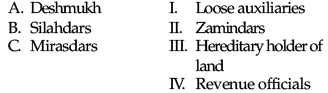
- a)[A-II],[B -III],[C-IV]
- b)[A-II],[B -I],[C-III]
- c)[A-III],[B-IV],[C-I]
- d)[A-III],[B-II],[C-I]
Correct answer is option 'B'. Can you explain this answer?
Match the following
a)
[A-II],[B -III],[C-IV]
b)
[A-II],[B -I],[C-III]
c)
[A-III],[B-IV],[C-I]
d)
[A-III],[B-II],[C-I]
| | Vaishnavi Mukherjee answered |
Chakali ailamma was a revolutionary leader during Telangana Rebellion. She fought against the atrocities of feudal lord, Zamindar Ramachandra Reddy, known as Visnoor Deshmukh, to save her four acres of land. Chityala Ailamma was born at Krishnapuram village in Rayaparthi Mandal Warangal district of Telangana State. She joined Andhra Maha Sabha and Communist party.
The regular army was called paga, while the loose auxiliaries called silahdars were supervised by havaldars who received fixed salaries. The forts were carefully supervised, Mavali foot soldiers and gunners being appointed there.
Thalkari or Mirasdars: Thalkari or Mirasdar paid land revenue, but were not officials and formed a large part of the village community, and were hereditary owners of the land.
The regular army was called paga, while the loose auxiliaries called silahdars were supervised by havaldars who received fixed salaries. The forts were carefully supervised, Mavali foot soldiers and gunners being appointed there.
Thalkari or Mirasdars: Thalkari or Mirasdar paid land revenue, but were not officials and formed a large part of the village community, and were hereditary owners of the land.
Shivaji sacked Surat again in 1670. After this he also raided the Mughal provinces of Berar, Baglana and Khandesh. What factor helped Shivaji?- a)The gradual decline of the Protuguese power on the western coast.
- b)The able assistance of Bijapur and Golcunda.
- c)Mughal preoccupation with the Afghan uprising in the northwest.
- d)None of these.
Correct answer is option 'C'. Can you explain this answer?
Shivaji sacked Surat again in 1670. After this he also raided the Mughal provinces of Berar, Baglana and Khandesh. What factor helped Shivaji?
a)
The gradual decline of the Protuguese power on the western coast.
b)
The able assistance of Bijapur and Golcunda.
c)
Mughal preoccupation with the Afghan uprising in the northwest.
d)
None of these.
 | Keerthana Shah answered |
Factors that helped Shivaji:
- Mughal preoccupation with the Afghan uprising: The Mughal Empire was facing challenges from the Afghan uprising in the northwest during Shivaji's raids. This preoccupation diverted Mughal attention and resources away from dealing with Shivaji's activities in the Deccan region, allowing him to carry out his raids successfully.
- The gradual decline of the Portuguese power: The decline of the Portuguese power on the western coast also played a significant role in Shivaji's success. With the weakening of the Portuguese presence, Shivaji was able to exploit the situation and expand his influence in the region without facing significant opposition from them.
- The able assistance of Bijapur and Golconda: Shivaji received support and assistance from the Sultanates of Bijapur and Golconda in his campaigns against the Mughals. This alliance provided Shivaji with additional resources and manpower, making it easier for him to carry out successful raids in Mughal provinces like Berar, Baglana, and Khandesh.
Overall, the combination of Mughal preoccupation with other challenges, the decline of Portuguese power, and the assistance from Bijapur and Golconda helped Shivaji in his military campaigns and raids during this period.
- Mughal preoccupation with the Afghan uprising: The Mughal Empire was facing challenges from the Afghan uprising in the northwest during Shivaji's raids. This preoccupation diverted Mughal attention and resources away from dealing with Shivaji's activities in the Deccan region, allowing him to carry out his raids successfully.
- The gradual decline of the Portuguese power: The decline of the Portuguese power on the western coast also played a significant role in Shivaji's success. With the weakening of the Portuguese presence, Shivaji was able to exploit the situation and expand his influence in the region without facing significant opposition from them.
- The able assistance of Bijapur and Golconda: Shivaji received support and assistance from the Sultanates of Bijapur and Golconda in his campaigns against the Mughals. This alliance provided Shivaji with additional resources and manpower, making it easier for him to carry out successful raids in Mughal provinces like Berar, Baglana, and Khandesh.
Overall, the combination of Mughal preoccupation with other challenges, the decline of Portuguese power, and the assistance from Bijapur and Golconda helped Shivaji in his military campaigns and raids during this period.

Chapter doubts & questions for The Maratha Age and Shivaji - 6 Months Preparation Course for OPSC 2026 is part of OPSC OCS (Odisha) exam preparation. The chapters have been prepared according to the OPSC OCS (Odisha) exam syllabus. The Chapter doubts & questions, notes, tests & MCQs are made for OPSC OCS (Odisha) 2026 Exam. Find important definitions, questions, notes, meanings, examples, exercises, MCQs and online tests here.
Chapter doubts & questions of The Maratha Age and Shivaji - 6 Months Preparation Course for OPSC in English & Hindi are available as part of OPSC OCS (Odisha) exam. Download more important topics, notes, lectures and mock test series for OPSC OCS (Odisha) Exam by signing up for free.
6 Months Preparation Course for OPSC636 videos|2472 docs|801 tests |
