


All Exams > OPSC OCS (Odisha) > 6 Months Preparation Course for OPSC > All Questions
All questions of Directive Principles of State Policy for OPSC OCS (Odisha) Exam
Which case foiled the attempt to accord primacy to the directives over fundamental rights?- a)State of Madras vs. Champakam (1951)
- b)A.B.Soshit Karamchari Sangh vs Union of India (1981)
- c)Kesavanand Bharati case (1973)
- d)Minerva Mills case (1980)
Correct answer is option 'D'. Can you explain this answer?
Which case foiled the attempt to accord primacy to the directives over fundamental rights?
a)
State of Madras vs. Champakam (1951)
b)
A.B.Soshit Karamchari Sangh vs Union of India (1981)
c)
Kesavanand Bharati case (1973)
d)
Minerva Mills case (1980)
 | Abhay Mukherjee answered |
In the case of Minerva Mills v. Union of India (1980), the Supreme Court of India held that the attempt to accord primacy to the directives over fundamental rights was unconstitutional.
The case involved a constitutional challenge to certain provisions of the 42nd Amendment Act, 1976, which had made significant changes to the Constitution of India. One of the key changes made by the amendment was the insertion of Article 31C, which sought to give primacy to the Directive Principles of State Policy over fundamental rights.
The Court, in a majority decision, struck down Article 31C as unconstitutional and upheld the primacy of fundamental rights. The following are the key reasons for the Court's decision:
1. Violation of the Basic Structure Doctrine:
The Court held that Article 31C violated the basic structure doctrine, which states that certain fundamental features of the Constitution cannot be amended. The Court reasoned that giving primacy to the directives over fundamental rights would undermine the balance and harmony between the two and upset the basic structure of the Constitution.
2. Restriction on Judicial Review:
Article 31C sought to restrict the power of judicial review by providing that laws made to implement the Directive Principles would not be invalidated on the ground of violation of fundamental rights. The Court held that such a restriction on judicial review was arbitrary and against the principles of separation of powers.
3. Equality before the Law:
The Court also noted that Article 31C violated the principle of equality before the law enshrined in Article 14 of the Constitution. By according primacy to the directives, the amendment would have allowed the State to discriminate against certain individuals or groups in the name of implementing social and economic policies.
4. Harmonious Construction:
Lastly, the Court emphasized the need for a harmonious construction of the Constitution, where fundamental rights and Directive Principles are read together. It held that both are complementary to each other and should be interpreted in a manner that upholds and promotes the welfare of the people.
In conclusion, the Minerva Mills case foiled the attempt to accord primacy to the directives over fundamental rights by striking down Article 31C of the Constitution. The Court upheld the importance of fundamental rights and the need for a harmonious balance between fundamental rights and Directive Principles.
The case involved a constitutional challenge to certain provisions of the 42nd Amendment Act, 1976, which had made significant changes to the Constitution of India. One of the key changes made by the amendment was the insertion of Article 31C, which sought to give primacy to the Directive Principles of State Policy over fundamental rights.
The Court, in a majority decision, struck down Article 31C as unconstitutional and upheld the primacy of fundamental rights. The following are the key reasons for the Court's decision:
1. Violation of the Basic Structure Doctrine:
The Court held that Article 31C violated the basic structure doctrine, which states that certain fundamental features of the Constitution cannot be amended. The Court reasoned that giving primacy to the directives over fundamental rights would undermine the balance and harmony between the two and upset the basic structure of the Constitution.
2. Restriction on Judicial Review:
Article 31C sought to restrict the power of judicial review by providing that laws made to implement the Directive Principles would not be invalidated on the ground of violation of fundamental rights. The Court held that such a restriction on judicial review was arbitrary and against the principles of separation of powers.
3. Equality before the Law:
The Court also noted that Article 31C violated the principle of equality before the law enshrined in Article 14 of the Constitution. By according primacy to the directives, the amendment would have allowed the State to discriminate against certain individuals or groups in the name of implementing social and economic policies.
4. Harmonious Construction:
Lastly, the Court emphasized the need for a harmonious construction of the Constitution, where fundamental rights and Directive Principles are read together. It held that both are complementary to each other and should be interpreted in a manner that upholds and promotes the welfare of the people.
In conclusion, the Minerva Mills case foiled the attempt to accord primacy to the directives over fundamental rights by striking down Article 31C of the Constitution. The Court upheld the importance of fundamental rights and the need for a harmonious balance between fundamental rights and Directive Principles.

Which of the following is NOT a difference between fundamental rights and directive principles?- a)Directives are not enforceable by the court, while fundamental rights are
- b)Directives are positive inducements, while fundamental rights are negative limitations
- c)Directives are implemented by the legislation, while fundamental rights are incorporated in the Constitution
- d)Directives can be declared void by courts, while fundamental rights cannot
Correct answer is option 'D'. Can you explain this answer?
Which of the following is NOT a difference between fundamental rights and directive principles?
a)
Directives are not enforceable by the court, while fundamental rights are
b)
Directives are positive inducements, while fundamental rights are negative limitations
c)
Directives are implemented by the legislation, while fundamental rights are incorporated in the Constitution
d)
Directives can be declared void by courts, while fundamental rights cannot
 | Dishani Choudhary answered |
Difference between Fundamental Rights and Directive Principles
Fundamental Rights and Directive Principles are two important provisions in the Indian Constitution that ensure the protection of individual rights and the development of the country. Here are the differences between the two:
Enforceability
- Fundamental Rights are justiciable and enforceable by the court, while Directive Principles are non-justiciable and not enforceable by the court.
- In other words, if a Fundamental Right is violated, the individual can approach the court for remedy, whereas if a Directive Principle is not implemented, the individual cannot approach the court.
Nature
- Fundamental Rights are negative limitations on the state's power, while Directive Principles are positive obligations on the state to ensure the welfare of the community.
- Fundamental Rights primarily focus on protecting individual rights, while Directive Principles primarily focus on promoting social and economic justice.
Incorporation
- Fundamental Rights are incorporated in Part III of the Indian Constitution, while Directive Principles are incorporated in Part IV.
- Fundamental Rights are enforceable against the state, while Directive Principles are merely guiding principles for the state.
Voidability
- Directives can be declared void by courts if they violate Fundamental Rights, while Fundamental Rights cannot be declared void.
- In other words, if a Directive Principle is implemented in a way that violates Fundamental Rights, it can be struck down by the court, whereas Fundamental Rights cannot be struck down by the court.
Conclusion
In conclusion, the main difference between Fundamental Rights and Directive Principles is their nature and enforceability. While Fundamental Rights are negative limitations on the state's power and enforceable by the court, Directive Principles are positive obligations on the state and non-justiciable.
Fundamental Rights and Directive Principles are two important provisions in the Indian Constitution that ensure the protection of individual rights and the development of the country. Here are the differences between the two:
Enforceability
- Fundamental Rights are justiciable and enforceable by the court, while Directive Principles are non-justiciable and not enforceable by the court.
- In other words, if a Fundamental Right is violated, the individual can approach the court for remedy, whereas if a Directive Principle is not implemented, the individual cannot approach the court.
Nature
- Fundamental Rights are negative limitations on the state's power, while Directive Principles are positive obligations on the state to ensure the welfare of the community.
- Fundamental Rights primarily focus on protecting individual rights, while Directive Principles primarily focus on promoting social and economic justice.
Incorporation
- Fundamental Rights are incorporated in Part III of the Indian Constitution, while Directive Principles are incorporated in Part IV.
- Fundamental Rights are enforceable against the state, while Directive Principles are merely guiding principles for the state.
Voidability
- Directives can be declared void by courts if they violate Fundamental Rights, while Fundamental Rights cannot be declared void.
- In other words, if a Directive Principle is implemented in a way that violates Fundamental Rights, it can be struck down by the court, whereas Fundamental Rights cannot be struck down by the court.
Conclusion
In conclusion, the main difference between Fundamental Rights and Directive Principles is their nature and enforceability. While Fundamental Rights are negative limitations on the state's power and enforceable by the court, Directive Principles are positive obligations on the state and non-justiciable.
Which amendment expanded the scope of the directive principles under Article 31C?- a)25th Amendment Act (1971)
- b)42nd Amendment Act (1976)
- c)73rd Amendment Act (1992)
- d)86th Amendment Act (2002)
Correct answer is option 'B'. Can you explain this answer?
Which amendment expanded the scope of the directive principles under Article 31C?
a)
25th Amendment Act (1971)
b)
42nd Amendment Act (1976)
c)
73rd Amendment Act (1992)
d)
86th Amendment Act (2002)
 | Kirti Singh answered |
The correct answer is option 'B,' which is the 42nd Amendment Act (1976). This amendment expanded the scope of the directive principles under Article 31C of the Indian Constitution.
Explanation:
1. Overview of Directive Principles and Article 31C:
- The Directive Principles of State Policy (DPSP) are a set of guidelines and principles given in Part IV of the Indian Constitution.
- They are non-justiciable in nature, meaning they cannot be enforced by courts. However, they serve as important principles for governance and policy-making.
- Article 31C was inserted into the Constitution by the 25th Amendment Act (1971) to give constitutional protection and precedence to certain directive principles.
2. The 42nd Amendment Act (1976):
- The 42nd Amendment Act is often referred to as the "Mini-Constitution" or the "Constitution of Indira."
- It was introduced during the tenure of Prime Minister Indira Gandhi and brought about significant changes to various aspects of the Constitution.
- This amendment aimed to strengthen the power of the central government and curtail the powers of states.
3. Expansion of Article 31C:
- The 42nd Amendment Act expanded the scope of Article 31C and provided additional protection to certain directive principles.
- Earlier, Article 31C protected only two directive principles: Article 39(b) and Article 39(c). These principles relate to the distribution of resources and the prevention of concentration of wealth and means of production.
- The 42nd Amendment Act added two more directive principles to the protection of Article 31C: Article 39(a) and Article 39(d).
- Article 39(a) directs the state to secure equal justice and free legal aid to economically weaker sections of society.
- Article 39(d) directs the state to secure just and humane conditions of work and maternity relief.
- By including these additional directive principles under Article 31C, the 42nd Amendment Act aimed to prioritize and give precedence to these principles over any laws that may be inconsistent with them.
In conclusion, the 42nd Amendment Act (1976) expanded the scope of the directive principles under Article 31C by adding two more principles, Article 39(a) and Article 39(d), to the protected list. This amendment aimed to prioritize and give constitutional protection to these directive principles.
Explanation:
1. Overview of Directive Principles and Article 31C:
- The Directive Principles of State Policy (DPSP) are a set of guidelines and principles given in Part IV of the Indian Constitution.
- They are non-justiciable in nature, meaning they cannot be enforced by courts. However, they serve as important principles for governance and policy-making.
- Article 31C was inserted into the Constitution by the 25th Amendment Act (1971) to give constitutional protection and precedence to certain directive principles.
2. The 42nd Amendment Act (1976):
- The 42nd Amendment Act is often referred to as the "Mini-Constitution" or the "Constitution of Indira."
- It was introduced during the tenure of Prime Minister Indira Gandhi and brought about significant changes to various aspects of the Constitution.
- This amendment aimed to strengthen the power of the central government and curtail the powers of states.
3. Expansion of Article 31C:
- The 42nd Amendment Act expanded the scope of Article 31C and provided additional protection to certain directive principles.
- Earlier, Article 31C protected only two directive principles: Article 39(b) and Article 39(c). These principles relate to the distribution of resources and the prevention of concentration of wealth and means of production.
- The 42nd Amendment Act added two more directive principles to the protection of Article 31C: Article 39(a) and Article 39(d).
- Article 39(a) directs the state to secure equal justice and free legal aid to economically weaker sections of society.
- Article 39(d) directs the state to secure just and humane conditions of work and maternity relief.
- By including these additional directive principles under Article 31C, the 42nd Amendment Act aimed to prioritize and give precedence to these principles over any laws that may be inconsistent with them.
In conclusion, the 42nd Amendment Act (1976) expanded the scope of the directive principles under Article 31C by adding two more principles, Article 39(a) and Article 39(d), to the protected list. This amendment aimed to prioritize and give constitutional protection to these directive principles.
Which case upheld the validity of the 25th Amendment Act?- a)State of Madras vs. Champakam (1951)
- b)A.B.Soshit Karamchari Sangh vs Union of India (1981)
- c)Kesavanand Bharati case (1973)
- d)Minerva Mills case (1980)
Correct answer is option 'C'. Can you explain this answer?
Which case upheld the validity of the 25th Amendment Act?
a)
State of Madras vs. Champakam (1951)
b)
A.B.Soshit Karamchari Sangh vs Union of India (1981)
c)
Kesavanand Bharati case (1973)
d)
Minerva Mills case (1980)
| | Rashi Mukherjee answered |
Explanation:
The 25th Amendment Act of the Indian Constitution was enacted in 1971. It was introduced to address the issues related to the election of the President and Vice-President of India. The amendment deals with the manner of election of the President and Vice-President, the conditions of their office, and the powers of the President to address the vacancies in the offices of the President and Vice-President.
Kesavananda Bharati case:
The Kesavananda Bharati case (1973) is one of the landmark cases in the history of the Indian judiciary. This case dealt with the validity of the 24th, 25th, and 29th amendments to the Indian Constitution. In this case, the Supreme Court upheld the validity of the 25th Amendment Act of 1971.
Arguments in favor of the 25th Amendment Act:
The government argued that the 25th Amendment Act was necessary to ensure the stability and continuity of the office of the President and Vice-President of India. The amendment provided for the election of the President and Vice-President by an electoral college consisting of elected members of the Parliament and the Legislative Assemblies.
Supreme Court's decision:
The Supreme Court, in its verdict, held that the 25th Amendment Act was valid as it did not violate the basic structure of the Indian Constitution. The court also held that the amendment was necessary to ensure the stability and continuity of the office of the President and Vice-President.
Conclusion:
The Kesavananda Bharati case is a landmark case as it established the principle of the basic structure of the Indian Constitution. It also upheld the validity of the 25th Amendment Act of 1971, which dealt with the election of the President and Vice-President of India.
The 25th Amendment Act of the Indian Constitution was enacted in 1971. It was introduced to address the issues related to the election of the President and Vice-President of India. The amendment deals with the manner of election of the President and Vice-President, the conditions of their office, and the powers of the President to address the vacancies in the offices of the President and Vice-President.
Kesavananda Bharati case:
The Kesavananda Bharati case (1973) is one of the landmark cases in the history of the Indian judiciary. This case dealt with the validity of the 24th, 25th, and 29th amendments to the Indian Constitution. In this case, the Supreme Court upheld the validity of the 25th Amendment Act of 1971.
Arguments in favor of the 25th Amendment Act:
The government argued that the 25th Amendment Act was necessary to ensure the stability and continuity of the office of the President and Vice-President of India. The amendment provided for the election of the President and Vice-President by an electoral college consisting of elected members of the Parliament and the Legislative Assemblies.
Supreme Court's decision:
The Supreme Court, in its verdict, held that the 25th Amendment Act was valid as it did not violate the basic structure of the Indian Constitution. The court also held that the amendment was necessary to ensure the stability and continuity of the office of the President and Vice-President.
Conclusion:
The Kesavananda Bharati case is a landmark case as it established the principle of the basic structure of the Indian Constitution. It also upheld the validity of the 25th Amendment Act of 1971, which dealt with the election of the President and Vice-President of India.
Which Amendment Act introduced Article 31C to protect a law seeking to implement a directive under 39 (b)-(c) from being declared ultra vires on the ground of contravening?- a)25th Amendment Act (1971)
- b)42nd Amendment Act (1976)
- c)73rd Amendment Act (1992)
- d)86th Amendment Act (2002)
Correct answer is option 'A'. Can you explain this answer?
Which Amendment Act introduced Article 31C to protect a law seeking to implement a directive under 39 (b)-(c) from being declared ultra vires on the ground of contravening?
a)
25th Amendment Act (1971)
b)
42nd Amendment Act (1976)
c)
73rd Amendment Act (1992)
d)
86th Amendment Act (2002)
 | Meera Mishra answered |
The correct answer is option 'A', which states that the 25th Amendment Act (1971) introduced Article 31C to protect a law seeking to implement a directive under 39 (b)-(c) from being declared ultra vires on the ground of contravening.
Explanation:
The 25th Amendment Act of 1971 was brought in to amend various provisions of the Constitution of India. One of the significant changes made by this amendment was the introduction of Article 31C.
Article 31C was added to the Constitution to protect laws that sought to implement the directive principles of state policy contained in Article 39(b) and (c) from being declared ultra vires on the ground of contravening the fundamental rights guaranteed under Articles 14, 19, and 31.
Let's break down the explanation further:
1. Introduction of Article 31C:
- The 25th Amendment Act introduced Article 31C into the Constitution of India.
- Article 31C is a constitutional provision that provides protection to laws aimed at implementing the directive principles of state policy.
2. Purpose of Article 31C:
- Article 31C was incorporated to ensure that laws made to implement the directive principles of state policy are not invalidated by the courts on the grounds of violating fundamental rights.
- The directive principles of state policy, enshrined in Part IV of the Constitution, are non-justiciable in nature. However, Article 31C was introduced to give them more teeth by providing immunity to laws enacted for their implementation.
3. Protection from Ultra Vires:
- Ultra vires means an act that is beyond the legal power or authority of the entity performing it.
- Article 31C protects laws that seek to implement the directive principles from being declared ultra vires on the grounds of contravening fundamental rights.
- This means that even if a law made to implement directive principles potentially violates fundamental rights, it cannot be struck down by the courts.
4. Grounds of Contravening:
- The grounds of contravening refer to the violation of fundamental rights guaranteed under Articles 14, 19, and 31 of the Indian Constitution.
- Article 14 ensures the right to equality, Article 19 guarantees certain fundamental freedoms, and Article 31 safeguards the right to property.
- Article 31C provides protection to laws implementing directive principles from being invalidated on the basis of contravening these fundamental rights.
In conclusion, the 25th Amendment Act (1971) introduced Article 31C into the Constitution of India to protect laws aimed at implementing the directive principles of state policy from being declared ultra vires on the grounds of contravening fundamental rights.
Explanation:
The 25th Amendment Act of 1971 was brought in to amend various provisions of the Constitution of India. One of the significant changes made by this amendment was the introduction of Article 31C.
Article 31C was added to the Constitution to protect laws that sought to implement the directive principles of state policy contained in Article 39(b) and (c) from being declared ultra vires on the ground of contravening the fundamental rights guaranteed under Articles 14, 19, and 31.
Let's break down the explanation further:
1. Introduction of Article 31C:
- The 25th Amendment Act introduced Article 31C into the Constitution of India.
- Article 31C is a constitutional provision that provides protection to laws aimed at implementing the directive principles of state policy.
2. Purpose of Article 31C:
- Article 31C was incorporated to ensure that laws made to implement the directive principles of state policy are not invalidated by the courts on the grounds of violating fundamental rights.
- The directive principles of state policy, enshrined in Part IV of the Constitution, are non-justiciable in nature. However, Article 31C was introduced to give them more teeth by providing immunity to laws enacted for their implementation.
3. Protection from Ultra Vires:
- Ultra vires means an act that is beyond the legal power or authority of the entity performing it.
- Article 31C protects laws that seek to implement the directive principles from being declared ultra vires on the grounds of contravening fundamental rights.
- This means that even if a law made to implement directive principles potentially violates fundamental rights, it cannot be struck down by the courts.
4. Grounds of Contravening:
- The grounds of contravening refer to the violation of fundamental rights guaranteed under Articles 14, 19, and 31 of the Indian Constitution.
- Article 14 ensures the right to equality, Article 19 guarantees certain fundamental freedoms, and Article 31 safeguards the right to property.
- Article 31C provides protection to laws implementing directive principles from being invalidated on the basis of contravening these fundamental rights.
In conclusion, the 25th Amendment Act (1971) introduced Article 31C into the Constitution of India to protect laws aimed at implementing the directive principles of state policy from being declared ultra vires on the grounds of contravening fundamental rights.
Which Directive is NOT included in Part IV of the Constitution but is still given attention by courts?- a)Article 350A
- b)Article 351
- c)Article 335
- d)All of the above
Correct answer is option 'D'. Can you explain this answer?
Which Directive is NOT included in Part IV of the Constitution but is still given attention by courts?
a)
Article 350A
b)
Article 351
c)
Article 335
d)
All of the above
| | Anjali Tiwari answered |
Article 350A, Article 351, and Article 335 are all directives that are not included in Part IV of the Constitution but are still given attention by courts.
1. Article 350A:
Article 350A states that it shall be the duty of the State to provide adequate facilities for instruction in the mother tongue at the primary stage of education to children belonging to linguistic minority groups. This directive emphasizes the importance of preserving and promoting linguistic diversity and ensuring that children from linguistic minority groups have access to education in their mother tongue. Although it is not included in Part IV of the Constitution, the courts have recognized its significance and have emphasized the need for the State to fulfill this duty.
2. Article 351:
Article 351 deals with the directive for the promotion of the Hindi language. It states that it shall be the duty of the Union to promote the spread of the Hindi language and to develop it so that it may serve as a medium of expression for all the elements of the composite culture of India. This directive recognizes the importance of Hindi as a language that can unify the diverse cultural and linguistic groups in the country. Although it is not included in Part IV, courts have given attention to this directive and have upheld the constitutional validity of laws that promote the use of Hindi.
3. Article 335:
Article 335 states that the claims of the members of the Scheduled Castes and Scheduled Tribes shall be taken into consideration, consistently with the maintenance of efficiency of administration, in the making of appointments to services and posts in connection with the affairs of the Union or of a State. This directive emphasizes the need to provide representation and reservation for the SC/ST communities in government services while also maintaining efficiency in administration. Although it is not included in Part IV, courts have given attention to this directive and have upheld the reservation policies for SC/ST communities.
In conclusion, Article 350A, Article 351, and Article 335 are all directives that are not included in Part IV of the Constitution but are still given attention by courts. These directives address important issues such as linguistic diversity, promotion of Hindi, and reservation for SC/ST communities, and the courts have recognized their significance in ensuring equality and inclusivity in society.
1. Article 350A:
Article 350A states that it shall be the duty of the State to provide adequate facilities for instruction in the mother tongue at the primary stage of education to children belonging to linguistic minority groups. This directive emphasizes the importance of preserving and promoting linguistic diversity and ensuring that children from linguistic minority groups have access to education in their mother tongue. Although it is not included in Part IV of the Constitution, the courts have recognized its significance and have emphasized the need for the State to fulfill this duty.
2. Article 351:
Article 351 deals with the directive for the promotion of the Hindi language. It states that it shall be the duty of the Union to promote the spread of the Hindi language and to develop it so that it may serve as a medium of expression for all the elements of the composite culture of India. This directive recognizes the importance of Hindi as a language that can unify the diverse cultural and linguistic groups in the country. Although it is not included in Part IV, courts have given attention to this directive and have upheld the constitutional validity of laws that promote the use of Hindi.
3. Article 335:
Article 335 states that the claims of the members of the Scheduled Castes and Scheduled Tribes shall be taken into consideration, consistently with the maintenance of efficiency of administration, in the making of appointments to services and posts in connection with the affairs of the Union or of a State. This directive emphasizes the need to provide representation and reservation for the SC/ST communities in government services while also maintaining efficiency in administration. Although it is not included in Part IV, courts have given attention to this directive and have upheld the reservation policies for SC/ST communities.
In conclusion, Article 350A, Article 351, and Article 335 are all directives that are not included in Part IV of the Constitution but are still given attention by courts. These directives address important issues such as linguistic diversity, promotion of Hindi, and reservation for SC/ST communities, and the courts have recognized their significance in ensuring equality and inclusivity in society.
In which case did the Supreme Court highlight the unenforceable nature of directive principles?- a)State of Madras vs. Champakam (1951)
- b)A.B.Soshit Karamchari Sangh vs Union of India (1981)
- c)Kesavanand Bharati case (1973)
- d)Minerva Mills case (1980)
Correct answer is option 'A'. Can you explain this answer?
In which case did the Supreme Court highlight the unenforceable nature of directive principles?
a)
State of Madras vs. Champakam (1951)
b)
A.B.Soshit Karamchari Sangh vs Union of India (1981)
c)
Kesavanand Bharati case (1973)
d)
Minerva Mills case (1980)
 | Sanjana Sen answered |
**Answer:**
The correct answer is option 'A' - State of Madras vs. Champakam (1951).
**Explanation:**
**Background:**
The State of Madras vs. Champakam case, also known as the First Amendment case, was a landmark case in Indian constitutional law that highlighted the unenforceable nature of directive principles.
**Directive Principles of State Policy:**
Directive Principles of State Policy are a set of guidelines or principles given in Part IV of the Indian Constitution. These principles are not enforceable by any court but are meant to guide the state in making laws and policies.
**Violation of Equality:**
In the State of Madras vs. Champakam case, the Madras government reserved seats in educational institutions for different communities based on their population. This reservation policy violated the principle of equality enshrined in Article 15(1) of the Indian Constitution.
**Supreme Court's Ruling:**
The Supreme Court held that the reservation policy violated the principle of equality and struck it down. In its judgment, the court highlighted the unenforceability of directive principles and stated that fundamental rights override directive principles.
**Conflict between Fundamental Rights and Directive Principles:**
The court observed that if there is a conflict between a fundamental right and a directive principle, the fundamental right will prevail. The court emphasized that the fundamental rights in Part III of the Constitution are enforceable, while the directive principles in Part IV are not enforceable.
**Balancing Fundamental Rights and Directive Principles:**
However, the court also recognized the importance of directive principles and stated that they should be used as a guide for the state in making laws and policies. The court emphasized the harmonious interpretation of fundamental rights and directive principles and urged the state to strike a balance between the two.
**Impact of the Judgment:**
The State of Madras vs. Champakam case highlighted the unenforceable nature of directive principles and the primacy of fundamental rights. It clarified the relationship between fundamental rights and directive principles and established that the fundamental rights have a higher legal status than directive principles.
**Conclusion:**
In the State of Madras vs. Champakam case, the Supreme Court emphasized the unenforceable nature of directive principles and held that fundamental rights override directive principles in case of a conflict. This landmark case clarified the status and importance of directive principles in Indian constitutional law.
The correct answer is option 'A' - State of Madras vs. Champakam (1951).
**Explanation:**
**Background:**
The State of Madras vs. Champakam case, also known as the First Amendment case, was a landmark case in Indian constitutional law that highlighted the unenforceable nature of directive principles.
**Directive Principles of State Policy:**
Directive Principles of State Policy are a set of guidelines or principles given in Part IV of the Indian Constitution. These principles are not enforceable by any court but are meant to guide the state in making laws and policies.
**Violation of Equality:**
In the State of Madras vs. Champakam case, the Madras government reserved seats in educational institutions for different communities based on their population. This reservation policy violated the principle of equality enshrined in Article 15(1) of the Indian Constitution.
**Supreme Court's Ruling:**
The Supreme Court held that the reservation policy violated the principle of equality and struck it down. In its judgment, the court highlighted the unenforceability of directive principles and stated that fundamental rights override directive principles.
**Conflict between Fundamental Rights and Directive Principles:**
The court observed that if there is a conflict between a fundamental right and a directive principle, the fundamental right will prevail. The court emphasized that the fundamental rights in Part III of the Constitution are enforceable, while the directive principles in Part IV are not enforceable.
**Balancing Fundamental Rights and Directive Principles:**
However, the court also recognized the importance of directive principles and stated that they should be used as a guide for the state in making laws and policies. The court emphasized the harmonious interpretation of fundamental rights and directive principles and urged the state to strike a balance between the two.
**Impact of the Judgment:**
The State of Madras vs. Champakam case highlighted the unenforceable nature of directive principles and the primacy of fundamental rights. It clarified the relationship between fundamental rights and directive principles and established that the fundamental rights have a higher legal status than directive principles.
**Conclusion:**
In the State of Madras vs. Champakam case, the Supreme Court emphasized the unenforceable nature of directive principles and held that fundamental rights override directive principles in case of a conflict. This landmark case clarified the status and importance of directive principles in Indian constitutional law.
What is the principle that courts should adopt when a law is challenged as constituting an invasion of the fundamental rights specified in Articles 14, 19, or 31?- a)Reasonable classification
- b)Reasonable restriction
- c)Public purpose
- d)Harmonious construction
Correct answer is option 'D'. Can you explain this answer?
What is the principle that courts should adopt when a law is challenged as constituting an invasion of the fundamental rights specified in Articles 14, 19, or 31?
a)
Reasonable classification
b)
Reasonable restriction
c)
Public purpose
d)
Harmonious construction
 | Mehul Sengupta answered |
The principle that courts should adopt when a law is challenged as constituting an invasion of the fundamental rights specified in Articles 14, 19, or 31 is "harmonious construction."
Explanation:
"Harmonious construction" refers to the interpretation of laws in a way that reconciles conflicting provisions and ensures the preservation of fundamental rights. It is a guiding principle for courts to strike a balance between the exercise of governmental power and the protection of individual rights.
Fundamental rights are enshrined in the Constitution of India, particularly in Articles 14, 19, and 31. Article 14 guarantees the right to equality and prohibits discrimination. Article 19 guarantees certain freedoms, such as the freedom of speech and expression, assembly, association, etc. Article 31 guarantees the right to property.
When a law is challenged as an invasion of these fundamental rights, the court's role is to interpret the law in a manner that upholds the spirit of the Constitution and ensures the protection of these rights. The principle of harmonious construction requires the court to reconcile conflicting provisions and interpret the law in a way that minimizes any infringement on fundamental rights.
In applying the principle of harmonious construction, the court may consider various factors such as the purpose of the law, the intent of the legislature, the overall scheme of the Constitution, and the need to balance individual rights with the legitimate interests of the state. The court may also review the reasonableness of the restriction imposed by the law and whether it is necessary to achieve a legitimate aim.
By adopting the principle of harmonious construction, courts aim to strike a balance between individual rights and the exercise of governmental power. This ensures that laws are interpreted and applied in a manner that respects and protects fundamental rights, while also recognizing the legitimate needs and interests of the state.
Explanation:
"Harmonious construction" refers to the interpretation of laws in a way that reconciles conflicting provisions and ensures the preservation of fundamental rights. It is a guiding principle for courts to strike a balance between the exercise of governmental power and the protection of individual rights.
Fundamental rights are enshrined in the Constitution of India, particularly in Articles 14, 19, and 31. Article 14 guarantees the right to equality and prohibits discrimination. Article 19 guarantees certain freedoms, such as the freedom of speech and expression, assembly, association, etc. Article 31 guarantees the right to property.
When a law is challenged as an invasion of these fundamental rights, the court's role is to interpret the law in a manner that upholds the spirit of the Constitution and ensures the protection of these rights. The principle of harmonious construction requires the court to reconcile conflicting provisions and interpret the law in a way that minimizes any infringement on fundamental rights.
In applying the principle of harmonious construction, the court may consider various factors such as the purpose of the law, the intent of the legislature, the overall scheme of the Constitution, and the need to balance individual rights with the legitimate interests of the state. The court may also review the reasonableness of the restriction imposed by the law and whether it is necessary to achieve a legitimate aim.
By adopting the principle of harmonious construction, courts aim to strike a balance between individual rights and the exercise of governmental power. This ensures that laws are interpreted and applied in a manner that respects and protects fundamental rights, while also recognizing the legitimate needs and interests of the state.
Match the correct pair:
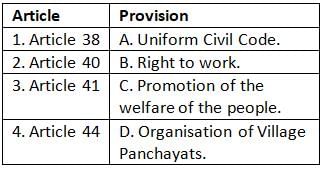
- a)1 - A, 2 - B, 3 - C, 4 - D
- b)1 - C, 2 - B, 3 - D, 4 - A
- c)1 - C, 2 - D, 3 - B, 4 - A
- d)More than one of the above
Correct answer is option 'C'. Can you explain this answer?
Match the correct pair:
a)
1 - A, 2 - B, 3 - C, 4 - D
b)
1 - C, 2 - B, 3 - D, 4 - A
c)
1 - C, 2 - D, 3 - B, 4 - A
d)
More than one of the above
 | T.S Academy answered |
Important Articles related to DPSP:
- Article 38 - Promotion of welfare of the people.
- Article 40 - Organisation of Village Panchayats.
- Article 41 - Right to work, education, and to public assistance in certain cases.
- Article 44 - Uniform Civil Code (UCC) for the citizens.
- Article 42 - Provision of Maternity Relief is given under.
Chapter doubts & questions for Directive Principles of State Policy - 6 Months Preparation Course for OPSC 2026 is part of OPSC OCS (Odisha) exam preparation. The chapters have been prepared according to the OPSC OCS (Odisha) exam syllabus. The Chapter doubts & questions, notes, tests & MCQs are made for OPSC OCS (Odisha) 2026 Exam. Find important definitions, questions, notes, meanings, examples, exercises, MCQs and online tests here.
Chapter doubts & questions of Directive Principles of State Policy - 6 Months Preparation Course for OPSC in English & Hindi are available as part of OPSC OCS (Odisha) exam. Download more important topics, notes, lectures and mock test series for OPSC OCS (Odisha) Exam by signing up for free.
6 Months Preparation Course for OPSC636 videos|2472 docs|801 tests |
