


All Exams > Class 10 > 30 Days Revision for Class 10 > All Questions
All questions of Power Sharing for Class 10 Exam
In Belgium, the percentage of French community is- a)54%
- b)40%
- c)30%
- d)20%
Correct answer is option 'B'. Can you explain this answer?
In Belgium, the percentage of French community is
a)
54%
b)
40%
c)
30%
d)
20%
 | Vivek Rana answered |
In Belgium total population divided as:
- 40% of the population belongs to French Community.
- 59% of the population belongs to the Flemish Community.
- 1% to the German-speaking Community.

Assertion and Reason Type Questions:In the question given below, there are two statements marked as Assertion (A) and Reason (R). Read the statements and choose the correct option:Assertion (A) : Power can be shared among governments at different levels.Reason (R) : Power may also share among different social groups.- a)Both (A) and (R) are true and (R) is the correct explanation of (A).
- b)Both (A) and (R) are true but (R) is not the correct explanation of (A).
- c)(A) is correct but (R) is wrong.
- d)(A) is wrong but (R) is correct.
Correct answer is option 'B'. Can you explain this answer?
Assertion and Reason Type Questions:
In the question given below, there are two statements marked as Assertion (A) and Reason (R). Read the statements and choose the correct option:
Assertion (A) : Power can be shared among governments at different levels.
Reason (R) : Power may also share among different social groups.
a)
Both (A) and (R) are true and (R) is the correct explanation of (A).
b)
Both (A) and (R) are true but (R) is not the correct explanation of (A).
c)
(A) is correct but (R) is wrong.
d)
(A) is wrong but (R) is correct.
 | Anita Menon answered |
- Power is shared among different organs of government, such as the legislature, executive and judiciary. This is called horizontal distribution of power because it allows different organs of government placed at the same level to exercise different powers.
- Power may be shared among different social groups such as the religious and linguistic groups. In some countries, there are constitutional and legal arrangements whereby socially weaker sections and women are represented in the legislatures and administration.
Which two languages are generally spoken in Belgium?- a)French and English
- b)Dutch and English
- c)French and Dutch
- d)Dutch and Sinhala
Correct answer is option 'C'. Can you explain this answer?
Which two languages are generally spoken in Belgium?
a)
French and English
b)
Dutch and English
c)
French and Dutch
d)
Dutch and Sinhala
 | Kiran Mehta answered |
The two languages are generally spoken in Belgium French and Dutch.
Dutch is the official language of the Flemish Community and the Flemish Region (merged to Flanders).
French, an official language of the Brussels-Capital Region.
Dutch is the official language of the Flemish Community and the Flemish Region (merged to Flanders).
French, an official language of the Brussels-Capital Region.
Can you explain the answer of this question below:Which community was rich and powerful in Belgium?
- A:
German
- B:
French
- C:
Dutch
- D:
None of the above.
The answer is b.
Which community was rich and powerful in Belgium?
German
French
Dutch
None of the above.
 | Arshiya Mehta answered |
The French community in Belgium is the powerful and rich community .
French is one of the three official languages of Belgium apart from Dutch and German.
Nearly 39% of the people in Belgium speak French, and here all major official documentations are written in the French language also.
Which of the following community is in majority in Sri Lanka? - a)Tamil
- b)Sinhalese
- c)Muslim
- d)Hindu
Correct answer is option 'B'. Can you explain this answer?
Which of the following community is in majority in Sri Lanka?
a)
Tamil
b)
Sinhalese
c)
Muslim
d)
Hindu
 | Neha Joshi answered |
The Sinhala community is still the largest majority by far, and constitute 74.9% of the population. The Sri Lankan Tamils are the second largest and now number 11.2%, with the third largest community being the Sri Lankan Moors who make up 9.3% of the population according to the 2012 census.
How many languages are scheduled in the Indian Constitution? - a)22
- b)21
- c)18
- d)20
Correct answer is option 'A'. Can you explain this answer?
a)
22
b)
21
c)
18
d)
20
| | Alok Verma answered |
The table below lists the 22 languages set out in the Eighth Schedule as of May 2008, together with the regions where they are used. Even though the English language is not included in the Eighth Schedule (as it is a foreign language), it is one of the official languages of the Union of India.
Which of the following is very important factor for better understanding between Center and State’s Government?- a)Emergence of regional political party
- b)the beginning of the era of coalition government
- c)when no single party got a clear majority
- d)all the above factors
Correct answer is option 'D'. Can you explain this answer?
a)
Emergence of regional political party
b)
the beginning of the era of coalition government
c)
when no single party got a clear majority
d)
all the above factors
| | Kavita Shah answered |
The rising era of Coalition government and regional politics has given rise to inter-relation between center and state governments. The word 'coalition' means a collective type that decides to work collectively jointly in an alliance to achieve a shared goal between two or more individuals, factions, governments, political parties, military forces, etc. Tolerance and in case of no single party rule makes it easier.
Which is the only official language of Sri Lanka? - a)Tamil
- b)Malyalam
- c)Sinhala
- d)None of the above.
Correct answer is option 'C'. Can you explain this answer?
a)
Tamil
b)
Malyalam
c)
Sinhala
d)
None of the above.
| | Anjali Kapoor answered |
The official languages of Sri Lanka is Sinhalese. It is the Sinhalese people's native language, who total approximately 16 million. An additional 4 million speak Sinhalese as a second language. This language belongs to the Indo-European language family. Within that category, is part of the Indo-Aryan branch. It is written with the Sinhalese alphabet which descends from the ancient Indian Brahmi writing. Modern-Sinhalese is traced to the Dravidian language as well as Pali and the medieval version of Sinhalese. It has also borrowed words from Tamil, Portuguese, Dutch, and English. The Rodiya community within Sri Lanka speaks a dialect of Sinhalese called Rodiya. It is considered an indication of belonging to a lower-caste in the society.
Main significance of Belgium Model of Power Sharing- a)Majoritarianism
- b)power shared in all ethnic groups according to their population
- c)on the basis of adult franchise
- d)none of the above
Correct answer is option 'B'. Can you explain this answer?
Main significance of Belgium Model of Power Sharing
a)
Majoritarianism
b)
power shared in all ethnic groups according to their population
c)
on the basis of adult franchise
d)
none of the above
| | Aruna Singh answered |
In the belgium model of power sharing
1-The state governments are not subordinate to the central which means they are not answerable to them.
2-Many powers of the central are given to the states.
3-The Dutch and the French enjoy a majority over each other in the whoe nation and the capital respectively . Thus Both the communities have equal number of representatives in the central as well as the Brussels's government.
4-There is a third government known as the community government which is elected by people belonging to one language , irrespective of where they live. This government has the power on cultural matters.
1-The state governments are not subordinate to the central which means they are not answerable to them.
2-Many powers of the central are given to the states.
3-The Dutch and the French enjoy a majority over each other in the whoe nation and the capital respectively . Thus Both the communities have equal number of representatives in the central as well as the Brussels's government.
4-There is a third government known as the community government which is elected by people belonging to one language , irrespective of where they live. This government has the power on cultural matters.
Can you explain the answer of this question below:Which of the following is not a federal country?- A:India
- B:Belgium
- C:USA
- D:Malaysia
The answer is D.
| | Vikram Kapoor answered |
Correct Answer :- D
China is not a federal country. There is a communist party in China. Federal is relating to a system of government in which several states form a unity but remain independent in internal affairs.
Belgium shares its border with- a)France
- b)Germany
- c)Luxembourg
- d)all the above
Correct answer is option 'D'. Can you explain this answer?
Belgium shares its border with
a)
France
b)
Germany
c)
Luxembourg
d)
all the above
| | Avinash Patel answered |
Belgium is a federal state located in Western Europe, bordering the North Sea.
Belgium shares borders with:
- France (556 km)
- Germany (133 km)
- Luxembourg (130 km)
- Netherlands (478 km)
Power struggle demanding separate Eelam was launched by:- a)Sinhalese
- b)Buddhists
- c)Tamilians
- d)None of the above
Correct answer is option 'C'. Can you explain this answer?
Power struggle demanding separate Eelam was launched by:
a)
Sinhalese
b)
Buddhists
c)
Tamilians
d)
None of the above
| | Kiran Mehta answered |
Due to the policy of majoritarianism Tamilians were suppressed under the supremacy of sinhalese. So, they launched movements against this and demanded a separate Eelam.
Match List-I (forms of power-sharing) with List-II (forms of government) and select the correct answer using the codes given below the lists :
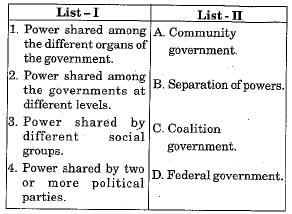
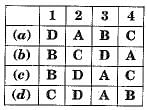
- a)a
- b)b
- c)c
- d)d
Correct answer is option 'C'. Can you explain this answer?
Match List-I (forms of power-sharing) with List-II (forms of government) and select the correct answer using the codes given below the lists :
a)
a
b)
b
c)
c
d)
d
| | Krishna Iyer answered |
(1) In a democracy, power is shared among different organs of government i.e. legislature, executive, and judiciary. This is known as the horizontal distribution of power because it allows different organs of government placed at the same level to exercise different powers.
(2) Federalism is the system of government in which power is divided between a central government and regional governments; in the United States, both the national government and the state governments possess a large measure of sovereignty.
(3) Power may also be shared among different social groups such as the religious and linguistic groups. ‘Community government’ in Belgium is a good example of this arrangement.
(4) Power shared by two or more political parties is the Coalition government.
Thus, option C is correct.
Can you explain the answer of this question below:How many people speak French and Dutch in the capital city of Brussels?- A:60 % French 40 % Dutch
- B:50% Dutch 50% French
- C:80% French 20% Dutch
- D:80% Dutch 20% French
The answer is C.
 | Poonam Reddy answered |
The capital of Brussels,80% people speak French while 20% people speak Dutch. In capital French were in majority and Dutch were in minority and whereas in the total population Dutch were in majority and French were in minority. The minority French people were rich and powerful.
DIRECTION : Mark the option which is most suitable:Assertion : Power should reside with one person and group located at one place in a democracy.Reason : If the power is dispersed, it will not be possible to take decision quickly and enforce it.- a)If both assertion and reason are true and reason is the correct explanation of assertion.
- b)If both assertion and reason are true but reason is not the correct explanation of assertion.
- c)If assertion is true but reason is false.
- d)If assertion is false and reason is true
Correct answer is option 'D'. Can you explain this answer?
DIRECTION : Mark the option which is most suitable:
Assertion : Power should reside with one person and group located at one place in a democracy.
Reason : If the power is dispersed, it will not be possible to take decision quickly and enforce it.
a)
If both assertion and reason are true and reason is the correct explanation of assertion.
b)
If both assertion and reason are true but reason is not the correct explanation of assertion.
c)
If assertion is true but reason is false.
d)
If assertion is false and reason is true
 | Radha Iyer answered |
In a good democratic government, due respect is given to diverse groups and views that exist in the society. Hence, political power should be distributed among citizens.
DIRECTION : Mark the option which is most suitable:Assertion : Tyranny of majority is highly desirable.Reason : It helps in making the political order more stable.- a)If both assertion and reason are true and reason is the correct explanation of assertion.
- b)If both assertion and reason are true but reason is not the correct explanation of assertion.
- c)If assertion is true but reason is false.
- d)If both assertion and reason are false.
Correct answer is option 'D'. Can you explain this answer?
DIRECTION : Mark the option which is most suitable:
Assertion : Tyranny of majority is highly desirable.
Reason : It helps in making the political order more stable.
a)
If both assertion and reason are true and reason is the correct explanation of assertion.
b)
If both assertion and reason are true but reason is not the correct explanation of assertion.
c)
If assertion is true but reason is false.
d)
If both assertion and reason are false.
| | Anjana Khatri answered |
Both Assertion and Reason are false.
Here are the reasons:
Hence, the Correct Answer is Option D
Here are the reasons:
• Tyranny of the majority: Tyranny of the majority means imposing the will and power of the majority on the minorities.
• Revolts by the minorities: Tyranny of the majority is never desirable since it leads to social conflicts and revolts by the minorities. Moreover, it harms even the majority. This may lead to civil wars between the groups.
• Social Conflicts: The social conflicts in any country always give rise to the chaotic political order in the country.
Hence, the Correct Answer is Option D
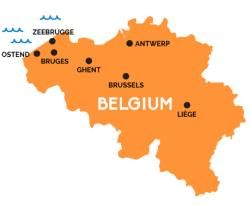
Get to know all key concepts of Class 10 Chapter Power Sharing through the document

Assertion and Reason Type Questions:In the question given below, there are two statements marked as Assertion (A) and Reason (R). Read the statements and choose the correct option:Assertion (A) : The Belgian leaders recognized the existence of regional differences and cultural diversities.Reason (R) : Between 1970 and 1993, they amended their constitution four times so as to work out an arrangement that would enable everyone to live together within the same country.- a)Both (A) and (R) are true and (R) is the correct explanation of (A).
- b)Both (A) and (R) are true but (R) is not the correct explanation of (A).
- c)(A) is correct but (R) is wrong.
- d)(A) is wrong but (R) is correct.
Correct answer is option 'A'. Can you explain this answer?
Assertion and Reason Type Questions:
In the question given below, there are two statements marked as Assertion (A) and Reason (R). Read the statements and choose the correct option:
Assertion (A) : The Belgian leaders recognized the existence of regional differences and cultural diversities.
Reason (R) : Between 1970 and 1993, they amended their constitution four times so as to work out an arrangement that would enable everyone to live together within the same country.
a)
Both (A) and (R) are true and (R) is the correct explanation of (A).
b)
Both (A) and (R) are true but (R) is not the correct explanation of (A).
c)
(A) is correct but (R) is wrong.
d)
(A) is wrong but (R) is correct.
| | Vivek Rana answered |
- In Belgium, the leaders recognized the existence of regional differences and cultural diversities. Between 1970 and 1993, they amended their constitution four times so as to work out an arrangement that would enable everyone to live together within the same country.
- The constitution of Belgium is known as the best in the world. It has been amended four times between 1970 to 1993 only to arrange so that the diverse communities can reside together peacefully within the same country without any conflicts.
Who are the minority community in Belgium?- a)English Speaking
- b)French Speaking
- c)Dutch Speaking
- d)None
Correct answer is option 'B'. Can you explain this answer?
Who are the minority community in Belgium?
a)
English Speaking
b)
French Speaking
c)
Dutch Speaking
d)
None
| | Dheeraj kumar answered |
The Minority Community in Belgium: French Speaking
Belgium is a country that is divided into two main linguistic communities: the Dutch-speaking Flemish community and the French-speaking Walloon community. There is also a small German-speaking community. The French-speaking community is considered a minority community in Belgium, and this is the correct answer to the question.
Reasons for the Minority Status
There are historical and political reasons for the minority status of the French-speaking community in Belgium. Belgium was originally a Dutch-speaking country, but after the Belgian Revolution in 1830, the French-speaking community gained more power and influence. This led to tensions between the Dutch-speaking and French-speaking communities, which were exacerbated by political and economic differences.
The linguistic divide in Belgium has also led to a lack of integration and communication between the two communities. This has resulted in the French-speaking community being marginalized and considered a minority community within Belgium.
Impact on Society
The minority status of the French-speaking community in Belgium has had an impact on society in various ways. For example:
- Political representation: The French-speaking community has less political representation than the Dutch-speaking community, which has led to a lack of voice and influence in government decisions.
- Education: The French-speaking community has its own education system, which is separate from the Dutch-speaking community. This has led to a lack of integration between the two communities and has perpetuated the linguistic divide.
- Economic opportunities: The linguistic divide has also led to a lack of economic opportunities for the French-speaking community, particularly in the Dutch-speaking regions of Belgium.
Conclusion
In conclusion, the minority community in Belgium is the French-speaking community. This is due to historical, political, and linguistic reasons, which have led to a lack of integration, representation, and opportunities for this community.
Belgium is a country that is divided into two main linguistic communities: the Dutch-speaking Flemish community and the French-speaking Walloon community. There is also a small German-speaking community. The French-speaking community is considered a minority community in Belgium, and this is the correct answer to the question.
Reasons for the Minority Status
There are historical and political reasons for the minority status of the French-speaking community in Belgium. Belgium was originally a Dutch-speaking country, but after the Belgian Revolution in 1830, the French-speaking community gained more power and influence. This led to tensions between the Dutch-speaking and French-speaking communities, which were exacerbated by political and economic differences.
The linguistic divide in Belgium has also led to a lack of integration and communication between the two communities. This has resulted in the French-speaking community being marginalized and considered a minority community within Belgium.
Impact on Society
The minority status of the French-speaking community in Belgium has had an impact on society in various ways. For example:
- Political representation: The French-speaking community has less political representation than the Dutch-speaking community, which has led to a lack of voice and influence in government decisions.
- Education: The French-speaking community has its own education system, which is separate from the Dutch-speaking community. This has led to a lack of integration between the two communities and has perpetuated the linguistic divide.
- Economic opportunities: The linguistic divide has also led to a lack of economic opportunities for the French-speaking community, particularly in the Dutch-speaking regions of Belgium.
Conclusion
In conclusion, the minority community in Belgium is the French-speaking community. This is due to historical, political, and linguistic reasons, which have led to a lack of integration, representation, and opportunities for this community.
Can you explain the answer of this question below:Why did the Sri Lankan Tamils launch parties and struggle?- A:to adopt majoritarianism
- B:to recognise Sinhalese as the only official language
- C: to recognise Tamil as an official language
- D:to dominate other language
The answer is C.
| | Aruna Singh answered |
The Sri Lankan Tamils launched parties and struggles for the recognition of Tamil as an official language, for regional autonomy and equality of opportunity in securing education and jobs. But their demand for more autonomy to provinces populated by the Tamils was repeatedly denied. By 1980s several political organizations were formed demanding an independent Tamil Elam (state) in northern and eastern parts of Sri Lanka. The distrust between the two communities turned into widespread conflict. It soon turned into a Civil War.
DIRECTION : Mark the option which is most suitable:Assertion : There was a feeling of alienation among Sri Lankan Tamils.Reason : The Sri Lankan government denied them equal political rights and discriminated against them in getting jobs and other opportunities,- a)If both assertion and reason are true and reason is the correct explanation of assertion.
- b)If both assertion and reason are true but reason is not the correct explanation of assertion.
- c)If assertion is true but reason is false.
- d)If both assertion and reason are false.
Correct answer is option 'A'. Can you explain this answer?
DIRECTION : Mark the option which is most suitable:
Assertion : There was a feeling of alienation among Sri Lankan Tamils.
Reason : The Sri Lankan government denied them equal political rights and discriminated against them in getting jobs and other opportunities,
a)
If both assertion and reason are true and reason is the correct explanation of assertion.
b)
If both assertion and reason are true but reason is not the correct explanation of assertion.
c)
If assertion is true but reason is false.
d)
If both assertion and reason are false.
| | Avinash Patel answered |
An act was passed in 1956 to recognize Sinhala as an official language. The government of Sri Lanka favoured people from Sinhala community for higher education and government jobs. It led to resentment among Sri Lankan Tamils as government was not sensitive to their culture and language.
What is a coalition government? - a)power shared among different social group
- b)power shared among different levels of government
- c)power shared among different political parties
- d)power shared among different organs of government
Correct answer is option 'C'. Can you explain this answer?
a)
power shared among different social group
b)
power shared among different levels of government
c)
power shared among different political parties
d)
power shared among different organs of government
| | Vikas Choudhury answered |
A coalition government is formed when two or more political parties join forces in order to create a majority. It's done in a bid to win an election under circumstances when the individual parties don't have nearly enough support to be elected by themselves, or following a "hung" election where there is no clear winner.
Other situations where a coalition may be formed is in times of war, economic crisis, or some other crisis where it's more important to work together than to follow normal political procedure.
Obviously, a coalition party has to compromise on certain issues, work together under circumstances where they normally wouldn't, and this can cause problems.
Some nay-sayers believe that such governments have a tendency to be fractious and prone to disharmony, because the individual parties hold differing beliefs and normally disagree on particular issues. At times, it's been known for polar opposite parties to come together as a coalition, and some argue that this is suboptimal and tends to add inertia to the political process.
Which one of the following is correct regarding power sharing?
A. It leads to conflict between different groups.
B. It ensures the stability of the country.
C. It helps to reduce the conflict between different groups. - a)Only A is true
- b)Only B is true
- c)Both A and B are true
- d)Both B and C are true
Correct answer is option 'D'. Can you explain this answer?
Which one of the following is correct regarding power sharing?
A. It leads to conflict between different groups.
B. It ensures the stability of the country.
C. It helps to reduce the conflict between different groups.
A. It leads to conflict between different groups.
B. It ensures the stability of the country.
C. It helps to reduce the conflict between different groups.
a)
Only A is true
b)
Only B is true
c)
Both A and B are true
d)
Both B and C are true
| | Kaavya Gupta answered |
Power sharing is a strategy that ensures that different groups have access to power and resources in society. It is an essential feature of a democracy and helps to prevent conflicts between different groups. The correct option is D, which means that both B and C are true.
Importance of power sharing:
- Helps to reduce conflicts: Power sharing helps to reduce conflicts between different groups by ensuring that each group has a say in how resources are allocated and decisions are made.
- Ensures stability: Power sharing ensures stability by preventing one group from dominating others. It helps to maintain a balance of power and prevents the abuse of power.
- Promotes inclusiveness: Power sharing promotes inclusiveness by giving voice to different groups. It ensures that the needs and interests of all groups are taken into account when making decisions.
- Fosters cooperation: Power sharing fosters cooperation between different groups. It encourages them to work together for the common good of society.
- Enhances democracy: Power sharing is an essential feature of a democracy. It ensures that power is distributed among different groups, and that no single group can monopolize power.
Conclusion:
In conclusion, power sharing is essential for the stability and development of a country. It helps to reduce conflicts between different groups, ensures inclusiveness, fosters cooperation, and enhances democracy. It is a critical strategy for promoting peace, prosperity, and progress in society.
Importance of power sharing:
- Helps to reduce conflicts: Power sharing helps to reduce conflicts between different groups by ensuring that each group has a say in how resources are allocated and decisions are made.
- Ensures stability: Power sharing ensures stability by preventing one group from dominating others. It helps to maintain a balance of power and prevents the abuse of power.
- Promotes inclusiveness: Power sharing promotes inclusiveness by giving voice to different groups. It ensures that the needs and interests of all groups are taken into account when making decisions.
- Fosters cooperation: Power sharing fosters cooperation between different groups. It encourages them to work together for the common good of society.
- Enhances democracy: Power sharing is an essential feature of a democracy. It ensures that power is distributed among different groups, and that no single group can monopolize power.
Conclusion:
In conclusion, power sharing is essential for the stability and development of a country. It helps to reduce conflicts between different groups, ensures inclusiveness, fosters cooperation, and enhances democracy. It is a critical strategy for promoting peace, prosperity, and progress in society.
Federalism is:- a)a form of unitary government
- b)a government with two or multi levels of government
- c)a form of autocratic government
- d)a & c
Correct answer is option 'B'. Can you explain this answer?
a)
a form of unitary government
b)
a government with two or multi levels of government
c)
a form of autocratic government
d)
a & c
 | Akanksha Joshi answered |
Federalism is a system of government in which the power is divided between a central authority andvarious constituent units of the country. Usually, a federation has two levels of government.
How many subjects are enlisted in the Concurrent List? - a)66
- b)62
- c)52
- d)68
Correct answer is option 'C'. Can you explain this answer?
How many subjects are enlisted in the Concurrent List?
a)
66
b)
62
c)
52
d)
68
 | Damini Skandhwasini answered |
97/100 central list
61-state list
47/52- concurrent
*currently enlisted/maximum strength
61-state list
47/52- concurrent
*currently enlisted/maximum strength
59 per cent of the country’s total population who speaks Dutch, lives in - a)Wallonia region
- b)Brussels
- c)Flemish region
- d)None of these
Correct answer is option 'C'. Can you explain this answer?
a)
Wallonia region
b)
Brussels
c)
Flemish region
d)
None of these
 | Aditi Iyer answered |
The correct answer is option 'C', which states that 59 per cent of the country's total population who speaks Dutch lives in the Flemish region. Here is a detailed explanation of why this option is correct:
Flanders is the northern region of Belgium, and it is home to the majority of the country's Dutch-speaking population. Dutch is one of the three official languages of Belgium, along with French and German. The distribution of these languages is not uniform across the country, and there are three main linguistic regions in Belgium:
1. The Flemish Region: This region encompasses the provinces of Antwerp, Limburg, East Flanders, West Flanders, and Flemish Brabant. It is predominantly Dutch-speaking and home to about 6.5 million people, which is approximately 59 per cent of Belgium's population who speaks Dutch.
2. The Walloon Region: This region covers the provinces of Hainaut, Liège, Luxembourg, Namur, Walloon Brabant, and the French-speaking part of Brussels. It is predominantly French-speaking and home to about 3.6 million people.
3. The Brussels-Capital Region: This is a bilingual region that includes the City of Brussels and 18 surrounding municipalities. It is home to about 1.2 million people, and both French and Dutch are official languages.
Therefore, option 'C' is correct because it correctly identifies the Flemish region as the place where the majority of the Dutch-speaking population of Belgium lives.
Flanders is the northern region of Belgium, and it is home to the majority of the country's Dutch-speaking population. Dutch is one of the three official languages of Belgium, along with French and German. The distribution of these languages is not uniform across the country, and there are three main linguistic regions in Belgium:
1. The Flemish Region: This region encompasses the provinces of Antwerp, Limburg, East Flanders, West Flanders, and Flemish Brabant. It is predominantly Dutch-speaking and home to about 6.5 million people, which is approximately 59 per cent of Belgium's population who speaks Dutch.
2. The Walloon Region: This region covers the provinces of Hainaut, Liège, Luxembourg, Namur, Walloon Brabant, and the French-speaking part of Brussels. It is predominantly French-speaking and home to about 3.6 million people.
3. The Brussels-Capital Region: This is a bilingual region that includes the City of Brussels and 18 surrounding municipalities. It is home to about 1.2 million people, and both French and Dutch are official languages.
Therefore, option 'C' is correct because it correctly identifies the Flemish region as the place where the majority of the Dutch-speaking population of Belgium lives.
Federalism is:- a)a form of unitary government
- b)a government with two or multi levels of government
- c)a form of autocratic government
- d)a & c
Correct answer is 'B'. Can you explain this answer?
a)
a form of unitary government
b)
a government with two or multi levels of government
c)
a form of autocratic government
d)
a & c
| | Gargi Saha answered |
Federalism is a system of government in which the power is divided between a central authority andvarious constituent units of the country. Usually, a federation has two levels of government.
Which one of the following is the 3rd tier of government in India?- a)Community Government
- b)State Government
- c)Panchayati Raj Government
- d)b & c
Correct answer is option 'C'. Can you explain this answer?
a)
Community Government
b)
State Government
c)
Panchayati Raj Government
d)
b & c
| | Anjali Kapoor answered |
In India, the Panchayati Raj now functions as a system of governance in which gram panchayats are the basic units of local administration. The system has three levels: Gram Panchayat (village level), Mandal Parishad or Block Samiti or Panchayat Samiti (block level), and Zila Parishad (district level).
In the question given below, there are two statements marked as Assertion (A) and Reason (R). Read the statements and choose the correct option: Assertion : Community government in Belgium is elected by one language community. Reason : Community government helped in resolving conflict between different linguistic groups.- a)Both assertion and reason are true and reason is the correct explanation of assertion.
- b)Both assertion and reason are true but reason is not the correct explanation of assertion.
- c)Assertion is true but reason is false.
- d)Both assertion and reason are false.
Correct answer is option 'A'. Can you explain this answer?
a)
Both assertion and reason are true and reason is the correct explanation of assertion.
b)
Both assertion and reason are true but reason is not the correct explanation of assertion.
c)
Assertion is true but reason is false.
d)
Both assertion and reason are false.
 | Aaditya Nair answered |
Understanding the Assertion and Reason
The question presents an Assertion (A) and a Reason (R) regarding the community government in Belgium. Let's analyze both statements.
Assertion (A): Community government in Belgium is elected by one language community.
- This statement is true.
- Belgium has three main language communities: Dutch, French, and German.
- The community government is indeed elected by each language group, which governs cultural and linguistic matters.
Reason (R): Community government helped in resolving conflict between different linguistic groups.
- This statement is also true.
- The establishment of community governments in Belgium was a significant step toward resolving tensions between the different linguistic communities.
- By allowing each language group to govern its cultural affairs, Belgium aimed to reduce conflicts and promote harmony.
Connection Between Assertion and Reason
- The reason explains why the assertion is true.
- The community government allows for representation of linguistic interests, which directly contributes to conflict resolution among the different groups.
Conclusion
- Since both statements are true, and the reason accurately explains the assertion, the correct choice is:
a) Both assertion and reason are true and reason is the correct explanation of assertion.
This demonstrates how Belgium's political structure effectively addresses and manages linguistic diversity, promoting peace and cooperation among its communities.
The question presents an Assertion (A) and a Reason (R) regarding the community government in Belgium. Let's analyze both statements.
Assertion (A): Community government in Belgium is elected by one language community.
- This statement is true.
- Belgium has three main language communities: Dutch, French, and German.
- The community government is indeed elected by each language group, which governs cultural and linguistic matters.
Reason (R): Community government helped in resolving conflict between different linguistic groups.
- This statement is also true.
- The establishment of community governments in Belgium was a significant step toward resolving tensions between the different linguistic communities.
- By allowing each language group to govern its cultural affairs, Belgium aimed to reduce conflicts and promote harmony.
Connection Between Assertion and Reason
- The reason explains why the assertion is true.
- The community government allows for representation of linguistic interests, which directly contributes to conflict resolution among the different groups.
Conclusion
- Since both statements are true, and the reason accurately explains the assertion, the correct choice is:
a) Both assertion and reason are true and reason is the correct explanation of assertion.
This demonstrates how Belgium's political structure effectively addresses and manages linguistic diversity, promoting peace and cooperation among its communities.
Why did the Sri Lankan Tamils launch parties and struggle?- a)to adopt majoritarianism
- b)to recognise Sinhalese as the only official language
- c)to recognise Tamil as an official language
- d)to dominate other language
Correct answer is option 'C'. Can you explain this answer?
a)
to adopt majoritarianism
b)
to recognise Sinhalese as the only official language
c)
to recognise Tamil as an official language
d)
to dominate other language
 | Anagha Desai answered |
The Sri Lankan Tamils launched parties and struggles for the recognition of Tamil as an official language, for regional autonomy and equality of opportunity in securing education and jobs. But their demand for more autonomy to provinces populated by the Tamils was repeatedly denied. By 1980s several political organizations were formed demanding an independent Tamil Elam (state) in northern and eastern parts of Sri Lanka. The distrust between the two communities turned into widespread conflict. It soon turned into a Civil War.
DIRECTION : Mark the option which is most suitable:Assertion : French speaking community in Belgium was rich and powerful.Reason : Belgian Government favoured French speaking community.- a)If both assertion and reason are true and reason is the correct explanation of assertion.
- b)If both assertion and reason are true but reason is not the correct explanation of assertion.
- c)If assertion is true but reason is false.
- d)If both assertion and reason are false.
Correct answer is option 'C'. Can you explain this answer?
DIRECTION : Mark the option which is most suitable:
Assertion : French speaking community in Belgium was rich and powerful.
Reason : Belgian Government favoured French speaking community.
a)
If both assertion and reason are true and reason is the correct explanation of assertion.
b)
If both assertion and reason are true but reason is not the correct explanation of assertion.
c)
If assertion is true but reason is false.
d)
If both assertion and reason are false.
| | Vikas Kumar answered |
Assertion: The assertion is French-speaking community in Belgium was rich and powerful.
• It is true but there was minor population of those of French.
• The Dutch-speaking community was very rich and powerful as compared to the French.
Reason: Belgian Government favoured French-speaking community.
• It is false as Belgian government favoured the system of equal representation
• The Belgian government follows horizontal power distribution wherein community-based government is prevalent.
Conclusion:
There was ethnic tension between French-speaking and Dutch-speaking communities in Belgium. So, the government adopted a power-sharing agreement where all the communities got equal representation.
There was ethnic tension between French-speaking and Dutch-speaking communities in Belgium. So, the government adopted a power-sharing agreement where all the communities got equal representation.
Hence, the Correct Answer is Option C
Assertion is true but Reason is false.
Get to know everything about Power Sharing in Belgium through this document:
Get to know everything about Power Sharing in Belgium through this document:

Sri Lanka emerged as an independent country in _______.- a)1948
- b)1947
- c)1949
- d)1958
Correct answer is option 'A'. Can you explain this answer?
Sri Lanka emerged as an independent country in _______.
a)
1948
b)
1947
c)
1949
d)
1958
 | EduRev Class 10 answered |
Sri Lanka emerged as an independent country in 1948.
Can you explain the answer of this question below:Federalism is:- A:a form of unitary government
- B:a government with two or multi levels of government
- C:a form of autocratic government
- D:a & c
The answer is B.
 | Samarth Gupta answered |
Federalism is a system of government in which the power is divided between a central authority andvarious constituent units of the country. Usually, a federation has two levels of government.
DIRECTION : Mark the option which is most suitable:Assertion : In a democracy, everyone has voice in the shaping of public policies.Reason : India has federal system.- a)If both assertion and reason are true and reason is the correct explanation of assertion.
- b)If both assertion and reason are true but reason is not the correct explanation of assertion.
- c)If assertion is true but reason is false.
- d)If both assertion and reason are false.
Correct answer is option 'B'. Can you explain this answer?
DIRECTION : Mark the option which is most suitable:
Assertion : In a democracy, everyone has voice in the shaping of public policies.
Reason : India has federal system.
a)
If both assertion and reason are true and reason is the correct explanation of assertion.
b)
If both assertion and reason are true but reason is not the correct explanation of assertion.
c)
If assertion is true but reason is false.
d)
If both assertion and reason are false.
| | Aditya Shah answered |
In a democracy, people elect the representatives who participate in the decision making process. Due respect and proper representation is given to diverse groups in a democratic system. Hence, in democracy everyone has voice in the shaping of public policies. However the reason does not justify the assertion.
In Belgium, how is power distributed in the government of Brussels?- a)Unequal representation based on linguistic groups
- b)Equal representation of Dutch-speaking ministers only
- c)Equal representation of French-speaking ministers only
- d)Equal representation of both linguistic groups
Correct answer is option 'D'. Can you explain this answer?
In Belgium, how is power distributed in the government of Brussels?
a)
Unequal representation based on linguistic groups
b)
Equal representation of Dutch-speaking ministers only
c)
Equal representation of French-speaking ministers only
d)
Equal representation of both linguistic groups
| | EduRev Class 10 answered |
In the government of Brussels, power is distributed in a manner that ensures equal representation of both linguistic groups, namely the Dutch-speaking and French-speaking communities. This approach aims to promote inclusivity and fairness in governance, reflecting the diverse linguistic and cultural landscape of the capital city.
In the question given below, there are two statements marked as Assertion (A) and Reason (R). Read the statements and choose the correct option:Assertion : In Belgium, the leaders realized that the unity of the country is possible by respecting the feelings and interest of different community.Reason : Belgium favoured Dutch speaking community.- a)Both assertion and reason are true and reason is the correct explanation of assertion.
- b)Both assertion and reason are true but reason is not the correct explanation of assertion.
- c)Assertion is true but reason is false.
- d)Both assertion and reason are false.
Correct answer is option 'C'. Can you explain this answer?
In the question given below, there are two statements marked as Assertion (A) and Reason (R). Read the statements and choose the correct option:
Assertion : In Belgium, the leaders realized that the unity of the country is possible by respecting the feelings and interest of different community.
Reason : Belgium favoured Dutch speaking community.
a)
Both assertion and reason are true and reason is the correct explanation of assertion.
b)
Both assertion and reason are true but reason is not the correct explanation of assertion.
c)
Assertion is true but reason is false.
d)
Both assertion and reason are false.
 | Kamna Science Academy answered |
Belgium is a small country in Europe. Dutch-speaking people are the majority in the state but the minority in Belgium's capital, Brussels. French-speaking people are the minority in the country but the majority in Brussels. The French-speaking community was fairly rich and powerful in Belgium. This uneven power distribution between the two communities led to power tussles in the state and their capital. However, the leaders of Belgium adopted a power-sharing arrangement that promoted equal representation of the communities and recognised cultural differences and regional diversities by accommodating both groups. The Belgian government didn't favour either of the communities. The reason is, therefore, not correct.
Why is there a need for third level of government in India?- a)a large number of problems and issues which are best settled at the local level
- b)Indian states are large and internally very diverse
- c)a & b
- d)none of above.
Correct answer is option 'C'. Can you explain this answer?
a)
a large number of problems and issues which are best settled at the local level
b)
Indian states are large and internally very diverse
c)
a & b
d)
none of above.
| | Varun Kapoor answered |
Three tier system :
1. Union Government
2. State Governments
3. Local Governments.
Steps :
• Now, it is constitutionally mandatory to hold regular elections to the local government bodies.
• Seats are reserved in the elected bodies and the executive heads of these institutions for the Scheduled Castes, Scheduled Tribes and the Backward Classes.
• At least one-third of all positions are reserved for women.
• An independent institution called the State Election Commission has been created in each state to conduct free and fair elections for the panchayat and the municipalities.
• The State governments are required to share some powers and revenue with the Local government bodies. The nature of sharing varies from state to state.
What characterizes a Coalition Government in governance?- a)Single-party domination
- b)Limited legislative powers
- c)Collaboration between multiple parties
- d)Authoritarian rule
Correct answer is option 'C'. Can you explain this answer?
What characterizes a Coalition Government in governance?
a)
Single-party domination
b)
Limited legislative powers
c)
Collaboration between multiple parties
d)
Authoritarian rule
 | Kavya nambiar answered |
Understanding Coalition Government
A coalition government is formed when multiple political parties come together to create a governing body. This arrangement typically occurs in systems where no single party gains an outright majority in the legislature.
Key Characteristics of Coalition Government
- Collaboration Between Multiple Parties
- In a coalition government, parties negotiate and collaborate to form a stable government. This often involves compromises on policies and sharing power to ensure effective governance.
- Diverse Representation
- Coalition governments represent a wider range of political views and interests, reflecting the diverse electorate. This can lead to more comprehensive policy-making that considers various perspectives.
- Stability Through Cooperation
- By working together, parties in a coalition can achieve greater stability than they might on their own. Joint efforts help to manage conflicts and foster a sense of shared responsibility.
- Legislative Challenges
- While collaboration can lead to effective governance, it may also result in challenges, such as slower decision-making processes due to differing agendas and the need for consensus.
Conclusion
In summary, a coalition government is characterized by collaboration between multiple parties, allowing for broader representation and potentially more stable governance. This contrasts with single-party domination, limited legislative powers, or authoritarian rule, which do not involve the same level of cooperative engagement among diverse political entities.
A coalition government is formed when multiple political parties come together to create a governing body. This arrangement typically occurs in systems where no single party gains an outright majority in the legislature.
Key Characteristics of Coalition Government
- Collaboration Between Multiple Parties
- In a coalition government, parties negotiate and collaborate to form a stable government. This often involves compromises on policies and sharing power to ensure effective governance.
- Diverse Representation
- Coalition governments represent a wider range of political views and interests, reflecting the diverse electorate. This can lead to more comprehensive policy-making that considers various perspectives.
- Stability Through Cooperation
- By working together, parties in a coalition can achieve greater stability than they might on their own. Joint efforts help to manage conflicts and foster a sense of shared responsibility.
- Legislative Challenges
- While collaboration can lead to effective governance, it may also result in challenges, such as slower decision-making processes due to differing agendas and the need for consensus.
Conclusion
In summary, a coalition government is characterized by collaboration between multiple parties, allowing for broader representation and potentially more stable governance. This contrasts with single-party domination, limited legislative powers, or authoritarian rule, which do not involve the same level of cooperative engagement among diverse political entities.
Find the incorrect option:a) Belgium is a big country in North America.b) It has borders with France, the Netherlands, Germany and Luxembourg.c) It has a population of a little over one crore.d) The ethnic composition of this small country is very complex.Correct answer is 'a'. Can you explain this answer?
Find the incorrect option:
a) Belgium is a big country in North America.
b) It has borders with France, the Netherlands, Germany and Luxembourg.
c) It has a population of a little over one crore.
d) The ethnic composition of this small country is very complex.
 | Ishan Choudhury answered |
The Incorrect option is (a): Belgium is a big country in North America.
Correct answer is: Belgium is a small country in Europe.
Assertion and Reason Type Questions:In the question given below, there are two statements marked as Assertion (A) and Reason (R). Read the statements and choose the correct option:Assertion (A) : Power sharing is good for democracy.Reason (R) : It helps to reduce the possibility of conflict between social groups.- a)Both (A) and (R) are true and (R) is the correct explanation of (A).
- b)Both (A) and (R) are true but (R) is not the correct explanation of (A).
- c)(A) is correct but (R) is wrong.
- d)(A) is wrong but (R) is correct.
Correct answer is option 'A'. Can you explain this answer?
Assertion and Reason Type Questions:
In the question given below, there are two statements marked as Assertion (A) and Reason (R). Read the statements and choose the correct option:
Assertion (A) : Power sharing is good for democracy.
Reason (R) : It helps to reduce the possibility of conflict between social groups.
a)
Both (A) and (R) are true and (R) is the correct explanation of (A).
b)
Both (A) and (R) are true but (R) is not the correct explanation of (A).
c)
(A) is correct but (R) is wrong.
d)
(A) is wrong but (R) is correct.
| | Aditya Shah answered |
- It helps to reduce the possibility of conflict between social groups. Power sharing is a good way to ensure the stability of political order, since social conflict often leads to political instability and violence.
- The possibility of conflict between social groups will be reduced if the power is shared. Power sharing is a good way to ensure the stability of political order, since social conflict often leads to political instability and violence.
In power-sharing between different political groups, what role does the representation of various political groups play in a democratic system?- a)Exclusion of certain political ideologies
- b)Promotion of one-party rule
- c)Encouragement of political diversity
- d)Elimination of political competition
Correct answer is option 'C'. Can you explain this answer?
In power-sharing between different political groups, what role does the representation of various political groups play in a democratic system?
a)
Exclusion of certain political ideologies
b)
Promotion of one-party rule
c)
Encouragement of political diversity
d)
Elimination of political competition
| | Kamna Science Academy answered |
In power-sharing between different political groups, the representation of various political groups plays a crucial role in a democratic system by encouraging political diversity. This diversity fosters healthy debate, ensures the consideration of multiple viewpoints, and promotes checks and balances within the political landscape. It also reflects the pluralistic nature of democracy, where different ideologies and interests coexist and contribute to the decision-making process.
In Belgium, out of the total population, 59 per cent live in the Flemish region and speak _______ language.- a)Dutch
- b)French
- c)English
- d)German
Correct answer is option 'A'. Can you explain this answer?
In Belgium, out of the total population, 59 per cent live in the Flemish region and speak _______ language.
a)
Dutch
b)
French
c)
English
d)
German
 | Nk Classes answered |
The Flemish region in Belgium is predominantly Dutch-speaking. Therefore, 59% of the population living in this region speaks the Dutch language.
DIRECTION : Mark the option which is most suitable:Assertion : Power Sharing is good.Reason : It leads to ethical tension.- a)If both assertion and reason are true and reason is the correct explanation of assertion.
- b)If both assertion and reason are true but reason is not the correct explanation of assertion.
- c)If assertion is true but reason is false.
- d)If both assertion and reason are false.
Correct answer is option ''. Can you explain this answer?
DIRECTION : Mark the option which is most suitable:
Assertion : Power Sharing is good.
Reason : It leads to ethical tension.
a)
If both assertion and reason are true and reason is the correct explanation of assertion.
b)
If both assertion and reason are true but reason is not the correct explanation of assertion.
c)
If assertion is true but reason is false.
d)
If both assertion and reason are false.
| | Ishan Choudhury answered |
Power Sharing is good because it helps in reducing the chances of conflict between different social groups and ensures stability of the political system.
DIRECTION : Mark the option which is most suitable:Assertion : Sinhala was recognized as only official language of Sri Lanka.Reason : The government of Sri Lanka wanted to establish the supremacy of Sinhala community.- a)If both assertion and reason are true and reason is the correct explanation of assertion.
- b)If both assertion and reason are true but reason is not the correct explanation of assertion.
- c)If assertion is true but reason is false.
- d)If both assertion and reason are false.
Correct answer is option 'A'. Can you explain this answer?
DIRECTION : Mark the option which is most suitable:
Assertion : Sinhala was recognized as only official language of Sri Lanka.
Reason : The government of Sri Lanka wanted to establish the supremacy of Sinhala community.
a)
If both assertion and reason are true and reason is the correct explanation of assertion.
b)
If both assertion and reason are true but reason is not the correct explanation of assertion.
c)
If assertion is true but reason is false.
d)
If both assertion and reason are false.
| | Radha Iyer answered |
The government of Sri Lanka passed an Act in 1956 to recognize Sinhala as only official language of Sri Lanka. The government also formulated preferential policies to favour Sinhala applicants for university positions and government jobs. All this was done to establish supremacy of Sinhala community. Thus the reason justifies the assertion.
Power-sharing between different levels of government, what does the term "federalism" refer to?- a)Power concentration in the central government only
- b)Distribution of power among various levels of government
- c)Power concentration in local governments only
- d)Absence of any governmental structure
Correct answer is option 'B'. Can you explain this answer?
Power-sharing between different levels of government, what does the term "federalism" refer to?
a)
Power concentration in the central government only
b)
Distribution of power among various levels of government
c)
Power concentration in local governments only
d)
Absence of any governmental structure
| | EduRev Class 10 answered |
Federalism, in power-sharing between different levels of government, refers to the distribution of power among various levels of government such as the central and provincial governments. This system allows for a division of powers and responsibilities between the different levels of government, ensuring a balance of authority and autonomy. Federal systems like that in India exemplify how power can be shared between central and state governments to govern effectively.
Find the incorrect option:- a)Power is shared among different organs of government.
- b)Such as the legislature, executive and judiciary.
- c)We call this as vertical distribution of powers.
- d)Because it allows different organs of government placed at same level to exercise different powers.
Correct answer is option 'C'. Can you explain this answer?
Find the incorrect option:
a)
Power is shared among different organs of government.
b)
Such as the legislature, executive and judiciary.
c)
We call this as vertical distribution of powers.
d)
Because it allows different organs of government placed at same level to exercise different powers.
| | Aditya Shah answered |
The Incorrect option is (c): We call this as vertical distribution of powers
Correct answer is: We call this as horizontal distribution of powers.
Which language was recognized as the only official language of Sri Lanka in 1956? (2012)
- a)Sinhala
- b)Tamil
- c)Hindi
- d)English
Correct answer is option 'A'. Can you explain this answer?
Which language was recognized as the only official language of Sri Lanka in 1956? (2012)
a)
Sinhala
b)
Tamil
c)
Hindi
d)
English
 | Mira Dey answered |
**Background Information:**
Sri Lanka, formerly known as Ceylon, gained independence from British colonial rule in 1948. At the time, English was recognized as the official language, and it continued to be widely used in education, administration, and legal proceedings.
**The Official Language Act of 1956:**
In 1956, the Official Language Act, also known as the Sinhala Only Act, was passed in Sri Lanka. This act recognized Sinhala as the only official language of the country, replacing English. The act was primarily driven by nationalist sentiments and aimed to elevate the status of the Sinhala language and the majority Sinhalese community.
**Key Factors:**
Several factors contributed to the passage of the Official Language Act in 1956:
1. Nationalism and Identity: The act was driven by nationalist sentiments and a desire to promote the Sinhala language as a symbol of the country's identity. It was seen as a way to assert the dominance of the Sinhalese community.
2. Ethnic Divide: Sri Lanka has a diverse population, with the Sinhalese community comprising the majority and the Tamil community being the largest minority. The act further deepened the ethnic divide by marginalizing the Tamil language and community.
3. Political Motivations: The passage of the act was also politically motivated, with politicians from the majority Sinhalese community using language as a tool to gain support and consolidate their power.
**Implications and Controversies:**
The Official Language Act had significant implications for Sri Lankan society:
1. Marginalization of Tamils: The act marginalized the Tamil language and community, leading to increased tensions and disparities between the Sinhalese and Tamil communities. It further fueled ethnic tensions and grievances that eventually escalated into a decades-long civil war.
2. Discrimination and Language Barriers: The act also resulted in discrimination against Tamils in various spheres, such as employment, education, and access to government services. Language barriers hindered the participation and advancement of Tamils, leading to a sense of alienation and inequality.
3. Repeal and Language Reconciliation: In subsequent years, there were efforts to promote language reconciliation and address the grievances of the Tamil community. The 13th Amendment to the Sri Lankan Constitution in 1987 recognized both Sinhala and Tamil as official languages, aiming to promote equality and inclusivity.
**Conclusion:**
In 1956, the Official Language Act recognized Sinhala as the only official language of Sri Lanka, replacing English. This act had far-reaching implications for the country's linguistic and ethnic dynamics, deepening the divide between the Sinhalese and Tamil communities. The act was driven by nationalist sentiments, political motivations, and a desire to elevate the status of the Sinhala language and community. However, it also resulted in marginalization, discrimination, and inequalities for the Tamil community.
Sri Lanka, formerly known as Ceylon, gained independence from British colonial rule in 1948. At the time, English was recognized as the official language, and it continued to be widely used in education, administration, and legal proceedings.
**The Official Language Act of 1956:**
In 1956, the Official Language Act, also known as the Sinhala Only Act, was passed in Sri Lanka. This act recognized Sinhala as the only official language of the country, replacing English. The act was primarily driven by nationalist sentiments and aimed to elevate the status of the Sinhala language and the majority Sinhalese community.
**Key Factors:**
Several factors contributed to the passage of the Official Language Act in 1956:
1. Nationalism and Identity: The act was driven by nationalist sentiments and a desire to promote the Sinhala language as a symbol of the country's identity. It was seen as a way to assert the dominance of the Sinhalese community.
2. Ethnic Divide: Sri Lanka has a diverse population, with the Sinhalese community comprising the majority and the Tamil community being the largest minority. The act further deepened the ethnic divide by marginalizing the Tamil language and community.
3. Political Motivations: The passage of the act was also politically motivated, with politicians from the majority Sinhalese community using language as a tool to gain support and consolidate their power.
**Implications and Controversies:**
The Official Language Act had significant implications for Sri Lankan society:
1. Marginalization of Tamils: The act marginalized the Tamil language and community, leading to increased tensions and disparities between the Sinhalese and Tamil communities. It further fueled ethnic tensions and grievances that eventually escalated into a decades-long civil war.
2. Discrimination and Language Barriers: The act also resulted in discrimination against Tamils in various spheres, such as employment, education, and access to government services. Language barriers hindered the participation and advancement of Tamils, leading to a sense of alienation and inequality.
3. Repeal and Language Reconciliation: In subsequent years, there were efforts to promote language reconciliation and address the grievances of the Tamil community. The 13th Amendment to the Sri Lankan Constitution in 1987 recognized both Sinhala and Tamil as official languages, aiming to promote equality and inclusivity.
**Conclusion:**
In 1956, the Official Language Act recognized Sinhala as the only official language of Sri Lanka, replacing English. This act had far-reaching implications for the country's linguistic and ethnic dynamics, deepening the divide between the Sinhalese and Tamil communities. The act was driven by nationalist sentiments, political motivations, and a desire to elevate the status of the Sinhala language and community. However, it also resulted in marginalization, discrimination, and inequalities for the Tamil community.
How many times the leaders of Belgium amended their constitution? - a)Two times
- b)Three times
- c)Four times
- d)Six times
Correct answer is option 'C'. Can you explain this answer?
a)
Two times
b)
Three times
c)
Four times
d)
Six times
| | Anjali Kapoor answered |
Belgium leaders amended constitution four times so as to work out an arrangement that would enable everyone to live together within the same country.
What is the significance of political parties forming an alliance and participating in direct power-sharing in a coalition government?- a)It leads to a decrease in the influence of political groups
- b)It enhances transparency and accountability in governance
- c)It often results in the exclusion of minority groups from decision-making
- d)It can lead to more stable governance through cooperation and consensus-building
Correct answer is option 'D'. Can you explain this answer?
What is the significance of political parties forming an alliance and participating in direct power-sharing in a coalition government?
a)
It leads to a decrease in the influence of political groups
b)
It enhances transparency and accountability in governance
c)
It often results in the exclusion of minority groups from decision-making
d)
It can lead to more stable governance through cooperation and consensus-building
| | Nk Classes answered |
When political parties form an alliance and engage in direct power-sharing through a coalition government, it can contribute to more stable governance within a democratic framework. By fostering cooperation and consensus-building among different political factions, coalition governments have the potential to promote inclusivity, compromise, and broader representation in decision-making processes. This collaborative approach to governance can help address diverse interests and perspectives, leading to more effective policymaking and administration.
What is the primary purpose of "Vertical Division of Power" in a government structure?- a)To concentrate power at the central level
- b)To distribute power between different branches of government
- c)To establish separate governments at various levels
- d)To balance power between higher and lower levels of government
Correct answer is option 'D'. Can you explain this answer??
a)
To concentrate power at the central level
b)
To distribute power between different branches of government
c)
To establish separate governments at various levels
d)
To balance power between higher and lower levels of government
| | Ashwini dubey answered |
Understanding Vertical Division of Power
The concept of "Vertical Division of Power" refers to the distribution of authority and responsibilities among different levels of government. This structure is crucial for maintaining a balanced governance system.
Key Purpose
- Balance of Power: The primary objective is to ensure a balance of authority between higher (central) and lower (state or local) levels of government. This prevents any single entity from wielding excessive power.
Government Structure
- Multiple Levels: In a vertically divided system, there are typically three levels of government:
- Central (national) government
- State (regional) governments
- Local (municipal) governments
- Defined Responsibilities: Each level has specific powers and responsibilities, which are often outlined in a constitution or legal framework. This helps in managing diverse needs effectively.
Benefits of Vertical Division
- Local Autonomy: Local governments can address community-specific issues more effectively, allowing for tailored solutions.
- Checks and Balances: The division creates a system of checks and balances where different levels can monitor and limit each other's powers.
- Enhanced Participation: Citizens have multiple avenues to engage with their government, making the political process more accessible and representative.
Conclusion
In summary, the vertical division of power is essential for achieving a balanced governance system, ensuring that power is distributed appropriately and that each level of government can function effectively without infringing on others' authority. This structure is fundamental to democratic governance and local self-rule.
The concept of "Vertical Division of Power" refers to the distribution of authority and responsibilities among different levels of government. This structure is crucial for maintaining a balanced governance system.
Key Purpose
- Balance of Power: The primary objective is to ensure a balance of authority between higher (central) and lower (state or local) levels of government. This prevents any single entity from wielding excessive power.
Government Structure
- Multiple Levels: In a vertically divided system, there are typically three levels of government:
- Central (national) government
- State (regional) governments
- Local (municipal) governments
- Defined Responsibilities: Each level has specific powers and responsibilities, which are often outlined in a constitution or legal framework. This helps in managing diverse needs effectively.
Benefits of Vertical Division
- Local Autonomy: Local governments can address community-specific issues more effectively, allowing for tailored solutions.
- Checks and Balances: The division creates a system of checks and balances where different levels can monitor and limit each other's powers.
- Enhanced Participation: Citizens have multiple avenues to engage with their government, making the political process more accessible and representative.
Conclusion
In summary, the vertical division of power is essential for achieving a balanced governance system, ensuring that power is distributed appropriately and that each level of government can function effectively without infringing on others' authority. This structure is fundamental to democratic governance and local self-rule.
Match the following item given column A with those in column B: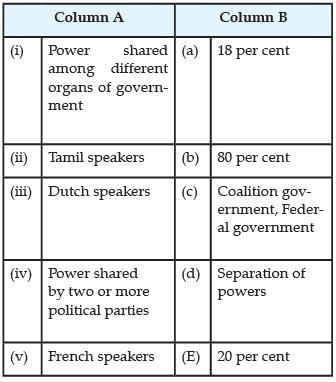
- a)(i)-(d), (ii)-(a), (iii)-(e), (iv)-(c), (v)-(b)
- b)(i)-(b), (ii)-(a), (iii)-(e), (iv)-(c), (v)-(d)
- c)(i)-(d), (ii)-(e), (iii)-(e), (iv)-(a), (v)-(b)
- d)(i)-(a), (ii)-(d), (iii)-(e), (iv)-(b), (v)-(c)
Correct answer is option 'A'. Can you explain this answer?
Match the following item given column A with those in column B:
a)
(i)-(d), (ii)-(a), (iii)-(e), (iv)-(c), (v)-(b)
b)
(i)-(b), (ii)-(a), (iii)-(e), (iv)-(c), (v)-(d)
c)
(i)-(d), (ii)-(e), (iii)-(e), (iv)-(a), (v)-(b)
d)
(i)-(a), (ii)-(d), (iii)-(e), (iv)-(b), (v)-(c)
| | Meera Rana answered |
(i) Power shared among different organs of government: Power is shared among different organs of government, such as the legislature, executive and judiciary. This is called horizontal distribution of power because it allows different organs of government placed at the same level to exercise different powers.
(ii) Tamil speakers: 18% population of Sri Lanka belongs to Tamil Speakers community.
(iii) Dutch speakers: Dutch is spoken by the rest 20 percent of the population but there are sometimes other languages such as English and German are also spoken.
(iv) Power shared by two or more political parties: Power shared among different organs of government is the Separation of Powers of government. Power shared among different social groups is the Community Government. -Power shared by two or more political parties is the Coalition Government.
(v) French speakers: The reason is that even though the city is the capital of Flanders, the Flemish speaking region of Belgium, 80% of the people there speak French.
Chapter doubts & questions for Power Sharing - 30 Days Revision for Class 10 2026 is part of Class 10 exam preparation. The chapters have been prepared according to the Class 10 exam syllabus. The Chapter doubts & questions, notes, tests & MCQs are made for Class 10 2026 Exam. Find important definitions, questions, notes, meanings, examples, exercises, MCQs and online tests here.
Chapter doubts & questions of Power Sharing - 30 Days Revision for Class 10 in English & Hindi are available as part of Class 10 exam. Download more important topics, notes, lectures and mock test series for Class 10 Exam by signing up for free.
30 Days Revision for Class 1040 videos|765 docs|218 tests |
