


All Exams > NEET > 30-Day Revision Course for NEET > All Questions
All questions of The Living World for NEET Exam
Nomenclature is governed by certain universal rules. Which one of the following is contrary to the rules of nomenclature? [NEET 2016]- a)Biological names can be written in any language.
- b)The first word in a biological name represents the genus name, and the second is a specific epithet.
- c)The names are written in Latin and are italicized when printed.
- d)When written by hand, the names are to be underlined.
Correct answer is option 'A'. Can you explain this answer?
Nomenclature is governed by certain universal rules. Which one of the following is contrary to the rules of nomenclature? [NEET 2016]
a)
Biological names can be written in any language.
b)
The first word in a biological name represents the genus name, and the second is a specific epithet.
c)
The names are written in Latin and are italicized when printed.
d)
When written by hand, the names are to be underlined.
 | Dev Patel answered |
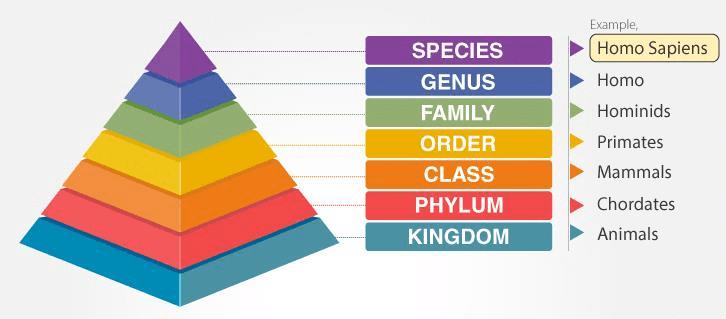
Binomial nomenclature (also called binomial nomenclature or binary nomenclature) is a formal system of naming species of living things by giving each a name composed of two parts, both of which use Latin grammatical forms, although they can be based on words from other languages.

One of the following functions is exhibited only by green plants and not by animals.- a)Growth
- b)Photosynthesis
- c)Digestion
- d)Response
Correct answer is option 'B'. Can you explain this answer?
One of the following functions is exhibited only by green plants and not by animals.
a)
Growth
b)
Photosynthesis
c)
Digestion
d)
Response
 | Pooja Mehta answered |
Plants and animals share many characteristics, but they are different in some respects. Animals usually move around and find their own food, while plants are usually immobile and create their food via photosynthesis. Plants and animals both have cells that contain DNA, yet the structure of their cells differs. Animal cells absorb nutrients from food, while plant cells use plastids to create energy from sunlight.
The taxon 'family' ends with- a)'ales'
- b)'ae'
- c)'ceae'
- d)'idae'
Correct answer is option 'C'. Can you explain this answer?
The taxon 'family' ends with
a)
'ales'
b)
'ae'
c)
'ceae'
d)
'idae'
 | Mohit Choudhury answered |
Taxon Family and its Ending
A taxon family is a group of related organisms within a classification system. The ending of a taxon family is determined by the International Code of Nomenclature for algae, fungi, and plants (ICN) and International Code of Zoological Nomenclature (ICZN). The ending of a taxon family reflects the rank of the taxon within the classification system.
- The ending "-ales" is used for the order level in the ICN classification system. For example, the order of flowering plants, Rosales.
- The ending "-ae" is used for the class level in the ICN classification system. For example, the class of flowering plants, Magnoliopsida.
- The ending "-ceae" is used for the family level in the ICN classification system. For example, the family of flowering plants, Rosaceae.
- In the ICZN classification system, the ending "-idae" is used for the family level. For example, the family of cats, Felidae.
Therefore, the correct answer to the given question is option C, "-ceae" is the ending of a taxon family in the ICN classification system.
A taxon family is a group of related organisms within a classification system. The ending of a taxon family is determined by the International Code of Nomenclature for algae, fungi, and plants (ICN) and International Code of Zoological Nomenclature (ICZN). The ending of a taxon family reflects the rank of the taxon within the classification system.
- The ending "-ales" is used for the order level in the ICN classification system. For example, the order of flowering plants, Rosales.
- The ending "-ae" is used for the class level in the ICN classification system. For example, the class of flowering plants, Magnoliopsida.
- The ending "-ceae" is used for the family level in the ICN classification system. For example, the family of flowering plants, Rosaceae.
- In the ICZN classification system, the ending "-idae" is used for the family level. For example, the family of cats, Felidae.
Therefore, the correct answer to the given question is option C, "-ceae" is the ending of a taxon family in the ICN classification system.
Which one of the following belongs to the family Muscidae? [NEET 2021]- a)Cockroach
- b)House fly
- c)Firefly
- d)Grasshopper
Correct answer is option 'B'. Can you explain this answer?
Which one of the following belongs to the family Muscidae? [NEET 2021]
a)
Cockroach
b)
House fly
c)
Firefly
d)
Grasshopper
 | Jyoti Sengupta answered |
- Muscidae are commonly known as house flies or stable flies.
- These are found worldwide in distribution and contain almost 4,000 described species in over 100 genera.
- Additional Information
- Anacardiaceae: It is famous as the cashew family or sumac family. Anacardiaceae include numerous genera, like cashew (in the type genus Anacardium), mango, poison ivy, poison oak.
- Hominidae: Hominidae family is one of the two living families of the ape superfamily Hominoidea. This family includes apes like orangutans (genus Pongo), the gorillas (Gorilla), and the chimpanzees as well as human beings (Homo).
- Poaceae: This family is a large and nearly ubiquitous family of monocotyledonous flowering plants known as grasses. This family includes the cereal grasses, bamboos, and the grasses of natural grassland.
A taxon is- a)A type of living organism
- b)A group of related species
- c)A taxonomic group of any ranking
- d)A group of related families
Correct answer is option 'C'. Can you explain this answer?
A taxon is
a)
A type of living organism
b)
A group of related species
c)
A taxonomic group of any ranking
d)
A group of related families
 | Devansh Mehra answered |
Each of this level of the hierarchy is called the taxonomic category or rank. In this system of classification, kingdom is always ranked the highest followed by division, class, order, family, genus, and species.
A group of interbreeding organisms is called a- a)Genus
- b)Species
- c)Family
- d)Order
Correct answer is option 'B'. Can you explain this answer?
A group of interbreeding organisms is called a
a)
Genus
b)
Species
c)
Family
d)
Order
 | Rohan Singh answered |
Species - A group of organisms that interbreed and produce fertile offspring. population - A group of organisms of the same species living in the same area at the same time, and which are capable of interbreeding.
The biologist who has been called the ‘Darwin of the 20th century’ is- a)Whittaker
- b)Diener
- c)Ernst Mayr
- d)Linnaeus
Correct answer is option 'C'. Can you explain this answer?
The biologist who has been called the ‘Darwin of the 20th century’ is
a)
Whittaker
b)
Diener
c)
Ernst Mayr
d)
Linnaeus
| | Rajat Kapoor answered |
Ernst Mayr has been called “Darwin's apostle” or the “Darwin of the 20th century” for promoting and dispersing Darwin's hypotheses throughout the past century. He was also a renowned taxonomist, tropical explorer, ornithologist, philosopher of biology, and historian of science. His work contributed to the conceptual revolution that led to the modern evolutionary synthesis of Mendelian genetics, systematics, and Darwinian evolution, and to the development of the biological species concept.
Systematics refers to the study of- a)Nomenclature and identification of plants and animals
- b)Different kinds of organisms and their classification
- c)Diversity of kinds of organisms and their relationships
- d)Identification and classification of plants and animals
Correct answer is option 'C'. Can you explain this answer?
Systematics refers to the study of
a)
Nomenclature and identification of plants and animals
b)
Different kinds of organisms and their classification
c)
Diversity of kinds of organisms and their relationships
d)
Identification and classification of plants and animals
| | Rohan Singh answered |
Systematics is the branch of study of diversity of organisms and all comparative and evolutionary relationship between them.
Cats and lions belong to the family called ________- a)Canidae
- b)Panthera
- c)Felidae
- d)Mammalia
Correct answer is option 'C'. Can you explain this answer?
Cats and lions belong to the family called ________
a)
Canidae
b)
Panthera
c)
Felidae
d)
Mammalia
 | Charvi Nair answered |
Family of Cats and LionsFelidae is the family to which both cats and lions belong. Let us explore this family in more detail.Definition: Felidae is a family of mammals that includes cats, lions, tigers, leopards, jaguars, and several other wild cats.Characteristics:- Felidae is a carnivorous family, meaning they eat meat.- They are known for their sharp claws and teeth, which they use for hunting.- Most felids are solitary animals, with the exception of lions, which live in groups called prides.- They have a short digestive tract and a keen sense of smell, which helps them locate prey.Classification:- The family Felidae is part of the order Carnivora.- There are two subfamilies within Felidae: Pantherinae (which includes lions, tigers, leopards, and jaguars) and Felinae (which includes all other wild cats).- Domestic cats also belong to Felidae, but they are not part of either subfamily.Importance:- Felids play a crucial role in maintaining the balance of their ecosystems.- They are also important cultural symbols in many parts of the world, such as the lion in Africa and the tiger in Asia.- Some felids, such as the cheetah, are endangered due to habitat loss and poaching.Conclusion:Felidae is a fascinating family of carnivorous mammals that includes some of the world's most iconic animals. Through their unique characteristics and important roles in their ecosystems, they continue to capture the imaginations of people around the world.
The branch connected with nomenclature, identification and classification of biological organisms is- a)Ecology
- b)Taxonomy
- c)Physiology
- d)Morphology
Correct answer is option 'B'. Can you explain this answer?
The branch connected with nomenclature, identification and classification of biological organisms is
a)
Ecology
b)
Taxonomy
c)
Physiology
d)
Morphology
| | Sanjana Singh answered |
The branch connected with nomenclature, identification, and classification of organism is called as taxonomy .It is also refferrd as systematics .
For more information read ncert page no.7.
For more information read ncert page no.7.
Mixture of yeast, sugar and water was taken in a test tube. After one hour, bubbles were observed in the mixture. The formation of bubbles was due to- a)Respiration
- b)Photosynthesis
- c)Digestion
- d)Excretion
Correct answer is option 'A'. Can you explain this answer?
Mixture of yeast, sugar and water was taken in a test tube. After one hour, bubbles were observed in the mixture. The formation of bubbles was due to
a)
Respiration
b)
Photosynthesis
c)
Digestion
d)
Excretion
 | Srivatsa Tadipatri answered |
Although i am an engineer student, i will try to answer u. yeast respires anaerobically and thus , energy is released and this causes bubbles.
Binomial nomenclature consists of two names. These are- a)Family and genus
- b)Genus and species
- c)Species and variety
- d)Order and family
Correct answer is option 'B'. Can you explain this answer?
Binomial nomenclature consists of two names. These are
a)
Family and genus
b)
Genus and species
c)
Species and variety
d)
Order and family
| | Preeti Iyer answered |
The first word in binomial nomenclature is the genus to which the organism belongs, and it is called the generic name. The second word is the name of the species to which the organism belongs, and it is called the specific epithet.
The practical purpose of classification of living organisms is to [1999]- a)explain the origin of living organisms
- b)trace the evolution of living organisms
- c)name the living organisms
- d)facilitate identification of unknown organisms
Correct answer is option 'D'. Can you explain this answer?
The practical purpose of classification of living organisms is to [1999]
a)
explain the origin of living organisms
b)
trace the evolution of living organisms
c)
name the living organisms
d)
facilitate identification of unknown organisms
 | Kajal Bose answered |
Biological classification is the scientific arrangement of organisms in a hierarchial series of groups and subgroups on the basis of similarities and differences in their traits. It helps in building evolutionary pathways and in identifying new oganisms.
A species was defined as ‘A population of interbreeding individuals which are reproductively isolated from other populations’ by- a)J. B. Lamarck
- b)Charles Darwin
- c)Ernst Mayr
- d)Carolus Linnaeus
Correct answer is option 'C'. Can you explain this answer?
A species was defined as ‘A population of interbreeding individuals which are reproductively isolated from other populations’ by
a)
J. B. Lamarck
b)
Charles Darwin
c)
Ernst Mayr
d)
Carolus Linnaeus
| | Rajat Kapoor answered |
Ernst Mayr (1942: 120) defined biological species as “groups of actually or potentially interbreeding natural populations, which are reproductively isolated from other such groups”. As Buffon (1749) had stated, “A spe- cies is a constant succession of similar individuals that can reproduce together” (Mayr, 1982).
Binomial nomenclature was given by- a)Theophrastus
- b)Linnaeus
- c)R. H. Whittaker
- d)Aristotle
Correct answer is option 'B'. Can you explain this answer?
Binomial nomenclature was given by
a)
Theophrastus
b)
Linnaeus
c)
R. H. Whittaker
d)
Aristotle
| | Siddiq Zayeda answered |
The adoption by biologists of a system of strictly binomial nomenclature is due to Swedish botanist and physician Carl von Linné, more commonly known by his Latinized name Carl Linnaeus (1707–1778)......
ICBN stands for [2007]- a)International Code of Botanical Nomenclature
- b)International congress of Biological Names
- c)Indian Code of Botanical Nomenclature
- d)Indian Congress of Biological Names.
Correct answer is option 'A'. Can you explain this answer?
ICBN stands for [2007]
a)
International Code of Botanical Nomenclature
b)
International congress of Biological Names
c)
Indian Code of Botanical Nomenclature
d)
Indian Congress of Biological Names.
| | Rohit Shah answered |
ICBN = International code of Botanical Nomenclature.
The Father of Zoology is- a)John Ray
- b)Buffon
- c)Carlous Linnaeus
- d)Aristotle
Correct answer is 'D'. Can you explain this answer?
The Father of Zoology is
a)
John Ray
b)
Buffon
c)
Carlous Linnaeus
d)
Aristotle
| | Preeti Iyer answered |
Aristotle is known as the 'Father of Biology'. Again, Botany and Zoology combine to form biology. So, I think Aristotle can e regarded as the "Father of Zoology'' as well as the "Father of Botany". Aristotle is called the father of zoology.He pioneered the observational and theoretical study of animals.
The book Genera Plantarum was written by- a)Bessy [1999]
- b)Hutchinson
- c)Engler and Prantl
- d)Carl Linnaeus
Correct answer is option 'D'. Can you explain this answer?
The book Genera Plantarum was written by
a)
Bessy [1999]
b)
Hutchinson
c)
Engler and Prantl
d)
Carl Linnaeus
 | Krish Saha answered |
Bentham & Hooker wrote the book Genera Plantarum. Bentham began with the Flora Hongkongensis in 1861, which was the first comprehensive work on any part of the little-known flora of China and Hong Kong, including Hong Kong Croton. This was followed by the Flora Australiensis, in seven volumes (1863-1878), the first flora of any large continental area that had ever been finished. His greatest work was the Genera Plantarum, begun in 1862, and concluded in 1883 in collaboration with Sir Joseph Dalton Hooker.
Each scientific name in binomial nomenclature consists of ________ names.- a)Five
- b)Two
- c)Three
- d)One
Correct answer is option 'B'. Can you explain this answer?
Each scientific name in binomial nomenclature consists of ________ names.
a)
Five
b)
Two
c)
Three
d)
One
| | Sanjana Singh answered |
Very easy question...a bio student should know all this ...there is no doubt in this question....obviously answer is two ..genus and species.
The scientific name of mango is written as Mangifera indica L. Pickup the correct statement about the significance of the letter 'L'.- a)Letter 'L' signifies Latin language
- b)The name is reverse with indica preceding Mangifera
- c)Letter L signifies the taxonomist, Linnaeus
- d)Letter L is superfluous
Correct answer is option 'C'. Can you explain this answer?
The scientific name of mango is written as Mangifera indica L. Pickup the correct statement about the significance of the letter 'L'.
a)
Letter 'L' signifies Latin language
b)
The name is reverse with indica preceding Mangifera
c)
Letter L signifies the taxonomist, Linnaeus
d)
Letter L is superfluous
 | Jyoti Chauhan answered |
Significance of the letter L in the scientific name of mango (Mangifera indica L.):
The letter L in the scientific name of mango, Mangifera indica L., signifies the taxonomist who first described this species using the binomial nomenclature system. Here are the details:
1. Binomial nomenclature system: This system of naming living organisms was developed by the Swedish naturalist Carl Linnaeus in the 18th century. It involves using two Latinized names to represent each species: the genus name (e.g., Mangifera) and the specific epithet (e.g., indica). The two names together form the species name (e.g., Mangifera indica).
2. Linnaeus: Carl Linnaeus (1707-1778) was a prominent taxonomist who is often called the "father of modern taxonomy." He developed the binomial nomenclature system and classified a vast number of organisms based on their physical characteristics. He also wrote several influential books, including Systema Naturae, in which he described and classified thousands of species.
3. Letter L: The letter L following the species name (Mangifera indica L.) is an abbreviation for Linnaeus, the taxonomist who first described this species. It indicates that Linnaeus was the first person to officially name and classify Mangifera indica.
Therefore, the correct option is (c) Letter L signifies the taxonomist, Linnaeus.
The letter L in the scientific name of mango, Mangifera indica L., signifies the taxonomist who first described this species using the binomial nomenclature system. Here are the details:
1. Binomial nomenclature system: This system of naming living organisms was developed by the Swedish naturalist Carl Linnaeus in the 18th century. It involves using two Latinized names to represent each species: the genus name (e.g., Mangifera) and the specific epithet (e.g., indica). The two names together form the species name (e.g., Mangifera indica).
2. Linnaeus: Carl Linnaeus (1707-1778) was a prominent taxonomist who is often called the "father of modern taxonomy." He developed the binomial nomenclature system and classified a vast number of organisms based on their physical characteristics. He also wrote several influential books, including Systema Naturae, in which he described and classified thousands of species.
3. Letter L: The letter L following the species name (Mangifera indica L.) is an abbreviation for Linnaeus, the taxonomist who first described this species. It indicates that Linnaeus was the first person to officially name and classify Mangifera indica.
Therefore, the correct option is (c) Letter L signifies the taxonomist, Linnaeus.
Which of the following organisms belongs to the family Anacardiaceae?- a)Man
- b)Housefly
- c)Mango
- d)Wheat
Correct answer is option 'C'. Can you explain this answer?
Which of the following organisms belongs to the family Anacardiaceae?
a)
Man
b)
Housefly
c)
Mango
d)
Wheat
 | Ashwin Saini answered |
Introduction to Anacardiaceae Family
The family Anacardiaceae, commonly known as the cashew or sumac family, includes a variety of flowering plants. This family is recognized for its diverse range of species, many of which produce edible fruits.
Key Characteristics of Anacardiaceae
- Diversity: The Anacardiaceae family encompasses over 80 genera and around 860 species.
- Fruits: Many members produce fleshy fruits, such as mangoes, cashews, and pistachios.
- Chemical Compounds: Some plants in this family contain urushiol, a compound that can cause allergic reactions, as seen in poison ivy.
Identifying the Correct Organism
Among the given options:
- a) Man: Humans do not belong to the Anacardiaceae family.
- b) Housefly: This is an insect and is unrelated to the Anacardiaceae family.
- c) Mango: The mango (Mangifera indica) is a member of the Anacardiaceae family, known for its sweet and juicy fruit.
- d) Wheat: Wheat is a cereal grain and belongs to the Poaceae family, not Anacardiaceae.
Conclusion
Thus, the correct answer is option 'C' (Mango). This fruit not only belongs to the Anacardiaceae family but also plays a significant role in agriculture and cuisine worldwide.
The family Anacardiaceae, commonly known as the cashew or sumac family, includes a variety of flowering plants. This family is recognized for its diverse range of species, many of which produce edible fruits.
Key Characteristics of Anacardiaceae
- Diversity: The Anacardiaceae family encompasses over 80 genera and around 860 species.
- Fruits: Many members produce fleshy fruits, such as mangoes, cashews, and pistachios.
- Chemical Compounds: Some plants in this family contain urushiol, a compound that can cause allergic reactions, as seen in poison ivy.
Identifying the Correct Organism
Among the given options:
- a) Man: Humans do not belong to the Anacardiaceae family.
- b) Housefly: This is an insect and is unrelated to the Anacardiaceae family.
- c) Mango: The mango (Mangifera indica) is a member of the Anacardiaceae family, known for its sweet and juicy fruit.
- d) Wheat: Wheat is a cereal grain and belongs to the Poaceae family, not Anacardiaceae.
Conclusion
Thus, the correct answer is option 'C' (Mango). This fruit not only belongs to the Anacardiaceae family but also plays a significant role in agriculture and cuisine worldwide.
The correct sequence of taxonomic categories is _________________.- a)Division → Class → Family → Order → Genus → Species
- b)Phylum → Order → Class → Family → Genus → Species
- c)Class → Division → Order → Family → Genus → Species
- d)Division → Class → Order → Family → Genus → Species
Correct answer is option 'D'. Can you explain this answer?
The correct sequence of taxonomic categories is _________________.
a)
Division → Class → Family → Order → Genus → Species
b)
Phylum → Order → Class → Family → Genus → Species
c)
Class → Division → Order → Family → Genus → Species
d)
Division → Class → Order → Family → Genus → Species
| | Nishtha Yadav answered |
B) Kingdom, Phylum, Class, Order, Family, Genus, Species
Study the four statements (A - D) given below and select the two correct ones out of them.(A) Definition of biological species was given by Ernst Mayr.(B) Photoperiod does not affect reproduction in plants.(C) Binomial nomenclature system was given by R.H. Whittaker.(D) In unicellular organisms, reproduction is synonymous with growth.The two correct statements are: [NEET 2016]- a)B and C
- b)C and D
- c)A and D
- d)A and B
Correct answer is option 'C'. Can you explain this answer?
Study the four statements (A - D) given below and select the two correct ones out of them.
(A) Definition of biological species was given by Ernst Mayr.
(B) Photoperiod does not affect reproduction in plants.
(C) Binomial nomenclature system was given by R.H. Whittaker.
(D) In unicellular organisms, reproduction is synonymous with growth.
The two correct statements are: [NEET 2016]
a)
B and C
b)
C and D
c)
A and D
d)
A and B
| | Jyoti Sengupta answered |
(A) Definition of biological species was given by Ernst Mayr. - This statement is correct. Ernst Mayr is indeed famous for his contributions to the biological species concept, which defines a species as a group of individuals that actually or potentially interbreed in nature.
(B) Photoperiod does not affect reproduction in plants. - This statement is incorrect. Photoperiod, or the length of day and night, significantly affects reproduction in many plants. It influences flowering time, which is a critical part of the reproductive process in plants.
(C) Binomial nomenclature system was given by R.H. Whittaker. - This statement is incorrect. The binomial nomenclature system was introduced by Carl Linnaeus, not R.H. Whittaker. R.H. Whittaker is known for proposing the five-kingdom classification system.
(D) In unicellular organisms, reproduction is synonymous with growth. - This statement is correct. In unicellular organisms, reproduction through cell division is essentially a form of growth, as one cell divides to become two, increasing the population size.
Therefore, the two correct statements are A (Definition of biological species was given by Ernst Mayr) and D (In unicellular organisms, reproduction is synonymous with growth), making the correct answer: A and D
Match Column I with Column II and select the correct option from the given codes:
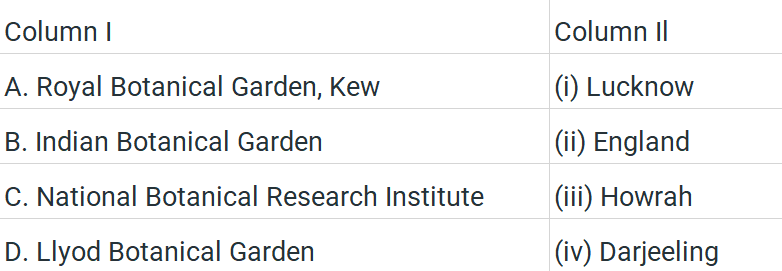
- a)A-(ii), B-(iii), C-(i), D-(iv)
- b)A-(i), B-(iii), C-(ii), D-(iv)
- c)A-(iv), B-(ii), C-(i), D-(iii)
- d)A-(iv), B-(iii), C-(i), D-(ii)
Correct answer is option 'A'. Can you explain this answer?
Match Column I with Column II and select the correct option from the given codes:
a)
A-(ii), B-(iii), C-(i), D-(iv)
b)
A-(i), B-(iii), C-(ii), D-(iv)
c)
A-(iv), B-(ii), C-(i), D-(iii)
d)
A-(iv), B-(iii), C-(i), D-(ii)
 | Stuti Kushwaha answered |
A is correct option
Species are considered as: [2003]- a)Real units of classification devised by taxonomists.
- b) The lowest units of classification.
- c)Real basic units of classification.
- d)The artificial concept of the human mind cannot be defined in absolute terms.
Correct answer is option 'C'. Can you explain this answer?
Species are considered as: [2003]
a)
Real units of classification devised by taxonomists.
b)
The lowest units of classification.
c)
Real basic units of classification.
d)
The artificial concept of the human mind cannot be defined in absolute terms.
 | Top Rankers answered |
In biology, a species is one of the basic units of biological classification and a taxonomic rank.
- A species is often defined as a group of organisms capable of interbreeding and producing fertile offspring.
- While in many cases this definition is adequate, more precise or differing measures are often used, such as similarity of DNA, morphology or ecological niche.
- The presence of specific locally adapted traits may further subdivide species into subspecies.

Binomial nomenclature of Wheat is _________- a) Tritica aestivum
- b) Musca domestica
- c) Oryza sativa
- d) Glycine max
Correct answer is option 'A'. Can you explain this answer?
Binomial nomenclature of Wheat is _________
a)
Tritica aestivum
b)
Musca domestica
c)
Oryza sativa
d)
Glycine max
 | Akash Menon answered |
Binomial Nomenclature of Wheat
Binomial nomenclature is a scientific naming system used to give unique names to living organisms. It was developed by Carl Linnaeus, a Swedish botanist, in the 18th century. The binomial nomenclature system consists of two Latin names, the genus and species name, which together form the scientific name of an organism.
The binomial nomenclature of Wheat is Tritica aestivum. Let's understand the meaning of these two names:
Genus: Tritica
Tritica is a genus of plants in the grass family, Poaceae. It includes several species of wheat, which are cultivated as cereal crops worldwide. The name Tritica comes from the Latin word "triticum," which means wheat.
Species: aestivum
The species name aestivum means "summer" in Latin. It refers to the fact that wheat is typically harvested in the summer months.
Therefore, the complete scientific name of wheat is Tritica aestivum.
Other options:
- Musca domestica: It is the scientific name of the common housefly.
- Oryza sativa: It is the scientific name of rice, which belongs to the genus Oryza.
- Glycine max: It is the scientific name of soybean, which belongs to the genus Glycine.
Binomial nomenclature is a scientific naming system used to give unique names to living organisms. It was developed by Carl Linnaeus, a Swedish botanist, in the 18th century. The binomial nomenclature system consists of two Latin names, the genus and species name, which together form the scientific name of an organism.
The binomial nomenclature of Wheat is Tritica aestivum. Let's understand the meaning of these two names:
Genus: Tritica
Tritica is a genus of plants in the grass family, Poaceae. It includes several species of wheat, which are cultivated as cereal crops worldwide. The name Tritica comes from the Latin word "triticum," which means wheat.
Species: aestivum
The species name aestivum means "summer" in Latin. It refers to the fact that wheat is typically harvested in the summer months.
Therefore, the complete scientific name of wheat is Tritica aestivum.
Other options:
- Musca domestica: It is the scientific name of the common housefly.
- Oryza sativa: It is the scientific name of rice, which belongs to the genus Oryza.
- Glycine max: It is the scientific name of soybean, which belongs to the genus Glycine.
The taxonomic unit ‘Phylum’ in the classification of animals is equivalent to which hierarchical level in classification of plants - a)
- Class
- b)Order
- c)Division
- d)Family
Correct answer is option 'C'. Can you explain this answer?
The taxonomic unit ‘Phylum’ in the classification of animals is equivalent to which hierarchical level in classification of plants
a)
- Class
b)
Order
c)
Division
d)
Family
 | Stepway Academy answered |
- Taxonomy can be defined as the study of principles, rules, and procedures of classification.
- All living organisms are arranged into different groups based on the similarities and dissimilarities in them.
- These groups are referred to as ranks or categories. All the categories together are referred to as Taxonomic Hierarchy.
- Taxon refers to a group of living organisms that represent a concrete unit of classification.
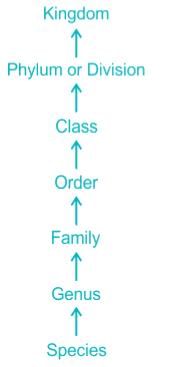
- Kingdom, Phylum/Division, Class, Order, Family, Genus, and Species are the compulsory categories in a Taxonomic Hierarchy.
- Sub-order, sub-family, etc. are facultative categories that are used as per need.
In the taxonomic categories which hierarchical arrangement in descending order is correct in the case of animals? [NEET 2022]- a)Kingdom, Class, Phylum, Family, Order, Genus, Species
- b)Kingdom, Order, Class, Phylum, Family, Genus, Species
- c)Kingdom, Order, Phylum, Class, Family, Genus, Species
- d)Kingdom, Phylum, Class, Order, Family, Genus, Species
Correct answer is option 'D'. Can you explain this answer?
In the taxonomic categories which hierarchical arrangement in descending order is correct in the case of animals? [NEET 2022]
a)
Kingdom, Class, Phylum, Family, Order, Genus, Species
b)
Kingdom, Order, Class, Phylum, Family, Genus, Species
c)
Kingdom, Order, Phylum, Class, Family, Genus, Species
d)
Kingdom, Phylum, Class, Order, Family, Genus, Species
 | Lead Academy answered |
The correct descending order of taxonomic categories in case of animals is:
Kingdom → Phylum → Class → Order → Family → Genus → Species
As we go from species to kingdom-- a)The number of similarities gets reduced than previous taxon.
- b)The number of similarities gets increased than previous taxon.
- c)The number of dissimilarities gets reduced than previous taxon.
- d)None of the above
Correct answer is option 'A'. Can you explain this answer?
As we go from species to kingdom-
a)
The number of similarities gets reduced than previous taxon.
b)
The number of similarities gets increased than previous taxon.
c)
The number of dissimilarities gets reduced than previous taxon.
d)
None of the above
 | Ciel Knowledge answered |
When transitioning from species to kingdom:
- The number of similarities decreases compared to the previous taxon.
This shift occurs because as we move up the taxonomic hierarchy from species to kingdom, we encompass a broader range of organisms. Kingdoms are more inclusive and encompass a wider variety of characteristics, leading to a reduction in the number of similarities observed between different organisms at the kingdom level compared to the species level.
- The number of similarities decreases compared to the previous taxon.
This shift occurs because as we move up the taxonomic hierarchy from species to kingdom, we encompass a broader range of organisms. Kingdoms are more inclusive and encompass a wider variety of characteristics, leading to a reduction in the number of similarities observed between different organisms at the kingdom level compared to the species level.
As we move higher from species to kingdom in the taxonomic hierarchy, what happens to the number of common characteristics shared among the members within the taxon?- a)The number increases
- b)The number remains the same
- c)The number decreases
- d)It varies unpredictably
Correct answer is option 'C'. Can you explain this answer?
As we move higher from species to kingdom in the taxonomic hierarchy, what happens to the number of common characteristics shared among the members within the taxon?
a)
The number increases
b)
The number remains the same
c)
The number decreases
d)
It varies unpredictably
| | Lead Academy answered |
- As we move higher from species to kingdom in the taxonomic hierarchy, the number of common characteristics shared among the members within the taxon decreases.
- Lower taxa have more shared characteristics, while higher taxa have fewer shared characteristics, making classification more complex at higher levels.
House fly belongs to _______ family. [2023]- a)Cyprinidae
- b)Hominidae
- c)Calliphoridae
- d)Muscidae
Correct answer is option 'D'. Can you explain this answer?
House fly belongs to _______ family. [2023]
a)
Cyprinidae
b)
Hominidae
c)
Calliphoridae
d)
Muscidae
| | Stepway Academy answered |
The house fly belongs to the Muscidae family, which is characterized by flies typically associated with humans and human habitations.
The common characteristics between tomato and potato will be maximum at the level of their: [NEET 2013]- a)Genus
- b)Family
- c)Order
- d)Division
Correct answer is option 'B'. Can you explain this answer?
The common characteristics between tomato and potato will be maximum at the level of their: [NEET 2013]
a)
Genus
b)
Family
c)
Order
d)
Division
| | Top Rankers answered |
- Tomato: Solanum lycopersicum
- Potato: Solanum tuberosum
Both belong to the family Solanaceae.
Although they share the same genus (Solanum), NEET considers the family level as the correct answer because the question compares two different species, and maximum common characteristics among different species are generally found up to the family level in the classification hierarchy.
Why other options are wrong:
- (a) Genus: Too specific. Similarities at the genus level apply mainly to organisms that are very closely related species. NEET interprets “maximum similarities between tomato and potato” in a broader sense, as both are economically important but distinct plants; hence the family level is considered.
- (c) Order: Higher level than family, so fewer common characteristics.
- (d) Division: Much broader category (includes many unrelated plants); very few common features at this level.
Final Answer: Family (Solanaceae) – because this level includes both tomato and potato and shows the greatest number of shared characteristics among them compared to order or division.
'X' and 'Y' are the components of Binomial nomenclature. This naming system was proposed by 'Z': [2023]- a)X - Generic name, Y - Specific epithet, Z - Carolus Linnaeus
- b)X - Specific epithet, Y - Generic name, Z - R.H. Whittaker
- c)X - Specific epithet, Y - Generic name, Z - Carolus Linnaeus
- d)X - Generic name, Y - Specific epithet, Z - R.H. Whittaker
Correct answer is option 'A'. Can you explain this answer?
'X' and 'Y' are the components of Binomial nomenclature. This naming system was proposed by 'Z': [2023]
a)
X - Generic name, Y - Specific epithet, Z - Carolus Linnaeus
b)
X - Specific epithet, Y - Generic name, Z - R.H. Whittaker
c)
X - Specific epithet, Y - Generic name, Z - Carolus Linnaeus
d)
X - Generic name, Y - Specific epithet, Z - R.H. Whittaker
| | Top Rankers answered |
In the binomial nomenclature system proposed by Carolus Linnaeus, 'X' is the generic name, and 'Y' is the specific epithet, which together uniquely identify a species.
Chapter doubts & questions for The Living World - 30-Day Revision Course for NEET 2026 is part of NEET exam preparation. The chapters have been prepared according to the NEET exam syllabus. The Chapter doubts & questions, notes, tests & MCQs are made for NEET 2026 Exam. Find important definitions, questions, notes, meanings, examples, exercises, MCQs and online tests here.
Chapter doubts & questions of The Living World - 30-Day Revision Course for NEET in English & Hindi are available as part of NEET exam. Download more important topics, notes, lectures and mock test series for NEET Exam by signing up for free.
30-Day Revision Course for NEET85 videos|301 docs|171 tests |
