


All Exams > NEET > 30-Day Revision Course for NEET > All Questions
All questions of Some Basic Concepts of Chemistry for NEET Exam
The number of atoms in 0.1 mol of a triatomic gas is :[2010](NA = 6.02 ×1023 mol–1)- a)6.026 × 10²²
- b)1.806 × 10²³
- c)3.600 × 10²³
- d)1.800 × 10²²
Correct answer is option 'B'. Can you explain this answer?
The number of atoms in 0.1 mol of a triatomic gas is :[2010](NA = 6.02 ×1023 mol–1)
a)
6.026 × 10²²
b)
1.806 × 10²³
c)
3.600 × 10²³
d)
1.800 × 10²²
 | Dipika Das answered |
The number of atoms in 0.1 mole of a triatomic gas = 0.1 × 3 × 6.023 × 1023.
= 1.806 × 1023
= 1.806 × 10²³

In an experiment it showed that 10 mL of 0.05 M solution of chloride required 10 mL of 0.1 M solution of AgNO3, which of the following will be the formula of the chloride (X stands for the symbol of the element other than chlorine): [NEET Kar. 2013]- a)X2Cl
- b)X2Cl2
- c)XCl2
- d)XCl4
Correct answer is option 'C'. Can you explain this answer?
In an experiment it showed that 10 mL of 0.05 M solution of chloride required 10 mL of 0.1 M solution of AgNO3, which of the following will be the formula of the chloride (X stands for the symbol of the element other than chlorine): [NEET Kar. 2013]
a)
X2Cl
b)
X2Cl2
c)
XCl2
d)
XCl4
 | Pallabi Reddy answered |
Millimoles of solution of chloride = 0.05 × 10 = 0.5
Millimoles of AgNO3 solution = 10 × 0.1 = 1
So, the millimoles of AgNO3 are double than the chloride solution
Millimoles of AgNO3 solution = 10 × 0.1 = 1
So, the millimoles of AgNO3 are double than the chloride solution

An organic compound contains 80% (by wt.) carbon and the remaining percentage of hydrogen. The right option for the empirical formula of this compound is: [Atomic wt. of C is 12, H is 1] (2021)- a)CH3
- b)CH4
- c)CH
- d)CH2
Correct answer is option 'A'. Can you explain this answer?
An organic compound contains 80% (by wt.) carbon and the remaining percentage of hydrogen. The right option for the empirical formula of this compound is: [Atomic wt. of C is 12, H is 1] (2021)
a)
CH3
b)
CH4
c)
CH
d)
CH2
 | Ajay Yadav answered |
An empirical formula represents the simplest whole number ratio of various atoms present in a compound, whereas, the molecular formula shows the exact number of different types of atoms present in a molecule of a compound.

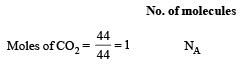
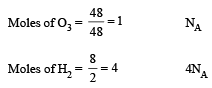

Which one of the followings has maximum number of atoms? (2020)- a)1g of O2(g) (Atomic mass of O = 16)
- b)1g of Li(s) (Atomic mass of Li = 7)
- c)1g of Ag(s) (Atomic mass of Ag = 108)
- d)1g of Mg(s) (Atomic mass of Mg = 24)
Correct answer is option 'B'. Can you explain this answer?
Which one of the followings has maximum number of atoms? (2020)
a)
1g of O2(g) (Atomic mass of O = 16)
b)
1g of Li(s) (Atomic mass of Li = 7)
c)
1g of Ag(s) (Atomic mass of Ag = 108)
d)
1g of Mg(s) (Atomic mass of Mg = 24)
| | Ajay Yadav answered |
(a) no. of atoms

(b) no. of atoms

(c) no. of atoms

(d) no. of atoms

∴ 1 gm of Li is having maximum no. of atoms.
(b) no. of atoms
(c) no. of atoms
(d) no. of atoms
∴ 1 gm of Li is having maximum no. of atoms.

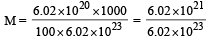
A compound X contains 32% of A, 20% of B and remaining percentage of C. Then, the empirical formula of X is :
(Given atomic masses of A = 64 ; B = 40 ; C = 32 u) [Neet 2024]- a)A2BC2
- b)ABC3
- c)AB2C2
- d)DABC4
Correct answer is option 'B'. Can you explain this answer?
A compound X contains 32% of A, 20% of B and remaining percentage of C. Then, the empirical formula of X is :
(Given atomic masses of A = 64 ; B = 40 ; C = 32 u) [Neet 2024]
(Given atomic masses of A = 64 ; B = 40 ; C = 32 u) [Neet 2024]
a)
A2BC2
b)
ABC3
c)
AB2C2
d)
DABC4
 | Top Rankers answered |
Ans: (b)
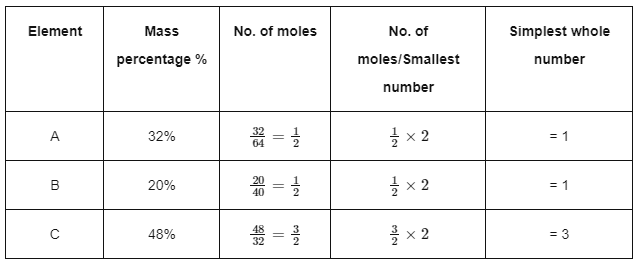
So, empirical formula of
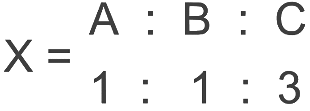
So, empirical formula of
∴ The correct empirical formula of compound X is ABC3
Among the following, choose the ones with equal number of atoms [NEET 2025]
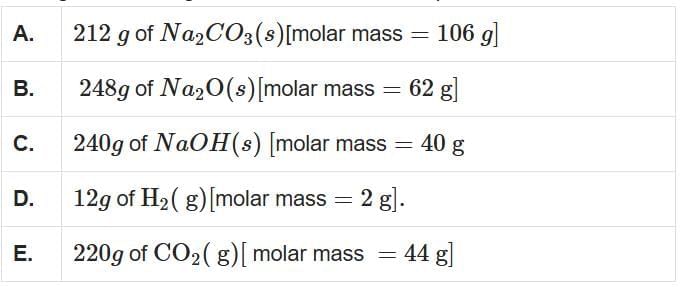
Choose the correct answer from the options given below:- a)B, C, and D only
- b)B, D, and E only
- c)A, B, and C only
- d)A, B and D only
Correct answer is option 'D'. Can you explain this answer?
Among the following, choose the ones with equal number of atoms [NEET 2025]
Choose the correct answer from the options given below:
Choose the correct answer from the options given below:
a)
B, C, and D only
b)
B, D, and E only
c)
A, B, and C only
d)
A, B and D only
 | Lead Academy answered |
Equal Number of Atoms
- The number of atoms in a given sample depends on the number of moles of molecules present, as well as the number of atoms in each molecule.
- The number of moles can be calculated using the formula:
- Moles = Mass / Molar Mass
- Once the moles are determined, the number of molecules can be calculated using Avogadro's number:
- Number of molecules = Moles × 6.022 × 10²³
- To calculate the total number of atoms, multiply the number of molecules by the number of atoms in the molecular formula.
For each option, calculate the number of moles and the total number of atoms:
A. 212 g of Na2CO3
:- Moles = 212 / 106 = 2 moles
- Na2CO3 contains 6 atoms per molecule (2 Na, 1 C, 3 O).
- Total atoms = 2 × 6 × 6.022 × 1023 = 72.264 × 10²³ atoms
B. 248 g of Na2O
:- Moles = 248 / 62 = 4 moles
- Na2O contains 3 atoms per molecule (2 Na, 1 O).
- Total atoms = 4 × 3 × 6.022 × 1023 = 72.264 × 10²³ atoms
C. 240 g of NaOH:
- Moles = 240 / 40 = 6 moles
- NaOH contains 3 atoms per molecule (1 Na, 1 O, 1 H).
- Total atoms = 6 × 3 × 6.022 × 1023 = 108.396 × 10²³ atoms
D. 12 g of H2
:- Moles = 12 / 2 = 6 moles
- H2 contains 2 atoms per molecule (2 H).
- Total atoms = 6 × 2 × 6.022 × 1023 = 72.264 × 10²³ atoms
E. 220 g of CO2
:- Moles = 220 / 44 = 5 moles
- CO2 contains 3 atoms per molecule (1 C, 2 O).
- Total atoms = 5 × 3 × 6.022 × 1023 = 90.33 × 10²³ atoms
Comparing the total atoms A, B, and D have equal total atoms (72.264 × 10²³).
Therefore, the correct answer is Option 2: A, B, and D only.
Therefore, the correct answer is Option 2: A, B, and D only.

Chapter doubts & questions for Some Basic Concepts of Chemistry - 30-Day Revision Course for NEET 2026 is part of NEET exam preparation. The chapters have been prepared according to the NEET exam syllabus. The Chapter doubts & questions, notes, tests & MCQs are made for NEET 2026 Exam. Find important definitions, questions, notes, meanings, examples, exercises, MCQs and online tests here.
Chapter doubts & questions of Some Basic Concepts of Chemistry - 30-Day Revision Course for NEET in English & Hindi are available as part of NEET exam. Download more important topics, notes, lectures and mock test series for NEET Exam by signing up for free.
30-Day Revision Course for NEET85 videos|301 docs|171 tests |
