


All Exams > NEET > 30-Day Revision Course for NEET > All Questions
All questions of Units and Measurements for NEET Exam


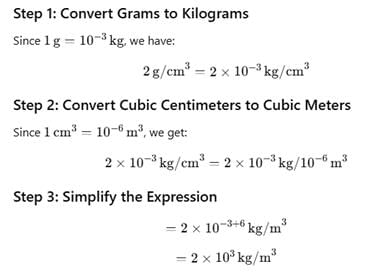

The SI unit of length is the meter. Suppose we adopt a new unit of length which equals to x meters. The area 1m2 expressed in terms of the new unit has a magnitude-- a)x
- b)x2
- c)

- d)

Correct answer is option 'D'. Can you explain this answer?
The SI unit of length is the meter. Suppose we adopt a new unit of length which equals to x meters. The area 1m2 expressed in terms of the new unit has a magnitude-
a)
x
b)
x2
c)
d)
 | Trisha Vashisht answered |
We have 1 unit = x meters
So 1 unit2 = x2 meter2
Hence, we get 1 meter2 = 1/x2 unit2
So 1 unit2 = x2 meter2
Hence, we get 1 meter2 = 1/x2 unit2

Which of the following statement is wrong ?- a)Unit of K.E. is Newton-metre
- b)Unit of viscosity is poise
- c)Work and energy have same dimensions
- d)Unit of surface tension is Newton metre
Correct answer is option 'D'. Can you explain this answer?
Which of the following statement is wrong ?
a)
Unit of K.E. is Newton-metre
b)
Unit of viscosity is poise
c)
Work and energy have same dimensions
d)
Unit of surface tension is Newton metre
 | Rajesh Gupta answered |
The incorrect statement is:
d) Unit of surface tension is Newton metre.
The correct unit of surface tension is Newton per metre (N/m), not Newton metre.
Here's a breakdown:
- a) Unit of K.E. is Newton-metre: True, because kinetic energy is measured in joules, and 1 joule equals 1 Newton-metre.
- b) Unit of viscosity is poise: True, poise is indeed a unit of dynamic viscosity.
- c) Work and energy have the same dimensions: True, both work and energy have the same dimensions and are measured in joules.
- d) Unit of surface tension is Newton metre: Incorrect, it should be Newton per metre (N/m).
Can you explain the answer of this question below: The SI unit of length is the meter. Suppose we adopt a new unit of length which equals to x meters. The area 1m2 expressed in terms of the new unit has a magnitude-- A:x
- B:x2
- C:
- D:
The answer is d.
The SI unit of length is the meter. Suppose we adopt a new unit of length which equals to x meters. The area 1m2 expressed in terms of the new unit has a magnitude-
A:
x
B:
x2
C:
D:
 | Kamna Science Academy answered |
We have 1 unit = x meters
So 1 unit2 = x2 meter2
Hence, we get 1 meter2 = 1/x2 unit2
So 1 unit2 = x2 meter2
Hence, we get 1 meter2 = 1/x2 unit2
The M.K.S. units of coefficient of viscosity is-- a)kg m-1s-1
- b)kg m s-2
- c)kg m2 s-1
- d)kg-1 m-1 s2
Correct answer is option 'A'. Can you explain this answer?
The M.K.S. units of coefficient of viscosity is-
a)
kg m-1s-1
b)
kg m s-2
c)
kg m2 s-1
d)
kg-1 m-1 s2
 | Suresh Iyer answered |
We know that coefficient of viscosity (η)= Fr/Av where F = tangential force, r = distance between the layers , v = velocity and A is the area of the surface.
Thus we get [η] = MLT-2.L / L2. (L/T)
= M / LT
Thus its unit is kg / m sec
Thus we get [η] = MLT-2.L / L2. (L/T)
= M / LT
Thus its unit is kg / m sec
Suppose refractive index μ is given as μ = A + B/λ2 where A and B are constants and λ is wavelength, then dimensions of B are same as that of- a)wavelength
- b)volume
- c)pressure
- d)area
Correct answer is option 'D'. Can you explain this answer?
Suppose refractive index μ is given as μ = A + B/λ2 where A and B are constants and λ is wavelength, then dimensions of B are same as that of
a)
wavelength
b)
volume
c)
pressure
d)
area
 | Poulomi Basu answered |
Understanding Refractive Index
The refractive index (μ) is a dimensionless quantity that describes how light propagates through a medium. In the given formula, μ = A + B/λ², A and B are constants, and λ is the wavelength of light.
Analyzing the Formula
- The term B/λ² must have the same dimensions as the constant A because they are added together.
- Since A is a constant and has dimensions, we need to analyze the dimensions of λ (wavelength) and how it affects B.
Dimensions of Wavelength
- Wavelength (λ) has dimensions of length, represented as [L].
Calculating Dimensions of B
- The term λ² has dimensions of [L²].
- For B/λ² to have dimensions equivalent to A, we can set up the following:
- Dimensions of B/λ² = Dimensions of A
- Thus, [B]/[L²] = [A]
Conclusion on Dimensions of B
- Rearranging gives us [B] = [A] × [L²].
- Since A is dimensionless (the refractive index), [B] must have dimensions of [L²] or area.
Correct Answer
- Therefore, the dimensions of B are the same as that of area, making the correct option (D) Area.
This analysis shows how the relationship between wavelength and the constants in the refractive index equation leads to the conclusion that B shares the dimensions of area.
The refractive index (μ) is a dimensionless quantity that describes how light propagates through a medium. In the given formula, μ = A + B/λ², A and B are constants, and λ is the wavelength of light.
Analyzing the Formula
- The term B/λ² must have the same dimensions as the constant A because they are added together.
- Since A is a constant and has dimensions, we need to analyze the dimensions of λ (wavelength) and how it affects B.
Dimensions of Wavelength
- Wavelength (λ) has dimensions of length, represented as [L].
Calculating Dimensions of B
- The term λ² has dimensions of [L²].
- For B/λ² to have dimensions equivalent to A, we can set up the following:
- Dimensions of B/λ² = Dimensions of A
- Thus, [B]/[L²] = [A]
Conclusion on Dimensions of B
- Rearranging gives us [B] = [A] × [L²].
- Since A is dimensionless (the refractive index), [B] must have dimensions of [L²] or area.
Correct Answer
- Therefore, the dimensions of B are the same as that of area, making the correct option (D) Area.
This analysis shows how the relationship between wavelength and the constants in the refractive index equation leads to the conclusion that B shares the dimensions of area.
A pair of physical quantities having the same dimensional formula is :- a)angular momentum and torque
- b)torque and energy
- c)force and power
- d)power and angular momentum
Correct answer is option 'B'. Can you explain this answer?
A pair of physical quantities having the same dimensional formula is :
a)
angular momentum and torque
b)
torque and energy
c)
force and power
d)
power and angular momentum
 | Gaurav Kumar answered |
The dimensions of angular momentum are M L2T−1
That of torque is M L2T−2
Also dimension of energy is M L2T−2
Where as same of force is M LT−2
And of power is M L2T−3
Thus we get torque and energy have the same dimensional formulas.
That of torque is M L2T−2
Also dimension of energy is M L2T−2
Where as same of force is M LT−2
And of power is M L2T−3
Thus we get torque and energy have the same dimensional formulas.
For 10(at+3) , the dimension of a is-- a)M0 L0 T0
- b)M0 L0 T1
- c)M0 L0 T-1
- d)None of these
Correct answer is option 'C'. Can you explain this answer?
For 10(at+3) , the dimension of a is-
a)
M0 L0 T0
b)
M0 L0 T1
c)
M0 L0 T-1
d)
None of these
| | Simran Chauhan answered |
Dimensional analysis is a method used to check the correctness of equations by comparing the dimensions of the physical quantities involved in the equation. The dimensions of a physical quantity refer to the powers to which the fundamental units of mass, length, and time are raised to represent that quantity.
Given that 10(at 3) is a quantity, we need to determine its dimensions. Here, 'at' denotes acceleration due to gravity, which has dimensions of length per unit time squared.
So, we can write 10(at 3) as 10 multiplied by (length/time^2)^3.
Breaking it down further, we get:
10 * (length^3 / time^6)
Now, we can compare the dimensions of this quantity with the given options:
a) M0L0T0 - This option implies that the quantity has no dimensions, which is not true.
b) M0L0T1 - This option includes a time dimension of 1, which is not sufficient to represent the given quantity.
c) M0L0T-1 - This option includes a time dimension of -1, which is correct as it cancels out the time dimension in the quantity.
d) None of these - This option is not correct as option c) is the correct answer.
Therefore, the dimension of 10(at 3) is M0L0T-1.
Given that 10(at 3) is a quantity, we need to determine its dimensions. Here, 'at' denotes acceleration due to gravity, which has dimensions of length per unit time squared.
So, we can write 10(at 3) as 10 multiplied by (length/time^2)^3.
Breaking it down further, we get:
10 * (length^3 / time^6)
Now, we can compare the dimensions of this quantity with the given options:
a) M0L0T0 - This option implies that the quantity has no dimensions, which is not true.
b) M0L0T1 - This option includes a time dimension of 1, which is not sufficient to represent the given quantity.
c) M0L0T-1 - This option includes a time dimension of -1, which is correct as it cancels out the time dimension in the quantity.
d) None of these - This option is not correct as option c) is the correct answer.
Therefore, the dimension of 10(at 3) is M0L0T-1.
The sum of the numbers 436.32, 227.2 and 0.301 in appropriate significant figures is- a)663.821
- b)663.8
- c)664
- d)663.82
Correct answer is option 'B'. Can you explain this answer?
The sum of the numbers 436.32, 227.2 and 0.301 in appropriate significant figures is
a)
663.821
b)
663.8
c)
664
d)
663.82
| | Amrita Choudhary answered |
The result of an addition or subtraction in the number having different precisions should be reported to the same number of decimal places as present in the number having the least number of decimal places.
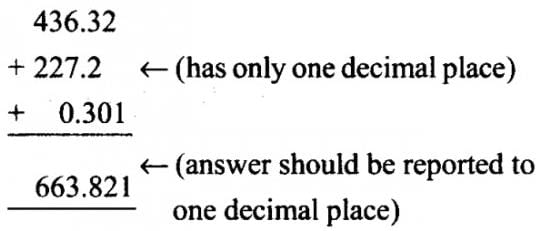
The final result should, therefore, be rounded off to one decimal place, i.e. 663.8
The dimensional formula of coefficient of viscosity is- a)[MLT-1]
- b)[M-1L2T-2]
- c)[ML-1T -1]
- d)none of these
Correct answer is option 'C'. Can you explain this answer?
The dimensional formula of coefficient of viscosity is
a)
[MLT-1]
b)
[M-1L2T-2]
c)
[ML-1T -1]
d)
none of these
 | Rahul Chaudhary answered |
Coefficient of viscosity (η)= Fr/Av
F= tangential Force, Area, r= distance between the layers, v= velocity.
Dimensional Formula of Force = M1L1T-2.
Dimensional Formula of Area= M0L2T0.
Dimensional Formula of distance= M0L1T0.
Dimensional Formula of velocity= M0L1T-1.
Dimensional Formula of Area= M0L2T0.
Dimensional Formula of distance= M0L1T0.
Dimensional Formula of velocity= M0L1T-1.
Putting these values in above equation we get,
[η]= [M1L1T-2][M0L1T0] / [M0L2T0] [M0L1T-1] = [M1L-1T-1]
Which of the following system of units is NOT based on the unit of mass, length and time alone- a)FPS (foot-pound-second)
- b)SI (International System of Units)
- c)CGS (centimeter-gram-second)
- d)MKS (meter-kilogram-second)
Correct answer is option 'B'. Can you explain this answer?
Which of the following system of units is NOT based on the unit of mass, length and time alone
a)
FPS (foot-pound-second)
b)
SI (International System of Units)
c)
CGS (centimeter-gram-second)
d)
MKS (meter-kilogram-second)
| | Arya Rane answered |
Understanding the Systems of Units
When discussing systems of units, it's crucial to know how they relate to fundamental quantities such as mass, length, and time. Let’s break down each system mentioned:
FPS (Foot-Pound-Second)
- This system is based on units of length (foot), mass (pound), and time (second).
- It is primarily used in the United States for everyday measurements.
CGS (Centimeter-Gram-Second)
- This system is based on units of length (centimeter), mass (gram), and time (second).
- It is commonly used in scientific contexts, particularly in physics and chemistry.
MKS (Meter-Kilogram-Second)
- MKS uses the meter for length, kilogram for mass, and second for time.
- It is often used in engineering and scientific applications.
SI (International System of Units)
- The SI system is the modern form of the metric system and includes additional base units beyond just mass, length, and time.
- Key base units include:
- Ampere (electric current)
- Kelvin (temperature)
- Mole (amount of substance)
- Thus, it is not solely based on mass, length, and time.
Conclusion
Therefore, the correct answer is option 'B' because the SI system incorporates additional fundamental units, making it more comprehensive than just the basic dimensions of mass, length, and time. This distinction highlights the SI system's versatility and its role in scientific standardization globally.
When discussing systems of units, it's crucial to know how they relate to fundamental quantities such as mass, length, and time. Let’s break down each system mentioned:
FPS (Foot-Pound-Second)
- This system is based on units of length (foot), mass (pound), and time (second).
- It is primarily used in the United States for everyday measurements.
CGS (Centimeter-Gram-Second)
- This system is based on units of length (centimeter), mass (gram), and time (second).
- It is commonly used in scientific contexts, particularly in physics and chemistry.
MKS (Meter-Kilogram-Second)
- MKS uses the meter for length, kilogram for mass, and second for time.
- It is often used in engineering and scientific applications.
SI (International System of Units)
- The SI system is the modern form of the metric system and includes additional base units beyond just mass, length, and time.
- Key base units include:
- Ampere (electric current)
- Kelvin (temperature)
- Mole (amount of substance)
- Thus, it is not solely based on mass, length, and time.
Conclusion
Therefore, the correct answer is option 'B' because the SI system incorporates additional fundamental units, making it more comprehensive than just the basic dimensions of mass, length, and time. This distinction highlights the SI system's versatility and its role in scientific standardization globally.
The dimensions of shear modulus of rigidity are- a)M1L1T−2
- b)M1L1T−1
- c)ML2T2
- d)ML−1T−2
Correct answer is option 'D'. Can you explain this answer?
The dimensions of shear modulus of rigidity are
a)
M1L1T−2
b)
M1L1T−1
c)
ML2T2
d)
ML−1T−2
 | Shivani Tiwari answered |
Understanding Shear Modulus of Rigidity
Shear modulus, also known as the modulus of rigidity, is a measure of a material's ability to resist shear deformation. The dimensions of shear modulus can be derived from the relationship between stress and strain.
Definition of Shear Modulus
- Shear modulus (G) is defined as the ratio of shear stress to shear strain.
- Mathematically, G = Shear Stress / Shear Strain.
Dimensions of Shear Stress
- Shear stress (τ) is defined as force (F) per unit area (A).
- Dimensions of force: M1L1T-2 (mass x acceleration).
- Dimensions of area: L2.
- Therefore, the dimensions of shear stress are:
τ = F/A = (M1L1T-2) / (L2) = M1L-1T-2.
Dimensions of Shear Strain
- Shear strain (γ) is the ratio of the change in the shape of the material to its original shape.
- It is a dimensionless quantity, so its dimensions are 1.
Calculating Dimensions of Shear Modulus
- Using the definitions, we can find the dimensions of shear modulus (G):
G = τ / γ = (M1L-1T-2) / 1 = M1L-1T-2.
Conclusion
- The correct dimensions of shear modulus of rigidity are:
ML-1T-2 (option D).
This aligns with the fundamental principles of mechanics and material science, validating the choice. Understanding these dimensions is crucial for applications in engineering and physics.
Shear modulus, also known as the modulus of rigidity, is a measure of a material's ability to resist shear deformation. The dimensions of shear modulus can be derived from the relationship between stress and strain.
Definition of Shear Modulus
- Shear modulus (G) is defined as the ratio of shear stress to shear strain.
- Mathematically, G = Shear Stress / Shear Strain.
Dimensions of Shear Stress
- Shear stress (τ) is defined as force (F) per unit area (A).
- Dimensions of force: M1L1T-2 (mass x acceleration).
- Dimensions of area: L2.
- Therefore, the dimensions of shear stress are:
τ = F/A = (M1L1T-2) / (L2) = M1L-1T-2.
Dimensions of Shear Strain
- Shear strain (γ) is the ratio of the change in the shape of the material to its original shape.
- It is a dimensionless quantity, so its dimensions are 1.
Calculating Dimensions of Shear Modulus
- Using the definitions, we can find the dimensions of shear modulus (G):
G = τ / γ = (M1L-1T-2) / 1 = M1L-1T-2.
Conclusion
- The correct dimensions of shear modulus of rigidity are:
ML-1T-2 (option D).
This aligns with the fundamental principles of mechanics and material science, validating the choice. Understanding these dimensions is crucial for applications in engineering and physics.
The pressure of 106 dyne/cm2 is equivalent to- a)105 N/m2
- b)106 N/m2
- c)107 N/m2
- d)108 N/m2
Correct answer is option 'A'. Can you explain this answer?
The pressure of 106 dyne/cm2 is equivalent to
a)
105 N/m2
b)
106 N/m2
c)
107 N/m2
d)
108 N/m2
| | Rajeev Nair answered |
We know that 105 dyne = 1N
And 104cm2 = 1 m2
Thus we get 10 dyne / cm2 = N / m2
Hence 106 dyne / cm2 =105 N / m2
And 104cm2 = 1 m2
Thus we get 10 dyne / cm2 = N / m2
Hence 106 dyne / cm2 =105 N / m2
Which of the following statements is incorrect?- a)Every measurement by measuring instrument has some error.
- b)A measurement can have more accuracy but less precision and vice versa.
- c)Every calculated quantity that is based on measured values has some error.
- d)The magnitude of the difference between the true value of the quantity and the individual measurement value is called the relative error of the measurement.
Correct answer is option 'D'. Can you explain this answer?
Which of the following statements is incorrect?
a)
Every measurement by measuring instrument has some error.
b)
A measurement can have more accuracy but less precision and vice versa.
c)
Every calculated quantity that is based on measured values has some error.
d)
The magnitude of the difference between the true value of the quantity and the individual measurement value is called the relative error of the measurement.
| | Raghav Bansal answered |
The magnitude of the difference between the true value of the quantity and the individual measurement value is called the absolute error of the measurement. Hence, option (d) is an incorrect statement while all other statements are correct.
The vernier scale of a travelling microscope has 50 divisions which coincide with 49 main scale divisions. If each main scale division is 0.5 mm, then the least count of the microscope is- a)0.02 mm
- b)0.05 mm
- c)0.01 mm
- d)0.1 mm
Correct answer is option 'C'. Can you explain this answer?
The vernier scale of a travelling microscope has 50 divisions which coincide with 49 main scale divisions. If each main scale division is 0.5 mm, then the least count of the microscope is
a)
0.02 mm
b)
0.05 mm
c)
0.01 mm
d)
0.1 mm
 | Jyoti Sengupta answered |
1 MSD = 0.5mm
50VSD = 49MSD
1 VSD = 49/50 MSD
Least Count = 1 MSD - 1 VSD

50VSD = 49MSD
1 VSD = 49/50 MSD
Least Count = 1 MSD - 1 VSD
Two resistors of resistances R1 = (300 ± 3)Ω and R2 = (500 ± 4)Ω are connected in series. The equivalent resistance of the series combination is- a)(800 ± 1)Ω
- b)(800 ± 7) Ω
- c)(200 ± 7) Ω
- d)(200 ± 1) Ω
Correct answer is option 'B'. Can you explain this answer?
Two resistors of resistances R1 = (300 ± 3)Ω and R2 = (500 ± 4)Ω are connected in series. The equivalent resistance of the series combination is
a)
(800 ± 1)Ω
b)
(800 ± 7) Ω
c)
(200 ± 7) Ω
d)
(200 ± 1) Ω
| | Jyoti Sengupta answered |
The equivalent resistance of series combination is
Rs = R1 + R2 = 300Ω + 500Ω = 800Ω
The error in equivalent resistance is given by
ΔR = (ΔR1 + ΔR2) = (3 + 4)Ω = 7Ω
Hence, the equivalent resistance along with error is (800 ± 7)Ω.
Rs = R1 + R2 = 300Ω + 500Ω = 800Ω
The error in equivalent resistance is given by
ΔR = (ΔR1 + ΔR2) = (3 + 4)Ω = 7Ω
Hence, the equivalent resistance along with error is (800 ± 7)Ω.
Which of the following is the most precise instrument for measuring length?- a)Metre rod of least count 0.1cm
- b)Vernier callipers of least count 0.01cm
- c)Screw gauge of least count 0.001cm
- d)None of these
Correct answer is option 'C'. Can you explain this answer?
Which of the following is the most precise instrument for measuring length?
a)
Metre rod of least count 0.1cm
b)
Vernier callipers of least count 0.01cm
c)
Screw gauge of least count 0.001cm
d)
None of these
 | Rohit Das answered |
Precision in Measuring Length
Measuring length is one of the fundamental aspects of physics and engineering. The accuracy and precision of any measurement depend on the instrument used to take the measurement. Precision refers to the degree of exactness with which a measurement is made. The most precise instrument for measuring length is the one that has the smallest least count.
Definition of Least Count
Least count refers to the smallest measurement that an instrument can make. For example, if the least count of a measuring instrument is 0.1 cm, then the instrument can measure lengths that are multiples of 0.1 cm. The smaller the least count, the more precise the instrument.
Comparison of Instruments
a) Metre Rod of Least Count 0.1 cm
A metre rod is a simple instrument used to measure length. It is a straight rod that is one metre in length. The least count of a metre rod is usually 0.1 cm. This means that the rod can measure lengths that are multiples of 0.1 cm. However, the metre rod is not a very precise instrument for measuring length.
b) Vernier Callipers of Least Count 0.01 cm
A vernier caliper is a more precise instrument for measuring length. It consists of two jaws, an upper and a lower, that can be adjusted to fit the object being measured. The jaws are connected to a scale that can be read to the nearest 0.1 mm. The least count of a vernier caliper is 0.01 cm, which means that it can measure lengths that are multiples of 0.01 cm.
c) Screw Gauge of Least Count 0.001 cm
A screw gauge is the most precise instrument for measuring length. It consists of a U-shaped frame with a screw attached to one end. The screw has a scale that can be read to the nearest 0.01 mm. The least count of a screw gauge is 0.001 cm, which means that it can measure lengths that are multiples of 0.001 cm.
Conclusion
In conclusion, the screw gauge is the most precise instrument for measuring length because it has the smallest least count. The smaller the least count, the more precise the instrument. While a metre rod and vernier calipers can also be used to measure length, they are not as precise as a screw gauge.
Measuring length is one of the fundamental aspects of physics and engineering. The accuracy and precision of any measurement depend on the instrument used to take the measurement. Precision refers to the degree of exactness with which a measurement is made. The most precise instrument for measuring length is the one that has the smallest least count.
Definition of Least Count
Least count refers to the smallest measurement that an instrument can make. For example, if the least count of a measuring instrument is 0.1 cm, then the instrument can measure lengths that are multiples of 0.1 cm. The smaller the least count, the more precise the instrument.
Comparison of Instruments
a) Metre Rod of Least Count 0.1 cm
A metre rod is a simple instrument used to measure length. It is a straight rod that is one metre in length. The least count of a metre rod is usually 0.1 cm. This means that the rod can measure lengths that are multiples of 0.1 cm. However, the metre rod is not a very precise instrument for measuring length.
b) Vernier Callipers of Least Count 0.01 cm
A vernier caliper is a more precise instrument for measuring length. It consists of two jaws, an upper and a lower, that can be adjusted to fit the object being measured. The jaws are connected to a scale that can be read to the nearest 0.1 mm. The least count of a vernier caliper is 0.01 cm, which means that it can measure lengths that are multiples of 0.01 cm.
c) Screw Gauge of Least Count 0.001 cm
A screw gauge is the most precise instrument for measuring length. It consists of a U-shaped frame with a screw attached to one end. The screw has a scale that can be read to the nearest 0.01 mm. The least count of a screw gauge is 0.001 cm, which means that it can measure lengths that are multiples of 0.001 cm.
Conclusion
In conclusion, the screw gauge is the most precise instrument for measuring length because it has the smallest least count. The smaller the least count, the more precise the instrument. While a metre rod and vernier calipers can also be used to measure length, they are not as precise as a screw gauge.
Which of the following instruments has minimum least count?- a)A vernier callipers with 20 divisions on the vernier scale coinciding with 19 main scale divisions
- b)A screw gauge of pitch 1mm and 100 divisions on the circular scale
- c)A spherometer of pitch 0.1mm and 100 divisions on the circular scale
- d)An optical instrument that can measure length to within a wavelength of light
Correct answer is option 'D'. Can you explain this answer?
Which of the following instruments has minimum least count?
a)
A vernier callipers with 20 divisions on the vernier scale coinciding with 19 main scale divisions
b)
A screw gauge of pitch 1mm and 100 divisions on the circular scale
c)
A spherometer of pitch 0.1mm and 100 divisions on the circular scale
d)
An optical instrument that can measure length to within a wavelength of light
| | Gaurav Kumar answered |
(a) Least count of vernier callipers
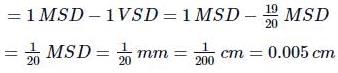
(∵ 1MSD = 1mm)
(b) Least count of screw gauge
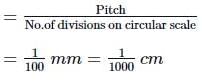
(c) Least count of spherometer
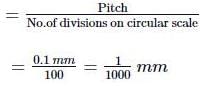
= 0.0001cm
(d) Wavelength of light, λ = 10−5 cm = 0.00001cm
Clearly the optical instrument is the most precise.
(∵ 1MSD = 1mm)
(b) Least count of screw gauge
(c) Least count of spherometer
= 0.0001cm
(d) Wavelength of light, λ = 10−5 cm = 0.00001cm
Clearly the optical instrument is the most precise.
If the error in measuring the radius of the sphere is 2% and that in measuring its mass is 3%, then the error in measuring the density of material of the sphere is- a)5%
- b)7%
- c)9%
- d)11%
Correct answer is option 'C'. Can you explain this answer?
If the error in measuring the radius of the sphere is 2% and that in measuring its mass is 3%, then the error in measuring the density of material of the sphere is
a)
5%
b)
7%
c)
9%
d)
11%
| | Jyoti Sengupta answered |
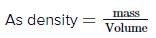
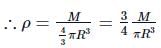
∴ The percentage error in density is

= 3% + 3(2%) = 3% + 6% = 9%
The temperatures of two bodies measured by a thermometer are t1 = 20 °C ± 0.5 °C and t2 = 50 °C ± 0.5 °C. The temperature difference and the error there is- a)30 °C ± 1 °C
- b)70 °C ± 0.5 °C
- c)30 °C ± 0.5 °C
- d)70 °C ± 1 °C
Correct answer is option 'A'. Can you explain this answer?
The temperatures of two bodies measured by a thermometer are t1 = 20 °C ± 0.5 °C and t2 = 50 °C ± 0.5 °C. The temperature difference and the error there is
a)
30 °C ± 1 °C
b)
70 °C ± 0.5 °C
c)
30 °C ± 0.5 °C
d)
70 °C ± 1 °C
 | Navya Choudhury answered |
Understanding Temperature Difference
To find the temperature difference between two bodies, we subtract the two temperature readings:
- t1 = 20 °C ± 0.5 °C
- t2 = 50 °C ± 0.5 °C
Calculating the Difference
The difference in temperature (ΔT) is calculated as follows:
- ΔT = t2 - t1 = 50 °C - 20 °C = 30 °C
Calculating the Error in Temperature Difference
To find the total error in the temperature difference, we consider the errors associated with each measurement. The rule for adding errors states that when subtracting two measurements, the errors add up:
- Error in t1 = 0.5 °C
- Error in t2 = 0.5 °C
Thus, the total error in ΔT is:
- Total Error = Error in t1 + Error in t2 = 0.5 °C + 0.5 °C = 1 °C
Final Result
Combining the calculated temperature difference and the total error, we arrive at:
- ΔT = 30 °C ± 1 °C
Conclusion
The correct answer is a) 30 °C ± 1 °C as it accurately represents the temperature difference and its associated error based on the measurements provided. Other options do not correctly reflect this calculation.
To find the temperature difference between two bodies, we subtract the two temperature readings:
- t1 = 20 °C ± 0.5 °C
- t2 = 50 °C ± 0.5 °C
Calculating the Difference
The difference in temperature (ΔT) is calculated as follows:
- ΔT = t2 - t1 = 50 °C - 20 °C = 30 °C
Calculating the Error in Temperature Difference
To find the total error in the temperature difference, we consider the errors associated with each measurement. The rule for adding errors states that when subtracting two measurements, the errors add up:
- Error in t1 = 0.5 °C
- Error in t2 = 0.5 °C
Thus, the total error in ΔT is:
- Total Error = Error in t1 + Error in t2 = 0.5 °C + 0.5 °C = 1 °C
Final Result
Combining the calculated temperature difference and the total error, we arrive at:
- ΔT = 30 °C ± 1 °C
Conclusion
The correct answer is a) 30 °C ± 1 °C as it accurately represents the temperature difference and its associated error based on the measurements provided. Other options do not correctly reflect this calculation.
If C the velocity of light, h Planck's constant and G gravitational constant are taken as fundamental quantities, then the dimensional formula of mass is- a)h−1/2G1/2C0
- b)h1/2C1/2G−1/2
- c)h−1/2C1/2G−1/2
- d)h−1/2C−1/2G−1/2
Correct answer is option 'B'. Can you explain this answer?
If C the velocity of light, h Planck's constant and G gravitational constant are taken as fundamental quantities, then the dimensional formula of mass is
a)
h−1/2G1/2C0
b)
h1/2C1/2G−1/2
c)
h−1/2C1/2G−1/2
d)
h−1/2C−1/2G−1/2
 | Infinity Academy answered |
Let,

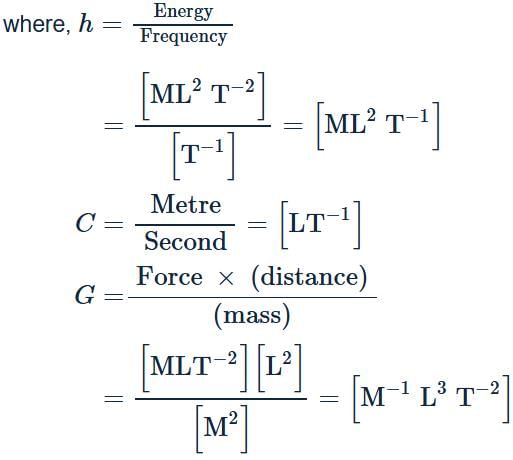
Comparing the coefficients M,L,T, of both sides we get
Comparing the coefficients M,L,T, of both sides we get
b−c=1
a + 2b + 3c = 0
−(a + b + 2c) = 0
Solve the Eqs. (ii), (iii) and (iv), we get
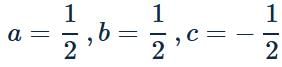
So,
M=h1/2C1/2G−1/2
a + 2b + 3c = 0
−(a + b + 2c) = 0
Solve the Eqs. (ii), (iii) and (iv), we get
So,
M=h1/2C1/2G−1/2
The angular frequency is measured in rad s-1. Its dimension in length are :- a)-2
- b)-1
- c)0
- d)2
Correct answer is option 'C'. Can you explain this answer?
The angular frequency is measured in rad s-1. Its dimension in length are :
a)
-2
b)
-1
c)
0
d)
2
| | Chirag Ghosh answered |
Understanding Angular Frequency
Angular frequency, denoted by the symbol ω, is a measure of how quickly an object rotates or oscillates. It is expressed in radians per second (rad/s). To understand its dimensions in terms of length, we need to delve into its definition and physical significance.
Definition of Angular Frequency
- Angular frequency is defined as the rate of change of the phase of a sinusoidal waveform, or the rate at which an object rotates around a central point.
- It is mathematically given by the formula: ω = 2π/T, where T is the period of rotation.
Dimensional Analysis
- The dimension of angular frequency can be analyzed from its units:
- It is measured in rad/s, where "rad" (radians) is a dimensionless unit.
- Therefore, when considering the dimensions, we focus solely on the "s" (seconds).
Dimensions in Length
- The dimension of time (T) in physics is [T].
- Since angular frequency is measured as 1/s, its dimension is [T]^-1.
- Hence, when we analyze how angular frequency relates to length, we find that it does not involve any length dimensions.
Conclusion
- The correct answer to the question regarding the dimensions of angular frequency in terms of length is indeed 0.
- This means that angular frequency has no dependence on length, confirming option 'C' as the correct answer.
Thus, angular frequency does not have any dimensions in the context of length, aligning perfectly with the answer provided.
Angular frequency, denoted by the symbol ω, is a measure of how quickly an object rotates or oscillates. It is expressed in radians per second (rad/s). To understand its dimensions in terms of length, we need to delve into its definition and physical significance.
Definition of Angular Frequency
- Angular frequency is defined as the rate of change of the phase of a sinusoidal waveform, or the rate at which an object rotates around a central point.
- It is mathematically given by the formula: ω = 2π/T, where T is the period of rotation.
Dimensional Analysis
- The dimension of angular frequency can be analyzed from its units:
- It is measured in rad/s, where "rad" (radians) is a dimensionless unit.
- Therefore, when considering the dimensions, we focus solely on the "s" (seconds).
Dimensions in Length
- The dimension of time (T) in physics is [T].
- Since angular frequency is measured as 1/s, its dimension is [T]^-1.
- Hence, when we analyze how angular frequency relates to length, we find that it does not involve any length dimensions.
Conclusion
- The correct answer to the question regarding the dimensions of angular frequency in terms of length is indeed 0.
- This means that angular frequency has no dependence on length, confirming option 'C' as the correct answer.
Thus, angular frequency does not have any dimensions in the context of length, aligning perfectly with the answer provided.
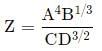
 and ΔA, ΔB, ΔC, and ΔD are their absolute errors in A, B, C and D respectively. The relative error in Z is then




In an experiment, the period of oscillation of a simple pendulum was observed to be 2.63s, 2.56s, 2.42s, 2.71s and 2.80s. The mean absolute error is- a)0.11s
- b)0.12s
- c)0.13s
- d)0.14s
Correct answer is option 'A'. Can you explain this answer?
In an experiment, the period of oscillation of a simple pendulum was observed to be 2.63s, 2.56s, 2.42s, 2.71s and 2.80s. The mean absolute error is
a)
0.11s
b)
0.12s
c)
0.13s
d)
0.14s
| | Suresh Iyer answered |
The mean period of oscillation of the pendulum is
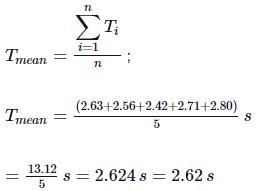
(Rounded off to two decimal places)
The absolute errors in the measurement are
ΔT1 = 2.62s − 2.63s = −0.01s
ΔT2 = 2.62s − 2.56s = 0.06s
ΔT3 = 2.62s − 2.42s = 0.20s
ΔT4 = 2.62s − 2.71s = −0.09s
ΔT5 = 2.62s − 2.80s = −0.18s
Mean absolute error is
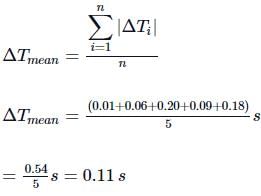
(Rounded off to two decimal places)
The absolute errors in the measurement are
ΔT1 = 2.62s − 2.63s = −0.01s
ΔT2 = 2.62s − 2.56s = 0.06s
ΔT3 = 2.62s − 2.42s = 0.20s
ΔT4 = 2.62s − 2.71s = −0.09s
ΔT5 = 2.62s − 2.80s = −0.18s
Mean absolute error is
Which of the following time measuring devices is most precise?- a)A wall clock
- b)An atomic clock
- c)A digital watch
- d)A stop watch
Correct answer is option 'B'. Can you explain this answer?
Which of the following time measuring devices is most precise?
a)
A wall clock
b)
An atomic clock
c)
A digital watch
d)
A stop watch
| | Gaurav Kumar answered |
An atomic clock is the most precise time measuring device because atomic oscillations are repeated with a precision of 1s in 1013s.


Chapter doubts & questions for Units and Measurements - 30-Day Revision Course for NEET 2026 is part of NEET exam preparation. The chapters have been prepared according to the NEET exam syllabus. The Chapter doubts & questions, notes, tests & MCQs are made for NEET 2026 Exam. Find important definitions, questions, notes, meanings, examples, exercises, MCQs and online tests here.
Chapter doubts & questions of Units and Measurements - 30-Day Revision Course for NEET in English & Hindi are available as part of NEET exam. Download more important topics, notes, lectures and mock test series for NEET Exam by signing up for free.
30-Day Revision Course for NEET85 videos|301 docs|171 tests |
