


All Exams > NEET > 30-Day Revision Course for NEET > All Questions
All questions of Motion in a Straight Line for NEET Exam
On velocity-time graph when two curves coincide, the objects will have- a)Same acceleration
- b)Same velocity
- c)Different velocity
- d)Different acceleration
Correct answer is option 'B'. Can you explain this answer?
On velocity-time graph when two curves coincide, the objects will have
a)
Same acceleration
b)
Same velocity
c)
Different velocity
d)
Different acceleration
 | Anjana Sharma answered |
On velocity-time graph, the point at which two curves coincide will indicate that both the objects have same velocity at that instant.

Two balls of equal mass and of Perfectly inelastic material are lying on the floor. One of the balls with velocity V is made to strike the second ball. Both the balls after impact will move with a velocity- a)v
- b)v/8
- c)v/4
- d)v/2
Correct answer is option 'D'. Can you explain this answer?
Two balls of equal mass and of Perfectly inelastic material are lying on the floor. One of the balls with velocity V is made to strike the second ball. Both the balls after impact will move with a velocity
a)
v
b)
v/8
c)
v/4
d)
v/2
 | Neha Joshi answered |
Given:
Let two balls A and B have mass mA, mB respectively, and their initial velocities are uA and uB. After the collision, they will move with the same velocity, vo.
Given that mass of both balls are same.
So mA = mB = m
uA = V, uB = 0
From the Concept of Momentum Conservation:
mAuA + mBuB = (m+m)vo
mV = 2mvo
vo = V/2
Both the balls after impact will move with velocity v/2.
The acceleration at any instant is the slope of the tangent of the ________ curve at that instant:- a)a-t
- b)v-t
- c)x-v
- d)x-t
Correct answer is option 'B'. Can you explain this answer?
The acceleration at any instant is the slope of the tangent of the ________ curve at that instant:
a)
a-t
b)
v-t
c)
x-v
d)
x-t
 | Om Desai answered |
This can be verified graphically
ObtaIning instantaneous acceleration from graph
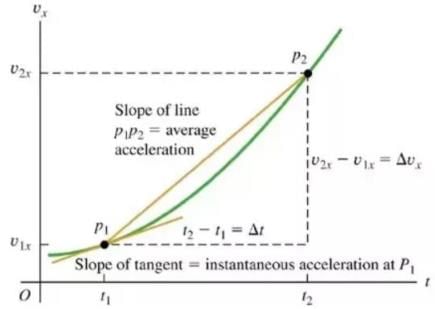
Figure shows the displacement – time graph of a particle moving along X – axis.
- a)particle moves at a variable velocity
- b)particle moves at a constant velocity upto a time t0 and then stops
- c)particle moves at a constant velocity upto a time t0 and then velocity increases
- d)particle moves at increasing velocity upto t0 and then velocity becomes constant
Correct answer is option 'B'. Can you explain this answer?
Figure shows the displacement – time graph of a particle moving along X – axis.
a)
particle moves at a variable velocity
b)
particle moves at a constant velocity upto a time t0 and then stops
c)
particle moves at a constant velocity upto a time t0 and then velocity increases
d)
particle moves at increasing velocity upto t0 and then velocity becomes constant
 | Preeti Iyer answered |
Because velocity is the slope of the x-t graph.(dx/dt=V) and by looking at the graph it can be seen that upto time T0 slope is constant so velocity will be constant and after time T0 slope is zero ( line is parallel to X axis) so the velocity will be zero.
Speed time graph of a particle moving along a fixed direction is shown in the figure below. The average speed of the particle over the interval: t = 0 s to 10 s.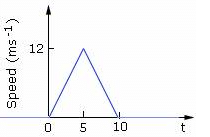
- a)16 m/s
- b)6 m/s
- c)10 m/s
- d)0.6 m/s
Correct answer is option 'B'. Can you explain this answer?
Speed time graph of a particle moving along a fixed direction is shown in the figure below. The average speed of the particle over the interval: t = 0 s to 10 s.
a)
16 m/s
b)
6 m/s
c)
10 m/s
d)
0.6 m/s
 | Lohit Matani answered |
From the given graph we get that the area of the given graph is total distance covered that is
= ½ x 10 x 12
= 60m
And total time taken is 10 sec
Thus average speed is 60m / 10sec
= 6 m/s
= ½ x 10 x 12
= 60m
And total time taken is 10 sec
Thus average speed is 60m / 10sec
= 6 m/s
Slope of displacement time graph or x-t graph gives us the particles’ ____________.- a)displacement
- b)deceleration
- c)velocity
- d)acceleration
Correct answer is option 'C'. Can you explain this answer?
Slope of displacement time graph or x-t graph gives us the particles’ ____________.
a)
displacement
b)
deceleration
c)
velocity
d)
acceleration
 | Rahul Bansal answered |
Velocity is a physical vector quantity; both magnitude and direction are needed to define it. The scalar absolute value (magnitude) of velocity is called "speed", being a coherent derived unit whose quantity is measured in the SI (metric system) as metres per second (m/s) or as the SI base unit of (m⋅s−1).
Linear inequalities are graphically represented on Cartesian plane by a- a)negative full space
- b)closed half space
- c)open half space
- d)positive full space
- e)
Correct answer is option 'B'. Can you explain this answer?
Linear inequalities are graphically represented on Cartesian plane by a
a)
negative full space
b)
closed half space
c)
open half space
d)
positive full space
e)
 | Muskaan Kumar answered |
The graph of an inequality in two variables is the set of points that represents all solutions to the inequality. A linear inequality divides the coordinate plane into two halves by a boundary line where one half represents the solutions of the inequality. The boundary line is dashed for > and < and solid for ≤ and ≥.
The distances covered by a freely falling body in its first, second, third,..., nth seconds of its motion- a)forms an arithematic progression
- b)forms a geometric progression
- c)do not form any well defined series
- d)form a series corresponding to the difference of square root of the successive natural numbers.
Correct answer is option 'A'. Can you explain this answer?
The distances covered by a freely falling body in its first, second, third,..., nth seconds of its motion
a)
forms an arithematic progression
b)
forms a geometric progression
c)
do not form any well defined series
d)
form a series corresponding to the difference of square root of the successive natural numbers.
 | Mira Joshi answered |
Distance travelled by a body in nth second is
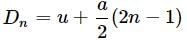
Here, u = 0, a = g
∴ Distance travelled by the body in 1st second is

Distance travelled by the body in 2nd second is

Distance travelled by the body in 3rd second is

and so on.
Hence, the distance covered by a freely falling body in its first, second, third ..... nth second of its motion forms an arithmetic progression.
Here, u = 0, a = g
∴ Distance travelled by the body in 1st second is
Distance travelled by the body in 2nd second is
Distance travelled by the body in 3rd second is
and so on.
Hence, the distance covered by a freely falling body in its first, second, third ..... nth second of its motion forms an arithmetic progression.
A player throws a ball upwards with an initial speed of 30 m s−1. How long does the ball take to return to the player's hands? (Take g = 10 m s−2).- a)3 s
- b)6 s
- c)9 s
- d)12 s
Correct answer is option 'B'. Can you explain this answer?
A player throws a ball upwards with an initial speed of 30 m s−1. How long does the ball take to return to the player's hands? (Take g = 10 m s−2).
a)
3 s
b)
6 s
c)
9 s
d)
12 s
 | Shubham Mogre answered |
In upward journey ball takes 3 sec and in downward journey 3 sec total 6 sec
by 1 equation of motion
v=u +at, here v=0 and u=30, a =10 solve through this .....
by 1 equation of motion
v=u +at, here v=0 and u=30, a =10 solve through this .....
A particle is released from rest from a tower of height 3h. The ratio of the intervals of time to cover three equal heights h is- a)t1:t2:t3 = 3:2:1
- b)t1:t2:t3 = 1:(√2-1):(√3-2)
- c)t1:t2:t3 = √3:√2:1
- d)t1:t2:t3 = 1:(√2-1):(√3-√2)
Correct answer is option 'D'. Can you explain this answer?
A particle is released from rest from a tower of height 3h. The ratio of the intervals of time to cover three equal heights h is
a)
t1:t2:t3 = 3:2:1
b)
t1:t2:t3 = 1:(√2-1):(√3-2)
c)
t1:t2:t3 = √3:√2:1
d)
t1:t2:t3 = 1:(√2-1):(√3-√2)
| | Mira Joshi answered |
Let t1, t2, t3 be the timings for three successive equal heights h covered during the free fall of the particle. Then
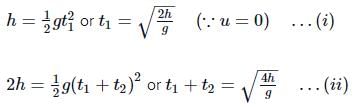

Subtracting (i) from (ii), we get

From (i),(iv) and (v), we get
t1:t2:t3 = 1:(√2-1) : (√3-√2)
A bird is tossing (flying to and fro) between two cars moving towards each other on a straight road. One car has speed of 27 km h−1 while the other has the speed of 18 km h−1. The bird starts moving from first car towards the other and is moving with the speed of 36 km h−1 when the two were separated by 36 km. The total distance covered by the bird is- a)28.8 km
- b)38.8 km
- c)48.8 km
- d)58.8 km
Correct answer is option 'A'. Can you explain this answer?
A bird is tossing (flying to and fro) between two cars moving towards each other on a straight road. One car has speed of 27 km h−1 while the other has the speed of 18 km h−1. The bird starts moving from first car towards the other and is moving with the speed of 36 km h−1 when the two were separated by 36 km. The total distance covered by the bird is
a)
28.8 km
b)
38.8 km
c)
48.8 km
d)
58.8 km
| | Ajay Yadav answered |
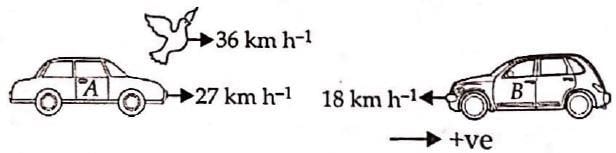
Velocity of car A, vA = +27kmh−1
Velocity of car B, vB = −18kmh−1
Relative velocity of car A with respect to car B
=vA − vB = + 27kmh−1 (−18kmh−1) = 45kmh−1
Time taken by the two cars to meet = 36 km/45 km h-1 = 0.8
Time taken by the two cars to meet = 36 km/45 km h-1 = 0.8
Thus, distance covered by the bird
= 36kmh−1 x 0.8h = 28.8km
= 36kmh−1 x 0.8h = 28.8km
Two parallel rail tracks run north-south. On one track train A moves north with a speed of 54 kmh−1 and on the other track train B moves south with a speed of 90kmh−1. What is the velocity of a monkey running on the roof of the train A against its motion with a velocity of 18 kmh-1 with respect to the train A as observed by a man standing on the ground?- a)5 ms-1
- b)10 ms-1
- c)15 ms-1
- d)20 ms-1
Correct answer is option 'B'. Can you explain this answer?
Two parallel rail tracks run north-south. On one track train A moves north with a speed of 54 kmh−1 and on the other track train B moves south with a speed of 90kmh−1. What is the velocity of a monkey running on the roof of the train A against its motion with a velocity of 18 kmh-1 with respect to the train A as observed by a man standing on the ground?
a)
5 ms-1
b)
10 ms-1
c)
15 ms-1
d)
20 ms-1
 | Gaurav Kumar answered |
Let the velocity of the monkey with respect to ground be vMG
Relative velocity of the monkey with respect to the train A
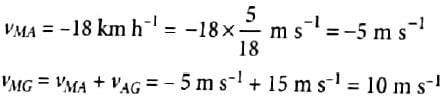
Relative velocity of the monkey with respect to the train A
A girl standing on a stationary lift (open from above) throws a ball upwards with initial speed 50 m s-1. The time taken by the ball to return to her hands is (Take g = 10 ms-2)- a)5s
- b)10 s
- c)15 s
- d)20 S
Correct answer is option 'B'. Can you explain this answer?
A girl standing on a stationary lift (open from above) throws a ball upwards with initial speed 50 m s-1. The time taken by the ball to return to her hands is (Take g = 10 ms-2)
a)
5s
b)
10 s
c)
15 s
d)
20 S
| | Jaspreet answered |
Since the ball reaches back so distance will be zero :. s =0
using second equation of motion
s=ut +1/2 at²
0= 50×t + 1/2 (-10t²)
0= 50t -5t²
50 t = 5t²
50 = 5t
t = 10 sec :)
using second equation of motion
s=ut +1/2 at²
0= 50×t + 1/2 (-10t²)
0= 50t -5t²
50 t = 5t²
50 = 5t
t = 10 sec :)
A body starts from rest and moves with constant acceleration for t s. It travels a distance x1 in first half of time and x2 in next half of time, then- a)x2 = 3x1
- b)x2 = x1
- c)x2 = 4x1
- d)x2 = 2x1
Correct answer is option 'A'. Can you explain this answer?
A body starts from rest and moves with constant acceleration for t s. It travels a distance x1 in first half of time and x2 in next half of time, then
a)
x2 = 3x1
b)
x2 = x1
c)
x2 = 4x1
d)
x2 = 2x1
| | Mira Joshi answered |
As the body starts from rest,
∴ u = 0
Let a be constant acceleration of the body.
Distance travelled by the body in (t/2) s is
x1=ut + 1/2 at2
∴ u = 0
Let a be constant acceleration of the body.
Distance travelled by the body in (t/2) s is
x1=ut + 1/2 at2
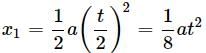
Distance travelled by the body in t s is

A man is standing on top of a building 100 m high. He throws two balls vertically, one at t = 0 and other after a time interval (less than 2 s). The later ball is thrown at a velocity of half the first. The vertical gap between first and second ball is 15 m at t = 2 s. The gap is found to remain constant. The velocities with which the balls were thrown are (Take g = 10 m s−2).- a)20ms−1, 10ms−1
- b)10ms−1, 5ms−1
- c)16ms−1, 8ms−1
- d)30ms−1, 15ms−1
Correct answer is option 'A'. Can you explain this answer?
A man is standing on top of a building 100 m high. He throws two balls vertically, one at t = 0 and other after a time interval (less than 2 s). The later ball is thrown at a velocity of half the first. The vertical gap between first and second ball is 15 m at t = 2 s. The gap is found to remain constant. The velocities with which the balls were thrown are (Take g = 10 m s−2).
a)
20ms−1, 10ms−1
b)
10ms−1, 5ms−1
c)
16ms−1, 8ms−1
d)
30ms−1, 15ms−1
| | Geetika Shah answered |
For first stone,
taking the vertical upwards motion of the first stone up to highest point
Here, u = u1, v = 0 (At highest point velocity is zero)
a = -g, S = h1
As v2 − u2 = 2aS

For second stone,
Taking the vertical upwards motion of the second stone up to highest point
here, u = U2, v = 0, a = −g, S = h2
As v2 − u2 = 2as
taking the vertical upwards motion of the first stone up to highest point
Here, u = u1, v = 0 (At highest point velocity is zero)
a = -g, S = h1
As v2 − u2 = 2aS
For second stone,
Taking the vertical upwards motion of the second stone up to highest point
here, u = U2, v = 0, a = −g, S = h2
As v2 − u2 = 2as

As per question
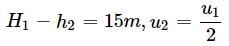
Subtract (ii) from (i), we get,
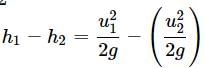
On substituting the given information, we get

or u1 = 20ms−1 and u2 = U1/2 = 10ms-1
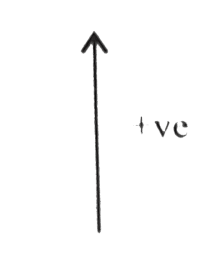
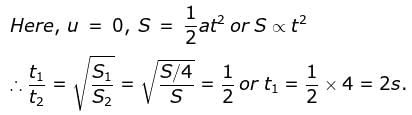
A ball is thrown vertically upwards with a velocity of 20 m s-1 from the top of a multistorey building of 25 m high. the time taken by the ball to reach the ground is- a)2 s
- b)3 s
- c)5 s
- d)7 s
Correct answer is option 'C'. Can you explain this answer?
A ball is thrown vertically upwards with a velocity of 20 m s-1 from the top of a multistorey building of 25 m high. the time taken by the ball to reach the ground is
a)
2 s
b)
3 s
c)
5 s
d)
7 s
| | Anjali Sharma answered |
Let t1 be the time taken by the ball to reach the highest point.
here, v = 0, u = 20ms−1, a = −g = −10ms−2, t = t1
As v = u + at
∴ 0 = 20 + (−10)t1 or t1 = 2s
Taking vertical downward motion of the ball from the highest point to ground.
Here, u = 0, a = +g = 10ms−2, S = 20 m + 25 m = 45 m, t = t2
here, v = 0, u = 20ms−1, a = −g = −10ms−2, t = t1
As v = u + at
∴ 0 = 20 + (−10)t1 or t1 = 2s
Taking vertical downward motion of the ball from the highest point to ground.
Here, u = 0, a = +g = 10ms−2, S = 20 m + 25 m = 45 m, t = t2
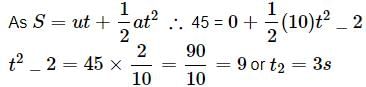
Total time taken by the ball to reach the ground = t1 + t2 = 2s + 3s = 5s
Stopping distance of a moving vehicle is directly proportional to- a)square of the initial velocity
- b)square of the initial acceleration
- c)the initial velocity
- d)the initial acceleration
Correct answer is option 'A'. Can you explain this answer?
Stopping distance of a moving vehicle is directly proportional to
a)
square of the initial velocity
b)
square of the initial acceleration
c)
the initial velocity
d)
the initial acceleration
| | Geetika Shah answered |
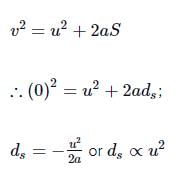
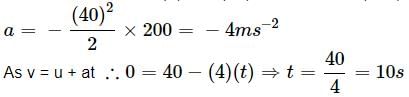
Let ds is the distance travelled by the vehicle before it stops.
Here, final velocity v = 0, initial velocity = u, S = ds
Using equation of motion

A bullet fired into a fixed wooden block loses half of its velocity after penetrating 40cm. It comes to rest after penetrating a further distance of- a)22/3 cm
- b)40/3 cm
- c)20/3 cm
- d)22/5 cm
Correct answer is option 'B'. Can you explain this answer?
A bullet fired into a fixed wooden block loses half of its velocity after penetrating 40cm. It comes to rest after penetrating a further distance of
a)
22/3 cm
b)
40/3 cm
c)
20/3 cm
d)
22/5 cm
| | Mira Joshi answered |
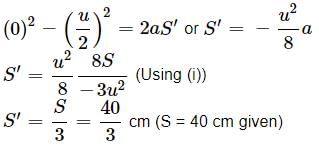
For first part of penetration, by equation of motion

For later part of penetration
A motorcycle and a car start from rest from the same place at the same time and travel in the same direction. The motorcycle accelerates at 1.0ms−1 up to a speed of 36 kmh-1 and the car at 0.5 ms1 up to a speed of 54 kmh-1. The time at which the car would overtake the motorcycle is- a)20 s
- b)25 s
- c)30 s
- d)35 s
Correct answer is option 'D'. Can you explain this answer?
A motorcycle and a car start from rest from the same place at the same time and travel in the same direction. The motorcycle accelerates at 1.0ms−1 up to a speed of 36 kmh-1 and the car at 0.5 ms1 up to a speed of 54 kmh-1. The time at which the car would overtake the motorcycle is
a)
20 s
b)
25 s
c)
30 s
d)
35 s
| | Anjali Sharma answered |
When car overtakes motorcycle, both have travelled the same distance in the same time. Let the total distance travelled be S and the total time taken to overtake be t.
For motorcycle:
Maximum speed attained = 36kmh−1

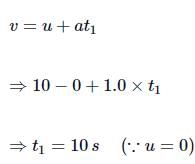
Since its acceleration = 1.0ms−2, the time t1 taken by it to attain the maximum speed is given by
The distance covered by motorcycle in attaining the maximum speed is

The time during which the motorcycle moves with maximum speed is (t − 10)s.
The distance covered by the motorcycle during this time is

∴ Total distance travelled by motorcycle in time t is
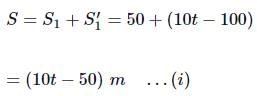
For car:
Maximum speed attained =

Since its acceleration = 0.5ms−2
Maximum speed attained = 36kmh−1
Since its acceleration = 1.0ms−2, the time t1 taken by it to attain the maximum speed is given by
The distance covered by motorcycle in attaining the maximum speed is
The time during which the motorcycle moves with maximum speed is (t − 10)s.
The distance covered by the motorcycle during this time is
∴ Total distance travelled by motorcycle in time t is
For car:
Maximum speed attained =
Since its acceleration = 0.5ms−2
The time taken by it to attain the maximum speed is given by
15 = 0 + 0.5 x t2 or t2 = 30s (∵ u = 0)
The distance covered by the car in attaining the maximum speed is

The time during which the car moves with maximum speed is (t − 30)s.
The distance covered by the car during this time is

∴ Total distance travelled by car in time t is
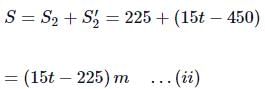
From equations (i) and (ii), we get
10t − 50 = 151 − 225 or 51 = 175 or 1 = 35s
15 = 0 + 0.5 x t2 or t2 = 30s (∵ u = 0)
The distance covered by the car in attaining the maximum speed is
The time during which the car moves with maximum speed is (t − 30)s.
The distance covered by the car during this time is
∴ Total distance travelled by car in time t is
From equations (i) and (ii), we get
10t − 50 = 151 − 225 or 51 = 175 or 1 = 35s
Free fall of an object in vacuum is a case of motion with- a)uniform velocity
- b)uniform acceleration
- c)variable acceleration
- d)uniform speed
Correct answer is option 'B'. Can you explain this answer?
Free fall of an object in vacuum is a case of motion with
a)
uniform velocity
b)
uniform acceleration
c)
variable acceleration
d)
uniform speed
| | Ajay Yadav answered |
Free fall of an object in vacuum is a case of motion with uniform acceleration.
A body falling freely under gravity passes two points 30 m apart in 1 s. From what point above the upper point it began to fall? (Take g = 9.8 ms2).- a)32.1 m
- b)16.0 m
- c)8.6 m
- d)4.0 m
Correct answer is option 'A'. Can you explain this answer?
A body falling freely under gravity passes two points 30 m apart in 1 s. From what point above the upper point it began to fall? (Take g = 9.8 ms2).
a)
32.1 m
b)
16.0 m
c)
8.6 m
d)
4.0 m
| | Anjali Sharma answered |
Suppose the body passes the upper point at t second and lower point at (t + 1) s, then
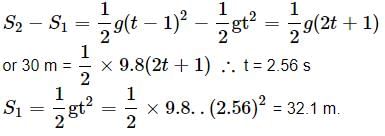
A police van moving on a highway with a speed of 30km h−1 fires a bullet at a thief's car speeding away in the same direction with a speed of 192km h−1. If the muzzle speed of the bullet is 150ms−1 , with what relative speed does the bullet hit the thief's car?- a)95 ms-1
- b)105 m s-1
- c)115 ms-1
- d)125 m s-1
Correct answer is option 'B'. Can you explain this answer?
A police van moving on a highway with a speed of 30km h−1 fires a bullet at a thief's car speeding away in the same direction with a speed of 192km h−1. If the muzzle speed of the bullet is 150ms−1 , with what relative speed does the bullet hit the thief's car?
a)
95 ms-1
b)
105 m s-1
c)
115 ms-1
d)
125 m s-1
| | Mira Joshi answered |
Speed of police van w.r.t. ground
∴ vPG = 30kmh−1
Speed of thief’s car w.r.t. ground
∴ vTG = 192kmh−1
Speed of bullet w.r.t. police van

Speed with which the bullet will hit the thief’s car will be
vBT = vBG + vGT = vBP + vPG + vGT
= 540kmh−1 + 30kmh−1 − 192kmh−1
(∵ vGT = −vTG)

A bus is moving with a speed of 10ms−1 on a straight road. A scooterist wishes to overtake the bus in 100s. If the bus is at a distance of 1km from the scooterist with what speed should the scooterist chase the bus?- a)40 ms-1
- b)25 ms-1
- c)115 m s-1
- d)125 ms-1
Correct answer is option 'D'. Can you explain this answer?
A bus is moving with a speed of 10ms−1 on a straight road. A scooterist wishes to overtake the bus in 100s. If the bus is at a distance of 1km from the scooterist with what speed should the scooterist chase the bus?
a)
40 ms-1
b)
25 ms-1
c)
115 m s-1
d)
125 ms-1
| | Raghav Bansal answered |
Let vs be the velocity of the scooter, the distance between the scooter and the bus = 1000m,
The velocity of the bus = 10ms−1
Time taken to overtake = 100s
Relative velocity of the scooter with respect to the bus = (vs − 10)
1000/(vs − 10) = 100s
= vs = 20ms−1
Two parallel rail tracks run north-south. On one track train A moves north with a speed of 54kmh−1 and on the other track train B moves south with a speed of 90kmh−1. The velocity of train A with respect to train B is- a)10 ms-1
- b)15 ms-1
- c)25 ms-1
- d)40 ms-1
Correct answer is option 'D'. Can you explain this answer?
Two parallel rail tracks run north-south. On one track train A moves north with a speed of 54kmh−1 and on the other track train B moves south with a speed of 90kmh−1. The velocity of train A with respect to train B is
a)
10 ms-1
b)
15 ms-1
c)
25 ms-1
d)
40 ms-1
| | Preeti Iyer answered |
Let the positive direction of motion be from south to north. Velocity of train A with respect to ground
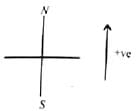

Velocity of train B with respect to ground

Relative velocity of train A with respect to train B is

The velocity of a particle at an instant is 10 ms-1 After 3 s its velocity will becomes 16 ms-1. The velocity at 2 s, before the given instant will be- a)6 ms-1
- b)4 ms-1
- c)2 ms-1
- d)1 ms-1
Correct answer is option 'A'. Can you explain this answer?
The velocity of a particle at an instant is 10 ms-1 After 3 s its velocity will becomes 16 ms-1. The velocity at 2 s, before the given instant will be
a)
6 ms-1
b)
4 ms-1
c)
2 ms-1
d)
1 ms-1
| | Gaurav Kumar answered |
Here, u = 10ms−1, t = 3s, v = 16ms−1

Now velocity at 2 s, before the given instant
10 = u + 2 x 2
∴ u = 6 m s−1 (since v = u + at)
10 = u + 2 x 2
∴ u = 6 m s−1 (since v = u + at)
A body A starts from rest with an acceleration a1. After 2 seconds, another body B starts from rest with an acceleration a2. If they travel equal distances in the 5th second, after the start of A, then the ratio a1 : a2, is equal to- a)5 : 9
- b)5 : 7
- c)9 : 5
- d)9 : 7
Correct answer is option 'A'. Can you explain this answer?
A body A starts from rest with an acceleration a1. After 2 seconds, another body B starts from rest with an acceleration a2. If they travel equal distances in the 5th second, after the start of A, then the ratio a1 : a2, is equal to
a)
5 : 9
b)
5 : 7
c)
9 : 5
d)
9 : 7
| | Gaurav Kumar answered |
Time taken by body A, t1 = 5s
Acceleration of body A = a1
Time taken by body B, t2 = 5 − 2 = 3s
Acceleration of body B = a2
Distance covered by first body in 5th second after its start,
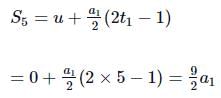
Distance covered by the second body in the 3rd second after its start,
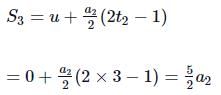
Since S5 = S3

Which of the following statements is not correct?- a)The zero velocity of a body at any instant does not necessarily impy zero acceleration at that instant.
- b)The kinematic equation of motions are true only for motion in which the magnitude and the direction of acceleration are constants during the couse of motion.
- c)The sign of acceleration tells us whether the particle's speed is increasing or decreasing.
- d)All of these.
Correct answer is option 'C'. Can you explain this answer?
Which of the following statements is not correct?
a)
The zero velocity of a body at any instant does not necessarily impy zero acceleration at that instant.
b)
The kinematic equation of motions are true only for motion in which the magnitude and the direction of acceleration are constants during the couse of motion.
c)
The sign of acceleration tells us whether the particle's speed is increasing or decreasing.
d)
All of these.
 | Aashna Rane answered |
Explanation:
The correct answer is option 'C' - The sign of acceleration tells us whether the particle's speed is increasing or decreasing.
Reason:
The sign of acceleration does not directly tell us whether the particle's speed is increasing or decreasing. The sign of acceleration only indicates the direction of the acceleration vector, not its magnitude.
Example:
Consider a particle moving in a straight line. If the particle is moving in the positive direction and has a positive acceleration, it means that the particle is speeding up. However, if the particle is moving in the positive direction and has a negative acceleration, it means that the particle is slowing down. Similarly, if the particle is moving in the negative direction and has a positive acceleration, it means that the particle is slowing down, while a negative acceleration means that the particle is speeding up.
Key Points:
- The sign of acceleration indicates the direction of the acceleration vector, not whether the particle's speed is increasing or decreasing.
- The magnitude of acceleration determines the rate of change of velocity, which indirectly affects the particle's speed. If the magnitude of acceleration is positive, the particle's speed may increase, while a negative magnitude of acceleration may cause the particle's speed to decrease.
- To determine whether the particle's speed is increasing or decreasing, one needs to consider the sign and magnitude of both velocity and acceleration vectors.
Conclusion:
The statement that the sign of acceleration tells us whether the particle's speed is increasing or decreasing is not correct. The sign of acceleration only indicates the direction of the acceleration vector, while the magnitude of acceleration determines the rate of change of velocity, which indirectly affects the particle's speed.
The correct answer is option 'C' - The sign of acceleration tells us whether the particle's speed is increasing or decreasing.
Reason:
The sign of acceleration does not directly tell us whether the particle's speed is increasing or decreasing. The sign of acceleration only indicates the direction of the acceleration vector, not its magnitude.
Example:
Consider a particle moving in a straight line. If the particle is moving in the positive direction and has a positive acceleration, it means that the particle is speeding up. However, if the particle is moving in the positive direction and has a negative acceleration, it means that the particle is slowing down. Similarly, if the particle is moving in the negative direction and has a positive acceleration, it means that the particle is slowing down, while a negative acceleration means that the particle is speeding up.
Key Points:
- The sign of acceleration indicates the direction of the acceleration vector, not whether the particle's speed is increasing or decreasing.
- The magnitude of acceleration determines the rate of change of velocity, which indirectly affects the particle's speed. If the magnitude of acceleration is positive, the particle's speed may increase, while a negative magnitude of acceleration may cause the particle's speed to decrease.
- To determine whether the particle's speed is increasing or decreasing, one needs to consider the sign and magnitude of both velocity and acceleration vectors.
Conclusion:
The statement that the sign of acceleration tells us whether the particle's speed is increasing or decreasing is not correct. The sign of acceleration only indicates the direction of the acceleration vector, while the magnitude of acceleration determines the rate of change of velocity, which indirectly affects the particle's speed.
A body initially at rest is moving with uniform acceleration a. Its velocity after n seconds is v. The displacement of the body in last 2 s is- a)

- b)

- c)

- d)

Correct answer is option 'A'. Can you explain this answer?
A body initially at rest is moving with uniform acceleration a. Its velocity after n seconds is v. The displacement of the body in last 2 s is
a)
b)
c)
d)
| | Pooja Shah answered |
Displacement in last 2 second
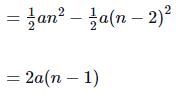
Acceleration a = v/n
(∵ t = ns)
Displacement in last 2s =

Acceleration a = v/n
(∵ t = ns)
Displacement in last 2s =
Two cars A and B are running at velocities of 60 km h−1 and 45 km h−1. What is the relative velocity of car A with respect to car B, if both are moving eastward?- a)15 km h-1
- b)45 km h-1
- c)60 km h-1
- d)105 km h-1
Correct answer is option 'A'. Can you explain this answer?
Two cars A and B are running at velocities of 60 km h−1 and 45 km h−1. What is the relative velocity of car A with respect to car B, if both are moving eastward?
a)
15 km h-1
b)
45 km h-1
c)
60 km h-1
d)
105 km h-1
| | Anjali Sharma answered |
Velocity of car A w.r.t. ground
∴ vAG = 60 kmh−1
Velocity of car B w.r.t. ground
∴ vBG = 45 km h−1
Relative velocity of car A w.r.t. B
vAB = vAG + vGB
=vAG − vBG = 15 km h−1 (∵ vGB = −vBG)
A 175m long train is travelling along a straight track with a velocity 72km−1h. A bird is flying parallel to the train in the opposite direction with a velocity 18km−1h. The time taken by the bird to cross the train is- a)35 s
- b)27 s
- c)11.6 s
- d)7 s
Correct answer is option 'D'. Can you explain this answer?
A 175m long train is travelling along a straight track with a velocity 72km−1h. A bird is flying parallel to the train in the opposite direction with a velocity 18km−1h. The time taken by the bird to cross the train is
a)
35 s
b)
27 s
c)
11.6 s
d)
7 s
| | Lakshmi Pillai answered |
Understanding the Problem
To find the time taken by the bird to cross the train, we first need to determine the relative speeds of the train and the bird.
Step 1: Convert Speeds to m/s
- The train's speed: 72 km/h = (72 * 1000) / (60 * 60) = 20 m/s
- The bird's speed: 18 km/h = (18 * 1000) / (60 * 60) = 5 m/s
Step 2: Calculate Relative Speed
Since the bird is flying in the opposite direction to the train, we add their speeds to find the relative speed:
- Relative speed = Speed of train + Speed of bird
- Relative speed = 20 m/s + 5 m/s = 25 m/s
Step 3: Calculate Time to Cross the Train
The time taken to cross the train is determined by the length of the train and the relative speed:
- Length of the train = 175 m
- Time = Distance / Speed
- Time = 175 m / 25 m/s = 7 seconds
Conclusion
Therefore, the time taken by the bird to cross the train is 7 seconds, which corresponds to option 'D'.
This exercise demonstrates the importance of understanding relative motion in physics, especially in problems involving objects moving in opposite directions.
To find the time taken by the bird to cross the train, we first need to determine the relative speeds of the train and the bird.
Step 1: Convert Speeds to m/s
- The train's speed: 72 km/h = (72 * 1000) / (60 * 60) = 20 m/s
- The bird's speed: 18 km/h = (18 * 1000) / (60 * 60) = 5 m/s
Step 2: Calculate Relative Speed
Since the bird is flying in the opposite direction to the train, we add their speeds to find the relative speed:
- Relative speed = Speed of train + Speed of bird
- Relative speed = 20 m/s + 5 m/s = 25 m/s
Step 3: Calculate Time to Cross the Train
The time taken to cross the train is determined by the length of the train and the relative speed:
- Length of the train = 175 m
- Time = Distance / Speed
- Time = 175 m / 25 m/s = 7 seconds
Conclusion
Therefore, the time taken by the bird to cross the train is 7 seconds, which corresponds to option 'D'.
This exercise demonstrates the importance of understanding relative motion in physics, especially in problems involving objects moving in opposite directions.
A ball is thrown vertically upwards with a velocity of 20 m s-1 from the top of a multistorey building of 25 m high. How high will the ball rise? (Take g = 10 m s-2)- a)10 m
- b)15 m
- c)20 m
- d)25 m
Correct answer is option 'C'. Can you explain this answer?
A ball is thrown vertically upwards with a velocity of 20 m s-1 from the top of a multistorey building of 25 m high. How high will the ball rise? (Take g = 10 m s-2)
a)
10 m
b)
15 m
c)
20 m
d)
25 m
 | Sanaya Mishra answered |
Understanding the Problem
A ball is thrown upwards with an initial velocity (u) of 20 m/s from a height of 25 m. We are to determine how high the ball will rise above the ground.
Key Concepts
- The maximum height (h) reached by the ball can be calculated using the kinematic equation:
h = u2 / (2g)
- Where:
- u = initial velocity (20 m/s)
- g = acceleration due to gravity (10 m/s2)
Calculating Maximum Height
1. Using the Kinematic Equation:
- Substitute the values:
- h = (20 m/s)2 / (2 * 10 m/s2)
- h = 400 m2/s2 / 20 m/s2
- h = 20 m
2. Total Height from the Ground:
- The total height from the ground when the ball reaches its maximum height is:
- Total height = Height of building + Maximum height reached by the ball
- Total height = 25 m + 20 m = 45 m
Conclusion
The ball will rise an additional height of 20 m above the building's top. So, the maximum height reached by the ball above its starting point (the building) is 20 m.
Thus, the correct answer is option 'C': 20 m.
A ball is thrown upwards with an initial velocity (u) of 20 m/s from a height of 25 m. We are to determine how high the ball will rise above the ground.
Key Concepts
- The maximum height (h) reached by the ball can be calculated using the kinematic equation:
h = u2 / (2g)
- Where:
- u = initial velocity (20 m/s)
- g = acceleration due to gravity (10 m/s2)
Calculating Maximum Height
1. Using the Kinematic Equation:
- Substitute the values:
- h = (20 m/s)2 / (2 * 10 m/s2)
- h = 400 m2/s2 / 20 m/s2
- h = 20 m
2. Total Height from the Ground:
- The total height from the ground when the ball reaches its maximum height is:
- Total height = Height of building + Maximum height reached by the ball
- Total height = 25 m + 20 m = 45 m
Conclusion
The ball will rise an additional height of 20 m above the building's top. So, the maximum height reached by the ball above its starting point (the building) is 20 m.
Thus, the correct answer is option 'C': 20 m.
If a simple graph G, contains n vertices and m edges, the number of edges in the Graph G'(Complement of G) is ___________- a)(n*n-n-2*m)/2
- b)(n*n+n+2*m)/2
- c)(n*n+n-2*m)/2
- d)(n*n-n+2*m)/2
Correct answer is option 'A'. Can you explain this answer?
If a simple graph G, contains n vertices and m edges, the number of edges in the Graph G'(Complement of G) is ___________
a)
(n*n-n-2*m)/2
b)
(n*n+n+2*m)/2
c)
(n*n+n-2*m)/2
d)
(n*n-n+2*m)/2
 | Sanaya Menon answered |
The complement of a graph G, denoted as G', is a graph that contains all the vertices of G, but does not have any of the edges that are present in G. In other words, if there is an edge between two vertices in G, there is no edge between those vertices in G'.
To find the number of edges in G', we need to consider the number of possible edges that can be formed between the vertices of G, and subtract the number of edges that are already present in G.
Let's break down the problem into steps to understand the solution better:
Step 1: Counting the total number of possible edges
In a simple graph G with n vertices, the total number of possible edges is given by the formula n(n-1)/2. This formula is derived from the fact that each vertex can be connected to (n-1) other vertices, but we divide by 2 to avoid counting each edge twice.
Step 2: Counting the number of edges in G
The given graph G contains m edges. So, the number of edges in G is m.
Step 3: Finding the number of edges in G'
To find the number of edges in G', we subtract the number of edges in G from the total number of possible edges. Mathematically, this can be represented as:
Number of edges in G' = Total number of possible edges - Number of edges in G
Substituting the formulas from Step 1 and Step 2, we get:
Number of edges in G' = n(n-1)/2 - m
Simplifying the expression further, we have:
Number of edges in G' = (n^2 - n - 2m)/2
Therefore, the correct answer is option A: (n^2 - n - 2m)/2.
To find the number of edges in G', we need to consider the number of possible edges that can be formed between the vertices of G, and subtract the number of edges that are already present in G.
Let's break down the problem into steps to understand the solution better:
Step 1: Counting the total number of possible edges
In a simple graph G with n vertices, the total number of possible edges is given by the formula n(n-1)/2. This formula is derived from the fact that each vertex can be connected to (n-1) other vertices, but we divide by 2 to avoid counting each edge twice.
Step 2: Counting the number of edges in G
The given graph G contains m edges. So, the number of edges in G is m.
Step 3: Finding the number of edges in G'
To find the number of edges in G', we subtract the number of edges in G from the total number of possible edges. Mathematically, this can be represented as:
Number of edges in G' = Total number of possible edges - Number of edges in G
Substituting the formulas from Step 1 and Step 2, we get:
Number of edges in G' = n(n-1)/2 - m
Simplifying the expression further, we have:
Number of edges in G' = (n^2 - n - 2m)/2
Therefore, the correct answer is option A: (n^2 - n - 2m)/2.
An object falling through a fluid is observed to have acceleration given by a = g − bv where g = gravitational acceleration and b is constant. After a long time of release, it is observed to fall with constant speed. The value of constant speed is- a)g/b
- b)b/g
- c)bg
- d)b
Correct answer is option 'A'. Can you explain this answer?
An object falling through a fluid is observed to have acceleration given by a = g − bv where g = gravitational acceleration and b is constant. After a long time of release, it is observed to fall with constant speed. The value of constant speed is
a)
g/b
b)
b/g
c)
bg
d)
b
 | Hansa Sharma answered |
Here, a = g − bv
When an object falls with constant speed vc, its acceleration becomes zero.
∴ g − bvc = 0 or vc = g/b
When an object falls with constant speed vc, its acceleration becomes zero.
∴ g − bvc = 0 or vc = g/b
A body covers 20 m, 22 m, 24 m, in 8th, 9th and 10th seconds respectively. The body starts- a)from rest and moves with uniform velocity.
- b)from rest and moves with uniform acceleration.
- c)with an initial velocity and moves with uniform acceleration.
- d)with an initial velocity and moves with uniform velocity.
Correct answer is option 'C'. Can you explain this answer?
A body covers 20 m, 22 m, 24 m, in 8th, 9th and 10th seconds respectively. The body starts
a)
from rest and moves with uniform velocity.
b)
from rest and moves with uniform acceleration.
c)
with an initial velocity and moves with uniform acceleration.
d)
with an initial velocity and moves with uniform velocity.
| | Ananya Das answered |
As distance travelled in successive seconds differ by 2 m each, therefore acceleration is constant = 2ms−2

Two trains A and B of length 400 m each are moving on two parallel tracks with a uniform speed of 72 km h-1 in the same direction, with A ahead of B. The driver of B decides to overtake A and accelerates by 1 ms-2. If after 50s, the guard of B just brushed past A, what was the original distance between them?- a)750 m
- b)1000 m
- c)1250 m
- d)2250 m
Correct answer is option 'C'. Can you explain this answer?
Two trains A and B of length 400 m each are moving on two parallel tracks with a uniform speed of 72 km h-1 in the same direction, with A ahead of B. The driver of B decides to overtake A and accelerates by 1 ms-2. If after 50s, the guard of B just brushed past A, what was the original distance between them?
a)
750 m
b)
1000 m
c)
1250 m
d)
2250 m
| | Ananya Das answered |
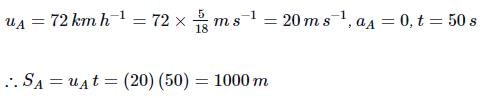
For train B,
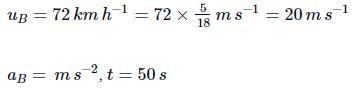
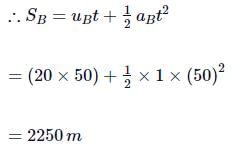
Original distance between A and B = SB − SA = 2250m − 1000m = 1250m
A ball A is dropped from a building of height 45 m. Simultaneously another identical ball B is thrown up with a speed 50 m s−1. The relative speed of ball B w.r.t. ball A at any instant of time is (Take g = 10 m s−2).- a)0
- b)10 m s-1
- c)25 ms-1
- d)50 ms-1
Correct answer is option 'D'. Can you explain this answer?
A ball A is dropped from a building of height 45 m. Simultaneously another identical ball B is thrown up with a speed 50 m s−1. The relative speed of ball B w.r.t. ball A at any instant of time is (Take g = 10 m s−2).
a)
0
b)
10 m s-1
c)
25 ms-1
d)
50 ms-1
 | Jyoti Sengupta answered |
Here, uA = −0 , uB = +50ms−1
aA = −g , aB = −g
uBA = uB − uA = 50ms−1 − (0)ms−1 = 50ms−1
aBA = aB − aA = −g − (−g) = 0
∵ vBA = uBA + aBAt(As aBA = 0)
∴ vBA = uBA
As there is no acceleration of ball B w.r.t to ball A, therefore the relative speed of ball B w.r.t ball A at any instant of time remains constant (= 50ms−1).
A train A which is 120m long is running with velocity 20m/s while train B which is 130m long is running in opposite direction with velocity 30m/s. What is the time taken by train B to cross the train A?- a)5 s
- b)25 s
- c)10 s
- d)100 s
Correct answer is option 'A'. Can you explain this answer?
A train A which is 120m long is running with velocity 20m/s while train B which is 130m long is running in opposite direction with velocity 30m/s. What is the time taken by train B to cross the train A?
a)
5 s
b)
25 s
c)
10 s
d)
100 s
 | Nabanita Chakraborty answered |
Understanding the Problem
To find the time taken by train B to completely cross train A, we need to consider both the lengths of the trains and their relative velocities.
Key Information
- Length of Train A: 120 m
- Length of Train B: 130 m
- Velocity of Train A: 20 m/s
- Velocity of Train B: 30 m/s
Relative Velocity Calculation
When two objects move in opposite directions, their relative velocity is the sum of their speeds.
- Relative Velocity = Velocity of Train A + Velocity of Train B
- Relative Velocity = 20 m/s + 30 m/s = 50 m/s
Total Distance to Cross
To find the total distance that train B needs to cover to completely cross train A, we add their lengths:
- Total Distance = Length of Train A + Length of Train B
- Total Distance = 120 m + 130 m = 250 m
Time Calculation
Using the formula for time, which is:
- Time = Total Distance / Relative Velocity
We can substitute the values:
- Time = 250 m / 50 m/s = 5 s
Conclusion
The time taken by train B to completely cross train A is 5 seconds.
Thus, the correct answer is option 'A'.
To find the time taken by train B to completely cross train A, we need to consider both the lengths of the trains and their relative velocities.
Key Information
- Length of Train A: 120 m
- Length of Train B: 130 m
- Velocity of Train A: 20 m/s
- Velocity of Train B: 30 m/s
Relative Velocity Calculation
When two objects move in opposite directions, their relative velocity is the sum of their speeds.
- Relative Velocity = Velocity of Train A + Velocity of Train B
- Relative Velocity = 20 m/s + 30 m/s = 50 m/s
Total Distance to Cross
To find the total distance that train B needs to cover to completely cross train A, we add their lengths:
- Total Distance = Length of Train A + Length of Train B
- Total Distance = 120 m + 130 m = 250 m
Time Calculation
Using the formula for time, which is:
- Time = Total Distance / Relative Velocity
We can substitute the values:
- Time = 250 m / 50 m/s = 5 s
Conclusion
The time taken by train B to completely cross train A is 5 seconds.
Thus, the correct answer is option 'A'.
On a long horizontally moving belt, a child runs to and fro with a speed 9kmh−1 (with respect to the belt) between his father and mother located 50m apart on the moving belt. The belt moves with a speed of 4kmh−1. For an observer on a stationary platform, the speed of the child running in the direction of motion of the belt is- a)4 km h-1
- b)5 km h-1
- c)9 km h-1
- d)13 km h-1
Correct answer is option 'D'. Can you explain this answer?
On a long horizontally moving belt, a child runs to and fro with a speed 9kmh−1 (with respect to the belt) between his father and mother located 50m apart on the moving belt. The belt moves with a speed of 4kmh−1. For an observer on a stationary platform, the speed of the child running in the direction of motion of the belt is
a)
4 km h-1
b)
5 km h-1
c)
9 km h-1
d)
13 km h-1
| | Jyoti Sengupta answered |
Figure shows conditions of the question.
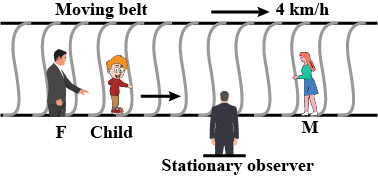
In this case,
Speed of belt w.r.t. ground
∴ vBG = 4kmh−1
Speed of child w.r.t. belt
∴ vCB = 9kmh−1
∴ For an observer on a stationary platform, speed of child running in the direction of motion of the belt is
vCG = vCB + vBG = 9kmh−1 + 4kmh−1
= 13kmh−1
Which of the following equations does not represent the kinematic equations of motion?- a)v = u + at
- b)S = ut + 1/2at2
- c)S = vt + 1/2at2
- d)v2 - u2 = 2aS
Correct answer is option 'C'. Can you explain this answer?
Which of the following equations does not represent the kinematic equations of motion?
a)
v = u + at
b)
S = ut + 1/2at2
c)
S = vt + 1/2at2
d)
v2 - u2 = 2aS
| | Mira Joshi answered |
S = vt + 1/2at2
It is not a kinematic equation of motion.
All others are three kinematic equations of motion.
It is not a kinematic equation of motion.
All others are three kinematic equations of motion.
A girl standing on a stationary lift (open from above) throws a ball upwards with initial speed 50 m s-1. if the lift starts moving up with a uniform speed of 5ms−1 and the girl again throws the ball up with the same speed, how long does the ball take to return to her hands?- a)5s
- b)10 s
- c)15 s
- d)20 S
Correct answer is option 'B'. Can you explain this answer?
A girl standing on a stationary lift (open from above) throws a ball upwards with initial speed 50 m s-1. if the lift starts moving up with a uniform speed of 5ms−1 and the girl again throws the ball up with the same speed, how long does the ball take to return to her hands?
a)
5s
b)
10 s
c)
15 s
d)
20 S
| | Geetika Shah answered |
When the lift starts moving upwards with uniform speed of 5 ms−1, there is no change of relative velocity of ball w.r.t. girl. Hence, even in this case the ball will return to the girl’s hands in the same time i.e 10s.
On a two-lane road, car A is travelling with a speed of 36 km h-1. Two cars B and C approach car A in opposite directions with a speed of 54 km h-1 each. At a certain instant, when the distance AB is equal to AC, both being 1 km, B decides to overtake A before C does. The minimum required acceleration of car B to avoid an accident is- a)1 ms-2
- b)1.5 ms-2
- c)2 ms-2
- d)3 ms-2
Correct answer is option 'A'. Can you explain this answer?
On a two-lane road, car A is travelling with a speed of 36 km h-1. Two cars B and C approach car A in opposite directions with a speed of 54 km h-1 each. At a certain instant, when the distance AB is equal to AC, both being 1 km, B decides to overtake A before C does. The minimum required acceleration of car B to avoid an accident is
a)
1 ms-2
b)
1.5 ms-2
c)
2 ms-2
d)
3 ms-2
| | Ajay Yadav answered |
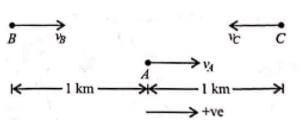
Velocity of car A ,

Velocity of car B ,

Velocity of car C ,
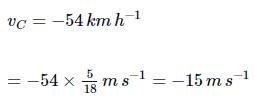
Relative velocity of car B w.r.t. car A
vBA = vB−vA = 15ms−1−10ms−1 = 5ms−1
Relative velocity of car C w.r.t. car A is
vCA = vC−vA = −15ms−1 − 10ms−1=−25ms−1
At a certain instant, both cars B and C are at the same distance from car A
i.e. AB − BC = 1km = 1000m
Time taken by car C to cover 1km to reach car A
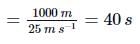
In order to avoid an accident, the car B accelerates such that it overtakes car A in less than 40s. Let the minimum required acceleration be a. Then,
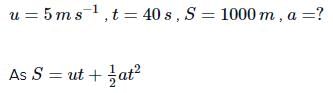
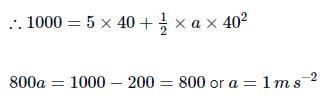
In order to avoid an accident, the car B accelerates such that it overtakes car A in less than 40s. Let the minimum required acceleration be a. Then,
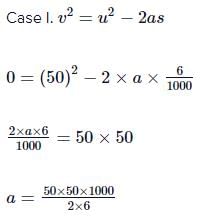
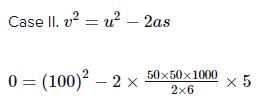
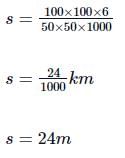
It is a common observation that rain clouds can be at about 1 km altitude above the ground. If a rain drop falls from such a height freely under gravity, then what will be its speed in km h-1 (Take g = 10 m )- a)510
- b)610
- c)710
- d)910
Correct answer is option 'A'. Can you explain this answer?
It is a common observation that rain clouds can be at about 1 km altitude above the ground. If a rain drop falls from such a height freely under gravity, then what will be its speed in km h-1 (Take g = 10 m )
a)
510
b)
610
c)
710
d)
910
| | Manisha Bajaj answered |
Given:
- Height of rain clouds above the ground = 1 km = 1000 m
- Acceleration due to gravity (g) = 10 m/s²
To find:
- Speed of the raindrop in km/h
Solution:
We can solve this problem using the equations of motion.
Step 1: Finding the time taken by the raindrop to fall
Using the second equation of motion:
v = u + gt
Where,
v = final velocity (which is 0 m/s as the raindrop falls freely)
u = initial velocity (which is also 0 m/s as the raindrop starts from rest)
g = acceleration due to gravity
t = time taken
0 = 0 + (10)(t)
0 = 10t
t = 0 s
The time taken by the raindrop to fall is 0 seconds.
Step 2: Converting the height and time into the same units
Since the height of the rain clouds is given in kilometers and the time is given in seconds, we need to convert them into the same units. Let's convert the height into meters.
Height of rain clouds = 1 km = 1000 m
Step 3: Finding the final velocity
Using the first equation of motion:
v = u + gt
Where,
v = final velocity
u = initial velocity (which is 0 m/s)
g = acceleration due to gravity (10 m/s²)
t = time taken (0 s)
v = 0 + (10)(0)
v = 0 m/s
The final velocity of the raindrop is 0 m/s.
Step 4: Converting the speed into km/h
Since the final velocity is given in m/s, we need to convert it into km/h.
Speed of the raindrop = 0 m/s
Speed of the raindrop = 0 × 3.6 km/h (1 m/s = 3.6 km/h)
The speed of the raindrop is 0 km/h.
Therefore, the correct answer is option 'A' (0 km/h).
- Height of rain clouds above the ground = 1 km = 1000 m
- Acceleration due to gravity (g) = 10 m/s²
To find:
- Speed of the raindrop in km/h
Solution:
We can solve this problem using the equations of motion.
Step 1: Finding the time taken by the raindrop to fall
Using the second equation of motion:
v = u + gt
Where,
v = final velocity (which is 0 m/s as the raindrop falls freely)
u = initial velocity (which is also 0 m/s as the raindrop starts from rest)
g = acceleration due to gravity
t = time taken
0 = 0 + (10)(t)
0 = 10t
t = 0 s
The time taken by the raindrop to fall is 0 seconds.
Step 2: Converting the height and time into the same units
Since the height of the rain clouds is given in kilometers and the time is given in seconds, we need to convert them into the same units. Let's convert the height into meters.
Height of rain clouds = 1 km = 1000 m
Step 3: Finding the final velocity
Using the first equation of motion:
v = u + gt
Where,
v = final velocity
u = initial velocity (which is 0 m/s)
g = acceleration due to gravity (10 m/s²)
t = time taken (0 s)
v = 0 + (10)(0)
v = 0 m/s
The final velocity of the raindrop is 0 m/s.
Step 4: Converting the speed into km/h
Since the final velocity is given in m/s, we need to convert it into km/h.
Speed of the raindrop = 0 m/s
Speed of the raindrop = 0 × 3.6 km/h (1 m/s = 3.6 km/h)
The speed of the raindrop is 0 km/h.
Therefore, the correct answer is option 'A' (0 km/h).
A body covers a distance of 4 m in 3rd second and 12 m in 5th second. If the motion is uniformly accelerated, how far will it travel in the next 3 seconds?- a)10 m
- b)30 m
- c)40 m
- d)60 m
Correct answer is option 'D'. Can you explain this answer?
A body covers a distance of 4 m in 3rd second and 12 m in 5th second. If the motion is uniformly accelerated, how far will it travel in the next 3 seconds?
a)
10 m
b)
30 m
c)
40 m
d)
60 m
| | Ajay Yadav answered |
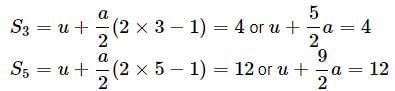
On solving, u = −6ms−1, a = 4ms−2
Distance travelled in next 3 seconds = S8 − S5

Two towns A and B are connected by a regular bus service with a bus leaving in either direction every T minutes. A man cycling with a speed of 20 kmh-1 in the direction A to B notices that a bus goes past him every 18 min in the direction of his motion, and every 6 min in the opposite direction. The period T of the bus service is- a)4.5 min
- b)9 min
- c)12 min
- d)24 min
Correct answer is option 'B'. Can you explain this answer?
Two towns A and B are connected by a regular bus service with a bus leaving in either direction every T minutes. A man cycling with a speed of 20 kmh-1 in the direction A to B notices that a bus goes past him every 18 min in the direction of his motion, and every 6 min in the opposite direction. The period T of the bus service is
a)
4.5 min
b)
9 min
c)
12 min
d)
24 min
| | Ananya Das answered |
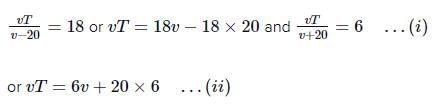
Let vkmh−1 be the constant speed with which the bus travel ply between the towns A and B .
Relative velocity of the bus from A to B with respect to the cyclist = (v − 20)kmh−1
Relative velocity of the bus from B to A with respect to the cyclist = (v + 20)kmh−1
Distance travelled by the bus in time T (minutes) = vT
As per question
Equating (i) and (ii) , we get
= 18v − 18 x 20 = 6v + 20 × 6
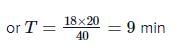
or 12v = 20 x 6 + 18 x 20 = 480 or v = 40 kmh−1
Putting this value of v in (i) , we get
40T = 18 x 40 − 18 x 20 = 18 x 20
Two cars A and B are running at velocities of 60 km h−1 and 45 km h−1. What is the relative velocity of car A with respect to car B, if car A is moving eastward and car B is moving westward?- a)15 km h-1
- b)45 km h-1
- c)60 km h-1
- d)105 km h-1
Correct answer is option 'D'. Can you explain this answer?
Two cars A and B are running at velocities of 60 km h−1 and 45 km h−1. What is the relative velocity of car A with respect to car B, if car A is moving eastward and car B is moving westward?
a)
15 km h-1
b)
45 km h-1
c)
60 km h-1
d)
105 km h-1
| | Raghav Bansal answered |
Velocity of car A w.r.t. ground
∴ vAG = 60 kmh−1 as it is moving towards east
Velocity of car B w.r.t. ground
∴vBG = -45 km h−1 as it is moving towards west
Relative velocity of car A w.r.t. B
vAB = vAG - vBG
= 60 - (-45) = 60 + 45= 105 km h−1
An auto travelling along a straight road increases its speed from 30.0 m s-1 to 50.0 m s-1 in a distance of 180 m. If the acceleration is constant, how much time elapses while the auto moves this distance?- a)6.0 S
- b)4.5
- c)3.6 s
- d)7.03
Correct answer is option 'B'. Can you explain this answer?
An auto travelling along a straight road increases its speed from 30.0 m s-1 to 50.0 m s-1 in a distance of 180 m. If the acceleration is constant, how much time elapses while the auto moves this distance?
a)
6.0 S
b)
4.5
c)
3.6 s
d)
7.03
| | Suresh Iyer answered |
Let a be constant acceleration of auto.
Here, u = 30ms−1, v = 50ms−1, S = 180 m
As v2 − u2 = 2aS
Here, u = 30ms−1, v = 50ms−1, S = 180 m
As v2 − u2 = 2aS

Solving this quadratic equation by quadratic formula, we get = 4.5s, −18 s, (t can't be negative)
∴ t = 4.5 s
A jet airplane travelling at the speed of 500kmh−1 ejects its products of combustion at the speed of 1500kmh−1 relative to the jet plane. The speed of the products of combustion with respect to an observer on the ground is- a)500 km h-1
- b)1000 km h-1
- c)1500 km h-1
- d)2000 km h-1
Correct answer is option 'B'. Can you explain this answer?
A jet airplane travelling at the speed of 500kmh−1 ejects its products of combustion at the speed of 1500kmh−1 relative to the jet plane. The speed of the products of combustion with respect to an observer on the ground is
a)
500 km h-1
b)
1000 km h-1
c)
1500 km h-1
d)
2000 km h-1
| | Hansa Sharma answered |
Veloity of jet plane w.r.t ground vjG = 500 km h-1
Velocity of products of combustion w.r.t jet plane vCJ = -1500 kmh-1
∴ Velocity of products of combustion w.r.t ground is vCG = vCJ + vJG = - 1500kmh-1 + 500 kmh-1
= -1000 km h-1
-ve sign shows that the direction of products of combustion is opposite to that of the plane
∴ Speed of the products of combustion w.r.t ground = 1000 km h-1
Velocity of products of combustion w.r.t jet plane vCJ = -1500 kmh-1
∴ Velocity of products of combustion w.r.t ground is vCG = vCJ + vJG = - 1500kmh-1 + 500 kmh-1
= -1000 km h-1
-ve sign shows that the direction of products of combustion is opposite to that of the plane
∴ Speed of the products of combustion w.r.t ground = 1000 km h-1
Chapter doubts & questions for Motion in a Straight Line - 30-Day Revision Course for NEET 2026 is part of NEET exam preparation. The chapters have been prepared according to the NEET exam syllabus. The Chapter doubts & questions, notes, tests & MCQs are made for NEET 2026 Exam. Find important definitions, questions, notes, meanings, examples, exercises, MCQs and online tests here.
Chapter doubts & questions of Motion in a Straight Line - 30-Day Revision Course for NEET in English & Hindi are available as part of NEET exam. Download more important topics, notes, lectures and mock test series for NEET Exam by signing up for free.
30-Day Revision Course for NEET85 videos|301 docs|171 tests |
