


All Exams > NEET > 30-Day Revision Course for NEET > All Questions
All questions of Animal Kingdom for NEET Exam
The cross-section of the body of an invertebrate is given below. Identify the animal which has this body plan.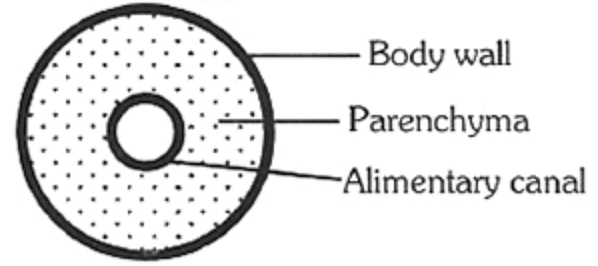
- a)Cockroach
- b)Earthworm
- c)Roundworm
- d)Planaria
Correct answer is option 'D'. Can you explain this answer?
The cross-section of the body of an invertebrate is given below. Identify the animal which has this body plan.
a)
Cockroach
b)
Earthworm
c)
Roundworm
d)
Planaria
 | Stepway Academy answered |
- It has three-layered body wall which includes ectoderm, endoderm, and mesoderm.
- Acoelomates lack a body cavity, and instead the space between the body wall and the digestive tract is filled with muscle fibres and loose tissue called parenchyma.
- It acts as a skeletal support, nutrient storage, motility, reserves of regenerative cells and transporting materials.
- Planaria belongs to phylum Platyhelminthes.
- These are flatworms and has acoelomate body plan.
Hence, the correct option is D.
NCERT Reference: Topic Phylum – Platyhelminthes” of chapter Animal Kingdom

Which phylum is a coelom and triploblastic animals?- a)Phylum Ctenophora
- b)Phylum Annelida
- c)Phylum Coelenterata
- d)Phylum Porifera
Correct answer is option 'B'. Can you explain this answer?
Which phylum is a coelom and triploblastic animals?
a)
Phylum Ctenophora
b)
Phylum Annelida
c)
Phylum Coelenterata
d)
Phylum Porifera
 | Raghav Bansal answered |
Annelida are aquatic (marine and freshwater) or terrestrial, free-living, and sometimes parasitic. They are bilateral symmetric and triploblastic.
Assertion (A): Nematodes are pseudocoelomates.
Reason (R): Pseudocoelomates have a body cavity that is not fully lined with mesoderm.- a) Both A and R are true, but R is not the correct explanation of A.
- b)A is true, but R is false.
- c)A is false, but R is true.
- d)Both A and R are true, and R is the correct explanation of A.
Correct answer is option 'D'. Can you explain this answer?
Assertion (A): Nematodes are pseudocoelomates.
Reason (R): Pseudocoelomates have a body cavity that is not fully lined with mesoderm.
Reason (R): Pseudocoelomates have a body cavity that is not fully lined with mesoderm.
a)
Both A and R are true, but R is not the correct explanation of A.
b)
A is true, but R is false.
c)
A is false, but R is true.
d)
Both A and R are true, and R is the correct explanation of A.
| | Rajesh Gupta answered |
Nematodes, or roundworms, are indeed classified as pseudocoelomates because they possess a body cavity, known as a pseudocoel, which is not completely lined by tissue derived from mesoderm.
Which among the following is a gregarious pest?- a)Locusta
- b)Apis
- c)Laccifer
- d)Bombyx
Correct answer is option 'A'. Can you explain this answer?
Which among the following is a gregarious pest?
a)
Locusta
b)
Apis
c)
Laccifer
d)
Bombyx
 | Jyoti Sengupta answered |
Locust (Locusta) is a gregarious pest belonging to phylum Arthropoda.
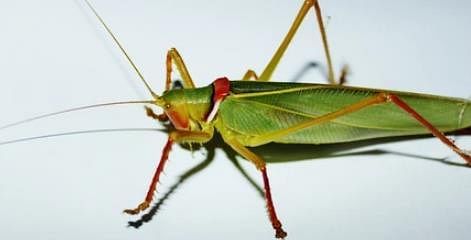
Fig: Image of Locust
Which one of the following characteristics is not shared by birds and mammals ? [2016]- a)Ossified endoskeleton
- b)Breathing using lungs
- c)Viviparity
- d)Warm blooded nature
Correct answer is option 'C'. Can you explain this answer?
Which one of the following characteristics is not shared by birds and mammals ? [2016]
a)
Ossified endoskeleton
b)
Breathing using lungs
c)
Viviparity
d)
Warm blooded nature
 | Deepak Joshi answered |
(c) Giving birth to living young that develop within the mother's body rather than hatching from eggs. All mammals except the monotremes are viviparous.
A reptile having four chambered heart isa)Snakeb)Salamanderc)Crocodiled)LizardsCorrect answer is option 'C'. Can you explain this answer?
 | Prakhar Maheshwari answered |
Except for crocodilians, which have a four-chambered heart, all reptiles have a three-chambered heart consisting of two atria and one ventricle.
What is the main excretory organ in insects?- a)Proboscis gland
- b)Malphighian tubules
- c)Gills
- d)Excretory pore
Correct answer is option 'B'. Can you explain this answer?
What is the main excretory organ in insects?
a)
Proboscis gland
b)
Malphighian tubules
c)
Gills
d)
Excretory pore
| | Rajat Kapoor answered |
Malpighian tubule
The Malpighian tubule system is a type of excretory and osmoregulatory system found in some insects, myriapods, arachnids, and tardigrades. The system consists of branching tubules extending from the alimentary canal that absorbs solutes, water, and wastes from the surrounding hemolymph.
Which among the following is oviparous?- a)Platypus
- b)Flying fox
- c)Common dolphin
- d)lephant
Correct answer is option 'A'. Can you explain this answer?
Which among the following is oviparous?
a)
Platypus
b)
Flying fox
c)
Common dolphin
d)
lephant
| | Rajeev Saxena answered |
Platypus is oviparous as it is an egg-laying mammal
Rest three are viviparous mammals.
Species going to extinct due to low reproductive rate is- a)Island sps
- b)Bald eagle
- c)Lion
- d)Giant panda
Correct answer is option 'D'. Can you explain this answer?
Species going to extinct due to low reproductive rate is
a)
Island sps
b)
Bald eagle
c)
Lion
d)
Giant panda
 | Rajesh Datta answered |
Giant panda is going to extinct due to low reproductively rate. They live in mountain ranges in central china. There reproductively rate is varyless due to climatic conditions.
Which of the following featrues is not present in the Phylum - Arthropoda ? [2016]- a)Chitinous exoskeleton
- b)Metameric segmentation
- c)Parapodia
- d)Jointed appendages
Correct answer is option 'C'. Can you explain this answer?
Which of the following featrues is not present in the Phylum - Arthropoda ? [2016]
a)
Chitinous exoskeleton
b)
Metameric segmentation
c)
Parapodia
d)
Jointed appendages
 | Pallabi Reddy answered |
(c) All arthropods possess a stiff exoskeleton (external skeleton) composed primarily of chitin. Arthropod bodies are divided into segments. Parapodia are paired, lateral appendages extending from the body segments. Arthropod appendages may be either biramous (branched) or uniramous (unbranched). They do not possess jointed appendages.
Which one of the following group of animals is correctly matched with its characteristics without any exception?- a)Reptila possess 3-chambered heart with incompletely divided ventricle
- b)Mammalia give birth to young ones
- c)Chordates possess a mouth with an upper and lower jaw
- d)Chondrichthyes possess cartilaginous endoskeleton
Correct answer is 'D'. Can you explain this answer?
Which one of the following group of animals is correctly matched with its characteristics without any exception?
a)
Reptila possess 3-chambered heart with incompletely divided ventricle
b)
Mammalia give birth to young ones
c)
Chordates possess a mouth with an upper and lower jaw
d)
Chondrichthyes possess cartilaginous endoskeleton
 | Anjali Iyer answered |
The members of the class - Chondrichthyes are marine animals with a streamlined body and have a cartilaginous endoskeleton.
A marine cartilaginous fish that can produce electric current is: [2014]- a)Pristis
- b)Torpedo
- c)Trygon
- d)Scoliodon
Correct answer is option 'B'. Can you explain this answer?
A marine cartilaginous fish that can produce electric current is: [2014]
a)
Pristis
b)
Torpedo
c)
Trygon
d)
Scoliodon
 | Gowri Nair answered |
(b) Torpedo is a sluggish fish. It is carnivorous. The prey is first killed by electric shock. The shock can also be harmful for human beings.
The excretory organ of Saccoglossus is- a)Malphighian tubules
- b)Proboscis gland
- c)Gills
- d)Excretory pore
Correct answer is option 'B'. Can you explain this answer?
The excretory organ of Saccoglossus is
a)
Malphighian tubules
b)
Proboscis gland
c)
Gills
d)
Excretory pore
 | Pooja Mehta answered |
A proboscis is an elongated appendage from the head of an animal, either a vertebrate or an invertebrate. In invertebrates, the term usually refers to tubular mouth parts used for feeding and sucking. In vertebrates, a proboscis is an elongated nose or snout.
Which of the following animals is not viviparous? [2015 RS]- a)Elephant
- b)Platypus
- c)Whale
- d)Flying fox (Bat)
Correct answer is option 'B'. Can you explain this answer?
Which of the following animals is not viviparous? [2015 RS]
a)
Elephant
b)
Platypus
c)
Whale
d)
Flying fox (Bat)
 | Jatin Chakraborty answered |
(b) Platypus is oviparous (egg laying animal). It belongs to class-mammalia.
In some animal groups, the body is found divided into compartments with serial repetition of at least some organs. This characteristic feature is called- a)Segmentation
- b)Metagenesis
- c)Metamerism
- d)Metamorphosis
Correct answer is option 'C'. Can you explain this answer?
In some animal groups, the body is found divided into compartments with serial repetition of at least some organs. This characteristic feature is called
a)
Segmentation
b)
Metagenesis
c)
Metamerism
d)
Metamorphosis
| | Santunu Pradhan answered |
Metamerism
Which group of chordates possesses sucking and circular mouth without jaws?- a)ClassChondrichthyes
- b)Class Cyclostomata
- c)Class Osteichthyes
- d)Both (b) and (c)
Correct answer is option 'B'. Can you explain this answer?
Which group of chordates possesses sucking and circular mouth without jaws?
a)
ClassChondrichthyes
b)
Class Cyclostomata
c)
Class Osteichthyes
d)
Both (b) and (c)
| | Pooja Mehta answered |
Class-Cyclostomata is comprised of, the living jawless fishes. Their mouth is circular and lack jaws, hence they are also called agnathans. It is surrounded by tentacles (e.g., lampreys and hellish). These also presses retractable teeth.
How many chambers are there in camel’s stomach?Identify the animal given below. Mention its phylum.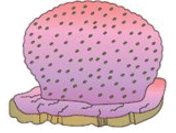
- a)1 chamber, Ascidia and phylum Chordata
- b)3 Chamber, Spongilla and phylum Porifera
- c)3 chambers, Euspongia and phylum Porifera
- d)4 chamber, Aurelia and phylum Coelenterata
Correct answer is option 'C'. Can you explain this answer?
How many chambers are there in camel’s stomach?Identify the animal given below. Mention its phylum.
a)
1 chamber, Ascidia and phylum Chordata
b)
3 Chamber, Spongilla and phylum Porifera
c)
3 chambers, Euspongia and phylum Porifera
d)
4 chamber, Aurelia and phylum Coelenterata
 | Shiksha Academy answered |
Euspongia, which belongs to the phylum Porifera, is commonly known as a sponge. Sponges are some of the simplest and most primitive animals in the animal kingdom.
Hence, the correct option is C.
NCERT Reference: Topic: Phylum – Porifera” of chapter Animal Kingdom
NCERT Reference: Topic: Phylum – Porifera” of chapter Animal Kingdom
Animals which possess cleidoic egg exhibit- a)External fertilisation and external development
- b)External fertilisation and internal development
- c)Internal fertilisation and internal development
- d)Internal fertilisation and external development
Correct answer is option 'D'. Can you explain this answer?
Animals which possess cleidoic egg exhibit
a)
External fertilisation and external development
b)
External fertilisation and internal development
c)
Internal fertilisation and internal development
d)
Internal fertilisation and external development
| | Rajeev Saxena answered |
Cleidoic eggs are laid by reptiles & birds. These eggs have protective shell which is porous to air and may be flexible or calcareous (hard). Birds and reptiles exhibit internal fertilization and laid eggs contain all the food the embryo needs for external development.
Silk produced by Antheraea Mylitta is called- a)Eri silk
- b)Muga silk
- c)Mysore silk
- d)Tasar silk
Correct answer is option 'D'. Can you explain this answer?
Silk produced by Antheraea Mylitta is called
a)
Eri silk
b)
Muga silk
c)
Mysore silk
d)
Tasar silk
| | Rajat Kapoor answered |
Tropical Tasar: Tasar (Tussah) is copperish colour, coarse silk mainly used for furnishings and interiors. It is less lustrous than mulberry silk, but has its own feel and appeal. Tasar silk is generated by the silkworm, Antheraea mylitta which mainly thrive on the food plants Asan and Arjun.
The scientific name of Asian tiger mosquito- a)Aedes aegypti
- b)Aedes albolineatus
- c)Aedes taeniorhynchus
- d)Aedes albopictus
Correct answer is option 'D'. Can you explain this answer?
The scientific name of Asian tiger mosquito
a)
Aedes aegypti
b)
Aedes albolineatus
c)
Aedes taeniorhynchus
d)
Aedes albopictus
 | Dev Patel answered |
The Asian tiger mosquito (Aedes albopictus) is a small black and white mosquito, about 1/4-inch long.
The phylum in which adults exhibit radial symmetry and larva exhibit bilateral symmetry is- a)Phylum Arthropoda
- b)Phylum Echinodermata
- c)Phylum Annelida
- d)Phylum Aschelminthes
Correct answer is option 'B'. Can you explain this answer?
The phylum in which adults exhibit radial symmetry and larva exhibit bilateral symmetry is
a)
Phylum Arthropoda
b)
Phylum Echinodermata
c)
Phylum Annelida
d)
Phylum Aschelminthes
| | Jyoti Kapoor answered |
Symmetry is an attribute of an organism showing regularity in body parts on a plane or around an axis. In Phylum Echinodermata, the adult echinoderms are radially symmetrical but the larvae are bilaterally symmetrical.
Air bladder is absent in- a)Sea horse
- b)Shark
- c)Flying fish
- d)All of the above
Correct answer is option 'B'. Can you explain this answer?
Air bladder is absent in
a)
Sea horse
b)
Shark
c)
Flying fish
d)
All of the above
| | Roshni Tiwari answered |
Explanation:
Air bladder is a gas-filled sac that helps fish to maintain buoyancy in water. However, not all fish have air bladders. The correct answer to the given question is option B, i.e., shark, as sharks do not have air bladders.
Reasons why sharks do not have an air bladder are:
1. Buoyancy control: Sharks have a special organ called the liver that is filled with oil. This oil is less dense than water and provides buoyancy to the shark, allowing it to stay afloat.
2. Depth control: Unlike bony fish that have a swim bladder to adjust their depth in water, sharks are able to control their depth by swimming. They can swim at different angles to adjust their depth in water.
3. Adaptation to environment: Sharks have evolved to live in their environment, and their body shape and buoyancy control mechanisms have adapted to suit their needs.
Therefore, it can be concluded that while some fish have air bladders to maintain buoyancy in water, sharks have evolved different mechanisms to control their buoyancy and depth in water.
Air bladder is a gas-filled sac that helps fish to maintain buoyancy in water. However, not all fish have air bladders. The correct answer to the given question is option B, i.e., shark, as sharks do not have air bladders.
Reasons why sharks do not have an air bladder are:
1. Buoyancy control: Sharks have a special organ called the liver that is filled with oil. This oil is less dense than water and provides buoyancy to the shark, allowing it to stay afloat.
2. Depth control: Unlike bony fish that have a swim bladder to adjust their depth in water, sharks are able to control their depth by swimming. They can swim at different angles to adjust their depth in water.
3. Adaptation to environment: Sharks have evolved to live in their environment, and their body shape and buoyancy control mechanisms have adapted to suit their needs.
Therefore, it can be concluded that while some fish have air bladders to maintain buoyancy in water, sharks have evolved different mechanisms to control their buoyancy and depth in water.
A jawless fish, which lays eggs in fresh water and whose ammocoetes larvae after metamorphosis return to the ocean is: [2015 RS]- a)myxine
- b)Neomyxine
- c)Petromyzon
- d)Eptatretus
Correct answer is option 'C'. Can you explain this answer?
A jawless fish, which lays eggs in fresh water and whose ammocoetes larvae after metamorphosis return to the ocean is: [2015 RS]
a)
myxine
b)
Neomyxine
c)
Petromyzon
d)
Eptatretus
 | Yash Saha answered |
(c) Petrormyzon marinus, commonly known as sea lamprey lays eggs in fresh water and its larvae after metamorphosis return to the ocean (saline water).
Body having meshwork of cell, internal cavities lined with food filtering flagellated cells and indirect development are the characteristics of phylum. [2015 RS]- a)Porifera
- b)Mollusca
- c)Protozoa
- d)Coelenterate
Correct answer is option 'A'. Can you explain this answer?
Body having meshwork of cell, internal cavities lined with food filtering flagellated cells and indirect development are the characteristics of phylum. [2015 RS]
a)
Porifera
b)
Mollusca
c)
Protozoa
d)
Coelenterate
 | Subham Chavan answered |
(a) The given characteristic features define the phylum porifera.
Which of the following characteristic features always holds true for the corresponding group of animals? [2016]- a)Cartilaginous Chondrichthyes endoskeleton
- b)Viviparous Mammalia
- c)Possess a mouth Chordata with an upper and a lower jaw
- d)3 - chambered heart Reptilia with one incompletely divided ventricle
Correct answer is option 'A'. Can you explain this answer?
Which of the following characteristic features always holds true for the corresponding group of animals? [2016]
a)
Cartilaginous Chondrichthyes endoskeleton
b)
Viviparous Mammalia
c)
Possess a mouth Chordata with an upper and a lower jaw
d)
3 - chambered heart Reptilia with one incompletely divided ventricle
| | Yash Saha answered |
(a) Chondrichthyes always have cartilaginous endoskeleton. Most mammals are viviparous, giving birth to live young. However, the five species of monotreme, the platypuses and the echidnas, lay eggs. Chordates have jawless animals (Agnatha) as well. Most reptiles have 3 chambered heart. Crocodilians have 4 chambered hearts. Turtles have 3 chambered heart but with an incomplete wall in the single ventricle, so their hearts are functionally 4 chambered.
Bilaterally symmetrical and acoelomate animals are exemplified by : [NEET 2020]- a)Aschelminthes
- b)Annelida
- c)Ctenophora
- d)Platyhelminthes
Correct answer is option 'D'. Can you explain this answer?
Bilaterally symmetrical and acoelomate animals are exemplified by : [NEET 2020]
a)
Aschelminthes
b)
Annelida
c)
Ctenophora
d)
Platyhelminthes
 | Mira Joshi answered |
Flatworms are bilaterally symmetrical, triploblastic and acoelomate animals with organ level of organisation. Aschelminthes is triploblastic, bilaterally symmetrical and pseudocoelomate. Annelida is triploblastic, bilaterally symmetrical and acoelomate. Ctenophora is radially symmetrical, diploblastic.
Consider following features. [NEET 2019](A) Organ system level of organisation
(B) Bilateral symmetry
(C) True coelomates with segmentation of bodySelect the correct option of animal groups which possess all the above characteristics.- a)Annelida, Mollusca and Chordata
- b)Annelida, Arthropoda and Chordata
- c)Annelida, Arthropoda and Mollusca
- d)Arthropoda, Mollusca and Chordata
Correct answer is option 'B'. Can you explain this answer?
Consider following features. [NEET 2019]
(A) Organ system level of organisation
(B) Bilateral symmetry
(C) True coelomates with segmentation of body
(B) Bilateral symmetry
(C) True coelomates with segmentation of body
Select the correct option of animal groups which possess all the above characteristics.
a)
Annelida, Mollusca and Chordata
b)
Annelida, Arthropoda and Chordata
c)
Annelida, Arthropoda and Mollusca
d)
Arthropoda, Mollusca and Chordata
| | Mira Joshi answered |
Mollusca shows organ system level of organisation with unsegmented body (except Neopilina which is a segmented mollusc) having distinct head, muscular foot and visceral hump. They usually show bilateral symmetry but some molluscs (example Pila) become asymmetrical due to torsion.
Read the following statements:
i) Spider and mosquito possess compound eye
ii) Jelly fishes possess cnidoblasts but comb-jellies lack them.
iii) All animals having true coelom are characterized by the presence of bilateral symmetry usually, tube-within-tube body plan, presence of mesoderm and true segmentation
iv) The animals of the phylum Porifera have originated from colonial protozoans.
Which of the above statements are correct?- a)i, ii, iv
- b)iii, iv
- c)i, iii
- d)ii, iii
Correct answer is option 'A'. Can you explain this answer?
Read the following statements:
i) Spider and mosquito possess compound eye
ii) Jelly fishes possess cnidoblasts but comb-jellies lack them.
iii) All animals having true coelom are characterized by the presence of bilateral symmetry usually, tube-within-tube body plan, presence of mesoderm and true segmentation
iv) The animals of the phylum Porifera have originated from colonial protozoans.
Which of the above statements are correct?
i) Spider and mosquito possess compound eye
ii) Jelly fishes possess cnidoblasts but comb-jellies lack them.
iii) All animals having true coelom are characterized by the presence of bilateral symmetry usually, tube-within-tube body plan, presence of mesoderm and true segmentation
iv) The animals of the phylum Porifera have originated from colonial protozoans.
Which of the above statements are correct?
a)
i, ii, iv
b)
iii, iv
c)
i, iii
d)
ii, iii
| | Stepway Academy answered |
i) Spider and mosquito possess compound eyes. The eyes of most insects, which are composed of many light-sensitive elements, each having its own reflective system and each forming a portion of an image.
ii) Jelly fishes possess cnidoblasts but comb-jellies lack them. Cnidoblasts are features of Coelenterata (Cnidaria) and comb-jellies come under the phylum Ctenophora.
iii) All animals with a true coelom usually exhibit bilateral symmetry, a tube-within-tube body plan, presence of mesoderm, and true segmentation.
iv) The animals of the phylum Porifera have indeed originated from colonial protozoans.
Thus, the correct statements are i, ii, and iv. The answer is Option A.
ii) Jelly fishes possess cnidoblasts but comb-jellies lack them. Cnidoblasts are features of Coelenterata (Cnidaria) and comb-jellies come under the phylum Ctenophora.
iii) All animals with a true coelom usually exhibit bilateral symmetry, a tube-within-tube body plan, presence of mesoderm, and true segmentation.
iv) The animals of the phylum Porifera have indeed originated from colonial protozoans.
Thus, the correct statements are i, ii, and iv. The answer is Option A.
Read the following statements:
(i) True coelom is a body cavity which arises as a cavity in the embryonic mesoderm.
(ii) Digestive cavity is found in acoelomates, pseudocoelomates as well as coelomates.
(iii) The body cavity of arthropods and non-cephalopod molluscs is called haemocoel.
(iv) Aschelminthes possess true body cavity.
(v) There is no cavity between the body wall and gut in Echinoderms.
Which of the statements are correct?- a)(i), (iii)
- b)(i), (ii), (iii)
- c)(iv), (v)
- d)(i), (iv), (v)
Correct answer is option 'A'. Can you explain this answer?
(i) True coelom is a body cavity which arises as a cavity in the embryonic mesoderm.
(ii) Digestive cavity is found in acoelomates, pseudocoelomates as well as coelomates.
(iii) The body cavity of arthropods and non-cephalopod molluscs is called haemocoel.
(iv) Aschelminthes possess true body cavity.
(v) There is no cavity between the body wall and gut in Echinoderms.
Which of the statements are correct?
a)
(i), (iii)
b)
(i), (ii), (iii)
c)
(iv), (v)
d)
(i), (iv), (v)
| | Nandini Mukherjee answered |
Correct Statements:
- (i) True coelom is a body cavity which arises as a cavity in the embryonic mesoderm.
- (iii) The body cavity of arthropods and non-cephalopod molluscs is called haemocoel.
Explanation:
- Statement (i): True coelom is indeed a body cavity that develops from a cavity in the embryonic mesoderm. It is lined by mesoderm and provides space for organs to develop and move independently within the body.
- Statement (iii): Haemocoel is a body cavity found in arthropods and non-cephalopod molluscs. It is a spacious cavity that accommodates blood and surrounds the organs.
Incorrect Statements:
- (ii) Digestive cavity is found in acoelomates, pseudocoelomates as well as coelomates - This statement is incorrect as acoelomates lack a body cavity, pseudocoelomates have a pseudocoelom, and coelomates have a true coelom.
- (iv) Aschelminthes possess true body cavity - Aschelminthes are pseudocoelomates, not possessing a true coelom.
- (v) There is no cavity between the body wall and gut in Echinoderms - Echinoderms actually possess a water vascular system instead of a body cavity.
Therefore, the correct statements are (i) and (iii), making option (a) the correct choice.
- (i) True coelom is a body cavity which arises as a cavity in the embryonic mesoderm.
- (iii) The body cavity of arthropods and non-cephalopod molluscs is called haemocoel.
Explanation:
- Statement (i): True coelom is indeed a body cavity that develops from a cavity in the embryonic mesoderm. It is lined by mesoderm and provides space for organs to develop and move independently within the body.
- Statement (iii): Haemocoel is a body cavity found in arthropods and non-cephalopod molluscs. It is a spacious cavity that accommodates blood and surrounds the organs.
Incorrect Statements:
- (ii) Digestive cavity is found in acoelomates, pseudocoelomates as well as coelomates - This statement is incorrect as acoelomates lack a body cavity, pseudocoelomates have a pseudocoelom, and coelomates have a true coelom.
- (iv) Aschelminthes possess true body cavity - Aschelminthes are pseudocoelomates, not possessing a true coelom.
- (v) There is no cavity between the body wall and gut in Echinoderms - Echinoderms actually possess a water vascular system instead of a body cavity.
Therefore, the correct statements are (i) and (iii), making option (a) the correct choice.
Consider the following statements : (NEET 2024)
A. Annelids are true coelomates
B. Poriferans are pseudocoelomates
C. Aschelminthes are acoelomates
D. Platyhelminthes are pseudocoelomatesChoose the correct answer from the options given below :- a)B only
- b)A only
- c)C only
- d)D only
Correct answer is option 'B'. Can you explain this answer?
Consider the following statements : (NEET 2024)
A. Annelids are true coelomates
B. Poriferans are pseudocoelomates
C. Aschelminthes are acoelomates
D. Platyhelminthes are pseudocoelomates
A. Annelids are true coelomates
B. Poriferans are pseudocoelomates
C. Aschelminthes are acoelomates
D. Platyhelminthes are pseudocoelomates
Choose the correct answer from the options given below :
a)
B only
b)
A only
c)
C only
d)
D only
 | Bs Academy answered |
Let's evaluate each statement with regard to the type of body cavity they describe:
A. Annelids are true coelomates: This statement is correct. Annelids (segmented worms, including earthworms) possess a true coelom, which is a body cavity fully lined with a mesodermal layer more specifically called peritoneum. This allows for the distinction of the internal organs from the body wall, and it facilitates greater complexity and organization of the internal structures.
B. Poriferans are pseudocoelomates: This statement is incorrect. Poriferans (sponges) do not have any type of body cavity. Sponges are at a basic level of complexity and lack true tissues and organs, including a coelom or a pseudocoelom. They are considered to have no body cavity and are thus neither coelomates nor pseudocoelomates.
C. Aschelminthes are acoelomates: This statement is incorrect. Aschelminthes, more commonly referred to as Nematoda or roundworms, are actually pseudocoelomates. They possess a pseudocoelom, which is a body cavity that is not entirely lined by mesodermal tissue, unlike a true coelom. The pseudocoel serves as a rudimentary circulatory system and provides a space for internal organs.
D. Platyhelminthes are pseudocoelomates: This statement is incorrect. Platyhelminthes (flatworms) are acoelomates, meaning they lack any body cavity. Their bodies are solid between the digestive tract and the body wall, lacking a filled cavity that would separate these structures.
From the analysis above, only statement A is accurate:
- A. Annelids are true coelomates - Correct
- B. Poriferans are pseudocoelomates - Incorrect
- C. Aschelminthes are acoelomates - Incorrect
- D. Platyhelminthes are pseudocoelomates - Incorrect
Thus, the correct answer to the question is: Option B
All living members of the class Cyclostomata are: [NEET 2025]- a)Symbiotic
- b)Ectoparasite
- c)Free living
- d)Endoparasite
Correct answer is option 'B'. Can you explain this answer?
All living members of the class Cyclostomata are: [NEET 2025]
a)
Symbiotic
b)
Ectoparasite
c)
Free living
d)
Endoparasite
 | Shraddha Sengupta answered |
Overview of Cyclostomata
Cyclostomata is a class of jawless fish characterized by their unique feeding mechanism and body structure. This class includes modern representatives such as lampreys and hagfish.
Feeding Mechanism
- Cyclostomes lack jaws but have a round, sucker-like mouth.
- They use their mouths to attach to hosts or substrates, facilitating their feeding process.
Ectoparasitic Nature
- Most living members of Cyclostomata are ectoparasites, meaning they live on the outside of their host organisms.
- Lampreys, for instance, attach to fish and feed on their blood and bodily fluids.
- This parasitic behavior allows them to obtain nutrients necessary for survival.
Ecological Role
- As ectoparasites, Cyclostomata play a significant role in their ecosystems.
- They are involved in regulating host populations and can impact the health of fish populations.
Conclusion
- The classification of Cyclostomata as ectoparasites is crucial to understanding their ecological importance and evolutionary adaptations.
- Their unique feeding strategy distinguishes them from other fish classes, highlighting their specialized niche in aquatic ecosystems.
In summary, the correct answer to the question is option 'B' due to the ectoparasitic lifestyle of living members of Cyclostomata.
Cyclostomata is a class of jawless fish characterized by their unique feeding mechanism and body structure. This class includes modern representatives such as lampreys and hagfish.
Feeding Mechanism
- Cyclostomes lack jaws but have a round, sucker-like mouth.
- They use their mouths to attach to hosts or substrates, facilitating their feeding process.
Ectoparasitic Nature
- Most living members of Cyclostomata are ectoparasites, meaning they live on the outside of their host organisms.
- Lampreys, for instance, attach to fish and feed on their blood and bodily fluids.
- This parasitic behavior allows them to obtain nutrients necessary for survival.
Ecological Role
- As ectoparasites, Cyclostomata play a significant role in their ecosystems.
- They are involved in regulating host populations and can impact the health of fish populations.
Conclusion
- The classification of Cyclostomata as ectoparasites is crucial to understanding their ecological importance and evolutionary adaptations.
- Their unique feeding strategy distinguishes them from other fish classes, highlighting their specialized niche in aquatic ecosystems.
In summary, the correct answer to the question is option 'B' due to the ectoparasitic lifestyle of living members of Cyclostomata.
Match each item in Column I with one item in Column II and choose your answer from the codes given below.
Column I | Column II
I. Placoid Scales | 1. Chondrichthyes
II. Ctenoid scales | 2. Osteichthyes
III. Ectoparasites | 3. Hemichordata
IV. Proboscis gland | 4. Cyclostomata
Codes:- a)1 2 3 4
- b)2 1 4 3
- c)2 1 3 4
- d)1 2 4 3
Correct answer is option 'D'. Can you explain this answer?
Column I | Column II
I. Placoid Scales | 1. Chondrichthyes
II. Ctenoid scales | 2. Osteichthyes
III. Ectoparasites | 3. Hemichordata
IV. Proboscis gland | 4. Cyclostomata
Codes:
a)
1 2 3 4
b)
2 1 4 3
c)
2 1 3 4
d)
1 2 4 3
 | EduRev NEET answered |
Placoid Scales are characteristic of Chondrichthyes (cartilaginous fishes).
Ctenoid Scales are characteristic of Osteichthyes (bony fishes).
Ectoparasites are typically associated with Cyclostomata (e.g., lampreys).
Proboscis gland is a feature of Hemichordata (e.g., acorn worms).
Thus, the correct code is Option D: 1 2 4 3.
Ctenoid Scales are characteristic of Osteichthyes (bony fishes).
Ectoparasites are typically associated with Cyclostomata (e.g., lampreys).
Proboscis gland is a feature of Hemichordata (e.g., acorn worms).
Thus, the correct code is Option D: 1 2 4 3.
The unique mammalian characteristics are: (NEET 2023)- a)hairs, tympanic membrane and mammary glands
- b)hairs, pinna and mammary glands
- c)hairs, pinna and indirect development
- d)pinna, monocondylic skull and mammary glands
Correct answer is option 'B'. Can you explain this answer?
The unique mammalian characteristics are: (NEET 2023)
a)
hairs, tympanic membrane and mammary glands
b)
hairs, pinna and mammary glands
c)
hairs, pinna and indirect development
d)
pinna, monocondylic skull and mammary glands
 | Top Rankers answered |
Unique mammalian characteristics include:
- Hair or fur: Mammals are the only animals that have hair. This hair helps to insulate the body to maintain a constant body temperature.
- Mammary glands: These are glands that, in females, produce milk for the nourishment of young ones. This is a characteristic feature of all mammals and is, in fact, the feature that gives this group its name.
- The presence of pinnae (external ears): Most mammals have pinnae that help to collect and direct sound waves into the ear.
Option A is incorrect because while mammals do have a tympanic membrane (ear drum), it is not unique to mammals; other vertebrate groups, such as birds and reptiles, also have a tympanic membrane.
Option C is incorrect because indirect development is not a unique characteristic of mammals; many animals, including certain insects, amphibians, and fishes, undergo indirect development.
Option D is incorrect because a monocondylic skull, in which the skull only articulates with the first vertebra via a single condyle, is a characteristic of some reptiles and amphibians, not mammals. Mammals possess a dicondylic skull, with two occipital condyles.
So, the correct answer is :
Option B : hairs, pinna and mammary glands.
Option C is incorrect because indirect development is not a unique characteristic of mammals; many animals, including certain insects, amphibians, and fishes, undergo indirect development.
Option D is incorrect because a monocondylic skull, in which the skull only articulates with the first vertebra via a single condyle, is a characteristic of some reptiles and amphibians, not mammals. Mammals possess a dicondylic skull, with two occipital condyles.
So, the correct answer is :
Option B : hairs, pinna and mammary glands.
Select the incorrect statements with respect to Cyclostomes: (NEET 2022 Phase 2)
(a) They lack scales and paired fins.
(b) They have circular mouth with jaws.
(c) They bear 6-15 pairs of gills.
(d) They migrate to deep sea for spawning.
Choose the most appropriate answer from the options given below:- a)(a) and (d) only
- b)(a) and (b) only
- c)(b) and (c) only
- d)(b) and (d) only
Correct answer is option 'D'. Can you explain this answer?
Select the incorrect statements with respect to Cyclostomes: (NEET 2022 Phase 2)
(a) They lack scales and paired fins.
(b) They have circular mouth with jaws.
(c) They bear 6-15 pairs of gills.
(d) They migrate to deep sea for spawning.
Choose the most appropriate answer from the options given below:
(a) They lack scales and paired fins.
(b) They have circular mouth with jaws.
(c) They bear 6-15 pairs of gills.
(d) They migrate to deep sea for spawning.
Choose the most appropriate answer from the options given below:
a)
(a) and (d) only
b)
(a) and (b) only
c)
(b) and (c) only
d)
(b) and (d) only
 | Sneha Chopra answered |
Understanding Cyclostomes
Cyclostomes, a group of jawless fish that includes lampreys and hagfish, exhibit unique characteristics that set them apart from other vertebrates. Let's analyze the statements provided about them.
Statement Analysis
Conclusion
Based on the analysis:
- Statements (b) and (d) are incorrect. Cyclostomes do not possess jaws and do not typically migrate to the deep sea for spawning.
- Therefore, the correct answer is option 'D', which identifies the incorrect statements as (b) and (d).
This understanding helps clarify the biological traits of cyclostomes, distinguishing them from other fish groups.
Cyclostomes, a group of jawless fish that includes lampreys and hagfish, exhibit unique characteristics that set them apart from other vertebrates. Let's analyze the statements provided about them.
Statement Analysis
- (a) They lack scales and paired fins.
This statement is correct. Cyclostomes do not possess scales or paired fins, which distinguishes them from many other fish species. - (b) They have circular mouth with jaws.
This statement is incorrect. Cyclostomes have a circular mouth, but they lack true jaws. Instead, they have a sucker-like mouth, which is characteristic of their feeding mechanism. - (c) They bear 6-15 pairs of gills.
This statement is correct. Cyclostomes typically possess multiple pairs of gills for respiration. - (d) They migrate to deep sea for spawning.
This statement is incorrect for most cyclostomes. While some species may have specific spawning behaviors, many migrate to freshwater or nearshore environments rather than the deep sea.
Conclusion
Based on the analysis:
- Statements (b) and (d) are incorrect. Cyclostomes do not possess jaws and do not typically migrate to the deep sea for spawning.
- Therefore, the correct answer is option 'D', which identifies the incorrect statements as (b) and (d).
This understanding helps clarify the biological traits of cyclostomes, distinguishing them from other fish groups.
Metagenesis refers to?
Options:- a)The presence of different morphic forms
- b)Alternation of generation between asexual and sexual phases of an organism
- c)Occurrence of a drastic change in the form during post-embryonic development
- d)Presence of a segmented body and parthenogenic mode of reproduction
Correct answer is option 'B'. Can you explain this answer?
Options:
a)
The presence of different morphic forms
b)
Alternation of generation between asexual and sexual phases of an organism
c)
Occurrence of a drastic change in the form during post-embryonic development
d)
Presence of a segmented body and parthenogenic mode of reproduction
 | Infinity Academy answered |
Metagenesis refers to the alternation of generations between asexual and sexual phases of an organism, commonly observed in cnidarians like jellyfish.
Option A: The presence of different morphic forms could refer to polymorphism, not specifically metagenesis.
Option C: This describes metamorphosis, not metagenesis.
Option D: This refers to characteristics unrelated to metagenesis.
Thus, the correct answer is Option B.
Option A: The presence of different morphic forms could refer to polymorphism, not specifically metagenesis.
Option C: This describes metamorphosis, not metagenesis.
Option D: This refers to characteristics unrelated to metagenesis.
Thus, the correct answer is Option B.
Which of the following animals has three chambered heart? (NEET 2022 Phase 2)- a)Pteropus
- b)Scoliodon
- c)Hippocampus
- d)Chelone
Correct answer is option 'D'. Can you explain this answer?
Which of the following animals has three chambered heart? (NEET 2022 Phase 2)
a)
Pteropus
b)
Scoliodon
c)
Hippocampus
d)
Chelone
| | Top Rankers answered |
- Option (4) is the correct answer because Chelone (turtle) is a reptile and the heart of reptiles are usually three-chambered except crocodiles.
- Option (1) is incorrect as Pteropus (flying fox) possess four -chambered heart.
- Option (2) and (3) are incorrect as Scoliodon (dog fish) and Hippocampus (sea horse) possess two - chambered heart.
Select the correct statements with reference to chordates. (NEET 2023)
A. Presence of a mid-dorsal, solid and double nerve cord.
B. Presence of closed circulatory system.
C. Presence of paired pharyngeal gill slits.
D. Presence of dorsal heart
E. Triploblastic pseudocoelomate animals.
Choose the correct answer from the options given below:- a)A, C and D only
- b)B and C only
- c)B, D and E only
- d)C, D and E only
Correct answer is option 'B'. Can you explain this answer?
Select the correct statements with reference to chordates. (NEET 2023)
A. Presence of a mid-dorsal, solid and double nerve cord.
B. Presence of closed circulatory system.
C. Presence of paired pharyngeal gill slits.
D. Presence of dorsal heart
E. Triploblastic pseudocoelomate animals.
Choose the correct answer from the options given below:
A. Presence of a mid-dorsal, solid and double nerve cord.
B. Presence of closed circulatory system.
C. Presence of paired pharyngeal gill slits.
D. Presence of dorsal heart
E. Triploblastic pseudocoelomate animals.
Choose the correct answer from the options given below:
a)
A, C and D only
b)
B and C only
c)
B, D and E only
d)
C, D and E only
| | Bs Academy answered |
Chordates are defined by having certain specific anatomical features at some point during their development. The correct attributes of chordates are:
1. Presence of a dorsal, hollow nerve cord (not a mid-dorsal, solid and double nerve cord as mentioned in statement A)
2. Presence of a closed circulatory system.
3. Presence of paired pharyngeal gill slits.
4. Presence of a post-anal tail.
5. Presence of a notochord.
1. Presence of a dorsal, hollow nerve cord (not a mid-dorsal, solid and double nerve cord as mentioned in statement A)
2. Presence of a closed circulatory system.
3. Presence of paired pharyngeal gill slits.
4. Presence of a post-anal tail.
5. Presence of a notochord.
Regarding the other statements :
- The heart of chordates is ventral, not dorsal (as in statement D).
- Chordates are triploblastic and coelomate, not pseudocoelomate (as in statement E).
So, based on these facts, the correct answer is :
Option B : B and C only.
- The heart of chordates is ventral, not dorsal (as in statement D).
- Chordates are triploblastic and coelomate, not pseudocoelomate (as in statement E).
So, based on these facts, the correct answer is :
Option B : B and C only.
Read the following statements:
(a) Metagenesis is observed in Helminths.
(b) Echinoderms are triploblastic and coelomate animals.
(c) Round worms have organ-system level of body organization.
(d) Comb plates present in ctenophores help in digestion.
(e) Water vascular system is characteristic of Echinoderms.
Options:- a)(a), (d) and (e) are correct
- b)(b), (c) and (e) are correct
- c)(c), (d) and (e) are correct
- d)(a), (b) and (c) are correct
Correct answer is option 'B'. Can you explain this answer?
(a) Metagenesis is observed in Helminths.
(b) Echinoderms are triploblastic and coelomate animals.
(c) Round worms have organ-system level of body organization.
(d) Comb plates present in ctenophores help in digestion.
(e) Water vascular system is characteristic of Echinoderms.
Options:
a)
(a), (d) and (e) are correct
b)
(b), (c) and (e) are correct
c)
(c), (d) and (e) are correct
d)
(a), (b) and (c) are correct
| | EduRev NEET answered |
(a) Metagenesis is observed in Helminths: Incorrect. Metagenesis refers to the alternation of generations between asexual and sexual phases, observed in cnidarians, not in helminths.
(b) Echinoderms are triploblastic and coelomate animals: Correct. Echinoderms have three germ layers (triploblastic) and a true coelom.
(c) Round worms have organ-system level of body organization: Correct. Roundworms (nematodes) have an organ-system level of organization.
(d) Comb plates present in ctenophores help in digestion: Incorrect. Comb plates (ctenes) in ctenophores are used for locomotion, not digestion.
(e) Water vascular system is characteristic of Echinoderms: Correct. The water vascular system is a unique feature of echinoderms.
Thus, the correct answer is Option B.
(b) Echinoderms are triploblastic and coelomate animals: Correct. Echinoderms have three germ layers (triploblastic) and a true coelom.
(c) Round worms have organ-system level of body organization: Correct. Roundworms (nematodes) have an organ-system level of organization.
(d) Comb plates present in ctenophores help in digestion: Incorrect. Comb plates (ctenes) in ctenophores are used for locomotion, not digestion.
(e) Water vascular system is characteristic of Echinoderms: Correct. The water vascular system is a unique feature of echinoderms.
Thus, the correct answer is Option B.
Which of the following statements correctly describes the presence of the notochord in Urochordata and Cephalochordata?- a)In Urochordata, the notochord is present throughout the life and extends from head to tail, while in Cephalochordata, it is present only in the larval tail.
- b)In Urochordata, the notochord is present only in the larval tail, while in Cephalochordata, it extends from head to tail region and is persistent throughout their life.
- c)In both Urochordata and Cephalochordata, the notochord is present only in the larval tail.
- d)In both Urochordata and Cephalochordata, the notochord extends from head to tail and is persistent throughout their life.
Correct answer is option 'B'. Can you explain this answer?
Which of the following statements correctly describes the presence of the notochord in Urochordata and Cephalochordata?
a)
In Urochordata, the notochord is present throughout the life and extends from head to tail, while in Cephalochordata, it is present only in the larval tail.
b)
In Urochordata, the notochord is present only in the larval tail, while in Cephalochordata, it extends from head to tail region and is persistent throughout their life.
c)
In both Urochordata and Cephalochordata, the notochord is present only in the larval tail.
d)
In both Urochordata and Cephalochordata, the notochord extends from head to tail and is persistent throughout their life.
| | Bs Academy answered |
In Urochordata, the notochord is present only in the larval tail, while in Cephalochordata, it extends from head to tail region and is persistent throughout their life.
Given below are two statements: one is labelled as Assertion (A) and the other is labelled as Reason (R). [NEET 2025]
Assertion (A): All vertebrates are chordates but all chordates are not vertebrates.
Reason (R): The members of subphylum vertebrata possess notochord during the embryonic period; the notochord is replaced by a cartilaginous or bony vertebral column in adults.
Choose the correct answer from the options given below:- a)(A) is True but (R) is False
- b)(A) is False but (R) is True
- c)Both (A) and (R) are True and (R) is the correct explanation of (A)
- d)Both (A) and (R) are True but (R) is not the correct explanation of (A)
Correct answer is option 'C'. Can you explain this answer?
Given below are two statements: one is labelled as Assertion (A) and the other is labelled as Reason (R). [NEET 2025]
Assertion (A): All vertebrates are chordates but all chordates are not vertebrates.
Reason (R): The members of subphylum vertebrata possess notochord during the embryonic period; the notochord is replaced by a cartilaginous or bony vertebral column in adults.
Choose the correct answer from the options given below:
Assertion (A): All vertebrates are chordates but all chordates are not vertebrates.
Reason (R): The members of subphylum vertebrata possess notochord during the embryonic period; the notochord is replaced by a cartilaginous or bony vertebral column in adults.
Choose the correct answer from the options given below:
a)
(A) is True but (R) is False
b)
(A) is False but (R) is True
c)
Both (A) and (R) are True and (R) is the correct explanation of (A)
d)
Both (A) and (R) are True but (R) is not the correct explanation of (A)
 | Lead Academy answered |
- (i) Assertion: True. All vertebrates belong to phylum Chordata because they show chordate features (for example, a notochord) at some stage. However, several chordates (such as urochordates and cephalochordates) are not vertebrates.
- (ii) Reason: True. In members of subphylum Vertebrata, a notochord is present in the embryo and is largely replaced by a segmented vertebral column made of cartilage or bone in adults.
- (iii) Justification: The reason explains why vertebrates are a subset of chordates — the developmental replacement of the notochord by a vertebral column is a defining feature that distinguishes vertebrates from non-vertebrate chordates. Hence (c) is correct.
Therefore, the correct answer is: (c) . Both (A) and (R) are True and (R) is the correct explanation of (A).
Match the following columns and select the correct option:
Column I Column II
(a) Aptenodytes (i) Flying fox
(b) Pteropus (ii) Angel fish
(c) Pterophyllum (iii) Lamprey
(d) Petromyzon (iv) Penguin
- a)a-(iii), b-(iv),c-(ii), d-(i)
- b)a-(iii), b-(iv),c-(i),d-(ii)
- c)a-(iv), b-(i), c-(ii), d-(iii)
- d)a-(ii),b-(i), c-(iv), d-(iii)
Correct answer is option 'C'. Can you explain this answer?
Match the following columns and select the correct option:
Column I Column II
(a) Aptenodytes (i) Flying fox
(b) Pteropus (ii) Angel fish
(c) Pterophyllum (iii) Lamprey
(d) Petromyzon (iv) Penguin
Column I Column II
(a) Aptenodytes (i) Flying fox
(b) Pteropus (ii) Angel fish
(c) Pterophyllum (iii) Lamprey
(d) Petromyzon (iv) Penguin
a)
a-(iii), b-(iv),c-(ii), d-(i)
b)
a-(iii), b-(iv),c-(i),d-(ii)
c)
a-(iv), b-(i), c-(ii), d-(iii)
d)
a-(ii),b-(i), c-(iv), d-(iii)
| | EduRev NEET answered |
Aptenodytes is a genus of penguins, so it matches with (iv) Penguin.
Pteropus refers to a genus of flying foxes, so it matches with (i) Flying fox.
Pterophyllum is a genus of angelfish, so it matches with (ii) Angel fish.
Petromyzon is a genus of lampreys, so it matches with (iii) Lamprey.
Thus, the correct option is Option C: (iv), (i), (ii), (iii).
Pteropus refers to a genus of flying foxes, so it matches with (i) Flying fox.
Pterophyllum is a genus of angelfish, so it matches with (ii) Angel fish.
Petromyzon is a genus of lampreys, so it matches with (iii) Lamprey.
Thus, the correct option is Option C: (iv), (i), (ii), (iii).
The following are the statements about non-chordates: (NEET 2024)A. Pharynx is perforated by gill slits.
B. Notochord is absent.
C. Central nervous system is dorsal.
D. Heart is dorsal if present.
E. Post anal tail is absent.Choose the most appropriate answer from the options given below:- a)A & C only
- b)A, B & D only
- c)B, D & E only
- d)B, C & D only
Correct answer is option 'C'. Can you explain this answer?
The following are the statements about non-chordates: (NEET 2024)
A. Pharynx is perforated by gill slits.
B. Notochord is absent.
C. Central nervous system is dorsal.
D. Heart is dorsal if present.
E. Post anal tail is absent.Choose the most appropriate answer from the options given below:
B. Notochord is absent.
C. Central nervous system is dorsal.
D. Heart is dorsal if present.
E. Post anal tail is absent.Choose the most appropriate answer from the options given below:
a)
A & C only
b)
A, B & D only
c)
B, D & E only
d)
B, C & D only
| | Tejas Nair answered |
Overview of Non-Chordates
Non-chordates are a diverse group of animals that lack key characteristics found in chordates. The statements provided can be evaluated based on the anatomical features of non-chordates.
Analysis of Each Statement
- A. Pharynx is perforated by gill slits.
This statement is typically true for chordates, especially in their larval stages (like in some tunicates and lancelets), but it is not a common feature of non-chordates.
- B. Notochord is absent.
This statement is correct. Non-chordates do not possess a notochord, which is a defining feature of chordates.
- C. Central nervous system is dorsal.
This statement is also correct for chordates. Non-chordates generally have a ventral nervous system or a nerve net in simpler forms.
- D. Heart is dorsal if present.
This statement is true for some chordates, but it does not apply to most non-chordates, as their circulatory systems vary widely.
- E. Post-anal tail is absent.
This statement is true for non-chordates. Many non-chordates do not have a post-anal tail, which is a characteristic feature of chordates.
Correct Answer Explanation
The correct answer is option C (B, D & E only) because:
- B (Notochord absent) and E (Post-anal tail absent) are true statements about non-chordates.
- D (Heart is dorsal if present) is misleading as it does not apply uniformly to non-chordates.
Thus, while B and E are accurate, D can also be misleading in interpretation, which leads to some confusion.
In summary, option C highlights the absence of the notochord, presence of a diverse circulatory system, and absence of a post-anal tail in non-chordates.
Non-chordates are a diverse group of animals that lack key characteristics found in chordates. The statements provided can be evaluated based on the anatomical features of non-chordates.
Analysis of Each Statement
- A. Pharynx is perforated by gill slits.
This statement is typically true for chordates, especially in their larval stages (like in some tunicates and lancelets), but it is not a common feature of non-chordates.
- B. Notochord is absent.
This statement is correct. Non-chordates do not possess a notochord, which is a defining feature of chordates.
- C. Central nervous system is dorsal.
This statement is also correct for chordates. Non-chordates generally have a ventral nervous system or a nerve net in simpler forms.
- D. Heart is dorsal if present.
This statement is true for some chordates, but it does not apply to most non-chordates, as their circulatory systems vary widely.
- E. Post-anal tail is absent.
This statement is true for non-chordates. Many non-chordates do not have a post-anal tail, which is a characteristic feature of chordates.
Correct Answer Explanation
The correct answer is option C (B, D & E only) because:
- B (Notochord absent) and E (Post-anal tail absent) are true statements about non-chordates.
- D (Heart is dorsal if present) is misleading as it does not apply uniformly to non-chordates.
Thus, while B and E are accurate, D can also be misleading in interpretation, which leads to some confusion.
In summary, option C highlights the absence of the notochord, presence of a diverse circulatory system, and absence of a post-anal tail in non-chordates.
Given below are two statements: one is labelled as Assertion and the other is labelled as Reason. (NEET 2022 Phase 1)
Assertion: All vertebrates are chordates, but all chordates are not vertebrates.
Reason: Notochord is replaced by a vertebral column in the adult vertebrates.
In the light of the above statements, choose the most appropriate answer from the options given below:- a)Both Assertion and Reason are correct but Reason is not the correct explanation of Assertion.
- b)Assertion is correct but Reason is not correct
- c)Assertion is not correct but Reason is correct
- d)Both Assertion and Reason are correct and Reason is the correct explanation of Assertion.
Correct answer is option 'D'. Can you explain this answer?
Given below are two statements: one is labelled as Assertion and the other is labelled as Reason. (NEET 2022 Phase 1)
Assertion: All vertebrates are chordates, but all chordates are not vertebrates.
Reason: Notochord is replaced by a vertebral column in the adult vertebrates.
In the light of the above statements, choose the most appropriate answer from the options given below:
Assertion: All vertebrates are chordates, but all chordates are not vertebrates.
Reason: Notochord is replaced by a vertebral column in the adult vertebrates.
In the light of the above statements, choose the most appropriate answer from the options given below:
a)
Both Assertion and Reason are correct but Reason is not the correct explanation of Assertion.
b)
Assertion is correct but Reason is not correct
c)
Assertion is not correct but Reason is correct
d)
Both Assertion and Reason are correct and Reason is the correct explanation of Assertion.
 | Niti Bajaj answered |
Understanding the Assertion
The assertion states: "All vertebrates are chordates, but all chordates are not vertebrates."
- Vertebrates: These are animals that have a backbone or spinal column. This group includes mammals, birds, reptiles, amphibians, and fish.
- Chordates: This broader category includes all animals that possess a notochord at some stage of their development. This group encompasses not only vertebrates but also invertebrate chordates such as tunicates and lancelets.
Thus, the assertion is correct because while all vertebrates belong to the phylum Chordata, not all chordates develop into vertebrates.
Understanding the Reason
The reason given is: "Notochord is replaced by a vertebral column in the adult vertebrates."
- The notochord is a flexible rod-like structure that provides support in the embryonic stages of all chordates.
- In vertebrates, during development, the notochord is gradually replaced by the vertebral column (spine) in adults.
This reason accurately explains a key characteristic that differentiates vertebrates from other chordates.
Conclusion
- Since both the assertion and reason are true, and the reason provides a correct explanation for the assertion, the correct answer is option 'D':
Both Assertion and Reason are correct and Reason is the correct explanation of Assertion.
The assertion states: "All vertebrates are chordates, but all chordates are not vertebrates."
- Vertebrates: These are animals that have a backbone or spinal column. This group includes mammals, birds, reptiles, amphibians, and fish.
- Chordates: This broader category includes all animals that possess a notochord at some stage of their development. This group encompasses not only vertebrates but also invertebrate chordates such as tunicates and lancelets.
Thus, the assertion is correct because while all vertebrates belong to the phylum Chordata, not all chordates develop into vertebrates.
Understanding the Reason
The reason given is: "Notochord is replaced by a vertebral column in the adult vertebrates."
- The notochord is a flexible rod-like structure that provides support in the embryonic stages of all chordates.
- In vertebrates, during development, the notochord is gradually replaced by the vertebral column (spine) in adults.
This reason accurately explains a key characteristic that differentiates vertebrates from other chordates.
Conclusion
- Since both the assertion and reason are true, and the reason provides a correct explanation for the assertion, the correct answer is option 'D':
Both Assertion and Reason are correct and Reason is the correct explanation of Assertion.
What is the term for specialized cells in flatworms that assist in osmoregulation and excretion?- a)Flame cells
- b)Cilia
- c)Glandular cells
- d)Nephrocytes
Correct answer is option 'A'. Can you explain this answer?
What is the term for specialized cells in flatworms that assist in osmoregulation and excretion?
a)
Flame cells
b)
Cilia
c)
Glandular cells
d)
Nephrocytes
| | Stepway Academy answered |
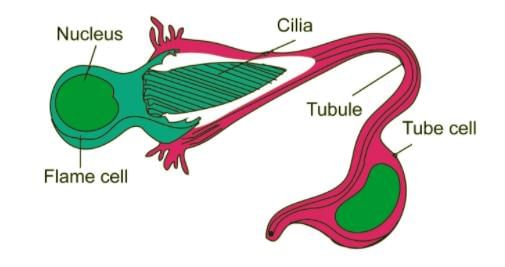
Flame cells are specialized cells in flatworms that help in osmoregulation and excretion by regulating the balance of fluids and salts in their bodies.
Radial symmetry is NOT found in adults of phylum ______. (NEET 2023)- a)Ctenophora
- b)Hemichordata
- c)Coelenterata
- d)Echinodermata
Correct answer is option 'B'. Can you explain this answer?
Radial symmetry is NOT found in adults of phylum ______. (NEET 2023)
a)
Ctenophora
b)
Hemichordata
c)
Coelenterata
d)
Echinodermata
| | Partho Kulkarni answered |
Understanding Radial Symmetry
Radial symmetry is a body plan in which body parts are arranged around a central axis. This type of symmetry is most commonly found in organisms that are aquatic and often sessile or free-floating.
Phylum Analysis
- Ctenophora (Comb Jellies):
- Exhibit radial symmetry in adults.
- Hemichordata (Acorn Worms):
- Adults display bilateral symmetry, not radial.
- They possess a segmented body and a distinct head region.
- Coelenterata (Cnidaria):
- Have radial symmetry in their adult forms (e.g., jellyfish, corals).
- Echinodermata (Starfish, Sea Urchins):
- Exhibit radial symmetry, typically pentamerous (five-part) symmetry in adults.
Conclusion
The correct answer is B (Hemichordata) because, unlike the other phyla listed, hemichordates demonstrate a bilateral symmetry as adults. Understanding these symmetries helps in the classification and study of various organisms within their respective phyla.
Radial symmetry is a body plan in which body parts are arranged around a central axis. This type of symmetry is most commonly found in organisms that are aquatic and often sessile or free-floating.
Phylum Analysis
- Ctenophora (Comb Jellies):
- Exhibit radial symmetry in adults.
- Hemichordata (Acorn Worms):
- Adults display bilateral symmetry, not radial.
- They possess a segmented body and a distinct head region.
- Coelenterata (Cnidaria):
- Have radial symmetry in their adult forms (e.g., jellyfish, corals).
- Echinodermata (Starfish, Sea Urchins):
- Exhibit radial symmetry, typically pentamerous (five-part) symmetry in adults.
Conclusion
The correct answer is B (Hemichordata) because, unlike the other phyla listed, hemichordates demonstrate a bilateral symmetry as adults. Understanding these symmetries helps in the classification and study of various organisms within their respective phyla.
Exoskeleton of arthropods is composed of: (NEET 2022 Phase 1)- a)Cellulose
- b)Chitin
- c)Glucosamine
- d)Cutin
Correct answer is option 'B'. Can you explain this answer?
Exoskeleton of arthropods is composed of: (NEET 2022 Phase 1)
a)
Cellulose
b)
Chitin
c)
Glucosamine
d)
Cutin
| | Lead Academy answered |
Option (b) is the correct answer as chitin forms the exoskeleton is arthropods and is found in fungal cell wall. N-acetyl glucosamine is the monomeric unit. Cellulose is a polysaccharide. Cutin is a derived lipid.
Read the following statements. (NEET 2021)(a) Metagenesis is observed in Helminths.
(b) Echinoderms are triploblastic and coelomate animals.
(c) Round worms have organ-system level of body organization
(d) Comb plates present in ctenophores help in digestion.
(e) Water vascular system is characteristic of Echinoderms.Choose the correct answer from the options given below.- a)(a), (d) and (e) are correct
- b)(b), (c) and (e) are correct
- c)(c), (d) and (e) are correct
- d)(a), (b) and (c) are correct
Correct answer is option 'B'. Can you explain this answer?
Read the following statements. (NEET 2021)
(a) Metagenesis is observed in Helminths.
(b) Echinoderms are triploblastic and coelomate animals.
(c) Round worms have organ-system level of body organization
(d) Comb plates present in ctenophores help in digestion.
(e) Water vascular system is characteristic of Echinoderms.
(b) Echinoderms are triploblastic and coelomate animals.
(c) Round worms have organ-system level of body organization
(d) Comb plates present in ctenophores help in digestion.
(e) Water vascular system is characteristic of Echinoderms.
Choose the correct answer from the options given below.
a)
(a), (d) and (e) are correct
b)
(b), (c) and (e) are correct
c)
(c), (d) and (e) are correct
d)
(a), (b) and (c) are correct
| | Mira Joshi answered |
- Those cnidarians which exist in both forms exhibit alternation of generation (Metagenesis), i.e., polyps produce medusae asexually and medusae form the polyps sexually (e.g., Obelia).
- The body bears eight external rows of ciliated comb plates, which help in locomotion.
- Roundworms have organ-system level of body organisation.
- They are triploblastic and coelomate animals.
- The most distinctive feature of echinoderms is the presence of water vascular system which helps in locomotion, capture and transport of food and respiration.
Match List I with List II : (NEET 2024)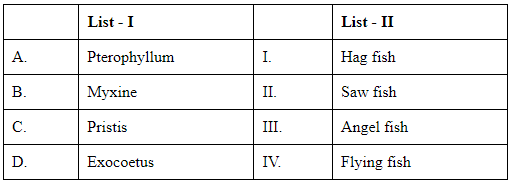
Choose the correct answer from the options given below :- a)A-II, B-I, C-IIII, D-IV
- b)A-III, B-I, C-II, D-IV
- c)A-IV, B-I, C-II, D-III
- d)A-III, B-II, C-I, D-IV
Correct answer is option 'B'. Can you explain this answer?
Match List I with List II : (NEET 2024)
Choose the correct answer from the options given below :
a)
A-II, B-I, C-IIII, D-IV
b)
A-III, B-I, C-II, D-IV
c)
A-IV, B-I, C-II, D-III
d)
A-III, B-II, C-I, D-IV
| | Stepway Academy answered |
Let's analyze the match between the items in List I and those in List II. We will specifically address the scientific names provided in List I and match them with their common names given in List II:
List I (Scientific Names) with List II (Common Names):
- Pterophyllum (A) - Angel fish (III): Pterophyllum is the scientific name for a type of cichlid commonly called angel fish. Therefore, A matches with III.
- Myxine (B) - Hag fish (I): Myxine is the genus for hagfish, which are known for their slime-producing capability. Hence, B matches with I.
- Pristis (C) - Saw fish (II): Pristis is the genus comprising the sawfishes, which are known for their long, saw-like rostrums. Consequently, C matches with II.
- Exocoetus (D) - Flying fish (IV): Exocoetus is a genus of marine fish known as flying fish, due to their ability to glide above the water's surface for short distances. Therefore, D matches with IV.
Now, compiling these matches together:
- A - III
- B - I
- C - II
- D - IV
The correct option that matches each scientific name with their respective common names accordingly is:
Option B: A-III, B-I, C-II, D-IV
Option B: A-III, B-I, C-II, D-IV
Match List I with List II: (NEET 2024)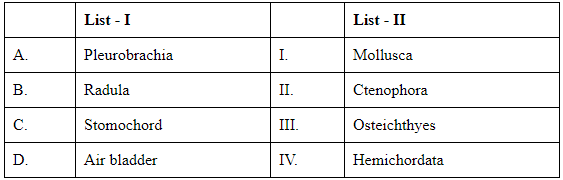 Choose the correct answer from the options given below :
- a)A-IV, B-II, C-III, D-I
- b)A-II, B-I, C-IV, D-III
- c)A-II, B-IV, C-I, D-III
- d)A-IV, B-III, C-II, D-I
Correct answer is option 'B'. Can you explain this answer?
Match List I with List II: (NEET 2024)
Choose the correct answer from the options given below :
a)
A-IV, B-II, C-III, D-I
b)
A-II, B-I, C-IV, D-III
c)
A-II, B-IV, C-I, D-III
d)
A-IV, B-III, C-II, D-I
 | Mohit Rajpoot answered |
To solve this matching question, we must evaluate each term in List I and determine its corresponding class or phylum in List II. Let's analyze each match:
Pleurobrachia: Pleurobrachia is a genus that belongs to the phylum Ctenophora, which is commonly known as comb jellies. Thus, A should be matched with II (Ctenophora).
Radula: A radula is a toothed, chitinous organ found within mollusks that is used for scraping or cutting food before the food enters the esophagus. Hence, B should be matched with I (Mollusca).
Stomochord: The stomochord is a small, tubular structure found in the collar of hemichordates, a fundamental character previously thought to link hemichordates and chordates. Therefore, C should be matched with IV (Hemichordata).
Air bladder: The air bladder, or swim bladder, is a gas-filled sac present in many bony fish that helps to maintain buoyancy. Hence, D should be matched with III (Osteichthyes, a class of bony fish).
Radula: A radula is a toothed, chitinous organ found within mollusks that is used for scraping or cutting food before the food enters the esophagus. Hence, B should be matched with I (Mollusca).
Stomochord: The stomochord is a small, tubular structure found in the collar of hemichordates, a fundamental character previously thought to link hemichordates and chordates. Therefore, C should be matched with IV (Hemichordata).
Air bladder: The air bladder, or swim bladder, is a gas-filled sac present in many bony fish that helps to maintain buoyancy. Hence, D should be matched with III (Osteichthyes, a class of bony fish).
Now, let's review the options given:
- Option A: A-IV, B-II, C-III, D-I
- Option B: A-II, B-I, C-IV, D-III
- Option C: A-II, B-IV, C-I, D-III
- Option D: A-IV, B-III, C-II, D-I
The correct matches, based on the classification should be: A-II, B-I, C-IV, D-III. Therefore, the correct answer is: Option B
Chapter doubts & questions for Animal Kingdom - 30-Day Revision Course for NEET 2026 is part of NEET exam preparation. The chapters have been prepared according to the NEET exam syllabus. The Chapter doubts & questions, notes, tests & MCQs are made for NEET 2026 Exam. Find important definitions, questions, notes, meanings, examples, exercises, MCQs and online tests here.
Chapter doubts & questions of Animal Kingdom - 30-Day Revision Course for NEET in English & Hindi are available as part of NEET exam. Download more important topics, notes, lectures and mock test series for NEET Exam by signing up for free.
30-Day Revision Course for NEET85 videos|301 docs|171 tests |
