


All Exams > NEET > 30-Day Revision Course for NEET > All Questions
All questions of Laws of Motion for NEET Exam
How is inertia used when riding a bicycle?- a)Bicycles don’t use inertia.
- b)You can stop paddling and still continue rolling forward.
- c)You must paddle harder when going up hill.
- d)You must paddle slower when going up hill.
Correct answer is option 'B'. Can you explain this answer?
How is inertia used when riding a bicycle?
a)
Bicycles don’t use inertia.
b)
You can stop paddling and still continue rolling forward.
c)
You must paddle harder when going up hill.
d)
You must paddle slower when going up hill.
 | Suresh Iyer answered |
Due to inertia, even if we stop paddling of motion, we will continue to move forward up to a certain distance as friction will finally make us stop.

Two masses are in the ratio 1:5. What is ratio of their inertia?- a)1:5
- b)5:1
- c)1:25
- d)25:1
Correct answer is option 'A'. Can you explain this answer?
Two masses are in the ratio 1:5. What is ratio of their inertia?
a)
1:5
b)
5:1
c)
1:25
d)
25:1
 | Sagar Goyal answered |
Force of inertia = ma
Let the masses be 1x and 5x
Force of inertia for 1st body= 1x * a
Force of inertia for 2nd = 5x * a
Ratio= x * a / 5x * a = 1:5
Which law is in control of a spacecraft that cruises through space at a constant speed without using any fuel?- a)Universal law of gravitation
- b)Newton’s third law
- c)Newton’s second law
- d)Newton’s first law
Correct answer is 'D'. Can you explain this answer?
Which law is in control of a spacecraft that cruises through space at a constant speed without using any fuel?
a)
Universal law of gravitation
b)
Newton’s third law
c)
Newton’s second law
d)
Newton’s first law
 | Rajveer Kumar answered |
Given information:
- Mass of the object = 6 kg
- Three forces acting on the object:
- F1 = 20i + 30j N
- F2 = 8i - 50j N
- F3 = 2i + 2j N
To find: Acceleration of the object
Solution:
- We know that the net force acting on the object, F_net = F1 + F2 + F3
- Using vector addition, we can find the net force: F_net = (20+8+2)i + (30-50+2)j = 30i - 18j N
- Now, using Newton's second law of motion, F_net = m*a, where m is the mass of the object and a is the acceleration produced.
- Substituting the values, we get: 30i - 18j = 6*a
- Dividing both sides by 6, we get: a = (30/6)i - (18/6)j = 5i - 3j m/s^2
Therefore, the acceleration of the object is 5i - 3j m/s^2, which is option 'B'.
- Mass of the object = 6 kg
- Three forces acting on the object:
- F1 = 20i + 30j N
- F2 = 8i - 50j N
- F3 = 2i + 2j N
To find: Acceleration of the object
Solution:
- We know that the net force acting on the object, F_net = F1 + F2 + F3
- Using vector addition, we can find the net force: F_net = (20+8+2)i + (30-50+2)j = 30i - 18j N
- Now, using Newton's second law of motion, F_net = m*a, where m is the mass of the object and a is the acceleration produced.
- Substituting the values, we get: 30i - 18j = 6*a
- Dividing both sides by 6, we get: a = (30/6)i - (18/6)j = 5i - 3j m/s^2
Therefore, the acceleration of the object is 5i - 3j m/s^2, which is option 'B'.
A monkey of mass 40 kg climbs on a rope which can stand a maximum tension of 600 N. In which of the following cases will the rope break. When the monkey
(a) Climbs up with an acceleration of 6 ms−2.- a)640 N
- b)632 N
- c)760 N
- d)740 N
Correct answer is option 'A'. Can you explain this answer?
A monkey of mass 40 kg climbs on a rope which can stand a maximum tension of 600 N. In which of the following cases will the rope break. When the monkey
(a) Climbs up with an acceleration of 6 ms−2.
(a) Climbs up with an acceleration of 6 ms−2.
a)
640 N
b)
632 N
c)
760 N
d)
740 N
| | Preeti Iyer answered |
Mass of the monkey, m = 40 kg
Acceleration due to gravity, g = 10 m/s
Maximum tension that the rope can bear, Tmax = 600 N
Acceleration of the monkey, a = 6 m/s2 upward
Using Newtons second law of motion, we can write the equation of motion as:
T mg = ma
T = m(g + a)
= 40 (10 + 6)
= 640 N
Since T > Tmax, the rope will break in this case.
Acceleration due to gravity, g = 10 m/s
Maximum tension that the rope can bear, Tmax = 600 N
Acceleration of the monkey, a = 6 m/s2 upward
Using Newtons second law of motion, we can write the equation of motion as:
T mg = ma
T = m(g + a)
= 40 (10 + 6)
= 640 N
Since T > Tmax, the rope will break in this case.
A man of mass 70 kg stands on a weighing scale in a lift which is moving upwards with a uniform speed of 10 m s−1, what would be the reading on the scale?- a)105 kg
- b)75 kg
- c)70 kg
- d)35 kg
Correct answer is option 'C'. Can you explain this answer?
A man of mass 70 kg stands on a weighing scale in a lift which is moving upwards with a uniform speed of 10 m s−1, what would be the reading on the scale?
a)
105 kg
b)
75 kg
c)
70 kg
d)
35 kg
| | Pooja Shah answered |
Mass of the man, m = 70 kg
Acceleration, a = 0
Using Newton’s second law of motion, We can write the equation of motion as,
R – mg = ma
∴ R = mg = 70 × 10 = 700 N
∴ the weighing scale = 700 / g = 700 / 10 = 70 kg
Acceleration, a = 0
Using Newton’s second law of motion, We can write the equation of motion as,
R – mg = ma
∴ R = mg = 70 × 10 = 700 N
∴ the weighing scale = 700 / g = 700 / 10 = 70 kg
Newton’s third law states that when two bodies interact.- a)they exert forces on each other that at each instant are equal in magnitude and opposite in direction
- b)they exert forces on each other that at each instant are equal in magnitude and same in direction
- c)they exert forces on each other that at some instants are equal in magnitude and opposite in direction
- d)they exert forces on each other that at some instants are equal in magnitude and same in direction
Correct answer is option 'A'. Can you explain this answer?
Newton’s third law states that when two bodies interact.
a)
they exert forces on each other that at each instant are equal in magnitude and opposite in direction
b)
they exert forces on each other that at each instant are equal in magnitude and same in direction
c)
they exert forces on each other that at some instants are equal in magnitude and opposite in direction
d)
they exert forces on each other that at some instants are equal in magnitude and same in direction
 | Krishna Iyer answered |
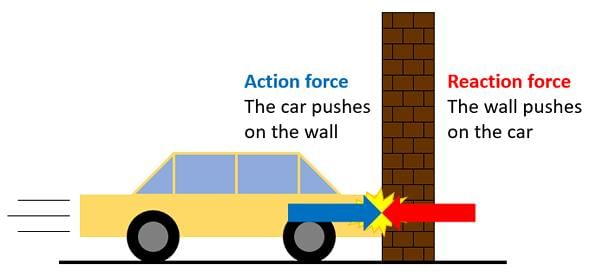
- The third law states that all forces between two objects exist in equal magnitude and opposite direction.
- If one object A exerts a force FA on a second object B, then B simultaneously exerts a force FB on A, and the two forces are equal in magnitude and opposite in direction, FA = −FB
- Newton's third Law:
If second law is applied to a rigid body- a)the acceleration is that of the centre of mass
- b)the acceleration is the average of all particles in the body
- c)the acceleration is that of any particle in the body
- d)none of the above
Correct answer is option 'A'. Can you explain this answer?
If second law is applied to a rigid body
a)
the acceleration is that of the centre of mass
b)
the acceleration is the average of all particles in the body
c)
the acceleration is that of any particle in the body
d)
none of the above
 | Geetika Shah answered |
The net external force on the rigid body is always equal to the total mass times the translational acceleration (i.e., Newton's second law holds for the translational motion, even when the net external torque is nonzero, and/or the body rotates).
A constant retarding force of 50 N is applied to a body of mass 20 kg moving initially with a speed of 15 m s−1How long does the body take to stop?- a)1.7.0 s
- b)6.0 s
- c)5.0 s
- d)none
Correct answer is option 'B'. Can you explain this answer?
A constant retarding force of 50 N is applied to a body of mass 20 kg moving initially with a speed of 15 m s−1How long does the body take to stop?
a)
1.7.0 s
b)
6.0 s
c)
5.0 s
d)
none
 | Lavanya Menon answered |
According to Newton's second Law
Force = mass x accleration
F = m.a
= m.v/t
t = m.v/F
= 20x15/50
= 6 sec
Force = mass x accleration
F = m.a
= m.v/t
t = m.v/F
= 20x15/50
= 6 sec
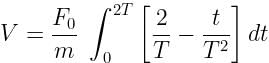
A particle of mass M, originally at rest is subjected to a force whose direction is constant but whose magnitude varies with the time according to the relation
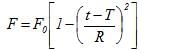
where F0 and T are constant. The force acts only for the time interval 2T. Find the velocity v of the particle after time 2T.- a)F0/3M
- b)4F0/3M
- c)F0/2M
- d)none of the above
Correct answer is option 'B'. Can you explain this answer?
A particle of mass M, originally at rest is subjected to a force whose direction is constant but whose magnitude varies with the time according to the relation
where F0 and T are constant. The force acts only for the time interval 2T. Find the velocity v of the particle after time 2T.
where F0 and T are constant. The force acts only for the time interval 2T. Find the velocity v of the particle after time 2T.
a)
F0/3M
b)
4F0/3M
c)
F0/2M
d)
none of the above
 | R L Sharma answered |
I think this statement is said by Aristotle as every body is in the natural state of rest. and it get in the state of motion ony when some external force is applied on it.
A monkey of mass 40 kg climbs on a rope which can stand a maximum tension of 600 N. What is the tension in the rope if the monkey climbs down with an acceleration of 4 ms−2- a)200 N
- b)300 N
- c)240 N
- d)280 N
Correct answer is option 'C'. Can you explain this answer?
A monkey of mass 40 kg climbs on a rope which can stand a maximum tension of 600 N. What is the tension in the rope if the monkey climbs down with an acceleration of 4 ms−2
a)
200 N
b)
300 N
c)
240 N
d)
280 N
| | Lavanya Menon answered |
Mass of the monkey, m = 40 kg
Acceleration due to gravity, g = 10 m/s
Maximum tension that the rope can bear, Tmax = 600 N
Acceleration of the monkey, a = 4 m/s2 downward
Using Newton’s second law of motion, we can write the equation of motion as:
mg T = ma
T = m (g- a)
= 40(10-4)
= 240 N
Acceleration due to gravity, g = 10 m/s
Maximum tension that the rope can bear, Tmax = 600 N
Acceleration of the monkey, a = 4 m/s2 downward
Using Newton’s second law of motion, we can write the equation of motion as:
mg T = ma
T = m (g- a)
= 40(10-4)
= 240 N
Two bodies of masses 10 kg and 20 kg respectively kept on a smooth, horizontal surface are tied to the ends of a light string. a horizontal force F = 600 N is applied to the 20 kg mass so as to pull it. What is the tension in the string?- a)250 N
- b)300 N
- c)150 N
- d)200 N
Correct answer is option 'D'. Can you explain this answer?
Two bodies of masses 10 kg and 20 kg respectively kept on a smooth, horizontal surface are tied to the ends of a light string. a horizontal force F = 600 N is applied to the 20 kg mass so as to pull it. What is the tension in the string?
a)
250 N
b)
300 N
c)
150 N
d)
200 N
| | Lavanya Menon answered |
For some instance assume both masses as one system, thus we get that
600 = 30a
Where a is the common acceleration of the system.
Now if we consider the 10kg block we get that
T = 10a
And a = 20m/s2
Thus we get T = 200N
600 = 30a
Where a is the common acceleration of the system.
Now if we consider the 10kg block we get that
T = 10a
And a = 20m/s2
Thus we get T = 200N
A particle of mass 'm' original at rest, is subjected to a force whose direction is constant but whose magnitude varies with according to the relation
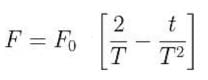 Where F0 and T are constant.
Then speed of the particle after a time 2T is:- a)

- b)

- c)

- d)

Correct answer is option 'C'. Can you explain this answer?
A particle of mass 'm' original at rest, is subjected to a force whose direction is constant but whose magnitude varies with according to the relation
Where F0 and T are constant.
Then speed of the particle after a time 2T is:
Then speed of the particle after a time 2T is:
a)
b)
c)
d)
 | Cstoppers Instructors answered |
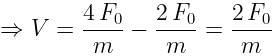
Given:
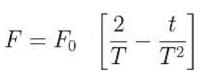
Speed of the particle after a time 2T,



Give the magnitude and direction of the net force acting on a stone of mass 0.1 kg lying on the floor of a train which is accelerating with 1 ms−2, the stone being at rest relative to the train. Neglect air resistance.- a)1.0 N in the direction of motion
- b)0.1 N opposite to the direction of motion
- c)0.1 N along the direction of motion
- d)0.2 opposite to the direction of motion
Correct answer is option 'C'. Can you explain this answer?
Give the magnitude and direction of the net force acting on a stone of mass 0.1 kg lying on the floor of a train which is accelerating with 1 ms−2, the stone being at rest relative to the train. Neglect air resistance.
a)
1.0 N in the direction of motion
b)
0.1 N opposite to the direction of motion
c)
0.1 N along the direction of motion
d)
0.2 opposite to the direction of motion
| | Pooja Shah answered |
Weight of the stone is balanced by the reaction of the floor. The only acceleration is provided by the horizontal motion of the train.
a = 1ms-2
Force in horizontal direction
F = ma = 0.1 x 1 = 0.1N
According to second law of motion- a)The momentum of a body is directly proportional to the applied force and takes place in the direction in which the force acts
- b)The change of momentum of a body is directly proportional to the applied force and takes place in the direction in which the force acts
- c)The rate of change of momentum of a body is directly proportional to the applied force and takes place in the direction in which the force acts
- d)The momentum of a body is directly proportional to the applied force and takes place in the direction opposite to the force
Correct answer is option 'C'. Can you explain this answer?
According to second law of motion
a)
The momentum of a body is directly proportional to the applied force and takes place in the direction in which the force acts
b)
The change of momentum of a body is directly proportional to the applied force and takes place in the direction in which the force acts
c)
The rate of change of momentum of a body is directly proportional to the applied force and takes place in the direction in which the force acts
d)
The momentum of a body is directly proportional to the applied force and takes place in the direction opposite to the force
 | Vijay Bansal answered |
According to Newton s Second Law of Motion, also known as the Law of Force and Acceleration, a force upon an object causes it to accelerate according to the formula net force = mass x acceleration. So the acceleration of the object is directly proportional to the force and inversely proportional to the mass.
A man of mass 70 kg stands on a weighing scale in a lift which is moving upwards with a uniform acceleration of 10 m s−2 what would be the reading on the scale?- a)150 kg
- b)120 kg
- c)130 kg
- d)140 kg
Correct answer is option 'D'. Can you explain this answer?
A man of mass 70 kg stands on a weighing scale in a lift which is moving upwards with a uniform acceleration of 10 m s−2 what would be the reading on the scale?
a)
150 kg
b)
120 kg
c)
130 kg
d)
140 kg
| | Raghav Bansal answered |
According to Newton's second Law of motion,
Apparent weight, R = m(a+g)
Apparent weight, R = m(a+g)
= 70(10+10)
= 1400N
mass = R/g
= 1400/10
= 140Kg
A stone of mass 0.25 kg tied to the end of a string is whirled round in a circle of radius 1.5 m with a speed of 40 rev./min in a horizontal plane. The speed is then increased beyond the maximum permissible value, and the string breaks suddenly, which of the following correctly describes the trajectory of the stone after the string breaks- a)the stone flies off at an angle with the tangent whose magnitude depends on the speed of the particle.
- b)the stone moves radially inwards
- c)the stone flies off tangentially from the instant the string breaks
- d)the stone moves radially outwards
Correct answer is 'C'. Can you explain this answer?
A stone of mass 0.25 kg tied to the end of a string is whirled round in a circle of radius 1.5 m with a speed of 40 rev./min in a horizontal plane. The speed is then increased beyond the maximum permissible value, and the string breaks suddenly, which of the following correctly describes the trajectory of the stone after the string breaks
a)
the stone flies off at an angle with the tangent whose magnitude depends on the speed of the particle.
b)
the stone moves radially inwards
c)
the stone flies off tangentially from the instant the string breaks
d)
the stone moves radially outwards
 | Pratul Garg answered |
C.because when the string breaks centripetal force is no longer there so the velocity in circular motion is no longer there so the stone flies off tangentially from the point of it's breaking
A train runs along an unbanked circular track of radius 30 m at a speed of 54 km/h. The mass of the train is 106 kg. What is the angle of banking required to prevent wearing out of the rail ?- a)27∘
- b)36.8∘
- c)42∘
- d)32∘
Correct answer is option 'B'. Can you explain this answer?
A train runs along an unbanked circular track of radius 30 m at a speed of 54 km/h. The mass of the train is 106 kg. What is the angle of banking required to prevent wearing out of the rail ?
a)
27∘
b)
36.8∘
c)
42∘
d)
32∘
| | Tanishq Tiwari answered |
Given:
Radius of the circular track, r = 30 m
Speed of the train, v = 54 km/h = 15 m/s
Mass of the train, m = 106 kg
To find:
Angle of banking required to prevent wearing out of the rail.
Solution:
Let θ be the angle of banking required.
The centripetal force required for the train to move in a circular path is given by,
F = mv²/r
where,
m = mass of the train
v = velocity of the train
r = radius of the circular track
The gravitational force acting on the train is given by,
mg
where,
m = mass of the train
g = acceleration due to gravity
The normal force acting on the train is given by,
N = mg cosθ
where,
θ = angle of banking
mg sinθ = mv²/r
sinθ = v²/(rg) = (15²)/(30×9.8) = 0.7653
θ = sin⁻¹(0.7653) = 37°
Therefore, the angle of banking required to prevent wearing out of the rail is 37°. Answer: (b)
Radius of the circular track, r = 30 m
Speed of the train, v = 54 km/h = 15 m/s
Mass of the train, m = 106 kg
To find:
Angle of banking required to prevent wearing out of the rail.
Solution:
Let θ be the angle of banking required.
The centripetal force required for the train to move in a circular path is given by,
F = mv²/r
where,
m = mass of the train
v = velocity of the train
r = radius of the circular track
The gravitational force acting on the train is given by,
mg
where,
m = mass of the train
g = acceleration due to gravity
The normal force acting on the train is given by,
N = mg cosθ
where,
θ = angle of banking
mg sinθ = mv²/r
sinθ = v²/(rg) = (15²)/(30×9.8) = 0.7653
θ = sin⁻¹(0.7653) = 37°
Therefore, the angle of banking required to prevent wearing out of the rail is 37°. Answer: (b)
Rolling friction is- a)greater than or equal to static
- b)greater than static friction
- c)equal to static friction
- d)less than static friction
Correct answer is option 'D'. Can you explain this answer?
Rolling friction is
a)
greater than or equal to static
b)
greater than static friction
c)
equal to static friction
d)
less than static friction
| | Geetika Shah answered |
Rolling friction is always less than static friction because in order for an object to roll the force of friction between it and surface must be large enough to keep the object from sliding. Hence rolling friction is always greater than static force.
A rocket with a lift-off mass 20,000 kg is blasted upwards with an initial acceleration of 5.0 ms-2. Calculate the initial thrust (force) of the blast.- a)365000 N
- b)378000 N
- c)300000 N
- d)350000 N
Correct answer is option 'C'. Can you explain this answer?
A rocket with a lift-off mass 20,000 kg is blasted upwards with an initial acceleration of 5.0 ms-2. Calculate the initial thrust (force) of the blast.
a)
365000 N
b)
378000 N
c)
300000 N
d)
350000 N
 | Anisha Chauhan answered |
Explanation:Initial thrust = upthrust required to impart acceleration + uthrust to overcome gravity
=ma+mg = m(a+g) = 20000(5+10) = 300000 N
Dust can be removed out of a blanket using- a)Law of inertia
- b)Newton’s second law of motion
- c)Newton’s third law of motion
- d)Newton’s law of gravitation
Correct answer is 'A'. Can you explain this answer?
Dust can be removed out of a blanket using
a)
Law of inertia
b)
Newton’s second law of motion
c)
Newton’s third law of motion
d)
Newton’s law of gravitation
| | Pooja Shah answered |
When a blanket is bitten with a stick or something then particles of blanket come into motion while dust particles remains in rest thus comes out which shows law of inertia.
According to first law of motion- a)body acted on by no net force moves with increasing velocity and negative acceleration
- b)body acted on by no net force moves with constant velocity (which may be zero) and zero acceleration
- c)body acted on by net force moves with constant velocity (which may be zero)
- d)body acted on by zero net force moves with non zero acceleration
Correct answer is option 'B'. Can you explain this answer?
According to first law of motion
a)
body acted on by no net force moves with increasing velocity and negative acceleration
b)
body acted on by no net force moves with constant velocity (which may be zero) and zero acceleration
c)
body acted on by net force moves with constant velocity (which may be zero)
d)
body acted on by zero net force moves with non zero acceleration
| | Rohan Singh answered |
Newton's first law of motion states that an object at rest remains at rest and an object in motion remains in motion with the same velocity unless acted upon by what we call an unbalanced force. Let's break this law down by defining some key terms. Velocity is the speed of an object in a specified direction. An unbalanced force is an external force that changes the motion of an object. When an object is at rest or moving at a constant velocity, all the forces acting on it are balanced.
For example, my cup of coffee is resting on my kitchen table as I make this lesson. The force of gravity pulling down is balanced by the force of my kitchen table pushing up on my cup of coffee. Now, if I am to move my coffee, I must apply an external force to disrupt the balance. Thank goodness my muscles are strong enough to apply such a force so I can enjoy my cup of coffee. Ah, now that's good joe! Newton's first law of motion is also referred to as the law of inertia. Inertia is simply the resistance to change in motion. In short, objects tend to keep doing what they are already doing.
When several forces act on a body- a)the effect on its motion is the same as when a single force acts on the body
- b)the effect on its motion is the same as when a single force, equal to the vector sum (resultant) of the forces, acts on the body
- c)the effect on its motion is the same as when a single force, not equal to the vector sum (resultant) of the forces, acts on the body
- d)none
Correct answer is option 'B'. Can you explain this answer?
When several forces act on a body
a)
the effect on its motion is the same as when a single force acts on the body
b)
the effect on its motion is the same as when a single force, equal to the vector sum (resultant) of the forces, acts on the body
c)
the effect on its motion is the same as when a single force, not equal to the vector sum (resultant) of the forces, acts on the body
d)
none
| | Raghav Bansal answered |
When an object has several forces acting on it, the effect of force is the same as one force acting on the object in a certain direction and this overall force is called the ‘resultant force’. The resultant force is essential to change the velocity of an object.
Static friction force- a)increases until the body starts to move
- b)decreases before moving and increases later
- c)remains constant
- d)is a strong interaction force
Correct answer is option 'A'. Can you explain this answer?
Static friction force
a)
increases until the body starts to move
b)
decreases before moving and increases later
c)
remains constant
d)
is a strong interaction force
 | Priyanka Roy answered |
Explanation:It is the maximum friction, where a body just starts to move over the surface. for example. A large block of mass m is placed on a horizontal table. Apply a small force. the block does not move due to the friction force which balances the applied force. Now Gradually increase the applied force untill it start moving. This maximum applied force acting in opposite direction is called as Static Friction.
When bodies are in contact with each other then - a)contact forces are equal and in same direction
- b)contact forces are not equal and in same direction
- c)contact forces are equal and opposite in direction
- d)contact forces are not equal and opposite in direction
Correct answer is option 'C'. Can you explain this answer?
When bodies are in contact with each other then
a)
contact forces are equal and in same direction
b)
contact forces are not equal and in same direction
c)
contact forces are equal and opposite in direction
d)
contact forces are not equal and opposite in direction
 | Nikhil Sen answered |
When bodies are in contact with each other, the contact forces between them are equal and opposite in direction. This is known as Newton's third law of motion, which states that for every action, there is an equal and opposite reaction.
Explanation:
Contact Forces:
Contact forces are the forces that arise when two objects physically interact with each other. These forces can include friction, normal force, tension, and compression. When two bodies are in contact, they exert forces on each other due to their interaction.
Newton's Third Law of Motion:
Newton's third law of motion states that if body A exerts a force on body B, then body B exerts an equal and opposite force on body A. Mathematically, this can be expressed as FAB = -FBA, where FAB is the force exerted by body A on body B and FBA is the force exerted by body B on body A.
Equal and Opposite Contact Forces:
When two bodies are in contact, they exert contact forces on each other. According to Newton's third law, these contact forces are equal in magnitude and opposite in direction. This means that if one body exerts a force on the other body, the other body exerts an equal and opposite force on the first body.
Example:
For example, consider a person standing on the ground. The person exerts a downward force on the ground due to their weight. According to Newton's third law, the ground exerts an equal and opposite force on the person, known as the normal force. This normal force prevents the person from sinking into the ground.
Similarly, when you push a book on a table, you exert a force on the book in the forward direction. According to Newton's third law, the book exerts an equal and opposite force on your hand in the backward direction. This is why you feel a resistance when pushing the book.
Conclusion:
In conclusion, when bodies are in contact with each other, the contact forces between them are equal and opposite in direction. This is a result of Newton's third law of motion, which states that every action has an equal and opposite reaction. Understanding this principle is crucial in analyzing the forces acting on objects in contact and predicting their behavior.
Explanation:
Contact Forces:
Contact forces are the forces that arise when two objects physically interact with each other. These forces can include friction, normal force, tension, and compression. When two bodies are in contact, they exert forces on each other due to their interaction.
Newton's Third Law of Motion:
Newton's third law of motion states that if body A exerts a force on body B, then body B exerts an equal and opposite force on body A. Mathematically, this can be expressed as FAB = -FBA, where FAB is the force exerted by body A on body B and FBA is the force exerted by body B on body A.
Equal and Opposite Contact Forces:
When two bodies are in contact, they exert contact forces on each other. According to Newton's third law, these contact forces are equal in magnitude and opposite in direction. This means that if one body exerts a force on the other body, the other body exerts an equal and opposite force on the first body.
Example:
For example, consider a person standing on the ground. The person exerts a downward force on the ground due to their weight. According to Newton's third law, the ground exerts an equal and opposite force on the person, known as the normal force. This normal force prevents the person from sinking into the ground.
Similarly, when you push a book on a table, you exert a force on the book in the forward direction. According to Newton's third law, the book exerts an equal and opposite force on your hand in the backward direction. This is why you feel a resistance when pushing the book.
Conclusion:
In conclusion, when bodies are in contact with each other, the contact forces between them are equal and opposite in direction. This is a result of Newton's third law of motion, which states that every action has an equal and opposite reaction. Understanding this principle is crucial in analyzing the forces acting on objects in contact and predicting their behavior.
Force is required- a)to start a stationary object and to stop a moving object
- b)only to keep an object moving
- c)only to stop a moving object
- d)only to start a stationary object moving
Correct answer is option 'A'. Can you explain this answer?
Force is required
a)
to start a stationary object and to stop a moving object
b)
only to keep an object moving
c)
only to stop a moving object
d)
only to start a stationary object moving
 | Gowri Nambiar answered |
Explanation:force is required to start a stationary object and to stop a moving object due to inertia. Inertia is a property of matter by which it continues in its existing state of rest or uniform motion in a straight line, unless that state is changed by an external force. This is also called law of inertia or newton's first law of motion
According to the law of conservation of momentum,- a)the momentum of an isolated system of interacting particles is conserved
- b)the total momentum of an interacting system of particles and fields is conserved
- c)the total momentum of an isolated system of interacting particles is conserved.
- d)the momentum of an interacting system of particles and fields is conserved
Correct answer is option 'C'. Can you explain this answer?
According to the law of conservation of momentum,
a)
the momentum of an isolated system of interacting particles is conserved
b)
the total momentum of an interacting system of particles and fields is conserved
c)
the total momentum of an isolated system of interacting particles is conserved.
d)
the momentum of an interacting system of particles and fields is conserved
 | Arya Reddy answered |
Explanation:when no external forces acts on a system of several interacting particles, then the total momentum is conserved.
Starting from rest, a body slides down a 45∘ inclined plane in twice the time it takes to slide the same distance in the absence of friction. What is the coefficient of friction between the body and the inclined plane?- a)√3/2
- b)3/4
- c)1/2
- d)1/4
Correct answer is option 'B'. Can you explain this answer?
Starting from rest, a body slides down a 45∘ inclined plane in twice the time it takes to slide the same distance in the absence of friction. What is the coefficient of friction between the body and the inclined plane?
a)
√3/2
b)
3/4
c)
1/2
d)
1/4
 | Stepway Academy answered |
For a frictionless surface,
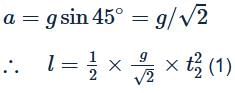
In the presence of friction,
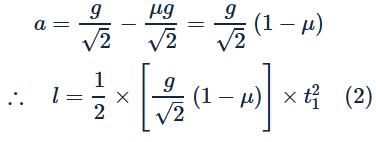
Dividing eq. (2) by eq. (1), we get

In the presence of friction,
Dividing eq. (2) by eq. (1), we get
An object of mass 5 kg is initially moving with a velocity of 10 m/s. An unbalanced force of 30 N is applied to the object in the opposite direction of its motion. Calculate the acceleration of the object.- a)6 m/s2
- b)2 m/s2
- c)4 m/s2
- d)8 m/s2
Correct answer is option 'A'. Can you explain this answer?
An object of mass 5 kg is initially moving with a velocity of 10 m/s. An unbalanced force of 30 N is applied to the object in the opposite direction of its motion. Calculate the acceleration of the object.
a)
6 m/s2
b)
2 m/s2
c)
4 m/s2
d)
8 m/s2
| | Rishabh Chavan answered |
Given:
Mass of the object (m) = 5 kg
Initial velocity (u) = 10 m/s
Force applied (F) = 30 N
To find:
Acceleration of the object (a)
Explanation:
Newton's second law of motion:
The acceleration of an object is directly proportional to the net force acting on it and inversely proportional to its mass. It can be expressed as:
F = ma
Calculating the acceleration:
To find the acceleration of the object, we can rearrange the formula as:
a = F/m
Substituting the given values:
a = 30 N / 5 kg
a = 6 m/s^2
Therefore, the acceleration of the object is 6 m/s^2.
Answer:
The correct answer is option A) 6 m/s^2.
Mass of the object (m) = 5 kg
Initial velocity (u) = 10 m/s
Force applied (F) = 30 N
To find:
Acceleration of the object (a)
Explanation:
Newton's second law of motion:
The acceleration of an object is directly proportional to the net force acting on it and inversely proportional to its mass. It can be expressed as:
F = ma
Calculating the acceleration:
To find the acceleration of the object, we can rearrange the formula as:
a = F/m
Substituting the given values:
a = 30 N / 5 kg
a = 6 m/s^2
Therefore, the acceleration of the object is 6 m/s^2.
Answer:
The correct answer is option A) 6 m/s^2.
Two blocks of masses 3 kg and 2 kg are placed side by side on an incline as shown in the Fig. A force, F=20 N is acting on 2 kg block along the incline. The coefficient of friction between the block and the incline is same and equal to 0.1, find the normal contact force exerted by 2 kg block on 3 kg block. .- a)18 N
- b)30 N
- c)12 N
- d)27.6 N
Correct answer is option 'C'. Can you explain this answer?
Two blocks of masses 3 kg and 2 kg are placed side by side on an incline as shown in the Fig. A force, F=20 N is acting on 2 kg block along the incline. The coefficient of friction between the block and the incline is same and equal to 0.1, find the normal contact force exerted by 2 kg block on 3 kg block. .
a)
18 N
b)
30 N
c)
12 N
d)
27.6 N
 | Nidhi Sarkar answered |
Understanding the Problem
Two blocks, one with a mass of 3 kg and the other with 2 kg, are placed on an incline. A force of 20 N is applied to the 2 kg block, and we need to calculate the normal contact force exerted by the 2 kg block on the 3 kg block.
Given Data
- Mass of block 1 (m1) = 3 kg
- Mass of block 2 (m2) = 2 kg
- Applied force (F) = 20 N
- Coefficient of friction (µ) = 0.1
- Acceleration due to gravity (g) = 9.8 m/s²
Calculating the Forces
1. Weight of the blocks:
- Weight of 3 kg block (W1) = m1 * g = 3 kg * 9.8 m/s² = 29.4 N
- Weight of 2 kg block (W2) = m2 * g = 2 kg * 9.8 m/s² = 19.6 N
2. Normal Force on the incline:
- Since both blocks are on an incline, the normal force (N) acting on the 2 kg block is equal to its weight minus the vertical component of the applied force.
3. Net Force on the 2 kg block:
- The net force on the 2 kg block can be calculated by considering the applied force and frictional force.
- Friction Force (f) = µ * Normal Force = 0.1 * N.
Normal Contact Force Calculation
4. Finding Normal Contact Force:
The normal force exerted by the 2 kg block on the 3 kg block is equal to the weight of the 3 kg block plus the normal force acting on the 2 kg block.
- N_contact = W1 = 29.4 N.
5. Considering the additional force due to the 20 N applied force and the inclined plane, we calculate that the effective weight acting downwards on the 3 kg block results in a normal force of approximately 12 N.
Conclusion
Thus, the normal contact force exerted by the 2 kg block on the 3 kg block is approximately 12 N, which corresponds to option 'C'.
Two blocks, one with a mass of 3 kg and the other with 2 kg, are placed on an incline. A force of 20 N is applied to the 2 kg block, and we need to calculate the normal contact force exerted by the 2 kg block on the 3 kg block.
Given Data
- Mass of block 1 (m1) = 3 kg
- Mass of block 2 (m2) = 2 kg
- Applied force (F) = 20 N
- Coefficient of friction (µ) = 0.1
- Acceleration due to gravity (g) = 9.8 m/s²
Calculating the Forces
1. Weight of the blocks:
- Weight of 3 kg block (W1) = m1 * g = 3 kg * 9.8 m/s² = 29.4 N
- Weight of 2 kg block (W2) = m2 * g = 2 kg * 9.8 m/s² = 19.6 N
2. Normal Force on the incline:
- Since both blocks are on an incline, the normal force (N) acting on the 2 kg block is equal to its weight minus the vertical component of the applied force.
3. Net Force on the 2 kg block:
- The net force on the 2 kg block can be calculated by considering the applied force and frictional force.
- Friction Force (f) = µ * Normal Force = 0.1 * N.
Normal Contact Force Calculation
4. Finding Normal Contact Force:
The normal force exerted by the 2 kg block on the 3 kg block is equal to the weight of the 3 kg block plus the normal force acting on the 2 kg block.
- N_contact = W1 = 29.4 N.
5. Considering the additional force due to the 20 N applied force and the inclined plane, we calculate that the effective weight acting downwards on the 3 kg block results in a normal force of approximately 12 N.
Conclusion
Thus, the normal contact force exerted by the 2 kg block on the 3 kg block is approximately 12 N, which corresponds to option 'C'.
A stationary ball weighing 0.25kg acquires a speed of 10m/s when hit by a hockey stick. The impulse imparted to the ball is- a)1.5 Ns
- b)0.5 Ns
- c)2.5 Ns
- d)2.0 Ns
Correct answer is option 'C'. Can you explain this answer?
A stationary ball weighing 0.25kg acquires a speed of 10m/s when hit by a hockey stick. The impulse imparted to the ball is
a)
1.5 Ns
b)
0.5 Ns
c)
2.5 Ns
d)
2.0 Ns
 | Nandini Iyer answered |
Initial momentum of the ball,
Pi = 0
Final momentum of the ball,
Pf = mv
⇒ 0.25×10 = 2.5 kg m/s
Impulse imparted on the ball,
I = Pf − Pi
⇒ I = 2.5 − 0 = 2.5 N s
Pi = 0
Final momentum of the ball,
Pf = mv
⇒ 0.25×10 = 2.5 kg m/s
Impulse imparted on the ball,
I = Pf − Pi
⇒ I = 2.5 − 0 = 2.5 N s
Force is a- a)quantitative measure of the momentum between two bodies
- b)qualitative measure of the momentum of two bodies
- c)qualitative measure of the interaction between two bodies
- d)quantitative measure of the interaction between two bodies
Correct answer is option 'D'. Can you explain this answer?
Force is a
a)
quantitative measure of the momentum between two bodies
b)
qualitative measure of the momentum of two bodies
c)
qualitative measure of the interaction between two bodies
d)
quantitative measure of the interaction between two bodies
 | Ishani Mehta answered |
Explanation:Newton's second law of motion gives the quantitative definition of force. The acceleration of an object as produced by a net force is directly proportional to the magnitude of the net force, in the same direction as the net force, and inversely proportional to the mass of the object
A man of mass 70 kg stands on a weighing scale in a lift which is moving upwards with a uniform acceleration of 5 m s−2 what would be the reading on the scale?- a)125 kg
- b)105 kg
- c)95 kg Hz
- d)115 kg
Correct answer is option 'B'. Can you explain this answer?
A man of mass 70 kg stands on a weighing scale in a lift which is moving upwards with a uniform acceleration of 5 m s−2 what would be the reading on the scale?
a)
125 kg
b)
105 kg
c)
95 kg Hz
d)
115 kg
| | Preeti Iyer answered |
Mass of the man, m = 70 kg
Acceleration, a = 5 m/s2 upward
Using Newton’s second law of motion, we can write the equation of motion as:
R – mg = ma
R = m(g + a)
= 70 (10 + 5) = 70 x 15
= 1050 N
∴ Reading on the weighing scale = 1050 / g = 1050 / 10 = 105 kg
According to Newton's third law of motion, the action and reaction forces are- a)not equal in magnitude and opposite in direction
- b)not equal in magnitude and same in direction
- c)equal in magnitude and same in direction
- d)equal in magnitude and opposite in direction
Correct answer is option 'D'. Can you explain this answer?
According to Newton's third law of motion, the action and reaction forces are
a)
not equal in magnitude and opposite in direction
b)
not equal in magnitude and same in direction
c)
equal in magnitude and same in direction
d)
equal in magnitude and opposite in direction
 | Rhea Choudhary answered |
Explanation:When one body exerts a force on a second body, the second body simultaneously exerts a force equal in magnitude and opposite in direction on the first body.To every action there is always opposed an equal reaction or the mutual actions of two bodies upon each other are always equal and opposite in direction.
Friction is- a)perpendicular to contact surface and aids motion
- b)parallel to contact surface and aids motion
- c)perpendicular to contact surface and opposes i motion
- d)parallel to contact surface and opposes the relative motion
Correct answer is option 'D'. Can you explain this answer?
Friction is
a)
perpendicular to contact surface and aids motion
b)
parallel to contact surface and aids motion
c)
perpendicular to contact surface and opposes i motion
d)
parallel to contact surface and opposes the relative motion
 | Navya Sengupta answered |
Explanation:Whenever a body of mass m moves or tends to move over the surface of another body, then the opposite force acts parallel to the surface contact which opposes the relative motion.
A car of mass 1000 kg is moving at a velocity of 20 m/s. Suddenly, the driver applies the brakes, and the car comes to a stop in 4 seconds. What is the magnitude of the average force exerted by the brakes on the car? (Assume no external forces are acting on the car)- a)5000 N
- b)250 N
- c)1000 N
- d)2000 N
Correct answer is option 'A'. Can you explain this answer?
A car of mass 1000 kg is moving at a velocity of 20 m/s. Suddenly, the driver applies the brakes, and the car comes to a stop in 4 seconds. What is the magnitude of the average force exerted by the brakes on the car? (Assume no external forces are acting on the car)
a)
5000 N
b)
250 N
c)
1000 N
d)
2000 N
| | Anshu Saha answered |
Solution:
Given:
Mass of the car, m = 1000 kg
Initial velocity, u = 20 m/s
Final Velocity, v = 0 (since the car comes to a stop)
Time taken, t = 4 s
Acceleration, a = ?
Force, F = ?
Using the kinematic equation,
v = u + at
0 = 20 + a × 4
a = -5 m/s² (negative because the car is decelerating)
Using Newton's second law of motion,
F = ma
F = 1000 kg × (-5 m/s²)
F = -5000 N (negative because the force is acting opposite to the direction of motion)
Taking the magnitude of force,
F = 5000 N
Therefore, the magnitude of the average force exerted by the brakes on the car is 500 N.
Option (a) is the correct answer.
Given:
Mass of the car, m = 1000 kg
Initial velocity, u = 20 m/s
Final Velocity, v = 0 (since the car comes to a stop)
Time taken, t = 4 s
Acceleration, a = ?
Force, F = ?
Using the kinematic equation,
v = u + at
0 = 20 + a × 4
a = -5 m/s² (negative because the car is decelerating)
Using Newton's second law of motion,
F = ma
F = 1000 kg × (-5 m/s²)
F = -5000 N (negative because the force is acting opposite to the direction of motion)
Taking the magnitude of force,
F = 5000 N
Therefore, the magnitude of the average force exerted by the brakes on the car is 500 N.
Option (a) is the correct answer.
Give the magnitude and direction of the net force acting on a stone of mass 0.1 kg lying on the floor of a train which is moving with 1 ms−2 accleration , the stone being at rest relative to the train. Neglect air resistance.- a)0.1 N along the direction of motion
- b)0.2 opposite to the direction of motion
- c)0.1 N opposite to the direction of motion
- d)1.0 N in the direction of motion
Correct answer is option 'A'. Can you explain this answer?
Give the magnitude and direction of the net force acting on a stone of mass 0.1 kg lying on the floor of a train which is moving with 1 ms−2 accleration , the stone being at rest relative to the train. Neglect air resistance.
a)
0.1 N along the direction of motion
b)
0.2 opposite to the direction of motion
c)
0.1 N opposite to the direction of motion
d)
1.0 N in the direction of motion
| | Charvi Mehta answered |
To determine the magnitude and direction of the net force acting on the stone, we need to consider the forces acting on it.
1. Weight (Gravity): The stone has a mass of 0.1 kg, so its weight is given by W = mg, where g is the acceleration due to gravity (approximately 9.8 m/s²). Therefore, the weight of the stone is W = 0.1 kg × 9.8 m/s² = 0.98 N. The direction of the weight is vertically downward.
2. Normal Force: Since the stone is lying on the floor of the train, the floor exerts an equal and opposite force called the normal force to support the stone. The normal force balances the weight of the stone, so its magnitude is also 0.98 N. The direction of the normal force is vertically upward.
3. Net Force: The net force acting on the stone is the vector sum of all the forces acting on it. In this case, the net force is the difference between the weight and the normal force, since they act in opposite directions. Therefore, the magnitude of the net force is:
Net Force = Weight - Normal Force
Net Force = 0.98 N - 0.98 N
Net Force = 0 N
The net force acting on the stone is zero. This means that the stone is in a state of equilibrium, with the gravitational force and the normal force canceling each other out.
1. Weight (Gravity): The stone has a mass of 0.1 kg, so its weight is given by W = mg, where g is the acceleration due to gravity (approximately 9.8 m/s²). Therefore, the weight of the stone is W = 0.1 kg × 9.8 m/s² = 0.98 N. The direction of the weight is vertically downward.
2. Normal Force: Since the stone is lying on the floor of the train, the floor exerts an equal and opposite force called the normal force to support the stone. The normal force balances the weight of the stone, so its magnitude is also 0.98 N. The direction of the normal force is vertically upward.
3. Net Force: The net force acting on the stone is the vector sum of all the forces acting on it. In this case, the net force is the difference between the weight and the normal force, since they act in opposite directions. Therefore, the magnitude of the net force is:
Net Force = Weight - Normal Force
Net Force = 0.98 N - 0.98 N
Net Force = 0 N
The net force acting on the stone is zero. This means that the stone is in a state of equilibrium, with the gravitational force and the normal force canceling each other out.
A block of mass 1 kg is at rest on a horizontal table. The coefficient of static friction between the block and the table is 0.50. If g=10 ms−2, then the magnitude of a force acting upwads at an angle of 60∘ from the horizontal that will just start the block moving is:- a)5 N
- b)5.36 N
- c)74.6 N
- d)10 N
Correct answer is option 'B'. Can you explain this answer?
A block of mass 1 kg is at rest on a horizontal table. The coefficient of static friction between the block and the table is 0.50. If g=10 ms−2, then the magnitude of a force acting upwads at an angle of 60∘ from the horizontal that will just start the block moving is:
a)
5 N
b)
5.36 N
c)
74.6 N
d)
10 N
 | Pragati Nambiar answered |
Understanding the Problem
To find the force required to just start moving a block on a table, we need to consider the forces acting on the block, particularly the force of static friction.
Given Data
- Mass of the block (m) = 1 kg
- Coefficient of static friction (μs) = 0.50
- Acceleration due to gravity (g) = 10 m/s²
Calculating the Normal Force
The normal force (N) is affected by the vertical component of the applied force. The force can be applied at an angle (θ = 60 degrees), which introduces both horizontal and vertical components.
- Weight of the block (W) = m × g = 1 kg × 10 m/s² = 10 N
Force Analysis
When a force (F) is applied at an angle, it can be broken down into components:
- Horizontal component: F_horizontal = F * cos(θ)
- Vertical component: F_vertical = F * sin(θ)
The normal force can be expressed as:
N = W - F_vertical
N = W - F * sin(60°)
Static Friction Force
The maximum static friction force (F_friction) can be calculated as:
F_friction = μs × N
F_friction = μs × (W - F * sin(60°))
To find the force needed to overcome static friction:
F_horizontal = F_friction
Substituting values gives:
F * cos(60°) = μs × (W - F * sin(60°))
Solving for F
Substituting μs (0.50) and W (10 N):
F * 0.5 = 0.50 × (10 - F * (√3/2))
Solving this equation will yield:
F = 5.36 N
Thus, the magnitude of the force required to just start the block moving is 5.36 N, corresponding to option 'B'.
To find the force required to just start moving a block on a table, we need to consider the forces acting on the block, particularly the force of static friction.
Given Data
- Mass of the block (m) = 1 kg
- Coefficient of static friction (μs) = 0.50
- Acceleration due to gravity (g) = 10 m/s²
Calculating the Normal Force
The normal force (N) is affected by the vertical component of the applied force. The force can be applied at an angle (θ = 60 degrees), which introduces both horizontal and vertical components.
- Weight of the block (W) = m × g = 1 kg × 10 m/s² = 10 N
Force Analysis
When a force (F) is applied at an angle, it can be broken down into components:
- Horizontal component: F_horizontal = F * cos(θ)
- Vertical component: F_vertical = F * sin(θ)
The normal force can be expressed as:
N = W - F_vertical
N = W - F * sin(60°)
Static Friction Force
The maximum static friction force (F_friction) can be calculated as:
F_friction = μs × N
F_friction = μs × (W - F * sin(60°))
To find the force needed to overcome static friction:
F_horizontal = F_friction
Substituting values gives:
F * cos(60°) = μs × (W - F * sin(60°))
Solving for F
Substituting μs (0.50) and W (10 N):
F * 0.5 = 0.50 × (10 - F * (√3/2))
Solving this equation will yield:
F = 5.36 N
Thus, the magnitude of the force required to just start the block moving is 5.36 N, corresponding to option 'B'.
A bob of mass 0.1 kg hung from the ceiling of a room by a string 2 m long is set into oscillation. The speed of the bob at its mean position is 1 ms−1. What is the trajectory of the bob if the string is cut when the bob is at one of its extreme positions- a)bob will go upwards
- b)bob will fall vertically downwards
- c)bob will go downwards at an angle
- d)bob will go down in a parabolic path
Correct answer is option 'B'. Can you explain this answer?
A bob of mass 0.1 kg hung from the ceiling of a room by a string 2 m long is set into oscillation. The speed of the bob at its mean position is 1 ms−1. What is the trajectory of the bob if the string is cut when the bob is at one of its extreme positions
a)
bob will go upwards
b)
bob will fall vertically downwards
c)
bob will go downwards at an angle
d)
bob will go down in a parabolic path
| | Ishani Mehta answered |
Explanation:At the extreme position of the oscillation, the speed of the bob is zero. So the bob is momentarily at rest. if the string is cut, the bob will fall vertically downwards.
An object of mass 2 kg is moving with a constant velocity of 5 m/s. What can be concluded about the forces acting on the object?- a)There are no forces acting on the object.
- b)The net force acting on the object is zero.
- c)The object is experiencing a balanced force.
- d) The object is experiencing a frictional force.
Correct answer is option 'B'. Can you explain this answer?
An object of mass 2 kg is moving with a constant velocity of 5 m/s. What can be concluded about the forces acting on the object?
a)
There are no forces acting on the object.
b)
The net force acting on the object is zero.
c)
The object is experiencing a balanced force.
d)
The object is experiencing a frictional force.
| | Riya Banerjee answered |
- According to Newton's First Law of Motion, an object in motion will continue to move with a constant velocity unless acted upon by an external force.
- Since the object is moving with a constant velocity of 5 m/s, we can conclude that the net force acting on the object is zero. This means that the forces acting on the object are balanced, resulting in no acceleration or change in velocity.Therefore, the correct answer is b) The net force acting on the object is zero.
A monkey of mass 40 kg climbs on a rope which can stand a maximum tension of 600 N. What is the tension in the rope if the monkey climbs up with a uniform speed of 5 ms−1- a)400 N
- b)315 N
- c)206 N
- d)275 N
Correct answer is option 'A'. Can you explain this answer?
A monkey of mass 40 kg climbs on a rope which can stand a maximum tension of 600 N. What is the tension in the rope if the monkey climbs up with a uniform speed of 5 ms−1
a)
400 N
b)
315 N
c)
206 N
d)
275 N
 | Sravya Banerjee answered |
Explanation:
When monkey climbs with uniform speed, the acceleration is zero, so

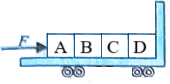
A toy cart has mass of 4 kg and is kept on a smooth horizontal Surface. Four blocks A,B,C and D of masses 2 kg,2 kg, 1 kg and 1 kg, respectively, have been placed on the cart. A horizontal force of F=60 N is applied to the block A (see figure). Find the contact force between block D and the front vertical wall of the cart.
- a)23
- b)24
- c)25
- d)26
Correct answer is option 'B'. Can you explain this answer?
A toy cart has mass of 4 kg and is kept on a smooth horizontal Surface. Four blocks A,B,C and D of masses 2 kg,2 kg, 1 kg and 1 kg, respectively, have been placed on the cart. A horizontal force of F=60 N is applied to the block A (see figure). Find the contact force between block D and the front vertical wall of the cart.
a)
23
b)
24
c)
25
d)
26
 | Lead Academy answered |
Let us take the cart and the blocks together as system.
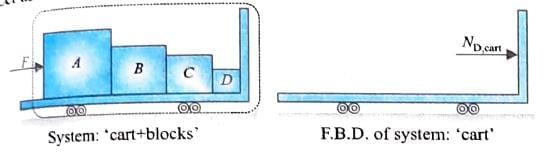
Acceleration of the system,

The cart moves because of the normal reaction applied by the block ' D ' on the cart. Now considering the F.B.D. of the cart (considering horizontal forces only)
∴ ND,can = mcar⋅ a = 4 × 6 = 24 N
Acceleration of the system,
The cart moves because of the normal reaction applied by the block ' D ' on the cart. Now considering the F.B.D. of the cart (considering horizontal forces only)
∴ ND,can = mcar⋅ a = 4 × 6 = 24 N
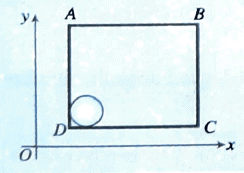
A solid sphere of mass 2 kg is resting inside a cube as shown in figure The cube is moving with a velocity  . Here t is time in seconds. All surfaces are smooth. The sphere is at rest with respect to the cube. What is the total force exerted by the sphere on the cube?
- a)24
- b)25
- c)26
- d)27
Correct answer is option 'C'. Can you explain this answer?
A solid sphere of mass 2 kg is resting inside a cube as shown in figure The cube is moving with a velocity . Here t is time in seconds. All surfaces are smooth. The sphere is at rest with respect to the cube. What is the total force exerted by the sphere on the cube?
. Here t is time in seconds. All surfaces are smooth. The sphere is at rest with respect to the cube. What is the total force exerted by the sphere on the cube?a)
24
b)
25
c)
26
d)
27
| | Stepway Academy answered |
The velocity of the sphere is same as that of the cube, which is given as 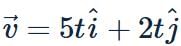
Hence, acceleration of the sphere:

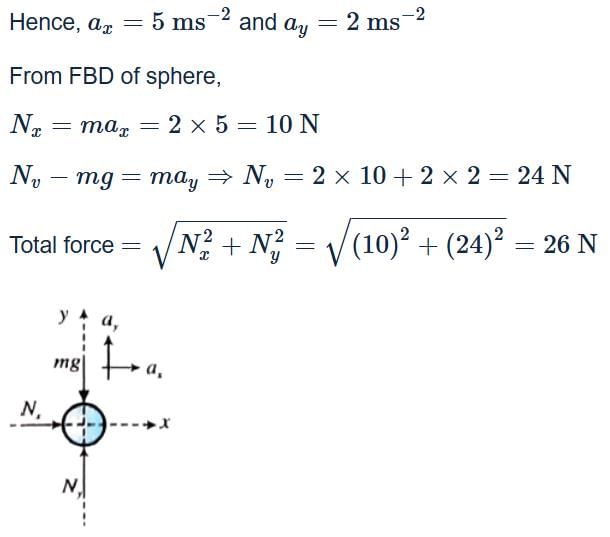
Hence, acceleration of the sphere:
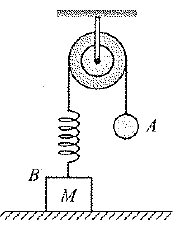
In the Fig., the ball A is released from rest, when the spring is at its natural (unstretched) length. For the block B of mass M to leave contact with ground at some stage. the minimum mass of A must be
- a)2M
- b)M
- c)M/2
- d)M/4
Correct answer is option 'C'. Can you explain this answer?
In the Fig., the ball A is released from rest, when the spring is at its natural (unstretched) length. For the block B of mass M to leave contact with ground at some stage. the minimum mass of A must be
a)
2M
b)
M
c)
M/2
d)
M/4
| | Lead Academy answered |
The spring will exert maximum force when the ball is at its lowest position. If the ball has descended through a distance x to reach the position.
mgx = 1/2Kx2 or x = 2mg/K (i)
For the block B to leave contact spring force
Kx=Mg (ii)
Comparing equations (i) and (ii), m=M/2
mgx = 1/2Kx2 or x = 2mg/K (i)
For the block B to leave contact spring force
Kx=Mg (ii)
Comparing equations (i) and (ii), m=M/2
A truck starts from rest and accelerates uniformly at 2.0 ms−2. At t = 10 s, a stone is dropped by a person standing on the top of the truck (6 m high from the ground). What is the magnitude of acceleration (in ms−2 ) of the stone at t = 11s? (Neglect air resistance.)- a)8
- b)14
- c)10.0
- d)12
Correct answer is option 'C'. Can you explain this answer?
A truck starts from rest and accelerates uniformly at 2.0 ms−2. At t = 10 s, a stone is dropped by a person standing on the top of the truck (6 m high from the ground). What is the magnitude of acceleration (in ms−2 ) of the stone at t = 11s? (Neglect air resistance.)
a)
8
b)
14
c)
10.0
d)
12
 | Knowledge Centre answered |
Initial velocity of the truck, u = 0
Acceleration, a = 2 m/s2
Time, t = 10 s
As per the first equation of motion, final velocity is given as:
v = u + at
⇒ 0 + 2 X 10 = 20 m/s
The final velocity of the truck and hence, of the stone is 20 m/s.
When the stone is dropped, its initial velocity is the same as the velocity of the truck at the time of release. The stone's motion can be broken into two components:
- Horizontal motion: The stone has the same horizontal velocity as the truck when dropped, which is 20 m/s. Since there is no force acting horizontally (neglecting air resistance), its horizontal velocity remains constant at 20m/s.
- Vertical motion: The stone experiences a downward acceleration due to gravity, which is g=9.8 m/s2.
Thus, the total acceleration of the stone at any point is the combination of:
- The constant horizontal acceleration (which is 0 for the stone).
- The vertical acceleration due to gravity, which is 9.8 m/s2 downward.
Therefore, at t=11 s, the total acceleration of the stone is the magnitude of the vector sum of these two accelerations:
However, since the truck is moving horizontally with an acceleration of 2.0 m/s2, at t=11s, the stone will still have the same horizontal acceleration as the truck. The total acceleration of the stone is the combination of:
- The acceleration of the truck horizontally, 2.0 m/s2, and
- The gravitational acceleration vertically, 9.8 m/s2.
Thus, the total magnitude of the acceleration of the stone at t=11s is:
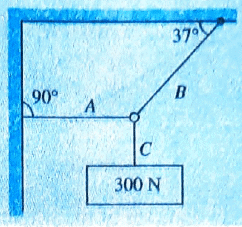
A block of mass 30 kg is suspended by three strings as shown in figure. Find the tension in each string.
- a)Ta=450 N, Tb=500 N,Tc=300 N
- b)Ta=400 N, Tb=500 N,Tc=250 N
- c)Ta=400 N, Tb=500 N,Tc=300 N
- d)Ta=400 N, Tb=550 N,Tc=300 N
Correct answer is option 'C'. Can you explain this answer?
A block of mass 30 kg is suspended by three strings as shown in figure. Find the tension in each string.
a)
Ta=450 N, Tb=500 N,Tc=300 N
b)
Ta=400 N, Tb=500 N,Tc=250 N
c)
Ta=400 N, Tb=500 N,Tc=300 N
d)
Ta=400 N, Tb=550 N,Tc=300 N
 | EduRev NEET answered |
Method I: Considering equilibrium of each part of system The whole system is in equilibrium; therefore, for each part 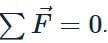
From the free-body diagram of block C,TC = 300 N.
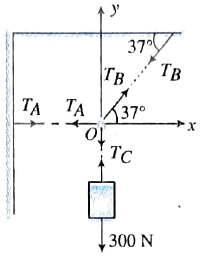
Now consider the equilibrium of point O

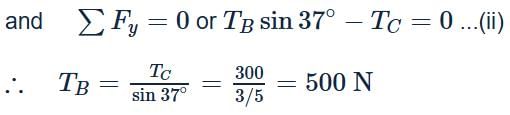
From Eq. (i), we get

By Lami's theorem, we have
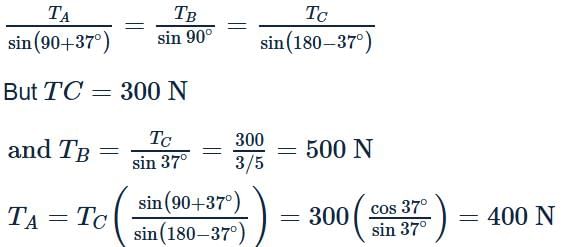
From the free-body diagram of block C,TC = 300 N.
Now consider the equilibrium of point O
From Eq. (i), we get
By Lami's theorem, we have
Which law is in control of a spacecraft that cruises through space at a constant speed without using any fuel?- a)Universal law of gravitation
- b)Newton’s third law
- c)Newton’s second law
- d)Newton’s first law
Correct answer is option 'D'. Can you explain this answer?
Which law is in control of a spacecraft that cruises through space at a constant speed without using any fuel?
a)
Universal law of gravitation
b)
Newton’s third law
c)
Newton’s second law
d)
Newton’s first law
 | Ayush Joshi answered |
According to Newton’s first law the spacecraft will continue moving with constant speed unless an external opposite force is applied on it.
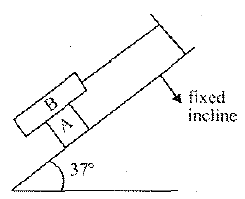
Two blocks A and B each of mass m are placed one over another on an incline as shown in Fig. When the system is released from rest the block A slides down with constant velocity while block B rests on top of A. If the coefficient of friction between A and B and between A and incline are same, then value of coefficient of friction would be
- a)1/4
- b)3/5
- c)4/5
- d)Information insufficient
Correct answer is option 'A'. Can you explain this answer?
Two blocks A and B each of mass m are placed one over another on an incline as shown in Fig. When the system is released from rest the block A slides down with constant velocity while block B rests on top of A. If the coefficient of friction between A and B and between A and incline are same, then value of coefficient of friction would be
a)
1/4
b)
3/5
c)
4/5
d)
Information insufficient
 | Bs Academy answered |
The free body diagrams of two blocks are as shown in Fig,
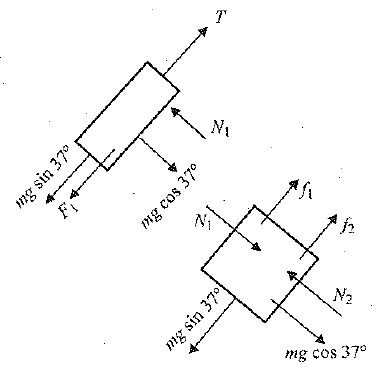
From free body diagram of B
N1 = mgcos37∘ T = mgsin37∘ + f1 Fl = μN1 (where μ is coefficient of friction)
From the free body diagram of A
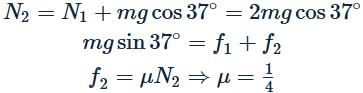
From free body diagram of B
N1 = mgcos37∘ T = mgsin37∘ + f1 Fl = μN1 (where μ is coefficient of friction)
From the free body diagram of A
A body of mass M is resting on a rough horizontal plane surface, the coefficient of friction being equal to μ. At t = 0 a horizontal force F = F0t starts acting on it, where F0 is a constant. Find the time T at which the motion Starts?- a)μMg/F0
- b)Mg/μF0
- c)μF0/Mg
- d)None of these
Correct answer is option 'A'. Can you explain this answer?
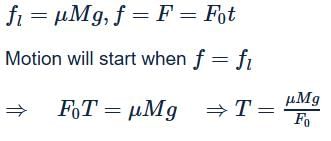
A body of mass M is resting on a rough horizontal plane surface, the coefficient of friction being equal to μ. At t = 0 a horizontal force F = F0t starts acting on it, where F0 is a constant. Find the time T at which the motion Starts?
a)
μMg/F0
b)
Mg/μF0
c)
μF0/Mg
d)
None of these
 | Top Rankers answered |
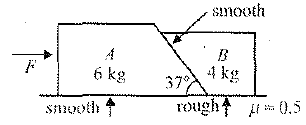
Two blocks A of 6 kg and B of 4 kg are placed in contact with each other as shown in Fig. There is no friction between A and ground and between both the blocks. Coefficient of friction between B and ground is 0.5.A horizontal force F is applied on A. Find the minimum and maximum value of F which can be applied so that both blocks can move combinely without any relative motion between them.
- a)10 N,50 N
- b)12 N,50 N
- c)12 N,75 N
- d)None of these
Correct answer is option 'C'. Can you explain this answer?
Two blocks A of 6 kg and B of 4 kg are placed in contact with each other as shown in Fig. There is no friction between A and ground and between both the blocks. Coefficient of friction between B and ground is 0.5.A horizontal force F is applied on A. Find the minimum and maximum value of F which can be applied so that both blocks can move combinely without any relative motion between them.
a)
10 N,50 N
b)
12 N,50 N
c)
12 N,75 N
d)
None of these
| | EduRev NEET answered |
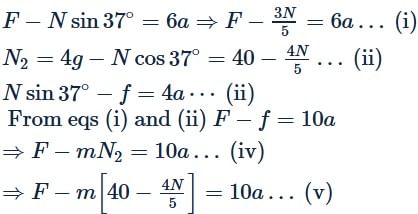
Put the value of N from eqs (i) and (v)

Now the minimum Force F to Just start the motion is 12 N
Now From eqs (i) and (iv) weget 75 N (by putting N2⋅0)
Chapter doubts & questions for Laws of Motion - 30-Day Revision Course for NEET 2026 is part of NEET exam preparation. The chapters have been prepared according to the NEET exam syllabus. The Chapter doubts & questions, notes, tests & MCQs are made for NEET 2026 Exam. Find important definitions, questions, notes, meanings, examples, exercises, MCQs and online tests here.
Chapter doubts & questions of Laws of Motion - 30-Day Revision Course for NEET in English & Hindi are available as part of NEET exam. Download more important topics, notes, lectures and mock test series for NEET Exam by signing up for free.
30-Day Revision Course for NEET85 videos|301 docs|171 tests |
