


All Exams > NEET > 30-Day Revision Course for NEET > All Questions
All questions of System of Particles and Rotational Motion for NEET Exam
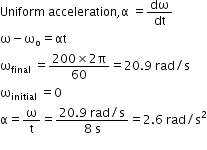
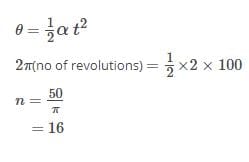
A CD accelerates uniformly from rest to 200 spins per minute in 8 seconds. If the rate of change of speed is constant, determine the instantaneous acceleration in rad/s2 .- a)200.2 π rad/s2
- b)25 rad/ s2
- c)20.9 rad/ s2
- d)2.6 rad/ s2
Correct answer is option 'D'. Can you explain this answer?
A CD accelerates uniformly from rest to 200 spins per minute in 8 seconds. If the rate of change of speed is constant, determine the instantaneous acceleration in rad/s2 .
a)
200.2 π rad/s2
b)
25 rad/ s2
c)
20.9 rad/ s2
d)
2.6 rad/ s2
 | Varun Kapoor answered |
The correct option is A
2.6 rad/ s2

Can you explain the answer of this question below:The angular position of a particle (in radians), along a circle of radius 0.8 m is given by the function in time (seconds) by  . The linear velocity of the particle
- A:
1.84 m/s
- B:
1.80 m/s
- C:
1.82 m/s
- D:
1.88 m/s
The answer is a.
The angular position of a particle (in radians), along a circle of radius 0.8 m is given by the function in time (seconds) by . The linear velocity of the particle
1.84 m/s
1.80 m/s
1.82 m/s
1.88 m/s
 | Knowledge Hub answered |
The answer is option A
So, as we know,
After differentiating angular velocity with respect to t,
Linear velocity=2t+2.3=ω
Now,
Velocity=r x ω(where r is 0.8m)
=0.8x2.3
=1.84m/s
So, as we know,
After differentiating angular velocity with respect to t,
Linear velocity=2t+2.3=ω
Now,
Velocity=r x ω(where r is 0.8m)
=0.8x2.3
=1.84m/s
A bomb of mass 16 kg at rest explodes into two pieces of masses 4 kg and 12 kg. The velocity of the 12 kg mass is 4 ms-1. The kinetic energy of the other mass is[AIEEE 2006]- a)144 J
- b)288 J
- c)192 J
- d)96 J
Correct answer is option 'B'. Can you explain this answer?
A bomb of mass 16 kg at rest explodes into two pieces of masses 4 kg and 12 kg. The velocity of the 12 kg mass is 4 ms-1. The kinetic energy of the other mass is
[AIEEE 2006]
a)
144 J
b)
288 J
c)
192 J
d)
96 J
 | Krishna Iyer answered |
Applying Conservation of Linear Momentum
16 x 0 = 12 x 4 + 4 x v => v = -12 m/s
So, KE = ½ m v2 = ½ x 4 x 144 = 288J
16 x 0 = 12 x 4 + 4 x v => v = -12 m/s
So, KE = ½ m v2 = ½ x 4 x 144 = 288J
A mixer grinder rotates clockwise, its angular velocity will be :- a)zero
- b)negative
- c)uniform but not zero
- d)positive
Correct answer is option 'B'. Can you explain this answer?
A mixer grinder rotates clockwise, its angular velocity will be :
a)
zero
b)
negative
c)
uniform but not zero
d)
positive
 | Ashish Roy answered |
**Explanation:**
A mixer grinder is a device that is used for grinding and mixing various ingredients. It consists of a motor and a set of blades that rotate at high speeds to perform the grinding and mixing tasks. When the mixer grinder is turned on, the motor starts rotating the blades in a clockwise direction.
**Angular Velocity:**
Angular velocity is a measure of how quickly an object rotates or moves around a central point. It is defined as the rate of change of angular displacement with respect to time. The direction of the angular velocity is determined by the direction of rotation. In the case of a mixer grinder rotating clockwise, the angular velocity will be negative.
**Direction of Angular Velocity:**
The direction of angular velocity is determined by the right-hand rule. According to the right-hand rule, if the fingers of the right hand curl in the direction of rotation, the thumb will point in the direction of the angular velocity vector. In the case of a mixer grinder rotating clockwise, the fingers of the right hand curl in the clockwise direction, and the thumb points in the opposite direction, which is counterclockwise or negative.
**Significance of Negative Angular Velocity:**
A negative angular velocity indicates that the object is rotating in the opposite direction compared to the conventional positive direction. In the case of a mixer grinder, a negative angular velocity means that the blades are rotating counterclockwise when viewed from above. This counterclockwise rotation is necessary for the blades to effectively grind and mix the ingredients.
**Conclusion:**
In conclusion, a mixer grinder rotates clockwise, which means its angular velocity will be negative. The negative angular velocity indicates that the blades are rotating counterclockwise when viewed from above, allowing them to efficiently perform the grinding and mixing tasks.
A mixer grinder is a device that is used for grinding and mixing various ingredients. It consists of a motor and a set of blades that rotate at high speeds to perform the grinding and mixing tasks. When the mixer grinder is turned on, the motor starts rotating the blades in a clockwise direction.
**Angular Velocity:**
Angular velocity is a measure of how quickly an object rotates or moves around a central point. It is defined as the rate of change of angular displacement with respect to time. The direction of the angular velocity is determined by the direction of rotation. In the case of a mixer grinder rotating clockwise, the angular velocity will be negative.
**Direction of Angular Velocity:**
The direction of angular velocity is determined by the right-hand rule. According to the right-hand rule, if the fingers of the right hand curl in the direction of rotation, the thumb will point in the direction of the angular velocity vector. In the case of a mixer grinder rotating clockwise, the fingers of the right hand curl in the clockwise direction, and the thumb points in the opposite direction, which is counterclockwise or negative.
**Significance of Negative Angular Velocity:**
A negative angular velocity indicates that the object is rotating in the opposite direction compared to the conventional positive direction. In the case of a mixer grinder, a negative angular velocity means that the blades are rotating counterclockwise when viewed from above. This counterclockwise rotation is necessary for the blades to effectively grind and mix the ingredients.
**Conclusion:**
In conclusion, a mixer grinder rotates clockwise, which means its angular velocity will be negative. The negative angular velocity indicates that the blades are rotating counterclockwise when viewed from above, allowing them to efficiently perform the grinding and mixing tasks.
A player caught a cricket ball of mass 150 g moving at a rate of 20 m/s. If the catching process is completed in 0.1 s, the force of the blow exerted by the ball on the hand of the player is equal to [AIEEE 2006]- a) 150 N
- b)3 N
- c)30 N
- d) 300 N
Correct answer is option 'C'. Can you explain this answer?
A player caught a cricket ball of mass 150 g moving at a rate of 20 m/s. If the catching process is completed in 0.1 s, the force of the blow exerted by the ball on the hand of the player is equal to
[AIEEE 2006]
a)
150 N
b)
3 N
c)
30 N
d)
300 N
 | Lavanya Menon answered |
F = ma = m(v/t)
F = 150 × 20 / 0.1 × 1000
F = 30N
F = 150 × 20 / 0.1 × 1000
F = 30N
Statement I : Two particles moving in the same direction do not lose all their energy in a completely inelastic collision.Statement II : Principle of conservation of momentum holds true for all kinds of collisions. [AIEEE 2010]- a) Statement I is true, Statement II is ture; Statement II is the correct explanation of Statement I.
- b)Statement I is true, Statement II is true; Statement II is not correct explanation of Statement I.
- c)Statement I is false, Statement II is true.
- d)Statement I is the true, Statement II is false.
Correct answer is option 'A'. Can you explain this answer?
Statement I : Two particles moving in the same direction do not lose all their energy in a completely inelastic collision.
Statement II : Principle of conservation of momentum holds true for all kinds of collisions.
[AIEEE 2010]
a)
Statement I is true, Statement II is ture; Statement II is the correct explanation of Statement I.
b)
Statement I is true, Statement II is true; Statement II is not correct explanation of Statement I.
c)
Statement I is false, Statement II is true.
d)
Statement I is the true, Statement II is false.
 | Hansa Sharma answered |
The strong interaction force between two bodies in which momentum is conserved is called collision. In any type of collision momentum is always conserved kinetic energy may or may not be conserved.
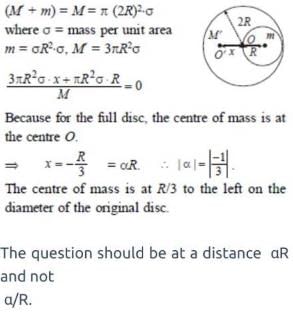
A circular disc of radius R is removed from a bigger circular disc of radius 2 R, such that the circumference of the discs coincide. The centre of mass of the new disc is  from the centre of the bigger disc. The value of a is[AIEEE 2007]
- a)

- b)

- c)

- d)

Correct answer is option 'A'. Can you explain this answer?
A circular disc of radius R is removed from a bigger circular disc of radius 2 R, such that the circumference of the discs coincide. The centre of mass of the new disc is from the centre of the bigger disc. The value of a is
from the centre of the bigger disc. The value of a is[AIEEE 2007]
a)
b)
c)
d)
 | Geetika Shah answered |
A smooth sphere A is moving on a frictionless horizontal plane with angular speed ω and center of mass velocity v. It collides elastically and head on with an identical sphere B at rest. Neglect friction everywhere. After the collision, their angular speeds are ωA and ωB respectively. Then- a)ωB = ω
- b)ωA< ωB
- c)ωA = ω
- d)ωA = ωB
Correct answer is option 'C'. Can you explain this answer?
A smooth sphere A is moving on a frictionless horizontal plane with angular speed ω and center of mass velocity v. It collides elastically and head on with an identical sphere B at rest. Neglect friction everywhere. After the collision, their angular speeds are ωA and ωB respectively. Then
a)
ωB = ω
b)
ωA< ωB
c)
ωA = ω
d)
ωA = ωB
| | Geetika Shah answered |
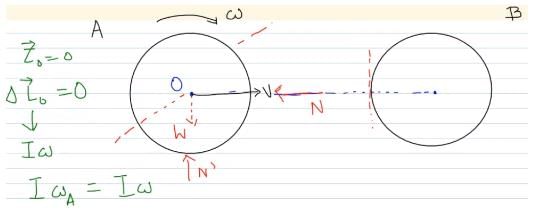
So, “I” gets cancelled.
A merry- go- round ( diameter 4.0 m ) starts from rest and uniformly accelerates until it rotates at 0.8 rev/min. This occurs in 11s. Once it has reached this rate , it rotates at 0.8 rev/min uniformly . Determine the angular acceleration- a)7.55 x 10⁻³ rad/s2
- b)6.7 x 10⁻³ rad/s2
- c)0.083 rad/s2
- d)0.083 rad/s
Correct answer is option 'A'. Can you explain this answer?
A merry- go- round ( diameter 4.0 m ) starts from rest and uniformly accelerates until it rotates at 0.8 rev/min. This occurs in 11s. Once it has reached this rate , it rotates at 0.8 rev/min uniformly . Determine the angular acceleration
a)
7.55 x 10⁻³ rad/s2
b)
6.7 x 10⁻³ rad/s2
c)
0.083 rad/s2
d)
0.083 rad/s
| | Lavanya Menon answered |
First we have to find ‘v’ by using the relation v = rw
Now, v = 0.167m/s
Then we find ‘a’ by using the relation a = v/t
So, a = 0.0152m/s2.
Now, we can find angular acceleration by using the formula α = a/r
Finally, α = 0.0076 rad/sec2
Now, v = 0.167m/s
Then we find ‘a’ by using the relation a = v/t
So, a = 0.0152m/s2.
Now, we can find angular acceleration by using the formula α = a/r
Finally, α = 0.0076 rad/sec2
The angular momentum of a body is 31.4 Js and its rate of revolution is 10 cycle per second. The momentum of inertia of the body about the axis of rotation is- a)0.5 kgm2
- b)0.15 kgm2
- c)1.5 kgm2
- d)2.5 kgm2
Correct answer is option 'A'. Can you explain this answer?
The angular momentum of a body is 31.4 Js and its rate of revolution is 10 cycle per second. The momentum of inertia of the body about the axis of rotation is
a)
0.5 kgm2
b)
0.15 kgm2
c)
1.5 kgm2
d)
2.5 kgm2
 | Raghav Bansal answered |
F = w/2π
w = 2πf
w = 2π × 10
w = 62.8
L = Iw
I = L/w
I = 31.4/62.8
I = 0.5 kgm2
Hence A
w = 2πf
w = 2π × 10
w = 62.8
L = Iw
I = L/w
I = 31.4/62.8
I = 0.5 kgm2
Hence A
A boy is playing with a tire of radius 0.5m. He accelerates it from 5rpm to 25 rpm in 15 seconds. The linear acceleration of tire is- a)70 m/s2
- b)7 m/s2
- c)10 m/s2
- d)0.07 m/s2
Correct answer is option 'D'. Can you explain this answer?
A boy is playing with a tire of radius 0.5m. He accelerates it from 5rpm to 25 rpm in 15 seconds. The linear acceleration of tire is
a)
70 m/s2
b)
7 m/s2
c)
10 m/s2
d)
0.07 m/s2
 | Naina Sharma answered |
r=0.5m, t=15s
n1=5rpm=5/60 rps
n2=25rpm=25/60rps
… ω1=2π(5) rad/s
… ω2=2π(25) rad/s
As,
a=r∝ [∝=ω2- ω1/t]
so, a=0.5[2π(n2-n1)/t]
a=0.5x6.28x20/60x15
a=6.28x2/60x3
a=6.28/90
a=0.697 m/s2
a≈0.7 m/s2
n1=5rpm=5/60 rps
n2=25rpm=25/60rps
… ω1=2π(5) rad/s
… ω2=2π(25) rad/s
As,
a=r∝ [∝=ω2- ω1/t]
so, a=0.5[2π(n2-n1)/t]
a=0.5x6.28x20/60x15
a=6.28x2/60x3
a=6.28/90
a=0.697 m/s2
a≈0.7 m/s2
Statement-I : A point particle of mass m moving with speed u collides with stationary point particle of mass M. If the maximum energy loss possible is given as  then f =
  .Statement-II : Maximum energy loss occurs when the particles get stuck together as a result of the collision. [JEE MAIN 2013]
- a)Statement-I is true, Statement-II is false
- b)Statement-I is false, Statement-II is true.
- c)Statement-I is true, Statement-II is a correct explanation of Statement-I
- d)Statement-I is true, Statement-II is ture, Statement-II is not a correct explanation of Statement-I.
Correct answer is option 'B'. Can you explain this answer?
Statement-I : A point particle of mass m moving with speed u collides with stationary point particle of mass M. If the maximum energy loss possible is given as then f = .
then f = .Statement-II : Maximum energy loss occurs when the particles get stuck together as a result of the collision. [JEE MAIN 2013]
a)
Statement-I is true, Statement-II is false
b)
Statement-I is false, Statement-II is true.
c)
Statement-I is true, Statement-II is a correct explanation of Statement-I
d)
Statement-I is true, Statement-II is ture, Statement-II is not a correct explanation of Statement-I.
| | Dino James answered |
Answer b is correct


Can you explain the answer of this question below:Let  H and E respectively be the angular speeds of the hour hand of a watch and that of the earth around its own axis. Compare the angular speeds of the earth and hour hand of a watch.
- A:
H = E
- B:
ωH = 2E
- C:
ωH = (1/2)E
- D:
ωH = 4E
The answer is b.
Let H and E respectively be the angular speeds of the hour hand of a watch and that of the earth around its own axis. Compare the angular speeds of the earth and hour hand of a watch.
H = E
ωH = 2E
ωH = (1/2)E
ωH = 4E
| | Gaurav Kumar answered |
Given,
Angular velocity of the hour hand-H
Earth’s speed around its own axis-E
So, time taken by hour hand to complete a rotation is=TH=12hr
Time taken by earth to complete a rotation =TE=24 hours
So,
ωE/ωH =(2π/TE )/2π/TH=TH/TE=1/2
⇒ ωE/ωH=1/2
⇒ 2 ωE= ωH
Angular velocity of the hour hand-H
Earth’s speed around its own axis-E
So, time taken by hour hand to complete a rotation is=TH=12hr
Time taken by earth to complete a rotation =TE=24 hours
So,
ωE/ωH =(2π/TE )/2π/TH=TH/TE=1/2
⇒ ωE/ωH=1/2
⇒ 2 ωE= ωH
Consider the following two statements :A. Linear momentum of a system of particles is zero.B. kinetic energy of a system of particles is zero.Then [AIEEE 2003]- a)A does not imply B and B does not imply A
- b)A implies B but B does not imply A
- c)A does not imply B but B implies A
- d)A implies B and B implies A
Correct answer is option 'C'. Can you explain this answer?
Consider the following two statements :
A. Linear momentum of a system of particles is zero.
B. kinetic energy of a system of particles is zero.Then
[AIEEE 2003]
a)
A does not imply B and B does not imply A
b)
A implies B but B does not imply A
c)
A does not imply B but B implies A
d)
A implies B and B implies A
 | Akanksha Acharya answered |
We know momentum of a system = mass* change in velocity.
but kinetic energy = 1/2 * mass * (velocity)²
If change in velocity is zero that doesn't mean that the velocity of the system is zero.....
If velocity of a system is zero then there is no change in velocity.....means change in velocity=0
so the answer is option (c).....
but kinetic energy = 1/2 * mass * (velocity)²
If change in velocity is zero that doesn't mean that the velocity of the system is zero.....
If velocity of a system is zero then there is no change in velocity.....means change in velocity=0
so the answer is option (c).....

The angular velocity of a second hand of a clock is :- a)π/ 30 rad/s
- b)π/5 rad/s
- c)2π rad/s
- d)π /3 rad/s
Correct answer is option 'A'. Can you explain this answer?
The angular velocity of a second hand of a clock is :
a)
π/ 30 rad/s
b)
π/5 rad/s
c)
2π rad/s
d)
π /3 rad/s
| | Krishna Iyer answered |
Time taken to complete one rotation is 60 seconds.
One rotation involves 360 degree = 2π
Formula of angular velocity = theta/time taken
Hence, omega = 2π/60
= π/30 rad/s
One rotation involves 360 degree = 2π
Formula of angular velocity = theta/time taken
Hence, omega = 2π/60
= π/30 rad/s
All the points of a rigid body rotating about the given axis have same :- a)Linear acceleration
- b)Angular velocity
- c)Linear velocity
- d)Angular momentum
Correct answer is option 'B'. Can you explain this answer?
All the points of a rigid body rotating about the given axis have same :
a)
Linear acceleration
b)
Angular velocity
c)
Linear velocity
d)
Angular momentum
| | Rajeev Saxena answered |
Thus, it is the velocity of a reference point fixed to the body. During purely translational motion (motion with no rotation), all points on a rigid body move with the same velocity. However, when motion involves rotation, the instantaneous velocity of any two points on the body will generally not be the same.
In an equilateral triangle of length 6 cm , three masses m1= 40g , m2= 60g and m3= 60g are located at the vertices. The moment of inertia of the system about an axis along the altitude of the triangle passing through m1 is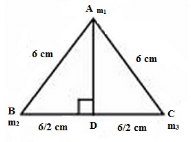
- a)1080 g cm2
- b)1020 g cm2
- c)1000 g cm2
- d)1100 g cm2
Correct answer is option 'A'. Can you explain this answer?
In an equilateral triangle of length 6 cm , three masses m1= 40g , m2= 60g and m3= 60g are located at the vertices. The moment of inertia of the system about an axis along the altitude of the triangle passing through m1 is
a)
1080 g cm2
b)
1020 g cm2
c)
1000 g cm2
d)
1100 g cm2
| | Naina Sharma answered |
Axis is along AD so Moment of inertia of first mass is zero and 2nd and 3rd masses are at distance of 6/2 from axis, so by using simply I=mr2 we get, I=60×36/4+60×36/4=1080 g cm2
Direction of linear velocity of a particle rotating in a circular motion is :- a)Along the tangent
- b)Along the radius away from the centre
- c)Along the axis of rotation
- d)Along the radius of the centre
Correct answer is option 'A'. Can you explain this answer?
Direction of linear velocity of a particle rotating in a circular motion is :
a)
Along the tangent
b)
Along the radius away from the centre
c)
Along the axis of rotation
d)
Along the radius of the centre
| | Mira Sharma answered |
Unlike linear motion, where velocity and acceleration are directed along the line of motion, in circular motion the direction of velocity is always tangent to the circle. This means that as the object moves in a circle, the direction of the velocity is always changing.
A linear velocity of a particle performing circular motion, which is directed along the tangent to the circular path at given point on the circular path at that instant is called instantaneous velocity. It is also called as tangential velocity.
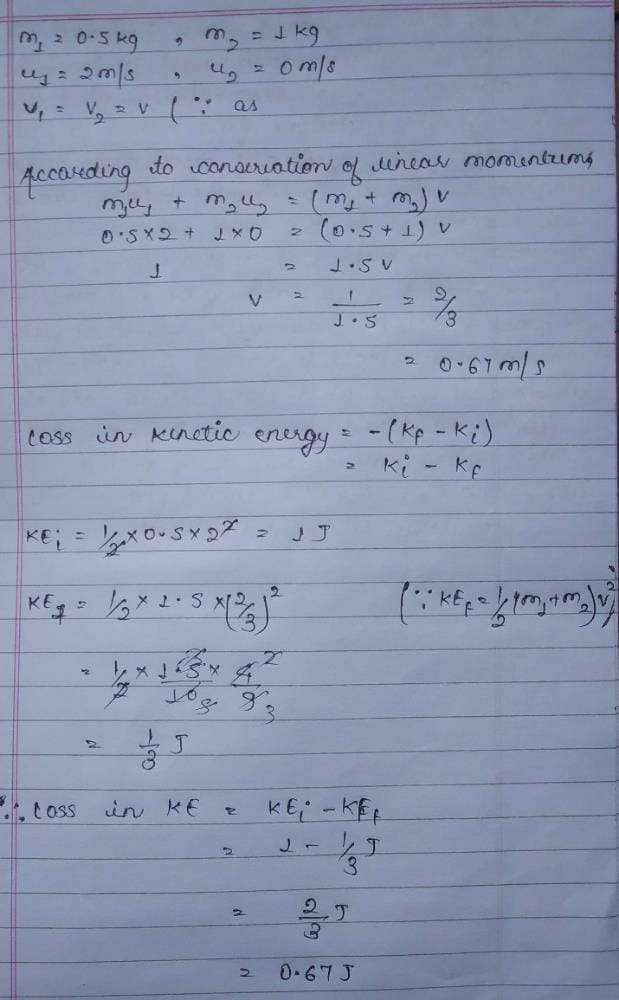
A block of mass 0.50 kg is moving with a speed of 2.00 ms-1 on a smooth surface. It strikes another mass of 1.00 kg and then they move together as a single body. The energy loss during the collision is [AIEEE 2008]- a)0.16 J
- b)1.00 J
- c)0.67 J
- d)0.34 J
Correct answer is option 'C'. Can you explain this answer?
A block of mass 0.50 kg is moving with a speed of 2.00 ms-1 on a smooth surface. It strikes another mass of 1.00 kg and then they move together as a single body. The energy loss during the collision is
[AIEEE 2008]
a)
0.16 J
b)
1.00 J
c)
0.67 J
d)
0.34 J
| | Ananya Singh answered |
Which of the following is not a unit of angular displacement?- a)Degrees
- b)revolutions
- c)metre
- d)radian
Correct answer is option 'C'. Can you explain this answer?
Which of the following is not a unit of angular displacement?
a)
Degrees
b)
revolutions
c)
metre
d)
radian
 | Nitin Nair answered |
Angular displacement is measured in units of radians. Two pi radians equals 360 degrees. The angular displacement is not a length (not measured in meters or feet), so an angular displacement is different than a linear displacement.
A demo CD, 8 cm in diameter, spins 200 rev/min. Determine its linear velocity in cm/s for a point 3 cm from the center.- a)62.8 cm/s
- b)20/6 cm/s
- c)20.9 cm/s
- d)40 π/6 cm/s
Correct answer is option 'A'. Can you explain this answer?
A demo CD, 8 cm in diameter, spins 200 rev/min. Determine its linear velocity in cm/s for a point 3 cm from the center.
a)
62.8 cm/s
b)
20/6 cm/s
c)
20.9 cm/s
d)
40 π/6 cm/s
| | Sanchita Chakraborty answered |
Given:
Diameter of CD = 8 cm
Radius of CD = 4 cm
Angular velocity = 200 rev/min
Point from center = 3 cm
To find:
Linear velocity in cm/s
Solution:
We can use the formula:
v = rω
where,
v = linear velocity
r = distance from center
ω = angular velocity
Substituting the given values, we get:
v = 3 cm × (200 rev/min × 2π rad/rev) / 60 s/min
v = 62.8 cm/s
Therefore, the linear velocity of the point 3 cm from the center of the demo CD is 62.8 cm/s.
Hence, the correct option is (a) 62.8 cm/s.
Diameter of CD = 8 cm
Radius of CD = 4 cm
Angular velocity = 200 rev/min
Point from center = 3 cm
To find:
Linear velocity in cm/s
Solution:
We can use the formula:
v = rω
where,
v = linear velocity
r = distance from center
ω = angular velocity
Substituting the given values, we get:
v = 3 cm × (200 rev/min × 2π rad/rev) / 60 s/min
v = 62.8 cm/s
Therefore, the linear velocity of the point 3 cm from the center of the demo CD is 62.8 cm/s.
Hence, the correct option is (a) 62.8 cm/s.
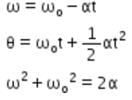
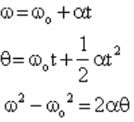

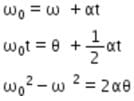

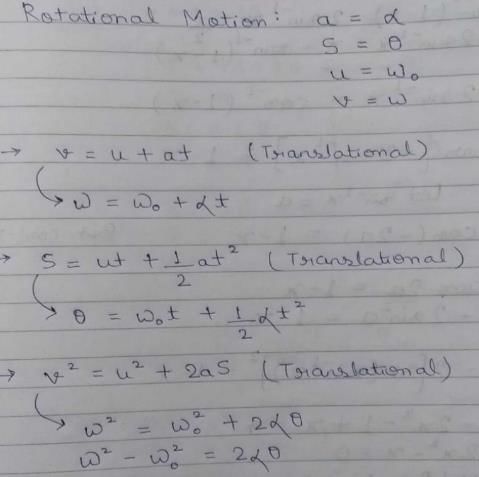
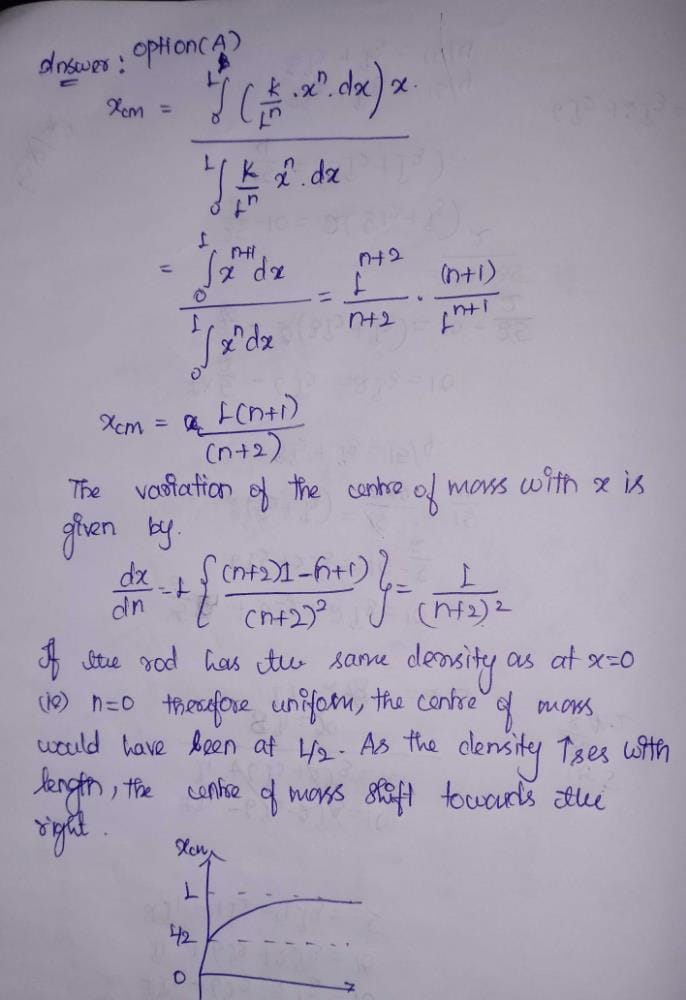
A thin rod of length L is lying along the x-axis with its ends at x = 0 and x = L. Its linear density (mass/length) varies with x as  where n can be zero or any positive number. If the position
  of the centre of mass of the rod is plotted against n, which of the following graphs best approximates the dependence of
  on n? [AIEEE 2008]
- a)

- b)

- c)

- d)

Correct answer is option 'A'. Can you explain this answer?
A thin rod of length L is lying along the x-axis with its ends at x = 0 and x = L. Its linear density (mass/length) varies with x as where n can be zero or any positive number. If the position of the centre of mass of the rod is plotted against n, which of the following graphs best approximates the dependence of on n?
where n can be zero or any positive number. If the position of the centre of mass of the rod is plotted against n, which of the following graphs best approximates the dependence of on n? [AIEEE 2008]
a)
b)
c)
d)
| | Gopikas S answered |
A mass m moves with a velocity v and collides inelastically with another identical mass. After collision the 1st mass moves with velocity in a direction perpendicular to the initial direction of motion. Find the speed of the second mass after collision. [AIEEE 2005]
- a) v
- b)

- c)

- d)

Correct answer is option 'C'. Can you explain this answer?
A mass m moves with a velocity v and collides inelastically with another identical mass. After collision the 1st mass moves with velocity in a direction perpendicular to the initial direction of motion. Find the speed of the second mass after collision.
in a direction perpendicular to the initial direction of motion. Find the speed of the second mass after collision. [AIEEE 2005]
a)
v
b)
c)
d)
 | Infinity Academy answered |
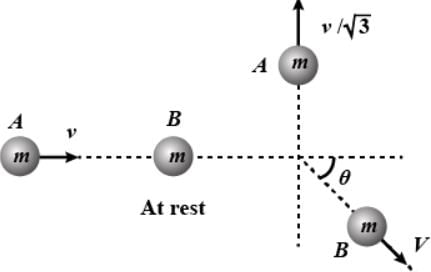
Let mass A moves with velocity v and collides inelastically with mass B, which is at rest.
According to problem mass A moves in a perpendicular direction and let the mass B moves at angle θ with the horizontal with velocity v.
Initial horizontal momentum of system
(before collision) = mv ....(i)
Final horizontal momentum of system
(after collision ) = mVcosθ.................(ii)
From the conservation of horizontal linear momentum mv
= mvcosθ ⇒ v = Vcosθ .....(iii)
Initial vertical momentum of system (before collision) is zero.
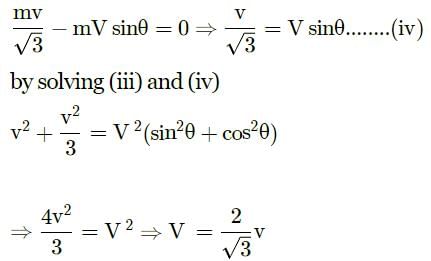
Final vertical momentum of system mv/√3 − mV sinθ
From the conservation of vertical linear momentum
According to problem mass A moves in a perpendicular direction and let the mass B moves at angle θ with the horizontal with velocity v.
Initial horizontal momentum of system
(before collision) = mv ....(i)
Final horizontal momentum of system
(after collision ) = mVcosθ.................(ii)
From the conservation of horizontal linear momentum mv
= mvcosθ ⇒ v = Vcosθ .....(iii)
Initial vertical momentum of system (before collision) is zero.
Final vertical momentum of system mv/√3 − mV sinθ
From the conservation of vertical linear momentum




Rotational analogue of force is :- a)Moment of Inertia
- b)Radius of gyration
- c)Gyration
- d)Torque
Correct answer is option 'D'. Can you explain this answer?
Rotational analogue of force is :
a)
Moment of Inertia
b)
Radius of gyration
c)
Gyration
d)
Torque
| | Nitin Nair answered |
The farther the force is applied from the pivot, the greater the angular acceleration. The equation τ = m(r^2)α is the rotational analog of Newton's second law (F=ma), where torque is analogous to force, angular acceleration is analogous to translational acceleration, and mr2 is analogous to mass (or inertia ).
A body A of mass M while falling vertically downwards under gravity breaks into two parts; a body B of mass  M and, a body C of mass M. The centre of mass of bodies B and C taken together shifts compared to that of body A towards [AIEEE 2005]
- a)Depends on height of breaking
- b)Does not shift
- c)Body C
- d)Body B
Correct answer is option 'B'. Can you explain this answer?
A body A of mass M while falling vertically downwards under gravity breaks into two parts; a body B of mass M and, a body C of mass M. The centre of mass of bodies B and C taken together shifts compared to that of body A towards
M and, a body C of mass M. The centre of mass of bodies B and C taken together shifts compared to that of body A towards [AIEEE 2005]
a)
Depends on height of breaking
b)
Does not shift
c)
Body C
d)
Body B
 | Jyoti Dey answered |
Since there is no different external force applied to the individual particles, the centre of mass remains same and does not shift.
Consider a two particle system with particles having masses m1 and m2. If the first particle is pushed towards the centre of mass through a distance d, by what distance should the second particle be moved, so as to keep the centre of mass at the same position? [AIEEE 2006]- a)

- b)

- c)

- d) D
Correct answer is option 'C'. Can you explain this answer?
Consider a two particle system with particles having masses m1 and m2. If the first particle is pushed towards the centre of mass through a distance d, by what distance should the second particle be moved, so as to keep the centre of mass at the same position?
[AIEEE 2006]
a)
b)
c)
d)
D
 | Bhavana Tiwari answered |
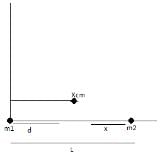
Xcm = (m1x1 + m2x2)/(m1 + m2)
Xcm = m2L/(m1 + m2)
Now, ATQ
Xcm = (m1d + m2(L-x))/(m1 + m2)
Since Xcm is same so,
⇒ (m1d + m2(L-x))/(m1 + m2) = m2L/(m1 + m2)
⇒ m1d + m2L - m2x = m2L
⇒ m1d = m2x
⇒ x = m1d/m2
Chapter doubts & questions for System of Particles and Rotational Motion - 30-Day Revision Course for NEET 2026 is part of NEET exam preparation. The chapters have been prepared according to the NEET exam syllabus. The Chapter doubts & questions, notes, tests & MCQs are made for NEET 2026 Exam. Find important definitions, questions, notes, meanings, examples, exercises, MCQs and online tests here.
Chapter doubts & questions of System of Particles and Rotational Motion - 30-Day Revision Course for NEET in English & Hindi are available as part of NEET exam. Download more important topics, notes, lectures and mock test series for NEET Exam by signing up for free.
30-Day Revision Course for NEET85 videos|301 docs|171 tests |
