


All Exams > NEET > 30-Day Revision Course for NEET > All Questions
All questions of Cell: The Unit of Life for NEET Exam
Which one of the following cell organelles is enclosed by a single membrane ? [2016]- a)Mitochondria
- b)Chloroplasts
- c)Lysosomes
- d)Nuclei
Correct answer is option 'C'. Can you explain this answer?
Which one of the following cell organelles is enclosed by a single membrane ? [2016]
a)
Mitochondria
b)
Chloroplasts
c)
Lysosomes
d)
Nuclei
 | Sushant Goyal answered |
(c) Double Membrane bound Organelles: Mitochondria, Chloroplasts, Endoplasmic Reticulum, Golgi Body, and Nucleus. Single Membrane bound Organelles: Lysosomes, Peroxisomes, and Vacuoles. Organelles lacking any membrane: Ribosomes, Centrioles, Nucleolus.

Which structures perform the function of mitochondria in bacteria? [2014]- a)Nucleoid
- b)Ribosomes
- c)Cell wall
- d)Mesosomes
Correct answer is option 'D'. Can you explain this answer?
Which structures perform the function of mitochondria in bacteria? [2014]
a)
Nucleoid
b)
Ribosomes
c)
Cell wall
d)
Mesosomes
 | Ayush Sengupta answered |
(d) In some bacteria (e.g., Bacillus subtilis) the plasma membrane form certain invaginations or in foldings called mesosomes in the cytoplasm. The mesosomes have various functions, viz., respiratory, secretory etc.
Which of the following are not membranebound? [2015 RS]- a)Ribosomes
- b)Lysosomes
- c)Mesosomes
- d)Vacuoles
Correct answer is option 'A'. Can you explain this answer?
Which of the following are not membranebound? [2015 RS]
a)
Ribosomes
b)
Lysosomes
c)
Mesosomes
d)
Vacuoles
 | Mrinalini Bajaj answered |
(a) Ribosomes are not membrance-bound cell organelle.
Select the correct matching in the following pairs: [2015 RS]- a)Smooth ER – Synthesis of lipids
- b)Rough ER – Synthesis of glycogen
- c)Rough ER – Oxidation of fatty acids
- d)Smooth ER – Oxidation of phospholipids
Correct answer is option 'A'. Can you explain this answer?
Select the correct matching in the following pairs: [2015 RS]
a)
Smooth ER – Synthesis of lipids
b)
Rough ER – Synthesis of glycogen
c)
Rough ER – Oxidation of fatty acids
d)
Smooth ER – Oxidation of phospholipids
 | Pallabi Reddy answered |
(a) Lipid synthesis takes place in smooth endoplasmic reticulum.
Cellular organelles with membranes are : [2015 RS]- a)chormosomes, ribosomes and endoplasmic reticulum
- b)endoplasmic reticulum, ribosomes and nuclei
- c)lysosomes, Golgi apparatus and mitochondria
- d)nuclei, ribosomes and mitochondria
Correct answer is option 'C'. Can you explain this answer?
Cellular organelles with membranes are : [2015 RS]
a)
chormosomes, ribosomes and endoplasmic reticulum
b)
endoplasmic reticulum, ribosomes and nuclei
c)
lysosomes, Golgi apparatus and mitochondria
d)
nuclei, ribosomes and mitochondria
 | Sonal Kulkarni answered |
(c) Lysosomes, golgi apparatus and mitochondria are the cell organelles which have membranes.
When the centromere is situated in the middle of two equal arms of chromosomes, the chromosome is referred as: (2021)- a)Sub-metacentric
- b)Acrocentric
- c)Metacentric
- d)Telocentric
Correct answer is option 'C'. Can you explain this answer?
When the centromere is situated in the middle of two equal arms of chromosomes, the chromosome is referred as: (2021)
a)
Sub-metacentric
b)
Acrocentric
c)
Metacentric
d)
Telocentric
 | Mira Joshi answered |
The metacentric chromosome has middle centromere forming two equal arms of the chromosome.
The solid linear cytoskeletal elements having a diameter of 6 nm and made up of a single type of monomer are known as: [2014]- a)Microtubules
- b)Microfilaments
- c)Intermediate filaments
- d)Lamins
Correct answer is option 'B'. Can you explain this answer?
The solid linear cytoskeletal elements having a diameter of 6 nm and made up of a single type of monomer are known as: [2014]
a)
Microtubules
b)
Microfilaments
c)
Intermediate filaments
d)
Lamins
 | Arnab Iyer answered |
(b) Microtubule, microfilament and intermediate filaments along with ER form cytoskeleton. Microfilaments are nonliving, solid and consist of actin protein. They are 4-6 nm in diameter.
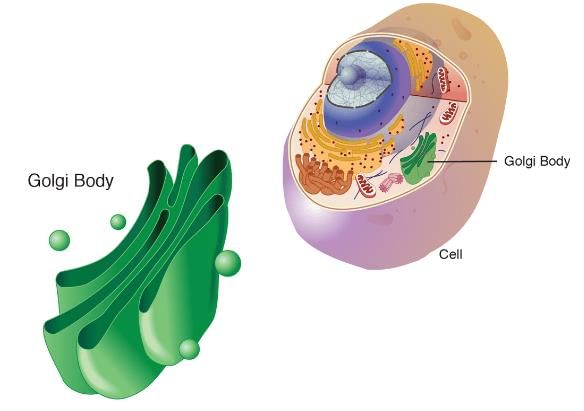
Which is the important site of formation of glycoproteins and glycolipids in eukaryotic cells? (2020)- a)Golgi bodies
- b)Polysomes
- c)Endoplasmic reticulum
- d)Peroxisomes
Correct answer is option 'A'. Can you explain this answer?
Which is the important site of formation of glycoproteins and glycolipids in eukaryotic cells? (2020)
a)
Golgi bodies
b)
Polysomes
c)
Endoplasmic reticulum
d)
Peroxisomes
| | Mira Joshi answered |
Proteins and lipids are formed in the endoplasmic reticulum and some of them are modified to form glycoproteins and glycolipids in the Golgi apparatus.
The osmotic expansion of a cell kept in water is chiefly regulated by: [2014]- a)Mitochondria
- b)Vacuoles
- c)Plastids
- d)Ribosomes
Correct answer is option 'B'. Can you explain this answer?
The osmotic expansion of a cell kept in water is chiefly regulated by: [2014]
a)
Mitochondria
b)
Vacuoles
c)
Plastids
d)
Ribosomes
 | Nilanjan Chakraborty answered |
(b) The vacuole is bound by a single membrane called tonoplast. It also functions as semipermeable membrane. It segregates vacuolar contents from cytoplasm, allows osmotic entry or exit of water, concentration and storage of nutrients as well as wastes.
Cell wall is absent in : [2015 RS]- a)Funaria
- b)Mycoplasma
- c)Nostoc
- d)Aspergillus
Correct answer is option 'B'. Can you explain this answer?
Cell wall is absent in : [2015 RS]
a)
Funaria
b)
Mycoplasma
c)
Nostoc
d)
Aspergillus
 | Dipanjan Mehta answered |
(b) Mycoplasma lacks cell wall.
Which of the following statements is true for a secretory cell?- a)Golgi apparatus is absent
- b)Only Smooth Endoplasmic Reticulum (SER) is present
- c)Rough Endoplasmic Reticulum (RER) is easily observed in the cell
- d)Secretory granules are formed in nucleus
Correct answer is option 'C'. Can you explain this answer?
Which of the following statements is true for a secretory cell?
a)
Golgi apparatus is absent
b)
Only Smooth Endoplasmic Reticulum (SER) is present
c)
Rough Endoplasmic Reticulum (RER) is easily observed in the cell
d)
Secretory granules are formed in nucleus
| | Shatabdi Malik answered |
The RER often occurs deep in the cytoplasm. It is particularly highly developed in the cells that synthesise and secrete proteins. These include liver cells, pancreatic cells, goblet cells, plasma cells, fibroblasts, etc.So, the correct answer is 'RER is easily observed in the cell'.
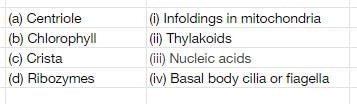
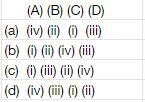

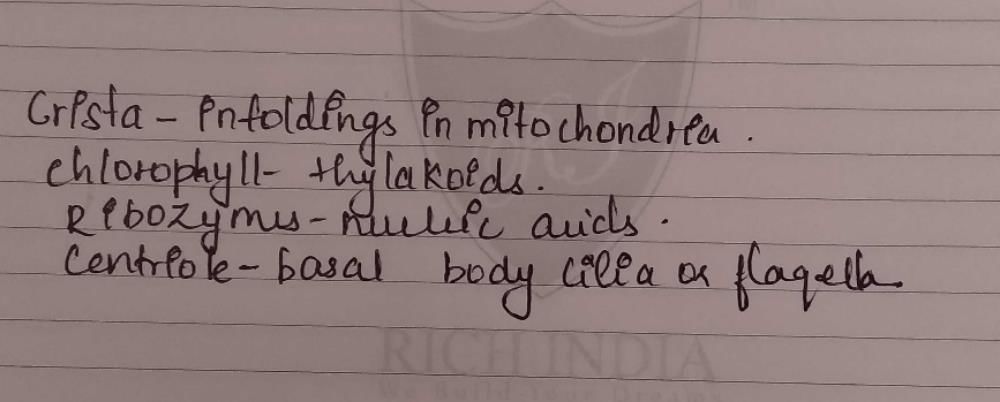
Which of the following statements is not correct? (2019)- a)Lysosomes are formed by the process of packaging in the endoplasmic reticulum.
- b)Lysosomes have numerous hydrolytic enzymes.
- c)The hydrolytic enzymes of lysosomes are active under acidic pH.
- d)Lysosomes are membrane-bound structures.
Correct answer is option 'A'. Can you explain this answer?
Which of the following statements is not correct? (2019)
a)
Lysosomes are formed by the process of packaging in the endoplasmic reticulum.
b)
Lysosomes have numerous hydrolytic enzymes.
c)
The hydrolytic enzymes of lysosomes are active under acidic pH.
d)
Lysosomes are membrane-bound structures.
 | Jyoti Sengupta answered |
- Lysosomes bud off from trans face to Golgi bodies.Precursor of lysosomal enzymes are synthesized by RER and then send to Golgi bodies for further processing.
So, the correct answer is 'Lysosomes are formed by the process of packaging in the endoplasmic reticulum'
Identify the correct order of organisation of genetic material from largest to smallest : [2015 RS]- a)Genome, chromosome, nucleotide, gene
- b)Genome, chromosome, gene, nucleotide
- c)Chromosome, genome, nucleotide, gene
- d)Chromosome, gene, genome, nucleotide
Correct answer is option 'B'. Can you explain this answer?
Identify the correct order of organisation of genetic material from largest to smallest : [2015 RS]
a)
Genome, chromosome, nucleotide, gene
b)
Genome, chromosome, gene, nucleotide
c)
Chromosome, genome, nucleotide, gene
d)
Chromosome, gene, genome, nucleotide
 | Sahana Sel answered |
A nucleotide is the most basic dna unit containing a base, sugar and phosphate.
Few of these basic units combine sequentially to form a Gene i.e the info/blueprint of a protein.
Many such genes are joined as a long chain wound multiple times to form a larger structure called chromosome.
All such chromosome (46 in human) constitute the biological blueprint aka genome of that organism.
Few of these basic units combine sequentially to form a Gene i.e the info/blueprint of a protein.
Many such genes are joined as a long chain wound multiple times to form a larger structure called chromosome.
All such chromosome (46 in human) constitute the biological blueprint aka genome of that organism.
If you remove the fimbriae from the bacterial cell, which of the following would you expect to happen?- a)The bacteria could no longer swim
- b)The bacteria would not adhere to the host tissue
- c)Transportation of molecules across the membrane would stop
- d)The shape of bacteria would change
Correct answer is option 'B'. Can you explain this answer?
If you remove the fimbriae from the bacterial cell, which of the following would you expect to happen?
a)
The bacteria could no longer swim
b)
The bacteria would not adhere to the host tissue
c)
Transportation of molecules across the membrane would stop
d)
The shape of bacteria would change
 | Vivek Patel answered |
Fimbriae are hair like structures present in large number in bacteria. They help in attaching bacteria to solid surface or host tissues.
Glycocalyx (mucilage sheath) of a bacterial cell may occur in the form of a loose sheath called ____ or it may be thick and tough called _____ .- a)capsule, slime layer
- b)slime layer, capsule
- c)mesosome, capsule
- d)mesosome, slime layer
Correct answer is option 'B'. Can you explain this answer?
Glycocalyx (mucilage sheath) of a bacterial cell may occur in the form of a loose sheath called ____ or it may be thick and tough called _____ .
a)
capsule, slime layer
b)
slime layer, capsule
c)
mesosome, capsule
d)
mesosome, slime layer
| | Vivek Patel answered |
Glycocalyx (mucilage sheath) is the outermost layer of the bacterial cell envelope which consists of non-cellulosic polysacharides with or without proteins. It may occur in the form of loose sheath, called slime layer. If it is a thick coering, it is called capsule. Glycocalyx gives sticky character to the cell and is not absolutely essential for survival of bacteria. It prevents desiccation, protects from phagocytes, toxic chemicals and viruses and serves in attachment. It may give selective advantage though in certain situations.
Which organelle is involved in the formation of cilia and flagella in animals?- a)Basal body
- b)Microfilament
- c)Centromere
- d)Kinetochore
Correct answer is option 'A'. Can you explain this answer?
Which organelle is involved in the formation of cilia and flagella in animals?
a)
Basal body
b)
Microfilament
c)
Centromere
d)
Kinetochore
 | Stepway Academy answered |
Basal body is also known as a modified centriole which serves both to create and connect the cilia and flagella to the cell.
Read the given statements and select the correct option.
Statement 1: In prokaryotes mitochondira are absent.
Statement 2: In prokaryotes mesosomes are present which help in respiration.- a)Both statements 1 and 2 are correct and statement 2 is the correct explanation of statement 1.
- b)Both statements 1 and 2 are correct but statement 2 is not the correct explanation of statement 1.
- c)Statement 1 is correct and statement 2 is incorrect.
- d)Both statements 1 and 2 are incorrect.
Correct answer is option 'B'. Can you explain this answer?
Read the given statements and select the correct option.
Statement 1: In prokaryotes mitochondira are absent.
Statement 2: In prokaryotes mesosomes are present which help in respiration.
Statement 1: In prokaryotes mitochondira are absent.
Statement 2: In prokaryotes mesosomes are present which help in respiration.
a)
Both statements 1 and 2 are correct and statement 2 is the correct explanation of statement 1.
b)
Both statements 1 and 2 are correct but statement 2 is not the correct explanation of statement 1.
c)
Statement 1 is correct and statement 2 is incorrect.
d)
Both statements 1 and 2 are incorrect.
 | Mohit Rajpoot answered |
The correct answer is b) Both statements 1 and 2 are correct but statement 2 is not the correct explanation of statement 1.
Explanation:
- Statement 1 is correct: Prokaryotes lack membrane-bound organelles like mitochondria.
- Statement 2 is also correct: Prokaryotes have structures called mesosomes, which are infoldings of the plasma membrane. They play a role in various functions including respiration. However, their role is not equivalent to the mitochondria in eukaryotic cells.
Which of the following is true for nucleolus? (2018)- a)Larger nucleoli are present in dividing cells.
- b)It is a membrane-bound structure.
- c)It takes part in spindle formation.
- d)It is a site for active ribosomal RNA synthesis.
Correct answer is option 'D'. Can you explain this answer?
Which of the following is true for nucleolus? (2018)
a)
Larger nucleoli are present in dividing cells.
b)
It is a membrane-bound structure.
c)
It takes part in spindle formation.
d)
It is a site for active ribosomal RNA synthesis.
| | Jyoti Sengupta answered |
- Nucleolus is naked (devoid of membrane), round or slightly irregular structure which is attached to the chromatin at a specific region called nucleolar organiser region (NOR).
- Nucleolus is a site for r RNA synthesis. Nucleolus disappears when the cell undergoes division and reappears after its completion.
Which of the following cell organelles is responsible for extracting energy from carbohydrates to form ATP? (2017)- a)Ribosome
- b)Chloroplast
- c)Mitochondrion
- d)Lysosome
Correct answer is option 'C'. Can you explain this answer?
Which of the following cell organelles is responsible for extracting energy from carbohydrates to form ATP? (2017)
a)
Ribosome
b)
Chloroplast
c)
Mitochondrion
d)
Lysosome
| | Jyoti Sengupta answered |
- Mitochondria are miniature biochemical factories where food stuffs or respiratory substrates arc completely oxidised to carbon dioxide and water The energy liberated in the process is initially stored in the form of reduced coenzymes and reduced prosthetic groups. The latter soon undergo oxidation and form energy rich ATP.
- ATP comes out of mitochondria and helps perform various energy-requiring processes of the cell like muscle contraction, nerve impulse conduction, biosynthesis, membrane transport, cell division, movement, etc. Because of the formation of ATP, the mitochondria arc called power houses of the cell.
What is true about genetic material of a prokaryotic cell?- a)Lacks histones
- b)Not enveloped by nuclear membrane
- c)Composed of a single circular DNA molecule
- d)All of these
Correct answer is option 'D'. Can you explain this answer?
What is true about genetic material of a prokaryotic cell?
a)
Lacks histones
b)
Not enveloped by nuclear membrane
c)
Composed of a single circular DNA molecule
d)
All of these
| | Suresh Iyer answered |
In prokaryotes, the genetic material consists of single circular DNA molecule lying entangled in nucleoid. It is not bounded by a definite nuclear membrance. Histones are water-soluble proteins rich in arginine and lysine that help in DNA packaging in chromosomes. Prokaryotic cells lack pistone proteins.
_____ are self replicating, extra chromosomal segments of double stranded circular and naked DNA, present in a bacterial cell.- a)Plasmids
- b)Nucleoid
- c)Mesosomes
- d)Bacteriophages
Correct answer is option 'A'. Can you explain this answer?
_____ are self replicating, extra chromosomal segments of double stranded circular and naked DNA, present in a bacterial cell.
a)
Plasmids
b)
Nucleoid
c)
Mesosomes
d)
Bacteriophages
| | Vivek Patel answered |
Plasmid is a structure in bacterial cell consisting of DNA that can exist and replicate independently of the chromosome. Plasmids provide genetic instructions for certain cell activities (e.g., antibiotic, resistance). They can be transferred from cell to cell in a bacterial colony.
The type of ribosomes found in prokaryotes is- a)80S type
- b)70S type
- c)30S type
- d)50S type
Correct answer is option 'B'. Can you explain this answer?
The type of ribosomes found in prokaryotes is
a)
80S type
b)
70S type
c)
30S type
d)
50S type
| | Vivek Patel answered |
The cytoplasmic ribosomes of prokaryotes (blue green algae, bacteria and PPLOs) are 70S. They have two subunits 50S and 30S.
Which type of substance would face difficulty to pass through the cell membrane? [NEET 2022 Phase 2]- a)Substance soluble in lipids
- b)Substance with hydrophobic moiety
- c)Substance with hydrophilic moiety
- d)All substance irrespective of hydrophobic and hydrophilic moiety
Correct answer is option 'C'. Can you explain this answer?
Which type of substance would face difficulty to pass through the cell membrane? [NEET 2022 Phase 2]
a)
Substance soluble in lipids
b)
Substance with hydrophobic moiety
c)
Substance with hydrophilic moiety
d)
All substance irrespective of hydrophobic and hydrophilic moiety
 | Sneha Chopra answered |
Understanding Cell Membrane Permeability
The cell membrane, or plasma membrane, is primarily composed of a phospholipid bilayer, which serves as a barrier to regulate what enters and exits the cell. The nature of a substance largely determines its ability to permeate this membrane.
Substance Solubility in Lipids
- Substances that are lipid-soluble can easily pass through the cell membrane.
- The hydrophobic (water-repelling) tails of phospholipids allow lipid-soluble substances to integrate and diffuse through the membrane.
Hydrophobic Moieties
- Substances with hydrophobic properties also tend to pass through the cell membrane more easily.
- These substances can interact favorably with the lipid bilayer, facilitating their movement across the membrane.
Hydrophilic Moieties
- In contrast, substances with hydrophilic properties are polar or charged, making it difficult for them to cross the hydrophobic lipid bilayer.
- Water-soluble substances, ions, and polar molecules struggle to diffuse through the membrane without assistance.
Conclusion
- The correct answer is option 'C' because hydrophilic substances face significant difficulty when attempting to pass through the cell membrane.
- They require specific transport mechanisms, such as channel proteins or carrier proteins, to facilitate their movement across the membrane.
Thus, understanding the nature of substances in relation to the cell membrane's structure is crucial for comprehending their transport mechanisms.
The cell membrane, or plasma membrane, is primarily composed of a phospholipid bilayer, which serves as a barrier to regulate what enters and exits the cell. The nature of a substance largely determines its ability to permeate this membrane.
Substance Solubility in Lipids
- Substances that are lipid-soluble can easily pass through the cell membrane.
- The hydrophobic (water-repelling) tails of phospholipids allow lipid-soluble substances to integrate and diffuse through the membrane.
Hydrophobic Moieties
- Substances with hydrophobic properties also tend to pass through the cell membrane more easily.
- These substances can interact favorably with the lipid bilayer, facilitating their movement across the membrane.
Hydrophilic Moieties
- In contrast, substances with hydrophilic properties are polar or charged, making it difficult for them to cross the hydrophobic lipid bilayer.
- Water-soluble substances, ions, and polar molecules struggle to diffuse through the membrane without assistance.
Conclusion
- The correct answer is option 'C' because hydrophilic substances face significant difficulty when attempting to pass through the cell membrane.
- They require specific transport mechanisms, such as channel proteins or carrier proteins, to facilitate their movement across the membrane.
Thus, understanding the nature of substances in relation to the cell membrane's structure is crucial for comprehending their transport mechanisms.
Mesosomes are the infoldings of cell membrane, which
(i) are present in both prokaryotic and eukaryotic cells.
(ii) help in cell wall formation, DNA replication and respitation.
(iii) increase the surface area of plasma membrane.- a)(i) and (ii)
- b)(ii) and (iii)
- c)(i) and (iii)
- d)(i), (ii) and (iii)
Correct answer is option 'B'. Can you explain this answer?
Mesosomes are the infoldings of cell membrane, which
(i) are present in both prokaryotic and eukaryotic cells.
(ii) help in cell wall formation, DNA replication and respitation.
(iii) increase the surface area of plasma membrane.
(i) are present in both prokaryotic and eukaryotic cells.
(ii) help in cell wall formation, DNA replication and respitation.
(iii) increase the surface area of plasma membrane.
a)
(i) and (ii)
b)
(ii) and (iii)
c)
(i) and (iii)
d)
(i), (ii) and (iii)
| | Vivek Patel answered |
The correct option is B (ii) and (iii)
Mesosomes are the areas in the cell membrane of prokaryotic cell which fold inwards. It helps in cell wall formation, DNA replication, respiration and increases the surface area of the plasma membrane.
Mesosomes are the areas in the cell membrane of prokaryotic cell which fold inwards. It helps in cell wall formation, DNA replication, respiration and increases the surface area of the plasma membrane.
Given below are two statements: [NEET 2024]
Statement I: Mitochondria and chloroplasts both double membranes bound organelles.
Statement II: Inner membrane of mitochondria is relatively less permeable, as compared chloroplast.
In the light of the above statements, choose the misappropriate answer from the options given below:
(a) Both Statement I and Statement II are correct.
(b) Both Statement I and Statement II are incorrect.
(c) Statement I is correct but Statement II is incorrect.
(d) Statement I is incorrect but Statement II is correct.- a)Both Statement I and Statement II are correct.
- b)Both Statement I and Statement II are incorrect.
- c)Statement I is correct but Statement II is incorrect.
- d)Statement I is incorrect but Statement II is correct.
Correct answer is option 'C'. Can you explain this answer?
Given below are two statements: [NEET 2024]
Statement I: Mitochondria and chloroplasts both double membranes bound organelles.
Statement II: Inner membrane of mitochondria is relatively less permeable, as compared chloroplast.
In the light of the above statements, choose the misappropriate answer from the options given below:
(a) Both Statement I and Statement II are correct.
(b) Both Statement I and Statement II are incorrect.
(c) Statement I is correct but Statement II is incorrect.
(d) Statement I is incorrect but Statement II is correct.
Statement I: Mitochondria and chloroplasts both double membranes bound organelles.
Statement II: Inner membrane of mitochondria is relatively less permeable, as compared chloroplast.
In the light of the above statements, choose the misappropriate answer from the options given below:
(a) Both Statement I and Statement II are correct.
(b) Both Statement I and Statement II are incorrect.
(c) Statement I is correct but Statement II is incorrect.
(d) Statement I is incorrect but Statement II is correct.
a)
Both Statement I and Statement II are correct.
b)
Both Statement I and Statement II are incorrect.
c)
Statement I is correct but Statement II is incorrect.
d)
Statement I is incorrect but Statement II is correct.
| | Dr. Mohit Rajpoot answered |
Statement I is correct because both mitochondria and chloroplasts are double membrane-bound organelles.
Statement II is also correct because the inner mitochondrial membrane is highly selective (less permeable), whereas the inner membrane of chloroplast is comparatively more permeable due to transport proteins.
Statement II is also correct because the inner mitochondrial membrane is highly selective (less permeable), whereas the inner membrane of chloroplast is comparatively more permeable due to transport proteins.
Prokaryotic cells are generally _____ and multiply _____ than the eukaryotic cells.- a)smaller, slower
- b)larger, slower
- c)smaller, faster
- d)larger, faster
Correct answer is option 'C'. Can you explain this answer?
Prokaryotic cells are generally _____ and multiply _____ than the eukaryotic cells.
a)
smaller, slower
b)
larger, slower
c)
smaller, faster
d)
larger, faster
| | Vivek Patel answered |
Prokaryotic cell is usually small (0.1-5.1μm) in size whereas eukaryotic cell size is comparatively larger (5-100μm). Prokaryotic cells multiply very rapidly by asecial means like binary fission, sporulation etc.
Correct sequence of layers of bacterial cell envelope from outward to inward is- a)Cell wall → Glycocalyx → Cell membrane
- b)Cell membrane → Glycocalyx → Cell wall
- c)Glycocalyx → Cell wall → Cell membrane
- d)Glycocalyx → Cell membrane → Cell wall
Correct answer is option 'C'. Can you explain this answer?
Correct sequence of layers of bacterial cell envelope from outward to inward is
a)
Cell wall → Glycocalyx → Cell membrane
b)
Cell membrane → Glycocalyx → Cell wall
c)
Glycocalyx → Cell wall → Cell membrane
d)
Glycocalyx → Cell membrane → Cell wall
 | Ajay Yadav answered |
Glycocalyx is the outermost layer of the cell envelope. Cell wall lies between plasma membrane andd glycocalyx.
Which one of the following statements refers to Reductionist Biology? [NEET 2025]- a)Chemical approach to study and understand living organisms
- b)Behavioural approach to study and understand living organisms
- c)Physico-chemical approach to study and understand living organisms
- d)Physiological approach to study and understand living organisms
Correct answer is option 'C'. Can you explain this answer?
Which one of the following statements refers to Reductionist Biology? [NEET 2025]
a)
Chemical approach to study and understand living organisms
b)
Behavioural approach to study and understand living organisms
c)
Physico-chemical approach to study and understand living organisms
d)
Physiological approach to study and understand living organisms
| | Lakshmi Khanna answered |
Understanding Reductionist Biology
Reductionist Biology is a scientific approach that simplifies complex biological systems into their most fundamental parts. This method is essential for studying and understanding living organisms at a detailed level.
Key Features of Reductionist Biology:
- Chemical Approach: While the chemical perspective is important, Reductionist Biology goes beyond just the chemical composition of life forms. It focuses on understanding the interactions and functions of biological molecules in a simplified context.
- Physico-Chemical Approach: This is the core of Reductionist Biology. It integrates principles from physics and chemistry to analyze biological systems. By examining how molecular structures and chemical reactions contribute to the behavior and functions of living organisms, this method allows for a precise understanding of biological phenomena.
- Reduction of Complexity: Reductionism tackles the complexity of biological systems by breaking them down into smaller, manageable units. For instance, studying a cell's components-like proteins, enzymes, and DNA-individually can reveal how they contribute to the cell's overall function.
- Applications in Research: This approach is fundamental in fields like molecular biology and genetics, where understanding the role of specific genes or proteins can lead to breakthroughs in medicine and biotechnology.
Conclusion
In summary, Reductionist Biology, represented by option 'C', emphasizes a physico-chemical approach to comprehend living organisms. By focusing on the intricate details of biological systems, scientists can gain insights that may be obscured when considering the organism as a whole.
Reductionist Biology is a scientific approach that simplifies complex biological systems into their most fundamental parts. This method is essential for studying and understanding living organisms at a detailed level.
Key Features of Reductionist Biology:
- Chemical Approach: While the chemical perspective is important, Reductionist Biology goes beyond just the chemical composition of life forms. It focuses on understanding the interactions and functions of biological molecules in a simplified context.
- Physico-Chemical Approach: This is the core of Reductionist Biology. It integrates principles from physics and chemistry to analyze biological systems. By examining how molecular structures and chemical reactions contribute to the behavior and functions of living organisms, this method allows for a precise understanding of biological phenomena.
- Reduction of Complexity: Reductionism tackles the complexity of biological systems by breaking them down into smaller, manageable units. For instance, studying a cell's components-like proteins, enzymes, and DNA-individually can reveal how they contribute to the cell's overall function.
- Applications in Research: This approach is fundamental in fields like molecular biology and genetics, where understanding the role of specific genes or proteins can lead to breakthroughs in medicine and biotechnology.
Conclusion
In summary, Reductionist Biology, represented by option 'C', emphasizes a physico-chemical approach to comprehend living organisms. By focusing on the intricate details of biological systems, scientists can gain insights that may be obscured when considering the organism as a whole.
Which of the following statements with respect to the endoplasmic reticulum is incorrect? [NEET 2022 Phase 1]- a)SER is devoid of ribosomes
- b)In prokaryotes only RER are present
- c)SER are the sites for lipid synthesis
- d)RER has ribosomes attached to ER
Correct answer is option 'B'. Can you explain this answer?
Which of the following statements with respect to the endoplasmic reticulum is incorrect? [NEET 2022 Phase 1]
a)
SER is devoid of ribosomes
b)
In prokaryotes only RER are present
c)
SER are the sites for lipid synthesis
d)
RER has ribosomes attached to ER
 | Top Rankers answered |
Presence of membranous organelles is an exclusive property of eukaryotic cells. Endoplasmic reticulum is an example of membranous organelles, so, it will always be found in eukaryotic cells only and never in the prokaryotes. This is true for SER and RER both.
Chapter doubts & questions for Cell: The Unit of Life - 30-Day Revision Course for NEET 2026 is part of NEET exam preparation. The chapters have been prepared according to the NEET exam syllabus. The Chapter doubts & questions, notes, tests & MCQs are made for NEET 2026 Exam. Find important definitions, questions, notes, meanings, examples, exercises, MCQs and online tests here.
Chapter doubts & questions of Cell: The Unit of Life - 30-Day Revision Course for NEET in English & Hindi are available as part of NEET exam. Download more important topics, notes, lectures and mock test series for NEET Exam by signing up for free.
30-Day Revision Course for NEET85 videos|301 docs|171 tests |
