


All Exams > NEET > 30-Day Revision Course for NEET > All Questions
All questions of Cell Cycle and Cell Division for NEET Exam
What is the proper sequence in mitosis?- a)Anaphase, metaphase, telophase and prophase
- b)Telophase, anaphase, metaphase and prophase
- c)Metaphase, telophase, prophase and anaphase
- d)Prophase, metaphase, anaphase and telophase
Correct answer is option 'D'. Can you explain this answer?
What is the proper sequence in mitosis?
a)
Anaphase, metaphase, telophase and prophase
b)
Telophase, anaphase, metaphase and prophase
c)
Metaphase, telophase, prophase and anaphase
d)
Prophase, metaphase, anaphase and telophase
 | Neha Joshi answered |
Mitosis consists of four basic phases: prophase, metaphase, anaphase, and telophase. These phases occur in this strict sequential order, and cytokinesis - the process of dividing the cell contents to make two new cells - starts in anaphase or telophase.
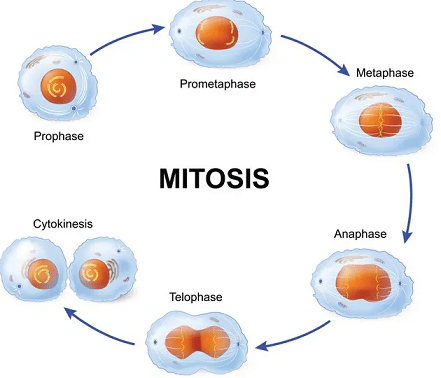
1. Prophase - During prophase, chromosomes get visible (chromatids), the centrioles migrate to the poles, nuclear membrane and nucleolus disappear and spindle formation is seen. Prophase in mitosis is longer than any other phases of mitosis because the cell has to prepare for the actual division that takes place from early through late prophase.
2. Metaphase - During this, chromosomes lineup around the centre (Cells in metaphase have the chromosomes, which appear as long thin strands under the microscope).
3. Anaphase - here, chromatids separate and move to opposite poles by spindle fibers. This allows each daughter cell to have an identical copy of each of the original cell’s chromosomes.
4.Telophase - During this phase, chromosomes disappear (become chromatin), nuclear membrane reforms, nucleoli reappears, spindle disappears and centrioles duplicate.
The correct answer is option D.

How many mitotic divisions are needed for a single cell to make 128 cells?- a)7
- b)14
- c)28
- d)32
Correct answer is option 'A'. Can you explain this answer?
How many mitotic divisions are needed for a single cell to make 128 cells?
a)
7
b)
14
c)
28
d)
32
 | Ananya Das answered |
Mitosis is a process of nuclear division in eukaryotic cells that occurs when a parent cell divides to produce two identical daughter cells.
Hence the process of the division will be:
► 1 cell gives 2 daughter cells (1st mitosis)
► 2 cells give 4 daughter cells (2nd mitosis)
► 4 cells give 8 daughter cells (3rd mitosis)
► 8 cells give 16 daughter cells (4th mitosis)
► 16 cells give 32 daughter cells (5th mitosis)
► 32 cells give 64 daughter cells (6th mitosis)
► 64 cells give 128 daughter cells (7th mitosis)
Hence the process of the division will be:
► 1 cell gives 2 daughter cells (1st mitosis)
► 2 cells give 4 daughter cells (2nd mitosis)
► 4 cells give 8 daughter cells (3rd mitosis)
► 8 cells give 16 daughter cells (4th mitosis)
► 16 cells give 32 daughter cells (5th mitosis)
► 32 cells give 64 daughter cells (6th mitosis)
► 64 cells give 128 daughter cells (7th mitosis)
Hence 7 mitotic divisions cell needed for a single cell to make 128 cells.
Which stages of cell division do the figures A and B represent?
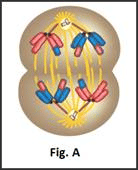
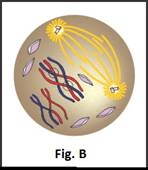
- a)A: Metaphase; B: Telophase
- b)A: Late anaphase; B: Prophase
- c)A: Telophase; B: Metaphase
- d)A: Prophase; B: Anaphase
Correct answer is option 'B'. Can you explain this answer?
Which stages of cell division do the figures A and B represent?
a)
A: Metaphase; B: Telophase
b)
A: Late anaphase; B: Prophase
c)
A: Telophase; B: Metaphase
d)
A: Prophase; B: Anaphase
 | Knowledge Hub answered |
- In Fig.A Chromatids are moving to opposite poles i.e Late anaphase.
- In Fig.B The duplicated DNA is compactly packed into chromosomes and spindle formation occurs i.e prophase.
Hence, the correct option is B.
NCERT Reference: Topic "Prophase” and “Anaphase” of chapter "Cell cycle and Cell division" of NCERT.
NCERT Reference: Topic "Prophase” and “Anaphase” of chapter "Cell cycle and Cell division" of NCERT.
A cell plate is laid during- a)Cytokinesis
- b)Karyokinesis
- c)Interphase
- d)None of the above
Correct answer is 'A'. Can you explain this answer?
A cell plate is laid during
a)
Cytokinesis
b)
Karyokinesis
c)
Interphase
d)
None of the above
 | Suresh Iyer answered |
- Cytokinesis is the part of the cell division process during which the cytoplasm of a single eukaryotic cell divides into two daughter cells.
- Cytoplasmic division begins during or after the late stages of nuclear division in mitosis and meiosis.
- During cytokinesis the spindle apparatus partitions and transports duplicated chromatids into the cytoplasm of the separating daughter cells. It thereby ensures that chromosome number and complement are maintained from one generation to the next and that, except in special cases, the daughter cells will be functional copies of the parent cell. After the completion of the telophase and cytokinesis, each daughter cell enters the interphase of the cell cycle.
Which of the phases of mitosis is the longest?- a)Telophase
- b)Prophase
- c)Anaphase
- d)Metaphase
Correct answer is option 'B'. Can you explain this answer?
Which of the phases of mitosis is the longest?
a)
Telophase
b)
Prophase
c)
Anaphase
d)
Metaphase
 | Vijay Bansal answered |
Prophase and telophase are stages involved in mitosis or meiosis. During G2 phase division of centrioles, mitochondria and chloroplasts occurs.
Crossing over results the exchange of genetic material, which occurs between- a)Non-sister chromosomes
- b)Sister chromatids
- c)Non-homologous chromosome
- d)Homologous chromosomes
Correct answer is option 'D'. Can you explain this answer?
Crossing over results the exchange of genetic material, which occurs between
a)
Non-sister chromosomes
b)
Sister chromatids
c)
Non-homologous chromosome
d)
Homologous chromosomes
 | Rohan Singh answered |
Most organisms that undergo sexual reproduction contain two types of cells in their body – haploid and diploid cells. Diploid cells are seen in most parts of the body and contain two copies of every chromosome. Therefore, they contain two genes to determine the sequence of nearly every RNA or protein. Haploid cells are usually male or female gametes formed as a result of meiosis and are seen in sexual organs. They contain only one complete set of chromosomes and are designed to fuse with another haploid gamete to produce a diploid zygote – with one paternal and one maternal set of chromosomes. Though they code for the same genes, their DNA sequences can vary slightly from one another. For instance, the paternal chromosome may contain the genetic information to result in antigen A being present on red blood cells, while the maternal chromosome may code for antigen B. These two antigens are similar in function, but differ from each other marginally in their amino acid sequence.
Plants show mitotic divisions ina)Haploid cellsb)Haploid cells and diploid cellsc)Somatic cellsd)Diploid cellsCorrect answer is option 'B'. Can you explain this answer?
 | Pooja Mehta answered |
Mitosis is the type of cell division that ensures equal distribution of genetic material in daughter cells.
Mitosis can occur both in diploid and haploid cells. The main function of mitosis is to make copies of cells for growth and regeneration.
If a haploid cell undergoes mitosis, which is something certain types of plant and fungus do as part of their normal life cycles, the end result is two identical haploid cells (n→n),
Some plants and fungi have their bodies composed of haploid cell .
EXAMPLE: Gametophyte of Bryophyte plants. It is produced from mitotic cell division of spores, which are produced by meiosis in sporophytes.
In mitosis, the number of chromosome sets in daughter cells will be- a)Half of parent cells
- b)Double of parent cells
- c)Different from parent cells
- d)Same as in parent cells
Correct answer is option 'D'. Can you explain this answer?
In mitosis, the number of chromosome sets in daughter cells will be
a)
Half of parent cells
b)
Double of parent cells
c)
Different from parent cells
d)
Same as in parent cells
 | Dilip Chaurasiya answered |
Same mitosis is also called equavational division becz. before and after mitosis ploidy is same..
The transition period between M-phase I and M-phase II in without DNA replication- a)Interstage
- b)Interkinesis
- c)Interphase
- d)Transition period
Correct answer is option 'B'. Can you explain this answer?
The transition period between M-phase I and M-phase II in without DNA replication
a)
Interstage
b)
Interkinesis
c)
Interphase
d)
Transition period
 | Pallabi Reddy answered |
The transition period between M-phase of Meiosis I and M-phase II during which no replication of DNA occurs is called as interkinesis.
At which stage of mitosis do chromatids separate and pass to different poles?- a)Anaphase
- b)Telophase
- c)Prophase
- d)Metaphase
Correct answer is option 'A'. Can you explain this answer?
At which stage of mitosis do chromatids separate and pass to different poles?
a)
Anaphase
b)
Telophase
c)
Prophase
d)
Metaphase
| | Vijay Bansal answered |
Anaphase -The shortest stage of mitosis. The centromeres divide, and the sister chromatids of each chromosome are pulled apart - or 'disjoin' - and move to the opposite ends of the cell, pulled by spindle fibres attached to the kinetochore regions.
During which stage of prophase I the crossing over takes place?- a)Pachytene
- b)Leptotene
- c)Zygotene
- d)Diplotene
Correct answer is option 'A'. Can you explain this answer?
During which stage of prophase I the crossing over takes place?
a)
Pachytene
b)
Leptotene
c)
Zygotene
d)
Diplotene
 | Lakshmi Sarkar answered |
The crossing over takes place during the pachytene stage of prophase I of meiosis.
Explanation:
Prophase I is the first stage of meiosis I, which is further divided into five substages: leptotene, zygotene, pachytene, diplotene, and diakinesis. During the prophase I, homologous chromosomes pair up and exchange genetic material through a process known as crossing over. This results in the formation of recombinant chromosomes that carry a combination of genetic material from both parents.
The crossing over occurs during the pachytene stage, which is characterized by the following events:
1. Homologous chromosomes pair up: The homologous chromosomes come together and form a bivalent or a tetrad.
2. Synapsis: The paired homologous chromosomes undergo synapsis, which is the physical association of the homologs.
3. Crossing over: The chromatids of the homologous chromosomes exchange genetic material at specific sites known as chiasmata. This leads to the formation of recombinant chromosomes.
4. Formation of the synaptonemal complex: The synaptonemal complex holds the homologous chromosomes together and facilitates the exchange of genetic material.
5. Nuclear envelope breakdown: The nuclear envelope breaks down, and the spindle fibers attach to the chromosomes.
In conclusion, the crossing over takes place during the pachytene stage of prophase I of meiosis.
Explanation:
Prophase I is the first stage of meiosis I, which is further divided into five substages: leptotene, zygotene, pachytene, diplotene, and diakinesis. During the prophase I, homologous chromosomes pair up and exchange genetic material through a process known as crossing over. This results in the formation of recombinant chromosomes that carry a combination of genetic material from both parents.
The crossing over occurs during the pachytene stage, which is characterized by the following events:
1. Homologous chromosomes pair up: The homologous chromosomes come together and form a bivalent or a tetrad.
2. Synapsis: The paired homologous chromosomes undergo synapsis, which is the physical association of the homologs.
3. Crossing over: The chromatids of the homologous chromosomes exchange genetic material at specific sites known as chiasmata. This leads to the formation of recombinant chromosomes.
4. Formation of the synaptonemal complex: The synaptonemal complex holds the homologous chromosomes together and facilitates the exchange of genetic material.
5. Nuclear envelope breakdown: The nuclear envelope breaks down, and the spindle fibers attach to the chromosomes.
In conclusion, the crossing over takes place during the pachytene stage of prophase I of meiosis.
Cell growth results in disturbing the ratio between- a)Nucleus - chromosome ratio
- b)Cytoplasm-chromosome ratio
- c)Cytoplasm-spindle fibre ratio
- d)Nucleus-cytoplasm ratio
Correct answer is option 'D'. Can you explain this answer?
Cell growth results in disturbing the ratio between
a)
Nucleus - chromosome ratio
b)
Cytoplasm-chromosome ratio
c)
Cytoplasm-spindle fibre ratio
d)
Nucleus-cytoplasm ratio
| | Anjali Iyer answered |
Mitosis usually results in the production of diploid daughter cells with identical genetic complement.
The growth of multicellular organisms is due to mitosis.
Cell growth results in disturbing the ratio between the nucleus and the cytoplasm. It therefore becomes essential for the cell to divide to restore the nucleo-cytoplasmic ratio.
Plant Cytokinesis differ from animals Cytokinesis in having- a)Midbody
- b)Microfilament
- c)Cell plate
- d)None of these
Correct answer is 'C'. Can you explain this answer?
Plant Cytokinesis differ from animals Cytokinesis in having
a)
Midbody
b)
Microfilament
c)
Cell plate
d)
None of these
| | Rohan Singh answered |
Plant cells divide by a cell plate that eventually becomes the cell wall whereas animal cells divide by a cleavage furrow.
Cell division is initiated in plants by- a)Cytokinin
- b)Abscisic acid
- c)Gibberellin
- d)Auxin
Correct answer is option 'A'. Can you explain this answer?
Cell division is initiated in plants by
a)
Cytokinin
b)
Abscisic acid
c)
Gibberellin
d)
Auxin
| | Rahul Bansal answered |
Mitosis is the mechanism by which the chromosome content of a somatic cell (haploid or diploid) is kept constant through successive cell divisions. The division of the cell is initiated by division of the nucleus i.e. Karyokinesis followed by division of cytoplasm i.e. Cytokinesis.
Centromere is required for- a)Transcription
- b)Cytoplasmic cleavage
- c)Movement of chromosomes towards poles
- d)Crossing over
Correct answer is option 'C'. Can you explain this answer?
Centromere is required for
a)
Transcription
b)
Cytoplasmic cleavage
c)
Movement of chromosomes towards poles
d)
Crossing over
 | Aravind Saha answered |
The arms of chromosome are known as chromatids. These arms are held together at a point called the centromere (or primary constriction). Centromere occurs any where along the length of chromosome. During ceIl division spindle fibres are attached to centromere and help in the movement of chromosomes towards the poles.
Crossing over results in the exchange of genetic material, which occurs between:- a)Bivalents
- b)Sister chromatids
- c)Non-homologous chromosome
- d)Non-sister chromatids of the homologous chromosomes
Correct answer is option 'D'. Can you explain this answer?
Crossing over results in the exchange of genetic material, which occurs between:
a)
Bivalents
b)
Sister chromatids
c)
Non-homologous chromosome
d)
Non-sister chromatids of the homologous chromosomes
 | Ayush Joshi answered |
Crossing over occurs between prophase 1 and metaphase 1 and is the process where homologous chromosomes pair up with each other and exchange different segments of their genetic material to form recombinant chromosomes. It can also happen during mitotic division, which may result in loss of heterozygosity.
In a cell cycle, during which phase are chromosomes arranged on the equatorial plate?- a)Metaphase
- b)Prophase
- c)Anaphase
- d)Telophase
Correct answer is option 'A'. Can you explain this answer?
In a cell cycle, during which phase are chromosomes arranged on the equatorial plate?
a)
Metaphase
b)
Prophase
c)
Anaphase
d)
Telophase
| | Rohan Singh answered |
During metaphase, the chromosomes get arranged in the form of a plate called the equatorial plate or metaphase plate at the equator of the spindle. This plate is at right angles to the axis of the spindle and is formed of the kinetochores, the arms of chromatids trailing away. The centromeres are drawn to the equator by the equal pull of two chromosomal fibres which connect the sister kinetochores to the opposite poles. The process of drawing the chromosomes onto the equator of the spindle is known as congression.
What is the average cell cycle span for a mammalian cell?- a)24 hours
- b)48 hours
- c)4 hours
- d)12 hours
Correct answer is option 'A'. Can you explain this answer?
What is the average cell cycle span for a mammalian cell?
a)
24 hours
b)
48 hours
c)
4 hours
d)
12 hours
 | Rajat Roy answered |
In the 24 hour average duration of cellcycle of a human cell.
“The synaptonemal complex is formed during A stage and dissolves during B stage”.
Complete the above statement by choosing the correct option for A and B.- a)A - Diplotene, B - Diakinesis
- b)A - Leptotene, B - Zygotene
- c)A - Zygotene, B - Diplotene
- d)A - Pachytene, B - Diplotene
Correct answer is option 'D'. Can you explain this answer?
“The synaptonemal complex is formed during A stage and dissolves during B stage”.
Complete the above statement by choosing the correct option for A and B.
Complete the above statement by choosing the correct option for A and B.
a)
A - Diplotene, B - Diakinesis
b)
A - Leptotene, B - Zygotene
c)
A - Zygotene, B - Diplotene
d)
A - Pachytene, B - Diplotene
 | Infinity Academy answered |
The synaptonemal complex is a protein structure that forms during the Pachytene stage of prophase I of meiosis, facilitating homologous chromosome pairing. It then dissolves during the Diplotene stage, marking the beginning of homologous chromosome separation.
Which is the longest phase of the cell cycle?- a)M-phase
- b)Interphase
- c)Leptotene
- d)S-phase
Correct answer is option 'B'. Can you explain this answer?
Which is the longest phase of the cell cycle?
a)
M-phase
b)
Interphase
c)
Leptotene
d)
S-phase
 | Stepway Academy answered |
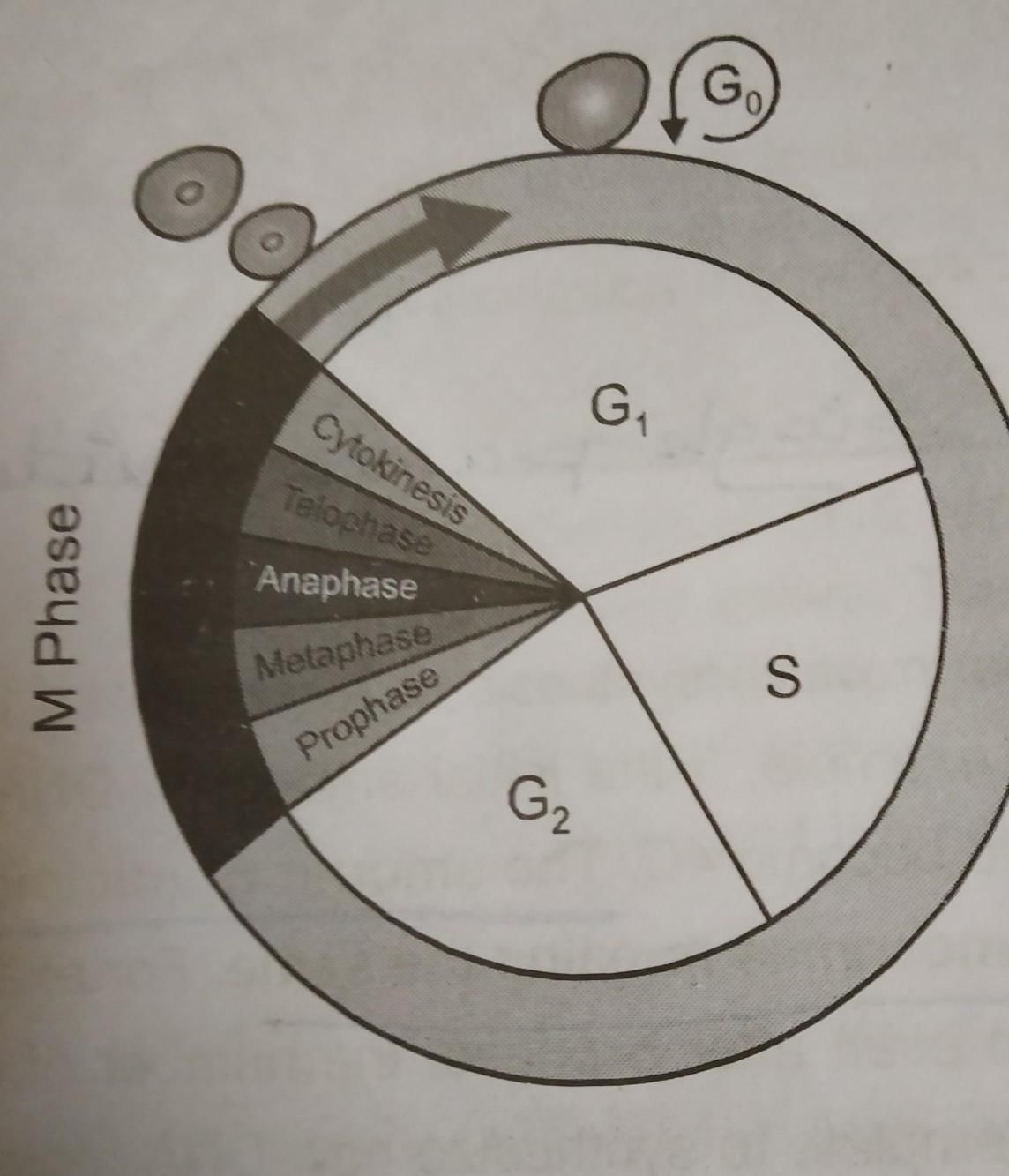
Cell cycle is divided into 2 phase. (i) Interphase (a period of preparation for cell division), (ii) M phase (the actual period of cell division). The interphase cell is metabolically quite active. Interphase is the long non dividing phase further divided into G1, S and G2. It occupies 75 to 90 % of entire cell division time.
Various phases of cell cycle are controlled by proteins- a)Hormones and CDKs
- b)Cytokines and Cyclins
- c)Cyclins and CDKs
- d)Hormones and Cyclins
Correct answer is option 'C'. Can you explain this answer?
Various phases of cell cycle are controlled by proteins
a)
Hormones and CDKs
b)
Cytokines and Cyclins
c)
Cyclins and CDKs
d)
Hormones and Cyclins
| | Stepway Academy answered |
Cyclin and CDKs enzymes are involved in controlling various phases of the cell cycle.
Cyclins are among the most important core cell cycle regulators.Cyclin A regulates the progression of cell cycle at S/G2 boundary and G2/M boundary.
M-phase promoting factor is Cyclin B which regulates the progression of cell cycle at G2/M boundary.
Cyclin D regulates the progression of cell cycle at G1/S boundary.
CDKs can modify various protein substrates involved in cell cycle progression.
M-phase promoting factor is Cyclin B which regulates the progression of cell cycle at G2/M boundary.
Cyclin D regulates the progression of cell cycle at G1/S boundary.
CDKs can modify various protein substrates involved in cell cycle progression.
CDK or cyclin dependent kinases are the enzymes that regulate the cell cycle by phosphorylating the amino acids like serine and threonine.
Consider the given two statements:
I. During G1 phase, the cell is metabolically active and continuously grows but does not replicate its DNA.
II. During G2 phase, proteins are synthesized in preparation for mitosis while cell growth continues.
Which of the following is correct?- a)Only I is correct
- b)Only II is correct
- c)Both I and II are correct
- d)Both I and II are incorrect
Correct answer is option 'C'. Can you explain this answer?
I. During G1 phase, the cell is metabolically active and continuously grows but does not replicate its DNA.
II. During G2 phase, proteins are synthesized in preparation for mitosis while cell growth continues.
Which of the following is correct?
a)
Only I is correct
b)
Only II is correct
c)
Both I and II are correct
d)
Both I and II are incorrect
 | Tejas Chatterjee answered |
Overview of Cell Cycle Phases
The cell cycle consists of several phases, including G1, S, G2, and M. Each phase has distinct roles in cell growth and division.
Statement I: G1 Phase
- The G1 phase is critical for cell growth.
- During this phase, the cell is metabolically active, producing RNA and synthesizing proteins.
- Importantly, DNA replication does not occur in G1; instead, it prepares the cell for the S phase, where DNA synthesis takes place.
Statement II: G2 Phase
- The G2 phase follows DNA synthesis and focuses on preparing the cell for mitosis.
- During G2, protein synthesis continues, particularly those proteins necessary for cell division, including components of the mitotic spindle.
- Cell growth also continues in this phase, ensuring that the cell is ready for the M phase (mitosis) where actual division occurs.
Conclusion
Both statements accurately describe their respective phases:
- G1 Phase: Metabolic activity and growth occur without DNA replication.
- G2 Phase: Preparations for mitosis take place with ongoing protein synthesis and further cell growth.
Thus, the correct answer is option 'C': Both I and II are correct. Understanding these phases is crucial for grasping cellular processes, especially in the context of the NEET syllabus.
The cell cycle consists of several phases, including G1, S, G2, and M. Each phase has distinct roles in cell growth and division.
Statement I: G1 Phase
- The G1 phase is critical for cell growth.
- During this phase, the cell is metabolically active, producing RNA and synthesizing proteins.
- Importantly, DNA replication does not occur in G1; instead, it prepares the cell for the S phase, where DNA synthesis takes place.
Statement II: G2 Phase
- The G2 phase follows DNA synthesis and focuses on preparing the cell for mitosis.
- During G2, protein synthesis continues, particularly those proteins necessary for cell division, including components of the mitotic spindle.
- Cell growth also continues in this phase, ensuring that the cell is ready for the M phase (mitosis) where actual division occurs.
Conclusion
Both statements accurately describe their respective phases:
- G1 Phase: Metabolic activity and growth occur without DNA replication.
- G2 Phase: Preparations for mitosis take place with ongoing protein synthesis and further cell growth.
Thus, the correct answer is option 'C': Both I and II are correct. Understanding these phases is crucial for grasping cellular processes, especially in the context of the NEET syllabus.
When a cell is viewed under the microscope, it does not show the Golgi complex, endoplasmic reticulum, nucleolus, and nuclear envelope in which stage of cell division?- a)Early prophase
- b)Late prophase
- c)Interphase
- d)Telophase
Correct answer is option 'B'. Can you explain this answer?
a)
Early prophase
b)
Late prophase
c)
Interphase
d)
Telophase
| | Stepway Academy answered |
In late prophase, the nuclear envelope, nucleolus, Golgi complex, and endoplasmic reticulum disappear, allowing the chromosomes to become fully condensed and visible. This marks the transition into metaphase, where the mitotic spindle fully forms.
If the DNA content of an onion tip cell is 2C at the end of the M-phase, what would be its DNA content at the end of the S-phase?- a)C
- b)2C
- c)3C
- d)4C
Correct answer is option 'D'. Can you explain this answer?
If the DNA content of an onion tip cell is 2C at the end of the M-phase, what would be its DNA content at the end of the S-phase?
a)
C
b)
2C
c)
3C
d)
4C
| | Infinity Academy answered |
If the DNA content of an onion tip cell is 2C at the end of the M-phase, then its DNA content would be 4C at the end of the S-phase. During the S-phase of the cell cycle, DNA replication takes place, and the amount of DNA in the cell doubles. At the end of the S-phase, each chromosome consists of two identical sister chromatids, which are held together at the centromere. Thus, the DNA content of the cell is doubled from the G1 phase (2C) to the end of the S-phase (4C), and it remains the same through the G2 phase. Therefore, if the DNA content of an onion tip cell is 2C at the end of the M-phase, it means that the cell has completed the mitotic division and has two sets of chromosomes. If the cell then enters the S-phase, it will replicate its DNA, resulting in the DNA content of 4C at the end of the S-phase.
Topic in NCERT: S phase (Synthesis)
Line in NCERT: "During this time the amount of DNA per cell doubles. If the initial amount of DNA is denoted as 2C then it increases to 4C."
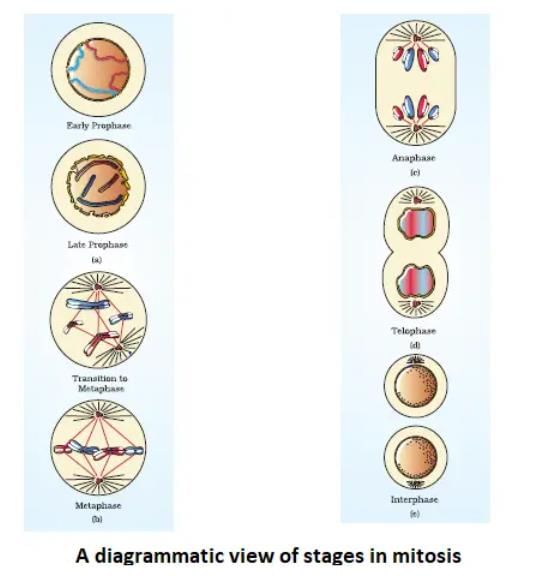
The figures below shows 3 phases of mitosis select the option given correct identification together with the correct event ?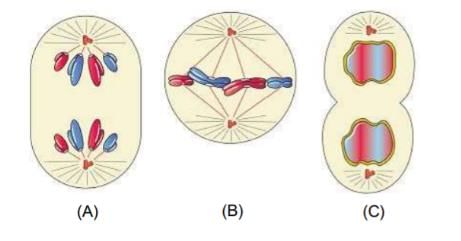
- a)C- Telophase-Nuclear envelope assembles around the chromosome clusters
- b)B- Anaphase-Segregation of homologous chromosomes.
- c) A- Prophase-Chromosomes get fully condensed.
- d)C- Metaphase-Condensation of chromatin to form chromosome
Correct answer is option 'A'. Can you explain this answer?
The figures below shows 3 phases of mitosis select the option given correct identification together with the correct event ?
a)
C- Telophase-Nuclear envelope assembles around the chromosome clusters
b)
B- Anaphase-Segregation of homologous chromosomes.
c)
A- Prophase-Chromosomes get fully condensed.
d)
C- Metaphase-Condensation of chromatin to form chromosome
| | Stepway Academy answered |

Chapter doubts & questions for Cell Cycle and Cell Division - 30-Day Revision Course for NEET 2026 is part of NEET exam preparation. The chapters have been prepared according to the NEET exam syllabus. The Chapter doubts & questions, notes, tests & MCQs are made for NEET 2026 Exam. Find important definitions, questions, notes, meanings, examples, exercises, MCQs and online tests here.
Chapter doubts & questions of Cell Cycle and Cell Division - 30-Day Revision Course for NEET in English & Hindi are available as part of NEET exam. Download more important topics, notes, lectures and mock test series for NEET Exam by signing up for free.
30-Day Revision Course for NEET85 videos|301 docs|171 tests |
