


All Exams > NEET > 30-Day Revision Course for NEET > All Questions
All questions of Gravitation for NEET Exam
Which is untrue about orbital velocity?- a)increases with the increase in height of satellite
- b)depends on mass and radius of planet around which it revolves
- c)it is independent of mass of satellite
- d)decreases with an increase in radius of orbit
Correct answer is option 'A'. Can you explain this answer?
Which is untrue about orbital velocity?
a)
increases with the increase in height of satellite
b)
depends on mass and radius of planet around which it revolves
c)
it is independent of mass of satellite
d)
decreases with an increase in radius of orbit
 | Om Desai answered |
The untrue statement about orbital velocity is:
1. increases with the increase in height of satellite
Explanation: Orbital velocity is the speed at which an object revolves around a planet or other celestial body in a stable orbit. According to the equation for orbital velocity, v = √(GM/r+h), where G is the gravitational constant, M is the mass of the planet, and r is the radius of the orbit.
As the height of the satellite increases (meaning it gets far to the planet), its h increase , so reasulting in decrease in velocity .
The other statements are true:
2. depends on mass and radius of planet around which it revolves: As mentioned in the equation, orbital velocity depends on both the mass (M) of the planet and the radius (r) of the orbit.
3. it is independent of mass of satellite: The mass of the satellite does not appear in the equation for orbital velocity, so it does not affect the speed at which the satellite orbits the planet.
4. decreases with an increase in radius of orbit: From the equation, we can see that as the radius of the orbit (r) increases, the orbital velocity (v) decreases.
1. increases with the increase in height of satellite
Explanation: Orbital velocity is the speed at which an object revolves around a planet or other celestial body in a stable orbit. According to the equation for orbital velocity, v = √(GM/r+h), where G is the gravitational constant, M is the mass of the planet, and r is the radius of the orbit.
As the height of the satellite increases (meaning it gets far to the planet), its h increase , so reasulting in decrease in velocity .
The other statements are true:
2. depends on mass and radius of planet around which it revolves: As mentioned in the equation, orbital velocity depends on both the mass (M) of the planet and the radius (r) of the orbit.
3. it is independent of mass of satellite: The mass of the satellite does not appear in the equation for orbital velocity, so it does not affect the speed at which the satellite orbits the planet.
4. decreases with an increase in radius of orbit: From the equation, we can see that as the radius of the orbit (r) increases, the orbital velocity (v) decreases.

The escape velocity of a body depends upon mass as [AIEEE 2002]- a)m0
- b)m1
- c)m2
- d)m3
Correct answer is option 'A'. Can you explain this answer?
The escape velocity of a body depends upon mass as [AIEEE 2002]
a)
m0
b)
m1
c)
m2
d)
m3
 | Pooja Shah answered |
We know that escape velocity, 
Where M is the mass of the planet and R is the radius of the planet.
Thus we can see that v does not depend upon the mass of the object.
Where M is the mass of the planet and R is the radius of the planet.
Thus we can see that v does not depend upon the mass of the object.
A particle of mass 10 g is kept on the surface of a uniform sphere of mass 100 kg and radius 10 cm. Find the work to be done against the gravitational force between them, to take the particle far away from the sphere, (you may take G = 6.67 × 10⁻¹¹ Nm2/kg-2) [AIEEE 2005]- a)13.34 × 10⁻¹⁰ J
- b)3.33 × 10⁻¹⁰ J
- c)6.67 × 10⁻⁹J
- d)6.67 × 10⁻¹⁰ J
Correct answer is option 'D'. Can you explain this answer?
A particle of mass 10 g is kept on the surface of a uniform sphere of mass 100 kg and radius 10 cm. Find the work to be done against the gravitational force between them, to take the particle far away from the sphere, (you may take G = 6.67 × 10⁻¹¹ Nm2/kg-2)
[AIEEE 2005]
a)
13.34 × 10⁻¹⁰ J
b)
3.33 × 10⁻¹⁰ J
c)
6.67 × 10⁻⁹J
d)
6.67 × 10⁻¹⁰ J
| | Preeti Iyer answered |
ΔW = Workdone = vf − ui
= 0 − [− GMmR]
ΔW = 6.67 × 10−11× 100 / 0.1 x 10/1000 = 6.67×10⁻¹⁰J
= 0 − [− GMmR]
ΔW = 6.67 × 10−11× 100 / 0.1 x 10/1000 = 6.67×10⁻¹⁰J
India’s first artificial satellite was:- a)Sputnik
- b)Rohini
- c)Insat
- d)Aryabhatta
Correct answer is option 'D'. Can you explain this answer?
India’s first artificial satellite was:
a)
Sputnik
b)
Rohini
c)
Insat
d)
Aryabhatta
 | Geetika Shah answered |
India's first artificial satellite was Aryabhata. Launched by soviet union on 19 April 1975
Two bodies of masses m and 4 m are placed at a distance r. The gravitational potential at a point on the line joining them where the gravitational field is zero, is [AIEEE 2011]- a)

- b)

- c)

- d) zero
Correct answer is option 'C'. Can you explain this answer?
Two bodies of masses m and 4 m are placed at a distance r. The gravitational potential at a point on the line joining them where the gravitational field is zero, is
[AIEEE 2011]
a)
b)
c)
d)
zero
| | Preeti Iyer answered |
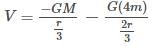
Let the point be the position when the gravitational field is zero
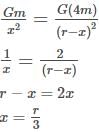
the point P is at a distance r/3 from mass m and 2r/3 from mass 4m


A satellite which appears to be at a fixed position at a definite height to an observer is called:- a)Geostationary satellite and geosynchronous satellite
- b)Polar satellite
- c)Geostationary satellite
- d)Geosynchronous satellite
Correct answer is option 'A'. Can you explain this answer?
A satellite which appears to be at a fixed position at a definite height to an observer is called:
a)
Geostationary satellite and geosynchronous satellite
b)
Polar satellite
c)
Geostationary satellite
d)
Geosynchronous satellite
 | Neha Joshi answered |
As the relative velocity of the satellite with respect to the earth is zero, it appears stationary from the Earth surface and therefore it is called is geostationary satellite or geosynchronous satellite.
Statement I : For a mass M kept at the centre of a cube of side a, the flux of gravitational field passing through its sides is 4p GM.andStatement II : If the direction of a field due to apoint source is radial and its dependence on the distance r from the source is given as  its flux through a closed surface depends only on the strength of the source enclosed by the surface and not on the size or shape of the surface. [AIEEE 2008]
- a)Statement I is true; Statement II is true; Statement II is not a correct explanation for Statement I.
- b)Statement I is true; Statement II is false.
- c)Statement I is false; Statement II is true.
- d)Statement I is true; Statement II is true; Statement II is a correct explanation for Statement I
Correct answer is option 'A'. Can you explain this answer?
Statement I : For a mass M kept at the centre of a cube of side a, the flux of gravitational field passing through its sides is 4p GM.
and
Statement II : If the direction of a field due to apoint source is radial and its dependence on the distance r from the source is given as its flux through a closed surface depends only on the strength of the source enclosed by the surface and not on the size or shape of the surface.
its flux through a closed surface depends only on the strength of the source enclosed by the surface and not on the size or shape of the surface. [AIEEE 2008]
a)
Statement I is true; Statement II is true; Statement II is not a correct explanation for Statement I.
b)
Statement I is true; Statement II is false.
c)
Statement I is false; Statement II is true.
d)
Statement I is true; Statement II is true; Statement II is a correct explanation for Statement I
 | Krishna Iyer answered |
Gravity flux:
g × area = 4 π GM
Same as electric flux gravitation flux depends only on the strength of mass hot on shape as in electric flux it depend on the amount of charge not on shape or size of surface.
g × area = 4 π GM
Same as electric flux gravitation flux depends only on the strength of mass hot on shape as in electric flux it depend on the amount of charge not on shape or size of surface.
The mass of a spaceship is 1000kg. It is to be launched from the earth's surface out into free space. The value of g and R (radius of earth) are 10 m/s2 and 6400 Km respectively. The required energy for this work will be [AIEEE 2012]- a)6.4 x 10¹¹ J
- b)6.4 x 10⁸ J
- c) 6.4 x 10⁹J
- d)6.4 x 10¹⁰J
Correct answer is option 'D'. Can you explain this answer?
The mass of a spaceship is 1000kg. It is to be launched from the earth's surface out into free space. The value of g and R (radius of earth) are 10 m/s2 and 6400 Km respectively. The required energy for this work will be
[AIEEE 2012]
a)
6.4 x 10¹¹ J
b)
6.4 x 10⁸ J
c)
6.4 x 10⁹J
d)
6.4 x 10¹⁰J
 | Jithin Saini answered |
Given,
Mass of spaceship (m) = 1000 kg
Acceleration due to gravity (g) = 10 m/s²
Radius of Earth (R) = 6400 km
We need to find out the required energy to launch the spaceship from Earth's surface to free space.
Potential Energy Calculation
When we lift an object against the gravitational force, the work done is stored as potential energy. The potential energy of an object at a height 'h' above the surface of the Earth is given by:
PE = mgh
where m is the mass of the object, g is the acceleration due to gravity and h is the height.
- Calculate the height attained by the spaceship
The spaceship is launched from the Earth's surface to free space. Therefore, the height attained by the spaceship is equal to the distance between the Earth's surface and the edge of the atmosphere.
- Calculate the radius of the atmosphere
The edge of the atmosphere is not clearly defined. However, the Kármán line is considered to be the boundary between the Earth's atmosphere and outer space. The Kármán line is located at a height of 100 km above the Earth's surface.
- Calculate the height of the spaceship
Height of the spaceship = Height of Kármán line - Radius of the Earth
Height of the spaceship = 100 km - 6400 km
Height of the spaceship = -6300 km (negative sign indicates that the spaceship is below the Earth's surface)
- Calculate the potential energy of the spaceship
PE = mgh
PE = 1000 kg x 10 m/s² x (-6300000 m)
PE = -6.3 x 10¹⁰ J (negative sign indicates that the potential energy is negative since the spaceship is below the Earth's surface)
Kinetic Energy Calculation
The kinetic energy of an object is given by:
KE = ½mv²
where m is the mass of the object and v is its velocity.
- Calculate the escape velocity of the spaceship
The escape velocity is the minimum velocity required to escape the gravitational field of the Earth. It is given by:
Vesc = √(2GM/R)
where G is the gravitational constant, M is the mass of the Earth and R is the distance between the spaceship and the center of the Earth.
- Calculate the distance between the spaceship and the center of the Earth
The distance between the spaceship and the center of the Earth is equal to the sum of the radius of the Earth and the height of the spaceship.
Distance between spaceship and center of Earth = Radius of Earth + Height of spaceship
Distance between spaceship and center of Earth = 6400 km - 6300 km
Distance between spaceship and center of Earth = 100 km
- Calculate the escape velocity of the spaceship
Vesc = √(2GM/R)
Vesc = √(2 x 6.67 x 10⁻¹¹ Nm²/kg² x 5.97 x 10²⁴ kg / 6.38 x 10⁶ m)
Vesc = 11.2 km/s
- Calculate the kinetic energy of the spaceship
KE = ½mv²
KE = ½ x 1000 kg x (11.2 km/s)²
KE = 6.2 x 10¹⁰ J
Total Energy Calculation
The total energy required
Mass of spaceship (m) = 1000 kg
Acceleration due to gravity (g) = 10 m/s²
Radius of Earth (R) = 6400 km
We need to find out the required energy to launch the spaceship from Earth's surface to free space.
Potential Energy Calculation
When we lift an object against the gravitational force, the work done is stored as potential energy. The potential energy of an object at a height 'h' above the surface of the Earth is given by:
PE = mgh
where m is the mass of the object, g is the acceleration due to gravity and h is the height.
- Calculate the height attained by the spaceship
The spaceship is launched from the Earth's surface to free space. Therefore, the height attained by the spaceship is equal to the distance between the Earth's surface and the edge of the atmosphere.
- Calculate the radius of the atmosphere
The edge of the atmosphere is not clearly defined. However, the Kármán line is considered to be the boundary between the Earth's atmosphere and outer space. The Kármán line is located at a height of 100 km above the Earth's surface.
- Calculate the height of the spaceship
Height of the spaceship = Height of Kármán line - Radius of the Earth
Height of the spaceship = 100 km - 6400 km
Height of the spaceship = -6300 km (negative sign indicates that the spaceship is below the Earth's surface)
- Calculate the potential energy of the spaceship
PE = mgh
PE = 1000 kg x 10 m/s² x (-6300000 m)
PE = -6.3 x 10¹⁰ J (negative sign indicates that the potential energy is negative since the spaceship is below the Earth's surface)
Kinetic Energy Calculation
The kinetic energy of an object is given by:
KE = ½mv²
where m is the mass of the object and v is its velocity.
- Calculate the escape velocity of the spaceship
The escape velocity is the minimum velocity required to escape the gravitational field of the Earth. It is given by:
Vesc = √(2GM/R)
where G is the gravitational constant, M is the mass of the Earth and R is the distance between the spaceship and the center of the Earth.
- Calculate the distance between the spaceship and the center of the Earth
The distance between the spaceship and the center of the Earth is equal to the sum of the radius of the Earth and the height of the spaceship.
Distance between spaceship and center of Earth = Radius of Earth + Height of spaceship
Distance between spaceship and center of Earth = 6400 km - 6300 km
Distance between spaceship and center of Earth = 100 km
- Calculate the escape velocity of the spaceship
Vesc = √(2GM/R)
Vesc = √(2 x 6.67 x 10⁻¹¹ Nm²/kg² x 5.97 x 10²⁴ kg / 6.38 x 10⁶ m)
Vesc = 11.2 km/s
- Calculate the kinetic energy of the spaceship
KE = ½mv²
KE = ½ x 1000 kg x (11.2 km/s)²
KE = 6.2 x 10¹⁰ J
Total Energy Calculation
The total energy required
Two spherical bodies of mass M and 5M and radii R and 2R respectively are released in free space with initial separation between their centres equal to 12R. If they attract each other due to gravitational force only. then the distance covered by the smaller body just before collision is [AIEEE 2003]- a)2.5 R
- b)4.5 R
- c)7.5 R
- d)1.5 R
Correct answer is option 'C'. Can you explain this answer?
Two spherical bodies of mass M and 5M and radii R and 2R respectively are released in free space with initial separation between their centres equal to 12R. If they attract each other due to gravitational force only. then the distance covered by the smaller body just before collision is [AIEEE 2003]
a)
2.5 R
b)
4.5 R
c)
7.5 R
d)
1.5 R
 | Anjana Sharma answered |


A satellite of mass m revolves around the earth of radius R at a height x from its surface. If g is the acceleration due to gravity on the surface of the earth, the orbital speed of the satellite is [AIEEE 2004]- a)gx
- b)

- c)

- d)

Correct answer is option 'D'. Can you explain this answer?
A satellite of mass m revolves around the earth of radius R at a height x from its surface. If g is the acceleration due to gravity on the surface of the earth, the orbital speed of the satellite is
[AIEEE 2004]
a)
gx
b)
c)
d)
| | Gaurav Kumar answered |
½ mv2 = GMm/2r
r = R + x
g = GM/R2
v = [gR2/R+x]2
r = R + x
g = GM/R2
v = [gR2/R+x]2
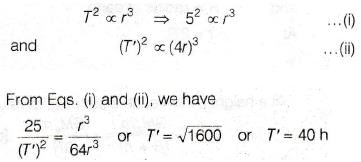
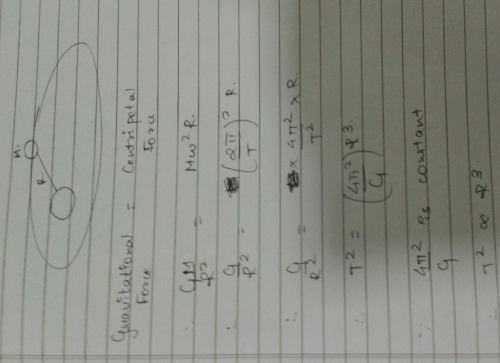
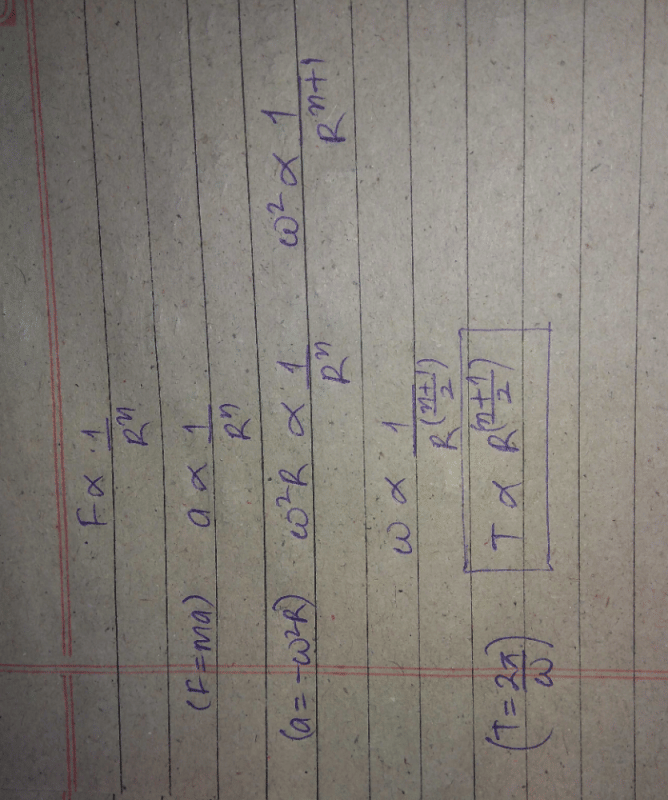
The time period of a satellite of earth is 5 h. If the separation between the earth and the satellite is increased to 4 times the previous value, the new time period will become [AIEEE 2003]- a)10 h
- b)80 h
- c)40 h
- d)20 h
Correct answer is option 'C'. Can you explain this answer?
The time period of a satellite of earth is 5 h. If the separation between the earth and the satellite is increased to 4 times the previous value, the new time period will become [AIEEE 2003]
a)
10 h
b)
80 h
c)
40 h
d)
20 h
| | Om Desai answered |
Read more on Sarthaks.com -


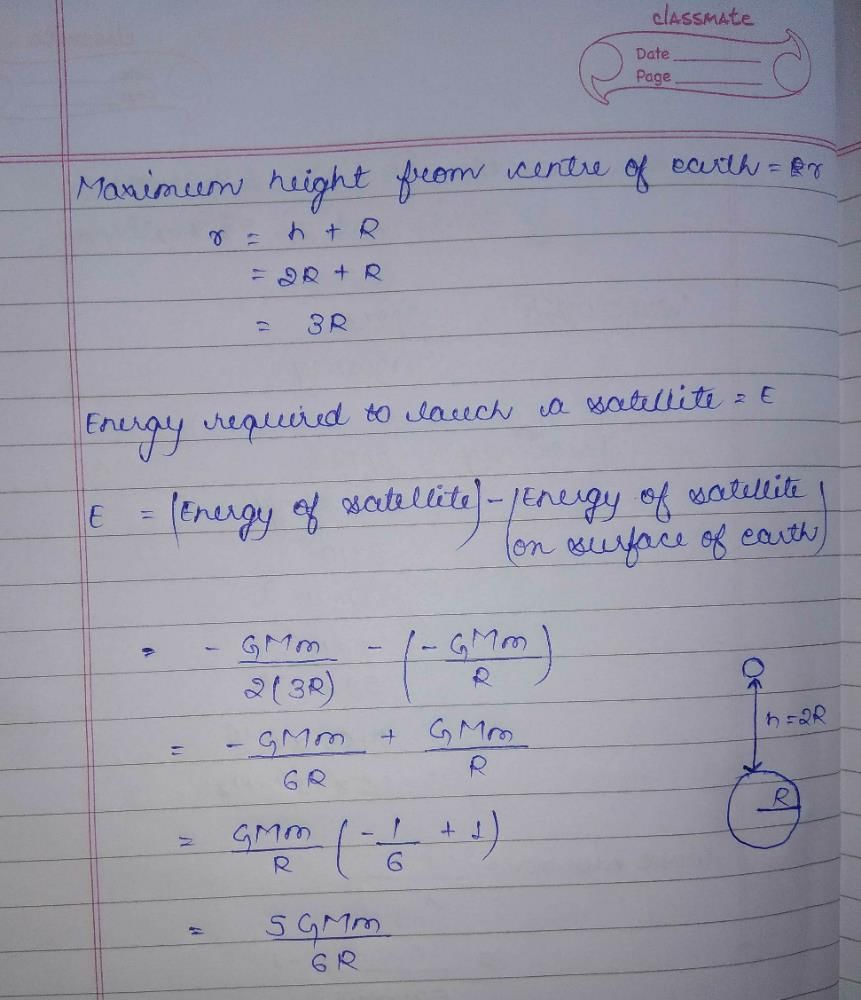
The kinetic energy needed to project a body of mass m from the earth's surface (radius R) to infinity is [AIEEE 2002]- a)

- b)

- c) mgR
- d)

Correct answer is option 'C'. Can you explain this answer?
The kinetic energy needed to project a body of mass m from the earth's surface (radius R) to infinity is [AIEEE 2002]
a)
b)
c)
mgR
d)
| | Geetika Shah answered |
If any object through with escaping velocity then the object will never come back at the ground, So we can assume it will reach at infinite distance.



Weightlessness is:- a)a situation in which the effective weight of the body becomes zero
- b)a situation in which the effective weight of the body becomes 10N
- c)a situation in which the effective weight of the body becomes 9.8N.
- d)a situation in which the effective mass of the body becomes zero
Correct answer is option 'A'. Can you explain this answer?
Weightlessness is:
a)
a situation in which the effective weight of the body becomes zero
b)
a situation in which the effective weight of the body becomes 10N
c)
a situation in which the effective weight of the body becomes 9.8N.
d)
a situation in which the effective mass of the body becomes zero
 | Akshay Shah answered |
Weight becomes zero in a freefall or when the total force on your body is zero.For example in a freely falling lift the contact force on your body is zero,so the wieghting machine would show zero reading.so you are wieghtless.
The time period of an earth satellite in circular orbit is independent of [AIEEE 2004]- a) The mass of the satellite
- b)Radius of its orbit
- c)Both the mass and radius of the orbit
- d)Neither the mass of the satellite nor the radius of its orbit
Correct answer is option 'A'. Can you explain this answer?
The time period of an earth satellite in circular orbit is independent of
[AIEEE 2004]
a)
The mass of the satellite
b)
Radius of its orbit
c)
Both the mass and radius of the orbit
d)
Neither the mass of the satellite nor the radius of its orbit
 | Raghav Bansal answered |
T = 2π a/v
a = radius of orbit
v = velocity of satellite
It is independent of mass of satellite
a = radius of orbit
v = velocity of satellite
It is independent of mass of satellite
Two particles of equal mass m go around a circle of radius R under action of their mutual gravitational attraction. The speed of each particle with respect to their centre of mass is [AIEEE 2011]- a)

- b)

- c)

- d)

Correct answer is option 'B'. Can you explain this answer?
Two particles of equal mass m go around a circle of radius R under action of their mutual gravitational attraction. The speed of each particle with respect to their centre of mass is [AIEEE 2011]
a)
b)
c)
d)
 | Sushil Kumar answered |
Both their masses move in a circular path at exactly opposite diametrically ends with their centripetal forces being the common force of gravitation between them.
I.e. mv2/r = G.m.m/ 4r2
We get v =
I.e. mv2/r = G.m.m/ 4r2
We get v =
Kepler’s second law states that the straight line joining the planet to the sun sweeps out equal areas in equal time. The statement is equivalent to saying that:- a)longitudnal acceleration is zero
- b)total acceleration is zero
- c)transverse acceleration is zero
- d)radial acceleration is zero
Correct answer is option 'C'. Can you explain this answer?
Kepler’s second law states that the straight line joining the planet to the sun sweeps out equal areas in equal time. The statement is equivalent to saying that:
a)
longitudnal acceleration is zero
b)
total acceleration is zero
c)
transverse acceleration is zero
d)
radial acceleration is zero
 | Suresh Reddy answered |
According to the second law the orbital radius and angular velocity of the planet in the elliptical orbit will vary. The planet travels faster when closer to the Sun, then slower when farther from the Sun. Hence we can say that the transverse acceleration is zero while radial and longitudinal accelerations are not zero.
Different planets have different escape velocities because:- a)different planets have different atmosphere
- b)they have different distances from sun
- c)escape velocity depends on the body that has to escape the atmosphere of the planet
- d)they have different masses and sizes
Correct answer is option 'D'. Can you explain this answer?
Different planets have different escape velocities because:
a)
different planets have different atmosphere
b)
they have different distances from sun
c)
escape velocity depends on the body that has to escape the atmosphere of the planet
d)
they have different masses and sizes
 | Nitin Nair answered |
The formula for calculating the escape velocity from the surface of a celestial body (e.g. a planet) is:
where G is the universal gravitation constant, M is the planet’s mass and R is its radius.Different planets have different mass and radius - and therefore different escape velocity.
The squares of the periods of revolution of the planets are proportional to the ___________of their semimajor axis of its orbit.- a)sqaures
- b)sqaures root
- c)cube
- d)cube roots
Correct answer is option 'C'. Can you explain this answer?
The squares of the periods of revolution of the planets are proportional to the ___________of their semimajor axis of its orbit.
a)
sqaures
b)
sqaures root
c)
cube
d)
cube roots
 | Lavanya Menon answered |
The Law of Periods: The square of the period of any planet is proportional to the cube of the semimajor axis of its orbit.
The escape velocity for a body projected vertically upwards from the surface of earth is 11 km/s. If the body is projected at an angle of 45° with the vertical, the escape velocity will be [AIEEE 2003]- a)

- b)

- c)

- d)

Correct answer is option 'C'. Can you explain this answer?
The escape velocity for a body projected vertically upwards from the surface of earth is 11 km/s. If the body is projected at an angle of 45° with the vertical, the escape velocity will be [AIEEE 2003]
a)
b)
c)
d)
 | Mira Sharma answered |
The escape velocity of a body does not depend on the angle of projection from earth. It is 11km/sec.
A satellite moves in a circular orbit around earth. The radius of this orbit is one half that of moon’s orbit. The satellite completes one revolution in:- a)(2) 3/2 lunar month
- b)(2) 3 lunar month
- c)(2) -3/2 lunar month
- d)(2)1/2 lunar month
Correct answer is option 'C'. Can you explain this answer?
A satellite moves in a circular orbit around earth. The radius of this orbit is one half that of moon’s orbit. The satellite completes one revolution in:
a)
(2) 3/2 lunar month
b)
(2) 3 lunar month
c)
(2) -3/2 lunar month
d)
(2)1/2 lunar month
| | Suresh Reddy answered |
We know that the time period of revolution for any object in orbit of radius r is 3
T = 2π (r3 / Gm) 1/2
Where m is the mass of earth.
As the ratio of radius of orbit of satellite to that of moon is 1:2
Hence there time period has a ratio of 1: 23/2
T = 2π (r3 / Gm) 1/2
Where m is the mass of earth.
As the ratio of radius of orbit of satellite to that of moon is 1:2
Hence there time period has a ratio of 1: 23/2
The change in the value of g at a height h above the surface of the earth is the same as at a depth d below the surface of earth. When both d and h are much smaller than the radius of earth, then which one of the following is correct ? [AIEEE 2005]- a)

- b)

- c) d= 2h
- d) d = h
Correct answer is option 'C'. Can you explain this answer?
The change in the value of g at a height h above the surface of the earth is the same as at a depth d below the surface of earth. When both d and h are much smaller than the radius of earth, then which one of the following is correct ?
[AIEEE 2005]
a)
b)
c)
d= 2h
d)
d = h
| | Jyoti Aiims Aspirant answered |
At height h g^=g [1-2h/R]
at depth d g^=g [1-d/R]
1-2h/R=1-d/R
d=2h
at depth d g^=g [1-d/R]
1-2h/R=1-d/R
d=2h
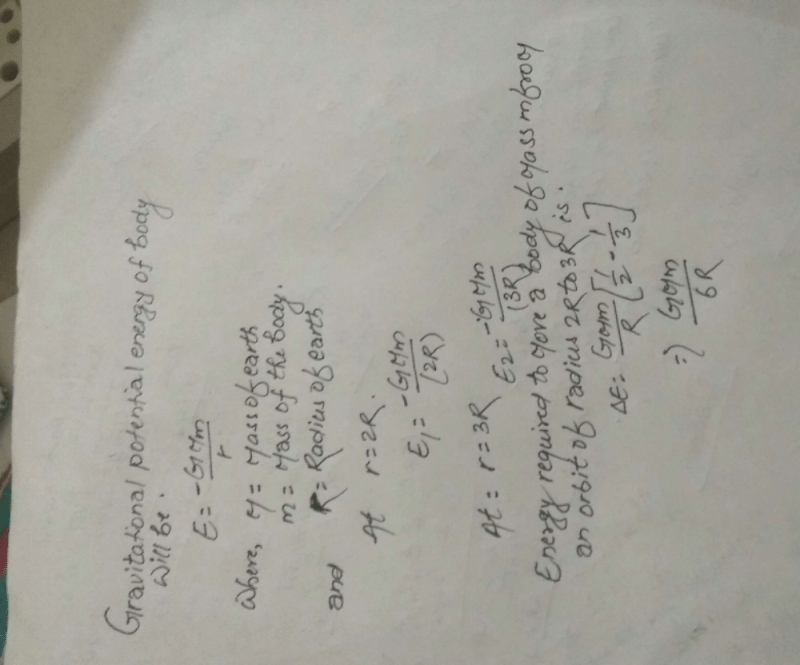
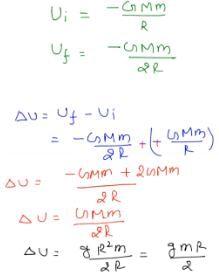
If g is the acceleration due to gravity on the earth's surface, the gain in the potential energy of an object of mass m raised from the surface of the earth to a height equal to the radius R of the earth, is [AIEEE 2004]- a)2 mgR
- b)

- c)

- d)mgR
Correct answer is option 'B'. Can you explain this answer?
If g is the acceleration due to gravity on the earth's surface, the gain in the potential energy of an object of mass m raised from the surface of the earth to a height equal to the radius R of the earth, is
[AIEEE 2004]
a)
2 mgR
b)
c)
d)
mgR
| | Pooja Shah answered |
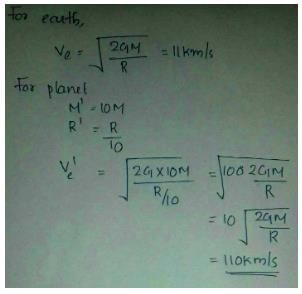
A planet in a distant solar system is 10 times more massive than the earth and its radius is 10 times smaller. Given that the escape velocity from the earth is 11kms-1, the escape velocity from the surface of the planet would be [AIEEE 2008]- a)1.1 kms-1
- b)11 kms-1
- c)110 kms-1
- d)0.11 kms-1
Correct answer is option 'C'. Can you explain this answer?
A planet in a distant solar system is 10 times more massive than the earth and its radius is 10 times smaller. Given that the escape velocity from the earth is 11kms-1, the escape velocity from the surface of the planet would be
[AIEEE 2008]
a)
1.1 kms-1
b)
11 kms-1
c)
110 kms-1
d)
0.11 kms-1
| | Om Desai answered |
If gE and gM are the accelerations due to gravity on the surfaces of the earth and the moon respectively and if Millikan's oil drop experiment could be performed on the two surfaces, one will find the ratio  to be [AIEEE 2007]
- a)1
- b)Zero
- c)

- d)

Correct answer is option 'A'. Can you explain this answer?
If gE and gM are the accelerations due to gravity on the surfaces of the earth and the moon respectively and if Millikan's oil drop experiment could be performed on the two surfaces, one will find the ratio to be
to be [AIEEE 2007]
a)
1
b)
Zero
c)
d)
| | Geetika Shah answered |
Since electronic charge (1.6 × 10⁻¹⁹C) is a universal constant. It does not depend on g. Therefore, electronic charge on the moon = electronic charge on the earth
Or
(electronic charge on the moon)/ (electronic charge on the earth) = 1
Or
(electronic charge on the moon)/ (electronic charge on the earth) = 1


If suddenly the gravitational force of attraction between earth and a satellite revolving around it becomes zero, then the satellite will [AIEEE 2002]- a)Continue to move in its orbit with same velocity
- b)Move tangentially to the original orbit with the same velocity
- c)Become stationary in its orbit
- d)Move towards the earth
Correct answer is option 'B'. Can you explain this answer?
If suddenly the gravitational force of attraction between earth and a satellite revolving around it becomes zero, then the satellite will [AIEEE 2002]
a)
Continue to move in its orbit with same velocity
b)
Move tangentially to the original orbit with the same velocity
c)
Become stationary in its orbit
d)
Move towards the earth
| | Mira Sharma answered |
When the gravitational force becomes zero that means the centripetal force required cannot be provided therefore the satellite will tend to move tangential to the original orbit with the same velocity (that the satellite had at the instant before the gravitation force become 0).


Chapter doubts & questions for Gravitation - 30-Day Revision Course for NEET 2026 is part of NEET exam preparation. The chapters have been prepared according to the NEET exam syllabus. The Chapter doubts & questions, notes, tests & MCQs are made for NEET 2026 Exam. Find important definitions, questions, notes, meanings, examples, exercises, MCQs and online tests here.
Chapter doubts & questions of Gravitation - 30-Day Revision Course for NEET in English & Hindi are available as part of NEET exam. Download more important topics, notes, lectures and mock test series for NEET Exam by signing up for free.
30-Day Revision Course for NEET85 videos|301 docs|171 tests |
