


All Exams > NEET > 30-Day Revision Course for NEET > All Questions
All questions of Mechanical Properties of Fluids for NEET Exam
A slender homogeneous rod of length 2L floats partly immersed in water, being supported by a string fastened to one of its ends, as shown. The specific gravity of the rod is 0.75. The length of rod that extends out of water is 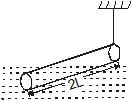
- a)L
- b)

- c)

- d)3L
Correct answer is option 'A'. Can you explain this answer?
A slender homogeneous rod of length 2L floats partly immersed in water, being supported by a string fastened to one of its ends, as shown. The specific gravity of the rod is 0.75. The length of rod that extends out of water is
a)
L
b)
c)
d)
3L
 | Knowledge Hub answered |
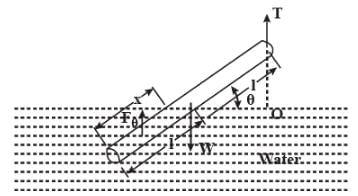
Let's say x length of the rod is dipped into the water.
Since the buoyant force acts through the centre of gravity the displaced water , the condition for rotational equilibrium is, taking moments about a point O along the line of action of T,
0=Στo
⇒0=wl cosθ−FB(2l−x/2)cosθ
⇒0=ρrodgA(2l)(lcosθ)−ρwatergAx(2l−x/2)cosθ
⇒0=(1/2ρwatergAcosθ) (x2−4lx+4 (ρrod/ρwater)l2) where A=cross section area
⇒x2−4lx+3l2=0
⇒x=l,3l.
x=3l is not a possible solution, hence 2l−x=2l−l=l length of the rod extends out of the water.

An open-ended U-tube of uniform cross-sectional area contains water (density 1.0 gram/centimeter3) standing initially 20 centimeters from the bottom in each arm. An immiscible liquid of density 4.0 grams/centimeter3 is added to one arm until a layer 5 centimeters high forms, as shown in the figure above. What is the ratio h2/h1 of the heights of the liquid in the two arms ? 
- a) 3/1
- b)5/2
- c)2/1
- d)3/2
Correct answer is option 'C'. Can you explain this answer?
An open-ended U-tube of uniform cross-sectional area contains water (density 1.0 gram/centimeter3) standing initially 20 centimeters from the bottom in each arm. An immiscible liquid of density 4.0 grams/centimeter3 is added to one arm until a layer 5 centimeters high forms, as shown in the figure above. What is the ratio h2/h1 of the heights of the liquid in the two arms ?
a)
3/1
b)
5/2
c)
2/1
d)
3/2
 | Ambition Institute answered |
5 × 4 × 10 + (h1 - 5) × 10 = h2 × 1 × 10
200 + 10h1 – 50 = 10h2
10h2 - 10h1 = 150
h2 - h1 = 15
h2 + h1 = 20 + 20 + 5 = 45
2h2 = 60
h2 = 30
h1 = 15
h2/h1 = 30/15
h2/h1 = 2/1
200 + 10h1 – 50 = 10h2
10h2 - 10h1 = 150
h2 - h1 = 15
h2 + h1 = 20 + 20 + 5 = 45
2h2 = 60
h2 = 30
h1 = 15
h2/h1 = 30/15
h2/h1 = 2/1
Water is flowing in a tube of non-uniform radius. The ratio of the radii at entrance and exit ends of tube is 3 : 2. The ratio of the velocities of water entering in and exiting from the tube will be –- a)8 : 27
- b)4 : 9
- c) 1 : 1
- d) 9 : 4
Correct answer is option 'B'. Can you explain this answer?
Water is flowing in a tube of non-uniform radius. The ratio of the radii at entrance and exit ends of tube is 3 : 2. The ratio of the velocities of water entering in and exiting from the tube will be –
a)
8 : 27
b)
4 : 9
c)
1 : 1
d)
9 : 4
 | Naina Sharma answered |
We know, for the fluid flowing through the non-uniform pipe the velocity of fluid is inversely proportional to the area of cross-section.
Hence, if v1, v2 are the velocities of entry and exit end of the pipe and a1, a2 are the area of cross-sections of entry and exit end of the pipe, then
v1/v2=a2/a1
⇒v1/v2=(r2)2/(r1)2
∴v1/v2=(2)2/(3)2=4/9
Hence, if v1, v2 are the velocities of entry and exit end of the pipe and a1, a2 are the area of cross-sections of entry and exit end of the pipe, then
v1/v2=a2/a1
⇒v1/v2=(r2)2/(r1)2
∴v1/v2=(2)2/(3)2=4/9
The area of cross-section of the wider tube shown in figure is 800 cm2. If a mass of 12 kg is placed on the massless piston, the difference in heights h in the level of water in the two tubes is : 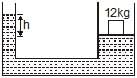
- a)10 cm
- b)6 cm
- c)15 cm
- d)2 cm
Correct answer is option 'C'. Can you explain this answer?
The area of cross-section of the wider tube shown in figure is 800 cm2. If a mass of 12 kg is placed on the massless piston, the difference in heights h in the level of water in the two tubes is :
a)
10 cm
b)
6 cm
c)
15 cm
d)
2 cm
 | EduRev JEE answered |
h × ρ × 10 = 120/800 × 10-4
h × ρ = 12/8 × 102
h × ρ = 150m
h × 1000 = 150m
h = 15cm
h × ρ = 12/8 × 102
h × ρ = 150m
h × 1000 = 150m
h = 15cm
Water is flowing in a horizontal pipe ofnon-uniform cross - section. At the most contracted place of the pipe –- a)Velocity of water will be maximum and pressure minimum
- b)Pressure of water will be maximum and velocity minimum
- c)Both pressure and velocity of water will be maximum
- d)Both pressure and velocity of water will be
minimum
Correct answer is option 'A'. Can you explain this answer?
Water is flowing in a horizontal pipe of
non-uniform cross - section. At the most contracted place of the pipe –
a)
Velocity of water will be maximum and pressure minimum
b)
Pressure of water will be maximum and velocity minimum
c)
Both pressure and velocity of water will be maximum
d)
Both pressure and velocity of water will be
minimum
minimum
 | Preeti Khanna answered |
Continuity equation states that, "For a non-viscous liquid and streamlined flow the volume flow rate (Area of cross section x velocity) is constant throughout the flow at any point".
According to this, Av = constant. So if at any point the cross-section area decreases then velocity of liquid at that point increases and vice-versa.
Bernoulli's equation states that, "For a streamlined and non-viscous flow the total energy (kinetic energy and pressure gradient) remains constant throughout the liquid.
According to this, kinetic energy + Pressure gradient = constant. So, if at any point the velocity increases the pressure at that point decreases and vice-versa.
At the most contracted place of the pipe area of cross section is minimum
⇒ velocity is maximum
⇒ pressure is minimum
According to this, Av = constant. So if at any point the cross-section area decreases then velocity of liquid at that point increases and vice-versa.
Bernoulli's equation states that, "For a streamlined and non-viscous flow the total energy (kinetic energy and pressure gradient) remains constant throughout the liquid.
According to this, kinetic energy + Pressure gradient = constant. So, if at any point the velocity increases the pressure at that point decreases and vice-versa.
At the most contracted place of the pipe area of cross section is minimum
⇒ velocity is maximum
⇒ pressure is minimum
large tank is filled with water to a height H. A small hole is made at the base of the tank. It takes T1 time to decrease the height of water to H/h, (h > 1) and it takes T2 time to take out the rest of water. If T1 = T2, then the value of h is :- a)2
- b)3
- c)4
- d)

Correct answer is option 'C'. Can you explain this answer?
large tank is filled with water to a height H. A small hole is made at the base of the tank. It takes T1 time to decrease the height of water to H/h, (h > 1) and it takes T2 time to take out the rest of water. If T1 = T2, then the value of h is :
a)
2
b)
3
c)
4
d)
 | Lavanya Menon answered |
t=A/a √2/g[√H1−√H2]
T1= A/a√2/g[√H1√H/η]
T2=A/a√2/g[√H/η−0]
Given, T1=T2
√H−√H/η=√H/η−0
⇒√H=2√H/η
⇒η=4
T1= A/a√2/g[√H1√H/η]
T2=A/a√2/g[√H/η−0]
Given, T1=T2
√H−√H/η=√H/η−0
⇒√H=2√H/η
⇒η=4
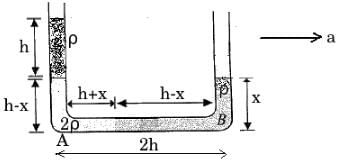
The vertical limbs of a U shaped tube are filled with a liquid of density r upto a height h on each side. The horizontal portion of the U tube having length 2h contains a liquid of density 2r. The U tube is moved horizontally with an accelerator g/2 parallel to the horizontal arm. The difference in heights in liquid levels in the two vertical limbs, at steady state will be- a)2h/7
- b)8h/7
- c)4h/7
- d)None
Correct answer is option 'B'. Can you explain this answer?
The vertical limbs of a U shaped tube are filled with a liquid of density r upto a height h on each side. The horizontal portion of the U tube having length 2h contains a liquid of density 2r. The U tube is moved horizontally with an accelerator g/2 parallel to the horizontal arm. The difference in heights in liquid levels in the two vertical limbs, at steady state will be
a)
2h/7
b)
8h/7
c)
4h/7
d)
None
| | Neha Joshi answered |
Given:
a=g/2
Pressure at A
PA=Po+ρgh+(2ρ)g(h−x)=Po+3ρgh−2ρgx
Pressure at B
PB=Po+ρgx
Using
PA−PB=[2ρ(h+x)+ρ(h−x)]a
∴ (Po+3ρgh−2ρgx)−(Po+ρgx)=[3ρh+ρx]×g/2
OR 3ρgh−3ρgx=3ρgh/2+1ρgx/2
OR 3ρgh/2=7ρgx/2 ⟹x=3h/7
∴ Difference in the heights between two columns ΔH=(2h−x)−x=2h−2x
⟹ ΔH=2h−6h/7=8h/7
a=g/2
Pressure at A
PA=Po+ρgh+(2ρ)g(h−x)=Po+3ρgh−2ρgx
Pressure at B
PB=Po+ρgx
Using
PA−PB=[2ρ(h+x)+ρ(h−x)]a
∴ (Po+3ρgh−2ρgx)−(Po+ρgx)=[3ρh+ρx]×g/2
OR 3ρgh−3ρgx=3ρgh/2+1ρgx/2
OR 3ρgh/2=7ρgx/2 ⟹x=3h/7
∴ Difference in the heights between two columns ΔH=(2h−x)−x=2h−2x
⟹ ΔH=2h−6h/7=8h/7
A piece of steel has a weight W in air, W1 when completely immersed in water and W2 when completely immersed in an unknown liquid. The relative density (specific gravity) of liquid is :- a)

- b)

- c)

- d)

Correct answer is option 'B'. Can you explain this answer?
A piece of steel has a weight W in air, W1 when completely immersed in water and W2 when completely immersed in an unknown liquid. The relative density (specific gravity) of liquid is :
a)
b)
c)
d)
| | Preeti Iyer answered |
If the loss of weight of a body in water is 'a' while in liquid is 'b' then
Sigma in liquid / sigma in water = upthrust on body in liquid / upthrust on body in water
Then a / b = (W air - W liquid) / (W air - W water).
Sigma in liquid / sigma in water = upthrust on body in liquid / upthrust on body in water
Then a / b = (W air - W liquid) / (W air - W water).
A beaker containing water is placed on the platform of a spring balance. The balance reads 1.5 kg. A stone of mass 0.5 kg and density 500 kg/m3 is immersed in water without touching the walls of beaker. What will be the balance reading now ?- a)2 Kg
- b)2.5 Kg
- c)1 KG
- d)3 Kg
Correct answer is option 'B'. Can you explain this answer?
A beaker containing water is placed on the platform of a spring balance. The balance reads 1.5 kg. A stone of mass 0.5 kg and density 500 kg/m3 is immersed in water without touching the walls of beaker. What will be the balance reading now ?
a)
2 Kg
b)
2.5 Kg
c)
1 KG
d)
3 Kg
 | Suresh Reddy answered |
Since the weight of the block must be equal to the buoyant force acting on the block for it to remain in equilibrium,
B=0.5kg
The reading of the spring balance = Weight of water + Buoyant force' reaction pair force downwards
=1.5kg+0.5kg=2kg
A boy carries a fish in one hand and a bucket (not full) of water in the other hand. If the places the fish in the bucket, the weight now carried by him (assume that water does not spill) :- a)Is less than before
- b)Is more than before
- c)Is the same as before
- d)Depends upon his speed
Correct answer is option 'C'. Can you explain this answer?
A boy carries a fish in one hand and a bucket (not full) of water in the other hand. If the places the fish in the bucket, the weight now carried by him (assume that water does not spill) :
a)
Is less than before
b)
Is more than before
c)
Is the same as before
d)
Depends upon his speed
 | Gaurav Kumar answered |
Buoyant force on fish due to water will be equal and opposite to the force on water by fish.
These two forces are internal forces for the fish bucket system.
Hence, they will not affect the weight the boy carries.
These two forces are internal forces for the fish bucket system.
Hence, they will not affect the weight the boy carries.
In the figure shown, the heavy cylinder (radius R) resting on a smooth surface separates two liquids of densities 2r and 3r. The height `h' for the equilibrium of cylinder must be 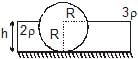
- a)3R/2
- b)

- c) R√2
- d)None
Correct answer is option 'B'. Can you explain this answer?
In the figure shown, the heavy cylinder (radius R) resting on a smooth surface separates two liquids of densities 2r and 3r. The height `h' for the equilibrium of cylinder must be
a)
3R/2
b)
c)
R√2
d)
None
 | Om Desai answered |
First, let’s concentrate on the force exerted by the liquid of density 3ρ on the cylinder in the horizontal direction.
Let the length of the cylinder be L.
Consider a small segment of length rdθ at an angle θ from the horizontal line.
Height of this segment from the topmost point of fluid 3ρ is R sinθ
Hence, the pressure exerted by the fluid will be 3ρgRsinθ
The force exerted in the horizontal direction, dF=3ρgRsinθRLcosθdθ
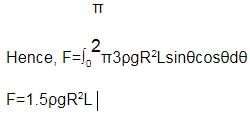
Similarly, proceeding for the fluid with density 2ρ
Height of any segment, above horizontal =h−R−Rsinθ
below horizontal, h−R+Rsinθ
Thus, horizontal force on the cylinder because of fluid,

For equilibrium, both the forces should be equal, hence solving the above equation,
h = R √3/2
Let the length of the cylinder be L.
Consider a small segment of length rdθ at an angle θ from the horizontal line.
Height of this segment from the topmost point of fluid 3ρ is R sinθ
Hence, the pressure exerted by the fluid will be 3ρgRsinθ
The force exerted in the horizontal direction, dF=3ρgRsinθRLcosθdθ
Similarly, proceeding for the fluid with density 2ρ
Height of any segment, above horizontal =h−R−Rsinθ
below horizontal, h−R+Rsinθ
Thus, horizontal force on the cylinder because of fluid,
For equilibrium, both the forces should be equal, hence solving the above equation,
h = R √3/2



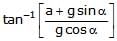
A fluid container is containing a liquid of density r is is accelerating upward with acceleration a along the inclined place of inclination a as shwon. Then the angle of inclination q of free surface is : 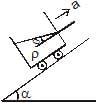
- a)tan_1

- b)
- c)
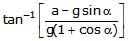
- d)
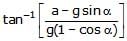
Correct answer is option 'B'. Can you explain this answer?
A fluid container is containing a liquid of density r is is accelerating upward with acceleration a along the inclined place of inclination a as shwon. Then the angle of inclination q of free surface is :
a)
tan_1
b)
c)
d)
 | Lohit Matani answered |
First resolve all components in the along and perpendicular to incline. Pressure difference is created in a vertical column full of liquid. This is because of gravity acting in downward direction. Similarly, pressure difference will be created too along the incline. So, p = h * d * g * cosa (in perpendicular direction) and
p = hd (a + g sina) (along incline).
So, tan(theta) = (a + gsina)/(gcosa)
p = hd (a + g sina) (along incline).
So, tan(theta) = (a + gsina)/(gcosa)
Some liquid is filled in a cylindrical vessel of radius R. Let F1 be the force applied by the liquid on the bottom of the cylinder. Now the same liquid is poured into a vessel of uniform square cross-section of side R. Let F2 be the force applied by the liquid on the bottom of this new vessel. Then :- a) F1 = pF2
- b)F1 =

- c)F1 =

- d) F1 = F2
Correct answer is option 'D'. Can you explain this answer?
Some liquid is filled in a cylindrical vessel of radius R. Let F1 be the force applied by the liquid on the bottom of the cylinder. Now the same liquid is poured into a vessel of uniform square cross-section of side R. Let F2 be the force applied by the liquid on the bottom of this new vessel. Then :
a)
F1 = pF2
b)
F1 =
c)
F1 =
d)
F1 = F2
| | Lohit Matani answered |
Force applied on the base is equal to the weight of the liquid, since in both cases the same liquid has been poured in the container, it will exert the same force on the base of the container.
F1=F2
F1=F2
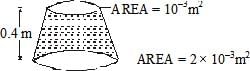
Water flows through a frictionless duct with a cross-section varying as shown in figure. Pressure p at points along the axis is represented by 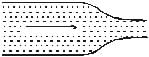
- a)
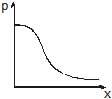
- b)
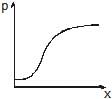
- c)
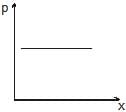
- d)
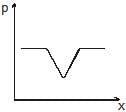
Correct answer is option 'A'. Can you explain this answer?
Water flows through a frictionless duct with a cross-section varying as shown in figure. Pressure p at points along the axis is represented by
a)
b)
c)
d)
| | Naina Sharma answered |
When the cross section of duct decreases the velocity of water increases and in accordance with Bernoulli's theorem the pressure decreases at that place.
Therefore, in this case, the pressure remains constant initially and then decreases as the area of cross section decreases along the neck of the tube and then remains constant along the mouth of the tube.
Hence, the graph in option A is correct.
Therefore, in this case, the pressure remains constant initially and then decreases as the area of cross section decreases along the neck of the tube and then remains constant along the mouth of the tube.
Hence, the graph in option A is correct.
A rectangular tank is placed on a horizontal ground and is filled with water to a height H above the base. A small hole is made on one vertical side at a depth D below the level of the water in the tank. The distance x from the bottom of the tank at which the water jet from the tank will hit the ground is- a)

- b)

- c)

- d)

Correct answer is option 'A'. Can you explain this answer?
A rectangular tank is placed on a horizontal ground and is filled with water to a height H above the base. A small hole is made on one vertical side at a depth D below the level of the water in the tank. The distance x from the bottom of the tank at which the water jet from the tank will hit the ground is
a)
b)
c)
d)
| | Knowledge Hub answered |
Time taken by liquid drop to fall
S=ut+(1/2)at2
t=√2(H−D)/g
Horizontal velocity of liquid =√2gD
Range =√2(H−D)/g× √2gD
Range =2√D(H−D)
S=ut+(1/2)at2
t=√2(H−D)/g
Horizontal velocity of liquid =√2gD
Range =√2(H−D)/g× √2gD
Range =2√D(H−D)
A large tank is filled with water (density = 103 kg/m3). A small hole is made at a depth 10m below water surface. The range of water issuing out of the hole is Ron ground. What extra pressure must be applied on the water surface so that the range becomes 2R (take 1 atm = 105 Pa and g = 10 m/s2) : 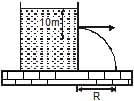
- a)9 Atm
- b)4 Atm
- c)5 Atm
- d)3 Atm
Correct answer is option 'D'. Can you explain this answer?
A large tank is filled with water (density = 103 kg/m3). A small hole is made at a depth 10m below water surface. The range of water issuing out of the hole is Ron ground. What extra pressure must be applied on the water surface so that the range becomes 2R (take 1 atm = 105 Pa and g = 10 m/s2) :
a)
9 Atm
b)
4 Atm
c)
5 Atm
d)
3 Atm
| | Preeti Iyer answered |
Range will become twice, if the velocity of efflux becomes twice. Since velocity of efflux is √2gh, it will become twice, if h becomes 4 times, or 40m.
Thus, an extra pressure equivalent to 30m of water should be applied.
1atm=0.76×13.6 m of water =10.336m of water
30m of water ≈3atm
Thus, an extra pressure equivalent to 30m of water should be applied.
1atm=0.76×13.6 m of water =10.336m of water
30m of water ≈3atm
The cross sectional area of a horizontal tube increases along its length linearly, as we move in the direction of flow. The variation of pressure, as we move along its length in the direction of flow (x-direction), is best depicted by which of the following graphs- a)

- b)

- c)

- d)

Correct answer is option 'A'. Can you explain this answer?
The cross sectional area of a horizontal tube increases along its length linearly, as we move in the direction of flow. The variation of pressure, as we move along its length in the direction of flow (x-direction), is best depicted by which of the following graphs
a)
b)
c)
d)
| | Knowledge Hub answered |
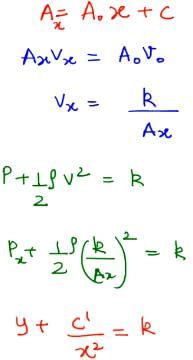
So, it will be a downward facing parabola.
The pressure at the bottom of a tank of water is 3P where P is the atmospheric pressure. If the water is drawn out till the level of water is lowered by one fifth., the pressure at the bottom of the tank will now be- a)2 P
- b)(13/5) P
- c)(8/5) P
- d)(4/5) P
Correct answer is option 'B'. Can you explain this answer?
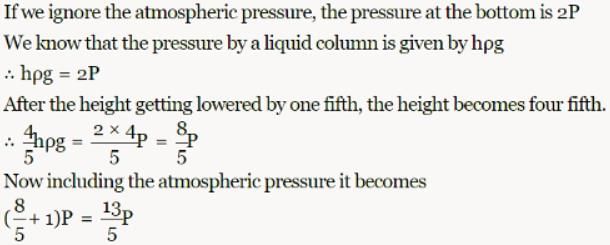
The pressure at the bottom of a tank of water is 3P where P is the atmospheric pressure. If the water is drawn out till the level of water is lowered by one fifth., the pressure at the bottom of the tank will now be
a)
2 P
b)
(13/5) P
c)
(8/5) P
d)
(4/5) P
 | Stepway Academy answered |
A body is just floating in a liquid (their densities are equal) If the body is slightly pressed down and released it will -- a) Start oscillating
- b)Sink to the bottom
- c)Come back to the same position immediately
- d)Come back to the same position slowly
Correct answer is option 'B'. Can you explain this answer?
A body is just floating in a liquid (their densities are equal) If the body is slightly pressed down and released it will -
a)
Start oscillating
b)
Sink to the bottom
c)
Come back to the same position immediately
d)
Come back to the same position slowly
 | Hansa Sharma answered |
The body will sink to the bottom as it gains a downward velocity and has no force to bring it back up. The weight becomes greater than upwards thrust.
As body is just floating, its density is same as that of the liquid.
If pressed below, it will gain momentum downwards, and continue to sink till bottom.
When the body is slightly pressed, the contraction in volume decreases upthrust, so weight becomes greater than upthrust, body moves down. The upthrust further decreases, since more and more contraction occurs as the body moves down. The body thus, sinks to the bottom.
If pressed below, it will gain momentum downwards, and continue to sink till bottom.
When the body is slightly pressed, the contraction in volume decreases upthrust, so weight becomes greater than upthrust, body moves down. The upthrust further decreases, since more and more contraction occurs as the body moves down. The body thus, sinks to the bottom.
A jet of water with cross section of 6 cm2 strikes a wall at an angle of 60º to the normal and rebounds elastically from the wall without losing energy. If the velocity of the water in the jet is 12 m/s, the force acting on the wall is- a)0.864 Nt
- b)86.4 Nt
- c)72 Nt
- d)7.2 Nt
Correct answer is option 'B'. Can you explain this answer?
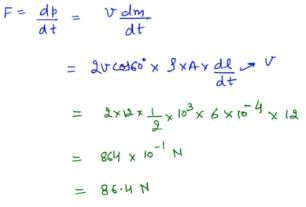
A jet of water with cross section of 6 cm2 strikes a wall at an angle of 60º to the normal and rebounds elastically from the wall without losing energy. If the velocity of the water in the jet is 12 m/s, the force acting on the wall is
a)
0.864 Nt
b)
86.4 Nt
c)
72 Nt
d)
7.2 Nt
| | Bhargavi Yadav answered |
An open cubical tank was initially fully filled with water. When the tank was accelerated on a horizontal plane along one of its side it was found that one third of volume of water spilled out. The acceleration was- a) g/4
- b) g/3
- c)3g/2
- d)None
Correct answer is option 'B'. Can you explain this answer?
An open cubical tank was initially fully filled with water. When the tank was accelerated on a horizontal plane along one of its side it was found that one third of volume of water spilled out. The acceleration was
a)
g/4
b)
g/3
c)
3g/2
d)
None
| | Pooja Kulkarni answered |
Let say the tank is accelerating by some acceleration a, such that the rest water in the tanks forms shape like this -
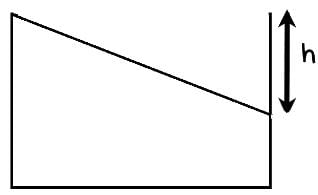
Acceleration, a is right wards.
Where let say h is the height from top till which there is no water
Now if we say V is total volume and B is area of its base and S be its height
We have ½ h X B = V / 3
Thus we get h = S/3
Thus the angle in this cross section of vacant triangle is tan-1 ⅓
Also the same triangle relates a and g, which can be seen when we make the block a inertial frame by adding pseudo force of magnitude ma and directing leftwards, thus we get a/g = ⅓
Thus we get a = g/3
Acceleration, a is right wards.
Where let say h is the height from top till which there is no water
Now if we say V is total volume and B is area of its base and S be its height
We have ½ h X B = V / 3
Thus we get h = S/3
Thus the angle in this cross section of vacant triangle is tan-1 ⅓
Also the same triangle relates a and g, which can be seen when we make the block a inertial frame by adding pseudo force of magnitude ma and directing leftwards, thus we get a/g = ⅓
Thus we get a = g/3
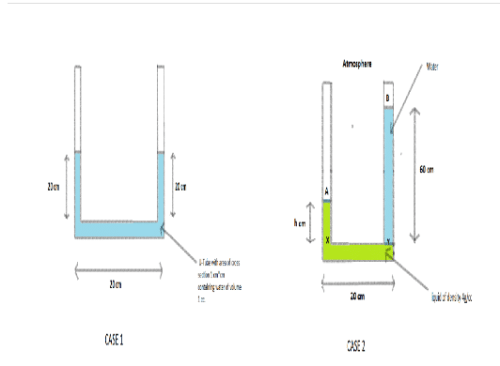
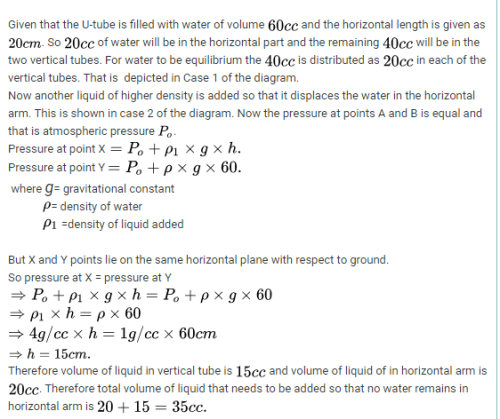
A U-tube having horizontal arm of length 20 cm, has uniform cross-sectional area = 1 cm2. It is filled with water of volume 60 cc. What volume of a liquid of density 4 g/cc should be poured from one side into the U-tube so that no water is left in the horizontal arm of the tube?- a)60 cc
- b)45 cc
- c)50 cc
- d)35 cc
Correct answer is option 'D'. Can you explain this answer?
A U-tube having horizontal arm of length 20 cm, has uniform cross-sectional area = 1 cm2. It is filled with water of volume 60 cc. What volume of a liquid of density 4 g/cc should be poured from one side into the U-tube so that no water is left in the horizontal arm of the tube?
a)
60 cc
b)
45 cc
c)
50 cc
d)
35 cc
 | Arun Khanna answered |
There is a metal cube inside a block of ice which is floating on the surface of water. The ice melts completely and metal falls in the water. Water level in thecontainer- a) Rises
- b)Falls
- c)Remains same
- d)Nothing can be concluded
Correct answer is option 'B'. Can you explain this answer?
There is a metal cube inside a block of ice which is floating on the surface of water. The ice melts completely and metal falls in the water. Water level in the
container
a)
Rises
b)
Falls
c)
Remains same
d)
Nothing can be concluded
 | Sinjini Pillai answered |
Vt = total volume, Vi = volume of ice, Vm = volume of metal, Vw = volume of water
Vt = Vw + Vi + Vm
Since Mi = Mw and ρi x Vi = (ρw)i x (Vw)i and ρi < (ρw)i
So, Vi > (Vw)i
Finally, Vt = (Vw)i + Vi + Vm
Vt = Vw + Vi + Vm
Since Mi = Mw and ρi x Vi = (ρw)i x (Vw)i and ρi < (ρw)i
So, Vi > (Vw)i
Finally, Vt = (Vw)i + Vi + Vm
Two stretched membranes of areas 2 and 3 m2 are placed in a liquid at the same depth. The ratio of the pressure on them is -- a) 1 : 1
- b) 2 : 3
- c)
 :
: 
- d)22 : 32
Correct answer is option 'A'. Can you explain this answer?
Two stretched membranes of areas 2 and 3 m2 are placed in a liquid at the same depth. The ratio of the pressure on them is -
a)
1 : 1
b)
2 : 3
c)
: d)
22 : 32
| | Suresh Iyer answered |
Pressure depends on depth of container irrespective of its shape and in the above case depth for both the vessels are given same. Therefore the hydraulic pressure for the containers will be in the ratio 1: 1
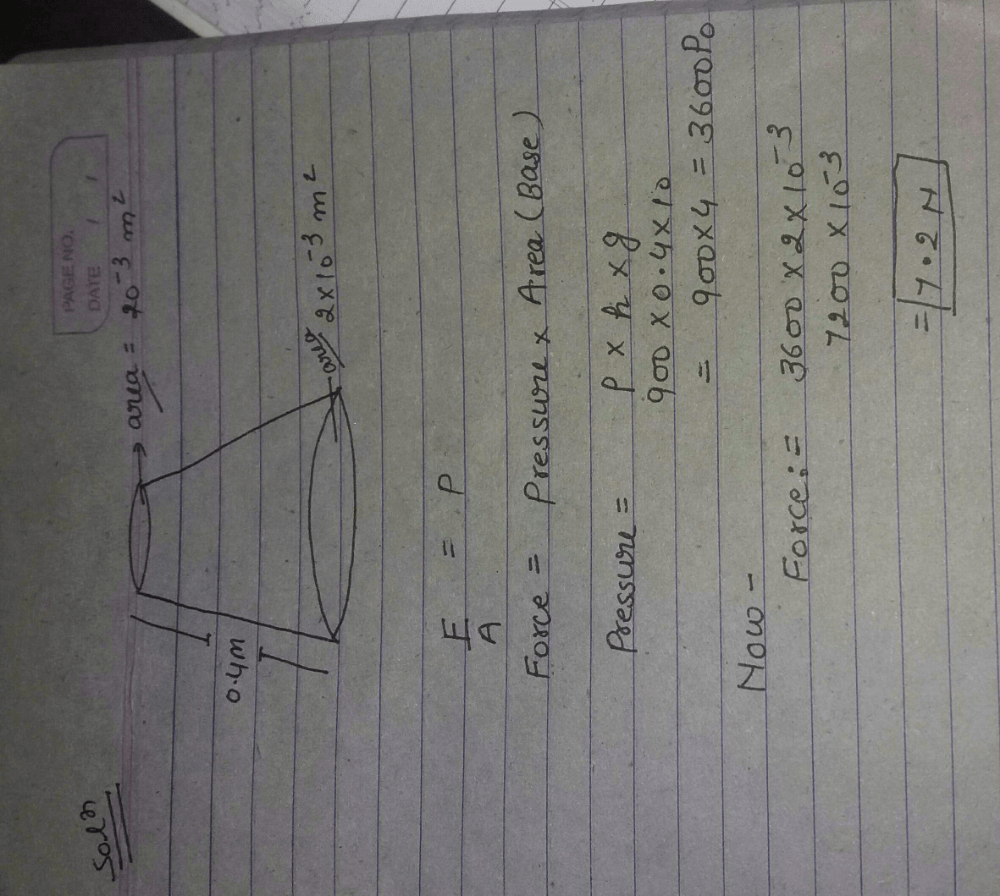
A heavy hollow cone of radius R and height h is placed on a horizontal table surface, with its flat base on the table. The whole volume inside the cone is filled with water of density r. The circular rim of the cone's base has a watertight seal with the table's surface and the top apex of the cone has a small hole. Neglecting atmospheric pressure find the total upward force exerted by water on the cone is- a)(2/3)pR2hrg
- b)(1/3)pR2hrg
- c)pR2hrg
- d)None
Correct answer is option 'A'. Can you explain this answer?
A heavy hollow cone of radius R and height h is placed on a horizontal table surface, with its flat base on the table. The whole volume inside the cone is filled with water of density r. The circular rim of the cone's base has a watertight seal with the table's surface and the top apex of the cone has a small hole. Neglecting atmospheric pressure find the total upward force exerted by water on the cone is
a)
(2/3)pR2hrg
b)
(1/3)pR2hrg
c)
pR2hrg
d)
None
 | Sandeep Chawla answered |
Total force exerted on the base by water and cone’s slant surface = mg = 1/3 πR2 Hρg downwards
Force exerted by the water = (ρgH) (πR2) (downwards)
So force exerted by the slant surface = 2/3 ρgH πR2 (upwards)
So force exerted by water on slant surface = 2/3 ρgHπR2
Force exerted by the water = (ρgH) (πR2) (downwards)
So force exerted by the slant surface = 2/3 ρgH πR2 (upwards)
So force exerted by water on slant surface = 2/3 ρgHπR2
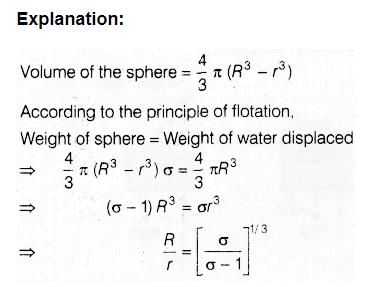
A metal ball of density 7800 kg/m3 is suspected to have a large number of cavities. It weighs 9.8 kg when weighed directly on a balance and 1.5 kg less when immersed in water. The fraction by volume of the cavities in the metal ball is approximately :- a)20%
- b)30%
- c)16%
- d)11%
Correct answer is option 'C'. Can you explain this answer?
A metal ball of density 7800 kg/m3 is suspected to have a large number of cavities. It weighs 9.8 kg when weighed directly on a balance and 1.5 kg less when immersed in water. The fraction by volume of the cavities in the metal ball is approximately :
a)
20%
b)
30%
c)
16%
d)
11%
 | Rajat Patel answered |
Answer- volume of cavity/ball=0.16
Explaination-
Here when put in water the water displaces/fills the empty cavity.
Volume of only metal=mass/density =9.8/7800=1.25X10^-3cu.m
Volume of whole ball including cavity= weight of water dispaced/density of water
Density of water is 1000kg/cu.m.
Volume of whole ball=1.5X10^-3cu.m
Volume of cavity=Volume of ball-volume of metal
=1.5X10^-3 - 1.25X10^-3
=0.25X10^-3cu.m
Ratio of volume of cavity/ball = 0.25X10^-3 / 1.5X10^-3 = 0.16 = 16%
0.16 fraction of whole ball is a cavity. i.e.16%.
A ball of relative density 0.8 falls into water from a height of 2m. The depth to which the ball will sink is (neglect viscous forces) :- a)8m
- b)2m
- c)6m
- d)4m
Correct answer is option 'A'. Can you explain this answer?
A ball of relative density 0.8 falls into water from a height of 2m. The depth to which the ball will sink is (neglect viscous forces) :
a)
8m
b)
2m
c)
6m
d)
4m
| | Nandini Patel answered |
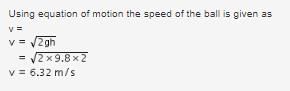
Let us calculate the buoyancy force by water try to stop the ball.
Buoyancy force = weight of displaced water
= Density of water x Volume of the ball x g
= d x V x g (Equation 1)
But buoyant force = ma
Therefore, ma = d x V x g
or a = (dVg) / m (Equation 2)
Let the density of the ball be d'.
→ m = d'V
Substituting in equation 2, we get
a = (dVg) / d'V
= dg / d'
=(d/d') x g
Given that relative density, (d / d') = 0.8
So, a = g / (0.8)
= 10 / 0.8
→ a = 12.5 m/s^2
Net deceleration of ball,a' = a - g = 12.5 - 10
= 2.5 m/s^2
Final speed of ball v' = 0
Using the equation - v'^2 = v^2 + 2a's..(where s = depth of ball in the water)
Substituting the values in the above equation, we get
40 = 0 + 2 x 2.5 x s
s = 8m
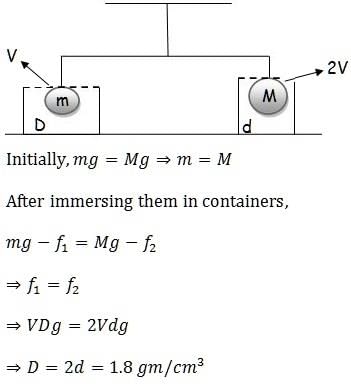
Two bodies having volumes V and 2V are suspended from the two arms of a common balance and they are found to balance each other. If larger body is immersed in oil (density d1 = 0.9 gm/cm3) and the smaller body is immersed in an unknown liquid, then the balance remain in equilibrium. The density of unknown liquid is given by :- a)2.4 gm/cm3
- b)1.8 gm/cm3
- c) 0.45 gm/cm3
- d)2.7 gm/cm3
Correct answer is option 'B'. Can you explain this answer?
Two bodies having volumes V and 2V are suspended from the two arms of a common balance and they are found to balance each other. If larger body is immersed in oil (density d1 = 0.9 gm/cm3) and the smaller body is immersed in an unknown liquid, then the balance remain in equilibrium. The density of unknown liquid is given by :
a)
2.4 gm/cm3
b)
1.8 gm/cm3
c)
0.45 gm/cm3
d)
2.7 gm/cm3
| | Ram Mohith answered |
A hollow cone floats with its axis vertical upto one-third of its height in a liquid of relative density 0.8 and with its vertex submerged. When another liquid of relative density r is filled in it upto one-third of its height, the cone floats upto half its vertical height. The height of the cone is 0.10 m and radius of the circular base is 0.05 m. The specific gravity r is given by- a)1.0
- b)1.5
- c)2.1
- d)1.9
Correct answer is option 'D'. Can you explain this answer?
A hollow cone floats with its axis vertical upto one-third of its height in a liquid of relative density 0.8 and with its vertex submerged. When another liquid of relative density r is filled in it upto one-third of its height, the cone floats upto half its vertical height. The height of the cone is 0.10 m and radius of the circular base is 0.05 m. The specific gravity r is given by
a)
1.0
b)
1.5
c)
2.1
d)
1.9
| | Sanchita Mukherjee answered |
Let the volume of cylinder be V and density to be ρ1
Vρ1g=V×800×g/27..(1) ,Volume of cone with height is h/3 is V/27
Vρ1g+Vρg/27=V×800g/8 ..(2) ,Volume of cone with height is h/2 is V/8
from above equation we ρ=800×19/8
Specific gravity =1900/1000=1.9
Vρ1g=V×800×g/27..(1) ,Volume of cone with height is h/3 is V/27
Vρ1g+Vρg/27=V×800g/8 ..(2) ,Volume of cone with height is h/2 is V/8
from above equation we ρ=800×19/8
Specific gravity =1900/1000=1.9
An ice block floats in a liquid whose density is less than water. A part of block is outside the liquid. When whole of ice has melted, the liquid level will -- a)Rise
- b)Go down
- c)Remain same
- d)First rise then go down
Correct answer is option 'B'. Can you explain this answer?
An ice block floats in a liquid whose density is less than water. A part of block is outside the liquid. When whole of ice has melted, the liquid level will -
a)
Rise
b)
Go down
c)
Remain same
d)
First rise then go down
 | Ayush Joshi answered |
When ice floats in a liquid, the volume of the ice block submerged in the liquid displaces an amount of liquid equal to the weight of the ice. Since the liquid is less dense than water, the ice block displaces more liquid than it would in water, but still, some part of the ice remains above the surface.
When the ice melts, it turns into water, which has a higher density than the liquid in which the ice was floating. The melted water will mix with the liquid, but since water is denser, it will contribute less to the liquid level than the volume of the ice that was initially displacing the liquid.
As a result, the overall liquid level will decrease when the ice has fully melted.
A cube of iron whose sides are of length L, is put into mercury. The weight of iron cube is W. The density of iron is rI, that of mercury is rM. The depth to which the cube sinks is given by the expression _- a)WL2rI
- b) WL2rM
- c)

- d)

Correct answer is option 'D'. Can you explain this answer?
A cube of iron whose sides are of length L, is put into mercury. The weight of iron cube is W. The density of iron is rI, that of mercury is rM. The depth to which the cube sinks is given by the expression _
a)
WL2rI
b)
WL2rM
c)
d)
| | T.ttttt answered |
The height of the block above the mercury level is h = 4.71 cm
Explanation:
Correct statement:
A cubical iron block of side 10 cm is floating on mercury in a vessel. What is the height of the block above the mercury level?
Given that the density of iron is 7.2 gm/c.c and density of the mercury =13.6 gm/c.c
Give data:
Density of iron is 7.2 gm/cm^3
Density of the mercury =13.6 gm/cm^3
Length of side of iron block = 10 cm
Let height of the lock = x
Volume of lock inside mercury = 10 x 10 x(10-x)
Weight of this volume of mercury = vm x 13.6 x 981 = upthrust on block
Total volume of block = 10 x 10 x 10 = 1000 cm^3
Weight "W" = Vρig = V x 7.2 x 981
Weight of mercury displaced = Weight of iron block
100 x (10-x) x 13.6 x 981 = 1000 x 7.2 x 981
100 x (10-x) x 13.6 = 1000 x 7.2
(10-x) x 1360 = 7200
10-x = 7200 / 1360
10-x = 5.29
10 - 5.29 = x
h = 4.71 cm
The height of the block above the mercury level is h = 4.71 cm
Also learn about
What is retardation ?
Explanation:
Correct statement:
A cubical iron block of side 10 cm is floating on mercury in a vessel. What is the height of the block above the mercury level?
Given that the density of iron is 7.2 gm/c.c and density of the mercury =13.6 gm/c.c
Give data:
Density of iron is 7.2 gm/cm^3
Density of the mercury =13.6 gm/cm^3
Length of side of iron block = 10 cm
Let height of the lock = x
Volume of lock inside mercury = 10 x 10 x(10-x)
Weight of this volume of mercury = vm x 13.6 x 981 = upthrust on block
Total volume of block = 10 x 10 x 10 = 1000 cm^3
Weight "W" = Vρig = V x 7.2 x 981
Weight of mercury displaced = Weight of iron block
100 x (10-x) x 13.6 x 981 = 1000 x 7.2 x 981
100 x (10-x) x 13.6 = 1000 x 7.2
(10-x) x 1360 = 7200
10-x = 7200 / 1360
10-x = 5.29
10 - 5.29 = x
h = 4.71 cm
The height of the block above the mercury level is h = 4.71 cm
Also learn about
What is retardation ?
A cylindrical tank of height 1 m and cross section area A = 4000 cm2 is initially empty when it is kept under a tap of cross sectional area 1 cm2. Water starts flowing from the tap at t = 0, with a speed = 2 m/s. There is a small hole in the base of the tank of cross-sectional area 0.5 cm2. The variation of height of water in tank (in meters) with time t is best depicted by- a)
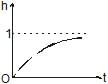
- b)
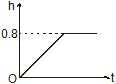
- c)
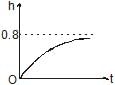
- d)
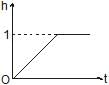
Correct answer is option 'C'. Can you explain this answer?
A cylindrical tank of height 1 m and cross section area A = 4000 cm2 is initially empty when it is kept under a tap of cross sectional area 1 cm2. Water starts flowing from the tap at t = 0, with a speed = 2 m/s. There is a small hole in the base of the tank of cross-sectional area 0.5 cm2. The variation of height of water in tank (in meters) with time t is best depicted by
a)
b)
c)
d)
 | Poulomi Singh answered |
We know the velocity of the water from the tap and the cross-sectional area of the tank. There is a rise in water level and as the water level rises the velocity of efflux through the bottom hole also increases.
Two cyllinders of same cross-section and length L but made of two material of densities d1and d2 are cemented together to form a cylinder of length 2L. The combination floats in a liquid of density d with a length L/2 above the surface of the liquid. If d1> d2 then :- a)

- b)

- c)

- d)d < d1
Correct answer is option 'A'. Can you explain this answer?
Two cyllinders of same cross-section and length L but made of two material of densities d1and d2 are cemented together to form a cylinder of length 2L. The combination floats in a liquid of density d with a length L/2 above the surface of the liquid. If d1> d2 then :
a)
b)
c)
d)
d < d1
 | Yash Ghoshal answered |
If we make the fbd of the body we get,
(A x L x d2 + A x L x d2) g = (A x 3L/2 X d)g
Thus we get that
d1 + d2 = 3/2d
And as d2 < d1
We get d1 + d2 < d1 + d1
Thus we get 2 d1 > 3d/2
Thus we get d1 > 3d/4
(A x L x d2 + A x L x d2) g = (A x 3L/2 X d)g
Thus we get that
d1 + d2 = 3/2d
And as d2 < d1
We get d1 + d2 < d1 + d1
Thus we get 2 d1 > 3d/2
Thus we get d1 > 3d/4
A cylindrical block of area of cross-section A and of material of density r is placed in a liquid of density one-third of density of block. The block compresses a spring and compression in the spring is one-third of the length of the block. If acceleration due to gravity is g, the spring constant of the spring is 
- a)rAg
- b)2rAg
- c)2rAg/3
- d)rAg/3
Correct answer is option 'B'. Can you explain this answer?
A cylindrical block of area of cross-section A and of material of density r is placed in a liquid of density one-third of density of block. The block compresses a spring and compression in the spring is one-third of the length of the block. If acceleration due to gravity is g, the spring constant of the spring is
a)
rAg
b)
2rAg
c)
2rAg/3
d)
rAg/3
| | Megha Basak answered |
Since the block is at rest, net force on the cylinderical block is zero, ie net upward = net downward force 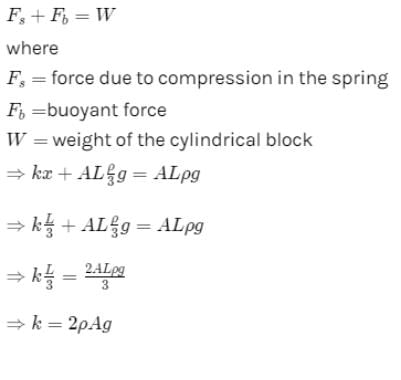
A container of large surface area is filled with liquid of density r. A cubical block of side edge a and mass M is floating in it with four-fifth of its volume submerged. If a coin of mass m is placed gently on the top surface of the block is just submerged. M is- a) 4m/5
- b)m/5
- c)4m
- d)5m
Correct answer is option 'C'. Can you explain this answer?
A container of large surface area is filled with liquid of density r. A cubical block of side edge a and mass M is floating in it with four-fifth of its volume submerged. If a coin of mass m is placed gently on the top surface of the block is just submerged. M is
a)
4m/5
b)
m/5
c)
4m
d)
5m
 | Aaditya Pillai answered |
Understanding the Floating Block
When a block floats in a liquid, it displaces a volume of liquid equal to its weight. In this scenario, we have a cubical block of side edge "a" and mass "M," floating in a liquid of density "r." Since four-fifths of the block's volume is submerged, we can denote the submerged volume as:
- Volume of the block = a^3
- Submerged volume = (4/5) * a^3
The weight of the displaced liquid equals the weight of the block:
- Weight of displaced liquid = r * (4/5) * a^3 * g
- Weight of the block = M * g
Thus, we have:
- M * g = r * (4/5) * a^3 * g
From this, we can simplify to find M:
- M = r * (4/5) * a^3
Adding the Coin
When a coin of mass "m" is placed on top of the block, it causes the block to sink further. Since the coin just causes the block to be fully submerged, the total weight now includes both the block and the coin:
- Total weight = (M + m) * g
Now, the total displaced volume must equal the weight of the total system:
- Displaced volume = a^3 (since the block is fully submerged)
The weight of the displaced liquid is now:
- Weight of displaced liquid = r * a^3 * g
Equating the weights gives:
- (M + m) * g = r * a^3 * g
Cancelling "g" from both sides, we get:
- M + m = r * a^3
Finding "M"
From our earlier equation:
- M = r * (4/5) * a^3
Substituting this into the new equation:
- (r * (4/5) * a^3) + m = r * a^3
Rearranging yields:
- m = r * a^3 * (1 - 4/5) = r * a^3 / 5
Now substituting this back into our expression for M:
- M = 4m
Thus, the correct answer is:
The Correct Answer
- M = 4m (Option C)
When a block floats in a liquid, it displaces a volume of liquid equal to its weight. In this scenario, we have a cubical block of side edge "a" and mass "M," floating in a liquid of density "r." Since four-fifths of the block's volume is submerged, we can denote the submerged volume as:
- Volume of the block = a^3
- Submerged volume = (4/5) * a^3
The weight of the displaced liquid equals the weight of the block:
- Weight of displaced liquid = r * (4/5) * a^3 * g
- Weight of the block = M * g
Thus, we have:
- M * g = r * (4/5) * a^3 * g
From this, we can simplify to find M:
- M = r * (4/5) * a^3
Adding the Coin
When a coin of mass "m" is placed on top of the block, it causes the block to sink further. Since the coin just causes the block to be fully submerged, the total weight now includes both the block and the coin:
- Total weight = (M + m) * g
Now, the total displaced volume must equal the weight of the total system:
- Displaced volume = a^3 (since the block is fully submerged)
The weight of the displaced liquid is now:
- Weight of displaced liquid = r * a^3 * g
Equating the weights gives:
- (M + m) * g = r * a^3 * g
Cancelling "g" from both sides, we get:
- M + m = r * a^3
Finding "M"
From our earlier equation:
- M = r * (4/5) * a^3
Substituting this into the new equation:
- (r * (4/5) * a^3) + m = r * a^3
Rearranging yields:
- m = r * a^3 * (1 - 4/5) = r * a^3 / 5
Now substituting this back into our expression for M:
- M = 4m
Thus, the correct answer is:
The Correct Answer
- M = 4m (Option C)
A vertical cylindrical container of base area A and upper cross-section area A1 making an angle 30° with the horizontal is placed in an open rainy field as shown near another cylindrical container having same base area A. The ratio of rates of collection of water in the two containers will be. 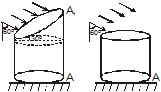
- a)

- b)

- c)2
- d)None
Correct answer is option 'C'. Can you explain this answer?
A vertical cylindrical container of base area A and upper cross-section area A1 making an angle 30° with the horizontal is placed in an open rainy field as shown near another cylindrical container having same base area A. The ratio of rates of collection of water in the two containers will be.
a)
b)
c)
2
d)
None
| | Anirban Shah answered |
In first container the Area vector is along the direction of rain. Rate of water collection in first container is A1×velocity of rain.
In second cylinder the component of Area vector along the direction of rain is A1cos60°=A1/2. So, rate of water collection in second container is 0.5A1×velocity of rain.
The ratio of water collection is 2.
In second cylinder the component of Area vector along the direction of rain is A1cos60°=A1/2. So, rate of water collection in second container is 0.5A1×velocity of rain.
The ratio of water collection is 2.
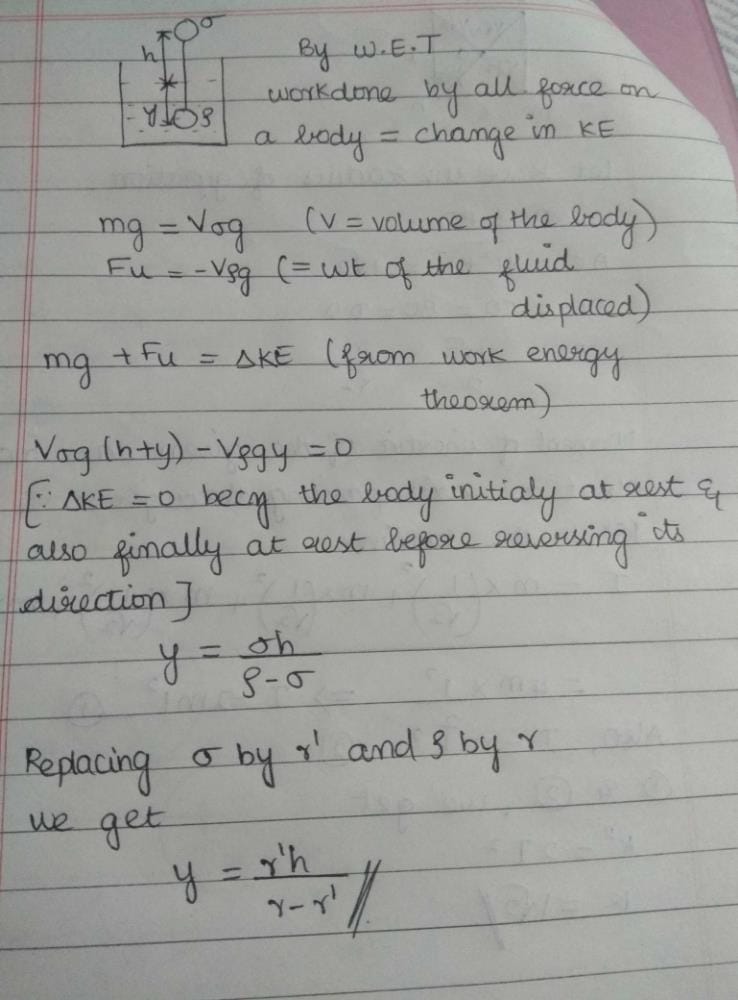
A body of density r' is dropped from rest at a height h into a lake of density r, where r > r'. Neglecting all disipative froces, calculate the maximum depth to which the body sinks before returning of float on the surface.- a)

- b)

- c)

- d)

Correct answer is option 'C'. Can you explain this answer?
A body of density r' is dropped from rest at a height h into a lake of density r, where r > r'. Neglecting all disipative froces, calculate the maximum depth to which the body sinks before returning of float on the surface.
a)
b)
c)
d)
 | Pooja Manokaran answered |
A cork of density 0.5 gcm-3 floats on a calm swimming pool. The fraction of the cork's volume which is under water is- a)0%
- b)25%
- c)10%
- d)50%
Correct answer is option 'D'. Can you explain this answer?
A cork of density 0.5 gcm-3 floats on a calm swimming pool. The fraction of the cork's volume which is under water is
a)
0%
b)
25%
c)
10%
d)
50%
| | Ananya Datta answered |
Question:
A cork of density 0.5 g/cm³ floats on a calm swimming pool. The fraction of the cork's volume which is underwater is:
a) 0%
b) 25%
c) 10%
d) 50%
Answer:
To determine the fraction of the cork's volume that is underwater, we need to analyze the buoyant force acting on the cork.
Buoyant Force:
The buoyant force is the upward force exerted on an object submerged in a fluid. It is given by the formula:
Buoyant force = weight of the fluid displaced
Archimedes' Principle:
According to Archimedes' principle, an object submerged in a fluid experiences an upward buoyant force equal to the weight of the fluid displaced by the object.
Analysis:
In this case, the cork is floating on a calm swimming pool, which means the buoyant force acting on the cork is equal to its weight. We know that the density of the cork is 0.5 g/cm³.
To determine the fraction of the cork's volume underwater, we need to compare the densities of the cork and the fluid (water). If the density of the cork is less than the density of water, it will float.
Calculation:
The density of water is approximately 1 g/cm³. Since the density of the cork (0.5 g/cm³) is less than the density of water, it will float.
When an object floats, the buoyant force is equal to its weight. This means that the weight of the cork is equal to the weight of the fluid displaced by the cork.
Since the cork is floating, it displaces an amount of water equal to its own weight. Therefore, the fraction of the cork's volume underwater is equal to the ratio of the cork's weight to the weight of the fluid displaced.
The fraction of the cork's volume underwater can be calculated using the formula:
Fraction underwater = Weight of cork / Weight of fluid displaced
Since the weight of the cork is equal to the weight of the fluid displaced, the fraction underwater is equal to 1, or 100%.
Conclusion:
Therefore, the correct answer is option d) 50%.
A cork of density 0.5 g/cm³ floats on a calm swimming pool. The fraction of the cork's volume which is underwater is:
a) 0%
b) 25%
c) 10%
d) 50%
Answer:
To determine the fraction of the cork's volume that is underwater, we need to analyze the buoyant force acting on the cork.
Buoyant Force:
The buoyant force is the upward force exerted on an object submerged in a fluid. It is given by the formula:
Buoyant force = weight of the fluid displaced
Archimedes' Principle:
According to Archimedes' principle, an object submerged in a fluid experiences an upward buoyant force equal to the weight of the fluid displaced by the object.
Analysis:
In this case, the cork is floating on a calm swimming pool, which means the buoyant force acting on the cork is equal to its weight. We know that the density of the cork is 0.5 g/cm³.
To determine the fraction of the cork's volume underwater, we need to compare the densities of the cork and the fluid (water). If the density of the cork is less than the density of water, it will float.
Calculation:
The density of water is approximately 1 g/cm³. Since the density of the cork (0.5 g/cm³) is less than the density of water, it will float.
When an object floats, the buoyant force is equal to its weight. This means that the weight of the cork is equal to the weight of the fluid displaced by the cork.
Since the cork is floating, it displaces an amount of water equal to its own weight. Therefore, the fraction of the cork's volume underwater is equal to the ratio of the cork's weight to the weight of the fluid displaced.
The fraction of the cork's volume underwater can be calculated using the formula:
Fraction underwater = Weight of cork / Weight of fluid displaced
Since the weight of the cork is equal to the weight of the fluid displaced, the fraction underwater is equal to 1, or 100%.
Conclusion:
Therefore, the correct answer is option d) 50%.
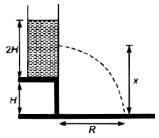
A tank is filled up to a height 2H with a liquid and is placedon a platform of height H from the ground. The distance x from the ground where a small hole is punched to get the maximum range R is :
- a)H
- b)1.25 H
- c)1.5 H
- d)2 H
Correct answer is option 'C'. Can you explain this answer?
A tank is filled up to a height 2H with a liquid and is placedon a platform of height H from the ground. The distance x from the ground where a small hole is punched to get the maximum range R is :
a)
H
b)
1.25 H
c)
1.5 H
d)
2 H
| | Anand Kapoor answered |
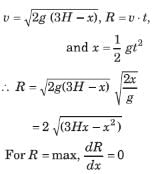
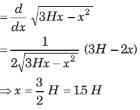
A cubical box of wine has a small spout located in one of the bottom corners. When the box is full and placed on a level surface, opening the spout results in a flow of wine with a initial speed of v0 (see figure). When the box is half empty, someone tilts it at 45º so that the spout is at the lowest point (see figure). When the spout is opened the wine will flow out with a speed of 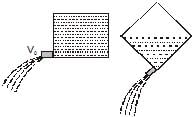
- a) v0
- b) v0/2
- c)

- d)

Correct answer is option 'D'. Can you explain this answer?
A cubical box of wine has a small spout located in one of the bottom corners. When the box is full and placed on a level surface, opening the spout results in a flow of wine with a initial speed of v0 (see figure). When the box is half empty, someone tilts it at 45º so that the spout is at the lowest point (see figure). When the spout is opened the wine will flow out with a speed of
a)
v0
b)
v0/2
c)
d)
| | Malavika Roy answered |
According to Torricelli's Theorem velocity of efflux i.e. the velocity with which the liquid flows out of a hole is equal to √2gh where h is the depth of the hole below the liquid surface.
Let’s say side of the cube is a, so we have
vo=√2ga
When cubical box is half empty, height of wine surface above the spout is half of the diagonal of the cube's face, i.e. (√2a)/2=a/√2
Now the speed of the wine from the spout is v′=√2g(a/√2)=vo/(2)1/4
Let’s say side of the cube is a, so we have
vo=√2ga
When cubical box is half empty, height of wine surface above the spout is half of the diagonal of the cube's face, i.e. (√2a)/2=a/√2
Now the speed of the wine from the spout is v′=√2g(a/√2)=vo/(2)1/4

 prgHR2
  prgHR2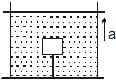
Chapter doubts & questions for Mechanical Properties of Fluids - 30-Day Revision Course for NEET 2026 is part of NEET exam preparation. The chapters have been prepared according to the NEET exam syllabus. The Chapter doubts & questions, notes, tests & MCQs are made for NEET 2026 Exam. Find important definitions, questions, notes, meanings, examples, exercises, MCQs and online tests here.
Chapter doubts & questions of Mechanical Properties of Fluids - 30-Day Revision Course for NEET in English & Hindi are available as part of NEET exam. Download more important topics, notes, lectures and mock test series for NEET Exam by signing up for free.
30-Day Revision Course for NEET85 videos|301 docs|171 tests |
