


All Exams > NEET > 30-Day Revision Course for NEET > All Questions
All questions of Photosynthesis in Higher Plants for NEET Exam
The splitting of water molecule is take place inside
a)Outer membraneb)Lumenc)Stromad)Inner membrane Correct answer is option 'B'. Can you explain this answer?
| | Vibhor Goyal answered |
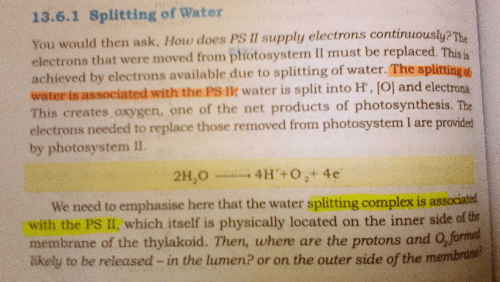
Splitting of water takes place near PS II, located in the inner side of the thylakoid membrane.
Splitting of water releases oxygen in the atmosphere and generates a proton gradient across the thylakoid membrane.

The splitting of water molecules is associated with- a)PS II
- b)PS I
- c)Cyclic phosphorylation
- d)Non-cyclic phosphorylation
Correct answer is option 'A'. Can you explain this answer?
The splitting of water molecules is associated with
a)
PS II
b)
PS I
c)
Cyclic phosphorylation
d)
Non-cyclic phosphorylation
 | Swara Sarkar answered |
This is achieved by electrons available due to splitting of water. The splitting of water is associated with the PS II; water is split into H+, [O] and electrons.

During photochemical reaction of photosynthesis –- a)liberation of O2 takes place
- b)Formation of ATP and NADPH2 take place
- c)Liberation of O2, formation of ATP, and NADPH2 takes place
- d)Assimilation of CO2 takes place
Correct answer is option 'C'. Can you explain this answer?
During photochemical reaction of photosynthesis –
a)
liberation of O2 takes place
b)
Formation of ATP and NADPH2 take place
c)
Liberation of O2, formation of ATP, and NADPH2 takes place
d)
Assimilation of CO2 takes place
 | Momin Anam answered |
C is correct
The by product of photosynthesis is- a)CO2
- b)Oxygen
- c)Energy
- d)Sugar
Correct answer is option 'B'. Can you explain this answer?
The by product of photosynthesis is
a)
CO2
b)
Oxygen
c)
Energy
d)
Sugar
 | Rajni Kokate answered |
6(CO2) + 12(H2O) ----------> C6H12O6 +6(O2) + 6H2O
In photosynthesis phototrophs synthesize glucose and water and evolve O2 as by product
In photosynthesis phototrophs synthesize glucose and water and evolve O2 as by product

Element which helps in electron transport in the process of photosynthesis is- a)Zinc
- b)Molybdenum
- c)Boron
- d)Mangnese
Correct answer is option 'D'. Can you explain this answer?
Element which helps in electron transport in the process of photosynthesis is
a)
Zinc
b)
Molybdenum
c)
Boron
d)
Mangnese
 | Preeti Iyer answered |
During noncyclic electron flow the electron hole in P-680 is filled by electrons obtained by photolysis of water. As a result, there is an evolution of oxygen and the electron move through Mn-protein bound to PS II. In this transport Mn++ is oxidised to Mn+++ and then reduced to Mn++ in a cyclic manner. The manganese thus transfers electrons from water to photosystem II and thus plays an important role in electron transport in the process of photosynthesis.
Which pigment system ultimately donates e– for the reduction of NADP.- a)PS II
- b)PS I
- c)CO2
- d)Plastoquinone
Correct answer is option 'B'. Can you explain this answer?
Which pigment system ultimately donates e– for the reduction of NADP.
a)
PS II
b)
PS I
c)
CO2
d)
Plastoquinone
 | Navya Sengupta answered |
Ans.
The electrons from PS I may also pass onto an electron carrier and then combine with the hydrogen ions (from the water) to reduce NADP to NADPH. This reduced NADP is used in the next series of reactions.
ADP + iP = ATP in grana is called :–- a)Phosphorylation
- b)Oxidative phosphorylation
- c)Photophosphorylation
- d)Photolysis
Correct answer is option 'C'. Can you explain this answer?
ADP + iP = ATP in grana is called :–
a)
Phosphorylation
b)
Oxidative phosphorylation
c)
Photophosphorylation
d)
Photolysis
 | Stepway Academy answered |
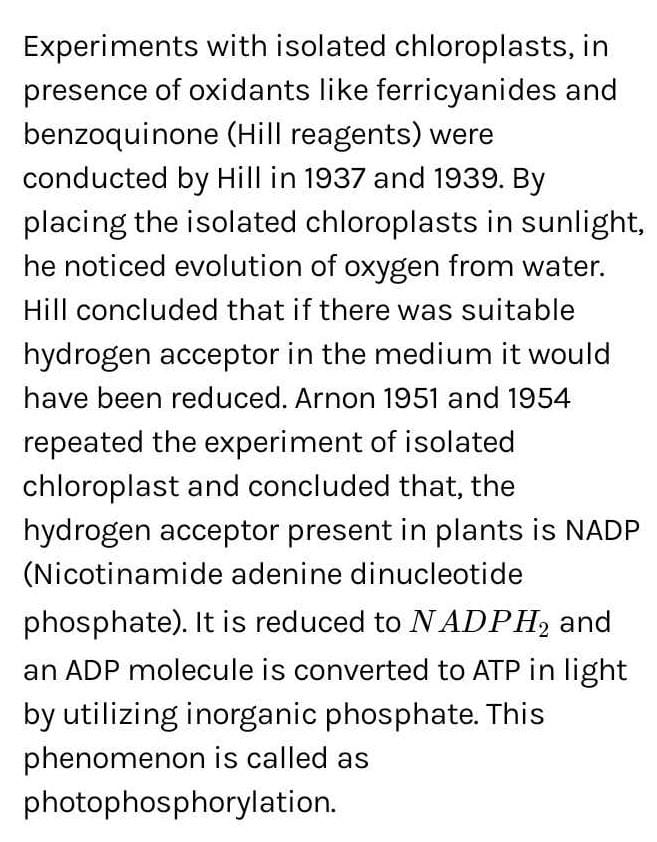
Photophosphorylation is the conversion of ADP to ATP using the energy of sunlight by activation of PSII. This involves the splitting of the water molecule in oxygen and hydrogen protons (H+), a process known as photolysis.
In PSI, the reaction centre the chlorophyll a has an absorption peak at- a)780nm
- b)700nm
- c)680nm
- d)800nm
Correct answer is option 'B'. Can you explain this answer?
In PSI, the reaction centre the chlorophyll a has an absorption peak at
a)
780nm
b)
700nm
c)
680nm
d)
800nm
| | Vartika Shukla (NEET Aspirant) answered |
In PS-I, the reaction centre chlorophyll a has an absorption peak at 700 nm, hence, is called P 700 while in PS-H, it has absorption maxima at 680 nm, so is called P 680.
so the correct answer is b) 700nm
so the correct answer is b) 700nm
The first step in photosynthesis is- a)Joining of three carbon atoms to from glucose
- b)Formation of ATP
- c)Ionization of water
- d)Excitement of an electron of chlorophyll by a photon of light.
Correct answer is option 'D'. Can you explain this answer?
The first step in photosynthesis is
a)
Joining of three carbon atoms to from glucose
b)
Formation of ATP
c)
Ionization of water
d)
Excitement of an electron of chlorophyll by a photon of light.
 | Nandini Patel answered |
The energy from the sun, raises an energy level in the chlorophyll molecule, causing electrons to leave the molecule and travel along the electron transport chain (ETC) in a series of oxidation and reductions. In doing so it releases energy converting ADP+Pi into ATP. Photolysis (splitting of water) occurs, and the electrons produced, replace those lost. This is the Light Dependant stage as it relies on light energy
In photosynthesis, hydrogen is transferred from the light reactions to dark reactions by :–- a)DPN
- b)DNA
- c)ATP
- d)NADP
Correct answer is option 'D'. Can you explain this answer?
In photosynthesis, hydrogen is transferred from the light reactions to dark reactions by :–
a)
DPN
b)
DNA
c)
ATP
d)
NADP
 | Bs Academy answered |
Photosynthesis occurs in two stages, light reaction, and dark reaction. During the light reaction reduced NADPH2 and ATP are synthesized. These products are used subsequently to reduce carbon dioxide into sugars. The purpose of ATP in photosynthesis is to transfer energy from light reaction to dark reaction. The purpose of NADP is to transfer hydrogen from light reaction to dark reaction in the form of reduced NADPH2.
Solarisation is- a)Effect of solar light
- b)Destruction of chlorophyll
- c)Formation of chlorophyll
- d)Utilisation of sunlight
Correct answer is option 'B'. Can you explain this answer?
Solarisation is
a)
Effect of solar light
b)
Destruction of chlorophyll
c)
Formation of chlorophyll
d)
Utilisation of sunlight
 | Muskaan Dasgupta answered |
Solarisation is the process of destruction of chlorophyll due to prolonged exposure to sunlight. This phenomenon is commonly observed in plants that grow in areas with high solar radiation. Here is a detailed explanation of the process:
Explanation:
Chlorophyll is the green pigment present in the leaves of plants. It plays a crucial role in photosynthesis, which is the process by which plants convert sunlight into energy. However, prolonged exposure to sunlight can damage the chlorophyll molecules, leading to their destruction. This process is known as solarisation.
Solarisation occurs due to the following reasons:
1. High intensity of sunlight: Plants that grow in areas with high solar radiation are more prone to solarisation. This is because the intensity of sunlight in these areas is much higher than in other regions.
2. Extended exposure to sunlight: The longer a plant is exposed to sunlight, the greater the damage to its chlorophyll molecules. This is why solarisation is more common during the summer months, when the days are longer and the sun is more intense.
Effects of solarisation:
1. Reduced photosynthesis: Solarisation damages the chlorophyll molecules, which reduces the plant's ability to carry out photosynthesis. This can lead to stunted growth and reduced yield.
2. Loss of colour: As the chlorophyll molecules are destroyed, the leaves of the plant lose their green colour and turn yellow or brown.
3. Increased susceptibility to pests and diseases: Plants that have been solarised are more susceptible to pests and diseases, as their weakened state makes them more vulnerable to attack.
Prevention of solarisation:
1. Shade: Providing shade to the plants can reduce their exposure to sunlight and prevent solarisation. This can be done by using shade cloth or by planting the crops under trees.
2. Watering: Regular watering can help cool down the plants and reduce the damage caused by solarisation.
3. Timely harvesting: Harvesting the crops before they are fully mature can reduce their exposure to sunlight and prevent solarisation.
In conclusion, solarisation is the process of destruction of chlorophyll due to prolonged exposure to sunlight. It can have a negative impact on plant growth and yield, and can be prevented by providing shade, regular watering, and timely harvesting.
Explanation:
Chlorophyll is the green pigment present in the leaves of plants. It plays a crucial role in photosynthesis, which is the process by which plants convert sunlight into energy. However, prolonged exposure to sunlight can damage the chlorophyll molecules, leading to their destruction. This process is known as solarisation.
Solarisation occurs due to the following reasons:
1. High intensity of sunlight: Plants that grow in areas with high solar radiation are more prone to solarisation. This is because the intensity of sunlight in these areas is much higher than in other regions.
2. Extended exposure to sunlight: The longer a plant is exposed to sunlight, the greater the damage to its chlorophyll molecules. This is why solarisation is more common during the summer months, when the days are longer and the sun is more intense.
Effects of solarisation:
1. Reduced photosynthesis: Solarisation damages the chlorophyll molecules, which reduces the plant's ability to carry out photosynthesis. This can lead to stunted growth and reduced yield.
2. Loss of colour: As the chlorophyll molecules are destroyed, the leaves of the plant lose their green colour and turn yellow or brown.
3. Increased susceptibility to pests and diseases: Plants that have been solarised are more susceptible to pests and diseases, as their weakened state makes them more vulnerable to attack.
Prevention of solarisation:
1. Shade: Providing shade to the plants can reduce their exposure to sunlight and prevent solarisation. This can be done by using shade cloth or by planting the crops under trees.
2. Watering: Regular watering can help cool down the plants and reduce the damage caused by solarisation.
3. Timely harvesting: Harvesting the crops before they are fully mature can reduce their exposure to sunlight and prevent solarisation.
In conclusion, solarisation is the process of destruction of chlorophyll due to prolonged exposure to sunlight. It can have a negative impact on plant growth and yield, and can be prevented by providing shade, regular watering, and timely harvesting.
Which occurs during the light reaction of photosynthesis- a)Chlorophyll is produced
- b)Water splits to form 2H+ & O2
- c)CO2 is given off as a waste
- d)Sugar is formed from CO2 and water
Correct answer is option 'B'. Can you explain this answer?
Which occurs during the light reaction of photosynthesis
a)
Chlorophyll is produced
b)
Water splits to form 2H+ & O2
c)
CO2 is given off as a waste
d)
Sugar is formed from CO2 and water
 | Om Desai answered |
The chlorophyll pigments which are excited give up their electrons and to compensate for the loss of electrons, water is split to release four H+ ions and four electrons and O2. The electrons that are lost from the PSII enter into an electron transfer chain or ETC.
Photorespiration does not occur in- a)C4 plants
- b)C3 plants
- c)Algae
- d)Bacteria
Correct answer is option 'A'. Can you explain this answer?
Photorespiration does not occur in
a)
C4 plants
b)
C3 plants
c)
Algae
d)
Bacteria
| | Awantika Gupta answered |
Photorespiration is a wastefull process because it doesn't synthesis ATP.
but in new ncert it is mentioned that the requirements of photorespiration is not known yet.
but in new ncert it is mentioned that the requirements of photorespiration is not known yet.
Which of the following stages of calvin cycle are in correct order?- a)Carboxylation, reduction, regeneration
- b)Regeneration,carboxylation, reduction
- c)Regeneration,reduction,carboxylation
- d)Carboxylation,regeneration,reduction
Correct answer is option 'A'. Can you explain this answer?
Which of the following stages of calvin cycle are in correct order?
a)
Carboxylation, reduction, regeneration
b)
Regeneration,carboxylation, reduction
c)
Regeneration,reduction,carboxylation
d)
Carboxylation,regeneration,reduction
| | Smruti Sucharita answered |
##ncert refer kro yrr... directly Diya hua h..
Dark fixation of CO2 in CAM plants is called ocification because it produces- a)Tartaric acid
- b)Oxaloacetic acid
- c)Malic acid
- d)Formic acid
Correct answer is option 'C'. Can you explain this answer?
Dark fixation of CO2 in CAM plants is called ocification because it produces
a)
Tartaric acid
b)
Oxaloacetic acid
c)
Malic acid
d)
Formic acid
| | Gopikas S answered |
The principal metabolic feature of CAM plants is assimilation of CO2 at night into malic acid which is stored in the vacuole. Malate is generated in the reaction catalyzed by PEP carboxylase and PEP is, in turn, generated by degradation of starch or soluble sugars. During the day, malate is released from the vacuole and is decarboxylated to provide CO2 for fixation in the Benson–Calvin cycle behind closed stomata. Starch and sugars are then resynthesized .
Fixation of 1 CO2 requires :–- a)6NADPH2 & 3ATP
- b)2NADP.H2 & 3ATP
- c)4 NADP.H2 & 3ATP
- d)5 NADP.H2 & 3ATP
Correct answer is option 'B'. Can you explain this answer?
Fixation of 1 CO2 requires :–
a)
6NADPH2 & 3ATP
b)
2NADP.H2 & 3ATP
c)
4 NADP.H2 & 3ATP
d)
5 NADP.H2 & 3ATP
| | Pooja Shah answered |
The Calvin cycle has three stages.
1)carbon fixation
2)reduction
3)regeneration.
At the end of each Calvin cycle net gain is 9ATP and 6 NADPH2.In each Calvin cycle, 3 CO2 molecules are fixed with RuBP to form 2 molecules of 3PGA in the first step. Later two molecules of 3PGA through a series of reactions regenerate 2RuBP in the third stage. So, for the fixation of one CO2 carbon dioxide molecule through the Calvin cycle requires 3ATP and 2NADPH2.
So, the correct answer is 'option B'.
1)carbon fixation
2)reduction
3)regeneration.
At the end of each Calvin cycle net gain is 9ATP and 6 NADPH2.In each Calvin cycle, 3 CO2 molecules are fixed with RuBP to form 2 molecules of 3PGA in the first step. Later two molecules of 3PGA through a series of reactions regenerate 2RuBP in the third stage. So, for the fixation of one CO2 carbon dioxide molecule through the Calvin cycle requires 3ATP and 2NADPH2.
So, the correct answer is 'option B'.
Photophosphorylation is the process in which- a)CO2 and O2 unite
- b)Phosphoglyceric acid is produced
- c)Aspartic acid is formed
- d)Light energy is converted in to chemical energy by production of ATP
Correct answer is option 'D'. Can you explain this answer?
Photophosphorylation is the process in which
a)
CO2 and O2 unite
b)
Phosphoglyceric acid is produced
c)
Aspartic acid is formed
d)
Light energy is converted in to chemical energy by production of ATP
| | Vartika shukla answered |
Phosphorylation: A biochemical process that involves the addition of phosphate to an organic compound. Examples include the addition of phosphate to glucose to produce glucose monophosphate and the addition of phosphate to adenosine diphosphate (ADP) to form adenosine triphosphate (ATP). Phosphorylation is carried out through the action of enzymes known as phosphotransferases or kinases.
The electron ejected by P680 in light reaction is initially accepted by- a)Plastoquinone
- b)ATP
- c)Ferredoxin
- d)P-700
Correct answer is option 'A'. Can you explain this answer?
The electron ejected by P680 in light reaction is initially accepted by
a)
Plastoquinone
b)
ATP
c)
Ferredoxin
d)
P-700
 | Rajeev Sharma answered |
During the light reaction, the path of the electron has been elucidated in the Z-scheme. It is named so because of its shape and was first proposed by Hill and Bendall in 1960. The electron released by reaction center of photosystem II i.e., P680 moves uphill and reduces pheophytin, a nonmagnesium chlorophyll a molecule. From pheophytin, electrons are accepted by plastoquinone which requires two electrons for complete reduction. It also accepts two protons from the stromal side of thylakoid membrane and becomes reduced to PQH2 after accepting 2 electrons and 2 protons. It is the only carrier in the photosynthetic electron transport chain, which can bind both electrons and protons.
PGA as the first CO2 fixation product was discovered in photosynthesis of- a)Angiosperm
- b)Bryophytes
- c)Algae
- d)Gymnosperm
Correct answer is option 'C'. Can you explain this answer?
PGA as the first CO2 fixation product was discovered in photosynthesis of
a)
Angiosperm
b)
Bryophytes
c)
Algae
d)
Gymnosperm
 | Abhiram Basu answered |
Photosynthesis and CO2 fixation
Photosynthesis is a process by which plants, algae, and some bacteria convert sunlight, carbon dioxide, and water into organic compounds and oxygen. This process is essential for life on earth as it produces the oxygen that we breathe and provides food for organisms that cannot produce their own.
CO2 fixation is the process by which carbon dioxide is transformed into an organic molecule that can be used by living organisms. This process is important because carbon dioxide is an essential component of the atmosphere, but it is not readily available to most organisms in its gaseous form.
PGA as the first CO2 fixation product
PGA (phosphoglyceric acid) is the first stable product of CO2 fixation in photosynthesis. It is formed when carbon dioxide combines with a five-carbon sugar called ribulose bisphosphate (RuBP) in a reaction catalyzed by the enzyme Rubisco (ribulose bisphosphate carboxylase/oxygenase).
Discovery of PGA
The discovery of PGA as the first CO2 fixation product was made by Melvin Calvin and his colleagues in the 1940s. They used radioactive carbon-14 to trace the movement of carbon through the photosynthetic process and discovered that PGA was the first stable product of CO2 fixation.
Source of PGA
PGA is produced in the stroma of the chloroplasts in plant cells. It is then used to make glucose and other organic compounds through a series of enzyme-catalyzed reactions known as the Calvin cycle.
Role of algae in PGA discovery
Algae played a crucial role in the discovery of PGA as the first CO2 fixation product. Algae are photosynthetic organisms that are capable of fixing carbon dioxide in a similar way to plants. They were used by Calvin and his colleagues as a model system to study photosynthesis and CO2 fixation.
Conclusion
In conclusion, PGA was discovered as the first CO2 fixation product in photosynthesis by Melvin Calvin and his colleagues in the 1940s. This discovery was made using algae as a model system and has since been confirmed in plants and other photosynthetic organisms.
Photosynthesis is a process by which plants, algae, and some bacteria convert sunlight, carbon dioxide, and water into organic compounds and oxygen. This process is essential for life on earth as it produces the oxygen that we breathe and provides food for organisms that cannot produce their own.
CO2 fixation is the process by which carbon dioxide is transformed into an organic molecule that can be used by living organisms. This process is important because carbon dioxide is an essential component of the atmosphere, but it is not readily available to most organisms in its gaseous form.
PGA as the first CO2 fixation product
PGA (phosphoglyceric acid) is the first stable product of CO2 fixation in photosynthesis. It is formed when carbon dioxide combines with a five-carbon sugar called ribulose bisphosphate (RuBP) in a reaction catalyzed by the enzyme Rubisco (ribulose bisphosphate carboxylase/oxygenase).
Discovery of PGA
The discovery of PGA as the first CO2 fixation product was made by Melvin Calvin and his colleagues in the 1940s. They used radioactive carbon-14 to trace the movement of carbon through the photosynthetic process and discovered that PGA was the first stable product of CO2 fixation.
Source of PGA
PGA is produced in the stroma of the chloroplasts in plant cells. It is then used to make glucose and other organic compounds through a series of enzyme-catalyzed reactions known as the Calvin cycle.
Role of algae in PGA discovery
Algae played a crucial role in the discovery of PGA as the first CO2 fixation product. Algae are photosynthetic organisms that are capable of fixing carbon dioxide in a similar way to plants. They were used by Calvin and his colleagues as a model system to study photosynthesis and CO2 fixation.
Conclusion
In conclusion, PGA was discovered as the first CO2 fixation product in photosynthesis by Melvin Calvin and his colleagues in the 1940s. This discovery was made using algae as a model system and has since been confirmed in plants and other photosynthetic organisms.
In sugarcane, CO2 is fixed in malic acid with the help of enzyme- a)Ribulose phosphate kinase
- b)RuBP carboxylase
- c)Fructose phosphotase
- d)PEP carboxylase
Correct answer is option 'D'. Can you explain this answer?
In sugarcane, CO2 is fixed in malic acid with the help of enzyme
a)
Ribulose phosphate kinase
b)
RuBP carboxylase
c)
Fructose phosphotase
d)
PEP carboxylase
 | Jay Kumar answered |
In C4 plants, Carbon dioxide is fixed in malic acid with the help of enzyme phosphoenel pyruvate (PEP). Malic acid is a four carbon compound that later change into oxyloacetic acid.
The function of ATP in photosynthesis is the transfer of energy from the- a)Dark reaction to the light reaction
- b)Light reaction to the dark reaction
- c)Chloroplasts to mitochondria
- d)Mitochondria to chloroplasts
Correct answer is option 'B'. Can you explain this answer?
The function of ATP in photosynthesis is the transfer of energy from the
a)
Dark reaction to the light reaction
b)
Light reaction to the dark reaction
c)
Chloroplasts to mitochondria
d)
Mitochondria to chloroplasts
 | Devansh Mehra answered |
Ans.
ATP act as carries of free energy between energy yielding and energy requiring reactions of the cell .Hence ATP is described as energy currency of the cell..It is a nucleotide consisting of adenine,ribose sugar and three phosphate groups .It is an energy rich compound and contains two high energy terminal bonds
In Photosynthesis, the role of ATP (together with NADPH) is to provide the energy needed for carbohydrate synthesis in the "dark" (Light-Independent) reactions (also known as the Calvin-Benson-Bassham Cycle, after its discoverers).
Carbon dioxide is fixed in- a)Dark reaction
- b)Anaerobic respiration
- c)Aerobic respiration
- d)Light reaction
Correct answer is option 'A'. Can you explain this answer?
Carbon dioxide is fixed in
a)
Dark reaction
b)
Anaerobic respiration
c)
Aerobic respiration
d)
Light reaction
| | Afifa Aaliya answered |
Carbon dioxide fixation takes place in absence of sunlight. Dark reaction make use of these organic energy molecules ATP and NADPH. This reaction cycle is also called as Calvin benison cycle. It occurs in the stroma. It requires to fix carbon dioxide into carbohydrates.
So option " A " is correct answer.
So option " A " is correct answer.
Which of the following is excited molecule during photosynthesis :–- a)Chlorophyll
- b)Oxygen
- c)Carbondioxide
- d)Water
Correct answer is option 'A'. Can you explain this answer?
Which of the following is excited molecule during photosynthesis :–
a)
Chlorophyll
b)
Oxygen
c)
Carbondioxide
d)
Water
| | Pooja Mehta answered |
Chlorophyll, any member of the most important class of pigments involved in photosynthesis, the process by which light energy is converted to chemical energy through the synthesis of organic compounds. Chlorophyll is found in virtually all photosynthetic organisms, including green plants, prokaryotic blue-green algae (cyanobacteria), and eukaryotic algae. It absorbs energy from light; this energy is then used to convert carbon dioxide to carbohydrates.
Splitting of water in photosynthesis is called :–- a)Dark reaction
- b)Photolysis
- c)Electron transfer
- d)Phototropism
Correct answer is option 'B'. Can you explain this answer?
Splitting of water in photosynthesis is called :–
a)
Dark reaction
b)
Photolysis
c)
Electron transfer
d)
Phototropism
| | Sanjana Singh answered |
Splitting of water in photosynthesis is called photolysis of water or lysis of water molecules which occur by the action of light . In this the water molecules breaks and form hydrogen and oxygen .
H2O-----> 2H+ +2e- + 1/2O2
H2O-----> 2H+ +2e- + 1/2O2
During ionisation of H2O, H+ is captured by- a)Chlorophyll
- b)NADP
- c)O2
- d)Cytochrome
Correct answer is option 'B'. Can you explain this answer?
During ionisation of H2O, H+ is captured by
a)
Chlorophyll
b)
NADP
c)
O2
d)
Cytochrome
 | Ciel Knowledge answered |
Ionisation of water or splitting of water during photosynthesis is called as photolysis of water. It occurs during light phase and water is split into oxygen, protons and electrons. The protons are released into thylakoid lumen. From thylakoid lumen, during ATP synthesis, electrons pass on to the stroma through ATPase system. The electrons are passed on to a series of electron acceptors and ultimately donated to NADP, which also takes protons from chloroplast stroma to produce reduced NADPH2. Thus ultimately protons from water are passed on to NADP.
At the time of ionization of H2O, which initially captures the electron- a)Chlorophyll
- b)NADP
- c)OH–
- d)Cytochrome
Correct answer is option 'A'. Can you explain this answer?
At the time of ionization of H2O, which initially captures the electron
a)
Chlorophyll
b)
NADP
c)
OH–
d)
Cytochrome
 | Rohan Unni answered |
Initially, chlorophyll captures the electron while ionization of water because trapping of the light energy is the key to photosynthesis. The first event is the absorption of light by a photoreceptor molecule and it is found in chloroplasts of green plants i.e. chlorophyll a.
During ATP synthesis electron pass through- a)Water
- b)Cytochromes
- c)O2
- d)CO2
Correct answer is option 'B'. Can you explain this answer?
During ATP synthesis electron pass through
a)
Water
b)
Cytochromes
c)
O2
d)
CO2
 | Juhi Iyer answered |
Ans.
Light reaction otherwise called as- a)Photochemical phase
- b)Carboxylation
- c)Regeneration
- d)Biosynthetic phase
Correct answer is option 'A'. Can you explain this answer?
Light reaction otherwise called as
a)
Photochemical phase
b)
Carboxylation
c)
Regeneration
d)
Biosynthetic phase
| | Shraddha Pillai answered |
Photochemical phase or Light reaction
The light reaction is the first stage of photosynthesis that occurs in the thylakoid membrane of the chloroplast. It requires light energy to break down water molecules into oxygen and hydrogen ions. The hydrogen ions are used to generate ATP and NADPH, which are used in the second stage of photosynthesis, the dark reaction.
Process of Light Reaction:
1. Absorption of Light Energy: Chlorophyll pigments present in the thylakoid membrane absorb light energy and transfer it to the reaction center.
2. Generation of ATP: The absorbed light energy is used to generate ATP by the process of photophosphorylation.
3. Generation of NADPH: The absorbed light energy is also used to generate NADPH by the process of photoreduction.
4. Splitting of Water Molecules: Water molecules are split into oxygen and hydrogen ions by the process of photolysis.
5. Release of Oxygen: The oxygen produced by the photolysis of water is released into the atmosphere.
Importance of Light Reaction:
1. Production of ATP and NADPH: The light reaction produces ATP and NADPH, which are used in the dark reaction to synthesize glucose.
2. Release of Oxygen: The oxygen produced by the light reaction is released into the atmosphere, which is essential for the survival of living organisms.
3. Maintenance of Chloroplast: The light reaction helps in the maintenance of chloroplast by generating ATP, which is used to power various metabolic processes in the chloroplast.
Conclusion:
The light reaction is a critical process in photosynthesis that generates ATP and NADPH, which are used in the dark reaction to synthesize glucose. It also releases oxygen into the atmosphere, which is essential for life on earth.
The light reaction is the first stage of photosynthesis that occurs in the thylakoid membrane of the chloroplast. It requires light energy to break down water molecules into oxygen and hydrogen ions. The hydrogen ions are used to generate ATP and NADPH, which are used in the second stage of photosynthesis, the dark reaction.
Process of Light Reaction:
1. Absorption of Light Energy: Chlorophyll pigments present in the thylakoid membrane absorb light energy and transfer it to the reaction center.
2. Generation of ATP: The absorbed light energy is used to generate ATP by the process of photophosphorylation.
3. Generation of NADPH: The absorbed light energy is also used to generate NADPH by the process of photoreduction.
4. Splitting of Water Molecules: Water molecules are split into oxygen and hydrogen ions by the process of photolysis.
5. Release of Oxygen: The oxygen produced by the photolysis of water is released into the atmosphere.
Importance of Light Reaction:
1. Production of ATP and NADPH: The light reaction produces ATP and NADPH, which are used in the dark reaction to synthesize glucose.
2. Release of Oxygen: The oxygen produced by the light reaction is released into the atmosphere, which is essential for the survival of living organisms.
3. Maintenance of Chloroplast: The light reaction helps in the maintenance of chloroplast by generating ATP, which is used to power various metabolic processes in the chloroplast.
Conclusion:
The light reaction is a critical process in photosynthesis that generates ATP and NADPH, which are used in the dark reaction to synthesize glucose. It also releases oxygen into the atmosphere, which is essential for life on earth.
Calvin cycle is discovered by- a)Melvin Calvin
- b)Blackmann
- c)Cornelius van neil
- d)Hatch and Slack
Correct answer is option 'A'. Can you explain this answer?
Calvin cycle is discovered by
a)
Melvin Calvin
b)
Blackmann
c)
Cornelius van neil
d)
Hatch and Slack
 | Anjali Sharma answered |
The cycle was discovered in 1950 by Melvin Calvin, James Bassham, and Andrew Benson at the University of California, Berkeley by using the radioactive isotope carbon-14. Photosynthesis occurs in two stages in a cell.
Blackman's law is related to - a)respiration
- b)transpiration
- c)root pressure
- d)photosynthesis.
Correct answer is option 'D'. Can you explain this answer?
Blackman's law is related to
a)
respiration
b)
transpiration
c)
root pressure
d)
photosynthesis.
| | Stepway Academy answered |
Blackman formulated the principle of limiting factors. He studied the effect of CO2 concentration, light intensity and temperature on the rate of photosynthesis.
Which one has Kranz anatomy?- a)Potato
- b)Maize
- c)Wheat
- d)Rice
Correct answer is option 'B'. Can you explain this answer?
Which one has Kranz anatomy?
a)
Potato
b)
Maize
c)
Wheat
d)
Rice
| | Manisha Sarkar answered |
Maize (option B) has Kranz anatomy.
Explanation:
Maize, also known as corn, is a C4 plant that exhibits a specialized leaf anatomy called Kranz anatomy. Kranz anatomy is characterized by the presence of two distinct types of photosynthetic cells: bundle sheath cells and mesophyll cells.
Bundle sheath cells:
- In maize, the bundle sheath cells are arranged in a ring-like manner around the vascular bundles.
- They are tightly packed and contain numerous chloroplasts.
- The walls of bundle sheath cells are thickened and contain many plasmodesmata, which allow for the exchange of metabolites between cells.
- The bundle sheath cells are responsible for the initial fixation of carbon dioxide (CO2) during photosynthesis.
Mesophyll cells:
- The mesophyll cells of maize leaves surround the bundle sheath cells.
- They are loosely arranged and contain fewer chloroplasts compared to bundle sheath cells.
- The mesophyll cells are involved in the initial uptake of carbon dioxide from the atmosphere.
Kranz anatomy and C4 photosynthesis:
- Kranz anatomy is a structural adaptation that enhances the efficiency of C4 photosynthesis.
- C4 photosynthesis is a biochemical pathway that helps plants overcome the limitations of the traditional C3 pathway, especially under high light and high temperature conditions.
- In C4 plants like maize, carbon dioxide is initially fixed into a four-carbon compound in the mesophyll cells, thanks to the enzyme phosphoenolpyruvate carboxylase (PEP carboxylase).
- The four-carbon compound is then transported to the bundle sheath cells, where it is decarboxylated to release CO2.
- The CO2 released in the bundle sheath cells is then used in the Calvin cycle for the synthesis of sugars.
- This spatial separation of initial CO2 fixation and the Calvin cycle helps reduce photorespiration and increases the efficiency of carbon fixation.
Conclusion:
In conclusion, maize (option B) exhibits Kranz anatomy, which is a specialized leaf anatomy found in C4 plants. This anatomical adaptation enhances the efficiency of C4 photosynthesis, allowing maize to thrive in environments with high light and temperature conditions.
Explanation:
Maize, also known as corn, is a C4 plant that exhibits a specialized leaf anatomy called Kranz anatomy. Kranz anatomy is characterized by the presence of two distinct types of photosynthetic cells: bundle sheath cells and mesophyll cells.
Bundle sheath cells:
- In maize, the bundle sheath cells are arranged in a ring-like manner around the vascular bundles.
- They are tightly packed and contain numerous chloroplasts.
- The walls of bundle sheath cells are thickened and contain many plasmodesmata, which allow for the exchange of metabolites between cells.
- The bundle sheath cells are responsible for the initial fixation of carbon dioxide (CO2) during photosynthesis.
Mesophyll cells:
- The mesophyll cells of maize leaves surround the bundle sheath cells.
- They are loosely arranged and contain fewer chloroplasts compared to bundle sheath cells.
- The mesophyll cells are involved in the initial uptake of carbon dioxide from the atmosphere.
Kranz anatomy and C4 photosynthesis:
- Kranz anatomy is a structural adaptation that enhances the efficiency of C4 photosynthesis.
- C4 photosynthesis is a biochemical pathway that helps plants overcome the limitations of the traditional C3 pathway, especially under high light and high temperature conditions.
- In C4 plants like maize, carbon dioxide is initially fixed into a four-carbon compound in the mesophyll cells, thanks to the enzyme phosphoenolpyruvate carboxylase (PEP carboxylase).
- The four-carbon compound is then transported to the bundle sheath cells, where it is decarboxylated to release CO2.
- The CO2 released in the bundle sheath cells is then used in the Calvin cycle for the synthesis of sugars.
- This spatial separation of initial CO2 fixation and the Calvin cycle helps reduce photorespiration and increases the efficiency of carbon fixation.
Conclusion:
In conclusion, maize (option B) exhibits Kranz anatomy, which is a specialized leaf anatomy found in C4 plants. This anatomical adaptation enhances the efficiency of C4 photosynthesis, allowing maize to thrive in environments with high light and temperature conditions.
NADPH2 is also called- a)Real power
- b)Oxidising agent
- c)Power house of energy
- d)Reducing power
Correct answer is option 'D'. Can you explain this answer?
NADPH2 is also called
a)
Real power
b)
Oxidising agent
c)
Power house of energy
d)
Reducing power
 | Smruti Sucharita answered |
As it gives hydrogen n reduce other components so it is called reducing power..
How many electrons and protons are produced during the photolysis of water?- a)4 electrons and 3 protons
- b)1 electron and 2 protons
- c)4 electrons and 4 protons
- d)3 electrons and protons
Correct answer is option 'C'. Can you explain this answer?
How many electrons and protons are produced during the photolysis of water?
a)
4 electrons and 3 protons
b)
1 electron and 2 protons
c)
4 electrons and 4 protons
d)
3 electrons and protons
 | Nipuns Institute answered |
- Four electrons and four protons are produced at the end of the photolysis of water.
- Two molecules of water get converted into 4H+ and 4e– along with free oxygen.
- The ions used for this splitting is Mn2+, Ca2+, and Cl–.
The ultimate gain of light reaction is :-- a)ATP & NADPH2
- b)NADPH2
- c)Only ATP
- d)Only O2
Correct answer is option 'A'. Can you explain this answer?
The ultimate gain of light reaction is :-
a)
ATP & NADPH2
b)
NADPH2
c)
Only ATP
d)
Only O2
 | Sagar Singh answered |
The Light Reaction of Photosynthesis
The light reaction is the first stage of photosynthesis, occurring in the thylakoid membranes of chloroplasts. Its primary function is to convert light energy into chemical energy.
Key Products of the Light Reaction
- ATP (Adenosine Triphosphate):
- Acts as an energy currency in the cell.
- Generated through photophosphorylation during the light-dependent reactions.
- NADPH2 (Nicotinamide Adenine Dinucleotide Phosphate):
- Serves as a reducing agent in the Calvin cycle.
- Produced by the reduction of NADP+ using electrons derived from water splitting.
- Oxygen (O2):
- Released as a byproduct during the photolysis of water.
- While essential for aerobic respiration, it is not the ultimate gain.
Overall Importance of ATP and NADPH2
- Both ATP and NADPH2 are crucial for the subsequent phase of photosynthesis, the Calvin cycle.
- They provide the necessary energy and reducing power for the synthesis of glucose from carbon dioxide.
Conclusion
Thus, the ultimate gain of the light reaction is both ATP and NADPH2, making option 'A' the correct answer. These products are indispensable for fueling the processes of life, particularly in photosynthetic organisms.
The light reaction is the first stage of photosynthesis, occurring in the thylakoid membranes of chloroplasts. Its primary function is to convert light energy into chemical energy.
Key Products of the Light Reaction
- ATP (Adenosine Triphosphate):
- Acts as an energy currency in the cell.
- Generated through photophosphorylation during the light-dependent reactions.
- NADPH2 (Nicotinamide Adenine Dinucleotide Phosphate):
- Serves as a reducing agent in the Calvin cycle.
- Produced by the reduction of NADP+ using electrons derived from water splitting.
- Oxygen (O2):
- Released as a byproduct during the photolysis of water.
- While essential for aerobic respiration, it is not the ultimate gain.
Overall Importance of ATP and NADPH2
- Both ATP and NADPH2 are crucial for the subsequent phase of photosynthesis, the Calvin cycle.
- They provide the necessary energy and reducing power for the synthesis of glucose from carbon dioxide.
Conclusion
Thus, the ultimate gain of the light reaction is both ATP and NADPH2, making option 'A' the correct answer. These products are indispensable for fueling the processes of life, particularly in photosynthetic organisms.
Algae and other submerged plants bount in water during day time and sink at night, because- a)They come upto enjoy some time
- b)They lose weight at night
- c)They become bouyant due to accumulation of O2 as a result of photosynthesis
- d)They become light due to food material accumulation
Correct answer is option 'C'. Can you explain this answer?
Algae and other submerged plants bount in water during day time and sink at night, because
a)
They come upto enjoy some time
b)
They lose weight at night
c)
They become bouyant due to accumulation of O2 as a result of photosynthesis
d)
They become light due to food material accumulation
| | Nitya Kaur answered |
Explanation:
Algae and other submerged plants exhibit a phenomenon called diurnal vertical migration, where they rise to the surface of the water during the day and sink to the bottom at night. The correct answer to why this occurs is option 'c', which states that they become buoyant due to the accumulation of oxygen (O2) as a result of photosynthesis.
Photosynthesis and Oxygen Production:
During daylight hours, algae and other submerged plants conduct photosynthesis, a process in which they use sunlight, carbon dioxide (CO2), and water (H2O) to produce glucose (food) and oxygen (O2). This process occurs in specialized organelles called chloroplasts, which contain the pigment chlorophyll.
Accumulation of Oxygen:
As these plants photosynthesize, they release oxygen into the surrounding water. The oxygen produced is then dissolved in the water, causing an increase in oxygen concentration. This accumulation of oxygen in the water leads to the plants becoming buoyant, making them rise to the surface.
Role of Oxygen in Buoyancy:
The accumulation of oxygen in the water reduces its density, making it less dense than the plants themselves. As a result, the plants experience a net upward force, causing them to float or remain suspended near the water's surface. This buoyancy enables them to maximize their exposure to sunlight, which is essential for photosynthesis.
Sinking at Night:
At night, when there is no sunlight available for photosynthesis, the plants cease their oxygen production. As a result, the oxygen concentration in the water decreases, and the water becomes denser. This increase in density causes the plants to lose their buoyancy and sink down to the bottom of the water body.
Significance of Diurnal Vertical Migration:
The diurnal vertical migration exhibited by algae and other submerged plants serves several purposes. By rising to the surface during the day, they can access sunlight for photosynthesis, ensuring the production of food and energy. Additionally, being near the surface allows them to disperse their offspring or spores effectively. Sinking to the bottom at night provides protection from herbivores and other potential threats present near the surface.
In conclusion, algae and other submerged plants rise to the surface of the water during the day and sink at night due to the accumulation and reduction of oxygen, respectively. This diurnal vertical migration enables them to optimize their photosynthesis, reproductive strategies, and protection in their aquatic environment.
Algae and other submerged plants exhibit a phenomenon called diurnal vertical migration, where they rise to the surface of the water during the day and sink to the bottom at night. The correct answer to why this occurs is option 'c', which states that they become buoyant due to the accumulation of oxygen (O2) as a result of photosynthesis.
Photosynthesis and Oxygen Production:
During daylight hours, algae and other submerged plants conduct photosynthesis, a process in which they use sunlight, carbon dioxide (CO2), and water (H2O) to produce glucose (food) and oxygen (O2). This process occurs in specialized organelles called chloroplasts, which contain the pigment chlorophyll.
Accumulation of Oxygen:
As these plants photosynthesize, they release oxygen into the surrounding water. The oxygen produced is then dissolved in the water, causing an increase in oxygen concentration. This accumulation of oxygen in the water leads to the plants becoming buoyant, making them rise to the surface.
Role of Oxygen in Buoyancy:
The accumulation of oxygen in the water reduces its density, making it less dense than the plants themselves. As a result, the plants experience a net upward force, causing them to float or remain suspended near the water's surface. This buoyancy enables them to maximize their exposure to sunlight, which is essential for photosynthesis.
Sinking at Night:
At night, when there is no sunlight available for photosynthesis, the plants cease their oxygen production. As a result, the oxygen concentration in the water decreases, and the water becomes denser. This increase in density causes the plants to lose their buoyancy and sink down to the bottom of the water body.
Significance of Diurnal Vertical Migration:
The diurnal vertical migration exhibited by algae and other submerged plants serves several purposes. By rising to the surface during the day, they can access sunlight for photosynthesis, ensuring the production of food and energy. Additionally, being near the surface allows them to disperse their offspring or spores effectively. Sinking to the bottom at night provides protection from herbivores and other potential threats present near the surface.
In conclusion, algae and other submerged plants rise to the surface of the water during the day and sink at night due to the accumulation and reduction of oxygen, respectively. This diurnal vertical migration enables them to optimize their photosynthesis, reproductive strategies, and protection in their aquatic environment.
Consider the following statements and choose the correct answer.a. Photochemical phase occurs inside the thylakoids, especially those of grana region.
b. Biosynthetic phase reactions occur in stroma or matrix of chloroplasts and are dependent upon light.- a)Both the statements are true.
- b)Both the statements are false.
- c)Statement 'a' is true and 'b' is false.
- d)Statement 'b' is true and 'a' is false.
Correct answer is option 'C'. Can you explain this answer?
Consider the following statements and choose the correct answer.
a. Photochemical phase occurs inside the thylakoids, especially those of grana region.
b. Biosynthetic phase reactions occur in stroma or matrix of chloroplasts and are dependent upon light.
b. Biosynthetic phase reactions occur in stroma or matrix of chloroplasts and are dependent upon light.
a)
Both the statements are true.
b)
Both the statements are false.
c)
Statement 'a' is true and 'b' is false.
d)
Statement 'b' is true and 'a' is false.
| | Bs Academy answered |
This is the correct option as statement 'b' is false. Biosynthetic phase reactions occur in stroma or matrix of chloroplasts and do not require light.
Which of the following is not related to the light reaction?- a)Also called Photochemical phase
- b)Light absorption
- c)Water splitting
- d)Electron transport
Correct answer is option 'D'. Can you explain this answer?
Which of the following is not related to the light reaction?
a)
Also called Photochemical phase
b)
Light absorption
c)
Water splitting
d)
Electron transport
| | Nipuns Institute answered |
Electron transport is not related to light reaction. It is because light reaction is mainly based on photochemical processes like light absorption, water splitting, the formation of ATP and NADPH, etc. where electron transport is not included.
Which of the following statements about thylakoid membrane is incorrect?- a)Thylakoid membranes possess the photosystem I and photosystem II.
- b)Thylakoid membranes contain chlorophyll pigments.
- c) Photolysis of water takes place in the thylakoid lumen.
- d)Thylakoid membranes contain the Calvin cycle enzymes.
Correct answer is option 'D'. Can you explain this answer?
Which of the following statements about thylakoid membrane is incorrect?
a)
Thylakoid membranes possess the photosystem I and photosystem II.
b)
Thylakoid membranes contain chlorophyll pigments.
c)
Photolysis of water takes place in the thylakoid lumen.
d)
Thylakoid membranes contain the Calvin cycle enzymes.
| | Ciel Knowledge answered |
- Calvin cycle is an example of light independent reaction in which carbohydrate is formed by the reaction of carbon dioxide and water by the utilisation of assimilatory power (ATP, NADPH) formed during light-dependent phase of photosynthesis. The site of Calvin cycle is the stroma of chloroplast.
- Thylakoid is a membranous-bound compartment present in the chloropplast. Photosystem I and photosystem II are present on the thylakoid membrane to carry out light-dependent reactions of photosynthesis. These two systems are involved in the absorption of different wavelengths of light for the production of ATP and NADPH.
- Chlorophyll pigments are embedded in the thylakoid membrane. They are responsible for absorbing light of different wavelengths to carry out light-dependent photosynthetic reactions.
- Water splitting reaction occurs in the lumen of thylakoid during light-dependent phase of photosynthesis. Photolysis of water is the first step of photosynthesis. Splitting of water provides electrons for the photosynthetic electron chains as well as protons for the establishment of proton gradients.
Respiration and photosynthesis both require- a)Green cells
- b)Sunlights
- c)Cytochromes
- d)Organic fuel
Correct answer is option 'C'. Can you explain this answer?
Respiration and photosynthesis both require
a)
Green cells
b)
Sunlights
c)
Cytochromes
d)
Organic fuel
| | Sanjana Singh answered |
Both respiration and photosynthesis involve electron transfer across a series of electron carriers embedded in the inner mitochondrial membrane and the thylakoid membrane respectively. Cytochromes are responsible for ATP production through electron transport and are iron containing proteins. They catalyze redox reaction and the heme group interconverts between oxidation states Fe2+ (reduced) and Fe3+ (oxidized) states.
The law of limiting factors is given by- a)Sachs
- b)Priestly
- c)Blackmann
- d)None of the above
Correct answer is option 'C'. Can you explain this answer?
The law of limiting factors is given by
a)
Sachs
b)
Priestly
c)
Blackmann
d)
None of the above
| | Rocky Handsome answered |
¥¥In 1905, Blackman gave the Law of Limiting factors. When several factors affect any biochemical process, then this law comes into effect. This states that:
If a chemical process is affected by more than one factor, then its rate will be determined by the factor which is nearest to its minimal value. It is the factor which directly affects the process if this quantity is changed.
•Blackman's law of limiting factors determines the rate of the photosynthesis.
If a chemical process is affected by more than one factor, then its rate will be determined by the factor which is nearest to its minimal value. It is the factor which directly affects the process if this quantity is changed.
•Blackman's law of limiting factors determines the rate of the photosynthesis.
The C4 pathway is otherwise called as- a)Cyclic phosphorylation
- b)Non cyclic phosphorylation
- c)Calvin pathway
- d)Hatch and slack pathway
Correct answer is option 'D'. Can you explain this answer?
The C4 pathway is otherwise called as
a)
Cyclic phosphorylation
b)
Non cyclic phosphorylation
c)
Calvin pathway
d)
Hatch and slack pathway
| | Ekta Gupta answered |
It is named after a scientist Hatch and slack pathway. basically this pathway helps plant to minimise water loss.. as we know that photosynthesis takes place in mesophyll cell but in this c4 pathway photosynthesis occurs in mesophyll as well as bundle sheath cell. mainly glucose molecule will form in bundle sheat cell.
On excitation, the electrons picked up by an electron acceptor is passed to- a)photons
- b)anntenae
- c)cytochromes
- d)reaction centre
Correct answer is option 'C'. Can you explain this answer?
On excitation, the electrons picked up by an electron acceptor is passed to
a)
photons
b)
anntenae
c)
cytochromes
d)
reaction centre
| | Prashanth Menon answered |
Electrons become excited and jump into an orbit farther from the atomic nucleus. These electrons are picked up by an electron acceptor which passes them to an electrons transport of cytochrome.
How many light-harvesting systems are there in light reaction?- a)Three
- b)One
- c)Two
- d)Four
Correct answer is option 'C'. Can you explain this answer?
How many light-harvesting systems are there in light reaction?
a)
Three
b)
One
c)
Two
d)
Four
 | Ambition Institute answered |
- The photosynthetic pigments are organized into two groups of light-harvesting systems.
- They are mainly composed of many pigments bonded to proteins.
- These light-harvesting systems are present within PS I and PS II.
Which one of the following concerns with photophosphorylation :-[AIPMT–2003]- a)ADP + AMP
 ATP
ATP - b)ADP + Inorganic PO4
 ATP
ATP - c)ADP + Inorganic PO4
 ATP
ATP - d)AMP + Inorganic PO4
 ATP
ATP
Correct answer is option 'B'. Can you explain this answer?
Which one of the following concerns with photophosphorylation :-
[AIPMT–2003]
a)
ADP + AMP ATP
ATPb)
ADP + Inorganic PO4 ATP
ATPc)
ADP + Inorganic PO4 ATP
ATPd)
AMP + Inorganic PO4 ATP
ATP| | Anjana Sharma answered |
The reaction in which addition of inorganic phosphate group to a compound of adenosine diphosphate (ADP) during the light reaction and formation of adenosine tri phosphate (ATP) is called as photophosphorylation.
Photophosphorylation involved two pigments for excitation namely PS1 (photosystem 1) and PS2 (photosystem 2). PS1 excited at 700 nm and PS2 at 680 nm. The reaction is written like as follows:
ADP + Inorganic PO4 \rightarrowATP the catalyst for this reaction is light.
Chapter doubts & questions for Photosynthesis in Higher Plants - 30-Day Revision Course for NEET 2026 is part of NEET exam preparation. The chapters have been prepared according to the NEET exam syllabus. The Chapter doubts & questions, notes, tests & MCQs are made for NEET 2026 Exam. Find important definitions, questions, notes, meanings, examples, exercises, MCQs and online tests here.
Chapter doubts & questions of Photosynthesis in Higher Plants - 30-Day Revision Course for NEET in English & Hindi are available as part of NEET exam. Download more important topics, notes, lectures and mock test series for NEET Exam by signing up for free.
30-Day Revision Course for NEET85 videos|301 docs|171 tests |
