


All Exams > NEET > 30-Day Revision Course for NEET > All Questions
All questions of Breathing and Exchange of Gases for NEET Exam
The figure shows a diagrammatic view of human respiratory system with labels A, B, C and D. Select the option which gives correct identification and main function and/or characteristics. [NEET 2013]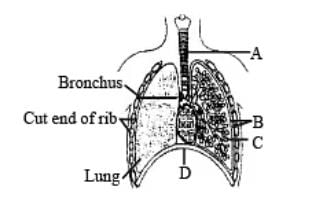
- a)B-pleural membrane-surrounds ribs on both sides to provides cushion against rubbing.
- b)C-Alveoli-thin walled vascular bag like structures for exchange of gases.
- c)D-Lower end of lungs-diaphragm pulls it down during inspiration
- d)A - trachea - long tubes up ported by complete cartilaginous rings for conducting inspired air.
Correct answer is option 'B'. Can you explain this answer?
The figure shows a diagrammatic view of human respiratory system with labels A, B, C and D. Select the option which gives correct identification and main function and/or characteristics. [NEET 2013]
a)
B-pleural membrane-surrounds ribs on both sides to provides cushion against rubbing.
b)
C-Alveoli-thin walled vascular bag like structures for exchange of gases.
c)
D-Lower end of lungs-diaphragm pulls it down during inspiration
d)
A - trachea - long tubes up ported by complete cartilaginous rings for conducting inspired air.
 | Abhishek Choudhary answered |
Alveoli are very thin, irregular walled bag like structures for gaseous exchange. Tracheae bronchi and bronchioles are supported by incomplete cartilaginous rings. Double layered pleural membrane surrounds the lungs with pleural fluid between them. It reduces friction on the lung surface.

Select the correct events that occur during inspiration. [2020]
(i) Contraction of diaphragm
(ii) Contraction of external inter costal muscles
(iii) Pulmonary volume decreases
(iv) Intra pulmonary pressure increases- a)(i), (ii) and (iv)
- b)Only (iv)
- c)(i) and (ii)
- d)(iii) and (iv)
Correct answer is option 'C'. Can you explain this answer?
Select the correct events that occur during inspiration. [2020]
(i) Contraction of diaphragm
(ii) Contraction of external inter costal muscles
(iii) Pulmonary volume decreases
(iv) Intra pulmonary pressure increases
(i) Contraction of diaphragm
(ii) Contraction of external inter costal muscles
(iii) Pulmonary volume decreases
(iv) Intra pulmonary pressure increases
a)
(i), (ii) and (iv)
b)
Only (iv)
c)
(i) and (ii)
d)
(iii) and (iv)
 | Jyoti Sengupta answered |
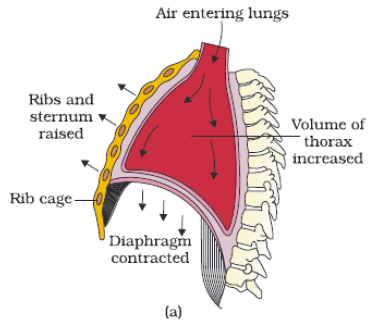
Inspiration is initiated by contraction of diaphragm which increases volume of thoracic chamber in antero-posterior axis and contraction of external inter –costal muscles which lifts up the ribs and sternum causing increases in volume of thoracic chamber in dorsoventral axis.
Which of the following factors are favourable for the formation of oxyhaemoglobin in alveoli? [2024]- a)High pO2 and High pCO2
- b)High pO2 and Lesser H+ concentration
- c)Low pCO2 and Lesser H+ concentration
- d)Low pCO2 and High temperature
Correct answer is option 'B'. Can you explain this answer?
Which of the following factors are favourable for the formation of oxyhaemoglobin in alveoli? [2024]
a)
High pO2 and High pCO2
b)
High pO2 and Lesser H+ concentration
c)
Low pCO2 and Lesser H+ concentration
d)
Low pCO2 and High temperature
 | EduRev NEET answered |
The formation of oxyhemoglobin in the alveoli is primarily influenced by the partial pressure of oxygen ( pO2 ), partial pressure of carbon dioxide ( pCO2), hydrogen ion concentration ( H+ ), and temperature. Understanding these factors will help in selecting the right option that describes the conditions favorable for maximizing the binding of oxygen to hemoglobin in the lungs.
1. Oxygen Partial Pressure ( pO2 ): High pO 2 enhances the formation of oxyhemoglobin. In the alveoli, where gas exchange occurs, the pO2 is relatively high, making it a favorable condition for oxyhemoglobin formation as oxygen molecules bind readily to hemoglobin.
2. Carbon Dioxide Partial Pressure ( pCO2 ): Lower pCO2 is favorable in the alveoli for oxyhemoglobin formation. High pCO2 leads to a lower pH (due to formation of carbonic acid), which can cause the release of O2 from hemoglobin (Bohr effect), reducing hemoglobin's affinity for oxygen.
3. Hydrogen Ion Concentration ( H+): Lesser H+ concentration, or higher pH, increases the affinity of hemoglobin for oxygen. In alkaline conditions (higher pH), hemoglobin is more likely to bind oxygen, thus forming oxyhemoglobin.
4. Temperature: Temperature also affects oxygen binding. Lower temperatures generally enhance the uptake of oxygen by hemoglobin. However, since the lung environment maintains a stable temperature, significant fluctuations in temperature are less of a consideration in this context compared to pO2 , pCO2 , and H+ concentration. Given these points, Option B - High pO2 and Lesser H+ concentration - best describes the conditions that are favorable for the formation of oxyhemoglobin in the alveoli. High pO2 ensures that more oxygen molecules are available to bind with hemoglobin, and a lower H+ concentration (higher pH) reduces the release of oxygen from hemoglobin, thereby increasing oxygen uptake.
1. Oxygen Partial Pressure ( pO2 ): High pO 2 enhances the formation of oxyhemoglobin. In the alveoli, where gas exchange occurs, the pO2 is relatively high, making it a favorable condition for oxyhemoglobin formation as oxygen molecules bind readily to hemoglobin.
2. Carbon Dioxide Partial Pressure ( pCO2 ): Lower pCO2 is favorable in the alveoli for oxyhemoglobin formation. High pCO2 leads to a lower pH (due to formation of carbonic acid), which can cause the release of O2 from hemoglobin (Bohr effect), reducing hemoglobin's affinity for oxygen.
3. Hydrogen Ion Concentration ( H+): Lesser H+ concentration, or higher pH, increases the affinity of hemoglobin for oxygen. In alkaline conditions (higher pH), hemoglobin is more likely to bind oxygen, thus forming oxyhemoglobin.
4. Temperature: Temperature also affects oxygen binding. Lower temperatures generally enhance the uptake of oxygen by hemoglobin. However, since the lung environment maintains a stable temperature, significant fluctuations in temperature are less of a consideration in this context compared to pO2 , pCO2 , and H+ concentration. Given these points, Option B - High pO2 and Lesser H+ concentration - best describes the conditions that are favorable for the formation of oxyhemoglobin in the alveoli. High pO2 ensures that more oxygen molecules are available to bind with hemoglobin, and a lower H+ concentration (higher pH) reduces the release of oxygen from hemoglobin, thereby increasing oxygen uptake.
What is vital capacity of our lungs?- a)Inspiratory reserve volume plus tidal volume
- b)Total lung capacity minus expiratory reserve volume
- c)Inspiratory reserve volume plus expiratory reserve volume
- d)Total lung capacity minus residual volume
Correct answer is option 'D'. Can you explain this answer?
What is vital capacity of our lungs?
a)
Inspiratory reserve volume plus tidal volume
b)
Total lung capacity minus expiratory reserve volume
c)
Inspiratory reserve volume plus expiratory reserve volume
d)
Total lung capacity minus residual volume
 | Rajeev Sharma answered |
Vital capacity of lungs is largest possible expiration after largest possible inspiration that is greatest. Volume of air can be exchanged in single respiration or amount of air breath in and out with greatest possible efforts.
VC = TRV +TV + ERV
= 3000 + 500 + 1100
= 4600 ml.
VC = TRV +TV + ERV
= 3000 + 500 + 1100
= 4600 ml.
Which of the following are the correct statement for respiration in human [2012]- a)Cigarette smoking may lead of inflammation of bronchi
- b)Neural signals from pneumotaxic centre in pons region of brain can increase the duration of inspiration
- c)Workers in grinding and stone - breaking industries may suffer from lung fibrosis
- d)About 90% of carbon dioxide (CO2) is carried by haemoglobin as carbamino haemoglobin.
Correct answer is option 'C'. Can you explain this answer?
Which of the following are the correct statement for respiration in human [2012]
a)
Cigarette smoking may lead of inflammation of bronchi
b)
Neural signals from pneumotaxic centre in pons region of brain can increase the duration of inspiration
c)
Workers in grinding and stone - breaking industries may suffer from lung fibrosis
d)
About 90% of carbon dioxide (CO2) is carried by haemoglobin as carbamino haemoglobin.
 | Shounak Nair answered |
(a) and (c) . Neural signals from pneumotaxic center in pons region of brain can limit the duration of inspiration. About 25% of carbodioxide (CO2) is carried by haemoglobin as carboxyhaemglobin.
Which of the following statements are correct with respect to vital capacity? (NEET 2022 Phase 2)(a) It includes ERV, TV and IRV
(b) Total volume of air a person can inspire after a normal expiration.
(c) The maximum volume of air a person can breathe in after forced expiration.
(d) It includes ERV, RV and IRV.
(e) The maximum volume of air a person can breath out after a forced inspiration.Choose the most appropriate answer from the options given below :- a)(a) and (e)
- b)(b), (d) and (e)
- c)(a), (c) and (d)
- d)(a), (c) and (e)
Correct answer is option 'D'. Can you explain this answer?
Which of the following statements are correct with respect to vital capacity? (NEET 2022 Phase 2)
(a) It includes ERV, TV and IRV
(b) Total volume of air a person can inspire after a normal expiration.
(c) The maximum volume of air a person can breathe in after forced expiration.
(d) It includes ERV, RV and IRV.
(e) The maximum volume of air a person can breath out after a forced inspiration.
(b) Total volume of air a person can inspire after a normal expiration.
(c) The maximum volume of air a person can breathe in after forced expiration.
(d) It includes ERV, RV and IRV.
(e) The maximum volume of air a person can breath out after a forced inspiration.
Choose the most appropriate answer from the options given below :
a)
(a) and (e)
b)
(b), (d) and (e)
c)
(a), (c) and (d)
d)
(a), (c) and (e)
 | Sakshi Bajaj answered |
Understanding Vital Capacity
Vital capacity is a crucial measurement in respiratory physiology. It represents the maximum amount of air a person can expel from the lungs after a maximum inhalation. Let’s analyze each statement to understand why option 'D' is the correct answer.
Statement Analysis
- (a) It includes ERV, TV, and IRV
- True. Vital capacity (VC) is calculated as the sum of Expiratory Reserve Volume (ERV), Tidal Volume (TV), and Inspiratory Reserve Volume (IRV).
- (b) Total volume of air a person can inspire after a normal expiration
- False. This statement describes the Inspiratory Reserve Volume (IRV), not the vital capacity.
- (c) The maximum volume of air a person can breathe in after forced expiration
- True. This statement is correct in explaining the maximum volume of air (which includes IRV) that can be inhaled after a forced expiration.
- (d) It includes ERV, RV, and IRV
- False. Vital capacity does not include Residual Volume (RV). It only includes ERV, TV, and IRV.
- (e) The maximum volume of air a person can breathe out after a forced inspiration
- True. This describes the maximum exhalation after a deep inhalation, which is often considered in the context of vital capacity.
Conclusion
Combining the true statements, we recognize that:
- Statements (a), (c), and (e) accurately describe aspects of vital capacity.
Therefore, the correct option is 'D' (a), (c), and (e) as they correctly encompass vital capacity's definition and its components.
Vital capacity is a crucial measurement in respiratory physiology. It represents the maximum amount of air a person can expel from the lungs after a maximum inhalation. Let’s analyze each statement to understand why option 'D' is the correct answer.
Statement Analysis
- (a) It includes ERV, TV, and IRV
- True. Vital capacity (VC) is calculated as the sum of Expiratory Reserve Volume (ERV), Tidal Volume (TV), and Inspiratory Reserve Volume (IRV).
- (b) Total volume of air a person can inspire after a normal expiration
- False. This statement describes the Inspiratory Reserve Volume (IRV), not the vital capacity.
- (c) The maximum volume of air a person can breathe in after forced expiration
- True. This statement is correct in explaining the maximum volume of air (which includes IRV) that can be inhaled after a forced expiration.
- (d) It includes ERV, RV, and IRV
- False. Vital capacity does not include Residual Volume (RV). It only includes ERV, TV, and IRV.
- (e) The maximum volume of air a person can breathe out after a forced inspiration
- True. This describes the maximum exhalation after a deep inhalation, which is often considered in the context of vital capacity.
Conclusion
Combining the true statements, we recognize that:
- Statements (a), (c), and (e) accurately describe aspects of vital capacity.
Therefore, the correct option is 'D' (a), (c), and (e) as they correctly encompass vital capacity's definition and its components.
Tidal Volume and Expiratory Reserve Volume of an athlete is 500 mL and 1000 mL respectively. What will be his expiratory capacity if the residual volume is 1200 mL? [2019]- a)2700 mL
- b)1500 mL
- c)1700 mL
- d)2200 mL
Correct answer is option 'B'. Can you explain this answer?
Tidal Volume and Expiratory Reserve Volume of an athlete is 500 mL and 1000 mL respectively. What will be his expiratory capacity if the residual volume is 1200 mL? [2019]
a)
2700 mL
b)
1500 mL
c)
1700 mL
d)
2200 mL
 | Mira Joshi answered |
Expiratory capacity is the total volume of air a person can expire after normal inspiration. It includes tidal volume and expiratory reserve volume.
EC = TV + ERV = 500 + 1000 = 1500 mL
EC = TV + ERV = 500 + 1000 = 1500 mL
Which of the following options correctly represents the lung conditions in asthma and emphysema, respectively? [2018]- a)Inflammation of bronchioles; Decreased respiratory surface
- b)Increased number of bronchioles; Increased respiratory surface
- c)Increased respiratory surface; Inflammation of bronchioles
- d)None of these
Correct answer is option 'A'. Can you explain this answer?
Which of the following options correctly represents the lung conditions in asthma and emphysema, respectively? [2018]
a)
Inflammation of bronchioles; Decreased respiratory surface
b)
Increased number of bronchioles; Increased respiratory surface
c)
Increased respiratory surface; Inflammation of bronchioles
d)
None of these
| | Preeti Iyer answered |
Asthma is a difficulty in breathing, causing wheezing due to inflammation of bronchi and bronchioles.
Emphysema is a chronic disorder in which abnormal distension of the bronchioles or alveolar sacs of the lungs occurs due to which respiratory surface is decreased for the exchange of oxygen and carbon dioxide.
Select the favorable conditions required for the formation of oxyhemoglobin at the alveoli. [2021]- a)High pO2, high pCO2, less H+, higher temperature
- b)Low pO2, low pCO2, more H+, higher temperature
- c)High pO2, low pCO2, less H+, lower temperature
- d)Low pO2 high pCO2 more H+, higher temperature
Correct answer is option 'C'. Can you explain this answer?
Select the favorable conditions required for the formation of oxyhemoglobin at the alveoli. [2021]
a)
High pO2, high pCO2, less H+, higher temperature
b)
Low pO2, low pCO2, more H+, higher temperature
c)
High pO2, low pCO2, less H+, lower temperature
d)
Low pO2 high pCO2 more H+, higher temperature
 | Avantika Gupta answered |
Formation of Oxyhemoglobin at Alveoli
Oxyhemoglobin is formed when oxygen molecules bind with hemoglobin in the red blood cells. The favorable conditions required for the formation of oxyhemoglobin at the alveoli are:
High pO2: The partial pressure of oxygen in the alveoli should be high to facilitate the binding of oxygen with hemoglobin.
Low pCO2: The partial pressure of carbon dioxide in the alveoli should be low to prevent the formation of carbaminohemoglobin, which is formed when carbon dioxide binds with hemoglobin.
Less H+: A low concentration of hydrogen ions (H+) is required to maintain the pH of the blood at a slightly alkaline level, which is optimal for the binding of oxygen with hemoglobin.
Lower temperature: A lower temperature in the alveoli is favorable for the binding of oxygen with hemoglobin.
Therefore, the correct option is C, which includes all the favorable conditions required for the formation of oxyhemoglobin at the alveoli.
Oxyhemoglobin is formed when oxygen molecules bind with hemoglobin in the red blood cells. The favorable conditions required for the formation of oxyhemoglobin at the alveoli are:
High pO2: The partial pressure of oxygen in the alveoli should be high to facilitate the binding of oxygen with hemoglobin.
Low pCO2: The partial pressure of carbon dioxide in the alveoli should be low to prevent the formation of carbaminohemoglobin, which is formed when carbon dioxide binds with hemoglobin.
Less H+: A low concentration of hydrogen ions (H+) is required to maintain the pH of the blood at a slightly alkaline level, which is optimal for the binding of oxygen with hemoglobin.
Lower temperature: A lower temperature in the alveoli is favorable for the binding of oxygen with hemoglobin.
Therefore, the correct option is C, which includes all the favorable conditions required for the formation of oxyhemoglobin at the alveoli.
When you hold your breath, which of the following gas changes in blood would first lead to the urge to breathe? [NEET 2015 / AIPMT 2015 ]- a)Rising CO2 concentration
- b)Falling CO2 concentration
- c)Rising CO2 and falling O2 concentration
- d)Falling O2 concentration
Correct answer is option 'A'. Can you explain this answer?
When you hold your breath, which of the following gas changes in blood would first lead to the urge to breathe? [NEET 2015 / AIPMT 2015 ]
a)
Rising CO2 concentration
b)
Falling CO2 concentration
c)
Rising CO2 and falling O2 concentration
d)
Falling O2 concentration
 | Mohit Rajpoot answered |
Excess CO2 mainly stimulates the respiratory centre of the brain and increases the inspiratory and expiratory signals to the respiratory muscles. O2 does not have a significant direct effect on the respiratory centre of the brain in controlling respiration.
Reduction in pH of blood will [NEET 2016 Phase 1]- a)Decrease the affinity of haemoglobin with oxygen.
- b)Release bicarbonate ions by the liver
- c)Reduce the rate of heartbeat
- d)Reduce the blood supply to the brain.
Correct answer is option 'A'. Can you explain this answer?
Reduction in pH of blood will [NEET 2016 Phase 1]
a)
Decrease the affinity of haemoglobin with oxygen.
b)
Release bicarbonate ions by the liver
c)
Reduce the rate of heartbeat
d)
Reduce the blood supply to the brain.
 | Lead Academy answered |
- A reduction in blood pH indicates an increase in acidity, known as acidosis.
- Acidosis decreases hemoglobin's affinity for oxygen, meaning it releases oxygen more readily to the tissues.
- This is crucial for maintaining oxygen delivery, especially under stress or high metabolic activity.
- The other options, such as liver bicarbonate release and heart rate reduction, are not directly related to pH changes in blood.
- Thus, the correct answer is that reduced pH decreases hemoglobin's oxygen affinity.
- Acidosis decreases hemoglobin's affinity for oxygen, meaning it releases oxygen more readily to the tissues.
- This is crucial for maintaining oxygen delivery, especially under stress or high metabolic activity.
- The other options, such as liver bicarbonate release and heart rate reduction, are not directly related to pH changes in blood.
- Thus, the correct answer is that reduced pH decreases hemoglobin's oxygen affinity.
Under normal physiological conditions in human being every 100 ml of oxygenated blood can deliver ___________ ml of O2 to the tissues. (NEET 2022 Phase 1)- a)5 ml
- b)4 ml
- c)10 ml
- d)2 ml
Correct answer is option 'A'. Can you explain this answer?
Under normal physiological conditions in human being every 100 ml of oxygenated blood can deliver ___________ ml of O2 to the tissues. (NEET 2022 Phase 1)
a)
5 ml
b)
4 ml
c)
10 ml
d)
2 ml
 | Sagar Jain answered |
Oxygen Delivery in Human Physiology
In human physiology, the delivery of oxygen from the blood to the tissues is a critical function. Under normal conditions, the amount of oxygen transported in the blood can be quantified.
Oxygen Content in Blood
- Oxygenated blood typically contains about 20 ml of O2 per 100 ml of blood.
- This oxygen is bound to hemoglobin in red blood cells, with a small portion dissolved in plasma.
Oxygen Delivery to Tissues
- Of the 20 ml of oxygen carried in 100 ml of blood, approximately 5 ml of O2 is delivered to the tissues during normal physiological conditions.
- This is based on the metabolic needs of the tissues, which utilize oxygen for cellular respiration.
Clinical Significance
- Understanding this delivery capability is crucial in various medical fields, especially in assessing respiratory function and conditions like hypoxia.
- The value may vary under different physiological or pathological conditions, but 5 ml is considered a standard delivery amount in healthy individuals.
Conclusion
- Hence, the correct answer to the question regarding the amount of oxygen delivered to tissues from 100 ml of oxygenated blood is 5 ml (option A). This highlights the efficiency of the respiratory and circulatory systems in meeting the metabolic demands of the body.
In human physiology, the delivery of oxygen from the blood to the tissues is a critical function. Under normal conditions, the amount of oxygen transported in the blood can be quantified.
Oxygen Content in Blood
- Oxygenated blood typically contains about 20 ml of O2 per 100 ml of blood.
- This oxygen is bound to hemoglobin in red blood cells, with a small portion dissolved in plasma.
Oxygen Delivery to Tissues
- Of the 20 ml of oxygen carried in 100 ml of blood, approximately 5 ml of O2 is delivered to the tissues during normal physiological conditions.
- This is based on the metabolic needs of the tissues, which utilize oxygen for cellular respiration.
Clinical Significance
- Understanding this delivery capability is crucial in various medical fields, especially in assessing respiratory function and conditions like hypoxia.
- The value may vary under different physiological or pathological conditions, but 5 ml is considered a standard delivery amount in healthy individuals.
Conclusion
- Hence, the correct answer to the question regarding the amount of oxygen delivered to tissues from 100 ml of oxygenated blood is 5 ml (option A). This highlights the efficiency of the respiratory and circulatory systems in meeting the metabolic demands of the body.
Lungs do not collapse between breaths and some air always remains in the lungs which can never be expelled because [NEET 2016 Phase 2]- a)There is a negative pressure in the lungs
- b)There is a negative intrapleural pressure pulling at the lung walls
- c)There is a positive intrapleural pressure
- d)Pressure in the lungs is higher than the atmospheric pressure.
Correct answer is option 'B'. Can you explain this answer?
Lungs do not collapse between breaths and some air always remains in the lungs which can never be expelled because [NEET 2016 Phase 2]
a)
There is a negative pressure in the lungs
b)
There is a negative intrapleural pressure pulling at the lung walls
c)
There is a positive intrapleural pressure
d)
Pressure in the lungs is higher than the atmospheric pressure.
 | Ambition Institute answered |
Intrapleural pressure is the pressure of air within the pleural cavity. Intrapleural pressure is always negative, which acts like a suction to keep the lungs inflated and prevent them from collapsing. The negative intrapleural pressure is due to three main factors: surface tension of the alveolar fluid; elasticity of lungs; elasticity of thoracic wall. Normally, there is a difference between intrapleural and intrapulmonary pressure, which is called transpulmonary pressure. This transpulmonary pressure creates the suction to keep the lungs inflated. If there is no pressure difference, there is no suction and lungs will collapse.
Approximately seventy per cent of carbon dioxide absorbed by the blood will be transported to the lungs: [NEET 2014 / AIPMT 2014 ]- a)As bicarbonate ions
- b)In the form of dissolved gas molecules
- c)By binding to R.B.C.
- d)As carbamino - haemoglobin
Correct answer is option 'A'. Can you explain this answer?
Approximately seventy per cent of carbon dioxide absorbed by the blood will be transported to the lungs: [NEET 2014 / AIPMT 2014 ]
a)
As bicarbonate ions
b)
In the form of dissolved gas molecules
c)
By binding to R.B.C.
d)
As carbamino - haemoglobin
| | Mohit Rajpoot answered |
- About 70% of CO2 (about 2.5ml per 100 ml. of blood), received by blood from the tissues, enters the RBCs where it reacts with water to form carbonic acid (H2CO3).
- Carbonic anhydrase, exclusively found in RBCs, speeds up the formation of H2CO3 and rapidly converts it back to carbon dioxide and water when blood reaches the lungs. Almost as rapidly as formed, all carbonic acid of RBCs dissociates into hydrogen (H+) and bicarbonate ions (HCO-3).
Lungs are made up of air-filled sacs, the alveoli. They do not collapse even after forceful expiration, because of [2017]- a)Inspiratory reserve volume
- b)Tidal volume
- c)Expiratory reserve volume
- d)Residual volume
Correct answer is option 'D'. Can you explain this answer?
Lungs are made up of air-filled sacs, the alveoli. They do not collapse even after forceful expiration, because of [2017]
a)
Inspiratory reserve volume
b)
Tidal volume
c)
Expiratory reserve volume
d)
Residual volume
| | Jyoti Sengupta answered |
Residual volume is the volume of air which remains in the lungs after the most forceful expiration. This residual air enables the lungs to continue exchange of gases even after maximum exhalation. Due to this, lungs do not collapse even after forceful expiration.
Asthma may be attributed to [NEET 2016 Phase 2]- a)Inflammation of the trachea
- b)Accumulation of fluid in the lungs
- c)Bacterial infection of the lungs
- d)Allergic reaction of the mast cells in the lungs.
Correct answer is option 'D'. Can you explain this answer?
Asthma may be attributed to [NEET 2016 Phase 2]
a)
Inflammation of the trachea
b)
Accumulation of fluid in the lungs
c)
Bacterial infection of the lungs
d)
Allergic reaction of the mast cells in the lungs.
| | Avik Patel answered |
Understanding Asthma
Asthma is a chronic respiratory condition characterized by inflammation and narrowing of the airways, which leads to difficulty in breathing. The primary underlying cause of asthma is often linked to an allergic reaction, particularly involving mast cells.
Key Factors Contributing to Asthma
- Allergic Reactions
- Asthma is frequently triggered by allergens such as pollen, dust mites, pet dander, and mold.
- When a person with asthma is exposed to these allergens, mast cells in the lungs release histamines and other inflammatory substances.
- This immune response causes airway inflammation, leading to symptoms like wheezing, coughing, chest tightness, and shortness of breath.
- Inflammation of the Airways
- The airways in asthmatic individuals become inflamed, which narrows the passage for air to flow.
- This inflammation is a direct result of the body’s immune response to allergens or irritants.
- Role of Mast Cells
- Mast cells are a type of white blood cell that play a crucial role in allergic reactions.
- When they encounter an allergen, they trigger the release of various chemicals that exacerbate airway inflammation.
Conclusion
In summary, asthma is primarily attributed to an allergic reaction involving mast cells in the lungs. While factors like inflammation of the trachea or lung infections can contribute to respiratory issues, the hallmark of asthma lies in its allergic nature. Understanding this can help in better management and treatment of the condition.
Asthma is a chronic respiratory condition characterized by inflammation and narrowing of the airways, which leads to difficulty in breathing. The primary underlying cause of asthma is often linked to an allergic reaction, particularly involving mast cells.
Key Factors Contributing to Asthma
- Allergic Reactions
- Asthma is frequently triggered by allergens such as pollen, dust mites, pet dander, and mold.
- When a person with asthma is exposed to these allergens, mast cells in the lungs release histamines and other inflammatory substances.
- This immune response causes airway inflammation, leading to symptoms like wheezing, coughing, chest tightness, and shortness of breath.
- Inflammation of the Airways
- The airways in asthmatic individuals become inflamed, which narrows the passage for air to flow.
- This inflammation is a direct result of the body’s immune response to allergens or irritants.
- Role of Mast Cells
- Mast cells are a type of white blood cell that play a crucial role in allergic reactions.
- When they encounter an allergen, they trigger the release of various chemicals that exacerbate airway inflammation.
Conclusion
In summary, asthma is primarily attributed to an allergic reaction involving mast cells in the lungs. While factors like inflammation of the trachea or lung infections can contribute to respiratory issues, the hallmark of asthma lies in its allergic nature. Understanding this can help in better management and treatment of the condition.
Which one of the following is one of the paths followed by air/O2 during respiration in an adult male Periplaneta americana as it enters the animal body? [NEET Kar. 2013]- a)Hypopharynx, mouth, pharynx, trachea, tissues
- b)Spiracle in metathorax , trachea , tracheoles, oxygen diffuses into cells
- c)Mouth, bronchial tube, trachea, oxygen enters cells
- d)Spiracle sinprothorax, tracheoles, trachea, oxygen diffuses into cells
Correct answer is option 'B'. Can you explain this answer?
Which one of the following is one of the paths followed by air/O2 during respiration in an adult male Periplaneta americana as it enters the animal body? [NEET Kar. 2013]
a)
Hypopharynx, mouth, pharynx, trachea, tissues
b)
Spiracle in metathorax , trachea , tracheoles, oxygen diffuses into cells
c)
Mouth, bronchial tube, trachea, oxygen enters cells
d)
Spiracle sinprothorax, tracheoles, trachea, oxygen diffuses into cells
 | Deepak Joshi answered |
The number of spiracles in cockroach is 10-pairs (2-pairs in thoracic and 8-pairs in abdominal region). The thoracic pairs of spiracles are present on pleuron between prothorax - mesothorax and metathorax. Each spiracle opens into a chamber called atrium. After atrium the tracheal tube ramifies into fine branches of tracheae, and then tracheoles.
Figure shown schematic plan of blood circulation in humans with labels A to D. Identify the label and give its function’s. [NEET 2013]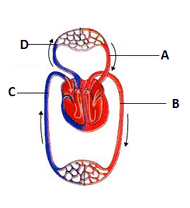
- a)B-Pulmonar y arter y-takes blood from heart to lungs, PO2 = 90 mm Hg
- b)C-Vena Cava - takes blood from body parts to right auricle, PCO2 = 45 mm Hg
- c)D - Dorsal aorta - takes blood from Heart to body Part PO2 = 95 mm Hg
- d)A-Pulmonary vein - takes impure blood from body parts, PO2 = 60 mm Hg
Correct answer is option 'B'. Can you explain this answer?
Figure shown schematic plan of blood circulation in humans with labels A to D. Identify the label and give its function’s. [NEET 2013]
a)
B-Pulmonar y arter y-takes blood from heart to lungs, PO2 = 90 mm Hg
b)
C-Vena Cava - takes blood from body parts to right auricle, PCO2 = 45 mm Hg
c)
D - Dorsal aorta - takes blood from Heart to body Part PO2 = 95 mm Hg
d)
A-Pulmonary vein - takes impure blood from body parts, PO2 = 60 mm Hg
 | Raghav Khanna answered |
A is Pulmonary vein which takes pure blood from lungs to heart. B is dorsal aorta which takes pure blood from heart to various body parts. C is Vena cava which takes impure blood from various body pars to right auricle of heart. D is pulmonary artery which takes impure blood from heart to lungs.
Name the chronic respiratory disorder caused mainly by cigarette smoking. [NEET 2016 Phase 2]
- a)Respiratory acidosis
- b)Respiratory alkalosis
- c)Emphysema
- d)Asthma
Correct answer is option 'C'. Can you explain this answer??
Name the chronic respiratory disorder caused mainly by cigarette smoking. [NEET 2016 Phase 2]
a)
Respiratory acidosis
b)
Respiratory alkalosis
c)
Emphysema
d)
Asthma
| | Ankita Sen answered |
Chronic Respiratory Disorder: Emphysema
Emphysema is a chronic respiratory disorder primarily caused by cigarette smoking. It is characterized by the destruction of the alveoli, the tiny air sacs in the lungs, leading to breathing difficulties.
Key Features of Emphysema:
- Alveolar Damage: Smoking damages the elastic fibers and walls of the alveoli, reducing their ability to expand and contract.
- Air Trapping: As the alveoli lose their elasticity, air becomes trapped in the lungs, making it difficult to exhale fully. This results in over-inflation of the lungs.
- Reduced Gas Exchange: The destruction of alveoli decreases the surface area available for gas exchange, leading to lower oxygen levels in the blood and increased carbon dioxide retention.
- Symptoms: Common symptoms include chronic cough, wheezing, shortness of breath, and increased production of mucus.
Pathophysiology:
- Inflammation: Cigarette smoke contains harmful chemicals that trigger inflammation in the lungs. This inflammation leads to the breakdown of elastin, a protein that helps maintain the structure of alveoli.
- Impaired Defense Mechanisms: Smoking also impairs the normal lung defense mechanisms, making the lungs more susceptible to infections and further damage.
Conclusion:
Emphysema, as a chronic respiratory disorder, is predominantly linked to cigarette smoking. The damage it causes to the lungs can lead to significant health issues and a reduced quality of life for affected individuals. Early diagnosis and cessation of smoking can help manage symptoms and slow disease progression.
Emphysema is a chronic respiratory disorder primarily caused by cigarette smoking. It is characterized by the destruction of the alveoli, the tiny air sacs in the lungs, leading to breathing difficulties.
Key Features of Emphysema:
- Alveolar Damage: Smoking damages the elastic fibers and walls of the alveoli, reducing their ability to expand and contract.
- Air Trapping: As the alveoli lose their elasticity, air becomes trapped in the lungs, making it difficult to exhale fully. This results in over-inflation of the lungs.
- Reduced Gas Exchange: The destruction of alveoli decreases the surface area available for gas exchange, leading to lower oxygen levels in the blood and increased carbon dioxide retention.
- Symptoms: Common symptoms include chronic cough, wheezing, shortness of breath, and increased production of mucus.
Pathophysiology:
- Inflammation: Cigarette smoke contains harmful chemicals that trigger inflammation in the lungs. This inflammation leads to the breakdown of elastin, a protein that helps maintain the structure of alveoli.
- Impaired Defense Mechanisms: Smoking also impairs the normal lung defense mechanisms, making the lungs more susceptible to infections and further damage.
Conclusion:
Emphysema, as a chronic respiratory disorder, is predominantly linked to cigarette smoking. The damage it causes to the lungs can lead to significant health issues and a reduced quality of life for affected individuals. Early diagnosis and cessation of smoking can help manage symptoms and slow disease progression.
Chapter doubts & questions for Breathing and Exchange of Gases - 30-Day Revision Course for NEET 2026 is part of NEET exam preparation. The chapters have been prepared according to the NEET exam syllabus. The Chapter doubts & questions, notes, tests & MCQs are made for NEET 2026 Exam. Find important definitions, questions, notes, meanings, examples, exercises, MCQs and online tests here.
Chapter doubts & questions of Breathing and Exchange of Gases - 30-Day Revision Course for NEET in English & Hindi are available as part of NEET exam. Download more important topics, notes, lectures and mock test series for NEET Exam by signing up for free.
30-Day Revision Course for NEET85 videos|301 docs|171 tests |
