


All Exams > NEET > 30-Day Revision Course for NEET > All Questions
All questions of Neural Control and Coordination for NEET Exam
Brain stem is the support system of brain and is the collective name for :- a)Medulla, Pons,and Midbrain
- b)Hypothalamus, Diencephalon, Cerebellum, and Pons
- c)Cerebrum, Mesencephalon, Diencephalon, and Medulla
- d)Prosencephalon, Mesencephalon, Pons, and Medulla
Correct answer is option 'A'. Can you explain this answer?
Brain stem is the support system of brain and is the collective name for :
a)
Medulla, Pons,and Midbrain
b)
Hypothalamus, Diencephalon, Cerebellum, and Pons
c)
Cerebrum, Mesencephalon, Diencephalon, and Medulla
d)
Prosencephalon, Mesencephalon, Pons, and Medulla
 | Pritam Choudhary answered |
Brainstem: The Support System of Brain
The brainstem is the lower part of the brain that connects the brain to the spinal cord. It is responsible for regulating important functions such as breathing, heart rate, blood pressure, and consciousness. The brainstem consists of three main parts, which are:
Medulla
The medulla oblongata, or simply the medulla, is the lowest part of the brainstem. It controls involuntary functions such as breathing, heartbeat, and digestion. The medulla also contains reflex centers for coughing, sneezing, and vomiting.
Pons
The pons is the middle part of the brainstem, located above the medulla and below the midbrain. It is involved in the regulation of sleep, respiration, and posture. The pons also helps to relay messages between different parts of the brain.
Midbrain
The midbrain, also known as the mesencephalon, is the uppermost part of the brainstem. It is involved in the regulation of vision, hearing, and movement. The midbrain contains several important structures, including the substantia nigra, which produces dopamine and is involved in the control of movement.
Conclusion
In conclusion, the brainstem is the support system of the brain and is responsible for regulating vital functions. It consists of three main parts, which are the medulla, pons, and midbrain. The medulla controls involuntary functions such as breathing and heartbeat, the pons is involved in the regulation of sleep and posture, and the midbrain is responsible for vision, hearing, and movement.
The brainstem is the lower part of the brain that connects the brain to the spinal cord. It is responsible for regulating important functions such as breathing, heart rate, blood pressure, and consciousness. The brainstem consists of three main parts, which are:
Medulla
The medulla oblongata, or simply the medulla, is the lowest part of the brainstem. It controls involuntary functions such as breathing, heartbeat, and digestion. The medulla also contains reflex centers for coughing, sneezing, and vomiting.
Pons
The pons is the middle part of the brainstem, located above the medulla and below the midbrain. It is involved in the regulation of sleep, respiration, and posture. The pons also helps to relay messages between different parts of the brain.
Midbrain
The midbrain, also known as the mesencephalon, is the uppermost part of the brainstem. It is involved in the regulation of vision, hearing, and movement. The midbrain contains several important structures, including the substantia nigra, which produces dopamine and is involved in the control of movement.
Conclusion
In conclusion, the brainstem is the support system of the brain and is responsible for regulating vital functions. It consists of three main parts, which are the medulla, pons, and midbrain. The medulla controls involuntary functions such as breathing and heartbeat, the pons is involved in the regulation of sleep and posture, and the midbrain is responsible for vision, hearing, and movement.

Injury localised to the hypothalamus would most likely disrupt- a)short term memory
- b)coordination during locomotion
- c)executive function, such as decision making
- d)regulation of body temperature
Correct answer is option 'D'. Can you explain this answer?
Injury localised to the hypothalamus would most likely disrupt
a)
short term memory
b)
coordination during locomotion
c)
executive function, such as decision making
d)
regulation of body temperature
 | Aman Sharma answered |
The primary function of the hypothalamus is homoeostasis, which is to maintain the body's normal temperature and body's status. So, if there is an injury to the hypothalamus, the thermoregulatory centre is disturbed resulting in a deregulation of body temperature. So, the correct answer is option D.
What is meant by coordination?- a)Only two organs interact
- b)Two or more organs interact
- c)Only two organs systems interact
- d)Only three organs interact
Correct answer is option 'B'. Can you explain this answer?
What is meant by coordination?
a)
Only two organs interact
b)
Two or more organs interact
c)
Only two organs systems interact
d)
Only three organs interact
 | Disha Basu answered |
Understanding Coordination
Coordination is a fundamental concept in biology, particularly in the context of how different organs and systems within an organism interact and work together to maintain homeostasis and overall function.
Key Aspects of Coordination:
- Definition: Coordination refers to the process by which two or more organs or organ systems interact to perform a specific function or response. It ensures that various physiological processes are synchronized for optimal functioning of the body.
- Complex Interactions: Unlike the options suggesting only two or three organs, coordination often involves multiple organs and systems working in harmony. For instance, the respiratory and circulatory systems coordinate to deliver oxygen to tissues and remove carbon dioxide.
- Examples:
- The digestive system coordinates with the nervous system to regulate hunger and satiety.
- The endocrine system interacts with various organs to maintain metabolic balance through hormone signaling.
- Importance: Effective coordination is vital for survival. It allows organisms to respond to environmental changes, regulate internal processes, and maintain overall health.
Conclusion:
Hence, the correct answer is option 'B', as coordination inherently involves the interaction of two or more organs. This collective effort ensures that the body can function efficiently and respond to various stimuli, highlighting the complexity and interdependence of biological systems.
Coordination is a fundamental concept in biology, particularly in the context of how different organs and systems within an organism interact and work together to maintain homeostasis and overall function.
Key Aspects of Coordination:
- Definition: Coordination refers to the process by which two or more organs or organ systems interact to perform a specific function or response. It ensures that various physiological processes are synchronized for optimal functioning of the body.
- Complex Interactions: Unlike the options suggesting only two or three organs, coordination often involves multiple organs and systems working in harmony. For instance, the respiratory and circulatory systems coordinate to deliver oxygen to tissues and remove carbon dioxide.
- Examples:
- The digestive system coordinates with the nervous system to regulate hunger and satiety.
- The endocrine system interacts with various organs to maintain metabolic balance through hormone signaling.
- Importance: Effective coordination is vital for survival. It allows organisms to respond to environmental changes, regulate internal processes, and maintain overall health.
Conclusion:
Hence, the correct answer is option 'B', as coordination inherently involves the interaction of two or more organs. This collective effort ensures that the body can function efficiently and respond to various stimuli, highlighting the complexity and interdependence of biological systems.
The………. difference across the resting membrane is called as Resting potential.- a)Electrochemical potential
- b)Electrical potential
- c)Chemical
- d)Chemiosmotic
Correct answer is option 'B'. Can you explain this answer?
The………. difference across the resting membrane is called as Resting potential.
a)
Electrochemical potential
b)
Electrical potential
c)
Chemical
d)
Chemiosmotic
 | Stepway Academy answered |
The electrical potential difference across the resting plasma membrane is called as the resting potential.
Topic in NCERT: NEURAL CONTROL AND COORDINATIONLine in NCERT: "The electrical potential difference across the resting plasma membrane is called as the resting potential."
Where are the myelinated neurons found?- a)In Spinal cord and cranial nerves
- b)Only in the embryonic condition
- c)In peripheral nerve
- d)In motor neurons
Correct answer is option 'A'. Can you explain this answer?
Where are the myelinated neurons found?
a)
In Spinal cord and cranial nerves
b)
Only in the embryonic condition
c)
In peripheral nerve
d)
In motor neurons
 | Ambition Institute answered |
Myelinated nerve fibres are found in spinal and cranial nerves. Unmyelinated nerve fibres are enclosed by a Schwann cell that does not form a myelin sheath around the axon and is commonly found in autonomous and the somatic neural system.
Which of the following statements is incorrect regarding electrical synapses?- a)Transmission of signals is faster than chemical synapses
- b)Pre and postsynaptic membranes are in very close proximity
- c) Electrical synapse can flow directly from one neuron to another
- d)They are very common in our system
Correct answer is option 'D'. Can you explain this answer?
Which of the following statements is incorrect regarding electrical synapses?
a)
Transmission of signals is faster than chemical synapses
b)
Pre and postsynaptic membranes are in very close proximity
c)
Electrical synapse can flow directly from one neuron to another
d)
They are very common in our system
 | Mohit Rajpoot answered |
Electrical synapses are very rare in our system. At electrical synapses, the membranes of pre and post synaptic neurons are in very close proximity. Impulse transmission across an electrical synapse is always faster than chemical synapse.
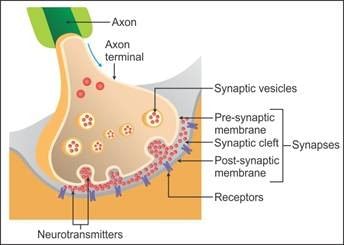
Topic in NCERT: Transmission of ImpulsesLine in NCERT: "Electrical synapses are rare in our system."
What does each branch of axon terminate into?- a)Another cell
- b)Vesicles
- c)Tubules
- d)Synaptic knob
Correct answer is option 'D'. Can you explain this answer?
What does each branch of axon terminate into?
a)
Another cell
b)
Vesicles
c)
Tubules
d)
Synaptic knob
 | Navya Datta answered |
Understanding Axon Termination
The axon is a vital part of a neuron responsible for transmitting electrical impulses away from the cell body. Its termination plays a crucial role in communication between neurons or between neurons and muscles or glands.
What Does the Axon Terminate Into?
The correct answer is option 'D': Synaptic knob. Here's why:
Structure of the Axon Termination
- The end of the axon branches into multiple terminal buttons or synaptic knobs.
- These knobs are specialized structures that play a key role in neurotransmission.
Function of Synaptic Knobs
- Neurotransmitter Release: Synaptic knobs contain vesicles filled with neurotransmitters. When an electrical impulse reaches the synaptic knob, it triggers the release of these neurotransmitters into the synaptic cleft.
- Communication: The neurotransmitters then bind to receptors on the adjacent cell (which could be another neuron, a muscle cell, or a gland), facilitating communication and signaling.
Other Options Explained
- Another Cell: While the axon does interact with other cells, it does not terminate directly into them. Instead, it releases neurotransmitters that communicate with these cells.
- Vesicles: Though vesicles are present within the synaptic knobs, they do not represent the termination structure itself.
- Tubules: Tubules refer to intracellular structures and are not relevant to the axon's termination.
Conclusion
In summary, the axon terminates into synaptic knobs, which are essential for neurotransmitter release and effective communication between cells, making them a vital component in the nervous system's functionality.
The axon is a vital part of a neuron responsible for transmitting electrical impulses away from the cell body. Its termination plays a crucial role in communication between neurons or between neurons and muscles or glands.
What Does the Axon Terminate Into?
The correct answer is option 'D': Synaptic knob. Here's why:
Structure of the Axon Termination
- The end of the axon branches into multiple terminal buttons or synaptic knobs.
- These knobs are specialized structures that play a key role in neurotransmission.
Function of Synaptic Knobs
- Neurotransmitter Release: Synaptic knobs contain vesicles filled with neurotransmitters. When an electrical impulse reaches the synaptic knob, it triggers the release of these neurotransmitters into the synaptic cleft.
- Communication: The neurotransmitters then bind to receptors on the adjacent cell (which could be another neuron, a muscle cell, or a gland), facilitating communication and signaling.
Other Options Explained
- Another Cell: While the axon does interact with other cells, it does not terminate directly into them. Instead, it releases neurotransmitters that communicate with these cells.
- Vesicles: Though vesicles are present within the synaptic knobs, they do not represent the termination structure itself.
- Tubules: Tubules refer to intracellular structures and are not relevant to the axon's termination.
Conclusion
In summary, the axon terminates into synaptic knobs, which are essential for neurotransmitter release and effective communication between cells, making them a vital component in the nervous system's functionality.
The rise in stimulus-induced permeability to
a. Potassium ions
b. Sodium ions
c. Restoring RMP
d. Diffusion of potassium ionsArrange them in order.- a)b-a-c-d
- b)a-b-c-d
- c)b-a-d-c
- d)c-a-d-b
Correct answer is option 'C'. Can you explain this answer?
The rise in stimulus-induced permeability to
a. Potassium ions
b. Sodium ions
c. Restoring RMP
d. Diffusion of potassium ions
a. Potassium ions
b. Sodium ions
c. Restoring RMP
d. Diffusion of potassium ions
Arrange them in order.
a)
b-a-c-d
b)
a-b-c-d
c)
b-a-d-c
d)
c-a-d-b
 | Ciel Knowledge answered |
The electrical potential difference across the resting plasma membrane is called as the resting potential.The rise in the stimulus-induced permeability to Na+ is extremely shortlived. It is quickly followed by a rise in permeability to K+. Within a fraction of a second, K+ diffuses outside the membrane and restores the resting potential of the membrane at the site of excitation and the fibre becomes once more responsive to further stimulation.
Topic in NCERT: Generation and Conduction of Nerve ImpulseLine in NCERT: "The rise in the stimulus-induced permeability to Na* is extremely short-lived. It is quickly followed by a rise in permeability to K*. Within a fraction of a second, K+ diffuses outside the membrane and restores the resting potential of the membrane at the site of excitation and the fibre becomes once more responsive to further stimulation."
Where are the specific receptors of neurotransmitters present?- a)Synaptic cleft
- b)Post-synaptic membrane
- c)Pre-synaptic membrane
- d)Synaptic vesicle
Correct answer is option 'B'. Can you explain this answer?
Where are the specific receptors of neurotransmitters present?
a)
Synaptic cleft
b)
Post-synaptic membrane
c)
Pre-synaptic membrane
d)
Synaptic vesicle
 | Lead Academy answered |
The released neurotransmitters bind to their specific receptors which are present on the post-synaptic membrane. The new potential developed may be either excitatory or inhibitory.
What are the short repeatedly branched fibres called?- a)Axon
- b)Dendrite
- c)Neurite
- d)Cell body
Correct answer is option 'B'. Can you explain this answer?
What are the short repeatedly branched fibres called?
a)
Axon
b)
Dendrite
c)
Neurite
d)
Cell body
 | Akash Nair answered |
Short Repeatedly Branched Fibres: Axon
An axon is a long, slender projection of a neuron that conducts electrical impulses away from the cell body, towards other neurons or target cells. It is the primary transmission line of the nervous system, responsible for transmitting and propagating action potentials.
Structure of an Axon:
- Axon Hillock: The axon hillock is the cone-shaped region of the neuron where the axon originates from the cell body. It is the site where action potentials are generated.
- Axon Proper: The axon proper is the elongated part of the axon that extends away from the cell body. It is covered by a lipid-rich insulating layer called the myelin sheath, which is produced by specialized supporting cells called Schwann cells in the peripheral nervous system, and oligodendrocytes in the central nervous system.
- Axon Terminal: At the distal end of the axon, there are fine branches called axon terminals or terminal boutons. These branches form synapses with other neurons or target cells, allowing for the transmission of signals.
Function of an Axon:
- Signal Transmission: The main function of an axon is to transmit electrical signals, known as action potentials, from the cell body to other neurons or target cells. These signals travel along the axon, facilitated by the myelin sheath and nodes of Ranvier, which allow for saltatory conduction. This rapid transmission of signals enables efficient communication within the nervous system.
- Synaptic Transmission: At the axon terminals, the electrical signals are converted into chemical signals. When an action potential reaches the axon terminal, it triggers the release of neurotransmitters into the synaptic cleft, which then bind to receptors on the target cell, transmitting the signal from one neuron to another or to an effector cell (such as a muscle cell or gland).
Conclusion:
In summary, the short repeatedly branched fibers in neurons are called axons. Axons play a vital role in the transmission of electrical signals throughout the nervous system, allowing for communication between neurons and the activation of target cells.
An axon is a long, slender projection of a neuron that conducts electrical impulses away from the cell body, towards other neurons or target cells. It is the primary transmission line of the nervous system, responsible for transmitting and propagating action potentials.
Structure of an Axon:
- Axon Hillock: The axon hillock is the cone-shaped region of the neuron where the axon originates from the cell body. It is the site where action potentials are generated.
- Axon Proper: The axon proper is the elongated part of the axon that extends away from the cell body. It is covered by a lipid-rich insulating layer called the myelin sheath, which is produced by specialized supporting cells called Schwann cells in the peripheral nervous system, and oligodendrocytes in the central nervous system.
- Axon Terminal: At the distal end of the axon, there are fine branches called axon terminals or terminal boutons. These branches form synapses with other neurons or target cells, allowing for the transmission of signals.
Function of an Axon:
- Signal Transmission: The main function of an axon is to transmit electrical signals, known as action potentials, from the cell body to other neurons or target cells. These signals travel along the axon, facilitated by the myelin sheath and nodes of Ranvier, which allow for saltatory conduction. This rapid transmission of signals enables efficient communication within the nervous system.
- Synaptic Transmission: At the axon terminals, the electrical signals are converted into chemical signals. When an action potential reaches the axon terminal, it triggers the release of neurotransmitters into the synaptic cleft, which then bind to receptors on the target cell, transmitting the signal from one neuron to another or to an effector cell (such as a muscle cell or gland).
Conclusion:
In summary, the short repeatedly branched fibers in neurons are called axons. Axons play a vital role in the transmission of electrical signals throughout the nervous system, allowing for communication between neurons and the activation of target cells.
Assertion (A): The human brain functions as the primary control center for both voluntary and involuntary actions in the body.
Reason (R): The brain is protected by the skull and meninges, which provide physical barriers against external damage.- a)If both Assertion and Reason are true and Reason is the correct explanation of Assertion
- b)If both Assertion and Reason are true but Reason is not the correct explanation of Assertion
- c)If Assertion is true but Reason is false
- d)If both Assertion and Reason are false
Correct answer is option 'B'. Can you explain this answer?
Assertion (A): The human brain functions as the primary control center for both voluntary and involuntary actions in the body.
Reason (R): The brain is protected by the skull and meninges, which provide physical barriers against external damage.
Reason (R): The brain is protected by the skull and meninges, which provide physical barriers against external damage.
a)
If both Assertion and Reason are true and Reason is the correct explanation of Assertion
b)
If both Assertion and Reason are true but Reason is not the correct explanation of Assertion
c)
If Assertion is true but Reason is false
d)
If both Assertion and Reason are false
 | Knowledge Centre answered |
Assertion (A): The human brain functions as the primary control center for both voluntary and involuntary actions in the body.
This statement is true. The brain is indeed responsible for controlling voluntary actions (like moving muscles consciously) and involuntary actions (like regulating heart rate and breathing).
Reason (R): The brain is protected by the skull and meninges, which provide physical barriers against external damage.
This statement is also true. The brain is encased in the skull, and it is further protected by the meninges, which are layers of protective tissue that cover the brain and spinal cord.
However, the Reason (R) does not directly explain the Assertion (A). While the protection of the brain by the skull and meninges is important for safeguarding the brain, it does not explain why the brain functions as the control center for voluntary and involuntary actions.
Thus, the correct answer is:
b) If both Assertion and Reason are true but Reason is not the correct explanation of Assertion.
Which of the following statements are correct?
(A) Depolarization of an axonal membrane is caused due to rise in stimulus-induced permeability to Na⁺ and its rapid influx into axoplasm.
(B) Diffusion of K⁺ outside the axonal membrane restores the resting potential of the membrane.
(C) Sodium-potassium pump maintains active transport of 2 Na⁺ outwards for 3 K⁺ into the axoplasm across the resting membrane.- a)A only
- b)A and B
- c)B and C
- d)A and C
Correct answer is option 'B'. Can you explain this answer?
(A) Depolarization of an axonal membrane is caused due to rise in stimulus-induced permeability to Na⁺ and its rapid influx into axoplasm.
(B) Diffusion of K⁺ outside the axonal membrane restores the resting potential of the membrane.
(C) Sodium-potassium pump maintains active transport of 2 Na⁺ outwards for 3 K⁺ into the axoplasm across the resting membrane.
a)
A only
b)
A and B
c)
B and C
d)
A and C
 | Bs Academy answered |
Depolarization of the axonal membrane happens due to an increase in Na⁺ permeability, which allows Na⁺ ions to rapidly enter the axoplasm, making Statement A correct. Statement B is also correct, as the diffusion of K⁺ out of the membrane restores the resting potential. Statement C is incorrect because the sodium-potassium pump moves 3 Na⁺ out for every 2 K⁺ in, not the other way around. Hence, the correct statements are A and B.Topic in NCERT: Generation and Conduction of Nerve Impulse
Line in NCERT: "The rise in the stimulus-induced permeability to Na* is extremely short-lived. It is quickly followed by a rise in permeability to K*. Within a fraction of a second, K+ diffuses outside the membrane and restores the resting potential of the membrane at the site of excitation and the fibre becomes once more responsive to further stimulation."
Which of the following integrates all the activities of the organs?- a)Excretory and Respiratory system
- b)The neural and digestive system
- c)Digestive and excretory system
- d)The neural and endocrine system
Correct answer is option 'D'. Can you explain this answer?
Which of the following integrates all the activities of the organs?
a)
Excretory and Respiratory system
b)
The neural and digestive system
c)
Digestive and excretory system
d)
The neural and endocrine system
 | Flembe Academy answered |
In our body, the neural and the endocrine system jointly coordinate and integrate all the activities of the organs so that they function in a synchronised fashion.
Topic in NCERT: NEURAL CONTROL AND COORDINATIONLine in NCERT: "The neural system and the endocrine system jointly coordinate and integrate all the activities of the organs so that they function in a synchronised fashion."
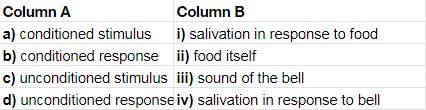
In Pavlov’s conditioned reflex experiment find the correct matches :
- a)a)-i, b)-iii, c)-iv, d)-ii
- b)a)-iv, b)-ii, c)-i, d)-iii
- c)a)-iii, b)-iv, c)-ii, d)-i
- d)a)-ii, b)-iii, c)-i, d)-iv
Correct answer is option 'C'. Can you explain this answer?
In Pavlov’s conditioned reflex experiment find the correct matches :
a)
a)-i, b)-iii, c)-iv, d)-ii
b)
a)-iv, b)-ii, c)-i, d)-iii
c)
a)-iii, b)-iv, c)-ii, d)-i
d)
a)-ii, b)-iii, c)-i, d)-iv
| | Wahid Khan answered |
There are different kinds of stimulus that is received by different receptors in our body. Hearing of sound of bell is conditioned stimulus and salivation in response to bell is conditioned response. Food itself is conditioned stimulus and salivation in response to food is unconditioned response.
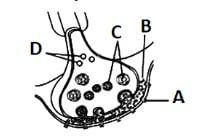
A diagram showing the axon terminal and synapse is given. Identify correctly at least two of A-D:
- a)B- Synaptic connection; D- K+
- b)A- Neurotransmitter; B- Synaptic cleft
- c)C- Neurotransmitter; D- Ca++
- d)A- Receptor; C- Synaptic vesicles
Correct answer is option 'D'. Can you explain this answer?
A diagram showing the axon terminal and synapse is given. Identify correctly at least two of A-D:
a)
B- Synaptic connection; D- K+
b)
A- Neurotransmitter; B- Synaptic cleft
c)
C- Neurotransmitter; D- Ca++
d)
A- Receptor; C- Synaptic vesicles
| | Bs Academy answered |
Chapter doubts & questions for Neural Control and Coordination - 30-Day Revision Course for NEET 2026 is part of NEET exam preparation. The chapters have been prepared according to the NEET exam syllabus. The Chapter doubts & questions, notes, tests & MCQs are made for NEET 2026 Exam. Find important definitions, questions, notes, meanings, examples, exercises, MCQs and online tests here.
Chapter doubts & questions of Neural Control and Coordination - 30-Day Revision Course for NEET in English & Hindi are available as part of NEET exam. Download more important topics, notes, lectures and mock test series for NEET Exam by signing up for free.
30-Day Revision Course for NEET85 videos|301 docs|171 tests |
