


All Exams > NEET > 30-Day Revision Course for NEET > All Questions
All questions of Sexual Reproduction in Flowering Plants for NEET Exam
Can you explain the answer of this question below: Which tissue is required to be present in between stock and scion during grafting?
- A:
Xylem
- B:
Phloem
- C:
Meristem
- D:
Parenchyma.
The answer is b.
Which tissue is required to be present in between stock and scion during grafting?
Xylem
Phloem
Meristem
Parenchyma.
 | Vijay Bansal answered |
Phloem, also called bast, tissues in plants that conduct foods made in the leaves to all other parts of the plant. Phloem is composed of various specialized cells called sieve tubes, companion cells, phloem fibres, and phloem parenchyma cells. Primary phloem is formed by the apical meristems (zones of new cell production) of root and shoot tips; it may be either protophloem, the cells of which are matured before elongation (during growth) of the area in which it lies, or metaphloem, the cells of which mature after elongation. Sieve tubes of protophloem are unable to stretch with the elongating tissues and are torn and destroyed as the plant ages. The other cell types in the phloem may be converted to fibres. The later maturing metaphloem is not destroyed and may function during the rest of the plant’s life in plants such as palms but is replaced by secondary phloem in plants that have a cambium.

Sporopollenin an organic material is present in- a)Exine
- b)Intine
- c)Style
- d)Stigma
Correct answer is 'A'. Can you explain this answer?
Sporopollenin an organic material is present in
a)
Exine
b)
Intine
c)
Style
d)
Stigma
 | Shraddha Gupta answered |
The exine of the pollen grain is made of sporopollenin. Sporopollenin is one of the most resistant organic compounds. It can withstand high temperature, strong acids and alkalis and cannot be degraded by any of the known enzymes. Hence, it acts as a shield and protects the pollen grain from getting damaged.
Can you explain the answer of this question below:The female gametophyte in angiosperm is
- A:
Ovule
- B:
Carpel
- C:
Embryo sac
- D:
Egg
The answer is c.
The female gametophyte in angiosperm is
Ovule
Carpel
Embryo sac
Egg
 | Aiims New Delhi answered |
Embryosacline of ncert in sexual reproduction in flowering plants chapter😀😀😀💯💯💯👍👍👍
Assertion: In monosporic development, all four megaspores produced from the megaspore mother cell (MMC) do not contribute to the formation of the female gametophyte.Reason: Monosporic development results in the formation of four functional megaspores.- a)Both the assertion and reason are true, and the reason is a correct explanation of the assertion.
- b)Both the assertion and reason are true, but the reason is not a correct explanation of the assertion.
- c)The assertion is true, but the reason is false.
- d)The assertion is false, but the reason is true.
Correct answer is option 'C'. Can you explain this answer?
Assertion: In monosporic development, all four megaspores produced from the megaspore mother cell (MMC) do not contribute to the formation of the female gametophyte.
Reason: Monosporic development results in the formation of four functional megaspores.
a)
Both the assertion and reason are true, and the reason is a correct explanation of the assertion.
b)
Both the assertion and reason are true, but the reason is not a correct explanation of the assertion.
c)
The assertion is true, but the reason is false.
d)
The assertion is false, but the reason is true.
| | Vijay Bansal answered |
Explanation: In monosporic development, only one megaspore out of the four produced from the megaspore mother cell (MMC) develops into the female gametophyte. The other three megaspores typically degenerate. Therefore, the assertion is correct. However, the reason is incorrect as it states that all four megaspores become functional, which is not the case in monosporic development.
Cucurbits and coconuts are examples of _______.- a)Polycious
- b)Dioecious
- c)Trioecious
- d)Monoecious
Correct answer is option 'D'. Can you explain this answer?
Cucurbits and coconuts are examples of _______.
a)
Polycious
b)
Dioecious
c)
Trioecious
d)
Monoecious
 | Jhanvi Tiwari answered |
Cucurbits and coconuts are examples of Monoecious plants.
Explanation:
Monoecious plants are those which have separate male and female flowers on the same plant. The term "monoecious" is derived from two Greek words, "monos" meaning "single" and "oikos" meaning "house". In monoecious plants, both male and female flowers are present in the same "house" or plant.
Cucurbits, which include plants like cucumber, pumpkin, and watermelon, are monoecious. They produce separate male and female flowers on the same plant. The male flowers have long, thin stalks with a single anther, while the female flowers have a swollen base which will eventually develop into the fruit.
Coconuts are also monoecious. The male and female flowers are borne on the same inflorescence, which is a type of flower cluster. The male flowers are small and yellow while the female flowers are larger and green. Once pollinated, the female flowers develop into the coconut fruit.
Explanation:
Monoecious plants are those which have separate male and female flowers on the same plant. The term "monoecious" is derived from two Greek words, "monos" meaning "single" and "oikos" meaning "house". In monoecious plants, both male and female flowers are present in the same "house" or plant.
Cucurbits, which include plants like cucumber, pumpkin, and watermelon, are monoecious. They produce separate male and female flowers on the same plant. The male flowers have long, thin stalks with a single anther, while the female flowers have a swollen base which will eventually develop into the fruit.
Coconuts are also monoecious. The male and female flowers are borne on the same inflorescence, which is a type of flower cluster. The male flowers are small and yellow while the female flowers are larger and green. Once pollinated, the female flowers develop into the coconut fruit.
Filiform apparatus is a characteristic feature of- a)Synergid
- b)Egg
- c)Suspensor
- d)Zygote
Correct answer is option 'A'. Can you explain this answer?
Filiform apparatus is a characteristic feature of
a)
Synergid
b)
Egg
c)
Suspensor
d)
Zygote
| | Vijay Bansal answered |
Filiform apparatus are finger-like projections present at the micropylar end of synergids of embryo sac.
Which of the following is an example of false fruit?- a)Apple
- b)Coconut
- c)Mango
- d)Papaya
Correct answer is option 'A'. Can you explain this answer?
Which of the following is an example of false fruit?
a)
Apple
b)
Coconut
c)
Mango
d)
Papaya
 | Pooja Mehta answered |
Apple - An accessory fruit (also called false fruit or spurious fruit) is a fruit in which some of the flesh is derived not from the ovary but from some adjacent tissue exterior to the carpel. Examples of accessory tissue are the receptacle of strawberries, figs, or mulberries, Pomes, such as apples and pears.
Which of the following plant is not pollinated by water?- a)Hydrilla
- b)Zostera
- c)Lotus
- d)Vallisneria
Correct answer is option 'C'. Can you explain this answer?
Which of the following plant is not pollinated by water?
a)
Hydrilla
b)
Zostera
c)
Lotus
d)
Vallisneria
 | Jyoti Sengupta answered |
Lotus is an aquatic plant but the flower of lotus is outside and above the water surface. So, it cannot be pollinated by water. It is generally pollinated by insects.
Embryo sac represents: - a)Megagametophyte
- b)Megasporangium
- c)Microgametophyte
- d)Microsporangium
Correct answer is option 'A'. Can you explain this answer?
Embryo sac represents:
a)
Megagametophyte
b)
Megasporangium
c)
Microgametophyte
d)
Microsporangium
| | Vijay Bansal answered |
The female gametophyte specifically termed a megagametophyte is also called the embryo sac in angiosperms. The megagametophyte produces an egg cell (or several in some groups) for the purpose of fertilization.
The cotyledon of maize grain is technically called as? - a)Funicle
- b)Dicots
- c)Scutellum
- d)Testa
Correct answer is option 'C'. Can you explain this answer?
The cotyledon of maize grain is technically called as?
a)
Funicle
b)
Dicots
c)
Scutellum
d)
Testa
 | Anand Jain answered |
The cotyledons are known as seed leaves, they are attached to the embryonic axis. Dicotyledons typically have two cotyledons and monocotyledons have oly one cotyledon. The single shield-shaped cotyledon in grains known as scutellum. Cotyledon of maize grain is called scutellum.
Can you explain the answer of this question below:Starting from the innermost part, the correct sequence of parts in an ovule are
- A:
Egg, integument, embryo sac and nucellus.
- B:
Egg, embryo sac, nucellus and integument.
- C:
Embryo sac, nucellus, integument and egg.
- D:
Egg, nucellus, embryo sac and integument.
The answer is b.
Starting from the innermost part, the correct sequence of parts in an ovule are
Egg, integument, embryo sac and nucellus.
Egg, embryo sac, nucellus and integument.
Embryo sac, nucellus, integument and egg.
Egg, nucellus, embryo sac and integument.
 | Preethi Saha answered |
The correct sequence of parts in an ovule starting from the innermost part is:
Egg, embryo sac, nucellus and integument.
Explanation:
• An ovule is a structure present in the ovary of a flower that contains the female reproductive cells.
• The ovule is composed of different parts, each playing a specific role in pollination and fertilization.
• The innermost part of the ovule is the egg cell, which is the female gamete.
• The egg cell is surrounded by the embryo sac, which is a structure that contains the synergids, antipodal cells, and the central cell.
• The central cell contains two nuclei, which will fuse with the sperm nuclei during fertilization to form the endosperm.
• The embryo sac is surrounded by the nucellus, which is the tissue that supplies nutrients to the developing embryo.
• The nucellus is surrounded by the integuments, which are two layers of tissue that form the outer covering of the ovule.
• The integuments develop into the seed coat after fertilization.
Therefore, the correct sequence of parts in an ovule starting from the innermost part is egg, embryo sac, nucellus and integument.
Egg, embryo sac, nucellus and integument.
Explanation:
• An ovule is a structure present in the ovary of a flower that contains the female reproductive cells.
• The ovule is composed of different parts, each playing a specific role in pollination and fertilization.
• The innermost part of the ovule is the egg cell, which is the female gamete.
• The egg cell is surrounded by the embryo sac, which is a structure that contains the synergids, antipodal cells, and the central cell.
• The central cell contains two nuclei, which will fuse with the sperm nuclei during fertilization to form the endosperm.
• The embryo sac is surrounded by the nucellus, which is the tissue that supplies nutrients to the developing embryo.
• The nucellus is surrounded by the integuments, which are two layers of tissue that form the outer covering of the ovule.
• The integuments develop into the seed coat after fertilization.
Therefore, the correct sequence of parts in an ovule starting from the innermost part is egg, embryo sac, nucellus and integument.
Endosperm type in which first division of primary endosperm nucleus and few subsequent division are not accompanied by wall formation is called?- a)Cellular type
- b)Micropylar type
- c)Free nuclear type
- d)Helobial type
Correct answer is option 'C'. Can you explain this answer?
Endosperm type in which first division of primary endosperm nucleus and few subsequent division are not accompanied by wall formation is called?
a)
Cellular type
b)
Micropylar type
c)
Free nuclear type
d)
Helobial type
| | Jayant Mishra answered |
Nuclear type:
In nuclear type of endosperm the first division of primary endosperm nucleus and few subsequent nuclear divisions are not accompanied by wall formation. The nuclei produced are free in the cytoplasm of the embryo sac and they may remain free indefinitely or wall formation takes place later. In the coconut, cell wall formation of endosperm is never found complete. In Areca and Phoenix the endosperm becomes very hard .
Inside the ovary the ovule is attached to placenta by means of- - a)Chalaza
- b)Micropyle
- c)Hilum
- d)Funicle
Correct answer is option 'D'. Can you explain this answer?
Inside the ovary the ovule is attached to placenta by means of-
a)
Chalaza
b)
Micropyle
c)
Hilum
d)
Funicle
| | Anjali Patel answered |
The ovule is the female reproductive structure of the flower and it is located inside the ovary. The ovule contains the female gametophyte and is attached to the placenta by means of the funicle.
Explanation:
- The ovary is the part of the flower that contains the ovules. It is the female reproductive organ of the flower.
- The ovule is a structure that contains the female gametophyte, the egg cell, and the surrounding protective layers.
- The placenta is the tissue inside the ovary that provides nutrients and support to the developing ovules.
- The funicle is the stalk-like structure that attaches the ovule to the placenta. It is also known as the stalk or the seed stalk.
- The funicle is responsible for transporting nutrients and water from the placenta to the developing ovule.
- The funicle also provides the pathway for the sperm cells to reach the egg cell during fertilization.
- The funicle is usually located at the base of the ovule and is often visible as a small, thin stalk.
In summary, the funicle is the structure that attaches the ovule to the placenta inside the ovary. It plays a vital role in the development and fertilization of the female reproductive structure in the flower.
Explanation:
- The ovary is the part of the flower that contains the ovules. It is the female reproductive organ of the flower.
- The ovule is a structure that contains the female gametophyte, the egg cell, and the surrounding protective layers.
- The placenta is the tissue inside the ovary that provides nutrients and support to the developing ovules.
- The funicle is the stalk-like structure that attaches the ovule to the placenta. It is also known as the stalk or the seed stalk.
- The funicle is responsible for transporting nutrients and water from the placenta to the developing ovule.
- The funicle also provides the pathway for the sperm cells to reach the egg cell during fertilization.
- The funicle is usually located at the base of the ovule and is often visible as a small, thin stalk.
In summary, the funicle is the structure that attaches the ovule to the placenta inside the ovary. It plays a vital role in the development and fertilization of the female reproductive structure in the flower.
Placenta is located inside the-------.- a)Micropyle
- b)Funicle
- c)Ovule cavity
- d)Ovarian cavity
Correct answer is option 'D'. Can you explain this answer?
Placenta is located inside the-------.
a)
Micropyle
b)
Funicle
c)
Ovule cavity
d)
Ovarian cavity
 | Rajat Kapoor answered |
Inside the ovary is the ovarian cavity (locule). The placenta is located inside the ovarian cavity. Arising from the placenta are the megasporangia, commonly called ovules.
Number of nuclei participating in double fertilisation is?- a)2
- b)5
- c)4
- d)3
Correct answer is 'B'. Can you explain this answer?
Number of nuclei participating in double fertilisation is?
a)
2
b)
5
c)
4
d)
3
 | Sadiya Siddique answered |
The two polar nuclei, 2 male gamates nuclei and an egg cell nucleus participates in double fertilization.thus, op B.
In most of angiosperms, pollen grains are shed at_______.- a)4-celled stage
- b)3-celled stage
- c)2-celled stage
- d)8-celled stage
Correct answer is option 'C'. Can you explain this answer?
In most of angiosperms, pollen grains are shed at_______.
a)
4-celled stage
b)
3-celled stage
c)
2-celled stage
d)
8-celled stage
| | Satakshi Kumari answered |
Generally pollengrain has two cells one vegetative and the other generative
so in many of the angiosperms about 60% of them shed off from anther at this two celled stage
and in remaining 40% of angiosperms the generative cell divides into two cells called as male gamets when present in the anther and at this three celled stage of the pollen grain they shed out..... three cells means one vegetative ,two male gametes
so in many of the angiosperms about 60% of them shed off from anther at this two celled stage
and in remaining 40% of angiosperms the generative cell divides into two cells called as male gamets when present in the anther and at this three celled stage of the pollen grain they shed out..... three cells means one vegetative ,two male gametes
Seed of castor is- a)non-endospermic, exalbuminous
- b)endospermic, albuminous
- c)endospermic, exalbuminous
- d)non-endospermic, albuminous
Correct answer is option 'B'. Can you explain this answer?
Seed of castor is
a)
non-endospermic, exalbuminous
b)
endospermic, albuminous
c)
endospermic, exalbuminous
d)
non-endospermic, albuminous
 | Infinity Academy answered |
- Endospermic: Castor seeds contain endosperm, which is the tissue that provides nourishment to the developing embryo.
- Albuminous: The endosperm in castor seeds remains in the mature seed and is not consumed during seed development, so it is termed albuminous.
Topic in NCERT: Seed
Line in NCERT: "Albuminous seeds retain a part of endosperm as it is not completely used up during embryo development (e.g., wheat, maize, barley, castor)."
The anther is a four sided structure consisting of four------------ located at the corner. - a)Microsporangia
- b)Megasporangia
- c)Macrosoporangia
- d)None of these
Correct answer is option 'A'. Can you explain this answer?
The anther is a four sided structure consisting of four------------ located at the corner.
a)
Microsporangia
b)
Megasporangia
c)
Macrosoporangia
d)
None of these
 | Prasenjit Pillai answered |
Anther is bilobed structure at the tips of stamen. Each lobe consists of two theca. Each theca change into microsporangium. Anther forms four sided structure having four microsporangia in which pollen grains are formed.
A typical angiosperm embryo sac at maturity is_______.- a)2 nucleate
- b)7 nucleate
- c)4 nucleate
- d)8 nucleate
Correct answer is option 'D'. Can you explain this answer?
A typical angiosperm embryo sac at maturity is_______.
a)
2 nucleate
b)
7 nucleate
c)
4 nucleate
d)
8 nucleate
 | Ruchi Chakraborty answered |
Angiospermic embryo sac is 8-nucleate but 7-celled at maturity. This includes 3- celled egg Synergids, 3 antipodal cells and 2 polar nuclei.
Sporopollenin an organic material is present in- a)Exine
- b)Intine
- c)Style
- d)Stigma
Correct answer is option 'A'. Can you explain this answer?
Sporopollenin an organic material is present in
a)
Exine
b)
Intine
c)
Style
d)
Stigma
| | Ritu Joshi answered |
The exine is made up of sporopollenin, which is one of the most resistant organic material. The in tine layer is made up of cellulose and pectin materials.The exine is hard and hence protects the pollen grains during adverse conditions.
What is the correct sequence of the formation of female gametophyte in angiosperms?- a)Nucellus, megaspore tetrad, megaspore mother cell, megaspore, female gametophyte
- b)Megaspore tetrad, nucellus, megaspore mother cell, megaspore, female gametophyte
- c)Nucellus, megaspore mother cell, megaspore tetrad, megaspore, female gametophyte
- d)Megaspore mother cell, megaspore tetrad, megaspore, nucellus, female gametophyte
Correct answer is option 'C'. Can you explain this answer?
What is the correct sequence of the formation of female gametophyte in angiosperms?
a)
Nucellus, megaspore tetrad, megaspore mother cell, megaspore, female gametophyte
b)
Megaspore tetrad, nucellus, megaspore mother cell, megaspore, female gametophyte
c)
Nucellus, megaspore mother cell, megaspore tetrad, megaspore, female gametophyte
d)
Megaspore mother cell, megaspore tetrad, megaspore, nucellus, female gametophyte
| | Lakshmi Bose answered |
Formation of Female Gametophyte in Angiosperms
The development of the female gametophyte in angiosperms follows a specific sequence, which can be outlined as follows:
1. Nucellus
- The nucellus is the tissue within the ovule that contains the megasporangium.
- It provides nourishment and support for the developing gametophyte.
2. Megaspore Mother Cell
- The megaspore mother cell (megasporocyte) is located within the nucellus.
- This diploid cell undergoes meiosis to produce four haploid megaspores.
3. Megaspore Tetrad
- After meiosis, the four megaspores form a tetrad.
- Typically, three of the megaspores degenerate, leaving one functional megaspore.
4. Megaspore
- The surviving megaspore undergoes mitotic divisions.
- It divides to form the female gametophyte, also known as the embryo sac.
5. Female Gametophyte
- The final structure is the mature female gametophyte, which usually contains seven cells and eight nuclei.
- This structure is crucial for fertilization, as it will eventually form the egg cell, synergids, and polar nuclei.
Conclusion
The correct sequence of formation of the female gametophyte is:
Nucellus → Megaspore Mother Cell → Megaspore Tetrad → Megaspore → Female Gametophyte
Thus, the correct answer is option 'C'. Understanding this sequence is vital for comprehending the reproductive processes in flowering plants, which is essential for NEET aspirants.
The development of the female gametophyte in angiosperms follows a specific sequence, which can be outlined as follows:
1. Nucellus
- The nucellus is the tissue within the ovule that contains the megasporangium.
- It provides nourishment and support for the developing gametophyte.
2. Megaspore Mother Cell
- The megaspore mother cell (megasporocyte) is located within the nucellus.
- This diploid cell undergoes meiosis to produce four haploid megaspores.
3. Megaspore Tetrad
- After meiosis, the four megaspores form a tetrad.
- Typically, three of the megaspores degenerate, leaving one functional megaspore.
4. Megaspore
- The surviving megaspore undergoes mitotic divisions.
- It divides to form the female gametophyte, also known as the embryo sac.
5. Female Gametophyte
- The final structure is the mature female gametophyte, which usually contains seven cells and eight nuclei.
- This structure is crucial for fertilization, as it will eventually form the egg cell, synergids, and polar nuclei.
Conclusion
The correct sequence of formation of the female gametophyte is:
Nucellus → Megaspore Mother Cell → Megaspore Tetrad → Megaspore → Female Gametophyte
Thus, the correct answer is option 'C'. Understanding this sequence is vital for comprehending the reproductive processes in flowering plants, which is essential for NEET aspirants.
While planning for an artificial hybridization programme involving dioecious plants, which of the following steps would not be relevant?- a) Bagging of the female flower
- b)Dusting of pollen on the stigma
- c) Emasculation
- d)Collection of pollen
Correct answer is option 'C'. Can you explain this answer?
While planning for an artificial hybridization programme involving dioecious plants, which of the following steps would not be relevant?
a)
Bagging of the female flower
b)
Dusting of pollen on the stigma
c)
Emasculation
d)
Collection of pollen
 | Ambition Institute answered |
In an artificial hybridization program with dioecious plants:
- Bagging of the female flower: Relevant to prevent unwanted pollen contamination.
- Dusting of pollen on the stigma: Essential for pollination to occur.
- Emasculation: Not relevant because dioecious plants have separate sexes; emasculation is for monoecious plants.
- Collection of pollen: Necessary for controlled pollination process.
Therefore, in this context, the step that would not be relevant is C: Emasculation.
Topic in NCERT: Artificial Hybridization Techniques
Line in NCERT: "Emasculated flowers have to be covered with a bag of suitable size, generally made up of butter paper, to prevent contamination of its stigma with unwanted pollen."
- Bagging of the female flower: Relevant to prevent unwanted pollen contamination.
- Dusting of pollen on the stigma: Essential for pollination to occur.
- Emasculation: Not relevant because dioecious plants have separate sexes; emasculation is for monoecious plants.
- Collection of pollen: Necessary for controlled pollination process.
Therefore, in this context, the step that would not be relevant is C: Emasculation.
Topic in NCERT: Artificial Hybridization Techniques
Line in NCERT: "Emasculated flowers have to be covered with a bag of suitable size, generally made up of butter paper, to prevent contamination of its stigma with unwanted pollen."
Which among the following statement is incorrect with respect to tapetum?- a)Cells have single nucleus only.
- b)It has dense cytoplasm.
- c)It is the innermost wall layer of microsporangia.
- d)It nourishes developing pollen grains.
Correct answer is option 'A'. Can you explain this answer?
Which among the following statement is incorrect with respect to tapetum?
a)
Cells have single nucleus only.
b)
It has dense cytoplasm.
c)
It is the innermost wall layer of microsporangia.
d)
It nourishes developing pollen grains.
| | Infinity Academy answered |
The innermost wall layer is the tapetum. It nourishes the developing pollen grains. Cells of the tapetum possess dense cytoplasm and generally have more than one nucleus.
Topic in NCERT: Tapetum
Line in NCERT: "Cells of the tapetum possess dense cytoplasm and generally have more than one nucleus."
Given below are two statements : one is labelled as Assertion (A) and the other is labelled as Reason (R).
Assertion (A): An apomixis is a form of asexual reproduction that mimics sexual reproduction.
Reason (R): There is no fertilisation in apomicts plants and they do not produce any seeds.- a)(A) is True but (R) is False.
- b)Both (A) and (R) are True but (R) is not the correct explanation of (A).
- c)(A) is False but (R) is True.
- d)Both (A) and (R) are True and (R) is the correct explanation of (A).
Correct answer is option 'A'. Can you explain this answer?
Given below are two statements : one is labelled as Assertion (A) and the other is labelled as Reason (R).
Assertion (A): An apomixis is a form of asexual reproduction that mimics sexual reproduction.
Reason (R): There is no fertilisation in apomicts plants and they do not produce any seeds.
Assertion (A): An apomixis is a form of asexual reproduction that mimics sexual reproduction.
Reason (R): There is no fertilisation in apomicts plants and they do not produce any seeds.
a)
(A) is True but (R) is False.
b)
Both (A) and (R) are True but (R) is not the correct explanation of (A).
c)
(A) is False but (R) is True.
d)
Both (A) and (R) are True and (R) is the correct explanation of (A).
 | EduRev NEET answered |
Assertion (A) is true because apomixis is an asexual process that results in seed formation without fertilization.
Reason (R) is false because apomictic plants do produce seeds despite the lack of fertilization.
So option (A) is True but (R) is False is correct .
Topic in NCERT: APOMIXIS AND POLYEMBRYONY
Line in NCERT: "Thus, apomixis is a form of asexual reproduction that mimics sexual reproduction."
Reason (R) is false because apomictic plants do produce seeds despite the lack of fertilization.
So option (A) is True but (R) is False is correct .
Topic in NCERT: APOMIXIS AND POLYEMBRYONY
Line in NCERT: "Thus, apomixis is a form of asexual reproduction that mimics sexual reproduction."
A typical anther is
(a) Tetrasporangiate
(b) Tetragonal
(c) Trilobed
(d) Surrounded by four wall layers- a)Only (a) and (d)
- b)Only (a), (b) and (d)
- c)Only (b) and (c)
- d)All (a), (b), (c) and (d)
Correct answer is option 'B'. Can you explain this answer?
A typical anther is
(a) Tetrasporangiate
(b) Tetragonal
(c) Trilobed
(d) Surrounded by four wall layers
(a) Tetrasporangiate
(b) Tetragonal
(c) Trilobed
(d) Surrounded by four wall layers
a)
Only (a) and (d)
b)
Only (a), (b) and (d)
c)
Only (b) and (c)
d)
All (a), (b), (c) and (d)
| | EduRev NEET answered |
(a) Tetrasporangiate: Correct. A typical anther has four pollen sacs or microsporangia.
(b) Tetragonal: Correct - The anther is a four-sided (tetragonal) structure consisting of four microsporangia located at the corners, two in each lobe.
(c) Trilobed: No, anthers are typically bilobed, not trilobed
(d) Surrounded by four wall layers: Correct. The anther is surrounded by four distinct wall layers: the epidermis, endothecium, middle layer, and tapetum.
Topic in NCERT: Anther Structure and Function
Line in NCERT: "A typical anther is bilobed, dithecous and tetrasporangiate. Four wall layers, the epidermis, endothecium, middle layers and the tapetum surround the microsporangium."
(b) Tetragonal: Correct - The anther is a four-sided (tetragonal) structure consisting of four microsporangia located at the corners, two in each lobe.
(c) Trilobed: No, anthers are typically bilobed, not trilobed
(d) Surrounded by four wall layers: Correct. The anther is surrounded by four distinct wall layers: the epidermis, endothecium, middle layer, and tapetum.
Topic in NCERT: Anther Structure and Function
Line in NCERT: "A typical anther is bilobed, dithecous and tetrasporangiate. Four wall layers, the epidermis, endothecium, middle layers and the tapetum surround the microsporangium."
Which tissue is required to be present in between stock and scion during grafting?- a)Xylem
- b)Phloem
- c)Meristem
- d)Parenchyma.
Correct answer is 'B'. Can you explain this answer?
Which tissue is required to be present in between stock and scion during grafting?
a)
Xylem
b)
Phloem
c)
Meristem
d)
Parenchyma.
 | Anjali Iyer answered |
Phloem, also called bast, tissues in plants that conduct foods made in the leaves to all other parts of the plant. Phloem is composed of various specialized cells called sieve tubes, companion cells, phloem fibres, and phloem parenchyma cells. Primary phloem is formed by the apical meristems (zones of new cell production) of root and shoot tips; it may be either protophloem, the cells of which are matured before elongation (during growth) of the area in which it lies, or metaphloem, the cells of which mature after elongation. Sieve tubes of protophloem are unable to stretch with the elongating tissues and are torn and destroyed as the plant ages. The other cell types in the phloem may be converted to fibres. The later maturing metaphloem is not destroyed and may function during the rest of the plant’s life in plants such as palms but is replaced by secondary phloem in plants that have a cambium.
Select the correct statement about the following diagram -
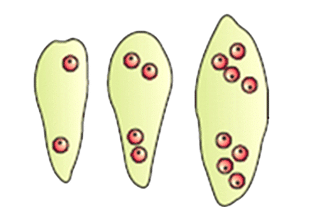
Statement I: It shows the two, four, and eighth nucleate stages of the embryo sac.
Statement II: The divisions are mitotic and free nuclear.- a)Statement I is correct, Statement II is correct
- b)Statement I is incorrect, Statement II is correct
- c)Statement I is correct, Statement II is incorrect
- d)Statement I is incorrect, Statement II is incorrect
Correct answer is option 'A'. Can you explain this answer?
Select the correct statement about the following diagram -
Statement I: It shows the two, four, and eighth nucleate stages of the embryo sac.
Statement II: The divisions are mitotic and free nuclear.
Statement I: It shows the two, four, and eighth nucleate stages of the embryo sac.
Statement II: The divisions are mitotic and free nuclear.
a)
Statement I is correct, Statement II is correct
b)
Statement I is incorrect, Statement II is correct
c)
Statement I is correct, Statement II is incorrect
d)
Statement I is incorrect, Statement II is incorrect
 | Bs Academy answered |
Here's a detailed explanation:
- The diagram depicts the different stages of embryo sac development.
- Statement I is correct because it accurately describes the content of the diagram, showing two, four, and eight nucleate stages of the embryo sac.
- Statement II is correct as the divisions in embryo sac development are typically free nuclear.
Topic in NCERT: Formation of the Embryo Sac
Line in NCERT: "The nucleus of the functional megaspore divides mitotically to form two nuclei which move to the opposite poles, forming the 2-nucleate embryo sac. Two more sequential mitotic nuclear divisions result in the formation of the 4-nucleate and later the 8-nucleate stages of the embryo sac. It is of interest to note that these mitotic divisions are strictly free nuclear, that is, nuclear divisions are not followed immediately by cell wall formation."
- The diagram depicts the different stages of embryo sac development.
- Statement I is correct because it accurately describes the content of the diagram, showing two, four, and eight nucleate stages of the embryo sac.
- Statement II is correct as the divisions in embryo sac development are typically free nuclear.
Topic in NCERT: Formation of the Embryo Sac
Line in NCERT: "The nucleus of the functional megaspore divides mitotically to form two nuclei which move to the opposite poles, forming the 2-nucleate embryo sac. Two more sequential mitotic nuclear divisions result in the formation of the 4-nucleate and later the 8-nucleate stages of the embryo sac. It is of interest to note that these mitotic divisions are strictly free nuclear, that is, nuclear divisions are not followed immediately by cell wall formation."
Identify A-D in the given enlarged view of one microsporangium showing wall layers: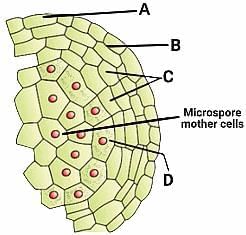
- a)A. Epidermis B. Endothecium C. Middle layers D,Tapetum
- b)A. Epidermis B. Middle Layer C. Endothecium D. Tapetum
- c)A.Endothelium B.Epidermis C.Tapetum D.Miidle Layer
- d)AEpithelium. B.Endothelium C.Tapetum D.Middle layers
Correct answer is option 'A'. Can you explain this answer?
Identify A-D in the given enlarged view of one microsporangium showing wall layers:
a)
A. Epidermis B. Endothecium C. Middle layers D,Tapetum
b)
A. Epidermis B. Middle Layer C. Endothecium D. Tapetum
c)
A.Endothelium B.Epidermis C.Tapetum D.Miidle Layer
d)
AEpithelium. B.Endothelium C.Tapetum D.Middle layers
 | Stepway Academy answered |
The correct answer is: (A)
In the given enlarged view of the microsporangium, the layers are identified as follows:
- A: Epidermis - the outermost protective layer
- B: Endothecium - the specialized cell layer surrounding the sporogenous tissue
- C: Middle layers - various layers lying between the endothecium and tapetum
- D: Tapetum - the innermost layer responsible for nourishing developing pollen grains
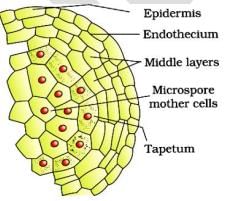
Topic in NCERT: Anther Structure
Line in NCERT: "four wall layers (Figure 1.3b)- the epidermis, endothecium, middle layers and the tapetum."
In the given enlarged view of the microsporangium, the layers are identified as follows:
- A: Epidermis - the outermost protective layer
- B: Endothecium - the specialized cell layer surrounding the sporogenous tissue
- C: Middle layers - various layers lying between the endothecium and tapetum
- D: Tapetum - the innermost layer responsible for nourishing developing pollen grains
Topic in NCERT: Anther Structure
Line in NCERT: "four wall layers (Figure 1.3b)- the epidermis, endothecium, middle layers and the tapetum."
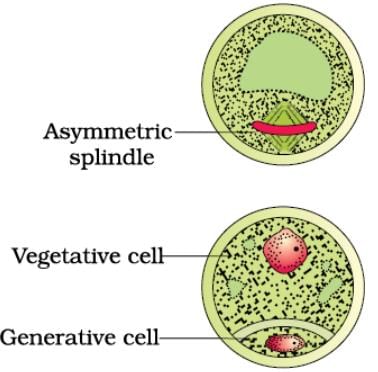
Study the stages of maturation of microspore into a pollen grain and select the correct statements:
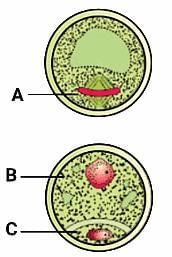
Statement I: The spindle formation as seen in A is strictly symmetric.
Statement II: The larger cell [B] is the generative cell and the smaller cell [C] is the vegetative cell.- a)Statement I is correct, Statement II is correct
- b)Statement I is incorrect, Statement II is correct
- c)Statement I is correct, Statement II is incorrect
- d)Statement I is incorrect, Statement II is incorrect
Correct answer is option 'D'. Can you explain this answer?
Study the stages of maturation of microspore into a pollen grain and select the correct statements:
Statement I: The spindle formation as seen in A is strictly symmetric.
Statement II: The larger cell [B] is the generative cell and the smaller cell [C] is the vegetative cell.
Statement I: The spindle formation as seen in A is strictly symmetric.
Statement II: The larger cell [B] is the generative cell and the smaller cell [C] is the vegetative cell.
a)
Statement I is correct, Statement II is correct
b)
Statement I is incorrect, Statement II is correct
c)
Statement I is correct, Statement II is incorrect
d)
Statement I is incorrect, Statement II is incorrect
| | Stepway Academy answered |
The correct answer is: D: Statement I is incorrect, Statement II is incorrect.
- The spindle formation as seen in Asymmetric during microspore maturation.
- The larger cell (B) is the vegetative cell, and the smaller cell (C) is the generative cell.
- The spindle formation as seen in Asymmetric during microspore maturation.
- The larger cell (B) is the vegetative cell, and the smaller cell (C) is the generative cell.
Diagram from NCERT:
In the given diagram:
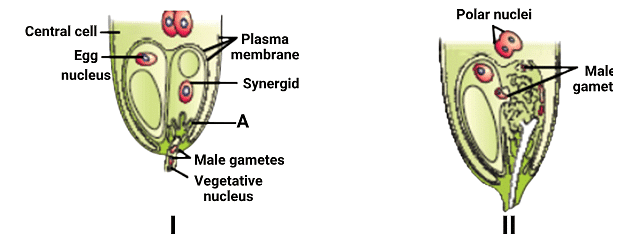
Statement I:I shows the entry of the pollen tube into a synergid under the guidance of A.
Statement II:II shows the discharge of male gametes into a synergid.- a)Statement I is correct, Statement II is correct
- b)Statement I is incorrect, Statement II is correct
- c)Statement I is correct, Statement II is incorrect
- d)Statement I is incorrect, Statement II is incorrect
Correct answer is option 'A'. Can you explain this answer?
In the given diagram:
Statement I:I shows the entry of the pollen tube into a synergid under the guidance of A.
Statement II:II shows the discharge of male gametes into a synergid.
Statement I:I shows the entry of the pollen tube into a synergid under the guidance of A.
Statement II:II shows the discharge of male gametes into a synergid.
a)
Statement I is correct, Statement II is correct
b)
Statement I is incorrect, Statement II is correct
c)
Statement I is correct, Statement II is incorrect
d)
Statement I is incorrect, Statement II is incorrect
 | Mohit Rajpoot answered |
(A) To determine the correctness of the statements regarding the given diagram:
- Statement I: The pollen tube enters a synergid under guidance from A, which is correct.
- Statement II: Male gametes are discharged into a synergid, which is correct
Statement I is correct, Statement II is correct SO OPTION (A)
Topic in NCERT: DOUBLE FERTILISATION
Line in NCERT: "the pollen tube releases the two male gametes into the cytoplasm of the synergid."
- Statement I: The pollen tube enters a synergid under guidance from A, which is correct.
- Statement II: Male gametes are discharged into a synergid, which is correct
Statement I is correct, Statement II is correct SO OPTION (A)
Topic in NCERT: DOUBLE FERTILISATION
Line in NCERT: "the pollen tube releases the two male gametes into the cytoplasm of the synergid."
Chapter doubts & questions for Sexual Reproduction in Flowering Plants - 30-Day Revision Course for NEET 2026 is part of NEET exam preparation. The chapters have been prepared according to the NEET exam syllabus. The Chapter doubts & questions, notes, tests & MCQs are made for NEET 2026 Exam. Find important definitions, questions, notes, meanings, examples, exercises, MCQs and online tests here.
Chapter doubts & questions of Sexual Reproduction in Flowering Plants - 30-Day Revision Course for NEET in English & Hindi are available as part of NEET exam. Download more important topics, notes, lectures and mock test series for NEET Exam by signing up for free.
30-Day Revision Course for NEET85 videos|301 docs|171 tests |
