


All Exams > NEET > 30-Day Revision Course for NEET > All Questions
All questions of Electric Charges and Fields for NEET Exam


Three concentric metallic spherical shells of radii R, 2R, 3R, are given charges Q1, Q2, Q3, respectively. It is found that the surface charge densities on the outer surfaces of the shells are equal. Then, the ratio of the charges given to the shells, Q1: Q2: Q3, is - a)it is 1:03:05
- b)it is 1:02:03
- c)it is 1:04:09
- d)it is 1:08:18
Correct answer is 'A'. Can you explain this answer?
Three concentric metallic spherical shells of radii R, 2R, 3R, are given charges Q1, Q2, Q3, respectively. It is found that the surface charge densities on the outer surfaces of the shells are equal. Then, the ratio of the charges given to the shells, Q1: Q2: Q3, is
a)
it is 1:03:05
b)
it is 1:02:03
c)
it is 1:04:09
d)
it is 1:08:18
 | Sanaya Kumar answered |
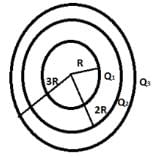
Since the charge goes to outer surface when given inside so the charges on concentri shells are respectively.
Q1, Q1 + Q2, Q1 + Q2 + Q3. Sine their charge densities are equal so σ1 = σ2 = σ3

So Q1 = 3Q2 = 5Q3 so 1 : 3 : 5
A semi-circular arc of radius ‘a’ is charged uniformly and the charge per unit length is λ. The electric field at the centre of this arc is [2000]- a)

- b)

- c)

- d)

Correct answer is option 'A'. Can you explain this answer?
A semi-circular arc of radius ‘a’ is charged uniformly and the charge per unit length is λ. The electric field at the centre of this arc is [2000]
a)
b)
c)
d)
 | Stepway Academy answered |
λ = linear charge density;
Charge on elementary portion dx = λ dx
Charge on elementary portion dx = λ dx
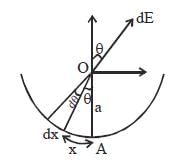
Electric field at
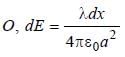
Horizontal electric field, i.e., perpendicular to AO, will be cancelled.
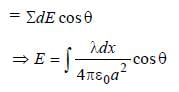
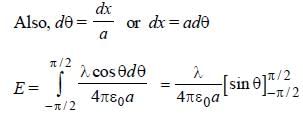
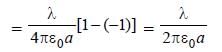
Hence, net electric field = addition of all electrical fields in direction of AO
Hence, net electric field = addition of all electrical fields in direction of AO
The linear charge densities of two infinitely long thin and parallel wires are 4Cm−1, 8Cm−1 and separation between them is 4 cm. Then the electric field intensity at mid point on the line joining them is- a)18 × 1011 NC−1
- b)36 × 1011NC−1
- c)9 × 10¹¹NC−1
- d)72 × 1011 NC−1
Correct answer is option 'B'. Can you explain this answer?
The linear charge densities of two infinitely long thin and parallel wires are 4Cm−1, 8Cm−1 and separation between them is 4 cm. Then the electric field intensity at mid point on the line joining them is
a)
18 × 1011 NC−1
b)
36 × 1011NC−1
c)
9 × 10¹¹NC−1
d)
72 × 1011 NC−1
 | Ashutosh Malik answered |
Given Data
- Linear charge density of wire 1 (λ1) = 4 C/m
- Linear charge density of wire 2 (λ2) = 8 C/m
- Separation between wires (d) = 4 cm = 0.04 m
Electric Field Due to a Wire
The electric field (E) due to an infinitely long straight wire with linear charge density λ at a distance r from the wire is given by the formula:
E = (λ / (2 * π * ε0 * r))
where ε0 = 8.85 × 10^-12 C^2/(N·m^2) is the permittivity of free space.
Midpoint Calculation
- The distance from each wire to the midpoint (r) = d/2 = 0.02 m
Electric Fields Calculation
1. Electric Field from Wire 1 (E1)
E1 = (λ1 / (2 * π * ε0 * r))
= (4 / (2 * π * 8.85 × 10^-12 * 0.02))
2. Electric Field from Wire 2 (E2)
E2 = (λ2 / (2 * π * ε0 * r))
= (8 / (2 * π * 8.85 × 10^-12 * 0.02))
Direction of Electric Fields
- E1 points away from wire 1 (to the right).
- E2 points away from wire 2 (to the left).
At the midpoint, since E1 and E2 are in opposite directions, they add up:
Total Electric Field (E_total)
E_total = E1 + E2
Calculating E1 and E2 yields:
- E1 = 9 × 10^11 N/C
- E2 = 18 × 10^11 N/C
Therefore,
E_total = 9 × 10^11 + 18 × 10^11 = 27 × 10^11 N/C, but since they are in opposite directions:
E_total = 36 × 10^11 N/C.
Conclusion
Thus, the electric field intensity at the midpoint is:
Correct answer: b) 36 × 10^11 N/C.
- Linear charge density of wire 1 (λ1) = 4 C/m
- Linear charge density of wire 2 (λ2) = 8 C/m
- Separation between wires (d) = 4 cm = 0.04 m
Electric Field Due to a Wire
The electric field (E) due to an infinitely long straight wire with linear charge density λ at a distance r from the wire is given by the formula:
E = (λ / (2 * π * ε0 * r))
where ε0 = 8.85 × 10^-12 C^2/(N·m^2) is the permittivity of free space.
Midpoint Calculation
- The distance from each wire to the midpoint (r) = d/2 = 0.02 m
Electric Fields Calculation
1. Electric Field from Wire 1 (E1)
E1 = (λ1 / (2 * π * ε0 * r))
= (4 / (2 * π * 8.85 × 10^-12 * 0.02))
2. Electric Field from Wire 2 (E2)
E2 = (λ2 / (2 * π * ε0 * r))
= (8 / (2 * π * 8.85 × 10^-12 * 0.02))
Direction of Electric Fields
- E1 points away from wire 1 (to the right).
- E2 points away from wire 2 (to the left).
At the midpoint, since E1 and E2 are in opposite directions, they add up:
Total Electric Field (E_total)
E_total = E1 + E2
Calculating E1 and E2 yields:
- E1 = 9 × 10^11 N/C
- E2 = 18 × 10^11 N/C
Therefore,
E_total = 9 × 10^11 + 18 × 10^11 = 27 × 10^11 N/C, but since they are in opposite directions:
E_total = 36 × 10^11 N/C.
Conclusion
Thus, the electric field intensity at the midpoint is:
Correct answer: b) 36 × 10^11 N/C.
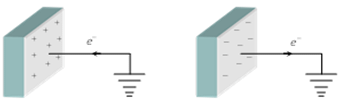
When a negatively charged conductor is connected to earth,- a)No charge flow occurs.
- b)Protons flow from the conductor to the earth.
- c)Electrons flow from the earth to the conductor.
- d)Electrons flow from the conductor to the earth.
Correct answer is option 'D'. Can you explain this answer?
When a negatively charged conductor is connected to earth,
a)
No charge flow occurs.
b)
Protons flow from the conductor to the earth.
c)
Electrons flow from the earth to the conductor.
d)
Electrons flow from the conductor to the earth.
 | Riya Banerjee answered |
Explanation:
When a negatively charged conductor is connected to the earth, electrons will flow from the conductor to the earth. This is because electrons have a negative charge and they will be repelled from the negatively charged conductor and attracted to the positively charged earth. As electrons flow from the conductor to the earth, the negative charge on the conductor will gradually decrease until it becomes neutral.
- Option A is incorrect because charge flow does occur when a negatively charged conductor is connected to the earth.
- Option B is incorrect because protons have a positive charge and they are not free to move in a conductor.
- Option C is incorrect because electrons flow from the earth to the conductor, not the other way around.


Two insulated charged copper spheres A and B have their centres separated by a distance of 50 cm. What is the mutual force of electrostatic repulsion if the charge on each is 6.5×10⁻⁷C ? The radii of A and B are negligible compared to the distance of separation.- a)4.5×10⁻²N
- b)2.5×10⁻²N
- c)1.5×10⁻²N
- d)3.5×10⁻²N
Correct answer is option 'C'. Can you explain this answer?
Two insulated charged copper spheres A and B have their centres separated by a distance of 50 cm. What is the mutual force of electrostatic repulsion if the charge on each is 6.5×10⁻⁷C ? The radii of A and B are negligible compared to the distance of separation.
a)
4.5×10⁻²N
b)
2.5×10⁻²N
c)
1.5×10⁻²N
d)
3.5×10⁻²N
 | Kavya Das answered |

The electric field at a distance 3R/2 from the centre of a charged conducting spherical shell of radius R is E. The electric field at a distance R/2 from the centre of the sphere is- a)E/2
- b)zero
- c)E
- d)E/4
Correct answer is option 'B'. Can you explain this answer?
The electric field at a distance 3R/2 from the centre of a charged conducting spherical shell of radius R is E. The electric field at a distance R/2 from the centre of the sphere is
a)
E/2
b)
zero
c)
E
d)
E/4
 | Rajeev Sharma answered |
Electric field at a point inside a charged
conducting spherical shell is zero.
conducting spherical shell is zero.
Can you explain the answer of this question below:Electric field lines can be said to be
- A:
lines of equal Electric field
- B:
drawing lines of electric fields
- C:
lines of equal Electric voltage
- D:
graphical representation of electric fields.
The answer is d.
Electric field lines can be said to be
lines of equal Electric field
drawing lines of electric fields
lines of equal Electric voltage
graphical representation of electric fields.
 | P. Poonia answered |
Simple they are imaginary line which be represent by graphical manner
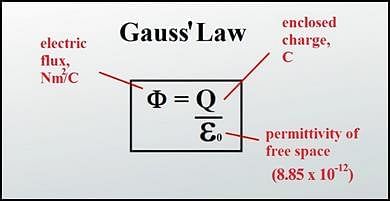
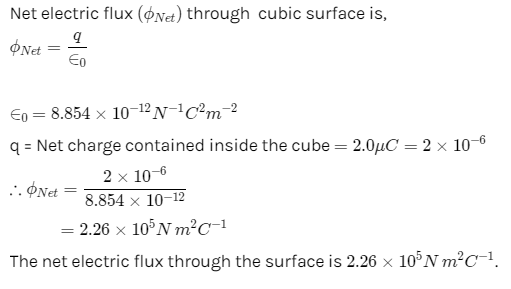
A point charge of 2.0 μCμC is at the centre of a cubic Gaussian surface 9.0 cm on edge. What is the net electric flux through the surface?- a)1.7×10⁵Nm2/C
- b)2.1×10⁵Nm2/C
- c)2.2×10⁵Nm2/C
- d)1.9×10⁵Nm2/C
Correct answer is option 'C'. Can you explain this answer?
A point charge of 2.0 μCμC is at the centre of a cubic Gaussian surface 9.0 cm on edge. What is the net electric flux through the surface?
a)
1.7×10⁵Nm2/C
b)
2.1×10⁵Nm2/C
c)
2.2×10⁵Nm2/C
d)
1.9×10⁵Nm2/C
 | Princy Goyal answered |
This question is based on Gauss law. Net electric flux will be 1/Enot times the total charge enclosed
A particle of mass m and charge q is placed atrest in a uniform electric field E and then released.The kinetic energy attained by the particle aftermoving a distance y is [1998]- a)qEy2
- b)qE2 y
- c)qEy
- d)q2 Ey
Correct answer is option 'C'. Can you explain this answer?
A particle of mass m and charge q is placed atrest in a uniform electric field E and then released.The kinetic energy attained by the particle aftermoving a distance y is [1998]
a)
qEy2
b)
qE2 y
c)
qEy
d)
q2 Ey
 | Abhishek Choudhary answered |
K.E. = Force × distance = qE.y


An electric dipole, consisting of two oppositecharges of 2x10⁻⁶ C each separated by adistance 3 cm is placed in an electric field of 2x10⁵ N/C. Torque acting on the dipole is [1995]- a)12 x10-1N - m
- b)12 x10-2 N - m
- c)12 x10-3N - m
- d)12 x10-4 N - m
Correct answer is option 'C'. Can you explain this answer?
An electric dipole, consisting of two oppositecharges of 2x10⁻⁶ C each separated by adistance 3 cm is placed in an electric field of 2x10⁵ N/C. Torque acting on the dipole is [1995]
a)
12 x10-1N - m
b)
12 x10-2 N - m
c)
12 x10-3N - m
d)
12 x10-4 N - m
 | Moumita Khanna answered |
Charges (q) = 2 × 10⁻⁶ C, Distance (d)
= 3 cm = 3 × 10⁻² m and electric field (E)
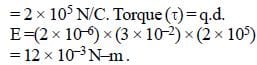
= 3 cm = 3 × 10⁻² m and electric field (E)
If 109electrons move out of a body to another body every second, how much time is approximately required to get a total charge of 1 C on the other body?- a)120 years
- b)220 years
- c)200 years
- d)180 years
Correct answer is option 'C'. Can you explain this answer?
If 109electrons move out of a body to another body every second, how much time is approximately required to get a total charge of 1 C on the other body?
a)
120 years
b)
220 years
c)
200 years
d)
180 years
 | Naina Bansal answered |
we know that 1 Coulomb = 6.242�10^18 eletrons
given 10^9 electrons take 1 secs
=> 10^9 electrons ------> 1 sec
=> 1 electrons ---------> 1/(10^9) secs
=> 6.242�10^18 ------> 6.242�10^18/ (10^9)
= 6.242�10^9 secs = 6.242�10^9/ (60*60*24*365) years
=197.93 years
A point charge causes an electric flux of −1.0×10³Nm2/C to pass through a spherical Gaussian surface of 10.0 cm radius centred on the charge. (a) If the radius of the Gaussian surface were doubled, how much flux would pass through the surface? (b) What is the value of the point charge? - a) 103Nm2/C,−7.8nC
- b) B 103Nm2/C,−8.8nC
- c) −103Nm2/C,−8.8nC
- d) −103Nm2/C,−6.8nC
Correct answer is option 'C'. Can you explain this answer?
A point charge causes an electric flux of −1.0×10³Nm2/C to pass through a spherical Gaussian surface of 10.0 cm radius centred on the charge. (a) If the radius of the Gaussian surface were doubled, how much flux would pass through the surface? (b) What is the value of the point charge?
a)
103Nm2/C,−7.8nC
b)
B 103Nm2/C,−8.8nC
c)
−103Nm2/C,−8.8nC
d)
−103Nm2/C,−6.8nC
 | Mira Sharma answered |
A. Doubling the radius of Gaussian surface will not affect the electric flux since the charge enclosed is the same in both cases. Thus, the flux will remain the same i.e., –1.0 x 10^3 Nm^2/C
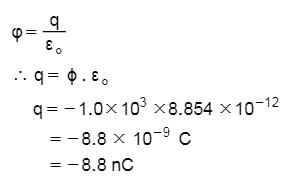
(b) Using gauss theorem,
Point charges + 4q, –q and +4q are kept on theX-axis at points x = 0, x =a and x = 2a respectively.- a)only – q is in stable equilibrium [1988]
- b)none of the charges is in equilibrium
- c)all the charges are in unstable equilibrium
- d)all the charges are in stable equilibrium.
Correct answer is option 'C'. Can you explain this answer?
Point charges + 4q, –q and +4q are kept on theX-axis at points x = 0, x =a and x = 2a respectively.
a)
only – q is in stable equilibrium [1988]
b)
none of the charges is in equilibrium
c)
all the charges are in unstable equilibrium
d)
all the charges are in stable equilibrium.
 | Vaibhav Basu answered |
Net force on each of the charge due to the
other charges is zero. However, disturbance
in any direction other than along the line on
which the charges lie, will not make the
charges return.
other charges is zero. However, disturbance
in any direction other than along the line on
which the charges lie, will not make the
charges return.
Two metallic spheres of radii 1 cm and 3 cmare given charges of –1×10⁻² C and 5×10⁻² C,respectively. If these are connected by aconducting wire, the final charge on the biggersphere is : [2012M]- a)2 × 10⁻² C
- b)3 × 10⁻² C
- c)4 × 10⁻² C
- d)1 × 10⁻² C
Correct answer is option 'B'. Can you explain this answer?
Two metallic spheres of radii 1 cm and 3 cmare given charges of –1×10⁻² C and 5×10⁻² C,respectively. If these are connected by aconducting wire, the final charge on the biggersphere is : [2012M]
a)
2 × 10⁻² C
b)
3 × 10⁻² C
c)
4 × 10⁻² C
d)
1 × 10⁻² C
 | Anu Bajaj answered |
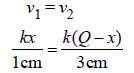
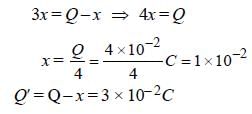
At equilibrium potential of both sphere
becomes same if charge of sphere one x
and other sphere Q – x then
where Q = 4 × 10⁻² C
becomes same if charge of sphere one x
and other sphere Q – x then
where Q = 4 × 10⁻² C
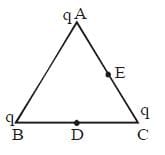
Three charges, each +q, are placed at the corners of an isosceles triangle ABC of sides BC and AC, 2a. D and E are the mid points of BC and CA. The work done in taking a charge Q from D to E is [2011 M]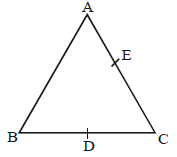
- a)

- b)

- c)zero
- d)

Correct answer is option 'C'. Can you explain this answer?
Three charges, each +q, are placed at the corners of an isosceles triangle ABC of sides BC and AC, 2a. D and E are the mid points of BC and CA. The work done in taking a charge Q from D to E is [2011 M]
a)
b)
c)
zero
d)
 | Jatin Chakraborty answered |
AC = BC
VD = VE
We have,
W = Q (VE – VD)
VD = VE
We have,
W = Q (VE – VD)
⇒W=0
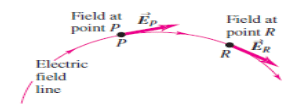
At any point on S on an electric field line - a)the perpendicular to the line is in the direction of at that point
- b)the tangent to the line is in the direction of at that point
- c)the binormal to the line is in the direction of at that point
- d)the curvature is in the direction of at that point
Correct answer is option 'B'. Can you explain this answer?
At any point on S on an electric field line
a)
the perpendicular to the line is in the direction of at that point
b)
the tangent to the line is in the direction of at that point
c)
the binormal to the line is in the direction of at that point
d)
the curvature is in the direction of at that point
 | Amar Pillai answered |
When a tangent is drawn at any point on field line then that tangent gives the direction of electric field at that point
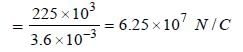
The electric intensity due to a dipole of length10 cm and having a charge of 500 μC, at a pointon the axis at a distance 20 cm from one of thecharges in air, is [2001]- a)6.25 × 10⁷ N/C
- b)9.28 × 10⁷ N/C
- c)13.1 × 10¹¹ N/C
- d)20.5 × 10⁷ N/C
Correct answer is option 'A'. Can you explain this answer?
The electric intensity due to a dipole of length10 cm and having a charge of 500 μC, at a pointon the axis at a distance 20 cm from one of thecharges in air, is [2001]
a)
6.25 × 10⁷ N/C
b)
9.28 × 10⁷ N/C
c)
13.1 × 10¹¹ N/C
d)
20.5 × 10⁷ N/C
 | Sonal Kulkarni answered |
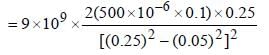
Given : Length of the dipole (2l) =10cm
= 0.1m or l = 0.05 m
Charge on the dipole (q) = 500 μC = 500 ×
10–6 C and distance of the point on the axis
from the mid-point of the dipole (r) = 20 + 5 =
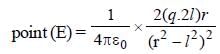
25 cm = 0.25 m. We know that the electric
field intensity due to dipole on the given
= 0.1m or l = 0.05 m
Charge on the dipole (q) = 500 μC = 500 ×
10–6 C and distance of the point on the axis
from the mid-point of the dipole (r) = 20 + 5 =
25 cm = 0.25 m. We know that the electric
field intensity due to dipole on the given
A square surface of side L metres is in the plane of the paper. A uniform electric field  (volt / m), also in the plane of the paper, is limited only to the lower half of the square surface (see figure). The electric flux in SI units associated with the
surface is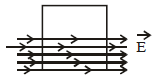
- a)EL2/2
- b)zero
- c)EL2
- d)EL2/(2ε0)
Correct answer is option 'B'. Can you explain this answer?
A square surface of side L metres is in the plane of the paper. A uniform electric field (volt / m), also in the plane of the paper, is limited only to the lower half of the square surface (see figure). The electric flux in SI units associated with the
surface is
(volt / m), also in the plane of the paper, is limited only to the lower half of the square surface (see figure). The electric flux in SI units associated with thesurface is
a)
EL2/2
b)
zero
c)
EL2
d)
EL2/(2ε0)
 | Ananya Das answered |
Flux =
 is electric field vector &
  is area vector
Here, angle between  is 90º.
is 90º.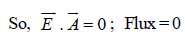
There is an electric field E in x-direction. If the work done on moving a charge of 0.2 C through a distance of 2 m along a line making an angle 60° with x-axis is 4J, then what is the value of E? [1995]- a)3 N/C
- b)4 N/C
- c)5 N/C
- d)20 N/C
Correct answer is option 'D'. Can you explain this answer?
There is an electric field E in x-direction. If the work done on moving a charge of 0.2 C through a distance of 2 m along a line making an angle 60° with x-axis is 4J, then what is the value of E? [1995]
a)
3 N/C
b)
4 N/C
c)
5 N/C
d)
20 N/C
 | Nilotpal Gupta answered |
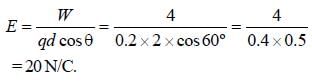
Charge (q) = 0.2 C; Distance (d) = 2m; Angle
θ = 60º and work done (W) = 4J.
Work done in moving the charge (W)
= F.d cos θ = qEd cos θ
θ = 60º and work done (W) = 4J.
Work done in moving the charge (W)
= F.d cos θ = qEd cos θ
or


Two equal positive charges q1 = q2 = 2.0 μC. μC are located at x = 0, y =0.3 and x =0 and y = -0.3 m respectively. What are the magnitude and direction of the total electric force (expressed in Newton and degrees counter clockwise w.r.t x - axis) that q1 and q2 exert on a third charge Q = 4.0 μC. μC at x =0.4 and y = 0 m- a)0.46,0.00
- b)0.44,2.00
- c)0.42,1.00
- d)0.48,3.00
Correct answer is option 'A'. Can you explain this answer?
Two equal positive charges q1 = q2 = 2.0 μC. μC are located at x = 0, y =0.3 and x =0 and y = -0.3 m respectively. What are the magnitude and direction of the total electric force (expressed in Newton and degrees counter clockwise w.r.t x - axis) that q1 and q2 exert on a third charge Q = 4.0 μC. μC at x =0.4 and y = 0 m
a)
0.46,0.00
b)
0.44,2.00
c)
0.42,1.00
d)
0.48,3.00
 | Ankita Datta answered |
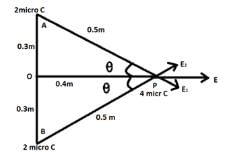
Side AP =  = 0.5m Electric Field due to charge at A on point P = Elecric Field due to charge at B on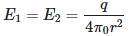
= 0.5m Electric Field due to charge at A on point P = Elecric Field due to charge at B on point P 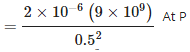

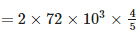
Where  So force due to this field on charge P
So force due to this field on charge PF = qE = 4 x 10-6 x 115.2 x 103 F = 0.46N
Since this force in the direction of positive x axis so angle = 00
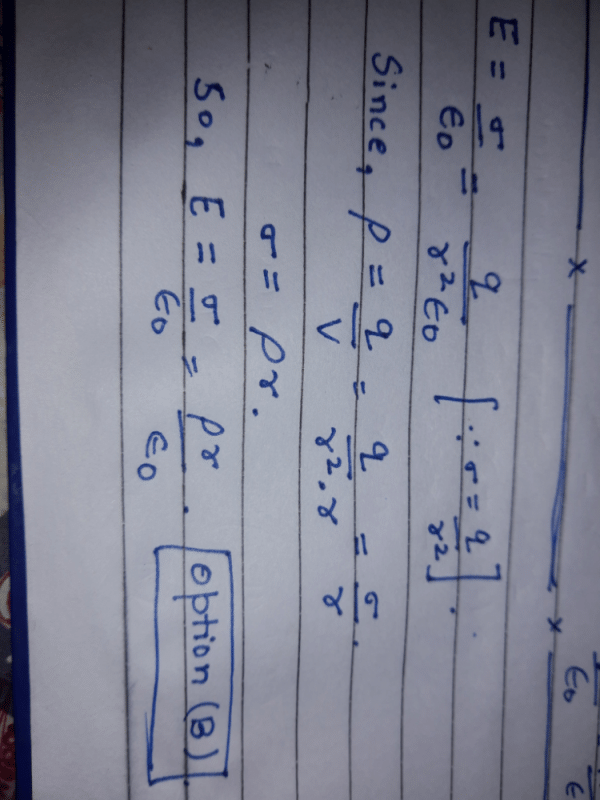
Find the electric field inside the sphere which carries a charge density proportional to the distance from the origin
ρ = kr- a)ρ/ε0
- b)ρr/ε0
- c) ρr2/ε0
- d)none of the above
Correct answer is option 'B'. Can you explain this answer?
Find the electric field inside the sphere which carries a charge density proportional to the distance from the origin
ρ = kr
ρ = kr
a)
ρ/ε0
b)
ρr/ε0
c)
ρr2/ε0
d)
none of the above
| | Geetika Tiwari answered |
We can start by using Gauss's Law to find the electric field. Gauss's Law states that the flux of the electric field through any closed surface is proportional to the charge enclosed by the surface. Mathematically, it can be written as:
∮E⋅dA = Qenc/ε0
where E is the electric field, dA is an infinitesimal area element on the surface, Qenc is the charge enclosed by the surface, and ε0 is the permittivity of free space.
In this case, we can choose a spherical Gaussian surface centered at the origin, with radius r. The charge enclosed by this surface is:
Qenc = ∫ρdV
where ρ is the charge density and dV is an infinitesimal volume element. Since the charge density is proportional to the distance from the origin, we can write:
ρ = k r
where k is a constant of proportionality. The integral becomes:
Qenc = ∫ρdV = k ∫r^2sinθdrdθdφ
where the limits of integration are 0 to r for r, 0 to π for θ, and 0 to 2π for φ. Evaluating the integral gives:
Qenc = (4/3)πk r^3
Now we can apply Gauss's Law to find the electric field. The flux of the electric field through the Gaussian surface is:
∮E⋅dA = E(4πr^2)
where we have used the fact that the surface area of a sphere is 4πr^2. Therefore, Gauss's Law gives us:
E(4πr^2) = (4/3)πk r^3/ε0
Solving for E, we get:
E = k r/3ε0
Therefore, the electric field inside the sphere is proportional to the distance from the origin, with a constant of proportionality k/3ε0.
∮E⋅dA = Qenc/ε0
where E is the electric field, dA is an infinitesimal area element on the surface, Qenc is the charge enclosed by the surface, and ε0 is the permittivity of free space.
In this case, we can choose a spherical Gaussian surface centered at the origin, with radius r. The charge enclosed by this surface is:
Qenc = ∫ρdV
where ρ is the charge density and dV is an infinitesimal volume element. Since the charge density is proportional to the distance from the origin, we can write:
ρ = k r
where k is a constant of proportionality. The integral becomes:
Qenc = ∫ρdV = k ∫r^2sinθdrdθdφ
where the limits of integration are 0 to r for r, 0 to π for θ, and 0 to 2π for φ. Evaluating the integral gives:
Qenc = (4/3)πk r^3
Now we can apply Gauss's Law to find the electric field. The flux of the electric field through the Gaussian surface is:
∮E⋅dA = E(4πr^2)
where we have used the fact that the surface area of a sphere is 4πr^2. Therefore, Gauss's Law gives us:
E(4πr^2) = (4/3)πk r^3/ε0
Solving for E, we get:
E = k r/3ε0
Therefore, the electric field inside the sphere is proportional to the distance from the origin, with a constant of proportionality k/3ε0.
An electric dipole of moment  is lying along a uniform electric field
  . The work done in rotating the dipole by 90° is
- a)pE/2
- b)2pE
- c)pE
- d)√2pE
Correct answer is option 'C'. Can you explain this answer?
An electric dipole of moment is lying along a uniform electric field . The work done in rotating the dipole by 90° is
is lying along a uniform electric field . The work done in rotating the dipole by 90° isa)
pE/2
b)
2pE
c)
pE
d)
√2pE
 | Arnav Iyer answered |
Work done in rotating a dipole
= pE (1 – cos θ)
= pE (1 – cos θ)
If θ = 90º, work done = pE (1 – 0) = pE
Electric field lines can be said to be - a)lines of equal Electric field
- b)drawing lines of electric fields
- c)lines of equal Electric voltage
- d)graphical representation of electric fields.
Correct answer is option 'D'. Can you explain this answer?
Electric field lines can be said to be
a)
lines of equal Electric field
b)
drawing lines of electric fields
c)
lines of equal Electric voltage
d)
graphical representation of electric fields.
| | Abhijeet Menon answered |
Explanation:Electric Field Lines can be defined as a curve which shows direction of electric field, when we draw tangent at its point. The concept of electric field was proposed by Michael Faraday, in the 19th century. He always thought that electric field lines can be used to describe and interpret the invisible electric field. Instead of using complex vector diagram every time, This pictorial representation or form is called electric field lines.Electric field lines can be used to describe electric field around a system of charges in a better way.
A tennis ball which has been covered with charges is suspended by a thread so that it hangs between two metal plates. One plate is earthed, while other is attracted to a high voltage generator. The ball- a)hangs without moving
- b)is attracted to the high voltage plate and stays there
- c)swings backward & forward hitting each plate in turn
- d)is repelled by earthed plate and stays there.
Correct answer is option 'C'. Can you explain this answer?
A tennis ball which has been covered with charges is suspended by a thread so that it hangs between two metal plates. One plate is earthed, while other is attracted to a high voltage generator. The ball
a)
hangs without moving
b)
is attracted to the high voltage plate and stays there
c)
swings backward & forward hitting each plate in turn
d)
is repelled by earthed plate and stays there.
 | Prashanth Banerjee answered |
Understanding the Scenario
A tennis ball covered with charges is suspended between two metal plates, one of which is earthed and the other connected to a high voltage generator. The behavior of the ball depends on the electric fields created by the charged plates.
Electric Charges and Forces
- The earthed plate is at zero potential, meaning it can freely accept or donate charges.
- The high voltage plate has a significant positive or negative charge, creating a strong electric field.
Interaction of the Tennis Ball
1. Induced Charges: The presence of the high voltage plate influences the tennis ball. The charges on the ball will rearrange themselves due to the electric field.
2. Attraction and Repulsion:
- If the high voltage plate is positively charged, it attracts negative charges from the ball and repels positive charges, leading to a net attraction towards it.
- Conversely, the earthed plate, being neutral, will attract the positive charges on the ball and repel the negative charges, creating a repulsive effect.
Movement of the Ball
- As a result of these attractive and repulsive forces, the ball will experience a swinging motion.
- The ball will swing back and forth between the two plates, hitting each one in turn, as it is continuously attracted to the high voltage plate and repelled by the earthed plate.
Conclusion
Hence, the correct answer is option 'C': the ball swings back and forth, hitting each plate in turn due to the interplay of electric forces from the charged plates. This demonstrates the fascinating effects of electric fields on charged objects.
A tennis ball covered with charges is suspended between two metal plates, one of which is earthed and the other connected to a high voltage generator. The behavior of the ball depends on the electric fields created by the charged plates.
Electric Charges and Forces
- The earthed plate is at zero potential, meaning it can freely accept or donate charges.
- The high voltage plate has a significant positive or negative charge, creating a strong electric field.
Interaction of the Tennis Ball
1. Induced Charges: The presence of the high voltage plate influences the tennis ball. The charges on the ball will rearrange themselves due to the electric field.
2. Attraction and Repulsion:
- If the high voltage plate is positively charged, it attracts negative charges from the ball and repels positive charges, leading to a net attraction towards it.
- Conversely, the earthed plate, being neutral, will attract the positive charges on the ball and repel the negative charges, creating a repulsive effect.
Movement of the Ball
- As a result of these attractive and repulsive forces, the ball will experience a swinging motion.
- The ball will swing back and forth between the two plates, hitting each one in turn, as it is continuously attracted to the high voltage plate and repelled by the earthed plate.
Conclusion
Hence, the correct answer is option 'C': the ball swings back and forth, hitting each plate in turn due to the interplay of electric forces from the charged plates. This demonstrates the fascinating effects of electric fields on charged objects.
Three point charges +q, –q and +q are placed at points (x = 0, y = a, z = 0), (x = 0, y = 0, z = 0) and (x = a, y = 0, z = 0) respectively. The magnitude and direction of the electric dipole moment vector of this charge assembly are [2007]- a)√2qa along the line joining points (x = 0, y = 0, z = 0) and (x = a, y = a, z = 0)
- b)qa along the line joining points (x = 0, y = 0, z = 0) and (x = a, y = a, z = 0)
- c)√2qa along +ve x direction
- d)√2qa along +ve y direction
Correct answer is option 'A'. Can you explain this answer?
Three point charges +q, –q and +q are placed at points (x = 0, y = a, z = 0), (x = 0, y = 0, z = 0) and (x = a, y = 0, z = 0) respectively. The magnitude and direction of the electric dipole moment vector of this charge assembly are [2007]
a)
√2qa along the line joining points (x = 0, y = 0, z = 0) and (x = a, y = a, z = 0)
b)
qa along the line joining points (x = 0, y = 0, z = 0) and (x = a, y = a, z = 0)
c)
√2qa along +ve x direction
d)
√2qa along +ve y direction
 | Ayush Chavan answered |
Three point charges +q, –2q and +q are placed
at points B (x = 0, y = a, z = 0),
O (x = 0, y = 0, z = 0) and A(x = a, y = 0, z = 0)
The system consists of two dipole moment
vectors due to (+q and –q) and again due to
(+q and –q) charges having equal
magnitudes qa units – one along
at points B (x = 0, y = a, z = 0),
O (x = 0, y = 0, z = 0) and A(x = a, y = 0, z = 0)
The system consists of two dipole moment
vectors due to (+q and –q) and again due to
(+q and –q) charges having equal
magnitudes qa units – one along
 and other along
  Hence, net dipole moment
  along
along  at an angle 45° with positive X-axis.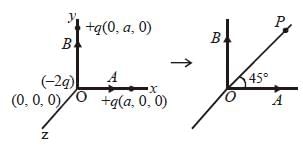
Three point charges +q, –2q and +q are placed at points (x = 0, y = a, z = 0), (x = 0, y = 0, z = 0) and (x = a, y = 0, z = 0) respectively. The magnitude and direction of the electric dipole moment vector of this charge assembly are- a)√2qa along the line joining points (x = 0, y = 0,
z = 0) and (x = a, y = a, z = 0) - b)qa along the line joining points (x = 0, y = 0,
z = 0) and (x = a, y = a, z = 0) - c)√2qa along + x direction
- d)√2qa along + y direction
Correct answer is option 'A'. Can you explain this answer?
Three point charges +q, –2q and +q are placed at points (x = 0, y = a, z = 0), (x = 0, y = 0, z = 0) and (x = a, y = 0, z = 0) respectively. The magnitude and direction of the electric dipole moment vector of this charge assembly are
a)
√2qa along the line joining points (x = 0, y = 0,
z = 0) and (x = a, y = a, z = 0)
z = 0) and (x = a, y = a, z = 0)
b)
qa along the line joining points (x = 0, y = 0,
z = 0) and (x = a, y = a, z = 0)
z = 0) and (x = a, y = a, z = 0)
c)
√2qa along + x direction
d)
√2qa along + y direction
| | Stepway Academy answered |
This consists of two dipoles, –q and +q with dipole moment along with the +y-direction and –q and +q along the x-direction.
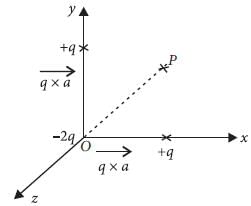

Along the direction 45° that is along OP, where P is (+a, +a, 0).
Along the direction 45° that is along OP, where P is (+a, +a, 0).
Two point charges A and B, having charges +Q and –Q respectively, are placed at certain distance apart and force acting between them is F. If 25% charge of A is transferred to B, then force between the charges becomes- a)4F/3
- b)F
- c)9F/16
- d)16F/9
Correct answer is option 'C'. Can you explain this answer?
Two point charges A and B, having charges +Q and –Q respectively, are placed at certain distance apart and force acting between them is F. If 25% charge of A is transferred to B, then force between the charges becomes
a)
4F/3
b)
F
c)
9F/16
d)
16F/9
 | Ambition Institute answered |
In case I :
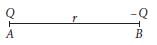

In Case II :
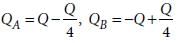
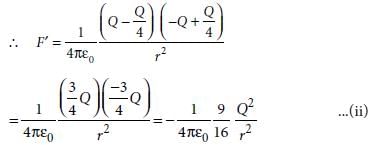
From equations (i) and (ii),

In Case II :
From equations (i) and (ii),
Ionization of a neutral atom is the - a)only gain of one or more electrons
- b)only gain of one or more protons
- c)gain or loss of one or more electrons
- d)only gain of one or more neutrons
Correct answer is option 'C'. Can you explain this answer?
Ionization of a neutral atom is the
a)
only gain of one or more electrons
b)
only gain of one or more protons
c)
gain or loss of one or more electrons
d)
only gain of one or more neutrons
 | Ashwin Yadav answered |
Explanation:It is not possible to remove or add protons to atom, but electron can be added or removed by an atom easily so charge can be developed on an atom by removing or adding electrons, by adding electrons it becomes negative charged ,by removing electrons it becomes positive charged.
A hollow metal sphere of radius R is uniformly charged. The electric field due to the sphere at a distance r from the centre- a)decreases as r increases for r < R and for r > R
- b)increases as r increases for r < R and for r > R
- c)zero as r increases for r < R, decreases as r increases for r > R
- d)zero as r increases for r < R, increases as r increases for r > R
Correct answer is option 'C'. Can you explain this answer?
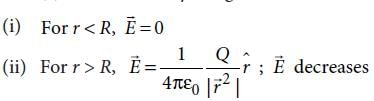
A hollow metal sphere of radius R is uniformly charged. The electric field due to the sphere at a distance r from the centre
a)
decreases as r increases for r < R and for r > R
b)
increases as r increases for r < R and for r > R
c)
zero as r increases for r < R, decreases as r increases for r > R
d)
zero as r increases for r < R, increases as r increases for r > R
 | Top Rankers answered |
In a uniformly charged hollow conducting sphere
A charge ‘q’ is placed at the centre of the linejoining two equal charges ‘Q’. The system ofthe three charges will be in equilibrium if ‘q’ isequal to [NEET Kar. 2013]- a)Q/2
- b)– Q/4
- c)Q/4
- d)– Q/2
Correct answer is option 'B'. Can you explain this answer?
A charge ‘q’ is placed at the centre of the linejoining two equal charges ‘Q’. The system ofthe three charges will be in equilibrium if ‘q’ isequal to [NEET Kar. 2013]
a)
Q/2
b)
– Q/4
c)
Q/4
d)
– Q/2
| | Abhijeet Menon answered |
A charge refers to an amount of money that is owed or paid for a particular product, service, or transaction. It can also refer to an accusation or allegation of wrongdoing, typically in a legal context.
A hollow insulated conduction sphere is givena positive charge of 10 μC. What will be theelectric field at the centre of the sphere if itsradius is 2 metres? [1998]- a)zero
- b)5 μCm–2
- c)20 μCm–2
- d)8 μCm–2
Correct answer is option 'A'. Can you explain this answer?
A hollow insulated conduction sphere is givena positive charge of 10 μC. What will be theelectric field at the centre of the sphere if itsradius is 2 metres? [1998]
a)
zero
b)
5 μCm–2
c)
20 μCm–2
d)
8 μCm–2
| | Arnav Iyer answered |
Charge resides on the outer surface of a
conducting hollow sphere of radius R. We
consider a spherical surface of radius r < R.
By Gauss's theorem,
conducting hollow sphere of radius R. We
consider a spherical surface of radius r < R.
By Gauss's theorem,
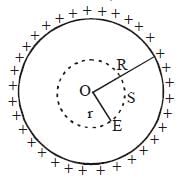

i.e. electric field inside a hollow sphere is zero.
The electric potential V at any point (x, y, z), all inmeters in space is given by V = 4x2 volt. Theelectric field at the point (1, 0, 2) in volt/meteris [2011M]- a)8 along positive X-axis
- b)16 along negative X-axis
- c)16 along positive X-axis
- d)8 along negative X-axis
Correct answer is option 'D'. Can you explain this answer?
The electric potential V at any point (x, y, z), all inmeters in space is given by V = 4x2 volt. Theelectric field at the point (1, 0, 2) in volt/meteris [2011M]
a)
8 along positive X-axis
b)
16 along negative X-axis
c)
16 along positive X-axis
d)
8 along negative X-axis
| | Arnav Iyer answered |
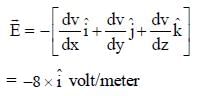
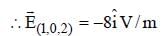
A point Q lies on the perpendicular bisector of an electrical dipole of dipole moment p. If the distance of Q from the dipole is r (much larger than the size of the dipole), then the electric field at Q is proportional to [1998]- a)p–1 and r–2
- b)p and r–2
- c)p2 and r–3
- d)p and r–3
Correct answer is option 'D'. Can you explain this answer?
A point Q lies on the perpendicular bisector of an electrical dipole of dipole moment p. If the distance of Q from the dipole is r (much larger than the size of the dipole), then the electric field at Q is proportional to [1998]
a)
p–1 and r–2
b)
p and r–2
c)
p2 and r–3
d)
p and r–3
| | Ayush Chavan answered |
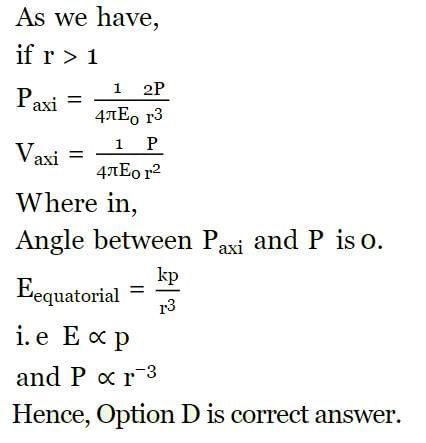

A square surface of side L meter in the plane of the paper is placed in a uniform electric field E (volt/m) acting along the same plane at an angle θ with the horizontal side of the square as shown in Figure. The electric flux linked to the surface, in units of volt. m, is [2010]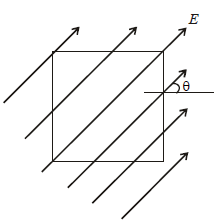
- a)EL2
- b)EL2 cos θ
- c)EL2 sin θ
- d)zero
Correct answer is option 'D'. Can you explain this answer?
A square surface of side L meter in the plane of the paper is placed in a uniform electric field E (volt/m) acting along the same plane at an angle θ with the horizontal side of the square as shown in Figure. The electric flux linked to the surface, in units of volt. m, is [2010]
a)
EL2
b)
EL2 cos θ
c)
EL2 sin θ
d)
zero
 | Charvi Shah answered |
Electric flux, φ = EA cos θ , where θ
= angle between E and normal to the
surface.
= angle between E and normal to the
surface.
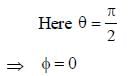
The surface charge density of a thin charged disc of radius R is σ. The value of the electric field at the centre of the disc is σ/2ϵ0. With respect to the field at the centre, the electric field along the axis at a distance R from the centre of the disc reduces (in percent) by _____. Answer should be rounded off to two decimal places.- a)714.3
- b)0.7143
- c)7.143
- d)71.43
Correct answer is option 'D'. Can you explain this answer?
The surface charge density of a thin charged disc of radius R is σ. The value of the electric field at the centre of the disc is σ/2ϵ0. With respect to the field at the centre, the electric field along the axis at a distance R from the centre of the disc reduces (in percent) by _____. Answer should be rounded off to two decimal places.
a)
714.3
b)
0.7143
c)
7.143
d)
71.43
 | EduRev NEET answered |
Electric field intensity at the centre of the disc. E = σ/2ϵ0 (given)
Electric field along the axis at any distance x from the centre of the disc
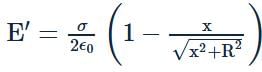
From question, x=R (radius of disc)
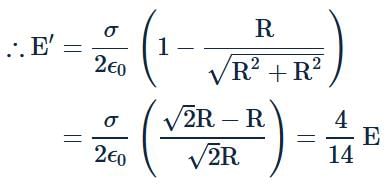
∴% reduction in the value of electric field

Electric field along the axis at any distance x from the centre of the disc
From question, x=R (radius of disc)
∴% reduction in the value of electric field
When air is replaced by a dielectric medium offorce constant K, the maximum force ofattraction between two charges, separated by adistance [1999]- a)decreases K-times
- b)increases K-times
- c)remains unchanged
- d)becomes 1/K2 times
Correct answer is option 'A'. Can you explain this answer?
When air is replaced by a dielectric medium offorce constant K, the maximum force ofattraction between two charges, separated by adistance [1999]
a)
decreases K-times
b)
increases K-times
c)
remains unchanged
d)
becomes 1/K2 times
 | Kunal Rane answered |
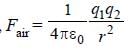
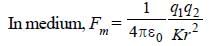
in air

A charge Q is enclosed by a Gaussian sphericalsurface of radius R. If the radius is doubled, thenthe outward electric flux will [2011]- a)increase four times
- b)be reduced to half
- c)remain the same
- d)be doubled
Correct answer is option 'C'. Can you explain this answer?
A charge Q is enclosed by a Gaussian sphericalsurface of radius R. If the radius is doubled, thenthe outward electric flux will [2011]
a)
increase four times
b)
be reduced to half
c)
remain the same
d)
be doubled
| | Ritika Sengupta answered |
Explanation:
The electric flux through a Gaussian surface is given by the formula:
Φ = Q/ε0
Where, Q is the charge enclosed by the Gaussian surface and ε0 is the permittivity of free space.
When the radius of the Gaussian surface is doubled, its area becomes four times the original area (since the surface area of a sphere is proportional to the square of its radius).
But the charge enclosed by the Gaussian surface remains the same.
Therefore, the electric field at any point on the Gaussian surface will be the same as before (since the electric field due to a point charge varies inversely with the square of the distance from the charge).
Hence, the electric flux through the Gaussian surface will also remain the same.
Therefore, the correct answer is option 'C': Remain the same.
The electric flux through a Gaussian surface is given by the formula:
Φ = Q/ε0
Where, Q is the charge enclosed by the Gaussian surface and ε0 is the permittivity of free space.
When the radius of the Gaussian surface is doubled, its area becomes four times the original area (since the surface area of a sphere is proportional to the square of its radius).
But the charge enclosed by the Gaussian surface remains the same.
Therefore, the electric field at any point on the Gaussian surface will be the same as before (since the electric field due to a point charge varies inversely with the square of the distance from the charge).
Hence, the electric flux through the Gaussian surface will also remain the same.
Therefore, the correct answer is option 'C': Remain the same.
An electric dipole of dipole moment p is alignedparallel to a uniform electric field E. The energyrequired to rotate the dipole by 90° is [NEET Kar. 2013]- a)pE2
- b)p2E
- c)pE
- d)infinity
Correct answer is option 'C'. Can you explain this answer?
An electric dipole of dipole moment p is alignedparallel to a uniform electric field E. The energyrequired to rotate the dipole by 90° is [NEET Kar. 2013]
a)
pE2
b)
p2E
c)
pE
d)
infinity
 | Shanaya Rane answered |
When electric dipole is aligned parallel
θ = 0° and the dipole is rotated by 90° i.e.,
θ = 90°.
Energy required to rotate the dipole
W = Uf – Ui = (–pE cos 90°) – (–pE cos 0°)
= pE.
θ = 0° and the dipole is rotated by 90° i.e.,
θ = 90°.
Energy required to rotate the dipole
W = Uf – Ui = (–pE cos 90°) – (–pE cos 0°)
= pE.
The mean free path of electrons in a metal is 4 × 10⁻⁸ m. The electric field which can give on an average 2 eV energy to an electron in the metal will be in units of V/m [2009]- a)5 × 10–11
- b)8 × 10–11
- c)5 × 10⁷
- d)8 × 10⁷
Correct answer is option 'C'. Can you explain this answer?
The mean free path of electrons in a metal is 4 × 10⁻⁸ m. The electric field which can give on an average 2 eV energy to an electron in the metal will be in units of V/m [2009]
a)
5 × 10–11
b)
8 × 10–11
c)
5 × 10⁷
d)
8 × 10⁷
 | Kajal Bose answered |
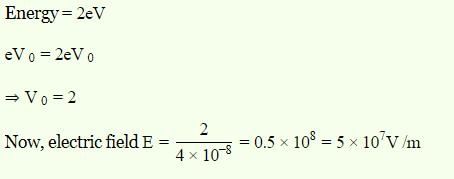
Correct Answer is C.
From a point charge, there is a fixed point A. At A, there is an electric field of 500 V/m andpotential difference of 3000 V. Distance betweenpoint charge and A will be [1997]- a)6 m
- b)12 m
- c)16 m
- d)24 m
Correct answer is option 'A'. Can you explain this answer?
From a point charge, there is a fixed point A. At A, there is an electric field of 500 V/m andpotential difference of 3000 V. Distance betweenpoint charge and A will be [1997]
a)
6 m
b)
12 m
c)
16 m
d)
24 m
 | Rajat Roy answered |
Given : Electric field (E) = 500 V/m
and potential difference (V) = 3000 V.
We know that electric field
and potential difference (V) = 3000 V.
We know that electric field
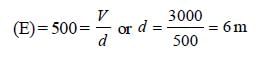
[where d = Distance between point charge
and A]
and A]
An electric dipole of moment ´p´ is placed in anelectric field of intensity ´E´. The dipole acquiresa position such that the axis of the dipole makesan angle θ with the direction of the field.Assuming that the potential energy of the dipole to be zero when = 90°, the torque and the potentialenergy of the dipole will respectively be :- a)p E sin θ, – p E cos θ
- b)p E sin θ, –2 p E cos θ
- c)p E sin θ, 2 p E cos θ
- d)p E cos θ, – p E cos θ
Correct answer is option 'A'. Can you explain this answer?
An electric dipole of moment ´p´ is placed in anelectric field of intensity ´E´. The dipole acquiresa position such that the axis of the dipole makesan angle θ with the direction of the field.Assuming that the potential energy of the dipole to be zero when = 90°, the torque and the potentialenergy of the dipole will respectively be :
a)
p E sin θ, – p E cos θ
b)
p E sin θ, –2 p E cos θ
c)
p E sin θ, 2 p E cos θ
d)
p E cos θ, – p E cos θ
 | Pankaj Kulkarni answered |
The torque on the dipole is given as
τ = PE sin θ
The potential energy of the dipole in the
electric field is given as
U = – PE cos θ
τ = PE sin θ
The potential energy of the dipole in the
electric field is given as
U = – PE cos θ
A point charge Q is moved along a circular path around another fixed point charge The work done is zero - a)only if Q returns to it's starting position
- b)in all cases
- c)only if the two charges have the same magnitude and opposite signs
- d)only if the two charges have the same magnitude
Correct answer is option 'B'. Can you explain this answer?
A point charge Q is moved along a circular path around another fixed point charge The work done is zero
a)
only if Q returns to it's starting position
b)
in all cases
c)
only if the two charges have the same magnitude and opposite signs
d)
only if the two charges have the same magnitude
 | Vaishnavi Dasgupta answered |
Explanation:Since that circular path behave as equipotential surface so work done is always zero.
An uniform electric field E exists along positive x-axis. The work done in moving a charge 0.5C through a distance 2 m along a direction making an angle 60∘ with x -axis is 10 J. Then what is the magnitude of electric field (in Vm−1)?- a)15
- b)20
- c)25
- d)30
Correct answer is option 'B'. Can you explain this answer?
An uniform electric field E exists along positive x-axis. The work done in moving a charge 0.5C through a distance 2 m along a direction making an angle 60∘ with x -axis is 10 J. Then what is the magnitude of electric field (in Vm−1)?
a)
15
b)
20
c)
25
d)
30
 | Shivani Tiwari answered |
Understanding the Problem
To find the magnitude of the electric field (E), we need to analyze the work done (W) in moving a charge (q) through a distance (d) at an angle (θ) to the electric field.
Given Values
- Charge (q) = 0.5 C
- Distance (d) = 2 m
- Angle (θ) = 60 degrees
- Work done (W) = 10 J
Formula for Work Done
The work done in moving a charge in an electric field is given by the formula:
W = q * E * d * cos(θ)
Where:
- W = Work done
- q = Charge
- E = Electric field magnitude
- d = Distance moved
- cos(θ) = Cosine of the angle between the field and the direction of movement
Substituting the Values
Now, substituting the known values into the formula:
10 J = 0.5 C * E * 2 m * cos(60 degrees)
We know that cos(60 degrees) = 0.5.
Thus, the equation simplifies to:
10 = 0.5 * E * 2 * 0.5
This leads to:
10 = 0.5 * E
Solving for E
Now, solving for E:
E = 10 / 0.5 = 20 Vm^-1
Conclusion
The magnitude of the electric field is 20 Vm^-1, which corresponds to option 'B'.
To find the magnitude of the electric field (E), we need to analyze the work done (W) in moving a charge (q) through a distance (d) at an angle (θ) to the electric field.
Given Values
- Charge (q) = 0.5 C
- Distance (d) = 2 m
- Angle (θ) = 60 degrees
- Work done (W) = 10 J
Formula for Work Done
The work done in moving a charge in an electric field is given by the formula:
W = q * E * d * cos(θ)
Where:
- W = Work done
- q = Charge
- E = Electric field magnitude
- d = Distance moved
- cos(θ) = Cosine of the angle between the field and the direction of movement
Substituting the Values
Now, substituting the known values into the formula:
10 J = 0.5 C * E * 2 m * cos(60 degrees)
We know that cos(60 degrees) = 0.5.
Thus, the equation simplifies to:
10 = 0.5 * E * 2 * 0.5
This leads to:
10 = 0.5 * E
Solving for E
Now, solving for E:
E = 10 / 0.5 = 20 Vm^-1
Conclusion
The magnitude of the electric field is 20 Vm^-1, which corresponds to option 'B'.
An electric dipole is placed at an angle of 30° with an electric field intensity 2 x 10⁵ N C–1.It experiences a torque equal to 4 N m. The charge on the dipole, if the dipole length is 2 cm, is- a)8 mC
- b)2 mC
- c)5 mC
- d)7 μC
Correct answer is option 'B'. Can you explain this answer?
An electric dipole is placed at an angle of 30° with an electric field intensity 2 x 10⁵ N C–1.It experiences a torque equal to 4 N m. The charge on the dipole, if the dipole length is 2 cm, is
a)
8 mC
b)
2 mC
c)
5 mC
d)
7 μC
| | Stepway Academy answered |
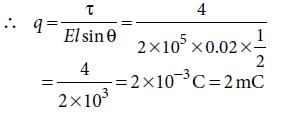
Here, q = 30°, E = 2 x 10⁵ N C–1, τ = 4 N m,
l = 2 cm = 0.02 m, q = ?
τ = pE sinq = (ql)E sinq
l = 2 cm = 0.02 m, q = ?
τ = pE sinq = (ql)E sinq
Intensity of an electric field (E) depends on distance r, due to a dipole, is related as [1996]- a)

- b)

- c)

- d)

Correct answer is option 'C'. Can you explain this answer?
Intensity of an electric field (E) depends on distance r, due to a dipole, is related as [1996]
a)
b)
c)
d)
 | Snehal Shah answered |
Intensity of electric field due to a Dipole

Chapter doubts & questions for Electric Charges and Fields - 30-Day Revision Course for NEET 2026 is part of NEET exam preparation. The chapters have been prepared according to the NEET exam syllabus. The Chapter doubts & questions, notes, tests & MCQs are made for NEET 2026 Exam. Find important definitions, questions, notes, meanings, examples, exercises, MCQs and online tests here.
Chapter doubts & questions of Electric Charges and Fields - 30-Day Revision Course for NEET in English & Hindi are available as part of NEET exam. Download more important topics, notes, lectures and mock test series for NEET Exam by signing up for free.
30-Day Revision Course for NEET85 videos|301 docs|171 tests |
