


All Exams > NEET > 30-Day Revision Course for NEET > All Questions
All questions of Moving Charges and Magnetism for NEET Exam
A charged particle is moving on circular path with velocity v in a uniform magnetic field B, if the velocity of the charged particle is doubled and strength of Magnetic field is halved, then radius becomes- a)8 times
- b)4 times
- c)2 times
- d)16 times
Correct answer is option 'B'. Can you explain this answer?
A charged particle is moving on circular path with velocity v in a uniform magnetic field B, if the velocity of the charged particle is doubled and strength of Magnetic field is halved, then radius becomes
a)
8 times
b)
4 times
c)
2 times
d)
16 times
 | Meera Singh answered |
As 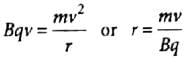
According to the question, v‘ = 2v and B' = B/2
∴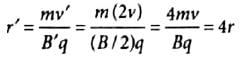
According to the question, v‘ = 2v and B' = B/2
∴

A particle having a mass of 10–2 kg carries a charge of 5 × 10⁻⁸ C. The particle is given an initial horozontal velocity of 105 ms–1 in the presence of electric field  and magnetic field
  . To keep the particle moving in a horizontal direction, it is necessary that(1) should be perpendicular to the direction of velocity and should be along the direction of velocity.(2) Both and should be along the direction of velocity.(3) Both and are mutually perpendicular and perpendicular to the direction of velocity.(4) should be along the direction of velocity and should be perpendicular to the direction of velocityWhich one of the following pairs of statements is possible?
- a)(2) and (4)
- b)(1) and (3)
- c)(3) and (4)
- d)(2) and (3)
Correct answer is option 'D'. Can you explain this answer?
A particle having a mass of 10–2 kg carries a charge of 5 × 10⁻⁸ C. The particle is given an initial horozontal velocity of 105 ms–1 in the presence of electric field and magnetic field . To keep the particle moving in a horizontal direction, it is necessary that
and magnetic field . To keep the particle moving in a horizontal direction, it is necessary that(1) should be perpendicular to the direction of velocity and should be along the direction of velocity.
should be perpendicular to the direction of velocity and should be along the direction of velocity.(2) Both and should be along the direction of velocity.
and should be along the direction of velocity.(3) Both and are mutually perpendicular and perpendicular to the direction of velocity.
and are mutually perpendicular and perpendicular to the direction of velocity.(4) should be along the direction of velocity and should be perpendicular to the direction of velocity
should be along the direction of velocity and should be perpendicular to the direction of velocityWhich one of the following pairs of statements is possible?
a)
(2) and (4)
b)
(1) and (3)
c)
(3) and (4)
d)
(2) and (3)
 | Ayush Sengupta answered |
Force due to electric field acts along the direction of the electric field but force due to the magnetic field acts along a direction perpendicular to both the velocity of the charged particle and the magnetic field.
Hence both statements (2) and (3) are true.
In statement (2), magnetic force is zero, so, electric force will keep the particle continue to move in horizontal direction. In statement (3), both electric and magnetic forces will be opposite to each other. If their magnitudes will be equal then the particle will continue horizontal motion.
Hence both statements (2) and (3) are true.
In statement (2), magnetic force is zero, so, electric force will keep the particle continue to move in horizontal direction. In statement (3), both electric and magnetic forces will be opposite to each other. If their magnitudes will be equal then the particle will continue horizontal motion.
A closely wound solenoid of 2000 turns and areaof cross-section 1.5 × 10⁻⁴ m2 carries a currentof 2.0 A. It suspended through its centre andperpendicular to its length, allowing it to turn ina horizontal plane in a uniform magnetic field 5 ×10⁻² tesla making an angle of 30° with the axis ofthe solenoid. The torque on the solenoid will be:- a)3 × 10⁻² N-m
- b)3 × 10⁻³ N-m
- c)1.5 × 10⁻³ N-m
- d)1.5 × 10⁻² N-m
Correct answer is option 'D'. Can you explain this answer?
A closely wound solenoid of 2000 turns and areaof cross-section 1.5 × 10⁻⁴ m2 carries a currentof 2.0 A. It suspended through its centre andperpendicular to its length, allowing it to turn ina horizontal plane in a uniform magnetic field 5 ×10⁻² tesla making an angle of 30° with the axis ofthe solenoid. The torque on the solenoid will be:
a)
3 × 10⁻² N-m
b)
3 × 10⁻³ N-m
c)
1.5 × 10⁻³ N-m
d)
1.5 × 10⁻² N-m
 | Lalit Yadav answered |
Torque on the solenoid is given by ζ = MB sinθ where θ is the angle between the magnetic field and the axis of solenoid.
M = niA
∴ ζ = niA B sin 30°
M = niA
∴ ζ = niA B sin 30°

= 1.5 x 10⁻² N-m
A current loop in a magnetic field [NEET 2013]- a)can be in equilibrium in one orientation
- b)can be in equilibrium in two orientations,both the equilibrium states are unstable
- c)can be in equilibrium in two orientations,one stable while the other is unstable
- d)experiences a torque whether the field isuniform or non-uniform in all orientations
Correct answer is option 'C'. Can you explain this answer?
A current loop in a magnetic field [NEET 2013]
a)
can be in equilibrium in one orientation
b)
can be in equilibrium in two orientations,both the equilibrium states are unstable
c)
can be in equilibrium in two orientations,one stable while the other is unstable
d)
experiences a torque whether the field isuniform or non-uniform in all orientations
 | Shivani Tiwari answered |
A current loop in a magnetic field is in equilibrium in two orientations one is stable and another unstable.
 = M B sinθ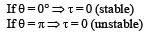
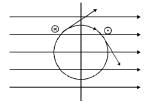
Do not experience a torque in some orientations Hence option (c) is correct.

A square current carrying loop is suspended in a uniform magnetic field acting in the plane of the loop. If the force on one arm of the loop is  , the net force on the remaining three arms of the loop is
- a)3
- b)-
- c)-3
- d)
Correct answer is option 'B'. Can you explain this answer?
A square current carrying loop is suspended in a uniform magnetic field acting in the plane of the loop. If the force on one arm of the loop is , the net force on the remaining three arms of the loop is
, the net force on the remaining three arms of the loop isa)
3
b)
-
c)
-3
d)
 | Arya Khanna answered |
The force on the two arms parallel to the field is zero.
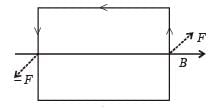
∴ Force on remaining arms = – F
Under the influence of a uniform magnetic field,a charged particle moves with constant speed vin a circle of radius R. The time period of rotationof the particle: [2009]- a)depends on R and not on v
- b)is independent of both v and R
- c)depends on both v and R
- d)depends on v and not on R
Correct answer is option 'B'. Can you explain this answer?
Under the influence of a uniform magnetic field,a charged particle moves with constant speed vin a circle of radius R. The time period of rotationof the particle: [2009]
a)
depends on R and not on v
b)
is independent of both v and R
c)
depends on both v and R
d)
depends on v and not on R
 | Anu Bajaj answered |
The time period of the charged particle is
given by
given by
Thus, time period is independent of both v and R.

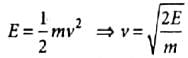
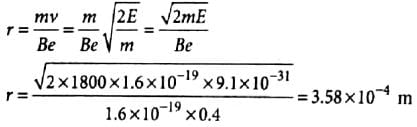
A uniform electric field and uniform magneticfield are acting along the same direction in acertain region. If an electron is projected in theregion such that its velocity is pointed alongthe direction of fields, then the electron [2011]- a)will turn towards right of direction of motion
- b)speed will decrease
- c)speed will increase
- d)will turn towards left direction of motion
Correct answer is option 'B'. Can you explain this answer?
A uniform electric field and uniform magneticfield are acting along the same direction in acertain region. If an electron is projected in theregion such that its velocity is pointed alongthe direction of fields, then the electron [2011]
a)
will turn towards right of direction of motion
b)
speed will decrease
c)
speed will increase
d)
will turn towards left direction of motion
 | Arya Nair answered |
 are in same direction so that magnetic force on electron becomes zero, only electric force acts. But force on electron due to electric field is opposite to the direction of velocity.
Two particles of equal charges after being accelerated through the same potential difference enter in a uniform transverse magnetic field and describe circular paths of radii R1 and R2. Then the ratio of their respective masses (M1/M2) is - a)R1/R2
- b)(R1/R2)2
- c)R2/R1
- d)(R2/R1)2
Correct answer is option 'B'. Can you explain this answer?
Two particles of equal charges after being accelerated through the same potential difference enter in a uniform transverse magnetic field and describe circular paths of radii R1 and R2. Then the ratio of their respective masses (M1/M2) is
a)
R1/R2
b)
(R1/R2)2
c)
R2/R1
d)
(R2/R1)2
 | Gaurav Kumar answered |
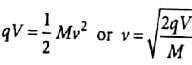
And Bqv = Mv2/R Or
 Using (i)
or
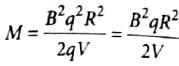
∴ M ∝ R2 (∵ B, q and V are same for the given two particles)
Hence (M1/M2) = (R1/R2)2
Two α-partides have the ratio of their velocities as 3 : 2 on entering the field. If they move in different circular paths, then the ratio of the radii of their paths is- a)2 : 3
- b)3 : 2
- c)9 : 4
- d)4 : 9
Correct answer is option 'B'. Can you explain this answer?
Two α-partides have the ratio of their velocities as 3 : 2 on entering the field. If they move in different circular paths, then the ratio of the radii of their paths is
a)
2 : 3
b)
3 : 2
c)
9 : 4
d)
4 : 9
| | Amar Dasgupta answered |
Explanation:
Given:
Two α-particles have the ratio of their velocities as 3 : 2 on entering the field.
Let:
Let the velocities of the two α-particles be 3v and 2v respectively.
Let the radii of their circular paths be r1 and r2 respectively.
Velocity-radius relationship:
The ratio of the velocities is equal to the inverse ratio of the radii of circular paths.
Therefore, 3v/2v = r2/r1
=> r2/r1 = 3/2
=> r1/r2 = 2/3
Conclusion:
The ratio of the radii of their circular paths is 2 : 3.
Therefore, the correct answer is option 'b) 3 : 2'.
Given:
Two α-particles have the ratio of their velocities as 3 : 2 on entering the field.
Let:
Let the velocities of the two α-particles be 3v and 2v respectively.
Let the radii of their circular paths be r1 and r2 respectively.
Velocity-radius relationship:
The ratio of the velocities is equal to the inverse ratio of the radii of circular paths.
Therefore, 3v/2v = r2/r1
=> r2/r1 = 3/2
=> r1/r2 = 2/3
Conclusion:
The ratio of the radii of their circular paths is 2 : 3.
Therefore, the correct answer is option 'b) 3 : 2'.
A proton carrying 1 MeV kinetic energy ismoving in a circular path of radius R in uniformmagnetic field. What should be the energy of an α -particle to describe a circle of same radius inthe same field? [2012M]- a)2 MeV
- b)1 MeV
- c)0.5 MeV
- d)4 MeV
Correct answer is option 'B'. Can you explain this answer?
A proton carrying 1 MeV kinetic energy ismoving in a circular path of radius R in uniformmagnetic field. What should be the energy of an α -particle to describe a circle of same radius inthe same field? [2012M]
a)
2 MeV
b)
1 MeV
c)
0.5 MeV
d)
4 MeV
 | Ruchi Chakraborty answered |
According to the principal of circular motion in a magnetic field
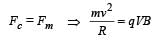
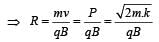


but R = Rα (given)
Thus K = K' = 1 MeV
A thin ring of radius R meter has charge q coulomb uniformly spread on it. The ring rotates about its axis with a constant frequency of f revolutions/s. The value of magnetic induction in Wb/m2 at the centre of the ring is [2010]- a)

- b)

- c)

- d)

Correct answer is option 'D'. Can you explain this answer?
A thin ring of radius R meter has charge q coulomb uniformly spread on it. The ring rotates about its axis with a constant frequency of f revolutions/s. The value of magnetic induction in Wb/m2 at the centre of the ring is [2010]
a)
b)
c)
d)
 | Prisha Singh answered |
Current in the ring due to rotation,
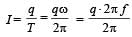
Therefore, magnetic field at the centre of the ring is

A square loop, carrying a steady current I, is placed in a horizontal plane near a long straight conductor carrying a steady current I1 at a distance d from the conductor as shown in figure. The loop will experience [2011M]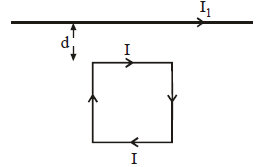
- a)a net repulsive force away from theconductor
- b)a net torque acting upward perpendicularto the horizontal plane
- c)a net torque acting downward normal tothe horizontal plane
- d)a net attractive force towards the conductor
Correct answer is option 'D'. Can you explain this answer?
A square loop, carrying a steady current I, is placed in a horizontal plane near a long straight conductor carrying a steady current I1 at a distance d from the conductor as shown in figure. The loop will experience [2011M]
a)
a net repulsive force away from theconductor
b)
a net torque acting upward perpendicularto the horizontal plane
c)
a net torque acting downward normal tothe horizontal plane
d)
a net attractive force towards the conductor
 | Nayanika Dasgupta answered |
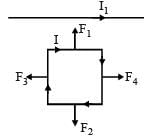
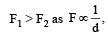 and F3 and F4 are equal and opposite. Hence, the net attraction force will be towards the conductor.
The magnetic force acting on a charged particleof charge – 2μC in a magnetic field of 2T actingin y direction, when the particle velocity is 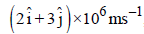 , is
, is- a)4 N in z direction
- b)8 N in y direction
- c)8 N in z direction
- d)8 N in – z direction
Correct answer is option 'D'. Can you explain this answer?
The magnetic force acting on a charged particleof charge – 2μC in a magnetic field of 2T actingin y direction, when the particle velocity is , is
, isa)
4 N in z direction
b)
8 N in y direction
c)
8 N in z direction
d)
8 N in – z direction
 | Sonal Kulkarni answered |
The magnetic force acting on the char ged paraticle is given by 



∴ Force is of 8N along – z-axis.
Charge q is uniformly spread on a thin ring of radius R. The ring rotates about its axis with a uniform frequency f Hz. The magnitude of magnetic induction at the centre of the ring is [2011M]- a)

- b)

- c)

- d)

Correct answer is option 'A'. Can you explain this answer?
Charge q is uniformly spread on a thin ring of radius R. The ring rotates about its axis with a uniform frequency f Hz. The magnitude of magnetic induction at the centre of the ring is [2011M]
a)
b)
c)
d)
 | Rajesh Datta answered |
When the ring rotates about its axis with a uniform frequency f Hz, the current flowing in the ring is

Magnetic field at the centre of the ring is

A long straight wire carries a certain current and produces a magnetic field of 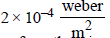 at a perpendicular distance of 5 cm from the wire. An electron situated at 5 cm from the wire moves with a velocity 107 m/s towards the wire along perpendicular to it. The force experienced by the electron will be [NEET Kar. 2013]
(charge on electron =1.6 × 10⁻¹⁹ C)- a)Zero
- b)3.2 N
- c)3.2 × 10⁻¹⁶ N
- d)1.6 × 10⁻¹⁶ N
Correct answer is option 'C'. Can you explain this answer?
A long straight wire carries a certain current and produces a magnetic field of at a perpendicular distance of 5 cm from the wire. An electron situated at 5 cm from the wire moves with a velocity 107 m/s towards the wire along perpendicular to it. The force experienced by the electron will be [NEET Kar. 2013]
(charge on electron =1.6 × 10⁻¹⁹ C)
at a perpendicular distance of 5 cm from the wire. An electron situated at 5 cm from the wire moves with a velocity 107 m/s towards the wire along perpendicular to it. The force experienced by the electron will be [NEET Kar. 2013](charge on electron =1.6 × 10–19 C)
a)
Zero
b)
3.2 N
c)
3.2 × 10⁻¹⁶ N
d)
1.6 × 10⁻¹⁶ N
 | Ishani Nambiar answered |
Given: Magnetic field B = 2 × 10⁻⁴ weber/m2
Velocity of electron, v = 107 m/s
Lorentz force F = qvB sinθ = 1.6 × 10–19 × 107 × 2 × 10–4 (∵ θ = 90°)
= 3.2 × 10⁻¹⁶ N
Velocity of electron, v = 107 m/s
Lorentz force F = qvB sinθ = 1.6 × 10–19 × 107 × 2 × 10–4 (∵ θ = 90°)
= 3.2 × 10⁻¹⁶ N
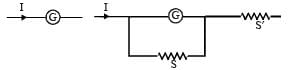
A galvanometer of resistance, G is shunted by a resistance S ohm. To keep the main current in the circuit unchanged, the resistance to be put in series with the galvanometer is [2011M]- a)

- b)

- c)

- d)

Correct answer is option 'C'. Can you explain this answer?
A galvanometer of resistance, G is shunted by a resistance S ohm. To keep the main current in the circuit unchanged, the resistance to be put in series with the galvanometer is [2011M]
a)
b)
c)
d)
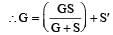
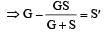
| | Prisha Singh answered |
To keep the main current in the circuit unchanged, the resistance of the galvanometer should be equal to the net resistance.

A current carrying loop in the form of a right angle isosceles triangle ABC is placed in a uniform magnetic field acting along AB. If the magnetic force on the arm BC is F, what is the force on the arm AC?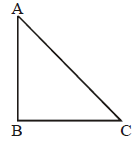
- a)-√2
- b)-
- c)
- d)√2
Correct answer is option 'B'. Can you explain this answer?
A current carrying loop in the form of a right angle isosceles triangle ABC is placed in a uniform magnetic field acting along AB. If the magnetic force on the arm BC is F, what is the force on the arm AC?
a)
-√2
b)
-
c)
d)
√2
| | Anu Bajaj answered |
Let a current i be flowing in the loop ABC in the direction shown in the figure. If the length of each of the sides AB and BC be x then
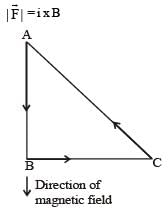
where B is the magnitude of the magnetic force.
The direction of will be in the direction perpendicular to the plane of the paper and going into it.
By Pythagorus theorem,
The direction of
will be in the direction perpendicular to the plane of the paper and going into it.By Pythagorus theorem,

∴ Magnitude of force on AC
 x B sin 45°

The direction of the force on AC is perpendicular to the plane of the paper and going out of it. Hence, force on 
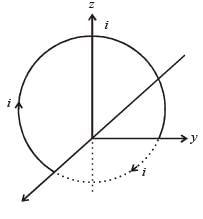
A current loop consists of two identical semicircular parts each of radius R, one lying in the x-y plane and the other in x-z plane. If the current in the loop is i., the resultant magnetic field due to the two semicircular parts at their common centre is- a)

- b)

- c)μ0i/2R
- d)

Correct answer is option 'B'. Can you explain this answer?
A current loop consists of two identical semicircular parts each of radius R, one lying in the x-y plane and the other in x-z plane. If the current in the loop is i., the resultant magnetic field due to the two semicircular parts at their common centre is
a)
b)
c)
μ0i/2R
d)
| | Ruchi Chakraborty answered |
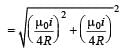
Magnetic fields due to the two parts at their common centre are respectively,
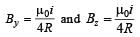
Resultant field = 

A galvanometer has a coil of resistance 100 ohmand gives a full-scale deflection for 30 mAcurrent. It is to work as a voltmeter of 30 voltrange, the resistance required to be added willbe [2010]- a)900Ω
- b)1800Ω
- c)500Ω
- d)1000Ω
Correct answer is option 'A'. Can you explain this answer?
A galvanometer has a coil of resistance 100 ohmand gives a full-scale deflection for 30 mAcurrent. It is to work as a voltmeter of 30 voltrange, the resistance required to be added willbe [2010]
a)
900Ω
b)
1800Ω
c)
500Ω
d)
1000Ω
| | Arya Nair answered |
Let the resistance to be added be R, then
30 = Ig(r + R)

= 1000 – 100 = 900Ω
Two similar coils of radius R are lying concentrically with their planes at right angles to each other. The currents flowing in them are
I and 2 I, respectively. The resultant magnetic field induction at the centre will be: [2012]- a)

- b)

- c)

- d)

Correct answer is option 'A'. Can you explain this answer?
Two similar coils of radius R are lying concentrically with their planes at right angles to each other. The currents flowing in them are
I and 2 I, respectively. The resultant magnetic field induction at the centre will be: [2012]
I and 2 I, respectively. The resultant magnetic field induction at the centre will be: [2012]
a)
b)
c)
d)
| | Sonal Kulkarni answered |
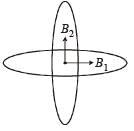
The magnetic field, due the coil, carrying current I Ampere

The magnetic field due to the coil, carrying current 2I Ampere

The resultant B



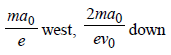
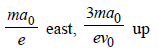
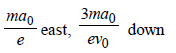
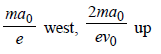
When a proton is released from rest in a room, it starts with an initial acceleration a0 towards west. When it is projected towards north with a speed v0 it moves with an initial acceleration 3a0 towards west. The electric and magnetic fields in the room are respectively [NEET 2013]- a)
- b)
- c)
- d)
Correct answer is option 'A'. Can you explain this answer?
When a proton is released from rest in a room, it starts with an initial acceleration a0 towards west. When it is projected towards north with a speed v0 it moves with an initial acceleration 3a0 towards west. The electric and magnetic fields in the room are respectively [NEET 2013]
a)
b)
c)
d)
| | Arya Khanna answered |
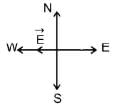
When moves with an acceleration a0 towards west, electric field
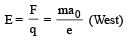
When moves with an acceleration 3a0 towards east, magnetic field
 (downward)
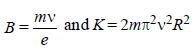
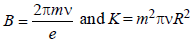
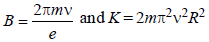
An alternating electric field, of frequency v, is applied across the dees (radius = R) of a cyclotron that is being used to accelerate
protons (mass = m). The operating magnetic field (B) used in the cyclotron and the kinetic energy (K) of the proton beam, produced by it, are given by : [2012]- a)
- b)
- c)
- d)
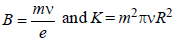
Correct answer is option 'C'. Can you explain this answer?
An alternating electric field, of frequency v, is applied across the dees (radius = R) of a cyclotron that is being used to accelerate
protons (mass = m). The operating magnetic field (B) used in the cyclotron and the kinetic energy (K) of the proton beam, produced by it, are given by : [2012]
protons (mass = m). The operating magnetic field (B) used in the cyclotron and the kinetic energy (K) of the proton beam, produced by it, are given by : [2012]
a)
b)
c)
d)
 | Shalini Saha answered |
Time period of cyclotron is



When a positively charged particle enters a uniform magnetic field with uniform velocity, its trajectory can be (i) a straight line (ii) a circle (iii) a helix.- a)(i) only
- b)(i) or (ii)
- c)(i) or (iii)
- d)any one of (i), (ii) and (iii)
Correct answer is option 'D'. Can you explain this answer?
When a positively charged particle enters a uniform magnetic field with uniform velocity, its trajectory can be (i) a straight line (ii) a circle (iii) a helix.
a)
(i) only
b)
(i) or (ii)
c)
(i) or (iii)
d)
any one of (i), (ii) and (iii)
 | Manoj Datta answered |
Explanation:
Introduction:
When a positively charged particle enters a uniform magnetic field with a uniform velocity, its trajectory can be a straight line, a circle, or a helix. The exact trajectory depends on the initial conditions of the particle, such as its velocity, charge, and angle of entry into the magnetic field.
Effect of Magnetic Field on Charged Particle:
When a charged particle moves through a magnetic field, it experiences a force called the magnetic Lorentz force. This force acts perpendicular to both the velocity of the particle and the magnetic field. The magnitude of the magnetic force can be given by the equation F = qvBsinθ, where F is the force, q is the charge of the particle, v is the velocity of the particle, B is the magnetic field strength, and θ is the angle between the velocity and the magnetic field.
Force Acting on a Particle:
The force acting on a positively charged particle in a magnetic field can be determined by the right-hand rule. If the thumb of the right hand points in the direction of the velocity of the particle, and the fingers point in the direction of the magnetic field, then the palm will point in the direction of the force acting on the particle.
Possible Trajectories:
The trajectory of a charged particle in a magnetic field depends on the initial conditions of the particle. The following are the possible trajectories:
1. Straight Line:
If the initial velocity of the particle is parallel or antiparallel to the magnetic field, then the force acting on the particle will be zero. In this case, the particle will continue to move in a straight line without any deflection.
2. Circle:
If the initial velocity of the particle is perpendicular to the magnetic field, the force acting on the particle will be maximum. This force will act as a centripetal force and cause the particle to move in a circular path with a constant radius.
3. Helix:
If the initial velocity of the particle has both a component perpendicular to the magnetic field and a component parallel to the magnetic field, the force acting on the particle will have both a radial and an axial component. This will cause the particle to move in a helical path.
Conclusion:
In conclusion, when a positively charged particle enters a uniform magnetic field with a uniform velocity, its trajectory can be a straight line, a circle, or a helix depending on the initial conditions of the particle. Therefore, the correct answer is option 'D' - any one of (i), (ii), and (iii).
Introduction:
When a positively charged particle enters a uniform magnetic field with a uniform velocity, its trajectory can be a straight line, a circle, or a helix. The exact trajectory depends on the initial conditions of the particle, such as its velocity, charge, and angle of entry into the magnetic field.
Effect of Magnetic Field on Charged Particle:
When a charged particle moves through a magnetic field, it experiences a force called the magnetic Lorentz force. This force acts perpendicular to both the velocity of the particle and the magnetic field. The magnitude of the magnetic force can be given by the equation F = qvBsinθ, where F is the force, q is the charge of the particle, v is the velocity of the particle, B is the magnetic field strength, and θ is the angle between the velocity and the magnetic field.
Force Acting on a Particle:
The force acting on a positively charged particle in a magnetic field can be determined by the right-hand rule. If the thumb of the right hand points in the direction of the velocity of the particle, and the fingers point in the direction of the magnetic field, then the palm will point in the direction of the force acting on the particle.
Possible Trajectories:
The trajectory of a charged particle in a magnetic field depends on the initial conditions of the particle. The following are the possible trajectories:
1. Straight Line:
If the initial velocity of the particle is parallel or antiparallel to the magnetic field, then the force acting on the particle will be zero. In this case, the particle will continue to move in a straight line without any deflection.
2. Circle:
If the initial velocity of the particle is perpendicular to the magnetic field, the force acting on the particle will be maximum. This force will act as a centripetal force and cause the particle to move in a circular path with a constant radius.
3. Helix:
If the initial velocity of the particle has both a component perpendicular to the magnetic field and a component parallel to the magnetic field, the force acting on the particle will have both a radial and an axial component. This will cause the particle to move in a helical path.
Conclusion:
In conclusion, when a positively charged particle enters a uniform magnetic field with a uniform velocity, its trajectory can be a straight line, a circle, or a helix depending on the initial conditions of the particle. Therefore, the correct answer is option 'D' - any one of (i), (ii), and (iii).
Chapter doubts & questions for Moving Charges and Magnetism - 30-Day Revision Course for NEET 2026 is part of NEET exam preparation. The chapters have been prepared according to the NEET exam syllabus. The Chapter doubts & questions, notes, tests & MCQs are made for NEET 2026 Exam. Find important definitions, questions, notes, meanings, examples, exercises, MCQs and online tests here.
Chapter doubts & questions of Moving Charges and Magnetism - 30-Day Revision Course for NEET in English & Hindi are available as part of NEET exam. Download more important topics, notes, lectures and mock test series for NEET Exam by signing up for free.
30-Day Revision Course for NEET85 videos|301 docs|171 tests |
