


All Exams > NEET > 30-Day Revision Course for NEET > All Questions
All questions of Organisms and Populations for NEET Exam


Small fish get stuck near the bottom of a shark and derive their nutrition from it? This kind of association is called- a)Parasitism
- b)Symbiosis
- c)Predation
- d)Commensalism
Correct answer is option 'D'. Can you explain this answer?
Small fish get stuck near the bottom of a shark and derive their nutrition from it? This kind of association is called
a)
Parasitism
b)
Symbiosis
c)
Predation
d)
Commensalism
 | Sonal Chakraborty answered |
Commensalism is a type of symbiotic relationship where one species benefits from the association, while the other is neither harmed nor helped. In this type of association, one species derives benefits from the other without causing any harm to the host.
Explanation:
In the given scenario, the small fish gets stuck near the bottom of a shark and derives its nutrition from it. The small fish is not harming the shark, nor is it providing any benefits to the shark. Therefore, this is an example of commensalism.
The small fish is using the shark as a shelter and also gets access to food particles that are present near the shark's mouth. The shark is not affected by the presence of the small fish, and it does not derive any benefit from it either.
In summary, commensalism is a type of symbiotic relationship where one species benefits from the association, while the other is neither harmed nor helped. The small fish getting stuck near the bottom of a shark and deriving its nutrition from it is an example of commensalism.
Explanation:
In the given scenario, the small fish gets stuck near the bottom of a shark and derives its nutrition from it. The small fish is not harming the shark, nor is it providing any benefits to the shark. Therefore, this is an example of commensalism.
The small fish is using the shark as a shelter and also gets access to food particles that are present near the shark's mouth. The shark is not affected by the presence of the small fish, and it does not derive any benefit from it either.
In summary, commensalism is a type of symbiotic relationship where one species benefits from the association, while the other is neither harmed nor helped. The small fish getting stuck near the bottom of a shark and deriving its nutrition from it is an example of commensalism.
Mycorrhiza represents - a)symbiotic association between a fungus and liverworts
- b)parasitic association between a fungus and an alga
- c)parasitic association between a fungus and roots of plants
- d)symbiotic association between a fungus and roots of higher plants
Correct answer is option 'D'. Can you explain this answer?
Mycorrhiza represents
a)
symbiotic association between a fungus and liverworts
b)
parasitic association between a fungus and an alga
c)
parasitic association between a fungus and roots of plants
d)
symbiotic association between a fungus and roots of higher plants
 | Sonal Kulkarni answered |
A nutrient depletion zone can develop when there is rapid soil solution uptake, low nutrient concentration, low diffusion rate, or low soil moisture. These conditions are very common; therefore, most plants rely on fungi to facilitate the uptake of minerals from the soil. Mycorrhizae, known as root fungi, form symbiotic associations with plant roots. In these associations, the fungi are actually integrated into the physical structure of the root. The fungi colonize the living root tissue during active plant growth.
Human population follows the- a)J-shaped growth curve
- b)Z-shaped growth curve
- c)S-shaped growth curve
- d)All of the above
Correct answer is option 'C'. Can you explain this answer?
Human population follows the
a)
J-shaped growth curve
b)
Z-shaped growth curve
c)
S-shaped growth curve
d)
All of the above
 | Harshitha Chavan answered |
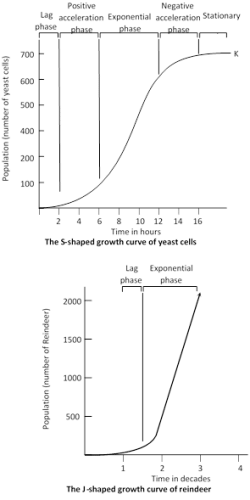
Logarithmic or Exponential phase : It is characterized by rapid growth in population which continues till enough food is available. But with the increase in reindeer population, there is corresponding decrease in the availability of food and space, which finally become exhausted, which leads to mass starvation and mortality. This sudden increase in mortality is called population crash. Lemming of Tundra, some insect, algal blooms and annual plants also show J-shaped curves. The population growth curve is S- shaped in most of the organisms, Human population also shows S-shaped curve.
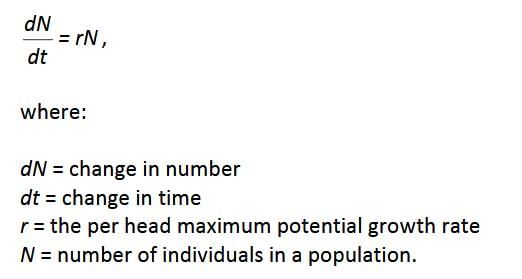
The formula for exponential population growth is- a)dN/rN = dt
- b)r N/dN = dt
- c)dt/dN = r N
- d)dN/dt = r N
Correct answer is option 'D'. Can you explain this answer?
The formula for exponential population growth is
a)
dN/rN = dt
b)
r N/dN = dt
c)
dt/dN = r N
d)
dN/dt = r N
 | Abhiram Nair answered |
Ans.
Formula = the rate of change in population size) = (the contribution of each individual to population growth) x (the number of individuals in the population
What does the carrying capacity (K) of a habitat refer to?- a)The maximum growth rate a population can achieve
- b)The maximum number of individuals an environment can support
- c)The rate of immigration into a population
- d)The total biomass of a population
Correct answer is option 'B'. Can you explain this answer?
a)
The maximum growth rate a population can achieve
b)
The maximum number of individuals an environment can support
c)
The rate of immigration into a population
d)
The total biomass of a population
 | Ambition Institute answered |
Carrying capacity (K) refers to the maximum number of individuals a habitat can support given the available resources. Beyond this limit, the population will stop growing or may even decline due to resource depletion.
Topic in NCERT: Carrying Capacity
Line in NCERT: "In nature, a given habitat has enough resources to support a maximum possible number, beyond which no further growth is possible. Let us call this limit as nature's carrying capacity (K) for that species in that habitat."
Which of the following adaptations are examples of plant defenses against herbivores?- a)Thorns on Acacia trees.
- b)High reproductive rate of a parasitic plant.
- c)Chemical production in Calotropis that harms herbivores.
- d)Camouflage in insects like the Monarch butterfly.
Correct answer is option 'A'. Can you explain this answer?
a)
Thorns on Acacia trees.
b)
High reproductive rate of a parasitic plant.
c)
Chemical production in Calotropis that harms herbivores.
d)
Camouflage in insects like the Monarch butterfly.
 | Infinity Academy answered |
Thorns on Acacia trees (A) and chemical production in Calotropis (C) are direct plant defenses against herbivores. The other options do not describe plant adaptations.
Topic in NCERT: Defenses Against Herbivory
Line in NCERT: "Plants therefore have evolved an astonishing variety of morphological and chemical defences against herbivores. Thorns (Acacia, Cactus) are the most common morphological means of defence. Many plants produce and store chemicals that make the herbivore sick when they are eaten, inhibit feeding or digestion, disrupt its reproduction or even kill it."
Consider the following statements about population growth and dynamics:
1. Exponential growth occurs only when resources are limited.
2. Logistic growth models show a sigmoid curve and account for carrying capacity.
3. Natality, mortality, immigration, and emigration are the four main factors that influence population size.
4. The intrinsic rate of natural increase (r) is constant and unaffected by environmental conditions.
Which of the following options is correct?- a)Statements 1 and 4 are correct.
- b)Statements 2 and 3 are correct.
- c)Statements 1 and 3 are correct.
- d)All statements are correct.
Correct answer is option 'B'. Can you explain this answer?
Consider the following statements about population growth and dynamics:
1. Exponential growth occurs only when resources are limited.
2. Logistic growth models show a sigmoid curve and account for carrying capacity.
3. Natality, mortality, immigration, and emigration are the four main factors that influence population size.
4. The intrinsic rate of natural increase (r) is constant and unaffected by environmental conditions.
Which of the following options is correct?
1. Exponential growth occurs only when resources are limited.
2. Logistic growth models show a sigmoid curve and account for carrying capacity.
3. Natality, mortality, immigration, and emigration are the four main factors that influence population size.
4. The intrinsic rate of natural increase (r) is constant and unaffected by environmental conditions.
Which of the following options is correct?
a)
Statements 1 and 4 are correct.
b)
Statements 2 and 3 are correct.
c)
Statements 1 and 3 are correct.
d)
All statements are correct.
 | Jay Chaudhary answered |
Understanding Population Growth Dynamics
Population dynamics is a crucial field of study in ecology, focusing on how populations change over time. Let's evaluate the given statements:
1. Exponential Growth and Resource Limitations
- Incorrect Statement: Exponential growth occurs when resources are abundant, allowing populations to grow rapidly without constraints. It does not occur only when resources are limited.
2. Logistic Growth and Carrying Capacity
- Correct Statement: Logistic growth is characterized by a sigmoid curve, which illustrates how a population grows rapidly at first, then slows as it approaches the carrying capacity of the environment. This model effectively integrates the concept of environmental limitations.
3. Factors Influencing Population Size
- Correct Statement: Natality (birth rate), mortality (death rate), immigration (movement into a population), and emigration (movement out of a population) are indeed the primary factors that influence population size, making this statement accurate.
4. Intrinsic Rate of Natural Increase (r)
- Incorrect Statement: The intrinsic rate of natural increase (r) is not constant; it can vary based on environmental conditions, resource availability, and other ecological factors.
Conclusion
Based on the evaluation:
- Statements 2 and 3 are correct, while statements 1 and 4 are incorrect. Thus, the correct answer is option B: "Statements 2 and 3 are correct."
Understanding these principles is essential for grasping how populations grow and interact with their environments, which is a key aspect of ecological studies in NEET.
Population dynamics is a crucial field of study in ecology, focusing on how populations change over time. Let's evaluate the given statements:
1. Exponential Growth and Resource Limitations
- Incorrect Statement: Exponential growth occurs when resources are abundant, allowing populations to grow rapidly without constraints. It does not occur only when resources are limited.
2. Logistic Growth and Carrying Capacity
- Correct Statement: Logistic growth is characterized by a sigmoid curve, which illustrates how a population grows rapidly at first, then slows as it approaches the carrying capacity of the environment. This model effectively integrates the concept of environmental limitations.
3. Factors Influencing Population Size
- Correct Statement: Natality (birth rate), mortality (death rate), immigration (movement into a population), and emigration (movement out of a population) are indeed the primary factors that influence population size, making this statement accurate.
4. Intrinsic Rate of Natural Increase (r)
- Incorrect Statement: The intrinsic rate of natural increase (r) is not constant; it can vary based on environmental conditions, resource availability, and other ecological factors.
Conclusion
Based on the evaluation:
- Statements 2 and 3 are correct, while statements 1 and 4 are incorrect. Thus, the correct answer is option B: "Statements 2 and 3 are correct."
Understanding these principles is essential for grasping how populations grow and interact with their environments, which is a key aspect of ecological studies in NEET.
Which of the following are examples of parasitism?- a) interaction between sea anemone that has stinging tentacles and the clown fish
- b)The Monarch butterfly’s chemical defenses.
- c)A lichen growing on a tree branch.
- d)The human liver fluke’s life cycle involving two intermediate hosts.
Correct answer is option 'D'. Can you explain this answer?
Which of the following are examples of parasitism?
a)
interaction between sea anemone that has stinging tentacles and the clown fish
b)
The Monarch butterfly’s chemical defenses.
c)
A lichen growing on a tree branch.
d)
The human liver fluke’s life cycle involving two intermediate hosts.
 | Bs Academy answered |
the human liver fluke’s life cycle (D) is an example of parasitism, where one species benefits at the expense of another. The other options describe mutualistic or commensal relationships.
Topic in NCERT: Life Cycles of Parasites
Line in NCERT: "The human liver fluke (a trematode parasite) depends on two intermediate hosts (a snail and a fish) to complete its life cycle."
When one population is harmed and the other remains unaffected, the relationship is called- a)Protocooperation
- b)Predation
- c)Amensalism
- d)Parasitism
Correct answer is option 'C'. Can you explain this answer?
When one population is harmed and the other remains unaffected, the relationship is called
a)
Protocooperation
b)
Predation
c)
Amensalism
d)
Parasitism
| | Dev Kumar answered |
No,It would be amensalism only when one population is being harmed by other population unconditionally means there is no intention of the population to harm the other population but it occurs due to release of some toxic substances by the population which harms the other population unintentionally and the population releasing toxic substances remains unharmed. but Accord to your question ans can also be predation and parasitism.
How does a carnivore population increase?- a)Due to the decrease in the availability of grass
- b)Due to the increase in the population of omnivore
- c)Due to the increase in the population of scavenger
- d)Due to the increase in the population of herbivore
Correct answer is option 'D'. Can you explain this answer?
How does a carnivore population increase?
a)
Due to the decrease in the availability of grass
b)
Due to the increase in the population of omnivore
c)
Due to the increase in the population of scavenger
d)
Due to the increase in the population of herbivore
 | Aditi Singh answered |
Understanding Carnivore Population Dynamics
The growth of a carnivore population is closely linked to the availability of their prey, primarily herbivores. Here’s a detailed explanation of why the correct answer is option 'D'—the increase in the population of herbivores.
Relationship Between Carnivores and Herbivores
- Carnivores are animals that primarily consume other animals (herbivores or other carnivores).
- The population of carnivores is dependent on the availability of herbivores as a food source.
Impact of Herbivore Population on Carnivores
- An increase in herbivore population means more food availability for carnivores.
- With sufficient food sources, carnivores can reproduce more successfully and increase their population size.
Ecological Balance
- Herbivores play a crucial role in maintaining the balance of ecosystems.
- When herbivore populations thrive, it can lead to an increase in carnivore numbers, as they have ample resources to sustain themselves.
Other Options Explained
- a) Decrease in Grass Availability: This would negatively impact herbivores, leading to a decline in their population, which would, in turn, affect carnivores negatively.
- b) Increase in Omnivores: While omnivores may compete with carnivores for food, their population growth does not directly enhance carnivore numbers.
- c) Increase in Scavengers: Scavengers primarily feed on dead animals and do not significantly impact the population dynamics of living carnivores.
In conclusion, the growth of a carnivore population is intricately linked to the availability of herbivores, making option 'D' the correct answer.
The growth of a carnivore population is closely linked to the availability of their prey, primarily herbivores. Here’s a detailed explanation of why the correct answer is option 'D'—the increase in the population of herbivores.
Relationship Between Carnivores and Herbivores
- Carnivores are animals that primarily consume other animals (herbivores or other carnivores).
- The population of carnivores is dependent on the availability of herbivores as a food source.
Impact of Herbivore Population on Carnivores
- An increase in herbivore population means more food availability for carnivores.
- With sufficient food sources, carnivores can reproduce more successfully and increase their population size.
Ecological Balance
- Herbivores play a crucial role in maintaining the balance of ecosystems.
- When herbivore populations thrive, it can lead to an increase in carnivore numbers, as they have ample resources to sustain themselves.
Other Options Explained
- a) Decrease in Grass Availability: This would negatively impact herbivores, leading to a decline in their population, which would, in turn, affect carnivores negatively.
- b) Increase in Omnivores: While omnivores may compete with carnivores for food, their population growth does not directly enhance carnivore numbers.
- c) Increase in Scavengers: Scavengers primarily feed on dead animals and do not significantly impact the population dynamics of living carnivores.
In conclusion, the growth of a carnivore population is intricately linked to the availability of herbivores, making option 'D' the correct answer.
Which of the following would necessarily decrease the density of a population in a given habitat?- a)Immigration > emigration
- b)Natality and immigration
- c)Natality > mortality
- d)Mortality and emigration
Correct answer is option 'D'. Can you explain this answer?
Which of the following would necessarily decrease the density of a population in a given habitat?
a)
Immigration > emigration
b)
Natality and immigration
c)
Natality > mortality
d)
Mortality and emigration
| | Kushagra Budhgaya answered |
Mortality no. of death in the population and emigration means no. of individuals left the habitat and gone at another place. so both will decrease no. of individuals in population hence decreasing population density
What is 'resource partitioning' and how does it help species co-exist?- a)It refers to species dividing resources like food or space to reduce competition.
- b)It is a process where one species eliminates another due to competitive superiority.
- c)It enables species to share the same habitat without harm.
- d)It allows species to access the same resource at different times or in different ways.
Correct answer is option 'A'. Can you explain this answer?
a)
It refers to species dividing resources like food or space to reduce competition.
b)
It is a process where one species eliminates another due to competitive superiority.
c)
It enables species to share the same habitat without harm.
d)
It allows species to access the same resource at different times or in different ways.
| | Ambition Institute answered |
Resource partitioning is a strategy where species share the same resources but divide them in a way that reduces competition, allowing them to coexist. This can be through spatial or temporal division of resources.
Topic in NCERT: Competition and Co-existence
Line in NCERT: "One such mechanism is ‘resource partitioning'. If two species compete for the same resource, they could avoid competition by choosing, for instance, different times for feeding or different foraging patterns."
Which of the following statements about predation is correct?- a)Predation is a form of mutualism where both predator and prey benefit.
- b)Predators can prevent prey populations from achieving high densities.
- c)Herbivores are not considered predators in ecological terms.
- d)Overexploitation of prey by predators leads to the extinction of both predator and prey species.
Correct answer is option 'B'. Can you explain this answer?
a)
Predation is a form of mutualism where both predator and prey benefit.
b)
Predators can prevent prey populations from achieving high densities.
c)
Herbivores are not considered predators in ecological terms.
d)
Overexploitation of prey by predators leads to the extinction of both predator and prey species.
| | Bs Academy answered |
Predators help control prey populations, often preventing prey from reaching excessively high densities. This is a natural ecological balance.
Topic in NCERT: Predation and its Ecological Role
Line in NCERT: "Some predators help in controlling their prey populations."
When the number of immigration and births is more than emigration and deaths, the growth curve of the population will show- a)Declining phase
- b)Steady phase
- c)Exponential phase
- d)Lag phase
Correct answer is option 'C'. Can you explain this answer?
When the number of immigration and births is more than emigration and deaths, the growth curve of the population will show
a)
Declining phase
b)
Steady phase
c)
Exponential phase
d)
Lag phase
 | Navya Tiwari answered |
Exponential Growth Phase
When the number of immigration and births is more than emigration and deaths, the growth curve of the population will show an exponential phase. This means that the population will experience rapid and continuous growth over time.
Key Points:
- Immigration refers to the movement of individuals from one country to another for the purpose of permanently residing there.
- Births refer to the number of individuals being born within a population.
- Emigration refers to the movement of individuals out of a country to permanently reside in another.
- Deaths refer to the number of individuals dying within a population.
Explanation:
When the number of immigration and births exceeds the number of emigration and deaths, the population experiences a positive net migration rate and a positive natural increase rate. This leads to an increase in the total population size, which is reflected in an exponential growth phase on the population growth curve.
During the exponential phase, the population grows at an accelerating rate. This occurs because the number of individuals being added to the population through immigration and births is greater than the number of individuals being lost through emigration and deaths. As a result, the population size increases rapidly, leading to a steep upward curve on the growth graph.
The exponential growth phase is characterized by a doubling of the population size within a relatively short period of time. This is due to the compounding effect of population growth, where the larger the population becomes, the more individuals are available for reproduction and immigration, leading to even faster growth rates.
This phase can continue until certain limiting factors, such as resource availability or environmental constraints, begin to exert pressure on the population. At this point, the growth may start to slow down and eventually reach a steady phase or enter a declining phase if the limiting factors become severe enough.
In summary, when immigration and births outnumber emigration and deaths, the population undergoes exponential growth, leading to a rapid increase in population size over time.
When the number of immigration and births is more than emigration and deaths, the growth curve of the population will show an exponential phase. This means that the population will experience rapid and continuous growth over time.
Key Points:
- Immigration refers to the movement of individuals from one country to another for the purpose of permanently residing there.
- Births refer to the number of individuals being born within a population.
- Emigration refers to the movement of individuals out of a country to permanently reside in another.
- Deaths refer to the number of individuals dying within a population.
Explanation:
When the number of immigration and births exceeds the number of emigration and deaths, the population experiences a positive net migration rate and a positive natural increase rate. This leads to an increase in the total population size, which is reflected in an exponential growth phase on the population growth curve.
During the exponential phase, the population grows at an accelerating rate. This occurs because the number of individuals being added to the population through immigration and births is greater than the number of individuals being lost through emigration and deaths. As a result, the population size increases rapidly, leading to a steep upward curve on the growth graph.
The exponential growth phase is characterized by a doubling of the population size within a relatively short period of time. This is due to the compounding effect of population growth, where the larger the population becomes, the more individuals are available for reproduction and immigration, leading to even faster growth rates.
This phase can continue until certain limiting factors, such as resource availability or environmental constraints, begin to exert pressure on the population. At this point, the growth may start to slow down and eventually reach a steady phase or enter a declining phase if the limiting factors become severe enough.
In summary, when immigration and births outnumber emigration and deaths, the population undergoes exponential growth, leading to a rapid increase in population size over time.
If in a population, natality is balanced by mortality, then there will be- a)Decrease in population growth
- b)Increase in population growth
- c)Zero population growth
- d)Overpopulation
Correct answer is option 'C'. Can you explain this answer?
If in a population, natality is balanced by mortality, then there will be
a)
Decrease in population growth
b)
Increase in population growth
c)
Zero population growth
d)
Overpopulation
 | Tejas Chavan answered |
The standard formula for calculating growth rate is Gr= N / t. Here, Gr is the growth rate expressed as a number of individuals. N is the total change in population size for the entire time period, also expressed as a number of individuals. Therefore if Birth= Death then N(B-D)=0 hence Gr=0/t=0.
So, the correct option is ' Zero Population Growth'
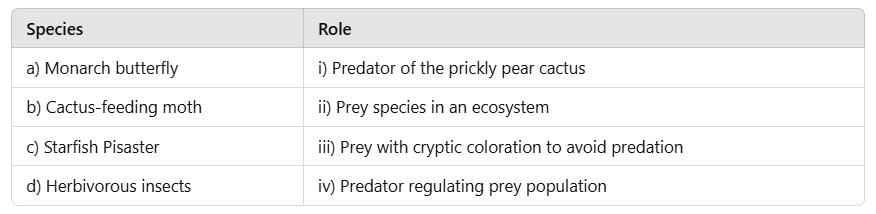
Match the following species with their role in ecological interactions:
- a)a) iii, b) i, c) iv, d) ii
- b)a) i, b) iii, c) iv, d) ii
- c)a) ii, b) i, c) iii, d) iv
- d)a) iv, b) ii, c) iii, d) i
Correct answer is option 'A'. Can you explain this answer?
Match the following species with their role in ecological interactions:
a)
a) iii, b) i, c) iv, d) ii
b)
a) i, b) iii, c) iv, d) ii
c)
a) ii, b) i, c) iii, d) iv
d)
a) iv, b) ii, c) iii, d) i
| | Bs Academy answered |
Monarch butterflies (a) have cryptic coloration to avoid being preyed upon, making them (iii) prey with cryptic coloration.
Cactus-feeding moths (b) are predators of the prickly pear cactus, making them (i) predator.
Starfish Pisaster (c) is a predator that regulates prey populations, so it's (iv) a predator.
Herbivorous insects (d) are prey species in an ecosystem, making them (ii) prey.
Cactus-feeding moths (b) are predators of the prickly pear cactus, making them (i) predator.
Starfish Pisaster (c) is a predator that regulates prey populations, so it's (iv) a predator.
Herbivorous insects (d) are prey species in an ecosystem, making them (ii) prey.
Match the items in Column A with the correct descriptions in Column B.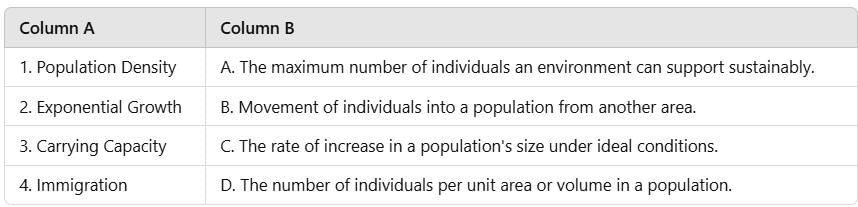
- a)1-D, 2-C, 3-A, 4-B
- b)1-C, 2-D, 3-B, 4-A
- c)1-A, 2-B, 3-D, 4-C
- d)1-D, 2-B, 3-C, 4-A
Correct answer is option 'A'. Can you explain this answer?
Match the items in Column A with the correct descriptions in Column B.
a)
1-D, 2-C, 3-A, 4-B
b)
1-C, 2-D, 3-B, 4-A
c)
1-A, 2-B, 3-D, 4-C
d)
1-D, 2-B, 3-C, 4-A
 | EduRev NEET answered |
Solution:
1 - D: Population Density → The number of individuals per unit area or volume in a population.
2 - C: Exponential Growth → The rate of increase in a population's size under ideal conditions.
3 - A: Carrying Capacity → The maximum number of individuals an environment can support sustainably.
4 - B: Immigration → Movement of individuals into a population from another area.
2 - C: Exponential Growth → The rate of increase in a population's size under ideal conditions.
3 - A: Carrying Capacity → The maximum number of individuals an environment can support sustainably.
4 - B: Immigration → Movement of individuals into a population from another area.
The graph shows two types of population growth curve. A is exponential and B is logistic.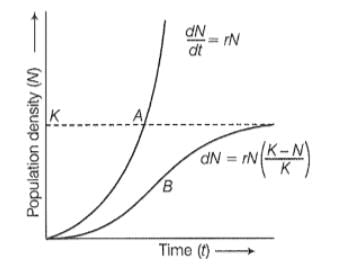 Which one of the following growth model considered as more realistic one?
- a)Exponential growth curve
- b)Logistic growth curve
- c)Both the growth curve
- d)None of the above
Correct answer is option 'B'. Can you explain this answer?
The graph shows two types of population growth curve. A is exponential and B is logistic.
Which one of the following growth model considered as more realistic one?
a)
Exponential growth curve
b)
Logistic growth curve
c)
Both the growth curve
d)
None of the above
 | Mohit Rajpoot answered |
Solution:
The logistic growth curve is considered more realistic because it accounts for the limitations imposed by the environment, such as limited resources and carrying capacity. In contrast, the exponential growth curve assumes unlimited resources, which rarely occurs in nature. Therefore, Option B is the correct answer as it reflects more realistic conditions for population growth.
Topic in NCERT: Logistic Growth Model
Line in NCERT: "the logistic growth model is considered a more realistic one."
Chapter doubts & questions for Organisms and Populations - 30-Day Revision Course for NEET 2026 is part of NEET exam preparation. The chapters have been prepared according to the NEET exam syllabus. The Chapter doubts & questions, notes, tests & MCQs are made for NEET 2026 Exam. Find important definitions, questions, notes, meanings, examples, exercises, MCQs and online tests here.
Chapter doubts & questions of Organisms and Populations - 30-Day Revision Course for NEET in English & Hindi are available as part of NEET exam. Download more important topics, notes, lectures and mock test series for NEET Exam by signing up for free.
30-Day Revision Course for NEET85 videos|301 docs|171 tests |
