


All Exams > NEET > 30-Day Revision Course for NEET > All Questions
All questions of Biodiversity and Conservation for NEET Exam
Which of the following are also called lungs of our planet?- a)Himalayas
- b)Amazonian rainforests
- c)Mediterranean Basin
- d)Western Ghats
Correct answer is option 'B'. Can you explain this answer?
Which of the following are also called lungs of our planet?
a)
Himalayas
b)
Amazonian rainforests
c)
Mediterranean Basin
d)
Western Ghats
 | Ayush Choudhury answered |
Amzonian rain forests are called as lungs of forest because it contains different kinds of vegetation that purify the atmosphere of the earth.

If all the members of a host species die then all its unique parasites also die off, representing:- a)biological control
- b)co-extinction
- c)conservation
- d)extinction
Correct answer is option 'B'. Can you explain this answer?
If all the members of a host species die then all its unique parasites also die off, representing:
a)
biological control
b)
co-extinction
c)
conservation
d)
extinction
 | Diya Datta answered |
If all members fo a host species die the parasite that obtain their food from the particular host also die off due to lack of food. This represent co-existence of species.
If we say, India has about 50,000 type of rice and 1000 types of varieties of mango what level of diversity it indicates:- a)community diversity
- b)ecosystem diversity
- c)genetic diversity
- d)species diversity
Correct answer is option 'C'. Can you explain this answer?
If we say, India has about 50,000 type of rice and 1000 types of varieties of mango what level of diversity it indicates:
a)
community diversity
b)
ecosystem diversity
c)
genetic diversity
d)
species diversity
 | Naveen Menon answered |
India has about 50,000 type of rice and 1000 types of varieties of mango. This thigh level of diversity indicates very high genetic diversity and one of the largest in the world.
When we compare the relationship between species richness and area for wide variety of taxa, the graph appears to be a :- a)cubic parabola
- b)rectangular hyperbola
- c)cubic hyperbola
- d)rectangular parabola
Correct answer is option 'D'. Can you explain this answer?
When we compare the relationship between species richness and area for wide variety of taxa, the graph appears to be a :
a)
cubic parabola
b)
rectangular hyperbola
c)
cubic hyperbola
d)
rectangular parabola
 | Prasenjit Pillai answered |
When a graph is drawn to compare the relationship between species richness and area for wide variety of texa, the graph appears to be a rectangular hyperbola.
According to Robert May, the global species diversity is about [2020]- a)50 million
- b)7 million
- c)1.5 million
- d)20 million
Correct answer is option 'B'. Can you explain this answer?
According to Robert May, the global species diversity is about [2020]
a)
50 million
b)
7 million
c)
1.5 million
d)
20 million
 | Mira Joshi answered |
Robert May was a theoretical ecologist the established, who field of theoretical ecology and population biology. According to him the global species diversity is about 7 million.
When we will move away from the equator towards poles, we will find:- a)a gradual decrease in the species diversity
- b)a gradual increase in the ecosystem diversity
- c)a gradual increase in the species diversity
- d)no change in the species diversity
Correct answer is option 'A'. Can you explain this answer?
When we will move away from the equator towards poles, we will find:
a)
a gradual decrease in the species diversity
b)
a gradual increase in the ecosystem diversity
c)
a gradual increase in the species diversity
d)
no change in the species diversity
 | Krish Patel answered |
When we will move away from the equator towards poles there is a gradual decrease in the species diversity. This is because climatic condition becomes gradually adverse as we move from equator to poles.
In a wetland the primary factor controlling the environment and the associated plant and animal life will be:- a)water
- b)temperature
- c)soil
- d)light
Correct answer is option 'A'. Can you explain this answer?
In a wetland the primary factor controlling the environment and the associated plant and animal life will be:
a)
water
b)
temperature
c)
soil
d)
light
 | Akshat Chavan answered |
The area that is saturated with water is called wetland. In wetland the primary factor controlling the environment and the associated plant and animal life will be water.
The World Summit on sustainable development held in 2002 in Johannesburg, South Africa pledged for (NEET 2022 Phase 2)- a)Collection and preservation of seeds of different genetic strains of commercially important plants.
- b)A significant reduction in the current rate of biodiversity loss.
- c)Declaration of more biodiversity hotspots.
- d)Increase in agricultural production.
Correct answer is option 'B'. Can you explain this answer?
The World Summit on sustainable development held in 2002 in Johannesburg, South Africa pledged for (NEET 2022 Phase 2)
a)
Collection and preservation of seeds of different genetic strains of commercially important plants.
b)
A significant reduction in the current rate of biodiversity loss.
c)
Declaration of more biodiversity hotspots.
d)
Increase in agricultural production.
 | Lead Academy answered |
In the World Summit on sustainable development held in 2002 in Johannesburg, South Africa, 190 countries pledged their commitment to achieve by 2010, a significant reduction in the current rate of biodiversity loss at global, regional and local levels.
Topic in NCERT: Biodiversity conservation
Line in NCERT: "in a follow-up, the world summit on sustainable development held in 2002 in johannesburg, south africa, 190 countries pledged their commitment to achieve by 2010, a significant reduction in the current rate of biodiversity loss at global, regional and local levels."
Introducing exotic species into new areas will:
i) increase competition for food & space.
ii) introduce diseases
iii) improve habitat
iv) lead to extinction of native species- a)only iv is correct.
- b)only ii, iii & iv are correct.
- c)only i, ii & iv are correct.
- d)all the above are correct.
Correct answer is option 'C'. Can you explain this answer?
Introducing exotic species into new areas will:
i) increase competition for food & space.
ii) introduce diseases
iii) improve habitat
iv) lead to extinction of native species
i) increase competition for food & space.
ii) introduce diseases
iii) improve habitat
iv) lead to extinction of native species
a)
only iv is correct.
b)
only ii, iii & iv are correct.
c)
only i, ii & iv are correct.
d)
all the above are correct.
 | Geetika Shah answered |
The impacts of introducing a non-native or invasive species to an ecosystem will vary depending on a number of factors.
In some instances, the introduced species may not survive. If there is no ecological niche for the species to fill or the species cannot adapt to fill a different ecological niche, the species will likely go extinct relatively quickly at the local level.
However, if the species is a generalist, or a species able to thrive in a variety of environments and consume many food sources, that species will likely do well. If the ecosystem has reached its stable state, this means that the invasive species will have to replace a native species. No two species can share the same ecological niche, thus one will be better adapted and survive. If the invasive species is better adapted, it will out compete the native species.
If the species reproduces quickly, it is also more likely to thrive in a new ecosystem. If it can reproduce and grow faster than its competitor, it will eventually out compete that species.
Typically, invasive species harm an ecosystem. For example, the Burmese python is found in the US but it isn't supposed to be here. These snakes were likely released by humans and were pets at one time. The environment is suitable for them and they have adapted to the area.
Introducing a new species can also introduce any diseases that species has. These new diseases can spread to other native species and negatively affect them.
Introducing exotic species into new areas will increase competition for food and space. Sometimes, exotic species brings disease along with them. Exotic species in new area do not lead to extinction of native species.
Which one of the following is not a method of in situ conservation of biodiversity? [2019]- a)Sacred grove
- b)Biosphere reserve
- c)Wildlife sanctuary
- d)Botanical garden
Correct answer is option 'D'. Can you explain this answer?
Which one of the following is not a method of in situ conservation of biodiversity? [2019]
a)
Sacred grove
b)
Biosphere reserve
c)
Wildlife sanctuary
d)
Botanical garden
| | Mira Joshi answered |
Botanical garden comes under ex-situ method of conservation of biodiversity.
Frugivorous birds are found in large numbers in tropical forests mainly because of : (NEET 2022 Phase 2)- a)Temperature conducive for their breeding
- b)Lack of niche specialisation
- c)Higher annual rainfall
- d)Availability of fruits throughout the year
Correct answer is option 'D'. Can you explain this answer?
Frugivorous birds are found in large numbers in tropical forests mainly because of : (NEET 2022 Phase 2)
a)
Temperature conducive for their breeding
b)
Lack of niche specialisation
c)
Higher annual rainfall
d)
Availability of fruits throughout the year
| | Lead Academy answered |
Frugivorous birds are fruit eating birds found in large number in tropical forest mainly because of availability of fruits throughout the year.
Topic in NCERT: Availability of fruits throughout the year
Line in NCERT: "availability of fruits throughout the year"
In a gene sanctuary genetic diversity of an endangered species can be preserved by :- a)protecting the ecosystem in which that species occurs naturally
- b)preserving DNA samples of different varieties in laboratory and growing them under controlled conditions.
- c)both A & B
- d)none of these
Correct answer is option 'A'. Can you explain this answer?
In a gene sanctuary genetic diversity of an endangered species can be preserved by :
a)
protecting the ecosystem in which that species occurs naturally
b)
preserving DNA samples of different varieties in laboratory and growing them under controlled conditions.
c)
both A & B
d)
none of these
| | Krish Patel answered |
Conservation of genetic diversity under natural habitat of endangered species is called gene sanctuary.
Alexander Von Humbolt described for the first time - a)Species area relationships
- b)Population Growth equation
- c)Ecological Biodiversity
- d)Laws of limiting factor
Correct answer is option 'A'. Can you explain this answer?
Alexander Von Humbolt described for the first time
a)
Species area relationships
b)
Population Growth equation
c)
Ecological Biodiversity
d)
Laws of limiting factor
| | Hitakshi answered |
Species area relationship is the relationship between
the area and the particular habitat. It was first studied by Alexander Von Humbolt. He observed that within a region species richness increased with increasing explored area, but only up to a limit. It is dependent on immigration, extinction and clustering etc. So, the correct answer is option 'A'.
the area and the particular habitat. It was first studied by Alexander Von Humbolt. He observed that within a region species richness increased with increasing explored area, but only up to a limit. It is dependent on immigration, extinction and clustering etc. So, the correct answer is option 'A'.
Rare species are :
i. represented by small populations in the world.
ii. thinly distributed over a wide area.
iii. all are grouped as endangered or vulnerable at present. - a)only i & ii are correct.
- b)only i & iii are correct.
- c)only ii & iii are correct.
- d)all are correct.
Correct answer is option 'A'. Can you explain this answer?
Rare species are :
i. represented by small populations in the world.
ii. thinly distributed over a wide area.
iii. all are grouped as endangered or vulnerable at present.
i. represented by small populations in the world.
ii. thinly distributed over a wide area.
iii. all are grouped as endangered or vulnerable at present.
a)
only i & ii are correct.
b)
only i & iii are correct.
c)
only ii & iii are correct.
d)
all are correct.
 | Shruti Chauhan answered |
Rare species are represented by small populations in the world. They are thinly distributed over wide area. Hence both statements are correct.
To preserve seeds that rapidly lose viability, can’t survive dessication and plants which are propagated vegetatively, method employed is :- a)cryopreservation
- b)agroforestry
- c)gene sanctuary
- d)in - situ conservation
Correct answer is option 'A'. Can you explain this answer?
To preserve seeds that rapidly lose viability, can’t survive dessication and plants which are propagated vegetatively, method employed is :
a)
cryopreservation
b)
agroforestry
c)
gene sanctuary
d)
in - situ conservation
| | Ayush Choudhury answered |
Cryopreservation is the method of preserving living organisms or their parts at extremely low temperature. To preserve seeds that rapidly lose viability and cannot survive desiccation are preserved by this method.
How many species in the world are facing threat of extinction?- a)More than 50,500.
- b)Less than 1,550
- c)More than 15,500.
- d)No more species are endangered.
Correct answer is option 'C'. Can you explain this answer?
How many species in the world are facing threat of extinction?
a)
More than 50,500.
b)
Less than 1,550
c)
More than 15,500.
d)
No more species are endangered.
| | Ayush Choudhury answered |
More than 15,500 species worldwide is facing threat of extinction which includes amphibians, gymnosperms, reptiles, birds and mammals etc.
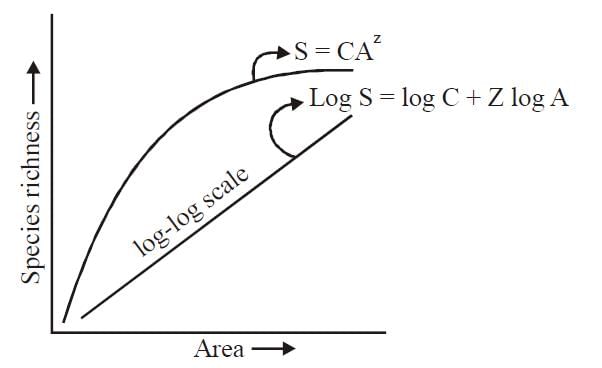
The great German naturalist and geographer Alexander von Humboldt observed that within a region species richness increased with increasing explored area, but only up to a limit. In fact, relation between species richness and area for a wide variety of taxa (angiosperm plants, birds, bats, freshwater fishes) turns out to be a rectangular hyperbola. Now find out correct equations shown in the graph: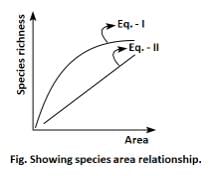
- a) I - S = CAZ; II - Log S = log C + Z log A
- b) I - Log S = log C + Z log A; II - S = CAZ
- c)I - S = CAZ + log C; II - Log S = log C + Z log A
- d)I - S = CAZ + log A; II - Log S = log C + Z log A
Correct answer is option 'A'. Can you explain this answer?
The great German naturalist and geographer Alexander von Humboldt observed that within a region species richness increased with increasing explored area, but only up to a limit. In fact, relation between species richness and area for a wide variety of taxa (angiosperm plants, birds, bats, freshwater fishes) turns out to be a rectangular hyperbola. Now find out correct equations shown in the graph:
a)
I - S = CAZ; II - Log S = log C + Z log A
b)
I - Log S = log C + Z log A; II - S = CAZ
c)
I - S = CAZ + log C; II - Log S = log C + Z log A
d)
I - S = CAZ + log A; II - Log S = log C + Z log A
 | Dr. Mohit Rajpoot answered |
Which one of the following have the highest number of species in nature?- a)Insects
- b)Birds
- c)Angiosperms
- d)Fungi
Correct answer is option 'A'. Can you explain this answer?
Which one of the following have the highest number of species in nature?
a)
Insects
b)
Birds
c)
Angiosperms
d)
Fungi
 | Persia Harris answered |
Insects have a powerful sense that could lead to something very dangerous and lead that person into a serious situation which meaning it’s has the highest number of species in the nature that we live in and on the planet we shall survive on! The answer would A!
What is the protection and conservation of species outside their natural habitat called?- a)No conservation
- b)On-site conservation
- c)Ex-situ conservation
- d)In-situ conservation
Correct answer is option 'C'. Can you explain this answer?
What is the protection and conservation of species outside their natural habitat called?
a)
No conservation
b)
On-site conservation
c)
Ex-situ conservation
d)
In-situ conservation
 | Infinity Academy answered |
The off-site or the protection and conservation of species (genetic resources) outside their natural habitat (populations of plant or animal species) is known as ex-situ conservation. Areas such as botanical gardens, zoos, Gene banks, Tissue culture banks are the places were ex-situ conservation is done.
The type of conservation in which the threatened species are taken out from their natural habitat and placed in special setting where they can be protected and given special care is called (NEET 2024)- a)in-situ conservation
- b)Biodiversity conservation
- c)Semi-conservative method
- d)Sustainable development
Correct answer is option 'B'. Can you explain this answer?
The type of conservation in which the threatened species are taken out from their natural habitat and placed in special setting where they can be protected and given special care is called (NEET 2024)
a)
in-situ conservation
b)
Biodiversity conservation
c)
Semi-conservative method
d)
Sustainable development
 | Sahana Chauhan answered |
Understanding Conservation Methods
Conservation plays a crucial role in protecting biodiversity, particularly for threatened species. The specific method mentioned in the question involves the removal of species from their natural habitats to ensure their survival.
In-Situ Conservation vs. Ex-Situ Conservation
- In-Situ Conservation: This method involves protecting species within their natural habitats. It focuses on preserving ecosystems and their biodiversity in the wild.
- Ex-Situ Conservation: The method referred to in the question is known as ex-situ conservation. This approach takes species out of their natural environment and places them in controlled settings, such as wildlife reserves, zoos, or botanical gardens.
Importance of Ex-Situ Conservation
- Protection from Threats: Ex-situ conservation allows for the protection of species from threats like habitat destruction, poaching, or climate change.
- Special Care: In these settings, species can receive specialized care, including medical treatment and breeding programs aimed at increasing population numbers.
- Research Opportunities: These environments also provide valuable opportunities for research and education, helping to raise awareness and support for conservation efforts.
Clarifying the Correct Answer
In light of the above explanations, the correct answer to the question is not option 'B' (Biodiversity conservation) but rather refers explicitly to the practice of ex-situ conservation.
- Biodiversity Conservation: This is a broader term that encompasses both in-situ and ex-situ methods, rather than specifically describing the practice of protecting species outside their natural habitats.
It is crucial for students to understand these distinctions for exams like NEET to accurately interpret conservation strategies.
Conservation plays a crucial role in protecting biodiversity, particularly for threatened species. The specific method mentioned in the question involves the removal of species from their natural habitats to ensure their survival.
In-Situ Conservation vs. Ex-Situ Conservation
- In-Situ Conservation: This method involves protecting species within their natural habitats. It focuses on preserving ecosystems and their biodiversity in the wild.
- Ex-Situ Conservation: The method referred to in the question is known as ex-situ conservation. This approach takes species out of their natural environment and places them in controlled settings, such as wildlife reserves, zoos, or botanical gardens.
Importance of Ex-Situ Conservation
- Protection from Threats: Ex-situ conservation allows for the protection of species from threats like habitat destruction, poaching, or climate change.
- Special Care: In these settings, species can receive specialized care, including medical treatment and breeding programs aimed at increasing population numbers.
- Research Opportunities: These environments also provide valuable opportunities for research and education, helping to raise awareness and support for conservation efforts.
Clarifying the Correct Answer
In light of the above explanations, the correct answer to the question is not option 'B' (Biodiversity conservation) but rather refers explicitly to the practice of ex-situ conservation.
- Biodiversity Conservation: This is a broader term that encompasses both in-situ and ex-situ methods, rather than specifically describing the practice of protecting species outside their natural habitats.
It is crucial for students to understand these distinctions for exams like NEET to accurately interpret conservation strategies.
How many hotspots of biodiversity in the world have been identified till date by Norman Myers?- a)34
- b)17
- c)25
- d)43
Correct answer is option 'A'. Can you explain this answer?
How many hotspots of biodiversity in the world have been identified till date by Norman Myers?
a)
34
b)
17
c)
25
d)
43
| | Hitakshi answered |
Biodiversity hotspots are a method to identify those regions of the world where attention is needed to address biodiversity loss and to guide investments in conservation. The idea was first developed by Norman Myers in 1988 to identify tropical forests hotspots characterised both by exceptional levels of plant endemism and serious habitat loss which he then expanded to a more global scope. A total of 34 hotspots in the world has been identified till date by Norman Myers, that cover only 2.3% of earth surface but are habitat for 77% of world's species.
Loss of biodiversity may lead to all except:- a)decline in plant production
- b)increased resistance to environmental perturbance
- c)increased variability in water use
- d)increased variability in pest and disease cycle
Correct answer is option 'B'. Can you explain this answer?
Loss of biodiversity may lead to all except:
a)
decline in plant production
b)
increased resistance to environmental perturbance
c)
increased variability in water use
d)
increased variability in pest and disease cycle
 | Bs Academy answered |
In general, loss of biodiversity in a region may lead to (a) decline in plant production, (b) lowered resistance to environmental perturbations such as drought and (c) increased variability in certain ecosystem processes such as plant productivity, water use, and pest and disease cycles.
What percent of the total oxygen in the Earth’s atmosphere is released by the Amazon forest?- a)50 %
- b)2 %
- c)40 %
- d)20 %
Correct answer is option 'D'. Can you explain this answer?
What percent of the total oxygen in the Earth’s atmosphere is released by the Amazon forest?
a)
50 %
b)
2 %
c)
40 %
d)
20 %
 | Shivani Tiwari answered |
Oxygen Contribution of the Amazon Forest
The Amazon rainforest plays a crucial role in the Earth's ecosystem, particularly in oxygen production. It is often called the "lungs of the planet."
Oxygen Production in the Amazon
- The Amazon rainforest is responsible for approximately 20% of the Earth's total oxygen supply.
- It achieves this through the process of photosynthesis, where trees convert carbon dioxide into oxygen.
Importance of Rainforests
- Rainforests, including the Amazon, are vital for maintaining global biodiversity.
- They house millions of species of plants, animals, and microorganisms, contributing to ecological balance.
Misconceptions about Oxygen Production
- A common misconception is that the Amazon produces 50% or more of the world's oxygen.
- While it is a significant contributor, the total oxygen levels in the atmosphere are also influenced by oceans and other forests.
Role of Oceans
- Oceans contribute a substantial portion of the Earth's oxygen, estimated to be around 50-80%.
- Phytoplankton, microscopic plants in the ocean, are major contributors to oxygen production.
Conclusion
- The Amazon rainforest is essential for oxygen production, providing about 20% of the total oxygen in the atmosphere.
- Protecting this critical ecosystem is vital for sustaining the planet's health and biodiversity.
The Amazon rainforest plays a crucial role in the Earth's ecosystem, particularly in oxygen production. It is often called the "lungs of the planet."
Oxygen Production in the Amazon
- The Amazon rainforest is responsible for approximately 20% of the Earth's total oxygen supply.
- It achieves this through the process of photosynthesis, where trees convert carbon dioxide into oxygen.
Importance of Rainforests
- Rainforests, including the Amazon, are vital for maintaining global biodiversity.
- They house millions of species of plants, animals, and microorganisms, contributing to ecological balance.
Misconceptions about Oxygen Production
- A common misconception is that the Amazon produces 50% or more of the world's oxygen.
- While it is a significant contributor, the total oxygen levels in the atmosphere are also influenced by oceans and other forests.
Role of Oceans
- Oceans contribute a substantial portion of the Earth's oxygen, estimated to be around 50-80%.
- Phytoplankton, microscopic plants in the ocean, are major contributors to oxygen production.
Conclusion
- The Amazon rainforest is essential for oxygen production, providing about 20% of the total oxygen in the atmosphere.
- Protecting this critical ecosystem is vital for sustaining the planet's health and biodiversity.
Which of the following is not a method of ex situ conservation? (NEET 2022 Phase 1)- a)National Parks
- b)Micropropagation
- c)Cryopreservation
- d)In vitro fertilization
Correct answer is option 'A'. Can you explain this answer?
Which of the following is not a method of ex situ conservation? (NEET 2022 Phase 1)
a)
National Parks
b)
Micropropagation
c)
Cryopreservation
d)
In vitro fertilization
 | Akshara Choudhury answered |
Understanding Ex Situ Conservation
Ex situ conservation refers to the preservation of species outside their natural habitats. This is crucial for protecting biodiversity, especially for endangered species.
Methods of Ex Situ Conservation
- Micropropagation: This is a technique used to produce a large number of plants through tissue culture. It allows for the rapid multiplication of plants and is effective for conserving rare species.
- Cryopreservation: This method involves storing genetic material (such as seeds, embryos, or cells) at ultra-low temperatures. It preserves the genetic diversity of species for future research and restoration efforts.
- In Vitro Fertilization: This technique is used to assist reproduction in species that may have difficulty mating in the wild. It enables the fertilization of eggs outside the body, facilitating the conservation of threatened species.
National Parks as In Situ Conservation
- National Parks: These are designated areas established to protect natural ecosystems and wildlife in their natural habitats. They play a vital role in in situ conservation, meaning that they conserve species in their original environments rather than outside of them.
Conclusion
The correct answer to the question is option 'A', as national parks are not a method of ex situ conservation. Instead, they exemplify in situ conservation, where species are protected within their natural ecosystems, allowing for natural evolutionary processes to continue. Other options listed, such as micropropagation, cryopreservation, and in vitro fertilization, are all methods aimed at conserving species outside their natural habitats.
Ex situ conservation refers to the preservation of species outside their natural habitats. This is crucial for protecting biodiversity, especially for endangered species.
Methods of Ex Situ Conservation
- Micropropagation: This is a technique used to produce a large number of plants through tissue culture. It allows for the rapid multiplication of plants and is effective for conserving rare species.
- Cryopreservation: This method involves storing genetic material (such as seeds, embryos, or cells) at ultra-low temperatures. It preserves the genetic diversity of species for future research and restoration efforts.
- In Vitro Fertilization: This technique is used to assist reproduction in species that may have difficulty mating in the wild. It enables the fertilization of eggs outside the body, facilitating the conservation of threatened species.
National Parks as In Situ Conservation
- National Parks: These are designated areas established to protect natural ecosystems and wildlife in their natural habitats. They play a vital role in in situ conservation, meaning that they conserve species in their original environments rather than outside of them.
Conclusion
The correct answer to the question is option 'A', as national parks are not a method of ex situ conservation. Instead, they exemplify in situ conservation, where species are protected within their natural ecosystems, allowing for natural evolutionary processes to continue. Other options listed, such as micropropagation, cryopreservation, and in vitro fertilization, are all methods aimed at conserving species outside their natural habitats.
All of the following are included in lex-situ conservation’ except [2018]- a)Wildlife safari parks
- b)Sacred groves
- c)Botanical gardens
- d)Seed banks
Correct answer is option 'B'. Can you explain this answer?
All of the following are included in lex-situ conservation’ except [2018]
a)
Wildlife safari parks
b)
Sacred groves
c)
Botanical gardens
d)
Seed banks
| | Mira Joshi answered |
Sacred groves come under in-situ conservation and represent the pristine forest patches around places of worship which are held in high esteem by tribal communities. Cutting of trees and branches is prohibited due to religious reasons. Wildlife safari parks, botanical gardens and seed blinks come under ex-situ conservation.
Which of the statements given above is/are correct regarding alien species invasions and co-extinctions?i. The introduction of the Nile perch in Lake Victoria caused the decline of indigenous cichlid fish species.ii. Invasive weed species such as Lantana and water hyacinth do not pose a significant threat to native species.iii. Co-extinctions occur when a species extinction leads to the extinction of its associated mutualistic partners.iv. The African catfish Clarias gariepinus has been legally introduced into rivers for aquaculture purposes.- a)A: i and iii
- b)B: i, ii, and iv
- c)C: ii and iv
- d)D: i, iii, and iv
Correct answer is option 'A'. Can you explain this answer?
Which of the statements given above is/are correct regarding alien species invasions and co-extinctions?
i. The introduction of the Nile perch in Lake Victoria caused the decline of indigenous cichlid fish species.
ii. Invasive weed species such as Lantana and water hyacinth do not pose a significant threat to native species.
iii. Co-extinctions occur when a species extinction leads to the extinction of its associated mutualistic partners.
iv. The African catfish Clarias gariepinus has been legally introduced into rivers for aquaculture purposes.
a)
A: i and iii
b)
B: i, ii, and iv
c)
C: ii and iv
d)
D: i, iii, and iv
 | Rutuja Datta answered |
Understanding Alien Species Invasions and Co-extinctions
Alien species invasions and co-extinctions are critical ecological issues impacting biodiversity. Let's analyze the statements provided:
Statement i: Nile Perch in Lake Victoria
- The introduction of Nile perch has indeed caused significant declines in indigenous cichlid fish species. This is a well-documented case of how an invasive species can disrupt local ecosystems and lead to the extinction of native species.
Statement ii: Invasive Weed Species
- This statement is incorrect. Invasive species like Lantana and water hyacinth pose substantial threats to native species by outcompeting them for resources, altering habitats, and disrupting local ecosystems. They can lead to the decline or extinction of native flora and fauna.
Statement iii: Co-extinctions
- Co-extinctions occur when the extinction of one species leads to the extinction of another that relies on it for survival, often seen in mutualistic relationships. This statement is correct, as the loss of a species can have cascading effects on its ecological partners.
Statement iv: African Catfish Introduction
- The African catfish (Clarias gariepinus) has been legally introduced into rivers in various regions for aquaculture. This statement is accurate and reflects the practice of using certain fish species to enhance aquaculture productivity.
Conclusion
- Based on the analysis, statements i, iii, and iv are correct, while statement ii is false. Therefore, the correct answer is option 'A': i and iii.
Understanding these dynamics is crucial for conservation efforts and managing biodiversity effectively.
Alien species invasions and co-extinctions are critical ecological issues impacting biodiversity. Let's analyze the statements provided:
Statement i: Nile Perch in Lake Victoria
- The introduction of Nile perch has indeed caused significant declines in indigenous cichlid fish species. This is a well-documented case of how an invasive species can disrupt local ecosystems and lead to the extinction of native species.
Statement ii: Invasive Weed Species
- This statement is incorrect. Invasive species like Lantana and water hyacinth pose substantial threats to native species by outcompeting them for resources, altering habitats, and disrupting local ecosystems. They can lead to the decline or extinction of native flora and fauna.
Statement iii: Co-extinctions
- Co-extinctions occur when the extinction of one species leads to the extinction of another that relies on it for survival, often seen in mutualistic relationships. This statement is correct, as the loss of a species can have cascading effects on its ecological partners.
Statement iv: African Catfish Introduction
- The African catfish (Clarias gariepinus) has been legally introduced into rivers in various regions for aquaculture. This statement is accurate and reflects the practice of using certain fish species to enhance aquaculture productivity.
Conclusion
- Based on the analysis, statements i, iii, and iv are correct, while statement ii is false. Therefore, the correct answer is option 'A': i and iii.
Understanding these dynamics is crucial for conservation efforts and managing biodiversity effectively.
Match List I with List II (NEET 2024)
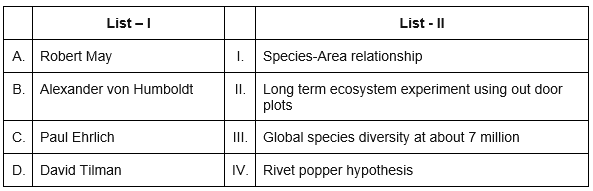 Choose the correct answer from the options given below:
- a)A-II, B-III, C-I, D-IV
- b)A-III, B-I, C-IV, D-II
- c)A-I, B-III, C-II, D-IV
- d)A-III, B-IV, C-II, D-I
Correct answer is option 'B'. Can you explain this answer?
Match List I with List II (NEET 2024)
Choose the correct answer from the options given below:
a)
A-II, B-III, C-I, D-IV
b)
A-III, B-I, C-IV, D-II
c)
A-I, B-III, C-II, D-IV
d)
A-III, B-IV, C-II, D-I
 | Ambition Institute answered |
To match the correct individual with their contribution or hypothesis, let's review each person listed along with the contributions mentioned:
Robert May is best known for his pioneering work in theoretical ecology, particularly in the areas of population dynamics and stability in ecological communities. However, none of the choices directly mention these specific contributions. Among the options, the closest (though indirect) could be his theoretical work that touch upon aspects like species diversity estimations.
Alexander von Humboldt, known for his extensive work in biogeography, made critical observations on the geographic distributions of species. His work best correlates with the "Species-Area relationship," which describes how the number of species increases with the area surveyed.
Paul Ehrlich is famous for his work on population studies and environmental issues facing humanity. His statement about the planet's carrying capacity and potential biodiversity loss is widely known. The "Global species diversity at about 7 million" might closely relate to his biodiversity and population studies, though it's not his primary known work.
David Tilman is well-acclaimed for his experimental work on biodiversity and ecosystem productivity. The "Long term ecosystem experiment using outdoor plots" directly correlates with his experimental approach to studying the relationship between biodiversity and ecosystem functioning using field experiments.
Robert May is best known for his pioneering work in theoretical ecology, particularly in the areas of population dynamics and stability in ecological communities. However, none of the choices directly mention these specific contributions. Among the options, the closest (though indirect) could be his theoretical work that touch upon aspects like species diversity estimations.
Alexander von Humboldt, known for his extensive work in biogeography, made critical observations on the geographic distributions of species. His work best correlates with the "Species-Area relationship," which describes how the number of species increases with the area surveyed.
Paul Ehrlich is famous for his work on population studies and environmental issues facing humanity. His statement about the planet's carrying capacity and potential biodiversity loss is widely known. The "Global species diversity at about 7 million" might closely relate to his biodiversity and population studies, though it's not his primary known work.
David Tilman is well-acclaimed for his experimental work on biodiversity and ecosystem productivity. The "Long term ecosystem experiment using outdoor plots" directly correlates with his experimental approach to studying the relationship between biodiversity and ecosystem functioning using field experiments.
Given these associations:
A (Robert May) might best fit with "Global species diversity at about 7 million" (III) though it's a rough fit.
B (Alexander von Humboldt) correlating with "Species-Area relationship" (I) is a much clearer connection.
C (Paul Ehrlich) and the "Global species diversity at about 7 million" (II) matches if we consider his general scope in biodiversity and population dynamics.
D (David Tilman) with "Long term ecosystem experiment using out door plots" (II) is an exact match for his field of work.
A (Robert May) might best fit with "Global species diversity at about 7 million" (III) though it's a rough fit.
B (Alexander von Humboldt) correlating with "Species-Area relationship" (I) is a much clearer connection.
C (Paul Ehrlich) and the "Global species diversity at about 7 million" (II) matches if we consider his general scope in biodiversity and population dynamics.
D (David Tilman) with "Long term ecosystem experiment using out door plots" (II) is an exact match for his field of work.
Looking at the options provided,
Option B: A-III, B-I, C-IV, D-II
This option aligns correctly as per the reasoning.
Therefore, the correct answer is Option B.
Option B: A-III, B-I, C-IV, D-II
This option aligns correctly as per the reasoning.
Therefore, the correct answer is Option B.
Topic in NCERT: The section name from which the line is given is:
importance of species diversity to the ecosystem
importance of species diversity to the ecosystem
Line in NCERT: Error occcured while getting response from embedding
How many hotspots of biodiversity’ in the world have been identified till date by Norman Myers? [2016]- a)17
- b)25
- c)34
- d)43
Correct answer is option 'C'. Can you explain this answer?
How many hotspots of biodiversity’ in the world have been identified till date by Norman Myers? [2016]
a)
17
b)
25
c)
34
d)
43
| | Mira Joshi answered |
Biodiversity hotspots are a method to identify- those regions of the world where attention is needed to address biodiversity loss and to guide investments in conservation. The idea was first developed by Norman Myers in 1988 to identify tropical forests hotspots characterised both by exceptional levels of plant endemism and serious habitat loss which he then expanded to a more global scope. Currently, 34 biodiversity hotspots have been identified most of which occur in tropical forests.
Which of the following statements regarding the diversity of plants and animals in tropical regions is/are correct?i. Species diversity is generally higher in tropical regions compared to temperate and polar areas due to longer evolutionary timeframes.ii. Tropical environments, being less seasonal and more constant, promote niche specialization which contributes to greater species diversity.iii. The greater availability of solar energy in tropical regions leads to higher productivity, which indirectly supports greater biodiversity.iv. Polar regions have been less affected by glaciation events than tropical regions, resulting in higher species diversity in the poles.- a)i, ii, and iii
- b)i and iv
- c)ii and iii
- d)i, ii, iii, and iv
Correct answer is option 'A'. Can you explain this answer?
Which of the following statements regarding the diversity of plants and animals in tropical regions is/are correct?
i. Species diversity is generally higher in tropical regions compared to temperate and polar areas due to longer evolutionary timeframes.
ii. Tropical environments, being less seasonal and more constant, promote niche specialization which contributes to greater species diversity.
iii. The greater availability of solar energy in tropical regions leads to higher productivity, which indirectly supports greater biodiversity.
iv. Polar regions have been less affected by glaciation events than tropical regions, resulting in higher species diversity in the poles.
a)
i, ii, and iii
b)
i and iv
c)
ii and iii
d)
i, ii, iii, and iv
| | Rutuja Datta answered |
Understanding Species Diversity in Tropical Regions
The statements regarding the diversity of plants and animals in tropical regions have varying degrees of accuracy. Here's a detailed explanation of why options i, ii, and iii are correct, while iv is inaccurate.
i. Longer Evolutionary Timeframes
- Species diversity is indeed higher in tropical regions compared to temperate and polar areas.
- This is primarily because tropical regions have experienced fewer severe climate changes over time, allowing species to evolve and diversify more extensively.
ii. Niche Specialization
- Tropical environments are characterized by less seasonal variation.
- This stability promotes niche specialization, where species adapt to specific roles or habitats, leading to greater species diversity.
iii. Higher Solar Energy Availability
- Tropical regions receive more solar energy, which enhances productivity.
- Increased plant growth supports a larger and more diverse array of animal species, contributing to higher biodiversity.
iv. Misconception about Polar Regions
- Polar regions have been significantly affected by glaciation events, leading to lower species diversity.
- In contrast, tropical regions have maintained a more stable climate, fostering a rich variety of life forms.
Conclusion
So, the correct answer is option 'A' (i, ii, and iii) as these statements accurately reflect the reasons behind the higher biodiversity in tropical regions, while option iv is incorrect.
The statements regarding the diversity of plants and animals in tropical regions have varying degrees of accuracy. Here's a detailed explanation of why options i, ii, and iii are correct, while iv is inaccurate.
i. Longer Evolutionary Timeframes
- Species diversity is indeed higher in tropical regions compared to temperate and polar areas.
- This is primarily because tropical regions have experienced fewer severe climate changes over time, allowing species to evolve and diversify more extensively.
ii. Niche Specialization
- Tropical environments are characterized by less seasonal variation.
- This stability promotes niche specialization, where species adapt to specific roles or habitats, leading to greater species diversity.
iii. Higher Solar Energy Availability
- Tropical regions receive more solar energy, which enhances productivity.
- Increased plant growth supports a larger and more diverse array of animal species, contributing to higher biodiversity.
iv. Misconception about Polar Regions
- Polar regions have been significantly affected by glaciation events, leading to lower species diversity.
- In contrast, tropical regions have maintained a more stable climate, fostering a rich variety of life forms.
Conclusion
So, the correct answer is option 'A' (i, ii, and iii) as these statements accurately reflect the reasons behind the higher biodiversity in tropical regions, while option iv is incorrect.
What are the species called whose number of individuals is greatly reduced to a critical level?- a)Indeterminate
- b)Endangered
- c)Vulnerable
- d)Rare
Correct answer is option 'B'. Can you explain this answer?
What are the species called whose number of individuals is greatly reduced to a critical level?
a)
Indeterminate
b)
Endangered
c)
Vulnerable
d)
Rare
 | Saranya Joshi answered |
Endangered Species
Endangered species refer to the species whose number of individuals is greatly reduced to a critical level. These species are at risk of extinction in the near future if appropriate measures are not taken to protect and conserve them. The term "endangered" is used to describe the level of threat a species faces based on its population size and the potential risks it encounters in its natural habitat.
Reasons for Endangerment
There are several factors that can contribute to a species becoming endangered. Some of the key reasons include:
1. Habitat loss: The destruction, degradation, or fragmentation of natural habitats due to human activities such as deforestation, urbanization, and agriculture can eliminate or disrupt the habitats of many species.
2. Climate change: Alterations in temperature, precipitation patterns, and sea levels caused by climate change can negatively impact ecosystems and the species that rely on them.
3. Pollution: Pollution from various sources, such as industrial waste, agricultural runoff, and air pollution, can contaminate habitats, water bodies, and food sources, leading to the decline of species.
4. Overexploitation: Unsustainable hunting, fishing, and harvesting practices can deplete populations of certain species, pushing them towards endangerment.
5. Invasive species: The introduction of non-native species into ecosystems can disrupt the balance of the ecosystem and outcompete native species for resources, leading to the decline of the latter.
6. Disease and predation: Outbreaks of diseases or the presence of predators can have a significant impact on the population size of certain species, especially if they lack natural defenses or immunity.
Conservation Efforts
To prevent the extinction of endangered species, various conservation efforts are undertaken. These include:
1. Habitat protection: Establishing protected areas, national parks, and wildlife reserves to safeguard the habitats of endangered species from human encroachment and destructive activities.
2. Species reintroduction: Captive breeding programs and reintroduction initiatives help increase the population size of endangered species and reintroduce them into their natural habitats.
3. Conservation education: Raising awareness among the public about the importance of biodiversity, conservation, and sustainable practices helps garner support and promote responsible behavior towards endangered species and their habitats.
4. International agreements and legislation: Governments and organizations work together to develop and implement laws, regulations, and international agreements that protect endangered species and regulate activities that pose a threat to them.
5. Research and monitoring: Conducting scientific research, monitoring population trends, and assessing the threats faced by endangered species help in developing effective conservation strategies and management plans.
By implementing these conservation initiatives, it is possible to mitigate the risks faced by endangered species and work towards their recovery and long-term survival.
Endangered species refer to the species whose number of individuals is greatly reduced to a critical level. These species are at risk of extinction in the near future if appropriate measures are not taken to protect and conserve them. The term "endangered" is used to describe the level of threat a species faces based on its population size and the potential risks it encounters in its natural habitat.
Reasons for Endangerment
There are several factors that can contribute to a species becoming endangered. Some of the key reasons include:
1. Habitat loss: The destruction, degradation, or fragmentation of natural habitats due to human activities such as deforestation, urbanization, and agriculture can eliminate or disrupt the habitats of many species.
2. Climate change: Alterations in temperature, precipitation patterns, and sea levels caused by climate change can negatively impact ecosystems and the species that rely on them.
3. Pollution: Pollution from various sources, such as industrial waste, agricultural runoff, and air pollution, can contaminate habitats, water bodies, and food sources, leading to the decline of species.
4. Overexploitation: Unsustainable hunting, fishing, and harvesting practices can deplete populations of certain species, pushing them towards endangerment.
5. Invasive species: The introduction of non-native species into ecosystems can disrupt the balance of the ecosystem and outcompete native species for resources, leading to the decline of the latter.
6. Disease and predation: Outbreaks of diseases or the presence of predators can have a significant impact on the population size of certain species, especially if they lack natural defenses or immunity.
Conservation Efforts
To prevent the extinction of endangered species, various conservation efforts are undertaken. These include:
1. Habitat protection: Establishing protected areas, national parks, and wildlife reserves to safeguard the habitats of endangered species from human encroachment and destructive activities.
2. Species reintroduction: Captive breeding programs and reintroduction initiatives help increase the population size of endangered species and reintroduce them into their natural habitats.
3. Conservation education: Raising awareness among the public about the importance of biodiversity, conservation, and sustainable practices helps garner support and promote responsible behavior towards endangered species and their habitats.
4. International agreements and legislation: Governments and organizations work together to develop and implement laws, regulations, and international agreements that protect endangered species and regulate activities that pose a threat to them.
5. Research and monitoring: Conducting scientific research, monitoring population trends, and assessing the threats faced by endangered species help in developing effective conservation strategies and management plans.
By implementing these conservation initiatives, it is possible to mitigate the risks faced by endangered species and work towards their recovery and long-term survival.
Which of the statements given above is/are correct?i. India accounts for 8.1% of global species diversity despite covering only 2.4% of the world's land area.ii. Approximately 45,000 plant species have been documented in India, along with twice as many animal species.iii. According to global estimates, only 22% of all living species have been identified so far.iv. It is estimated that there are less than 100,000 undiscovered plant species in India.- a)i, ii and iii
- b)ii and iii
- c)i, ii, iii and iv
- d)i and iv
Correct answer is option 'A'. Can you explain this answer?
Which of the statements given above is/are correct?
i. India accounts for 8.1% of global species diversity despite covering only 2.4% of the world's land area.
ii. Approximately 45,000 plant species have been documented in India, along with twice as many animal species.
iii. According to global estimates, only 22% of all living species have been identified so far.
iv. It is estimated that there are less than 100,000 undiscovered plant species in India.
a)
i, ii and iii
b)
ii and iii
c)
i, ii, iii and iv
d)
i and iv
| | Rutuja Datta answered |
India's Species Diversity
India is renowned for its rich biodiversity, and the statements provided reflect various aspects of this diversity. Let's break down each statement to understand why options (i), (ii), and (iii) are correct.
Statement Analysis
- i. India accounts for 8.1% of global species diversity despite covering only 2.4% of the world's land area.
- This statement is accurate. India is one of the 17 megadiverse countries, hosting a significant percentage of the world’s total species despite its relatively small land area.
- ii. Approximately 45,000 plant species have been documented in India, along with twice as many animal species.
- This statement is also correct. India boasts a diverse range of flora and fauna, with approximately 45,000 documented plant species and an estimated 91,000 animal species, highlighting its ecological richness.
- iii. According to global estimates, only 22% of all living species have been identified so far.
- This statement holds true as well. Global biodiversity studies indicate that a significant number of species remain undiscovered, emphasizing the ongoing need for research in biodiversity.
- iv. It is estimated that there are less than 100,000 undiscovered plant species in India.
- This statement is less accurate. Estimates suggest that there could be more undiscovered species, potentially exceeding 100,000, indicating that the actual number of undiscovered species could be higher than stated.
Conclusion
Based on this analysis, the correct answer is option A: i, ii, and iii are correct statements about biodiversity in India.
India is renowned for its rich biodiversity, and the statements provided reflect various aspects of this diversity. Let's break down each statement to understand why options (i), (ii), and (iii) are correct.
Statement Analysis
- i. India accounts for 8.1% of global species diversity despite covering only 2.4% of the world's land area.
- This statement is accurate. India is one of the 17 megadiverse countries, hosting a significant percentage of the world’s total species despite its relatively small land area.
- ii. Approximately 45,000 plant species have been documented in India, along with twice as many animal species.
- This statement is also correct. India boasts a diverse range of flora and fauna, with approximately 45,000 documented plant species and an estimated 91,000 animal species, highlighting its ecological richness.
- iii. According to global estimates, only 22% of all living species have been identified so far.
- This statement holds true as well. Global biodiversity studies indicate that a significant number of species remain undiscovered, emphasizing the ongoing need for research in biodiversity.
- iv. It is estimated that there are less than 100,000 undiscovered plant species in India.
- This statement is less accurate. Estimates suggest that there could be more undiscovered species, potentially exceeding 100,000, indicating that the actual number of undiscovered species could be higher than stated.
Conclusion
Based on this analysis, the correct answer is option A: i, ii, and iii are correct statements about biodiversity in India.
Alexander von Humboldt described for the first time [2017]- a)Laws of limiting factor
- b)Species area relationships
- c)Population growth equation
- d)Ecological biodiversity
Correct answer is option 'B'. Can you explain this answer?
Alexander von Humboldt described for the first time [2017]
a)
Laws of limiting factor
b)
Species area relationships
c)
Population growth equation
d)
Ecological biodiversity
| | Mira Joshi answered |
Alexander von Humboldt described species-area relationship for the first time. He observed that within a region, species richness increases with increasing explored area, but only upto a limit.
Chapter doubts & questions for Biodiversity and Conservation - 30-Day Revision Course for NEET 2026 is part of NEET exam preparation. The chapters have been prepared according to the NEET exam syllabus. The Chapter doubts & questions, notes, tests & MCQs are made for NEET 2026 Exam. Find important definitions, questions, notes, meanings, examples, exercises, MCQs and online tests here.
Chapter doubts & questions of Biodiversity and Conservation - 30-Day Revision Course for NEET in English & Hindi are available as part of NEET exam. Download more important topics, notes, lectures and mock test series for NEET Exam by signing up for free.
30-Day Revision Course for NEET85 videos|301 docs|171 tests |
