


All Exams > NEET > NEET Chapter-wise Solved Papers 31 Year (PCB) > All Questions
All questions of Plant Growth and Development for NEET Exam
Hormone responsible for senescence [2001]- a)ABA
- b)auxin
- c)GA
- d)cytokinin
Correct answer is option 'A'. Can you explain this answer?
Hormone responsible for senescence [2001]
a)
ABA
b)
auxin
c)
GA
d)
cytokinin
 | Ruchi Chopra answered |
ABA or Abscisic acid is responsible for leaf fall or senescence.

What breaks bud dormancy of potato tuber?- a)Gibberellin
- b)IAA [2001]
- c)ABA
- d)Zeatin
Correct answer is option 'A'. Can you explain this answer?
What breaks bud dormancy of potato tuber?
a)
Gibberellin
b)
IAA [2001]
c)
ABA
d)
Zeatin
 | Pooja Choudhary answered |
IAA promotes apical dominance. ABA induces dormancy in buds.
Removal of apical bud results in [1993, 2000]- a)formation of new apical bud
- b)elongation of main stem
- c)death of plant
- d)formation of lateral branching
Correct answer is option 'D'. Can you explain this answer?
Removal of apical bud results in [1993, 2000]
a)
formation of new apical bud
b)
elongation of main stem
c)
death of plant
d)
formation of lateral branching
 | Gowri Nair answered |
Apical buds inhibit lateral branching due to apical dominance. Removal of apical bud promotes lateral branching.
During seed germination its stored food is mobilized [NEET 2013]- a)Cytokinin
- b)ABA
- c)Gibberellin
- d)Ethylene
Correct answer is option 'C'. Can you explain this answer?
During seed germination its stored food is mobilized [NEET 2013]
a)
Cytokinin
b)
ABA
c)
Gibberellin
d)
Ethylene
 | Naveen Menon answered |
Gibberellins stimulate the synthesis of α-amylase and proteases enzyme in germinating grains of cereals. They are involved in the conversion of starch into sugar. The proteases convert an inactive β-amylase to the active form. The active β-amylase and α-amylase together digest starch to glucose which is mobilized to meet the metabolic demands of embryo.
The regulator which retards ageing/ senescence of plant parts is : [1993]- a)cytokinin
- b)auxin
- c)gibberellin
- d)abscisic acid
Correct answer is option 'A'. Can you explain this answer?
The regulator which retards ageing/ senescence of plant parts is : [1993]
a)
cytokinin
b)
auxin
c)
gibberellin
d)
abscisic acid
 | Pankaj Banerjee answered |
Cytokinin help in retaining chlorophyll, hence delay senescense.
Which of the following prevents fall of fruits?[2001]- a)GA3
- b)NAA
- c)Ethylene
- d)Zeatin
Correct answer is option 'B'. Can you explain this answer?
Which of the following prevents fall of fruits?[2001]
a)
GA3
b)
NAA
c)
Ethylene
d)
Zeatin
 | Devansh Mehra answered |
NAA or Naphthalene Acetic Acid is synthetic auxin. It is used to check fruit fall specially in tomato.
The plant hormone used to destroy weeds in a field is: [2021]- a)2, 4-D
- b)IBA
- c)IAA
- d)NAA
Correct answer is option 'A'. Can you explain this answer?
The plant hormone used to destroy weeds in a field is: [2021]
a)
2, 4-D
b)
IBA
c)
IAA
d)
NAA
 | Anjali Sharma answered |
2, 4-D, widely used to kill dicotyledonous weeds, does not affect mature monocotyledonous plants.
They help to initiate rooting in stem cuttings, an application widely used for plant propagation. Auxins promote flowering e.g. in pineapples. They help to prevent fruit and leaf drop at early stages but promote the abscission of older mature leaves and fruits.
In most higher plants, the growing apical bud inhibits the growth of the lateral (axillary) buds, a phenomenon called apical dominance. Removal of shoot tips (decapitation) usually results in the growth of lateral buds (Figure 15.11). It is widely applied in tea plantations, hedge-making. Can you explain why?
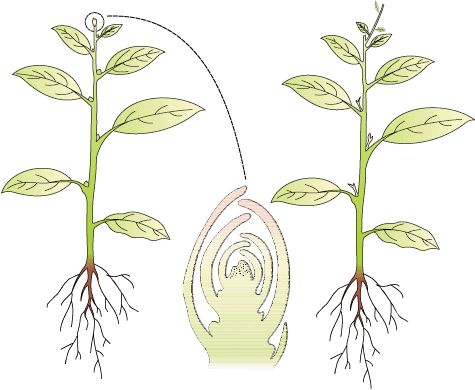
In most higher plants, the growing apical bud inhibits the growth of the lateral (axillary) buds, a phenomenon called apical dominance. Removal of shoot tips (decapitation) usually results in the growth of lateral buds (Figure 15.11). It is widely applied in tea plantations, hedge-making. Can you explain why?
Production of Cucumber has increased manifold in recent years. Application of which of the following phytohormones has resulted in this increased yield as the hormone is known to produce female flowers in the plants: (NEET 2022 Phase 1)- a)ABA
- b)Gibberellin
- c)Ethylene
- d)Cytokinin
Correct answer is option 'C'. Can you explain this answer?
Production of Cucumber has increased manifold in recent years. Application of which of the following phytohormones has resulted in this increased yield as the hormone is known to produce female flowers in the plants: (NEET 2022 Phase 1)
a)
ABA
b)
Gibberellin
c)
Ethylene
d)
Cytokinin
 | Sanaya Banerjee answered |
Introduction to Phytohormones and Cucumber Production
The increased production of cucumbers is significantly influenced by the application of phytohormones. Among these hormones, ethylene plays a crucial role in promoting female flower formation, which is essential for enhancing cucumber yields.
Role of Ethylene in Flower Development
- Promotion of Female Flowers: Ethylene is known to stimulate the production of female flowers in cucumber plants. This is critical since female flowers develop into the fruits that we harvest.
- Balance of Flower Types: In cucumber cultivation, a higher ratio of female to male flowers is desirable for maximizing fruit yield. Ethylene shifts this balance, favoring the formation of female flowers.
Application of Ethylene
- Timing: Ethylene can be applied at specific growth stages to ensure the optimal flowering pattern. This can be done through various methods, including the use of ethylene-releasing compounds or controlled environmental conditions.
- Impact on Yield: By increasing the number of female flowers, ethylene directly contributes to higher fruit set and overall yield, making it a valuable tool in cucumber cultivation.
Conclusion
In summary, the application of ethylene is a key factor in the significant increase in cucumber production in recent years. Its ability to induce female flower formation is essential for improving yields, making it an invaluable phytohormone in agricultural practices for cucumbers.
The increased production of cucumbers is significantly influenced by the application of phytohormones. Among these hormones, ethylene plays a crucial role in promoting female flower formation, which is essential for enhancing cucumber yields.
Role of Ethylene in Flower Development
- Promotion of Female Flowers: Ethylene is known to stimulate the production of female flowers in cucumber plants. This is critical since female flowers develop into the fruits that we harvest.
- Balance of Flower Types: In cucumber cultivation, a higher ratio of female to male flowers is desirable for maximizing fruit yield. Ethylene shifts this balance, favoring the formation of female flowers.
Application of Ethylene
- Timing: Ethylene can be applied at specific growth stages to ensure the optimal flowering pattern. This can be done through various methods, including the use of ethylene-releasing compounds or controlled environmental conditions.
- Impact on Yield: By increasing the number of female flowers, ethylene directly contributes to higher fruit set and overall yield, making it a valuable tool in cucumber cultivation.
Conclusion
In summary, the application of ethylene is a key factor in the significant increase in cucumber production in recent years. Its ability to induce female flower formation is essential for improving yields, making it an invaluable phytohormone in agricultural practices for cucumbers.
What reason will you assign for coconut milk used in tissue culture? [2000, 03]- a)Gibberellins
- b)Cytokinins
- c)Auxins
- d)Ethylene
Correct answer is option 'B'. Can you explain this answer?
What reason will you assign for coconut milk used in tissue culture? [2000, 03]
a)
Gibberellins
b)
Cytokinins
c)
Auxins
d)
Ethylene
 | Shivani Rane answered |
The medium in tissue culture provides all the essential nutrients required for growth and division of callus. Coconut milk contains cytokinins which is useful in tissue culture.
What is a stress hormone? or The hormone produced during adverse environmental conditions is [1993]- a)benzyl aminopurine
- b)dichlorophenoxy acetic acid
- c)ethylene
- d)abscisic acid
Correct answer is option 'D'. Can you explain this answer?
What is a stress hormone? or The hormone produced during adverse environmental conditions is [1993]
a)
benzyl aminopurine
b)
dichlorophenoxy acetic acid
c)
ethylene
d)
abscisic acid
| | Devansh Mehra answered |
Abscisic Acid (ABA) is called stress hormone which works in adverse environmental condition when there is low water content in atmosphere or in drought conditions. ABA causes the stomatal closure of leaves due to which the water loss by the plant is minimized.
Seed dormancy is due to the [2002]- a)ethylene
- b)abscisic acid
- c)IAA
- d)starch
Correct answer is option 'B'. Can you explain this answer?
Seed dormancy is due to the [2002]
a)
ethylene
b)
abscisic acid
c)
IAA
d)
starch
| | Tarun Majumdar answered |
Seed dormancy and Abscisic acid
Seed dormancy is a phenomenon in which the seed remains inactive even under favorable environmental conditions for germination. Abscisic acid (ABA) is a plant hormone that plays a vital role in inducing seed dormancy.
Role of ABA in seed dormancy:
1. Inhibition of germination: ABA inhibits seed germination by suppressing the action of gibberellins (GA), another plant hormone that promotes germination.
2. Induction of dormancy: ABA induces seed dormancy by inhibiting the synthesis of enzymes that break down starch into simple sugars, which are required for germination.
3. Regulation of water content: ABA regulates the water content in seeds by controlling the opening and closing of stomata. In dry conditions, ABA accumulates in the seed and promotes stomatal closure, preventing water loss and maintaining seed viability.
4. Stress response: ABA plays a role in the plant's stress response by inducing the expression of stress-responsive genes and protecting the seed from harsh environmental conditions.
Conclusion:
Therefore, it is clear that ABA is responsible for inducing seed dormancy by inhibiting germination, regulating water content, and promoting stress response. Hence, option B, i.e., Abscisic acid, is the correct answer.
Seed dormancy is a phenomenon in which the seed remains inactive even under favorable environmental conditions for germination. Abscisic acid (ABA) is a plant hormone that plays a vital role in inducing seed dormancy.
Role of ABA in seed dormancy:
1. Inhibition of germination: ABA inhibits seed germination by suppressing the action of gibberellins (GA), another plant hormone that promotes germination.
2. Induction of dormancy: ABA induces seed dormancy by inhibiting the synthesis of enzymes that break down starch into simple sugars, which are required for germination.
3. Regulation of water content: ABA regulates the water content in seeds by controlling the opening and closing of stomata. In dry conditions, ABA accumulates in the seed and promotes stomatal closure, preventing water loss and maintaining seed viability.
4. Stress response: ABA plays a role in the plant's stress response by inducing the expression of stress-responsive genes and protecting the seed from harsh environmental conditions.
Conclusion:
Therefore, it is clear that ABA is responsible for inducing seed dormancy by inhibiting germination, regulating water content, and promoting stress response. Hence, option B, i.e., Abscisic acid, is the correct answer.
It takes very long time for pineapple plants to produce flowers. Which combination of hormones can be applied to artificially induce flowering in pineapple plants throughout the year to increase yield? [2019]- a)Cytokinin and Abscisic acid
- b)Auxin and Ethylene
- c)Gibberellin and Cytokinin
- d)Gibberellin and Abscisic acid
Correct answer is option 'B'. Can you explain this answer?
It takes very long time for pineapple plants to produce flowers. Which combination of hormones can be applied to artificially induce flowering in pineapple plants throughout the year to increase yield? [2019]
a)
Cytokinin and Abscisic acid
b)
Auxin and Ethylene
c)
Gibberellin and Cytokinin
d)
Gibberellin and Abscisic acid
 | Jyoti Sengupta answered |
Synthetic auxins like NAA and 2, 4-D are often employed for inducing flowering in pineapple, Ethylene also stimulates Powering in pineapple and related plants. Hence, both auxin and ethylene can be applied artificially to induce flowering in pineapple plants throughout the year to increase yield.
Ethylene gas is used for [1995]- a)growth of plants
- b)delaying fruit’s abscission
- c)ripening of fruits
- d)stopping the leaf abscission
Correct answer is option 'C'. Can you explain this answer?
Ethylene gas is used for [1995]
a)
growth of plants
b)
delaying fruit’s abscission
c)
ripening of fruits
d)
stopping the leaf abscission
 | Abhijeet Goyal answered |
Ethylene is a gaseous plant hormone which plays an important role in fruit ripening. In the presence of ethylene there is an increase in the rate of respiration.
Which one of the following plants does not show plasticity? (NEET 2022 Phase 1)- a)Coriander
- b)Buttercup
- c)Maize
- d)Cotton
Correct answer is option 'C'. Can you explain this answer?
Which one of the following plants does not show plasticity? (NEET 2022 Phase 1)
a)
Coriander
b)
Buttercup
c)
Maize
d)
Cotton
 | EduRev NEET answered |
Plants follow different pathways in response to environment or phases of life to form different kinds of structures. This ability is called plasticity e.g. heterophylly in cotton, coriander and larkspur. In such plants, leaves of juvenile plant are different in a shape from those in mature plants.
Maize does not show plasticity.
Maize does not show plasticity.
Topic in NCERT: Plant growth and development
Line in NCERT: "plants follow different pathways in response to environment or phases of life to form different kinds of structures. this ability is called plasticity, e.g., heterophylly in cotton, coriander and larkspur."
The pineapple which under natural conditions is difficult to blossom has been made to produce fruits throughout the year by application of [NEET Kar. 2013]- a)IAA, IBA
- b)NAA, 2, 4-D
- c)Phenyl acetic acid
- d)Cytokinin
Correct answer is option 'B'. Can you explain this answer?
The pineapple which under natural conditions is difficult to blossom has been made to produce fruits throughout the year by application of [NEET Kar. 2013]
a)
IAA, IBA
b)
NAA, 2, 4-D
c)
Phenyl acetic acid
d)
Cytokinin
 | Abhishek Desai answered |
Plants which are difficult to flower can be made to do so by spraying them with 2, 4, –D (2, 4 – dichlorophenoxy acetic acid) and NAA (napthalene acetic acid) which are synthetic auxins, e.g., litchi, pineapple.
ABA is involved in [1999]- a)dormancy of seeds
- b)root elongation
- c)shoot elongation
- d)increased cell division
Correct answer is option 'A'. Can you explain this answer?
ABA is involved in [1999]
a)
dormancy of seeds
b)
root elongation
c)
shoot elongation
d)
increased cell division
 | Anjana Dasgupta answered |
Gibberellins are involved in shoot elongation. Auxins are important in root elongation and cell division
Which hormone promotes internode/petiole elongation in deep water rice? (NEET 2023)- a)GA3
- b)Kinetin
- c)Ethylene
- d)2, 4-D
Correct answer is option 'C'. Can you explain this answer?
Which hormone promotes internode/petiole elongation in deep water rice? (NEET 2023)
a)
GA3
b)
Kinetin
c)
Ethylene
d)
2, 4-D
 | Ambition Institute answered |
The hormone that promotes internode/petiole elongation in deep water rice is Ethylene.
Ethylene is a plant hormone that plays a critical role in growth and development, including responses to environmental stimuli. In the case of deep water rice, when the plants are submerged, the ethylene concentration increases and promotes rapid internodal elongation, which allows the plant to keep its leaves above the water surface.
So, the correct answer is Option C - Ethylene.
Ethylene is a plant hormone that plays a critical role in growth and development, including responses to environmental stimuli. In the case of deep water rice, when the plants are submerged, the ethylene concentration increases and promotes rapid internodal elongation, which allows the plant to keep its leaves above the water surface.
So, the correct answer is Option C - Ethylene.
Topic in NCERT: Ethylene
Line in NCERT: "ethylene promotes rapid internode/petiole elongation in deep water rice plants."
Chapter doubts & questions for Plant Growth and Development - NEET Chapter-wise Solved Papers 31 Year (PCB) 2026 is part of NEET exam preparation. The chapters have been prepared according to the NEET exam syllabus. The Chapter doubts & questions, notes, tests & MCQs are made for NEET 2026 Exam. Find important definitions, questions, notes, meanings, examples, exercises, MCQs and online tests here.
Chapter doubts & questions of Plant Growth and Development - NEET Chapter-wise Solved Papers 31 Year (PCB) in English & Hindi are available as part of NEET exam. Download more important topics, notes, lectures and mock test series for NEET Exam by signing up for free.
NEET Chapter-wise Solved Papers 31 Year (PCB)82 docs|139 tests |
