


All Exams > Class 6 > Maharashtra Board for Class 6 All Subjects > All Questions
All questions of Basic Concepts in Geometry for Class 6 Exam
What is the number of end points of a Straight line?- a)Zero
- b)Two
- c)One
- d)Three
Correct answer is option 'A'. Can you explain this answer?
What is the number of end points of a Straight line?
a)
Zero
b)
Two
c)
One
d)
Three
| | Himangshu Das answered |
A line has no end point...

How many lines can be drawn passing through a given point?- a)Two
- b)One
- c)Infinite
- d)Zero
Correct answer is option 'C'. Can you explain this answer?
How many lines can be drawn passing through a given point?
a)
Two
b)
One
c)
Infinite
d)
Zero
 | Shiksha Academy answered |
Infinite lines can be drawn passing through a given point.



Which of these instruments are used to construct a line segment?- a)Compasses and a scale.
- b)A divider and a protractor.
- c)Set squares and scale.
- d)A divider and compasses.
Correct answer is option 'A'. Can you explain this answer?
Which of these instruments are used to construct a line segment?
a)
Compasses and a scale.
b)
A divider and a protractor.
c)
Set squares and scale.
d)
A divider and compasses.
 | Moumita Kumar answered |
To construct a line segment, the most appropriate instruments are those that allow for accurate measurement and drawing of straight lines. Among the given options, the most suitable choice is:
1. **Compasses and a scale**: This combination allows you to measure a specific length using the scale and then draw the line segment with the compasses by marking the endpoints.
So, the correct answer is:
1. Compasses and a scale.
What is the simplest of all geometrical figures which has no size but has a position?- a)A line
- b)A line segment
- c)A point
- d)A plane
Correct answer is option 'C'. Can you explain this answer?
What is the simplest of all geometrical figures which has no size but has a position?
a)
A line
b)
A line segment
c)
A point
d)
A plane
 | Rajat Chatterjee answered |
Explanation:
A point is the simplest of all geometrical figures which has no size but has a position. A point is represented by a dot and is usually named using a capital letter.
Characteristics of a point:
- A point has no size or dimension. It is a zero-dimensional object.
- A point has no length, width, or height.
- A point has no shape or orientation.
- A point is represented by a dot.
Position of a point:
A point can be located on a plane or in space by using its coordinates. In a two-dimensional plane, a point is located using two coordinates - x and y. In a three-dimensional space, a point is located using three coordinates - x, y, and z. The position of a point can also be described using its distance and direction from a reference point or line.
Uses of a point:
- A point is used to define the location of other geometrical figures.
- A point is used to measure the distance between two objects.
- A point is used in geometry, physics, engineering, and other fields.
In the given figure what is point P called? 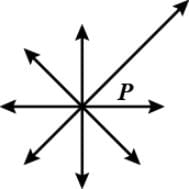
- a)Vertical point
- b)Point of concurrence
- c)Plane
- d)Point of intersection
Correct answer is option 'B'. Can you explain this answer?
In the given figure what is point P called?
a)
Vertical point
b)
Point of concurrence
c)
Plane
d)
Point of intersection
 | Shilpa Choudhury answered |
Many lines are intersecting at one point.
Point of concurrence: A point where more than two line intersects.
Point of concurrence: A point where more than two line intersects.
What is a set of points extending infinitely in all directions on the same flat surface called?- a)A line
- b)A plane
- c)Ray
- d)A point
Correct answer is option 'B'. Can you explain this answer?
What is a set of points extending infinitely in all directions on the same flat surface called?
a)
A line
b)
A plane
c)
Ray
d)
A point
 | Dr Manju Sen answered |
Sets of points extending infinitely in all direction on the same flat surface is a plane.
How do you write a line segment AB symbolically?- a)

- b)

- c)

- d)AB
Correct answer is option 'A'. Can you explain this answer?
How do you write a line segment AB symbolically?
a)
b)
c)
d)
AB
 | Siva Prasad answered |
A is line segment symbol
In the given figure, what are lines l, m and n called? 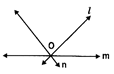
- a)Collinear lines
- b)Parallel lines
- c)Concurrent lines
- d)Intersecting lines
Correct answer is option 'C'. Can you explain this answer?
In the given figure, what are lines l, m and n called?
a)
Collinear lines
b)
Parallel lines
c)
Concurrent lines
d)
Intersecting lines
 | Rahul Kumar answered |
Concurrent lines are three or more lines meeting at a point. Intersecting lines are two lines that meet at a common point. The point at which these three lines meet each other is called as the point of concurrency. The point at which these two lines meet each other is called as the point of intersection
In the given figure, what are points P, O and Q called? 
- a)Collinear points
- b)Non-collinear points
- c)Concurrent lines
- d)Non coplanar lines
Correct answer is option 'B'. Can you explain this answer?
In the given figure, what are points P, O and Q called?
a)
Collinear points
b)
Non-collinear points
c)
Concurrent lines
d)
Non coplanar lines
| | Madhu Sulaniya answered |
R, P and Q would be collinear points. Similarly P and O or P and Q would be collinear but P,O and Q are non collinear points
What are used to represent points?- a)Numerals.
- b)Capital letters of alphabet.
- c)Lower case letters of alphabet.
- d)All of the above
Correct answer is option 'B'. Can you explain this answer?
What are used to represent points?
a)
Numerals.
b)
Capital letters of alphabet.
c)
Lower case letters of alphabet.
d)
All of the above
 | Harshad Goyal answered |
Representing Points
Points are represented by various symbols in different contexts. In mathematics, the most common symbol used to represent points is the capital letter of the alphabet.
Capital Letters of Alphabet
Capital letters of the alphabet are used to represent points in coordinate geometry. For example, in the Cartesian coordinate system, each point is represented by a pair of numbers, usually denoted by (x, y). Here, the x-coordinate is represented on the horizontal axis and the y-coordinate is represented on the vertical axis. Each point is uniquely identified by its coordinates.
In this system, points are represented by a capital letter of the alphabet, followed by the coordinates in brackets. For example, point A with coordinates (2, 3) is represented as A(2, 3).
Numerals and Lower Case Letters of Alphabet
Numerals and lower case letters of the alphabet are not commonly used to represent points in mathematics. However, they may be used in other contexts, such as in computer programming or data visualization.
Conclusion
In conclusion, points are most commonly represented by capital letters of the alphabet in mathematics, particularly in coordinate geometry. Other symbols may be used in different contexts, but capital letters remain the most widely used symbol for representing points.
Points are represented by various symbols in different contexts. In mathematics, the most common symbol used to represent points is the capital letter of the alphabet.
Capital Letters of Alphabet
Capital letters of the alphabet are used to represent points in coordinate geometry. For example, in the Cartesian coordinate system, each point is represented by a pair of numbers, usually denoted by (x, y). Here, the x-coordinate is represented on the horizontal axis and the y-coordinate is represented on the vertical axis. Each point is uniquely identified by its coordinates.
In this system, points are represented by a capital letter of the alphabet, followed by the coordinates in brackets. For example, point A with coordinates (2, 3) is represented as A(2, 3).
Numerals and Lower Case Letters of Alphabet
Numerals and lower case letters of the alphabet are not commonly used to represent points in mathematics. However, they may be used in other contexts, such as in computer programming or data visualization.
Conclusion
In conclusion, points are most commonly represented by capital letters of the alphabet in mathematics, particularly in coordinate geometry. Other symbols may be used in different contexts, but capital letters remain the most widely used symbol for representing points.
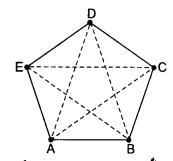
How many diagonals are there in the follow-ing figure?
- a)5
- b)4
- c)2
- d)3
Correct answer is option 'A'. Can you explain this answer?
How many diagonals are there in the follow-ing figure?
a)
5
b)
4
c)
2
d)
3
 | EduRev Class 6 answered |
Here, the diagonals are AD, AC, BD, BE, CE. Totally there are 5 diagonals.
Which of the following statements is false?- a)Every chord of a circle is also a diameter.
- b)The centre of a circle is always in its interior.
- c)Every diameter of a circle is also a chord.
- d)Two diameters of a circle will necessarily intersect.
Correct answer is option 'A'. Can you explain this answer?
Which of the following statements is false?
a)
Every chord of a circle is also a diameter.
b)
The centre of a circle is always in its interior.
c)
Every diameter of a circle is also a chord.
d)
Two diameters of a circle will necessarily intersect.
 | Sanjana Mukherjee answered |
False Statement: Every chord of a circle is also a diameter.
- Understanding Chords and Diameters:
- Explanation of the False Statement:
- Counterexample:
- Conclusion:
- A chord of a circle is a line segment that connects two points on the circumference of the circle.
- A diameter of a circle is a chord that passes through the center of the circle.
The false statement suggests that every chord of a circle is also a diameter. However, this is not true. Let's understand why:
A counterexample is a specific example that disproves a statement. In this case, we can provide a counterexample where a chord is not a diameter:
Let's consider a circle with center O and two points A and B on its circumference. Segment AB is a chord of the circle.
___________O___________
/ \
/ \
/ \
/ \
A B
In this case, segment AB is a chord of the circle but it is not a diameter. The diameter of the circle would be a line segment passing through the center O and having endpoints on the circumference of the circle.
Therefore, the false statement is that every chord of a circle is also a diameter. In reality, a chord can be any line segment connecting two points on a circle, whereas a diameter is a specific chord that passes through the center of the circle.
How is a line PQ symbolically written?- a)

- b)

- c)

- d)

Correct answer is option 'B'. Can you explain this answer?
How is a line PQ symbolically written?
a)
b)
c)
d)
| | Shweta garg answered |
The symbol of a line is ↔.
Hence, a line PQ is symbolically written as
Hence, a line PQ is symbolically written as

- a)

- b)

- c)

- d)

Correct answer is option 'C'. Can you explain this answer?
a)
b)
c)
d)
 | Helly Popat answered |
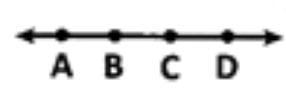
Here, AC is the answer in this question and we have to find that what we have to subtract from AD so that we get the answer AC.
We have also saw that figure in question. It shows that if we subtract DC from AD we will get our answer that is AC.
We have also saw that figure in question. It shows that if we subtract DC from AD we will get our answer that is AC.
Name the set of points which is a part of a line with two end points.- a)A line
- b)A line segment
- c)A ray
- d)A point
Correct answer is option 'B'. Can you explain this answer?
Name the set of points which is a part of a line with two end points.
a)
A line
b)
A line segment
c)
A ray
d)
A point
| | Palak Nair answered |
**Line Segment:**
A line segment is a part of a line that has two endpoints. It is a straight path between two points. The length of a line segment can be measured using a ruler or any other measuring tool.
**Explanation:**
A line is a straight path that extends infinitely in both directions. It has no endpoints. For example, if you draw a line on a piece of paper, you can extend it indefinitely in both directions.
A ray is a straight path that extends infinitely in one direction. It has one endpoint and goes on forever in the other direction. For example, if you draw a ray on a piece of paper, you can extend it infinitely in one direction but not in the other.
A point is a location in space. It has no length, width, or height. It is represented by a dot. For example, if you mark a dot on a piece of paper, it represents a point.
A line segment, on the other hand, is a part of a line that has two endpoints. It is a finite length and can be measured. For example, if you draw a line segment on a piece of paper, it has a definite length between the two endpoints.
In the context of the given question, the set of points that is a part of a line with two endpoints is a line segment. This is because a line segment is the only option that fits the description of having two endpoints and being a part of a line. A line does not have endpoints, a ray extends infinitely in one direction, and a point is a single location without any length. Only a line segment has the characteristics of being a part of a line and having two endpoints.
Therefore, the correct answer is option B - A line segment.
A line segment is a part of a line that has two endpoints. It is a straight path between two points. The length of a line segment can be measured using a ruler or any other measuring tool.
**Explanation:**
A line is a straight path that extends infinitely in both directions. It has no endpoints. For example, if you draw a line on a piece of paper, you can extend it indefinitely in both directions.
A ray is a straight path that extends infinitely in one direction. It has one endpoint and goes on forever in the other direction. For example, if you draw a ray on a piece of paper, you can extend it infinitely in one direction but not in the other.
A point is a location in space. It has no length, width, or height. It is represented by a dot. For example, if you mark a dot on a piece of paper, it represents a point.
A line segment, on the other hand, is a part of a line that has two endpoints. It is a finite length and can be measured. For example, if you draw a line segment on a piece of paper, it has a definite length between the two endpoints.
In the context of the given question, the set of points that is a part of a line with two endpoints is a line segment. This is because a line segment is the only option that fits the description of having two endpoints and being a part of a line. A line does not have endpoints, a ray extends infinitely in one direction, and a point is a single location without any length. Only a line segment has the characteristics of being a part of a line and having two endpoints.
Therefore, the correct answer is option B - A line segment.
How many lines can pass through one given point?- a)Countless
- b)2
- c)4
- d)1
Correct answer is option 'A'. Can you explain this answer?
How many lines can pass through one given point?
a)
Countless
b)
2
c)
4
d)
1
 | Coachify answered |
To determine the number of lines that can pass through a single given point, consider the following:
- A line is defined by two points.
- Given one point, there is no restriction on the direction or slope a line can take through this point.
- Therefore, an infinite number of lines can pass through a single point.
Thus, the correct answer is A: Countless.
How many sides are there in a quadrilateral?- a)1
- b)2
- c)3
- d)4
Correct answer is option 'D'. Can you explain this answer?
How many sides are there in a quadrilateral?
a)
1
b)
2
c)
3
d)
4
 | Torcia Education answered |
The correct answer is D: 4.
- A quadrilateral is a polygon.
- The prefix "quadri-" means four, indicating the number of sides.
- Examples include squares, rectangles, and trapezoids.
- Each quadrilateral has:
- Four sides
- Four vertices (corners)
- Four angles
Understanding the term "quadrilateral" helps identify it as a four-sided shape.
- A quadrilateral is a polygon.
- The prefix "quadri-" means four, indicating the number of sides.
- Examples include squares, rectangles, and trapezoids.
- Each quadrilateral has:
- Four sides
- Four vertices (corners)
- Four angles
Understanding the term "quadrilateral" helps identify it as a four-sided shape.
How many points are enough to fix a line?- a)2
- b)1
- c)3
- d)4
Correct answer is option 'A'. Can you explain this answer?
How many points are enough to fix a line?
a)
2
b)
1
c)
3
d)
4
| | Dr Manju Sen answered |
To fix a line in a plane, you need 2 points. Here's why:
- Two distinct points uniquely determine a line in a plane.
- If you have 1 point, you can draw infinite lines passing through it.
- With 3 or more points, you risk creating inconsistencies or unnecessary complexity.
Therefore, the correct answer is A: 2 points.
- Two distinct points uniquely determine a line in a plane.
- If you have 1 point, you can draw infinite lines passing through it.
- With 3 or more points, you risk creating inconsistencies or unnecessary complexity.
Therefore, the correct answer is A: 2 points.
How many lines can you draw joining two distinct points in a plane?- a)Two
- b)One
- c)Zero
- d)Infinitely many
Correct answer is option 'B'. Can you explain this answer?
How many lines can you draw joining two distinct points in a plane?
a)
Two
b)
One
c)
Zero
d)
Infinitely many
 | Srishti Menon answered |
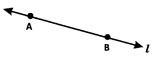
Only one line can be drawn passing through two given points.
How many angles are there in a quadrilateral?- a)4
- b)2
- c)3
- d)1
Correct answer is option 'A'. Can you explain this answer?
How many angles are there in a quadrilateral?
a)
4
b)
2
c)
3
d)
1
| | Torcia Education answered |
To determine how many angles are in a quadrilateral, consider the following points:
- - A quadrilateral is a polygon with four sides.
- - By definition, a polygon with four sides will have four vertices.
- - Each vertex in a polygon represents an angle.
Therefore, a quadrilateral has:
- 4 angles
- 4 angles
Three points P, Q and R are said to be collinear. Where do they lie?- a)On the same plane.
- b)On the same line.
- c)On different lines.
- d)On different planes.
Correct answer is option 'B'. Can you explain this answer?
Three points P, Q and R are said to be collinear. Where do they lie?
a)
On the same plane.
b)
On the same line.
c)
On different lines.
d)
On different planes.
 | Rutuja Bose answered |
Understanding Collinearity
Collinearity refers to the geometric arrangement of points in a plane. When we say three points P, Q, and R are collinear, it means they lie on the same straight line.
Why Collinear Points Lie on the Same Line
- Definition of Collinearity: Collinear points are those that can be connected by a single straight line. Thus, when we say P, Q, and R are collinear, they share a direct linear path.
- Visual Illustration: Imagine drawing a straight line. If you can place points P, Q, and R directly on that line without any deviation, they are collinear.
- Implication in Geometry: In geometry, understanding the concept of collinearity helps in determining relationships between points, lines, and shapes. For example, if points are collinear, they lack any angle between them, indicating direct alignment.
Why Other Options Are Incorrect
- Option A (On the same plane): While collinear points do indeed lie on the same plane, this statement is too broad as it can include points that are not collinear.
- Option C (On different lines): Collinear points cannot be on different lines. This contradicts the very definition of collinearity.
- Option D (On different planes): If points are collinear, they must exist within the same plane, as being on different planes would prevent them from lying on the same line.
Conclusion
In conclusion, the correct answer to the question is option B: "On the same line." Understanding this concept is fundamental in grasping basic geometric principles and relationships between points.
Collinearity refers to the geometric arrangement of points in a plane. When we say three points P, Q, and R are collinear, it means they lie on the same straight line.
Why Collinear Points Lie on the Same Line
- Definition of Collinearity: Collinear points are those that can be connected by a single straight line. Thus, when we say P, Q, and R are collinear, they share a direct linear path.
- Visual Illustration: Imagine drawing a straight line. If you can place points P, Q, and R directly on that line without any deviation, they are collinear.
- Implication in Geometry: In geometry, understanding the concept of collinearity helps in determining relationships between points, lines, and shapes. For example, if points are collinear, they lack any angle between them, indicating direct alignment.
Why Other Options Are Incorrect
- Option A (On the same plane): While collinear points do indeed lie on the same plane, this statement is too broad as it can include points that are not collinear.
- Option C (On different lines): Collinear points cannot be on different lines. This contradicts the very definition of collinearity.
- Option D (On different planes): If points are collinear, they must exist within the same plane, as being on different planes would prevent them from lying on the same line.
Conclusion
In conclusion, the correct answer to the question is option B: "On the same line." Understanding this concept is fundamental in grasping basic geometric principles and relationships between points.
How many angles are there in a triangle?- a)1
- b)2
- c)3
- d)4
Correct answer is option 'C'. Can you explain this answer?
How many angles are there in a triangle?
a)
1
b)
2
c)
3
d)
4
| | Anisha Iyer answered |
Number of Angles in a Triangle
Triangles are geometric shapes that consist of three sides and three angles.
Definition of an Angle
An angle is formed when two lines or rays meet at a common endpoint. In a triangle, three angles are formed where the three sides meet.
Angles in a Triangle
1. A triangle has three angles.
2. Each angle is formed at the intersection of two sides of the triangle.
3. The sum of all three angles in a triangle is always equal to 180 degrees.
4. The angles in a triangle can vary in size and shape, depending on the type of triangle (e.g., equilateral, isosceles, scalene).
Importance of Understanding Triangle Angles
1. Understanding the angles in a triangle is crucial for solving geometry problems.
2. The relationship between the angles in a triangle can help determine the type of triangle and solve for unknown angles or side lengths.
3. Knowing the properties of triangles and their angles is fundamental in various fields, including mathematics, architecture, and engineering.
In conclusion, a triangle has three angles, and each angle plays a significant role in determining the properties and characteristics of the triangle. Understanding the angles in a triangle is essential for solving geometry problems and applying geometric principles in real-world scenarios.
Which instrument is used to compare two line segments?- a)Compasses
- b)A divider
- c)Set squares
- d)A protractor
Correct answer is option 'B'. Can you explain this answer?
Which instrument is used to compare two line segments?
a)
Compasses
b)
A divider
c)
Set squares
d)
A protractor
| | Srishti Menon answered |
A divider is used to compare line segments.
Four lines p, q, r and s are said to be concurrent. What do they pass through?- a)Same line
- b)Same point
- c)Same plane
- d)Different points
Correct answer is option 'B'. Can you explain this answer?
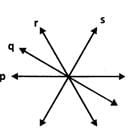
Four lines p, q, r and s are said to be concurrent. What do they pass through?
a)
Same line
b)
Same point
c)
Same plane
d)
Different points
 | Jhanvi Banerjee answered |
If the lines p, q, r and s are said to be concurrent they pass through the same point.
How many vertices are there in a triangle?- a)3
- b)2
- c)1
- d)4
Correct answer is option 'A'. Can you explain this answer?
How many vertices are there in a triangle?
a)
3
b)
2
c)
1
d)
4
 | Get Idea answered |
The correct answer is A: 3.
- A triangle is a polygon with three edges and three vertices.
- Each corner point of a triangle is called a vertex.
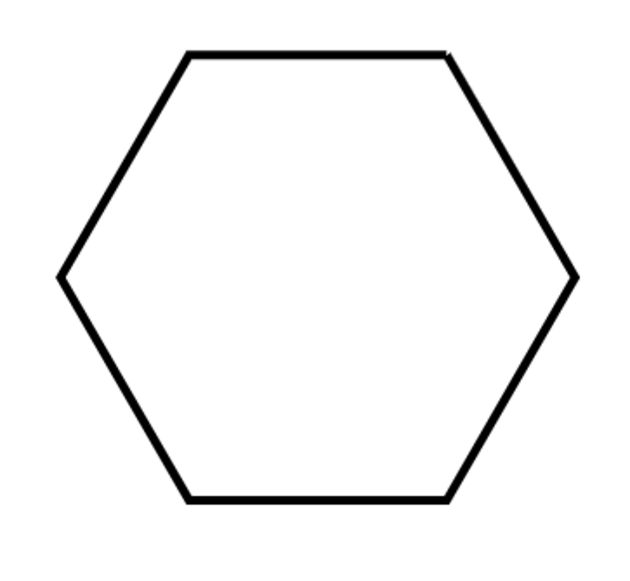
How many sides are there in the following figure?
- a)4
- b)6
- c)2
- d)3
Correct answer is option 'B'. Can you explain this answer?
How many sides are there in the following figure?
a)
4
b)
6
c)
2
d)
3
| | Get Idea answered |
To determine how many sides the figure has, examine the image provided. The shape depicted is a hexagon.
- A hexagon is defined as a polygon with six sides.
- The prefix "hexa-" in Greek means six, indicating the number of sides in the shape.
- A hexagon is defined as a polygon with six sides.
- The prefix "hexa-" in Greek means six, indicating the number of sides in the shape.
How many vertices are there in the following figure?
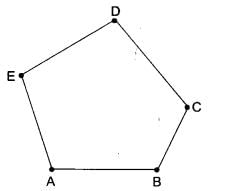
- a)4
- b)3
- c)2
- d)5
Correct answer is option 'D'. Can you explain this answer?
How many vertices are there in the following figure?
a)
4
b)
3
c)
2
d)
5
| | Get Idea answered |
To determine the number of vertices in the figure, look at the points where two or more lines meet. Each of these points is considered a vertex.
- Identify all intersections of the edges in the figure.
- Count each intersection point (vertex).
What is the symbolic representation of a ray OP?- a)

- b)

- c)

- d)OP
Correct answer is option 'C'. Can you explain this answer?
What is the symbolic representation of a ray OP?
a)
b)
c)
d)
OP
 | Shilpa Kulkarni answered |
As ray originates from a point it move farther and have no end . so option (c) is correct
Chapter doubts & questions for Basic Concepts in Geometry - Maharashtra Board for Class 6 All Subjects 2026 is part of Class 6 exam preparation. The chapters have been prepared according to the Class 6 exam syllabus. The Chapter doubts & questions, notes, tests & MCQs are made for Class 6 2026 Exam. Find important definitions, questions, notes, meanings, examples, exercises, MCQs and online tests here.
Chapter doubts & questions of Basic Concepts in Geometry - Maharashtra Board for Class 6 All Subjects in English & Hindi are available as part of Class 6 exam. Download more important topics, notes, lectures and mock test series for Class 6 Exam by signing up for free.
Maharashtra Board for Class 6 All Subjects91 videos|633 docs|68 tests |
