


All Exams > Class 8 > Maharashtra Board for Class 8 All Subjects > All Questions
All questions of Inside the Atom for Class 8 Exam
Na+ has 12 neutrons and 10 electrons. Which of the following statement is correct?- a)Na+ has atomic number equal to 10 and mass number 22
- b)Na+ has atomic number equal to 11 and mass number 23
- c)Na+ has atomic number equal to 10 and mass number 23
- d)Na+ has atomic number equal to 11 and mass number 22
Correct answer is option 'B'. Can you explain this answer?
Na+ has 12 neutrons and 10 electrons. Which of the following statement is correct?
a)
Na+ has atomic number equal to 10 and mass number 22
b)
Na+ has atomic number equal to 11 and mass number 23
c)
Na+ has atomic number equal to 10 and mass number 23
d)
Na+ has atomic number equal to 11 and mass number 22
 | Geetika Shah answered |
The chemical symbol Na+ represents a sodium ion. The atomic number of sodium (Na) is 11, which means it has 11 protons.
Given that Na+ has 12 neutrons, we can determine the mass number by adding the number of neutrons to the number of protons. So, for Na+:
Given that Na+ has 12 neutrons, we can determine the mass number by adding the number of neutrons to the number of protons. So, for Na+:
Mass number = Number of neutrons + Number of protons Mass number = 12 neutrons + 11 protons Mass number = 23
The atomic number remains unchanged because it is determined by the number of protons, which is characteristic of each element. The loss or gain of electrons to form ions does not change the atomic number.
Therefore, the correct statement is: Na+ has an atomic number equal to 11 and a mass number of 23.

In an atom, the mass number of an atom is equal to the number of___________.- a)nucleons
- b)protons
- c)electrons
- d)neutrons
Correct answer is option 'A'. Can you explain this answer?
In an atom, the mass number of an atom is equal to the number of___________.
a)
nucleons
b)
protons
c)
electrons
d)
neutrons
 | Anisha Yadav answered |
Mass Number of an Atom:
The mass number of an atom is the sum of the number of protons and neutrons in the nucleus of an atom. It is denoted by the symbol A.
Formula for Mass Number:
Mass Number (A) = Number of Protons (Z) + Number of Neutrons (N)
Explanation of the Answer:
In an atom, the mass number is equal to the total number of nucleons. Nucleons are the particles found in the nucleus of an atom. They include protons and neutrons. Electrons are not included in the mass number calculation because they are much lighter than protons and neutrons and their mass is negligible in comparison.
Therefore, the correct answer is option 'A' which states that the mass number of an atom is equal to the number of nucleons.
Conclusion:
The mass number of an atom is a crucial concept in nuclear physics and chemistry. It helps in determining the stability and properties of an atom. The atomic mass of an element is the weighted average of the mass numbers of all the isotopes of that element.
The mass number of an atom is the sum of the number of protons and neutrons in the nucleus of an atom. It is denoted by the symbol A.
Formula for Mass Number:
Mass Number (A) = Number of Protons (Z) + Number of Neutrons (N)
Explanation of the Answer:
In an atom, the mass number is equal to the total number of nucleons. Nucleons are the particles found in the nucleus of an atom. They include protons and neutrons. Electrons are not included in the mass number calculation because they are much lighter than protons and neutrons and their mass is negligible in comparison.
Therefore, the correct answer is option 'A' which states that the mass number of an atom is equal to the number of nucleons.
Conclusion:
The mass number of an atom is a crucial concept in nuclear physics and chemistry. It helps in determining the stability and properties of an atom. The atomic mass of an element is the weighted average of the mass numbers of all the isotopes of that element.
The number of valence electron in Na is –- a)1
- b)2
- c)3
- d)4
Correct answer is option 'A'. Can you explain this answer?
The number of valence electron in Na is –
a)
1
b)
2
c)
3
d)
4
 | Reema Singh answered |
1. Na has one valence electron.
An atom with 3 protons and 4 neutrons will have a valency of - a)3
- b)7
- c)1
- d)4
Correct answer is option 'C'. Can you explain this answer?
An atom with 3 protons and 4 neutrons will have a valency of
a)
3
b)
7
c)
1
d)
4
 | Shreeya Joshi Joshi answered |
Yeah as no.of protons= electrons
Number of electrons will be 3 so configuration will be 2,1 so therefore that element will need to give 1 electron to satisfy duplet rule.
If I am not wrong is the element Beryllium???
Wonderful question!
Number of electrons will be 3 so configuration will be 2,1 so therefore that element will need to give 1 electron to satisfy duplet rule.
If I am not wrong is the element Beryllium???
Wonderful question!
What is the no. of electrons in Argon?- a)16
- b)17
- c)18
- d)19
Correct answer is option 'C'. Can you explain this answer?
What is the no. of electrons in Argon?
a)
16
b)
17
c)
18
d)
19
 | Shweta Pandey answered |
Argon has 18electrons
A=Z+N
A=mass number
Z=number of protons in nucleus
N=number of neutron in nucleus
Z=e=p (number of electron )
sol~
A=39
Z=e=p=18
N =21
second method is, (Aufbau Principle)
Ar=18
1s2,2s2 2p6,3s2 3p6.
A=Z+N
A=mass number
Z=number of protons in nucleus
N=number of neutron in nucleus
Z=e=p (number of electron )
sol~
A=39
Z=e=p=18
N =21
second method is, (Aufbau Principle)
Ar=18
1s2,2s2 2p6,3s2 3p6.
The no. of electrons in the valence shells of Sodium and Calcium repectively:- a)1, 1
- b)2, 1
- c)1, 2
- d)2, 2
Correct answer is option 'C'. Can you explain this answer?
The no. of electrons in the valence shells of Sodium and Calcium repectively:
a)
1, 1
b)
2, 1
c)
1, 2
d)
2, 2
 | Partho Saini answered |
Electronic configuration of
Na is 2, 8, 1
Ca is 2, 8, 8, 2
Direction: In the following questions, a statement of assertion (A) is followed by a statement of reason (R). Mark the correct choice as:Assertion : The size of the nucleus is very small as compared to the size of the atom.Reason : The electrons revolve around the nucleus of the atom.- a)Both assertion (A) and reason (R) are true and reason (R) is the correct explanation of assertion (A).
- b)Both assertion (A) and reason (R) are true but reason (R) is not the correct explanation of assertion (A).
- c)Assertion (A) is true but reason (R) is false.
- d)Assertion (A) is false but reason (R) is true.
Correct answer is option 'B'. Can you explain this answer?
Direction: In the following questions, a statement of assertion (A) is followed by a statement of reason (R). Mark the correct choice as:
Assertion : The size of the nucleus is very small as compared to the size of the atom.
Reason : The electrons revolve around the nucleus of the atom.
a)
Both assertion (A) and reason (R) are true and reason (R) is the correct explanation of assertion (A).
b)
Both assertion (A) and reason (R) are true but reason (R) is not the correct explanation of assertion (A).
c)
Assertion (A) is true but reason (R) is false.
d)
Assertion (A) is false but reason (R) is true.
 | Avinash Patel answered |
The nucleus of an atom is about 10-15 m in size; this means it is about 10-5 (or 1/100,000) of the size of the whole atom. A good comparison of the nucleus to the atom is like a pea in the middle of a racetrack. (10-15 m is typical for the smaller nuclei; larger ones go up to about 10 times that.)
Atomic number of any element–- a)Atomic weight divided by two
- b)Nucleus weight
- c)Electrical charge of nucleus
- d)Total charge of electrons
Correct answer is option 'C'. Can you explain this answer?
Atomic number of any element–
a)
Atomic weight divided by two
b)
Nucleus weight
c)
Electrical charge of nucleus
d)
Total charge of electrons
 | Let's Tute answered |
- The atomic number of an element is the number of protons in its nucleus.
- This defines the identity of the element and determines its position in the periodic table.
- Since protons have a positive charge, the atomic number is effectively the electrical charge of the nucleus.
- Electrons, which are negatively charged, balance this charge in a neutral atom.
- Therefore, the atomic number is best described as the electrical charge of the nucleus, making option C correct.
- This defines the identity of the element and determines its position in the periodic table.
- Since protons have a positive charge, the atomic number is effectively the electrical charge of the nucleus.
- Electrons, which are negatively charged, balance this charge in a neutral atom.
- Therefore, the atomic number is best described as the electrical charge of the nucleus, making option C correct.

The atomic number of an element is equal to:- a)The number of electrons in the nucleus
- b)The number of neutrons in the atom
- c)The number of protons in the nucleus
- d)The total number of nucleons
Correct answer is option 'C'. Can you explain this answer?
The atomic number of an element is equal to:
a)
The number of electrons in the nucleus
b)
The number of neutrons in the atom
c)
The number of protons in the nucleus
d)
The total number of nucleons
 | Rishabh Unni answered |
Understanding Atomic Number
The atomic number is a fundamental property of an element that defines its identity in the periodic table.
Definition of Atomic Number
- The atomic number is defined as the number of protons in the nucleus of an atom.
- It is denoted by the symbol 'Z'.
Significance of Protons
- Protons are positively charged particles found in the nucleus.
- The number of protons determines the element's chemical properties and its place in the periodic table.
Relation to Electrons
- In a neutral atom, the number of electrons equals the number of protons.
- This balance of charges ensures the atom is electrically neutral.
Neutrons and Nucleons
- Neutrons are neutral particles in the nucleus and do not affect the atomic number.
- The total number of protons and neutrons in an atom is known as the mass number, which is different from the atomic number.
Why Option 'C' is Correct
- Option 'C', stating that the atomic number equals the number of protons in the nucleus, is accurate.
- This definition directly correlates with the identity of the element.
Summary
- The atomic number is fundamental for identifying elements.
- It directly influences an element's chemical behavior and its placement in the periodic table.
- Understanding the atomic number helps in grasping concepts in chemistry and atomic structure.
The atomic number is a fundamental property of an element that defines its identity in the periodic table.
Definition of Atomic Number
- The atomic number is defined as the number of protons in the nucleus of an atom.
- It is denoted by the symbol 'Z'.
Significance of Protons
- Protons are positively charged particles found in the nucleus.
- The number of protons determines the element's chemical properties and its place in the periodic table.
Relation to Electrons
- In a neutral atom, the number of electrons equals the number of protons.
- This balance of charges ensures the atom is electrically neutral.
Neutrons and Nucleons
- Neutrons are neutral particles in the nucleus and do not affect the atomic number.
- The total number of protons and neutrons in an atom is known as the mass number, which is different from the atomic number.
Why Option 'C' is Correct
- Option 'C', stating that the atomic number equals the number of protons in the nucleus, is accurate.
- This definition directly correlates with the identity of the element.
Summary
- The atomic number is fundamental for identifying elements.
- It directly influences an element's chemical behavior and its placement in the periodic table.
- Understanding the atomic number helps in grasping concepts in chemistry and atomic structure.
Mass number of element is –- a)Number of protons in its nucleus
- b)Number of electrons and protons in the atom
- c)Number of neutrons and protons in the nucleus
- d)Number of neutrons in the nucleus
Correct answer is option 'C'. Can you explain this answer?
Mass number of element is –
a)
Number of protons in its nucleus
b)
Number of electrons and protons in the atom
c)
Number of neutrons and protons in the nucleus
d)
Number of neutrons in the nucleus
| | Shaheenpreet Kaul. answered |
The mass number is sum. Of protons and neutrons in the nucleus because mass of electrons is so much less that it is almost neglectable. So when we calculate mass we only take protons and neutrons.
Direction: In the following questions, a statement of assertion (A) is followed by a statement of reason (R). Mark the correct choice as:Assertion : The atoms of different elements having same mass number but different atomic numbers are known as isobars.Reason : The sum of protons and neutrons, in the isobars is always different.- a)Both assertion (A) and reason (R) are true and reason (R) is the correct explanation of assertion (A).
- b)Both assertion (A) and reason (R) are true but reason (R) is not the correct explanation of assertion (A).
- c)Assertion (A) is true but reason (R) is false.
- d)Assertion (A) is false but reason (R) is true.
Correct answer is option 'C'. Can you explain this answer?
Direction: In the following questions, a statement of assertion (A) is followed by a statement of reason (R). Mark the correct choice as:
Assertion : The atoms of different elements having same mass number but different atomic numbers are known as isobars.
Reason : The sum of protons and neutrons, in the isobars is always different.
a)
Both assertion (A) and reason (R) are true and reason (R) is the correct explanation of assertion (A).
b)
Both assertion (A) and reason (R) are true but reason (R) is not the correct explanation of assertion (A).
c)
Assertion (A) is true but reason (R) is false.
d)
Assertion (A) is false but reason (R) is true.
| | Avinash Patel answered |
Sum of protons and neutrons is known as mass number which is same for isobars.
Direction: In the following questions, a statement of assertion (A) is followed by a statement of reason (R). Mark the correct choice as:Assertion : Isobars are identical in chemical properties.Reason : Isobars have same atomic number.- a)Both assertion (A) and reason (R) are true and reason (R) is the correct explanation of assertion (A).
- b)Both assertion (A) and reason (R) are true but reason (R) is not the correct explanation of assertion (A).
- c)Assertion (A) is true but reason (R) is false.
- d)Both assertion and reason are incorrect.
Correct answer is option 'D'. Can you explain this answer?
Direction: In the following questions, a statement of assertion (A) is followed by a statement of reason (R). Mark the correct choice as:
Assertion : Isobars are identical in chemical properties.
Reason : Isobars have same atomic number.
a)
Both assertion (A) and reason (R) are true and reason (R) is the correct explanation of assertion (A).
b)
Both assertion (A) and reason (R) are true but reason (R) is not the correct explanation of assertion (A).
c)
Assertion (A) is true but reason (R) is false.
d)
Both assertion and reason are incorrect.
 | Radha Iyer answered |
Isobars are not identical in chemical properties because they have same mass number and different atomic numbers.
When a gas at reduced pressure is subjected to an electric discharge, the rays orignating from the negative electrode are–- a)Anode rays
- b)Cathode rays
- c)x-rays
- d)Radiation ray
Correct answer is option 'A'. Can you explain this answer?
When a gas at reduced pressure is subjected to an electric discharge, the rays orignating from the negative electrode are–
a)
Anode rays
b)
Cathode rays
c)
x-rays
d)
Radiation ray
 | Vikas Kapoor answered |
Cathode ray, stream of electrons leaving the negative electrode (cathode) in a discharge tube containing a gas at low pressure, or electrons emitted by a heated filament in certain electron tubes. Cathode rays focused on a hard target (anticathode) produce X-rays or focused on a small object in a vacuum generate very high temperatures (cathode-ray furnace). When cathode rays strike certain molecules used to coat a cathode screen, they cause the molecules (and hence the screen) to emit light.
The isotope deuterium of hydrogen has- a)No neutrons and one proton
- b)One neutrons and two protons
- c)One electron and two neutron
- d)One proton and one neutron
Correct answer is option 'D'. Can you explain this answer?
The isotope deuterium of hydrogen has
a)
No neutrons and one proton
b)
One neutrons and two protons
c)
One electron and two neutron
d)
One proton and one neutron
 | Betu Betu answered |
Because we know that isotopes have same atomic no but different atomic mass . the isotopes of hydrogen have same no of proton because no of proton = atomic no and and atomic no do not change in isotopes but the no of electron will change due to change in its mass
Fundamental particle of atomic nucleus is–- a)p, e-
- b)p, n, e
- c)p, n
- d)n , e
Correct answer is option 'C'. Can you explain this answer?
Fundamental particle of atomic nucleus is–
a)
p, e-
b)
p, n, e
c)
p, n
d)
n , e
 | Dhruva Mohan answered |
Opt.b proton
neutron
electron
neutron
electron
Direction: In the following questions, a statement of assertion (A) is followed by a statement of reason (R). Mark the correct choice as:Assertion : Atom is electrically neutral.Reason : A neutral particle, neutron is present in the nucleus of atom.- a)Both assertion (A) and reason (R) are true and reason (R) is the correct explanation of assertion (A).
- b)Both assertion (A) and reason (R) are true but reason (R) is not the correct explanation of assertion (A).
- c)Assertion (A) is true but reason (R) is false.
- d)Assertion (A) is false but reason (R) is true.
Correct answer is option 'B'. Can you explain this answer?
Direction: In the following questions, a statement of assertion (A) is followed by a statement of reason (R). Mark the correct choice as:
Assertion : Atom is electrically neutral.
Reason : A neutral particle, neutron is present in the nucleus of atom.
a)
Both assertion (A) and reason (R) are true and reason (R) is the correct explanation of assertion (A).
b)
Both assertion (A) and reason (R) are true but reason (R) is not the correct explanation of assertion (A).
c)
Assertion (A) is true but reason (R) is false.
d)
Assertion (A) is false but reason (R) is true.
| | Aditi Sharma answered |
Atom is electrically neutral because the number of protons (positively charged particle) is equal to the number of electrons (negatively charged particle).
Neutron is a fundamental particle which have–- a)+1 unit charge and 1 unit mass
- b)No charge and 1 unit mass
- c)Have no charge and mass
- d)Have –1 unit charge and 1 unit mass
Correct answer is option 'B'. Can you explain this answer?
Neutron is a fundamental particle which have–
a)
+1 unit charge and 1 unit mass
b)
No charge and 1 unit mass
c)
Have no charge and mass
d)
Have –1 unit charge and 1 unit mass
| | Mira Sharma answered |
Neutron is a fundamental particle which have–
There are four options given to choose from regarding the charge and mass of a neutron. Let's analyze each option to determine the correct answer.
Option A: 1 unit charge and 1 unit mass
- A neutron has no charge, so this option is incorrect.
Option B: No charge and 1 unit mass
- This option correctly states that a neutron has no charge. Neutrons are electrically neutral particles.
- Neutrons do have mass, with a mass of approximately 1 atomic mass unit (u) or 1.67 × 10^-27 kg.
- Therefore, option B is correct.
Option C: Have no charge and mass
- This option is incorrect as it implies that a neutron has no mass. However, neutrons do have mass.
Option D: Have –1 unit charge and 1 unit mass
- This option is incorrect as it states that a neutron has a negative charge. Neutrons are electrically neutral and do not possess any charge.
Therefore, the correct answer is option B: Neutrons have no charge and 1 unit mass.
There are four options given to choose from regarding the charge and mass of a neutron. Let's analyze each option to determine the correct answer.
Option A: 1 unit charge and 1 unit mass
- A neutron has no charge, so this option is incorrect.
Option B: No charge and 1 unit mass
- This option correctly states that a neutron has no charge. Neutrons are electrically neutral particles.
- Neutrons do have mass, with a mass of approximately 1 atomic mass unit (u) or 1.67 × 10^-27 kg.
- Therefore, option B is correct.
Option C: Have no charge and mass
- This option is incorrect as it implies that a neutron has no mass. However, neutrons do have mass.
Option D: Have –1 unit charge and 1 unit mass
- This option is incorrect as it states that a neutron has a negative charge. Neutrons are electrically neutral and do not possess any charge.
Therefore, the correct answer is option B: Neutrons have no charge and 1 unit mass.
Which species does not contain neutron –- a)H
- b)Li+2
- c)C
- d)O
Correct answer is option 'A'. Can you explain this answer?
Which species does not contain neutron –
a)
H
b)
Li+2
c)
C
d)
O
| | Priya Shah answered |
No species exists without neutrons. All atoms have at least one neutron in their nucleus, except for the hydrogen-1 isotope, which does not have any neutrons.
An atom which has a mass number of 14 or 8 neutrons is–- a)Isotope of oxygen
- b)Isobar of oxygen
- c)Isotope of carbon
- d)Isobar of carbon
Correct answer is option 'C'. Can you explain this answer?
An atom which has a mass number of 14 or 8 neutrons is–
a)
Isotope of oxygen
b)
Isobar of oxygen
c)
Isotope of carbon
d)
Isobar of carbon
| | Gaurav Kumar answered |
Isotopes are the atoms of the same element with similar atomic number but different atomic mass.The elements of isotopes share same chemical properties but different physical properties
Atomic models have been improved over the years. Arrange the following atomic models in the order of their chronological order.
(i) Rutherford’s atomic model
(ii) Thomson’s atomic model
(iii) Bohr’s atomic model- a)(i), (ii) and (iii)
- b)(ii), (iii) and (i)
- c)(ii), (i) and (iii)
- d)(iii), (ii) and (i)
Correct answer is option 'C'. Can you explain this answer?
Atomic models have been improved over the years. Arrange the following atomic models in the order of their chronological order.
(i) Rutherford’s atomic model
(ii) Thomson’s atomic model
(iii) Bohr’s atomic model
(i) Rutherford’s atomic model
(ii) Thomson’s atomic model
(iii) Bohr’s atomic model
a)
(i), (ii) and (iii)
b)
(ii), (iii) and (i)
c)
(ii), (i) and (iii)
d)
(iii), (ii) and (i)
| | Sagarika Joshi answered |
Model (ii) Bohr model (iii) Thomson model
(iii) Thomson model, (i) Rutherford model, (ii) Bohr model
(iii) Thomson model, (i) Rutherford model, (ii) Bohr model
The electron should be filled in the orbital in accordance with the increasing order of their energy. This statement
is related with- a)Affbau principle
- b)Pauli principle
- c)Hund's principle
- d)Plank's rules
Correct answer is option 'A'. Can you explain this answer?
The electron should be filled in the orbital in accordance with the increasing order of their energy. This statement
is related with
is related with
a)
Affbau principle
b)
Pauli principle
c)
Hund's principle
d)
Plank's rules
| | Rahul Choudhury answered |
This statement is related with Aufbau principle.
According to Aufbau principle (also known as (n+l) rule), electrons are filled in different orbitals from lower (n+l) value orbital to higher (n+l) value orbital.
In case (n+l) value is same, electron is filled first in orbital with lower value of n.
According to Aufbau principle (also known as (n+l) rule), electrons are filled in different orbitals from lower (n+l) value orbital to higher (n+l) value orbital.
In case (n+l) value is same, electron is filled first in orbital with lower value of n.
Direction: In the following questions, a statement of assertion (A) is followed by a statement of reason (R). Mark the correct choice as:Assertion : In Rutherford’s gold foil experiment, very few α -particles are deflected back.Reason : Nucleus present inside the atom is heavy.- a)Both assertion (A) and reason (R) are true and reason (R) is the correct explanation of assertion (A).
- b)Both assertion (A) and reason (R) are true but reason (R) is not the correct explanation of assertion (A).
- c)Assertion (A) is true but reason (R) is false.
- d)Assertion (A) is false but reason (R) is true.
Correct answer is option 'B'. Can you explain this answer?
Direction: In the following questions, a statement of assertion (A) is followed by a statement of reason (R). Mark the correct choice as:
Assertion : In Rutherford’s gold foil experiment, very few α -particles are deflected back.
Reason : Nucleus present inside the atom is heavy.
a)
Both assertion (A) and reason (R) are true and reason (R) is the correct explanation of assertion (A).
b)
Both assertion (A) and reason (R) are true but reason (R) is not the correct explanation of assertion (A).
c)
Assertion (A) is true but reason (R) is false.
d)
Assertion (A) is false but reason (R) is true.
| | Amit Kumar answered |
Nucleus present inside the atom is heavy but small.
Statement 1 - According to the Rutherford model of the atom, an electron in a circular orbit experiences acceleration and, as a result, radiates energy, leading to a loss of energy over time.
Statement 2 - According to the Rutherford model of the atom, this energy loss would cause the electron to spiral into the nucleus, making atoms inherently unstable.Which of the statements given above is/are correct?- a)1 Only
- b)2 only
- c)Both 1 and 2
- d)Neither 1 nor 2
Correct answer is option 'C'. Can you explain this answer?
Statement 1 - According to the Rutherford model of the atom, an electron in a circular orbit experiences acceleration and, as a result, radiates energy, leading to a loss of energy over time.
Statement 2 - According to the Rutherford model of the atom, this energy loss would cause the electron to spiral into the nucleus, making atoms inherently unstable.
Statement 2 - According to the Rutherford model of the atom, this energy loss would cause the electron to spiral into the nucleus, making atoms inherently unstable.
Which of the statements given above is/are correct?
a)
1 Only
b)
2 only
c)
Both 1 and 2
d)
Neither 1 nor 2
 | Imk Pathshala answered |
Both statements describe the limitations of the Rutherford model and how they lead to instability in atoms, which was later addressed by the Bohr model.
Statement 1: This is consistent with Rutherford's model, where he proposed that the electron orbits the nucleus in a circular path. Since the electron is accelerating in this orbit, classical electromagnetic theory states that it should emit radiation and lose energy over time. This leads to the electron's energy decreasing as it radiates energy.
Statement 2: This follows logically from Statement 1. Since the electron in Rutherford's model radiates energy and loses it over time, it would move closer to the nucleus as its energy decreases. Eventually, the electron would spiral into the nucleus, causing the atom to collapse. This would make the atom unstable in the Rutherford model.
Statement 2: This follows logically from Statement 1. Since the electron in Rutherford's model radiates energy and loses it over time, it would move closer to the nucleus as its energy decreases. Eventually, the electron would spiral into the nucleus, causing the atom to collapse. This would make the atom unstable in the Rutherford model.
An isotope of an element has 11 protons and 13 neutrons. What is the mass number of another isotope of the same element with 14 neutrons?- a)24
- b)25
- c)11
- d)14
Correct answer is option 'B'. Can you explain this answer?
An isotope of an element has 11 protons and 13 neutrons. What is the mass number of another isotope of the same element with 14 neutrons?
a)
24
b)
25
c)
11
d)
14
| | Maulik Patel answered |
Understanding Isotopes
When discussing isotopes, it's important to remember that they are variants of the same element that have the same number of protons but differ in the number of neutrons.
Key Components
- Protons: The number of protons defines the element. In this case, the element has 11 protons.
- Neutrons: The number of neutrons can vary, leading to different isotopes. Here, we have isotopes with 13 and 14 neutrons.
Calculating Mass Number
The mass number of an isotope is calculated by adding the number of protons and neutrons together.
- For the first isotope with 11 protons and 13 neutrons:
- Mass Number = Protons + Neutrons
- Mass Number = 11 + 13 = 24
- For the second isotope with 11 protons and 14 neutrons:
- Mass Number = Protons + Neutrons
- Mass Number = 11 + 14 = 25
Conclusion
Thus, the mass number of the isotope with 14 neutrons is 25. Therefore, the correct answer to the question is option b) 25.
This understanding of isotopes is fundamental in chemistry and helps explain the variations in atomic mass for elements on the periodic table.
When discussing isotopes, it's important to remember that they are variants of the same element that have the same number of protons but differ in the number of neutrons.
Key Components
- Protons: The number of protons defines the element. In this case, the element has 11 protons.
- Neutrons: The number of neutrons can vary, leading to different isotopes. Here, we have isotopes with 13 and 14 neutrons.
Calculating Mass Number
The mass number of an isotope is calculated by adding the number of protons and neutrons together.
- For the first isotope with 11 protons and 13 neutrons:
- Mass Number = Protons + Neutrons
- Mass Number = 11 + 13 = 24
- For the second isotope with 11 protons and 14 neutrons:
- Mass Number = Protons + Neutrons
- Mass Number = 11 + 14 = 25
Conclusion
Thus, the mass number of the isotope with 14 neutrons is 25. Therefore, the correct answer to the question is option b) 25.
This understanding of isotopes is fundamental in chemistry and helps explain the variations in atomic mass for elements on the periodic table.
The maximum number of electrons that can be accommodated in third shell ( n = 3) is:- a)2
- b)8
- c)18
- d)10
Correct answer is option 'C'. Can you explain this answer?
The maximum number of electrons that can be accommodated in third shell ( n = 3) is:
a)
2
b)
8
c)
18
d)
10
| | Sreemoyee Bajaj answered |
**Explanation:**
The maximum number of electrons that can be accommodated in a shell is given by the formula 2n², where 'n' is the principal quantum number of the shell.
In the case of the third shell, n = 3. Therefore, the maximum number of electrons that can be accommodated in the third shell is:
2(3)² = 2(9) = 18
**- Electron distribution in shells:**
In an atom, electrons are distributed in different shells based on their energy levels. The shells are numbered starting from the innermost shell, which is designated as the first shell (n = 1), followed by the second shell (n = 2), and so on.
Each shell can hold a maximum number of electrons based on its principal quantum number (n). The electron distribution in shells is as follows:
- **First shell (n = 1):** This shell can hold a maximum of 2 electrons.
- **Second shell (n = 2):** This shell can hold a maximum of 2(2)² = 8 electrons.
- **Third shell (n = 3):** This shell can hold a maximum of 2(3)² = 18 electrons.
- **Fourth shell (n = 4):** This shell can hold a maximum of 2(4)² = 32 electrons.
- **Fifth shell (n = 5):** This shell can hold a maximum of 2(5)² = 50 electrons.
- **And so on...**
It is important to note that as the principal quantum number increases, the maximum number of electrons that can be accommodated in a shell also increases. This is because higher energy levels can accommodate more electrons.
Thus, the correct answer is option 'C' (18) as the maximum number of electrons that can be accommodated in the third shell (n = 3) is 18.
The maximum number of electrons that can be accommodated in a shell is given by the formula 2n², where 'n' is the principal quantum number of the shell.
In the case of the third shell, n = 3. Therefore, the maximum number of electrons that can be accommodated in the third shell is:
2(3)² = 2(9) = 18
**- Electron distribution in shells:**
In an atom, electrons are distributed in different shells based on their energy levels. The shells are numbered starting from the innermost shell, which is designated as the first shell (n = 1), followed by the second shell (n = 2), and so on.
Each shell can hold a maximum number of electrons based on its principal quantum number (n). The electron distribution in shells is as follows:
- **First shell (n = 1):** This shell can hold a maximum of 2 electrons.
- **Second shell (n = 2):** This shell can hold a maximum of 2(2)² = 8 electrons.
- **Third shell (n = 3):** This shell can hold a maximum of 2(3)² = 18 electrons.
- **Fourth shell (n = 4):** This shell can hold a maximum of 2(4)² = 32 electrons.
- **Fifth shell (n = 5):** This shell can hold a maximum of 2(5)² = 50 electrons.
- **And so on...**
It is important to note that as the principal quantum number increases, the maximum number of electrons that can be accommodated in a shell also increases. This is because higher energy levels can accommodate more electrons.
Thus, the correct answer is option 'C' (18) as the maximum number of electrons that can be accommodated in the third shell (n = 3) is 18.
Direction: In the following questions, a statement of assertion (A) is followed by a statement of reason (R). Mark the correct choice as:Assertion : Bohr’s orbits are called stationary orbits.Reason : Electrons remain stationary in these orbits for sometime.- a)Both assertion (A) and reason (R) are true and reason (R) is the correct explanation of assertion (A).
- b)Both assertion (A) and reason (R) are true but reason (R) is not the correct explanation of assertion (A).
- c)Assertion (A) is true but reason (R) is false.
- d)Assertion (A) is false but reason (R) is true.
Correct answer is option 'C'. Can you explain this answer?
Direction: In the following questions, a statement of assertion (A) is followed by a statement of reason (R). Mark the correct choice as:
Assertion : Bohr’s orbits are called stationary orbits.
Reason : Electrons remain stationary in these orbits for sometime.
a)
Both assertion (A) and reason (R) are true and reason (R) is the correct explanation of assertion (A).
b)
Both assertion (A) and reason (R) are true but reason (R) is not the correct explanation of assertion (A).
c)
Assertion (A) is true but reason (R) is false.
d)
Assertion (A) is false but reason (R) is true.
| | Swati Verma answered |
Electrons in different orbits have fixed energies.
Direction: In the following questions, a statement of assertion (A) is followed by a statement of reason (R). Mark the correct choice as:Assertion : Isotopes of an element show different valencies.Reason : Isotopes have different atomic numbers.- a)Both assertion (A) and reason (R) are true and reason (R) is the correct explanation of assertion (A).
- b)Both assertion (A) and reason (R) are true but reason (R) is not the correct explanation of assertion (A).
- c)Assertion (A) is true but reason (R) is false.
- d)Both A and R are False
Correct answer is option 'D'. Can you explain this answer?
Direction: In the following questions, a statement of assertion (A) is followed by a statement of reason (R). Mark the correct choice as:
Assertion : Isotopes of an element show different valencies.
Reason : Isotopes have different atomic numbers.
a)
Both assertion (A) and reason (R) are true and reason (R) is the correct explanation of assertion (A).
b)
Both assertion (A) and reason (R) are true but reason (R) is not the correct explanation of assertion (A).
c)
Assertion (A) is true but reason (R) is false.
d)
Both A and R are False
 | Ishan Choudhury answered |
Isotopes have the same number of electrons. Hence, their valencies do not differ. Isotopes have the same atomic number but different atomic mass numbers: The total number of protons present in the atomic nucleus is known as its atomic number whereas the mass number is defined as the total number of protons and neutrons present in the atomic nucleus.
Direction: In the following questions, a statement of assertion (A) is followed by a statement of reason (R). Mark the correct choice as:Assertion : Isotopes are electrically neutral.Reason : Isotopes are species with same mass number but different atomic numbers.- a)Both assertion (A) and reason (R) are true and reason (R) is the correct explanation of assertion (A).
- b)Both assertion (A) and reason (R) are true but reason (R) is not the correct explanation of assertion (A).
- c)Assertion (A) is true but reason (R) is false.
- d)Assertion (A) is false but reason (R) is true.
Correct answer is option 'C'. Can you explain this answer?
Direction: In the following questions, a statement of assertion (A) is followed by a statement of reason (R). Mark the correct choice as:
Assertion : Isotopes are electrically neutral.
Reason : Isotopes are species with same mass number but different atomic numbers.
a)
Both assertion (A) and reason (R) are true and reason (R) is the correct explanation of assertion (A).
b)
Both assertion (A) and reason (R) are true but reason (R) is not the correct explanation of assertion (A).
c)
Assertion (A) is true but reason (R) is false.
d)
Assertion (A) is false but reason (R) is true.
| | Vivek Rana answered |
Isotopes are species with same atomic number but different mass numbers.
Lighest particle is –- a)Neutron
- b)Electron
- c)Proton
- d)None of these
Correct answer is option 'B'. Can you explain this answer?
Lighest particle is –
a)
Neutron
b)
Electron
c)
Proton
d)
None of these
 | Priya Dasgupta answered |
The lightest particle known to exist is the neutrino. Neutrinos are subatomic particles that have a very small mass and do not have an electric charge. They are extremely difficult to detect and interact very weakly with other particles, which makes them elusive and challenging to study.
Direction: In the following questions, a statement of assertion (A) is followed by a statement of reason (R). Mark the correct choice as:Assertion : A few positively charged a -particles are deflected in Rutherford’s experiment.Reason : Most of the space in the atom is empty.- a)Both assertion (A) and reason (R) are true and reason (R) is the correct explanation of assertion (A).
- b)Both assertion (A) and reason (R) are true but reason (R) is not the correct explanation of assertion (A).
- c)Assertion (A) is true but reason (R) is false.
- d)Assertion (A) is false but reason (R) is true.
Correct answer is option 'B'. Can you explain this answer?
Direction: In the following questions, a statement of assertion (A) is followed by a statement of reason (R). Mark the correct choice as:
Assertion : A few positively charged a -particles are deflected in Rutherford’s experiment.
Reason : Most of the space in the atom is empty.
a)
Both assertion (A) and reason (R) are true and reason (R) is the correct explanation of assertion (A).
b)
Both assertion (A) and reason (R) are true but reason (R) is not the correct explanation of assertion (A).
c)
Assertion (A) is true but reason (R) is false.
d)
Assertion (A) is false but reason (R) is true.
| | Advait Desai answered |
Assertion (A): A few positively charged alpha particles are deflected in Rutherford's experiment.
Reason (R): Most of the space in the atom is empty.
Explanation:
In Rutherford's experiment, alpha particles were bombarded onto a thin gold foil. According to the prevailing 'plum pudding' model of the atom, it was believed that the positive charge and mass of the atom were uniformly distributed throughout the atom. In this model, it was expected that the alpha particles would pass straight through the foil with minimal deflection.
However, the actual results of the experiment showed that some of the alpha particles were deflected at large angles or even bounced back. This observation led Rutherford to propose a new model of the atom, known as the nuclear model. In this model, he suggested that the positive charge and most of the mass of the atom are concentrated in a tiny, dense nucleus at the center, while the electrons orbit the nucleus.
Assertion (A) is true because in Rutherford's experiment, a few alpha particles were indeed deflected from their initial paths.
Reason (R) is also true because the deflection of alpha particles in Rutherford's experiment provided evidence for the existence of a tiny, dense nucleus within the atom. This implies that most of the space within the atom is empty, with the electrons occupying a relatively large volume compared to the nucleus.
Reason (R) is the correct explanation of assertion (A) because the deflection of alpha particles can be attributed to the repulsive electrostatic forces between the positively charged alpha particles and the positively charged nucleus. Since most of the space in the atom is empty, the chances of an alpha particle coming close to the nucleus and experiencing a significant deflection are relatively low.
Therefore, the correct answer is option B - Both assertion (A) and reason (R) are true, but reason (R) is not the correct explanation of assertion (A).
Reason (R): Most of the space in the atom is empty.
Explanation:
In Rutherford's experiment, alpha particles were bombarded onto a thin gold foil. According to the prevailing 'plum pudding' model of the atom, it was believed that the positive charge and mass of the atom were uniformly distributed throughout the atom. In this model, it was expected that the alpha particles would pass straight through the foil with minimal deflection.
However, the actual results of the experiment showed that some of the alpha particles were deflected at large angles or even bounced back. This observation led Rutherford to propose a new model of the atom, known as the nuclear model. In this model, he suggested that the positive charge and most of the mass of the atom are concentrated in a tiny, dense nucleus at the center, while the electrons orbit the nucleus.
Assertion (A) is true because in Rutherford's experiment, a few alpha particles were indeed deflected from their initial paths.
Reason (R) is also true because the deflection of alpha particles in Rutherford's experiment provided evidence for the existence of a tiny, dense nucleus within the atom. This implies that most of the space within the atom is empty, with the electrons occupying a relatively large volume compared to the nucleus.
Reason (R) is the correct explanation of assertion (A) because the deflection of alpha particles can be attributed to the repulsive electrostatic forces between the positively charged alpha particles and the positively charged nucleus. Since most of the space in the atom is empty, the chances of an alpha particle coming close to the nucleus and experiencing a significant deflection are relatively low.
Therefore, the correct answer is option B - Both assertion (A) and reason (R) are true, but reason (R) is not the correct explanation of assertion (A).
When alpha-particles are sent through a thin metal foil, most of them go straight through the foil because - a)alpha-particles are positively charged
- b)alpha-particles are much smaller than electrons
- c)alpha-particles move with low velocity
- d)most part of the atom is empty
Correct answer is option 'D'. Can you explain this answer?
When alpha-particles are sent through a thin metal foil, most of them go straight through the foil because
a)
alpha-particles are positively charged
b)
alpha-particles are much smaller than electrons
c)
alpha-particles move with low velocity
d)
most part of the atom is empty
 | Kritika Bose answered |
When alpha particles are sent through at thin metal foil, most of them go straight through the foil because most part of the atom is empty space. In other words, there is no obstruction in the path of alpha particles.
Direction: In the following questions, a statement of assertion (A) is followed by a statement of reason (R). Mark the correct choice as:Assertion : Isotopes are electrically neutral.Reason : Isotopes of an element have equal number of protons and electrons.- a)Both assertion (A) and reason (R) are true and reason (R) is the correct explanation of assertion (A).
- b)Both assertion (A) and reason (R) are true but reason (R) is not the correct explanation of assertion (A).
- c)Assertion (A) is true but reason (R) is false.
- d)Assertion (A) is false but reason (R) is true.
Correct answer is option 'A'. Can you explain this answer?
Direction: In the following questions, a statement of assertion (A) is followed by a statement of reason (R). Mark the correct choice as:
Assertion : Isotopes are electrically neutral.
Reason : Isotopes of an element have equal number of protons and electrons.
a)
Both assertion (A) and reason (R) are true and reason (R) is the correct explanation of assertion (A).
b)
Both assertion (A) and reason (R) are true but reason (R) is not the correct explanation of assertion (A).
c)
Assertion (A) is true but reason (R) is false.
d)
Assertion (A) is false but reason (R) is true.
| | Prarthana Shah answered |
Assertion: Isotopes are electrically neutral.
Reason: Isotopes of an element have equal number of protons and electrons.
Explanation:
Isotopes are atoms of the same element that have different numbers of neutrons in their nucleus. The number of neutrons in an atom does not affect its electrical charge because neutrons are electrically neutral. Therefore, the assertion that isotopes are electrically neutral is correct.
The reason given for this assertion is also correct. All atoms have an equal number of protons and electrons in order to maintain electrical neutrality. Protons have a positive charge, while electrons have a negative charge. The positive charge of the protons is balanced by the negative charge of the electrons, resulting in an overall neutral charge for the atom.
Since isotopes have the same number of protons as the original element, they also have an equal number of electrons. This maintains the electrical neutrality of the atom, regardless of the number of neutrons present.
Conclusion:
Both the assertion and the reason are true, and the reason provides the correct explanation for the assertion. Therefore, option A is the correct answer.
Reason: Isotopes of an element have equal number of protons and electrons.
Explanation:
Isotopes are atoms of the same element that have different numbers of neutrons in their nucleus. The number of neutrons in an atom does not affect its electrical charge because neutrons are electrically neutral. Therefore, the assertion that isotopes are electrically neutral is correct.
The reason given for this assertion is also correct. All atoms have an equal number of protons and electrons in order to maintain electrical neutrality. Protons have a positive charge, while electrons have a negative charge. The positive charge of the protons is balanced by the negative charge of the electrons, resulting in an overall neutral charge for the atom.
Since isotopes have the same number of protons as the original element, they also have an equal number of electrons. This maintains the electrical neutrality of the atom, regardless of the number of neutrons present.
Conclusion:
Both the assertion and the reason are true, and the reason provides the correct explanation for the assertion. Therefore, option A is the correct answer.
What analogy did Thomson use to describe his model of the atom?- a)A sandwich
- b)A Christmas pudding
- c)A balloon
- d)A fruit salad
Correct answer is option 'B'. Can you explain this answer?
What analogy did Thomson use to describe his model of the atom?
a)
A sandwich
b)
A Christmas pudding
c)
A balloon
d)
A fruit salad
 | Academic Studio answered |
Thomson compared his model of the atom to a Christmas pudding, where the positive charge is the pudding itself and the electrons are the currants embedded within it.
The maximum number of electrons that can be accomodate in the nth level is–- a)n2
- b)2n2
- c)4n2
- d)n
Correct answer is option 'B'. Can you explain this answer?
The maximum number of electrons that can be accomodate in the nth level is–
a)
n2
b)
2n2
c)
4n2
d)
n
| | Let's Tute answered |
According to the question, we need to determine the maximum number of electrons that can be accommodated in the nth level.
To solve this problem, we can use the formula for the maximum number of electrons in a specific energy level. The formula is given by:
Maximum number of electrons = 2n^2
Where:
- n represents the energy level or the principal quantum number.
Let's break down the solution into steps:
Step 1: Substitute the value of n into the formula.
- We are given the value of n as the nth level.
Step 2: Calculate the maximum number of electrons.
- Square the value of n (n^2).
- Multiply the squared value by 2 (2n^2).
Step 3: Determine the final answer.
- The maximum number of electrons that can be accommodated in the nth level is equal to the result obtained from step 2.
Therefore, the correct answer is option B: 2n^2.
To solve this problem, we can use the formula for the maximum number of electrons in a specific energy level. The formula is given by:
Maximum number of electrons = 2n^2
Where:
- n represents the energy level or the principal quantum number.
Let's break down the solution into steps:
Step 1: Substitute the value of n into the formula.
- We are given the value of n as the nth level.
Step 2: Calculate the maximum number of electrons.
- Square the value of n (n^2).
- Multiply the squared value by 2 (2n^2).
Step 3: Determine the final answer.
- The maximum number of electrons that can be accommodated in the nth level is equal to the result obtained from step 2.
Therefore, the correct answer is option B: 2n^2.
In the Thomson’s model of atoms, which of the following statements are correct?
(i) The mass of the atoms is assumed to be uniformly distributed over the atom.
(ii) The positive charge is uniformly distributed over the space.
(iii) The electrons are uniformly distributed in the positively charged sphere.
(iv) The electrons attract each other to stabilise the atom.- a)(i), (ii) and (iii)
- b)(i) and (iii)
- c)(i) and (iv)
- d)(i), (iii) and (iv)
Correct answer is option 'B'. Can you explain this answer?
In the Thomson’s model of atoms, which of the following statements are correct?
(i) The mass of the atoms is assumed to be uniformly distributed over the atom.
(ii) The positive charge is uniformly distributed over the space.
(iii) The electrons are uniformly distributed in the positively charged sphere.
(iv) The electrons attract each other to stabilise the atom.
(i) The mass of the atoms is assumed to be uniformly distributed over the atom.
(ii) The positive charge is uniformly distributed over the space.
(iii) The electrons are uniformly distributed in the positively charged sphere.
(iv) The electrons attract each other to stabilise the atom.
a)
(i), (ii) and (iii)
b)
(i) and (iii)
c)
(i) and (iv)
d)
(i), (iii) and (iv)
 | EduRev Class 9 answered |
Statement (i): The mass of the atom is assumed to be uniformly distributed over the atom.
- Correct. According to Thomson, the atom is a uniformly distributed mass.
Statement (iii): The electrons are uniformly distributed in the positively charged sphere.
- Correct. Electrons are embedded in the positively charged sphere like "plums in a pudding."
Rutherford’s a-particle scattering experiment showed that
(i) electrons have negative charge
(ii) the mass and positive charge of the atom is concentrated in the nucleus
(iii) neutron exists in the nucleus
(iv) most of the space in atom is empty
Which of the above statements are correct?- a)(i) and (ii)
- b)(ii) and (iv)
- c)(i) and (iii)
- d)All of these
Correct answer is option 'B'. Can you explain this answer?
Rutherford’s a-particle scattering experiment showed that
(i) electrons have negative charge
(ii) the mass and positive charge of the atom is concentrated in the nucleus
(iii) neutron exists in the nucleus
(iv) most of the space in atom is empty
Which of the above statements are correct?
(i) electrons have negative charge
(ii) the mass and positive charge of the atom is concentrated in the nucleus
(iii) neutron exists in the nucleus
(iv) most of the space in atom is empty
Which of the above statements are correct?
a)
(i) and (ii)
b)
(ii) and (iv)
c)
(i) and (iii)
d)
All of these
| | Rajdeep Goyal answered |
Points (ii) and (iv) are correct. An atom consists of a positively charged, dense and very small nucleus which have all the protons and neutrons. Positive charge is due to protons, as neutrons have no charge. Most of the space is empty because most of the alpha particles pass straight through the gold foil without any deflection.
Electrons have negative charge, it was explained by Thomson. The existance of neutron was discovered by Chadwick.
Electrons have negative charge, it was explained by Thomson. The existance of neutron was discovered by Chadwick.
An element U has 13 electrons. According to Bohr’s model, what is the electron distribution, and why might Rutherford’s model predict instability for this atom? - a)K: 2, L: 8, M: 3; Electrons would spiral into the nucleus due to energy loss
- b)K: 2, L: 7, M: 4; Electrons would gain energy and escape
- c)K: 2, L: 8, M: 3; Electrons would gain energy and orbit faster
- d)K: 2, L: 8, M: 3; Electrons would remain stable in circular orbits
Correct answer is option 'A'. Can you explain this answer?
An element U has 13 electrons. According to Bohr’s model, what is the electron distribution, and why might Rutherford’s model predict instability for this atom?
a)
K: 2, L: 8, M: 3; Electrons would spiral into the nucleus due to energy loss
b)
K: 2, L: 7, M: 4; Electrons would gain energy and escape
c)
K: 2, L: 8, M: 3; Electrons would gain energy and orbit faster
d)
K: 2, L: 8, M: 3; Electrons would remain stable in circular orbits
| | Amar Yadav answered |
Understanding Electron Distribution in Element U
Element U has 13 electrons, which need to be arranged according to the principles of Bohr's model of the atom. The correct distribution of electrons is:
- K Shell: 2 electrons
- L Shell: 8 electrons
- M Shell: 3 electrons
This distribution follows the maximum capacity of each shell, where the K shell can hold 2 electrons, the L shell can hold 8 electrons, and the M shell can hold up to 18 electrons.
Why Rutherford's Model Predicts Instability
Rutherford's model of the atom proposed that electrons orbit the nucleus much like planets around the sun. However, this model had significant limitations:
- Energy Loss: According to classical physics, an electron in circular motion should lose energy due to electromagnetic radiation. As it loses energy, it spirals inward toward the nucleus.
- Instability: This continuous loss of energy would lead to electrons eventually collapsing into the nucleus, causing the atom to become unstable and ultimately disintegrate.
The Bohr model, however, introduced quantized energy levels, which allowed electrons to occupy specific orbits without losing energy, explaining the stability of atoms.
Conclusion
Thus, the electron distribution for element U is K: 2, L: 8, M: 3. According to Rutherford's model, this configuration would be unstable due to the predicted spiral motion of electrons into the nucleus, a concept that was later refined by Bohr's model.
Element U has 13 electrons, which need to be arranged according to the principles of Bohr's model of the atom. The correct distribution of electrons is:
- K Shell: 2 electrons
- L Shell: 8 electrons
- M Shell: 3 electrons
This distribution follows the maximum capacity of each shell, where the K shell can hold 2 electrons, the L shell can hold 8 electrons, and the M shell can hold up to 18 electrons.
Why Rutherford's Model Predicts Instability
Rutherford's model of the atom proposed that electrons orbit the nucleus much like planets around the sun. However, this model had significant limitations:
- Energy Loss: According to classical physics, an electron in circular motion should lose energy due to electromagnetic radiation. As it loses energy, it spirals inward toward the nucleus.
- Instability: This continuous loss of energy would lead to electrons eventually collapsing into the nucleus, causing the atom to become unstable and ultimately disintegrate.
The Bohr model, however, introduced quantized energy levels, which allowed electrons to occupy specific orbits without losing energy, explaining the stability of atoms.
Conclusion
Thus, the electron distribution for element U is K: 2, L: 8, M: 3. According to Rutherford's model, this configuration would be unstable due to the predicted spiral motion of electrons into the nucleus, a concept that was later refined by Bohr's model.
Identify the Mg atom from the following figures where, n and p represent the number of neutrons and protons respectively.- a)
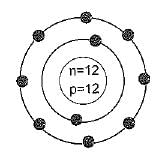
- b)
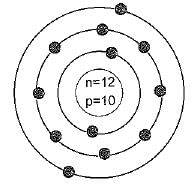
- c)
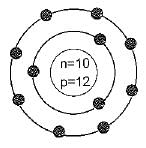
- d)
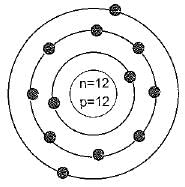
Correct answer is option 'D'. Can you explain this answer?
Identify the Mg atom from the following figures where, n and p represent the number of neutrons and protons respectively.
a)
b)
c)
d)
| | Let's Tute answered |
Electronic configuration of 12Mg atom = 2, 8, 2
Number of protons in Mg atom = 2+ 8 + 2 = 12
Number of neutrons in Mg atom = 24 -12 = 12
[as mass number of Mg atom = 24 and number of neutrons = mass number – number of protons]
[as mass number of Mg atom = 24 and number of neutrons = mass number – number of protons]
Therefore, option (d) is the correct answer.
Direction: In the following questions, a statement of assertion (A) is followed by a statement of reason (R). Mark the correct choice as:Assertion : Anions are larger in size than the parent atom.Reason : In an anion, the number of protons in the nucleus is less than the number of electrons moving around it.- a)Both assertion (A) and reason (R) are true and reason (R) is the correct explanation of assertion (A).
- b)Both assertion (A) and reason (R) are true but reason (R) is not the correct explanation of assertion (A).
- c)Assertion (A) is true but reason (R) is false.
- d)Assertion (A) is false but reason (R) is true.
Correct answer is option 'A'. Can you explain this answer?
Direction: In the following questions, a statement of assertion (A) is followed by a statement of reason (R). Mark the correct choice as:
Assertion : Anions are larger in size than the parent atom.
Reason : In an anion, the number of protons in the nucleus is less than the number of electrons moving around it.
a)
Both assertion (A) and reason (R) are true and reason (R) is the correct explanation of assertion (A).
b)
Both assertion (A) and reason (R) are true but reason (R) is not the correct explanation of assertion (A).
c)
Assertion (A) is true but reason (R) is false.
d)
Assertion (A) is false but reason (R) is true.
| | Swati Verma answered |
The size of an anion is larger than its parent atom because anions are formed due to the gain of electrons. When the electrons increase, there are still the same number of protons. The attractive force is thus reduced as there are the same number of protons attracting an increased number of electrons.
Isobars are atoms that have:- a)The same atomic number but different mass numbers
- b)Different mass numbers and atomic numbers
- c)The same mass number but different atomic numbers
- d)Identical proton and neutron numbers
Correct answer is option 'C'. Can you explain this answer?
Isobars are atoms that have:
a)
The same atomic number but different mass numbers
b)
Different mass numbers and atomic numbers
c)
The same mass number but different atomic numbers
d)
Identical proton and neutron numbers
 | Sahil Gupta answered |
Understanding Isobars
Isobars are a concept in nuclear chemistry that refers to atoms of different elements that share the same mass number but have different atomic numbers. Here's a detailed explanation of isobars:
Definition of Isobars
- Isobars are atoms that have:
- The same mass number (the total number of protons and neutrons).
- Different atomic numbers (the number of protons).
Why Option 'C' is Correct
- In option 'C', the statement emphasizes that isobars have:
- Identical mass numbers, meaning they contain the same total number of nucleons (protons + neutrons).
- Different atomic numbers, indicating that they are different elements.
Examples of Isobars
- A classic example of isobars includes:
- Carbon-14 (6 protons and 8 neutrons) and Nitrogen-14 (7 protons and 7 neutrons).
- Both have a mass number of 14 but differ in their atomic numbers (6 for Carbon and 7 for Nitrogen).
Importance of Isobars
- Understanding isobars is crucial in:
- Nuclear chemistry and physics, where the behavior of elements can be analyzed based on their mass numbers.
- Applications in radiocarbon dating and nuclear medicine, where isotopes play a significant role.
In summary, isobars are fascinating as they reveal how elements can be related through their nucleon count while exhibiting different chemical properties due to their unique atomic numbers.
Isobars are a concept in nuclear chemistry that refers to atoms of different elements that share the same mass number but have different atomic numbers. Here's a detailed explanation of isobars:
Definition of Isobars
- Isobars are atoms that have:
- The same mass number (the total number of protons and neutrons).
- Different atomic numbers (the number of protons).
Why Option 'C' is Correct
- In option 'C', the statement emphasizes that isobars have:
- Identical mass numbers, meaning they contain the same total number of nucleons (protons + neutrons).
- Different atomic numbers, indicating that they are different elements.
Examples of Isobars
- A classic example of isobars includes:
- Carbon-14 (6 protons and 8 neutrons) and Nitrogen-14 (7 protons and 7 neutrons).
- Both have a mass number of 14 but differ in their atomic numbers (6 for Carbon and 7 for Nitrogen).
Importance of Isobars
- Understanding isobars is crucial in:
- Nuclear chemistry and physics, where the behavior of elements can be analyzed based on their mass numbers.
- Applications in radiocarbon dating and nuclear medicine, where isotopes play a significant role.
In summary, isobars are fascinating as they reveal how elements can be related through their nucleon count while exhibiting different chemical properties due to their unique atomic numbers.
The atomic size of atom is nearly –- a)10-10 cm
- b)10-6 m
- c)10-7 m
- d)10-10 m
Correct answer is option 'D'. Can you explain this answer?
The atomic size of atom is nearly –
a)
10-10 cm
b)
10-6 m
c)
10-7 m
d)
10-10 m
| | Aravind Kulkarni answered |
The atom is about 10-10 meters (or 10-8 centimeters) in size. This means a row of 10^8 (or 100,000,000)atoms would stretch a centimeter, about the size of your fingernail. Atoms of different elements are different sizes, but 10-10 m can be thought of as a rough value for any atom.
Can you explain the answer of this question below:The first use of quantum theory to explain the structure of atom was made by –
- A:
Heisenberg
- B:
Bohr
- C:
Plank
- D:
Einstein
The answer is B.
The first use of quantum theory to explain the structure of atom was made by –
Heisenberg
Bohr
Plank
Einstein
 | Prachi Rathore answered |
Bohr first made use of quantum theory to explain the structure of atom and proposed that energy of electron in an atom is quantized
Direction: In the following questions, a statement of assertion (A) is followed by a statement of reason (R). Mark the correct choice as:Assertion : Cathode rays travel in straight lines.Reason : Cathode rays do not penetrate through thin sheets.- a)Both assertion (A) and reason (R) are true and reason (R) is the correct explanation of assertion (A).
- b)Both assertion (A) and reason (R) are true but reason (R) is not the correct explanation of assertion (A).
- c)Assertion (A) is true but reason (R) is false.
- d)Assertion (A) is false but reason (R) is true.
Correct answer is option 'C'. Can you explain this answer?
Direction: In the following questions, a statement of assertion (A) is followed by a statement of reason (R). Mark the correct choice as:
Assertion : Cathode rays travel in straight lines.
Reason : Cathode rays do not penetrate through thin sheets.
a)
Both assertion (A) and reason (R) are true and reason (R) is the correct explanation of assertion (A).
b)
Both assertion (A) and reason (R) are true but reason (R) is not the correct explanation of assertion (A).
c)
Assertion (A) is true but reason (R) is false.
d)
Assertion (A) is false but reason (R) is true.
| | Meera Rana answered |
Cathode rays can penetrate through thin sweets.
What was the primary goal of Rutherford's experiment with alpha particles?- a)To determine the mass of gold atoms
- b)To discover the existence of electrons
- c)To understand how electrons are arranged within an atom
- d)To measure the speed of alpha particles
Correct answer is option 'C'. Can you explain this answer?
What was the primary goal of Rutherford's experiment with alpha particles?
a)
To determine the mass of gold atoms
b)
To discover the existence of electrons
c)
To understand how electrons are arranged within an atom
d)
To measure the speed of alpha particles
 | EduRev UPSC answered |
Rutherford aimed to understand the arrangement of electrons within the atom through his experiments with alpha particles.
Direction: In the following questions, a statement of assertion (A) is followed by a statement of reason (R). Mark the correct choice as:
Assertion: Members of noble gas family are very little reactive chemically.
Reason: Members of noble gas family have completely filled valence shells of their atoms.- a)Both assertion (A) and reason (R) are true and reason (R) is the correct explanation of assertion (A).
- b)Both assertion (A) and reason (R) are true but reason (R) is not the correct explanation of assertion (A).
- c)Assertion (A) is true but reason (R) is false.
- d)Assertion (A) is false but reason (R) is true.
Correct answer is option 'A'. Can you explain this answer?
Direction: In the following questions, a statement of assertion (A) is followed by a statement of reason (R). Mark the correct choice as:
Assertion: Members of noble gas family are very little reactive chemically.
Reason: Members of noble gas family have completely filled valence shells of their atoms.
Assertion: Members of noble gas family are very little reactive chemically.
Reason: Members of noble gas family have completely filled valence shells of their atoms.
a)
Both assertion (A) and reason (R) are true and reason (R) is the correct explanation of assertion (A).
b)
Both assertion (A) and reason (R) are true but reason (R) is not the correct explanation of assertion (A).
c)
Assertion (A) is true but reason (R) is false.
d)
Assertion (A) is false but reason (R) is true.
| | Amit Sharma answered |
The correct option is A
Both assertion and reason are correct and the reason is the correct explanation of assertion.
Explanation for assertion:
Group 18 elements are called inert gases, as they do not react easily.
Explanation for reason statement:
- Noble gas elements have their duplet or octet complete, which means that they have completely filled valence shells.
- Due to this reason, they have very low electronegativity and very high Ionization Potential, hence they are then fairly unreactive and called inert gases.
Hence, A) Both assertion and reason are true, reason is the correct explanation of assertion.
What is the valency of an element with an electron configuration of 2, 8, 3?- a)8
- b)3
- c)5
- d)0
Correct answer is option 'B'. Can you explain this answer?
What is the valency of an element with an electron configuration of 2, 8, 3?
a)
8
b)
3
c)
5
d)
0
| | Sandeep Rane answered |
Understanding Valency
Valency refers to the combining capacity of an element, which is determined by the number of electrons in its outermost shell.
Electron Configuration Overview
- The given electron configuration is 2, 8, 3.
- This indicates that the element has:
- 2 electrons in the first shell
- 8 electrons in the second shell
- 3 electrons in the third shell
Determining the Valency
- Valency is primarily influenced by the number of electrons in the outermost shell, also known as the valence shell.
- For the element with an electron configuration of 2, 8, 3:
- The outermost shell (third shell) contains 3 electrons.
Valency Calculation
- Elements tend to lose, gain, or share electrons to achieve a stable electron configuration, typically resembling that of noble gases.
- Since this element has 3 electrons in its outermost shell:
- It can lose these 3 electrons to achieve a stable configuration.
Conclusion
- Therefore, the valency of this element is 3, as it can form bonds by losing 3 electrons.
- The correct answer to the question is option 'B', which signifies a valency of 3.
This understanding of electron configuration helps predict how elements will react and bond with one another, forming the basis of chemical behavior.
Valency refers to the combining capacity of an element, which is determined by the number of electrons in its outermost shell.
Electron Configuration Overview
- The given electron configuration is 2, 8, 3.
- This indicates that the element has:
- 2 electrons in the first shell
- 8 electrons in the second shell
- 3 electrons in the third shell
Determining the Valency
- Valency is primarily influenced by the number of electrons in the outermost shell, also known as the valence shell.
- For the element with an electron configuration of 2, 8, 3:
- The outermost shell (third shell) contains 3 electrons.
Valency Calculation
- Elements tend to lose, gain, or share electrons to achieve a stable electron configuration, typically resembling that of noble gases.
- Since this element has 3 electrons in its outermost shell:
- It can lose these 3 electrons to achieve a stable configuration.
Conclusion
- Therefore, the valency of this element is 3, as it can form bonds by losing 3 electrons.
- The correct answer to the question is option 'B', which signifies a valency of 3.
This understanding of electron configuration helps predict how elements will react and bond with one another, forming the basis of chemical behavior.
Which law states that "In a chemical substance, the elements are always present in definite proportions by mass"?- a)Law of Conservation of Mass
- b)Law of Definite Proportions
- c)Law of Multiple Proportions
- d)Law of Chemical Reactions
Correct answer is option 'B'. Can you explain this answer?
Which law states that "In a chemical substance, the elements are always present in definite proportions by mass"?
a)
Law of Conservation of Mass
b)
Law of Definite Proportions
c)
Law of Multiple Proportions
d)
Law of Chemical Reactions
| | Kalyan Choudhury answered |
Understanding the Law of Definite Proportions
The Law of Definite Proportions, also known as Proust's Law, is a fundamental principle in chemistry. This law states that in any given chemical compound, the elements are always present in fixed proportions by mass, regardless of the source or the method of preparation.
Key Points of the Law:
- Fixed Ratios:
- Each chemical compound has a specific ratio of elements. For example, water (H2O) consists of 2 hydrogen atoms and 1 oxygen atom in every molecule.
- Mass Consistency:
- The mass of each element in a compound remains constant. Using the water example, if you have 18 grams of water, it will always contain 2 grams of hydrogen and 16 grams of oxygen.
- Implication in Chemistry:
- This law supports the idea that compounds are distinct substances with unique properties, and their chemical formulas reflect the exact ratios of their constituent elements.
Comparison with Other Laws:
- Law of Conservation of Mass:
- This law states that mass is neither created nor destroyed in a chemical reaction, which is different from the fixed ratios of the Law of Definite Proportions.
- Law of Multiple Proportions:
- This law explains how elements can combine in different ratios to form different compounds, but it does not specify that each compound has a fixed ratio.
In conclusion, the Law of Definite Proportions is crucial for understanding chemical compounds and their consistent composition, allowing chemists to predict how substances will behave in reactions.
The Law of Definite Proportions, also known as Proust's Law, is a fundamental principle in chemistry. This law states that in any given chemical compound, the elements are always present in fixed proportions by mass, regardless of the source or the method of preparation.
Key Points of the Law:
- Fixed Ratios:
- Each chemical compound has a specific ratio of elements. For example, water (H2O) consists of 2 hydrogen atoms and 1 oxygen atom in every molecule.
- Mass Consistency:
- The mass of each element in a compound remains constant. Using the water example, if you have 18 grams of water, it will always contain 2 grams of hydrogen and 16 grams of oxygen.
- Implication in Chemistry:
- This law supports the idea that compounds are distinct substances with unique properties, and their chemical formulas reflect the exact ratios of their constituent elements.
Comparison with Other Laws:
- Law of Conservation of Mass:
- This law states that mass is neither created nor destroyed in a chemical reaction, which is different from the fixed ratios of the Law of Definite Proportions.
- Law of Multiple Proportions:
- This law explains how elements can combine in different ratios to form different compounds, but it does not specify that each compound has a fixed ratio.
In conclusion, the Law of Definite Proportions is crucial for understanding chemical compounds and their consistent composition, allowing chemists to predict how substances will behave in reactions.
Isotopes of an element are the atom which have –- a)The same number of neutrons in their nuclei
- b)The same mass number
- c)Different number of electrons in their orbit
- d)The same number of proton in their nuclei
Correct answer is option 'D'. Can you explain this answer?
Isotopes of an element are the atom which have –
a)
The same number of neutrons in their nuclei
b)
The same mass number
c)
Different number of electrons in their orbit
d)
The same number of proton in their nuclei
| | Abhishek Phogat answered |
Species which have same atomic number that is number of protons.... Hence option d....
Direction: In the following questions, a statement of assertion (A) is followed by a statement of reason (R). Mark the correct choice as:Assertion : Thomson’s atomic model is known as ‘raisin pudding’ model.Reason : The atom is visualized as a pudding of positive charge with electrons (raisins) embedded in it.- a)Both assertion (A) and reason (R) are true and reason (R) is the correct explanation of assertion (A).
- b)Both assertion (A) and reason (R) are true but reason (R) is not the correct explanation of assertion (A).
- c)Assertion (A) is true but reason (R) is false.
- d)Assertion (A) is false but reason (R) is true.
Correct answer is option 'A'. Can you explain this answer?
Direction: In the following questions, a statement of assertion (A) is followed by a statement of reason (R). Mark the correct choice as:
Assertion : Thomson’s atomic model is known as ‘raisin pudding’ model.
Reason : The atom is visualized as a pudding of positive charge with electrons (raisins) embedded in it.
a)
Both assertion (A) and reason (R) are true and reason (R) is the correct explanation of assertion (A).
b)
Both assertion (A) and reason (R) are true but reason (R) is not the correct explanation of assertion (A).
c)
Assertion (A) is true but reason (R) is false.
d)
Assertion (A) is false but reason (R) is true.
 | Kavya Chopra answered |
Assertion : Thomson’s atomic model is known as ‘raisin pudding’ model.
Reason : The atom is visualized as a pudding of positive charge with electrons (raisins) embedded in it.
The correct answer is option A: Both assertion (A) and reason (R) are true and reason (R) is the correct explanation of assertion (A).
Explanation:
Thomson's atomic model, also known as the "raisin pudding" model, was proposed by J.J. Thomson in 1904. This model was a modification of the earlier plum pudding model proposed by Thomson himself in 1897. Let's break down the assertion and reason to understand why option A is the correct answer.
Thomson's Atomic Model:
- Thomson's atomic model was proposed as a modification of the plum pudding model.
- It was based on the discovery of electrons by Thomson through his experiments with cathode rays.
- According to Thomson's model, an atom is visualized as a sphere of positive charge with electrons embedded in it like raisins in a pudding.
- The positive charge in the atom is spread uniformly throughout the atom, while the negatively charged electrons are scattered randomly within the positive charge.
Assertion (A): Thomson’s atomic model is known as ‘raisin pudding’ model.
The assertion is true. Thomson's atomic model is indeed known as the "raisin pudding" model because it visualizes the atom as a sphere of positive charge with electrons embedded in it like raisins in a pudding.
Reason (R): The atom is visualized as a pudding of positive charge with electrons (raisins) embedded in it.
The reason is also true. In Thomson's atomic model, the atom is indeed visualized as a pudding of positive charge with electrons (raisins) embedded in it. The positive charge represents the overall charge of the atom, while the electrons represent the negatively charged particles.
Explanation of Correct Answer:
In this case, both the assertion and the reason are true. The reason provided correctly explains the assertion. Thomson's atomic model is known as the "raisin pudding" model because it visualizes the atom as a sphere of positive charge with electrons embedded in it like raisins in a pudding. Therefore, option A is the correct answer.
Reason : The atom is visualized as a pudding of positive charge with electrons (raisins) embedded in it.
The correct answer is option A: Both assertion (A) and reason (R) are true and reason (R) is the correct explanation of assertion (A).
Explanation:
Thomson's atomic model, also known as the "raisin pudding" model, was proposed by J.J. Thomson in 1904. This model was a modification of the earlier plum pudding model proposed by Thomson himself in 1897. Let's break down the assertion and reason to understand why option A is the correct answer.
Thomson's Atomic Model:
- Thomson's atomic model was proposed as a modification of the plum pudding model.
- It was based on the discovery of electrons by Thomson through his experiments with cathode rays.
- According to Thomson's model, an atom is visualized as a sphere of positive charge with electrons embedded in it like raisins in a pudding.
- The positive charge in the atom is spread uniformly throughout the atom, while the negatively charged electrons are scattered randomly within the positive charge.
Assertion (A): Thomson’s atomic model is known as ‘raisin pudding’ model.
The assertion is true. Thomson's atomic model is indeed known as the "raisin pudding" model because it visualizes the atom as a sphere of positive charge with electrons embedded in it like raisins in a pudding.
Reason (R): The atom is visualized as a pudding of positive charge with electrons (raisins) embedded in it.
The reason is also true. In Thomson's atomic model, the atom is indeed visualized as a pudding of positive charge with electrons (raisins) embedded in it. The positive charge represents the overall charge of the atom, while the electrons represent the negatively charged particles.
Explanation of Correct Answer:
In this case, both the assertion and the reason are true. The reason provided correctly explains the assertion. Thomson's atomic model is known as the "raisin pudding" model because it visualizes the atom as a sphere of positive charge with electrons embedded in it like raisins in a pudding. Therefore, option A is the correct answer.
Chapter doubts & questions for Inside the Atom - Maharashtra Board for Class 8 All Subjects 2026 is part of Class 8 exam preparation. The chapters have been prepared according to the Class 8 exam syllabus. The Chapter doubts & questions, notes, tests & MCQs are made for Class 8 2026 Exam. Find important definitions, questions, notes, meanings, examples, exercises, MCQs and online tests here.
Chapter doubts & questions of Inside the Atom - Maharashtra Board for Class 8 All Subjects in English & Hindi are available as part of Class 8 exam. Download more important topics, notes, lectures and mock test series for Class 8 Exam by signing up for free.
Maharashtra Board for Class 8 All Subjects92 videos|533 docs|62 tests |
