


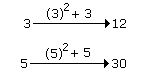

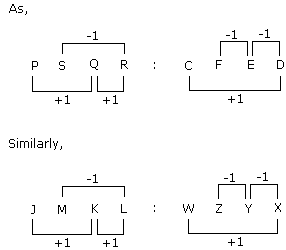

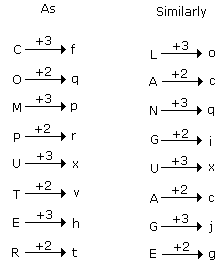

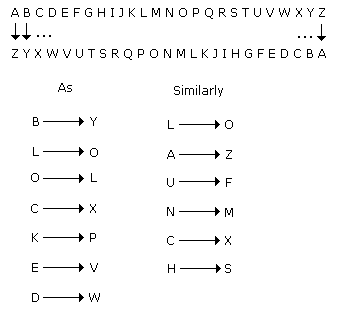


‘Mustard’ is related to ‘Seed’ in the same way as ‘Carrot’ is related to………. ?
All Exams > SSC CGL > General Intelligence and Reasoning for SSC CGL > All Questions
All questions of Analogy for SSC CGL Exam
Directions to SolveIn each of the following questions find out the alternative which will replace the question mark.Question - In this pyramid number if: 11 22 31 : 12 21 32 :: 9 12 21 : ?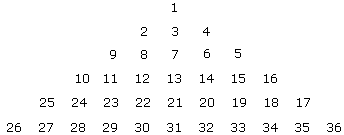
- a)2 7 14
- b)8 13 20
- c)6 15 18
- d)10 23 30
Correct answer is option 'B'. Can you explain this answer?
Directions to Solve
In each of the following questions find out the alternative which will replace the question mark.
Question - In this pyramid number if: 11 22 31 : 12 21 32 :: 9 12 21 : ?
a)
2 7 14
b)
8 13 20
c)
6 15 18
d)
10 23 30
 | Nikita Singh answered |
If we see diagonally we will get 11 22 31 and the next diagonal series is 12 21 32. Similarly the next diagonal series after 9 12 21 is 8 13 20.
Directions to SolveIn each of the following questions find out the alternative which will replace the question mark.Question - Peace : Chaos :: Creation : ?- a)Build
- b)Construction
- c)Destruction
- d)Manufacture
Correct answer is option 'C'. Can you explain this answer?
Directions to Solve
In each of the following questions find out the alternative which will replace the question mark.
Question -
Peace : Chaos :: Creation : ?
a)
Build
b)
Construction
c)
Destruction
d)
Manufacture
 | Sravya Deshpande answered |
As opposite meaning of peace is chaos similarly opposite meaning of creation is destruction.
Directions to SolveIn each of the following questions find out the alternative which will replace the question mark.Question - 8 : 28 :: 27 : ?- a)28
- b)8
- c)64
- d)65
Correct answer is option 'D'. Can you explain this answer?
Directions to Solve
In each of the following questions find out the alternative which will replace the question mark.
Question - 8 : 28 :: 27 : ?
a)
28
b)
8
c)
64
d)
65
 | Nandini Singh answered |
First number = 8 and the sum of the digits of the second number is 2 + 8 = 10.
Thus the difference of the first number and the sum of the digits of second number is 10 - 8 = 2.
Similarly, the sum of the digits of third number is 2 + 7 = 9.
Hence the sum of digits of fourth number should be 2 more than 9 i.e. 11
Hence, fourth number is 65.
Select the option that is related to the third word in the same way as the second word is related to the first word. (The words must be considered as meaningful English words and must not be related to each other based on the number of letters/number of consonants/vowels in the word.)Concology : Shells :: Palaeontology : ?- a)Metals
- b)Fossils
- c)Planets
- d)Soil
Correct answer is option 'B'. Can you explain this answer?
Select the option that is related to the third word in the same way as the second word is related to the first word. (The words must be considered as meaningful English words and must not be related to each other based on the number of letters/number of consonants/vowels in the word.)
Concology : Shells :: Palaeontology : ?
a)
Metals
b)
Fossils
c)
Planets
d)
Soil
 | Elite Coaching Classes answered |
The logic followed here is:
Logic: Study of specific subjects.
Here,
Concology : Shells → Concology is the study of shells.
Similarly,
Palaeontology : Fossils → Palaeontology is the study of fossils.
Hence, the correct answer is "Option 2".
Logic: Study of specific subjects.
Here,
Concology : Shells → Concology is the study of shells.
Similarly,
Palaeontology : Fossils → Palaeontology is the study of fossils.
Hence, the correct answer is "Option 2".
Directions to SolveIn each word of the following questions consists of pair of words bearing a relationship among these, from amongst the alternatives, pick up the pair that best illustrate a similar relationship.Question - Sunrise : Sunset- a)Dawn : Twilight
- b)Noon : Midnight
- c)Morning : Night
- d)Energetic : Lazy
Correct answer is option 'C'. Can you explain this answer?
Directions to Solve
In each word of the following questions consists of pair of words bearing a relationship among these, from amongst the alternatives, pick up the pair that best illustrate a similar relationship.
Question - Sunrise : Sunset
a)
Dawn : Twilight
b)
Noon : Midnight
c)
Morning : Night
d)
Energetic : Lazy
 | Ishani Mishra answered |
At sunrise morning begins, similarly at sunset night begins.
This question consists of a pair of words which have a certain relationship to each other. Select the pair which does NOT have the same relationship.Smart : Intelligent
1) Liable : Accountable
2) Modest : Humble
3) Nimble : Sluggish
4) Outbreak : Eruption- a)3
- b)1
- c)4
- d)2
Correct answer is option 'A'. Can you explain this answer?
This question consists of a pair of words which have a certain relationship to each other. Select the pair which does NOT have the same relationship.
Smart : Intelligent
1) Liable : Accountable
2) Modest : Humble
3) Nimble : Sluggish
4) Outbreak : Eruption
1) Liable : Accountable
2) Modest : Humble
3) Nimble : Sluggish
4) Outbreak : Eruption
a)
3
b)
1
c)
4
d)
2
| | Elite Coaching Classes answered |
The logic followed here is:
Logic: Identifying Synonyms.
Here,
Smart : Intelligent → Smart and Intelligent are synonyms.
Similarly,
Liable : Accountable → Liable and Accountable are synonyms.
Modest : Humble → Modest and Humble are synonyms.
Outbreak : Eruption → Outbreak and Eruption are synonyms.
However,
Nimble : Sluggish → Nimble and Sluggish are antonyms, not synonyms.
Hence, the correct answer is "Option 1".
Logic: Identifying Synonyms.
Here,
Smart : Intelligent → Smart and Intelligent are synonyms.
Similarly,
Liable : Accountable → Liable and Accountable are synonyms.
Modest : Humble → Modest and Humble are synonyms.
Outbreak : Eruption → Outbreak and Eruption are synonyms.
However,
Nimble : Sluggish → Nimble and Sluggish are antonyms, not synonyms.
Hence, the correct answer is "Option 1".
Directions to SolveIn each of the following questions find out the alternative which will replace the question mark.Question - 335 : 216 :: 987 : ?- a)868
- b)867
- c)872
- d)888
Correct answer is option 'A'. Can you explain this answer?
Directions to Solve
In each of the following questions find out the alternative which will replace the question mark.
Question - 335 : 216 :: 987 : ?
a)
868
b)
867
c)
872
d)
888
 | Alok Patel answered |
As 335 - 216 = 119
Similarly, 987 - X = 119
Therefore, X = 987 - 119 = 868.
Directions to SolveIn each of the following questions find out the alternative which will replace the question mark.Question - 144 : 10 :: 169 : ?- a)14
- b)11
- c)13
- d)12
Correct answer is option 'B'. Can you explain this answer?
Directions to Solve
In each of the following questions find out the alternative which will replace the question mark.
Question -
144 : 10 :: 169 : ?
a)
14
b)
11
c)
13
d)
12
 | Sanaya Sharma answered |
Sure, let's find the correct answer for the given problem.
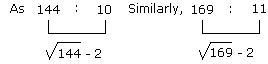
144 : 10 :: 169 : ?
- 144 is a perfect square (12²) and its square root is 12.
- 12 is then reduced to 10 by subtracting 2 (12 - 2 = 10).
- Similarly, 169 is a perfect square (13²) and its square root is 13.
- Following the same pattern, subtract 2 from 13 (13 - 2 = 11).
Thus, the correct answer is:
B: 11
- 169 : 11
144 : 10 :: 169 : ?
- 144 is a perfect square (12²) and its square root is 12.
- 12 is then reduced to 10 by subtracting 2 (12 - 2 = 10).
- Similarly, 169 is a perfect square (13²) and its square root is 13.
- Following the same pattern, subtract 2 from 13 (13 - 2 = 11).
Thus, the correct answer is:
B: 11
- 169 : 11
9 is related to 47 following a certain logic. Following the same logic, 12 is related to 62. To which of the following is 17 related, following the same logic?
(NOTE: Operations should be performed on the whole numbers, without breaking down the numbers into their constituent digits. E.g. 13 – Operations on 13 such as adding/ subtracting /multiplying to 13 can be performed. Breaking down 13 into 1 and 3 and then performing mathematical operations on 1 and 3 is not allowed.)- a)97
- b)87
- c)85
- d)75
Correct answer is option 'B'. Can you explain this answer?
9 is related to 47 following a certain logic. Following the same logic, 12 is related to 62. To which of the following is 17 related, following the same logic?
(NOTE: Operations should be performed on the whole numbers, without breaking down the numbers into their constituent digits. E.g. 13 – Operations on 13 such as adding/ subtracting /multiplying to 13 can be performed. Breaking down 13 into 1 and 3 and then performing mathematical operations on 1 and 3 is not allowed.)
(NOTE: Operations should be performed on the whole numbers, without breaking down the numbers into their constituent digits. E.g. 13 – Operations on 13 such as adding/ subtracting /multiplying to 13 can be performed. Breaking down 13 into 1 and 3 and then performing mathematical operations on 1 and 3 is not allowed.)
a)
97
b)
87
c)
85
d)
75
 | Pramod Shane answered |
47 = 9x5 + 2
60 = 12x5 + 2
similarly
17x5 + 2 = 85 +2 = 87
Select the set in which the numbers are related in the same way as are the numbers of the following sets.(NOTE: Operations should be performed on the whole numbers, without breaking down the numbers into its constituent digits. E.g. 13 – Operations on 13 such as adding/deleting/multiplying etc. to 13 can be performed. Breaking down 13 into 1 and 3 and then performing mathematical operations on 1 and 3 is not allowed.)(10, 20, 4)
(15, 30, 6) - a)(20, 40, 8)
- b)(20, 30, 8)
- c)(20, 40, 6)
- d)(10, 40, 8)
Correct answer is option 'A'. Can you explain this answer?
Select the set in which the numbers are related in the same way as are the numbers of the following sets.
(NOTE: Operations should be performed on the whole numbers, without breaking down the numbers into its constituent digits. E.g. 13 – Operations on 13 such as adding/deleting/multiplying etc. to 13 can be performed. Breaking down 13 into 1 and 3 and then performing mathematical operations on 1 and 3 is not allowed.)
(10, 20, 4)
(15, 30, 6)
(15, 30, 6)
a)
(20, 40, 8)
b)
(20, 30, 8)
c)
(20, 40, 6)
d)
(10, 40, 8)
| | Elite Coaching Classes answered |
The logic followed here is : [(1st number × 2) + 2nd number] ÷ 10 = 3rd number
Given :
(10, 20, 4)
[(10 × 2) + 20] ÷ 10 = 4
[20 + 20] ÷ 10 = 4
40 ÷ 10 = 4
4 = 4 (LHS = RHS)
And,
(15, 30, 6)
[(15 × 2) + 30] ÷ 10 = 6
[30 + 30] ÷ 10 = 6
60 ÷ 10 = 6
6 = 6 (LHS = RHS)
So,
Option - (1) : (20, 40, 8)
[(20 × 2) + 40] ÷ 10 = 8
[40 + 40] ÷ 10 = 8
80 ÷ 10 = 8
(10, 20, 4)
[(10 × 2) + 20] ÷ 10 = 4
[20 + 20] ÷ 10 = 4
40 ÷ 10 = 4
4 = 4 (LHS = RHS)
And,
(15, 30, 6)
[(15 × 2) + 30] ÷ 10 = 6
[30 + 30] ÷ 10 = 6
60 ÷ 10 = 6
6 = 6 (LHS = RHS)
So,
Option - (1) : (20, 40, 8)
[(20 × 2) + 40] ÷ 10 = 8
[40 + 40] ÷ 10 = 8
80 ÷ 10 = 8
8 = 8 (LHS = RHS)
Option - (2) : (20, 30, 8)
[(20 × 2) + 30] ÷ 10 = 6
[40 + 30] ÷ 10 = 6
70 ÷ 10 = 6
7 ≠ 6 (LHS ≠ RHS)
Option - (3) : (20, 40, 6)
[(20 × 2) + 40] ÷ 10 = 6
[40 + 40] ÷ 10 = 6
80 ÷ 10 = 6
Option - (2) : (20, 30, 8)
[(20 × 2) + 30] ÷ 10 = 6
[40 + 30] ÷ 10 = 6
70 ÷ 10 = 6
7 ≠ 6 (LHS ≠ RHS)
Option - (3) : (20, 40, 6)
[(20 × 2) + 40] ÷ 10 = 6
[40 + 40] ÷ 10 = 6
80 ÷ 10 = 6
8 ≠ 6 (LHS ≠ RHS)
Option - (4) : (10, 40, 8)
[(10 × 2) + 40] ÷ 10 = 8
[20 + 40] ÷ 10 = 8
60 ÷ 10 = 8
7 ≠ 8 (LHS ≠ RHS)
Hence, "Option - (1)" is the correct answer.
Option - (4) : (10, 40, 8)
[(10 × 2) + 40] ÷ 10 = 8
[20 + 40] ÷ 10 = 8
60 ÷ 10 = 8
7 ≠ 8 (LHS ≠ RHS)
Hence, "Option - (1)" is the correct answer.
Select the word-pair that best represents a similar relationship to the one expressed in the pair of words given below.
(The words must be considered as meaningful English words and must not be related to each other based on the number of letters/number of consonants/vowels in the word)
Strong : Robust - a)Kind : Generous
- b)Brave : Fearful
- c)Knowledge : Ignorance
- d)Create : Destroy
Correct answer is option 'A'. Can you explain this answer?
Select the word-pair that best represents a similar relationship to the one expressed in the pair of words given below.
(The words must be considered as meaningful English words and must not be related to each other based on the number of letters/number of consonants/vowels in the word)
Strong : Robust
(The words must be considered as meaningful English words and must not be related to each other based on the number of letters/number of consonants/vowels in the word)
Strong : Robust
a)
Kind : Generous
b)
Brave : Fearful
c)
Knowledge : Ignorance
d)
Create : Destroy
| | Elite Coaching Classes answered |
The logic followed here is:
Logic: Synonyms - Words with similar meanings.
Here,
Strong : Robust → Strong and Robust are words with similar meanings (synonyms).
Similarly,
Kind : Generous → Kind and Generous are also words with similar meanings (synonyms).
Hence, the correct answer is "Option 1".
Logic: Synonyms - Words with similar meanings.
Here,
Strong : Robust → Strong and Robust are words with similar meanings (synonyms).
Similarly,
Kind : Generous → Kind and Generous are also words with similar meanings (synonyms).
Hence, the correct answer is "Option 1".
Directions to SolveIn each word of the following questions consists of pair of words bearing a relationship among these, from amongst the alternatives, pick up the pair that best illustrate a similar relationship.Question - Sound : Muffled- a)Moisture : Humid
- b)Colour : Faded
- c)Despair : Anger
- d)Odour : Pungent
Correct answer is option 'B'. Can you explain this answer?
Directions to Solve
In each word of the following questions consists of pair of words bearing a relationship among these, from amongst the alternatives, pick up the pair that best illustrate a similar relationship.
Question - Sound : Muffled
a)
Moisture : Humid
b)
Colour : Faded
c)
Despair : Anger
d)
Odour : Pungent
 | Keerthana Choudhary answered |
Second is the process of gradual disappearances of the first.
Directions to SolveIn each word of the following questions consists of pair of words bearing a relationship among these, from amongst the alternatives, pick up the pair that best illustrate a similar relationship.Question - Silence : Noise- a)Quiet : Peace
- b)Baldness : Hair
- c)Talk : Whisper
- d)Sing : Dance
Correct answer is option 'B'. Can you explain this answer?
Directions to Solve
In each word of the following questions consists of pair of words bearing a relationship among these, from amongst the alternatives, pick up the pair that best illustrate a similar relationship.
Question - Silence : Noise
a)
Quiet : Peace
b)
Baldness : Hair
c)
Talk : Whisper
d)
Sing : Dance
 | Kaavya Nair answered |
Solution:
To solve this question, we need to analyze the relationship between the words "Silence" and "Noise" and find the pair that exhibits a similar relationship.
1. Understanding the Relationship:
The word "Silence" is the opposite or absence of the word "Noise." Silence refers to the absence of any sound or noise, while noise refers to any unwanted or unpleasant sound.
2. Analyzing the Options:
Let's analyze each option and see if they exhibit a similar relationship.
a) Quiet : Peace
The words "Quiet" and "Peace" do not exhibit a similar relationship as "Silence" and "Noise." Quiet refers to a low volume or lack of sound, while peace refers to a state of tranquility or absence of conflict.
b) Baldness : Hair
The words "Baldness" and "Hair" do not exhibit a similar relationship as "Silence" and "Noise." Baldness refers to the absence of hair, while hair refers to the strands that grow on the head or body.
c) Talk : Whisper
The words "Talk" and "Whisper" do not exhibit a similar relationship as "Silence" and "Noise." Talk refers to speaking in a normal volume, while whisper refers to speaking in a soft, hushed tone.
d) Sing : Dance
The words "Sing" and "Dance" do not exhibit a similar relationship as "Silence" and "Noise." Singing refers to producing musical sounds with the voice, while dancing refers to moving rhythmically to music.
3. Conclusion:
After analyzing all the options, we can see that the pair "Baldness : Hair" does not exhibit a similar relationship as "Silence : Noise." Therefore, the correct answer is option 'B' - "Quiet : Peace." Although not a perfect match, "Quiet" and "Peace" both refer to a state of calmness or absence of disturbance, which is similar to the relationship between "Silence" and "Noise."
Final Answer:
The pair that best illustrates a similar relationship as "Silence : Noise" is "Quiet : Peace" (option 'A').
To solve this question, we need to analyze the relationship between the words "Silence" and "Noise" and find the pair that exhibits a similar relationship.
1. Understanding the Relationship:
The word "Silence" is the opposite or absence of the word "Noise." Silence refers to the absence of any sound or noise, while noise refers to any unwanted or unpleasant sound.
2. Analyzing the Options:
Let's analyze each option and see if they exhibit a similar relationship.
a) Quiet : Peace
The words "Quiet" and "Peace" do not exhibit a similar relationship as "Silence" and "Noise." Quiet refers to a low volume or lack of sound, while peace refers to a state of tranquility or absence of conflict.
b) Baldness : Hair
The words "Baldness" and "Hair" do not exhibit a similar relationship as "Silence" and "Noise." Baldness refers to the absence of hair, while hair refers to the strands that grow on the head or body.
c) Talk : Whisper
The words "Talk" and "Whisper" do not exhibit a similar relationship as "Silence" and "Noise." Talk refers to speaking in a normal volume, while whisper refers to speaking in a soft, hushed tone.
d) Sing : Dance
The words "Sing" and "Dance" do not exhibit a similar relationship as "Silence" and "Noise." Singing refers to producing musical sounds with the voice, while dancing refers to moving rhythmically to music.
3. Conclusion:
After analyzing all the options, we can see that the pair "Baldness : Hair" does not exhibit a similar relationship as "Silence : Noise." Therefore, the correct answer is option 'B' - "Quiet : Peace." Although not a perfect match, "Quiet" and "Peace" both refer to a state of calmness or absence of disturbance, which is similar to the relationship between "Silence" and "Noise."
Final Answer:
The pair that best illustrates a similar relationship as "Silence : Noise" is "Quiet : Peace" (option 'A').
Directions to SolveIn each of the following questions find out the alternative which will replace the question mark.Question - K/T : 11/20 :: J/R : ?- a)10/18
- b)11/19
- c)10/8
- d)9/10
Correct answer is option 'A'. Can you explain this answer?
Directions to Solve
In each of the following questions find out the alternative which will replace the question mark.
Question - K/T : 11/20 :: J/R : ?
a)
10/18
b)
11/19
c)
10/8
d)
9/10
| | Nandini Singh answered |
In Eq. alphabets positions of K and T are 11 and 20 respectively.
Similarly positions of J and R are 10 and 18.
Directions to SolveIn each of the following questions find out the alternative which will replace the question mark.Question - Poles : Magnet :: ? : Battery- a)Cells
- b)Power
- c)Terminals
- d)Energy
Correct answer is option 'C'. Can you explain this answer?
Directions to Solve
In each of the following questions find out the alternative which will replace the question mark.
Question -
Poles : Magnet :: ? : Battery
a)
Cells
b)
Power
c)
Terminals
d)
Energy
 | Kalyan Mukherjee answered |
Explanation:
The given analogy is Poles : Magnet :: ? : Battery. We need to find the alternative which will replace the question mark.
Poles and Magnet are related to each other because poles are the ends of a magnet where the magnetic force is strongest.
Similarly, we need to find a word which is related to Battery.
Cells, Power, Terminals, and Energy are all related to Battery in some way. Let's see how:
Cells: Batteries consist of cells that convert chemical energy into electrical energy.
Power: Batteries are a source of power that provide electrical energy to devices.
Terminals: Batteries have positive and negative terminals that allow them to be connected to devices and provide electrical energy.
Energy: Batteries store potential energy that is converted into electrical energy.
Out of these options, Terminals is the most appropriate alternative to replace the question mark because poles and terminals are both the ends of an object and are used for connectivity. Thus, the correct answer is option 'C' - Terminals.
The given analogy is Poles : Magnet :: ? : Battery. We need to find the alternative which will replace the question mark.
Poles and Magnet are related to each other because poles are the ends of a magnet where the magnetic force is strongest.
Similarly, we need to find a word which is related to Battery.
Cells, Power, Terminals, and Energy are all related to Battery in some way. Let's see how:
Cells: Batteries consist of cells that convert chemical energy into electrical energy.
Power: Batteries are a source of power that provide electrical energy to devices.
Terminals: Batteries have positive and negative terminals that allow them to be connected to devices and provide electrical energy.
Energy: Batteries store potential energy that is converted into electrical energy.
Out of these options, Terminals is the most appropriate alternative to replace the question mark because poles and terminals are both the ends of an object and are used for connectivity. Thus, the correct answer is option 'C' - Terminals.
- a)Fruit
- b)Stem
- c)Flower
- d)Root
Correct answer is option 'D'. Can you explain this answer?
a)
Fruit
b)
Stem
c)
Flower
d)
Root
 | EduRev CAT answered |
Mustard is known for its seeds (mustard seed). Similarly, a carrot is the edible root of the plant, so it relates to "Root."
Select the word-pair that best represents a similar relationship to the one expressed in the pair of words given below.
(The words must be considered as meaningful English words and must not be related to each other based on the number of letters/number of consonants/vowels in the word)Carpenter : Furniture- a)Dam : Engineer
- b)Book : Author
- c)Cook : Soup
- d)Magazine : Editor
Correct answer is option 'C'. Can you explain this answer?
Select the word-pair that best represents a similar relationship to the one expressed in the pair of words given below.
(The words must be considered as meaningful English words and must not be related to each other based on the number of letters/number of consonants/vowels in the word)
(The words must be considered as meaningful English words and must not be related to each other based on the number of letters/number of consonants/vowels in the word)
Carpenter : Furniture
a)
Dam : Engineer
b)
Book : Author
c)
Cook : Soup
d)
Magazine : Editor
| | Elite Coaching Classes answered |
The logic followed here is:
Logic: Professions and their creations.
Here,
Carpenter : Furniture → Carpenter is a profession that creates Furniture.
Similarly,
Cook : Soup → Cook is a profession that creates Soup.
Hence, the correct answer is "Option 3".
Logic: Professions and their creations.
Here,
Carpenter : Furniture → Carpenter is a profession that creates Furniture.
Similarly,
Cook : Soup → Cook is a profession that creates Soup.
Hence, the correct answer is "Option 3".
Three of the following four are alike in a certain way and thus form a group. Which is the one that does NOT belong to that group?
(Note : The odd one out is not based on the number of consonants/vowels or their position in the letter cluster.)- a)PSU
- b)HKN
- c)DGJ
- d)TWZ
Correct answer is option 'A'. Can you explain this answer?
Three of the following four are alike in a certain way and thus form a group. Which is the one that does NOT belong to that group?
(Note : The odd one out is not based on the number of consonants/vowels or their position in the letter cluster.)
(Note : The odd one out is not based on the number of consonants/vowels or their position in the letter cluster.)
a)
PSU
b)
HKN
c)
DGJ
d)
TWZ
 | Amrita Reddy answered |
Understanding the Grouping
To determine which option does not belong to the group, let's analyze the given sets of letters:
- a) PSU
- b) HKN
- c) DGJ
- d) TWZ
Identifying Patterns
1. Sequential Letters:
- Check if the letters within each option follow a sequential pattern in the English alphabet.
- For example:
- HKN: H (8), K (11), N (14) - all letters are separated by an interval of 3.
- DGJ: D (4), G (7), J (10) - all letters are separated by an interval of 3.
- TWZ: T (20), W (23), Z (26) - all letters are separated by an interval of 3.
2. Examining PSU:
- PSU: P (16), S (19), U (21) - the intervals between these letters are not consistent (P to S = 3, S to U = 2).
Conclusion
- Based on the analysis, the letters in options b) HKN, c) DGJ, and d) TWZ exhibit a consistent pattern of being separated by an interval of 3, whereas a) PSU does not follow this rule.
Final Decision
- Therefore, the odd one out is a) PSU as it does not share the same sequential characteristic present in the other three options.
To determine which option does not belong to the group, let's analyze the given sets of letters:
- a) PSU
- b) HKN
- c) DGJ
- d) TWZ
Identifying Patterns
1. Sequential Letters:
- Check if the letters within each option follow a sequential pattern in the English alphabet.
- For example:
- HKN: H (8), K (11), N (14) - all letters are separated by an interval of 3.
- DGJ: D (4), G (7), J (10) - all letters are separated by an interval of 3.
- TWZ: T (20), W (23), Z (26) - all letters are separated by an interval of 3.
2. Examining PSU:
- PSU: P (16), S (19), U (21) - the intervals between these letters are not consistent (P to S = 3, S to U = 2).
Conclusion
- Based on the analysis, the letters in options b) HKN, c) DGJ, and d) TWZ exhibit a consistent pattern of being separated by an interval of 3, whereas a) PSU does not follow this rule.
Final Decision
- Therefore, the odd one out is a) PSU as it does not share the same sequential characteristic present in the other three options.
Three of the following four letter-clusters are alike in a certain way and thus form a group. Select the letter-cluster that does NOT belong to that group (Note: The odd one out is not based on the number of consonants/vowels or their position in the letter cluster) - a)FJN
- b)LHJ
- c)QUY
- d)XBF
Correct answer is option 'B'. Can you explain this answer?
Three of the following four letter-clusters are alike in a certain way and thus form a group. Select the letter-cluster that does NOT belong to that group (Note: The odd one out is not based on the number of consonants/vowels or their position in the letter cluster)
a)
FJN
b)
LHJ
c)
QUY
d)
XBF
| | Elite Coaching Classes answered |
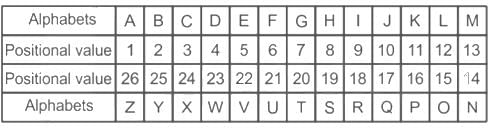
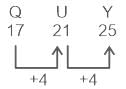
The logic followed here is:
So,
Option - 1) FJN
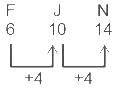
Option - 2) LHJ
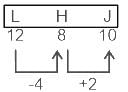
Option - 3) QUY
Option - 4) XBF
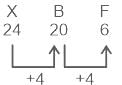
Thus, out of all options "LHJ" is the odd one out.
Hence, "Option 2" is the correct answer.
Directions to SolveIn each of the following questions find out the alternative which will replace the question mark.Question - 123 : 132 :: 235 : ?- a)232
- b)352
- c)253
- d)252
Correct answer is option 'C'. Can you explain this answer?
Directions to Solve
In each of the following questions find out the alternative which will replace the question mark.
Question - 123 : 132 :: 235 : ?
a)
232
b)
352
c)
253
d)
252
 | Jaideep Shah answered |
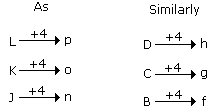
As, 123 → 132
As, 235 → 253
The middle digit of first term becomes power to the next term.

Select the option that is related to the fifth number in the same way as the fourth number is related to the third number and the second number is related to the first number.76 : 69 :: 49 : 45 :: 69 : ?- a)62
- b)63
- c)67
- d)65
Correct answer is option 'B'. Can you explain this answer?
Select the option that is related to the fifth number in the same way as the fourth number is related to the third number and the second number is related to the first number.
76 : 69 :: 49 : 45 :: 69 : ?
a)
62
b)
63
c)
67
d)
65
| | Elite Coaching Classes answered |
The logic followed here is:
Logic: (1st number - 1st digit of that number) = 2nd number.
Now,
For, 76 : 69
⇒ (76 - 7) = 69.
For, 49 : 45
⇒ (49 - 4) = 45.
Similarly, for 69 : ?
⇒ (69 - 6) = 63.
Hence, the correct answer is "Option 2".
Logic: (1st number - 1st digit of that number) = 2nd number.
Now,
For, 76 : 69
⇒ (76 - 7) = 69.
For, 49 : 45
⇒ (49 - 4) = 45.
Similarly, for 69 : ?
⇒ (69 - 6) = 63.
Hence, the correct answer is "Option 2".
Directions to SolveIn each of the following questions find out the alternative which will replace the question mark.Question - 25 : 37 :: 49 : ?- a)41
- b)65
- c)56
- d)60
Correct answer is option 'B'. Can you explain this answer?
Directions to Solve
In each of the following questions find out the alternative which will replace the question mark.
Question - 25 : 37 :: 49 : ?
a)
41
b)
65
c)
56
d)
60
 | Pallavi Chavan answered |
As 25 = (5)2 → (5 + 1)2 + 1 = 37.
As 49 = (7)2 → (7 + 1)2 + 1 = 65.
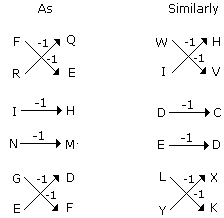


Directions to SolveIn each of the following questions find out the alternative which will replace the question mark.Question - MXN : 13 x 14 :: FXR : ?- a)14 x 15
- b)5 x 17
- c)6 x 18
- d)7 x 19
Correct answer is option 'C'. Can you explain this answer?
Directions to Solve
In each of the following questions find out the alternative which will replace the question mark.
Question -
MXN : 13 x 14 :: FXR : ?
a)
14 x 15
b)
5 x 17
c)
6 x 18
d)
7 x 19
 | Prasad Banerjee answered |
As position of M and N in Eq. alphabets are 13 and 14 respectively.Same position of F and R in Eq. alphabets are 6 and 18 respectively.
Select the word-pair that best represents a similar relationship to the one expressed in the pair of words given below. (The words must be considered as meaningful English words and must not be related to each other based on the number of letters/number of consonants/vowels in the word.)Dawn - Sunrise - a)Easy - Simple
- b)Touch - Toes
- c)Old - New
- d)Joy - Sad
Correct answer is option 'A'. Can you explain this answer?
Select the word-pair that best represents a similar relationship to the one expressed in the pair of words given below. (The words must be considered as meaningful English words and must not be related to each other based on the number of letters/number of consonants/vowels in the word.)
Dawn - Sunrise
a)
Easy - Simple
b)
Touch - Toes
c)
Old - New
d)
Joy - Sad
 | Sushant Majumdar answered |
Understanding the Relationship: Dawn and Sunrise
The word pair "Dawn - Sunrise" represents a relationship where both terms are related to the beginning of the day. "Dawn" refers to the time when light begins to appear in the sky before the sun rises, while "Sunrise" is the moment when the sun actually comes above the horizon. Both words signify different stages of the same phenomenon.
Analyzing the Options
Let's analyze the provided options to find a similar relationship:
Conclusion: The Correct Pair
Given the analysis, Option A (Easy - Simple) is the most appropriate choice as it reflects a similar relationship of meaning, just as "Dawn" and "Sunrise" do concerning the beginning of the day.
The word pair "Dawn - Sunrise" represents a relationship where both terms are related to the beginning of the day. "Dawn" refers to the time when light begins to appear in the sky before the sun rises, while "Sunrise" is the moment when the sun actually comes above the horizon. Both words signify different stages of the same phenomenon.
Analyzing the Options
Let's analyze the provided options to find a similar relationship:
- Option A: Easy - Simple
- Both words are synonyms and represent a similar concept of being uncomplicated or not difficult.
- Option B: Touch - Toes
- These terms are related through body parts, but they do not share a sequential or developmental relationship.
- Option C: Old - New
- This pair represents antonyms, which is a different relationship than that of "Dawn" and "Sunrise."
- Option D: Joy - Sad
- These words are also antonyms, contrasting emotions rather than being part of the same process.
Conclusion: The Correct Pair
Given the analysis, Option A (Easy - Simple) is the most appropriate choice as it reflects a similar relationship of meaning, just as "Dawn" and "Sunrise" do concerning the beginning of the day.
Direction: In each of the following questions, a related pair of words is followed by four pairs of words or phrases. Select the pair that best expresses a relationship similar to the one expressed in the question pair.Peel : Peal- a)Coat : Rind
- b)Laugh : Bell
- c)Rain : Reign
- d)Brain : Cranium
Correct answer is option 'C'. Can you explain this answer?
Direction: In each of the following questions, a related pair of words is followed by four pairs of words or phrases. Select the pair that best expresses a relationship similar to the one expressed in the question pair.
Peel : Peal
a)
Coat : Rind
b)
Laugh : Bell
c)
Rain : Reign
d)
Brain : Cranium
 | Mayank Unni answered |
Analogy Explanation:
Peel : Peal
Similarity:
- The relationship between "peel" and "peal" is that of a homophone, where two words have similar pronunciation but different meanings.
Applying the Relationship:
Rain : Reign
- The pair "rain" and "reign" also exhibit a homophonic relationship as they sound similar but have distinct meanings.
- "Rain" refers to water falling from the sky in the form of droplets, while "reign" refers to a period during which a sovereign rules.
- Both words have different spellings and meanings, just like "peel" and "peal" in the original pair.
Therefore, the correct answer is option 'C' - Rain : Reign.
Peel : Peal
Similarity:
- The relationship between "peel" and "peal" is that of a homophone, where two words have similar pronunciation but different meanings.
Applying the Relationship:
Rain : Reign
- The pair "rain" and "reign" also exhibit a homophonic relationship as they sound similar but have distinct meanings.
- "Rain" refers to water falling from the sky in the form of droplets, while "reign" refers to a period during which a sovereign rules.
- Both words have different spellings and meanings, just like "peel" and "peal" in the original pair.
Therefore, the correct answer is option 'C' - Rain : Reign.

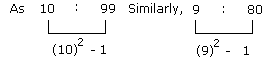
Directions to SolveIn each word of the following questions consists of pair of words bearing a relationship among these, from amongst the alternatives, pick up the pair that best illustrate a similar relationship.Question - Lawyer : Court- a)Chemist : Laboratory
- b)Businessman : Office
- c)Labour : Factory
- d)Athlete : Olympics
Correct answer is option 'A'. Can you explain this answer?
Directions to Solve
In each word of the following questions consists of pair of words bearing a relationship among these, from amongst the alternatives, pick up the pair that best illustrate a similar relationship.
Question - Lawyer : Court
a)
Chemist : Laboratory
b)
Businessman : Office
c)
Labour : Factory
d)
Athlete : Olympics
 | Roshni Kulkarni answered |
As the working field of lawyer is Court, similarly the working field of chemist is laboratory.
Directions to SolveIn each word of the following questions consists of pair of words bearing a relationship among these, from amongst the alternatives, pick up the pair that best illustrate a similar relationship.Question - Numismatist : Coins- a)Jeweller : Jewels
- b)Cartographer : Maps
- c)Philatelist : Stamps
- d)Geneticist : Chromosomes
Correct answer is option 'C'. Can you explain this answer?
Directions to Solve
In each word of the following questions consists of pair of words bearing a relationship among these, from amongst the alternatives, pick up the pair that best illustrate a similar relationship.
Question - Numismatist : Coins
a)
Jeweller : Jewels
b)
Cartographer : Maps
c)
Philatelist : Stamps
d)
Geneticist : Chromosomes
 | Saanvi Pillai answered |
As Numismatist collects coins similarly Philatelist collects stamps.
Directions to SolveIn each word of the following questions consists of pair of words bearing a relationship among these, from amongst the alternatives, pick up the pair that best illustrate a similar relationship.Question - Glove : Hand- a)Neck : Collar
- b)Tie : Shirt
- c)Socks : Feet
- d)Coat : Pocket
Correct answer is option 'C'. Can you explain this answer?
Directions to Solve
In each word of the following questions consists of pair of words bearing a relationship among these, from amongst the alternatives, pick up the pair that best illustrate a similar relationship.
Question - Glove : Hand
a)
Neck : Collar
b)
Tie : Shirt
c)
Socks : Feet
d)
Coat : Pocket
 | Pallabi Kaur answered |
As Glove is worn in Hands similarly Socks are worn on feet.
Directions to SolveIn each word of the following questions consists of pair of words bearing a relationship among these, from amongst the alternatives, pick up the pair that best illustrate a similar relationship.Question - Rectangle : Pentagon- a)Side : Angle
- b)Diagonal : Perimeter
- c)Triangle : Rectangle
- d)Circle : Square
Correct answer is option 'C'. Can you explain this answer?
Directions to Solve
In each word of the following questions consists of pair of words bearing a relationship among these, from amongst the alternatives, pick up the pair that best illustrate a similar relationship.
Question - Rectangle : Pentagon
a)
Side : Angle
b)
Diagonal : Perimeter
c)
Triangle : Rectangle
d)
Circle : Square
 | Shraddha Dasgupta answered |
Second one had one more side than the first.
Directions to SolveIn each word of the following questions consists of pair of words bearing a relationship among these, from amongst the alternatives, pick up the pair that best illustrate a similar relationship.Question - Train : Track- a)Water : Boat
- b)Bullet : Barrel
- c)Idea : Brain
- d)Fame : Television
Correct answer is option 'B'. Can you explain this answer?
Directions to Solve
In each word of the following questions consists of pair of words bearing a relationship among these, from amongst the alternatives, pick up the pair that best illustrate a similar relationship.
Question - Train : Track
a)
Water : Boat
b)
Bullet : Barrel
c)
Idea : Brain
d)
Fame : Television
 | Dipika Iyer answered |
As Train is guided by the track similarly Bullet is guided by the barrel.
Directions to SolveIn each of the following questions find out the alternative which will replace the question mark.Question - 61 : 121 :: ? : 337- a)211
- b)222
- c)220
- d)240
Correct answer is option 'A'. Can you explain this answer?
Directions to Solve
In each of the following questions find out the alternative which will replace the question mark.
Question - 61 : 121 :: ? : 337
a)
211
b)
222
c)
220
d)
240
 | Saanvi Sarkar answered |
As, 61 = (4)3 - 3
121 = (5)3 - 4
and 337 = (7)3 - 6
Therefore, ? = (6)3 - 5 = 211
15 is related to 45 following a certain logic. Following the same logic, 25 is related to 125. Which of the following numbers is related to 80 using the same logic?- a)20
- b)21
- c)18
- d)22
Correct answer is option 'A'. Can you explain this answer?
15 is related to 45 following a certain logic. Following the same logic, 25 is related to 125. Which of the following numbers is related to 80 using the same logic?
a)
20
b)
21
c)
18
d)
22
| | Elite Coaching Classes answered |
The logic followed here is:
Logic: Second number of the pair is a multiple of first number
15: 45
→ 45 is a multiple of 15.
25: 125
→ 125 is a multiple of 25.
Similarly,
?: 80
→ 80 is a multiple of 20 among the given options.
Hence, the correct answer is "20".
Logic: Second number of the pair is a multiple of first number
15: 45
→ 45 is a multiple of 15.
25: 125
→ 125 is a multiple of 25.
Similarly,
?: 80
→ 80 is a multiple of 20 among the given options.
Hence, the correct answer is "20".

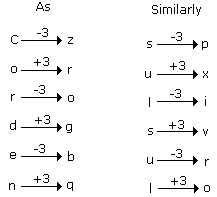
Directions to SolveIn each of the following questions find out the alternative which will replace the question mark.Question - 24 : 60 :: 120 : ?- a)160
- b)220
- c)300
- d)108
Correct answer is option 'C'. Can you explain this answer?
Directions to Solve
In each of the following questions find out the alternative which will replace the question mark.
Question - 24 : 60 :: 120 : ?
a)
160
b)
220
c)
300
d)
108
| | Jatin Yadav answered |
Analysing the given question:
The symbol "::" means "is to" and the numbers before and after it have a certain relationship. We need to find out the number which will have a similar relationship with the second number given in the question.
Solution:
24 : 60 :: 120 : ?
Here, "24 is to 60" means that 24 is 40% of 60. Similarly, we need to find out the number which is 40% of 120.
- To find out 40% of 120, we can multiply 120 by 0.4 (or 40/100).
- 40% of 120 = 0.4 x 120 = 48.
Therefore, the number which will replace the question mark is 48 more than 120.
- 120 + 48 = 168.
But, 168 is not given in the options.
- We can also find out the answer by cross-multiplying the given ratios.
24 : 60 :: 120 : ?
(24/60) = (120/x) [cross-multiplying]
24x = 60 x 120
x = (60 x 120) / 24
x = 300
Therefore, the number which will replace the question mark is 300.
Hence, the correct answer is option (c) 300.
The symbol "::" means "is to" and the numbers before and after it have a certain relationship. We need to find out the number which will have a similar relationship with the second number given in the question.
Solution:
24 : 60 :: 120 : ?
Here, "24 is to 60" means that 24 is 40% of 60. Similarly, we need to find out the number which is 40% of 120.
- To find out 40% of 120, we can multiply 120 by 0.4 (or 40/100).
- 40% of 120 = 0.4 x 120 = 48.
Therefore, the number which will replace the question mark is 48 more than 120.
- 120 + 48 = 168.
But, 168 is not given in the options.
- We can also find out the answer by cross-multiplying the given ratios.
24 : 60 :: 120 : ?
(24/60) = (120/x) [cross-multiplying]
24x = 60 x 120
x = (60 x 120) / 24
x = 300
Therefore, the number which will replace the question mark is 300.
Hence, the correct answer is option (c) 300.
Direction: In each of the following questions a pair of capitalised words is followed by four pair of words. You are required to mark as the answer the pair of words which have a relationship between them most similar to the relationship between the capitalised pair.Malapropism : Words- a)Anachronism : Time
- b)Ellipsis : Sentence
- c)Jinjanthropism : Apes
- d)Catechism : Religion
Correct answer is option 'A'. Can you explain this answer?
Direction: In each of the following questions a pair of capitalised words is followed by four pair of words. You are required to mark as the answer the pair of words which have a relationship between them most similar to the relationship between the capitalised pair.
Malapropism : Words
a)
Anachronism : Time
b)
Ellipsis : Sentence
c)
Jinjanthropism : Apes
d)
Catechism : Religion
 | Glance Learning Institute answered |
Malapropism: The mistaken use of a word in place of a similar-sounding one, often with unintentionally amusing or nonsensical results.
- Anachronism: Something or someone placed in the wrong time period, out of its proper chronological order.
- Ellipsis: The omission of one or more words from a sentence, where the omitted words are understood from the context.
- Jinjanthropism: Attributing human characteristics or behavior to apes or other non-human primates.
- Catechism: A summary of religious principles, often in the form of questions and answers, used for instruction in religious doctrine.
Hence according to meanings, Option A is correct.
Direction: In each of the following questions, a related pair of words is followed by four pairs of words or phrases. Select the pair that best expresses a relationship similar to the one expressed in the question pair.Doggerel : Poet- a)Symphony : Composer
- b)Prediction : Astrologer
- c)Wine : Vintner
- d)Pulp fiction : Novelist
Correct answer is option 'D'. Can you explain this answer?
Direction: In each of the following questions, a related pair of words is followed by four pairs of words or phrases. Select the pair that best expresses a relationship similar to the one expressed in the question pair.
Doggerel : Poet
a)
Symphony : Composer
b)
Prediction : Astrologer
c)
Wine : Vintner
d)
Pulp fiction : Novelist
| | Glance Learning Institute answered |
Doggerel is a badly written verse, which is written by a poet. Pulp fiction is a badly written piece of fiction, written by a novelist. (a), (b) and (c) do not show this derogatory relationship.

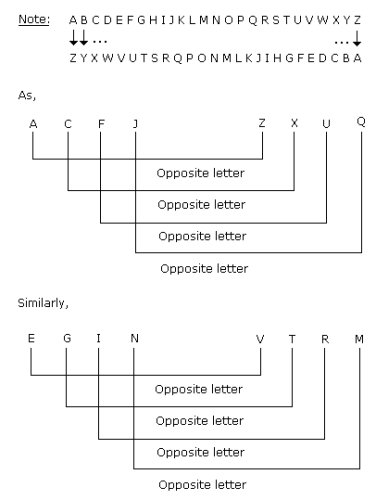
Chapter doubts & questions for Analogy - General Intelligence and Reasoning for SSC CGL 2026 is part of SSC CGL exam preparation. The chapters have been prepared according to the SSC CGL exam syllabus. The Chapter doubts & questions, notes, tests & MCQs are made for SSC CGL 2026 Exam. Find important definitions, questions, notes, meanings, examples, exercises, MCQs and online tests here.
Chapter doubts & questions of Analogy - General Intelligence and Reasoning for SSC CGL in English & Hindi are available as part of SSC CGL exam. Download more important topics, notes, lectures and mock test series for SSC CGL Exam by signing up for free.
General Intelligence and Reasoning for SSC CGL177 videos|264 docs|169 tests |
