


All Exams > SSC CGL > General Intelligence and Reasoning for SSC CGL > All Questions
All questions of Figure Formation & Analysis for SSC CGL Exam
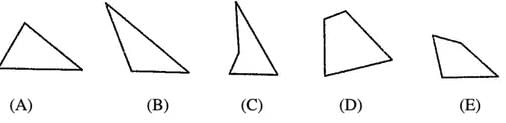
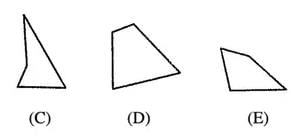
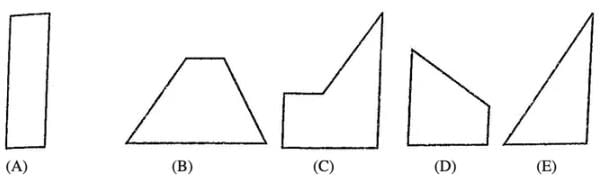
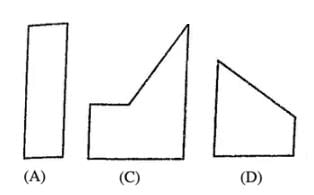
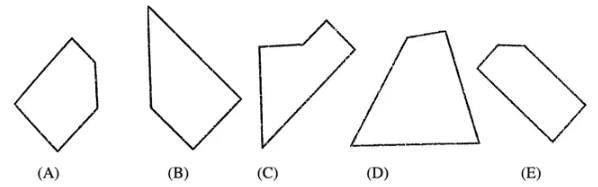
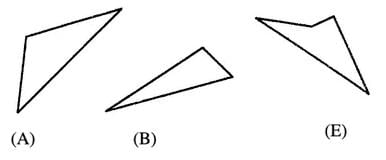
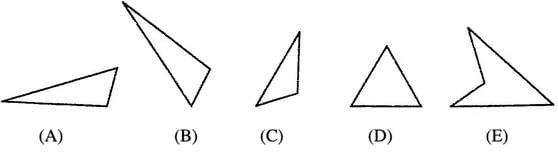
In the following question, five figures are given. Out of them, find the three figures that can be joined to form an equilateral triangle.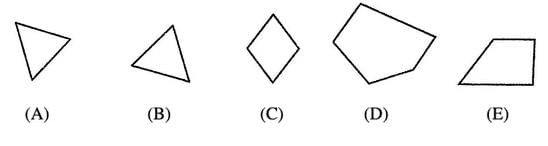
- a)BCD
- b)ABC
- c)CDE
- d)BCE
Correct answer is option 'B'. Can you explain this answer?
In the following question, five figures are given. Out of them, find the three figures that can be joined to form an equilateral triangle.
a)
BCD
b)
ABC
c)
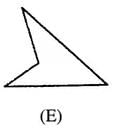
CDE
d)
BCE
 | Target Study Academy answered |
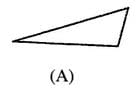
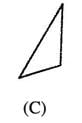
When we join the three figures A, B and C, then we can make an equilateral triangle.
Hence B is correct answer.

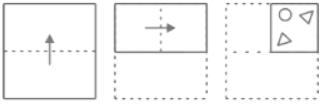
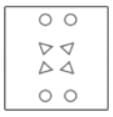
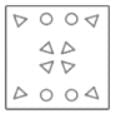
Paper is folded and cut as shown below. How will it appear when unfolded?
- a)
- b)
- c)
- d)
Correct answer is option 'B'. Can you explain this answer?
Paper is folded and cut as shown below. How will it appear when unfolded?
a)
b)
c)
d)
 | EduRev SSC CGL answered |
The given figure when unfolded is as follows:
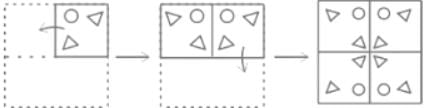
Hence, option (b) is the correct answer.
Hence, option (b) is the correct answer.
Find the minimum number of straight lines required to make the given figure.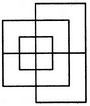
- a)13
- b)15
- c)17
- d)19
Correct answer is option 'A'. Can you explain this answer?
Find the minimum number of straight lines required to make the given figure.
a)
13
b)
15
c)
17
d)
19
| | EduRev SSC CGL answered |
The figure may be labelled as shown.
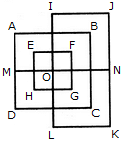
The horizontal lines are IJ, AB, EF, MN, HG, DC and LK i.e. 7 in number.
The vertical lines are AD, EH, IL, FG, BC and JK i.e. 6 in number.
Thus, there are 7 + 6 = 13 straight lines in the figure.
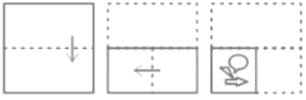
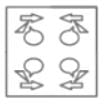
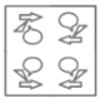
The sequence of folding a piece of paper and the manner in which the folded paper has been cut is shown below. Choose a figure which would most closely resemble the unfolded form of the paper.
- a)
- b)
- c)

- d)

Correct answer is option 'A'. Can you explain this answer?
The sequence of folding a piece of paper and the manner in which the folded paper has been cut is shown below. Choose a figure which would most closely resemble the unfolded form of the paper.
a)
b)
c)
d)
 | Ssc Cgl answered |
When the paper is unfolded, it appears as shown below,
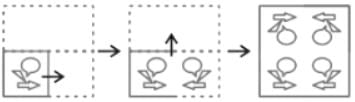
Hence, the correct answer is "Option a".
Hence, the correct answer is "Option a".
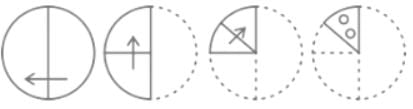
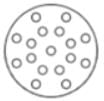
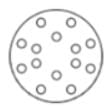
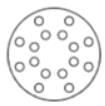
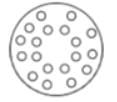
The sequence of folding of paper and the manner in which the folded paper has been cut is shown in the following figures. How would this paper look when unfolded?
- a)
- b)
- c)
- d)
Correct answer is option 'C'. Can you explain this answer?
The sequence of folding of paper and the manner in which the folded paper has been cut is shown in the following figures. How would this paper look when unfolded?
a)
b)
c)
d)
| | Ssc Cgl answered |
The image obtained when the paper is unfolded is,
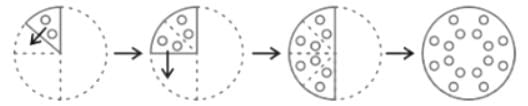
Hence, option c is the correct answer.
Hence, option c is the correct answer.
Find the number of triangles in the given figure.
- a)22
- b)24
- c)26
- d)28
Correct answer is option 'D'. Can you explain this answer?
Find the number of triangles in the given figure.
a)
22
b)
24
c)
26
d)
28
 | Glance Learning Institute answered |
The figure may be labelled as shown.
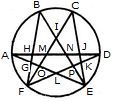
The simplest triangles are AGH, GFO, LFO, DJK, EKP, PEL and IMN i.e. 7 in number.
The triangles having two components each are GFL, KEL, AMO, NDP, BHN, CMJ, NEJ and HFM i.e. 8 in number.
The triangles having three components each are IOE, IFP, BIF and CEI i.e. 4 in number.
The triangles having four components each are ANE and DMF i.e. 2 in number.
The triangles having five components each are FCK, BGE and ADL i.e. 3 in number.
The triangles having six components each are BPF, COE, DHF and AJE i.e. 4 in number.
Total number of triangles in the figure = 7 + 8 + 4 + 2 + 3 + 4 = 28.
Find the number of triangles in the given figure.
- a)11
- b)13
- c)15
- d)17
Correct answer is option 'C'. Can you explain this answer?
Find the number of triangles in the given figure.
a)
11
b)
13
c)
15
d)
17
 | Iq Funda answered |
The figure may be labelled as shown.
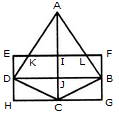
The simplest triangles are AKI, AIL, EKD, LFB, DJC, BJC, DHC and BCG i.e. 8 in number.
The triangles composed of two components each are AKL, ADJ, AJB and DBC i.e. 4 in number.
The triangles composed of the three components each are ADC and ABC i.e. 2 in number.
There is only one triangle i.e. ADB composed of four components.
Thus, there are 8+ 4 + 2 + 1= 15 triangles in the figure.
Find the number of triangles in the given figure.
- a)36
- b)40
- c)44
- d)48
Correct answer is option 'D'. Can you explain this answer?
Find the number of triangles in the given figure.
a)
36
b)
40
c)
44
d)
48
| | EduRev SSC CGL answered |
The figure may be labelled as shown.
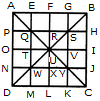
The simplest triangles are APQ, AEQ, QTU, QRU, BGS, BHS, RSU, SUV, TUW, UWX, NWD, WDM, UVY, UXY, JCY and YKC i.e. 16 in number.
The triangles composed of two components each are QUW, QSU, SYU and UWY i.e. 4 in number.
The triangles composed of three components each are AOU, AFU, FBU, BIU, UIC, ULC, ULD and OUD i.e. 8 in number.
The triangles composed of four components each are QYW, QSW, QSY and SYW i.e. 4 in number.
The triangles composed of six components each are AUD, ABU, BUC and DUC i.e. 4 in number.
The triangles composed of seven components each are QMC, ANY, EBW, PSD, CQH, AGY, DSK and BJW i.e. 8 in number.
The triangles composed of twelve components each are ABD, ABC, BCD and ACD i.e. 4 in number.
Thus, there are 16 + 4 + 8 + 4 + 4 + 8 + 4 = 48 triangles in the figure.
Find the number of triangles in the given figure.
- a)4
- b)5
- c)6
- d)7
Correct answer is option 'B'. Can you explain this answer?
Find the number of triangles in the given figure.
a)
4
b)
5
c)
6
d)
7
| | Ssc Cgl answered |
The figure may be labelled as shown.
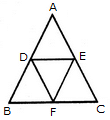
The simplest triangles are ADE, BDF, DEF and EFC i.e. 4 in number.
There is only one triangle ABC composed of four components.
Thus, there are 4+1 = 5 triangles in the given figure.
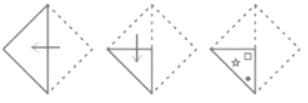
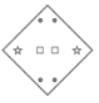
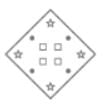
A paper is folded and cut as shown below. How will it appear when unfolded?
- a)
- b)
- c)
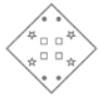
- d)
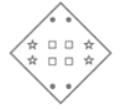
Correct answer is option 'C'. Can you explain this answer?
A paper is folded and cut as shown below. How will it appear when unfolded?
a)
b)
c)
d)
| | Ssc Cgl answered |
After unfolding the paper step by step:
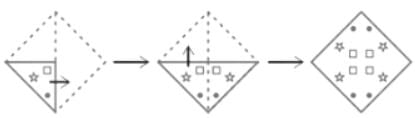
Hence, the correct answer is "Option (c)".
Hence, the correct answer is "Option (c)".
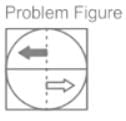
Select the Answer Figure that depicts the following transparent sheet (Problem Figure) when folded at the dotted line shown.
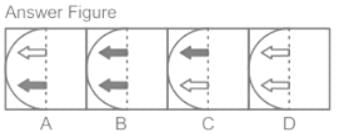
- a)D
- b)C
- c)A
- d)B
Correct answer is option 'B'. Can you explain this answer?
Select the Answer Figure that depicts the following transparent sheet (Problem Figure) when folded at the dotted line shown.
a)
D
b)
C
c)
A
d)
B
| | EduRev SSC CGL answered |
Given problem figure:
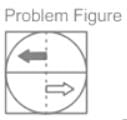
So, figure that depicts the following transparent sheet when folded at the dotted line shown is:
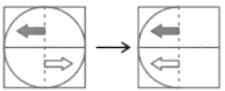
So, figure that depicts the following transparent sheet when folded at the dotted line shown is:
Here, Out of all answer figures given figure (c) will be obtained by folding the transparent sheet when folded at the dotted line.
Hence, "Option - (b)" is the correct answer.
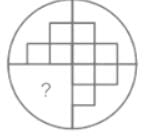
Fill in the question mark.
- a)

- b)

- c)

- d)

Correct answer is option 'B'. Can you explain this answer?
Fill in the question mark.
a)
b)
c)
d)
| | Ssc Cgl answered |
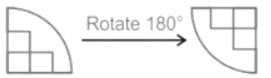
The figure which will complete the pattern is:
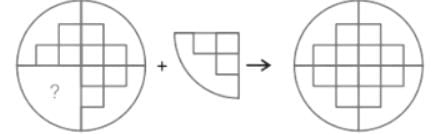
Hence option b is the correct answer.
DIRECTIONS: Select the answer figure in which the question figure is embedded.
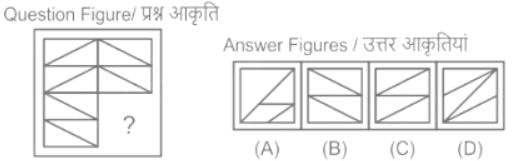
- a)a
- b)b
- c)c
- d)d
Correct answer is option 'C'. Can you explain this answer?
DIRECTIONS: Select the answer figure in which the question figure is embedded.
a)
a
b)
b
c)
c
d)
d
| | EduRev SSC CGL answered |
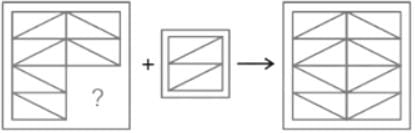
Hence, the correct answer is "option c".
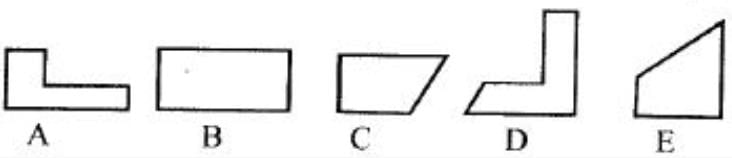
In the following question, five figures are given. Out of them, find the three figures that can be joined to form a square.
- a)ABD
- b)ACE
- c)BDE
- d)CDE
Correct answer is option 'B'. Can you explain this answer?
In the following question, five figures are given. Out of them, find the three figures that can be joined to form a square.
a)
ABD
b)
ACE
c)
BDE
d)
CDE
| | Glance Learning Institute answered |
Considering each option and relying on visual observation, we can see that every other option other than C doesn't make a complete square. Hence the answer.
What is the number of straight lines and the number of triangles in the given figure.
- a)10 straight lines and 34 triangles
- b)9 straight lines and 34 triangles
- c)9 straight lines and 36 triangles
- d)10 straight lines and 36 triangles
Correct answer is option 'C'. Can you explain this answer?
What is the number of straight lines and the number of triangles in the given figure.
a)
10 straight lines and 34 triangles
b)
9 straight lines and 34 triangles
c)
9 straight lines and 36 triangles
d)
10 straight lines and 36 triangles
| | EduRev SSC CGL answered |
The figure may be labelled as shown.
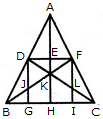
The Horizontal lines are DF and BC i.e. 2 in number.
The Vertical lines are DG, AH and FI i.e. 3 in number.
The Slanting lines are AB, AC, BF and DC i.e. 4 in number.
Thus, there are 2 + 3 + 4 = 9 straight lines in the figure.
Now, we shall count the number of triangles in the figure.
The simplest triangles are ADE, AEF, DEK, EFK, DJK, FLK, DJB, FLC, BJG and LIC i.e. 10 in number.
The triangles composed of two components each are ADF, AFK, DFK, ADK, DKB, FCK, BKH, KHC, DGB and FIC i.e. 10 in number.
The triangles composed of three components each are DFJ and DFL i.e. 2 in number.
The triangles composed of four components each are ABK, ACK, BFI, CDG, DFB, DFC and BKC i.e. 7 in number.
The triangles composed of six components each are ABH, ACH, ABF, ACD, BFC and CDB i.e. 6 in number.
There is only one triangle i.e. ABC composed of twelve components.
There are 10 + 10 + 2 + 7 + 6+ 1 = 36 triangles in the figure.
Find the number of triangles in the given figure.
- a)10
- b)12
- c)14
- d)16
Correct answer is option 'C'. Can you explain this answer?
Find the number of triangles in the given figure.
a)
10
b)
12
c)
14
d)
16
| | Iq Funda answered |
The figure may be labelled as shown.
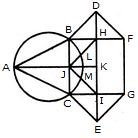
The simplest triangles are ABJ, ACJ, BDH, DHF, CIE and GIE i.e. 6 in number.
The triangles composed of two components each are ABC, BDF, CEG, BHJ, JHK, JKI and CJI i.e. 7 in number.
There is only one triangle JHI which is composed of four components.
Thus, there are 6 + 7 + 1 = 14 triangles in the given figure.
Find the number of triangles in the given figure.
- a)8
- b)10
- c)12
- d)14
Correct answer is option 'C'. Can you explain this answer?
Find the number of triangles in the given figure.
a)
8
b)
10
c)
12
d)
14
| | Ssc Cgl answered |
The figure may be labelled as shown.
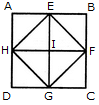
The simplest triangles are AEH, EHI, EBF, EFI, FGC, IFG, DGH and HIG i.e. 8 in number.
The triangles composed of two components each are HEF, EFG, HFG and EFG i.e. 4 in number.
Thus, there are 8 + 4 = 12 triangles in the figure.
Find the number of triangles in the given figure.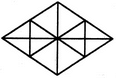
- a)16
- b)22
- c)28
- d)32
Correct answer is option 'C'. Can you explain this answer?
Find the number of triangles in the given figure.
a)
16
b)
22
c)
28
d)
32
 | T.S Academy answered |
The figure may be labelled as shown.
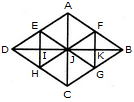
The simplest triangles are AFJ, FJK, FKB, BKG, JKG, JGC, HJC, HIJ, DIH, DEI, EIJ and AEJ i.e. 12 in number.
The triangles composed of two components each are JFB, FBG, BJG, JFG, DEJ, EJH, DJH and DEH i.e. 8 in number.
The triangles composed of three components each are AJB, JBC, DJC and ADJ i.e. 4 in number.
The triangles composed of six components each are DAB, ABC, BCD and ADC i.e. 4 in number.
Thus, there are 12 + 8 + 4 + 4 = 28 triangles in the figure.
Find the number of triangles in the given figure.
- a)16
- b)13
- c)9
- d)7
Correct answer is option 'A'. Can you explain this answer?
Find the number of triangles in the given figure.
a)
16
b)
13
c)
9
d)
7
| | Glance Learning Institute answered |
The figure may be labelled as shown.
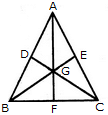
The simplest triangles are AGE, EGC, GFC, BGF, DGB and ADG i.e. 6 in number.
The triangles composed of two components each are AGC, BGC and ABG i.e. 3 in number.
The triangles composed of three components each are AFC, BEC, BDC, ABF, ABE and DAC i.e. 6 in number.
There is only one triangle i.e. ABC composed of six components.
Thus, there are 6 + 3 + 6 + 1 = 16 triangles in the given figure.
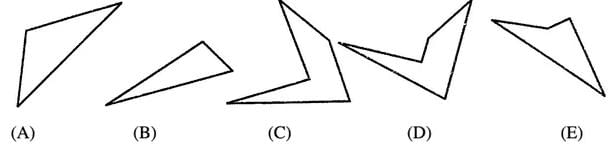
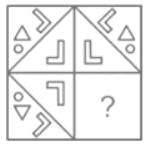
Select a figure amongst the four alternatives that when placed in the blank space(?) of figure X will complete the pattern. (Rotation is not allowed).
- a)

- b)

- c)

- d)

Correct answer is option 'D'. Can you explain this answer?
Select a figure amongst the four alternatives that when placed in the blank space(?) of figure X will complete the pattern. (Rotation is not allowed).
a)
b)
c)
d)
| | EduRev SSC CGL answered |
The figure which will complete the pattern is:
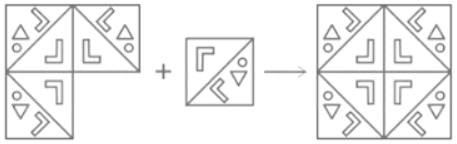
Hence, option d is the correct answer.
Hence, option d is the correct answer.
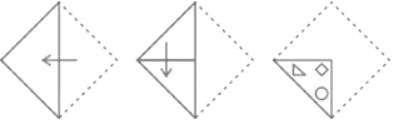
The sequence of folding a piece of paper and the manner in which the folded paper has cut is shown in the following figures. How would this paper look when unfolded?
- a)
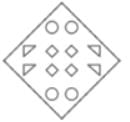
- b)
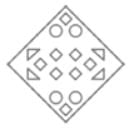
- c)
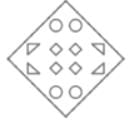
- d)
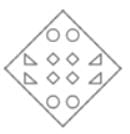
Correct answer is option 'C'. Can you explain this answer?
The sequence of folding a piece of paper and the manner in which the folded paper has cut is shown in the following figures. How would this paper look when unfolded?
a)
b)
c)
d)
| | EduRev SSC CGL answered |
The paper when unfolded will appear as shown below:
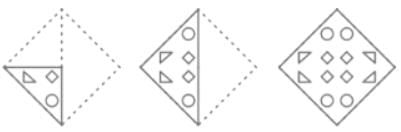
Hence, 'option c’ is the correct answer.
Hence, 'option c’ is the correct answer.
Find the number of triangles in the given figure.
- a)18
- b)20
- c)24
- d)27
Correct answer is option 'C'. Can you explain this answer?
Find the number of triangles in the given figure.
a)
18
b)
20
c)
24
d)
27
| | EduRev SSC CGL answered |
The figure may be labelled as shown.
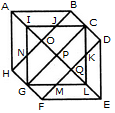
The simplest triangles are IJO, BCJ, CDK, KQL, MLQ, GFM, GHN and NIO i.e. 8 in number.
The triangles composed of two components each are ABO, AHO, NIJ, IGP, ICP, DEQ, FEQ, KLM, LCP and LGP i.e.10 in number.
The triangles composed of four components each are HAB, DEF, LGI, GIC, ICL and GLC i.e. 6 in number.
Total number of triangles in the figure = 8 + 10 + 6 = 24.
Find the minimum number of straight lines required to make the given figure.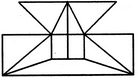
- a)16
- b)17
- c)18
- d)19
Correct answer is option 'B'. Can you explain this answer?
Find the minimum number of straight lines required to make the given figure.
a)
16
b)
17
c)
18
d)
19
| | EduRev SSC CGL answered |
The figure may be labelled as shown.
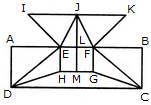
The horizontal lines are IK, AB, HG and DC i.e. 4 in number.
The vertical lines are AD, EH, JM, FG and BC i.e. 5 in number.
The slanting lines are IE, JE, JF, KF, DE, DH, FC and GC i.e. 8 is number.
Thus, there are 4 + 5 + 8 = 17 straight lines in the figure.
Select the figure which when placed in the blank space of the figure marked ‘X’ would complete the pattern.
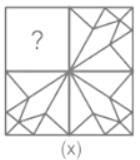
- a)

- b)

- c)

- d)

Correct answer is option 'B'. Can you explain this answer?
Select the figure which when placed in the blank space of the figure marked ‘X’ would complete the pattern.
a)
b)
c)
d)
| | EduRev SSC CGL answered |
After placing the figure in the blank space of the figure marked ‘X’ then complete pattern is -
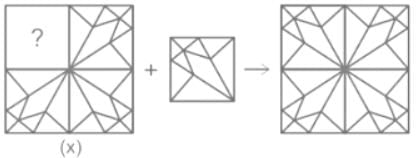
Hence, ‘option b’ is the correct answer.
Hence, ‘option b’ is the correct answer.
Find the number of triangles in the given figure.
- a)28
- b)32
- c)36
- d)40
Correct answer is option 'C'. Can you explain this answer?
Find the number of triangles in the given figure.
a)
28
b)
32
c)
36
d)
40
| | T.S Academy answered |
The figure may be labelled as shown.
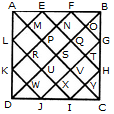
The simplest triangles are AML, LRK, KWD, DWJ, JXI, IYC, CYH, HTG, GOB, BOF, FNE and EMA i.e. 12 in number.
The triangles composed of two components each are AEL, KDJ, HIC and FBG i.e. 4 in number.
The triangles composed of three components each are APF, EQB, BQH, GVC, CVJ, IUD, DUL and KPA i.e. 8 in number.
The triangles composed of six components each are ASB, BSC, CSD, DSA, AKF, EBH, CGJ and IDL i.e. 8 in number.
The triangles composed of twelve components each are ADB, ABC, BCD and CDA i.e. 4 in number.
Total number of triangles in the figure = 12 + 4 + 8 + 8 + 4 = 36.
Find the number of triangles in the given figure.
- a)5
- b)6
- c)8
- d)10
Correct answer is option 'D'. Can you explain this answer?
Find the number of triangles in the given figure.
a)
5
b)
6
c)
8
d)
10
| | Glance Learning Institute answered |
The figure may be labelled as shown.
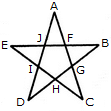
The simplest triangles are AJF, FBG, GCH, HDI and IEJ i.e. 5 in number.
The triangles composed of three components each EBH, AIC, EFC, ADG and BJD i.e. 5 in number.
Thus, there are 5 + 5 = 10 triangles in the figure.
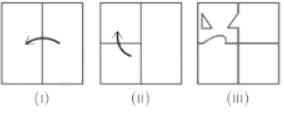
The sequence of folding a piece of paper (figure i and ii) and the manner in which the folded paper has been cut (figure iii) is shown in the following figures. Select the option that would most closely resemble the unfolded from of figure (iii).
- a)

- b)

- c)

- d)

Correct answer is option 'C'. Can you explain this answer?
The sequence of folding a piece of paper (figure i and ii) and the manner in which the folded paper has been cut (figure iii) is shown in the following figures. Select the option that would most closely resemble the unfolded from of figure (iii).
a)
b)
c)
d)
| | EduRev SSC CGL answered |
According to given figure:
The figure will appear when it is opened as follows:
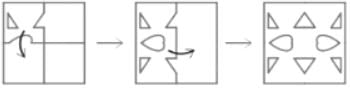
Hence, "Option - (c)" is the correct answer.
Hence, "Option - (c)" is the correct answer.
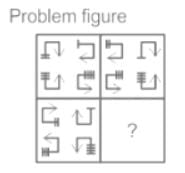
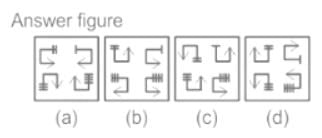
Which answer figure will complete the pattern in the question figure?
- a)a
- b)b
- c)c
- d)d
Correct answer is option 'D'. Can you explain this answer?
Which answer figure will complete the pattern in the question figure?
a)
a
b)
b
c)
c
d)
d
| | EduRev SSC CGL answered |
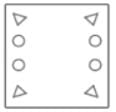
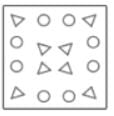
In the above figure we can see that shape with arrow sign for south and north is either on left side or right but both are at same side.
In each block all four direction are shown with the help of arrow.
The answer figure which completes the question figure is figure d.
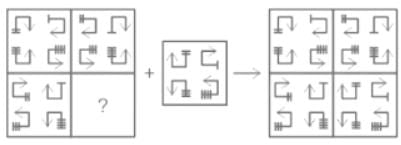
Hence, option d is the correct answer.
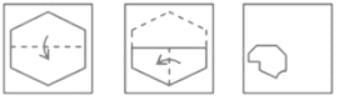

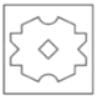
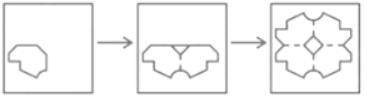
In the following question, which pattern will the given sheet resemble when it is folded at the dotted line? (Sheet is transparent)
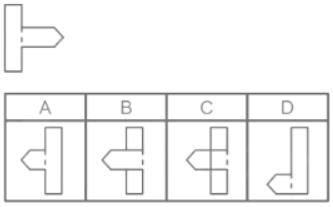
- a)D
- b)A
- c)B
- d)C
Correct answer is option 'C'. Can you explain this answer?
In the following question, which pattern will the given sheet resemble when it is folded at the dotted line? (Sheet is transparent)
a)
D
b)
A
c)
B
d)
C
| | EduRev SSC CGL answered |
Important Points
- The sheet is transparent.
- Therefore, the left side of the rectangle will be visible after folding.
The pattern that will appear after folding is as follows,
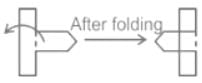
Hence, “option figure C” is the correct answer.
Find the number of triangles in the given figure.
- a)21
- b)23
- c)25
- d)27
Correct answer is option 'D'. Can you explain this answer?
Find the number of triangles in the given figure.
a)
21
b)
23
c)
25
d)
27
| | T.S Academy answered |
The figure may be labelled as shown.
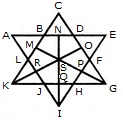
The simplest triangles are ABL, BCD, DEF, FGP, PGH, QHI, JQI, KRJ and LRK i.e. 9 in number.
The triangles composed of two components each are OSG, SGQ, SPI, SRI, KSQ, KMS, FGH, JHI and JKL i.e. 9 in number.
There is only one triangle i.e. KSG which is composed of four components.
The triangles composed of five components each are NEI, ANI, MCG and KCO i.e. 4 in number.
The triangles composed of six components each are GMK and KOG i.e. 2 in number.
There is only one triangle i.e. AEI composed of ten components.
There is only one triangle i.e. KCG composed of eleven components.
Therefore, Total number of triangles in the given figure = 9 + 9+1 + 4 + 2+1 + 1 = 27.
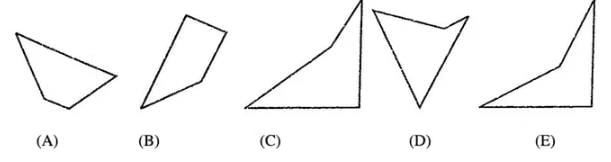

Find the number of triangles in the given figure.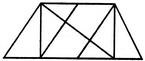
- a)8
- b)10
- c)12
- d)14
Correct answer is option 'D'. Can you explain this answer?
Find the number of triangles in the given figure.
a)
8
b)
10
c)
12
d)
14
| | Ssc Cgl answered |
The figure may be labelled as shown.
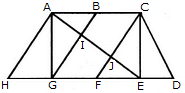
The simplest triangles are AHG, AIG, AIB, JFE, CJE and CED i.e. 6 in number.
The triangles composed of two components each are ABG, CFE, ACJ and EGI i.e. 4 in number.
The triangles composed of three components each are ACE, AGE and CFD i.e. 3 in number.
There is only one triangle i.e. AHE composed of four components.
Therefore, There are 6 + 4 + 3 + 1 = 14 triangles in the given figure.
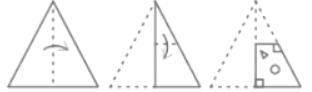
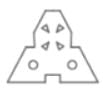
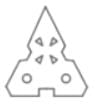
The sequence of folding a piece of paper and the manner in which the folded paper has been cut is shown in the following figures. How would this paper look when unfolded?
- a)
- b)
- c)
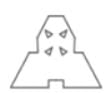
- d)More than one of the above
Correct answer is option 'A'. Can you explain this answer?
The sequence of folding a piece of paper and the manner in which the folded paper has been cut is shown in the following figures. How would this paper look when unfolded?
a)
b)
c)
d)
More than one of the above
| | Ssc Cgl answered |
Given:
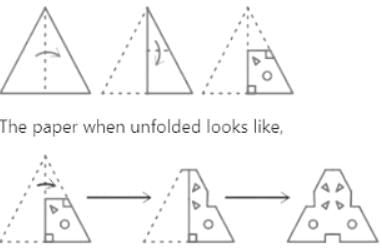
Hence, the correct answer is "Option (a)".
Hence, the correct answer is "Option (a)".
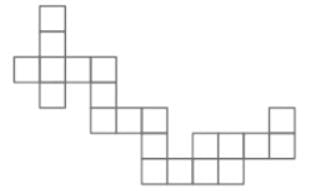
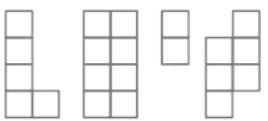
Which of the following answer figure patterns can be combined to make the question figure?
- a)
- b)
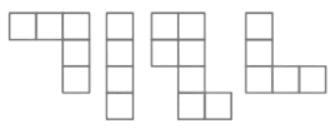
- c)
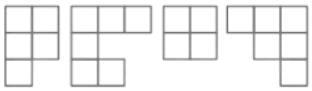
- d)
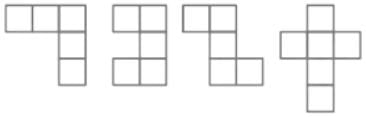
Correct answer is option 'D'. Can you explain this answer?
Which of the following answer figure patterns can be combined to make the question figure?
a)
b)
c)
d)
| | Ssc Cgl answered |
The figures which can be combined to form the given figure are,
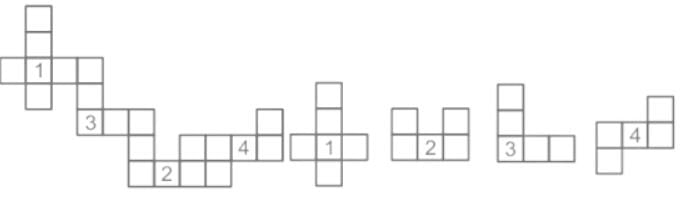
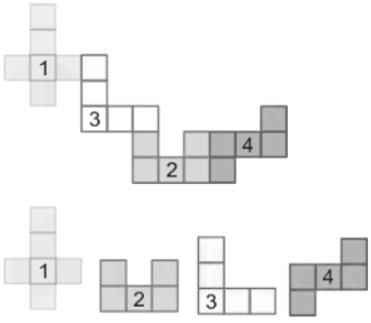
Hence, option d is the correct answer.
Hence, option d is the correct answer.
Select the option figure which when placed in the blank space of the problem figure would complete the pattern.
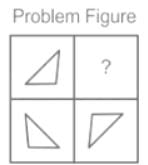
- a)

- b)

- c)

- d)

Correct answer is option 'A'. Can you explain this answer?
Select the option figure which when placed in the blank space of the problem figure would complete the pattern.
a)
b)
c)
d)
| | Ssc Cgl answered |
The figure which will complete the given pattern is,
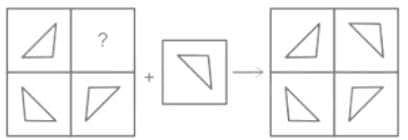
Hence, option a is the correct answer.
Hence, option a is the correct answer.
Find the number of triangles in the given figure.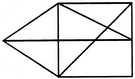
- a)12
- b)13
- c)14
- d)15
Correct answer is option 'D'. Can you explain this answer?
Find the number of triangles in the given figure.
a)
12
b)
13
c)
14
d)
15
| | Target Study Academy answered |
The figure may be labelled as shown.
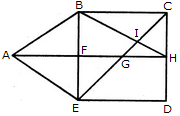
The simplest triangles are ABF, BIC, CIH, GIH, FGE and AFE i.e. 6 in number.
The triangles composed of two components each are ABE, AGE, BHF, BCH, CGH and BIE i.e. 6 in number.
The triangles composed of three components each are ABH, BCE and CDE i.e. 3 in number.
Hence, the total number of triangles in the figure = 6 + 6 + 3 = 15.
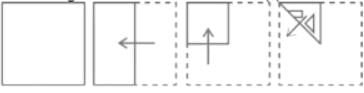
A piece of paper is folded and punched as shown below in the question figures. From the given answer figures, indicate how it will appear when opened.
- a)

- b)

- c)

- d)

Correct answer is option 'D'. Can you explain this answer?
A piece of paper is folded and punched as shown below in the question figures. From the given answer figures, indicate how it will appear when opened.
a)
b)
c)
d)
| | EduRev SSC CGL answered |
According to the given figure:
The figure will appear when it is opened as follows:

Hence, 'Option d' is the correct answer.
Hence, 'Option d' is the correct answer.
Find the number of triangles in the given figure.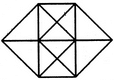
- a)20
- b)24
- c)28
- d)32
Correct answer is option 'C'. Can you explain this answer?
Find the number of triangles in the given figure.
a)
20
b)
24
c)
28
d)
32
| | Ssc Cgl answered |
The figure may be labelled as shown.
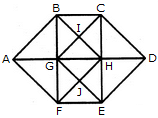
The simplest triangles are ABG, BIG, BIC, CIH, GIH, CDH, HED, GHJ, HJE, FEJ, GFJ and AGF i.e. 12 in number.
The triangles composed of two components each are ABF, CDE, GBC, BCH, GHG, BHG, GHF, GHE, HEF and GEF i.e. 10 in number.
The triangles composed of three components each are ABH, AFH, CDG and GDE i.e. 4 in number.
The triangles composed of four components each are BHF and CGE i.e. 2 in number.
Total number of triangles in the figure = 12 + 10 + 4 + 2 = 28.
Find the number of triangles in the given figure.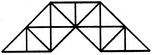
- a)23
- b)27
- c)29
- d)31
Correct answer is option 'C'. Can you explain this answer?
Find the number of triangles in the given figure.
a)
23
b)
27
c)
29
d)
31
| | EduRev SSC CGL answered |
The figure may be labelled as shown.
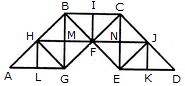
The simplest triangles are AHL, LHG, GHM, HMB, GMF, BMF, BIF, CIF, FNC, CNJ, FNE, NEJ, EKJ and JKD i.e. 14 in number.
The triangles composed of two components each are AGH, BHG, HBF, BFG, HFG, BCF, CJF, CJE, JEF, CFE and JED i.e. 11 in number.
The triangles composed of four components each are ABG, CBG, BCE and CED i.e. 4 in number.
Total number of triangles in the given figure = 14 + 11 + 4 = 29.
Find the minimum number of straight lines required to make the given figure.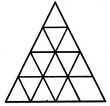
- a)9
- b)11
- c)15
- d)16
Correct answer is option 'B'. Can you explain this answer?
Find the minimum number of straight lines required to make the given figure.
a)
9
b)
11
c)
15
d)
16
| | Glance Learning Institute answered |
The figure may be labelled as shown.
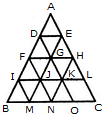
The horizontal lines are DE, FH, IL and BC i.e. 4 in number.
The slanting lines are AC, DO, FN, IM, AB, EM and HN i.e. 7 in number.
Thus, there are 4 + 7 = 11 straight lines in the figure.
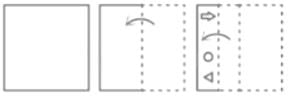
A paper is folded and cut as shown below. How will it appear when unfolded?
- a)

- b)

- c)

- d)

Correct answer is option 'B'. Can you explain this answer?
A paper is folded and cut as shown below. How will it appear when unfolded?
a)
b)
c)
d)
| | EduRev SSC CGL answered |
To determine how the paper will appear when unfolded after being cut as shown, let's analyze the folding and cutting process.
- The paper is initially folded once, creating two layers.
- It is then cut in the shape of a triangle and a circle. The key to this puzzle is to remember that when the paper is unfolded, the cuts will appear symmetrically on both sides.
Given the four options (A, B, C, D), the correct answer will show the shapes in a symmetrical pattern reflecting the original cut.
After analyzing the cuts, the correct unfolded pattern would correspond to Option b. It displays the shapes as they would appear when the folded paper is opened, with the shapes mirrored on each side.
What is the number of triangles that can be formed whose vertices are the vertices of an octagon but have only one side common with that of octagon?- a)64
- b)32
- c)24
- d)16
Correct answer is option 'B'. Can you explain this answer?
What is the number of triangles that can be formed whose vertices are the vertices of an octagon but have only one side common with that of octagon?
a)
64
b)
32
c)
24
d)
16
| | Iq Funda answered |
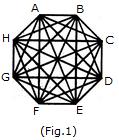
When the triangles are drawn in an octagon with vertices same as those of the octagon and having one side common to that of the octagon, the figure will appear as shown in (Fig. 1).
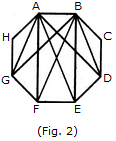
Now, we shall first consider the triangles having only one side AB common with octagon ABCDEFGH and having vertices common with the octagon (See Fig. 2).Such triangles are ABD, ABE, ABF and ABG i.e. 4 in number.
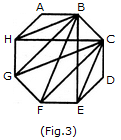
Similarly, the triangles having only one side BC common with the octagon and also having vertices common with the octagon are BCE, BCF, BCG and BCH (as shown in Fig. 3). i.e. There are 4 such triangles.
This way, we have 4 triangles for each side of the octagon. Thus, there are 8 x 4 = 32 such triangles.
Find the number of triangles in the given figure.
- a)27
- b)25
- c)23
- d)21
Correct answer is option 'A'. Can you explain this answer?
Find the number of triangles in the given figure.
a)
27
b)
25
c)
23
d)
21
| | Ssc Cgl answered |
The figure may be labelled as shown.
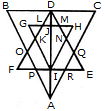
The simplest triangles are GLK, DLJ, DJM, HMN, QRE, IRA, IPA and FPO i.e. 8 in number.
The triangles having two components each are BDO, CDQ, DLM, PRA, KFI, NEI, HJI, GJI, DKI and DNI i.e. 10 in number.
The triangles having four components each are DIE, DFI, DOA, DQA and GHI i.e. 5 in number.
The triangles having six components each are DCA and DBA i.e. 2 in number.
DEF is the only triangle having eight components.
ABC is the only triangle having twelve components.
Thus, there are 8 + 10 + 5 + 2 + 1 + 1 = 27 triangles in the figure.
Find the number of triangles in the given figure.
- a)16
- b)18
- c)19
- d)21
Correct answer is option 'D'. Can you explain this answer?
Find the number of triangles in the given figure.
a)
16
b)
18
c)
19
d)
21
| | Ssc Cgl answered |
The figure may be labelled as shown.
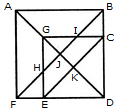
The simplest triangles are EFH, BIC, GHJ, GIJ, EKD and CKD i.e. 6 in number.
The triangles composed of two components each are ABJ, AFJ, GCK, GEK, CED arid GHI i.e. 6 in number.
The triangles composed of three components each are GCD, GED, DJB and DJF i.e. 4 in number.
The triangles composed of four components each are ABF and GCE i.e. 2 in number.
The triangles composed of five components each are ABD and AFD i.e. 2 in number.
There is only one triangle i.e. FBD composed of six components.
Total number of triangles in the figure = 6 + 6 + 4 + 2 + 2 + 1 = 21.
Chapter doubts & questions for Figure Formation & Analysis - General Intelligence and Reasoning for SSC CGL 2026 is part of SSC CGL exam preparation. The chapters have been prepared according to the SSC CGL exam syllabus. The Chapter doubts & questions, notes, tests & MCQs are made for SSC CGL 2026 Exam. Find important definitions, questions, notes, meanings, examples, exercises, MCQs and online tests here.
Chapter doubts & questions of Figure Formation & Analysis - General Intelligence and Reasoning for SSC CGL in English & Hindi are available as part of SSC CGL exam. Download more important topics, notes, lectures and mock test series for SSC CGL Exam by signing up for free.
General Intelligence and Reasoning for SSC CGL177 videos|264 docs|169 tests |
