


All Exams > SSC CGL > General Intelligence and Reasoning for SSC CGL > All Questions
All questions of Cubes & Dice for SSC CGL Exam
The cube of any multiple of 2 is always divisible by- a)16
- b)12
- c)8
- d)14
Correct answer is option 'C'. Can you explain this answer?
The cube of any multiple of 2 is always divisible by
a)
16
b)
12
c)
8
d)
14
 | EduRev CAT answered |
Cube of multiple of 2 is divisible by 8
eg:
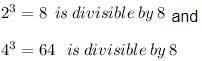
eg:

Cube of a natural number will never end with the digit- a)0
- b)1
- c)3
- d)none of these
Correct answer is option 'D'. Can you explain this answer?
Cube of a natural number will never end with the digit
a)
0
b)
1
c)
3
d)
none of these
 | Arun Sharma answered |
There'd no such digit which can't end in a cube of a natural number. Hence a cube of a natural number can end with any digit.
1³= 1 (ends with 1)
2³= 8 (ends with 8)
3³= 27 (ends with 7)
4³= 64 (ends with 4)
5³= 125 (ends with 5)
6³= 216 (ends with 6)
7³= 343 (ends with 3)
8³= 512 (ends with 2)
9³= 729 (ends with 9)
0³= 0 (ends with 0)
Hence the last digits are 0,1,8,7,4,5,6,3,2,9
Therefore we see every digits are last digits of these cubes. Hence a cube of a natural number can end with any digit.
1³= 1 (ends with 1)
2³= 8 (ends with 8)
3³= 27 (ends with 7)
4³= 64 (ends with 4)
5³= 125 (ends with 5)
6³= 216 (ends with 6)
7³= 343 (ends with 3)
8³= 512 (ends with 2)
9³= 729 (ends with 9)
0³= 0 (ends with 0)
Hence the last digits are 0,1,8,7,4,5,6,3,2,9
Therefore we see every digits are last digits of these cubes. Hence a cube of a natural number can end with any digit.

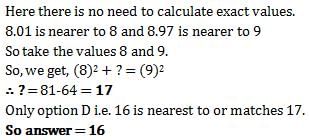
What is the smallest number by which 3600 be divided to make it a perfect cube?- a)9
- b)50
- c)300
- d)450
Correct answer is option 'D'. Can you explain this answer?
What is the smallest number by which 3600 be divided to make it a perfect cube?
a)
9
b)
50
c)
300
d)
450
 | Raghavendra Sharma answered |
3600=23 X 52 X 32 X 2
To make it a perfect cube it must be divided by
52 X 32 X 2=450
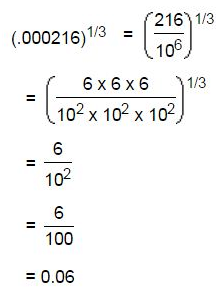
Cube of 0.2 is- a)0.8
- b)0.08
- c)0.008
- d)none of these
Correct answer is option 'C'. Can you explain this answer?
Cube of 0.2 is
a)
0.8
b)
0.08
c)
0.008
d)
none of these
 | Ishani Rane answered |
(0.2)3 = 0.2 x 0.2 x 0.2 = 0.008
Therefore, cube of 0.2 is 0.008
Two positions of dice are shown below. How many points will be on the top when 2 points are at the bottom?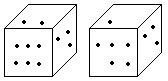
- a)6
- b)5
- c)4
- d)1
Correct answer is option 'D'. Can you explain this answer?
Two positions of dice are shown below. How many points will be on the top when 2 points are at the bottom?
a)
6
b)
5
c)
4
d)
1
 | Janhavi Mishra answered |
In these 2 positions of a dice, one common face having points 3 is in the same position. Hence according to rule (3), there will be 4 points on the required face.
Directions to SolveThe figure given on the left hand side in each of the following questions is folded to form a box. Choose from the alternatives (1), (2), (3) and (4) the boxes that is similar to the box formed.Question - 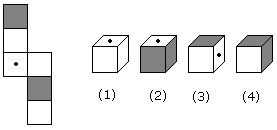
- a)2 and 3 only
- b)1, 3 and 4 only
- c)2 and 4 only
- d)1 and 4 only
Correct answer is option 'B'. Can you explain this answer?
Directions to Solve
The figure given on the left hand side in each of the following questions is folded to form a box. Choose from the alternatives (1), (2), (3) and (4) the boxes that is similar to the box formed.
Question - a)
2 and 3 only
b)
1, 3 and 4 only
c)
2 and 4 only
d)
1 and 4 only
 | KS Coaching Center answered |
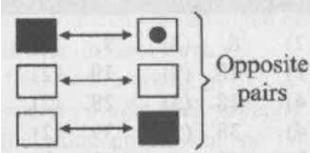
As, shown in figure, these are opposite of each other. Thus, option (2) is correct.
Which symbol will be on the face opposite to the face with symbol * ?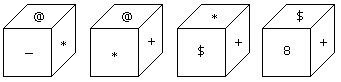
- a)@
- b)$
- c)8
- d)+
Correct answer is option 'C'. Can you explain this answer?
Which symbol will be on the face opposite to the face with symbol * ?
a)
@
b)
$
c)
8
d)
+
 | Alok Sen answered |
- The symbols of the adjacent faces to the face with symbol * are @, -, + and $.
- Hence the required symbol is 8.
Six dice with upper faces erased are as shows.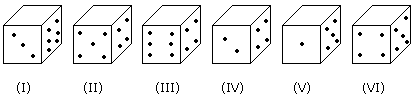 The sum of the numbers of dots on the opposite face is 7.Question - If the dice (I), (II) and (III) have even number of dots on their bottom faces, then what would be the total number of dots on their top faces?
- a)7
- b)11
- c)12
- d)14
Correct answer is option 'B'. Can you explain this answer?
Six dice with upper faces erased are as shows.
The sum of the numbers of dots on the opposite face is 7.
If the dice (I), (II) and (III) have even number of dots on their bottom faces, then what would be the total number of dots on their top faces?
a)
7
b)
11
c)
12
d)
14
| | Anjali Nair answered |
No. of dots on the top faces of dice (I), (II) and (III) are 5, 1 and 5 respectively.
Required total = 5 + 1 + 5 = 11
Two positions of a dice are shown below. Which number will appear on the face opposite to the face with the number 5?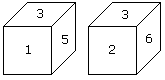
- a)2/6
- b)2
- c)6
- d)4
Correct answer is option 'C'. Can you explain this answer?
Two positions of a dice are shown below. Which number will appear on the face opposite to the face with the number 5?
a)
2/6
b)
2
c)
6
d)
4
| | Rajveer Ghoshal answered |
According to the rule no. (3), common faces with number 3, are in same positions. Hence the number of the opposite face to face with number 5 will be 6.
Directions to SolveThe figure given on the left hand side in each of the following questions is folded to form a box. Choose from the alternatives (1), (2), (3) and (4) the boxes that is similar to the box formed.Question - 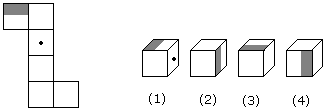
- a)1 and 2 only
- b)2 and 3 only
- c)1, 2, 3 and 4
- d)2 and 4 only
Correct answer is option 'C'. Can you explain this answer?
Directions to Solve
The figure given on the left hand side in each of the following questions is folded to form a box. Choose from the alternatives (1), (2), (3) and (4) the boxes that is similar to the box formed.
Question -
a)
1 and 2 only
b)
2 and 3 only
c)
1, 2, 3 and 4
d)
2 and 4 only
 | Nilanjan Biswas answered |
C

Cube of all even natural numbers is- a)even
- b)odd
- c)even or odd
- d)none of these
Correct answer is option 'A'. Can you explain this answer?
Cube of all even natural numbers is
a)
even
b)
odd
c)
even or odd
d)
none of these
 | S.v. Reddy answered |
Any even number to power 2 will have unit digit number
Example : 2^8=16÷8=2
16÷2=8
Example : 2^8=16÷8=2
16÷2=8
A cube of side n is painted green on all its sides. It is then cut into n3 identical cubes. How many of the smaller cubes will have three of its sides painted?- a)4
- b)6
- c)8
- d)Cannot be determined
Correct answer is option 'C'. Can you explain this answer?
A cube of side n is painted green on all its sides. It is then cut into n3 identical cubes. How many of the smaller cubes will have three of its sides painted?
a)
4
b)
6
c)
8
d)
Cannot be determined
 | Talent Triumphacademy answered |
Since, all the sides of the cube is painted, the cubes cut out from the corners will have three of its faces green. Since there are 8 corners for a cube, there will be 8 such cubes.
The smallest number by which 5400 must be multiplied so that it become a perfect cube, is- a)2
- b)10
- c)5
- d)3
Correct answer is option 'C'. Can you explain this answer?
The smallest number by which 5400 must be multiplied so that it become a perfect cube, is
a)
2
b)
10
c)
5
d)
3
| | Manoj Nambiar answered |
Understanding Perfect Cubes
To make a number a perfect cube, all the prime factors in its prime factorization must have exponents that are multiples of 3.
Prime Factorization of 5400
1. Start by breaking down 5400 into its prime factors:
- 5400 = 54 × 100
- 54 = 2 × 27 = 2 × 3^3
- 100 = 10^2 = 2^2 × 5^2
- Therefore, 5400 = 2^3 × 3^3 × 5^2
Analyzing Exponents
2. The prime factorization of 5400 is:
- 2^3
- 3^3
- 5^2
3. Now, check the exponents:
- For 2: exponent is 3 (already a multiple of 3)
- For 3: exponent is 3 (already a multiple of 3)
- For 5: exponent is 2 (not a multiple of 3)
Finding the Smallest Multiplier
4. To convert the exponent of 5 from 2 to the next multiple of 3:
- The next multiple of 3 is 3.
- Hence, we need to increase the exponent of 5 by 1 (from 2 to 3).
5. Therefore, we must multiply 5400 by 5^1, which equals 5.
Conclusion
Thus, the smallest number by which 5400 must be multiplied to become a perfect cube is 5.
Correct answer: option 'C'.
To make a number a perfect cube, all the prime factors in its prime factorization must have exponents that are multiples of 3.
Prime Factorization of 5400
1. Start by breaking down 5400 into its prime factors:
- 5400 = 54 × 100
- 54 = 2 × 27 = 2 × 3^3
- 100 = 10^2 = 2^2 × 5^2
- Therefore, 5400 = 2^3 × 3^3 × 5^2
Analyzing Exponents
2. The prime factorization of 5400 is:
- 2^3
- 3^3
- 5^2
3. Now, check the exponents:
- For 2: exponent is 3 (already a multiple of 3)
- For 3: exponent is 3 (already a multiple of 3)
- For 5: exponent is 2 (not a multiple of 3)
Finding the Smallest Multiplier
4. To convert the exponent of 5 from 2 to the next multiple of 3:
- The next multiple of 3 is 3.
- Hence, we need to increase the exponent of 5 by 1 (from 2 to 3).
5. Therefore, we must multiply 5400 by 5^1, which equals 5.
Conclusion
Thus, the smallest number by which 5400 must be multiplied to become a perfect cube is 5.
Correct answer: option 'C'.
Two positions of dice are shown below. How many points will appear on the opposite to the face containing 5 points?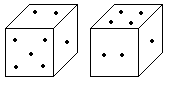
- a)3
- b)1
- c)2
- d)4
Correct answer is option 'D'. Can you explain this answer?
Two positions of dice are shown below. How many points will appear on the opposite to the face containing 5 points?
a)
3
b)
1
c)
2
d)
4
| | Amar Chavan answered |
In these two positions one of the common face having 1 point is in the same position. Therefore according to rule (2). There will be 4 points on the required face.
Which color is opposite to yellow?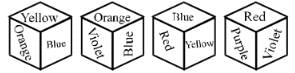
- a)Violet
- b)Red
- c)Purple
- d)Blue
Correct answer is option 'A'. Can you explain this answer?
Which color is opposite to yellow?
a)
Violet
b)
Red
c)
Purple
d)
Blue
 | Ssc Cgl answered |
On the basis of following pattern in given dices , we can say that
Orange, Blue and Red are on the adjacent faces of yellow color.
Again, Blue, Orange, Red and Purple colors are on the adjacent faces of violet color.
Therefore, violet color will be on the face opposite to yellow color.
Orange, Blue and Red are on the adjacent faces of yellow color.
Again, Blue, Orange, Red and Purple colors are on the adjacent faces of violet color.
Therefore, violet color will be on the face opposite to yellow color.
How many dots are contained on the faces opposite to that containing four dots?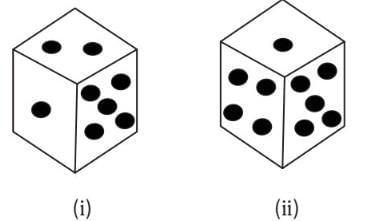
- a)2
- b)3
- c)6
- d)1
Correct answer is option 'A'. Can you explain this answer?
How many dots are contained on the faces opposite to that containing four dots?
a)
2
b)
3
c)
6
d)
1
 | EduRev SSC CGL answered |
as both the figure contains one dot and 5 dots, fixing the 5 dots face and moving one dot face position to fig (i). we find 4 dots is opposite to 2 dots.
For the better understanding take a dice and apply the same steps which is mentioned above.
A dice is thrown four times and its four different positions are given below. Find the number on the face opposite the face showing 2.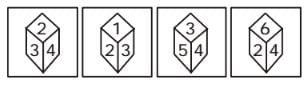
- a)4
- b)5
- c)6
- d)3
Correct answer is option 'B'. Can you explain this answer?
A dice is thrown four times and its four different positions are given below. Find the number on the face opposite the face showing 2.
a)
4
b)
5
c)
6
d)
3
| | Ssc Cgl answered |
As per the given pattern in question figure , we can find the similar next position of given dice .
The numbers 1, 3, 4 and 6 lie on the faces adjacent to the number 2.
Therefore, the number 5 lies on the face opposite to the number 2.
The numbers 1, 3, 4 and 6 lie on the faces adjacent to the number 2.
Therefore, the number 5 lies on the face opposite to the number 2.
Choose from the four answer figures, the figure that will be formed when question figure is folded into a box.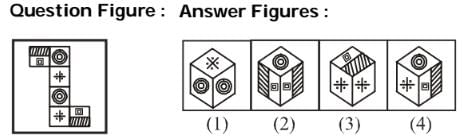
- a)1
- b)2
- c)3
- d)4
Correct answer is option 'D'. Can you explain this answer?
Choose from the four answer figures, the figure that will be formed when question figure is folded into a box.
a)
1
b)
2
c)
3
d)
4
| | EduRev SSC CGL answered |
On the basis of following pattern in given dices , we can say that
Clearly, the similar figures will be on the opposite faces of one another.
Clearly, the similar figures will be on the opposite faces of one another.
Two positions of a dice are shown below. When 3 is at the bottom, what number will be at the top?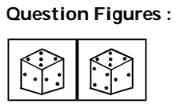
- a)6
- b)3
- c)4
- d)2
Correct answer is option 'C'. Can you explain this answer?
Two positions of a dice are shown below. When 3 is at the bottom, what number will be at the top?
a)
6
b)
3
c)
4
d)
2
| | EduRev SSC CGL answered |
As per the given pattern in question figure , we can find the similar next position of given dice .
From the two views of the dice it is clear that number 4 will be at the top when 3 is at the bottom.
From the two views of the dice it is clear that number 4 will be at the top when 3 is at the bottom.
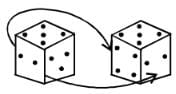
Two positions of a cube with its surfaces numbered are shown below. When the surface 4 touch the bottom, what surface will be on the top?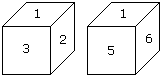
- a)1
- b)2
- c)5
- d)6
Correct answer is option 'A'. Can you explain this answer?
Two positions of a cube with its surfaces numbered are shown below. When the surface 4 touch the bottom, what surface will be on the top?
a)
1
b)
2
c)
5
d)
6
| | Rajveer Ghoshal answered |
In these 2 positions one common face with number 1 is in the same position. Hence according to the rule number (3), 2 is opposite 6 and 3 is opposite to 5. Therefore opposite to 4 is 1.
From the four positions of a dice given below, find the color which is opposite to yellow ?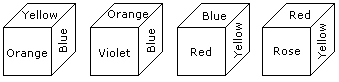
- a)Violet
- b)Red
- c)Rose
- d)Blue
Correct answer is option 'A'. Can you explain this answer?
From the four positions of a dice given below, find the color which is opposite to yellow ?
a)
Violet
b)
Red
c)
Rose
d)
Blue
| | Amar Chavan answered |
The colours adjacent to yellow are orange, blue, red and rose. Hence violet will be opposite to yellow.
Which digit will appear on the face opposite to the face with number 4?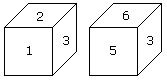
- a)3
- b)5
- c)6
- d)2/3
Correct answer is option 'A'. Can you explain this answer?
Which digit will appear on the face opposite to the face with number 4?
a)
3
b)
5
c)
6
d)
2/3
| | Shivam Malik answered |
Here the common faces with number 3, are in same positions. Hence 6 is opposite to 2 and 5 is opposite to 1. Therefore 4 is opposite to 3.
Choose a box that is similar to the box formed from the given sheet of paper (X).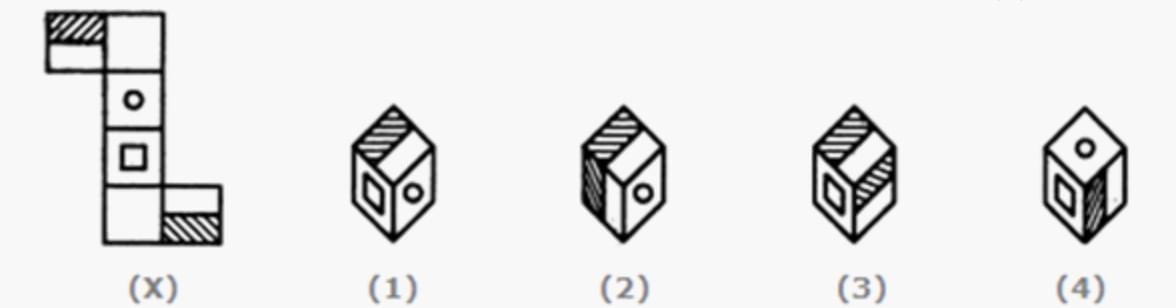
- a)3 only
- b)2 only
- c)1 only
- d)4 only
Correct answer is option 'C'. Can you explain this answer?
Choose a box that is similar to the box formed from the given sheet of paper (X).
a)
3 only
b)
2 only
c)
1 only
d)
4 only
| | EduRev CAT answered |
- When the given sheet depicted in the figure (X) is folded to form a hollow cube, the two half-shaded faces will lie opposite to each other, the face that features a square will lie opposite to one of the two blank faces in the sheet given, and the face with a circle will lie opposite to the other blank face in the sheet.
- So, the hollow cubes shown in the figure (2) and figure (3) that have two half-shaded faces that are adjacent to each other, is not possible to be made by folding the sheet depicted in the figure (X).
- Although the hollow cube depicted in the figure (4) has faces that may appear to be adjacent to each other but the hollow cube formed by folding the given sheet in the figure (X) cannot be rotated to form the hollow cube in the figure(4).
- Therefore, only the hollow cube in figure(1) is possible.
How many points will be on the face opposite to in face which contains 2 points?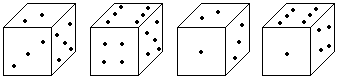
- a)1
- b)5
- c)4
- d)6
Correct answer is option 'D'. Can you explain this answer?
How many points will be on the face opposite to in face which contains 2 points?
a)
1
b)
5
c)
4
d)
6
 | Sravya Deshpande answered |
In first two positions of dice one common face containing 5 is same. Therefore according to rule no. (3) the face opposite to the face which contains 2 point, will contains 6 points.
Two positions of a cubical block are shown. When 5 is at the top which number will be at bottom?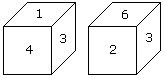
- a)1
- b)2
- c)3
- d)4
Correct answer is option 'C'. Can you explain this answer?
Two positions of a cubical block are shown. When 5 is at the top which number will be at bottom?
a)
1
b)
2
c)
3
d)
4
| | Amar Chavan answered |
In these 2 positions one common face with number 3, is in same position. Hence according to rule (3), 1 is opposite to 6 and 4 is opposite to 2. Therefore 5 is opposite to 3.
Two positions of a dice are shown below. When number '1' is on the top. What number will be at the bottom?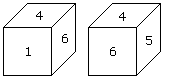
- a)3
- b)5
- c)2
- d)6
Correct answer is option 'B'. Can you explain this answer?
Two positions of a dice are shown below. When number '1' is on the top. What number will be at the bottom?
a)
3
b)
5
c)
2
d)
6
| | Amar Chavan answered |
According to the rule (2) when 'one' is at the top, then 5 will be at the bottom.
Directions to SolveSix dice with upper faces erased are as shows.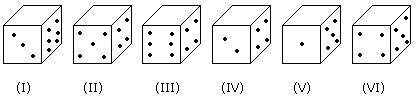 The sum of the numbers of dots on the opposite face is 7.Question - If the odd numbered dice have even number of dots on their top faces, then what would be the total number of dots on the top faces of their dice?
- a)8
- b)10
- c)12
- d)14
Correct answer is option 'A'. Can you explain this answer?
Directions to Solve
Six dice with upper faces erased are as shows.
The sum of the numbers of dots on the opposite face is 7.
If the odd numbered dice have even number of dots on their top faces, then what would be the total number of dots on the top faces of their dice?
a)
8
b)
10
c)
12
d)
14
| | Rajveer Ghoshal answered |
Odd numbered dice are : (II), (III) and (V)
No. of dots on the top faces of these dice are 2, 2 and 4 respectively.
Required total = 2 + 2 + 4 = 8
Here 4 positions of a cube are shown. Which sign will be opposite to '+' ?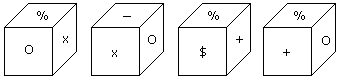
- a)%
- b)-
- c)x
- d)$
Correct answer is option 'C'. Can you explain this answer?
Here 4 positions of a cube are shown. Which sign will be opposite to '+' ?
a)
%
b)
-
c)
x
d)
$
| | Anjali Nair answered |
From position I and III common face with % is in the same position. Hence according to rule (3) opposite is X.
How many dots will be there on the face opposite to the face with 2 dots?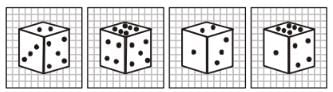
- a)1
- b)5
- c)4
- d)6
Correct answer is option 'D'. Can you explain this answer?
How many dots will be there on the face opposite to the face with 2 dots?
a)
1
b)
5
c)
4
d)
6
| | Ssc Cgl answered |
According to given dice , we can say that
Two, three, four and six dots are on the faces adjacent to one dot.
Therefore, five dots are on face opposite one dot.
One dot, three dots and five dots are on the faces adjacent to two dots.
From the second view of the cube it is clear that four dots are on the face adjacent to two dots.
Therefore, six dots are on the face opposite two dots.
Two, three, four and six dots are on the faces adjacent to one dot.
Therefore, five dots are on face opposite one dot.
One dot, three dots and five dots are on the faces adjacent to two dots.
From the second view of the cube it is clear that four dots are on the face adjacent to two dots.
Therefore, six dots are on the face opposite two dots.
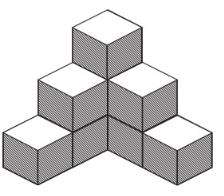
How many cubes are there in below figure?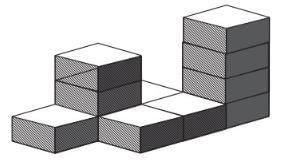
- a)10
- b)11
- c)12
- d)13
Correct answer is option 'B'. Can you explain this answer?
How many cubes are there in below figure?
a)
10
b)
11
c)
12
d)
13
| | EduRev SSC CGL answered |
4 columns with 1 cubes = 4 cubes
1 columns with 3 cubes = 3
1 columns with 4 cubes = 4
Total cubes = 4 + 3 + 4 = 11
1 columns with 3 cubes = 3
1 columns with 4 cubes = 4
Total cubes = 4 + 3 + 4 = 11
Two positions of a dice are shown below. When the heart shape is at the top, what will be at the bottom?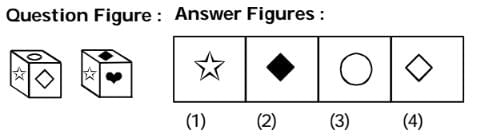
- a)1
- b)2
- c)3
- d)4
Correct answer is option 'D'. Can you explain this answer?
Two positions of a dice are shown below. When the heart shape is at the top, what will be at the bottom?
a)
1
b)
2
c)
3
d)
4
| | EduRev SSC CGL answered |
On the basis of question figure pattern ,
Here the common faces with star are in same positions .
When the heart shape is at the top, the rhombus would be on the bottom.
Here the common faces with star are in same positions .
When the heart shape is at the top, the rhombus would be on the bottom.
Two positions of a dice are shown below. When ‘2’ is at the bottom, what number will be at the top?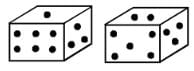
- a)3
- b)5
- c)1
- d)6
Correct answer is option 'C'. Can you explain this answer?
Two positions of a dice are shown below. When ‘2’ is at the bottom, what number will be at the top?
a)
3
b)
5
c)
1
d)
6
| | EduRev SSC CGL answered |
On the basis of following pattern in given dices , we can say that
Here the common faces with 3 dots are in same positions .Thus , When ‘2’ is at the bottom, number '1’ will be on the top.
Here the common faces with 3 dots are in same positions .Thus , When ‘2’ is at the bottom, number '1’ will be on the top.
Four positions of a dice are given below. Identify the number at the bottom when top is 6.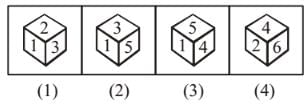
- a)3
- b)1
- c)4
- d)5
Correct answer is option 'B'. Can you explain this answer?
Four positions of a dice are given below. Identify the number at the bottom when top is 6.
a)
3
b)
1
c)
4
d)
5
| | Ssc Cgl answered |
On the basis of following pattern in given dices , we can say that
The numbers 2, 3, 4 and 5 cannot be on the opposite faces of the number 1.
Therefore 1 lies opposite to 6.
The numbers 2, 3, 4 and 5 cannot be on the opposite faces of the number 1.
Therefore 1 lies opposite to 6.
Study the four different positions of a cube given below with numbers from 1 to 6 marked on its faces. Find out which number is contained on the face opposite to that containing 3.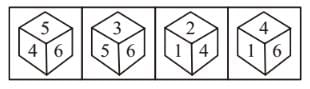
- a)5
- b)4
- c)2
- d)6
Correct answer is option 'B'. Can you explain this answer?
Study the four different positions of a cube given below with numbers from 1 to 6 marked on its faces. Find out which number is contained on the face opposite to that containing 3.
a)
5
b)
4
c)
2
d)
6
| | Ssc Cgl answered |
We follow the given pattern :-
From Ist and IInd figures the numbers 1, 2, 5 and 6 cannot be on the face opposite the number 4.
Therefore, 3 lies opposite 4.
From Ist and IInd figures the numbers 1, 2, 5 and 6 cannot be on the face opposite the number 4.
Therefore, 3 lies opposite 4.
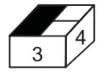
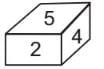
Among the four alternatives choose which one can be the similar box as the question figure.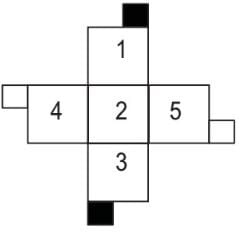
- a)

- b)
- c)
- d)

Correct answer is option 'A'. Can you explain this answer?
Among the four alternatives choose which one can be the similar box as the question figure.
a)
b)
c)
d)
| | EduRev SSC CGL answered |
(a) satisfies all the conditions of dice formation or constructions.
From the following two different appearances of die find out the number which is opposite to ‘5’.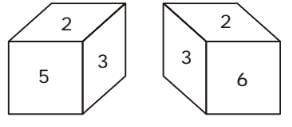
- a)2
- b)3
- c)4
- d)6
Correct answer is option 'D'. Can you explain this answer?
From the following two different appearances of die find out the number which is opposite to ‘5’.
a)
2
b)
3
c)
4
d)
6
| | Ssc Cgl answered |
As per the given pattern in question figure , we can find the similar next position of given dice .
Here 2 and 3 numbers faces are at the same side .
From the two different views of the dice it is clear that ‘6’ lies opposite to ‘5’.
Here 2 and 3 numbers faces are at the same side .
From the two different views of the dice it is clear that ‘6’ lies opposite to ‘5’.
Three positions of a dice are given below. Identify the number on the face opposite to 6.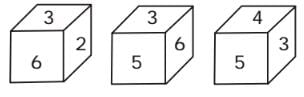
- a)1
- b)4
- c)5
- d)6
Correct answer is option 'B'. Can you explain this answer?
Three positions of a dice are given below. Identify the number on the face opposite to 6.
a)
1
b)
4
c)
5
d)
6
| | EduRev SSC CGL answered |
On the basis of following pattern in given dices , we can say that
The numbers 2, 4, 5 and 6 cannot be on the face opposite to 3.
The numbers 1, 3, 4 and 6 cannot be on the face opposite to 5.
Therefore, 2 lies opposite 5.
Clearly, 4 lies opposite 6.
The numbers 2, 4, 5 and 6 cannot be on the face opposite to 3.
The numbers 1, 3, 4 and 6 cannot be on the face opposite to 5.
Therefore, 2 lies opposite 5.
Clearly, 4 lies opposite 6.
If the total sum of numbers on opposite faces of a cubical block is always 7, find the figure which is correct.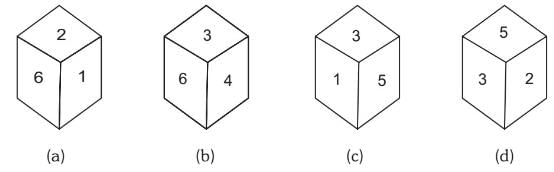
- a)(a)
- b)(b)
- c)(c)
- d)(d)
Correct answer is option 'C'. Can you explain this answer?
If the total sum of numbers on opposite faces of a cubical block is always 7, find the figure which is correct.
a)
(a)
b)
(b)
c)
(c)
d)
(d)
 | Iq Funda answered |
as per the question, sum of the numbers on opposite sides or faces is always 7. Therefore
1 appears opposite 6,
2 appears opposite 5 and
3 must appears opposite of 4.
In (a) 1 cannot adjacent to 6 In (b) 3 cannot adjacent to 4 In (d) 2 cannot appears adjacent to 5 Hence only option (c) is correct.
1 appears opposite 6,
2 appears opposite 5 and
3 must appears opposite of 4.
In (a) 1 cannot adjacent to 6 In (b) 3 cannot adjacent to 4 In (d) 2 cannot appears adjacent to 5 Hence only option (c) is correct.
For the better understanding take a dice and apply the same steps which is mentioned above.
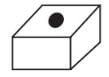
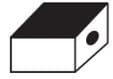
Among the four alternatives which one cannot be the similar box as the question figure.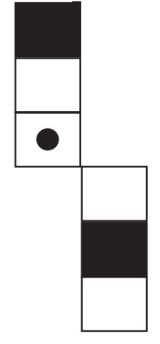
- a)
- b)

- c)

- d)
Correct answer is option 'C'. Can you explain this answer?
Among the four alternatives which one cannot be the similar box as the question figure.
a)
b)
c)
d)
| | Ssc Cgl answered |
as the dot face cannot be adjacent to both the dark shaded faces. Hence option c cannot be possible.
Four positions of a dice are given below:
Find the number on the face opposite to the face showing 4.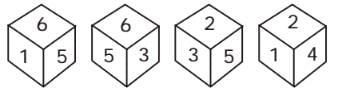
- a)5
- b)6
- c)3
- d)1
Correct answer is option 'A'. Can you explain this answer?
Four positions of a dice are given below:
Find the number on the face opposite to the face showing 4.
Find the number on the face opposite to the face showing 4.
a)
5
b)
6
c)
3
d)
1
| | Ssc Cgl answered |
As we can see that ,
The numbers 1, 2, 3 and 6 lie on the faces adjacent to the number 5.
Therefore, the number 5 lies opposite 4.
The numbers 1, 2, 3 and 6 lie on the faces adjacent to the number 5.
Therefore, the number 5 lies opposite 4.
How many cubes are there in below figure?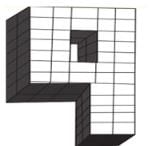
- a)84
- b)64
- c)48
- d)50
Correct answer is option 'A'. Can you explain this answer?
How many cubes are there in below figure?
a)
84
b)
64
c)
48
d)
50
| | Ssc Cgl answered |
There are total 42 cubes present in the upper portion.
Then total cubes be 42 × 2 = 84
Second method to find out the number of cubes/blocks.
24 columns with 2 cubes each = 24 × 2 = 48
14 columns with 2 cubes each = 28
4 columns with 2 cubes each = 8
Total cubes = 48 + 28 + 8 = 84
Then total cubes be 42 × 2 = 84
Second method to find out the number of cubes/blocks.
24 columns with 2 cubes each = 24 × 2 = 48
14 columns with 2 cubes each = 28
4 columns with 2 cubes each = 8
Total cubes = 48 + 28 + 8 = 84
Four positions of a dice are given below. Identify the number at the bottom when top’s number is 6.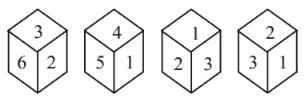
- a)5
- b)1
- c)3
- d)4
Correct answer is option 'B'. Can you explain this answer?
Four positions of a dice are given below. Identify the number at the bottom when top’s number is 6.
a)
5
b)
1
c)
3
d)
4
| | Ssc Cgl answered |
On the basis of above given pattern in dice , we get
The numbers 2, 3, 4 and 5 cannot be on the face opposite to 1.
Therefore, 6 lies opposite 1.
The numbers 2, 3, 4 and 5 cannot be on the face opposite to 1.
Therefore, 6 lies opposite 1.
Two positions of a dice are shown below. When 4 is at the top what number will be at the bottom?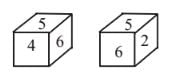
- a)5
- b)1
- c)2
- d)6
Correct answer is option 'C'. Can you explain this answer?
Two positions of a dice are shown below. When 4 is at the top what number will be at the bottom?
a)
5
b)
1
c)
2
d)
6
| | EduRev SSC CGL answered |
On the basis of following pattern in given dices , we can say that
The numbers 2, 4 and 5 cannot be on the opposite face of 6.
From the two views of dice, it is clear that 2 is at bottom when 4 is at top.
The numbers 2, 4 and 5 cannot be on the opposite face of 6.
From the two views of dice, it is clear that 2 is at bottom when 4 is at top.
Three positions of a cube are given. Based on them find out which number is found opposite of number 2 in a given cube?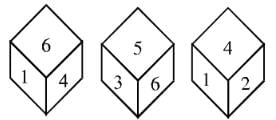
- a)2
- b)5
- c)1
- d)6
Correct answer is option 'D'. Can you explain this answer?
Three positions of a cube are given. Based on them find out which number is found opposite of number 2 in a given cube?
a)
2
b)
5
c)
1
d)
6
| | EduRev SSC CGL answered |
As per the given pattern in question figure , we can find the similar next position of given dice .
The numbers 1, 3, 4 and 5 are on adjacent faces of the number
Therefore, 6 lies opposite 2.
The numbers 1, 3, 4 and 5 are on adjacent faces of the number
Therefore, 6 lies opposite 2.
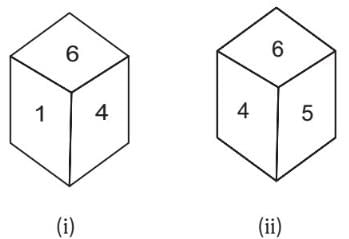
Two positions of a dice are shown below (i) and (ii). When 3 is at the top which number will be at the bottom?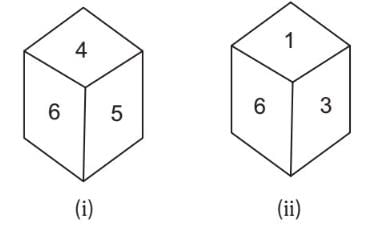
- a)2
- b)4
- c)5
- d)6
Correct answer is option 'C'. Can you explain this answer?
Two positions of a dice are shown below (i) and (ii). When 3 is at the top which number will be at the bottom?
a)
2
b)
4
c)
5
d)
6
| | EduRev SSC CGL answered |
as number 6 position is same in both the figures. We can assume that the dice to be rotated so that 6 remains on the same face and 1,3,4 and 5 will be arranged ascending order as all are adjacent to 6. Hence, when 3 is in top, 5 will be at bottam.
A dice is thrown four times and its four different positions are shown below. Find the number on the face opposite the face showing 2.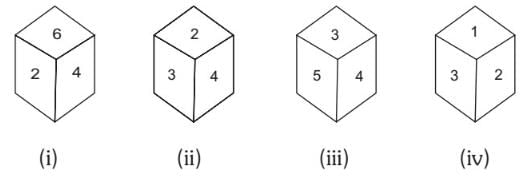
- a)3
- b)4
- c)5
- d)6
Correct answer is option 'C'. Can you explain this answer?
A dice is thrown four times and its four different positions are shown below. Find the number on the face opposite the face showing 2.
a)
3
b)
4
c)
5
d)
6
| | EduRev SSC CGL answered |
from figure i, ii and iv we conclude that 6, 4, 3 and 1 lie adjacent to 2. Hence 5 be opposite of 2.
For the better understanding take a dice ans apply the same steps which is mentioned above.
Chapter doubts & questions for Cubes & Dice - General Intelligence and Reasoning for SSC CGL 2026 is part of SSC CGL exam preparation. The chapters have been prepared according to the SSC CGL exam syllabus. The Chapter doubts & questions, notes, tests & MCQs are made for SSC CGL 2026 Exam. Find important definitions, questions, notes, meanings, examples, exercises, MCQs and online tests here.
Chapter doubts & questions of Cubes & Dice - General Intelligence and Reasoning for SSC CGL in English & Hindi are available as part of SSC CGL exam. Download more important topics, notes, lectures and mock test series for SSC CGL Exam by signing up for free.
General Intelligence and Reasoning for SSC CGL177 videos|264 docs|169 tests |
