


All Exams > Class 6 > Science Olympiad Class 6 > All Questions
All questions of Food and its Components for Class 6 Exam
Which of the following vitamins and their deficiency disease is NOT correctly paired?- a)Vitamin A → Night blindness
- b)Vitamin B1→ Scurvy
- c)Iron → Anaemia
- d)Vitamin D → Rickets
Correct answer is option 'B'. Can you explain this answer?
Which of the following vitamins and their deficiency disease is NOT correctly paired?
a)
Vitamin A → Night blindness
b)
Vitamin B1→ Scurvy
c)
Iron
→ Anaemiad)
Vitamin D → Rickets
 | Sanskriti Tiwari answered |
Deficiency of vitamin B1 causes Beri-Beri. Beriberi is a disease in which the body does not have enough thiamine.

Which of the following classes of food is present in pulses?- a)Vitamins
- b)Fats
- c)Carbohydrates
- d)Proteins
Correct answer is option 'D'. Can you explain this answer?
Which of the following classes of food is present in pulses?
a)
Vitamins
b)
Fats
c)
Carbohydrates
d)
Proteins
 | Arjun Desai answered |
Explanation for the correct option:
- Pulses are known to be an excellent source of protein nutrients.
- Along with Proteins, they also contain minerals and vitamins. It is also a very cheap source of protein.
- Storage proteins like albumin and globulin make up the majority of the proteins found in pulses.
- The primary storage proteins in pulse seeds are globulins, which account for 35-72% of the total protein in the seeds. Albumins make up the majority of the remaining protein component.
How is roughage important to humans?- a)Prevents constipation
- b)Builds and repairs tissues
- c)Maintains the health to the body
- d)Produces hemoglobin in red blood cells
Correct answer is option 'A'. Can you explain this answer?
How is roughage important to humans?
a)
Prevents constipation
b)
Builds and repairs tissues
c)
Maintains the health to the body
d)
Produces hemoglobin in red blood cells
 | Vaibhav Shah answered |
The given information is about dietary fibre. Fibres prevent constipation.
Match the following pairs and choose the correct answer.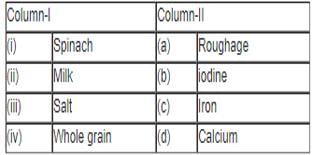
- a)(i)−d,(ii)−a,(iii)−c,(iv)−d
- b)(i)−d,(ii)−c,(iii)−a,(iv)−b
- c)(i)−c,(ii)−a,(iii)−d,(iv)−b
- d)(i)−c,(ii)−d,(iii)−b,(iv)−a
Correct answer is option 'D'. Can you explain this answer?
Match the following pairs and choose the correct answer.
a)
(i)−d,(ii)−a,(iii)−c,(iv)−d
b)
(i)−d,(ii)−c,(iii)−a,(iv)−b
c)
(i)−c,(ii)−a,(iii)−d,(iv)−b
d)
(i)−c,(ii)−d,(iii)−b,(iv)−a
 | Devansh Singh answered |
Spinach - Iron Milk - Calcium Salt - Iodine Whole grain - Roughage
Which of the following statements is/are correct with regard to our diet?- a)Eat a diet rich in carbohydrates and proteins.
- b)Drink plenty of water
- c)Eat green vegetables every day.
- d)All of these
Correct answer is option 'D'. Can you explain this answer?
Which of the following statements is/are correct with regard to our diet?
a)
Eat a diet rich in carbohydrates and proteins.
b)
Drink plenty of water
c)
Eat green vegetables every day.
d)
All of these
 | Akshita Basu answered |
A balanced and nutritious diet is essential for maintaining good health. Here’s why each of the statements is correct:
- Eat a diet rich in carbohydrates and proteins: Carbohydrates are the body's primary source of energy, while proteins are crucial for the growth, repair, and maintenance of body tissues. Including both in your diet ensures that your body has the necessary energy to function and the building blocks to maintain and repair itself.
- Drink plenty of water: Water is vital for various bodily functions, including digestion, absorption of nutrients, regulation of body temperature, and removal of waste products. Staying hydrated helps keep these processes running smoothly.
- Eat green vegetables every day: Green vegetables are packed with essential vitamins, minerals, and fiber. They are also low in calories and rich in antioxidants, which help protect the body from various diseases. Regular consumption of green vegetables supports overall health and well-being.
Conclusion: All three practices are important components of a healthy diet, which is why the correct answer is "All of these." Each plays a unique role in ensuring that your body gets the necessary nutrients, stays hydrated, and remains healthy.
4o
Priya placed two drops of a liquid on cooked rice which turned the rice blue- black. What could be the liquid?- a)Vegetable oil
- b)Iodine solution
- c)Benedict's solution
- d)Nitrate solution
Correct answer is option 'B'. Can you explain this answer?
Priya placed two drops of a liquid on cooked rice which turned the rice blue- black. What could be the liquid?
a)
Vegetable oil
b)
Iodine solution
c)
Benedict's solution
d)
Nitrate solution
 | Ananya Mishra answered |
Rice is a rich source of starch. When iodine solution is added. It will turn to blue-black colour.
The food items given below belongs to which of the following groups?Beans, Peas, Pulses and Meat - a)Fats
- b)Proteins
- c)Vitamins
- d)Carbohydrate
Correct answer is option 'B'. Can you explain this answer?
The food items given below belongs to which of the following groups?
Beans, Peas, Pulses and Meat
a)
Fats
b)
Proteins
c)
Vitamins
d)
Carbohydrate
| | Ananya Mishra answered |
The given food items are rich in proteins.
Which of the following vitamins is lost by heating?- a)Vitamin A
- b)Vitamin C
- c)Vitamin D
- d)Vitamin K
Correct answer is option 'B'. Can you explain this answer?
Which of the following vitamins is lost by heating?
a)
Vitamin A
b)
Vitamin C
c)
Vitamin D
d)
Vitamin K
 | Aruna nair answered |
Vitamin C is a water-soluble vitamin that helps in growth and development and is also called ascorbic acid. It is a temperature-sensitive vitamin that gets destroyed at elevated temperatures.
White of an egg turns violet when two drops of copper sulphate and ten drops of caustic soda are added to it. This indicates the presence of which of the following components of food?- a)Starch
- b)Proteins
- c)Fats
- d)Vitamins
Correct answer is option 'B'. Can you explain this answer?
White of an egg turns violet when two drops of copper sulphate and ten drops of caustic soda are added to it. This indicates the presence of which of the following components of food?
a)
Starch
b)
Proteins
c)
Fats
d)
Vitamins
 | Anisha Nambiar answered |
When food turns to violet colour when treated with copper sulphate solution and caustic soda indicates the presence of proteins.
Nutrient is defined as__________.- a)Constituent of food that helps in body functioning
- b)Substance which alters body functioning
- c)Constituent of food that doesn't helps in body functioning
- d)Substance which are not useful for body functioning
Correct answer is option 'A'. Can you explain this answer?
Nutrient is defined as__________.
a)
Constituent of food that helps in body functioning
b)
Substance which alters body functioning
c)
Constituent of food that doesn't helps in body functioning
d)
Substance which are not useful for body functioning
 | EduRev Class 6 answered |
Nutrients are the constituents of food that help in body functioning in one way or the other such as providing energy, repair cells, and growth. There are six major types of nutrients are carbohydrates, lipids, proteins, vitamins, minerals, and water.
Thus, option A is correct.
Thus, option A is correct.
Which of the following nutrients is called “energy giving food”?- a)fats
- b)carbohydrates
- c)both
- d)none
Correct answer is option 'C'. Can you explain this answer?
Which of the following nutrients is called “energy giving food”?
a)
fats
b)
carbohydrates
c)
both
d)
none
 | Rohini Seth answered |
Fat and Carbohydrated both are the nutrients called as "Energy giving Food".
Which of the following vitamins are produced in our body when exposed to sunlight in the morning?- a)Vitamin A
- b)Vitamin B
- c)Vitamin D
- d)Vitamin K
Correct answer is option 'C'. Can you explain this answer?
Which of the following vitamins are produced in our body when exposed to sunlight in the morning?
a)
Vitamin A
b)
Vitamin B
c)
Vitamin D
d)
Vitamin K
 | Harshitha Mukherjee answered |
Sunlight exposure in the summer can equip your body to stock up on vitamin D3 that can last throughout the fall and yield for the production of more vitamin D, which leads to higher serotonin levels. Skin that is exposed to ultraviolet (UV) rays release a compound, nitric oxide, that lowers blood pressure.
Which of the following is a fat free and rich source of Vitamin A?- a)Carrot
- b)Potato
- c)Honey
- d)Eggs
Correct answer is option 'A'. Can you explain this answer?
Which of the following is a fat free and rich source of Vitamin A?
a)
Carrot
b)
Potato
c)
Honey
d)
Eggs
 | Harshad Shah answered |
Carrot is a rich source of vitamin-A.
Which one of the following Vitamins deficiency leads to bleeding of gums, slow healing of wounds and aching limbs?- a)Vitamin A
- b)Vitamin B
- c)Vitamin C
- d)Vitamin D
Correct answer is option 'C'. Can you explain this answer?
Which one of the following Vitamins deficiency leads to bleeding of gums, slow healing of wounds and aching limbs?
a)
Vitamin A
b)
Vitamin B
c)
Vitamin C
d)
Vitamin D
| | Anisha Nambiar answered |
Deficiency of vitamin C causes scurvy. Vitamin C is necessary for keeping gums and joints healthy and building resistance to infections.
Which of the following symptoms is shown by a person whose diet is deficient in proteins?- a)Swelling of face
- b)Obesity
- c)Bent bones
- d)Poor vision
Correct answer is option 'A'. Can you explain this answer?
Which of the following symptoms is shown by a person whose diet is deficient in proteins?
a)
Swelling of face
b)
Obesity
c)
Bent bones
d)
Poor vision
 | Raj Mukherjee answered |
If a person does not get enough proteins in his/her food, he/she is likely to have stunted growth and a swollen face.
Which mineral is essential for strong bones and teeth?- a)Iodine
- b)Calcium
- c)Sodium
- d)Iron
Correct answer is option 'B'. Can you explain this answer?
Which mineral is essential for strong bones and teeth?
a)
Iodine
b)
Calcium
c)
Sodium
d)
Iron
 | Dr Manju Sen answered |
Calcium is the mineral is essential for strong bones and teeth.
Nutrients are classified into________ types.- a)5
- b)6
- c)3
- d)7
Correct answer is option 'A'. Can you explain this answer?
Nutrients are classified into________ types.
a)
5
b)
6
c)
3
d)
7
 | Get Idea answered |
Nutrients are classified into 5 types: carbohydrates, proteins, fats, vitamins, and minerals. While water and dietary fibre (roughage) are important for health, they are not classified as nutrients. Therefore, the correct answer is 5.
Match the following items in Column I with their correct sources or associated nutrients in Column II.Column I Column II (i) Amla (a) Calcium (ii) Carrot (b) Iodine (iii) Milk (c) Vitamin C (iv) Salt (d) Vitamin A
- a)(i)−d, (ii)−c, (iii)−b, (iv)−a
- b)(i)−c, (ii)−d, (iii)−a, (iv)−b
- c)(i)−a, (ii)−b, (iii)−c, (iv)−d
- d)(i)−d, (ii)−a, (iii)−c, (iv)−b
Correct answer is option 'D'. Can you explain this answer?
Match the following items in Column I with their correct sources or associated nutrients in Column II.
| Column I | Column II |
|---|---|
| (i) Amla | (a) Calcium |
| (ii) Carrot | (b) Iodine |
| (iii) Milk | (c) Vitamin C |
| (iv) Salt | (d) Vitamin A |
a)
(i)−d, (ii)−c, (iii)−b, (iv)−a
b)
(i)−c, (ii)−d, (iii)−a, (iv)−b
c)
(i)−a, (ii)−b, (iii)−c, (iv)−d
d)
(i)−d, (ii)−a, (iii)−c, (iv)−b
 | Partho Nair answered |
Understanding the Nutritional Sources
To match the items in Column I with their correct sources or associated nutrients in Column II, we need to analyze each item and its known nutritional benefits.
Matching Items
- (i) Amla:
- Known for its high vitamin C content, Amla is a potent antioxidant.
- Correct Match: (c) Vitamin C
- (ii) Carrot:
- Carrots are rich in beta-carotene, which the body converts into vitamin A, essential for good vision and immune function.
- Correct Match: (d) Vitamin A
- (iii) Milk:
- Milk is an excellent source of calcium, vital for healthy bones and teeth.
- Correct Match: (a) Calcium
- (iv) Salt:
- Table salt is often iodized, meaning it has added iodine, which is important for thyroid function.
- Correct Match: (b) Iodine
Final Matches
Based on the analysis, the correct answer is:
- (i)−c (Amla - Vitamin C)
- (ii)−d (Carrot - Vitamin A)
- (iii)−a (Milk - Calcium)
- (iv)−b (Salt - Iodine)
These matches correspond to option 'D': (i)−c, (ii)−d, (iii)−a, (iv)−b.
Conclusion
Understanding the nutritional sources of common foods helps in making informed dietary choices. Each food item is associated with specific nutrients that are essential for overall health.
To match the items in Column I with their correct sources or associated nutrients in Column II, we need to analyze each item and its known nutritional benefits.
Matching Items
- (i) Amla:
- Known for its high vitamin C content, Amla is a potent antioxidant.
- Correct Match: (c) Vitamin C
- (ii) Carrot:
- Carrots are rich in beta-carotene, which the body converts into vitamin A, essential for good vision and immune function.
- Correct Match: (d) Vitamin A
- (iii) Milk:
- Milk is an excellent source of calcium, vital for healthy bones and teeth.
- Correct Match: (a) Calcium
- (iv) Salt:
- Table salt is often iodized, meaning it has added iodine, which is important for thyroid function.
- Correct Match: (b) Iodine
Final Matches
Based on the analysis, the correct answer is:
- (i)−c (Amla - Vitamin C)
- (ii)−d (Carrot - Vitamin A)
- (iii)−a (Milk - Calcium)
- (iv)−b (Salt - Iodine)
These matches correspond to option 'D': (i)−c, (ii)−d, (iii)−a, (iv)−b.
Conclusion
Understanding the nutritional sources of common foods helps in making informed dietary choices. Each food item is associated with specific nutrients that are essential for overall health.
Which of the following vitamins is present in the given substances? 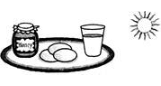
- a)Vitamin E
- b)Vitamin D
- c)Vitamin K
- d)Vitamin C
Correct answer is option 'B'. Can you explain this answer?
Which of the following vitamins is present in the given substances?
a)
Vitamin E
b)
Vitamin D
c)
Vitamin K
d)
Vitamin C
 | Preethi Basak answered |
Vitamin D helps our body to use calcium for bones and teeth, it is found in sunlight, eggs, butter and milk.
Chapter doubts & questions for Food and its Components - Science Olympiad Class 6 2026 is part of Class 6 exam preparation. The chapters have been prepared according to the Class 6 exam syllabus. The Chapter doubts & questions, notes, tests & MCQs are made for Class 6 2026 Exam. Find important definitions, questions, notes, meanings, examples, exercises, MCQs and online tests here.
Chapter doubts & questions of Food and its Components - Science Olympiad Class 6 in English & Hindi are available as part of Class 6 exam. Download more important topics, notes, lectures and mock test series for Class 6 Exam by signing up for free.
Science Olympiad Class 645 videos|122 docs|89 tests |
