


All Exams > Class 8 > Mathematical Olympiad Class 8 > All Questions
All questions of Achievers Section for Class 8 Exam
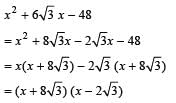
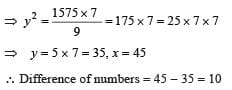
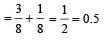
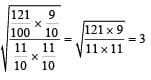
 is
is  . What is the other factor ?




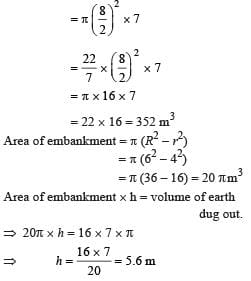
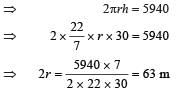
A well with internal diameter 8m is dug 7m deep. The earth taken out of it is spread at around to a width of 2 m to form an embankment. The height of embankment will be :- a)1.4 m
- b)2.8 m
- c)4.2 m
- d)5.6 m
Correct answer is option 'D'. Can you explain this answer?
A well with internal diameter 8m is dug 7m deep. The earth taken out of it is spread at around to a width of 2 m to form an embankment. The height of embankment will be :
a)
1.4 m
b)
2.8 m
c)
4.2 m
d)
5.6 m
 | Shubham Sharma answered |
Volume of earth dug out

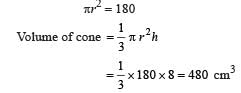

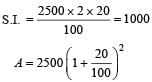
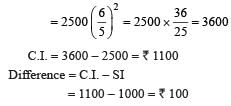

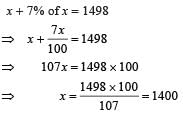
One of the factor of x2 + 17x + 60 is- a)x + 12
- b)x – 5
- c)5x – 1
- d)x – 12
Correct answer is option 'A'. Can you explain this answer?
One of the factor of x2 + 17x + 60 is
a)
x + 12
b)
x – 5
c)
5x – 1
d)
x – 12
| | Shubham Sharma answered |
x2 + 17x + 60
=x2 +5x +12x + 60
=x(x+5) +12(x+5)
=(x+5) + (x+12)
=x2 +5x +12x + 60
=x(x+5) +12(x+5)
=(x+5) + (x+12)

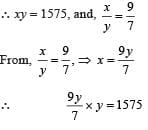
Read the given statements carefully and state 'T' for true and 'F' for false.
(i) The sum of the first n natural numbers is given by n(n+1)/2.
(ii) The sum of the squares of the first n natural numbers is given by n(n+1)(2n+1)/6.
(iii) The sum of the cubes of the first n natural numbers is given by (n(n+1)/2)².- a)(i)-T, (ii)-T, (iii)-T
- b)(i)-T, (ii)-F, (iii)-T
- c)(i)-F, (ii)-T, (iii)-F
- d)(i)-T, (ii)-T, (iii)-F
Correct answer is option 'A'. Can you explain this answer?
Read the given statements carefully and state 'T' for true and 'F' for false.
(i) The sum of the first n natural numbers is given by n(n+1)/2.
(ii) The sum of the squares of the first n natural numbers is given by n(n+1)(2n+1)/6.
(iii) The sum of the cubes of the first n natural numbers is given by (n(n+1)/2)².
(i) The sum of the first n natural numbers is given by n(n+1)/2.
(ii) The sum of the squares of the first n natural numbers is given by n(n+1)(2n+1)/6.
(iii) The sum of the cubes of the first n natural numbers is given by (n(n+1)/2)².
a)
(i)-T, (ii)-T, (iii)-T
b)
(i)-T, (ii)-F, (iii)-T
c)
(i)-F, (ii)-T, (iii)-F
d)
(i)-T, (ii)-T, (iii)-F
 | C K Academy answered |
(i) The sum of the first n natural numbers is indeed given by n(n+1)/2, which is correct.
(ii) The sum of the squares of the first n natural numbers is given by n(n+1)(2n+1)/6, which is also correct.
(iii) The sum of the cubes of the first n natural numbers is given by (n(n+1)/2)², which is correct.
(ii) The sum of the squares of the first n natural numbers is given by n(n+1)(2n+1)/6, which is also correct.
(iii) The sum of the cubes of the first n natural numbers is given by (n(n+1)/2)², which is correct.
9x2 + 25 - 30x is the square of- a)3x – 5
- b)– 3x – 5
- c)3x + 5
- d)-3x2 + 5
Correct answer is option 'A'. Can you explain this answer?
9x2 + 25 - 30x is the square of
a)
3x – 5
b)
– 3x – 5
c)
3x + 5
d)
-3x2 + 5
| | Shubham Sharma answered |
9x2 + 25 - 30x
= (3x)2 + (5)2 - 2 (3x) (5)
= (3x - 5)2
= (3x)2 + (5)2 - 2 (3x) (5)
= (3x - 5)2
A cuboid vessel is 20 cm long and 12 cm wide. How high must it be to bold 3 liters of water?- a)12.5 cm
- b)12 cm
- c)14 cm
- d)4.5 cm
Correct answer is option 'A'. Can you explain this answer?
A cuboid vessel is 20 cm long and 12 cm wide. How high must it be to bold 3 liters of water?
a)
12.5 cm
b)
12 cm
c)
14 cm
d)
4.5 cm
 | Athira Nambiar answered |
Length = 20cm
width = 12cm
volume = 3 litre=3000cm^3
height = 3000\20x12
= 12.5cm

One of the letters from the word SOCIOLOGY is chosen at random. What is the probability that this letter is O? - a)

- b)

- c)

- d)None of these
Correct answer is option 'A'. Can you explain this answer?
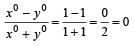
One of the letters from the word SOCIOLOGY is chosen at random. What is the probability that this letter is O?
a)
b)
c)
d)
None of these
| | Shubham Sharma answered |
Total number of letters = 9
Number of letter ‘O’ = 3
Required probability
Number of letter ‘O’ = 3
Required probability
Read the given statements carefully and state 'T' for true and 'F' for false.
(i) The roots of the quadratic equation ax² + bx + c = 0 are given by (-b ± √(b²-4ac)) / 2a.
(ii) The discriminant of the quadratic equation ax² + bx + c = 0 is b² - 4ac.
(iii) If the discriminant is negative, the quadratic equation has two real and distinct roots.- a)(i)-T, (ii)-T, (iii)-F
- b)(i)-F, (ii)-T, (iii)-T
- c)(i)-T, (ii)-F, (iii)-T
- d)(i)-T, (ii)-T, (iii)-T
Correct answer is option 'A'. Can you explain this answer?
Read the given statements carefully and state 'T' for true and 'F' for false.
(i) The roots of the quadratic equation ax² + bx + c = 0 are given by (-b ± √(b²-4ac)) / 2a.
(ii) The discriminant of the quadratic equation ax² + bx + c = 0 is b² - 4ac.
(iii) If the discriminant is negative, the quadratic equation has two real and distinct roots.
(i) The roots of the quadratic equation ax² + bx + c = 0 are given by (-b ± √(b²-4ac)) / 2a.
(ii) The discriminant of the quadratic equation ax² + bx + c = 0 is b² - 4ac.
(iii) If the discriminant is negative, the quadratic equation has two real and distinct roots.
a)
(i)-T, (ii)-T, (iii)-F
b)
(i)-F, (ii)-T, (iii)-T
c)
(i)-T, (ii)-F, (iii)-T
d)
(i)-T, (ii)-T, (iii)-T
 | Meera Kumar answered |
Understanding the Statements
The question examines three statements related to quadratic equations, specifically of the form ax² + bx + c = 0. Let's analyze each statement to understand why option 'A' is the correct answer.
Statement (i):
- The roots of the quadratic equation ax² + bx + c = 0 are given by the formula (-b ± √(b² - 4ac)) / 2a.
- This statement is True (T). This is the standard formula known as the quadratic formula, used to find the roots of a quadratic equation.
Statement (ii):
- The discriminant of the quadratic equation ax² + bx + c = 0 is b² - 4ac.
- This statement is also True (T). The discriminant helps determine the nature of the roots of the quadratic equation.
Statement (iii):
- If the discriminant is negative, the quadratic equation has two real and distinct roots.
- This statement is False (F). When the discriminant is negative, it indicates that the quadratic equation has no real roots; instead, it has two complex roots.
Conclusion
Based on the analysis:
- Statement (i) is True (T).
- Statement (ii) is True (T).
- Statement (iii) is False (F).
Thus, the correct answer is option 'A', which states: (i)-T, (ii)-T, (iii)-F. This indicates a clear understanding of the properties of quadratic equations and their discriminants.
The question examines three statements related to quadratic equations, specifically of the form ax² + bx + c = 0. Let's analyze each statement to understand why option 'A' is the correct answer.
Statement (i):
- The roots of the quadratic equation ax² + bx + c = 0 are given by the formula (-b ± √(b² - 4ac)) / 2a.
- This statement is True (T). This is the standard formula known as the quadratic formula, used to find the roots of a quadratic equation.
Statement (ii):
- The discriminant of the quadratic equation ax² + bx + c = 0 is b² - 4ac.
- This statement is also True (T). The discriminant helps determine the nature of the roots of the quadratic equation.
Statement (iii):
- If the discriminant is negative, the quadratic equation has two real and distinct roots.
- This statement is False (F). When the discriminant is negative, it indicates that the quadratic equation has no real roots; instead, it has two complex roots.
Conclusion
Based on the analysis:
- Statement (i) is True (T).
- Statement (ii) is True (T).
- Statement (iii) is False (F).
Thus, the correct answer is option 'A', which states: (i)-T, (ii)-T, (iii)-F. This indicates a clear understanding of the properties of quadratic equations and their discriminants.
The sum of digits of a two-digit number is 9. If 9 is subtracted from the number, its digits are interchanged.Q. What is the half of that number?- a)26
- b)27
- c)28
- d)29
Correct answer is option 'B'. Can you explain this answer?
The sum of digits of a two-digit number is 9. If 9 is subtracted from the number, its digits are interchanged.
Q. What is the half of that number?
a)
26
b)
27
c)
28
d)
29
 | Uday Mehta answered |
Understanding the Problem
To solve the problem, we need to identify a two-digit number whose digits add up to 9, and when 9 is subtracted from it, the digits are reversed.
Step 1: Define the Two-Digit Number
Let the two-digit number be represented as:
- 10a + b, where
- a = tens digit
- b = units digit
Step 2: Set Up the Equations
From the problem, we have the following conditions:
- The sum of the digits is 9:
- a + b = 9
- When 9 is subtracted from the number, the digits are interchanged:
- 10a + b - 9 = 10b + a
Step 3: Simplify the Second Equation
Rearranging the second equation gives:
- 10a + b - 9 = 10b + a
- This simplifies to:
- 9a - 9b = 9
- or, a - b = 1
Step 4: Solve the Equations
Now we have a system of equations:
1. a + b = 9
2. a - b = 1
Adding these equations:
- (a + b) + (a - b) = 9 + 1
- 2a = 10
- a = 5
Now substitute a = 5 into a + b = 9:
- 5 + b = 9
- b = 4
Step 5: Find the Number
The two-digit number is:
- 10a + b = 10(5) + 4 = 54
Step 6: Calculate Half of the Number
Now, to find half of the number:
- Half of 54 = 27
Conclusion
Thus, the half of that number is 27, confirming that the correct answer is option 'B'.
To solve the problem, we need to identify a two-digit number whose digits add up to 9, and when 9 is subtracted from it, the digits are reversed.
Step 1: Define the Two-Digit Number
Let the two-digit number be represented as:
- 10a + b, where
- a = tens digit
- b = units digit
Step 2: Set Up the Equations
From the problem, we have the following conditions:
- The sum of the digits is 9:
- a + b = 9
- When 9 is subtracted from the number, the digits are interchanged:
- 10a + b - 9 = 10b + a
Step 3: Simplify the Second Equation
Rearranging the second equation gives:
- 10a + b - 9 = 10b + a
- This simplifies to:
- 9a - 9b = 9
- or, a - b = 1
Step 4: Solve the Equations
Now we have a system of equations:
1. a + b = 9
2. a - b = 1
Adding these equations:
- (a + b) + (a - b) = 9 + 1
- 2a = 10
- a = 5
Now substitute a = 5 into a + b = 9:
- 5 + b = 9
- b = 4
Step 5: Find the Number
The two-digit number is:
- 10a + b = 10(5) + 4 = 54
Step 6: Calculate Half of the Number
Now, to find half of the number:
- Half of 54 = 27
Conclusion
Thus, the half of that number is 27, confirming that the correct answer is option 'B'.

The length, breadth, and height of a cuboid are 15 cm, 10 cm, and 8 cm respectively. Find the total surface area of the cuboid.- a)860 cm2
- b)850 cm2
- c)700 cm2
- d)830 cm2
Correct answer is option 'C'. Can you explain this answer?
The length, breadth, and height of a cuboid are 15 cm, 10 cm, and 8 cm respectively. Find the total surface area of the cuboid.
a)
860 cm2
b)
850 cm2
c)
700 cm2
d)
830 cm2
 | EduRev Class 8 answered |
Total surface area of a cuboid = 2(lb + bh + hl)
= 2(15 × 10 + 10 × 8 + 8 × 15)
= 2(150 + 80+ 120) = 2 × 350 = 700cm2
= 2(15 × 10 + 10 × 8 + 8 × 15)
= 2(150 + 80+ 120) = 2 × 350 = 700cm2
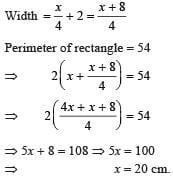
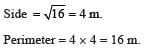
 What is its perimeter?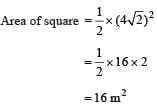
Read the given statements carefully and state 'T' for true and 'F' for false.
(i) The volume of a sphere is given by the formula (4/3)πr³.
(ii) If the radius of a sphere is doubled, the volume becomes eight times.
(iii) The surface area of a sphere is given by 4πr².- a)(i)-T, (ii)-T, (iii)-T
- b)(i)-T, (ii)-F, (iii)-T
- c)(i)-T, (ii)-T, (iii)-F
- d)(i)-F, (ii)-T, (iii)-T
Correct answer is option 'A'. Can you explain this answer?
Read the given statements carefully and state 'T' for true and 'F' for false.
(i) The volume of a sphere is given by the formula (4/3)πr³.
(ii) If the radius of a sphere is doubled, the volume becomes eight times.
(iii) The surface area of a sphere is given by 4πr².
(i) The volume of a sphere is given by the formula (4/3)πr³.
(ii) If the radius of a sphere is doubled, the volume becomes eight times.
(iii) The surface area of a sphere is given by 4πr².
a)
(i)-T, (ii)-T, (iii)-T
b)
(i)-T, (ii)-F, (iii)-T
c)
(i)-T, (ii)-T, (iii)-F
d)
(i)-F, (ii)-T, (iii)-T
| | C K Academy answered |
(i) The volume of a sphere is indeed given by the formula (4/3)πr³, which is correct.
(ii) If the radius of a sphere is doubled, the volume becomes (2r)³ = 8r³, making it eight times the original volume, which is also correct.
(iii) The surface area of a sphere is given by 4πr², which is correct.
(ii) If the radius of a sphere is doubled, the volume becomes (2r)³ = 8r³, making it eight times the original volume, which is also correct.
(iii) The surface area of a sphere is given by 4πr², which is correct.


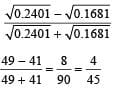
A sphere has a diameter of 14 cm. Find its surface area.- a)616 cm2
- b)500 cm2
- c)600 cm2
- d)620 cm2
Correct answer is option 'A'. Can you explain this answer?
A sphere has a diameter of 14 cm. Find its surface area.
a)
616 cm2
b)
500 cm2
c)
600 cm2
d)
620 cm2
| | EduRev Class 8 answered |
Radius r = 14/2 = 7cm
Surface area of a sphere = 4πr2
= 4 π × 49 = 616cm2
Surface area of a sphere = 4πr2
= 4 π × 49 = 616cm2
The base area of a rectangular prism is 60 cm2 . If its height is 10 cm, find its volume.- a)600 cm2
- b)500 cm2
- c)700 cm2
- d)800 cm2
Correct answer is option 'A'. Can you explain this answer?
The base area of a rectangular prism is 60 cm2 . If its height is 10 cm, find its volume.
a)
600 cm2
b)
500 cm2
c)
700 cm2
d)
800 cm2
 | Trisha Vashisht answered |
Volume of a rectangular prism = Base area × height
= 60 cm2 × 10 cm = 600cm3
= 60 cm2 × 10 cm = 600cm3
Read the given statements carefully and state 'T' for true and 'F' for false.
(i) The sum of the first n natural numbers is given by n(n+1)/2.
(ii) The sum of the squares of the first n natural numbers is given by n(n+1)(2n+1)/6.
(iii) The sum of the cubes of the first n natural numbers is given by (n(n+1)/2)².
(i) (ii) (iii)- a)(i)-T, (ii)-T, (iii)-T
- b)(i)-T, (ii)-F, (iii)-T
- c)(i)-F, (ii)-T, (iii)-F
- d)(i)-T, (ii)-T, (iii)-F
Correct answer is option 'A'. Can you explain this answer?
Read the given statements carefully and state 'T' for true and 'F' for false.
(i) The sum of the first n natural numbers is given by n(n+1)/2.
(ii) The sum of the squares of the first n natural numbers is given by n(n+1)(2n+1)/6.
(iii) The sum of the cubes of the first n natural numbers is given by (n(n+1)/2)².
(i) (ii) (iii)
(i) The sum of the first n natural numbers is given by n(n+1)/2.
(ii) The sum of the squares of the first n natural numbers is given by n(n+1)(2n+1)/6.
(iii) The sum of the cubes of the first n natural numbers is given by (n(n+1)/2)².
(i) (ii) (iii)
a)
(i)-T, (ii)-T, (iii)-T
b)
(i)-T, (ii)-F, (iii)-T
c)
(i)-F, (ii)-T, (iii)-F
d)
(i)-T, (ii)-T, (iii)-F
 | Nitya Sen answered |
Explanation of the Statements
Let's analyze each statement one by one:
Statement (i): The sum of the first n natural numbers is given by n(n+1)/2.
- This statement is True.
- The formula n(n+1)/2 accurately calculates the sum of the first n natural numbers.
- For example, for n=3, the sum is 1 + 2 + 3 = 6, and using the formula: 3(3+1)/2 = 6.
Statement (ii): The sum of the squares of the first n natural numbers is given by n(n+1)(2n+1)/6.
- This statement is also True.
- The formula n(n+1)(2n+1)/6 correctly gives the sum of the squares of the first n natural numbers.
- For n=3, the squares are 1^2 + 2^2 + 3^2 = 14, and using the formula: 3(3+1)(2*3+1)/6 = 14.
Statement (iii): The sum of the cubes of the first n natural numbers is given by (n(n+1)/2)².
- This statement is True.
- The sum of the cubes of the first n natural numbers can be expressed as the square of the sum of the first n natural numbers.
- For n=3, the cubes are 1^3 + 2^3 + 3^3 = 36, and using the formula: (3(3+1)/2)² = 36.
Conclusion
- Since all three statements are true, the correct answer is option a: (i)-T, (ii)-T, (iii)-T.
Let's analyze each statement one by one:
Statement (i): The sum of the first n natural numbers is given by n(n+1)/2.
- This statement is True.
- The formula n(n+1)/2 accurately calculates the sum of the first n natural numbers.
- For example, for n=3, the sum is 1 + 2 + 3 = 6, and using the formula: 3(3+1)/2 = 6.
Statement (ii): The sum of the squares of the first n natural numbers is given by n(n+1)(2n+1)/6.
- This statement is also True.
- The formula n(n+1)(2n+1)/6 correctly gives the sum of the squares of the first n natural numbers.
- For n=3, the squares are 1^2 + 2^2 + 3^2 = 14, and using the formula: 3(3+1)(2*3+1)/6 = 14.
Statement (iii): The sum of the cubes of the first n natural numbers is given by (n(n+1)/2)².
- This statement is True.
- The sum of the cubes of the first n natural numbers can be expressed as the square of the sum of the first n natural numbers.
- For n=3, the cubes are 1^3 + 2^3 + 3^3 = 36, and using the formula: (3(3+1)/2)² = 36.
Conclusion
- Since all three statements are true, the correct answer is option a: (i)-T, (ii)-T, (iii)-T.
Read the given statements carefully and state 'T' for true and 'F' for false.
(i) The determinant of a 2x2 matrix [a b; c d] is ad - bc.
(ii) The inverse of a non-singular matrix always exists.
(iii) If a matrix is singular, its determinant is zero.
(i) (ii) (iii)- a)(i)-T, (ii)-F, (iii)-T
- b)(i)-F,(ii)- T, (iii)-F
- c)(i)-T, (ii)-T, (iii)-T
- d)(i)-F, (ii)-F, (iii)-T
Correct answer is option 'C'. Can you explain this answer?
Read the given statements carefully and state 'T' for true and 'F' for false.
(i) The determinant of a 2x2 matrix [a b; c d] is ad - bc.
(ii) The inverse of a non-singular matrix always exists.
(iii) If a matrix is singular, its determinant is zero.
(i) (ii) (iii)
(i) The determinant of a 2x2 matrix [a b; c d] is ad - bc.
(ii) The inverse of a non-singular matrix always exists.
(iii) If a matrix is singular, its determinant is zero.
(i) (ii) (iii)
a)
(i)-T, (ii)-F, (iii)-T
b)
(i)-F,(ii)- T, (iii)-F
c)
(i)-T, (ii)-T, (iii)-T
d)
(i)-F, (ii)-F, (iii)-T
| | Meera Kumar answered |
Understanding the Statements
Let's analyze each statement regarding matrices to determine their truth values.
Statement (i): The determinant of a 2x2 matrix [a b; c d] is ad - bc.
- This statement is True.
- The formula for the determinant of a 2x2 matrix is indeed calculated as ad - bc.
Statement (ii): The inverse of a non-singular matrix always exists.
- This statement is True.
- A non-singular matrix is one that has a non-zero determinant, which guarantees that an inverse can be calculated.
Statement (iii): If a matrix is singular, its determinant is zero.
- This statement is True.
- A singular matrix is defined as one that does not have an inverse, which occurs when its determinant equals zero.
Conclusion
Thus, evaluating each statement gives us:
- (i) - T
- (ii) - T
- (iii) - T
Therefore, the correct option is (c): (i) - T, (ii) - T, (iii) - T.
This reflects a solid understanding of matrix properties, crucial for solving mathematical problems related to linear algebra.
Let's analyze each statement regarding matrices to determine their truth values.
Statement (i): The determinant of a 2x2 matrix [a b; c d] is ad - bc.
- This statement is True.
- The formula for the determinant of a 2x2 matrix is indeed calculated as ad - bc.
Statement (ii): The inverse of a non-singular matrix always exists.
- This statement is True.
- A non-singular matrix is one that has a non-zero determinant, which guarantees that an inverse can be calculated.
Statement (iii): If a matrix is singular, its determinant is zero.
- This statement is True.
- A singular matrix is defined as one that does not have an inverse, which occurs when its determinant equals zero.
Conclusion
Thus, evaluating each statement gives us:
- (i) - T
- (ii) - T
- (iii) - T
Therefore, the correct option is (c): (i) - T, (ii) - T, (iii) - T.
This reflects a solid understanding of matrix properties, crucial for solving mathematical problems related to linear algebra.
Read the given statements carefully and select the correct option.
Statement-1: The number of diagonals in a polygon with 'n' sides is given by n(n-3)/2.
Statement-2: A regular hexagon can be divided into 6 equilateral triangles.- a)Statement-1 is false but Statement-2 is true.
- b)Statement-1 is true but Statement-2 is false.
- c)Both Statement-1 and Statement-2 are true.
- d)Both Statement-1 and Statement-2 are false.
Correct answer is option 'C'. Can you explain this answer?
Statement-1: The number of diagonals in a polygon with 'n' sides is given by n(n-3)/2.
Statement-2: A regular hexagon can be divided into 6 equilateral triangles.
a)
Statement-1 is false but Statement-2 is true.
b)
Statement-1 is true but Statement-2 is false.
c)
Both Statement-1 and Statement-2 are true.
d)
Both Statement-1 and Statement-2 are false.
| | EduRev Class 8 answered |
The formula for the number of diagonals in a polygon with 'n' sides is n(n-3)/2. A regular hexagon can be divided into 6 equilateral triangles. Thus, both statements are true.
Read the given statements carefully and select the correct option.
Statement-1: If the length and breadth of a rectangle are increased by 20%, the area of the rectangle is increased by 44%.
Statement-2: The diagonal of a square with side length 'a' is given by a√2.- a) Both Statement-1 and Statement-2 are true.
- b)Statement-1 is true but Statement-2 is false.
- c)Statement-1 is false but Statement-2 is true.
- d)Both Statement-1 and Statement-2 are false.
Correct answer is option 'A'. Can you explain this answer?
Read the given statements carefully and select the correct option.
Statement-1: If the length and breadth of a rectangle are increased by 20%, the area of the rectangle is increased by 44%.
Statement-2: The diagonal of a square with side length 'a' is given by a√2.
Statement-1: If the length and breadth of a rectangle are increased by 20%, the area of the rectangle is increased by 44%.
Statement-2: The diagonal of a square with side length 'a' is given by a√2.
a)
Both Statement-1 and Statement-2 are true.
b)
Statement-1 is true but Statement-2 is false.
c)
Statement-1 is false but Statement-2 is true.
d)
Both Statement-1 and Statement-2 are false.
| | EduRev Class 8 answered |

In 10 days earth picks up 2.6 × 10⁸ kg of dust from the atmosphere. How much dusk will it pick up in 45 days?- a)1. 17 × 109
- b)1.17 × 10⁷
- c)1.17 × 10⁵
- d)1.17 × 10⁴
Correct answer is option 'A'. Can you explain this answer?
In 10 days earth picks up 2.6 × 10⁸ kg of dust from the atmosphere. How much dusk will it pick up in 45 days?
a)
1. 17 × 109
b)
1.17 × 10⁷
c)
1.17 × 10⁵
d)
1.17 × 10⁴
 | Aarya Deshpande answered |
Let the amount of dust picked up by the earth in 45 days be x pounds.
Since the amount of dust picked up by the earth and the number of days are in direct variation, we have :
Ratio of the dust picked up by the earth in pounds = ratio of the number of days taken
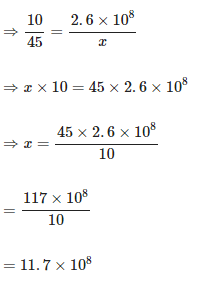
Thus ,11.7x10^8 pounds of dust will be picked up by the earth in 45 days .
Read the given statements carefully and select the correct option.
Statement-1: The sum of the interior angles of a polygon is always greater than the sum of its exterior angles.
Statement-2: For any triangle, the sum of its exterior angles is always 360 degrees.- a)Statement-1 is false but Statement-2 is true.
- b)Statement-1 is true but Statement-2 is false.
- c)Both Statement-1 and Statement-2 are true.
- d)Both Statement-1 and Statement-2 are false.
Correct answer is option 'A'. Can you explain this answer?
Statement-1: The sum of the interior angles of a polygon is always greater than the sum of its exterior angles.
Statement-2: For any triangle, the sum of its exterior angles is always 360 degrees.
a)
Statement-1 is false but Statement-2 is true.
b)
Statement-1 is true but Statement-2 is false.
c)
Both Statement-1 and Statement-2 are true.
d)
Both Statement-1 and Statement-2 are false.
| | Trisha Vashisht answered |
The sum of the interior angles of a polygon is not always greater than the sum of its exterior angles, as the sum of exterior angles is always 360 degrees for any polygon. However, for any triangle, the sum of its exterior angles is indeed always 360 degrees.
The base area of a triangular prism is 45 cm². If its height is 8 cm, find its volume.- a)360 cm³
- b)320 cm³
- c)400 cm³
- d)340 cm³
Correct answer is option 'A'. Can you explain this answer?
The base area of a triangular prism is 45 cm². If its height is 8 cm, find its volume.
a)
360 cm³
b)
320 cm³
c)
400 cm³
d)
340 cm³
| | EduRev Class 8 answered |
Volume of a triangular prism = Base area × height
= 45cm2 × 8cm = 360cm3
= 45cm2 × 8cm = 360cm3
Read the given statements carefully and state 'T' for true and 'F' for false.
(i) The determinant of a 2x2 matrix [a b; c d] is ad - bc.
(ii) The inverse of a non-singular matrix always exists.
(iii) If a matrix is singular, its determinant is zero.- a)(i)-T, (ii)-F, (iii)-T
- b)(i)-F, (ii)-T, (iii)-F
- c)(i)-T, (ii)-T, (iii)-T
- d)(i)-F, (ii)-F, (iii)-T
Correct answer is option 'C'. Can you explain this answer?
Read the given statements carefully and state 'T' for true and 'F' for false.
(i) The determinant of a 2x2 matrix [a b; c d] is ad - bc.
(ii) The inverse of a non-singular matrix always exists.
(iii) If a matrix is singular, its determinant is zero.
(i) The determinant of a 2x2 matrix [a b; c d] is ad - bc.
(ii) The inverse of a non-singular matrix always exists.
(iii) If a matrix is singular, its determinant is zero.
a)
(i)-T, (ii)-F, (iii)-T
b)
(i)-F, (ii)-T, (iii)-F
c)
(i)-T, (ii)-T, (iii)-T
d)
(i)-F, (ii)-F, (iii)-T
| | Trisha Vashisht answered |
(i) The determinant of a 2x2 matrix [a b; c d] is indeed ad - bc, which is correct.
(ii) The inverse of a non-singular matrix (a matrix with a non-zero determinant) always exists, which is also correct.
(iii) If a matrix is singular, its determinant is zero, which is correct.
(ii) The inverse of a non-singular matrix (a matrix with a non-zero determinant) always exists, which is also correct.
(iii) If a matrix is singular, its determinant is zero, which is correct.
Match the following: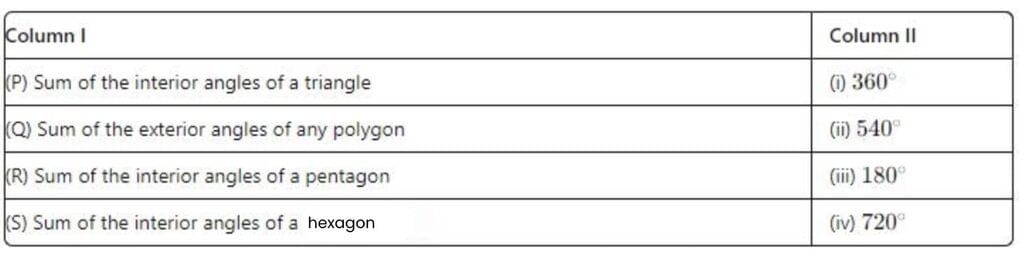
- a)(P) → (iii), (Q) → (i), (R) → (iv), (S) → (ii)
- b)(P) → (i), (Q) → (iv), (R) → (ii), (S) → (iii)
- c)(P) → (iii), (Q) → (i), (R) → (ii), (S) → (iv)
- d)(P) → (iv), (Q) → (iii), (R) → (i), (S) → (ii)
Correct answer is option 'C'. Can you explain this answer?
Match the following:
a)
(P) → (iii), (Q) → (i), (R) → (iv), (S) → (ii)
b)
(P) → (i), (Q) → (iv), (R) → (ii), (S) → (iii)
c)
(P) → (iii), (Q) → (i), (R) → (ii), (S) → (iv)
d)
(P) → (iv), (Q) → (iii), (R) → (i), (S) → (ii)
| | EduRev Class 8 answered |
- (P) The sum of the interior angles of a triangle is 180∘.
- (Q) The sum of the exterior angles of any polygon is 360∘.
- (R) The sum of the interior angles of a pentagon is 540∘.
- (S) The sum of the interior angles of a hexagon is 720∘.
A man can row upstream at 5 km/hr and downstream at 9 km/hr. Find the speed of the man in still water and the speed of the stream.- a)Speed in still water = 7 km/hr, Speed of stream = 2 km/hr
- b)Speed in still water = 6 km/hr, Speed of stream = 3 km/hr
- c)Speed in still water = 8 km/hr, Speed of stream = 1 km/hr
- d)Speed in still water = 7 km/hr, Speed of stream = 1 km/hr
Correct answer is option 'A'. Can you explain this answer?
A man can row upstream at 5 km/hr and downstream at 9 km/hr. Find the speed of the man in still water and the speed of the stream.
a)
Speed in still water = 7 km/hr, Speed of stream = 2 km/hr
b)
Speed in still water = 6 km/hr, Speed of stream = 3 km/hr
c)
Speed in still water = 8 km/hr, Speed of stream = 1 km/hr
d)
Speed in still water = 7 km/hr, Speed of stream = 1 km/hr
| | C K Academy answered |
Let the speed of the man in still water be x km/hr and the speed of the stream be y km/hr.
Upstream speed = x − y = 5 km/hr
Downstream speed = x + y = 9 km/hr
Adding the two equations:
(x − y) + (x + y) = 5 + 9
2x = 14
x =7km/hr
Subtracting the two equations:
(x + y) − (x − y) = 9 − 5
2y = 4
y = 2km/hr
Upstream speed = x − y = 5 km/hr
Downstream speed = x + y = 9 km/hr
Adding the two equations:
(x − y) + (x + y) = 5 + 9
2x = 14
x =7km/hr
Subtracting the two equations:
(x + y) − (x − y) = 9 − 5
2y = 4
y = 2km/hr
Read the given statements carefully and state 'T' for true and 'F' for false.
(i) The volume of a sphere is given by the formula (4/3)πr³.
(ii) If the radius of a sphere is doubled, the volume becomes eight times.
(iii) The surface area of a sphere is given by 4πr².- a)(i)-T, (ii)-T, (iii)-T
- b)(i)-T, (ii)-F, (iii)-T
- c)(i)-T, (ii)-T, (iii)-F
- d)(i)-F, (ii)-T, (iii)-T
Correct answer is option 'A'. Can you explain this answer?
Read the given statements carefully and state 'T' for true and 'F' for false.
(i) The volume of a sphere is given by the formula (4/3)πr³.
(ii) If the radius of a sphere is doubled, the volume becomes eight times.
(iii) The surface area of a sphere is given by 4πr².
(i) The volume of a sphere is given by the formula (4/3)πr³.
(ii) If the radius of a sphere is doubled, the volume becomes eight times.
(iii) The surface area of a sphere is given by 4πr².
a)
(i)-T, (ii)-T, (iii)-T
b)
(i)-T, (ii)-F, (iii)-T
c)
(i)-T, (ii)-T, (iii)-F
d)
(i)-F, (ii)-T, (iii)-T
| | Trisha Vashisht answered |
(i) The volume of a sphere is indeed given by the formula (4/3)πr³, which is correct.
(ii) If the radius of a sphere is doubled, the volume becomes (2r)³ = 8r³, making it eight times the original volume, which is also correct.
(iii) The surface area of a sphere is given by 4πr², which is correct.
(ii) If the radius of a sphere is doubled, the volume becomes (2r)³ = 8r³, making it eight times the original volume, which is also correct.
(iii) The surface area of a sphere is given by 4πr², which is correct.

If the area of a trapezium is 90 cm2 and its height is 5 cm, find the sum of the lengths of the parallel sides.- a)36 cm
- b)40 cm
- c)34 cm
- d)32 cm
Correct answer is option 'A'. Can you explain this answer?
If the area of a trapezium is 90 cm2 and its height is 5 cm, find the sum of the lengths of the parallel sides.
a)
36 cm
b)
40 cm
c)
34 cm
d)
32 cm
| | Trisha Vashisht answered |
Area of a trapezium = 1/2 ×(sum of parallel sides) × height
90 = 1/2 ×(sum of parallel sides) × 5
sum of parallel sides = 90×2 / 5 =36cm
90 = 1/2 ×(sum of parallel sides) × 5
sum of parallel sides = 90×2 / 5 =36cm
Read the given statements carefully and select the correct option.
Statement-1: If the sides of a triangle are in the ratio 3:4:5, then the triangle is a right-angled triangle.
Statement-2: The area of an equilateral triangle with side length 'a' is (√3/4)a².- a)Statement-1 is false but Statement-2 is true.
- b)Statement-1 is true but Statement-2 is false.
- c)Both Statement-1 and Statement-2 are true.
- d)Both Statement-1 and Statement-2 are false.
Correct answer is option 'C'. Can you explain this answer?
Statement-1: If the sides of a triangle are in the ratio 3:4:5, then the triangle is a right-angled triangle.
Statement-2: The area of an equilateral triangle with side length 'a' is (√3/4)a².
a)
Statement-1 is false but Statement-2 is true.
b)
Statement-1 is true but Statement-2 is false.
c)
Both Statement-1 and Statement-2 are true.
d)
Both Statement-1 and Statement-2 are false.
| | EduRev Class 8 answered |
If the sides of a triangle are in the ratio 3:4:5, it is a right-angled triangle by the Pythagorean theorem. The area of an equilateral triangle with side length 'a' is indeed (√3/4)a². Hence, both statements are true.
Match the following: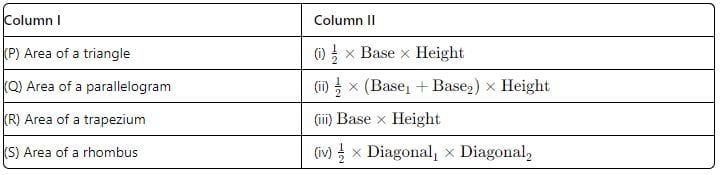
- a)(P) → (i), (Q) → (iii), (R) → (ii), (S) → (iv)
- b)(P) → (ii), (Q) → (iii), (R) → (iv), (S) → (i)
- c)(P) → (i), (Q) → (ii), (R) → (iii), (S) → (iv)
- d)(P) → (iii), (Q) → (ii), (R) → (iv), (S) → (i)
Correct answer is option 'A'. Can you explain this answer?
Match the following:
a)
(P) → (i), (Q) → (iii), (R) → (ii), (S) → (iv)
b)
(P) → (ii), (Q) → (iii), (R) → (iv), (S) → (i)
c)
(P) → (i), (Q) → (ii), (R) → (iii), (S) → (iv)
d)
(P) → (iii), (Q) → (ii), (R) → (iv), (S) → (i)
| | C K Academy answered |
- (P) The area of a triangle is 1/2 × Base × Height.
- (Q) The area of a parallelogram is Base × Height.
- (R) The area of a trapezium is 1/2 × (Base1 + Base2) × Height.
- (S) The area of a rhombus is 1/2 × Diagonal1 × Diagonal2.
Match the following: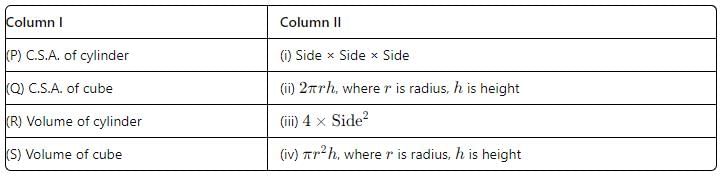
- a)(P) → (ii), (Q) → (iv), (R) → (i), (S) → (iii)
- b)(P) → (iii), (Q) → (iv), (R) → (ii), (S) → (i)
- c)(P) → (ii), (Q) → (iii), (R) → (iv), (S) → (i)
- d)(P) → (iii), (Q) → (i), (R) → (iv), (S) → (ii)
Correct answer is option 'C'. Can you explain this answer?
Match the following:
a)
(P) → (ii), (Q) → (iv), (R) → (i), (S) → (iii)
b)
(P) → (iii), (Q) → (iv), (R) → (ii), (S) → (i)
c)
(P) → (ii), (Q) → (iii), (R) → (iv), (S) → (i)
d)
(P) → (iii), (Q) → (i), (R) → (iv), (S) → (ii)
| | EduRev Class 8 answered |
- (P) The Curved Surface Area (C.S.A.) of a cylinder is 2πrh.
- (Q) The Curved Surface Area (C.S.A.) of a cube is 4 × Side2.
- (R) The volume of a cylinder is πr2h.
- (S) The volume of a cube is Side3.
If the circumference of a circle is 44 cm, find its area.- a)154 cm2
- b)140 cm2
- c)145 cm2
- d)150 cm2
Correct answer is option 'A'. Can you explain this answer?
If the circumference of a circle is 44 cm, find its area.
a)
154 cm2
b)
140 cm2
c)
145 cm2
d)
150 cm2
| | EduRev Class 8 answered |
Circumference of a circle = 2πr = 44cm
πr = 22
r = 22 / π = 7 cm
Area = πr2 = π × 72 = π × 49 = 154 cm2
πr = 22
r = 22 / π = 7 cm
Area = πr2 = π × 72 = π × 49 = 154 cm2
Match the following: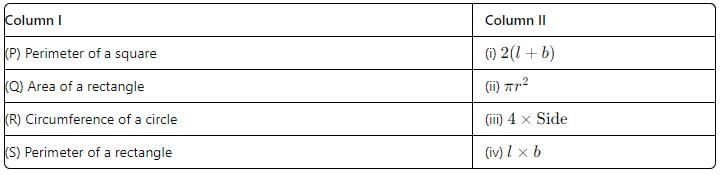
- a)(P) → (iii), (Q) → (ii), (R) → (iv), (S) → (i)
- b)(P) → (iii), (Q) → (iv), (R) → (ii), (S) → (i)
- c)(P) → (i), (Q) → (iii), (R) → (ii), (S) → (iv)
- d)(P) → (ii), (Q) → (iv), (R) → (iii), (S) → (i)
Correct answer is option 'B'. Can you explain this answer?
Match the following:
a)
(P) → (iii), (Q) → (ii), (R) → (iv), (S) → (i)
b)
(P) → (iii), (Q) → (iv), (R) → (ii), (S) → (i)
c)
(P) → (i), (Q) → (iii), (R) → (ii), (S) → (iv)
d)
(P) → (ii), (Q) → (iv), (R) → (iii), (S) → (i)
| | C K Academy answered |
- (P) The perimeter of a square is 4 × Side.
- (Q) The area of a rectangle is l × b.
- (R) The circumference of a circle is 2πr.
- (S) The perimeter of a rectangle is 2(l + b).
Read the given statements carefully and select the correct option.
Statement-1: In any parallelogram, the diagonals bisect each other.
Statement-2: The diagonals of a rhombus are equal in length.- a)Statement-1 is false but Statement-2 is true.
- b)Statement-1 is true but Statement-2 is false.
- c)Both Statement-1 and Statement-2 are true.
- d)Both Statement-1 and Statement-2 are false.
Correct answer is option 'B'. Can you explain this answer?
Statement-1: In any parallelogram, the diagonals bisect each other.
Statement-2: The diagonals of a rhombus are equal in length.
a)
Statement-1 is false but Statement-2 is true.
b)
Statement-1 is true but Statement-2 is false.
c)
Both Statement-1 and Statement-2 are true.
d)
Both Statement-1 and Statement-2 are false.
| | C K Academy answered |
In any parallelogram, the diagonals do bisect each other, so Statement-1 is true. However, the diagonals of a rhombus are not equal in length; they are only equal in a square, so Statement-2 is false.
The diagonals of a rhombus are 16 cm and 30 cm. Find its area.- a)120cm2
- b)240 cm2
- c)200 cm2
- d)180 cm2
Correct answer is option 'B'. Can you explain this answer?
The diagonals of a rhombus are 16 cm and 30 cm. Find its area.
a)
120cm2
b)
240 cm2
c)
200 cm2
d)
180 cm2
| | C K Academy answered |
Area of a rhombus = 1/2 d1d2
= 1/2 x 16 x 30 = 240 cm2
= 1/2 x 16 x 30 = 240 cm2
Read the given statements carefully and state 'T' for true and 'F' for false.
(i) The roots of the quadratic equation ax² + bx + c = 0 are given by (-b ± √(b²-4ac)) / 2a.
(ii) The discriminant of the quadratic equation ax² + bx + c = 0 is b² - 4ac.
(iii) If the discriminant is negative, the quadratic equation has two real and distinct roots.
(i) (ii) (iii)- a)(i)-T, (ii)-T, (iii)-F
- b)(i)-F, (ii)-T, (iii)-T
- c)(i)-, (ii)-F, (iii)-T
- d)(i)-T, (ii)-T, (iii)-T
Correct answer is option 'A'. Can you explain this answer?
Read the given statements carefully and state 'T' for true and 'F' for false.
(i) The roots of the quadratic equation ax² + bx + c = 0 are given by (-b ± √(b²-4ac)) / 2a.
(ii) The discriminant of the quadratic equation ax² + bx + c = 0 is b² - 4ac.
(iii) If the discriminant is negative, the quadratic equation has two real and distinct roots.
(i) (ii) (iii)
(i) The roots of the quadratic equation ax² + bx + c = 0 are given by (-b ± √(b²-4ac)) / 2a.
(ii) The discriminant of the quadratic equation ax² + bx + c = 0 is b² - 4ac.
(iii) If the discriminant is negative, the quadratic equation has two real and distinct roots.
(i) (ii) (iii)
a)
(i)-T, (ii)-T, (iii)-F
b)
(i)-F, (ii)-T, (iii)-T
c)
(i)-, (ii)-F, (iii)-T
d)
(i)-T, (ii)-T, (iii)-T
| | EduRev Class 8 answered |
(i) The roots of the quadratic equation ax² + bx + c = 0 are indeed given by (-b ± √(b²-4ac)) / 2a, which is correct.
(ii) The discriminant of the quadratic equation ax² + bx + c = 0 is b² - 4ac, which is also correct.
(iii) If the discriminant is negative, the quadratic equation has two complex conjugate roots, not two real and distinct roots, which makes this statement false.
(ii) The discriminant of the quadratic equation ax² + bx + c = 0 is b² - 4ac, which is also correct.
(iii) If the discriminant is negative, the quadratic equation has two complex conjugate roots, not two real and distinct roots, which makes this statement false.
Match the following: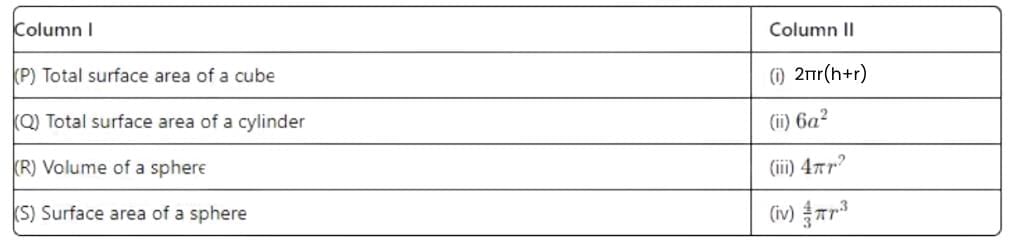
- a)(P) → (ii), (Q) → (i), (R) → (iv), (S) → (iii)
- b)(P) → (i), (Q) → (iii), (R) → (ii), (S) → (iv)
- c)(P) → (ii), (Q) → (iv), (R) → (iii), (S) → (i)
- d)(P) → (iii), (Q) → (ii), (R) → (iv), (S) → (i)
Correct answer is option 'A'. Can you explain this answer?
Match the following:
a)
(P) → (ii), (Q) → (i), (R) → (iv), (S) → (iii)
b)
(P) → (i), (Q) → (iii), (R) → (ii), (S) → (iv)
c)
(P) → (ii), (Q) → (iv), (R) → (iii), (S) → (i)
d)
(P) → (iii), (Q) → (ii), (R) → (iv), (S) → (i)
| | EduRev Class 8 answered |
- (P) The total surface area of a cube is 6a2.
- (Q) The total surface area of a cylinder is 2πrh + 2πr2 = 2πr(h + r).
- (R) The volume of a sphere is 4/3πr3.
- (S) The surface area of a sphere is 4πr2.
Chapter doubts & questions for Achievers Section - Mathematical Olympiad Class 8 2026 is part of Class 8 exam preparation. The chapters have been prepared according to the Class 8 exam syllabus. The Chapter doubts & questions, notes, tests & MCQs are made for Class 8 2026 Exam. Find important definitions, questions, notes, meanings, examples, exercises, MCQs and online tests here.
Chapter doubts & questions of Achievers Section - Mathematical Olympiad Class 8 in English & Hindi are available as part of Class 8 exam. Download more important topics, notes, lectures and mock test series for Class 8 Exam by signing up for free.
Mathematical Olympiad Class 842 videos|87 docs|61 tests |
