


All Exams > Class 8 > Mathematical Olympiad Class 8 > All Questions
All questions of Understanding Quadrilaterals for Class 8 Exam
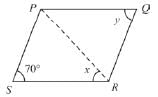
PQRS is a parallelogram and ∠SPR = 50°, then find y.
- a)70°
- b)110°
- c)50°
- d)130°
Correct answer is option 'A'. Can you explain this answer?
PQRS is a parallelogram and ∠SPR = 50°, then find y.
a)
70°
b)
110°
c)
50°
d)
130°
 | Shubham Sharma answered |
PQRS is a parallelogram.
∴ ∠S = ∠Q = y = 70°
∴ ∠S = ∠Q = y = 70°

The ratio of two sides of a parallelogram is 4 : 3. If its perimeter is 56 cm, what is the difference between largest and smallest side?- a)8 cm
- b)4 cm 9
- c)12 cm
- d)16 cm
Correct answer is option 'B'. Can you explain this answer?
The ratio of two sides of a parallelogram is 4 : 3. If its perimeter is 56 cm, what is the difference between largest and smallest side?
a)
8 cm
b)
4 cm 9
c)
12 cm
d)
16 cm
 | Amit Sharma answered |
The opposite sides of parallelogram are equal.
∴ 4x + 3x + 4x + 3x = 56
⇒ 14x = 56 ⇒ x = 4
∴ 4x = 4 × 4 = 16
and 3x = 4 × 3 = 12
∴ Difference = 16 – 12 = 4 cm
∴ 4x + 3x + 4x + 3x = 56
⇒ 14x = 56 ⇒ x = 4
∴ 4x = 4 × 4 = 16
and 3x = 4 × 3 = 12
∴ Difference = 16 – 12 = 4 cm
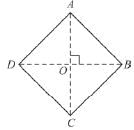
ABCD is a rhombus, AC = 16 cm and BD = 12 cm, then what is the measure of BC?
- a)10 cm
- b)12cm
- c)9 cm
- d)11 cm
Correct answer is option 'A'. Can you explain this answer?
ABCD is a rhombus, AC = 16 cm and BD = 12 cm, then what is the measure of BC?
a)
10 cm
b)
12cm
c)
9 cm
d)
11 cm
 | Nilofer Singh answered |
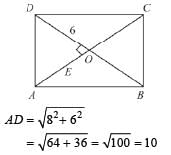
∵ ABCD is a rhombus.
∴ AB = BC = CD = DA
∵ Diagonals of a rhombus bisect each other.
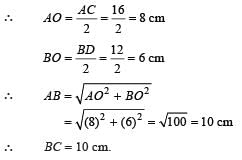
∴ AB = BC = CD = DA
∵ Diagonals of a rhombus bisect each other.
Of any two adjacent sides of a parallelogram one is longer than the other by 3 cm. If the perimeter is 36 cm, then what is the length of smaller side of parallelogram?- a)10.5 cm
- b)7.5 cm
- c)6 cm
- d)12 cm
Correct answer is option 'B'. Can you explain this answer?
Of any two adjacent sides of a parallelogram one is longer than the other by 3 cm. If the perimeter is 36 cm, then what is the length of smaller side of parallelogram?
a)
10.5 cm
b)
7.5 cm
c)
6 cm
d)
12 cm
 | Geetika Shah answered |
Let smaller side be x.
Longer side = x +3
∴ x + x + 3 + x + x + 3 = 36
⇒ 4x + 6 = 36 ⇒ 4x = 30

Longer side = x +3
∴ x + x + 3 + x + x + 3 = 36
⇒ 4x + 6 = 36 ⇒ 4x = 30
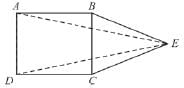
In ∆BCE, BE = EC, and ABCD is a square, and ∠BEC = 60°, then the measure of ∠BEA will be :
- a)45°
- b)35°
- c)15°
- d)25°
Correct answer is option 'C'. Can you explain this answer?
In ∆BCE, BE = EC, and ABCD is a square, and ∠BEC = 60°, then the measure of ∠BEA will be :
a)
45°
b)
35°
c)
15°
d)
25°
 | Learning Education answered |
Given BE = EC
∴ ∠EBC = ∠ECB
In ∆BEC,
2∠EBC + ∠BEC = 180°
⇒ ∠EBC = ∠ECB = 60°
∴ ∆EBC is an equilateral triangle having
EB = BC = EC
AB = BC = CD = DA = EB = EC
[∵ABCD is a square].
∠ABE = 90° + 60° = 150°
In ∆ABE,
∠ABE + 2∠AEB = 180° [Q AEB = BAE].
2∠AEB = 180° - ∠ABE = 180 - 150 = 30°
⇒ ∠AEB = 15°
∴ ∠EBC = ∠ECB
In ∆BEC,
2∠EBC + ∠BEC = 180°
⇒ ∠EBC = ∠ECB = 60°
∴ ∆EBC is an equilateral triangle having
EB = BC = EC
AB = BC = CD = DA = EB = EC
[∵ABCD is a square].
∠ABE = 90° + 60° = 150°
In ∆ABE,
∠ABE + 2∠AEB = 180° [Q AEB = BAE].
2∠AEB = 180° - ∠ABE = 180 - 150 = 30°
⇒ ∠AEB = 15°
The four angles of a quadrilateral are in the ratio 2 : 3 : 5 : 8. Then what is the difference between largest and smallest angle of the quadrilateral?- a)80°
- b)100°
- c)110°
- d)120°
Correct answer is option 'D'. Can you explain this answer?
The four angles of a quadrilateral are in the ratio 2 : 3 : 5 : 8. Then what is the difference between largest and smallest angle of the quadrilateral?
a)
80°
b)
100°
c)
110°
d)
120°
| | Pooja Shah answered |
Let the angles are 2x, 3x, 5x, 8x.
∴ 2x + 3x + 5x + 8x = 360°
⇒ 18x = 360° ⇒ x = 20°
2x = 2 × 20° = 40°; 3x = 3 × 20° = 60°
5x = 5 × 20° = 100°; 8x = 8 × 20° = 160°
Required difference = 160° - 40° = 120°.
∴ 2x + 3x + 5x + 8x = 360°
⇒ 18x = 360° ⇒ x = 20°
2x = 2 × 20° = 40°; 3x = 3 × 20° = 60°
5x = 5 × 20° = 100°; 8x = 8 × 20° = 160°
Required difference = 160° - 40° = 120°.
Three angles of a quadrilateral are equal and the measure of fourth angle is 120°. What is the measure of each of the equal angle?- a)40°
- b)60°
- c)80°
- d)90°
Correct answer is option 'C'. Can you explain this answer?
Three angles of a quadrilateral are equal and the measure of fourth angle is 120°. What is the measure of each of the equal angle?
a)
40°
b)
60°
c)
80°
d)
90°
 | Lakesway Classes answered |
Let the angle be x.
∴ x + x + x + 120° = 360°
⇒ 3x = 240° ⇒ x = 80°
∴ x + x + x + 120° = 360°
⇒ 3x = 240° ⇒ x = 80°
If α < 90°, then, ABCD, may be a : (Given : ABCD is a parallelogram) and ∠B = 90°
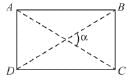
- a)Rectangle
- b)Trapezium
- c)Square
- d)Rhombus
Correct answer is option 'A'. Can you explain this answer?
If α < 90°, then, ABCD, may be a : (Given : ABCD is a parallelogram) and ∠B = 90°
a)
Rectangle
b)
Trapezium
c)
Square
d)
Rhombus
| | Geetika Shah answered |
∵ ∠B = 90°, and, ABCD is a parallelogram
∴ ∠C = 90°, ∠A = 90° and ∠D = 90°
So, ABCD may be a rectangle or square, but, since, α < 90°.
∴ΑΒCD must be a rectangle.
∴ ∠C = 90°, ∠A = 90° and ∠D = 90°
So, ABCD may be a rectangle or square, but, since, α < 90°.
∴ΑΒCD must be a rectangle.
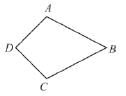
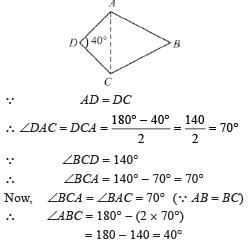
 cm, then perimeter of PQRS is :


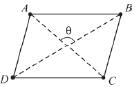
If θ = 90°, and, ∠A = ∠C = 110°, then, ABCD is :
- a)Square
- b)Rectangle
- c)Rhombus
- d)None of these
Correct answer is option 'A'. Can you explain this answer?
If θ = 90°, and, ∠A = ∠C = 110°, then, ABCD is :
a)
Square
b)
Rectangle
c)
Rhombus
d)
None of these
| | Shubham Sharma answered |
∵ θ = 90° (Angle between the diagonals)
∴ ABCD may be a rhombus or square.
But, since, ∠A = ∠C = 110°
∴ ABCD must be a rhombus.
∴ ABCD may be a rhombus or square.
But, since, ∠A = ∠C = 110°
∴ ABCD must be a rhombus.
In a rhombus or any parallelogram, the opposite angles are always equal
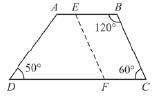
From the adjoining figure, find the measure of ∠EFD if AB || CD, EF || BC.
- a)40°
- b)70°
- c)50°
- d)60°
Correct answer is option 'D'. Can you explain this answer?
From the adjoining figure, find the measure of ∠EFD if AB || CD, EF || BC.
a)
40°
b)
70°
c)
50°
d)
60°
| | Ananya Das answered |
∠ABC + ∠BCF = 180°
[Interior angles or same side of transversal].
⇒ ∠BCF =180° - 120° = 60°
∠BCF = ∠EFD (corresponding angles)
∴ ∠EFD = 60°
[Interior angles or same side of transversal].
⇒ ∠BCF =180° - 120° = 60°
∠BCF = ∠EFD (corresponding angles)
∴ ∠EFD = 60°
In the adjoining figure, AD || BC and AB and DC are not parallel, then ∠B =

- a)110°
- b)70°
- c)80°
- d)40°
Correct answer is option 'B'. Can you explain this answer?
In the adjoining figure, AD || BC and AB and DC are not parallel, then ∠B =
a)
110°
b)
70°
c)
80°
d)
40°
| | Geetika Shah answered |
∵ AB is parallel to BC, and, AB is transversal.
∴ ∠A + ∠B = 180°
⇒ ∠B = 180° - ∠A = 180° - 110° = 70°
∴ ∠A + ∠B = 180°
⇒ ∠B = 180° - ∠A = 180° - 110° = 70°
Two adjacent sides of a parallelogram are 5 cm and 7 cm long what is the perimeter of parallelogram?- a)24 cm
- b)28 cm
- c)22 cm
- d)26 cm
Correct answer is option 'A'. Can you explain this answer?
Two adjacent sides of a parallelogram are 5 cm and 7 cm long what is the perimeter of parallelogram?
a)
24 cm
b)
28 cm
c)
22 cm
d)
26 cm
| | Ananya Das answered |
Perimeter of parallelogram
= 5 + 7 + 5 +7 = 24 cm
= 5 + 7 + 5 +7 = 24 cm
Find x and y:

KLMN is a parallelogram.- a)x = 55°, y = 55°
- b)x = 65°, y = 55°
- c)x = 60°, y = 65°
- d)None of these
Correct answer is option 'C'. Can you explain this answer?
Find x and y:
KLMN is a parallelogram.
KLMN is a parallelogram.
a)
x = 55°, y = 55°
b)
x = 65°, y = 55°
c)
x = 60°, y = 65°
d)
None of these
 | Kavya Saxena answered |
In ∆LAM,
∠ALM + 90° + ∠M = 180°
⇒∠M = 65°
∴x=∠M= 60° (∵KLMN is a parallelogram).
In ∆BLK,
∠BLK + 65° + 90° = 180°
⇒ ∠M = 180° - 90° = 90°
⇒∠BLK = 25°
∵ ∠L = 180° - 65° = y + 25° + 25°
⇒y = 65°
∠ALM + 90° + ∠M = 180°
⇒∠M = 65°
∴x=∠M= 60° (∵KLMN is a parallelogram).
In ∆BLK,
∠BLK + 65° + 90° = 180°
⇒ ∠M = 180° - 90° = 90°
⇒∠BLK = 25°
∵ ∠L = 180° - 65° = y + 25° + 25°
⇒y = 65°
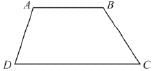
ABCD is an isosceles trapezium , i.e., AD = BC, then
- a)AD = CD
- b)∠A = ∠B
- c)∠A = ∠D
- d)∠C = ∠A
Correct answer is option 'B'. Can you explain this answer?
ABCD is an isosceles trapezium , i.e., AD = BC, then
a)
AD = CD
b)
∠A = ∠B
c)
∠A = ∠D
d)
∠C = ∠A
| | Amit Sharma answered |
∵ ABCD is an isosceles trapezium.
∴ AD = BC
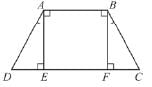
Draw AE ⊥ DC and BF ⊥ DC, then, in ∆AED and ∠BFC.
∠AED = ∠BFC = 90°,
AB = BC,
AE = BF (perpendicular distance between two parallel lines)
∴ ∆AEB ≅ ∆BFC (ets congruency)
∴ ∠A = ∠B
∴ AD = BC
Draw AE ⊥ DC and BF ⊥ DC, then, in ∆AED and ∠BFC.
∠AED = ∠BFC = 90°,
AB = BC,
AE = BF (perpendicular distance between two parallel lines)
∴ ∆AEB ≅ ∆BFC (ets congruency)
∴ ∠A = ∠B
ABCD is a parallelogram.
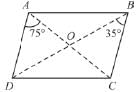
The measure of ∠ADO is :- a)55°
- b)45°
- c)35°
- d)75°
Correct answer is option 'C'. Can you explain this answer?
ABCD is a parallelogram.
The measure of ∠ADO is :
The measure of ∠ADO is :
a)
55°
b)
45°
c)
35°
d)
75°
 | Pie Academy answered |
∠OBC = ∠ODA = 35°
(Alternate Interior ∠S).
(Alternate Interior ∠S).
ABCD is a rhombus and ∠AEF = 50°. Find x.

- a)15°
- b)20°
- c)35°
- d)25°
Correct answer is option 'D'. Can you explain this answer?
ABCD is a rhombus and ∠AEF = 50°. Find x.
a)
15°
b)
20°
c)
35°
d)
25°
 | Target Study Academy answered |
∵ AE = EB.
∴ ∠BAE = ∠ABE = x.
∵ ΔDO = OB, and , AO = OC
In ΔABE,
∠DAE + ∠ABE = ∠AEF
⇒ x + x = 50°
⇒ 2x = 50°
⇒ x = 25°
∴ ∠BAE = ∠ABE = x.
∵ ΔDO = OB, and , AO = OC
In ΔABE,
∠DAE + ∠ABE = ∠AEF
⇒ x + x = 50°
⇒ 2x = 50°
⇒ x = 25°
ABCD is a rectangle , with, ED = DC, ∠BOC = 120°, ∠CED = 30°.
 Find ‘x’ from the adjoining figure.
 - a)75°
- b)65°
- c)90°
- d)120°
Correct answer is option 'C'. Can you explain this answer?
ABCD is a rectangle , with, ED = DC, ∠BOC = 120°, ∠CED = 30°.
Find ‘x’ from the adjoining figure.
a)
75°
b)
65°
c)
90°
d)
120°
| | Amit Kumar answered |
From ∆EDC,
∠EDC = 180° - 2 × 30° = 120°
∠EDG = ∠EDC - ∠D = 120° - 90° = 30°
Also,

∠EDC = 180° - 2 × 30° = 120°
∠EDG = ∠EDC - ∠D = 120° - 90° = 30°
Also,

In the given Fig. ABCD is a rhombus. If ∠DAB = 110°, what is ∠BDC ?

- a)30°
- b)35°
- c)40°
- d)45°.
Correct answer is option 'B'. Can you explain this answer?
In the given Fig. ABCD is a rhombus. If ∠DAB = 110°, what is ∠BDC ?
a)
30°
b)
35°
c)
40°
d)
45°.
| | Pooja Shah answered |
In rhombus ABCD,
∠DAB = 110° = ∠BCD
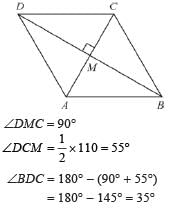
∠DAB = 110° = ∠BCD
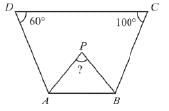
In the given figure the bisector of ∠A and ∠B meet in a point P. If ∠C = 100°, ∠D = 60°, what is the the measure of ∠APB?
- a)60°
- b)80°
- c)90°
- d)100°
Correct answer is option 'B'. Can you explain this answer?
In the given figure the bisector of ∠A and ∠B meet in a point P. If ∠C = 100°, ∠D = 60°, what is the the measure of ∠APB?
a)
60°
b)
80°
c)
90°
d)
100°
| | Shubham Sharma answered |
In figure ∠A + ∠B + ∠C + ∠D = 360°
⇒ ∠A + ∠B + 100° + 60° = 360°
⇒ ∠A + ∠B = 200°
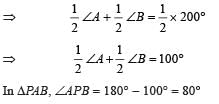
⇒ ∠A + ∠B + 100° + 60° = 360°
⇒ ∠A + ∠B = 200°
The sum of two opposite angles of a parallelogram is 130°. What is the difference between largest and smallest angle of parallelogram?- a)65°
- b)50°
- c)115°
- d)100°
Correct answer is option 'B'. Can you explain this answer?
The sum of two opposite angles of a parallelogram is 130°. What is the difference between largest and smallest angle of parallelogram?
a)
65°
b)
50°
c)
115°
d)
100°
| | Radhika Iyer answered |
Here ABCD is a parallelogram and ∠A + ∠C = 130°
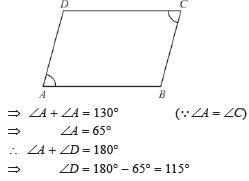
∠B = ∠D = 115°
Difference = 115° - 65° = 50°
∠B = ∠D = 115°
Difference = 115° - 65° = 50°
ABCD is a parallelogram having its sides, AB = 4x + 1 BC = 2y + 3, CD = 25, DA = y + 28, then, x + y =- a) 29
- b)21
- c)25
- d)33
Correct answer is option 'D'. Can you explain this answer?
ABCD is a parallelogram having its sides, AB = 4x + 1 BC = 2y + 3, CD = 25, DA = y + 28, then, x + y =
a)
29
b)
21
c)
25
d)
33
| | Hina Sharma answered |
In a parallelogram.
AB = CD, and, BC = DA
⇒ 4x + 1 = 25 and 2y + 3 = y + 28
⇒ x = 8, and, y = 25
∴ x + y = 8 + 25 = 33
AB = CD, and, BC = DA
⇒ 4x + 1 = 25 and 2y + 3 = y + 28
⇒ x = 8, and, y = 25
∴ x + y = 8 + 25 = 33
The quadrilateral formed by joining the mid-points of a given quadrilateral will be (surely) :- a)Parallelogram
- b)Rectangle
- c)Rhombus
- d)Square
Correct answer is option 'A'. Can you explain this answer?
The quadrilateral formed by joining the mid-points of a given quadrilateral will be (surely) :
a)
Parallelogram
b)
Rectangle
c)
Rhombus
d)
Square
 | Anika Bhatia answered |

ABCD is a parallelogram and P,Q,R,S are the midpoints of AB, BC, CD, DA respectively. Consider, AC as a diagonal of ABCD.
Now, According to midpoint theorem,
PQ =1/2 AC and PQ is parallel to AC,
and SR = 1/2 AC and PQ is parallel to AC.
∴ PQ = RS and PQ || RS || AC.
∴ PQRS will be a parallelogram.

ABCD is a rhombus and ABEF is a square find ‘a’.

- a)30°
- b)45°
- c)60°
- d)75°
Correct answer is option 'A'. Can you explain this answer?
ABCD is a rhombus and ABEF is a square find ‘a’.
a)
30°
b)
45°
c)
60°
d)
75°
| | Samarth Goyal answered |
∵ AB is a common side in both square and rhombus.
∴ AB = BC = CD = DA = FA = FE = EB
In ∆EBC,
∠BEC + ∠C + ∠B = 180° [∠C = ∠BEC]
[∵ EB = BC]

[∠B = 90° + 60° = 150°]
∵ AE is the diagonal of square. ∴
∴∠AEF = 45°
Now,
∵∠ E is the angle of a square,
∴∠E = 90°
⇒ 45° + 15° + a = 90°
⇒ a = 30°
∴ AB = BC = CD = DA = FA = FE = EB
In ∆EBC,
∠BEC + ∠C + ∠B = 180° [∠C = ∠BEC]
[∵ EB = BC]
[∠B = 90° + 60° = 150°]
∵ AE is the diagonal of square. ∴
∴∠AEF = 45°
Now,
∵∠ E is the angle of a square,
∴∠E = 90°
⇒ 45° + 15° + a = 90°
⇒ a = 30°
The bisectors of any two adjacent angles of a parallelogram intersect at- a)30°
- b)45°
- c)60°
- d)90°
Correct answer is option 'D'. Can you explain this answer?
The bisectors of any two adjacent angles of a parallelogram intersect at
a)
30°
b)
45°
c)
60°
d)
90°
| | Aarav Chaudhary answered |
The Angle Properties of a Parallelogram
In a parallelogram, opposite angles are equal, and consecutive angles are supplementary (they add up to 180°).
Understanding the Angles
Let’s denote the angles of a parallelogram as A, B, C, and D. Then, we have:
- Angle A = Angle C
- Angle B = Angle D
- A + B = 180°
The Bisectors of Adjacent Angles
Now, consider two adjacent angles, say Angle A and Angle B. Their measures can be expressed as:
- A + B = 180°
When we draw the bisectors of these angles, they divide each angle into two equal parts:
- Angle A is divided into A/2 and A/2
- Angle B is divided into B/2 and B/2
Finding the Measure of the Angle Between the Bisectors
The angle between the two bisectors can be calculated as follows:
- Angle between bisectors = (A/2) + (B/2)
Substituting B = 180° - A, we get:
- Angle between bisectors = (A/2) + ((180° - A)/2)
This simplifies to:
- Angle between bisectors = (A + 180° - A)/2 = 180°/2 = 90°
Conclusion
Thus, the angle formed by the intersection of the bisectors of any two adjacent angles of a parallelogram is always 90°. Therefore, the correct answer is option 'D' - 90°.
In a parallelogram, opposite angles are equal, and consecutive angles are supplementary (they add up to 180°).
Understanding the Angles
Let’s denote the angles of a parallelogram as A, B, C, and D. Then, we have:
- Angle A = Angle C
- Angle B = Angle D
- A + B = 180°
The Bisectors of Adjacent Angles
Now, consider two adjacent angles, say Angle A and Angle B. Their measures can be expressed as:
- A + B = 180°
When we draw the bisectors of these angles, they divide each angle into two equal parts:
- Angle A is divided into A/2 and A/2
- Angle B is divided into B/2 and B/2
Finding the Measure of the Angle Between the Bisectors
The angle between the two bisectors can be calculated as follows:
- Angle between bisectors = (A/2) + (B/2)
Substituting B = 180° - A, we get:
- Angle between bisectors = (A/2) + ((180° - A)/2)
This simplifies to:
- Angle between bisectors = (A + 180° - A)/2 = 180°/2 = 90°
Conclusion
Thus, the angle formed by the intersection of the bisectors of any two adjacent angles of a parallelogram is always 90°. Therefore, the correct answer is option 'D' - 90°.
In the above figure, OS = OQ and PR = 2OR = 2OR, and also, OR = OS, then, PQRS is not a

- a)Rhombus
- b)Rectangle
- c)Square
- d)Parallelogram.
Correct answer is option 'A'. Can you explain this answer?
In the above figure, OS = OQ and PR = 2OR = 2OR, and also, OR = OS, then, PQRS is not a
a)
Rhombus
b)
Rectangle
c)
Square
d)
Parallelogram.
| | Naveen Nair answered |
∵ O is the bisector of both the diagonals.
∴ PQRS is a parallelogram.
∵ Diagonals of the parallelogram are equal.
∴ PQRS may be a square or rectangle.
∴ PQRS is a parallelogram.
∵ Diagonals of the parallelogram are equal.
∴ PQRS may be a square or rectangle.
Chapter doubts & questions for Understanding Quadrilaterals - Mathematical Olympiad Class 8 2026 is part of Class 8 exam preparation. The chapters have been prepared according to the Class 8 exam syllabus. The Chapter doubts & questions, notes, tests & MCQs are made for Class 8 2026 Exam. Find important definitions, questions, notes, meanings, examples, exercises, MCQs and online tests here.
Chapter doubts & questions of Understanding Quadrilaterals - Mathematical Olympiad Class 8 in English & Hindi are available as part of Class 8 exam. Download more important topics, notes, lectures and mock test series for Class 8 Exam by signing up for free.
Mathematical Olympiad Class 842 videos|87 docs|61 tests |
