


All Exams > Class 8 > Mathematical Olympiad Class 8 > All Questions
All questions of Mensuration for Class 8 Exam


If the length of each side of a cube is doubled then how many times does its surface area become?- a)4 times
- b)8 times
- c)16 times
- d)None of these
Correct answer is option 'A'. Can you explain this answer?
If the length of each side of a cube is doubled then how many times does its surface area become?
a)
4 times
b)
8 times
c)
16 times
d)
None of these
 | Shubham Sharma answered |
Let the length of cube = a.
Surface area = 6a2.
∴ Length of cube = 2a.
Surface area = 6(2a)2 = 6 × 4a2 = 24a2
= 4 × 6a2
Surface area = 6a2.
∴ Length of cube = 2a.
Surface area = 6(2a)2 = 6 × 4a2 = 24a2
= 4 × 6a2


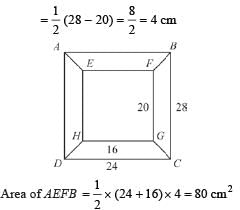
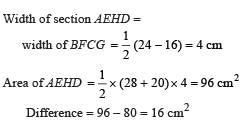
In the given figure the outer dimension is 24 cm × 28 cm and the inner dimension 16 cm × 20 cm. What is the difference between two adjacent section of the frame if the width of each section is same?

- a)20 cm2
- b)24 cm2
- c)16 cm2
- d)28 cm
Correct answer is option 'C'. Can you explain this answer?
In the given figure the outer dimension is 24 cm × 28 cm and the inner dimension 16 cm × 20 cm. What is the difference between two adjacent section of the frame if the width of each section is same?
a)
20 cm2
b)
24 cm2
c)
16 cm2
d)
28 cm
 | Geetika Shah answered |
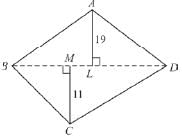
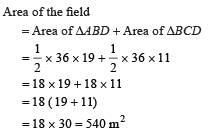
Width of section AEFB = width of CGHD
A rectangular piece of paper 11 cm × 4 cm is folded without overlapping to make a cylinder of height 4 cm. What is its volume?- a)32⋅5 cm3
- b)36⋅5 cm3
- c)38⋅5 cm3
- d)None of these
Correct answer is option 'C'. Can you explain this answer?
A rectangular piece of paper 11 cm × 4 cm is folded without overlapping to make a cylinder of height 4 cm. What is its volume?
a)
32⋅5 cm3
b)
36⋅5 cm3
c)
38⋅5 cm3
d)
None of these
 | Sarthak Basu answered |
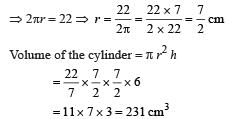
Length of the paper becomes the perimeter of the Base of the cylinder and width becomes height.
let radius of the cylinder = r and height = h
perimeter of the Base of the cylinder =2pi r =11
2x22/7xr=11
r=7/4cm
Therefore, volume of the cylinder =V=pi r^2h
=22/7 x 7/4 � 7/4 x 4cm^3=38.5cm^3.
Hence, the volume of the cylinder is 38.5cm^3.
A swimming pool is 260 m long and 140 m wide. If 54600 cubic metres of water is pumped into it, what is the height of the water level in it ?- a)1 m
- b)1⋅5 m
- c)2 m
- d)2⋅5 m
Correct answer is option 'B'. Can you explain this answer?
A swimming pool is 260 m long and 140 m wide. If 54600 cubic metres of water is pumped into it, what is the height of the water level in it ?
a)
1 m
b)
1⋅5 m
c)
2 m
d)
2⋅5 m
 | Alok Goyal answered |
Understanding the Problem
To find the height of the water level in the swimming pool, we need to use the formula for the volume of a rectangular prism (which the pool resembles).
Volume Formula
The volume (V) of a rectangular prism is calculated as:
- V = length × width × height
In this case:
- Length = 260 m
- Width = 140 m
- Volume of water = 54,600 m³
Finding the Height
Rearranging the volume formula to find height (h):
- h = V / (length × width)
Now, plug in the values:
- h = 54,600 m³ / (260 m × 140 m)
Calculating the Area of the Base
First, calculate the area of the base (length × width):
- Area = 260 m × 140 m = 36,400 m²
Calculating the Height
Now, substitute the area back into the height formula:
- h = 54,600 m³ / 36,400 m²
Final Calculation
Performing the division:
- h = 54,600 / 36,400 = 1.5 m
Thus, the height of the water level in the swimming pool is:
Correct Answer
- 1.5 m (Option B)
This calculation shows that when 54,600 cubic meters of water is pumped into the pool, it raises the water level to 1.5 meters.
To find the height of the water level in the swimming pool, we need to use the formula for the volume of a rectangular prism (which the pool resembles).
Volume Formula
The volume (V) of a rectangular prism is calculated as:
- V = length × width × height
In this case:
- Length = 260 m
- Width = 140 m
- Volume of water = 54,600 m³
Finding the Height
Rearranging the volume formula to find height (h):
- h = V / (length × width)
Now, plug in the values:
- h = 54,600 m³ / (260 m × 140 m)
Calculating the Area of the Base
First, calculate the area of the base (length × width):
- Area = 260 m × 140 m = 36,400 m²
Calculating the Height
Now, substitute the area back into the height formula:
- h = 54,600 m³ / 36,400 m²
Final Calculation
Performing the division:
- h = 54,600 / 36,400 = 1.5 m
Thus, the height of the water level in the swimming pool is:
Correct Answer
- 1.5 m (Option B)
This calculation shows that when 54,600 cubic meters of water is pumped into the pool, it raises the water level to 1.5 meters.
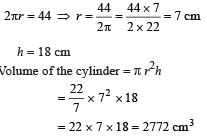
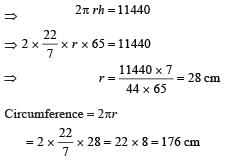
The circumference of the base of a cylinder is 198 cm and its height is 30 cm. What is the curved surface area of the cylinder?- a)5240 cm2
- b)5940 cm2
- c)5640 cm2
- d)5340 cm2
Correct answer is option 'B'. Can you explain this answer?
The circumference of the base of a cylinder is 198 cm and its height is 30 cm. What is the curved surface area of the cylinder?
a)
5240 cm2
b)
5940 cm2
c)
5640 cm2
d)
5340 cm2
 | Shail Sengupta answered |
Given:
Circumference of the base of the cylinder = 198 cm
Height of the cylinder = 30 cm
To find:
Curved surface area of the cylinder
Solution:
First, let's find the radius of the base of the cylinder using the circumference formula:
Circumference = 2πr
Given that the circumference is 198 cm, we can equate it to 2πr:
198 = 2πr
Dividing both sides by 2π, we get:
r = 198 / (2π)
Now, let's calculate the curved surface area of the cylinder:
Curved surface area = 2πrh
Substituting the given values, we get:
Curved surface area = 2π * (198 / (2π)) * 30
Simplifying further, we have:
Curved surface area = 198 * 30
Curved surface area = 5940 cm²
Therefore, the curved surface area of the cylinder is 5940 cm², which corresponds to option B.
Circumference of the base of the cylinder = 198 cm
Height of the cylinder = 30 cm
To find:
Curved surface area of the cylinder
Solution:
First, let's find the radius of the base of the cylinder using the circumference formula:
Circumference = 2πr
Given that the circumference is 198 cm, we can equate it to 2πr:
198 = 2πr
Dividing both sides by 2π, we get:
r = 198 / (2π)
Now, let's calculate the curved surface area of the cylinder:
Curved surface area = 2πrh
Substituting the given values, we get:
Curved surface area = 2π * (198 / (2π)) * 30
Simplifying further, we have:
Curved surface area = 198 * 30
Curved surface area = 5940 cm²
Therefore, the curved surface area of the cylinder is 5940 cm², which corresponds to option B.
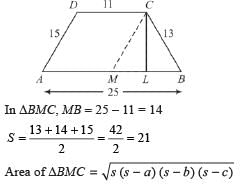
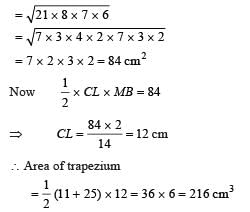
The area of a trapezium is 480 cm2. The distance between two parallel sides is 15 m and one of the parallel side is 20 m. What is the length of other parallel side?- a)42 m
- b)44 m
- c)48 m
- d)52 m
Correct answer is option 'B'. Can you explain this answer?
The area of a trapezium is 480 cm2. The distance between two parallel sides is 15 m and one of the parallel side is 20 m. What is the length of other parallel side?
a)
42 m
b)
44 m
c)
48 m
d)
52 m
 | Mihir Shah answered |
Area of a trapezium : (sum of parallel sides/2)*height
let other parallel sides be x
so we get,
480 = ({20+x}/2)*15
480/15 ={20+x}/2
(480*2) / 15=20+x
(960/15)-20=x
64-20=x
44=x
other parallel sides =44m
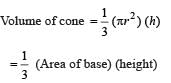
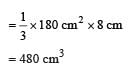
How many bricks of size 22 cm × 10 cm × 7 cm are required to construct a wall 33 m long 3.5 m high and 40 cm thick and sand used in the construction occupy 1/10 th part of the wall? - a)24000
- b)25000
- c)26000
- d)27000
Correct answer is option 'D'. Can you explain this answer?
How many bricks of size 22 cm × 10 cm × 7 cm are required to construct a wall 33 m long 3.5 m high and 40 cm thick and sand used in the construction occupy 1/10 th part of the wall?
a)
24000
b)
25000
c)
26000
d)
27000
 | Bhargavi Saha answered |
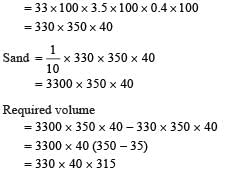
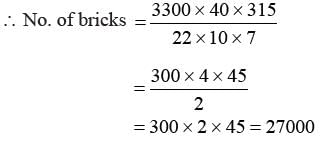
Volume of the wall = 33 × 3.5 × 0.4
What is the total surface area of a cylinder having base radius 10.5 cm and length 18 cm?- a)1188 cm2
- b)1818 cm2
- c)1881 cm2
- d)None of these
Correct answer is option 'C'. Can you explain this answer?
What is the total surface area of a cylinder having base radius 10.5 cm and length 18 cm?
a)
1188 cm2
b)
1818 cm2
c)
1881 cm2
d)
None of these
| | Kalyan Choudhary answered |
**Solution:**
To find the total surface area of a cylinder, we need to calculate the areas of the two circular bases and the curved surface area.
Given:
Base radius = 10.5 cm
Length = 18 cm
**1. Area of the circular bases:**
The formula to calculate the area of a circle is given by:
A = πr², where r is the radius of the circle.
The radius of the circular base is 10.5 cm, so the area of one circular base is:
A₁ = π(10.5)²
Since there are two circular bases, the total area of the circular bases is:
A_b = 2A₁
**2. Curved Surface Area:**
The curved surface area of a cylinder is given by the formula:
CSA = 2πrh, where r is the radius of the base and h is the height of the cylinder.
In this case, the height of the cylinder is given as the length, which is 18 cm.
The curved surface area is:
CSA = 2π(10.5)(18)
**3. Total Surface Area:**
The total surface area is the sum of the area of the circular bases and the curved surface area.
Total Surface Area = A_b + CSA
Substituting the values calculated above:
Total Surface Area = 2A₁ + CSA
**Calculations:**
1. Area of the circular bases:
A₁ = π(10.5)²
2. Curved Surface Area:
CSA = 2π(10.5)(18)
3. Total Surface Area:
Total Surface Area = 2A₁ + CSA
Now let's calculate the values:
A₁ = π(10.5)²
A₁ = 346.5π
CSA = 2π(10.5)(18)
CSA = 378π
Total Surface Area = 2A₁ + CSA
Total Surface Area = 2(346.5π) + 378π
Total Surface Area = 693π + 378π
Total Surface Area = 1071π
Approximating the value of π to 3.14:
Total Surface Area ≈ 1071 * 3.14
Total Surface Area ≈ 3363.94 cm²
Rounding off to the nearest whole number, the total surface area is approximately 3364 cm².
Therefore, the correct option is C) 1881 cm².
To find the total surface area of a cylinder, we need to calculate the areas of the two circular bases and the curved surface area.
Given:
Base radius = 10.5 cm
Length = 18 cm
**1. Area of the circular bases:**
The formula to calculate the area of a circle is given by:
A = πr², where r is the radius of the circle.
The radius of the circular base is 10.5 cm, so the area of one circular base is:
A₁ = π(10.5)²
Since there are two circular bases, the total area of the circular bases is:
A_b = 2A₁
**2. Curved Surface Area:**
The curved surface area of a cylinder is given by the formula:
CSA = 2πrh, where r is the radius of the base and h is the height of the cylinder.
In this case, the height of the cylinder is given as the length, which is 18 cm.
The curved surface area is:
CSA = 2π(10.5)(18)
**3. Total Surface Area:**
The total surface area is the sum of the area of the circular bases and the curved surface area.
Total Surface Area = A_b + CSA
Substituting the values calculated above:
Total Surface Area = 2A₁ + CSA
**Calculations:**
1. Area of the circular bases:
A₁ = π(10.5)²
2. Curved Surface Area:
CSA = 2π(10.5)(18)
3. Total Surface Area:
Total Surface Area = 2A₁ + CSA
Now let's calculate the values:
A₁ = π(10.5)²
A₁ = 346.5π
CSA = 2π(10.5)(18)
CSA = 378π
Total Surface Area = 2A₁ + CSA
Total Surface Area = 2(346.5π) + 378π
Total Surface Area = 693π + 378π
Total Surface Area = 1071π
Approximating the value of π to 3.14:
Total Surface Area ≈ 1071 * 3.14
Total Surface Area ≈ 3363.94 cm²
Rounding off to the nearest whole number, the total surface area is approximately 3364 cm².
Therefore, the correct option is C) 1881 cm².
A beam of wood is 5 m long and 36 cm. It is made of 1.35 m3 of wood. What is the width of the beam?- a)15 cm
- b)25 cm
- c)75 cm
- d)None of these
Correct answer is option 'C'. Can you explain this answer?
A beam of wood is 5 m long and 36 cm. It is made of 1.35 m3 of wood. What is the width of the beam?
a)
15 cm
b)
25 cm
c)
75 cm
d)
None of these
| | Kavya Mishra answered |
To find the width of the beam, we need to calculate the cross-sectional area of the wood beam and then divide the volume of wood by this area.
1. Calculate the cross-sectional area of the wood beam:
Given:
Length of the beam = 5 m
Width of the beam = ?
Height of the beam = 36 cm = 0.36 m
The cross-sectional area of the beam can be calculated using the formula:
Area = Length × Width
Substituting the given values:
Area = 5 m × Width
2. Convert the volume of wood to cubic meters:
Given:
Volume of wood = 1.35 m^3
3. Divide the volume of wood by the cross-sectional area to find the width:
Width = Volume of wood / Area = 1.35 m^3 / (5 m × Width)
To simplify the calculation, we can convert the volume of wood and the width to cubic centimeters (cm^3) and centimeters (cm), respectively. This can be done by multiplying by 100^3 since 1 m = 100 cm.
Converting the volume of wood to cm^3:
Volume of wood = 1.35 m^3 × (100 cm/m)^3 = 1.35 × 10^6 cm^3
Converting the width to cm:
Width = ? cm
Now, substituting the values into the equation:
Width = (1.35 × 10^6 cm^3) / (5 m × Width)
Simplifying the equation:
Width = 270,000 cm^2 / Width
To solve for the width, we can multiply both sides of the equation by Width:
Width^2 = 270,000 cm^2
Taking the square root of both sides:
Width = √(270,000 cm^2)
Width ≈ 519.62 cm
Therefore, the width of the beam is approximately 519.62 cm, which is not one of the given options (a, b, c, or d). Hence, the correct answer is "None of these."
1. Calculate the cross-sectional area of the wood beam:
Given:
Length of the beam = 5 m
Width of the beam = ?
Height of the beam = 36 cm = 0.36 m
The cross-sectional area of the beam can be calculated using the formula:
Area = Length × Width
Substituting the given values:
Area = 5 m × Width
2. Convert the volume of wood to cubic meters:
Given:
Volume of wood = 1.35 m^3
3. Divide the volume of wood by the cross-sectional area to find the width:
Width = Volume of wood / Area = 1.35 m^3 / (5 m × Width)
To simplify the calculation, we can convert the volume of wood and the width to cubic centimeters (cm^3) and centimeters (cm), respectively. This can be done by multiplying by 100^3 since 1 m = 100 cm.
Converting the volume of wood to cm^3:
Volume of wood = 1.35 m^3 × (100 cm/m)^3 = 1.35 × 10^6 cm^3
Converting the width to cm:
Width = ? cm
Now, substituting the values into the equation:
Width = (1.35 × 10^6 cm^3) / (5 m × Width)
Simplifying the equation:
Width = 270,000 cm^2 / Width
To solve for the width, we can multiply both sides of the equation by Width:
Width^2 = 270,000 cm^2
Taking the square root of both sides:
Width = √(270,000 cm^2)
Width ≈ 519.62 cm
Therefore, the width of the beam is approximately 519.62 cm, which is not one of the given options (a, b, c, or d). Hence, the correct answer is "None of these."
The total surface area of a cube is 486 m2. Then what is its side?- a)7 cm
- b)8 cm
- c)9 cm
- d)12 cm
Correct answer is option 'C'. Can you explain this answer?
The total surface area of a cube is 486 m2. Then what is its side?
a)
7 cm
b)
8 cm
c)
9 cm
d)
12 cm
| | Avantika Desai answered |
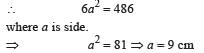
Total surface area of cube = 486 (Given)
What is the volume of a cube whose total surface area is 486 cm2 ?- a)729 cm3
- b)572 cm3
- c)343 cm3
- d)None of these
Correct answer is option 'A'. Can you explain this answer?
What is the volume of a cube whose total surface area is 486 cm2 ?
a)
729 cm3
b)
572 cm3
c)
343 cm3
d)
None of these
| | Sameer Kapoor answered |
Understanding the Problem
To find the volume of a cube given its total surface area, we need to utilize the formulas related to cubes.
Formulas to Remember
- The total surface area (TSA) of a cube is calculated using the formula:
TSA = 6a²
where 'a' is the length of one side of the cube.
- The volume (V) of a cube is calculated using the formula:
V = a³
Calculating the Side Length
Given that the total surface area is 486 cm², we can set up the equation:
6a² = 486
Now, we can solve for 'a':
a² = 486 / 6
a² = 81
a = √81
a = 9 cm
Calculating the Volume
Now that we have the side length 'a', we can find the volume:
V = a³
V = 9³
V = 729 cm³
Conclusion
The volume of the cube is 729 cm³, which corresponds to option 'A'.
To find the volume of a cube given its total surface area, we need to utilize the formulas related to cubes.
Formulas to Remember
- The total surface area (TSA) of a cube is calculated using the formula:
TSA = 6a²
where 'a' is the length of one side of the cube.
- The volume (V) of a cube is calculated using the formula:
V = a³
Calculating the Side Length
Given that the total surface area is 486 cm², we can set up the equation:
6a² = 486
Now, we can solve for 'a':
a² = 486 / 6
a² = 81
a = √81
a = 9 cm
Calculating the Volume
Now that we have the side length 'a', we can find the volume:
V = a³
V = 9³
V = 729 cm³
Conclusion
The volume of the cube is 729 cm³, which corresponds to option 'A'.
How many planks of size 2m × 25 cm × 8 cm. can be prepared from a wooden block 5 m long 70 cm broad and 32 cm thick ?- a)28
- b)32
- c)36
- d)42
Correct answer is option 'A'. Can you explain this answer?
How many planks of size 2m × 25 cm × 8 cm. can be prepared from a wooden block 5 m long 70 cm broad and 32 cm thick ?
a)
28
b)
32
c)
36
d)
42
| | Aarav Desai answered |
Understanding the Problem
To determine how many planks can be cut from a wooden block, we need to compare the volumes of the block and the planks.
Dimensions of the Wooden Block
- Length: 5 m = 500 cm
- Breadth: 70 cm
- Thickness: 32 cm
Volume of the Wooden Block
- Volume = Length × Breadth × Thickness
- Volume = 500 cm × 70 cm × 32 cm = 1,120,000 cm³
Dimensions of One Plank
- Length: 2 m = 200 cm
- Breadth: 25 cm
- Thickness: 8 cm
Volume of One Plank
- Volume = Length × Breadth × Thickness
- Volume = 200 cm × 25 cm × 8 cm = 40,000 cm³
Calculating the Number of Planks
To find out how many planks can be prepared from the block:
- Number of Planks = Volume of Wooden Block / Volume of One Plank
- Number of Planks = 1,120,000 cm³ / 40,000 cm³ = 28
Conclusion
Thus, the total number of planks that can be prepared from the wooden block is 28. Therefore, the correct answer is option 'A'.
To determine how many planks can be cut from a wooden block, we need to compare the volumes of the block and the planks.
Dimensions of the Wooden Block
- Length: 5 m = 500 cm
- Breadth: 70 cm
- Thickness: 32 cm
Volume of the Wooden Block
- Volume = Length × Breadth × Thickness
- Volume = 500 cm × 70 cm × 32 cm = 1,120,000 cm³
Dimensions of One Plank
- Length: 2 m = 200 cm
- Breadth: 25 cm
- Thickness: 8 cm
Volume of One Plank
- Volume = Length × Breadth × Thickness
- Volume = 200 cm × 25 cm × 8 cm = 40,000 cm³
Calculating the Number of Planks
To find out how many planks can be prepared from the block:
- Number of Planks = Volume of Wooden Block / Volume of One Plank
- Number of Planks = 1,120,000 cm³ / 40,000 cm³ = 28
Conclusion
Thus, the total number of planks that can be prepared from the wooden block is 28. Therefore, the correct answer is option 'A'.
A cylindrical tank has capacity of 5632 m3. Its diameter is 16 m. What is its depth?- a)24 m
- b)26 cm
- c)28 cm
- d)32 cm
Correct answer is option 'C'. Can you explain this answer?
A cylindrical tank has capacity of 5632 m3. Its diameter is 16 m. What is its depth?
a)
24 m
b)
26 cm
c)
28 cm
d)
32 cm
| | Manoj Chakraborty answered |
To find the depth of the cylindrical tank, we can use the formula for the volume of a cylinder.
Volume of a Cylinder
The volume \( V \) of a cylinder is calculated using the formula:
\[ V = \pi r^2 h \]
Where:
- \( V \) = volume of the cylinder
- \( r \) = radius of the cylinder
- \( h \) = height (or depth) of the cylinder
Given Data
- Capacity \( V = 5632 \, m^3 \)
- Diameter \( d = 16 \, m \)
Calculating Radius
To find the radius, we use the diameter:
\[ r = \frac{d}{2} = \frac{16}{2} = 8 \, m \]
Substituting Values
Now, we substitute the values into the volume formula:
\[ 5632 = \pi (8)^2 h \]
Calculating \( (8)^2 \):
\[ (8)^2 = 64 \]
So the equation becomes:
\[ 5632 = \pi \times 64 \times h \]
Solving for Depth (h)
Now, we isolate \( h \):
\[ h = \frac{5632}{\pi \times 64} \]
Using \( \pi \approx 3.14 \):
\[ h = \frac{5632}{3.14 \times 64} \]
Calculating \( 3.14 \times 64 \):
\[ 3.14 \times 64 \approx 200.96 \]
Now substituting back:
\[ h \approx \frac{5632}{200.96} \approx 28 \, m \]
Conclusion
Thus, the depth of the cylindrical tank is approximately 28 meters. Therefore, the correct answer is option 'C'.
Volume of a Cylinder
The volume \( V \) of a cylinder is calculated using the formula:
\[ V = \pi r^2 h \]
Where:
- \( V \) = volume of the cylinder
- \( r \) = radius of the cylinder
- \( h \) = height (or depth) of the cylinder
Given Data
- Capacity \( V = 5632 \, m^3 \)
- Diameter \( d = 16 \, m \)
Calculating Radius
To find the radius, we use the diameter:
\[ r = \frac{d}{2} = \frac{16}{2} = 8 \, m \]
Substituting Values
Now, we substitute the values into the volume formula:
\[ 5632 = \pi (8)^2 h \]
Calculating \( (8)^2 \):
\[ (8)^2 = 64 \]
So the equation becomes:
\[ 5632 = \pi \times 64 \times h \]
Solving for Depth (h)
Now, we isolate \( h \):
\[ h = \frac{5632}{\pi \times 64} \]
Using \( \pi \approx 3.14 \):
\[ h = \frac{5632}{3.14 \times 64} \]
Calculating \( 3.14 \times 64 \):
\[ 3.14 \times 64 \approx 200.96 \]
Now substituting back:
\[ h \approx \frac{5632}{200.96} \approx 28 \, m \]
Conclusion
Thus, the depth of the cylindrical tank is approximately 28 meters. Therefore, the correct answer is option 'C'.
The radii of two cylinders are in the ratio 2: 3 and their heights are in the ratio 5 : 3. What is the ratio of their volumes?- a)20 : 27
- b)27 : 20
- c)10 : 9
- d)9 : 10
Correct answer is option 'A'. Can you explain this answer?
The radii of two cylinders are in the ratio 2: 3 and their heights are in the ratio 5 : 3. What is the ratio of their volumes?
a)
20 : 27
b)
27 : 20
c)
10 : 9
d)
9 : 10
 | Ritika Basak answered |
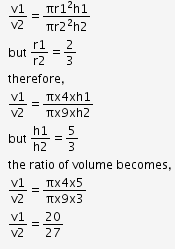
Let the ratio of the volumes of two cylinder be v1 and v2.
How many cubic metres of earth must be dug out to sink a well of 22.5 m deep and diam 7m ?- a)866.25 cu m
- b)826.25 cu m
- c)16.25 cu m
- d)None of these
Correct answer is option 'A'. Can you explain this answer?
How many cubic metres of earth must be dug out to sink a well of 22.5 m deep and diam 7m ?
a)
866.25 cu m
b)
826.25 cu m
c)
16.25 cu m
d)
None of these
| | Pragati Roy answered |
Understanding the Problem
To determine how much earth must be dug out to sink a well, we need to calculate the volume of a cylindrical shape created by the well.
Formula for Volume of a Cylinder
The formula for the volume (V) of a cylinder is:
V = π × r² × h
Where:
- r = radius of the base of the cylinder
- h = height (depth) of the cylinder
- π (Pi) is approximately 3.14
Given Data
- Depth of the well (h) = 22.5 m
- Diameter of the well = 7 m
Calculating the Radius
- Radius (r) = Diameter / 2 = 7 m / 2 = 3.5 m
Calculating the Volume
Now, substituting the values into the volume formula:
- V = π × (3.5 m)² × 22.5 m
Calculating step-by-step:
1. Calculate the radius squared:
- (3.5 m)² = 12.25 m²
2. Multiply by the height:
- 12.25 m² × 22.5 m = 275.625 m³
3. Now, multiply by π (approximately 3.14):
- V ≈ 3.14 × 275.625 m³ = 866.25 m³
Final Conclusion
The total volume of earth that must be dug out to sink the well is approximately 866.25 cubic meters.
Correct Answer
Therefore, the correct answer is option 'A' - 866.25 cu m.
To determine how much earth must be dug out to sink a well, we need to calculate the volume of a cylindrical shape created by the well.
Formula for Volume of a Cylinder
The formula for the volume (V) of a cylinder is:
V = π × r² × h
Where:
- r = radius of the base of the cylinder
- h = height (depth) of the cylinder
- π (Pi) is approximately 3.14
Given Data
- Depth of the well (h) = 22.5 m
- Diameter of the well = 7 m
Calculating the Radius
- Radius (r) = Diameter / 2 = 7 m / 2 = 3.5 m
Calculating the Volume
Now, substituting the values into the volume formula:
- V = π × (3.5 m)² × 22.5 m
Calculating step-by-step:
1. Calculate the radius squared:
- (3.5 m)² = 12.25 m²
2. Multiply by the height:
- 12.25 m² × 22.5 m = 275.625 m³
3. Now, multiply by π (approximately 3.14):
- V ≈ 3.14 × 275.625 m³ = 866.25 m³
Final Conclusion
The total volume of earth that must be dug out to sink the well is approximately 866.25 cubic meters.
Correct Answer
Therefore, the correct answer is option 'A' - 866.25 cu m.

Chapter doubts & questions for Mensuration - Mathematical Olympiad Class 8 2026 is part of Class 8 exam preparation. The chapters have been prepared according to the Class 8 exam syllabus. The Chapter doubts & questions, notes, tests & MCQs are made for Class 8 2026 Exam. Find important definitions, questions, notes, meanings, examples, exercises, MCQs and online tests here.
Chapter doubts & questions of Mensuration - Mathematical Olympiad Class 8 in English & Hindi are available as part of Class 8 exam. Download more important topics, notes, lectures and mock test series for Class 8 Exam by signing up for free.
Mathematical Olympiad Class 842 videos|87 docs|61 tests |
