


All Exams > Class 8 > Mathematical Olympiad Class 8 > All Questions
All questions of Introduction to Graphs for Class 8 Exam
The bar-graph provided gives the sales of books (in thousand numbers) by six branches of a publishing company during two consecutive years 2013 and 2014. Sales of books (in thousand numbers) in different branches 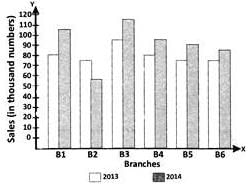 What percent of the average sales of branches B1,B2 and B3 in 2014 is the average sales of branches B1,B3 and B6 in 2013?
- a)75
- b)77.5
- c)91
- d)87.5
Correct answer is option 'C'. Can you explain this answer?
The bar-graph provided gives the sales of books (in thousand numbers) by six branches of a publishing company during two consecutive years 2013 and 2014. Sales of books (in thousand numbers) in different branches
What percent of the average sales of branches B1,B2 and B3 in 2014 is the average sales of branches B1,B3 and B6 in 2013?
a)
75
b)
77.5
c)
91
d)
87.5
 | Ananya Das answered |
Average sale of B1,B2 and B3 in 2014=(105+115+55)/3=91.667
Average sale of B1,B3 and B6 in 2013=(80+75+95)/3=83.333
83.333=x*91.667/100
x=8333.3/91.667=91(Approx.)
Average sale of B1,B3 and B6 in 2013=(80+75+95)/3=83.333
83.333=x*91.667/100
x=8333.3/91.667=91(Approx.)

Which of the following statements is true?- a)The X-axis is a vertical line.
- b)The Y-axis is a horizontal line.
- c)The scale on both the axes must be the same in a Cartesian plane.
- d)The point of intersection between the X-axis and Y-axis is called the origin.
Correct answer is option 'D'. Can you explain this answer?
Which of the following statements is true?
a)
The X-axis is a vertical line.
b)
The Y-axis is a horizontal line.
c)
The scale on both the axes must be the same in a Cartesian plane.
d)
The point of intersection between the X-axis and Y-axis is called the origin.
 | Rishika Ahuja answered |
Origin is the point of intersection of the X and Y axes.
Which of the points given is a point on the X-axis?- a)(5,0)
- b)(0,5)
- c)(5,3)
- d)(3,5)
Correct answer is option 'A'. Can you explain this answer?
Which of the points given is a point on the X-axis?
a)
(5,0)
b)
(0,5)
c)
(5,3)
d)
(3,5)
 | Raj Khanna answered |
Understanding Points on the X-axis
To determine which points lie on the X-axis, it's essential to understand the characteristics of the X-axis in a coordinate system.
Definition of the X-axis
- The X-axis is a horizontal line where the value of Y is always 0.
- Any point on the X-axis can be represented as (X, 0), meaning the Y-coordinate is 0.
Analyzing the Given Points
Let's take a closer look at the options provided:
- Option A: (5, 0)
- Here, the Y-coordinate is 0.
- This point is indeed on the X-axis.
- Option B: (0, 5)
- The Y-coordinate is 5.
- This point lies on the Y-axis, not the X-axis.
- Option C: (5, 3)
- The Y-coordinate is 3.
- This point is located above the X-axis, not on it.
- Option D: (3, 5)
- The Y-coordinate is 5.
- This point is also above the X-axis and not on it.
Conclusion
Based on the analysis, the only point that satisfies the condition of being on the X-axis is:
- (5, 0) - This confirms that option A is the correct answer.
Understanding the coordinates helps in identifying points on axes effectively.
To determine which points lie on the X-axis, it's essential to understand the characteristics of the X-axis in a coordinate system.
Definition of the X-axis
- The X-axis is a horizontal line where the value of Y is always 0.
- Any point on the X-axis can be represented as (X, 0), meaning the Y-coordinate is 0.
Analyzing the Given Points
Let's take a closer look at the options provided:
- Option A: (5, 0)
- Here, the Y-coordinate is 0.
- This point is indeed on the X-axis.
- Option B: (0, 5)
- The Y-coordinate is 5.
- This point lies on the Y-axis, not the X-axis.
- Option C: (5, 3)
- The Y-coordinate is 3.
- This point is located above the X-axis, not on it.
- Option D: (3, 5)
- The Y-coordinate is 5.
- This point is also above the X-axis and not on it.
Conclusion
Based on the analysis, the only point that satisfies the condition of being on the X-axis is:
- (5, 0) - This confirms that option A is the correct answer.
Understanding the coordinates helps in identifying points on axes effectively.
The following pie charts show the Jistribution of students of graduate and 3ost-graduate levels in seven different institutes M, M P, Q, R, S and Tina town. Distribution of students at graduate and post-graduate levels in seven institutes M, N, P,Q, R, S, and T. Total number of students of graduate level = 27300 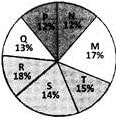 Total number of students of post-graduate level = 24700
 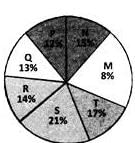 Note: Pie charts are not drawn to scale. What is the total number of students studying at post-graduate level from institutes N and P?
- a) 5601
- b) 5944
- c) 6669
- d) 7004
Correct answer is option 'C'. Can you explain this answer?
The following pie charts show the Jistribution of students of graduate and 3ost-graduate levels in seven different institutes M, M P, Q, R, S and Tina town. Distribution of students at graduate and post-graduate levels in seven institutes M, N, P,Q, R, S, and T. Total number of students of graduate level = 27300
Total number of students of post-graduate level = 24700
Note: Pie charts are not drawn to scale. What is the total number of students studying at post-graduate level from institutes N and P?
a)
5601
b)
5944
c)
6669
d)
7004
 | Tanisk Nirala answered |
Pesentage of post graduate from p + n = total so 24700/100 × 12 +24700/100 × 15 = 2964+3705 = 6669 hence proved
The bar-graph provided gives the sales of books (in thousand numbers) by six branches of a publishing company during two consecutive years 2013 and 2014. Sales of books (in thousand numbers) in different branches 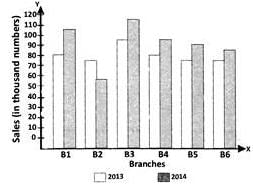 What percent of the total sales of branch B3 for both the years is the total sales of branch B6 for both the years?
- a)68.54
- b)71.11
- c)76.19
- d)75.55
Correct answer is option 'C'. Can you explain this answer?
The bar-graph provided gives the sales of books (in thousand numbers) by six branches of a publishing company during two consecutive years 2013 and 2014. Sales of books (in thousand numbers) in different branches
What percent of the total sales of branch B3 for both the years is the total sales of branch B6 for both the years?
a)
68.54
b)
71.11
c)
76.19
d)
75.55
 | Anushka Joshi answered |
The required percentage 
The bar chart shows the number of workers employed by a trading company in three years.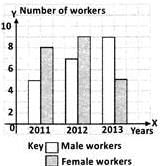 Calculate the difference between the total number of male and female workers employed over those three years.
- a)1
- b)2
- c)4
- d)6
Correct answer is option 'A'. Can you explain this answer?
The bar chart shows the number of workers employed by a trading company in three years.
Calculate the difference between the total number of male and female workers employed over those three years.
a)
1
b)
2
c)
4
d)
6
 | Nikhil Jain answered |
The total number of male workers employed = 5+7+9 = 21
The total number of female workers employed =8+9+5 = 22
∴ The required difference = 22−21 = 1
The total number of female workers employed =8+9+5 = 22
∴ The required difference = 22−21 = 1
The bar-graph provided gives the sales of books (in thousand numbers) by six branches of a publishing company during two consecutive years 2013 and 2014. Sales of books (in thousand numbers) in different branches 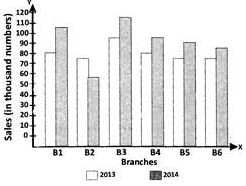 What is the average sale of all the branches (in thousand numbers) for the year 2013?
- a)73
- b)81
- c)83
- d)88
Correct answer is option 'B'. Can you explain this answer?
The bar-graph provided gives the sales of books (in thousand numbers) by six branches of a publishing company during two consecutive years 2013 and 2014. Sales of books (in thousand numbers) in different branches
What is the average sale of all the branches (in thousand numbers) for the year 2013?
a)
73
b)
81
c)
83
d)
88
 | Anu Choudhury answered |
The average sales of all the six branches (in thousand numbers) for the year 2013
= 1/6×[80+75+95+85+75+75] = 80.8 = 81
= 1/6×[80+75+95+85+75+75] = 80.8 = 81
The line graph shows the sale of dolls by Suhas from Monday to Saturday in a particular week.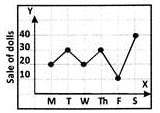 Given that the cost of one doll is Rs.35, how much did Suhas receive from the sale or dolls on Saturday?
- a)Rs.200
- b)Rs.700
- c)Rs.1050
- d)Rs.1400
Correct answer is option 'D'. Can you explain this answer?
The line graph shows the sale of dolls by Suhas from Monday to Saturday in a particular week.
Given that the cost of one doll is Rs.35, how much did Suhas receive from the sale or dolls on Saturday?
a)
Rs.200
b)
Rs.700
c)
Rs.1050
d)
Rs.1400
 | Ishani Choudhury answered |
Sale of dolls on Saturday = 40 Cost of each doll = Rs.35
∴ Amount earned Rs.35 × 40 = Rs.1400
∴ Amount earned Rs.35 × 40 = Rs.1400
Direction: The following pie charts show the distribution of students of graduate and post-graduate levels in seven different institutes M, N , P, Q, R, S and T town.Total number of students of graduate level = 27300 Total number of students of post-graduate level = 24700 Note: Pie charts are not drawn to scale. How many students of institutes M and S are studying at graduate level?- a)7516
- b)8463
- c)9127
- d)9409
Correct answer is option 'B'. Can you explain this answer?
Direction: The following pie charts show the distribution of students of graduate and post-graduate levels in seven different institutes M, N , P, Q, R, S and T town.
Total number of students of graduate level = 27300
Total number of students of post-graduate level = 24700
Note: Pie charts are not drawn to scale. How many students of institutes M and S are studying at graduate level?
a)
7516
b)
8463
c)
9127
d)
9409
| | Sameer Chaudhary answered |
Students of institute M at graduate level = 17% of 27300 =4641 Students of institute S at graduate level = 14 % of 27300 = 3822
∴ Total number of students at graduate level in institutes M and S = 4641+3822 = 8463 (or) 31% of 27300 = 8463
Which of the following statements is correct?- a)The coordinates of the origin are (0,1).
- b)The point (5,0) lies on the Y-axis.
- c)The point (0,7) lies on the Y-axis.
- d)The point (3,2) lies on the X-axis.
Correct answer is option 'C'. Can you explain this answer?
Which of the following statements is correct?
a)
The coordinates of the origin are (0,1).
b)
The point (5,0) lies on the Y-axis.
c)
The point (0,7) lies on the Y-axis.
d)
The point (3,2) lies on the X-axis.
 | Shalini Shah answered |
The correct statement is option 'C': The point (0,7) lies on the Y-axis.
Explanation:
To understand why this statement is correct, let's first review what the X-axis and Y-axis represent in a Cartesian coordinate system.
- The X-axis is the horizontal line that runs left to right, with positive values to the right of the origin (0) and negative values to the left.
- The Y-axis is the vertical line that runs bottom to top, with positive values above the origin (0) and negative values below.
Now, let's analyze each statement to determine their accuracy.
a) The coordinates of the origin are (0,1).
This statement is incorrect. The origin (0,0) represents the point where the X-axis and Y-axis intersect. The Y-coordinate of the origin is 0, not 1.
b) The point (5,0) lies on the Y-axis.
This statement is incorrect. The point (5,0) has a Y-coordinate of 0, which means it lies on the X-axis, not the Y-axis.
c) The point (0,7) lies on the Y-axis.
This statement is correct. The point (0,7) has an X-coordinate of 0, which means it lies on the Y-axis. The Y-coordinate is 7, indicating that it is 7 units above the origin.
d) The point (3,2) lies on the X-axis.
This statement is incorrect. The point (3,2) has a Y-coordinate of 2, which means it does not lie on the X-axis. It lies above the X-axis, 2 units up.
In summary, the correct statement is option 'C': The point (0,7) lies on the Y-axis because its X-coordinate is 0.
Explanation:
To understand why this statement is correct, let's first review what the X-axis and Y-axis represent in a Cartesian coordinate system.
- The X-axis is the horizontal line that runs left to right, with positive values to the right of the origin (0) and negative values to the left.
- The Y-axis is the vertical line that runs bottom to top, with positive values above the origin (0) and negative values below.
Now, let's analyze each statement to determine their accuracy.
a) The coordinates of the origin are (0,1).
This statement is incorrect. The origin (0,0) represents the point where the X-axis and Y-axis intersect. The Y-coordinate of the origin is 0, not 1.
b) The point (5,0) lies on the Y-axis.
This statement is incorrect. The point (5,0) has a Y-coordinate of 0, which means it lies on the X-axis, not the Y-axis.
c) The point (0,7) lies on the Y-axis.
This statement is correct. The point (0,7) has an X-coordinate of 0, which means it lies on the Y-axis. The Y-coordinate is 7, indicating that it is 7 units above the origin.
d) The point (3,2) lies on the X-axis.
This statement is incorrect. The point (3,2) has a Y-coordinate of 2, which means it does not lie on the X-axis. It lies above the X-axis, 2 units up.
In summary, the correct statement is option 'C': The point (0,7) lies on the Y-axis because its X-coordinate is 0.
The bar chart shows the number of 'Maruti' and 'Benz' cars sold by three dealers, A, B and C. 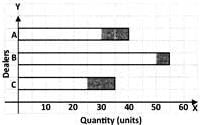 Which of the following statements is true?
- a)Dealer A sold 40 Maruti cars less than dealer B.
- b)Dealer B sold 50 Maruti cars more than dealer C.
- c)Dealer B sold the most number of Benz cars.
- d)The total number of Benz cars by dealers B and C is 15.
Correct answer is option 'C'. Can you explain this answer?
The bar chart shows the number of 'Maruti' and 'Benz' cars sold by three dealers, A, B and C.
Which of the following statements is true?
a)
Dealer A sold 40 Maruti cars less than dealer B.
b)
Dealer B sold 50 Maruti cars more than dealer C.
c)
Dealer B sold the most number of Benz cars.
d)
The total number of Benz cars by dealers B and C is 15.
| | Anu Choudhury answered |
The number of Benz cars sold by dealer B is the maximum.
The bar-graph provided gives the sales of books (in thousand numbers) by six branches of a publishing company during two consecutive years 2013 and 2014. Sales of books (in thousand numbers) in different branches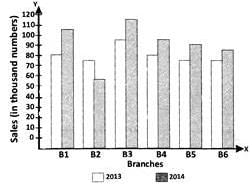 What is the ratio of the total sales of branch B2 for both years to the total sales of branch B4 for both the years
- a)2:3
- b)3:5
- c)4:5
- d)13:18
Correct answer is option 'D'. Can you explain this answer?
The bar-graph provided gives the sales of books (in thousand numbers) by six branches of a publishing company during two consecutive years 2013 and 2014. Sales of books (in thousand numbers) in different branches
What is the ratio of the total sales of branch B2 for both years to the total sales of branch B4 for both the years
a)
2:3
b)
3:5
c)
4:5
d)
13:18
 | Madhurima Nair answered |
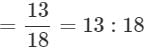
The required ratio 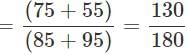
The line graph shows the price of chicken in towns M and N.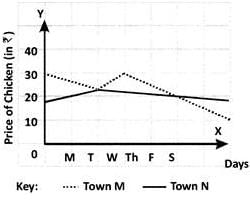 On which days are the price of chicken the same in both the towns?
- a)Tuesday and Friday only
- b)Friday only
- c)Wednesday and Friday only
- d)Tuesday only
Correct answer is option 'A'. Can you explain this answer?
The line graph shows the price of chicken in towns M and N.
On which days are the price of chicken the same in both the towns?
a)
Tuesday and Friday only
b)
Friday only
c)
Wednesday and Friday only
d)
Tuesday only
 | Aarya Deshpande answered |
The price of chicken is the same in both the towns ⇒ their graphs intersect at a point. This happens to be on Tuesday and Friday.
Direction: The bar-graph provided gives the sales of books (in thousand numbers) by six branches of a publishing company during two consecutive years 2013 and 2014. Sales of books (in thousand numbers) in different branches 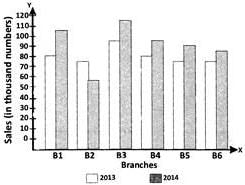 What is the total sales of branches B1, B3 and B5 together for both the years (in thousand numbers)?
- a)250
- b)310
- c)435
- d)565
Correct answer is option 'D'. Can you explain this answer?
Direction: The bar-graph provided gives the sales of books (in thousand numbers) by six branches of a publishing company during two consecutive years 2013 and 2014. Sales of books (in thousand numbers) in different branches
What is the total sales of branches B1, B3 and B5 together for both the years (in thousand numbers)?
a)
250
b)
310
c)
435
d)
565
 | Rishika Dey answered |
Total sales of branches B1,B3, and B5 together for both the years (in thousand numbers)
=(80+105)+(95+115)+(785+95) = 565
=(80+105)+(95+115)+(785+95) = 565
Chapter doubts & questions for Introduction to Graphs - Mathematical Olympiad Class 8 2026 is part of Class 8 exam preparation. The chapters have been prepared according to the Class 8 exam syllabus. The Chapter doubts & questions, notes, tests & MCQs are made for Class 8 2026 Exam. Find important definitions, questions, notes, meanings, examples, exercises, MCQs and online tests here.
Chapter doubts & questions of Introduction to Graphs - Mathematical Olympiad Class 8 in English & Hindi are available as part of Class 8 exam. Download more important topics, notes, lectures and mock test series for Class 8 Exam by signing up for free.
Mathematical Olympiad Class 842 videos|87 docs|61 tests |
