


All Exams > Class 8 > Mathematical Olympiad Class 8 > All Questions
All questions of Cubes and Dice for Class 8 Exam
Directions: Observe the figure of a plane view of a cube and answer the given questions following it. 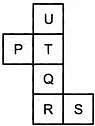 Which face will be at top if face "T" will be at the bottom?
- a)Q
- b)S
- c)R
- d)U
Correct answer is option 'C'. Can you explain this answer?
Directions: Observe the figure of a plane view of a cube and answer the given questions following it.
Which face will be at top if face "T" will be at the bottom?
a)
Q
b)
S
c)
R
d)
U
 | Coders Trust answered |
Imagine folding the paper in this way, we will figure out that R will come at the top and opposite to T.

What is the maximum number of identical pieces a cube can be cut into by 7 cuts?- a)27
- b)36
- c)38
- d)49
Correct answer is option 'B'. Can you explain this answer?
What is the maximum number of identical pieces a cube can be cut into by 7 cuts?
a)
27
b)
36
c)
38
d)
49
 | Debolina Shah answered |
Understanding Cube Cuts
To determine the maximum number of identical pieces a cube can be divided into by 7 cuts, we can follow a systematic approach. Each cut can increase the number of pieces exponentially, depending on how they intersect.
Maximum Pieces Formula
The formula to calculate the maximum number of pieces (P) created by n cuts is:
P = (n^3 + 5n + 6) / 6
This formula arises from the general principle of how each new cut can potentially intersect all previous cuts.
Calculating for 7 Cuts
Now, substituting n = 7 into the formula:
- P = (7^3 + 5*7 + 6) / 6
- P = (343 + 35 + 6) / 6
- P = 384 / 6
- P = 64
However, this result is for the maximum number of pieces resulting from 7 cuts, leading us to a misunderstanding.
Correct Approach for Identical Pieces
For identical pieces, we must consider how cuts can be made uniformly. To achieve the maximum number of identical pieces, we can divide the cube into smaller cubical units.
- Each cut can effectively divide the cube into smaller cubes.
- The best configuration involves making equal cuts along each dimension (length, width, height).
Identical Pieces Calculation
1. Making 3 Cuts in One Direction: This divides the cube into 4 pieces along that dimension.
2. Making 2 Cuts in the Second Direction: This divides the remaining pieces further, doubling the count.
3. Making 2 Cuts in the Third Direction: This again doubles the count.
Thus, the total number of pieces can be calculated as:
- 4 pieces (from first cuts) x 3 pieces (from second cuts) x 3 pieces (from third cuts) = 36 identical pieces.
Conclusion
Therefore, the correct answer for the maximum number of identical pieces a cube can be cut into by 7 cuts is 36, which corresponds to option 'B'.
To determine the maximum number of identical pieces a cube can be divided into by 7 cuts, we can follow a systematic approach. Each cut can increase the number of pieces exponentially, depending on how they intersect.
Maximum Pieces Formula
The formula to calculate the maximum number of pieces (P) created by n cuts is:
P = (n^3 + 5n + 6) / 6
This formula arises from the general principle of how each new cut can potentially intersect all previous cuts.
Calculating for 7 Cuts
Now, substituting n = 7 into the formula:
- P = (7^3 + 5*7 + 6) / 6
- P = (343 + 35 + 6) / 6
- P = 384 / 6
- P = 64
However, this result is for the maximum number of pieces resulting from 7 cuts, leading us to a misunderstanding.
Correct Approach for Identical Pieces
For identical pieces, we must consider how cuts can be made uniformly. To achieve the maximum number of identical pieces, we can divide the cube into smaller cubical units.
- Each cut can effectively divide the cube into smaller cubes.
- The best configuration involves making equal cuts along each dimension (length, width, height).
Identical Pieces Calculation
1. Making 3 Cuts in One Direction: This divides the cube into 4 pieces along that dimension.
2. Making 2 Cuts in the Second Direction: This divides the remaining pieces further, doubling the count.
3. Making 2 Cuts in the Third Direction: This again doubles the count.
Thus, the total number of pieces can be calculated as:
- 4 pieces (from first cuts) x 3 pieces (from second cuts) x 3 pieces (from third cuts) = 36 identical pieces.
Conclusion
Therefore, the correct answer for the maximum number of identical pieces a cube can be cut into by 7 cuts is 36, which corresponds to option 'B'.
Directions: A cube is coloured red on all of its faces. It is then cut into 64 smaller cubes of equal size. The smaller cubes so obtained are now separated.
How many smaller cubes have no face coloured?- a)24
- b)16
- c)8
- d)10
Correct answer is option 'C'. Can you explain this answer?
Directions: A cube is coloured red on all of its faces. It is then cut into 64 smaller cubes of equal size. The smaller cubes so obtained are now separated.
How many smaller cubes have no face coloured?
How many smaller cubes have no face coloured?
a)
24
b)
16
c)
8
d)
10
 | Saptarshi Das answered |
Understanding the Cube
A cube is a three-dimensional shape with six equal square faces. When we paint it red on all sides and then cut it into smaller cubes, we need to analyze how many of these smaller cubes will have no red paint on any face.
Cutting the Cube
The given cube is cut into 64 smaller cubes. This means the cube is divided into a 4x4x4 grid (since 4 * 4 * 4 = 64). Each smaller cube will have a side length that is one-fourth of the original cube's side length.
Identifying Inner Cubes
To find the cubes with no red paint, we need to consider only the inner cubes. The outer layer of cubes will have at least one face painted red.
- The outer layer consists of the cubes on the edges and corners of the original cube.
- Only the cubes that are completely surrounded by other cubes will be unpainted.
Counting the Inner Cubes
In a 4x4x4 cube, the inner cubes are located in the center, away from any outer face.
- Dimensions of the Inner Cube:
The inner cube formed by removing the outer layer has dimensions 2x2x2 (since we remove one layer from each side).
- Calculating Inner Cubes:
The total number of smaller cubes in this inner 2x2x2 cube is 2 * 2 * 2 = 8.
Conclusion
Thus, the total number of smaller cubes that have no face coloured is 8.
The correct answer is option 'C'.
A cube is a three-dimensional shape with six equal square faces. When we paint it red on all sides and then cut it into smaller cubes, we need to analyze how many of these smaller cubes will have no red paint on any face.
Cutting the Cube
The given cube is cut into 64 smaller cubes. This means the cube is divided into a 4x4x4 grid (since 4 * 4 * 4 = 64). Each smaller cube will have a side length that is one-fourth of the original cube's side length.
Identifying Inner Cubes
To find the cubes with no red paint, we need to consider only the inner cubes. The outer layer of cubes will have at least one face painted red.
- The outer layer consists of the cubes on the edges and corners of the original cube.
- Only the cubes that are completely surrounded by other cubes will be unpainted.
Counting the Inner Cubes
In a 4x4x4 cube, the inner cubes are located in the center, away from any outer face.
- Dimensions of the Inner Cube:
The inner cube formed by removing the outer layer has dimensions 2x2x2 (since we remove one layer from each side).
- Calculating Inner Cubes:
The total number of smaller cubes in this inner 2x2x2 cube is 2 * 2 * 2 = 8.
Conclusion
Thus, the total number of smaller cubes that have no face coloured is 8.
The correct answer is option 'C'.
What is the least number of cuts required to cut a cube into 24 identical pieces?- a)5
- b)6
- c)7
- d)8
Correct answer is option 'A'. Can you explain this answer?
What is the least number of cuts required to cut a cube into 24 identical pieces?
a)
5
b)
6
c)
7
d)
8
 | Aman Choudhury answered |
Understanding the Problem
To cut a cube into 24 identical pieces, we need to determine the least number of cuts required. A cube has three dimensions, and we can effectively utilize cuts along these dimensions.
Strategic Cutting Plan
1. First Cut:
- Make the first cut horizontally through the center of the cube.
- This divides the cube into 2 equal halves.
2. Second Cut:
- Make the second cut vertically along the first dimension (length).
- This will result in 4 equal pieces.
3. Third Cut:
- Make the third cut vertically along the second dimension (width).
- This gives us 8 pieces.
4. Fourth Cut:
- Now, take one of the 8 pieces and make a horizontal cut through the middle of this piece.
- This doubles the number of pieces to 16.
5. Fifth Cut:
- Finally, make one more cut, either vertically in length or width, through the center of the remaining pieces.
- This will result in a total of 24 identical pieces.
Conclusion
- Thus, we can efficiently cut a cube into 24 identical pieces using just 5 cuts.
- The strategy involves cutting through the middle of the cube and then making additional cuts to divide the segments further.
In summary, the least number of cuts required to achieve 24 identical pieces from a cube is 5.
To cut a cube into 24 identical pieces, we need to determine the least number of cuts required. A cube has three dimensions, and we can effectively utilize cuts along these dimensions.
Strategic Cutting Plan
1. First Cut:
- Make the first cut horizontally through the center of the cube.
- This divides the cube into 2 equal halves.
2. Second Cut:
- Make the second cut vertically along the first dimension (length).
- This will result in 4 equal pieces.
3. Third Cut:
- Make the third cut vertically along the second dimension (width).
- This gives us 8 pieces.
4. Fourth Cut:
- Now, take one of the 8 pieces and make a horizontal cut through the middle of this piece.
- This doubles the number of pieces to 16.
5. Fifth Cut:
- Finally, make one more cut, either vertically in length or width, through the center of the remaining pieces.
- This will result in a total of 24 identical pieces.
Conclusion
- Thus, we can efficiently cut a cube into 24 identical pieces using just 5 cuts.
- The strategy involves cutting through the middle of the cube and then making additional cuts to divide the segments further.
In summary, the least number of cuts required to achieve 24 identical pieces from a cube is 5.
Chapter doubts & questions for Cubes and Dice - Mathematical Olympiad Class 8 2026 is part of Class 8 exam preparation. The chapters have been prepared according to the Class 8 exam syllabus. The Chapter doubts & questions, notes, tests & MCQs are made for Class 8 2026 Exam. Find important definitions, questions, notes, meanings, examples, exercises, MCQs and online tests here.
Chapter doubts & questions of Cubes and Dice - Mathematical Olympiad Class 8 in English & Hindi are available as part of Class 8 exam. Download more important topics, notes, lectures and mock test series for Class 8 Exam by signing up for free.
Mathematical Olympiad Class 842 videos|87 docs|61 tests |
