


All Exams > Class 8 > Science Olympiad Class 8 > All Questions
All questions of Alpha-Numeric Sequence Puzzle for Class 8 Exam
Arrange the given words in the alphabetical order and choose the one that comes last.- a)Transist
- b)Transport
- c)Transmit
- d)Translate
Correct answer is option 'B'. Can you explain this answer?
Arrange the given words in the alphabetical order and choose the one that comes last.
a)
Transist
b)
Transport
c)
Transmit
d)
Translate
 | Amit Sharma answered |
Transist, translate, transmit and transport. The correct option should be B.


Shankar ranked 7th from the top and 34th from the bottom in a class. How many students are there in a class?- a)38
- b)39
- c)40
- d)41
Correct answer is option 'C'. Can you explain this answer?
Shankar ranked 7th from the top and 34th from the bottom in a class. How many students are there in a class?
a)
38
b)
39
c)
40
d)
41
 | Meghana Iyer answered |
Total number of students = 6 + 1 + 33 = 40
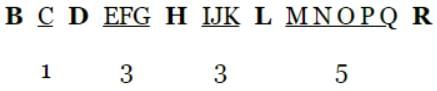
Directions: In each of the following questions find out which of the letter series follows the given rule.Q. Number of letters skipped in between adjacent letters in the series is odd.- a)MPRUX
- b)FIMRX
- c)EIMQV
- d)BDHLR
Correct answer is option 'D'. Can you explain this answer?
Directions: In each of the following questions find out which of the letter series follows the given rule.
Q. Number of letters skipped in between adjacent letters in the series is odd.
a)
MPRUX
b)
FIMRX
c)
EIMQV
d)
BDHLR
 | Rishika Tiwari answered |
Let's analyze each option to determine which letter series has an odd number of letters skipped between adjacent letters.
Option 1: MPRUX
- M to P: 2 letters skipped (N, O) — Even
- P to R: 1 letter skipped (Q) — Odd
- R to U: 2 letters skipped (S, T) — Even
- U to X: 2 letters skipped (V, W) — Even
- This series does not have all odd skips. So, not correct.
Option 2: FIMRX
- F to I: 2 letters skipped (G, H) — Even
- I to M: 3 letters skipped (J, K, L) — Odd
- M to R: 4 letters skipped (N, O, P, Q) — Even
- R to X: 5 letters skipped (S, T, U, V, W) — Odd
- This series has a mix of odd and even skips. So, not correct.
Option 3: EIMQV
- E to I: 3 letters skipped (F, G, H) — Odd
- I to M: 3 letters skipped (J, K, L) — Odd
- M to Q: 3 letters skipped (N, O, P) — Odd
- Q to V: 4 letters skipped (R, S, T, U) — Even
- This series also has a mix of odd and even skips. So, not correct.
Option 4: BDHLR
- B to D: 1 letter skipped (C) — Odd
- D to H: 3 letters skipped (E, F, G) — Odd
- H to L: 3 letters skipped (I, J, K) — Odd
- L to R: 5 letters skipped (M, N, O, P, Q) — Odd
- All skips between letters in this series are odd.
Conclusion:
The correct answer is Option 4: BDHLR, as it is the only series where the number of letters skipped between adjacent letters is consistently odd.
Directions: Each of the following questions is based on the following alphabet – series:
A B C D E F G H I J K L M N O P Q R S T U V
W X Y ZQ. If only the first half of the given alphabet is reversed, how many letters will be there between K and R?- a)14
- b)16
- c)10
- d)6
Correct answer is option 'A'. Can you explain this answer?
Directions: Each of the following questions is based on the following alphabet – series:
A B C D E F G H I J K L M N O P Q R S T U V
W X Y Z
A B C D E F G H I J K L M N O P Q R S T U V
W X Y Z
Q. If only the first half of the given alphabet is reversed, how many letters will be there between K and R?
a)
14
b)
16
c)
10
d)
6
 | Sounak Chatterjee answered |
Reversing only the first 13 letters, we obtain the following letter series:
M L K J I H G F E D C B A N O P Q R S T U V W X Y Z.
Clearly, there are 14 letters between K and R in the above series.
M L K J I H G F E D C B A N O P Q R S T U V W X Y Z.
Clearly, there are 14 letters between K and R in the above series.
In the series given below, how many 8’s are there each of which is exactly divisible by its immediate preceding as well as succeeding numbers?
2 8 4 3 8 5 4 8 2 6 7 8 4 6 2 8 4 1 7 ? - a)1
- b)2
- c)3
- d)4
Correct answer is option 'C'. Can you explain this answer?
In the series given below, how many 8’s are there each of which is exactly divisible by its immediate preceding as well as succeeding numbers?
2 8 4 3 8 5 4 8 2 6 7 8 4 6 2 8 4 1 7 ?
2 8 4 3 8 5 4 8 2 6 7 8 4 6 2 8 4 1 7 ?
a)
1
b)
2
c)
3
d)
4
 | Rajat Chatterjee answered |
Understanding the Problem
In the given series, we need to identify the occurrences of the number 8 that are exactly divisible by both the numbers immediately before and after them.
Series Breakdown
The series is:
2, 8, 4, 3, 8, 5, 4, 8, 2, 6, 7, 8, 4, 6, 2, 8, 4, 1, 7
Identifying Relevant 8's
We will analyze each occurrence of the number 8:
- First 8 (2, 8, 4)
- Preceding number: 2
- Succeeding number: 4
- 8 is divisible by 2 (8 ÷ 2 = 4) and by 4 (8 ÷ 4 = 2).
- Valid 8
- Second 8 (3, 8, 5)
- Preceding number: 3
- Succeeding number: 5
- 8 is not divisible by 3 (8 ÷ 3 = 2.67) and not divisible by 5 (8 ÷ 5 = 1.6).
- Invalid 8
- Third 8 (4, 8, 2)
- Preceding number: 4
- Succeeding number: 2
- 8 is divisible by 4 (8 ÷ 4 = 2) and by 2 (8 ÷ 2 = 4).
- Valid 8
- Fourth 8 (6, 8, 4)
- Preceding number: 6
- Succeeding number: 4
- 8 is not divisible by 6 (8 ÷ 6 = 1.33) and by 4 (8 ÷ 4 = 2).
- Invalid 8
- Fifth 8 (2, 8, 4)
- Preceding number: 2
- Succeeding number: 4
- 8 is divisible by 2 and by 4.
- Valid 8
- Sixth 8 (4, 8, 1)
- Preceding number: 4
- Succeeding number: 1
- 8 is divisible by 4 and by 1.
- Valid 8
Conclusion
In total, we have three valid occurrences of 8 that meet the criteria. Therefore, the answer is 3.
In the given series, we need to identify the occurrences of the number 8 that are exactly divisible by both the numbers immediately before and after them.
Series Breakdown
The series is:
2, 8, 4, 3, 8, 5, 4, 8, 2, 6, 7, 8, 4, 6, 2, 8, 4, 1, 7
Identifying Relevant 8's
We will analyze each occurrence of the number 8:
- First 8 (2, 8, 4)
- Preceding number: 2
- Succeeding number: 4
- 8 is divisible by 2 (8 ÷ 2 = 4) and by 4 (8 ÷ 4 = 2).
- Valid 8
- Second 8 (3, 8, 5)
- Preceding number: 3
- Succeeding number: 5
- 8 is not divisible by 3 (8 ÷ 3 = 2.67) and not divisible by 5 (8 ÷ 5 = 1.6).
- Invalid 8
- Third 8 (4, 8, 2)
- Preceding number: 4
- Succeeding number: 2
- 8 is divisible by 4 (8 ÷ 4 = 2) and by 2 (8 ÷ 2 = 4).
- Valid 8
- Fourth 8 (6, 8, 4)
- Preceding number: 6
- Succeeding number: 4
- 8 is not divisible by 6 (8 ÷ 6 = 1.33) and by 4 (8 ÷ 4 = 2).
- Invalid 8
- Fifth 8 (2, 8, 4)
- Preceding number: 2
- Succeeding number: 4
- 8 is divisible by 2 and by 4.
- Valid 8
- Sixth 8 (4, 8, 1)
- Preceding number: 4
- Succeeding number: 1
- 8 is divisible by 4 and by 1.
- Valid 8
Conclusion
In total, we have three valid occurrences of 8 that meet the criteria. Therefore, the answer is 3.

Directions: Each of the following questions is based on the following alphabet – series:
A B C D E F G H I J K L M N O P Q R S T U V
W X Y ZQ. In the following alphabets, which letter is eighth to the right of the fourteenth letter from the right end?
Z A B C D E F G H I J K L M N O P Q R S T U V W X Y - a)H
- b)R
- c)S
- d)T
Correct answer is option 'D'. Can you explain this answer?
Directions: Each of the following questions is based on the following alphabet – series:
A B C D E F G H I J K L M N O P Q R S T U V
W X Y Z
A B C D E F G H I J K L M N O P Q R S T U V
W X Y Z
Q. In the following alphabets, which letter is eighth to the right of the fourteenth letter from the right end?
Z A B C D E F G H I J K L M N O P Q R S T U V W X Y
Z A B C D E F G H I J K L M N O P Q R S T U V W X Y
a)
H
b)
R
c)
S
d)
T
 | Keerthana Gupta answered |
The fourteenth letter from the right is L. the eighth letter to the right of L is T.
Directions: In each of the following questions find out which of the letter series follows the given rule.Q. Number of letters skipped in between adjacent letters in the series doubles every time.- a)BDGLU
- b)EGJOF
- c)GJNSY
- d)ADIPY
Correct answer is option 'A'. Can you explain this answer?
Directions: In each of the following questions find out which of the letter series follows the given rule.
Q. Number of letters skipped in between adjacent letters in the series doubles every time.
a)
BDGLU
b)
EGJOF
c)
GJNSY
d)
ADIPY
 | Rahul Mehra answered |

Directions: In this type of questions, a figure or a matrix is given in which some numbers are filled according to a rule. A place is left blank. You have to find out a character (a number or a letter) from the given possible answers which may be filled in the blank space.Q. Which one will replace the question mark?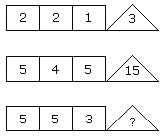
- a)11
- b)19
- c)15
- d)22
Correct answer is option 'D'. Can you explain this answer?
Directions: In this type of questions, a figure or a matrix is given in which some numbers are filled according to a rule. A place is left blank. You have to find out a character (a number or a letter) from the given possible answers which may be filled in the blank space.
Q. Which one will replace the question mark?
a)
11
b)
19
c)
15
d)
22
 | Ajmal Ram answered |
11


Saket is 7 ranks ahead of Manoj in a class of 50. If Manoj’s rank is 17th from the last, what is Saket’s rank from the start?- a)25
- b)26
- c)27
- d)28
Correct answer is option 'C'. Can you explain this answer?
Saket is 7 ranks ahead of Manoj in a class of 50. If Manoj’s rank is 17th from the last, what is Saket’s rank from the start?
a)
25
b)
26
c)
27
d)
28
| | Rahul Mehra answered |
Manoj’s rank is 17th from the last.
Saket’s rank = 17 + 7 = 24th from the last.
No. of students ahead of Saket = 50 – 24 = 26
Saket’s rank from start = 26 + 1 = 27th
Saket’s rank = 17 + 7 = 24th from the last.
No. of students ahead of Saket = 50 – 24 = 26
Saket’s rank from start = 26 + 1 = 27th
Directions: In each of the following questions find out which of the letter series follows the given rule.Q. Number of letters skipped in between adjacent letters in the series decreases by three.- a)HVDKP
- b)HUELP
- c)HUELD
- d)DMSXA
Correct answer is option 'B'. Can you explain this answer?
Directions: In each of the following questions find out which of the letter series follows the given rule.
Q. Number of letters skipped in between adjacent letters in the series decreases by three.
a)
HVDKP
b)
HUELP
c)
HUELD
d)
DMSXA
| | Keerthana Gupta answered |
H I J K L M N O P Q R S T U V W X Y Z
12 9

12 9

Directions: In each of the following questions find out which of the letter series follows the given rule.Q. Number of letters skipped in between adjacent letters in the series decreases by one each time.- a)BHNSV
- b)TZEIL
- c)MSYBG
- d)IMTXB
Correct answer is option 'B'. Can you explain this answer?
Directions: In each of the following questions find out which of the letter series follows the given rule.
Q. Number of letters skipped in between adjacent letters in the series decreases by one each time.
a)
BHNSV
b)
TZEIL
c)
MSYBG
d)
IMTXB
| | Sounak Chatterjee answered |



How many 6's are there in the following series each of which is immediately preceded by 5 but not immediately followed by P?
5 6 A 6 7 E 5 6 P 6 8 5 9 B 5 6 D 6 H 6 5 L 6 K 6 5 G 5 6 N 5 6 8- a)4
- b)6
- c)7
- d)5
Correct answer is option 'A'. Can you explain this answer?
5 6 A 6 7 E 5 6 P 6 8 5 9 B 5 6 D 6 H 6 5 L 6 K 6 5 G 5 6 N 5 6 8
a)
4
b)
6
c)
7
d)
5
 | Stoneridge Institute answered |
There are four occurrences of 6 that are immediately preceded by 5 but not immediately followed by P: 5 6, 5 6, 5 6, 5 6.
Arrange the given words in a meaningful sequence: Key, Door, Lock, Room, Switch on- a)Switch on, Key, Door, Room, Lock
- b)Room, Door, Key, Switch on, Lock
- c)Key, Lock, Door, Room, Switch on
- d)Key, Door, Lock, Room, Switch on
Correct answer is option 'D'. Can you explain this answer?
a)
Switch on, Key, Door, Room, Lock
b)
Room, Door, Key, Switch on, Lock
c)
Key, Lock, Door, Room, Switch on
d)
Key, Door, Lock, Room, Switch on
 | Rohini Seth answered |
The correct sequence is Key (to open) the Door, then Lock the Door to enter the Room, and finally, Switch on the lights.

Directions: Each of the following questions is based on the following alphabet – series:
A B C D E F G H I J K L M N O P Q R S T U V
W X Y ZQ. If the order of the English alphabet is reversed, then which letter would be exactly in the middle?- a)M
- b)N
- c)L
- d)None of these?
Correct answer is option 'D'. Can you explain this answer?
Directions: Each of the following questions is based on the following alphabet – series:
A B C D E F G H I J K L M N O P Q R S T U V
W X Y Z
A B C D E F G H I J K L M N O P Q R S T U V
W X Y Z
Q. If the order of the English alphabet is reversed, then which letter would be exactly in the middle?
a)
M
b)
N
c)
L
d)
None of these?
 | Shreya Sarkar answered |
The new letter series obtained on reversing the order of the English alphabet is
Z Y X W V U T S R Q P O N M L K J I H G F E D C B A.
Since the series has an even number of letters there is no such letter which lies exactly in the middle.
Z Y X W V U T S R Q P O N M L K J I H G F E D C B A.
Since the series has an even number of letters there is no such letter which lies exactly in the middle.
How many m's are there in the even places in the sequence?
A a c d j d j d m m m m d s m m s m m s m s- a)4
- b)6
- c)8
- d)10
Correct answer is option 'B'. Can you explain this answer?
A a c d j d j d m m m m d s m m s m m s m s
a)
4
b)
6
c)
8
d)
10
| | Rohini Seth answered |
There are six occurrences of m in the sequence that appear in even places (positions 4, 8, 10, 12, 16, and 20).
Directions: Each of the following questions is based on the following alphabet – series:
A B C D E F G H I J K L M N O P Q R S T U V
W X Y ZQ. Which letter in the alphabet is as far from G as T is from M?- a)P
- b)O
- c)M
- d)N
Correct answer is option 'D'. Can you explain this answer?
Directions: Each of the following questions is based on the following alphabet – series:
A B C D E F G H I J K L M N O P Q R S T U V
W X Y Z
A B C D E F G H I J K L M N O P Q R S T U V
W X Y Z
Q. Which letter in the alphabet is as far from G as T is from M?
a)
P
b)
O
c)
M
d)
N
 | Muskaan Choudhury answered |
Distance Calculation:
The distance between two letters in the alphabet can be calculated by counting the number of letters between them.
Distance between T and M:
T is 5 letters away from M in the alphabet. (M, N, O, P, Q, T)
Distance between G and the letter:
To find a letter that is as far from G as T is from M, we need to find a letter that is also 5 letters away from G.
Finding the letter:
Starting from G, we count 5 letters ahead which gives us the letter N. (G, H, I, J, K, N)
Therefore, the letter that is as far from G as T is from M is N.
The distance between two letters in the alphabet can be calculated by counting the number of letters between them.
Distance between T and M:
T is 5 letters away from M in the alphabet. (M, N, O, P, Q, T)
Distance between G and the letter:
To find a letter that is as far from G as T is from M, we need to find a letter that is also 5 letters away from G.
Finding the letter:
Starting from G, we count 5 letters ahead which gives us the letter N. (G, H, I, J, K, N)
Therefore, the letter that is as far from G as T is from M is N.
Directions: In each of the following questions find out which of the letter series follows the given rule.Q. Number of letters skipped in between adjacent letters of the series starting from behind increases by one.- a)ONLKJ
- b)OMKIG
- c)OIGDC
- d)OMJFA
Correct answer is option 'D'. Can you explain this answer?
Directions: In each of the following questions find out which of the letter series follows the given rule.
Q. Number of letters skipped in between adjacent letters of the series starting from behind increases by one.
a)
ONLKJ
b)
OMKIG
c)
OIGDC
d)
OMJFA
 | Malavika Kulkarni answered |

How many 4's are there in the following number series, each of which is immediately preceded and followed by an even digit?
6 4 3 2 4 8 3 1 5 4 2 3 2 4 6 4 8 1 3 2 4 2 6 4 5- a)Four
- b)Two
- c)Three
- d)One
Correct answer is option 'A'. Can you explain this answer?
How many 4's are there in the following number series, each of which is immediately preceded and followed by an even digit?
6 4 3 2 4 8 3 1 5 4 2 3 2 4 6 4 8 1 3 2 4 2 6 4 5
6 4 3 2 4 8 3 1 5 4 2 3 2 4 6 4 8 1 3 2 4 2 6 4 5
a)
Four
b)
Two
c)
Three
d)
One
 | Torcia Education answered |
There is only one occurrence of 4 in the sequence that is immediately preceded and followed by an even digit: 2 4 8.
In a queue, Ravi is 13th from the back Amar is 12th from the front. Hari is standing between the two. What should be the minimum number of boys standing in queue?- a)14
- b)15
- c)16
- d)17
Correct answer is option 'A'. Can you explain this answer?
In a queue, Ravi is 13th from the back Amar is 12th from the front. Hari is standing between the two. What should be the minimum number of boys standing in queue?
a)
14
b)
15
c)
16
d)
17
 | Priya Pillai answered |
Explanation:
- Given: Ravi is 13th from the back and Amar is 12th from the front.
- Let's assume there are 'x' boys in the queue.
- So, the position of Hari will be (x - 12) from the back and (x - 13) from the front.
- Since Hari is standing between Ravi and Amar, we have:
- (x - 13) - Ravi's position = Ravi's position - 1
- Ravi's position - (x - 12) = Amar's position - 1
- Solving the equations, we get Ravi's position as 13 and Amar's position as 14.
- Therefore, the minimum number of boys standing in the queue should be 14.
Therefore, the correct answer is option 'A' (14 boys).
Naresh ranks 5th in a class, Vikas is 8th from the last. If Raju is 6th after Naresh and Just in the middle of Naresh and Vikas. How many students are there in the class?- a)23
- b)24
- c)25
- d)26
Correct answer is option 'B'. Can you explain this answer?
Naresh ranks 5th in a class, Vikas is 8th from the last. If Raju is 6th after Naresh and Just in the middle of Naresh and Vikas. How many students are there in the class?
a)
23
b)
24
c)
25
d)
26
 | Ashutosh Chaudhary answered |
Understanding the Rankings
Naresh ranks 5th in his class. This means there are 4 students ahead of him.
Vikas's Position
Vikas is 8th from the last. To find his actual position in the class, we need to know the total number of students. If we denote the total number of students as "N", then Vikas's position can be expressed as:
- Vikas's position = N - 7 (since he is 8th from the last)
Raju's Position
Raju ranks 6th after Naresh. Since Naresh is 5th, Raju would be:
- Raju's position = 5 + 6 = 11th
Middle Ranking
Raju is also stated to be in the middle of Naresh and Vikas. The middle position can be calculated as:
- Middle position = (Naresh's position + Vikas's position) / 2
This means:
- 11 = (5 + (N - 7)) / 2
Calculating the Total Students
To find N, we solve the equation:
1. Rearrange:
- 11 = (5 + N - 7) / 2
- 11 = (N - 2) / 2
2. Multiply both sides by 2:
- 22 = N - 2
3. Add 2 to both sides:
- N = 24
Conclusion
Therefore, the total number of students in the class is 24. Thus, the correct answer is option 'B'.
Naresh ranks 5th in his class. This means there are 4 students ahead of him.
Vikas's Position
Vikas is 8th from the last. To find his actual position in the class, we need to know the total number of students. If we denote the total number of students as "N", then Vikas's position can be expressed as:
- Vikas's position = N - 7 (since he is 8th from the last)
Raju's Position
Raju ranks 6th after Naresh. Since Naresh is 5th, Raju would be:
- Raju's position = 5 + 6 = 11th
Middle Ranking
Raju is also stated to be in the middle of Naresh and Vikas. The middle position can be calculated as:
- Middle position = (Naresh's position + Vikas's position) / 2
This means:
- 11 = (5 + (N - 7)) / 2
Calculating the Total Students
To find N, we solve the equation:
1. Rearrange:
- 11 = (5 + N - 7) / 2
- 11 = (N - 2) / 2
2. Multiply both sides by 2:
- 22 = N - 2
3. Add 2 to both sides:
- N = 24
Conclusion
Therefore, the total number of students in the class is 24. Thus, the correct answer is option 'B'.
Directions: Each of the following questions is based on the following alphabet – series:
A B C D E F G H I J K L M N O P Q R S T U V
W X Y ZQ. If the last ten letters of the alphabet are written in the reverse order, which of the following will be the sixth to the right of the thirteenth letter from the left end?- a)Y
- b)X
- c)W
- d)V
Correct answer is option 'B'. Can you explain this answer?
Directions: Each of the following questions is based on the following alphabet – series:
A B C D E F G H I J K L M N O P Q R S T U V
W X Y Z
A B C D E F G H I J K L M N O P Q R S T U V
W X Y Z
Q. If the last ten letters of the alphabet are written in the reverse order, which of the following will be the sixth to the right of the thirteenth letter from the left end?
a)
Y
b)
X
c)
W
d)
V
| | Maya Deshpande answered |
It seems like the directions are incomplete. Could you please provide the alphabet or any additional information needed to answer the questions?
Directions: Each of the following questions is based on the following alphabet – series:
A B C D E F G H I J K L M N O P Q R S T U V
W X Y ZQ. Which letter is sixteenth to the right of the letter which is fourth to the left of I?- a)U
- b)V
- c)T
- d)S
Correct answer is option 'A'. Can you explain this answer?
Directions: Each of the following questions is based on the following alphabet – series:
A B C D E F G H I J K L M N O P Q R S T U V
W X Y Z
A B C D E F G H I J K L M N O P Q R S T U V
W X Y Z
Q. Which letter is sixteenth to the right of the letter which is fourth to the left of I?
a)
U
b)
V
c)
T
d)
S
| | Keerthana Gupta answered |
The fourth letter to the left of I is E. the sixteenth letter to the right of E is U.
Directions: In each of the following questions find out which of the letter series follows the given rule.Q. Number of letters skipped in between adjacent letters in the series is in the order of 2, 5, 7, 10. - a)QTZHS
- b)SYBEP
- c)FNKOT
- d)CEGLT
Correct answer is option 'A'. Can you explain this answer?
Directions: In each of the following questions find out which of the letter series follows the given rule.
Q. Number of letters skipped in between adjacent letters in the series is in the order of 2, 5, 7, 10.
a)
QTZHS
b)
SYBEP
c)
FNKOT
d)
CEGLT
| | Rishika Tiwari answered |
Q R S T U V W X Y Z A B C D E F G
2 5 7
H I J K L M N O P Q R S
10
2 5 7
H I J K L M N O P Q R S
10
Directions: Each of the following questions is based on the following alphabet – series:
A B C D E F G H I J K L M N O P Q R S T U V
W X Y ZQ. Which letter is seventh to the right of the thirteenth letter from the left end?- a)S
- b)U
- c)T
- d)None of these
Correct answer is option 'C'. Can you explain this answer?
Directions: Each of the following questions is based on the following alphabet – series:
A B C D E F G H I J K L M N O P Q R S T U V
W X Y Z
A B C D E F G H I J K L M N O P Q R S T U V
W X Y Z
Q. Which letter is seventh to the right of the thirteenth letter from the left end?
a)
S
b)
U
c)
T
d)
None of these
| | Rishika Tiwari answered |
Counting from the left, i.e. from A in the given alphabet series, the thirteenth letter is M. counting from M towards the right, the seventh letter is T.

Directions: In this type of questions, a figure or a matrix is given in which some numbers are filled according to a rule. A place is left blank. You have to find out a character (a number or a letter) from the given possible answers which may be filled in the blank space.Q. Which one will replace the question mark?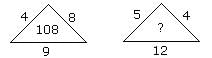
- a)80
- b)114
- c)108
- d)None of these
Correct answer is option 'C'. Can you explain this answer?
Directions: In this type of questions, a figure or a matrix is given in which some numbers are filled according to a rule. A place is left blank. You have to find out a character (a number or a letter) from the given possible answers which may be filled in the blank space.
Q. Which one will replace the question mark?
a)
80
b)
114
c)
108
d)
None of these
 | Jhanvi Banerjee answered |
From figure I (4 + 8) × 9 = 108
∴ ? = (5 + 4) × 12 = 108
∴ ? = (5 + 4) × 12 = 108
Arrange the given words in the alphabetical order and choose the one that comes last.- a)Temperature
- b)Transition
- c)Temple
- d)Transmit
Correct answer is option 'D'. Can you explain this answer?
Arrange the given words in the alphabetical order and choose the one that comes last.
a)
Temperature
b)
Transition
c)
Temple
d)
Transmit
| | Palak Nair answered |
Temperature, Temple, Transition and Transmit.
Directions: In this type of questions, a figure or a matrix is given in which some numbers are filled according to a rule. A place is left blank. You have to find out a character (a number or a letter) from the given possible answers which may be filled in the blank space.Q. Which one will replace the question mark?
- a)660
- b)670
- c)610
- d)690
Correct answer is option 'D'. Can you explain this answer?
Directions: In this type of questions, a figure or a matrix is given in which some numbers are filled according to a rule. A place is left blank. You have to find out a character (a number or a letter) from the given possible answers which may be filled in the blank space.
Q. Which one will replace the question mark?
a)
660
b)
670
c)
610
d)
690
 | Athira Desai answered |
From figure I (1)2 + (5)2 + (4)2 + (3)2
=51 × 10 = 510
and from figure II (3)2 + (4)2 + (6)2 + (2)2
= 65 × 10 = 650
Similarly, from figure III (0)2 + (1)2 + (2)2 + (8)2 = 69 × 10 = 690
=51 × 10 = 510
and from figure II (3)2 + (4)2 + (6)2 + (2)2
= 65 × 10 = 650
Similarly, from figure III (0)2 + (1)2 + (2)2 + (8)2 = 69 × 10 = 690
Directions: In this type of questions, a figure or a matrix is given in which some numbers are filled according to a rule. A place is left blank. You have to find out a character (a number or a letter) from the given possible answers which may be filled in the blank space.Q. Which one will replace the question mark?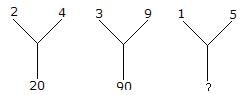
- a)20
- b)26
- c)25
- d)75
Correct answer is option 'B'. Can you explain this answer?
Directions: In this type of questions, a figure or a matrix is given in which some numbers are filled according to a rule. A place is left blank. You have to find out a character (a number or a letter) from the given possible answers which may be filled in the blank space.
Q. Which one will replace the question mark?
a)
20
b)
26
c)
25
d)
75
| | Athira Desai answered |
(2)2 + (4)2 = 20
(3)2 + (9)2 = 90
Therefore, ? = (1)2 + (5)2 = 26
(3)2 + (9)2 = 90
Therefore, ? = (1)2 + (5)2 = 26
If in a single line, Mohan is 23rd from both the ends. How many boys are there in the class?- a)44
- b)45
- c)46
- d)47
Correct answer is option 'B'. Can you explain this answer?
If in a single line, Mohan is 23rd from both the ends. How many boys are there in the class?
a)
44
b)
45
c)
46
d)
47
 | Raj Mukherjee answered |
Required no. of boys = 22 + 1 + 22 = 45
Directions: In this type of questions, a figure or a matrix is given in which some numbers are filled according to a rule. A place is left blank. You have to find out a character (a number or a letter) from the given possible answers which may be filled in the blank space.Q. Which one will replace the question mark?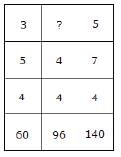
- a)4
- b)6
- c)9
- d)8
Correct answer is option 'B'. Can you explain this answer?
Directions: In this type of questions, a figure or a matrix is given in which some numbers are filled according to a rule. A place is left blank. You have to find out a character (a number or a letter) from the given possible answers which may be filled in the blank space.
Q. Which one will replace the question mark?
a)
4
b)
6
c)
9
d)
8
 | Moumita Kumar answered |
3 × 5 × 4 = 60
and 5 × 7 × 4 = 140
Therefore, 4 × 4 × ? = 96
⇒ ? = (96/16) = 6
and 5 × 7 × 4 = 140
Therefore, 4 × 4 × ? = 96
⇒ ? = (96/16) = 6
Directions: In this type of questions, a figure or a matrix is given in which some numbers are filled according to a rule. A place is left blank. You have to find out a character (a number or a letter) from the given possible answers which may be filled in the blank space.Q. Which one will replace the question mark?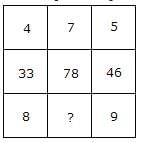
- a)12
- b)13
- c)11
- d)10
Correct answer is option 'C'. Can you explain this answer?
Directions: In this type of questions, a figure or a matrix is given in which some numbers are filled according to a rule. A place is left blank. You have to find out a character (a number or a letter) from the given possible answers which may be filled in the blank space.
Q. Which one will replace the question mark?
a)
12
b)
13
c)
11
d)
10
| | Athira Desai answered |
From column I (4 × 8) + 1 = 33
From column II (5 × 9) + 1 = 46
Similarly, from column III (7 × ?) + 1 = 78
From column II (5 × 9) + 1 = 46
Similarly, from column III (7 × ?) + 1 = 78

Directions: In this type of questions, a figure or a matrix is given in which some numbers are filled according to a rule. A place is left blank. You have to find out a character (a number or a letter) from the given possible answers which may be filled in the blank space.Q. Which one will replace the question mark?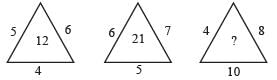
- a)14
- b)22
- c)32
- d)320
Correct answer is option 'C'. Can you explain this answer?
Directions: In this type of questions, a figure or a matrix is given in which some numbers are filled according to a rule. A place is left blank. You have to find out a character (a number or a letter) from the given possible answers which may be filled in the blank space.
Q. Which one will replace the question mark?
a)
14
b)
22
c)
32
d)
320
 | Raksha Roy answered |
From figure I (5 × 6 × 4)/10 = 12 and from figure II (6 × 7 × 5)/10 = 21 Therefore, from figure III ? = (4 × 8 × 10)/10 = 32
Directions: In this type of questions, a figure or a matrix is given in which some numbers are filled according to a rule. A place is left blank. You have to find out a character (a number or a letter) from the given possible answers which may be filled in the blank space.Q. Which one will replace the question mark?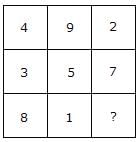
- a)9
- b)6
- c)15
- d)14
Correct answer is option 'B'. Can you explain this answer?
Directions: In this type of questions, a figure or a matrix is given in which some numbers are filled according to a rule. A place is left blank. You have to find out a character (a number or a letter) from the given possible answers which may be filled in the blank space.
Q. Which one will replace the question mark?
a)
9
b)
6
c)
15
d)
14
 | Pragati Das answered |
Here,
(4 + 9 + 2) = (3 + 5 + 7) = (8 + 1 + ?)
⇒ ? = 15 – 9 = 6
Total in each case = 15
(4 + 9 + 2) = (3 + 5 + 7) = (8 + 1 + ?)
⇒ ? = 15 – 9 = 6
Total in each case = 15
Directions: In this type of questions, a figure or a matrix is given in which some numbers are filled according to a rule. A place is left blank. You have to find out a character (a number or a letter) from the given possible answers which may be filled in the blank space.Q. Which one will replace the question mark?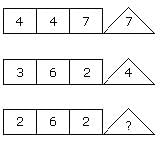
- a)2
- b)4
- c)6
- d)8
Correct answer is option 'C'. Can you explain this answer?
Directions: In this type of questions, a figure or a matrix is given in which some numbers are filled according to a rule. A place is left blank. You have to find out a character (a number or a letter) from the given possible answers which may be filled in the blank space.
Q. Which one will replace the question mark?
a)
2
b)
4
c)
6
d)
8
 | Harshad Shah answered |
(4 × 7) ÷ 4 = 7
and (6 × 2) ÷ 3 = 4
Therefore, (6 × 2) ÷ 2 = 6
and (6 × 2) ÷ 3 = 4
Therefore, (6 × 2) ÷ 2 = 6
Directions: In this type of questions, a figure or a matrix is given in which some numbers are filled according to a rule. A place is left blank. You have to find out a character (a number or a letter) from the given possible answers which may be filled in the blank space.Q. Which one will replace the question mark?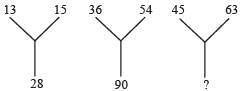
- a)18
- b)90
- c)108
- d)28
Correct answer is option 'C'. Can you explain this answer?
Directions: In this type of questions, a figure or a matrix is given in which some numbers are filled according to a rule. A place is left blank. You have to find out a character (a number or a letter) from the given possible answers which may be filled in the blank space.
Q. Which one will replace the question mark?
a)
18
b)
90
c)
108
d)
28
 | Srishti Menon answered |
From figure I 13 + 15 = 28
From figure II 36 + 54 = 90
Therefore, from figure III 45 + 63 = 108
From figure II 36 + 54 = 90
Therefore, from figure III 45 + 63 = 108

Ranjan ranks 18th in a class of 49 students. What is his rank from last?- a)28
- b)29
- c)31
- d)32
Correct answer is option 'D'. Can you explain this answer?
Ranjan ranks 18th in a class of 49 students. What is his rank from last?
a)
28
b)
29
c)
31
d)
32
| | Rahul Mehra answered |
Here, 49 – 18 = 31
So, Ranjan’s rank = 31 + 1 = 32nd form the last.
So, Ranjan’s rank = 31 + 1 = 32nd form the last.
In a row of boys Raja is 10th from the left and Pramod, who is 9th from the right interchange their positions, Raja becomes 15th from the left. How many boys are there in the row?- a)23
- b)24
- c)25
- d)26
Correct answer is option 'A'. Can you explain this answer?
In a row of boys Raja is 10th from the left and Pramod, who is 9th from the right interchange their positions, Raja becomes 15th from the left. How many boys are there in the row?
a)
23
b)
24
c)
25
d)
26
 | Nitin Iyer answered |
Raja’s new position is 15th from the left and this is the same as 9th position from the right for Pramod.
No. of boys = 15 + 9 – 1 = 23
No. of boys = 15 + 9 – 1 = 23


Directions: In this type of questions, a figure or a matrix is given in which some numbers are filled according to a rule. A place is left blank. You have to find out a character (a number or a letter) from the given possible answers which may be filled in the blank space.Q. Which one will replace the question mark?
- a)25
- b)625
- c)125
- d)50
Correct answer is option 'C'. Can you explain this answer?
Directions: In this type of questions, a figure or a matrix is given in which some numbers are filled according to a rule. A place is left blank. You have to find out a character (a number or a letter) from the given possible answers which may be filled in the blank space.
Q. Which one will replace the question mark?
a)
25
b)
625
c)
125
d)
50
 | Moumita Desai answered |
All numbers are cubes,
(7)3 = 343
(1)3 = 1
(3)3 = 27
Similarly, ? = (5)3 = 125
(7)3 = 343
(1)3 = 1
(3)3 = 27
Similarly, ? = (5)3 = 125
Chapter doubts & questions for Alpha-Numeric Sequence Puzzle - Science Olympiad Class 8 2026 is part of Class 8 exam preparation. The chapters have been prepared according to the Class 8 exam syllabus. The Chapter doubts & questions, notes, tests & MCQs are made for Class 8 2026 Exam. Find important definitions, questions, notes, meanings, examples, exercises, MCQs and online tests here.
Chapter doubts & questions of Alpha-Numeric Sequence Puzzle - Science Olympiad Class 8 in English & Hindi are available as part of Class 8 exam. Download more important topics, notes, lectures and mock test series for Class 8 Exam by signing up for free.
Science Olympiad Class 865 videos|122 docs|67 tests |
