


All Exams > NEET > Biology Class 11 > All Questions
All questions of Neural Control and Coordination for NEET Exam
If the corpus callosum is removed in mammalian brain then what will be affected :-- a)Coordination of Cerebrum
- b)Involuntary activity of brain
- c)Coordination of Cerebellum
- d)Behaviour and emotional disturbances
Correct answer is option 'A'. Can you explain this answer?
If the corpus callosum is removed in mammalian brain then what will be affected :-
a)
Coordination of Cerebrum
b)
Involuntary activity of brain
c)
Coordination of Cerebellum
d)
Behaviour and emotional disturbances
| | Kadambala Hemalatha answered |
Option A is correct becose, corpus callosam is trancverce connection between two cerebral hemisphears.. it helps in coordination between the two cerebral hemisphears..

The most abundant intracellular cation is : [NEET 2013]- a)Ca++
- b)H+
- c)K+
- d)Na+
Correct answer is option 'C'. Can you explain this answer?
The most abundant intracellular cation is : [NEET 2013]
a)
Ca++
b)
H+
c)
K+
d)
Na+
 | Shalini Saha answered |
The most abundant intracellular cation is K+.
Brain stem is the support system of brain and is the collective name for :- a)Medulla, Pons,and Midbrain
- b)Hypothalamus, Diencephalon, Cerebellum, and Pons
- c)Cerebrum, Mesencephalon, Diencephalon, and Medulla
- d)Prosencephalon, Mesencephalon, Pons, and Medulla
Correct answer is option 'A'. Can you explain this answer?
Brain stem is the support system of brain and is the collective name for :
a)
Medulla, Pons,and Midbrain
b)
Hypothalamus, Diencephalon, Cerebellum, and Pons
c)
Cerebrum, Mesencephalon, Diencephalon, and Medulla
d)
Prosencephalon, Mesencephalon, Pons, and Medulla
 | Pritam Choudhary answered |
Brainstem: The Support System of Brain
The brainstem is the lower part of the brain that connects the brain to the spinal cord. It is responsible for regulating important functions such as breathing, heart rate, blood pressure, and consciousness. The brainstem consists of three main parts, which are:
Medulla
The medulla oblongata, or simply the medulla, is the lowest part of the brainstem. It controls involuntary functions such as breathing, heartbeat, and digestion. The medulla also contains reflex centers for coughing, sneezing, and vomiting.
Pons
The pons is the middle part of the brainstem, located above the medulla and below the midbrain. It is involved in the regulation of sleep, respiration, and posture. The pons also helps to relay messages between different parts of the brain.
Midbrain
The midbrain, also known as the mesencephalon, is the uppermost part of the brainstem. It is involved in the regulation of vision, hearing, and movement. The midbrain contains several important structures, including the substantia nigra, which produces dopamine and is involved in the control of movement.
Conclusion
In conclusion, the brainstem is the support system of the brain and is responsible for regulating vital functions. It consists of three main parts, which are the medulla, pons, and midbrain. The medulla controls involuntary functions such as breathing and heartbeat, the pons is involved in the regulation of sleep and posture, and the midbrain is responsible for vision, hearing, and movement.
The brainstem is the lower part of the brain that connects the brain to the spinal cord. It is responsible for regulating important functions such as breathing, heart rate, blood pressure, and consciousness. The brainstem consists of three main parts, which are:
Medulla
The medulla oblongata, or simply the medulla, is the lowest part of the brainstem. It controls involuntary functions such as breathing, heartbeat, and digestion. The medulla also contains reflex centers for coughing, sneezing, and vomiting.
Pons
The pons is the middle part of the brainstem, located above the medulla and below the midbrain. It is involved in the regulation of sleep, respiration, and posture. The pons also helps to relay messages between different parts of the brain.
Midbrain
The midbrain, also known as the mesencephalon, is the uppermost part of the brainstem. It is involved in the regulation of vision, hearing, and movement. The midbrain contains several important structures, including the substantia nigra, which produces dopamine and is involved in the control of movement.
Conclusion
In conclusion, the brainstem is the support system of the brain and is responsible for regulating vital functions. It consists of three main parts, which are the medulla, pons, and midbrain. The medulla controls involuntary functions such as breathing and heartbeat, the pons is involved in the regulation of sleep and posture, and the midbrain is responsible for vision, hearing, and movement.
Injury localised to the hypothalamus would most likely disrupt- a)short term memory
- b)coordination during locomotion
- c)executive function, such as decision making
- d)regulation of body temperature
Correct answer is option 'D'. Can you explain this answer?
Injury localised to the hypothalamus would most likely disrupt
a)
short term memory
b)
coordination during locomotion
c)
executive function, such as decision making
d)
regulation of body temperature
 | Aman Sharma answered |
The primary function of the hypothalamus is homoeostasis, which is to maintain the body's normal temperature and body's status. So, if there is an injury to the hypothalamus, the thermoregulatory centre is disturbed resulting in a deregulation of body temperature. So, the correct answer is option D.
During the transmission of nerve impulse through a nerve fibre, the potential on the inner side of the plasma membrane has which type of electric change? [2007]- a)First positive, then negative and continue to be positive
- b)First negative, then positive and continue to be positive.
- c)First positive, then negative and again back to positive
- d)First negative, then positive and again back to negative
Correct answer is option 'D'. Can you explain this answer?
During the transmission of nerve impulse through a nerve fibre, the potential on the inner side of the plasma membrane has which type of electric change? [2007]
a)
First positive, then negative and continue to be positive
b)
First negative, then positive and continue to be positive.
c)
First positive, then negative and again back to positive
d)
First negative, then positive and again back to negative
 | Muskaan Basak answered |
Once the events of depolarization have occurred, a nerve impulse or spike is initiated. Action potential is another name of nerve impulse. It lasts about 1 msec (millisecond). The stimulalted, negatively charged point on the outside of the membrane sends out an electrical current to the positive point (still polarized adjacent to it). This local current causes the adjacent inner part of the membrane to reverse its potential from –70 mV to +30 mV. The reversal repeats itself over and over until the nerve impulse is conducted through the length of the neuron
What is meant by coordination?- a)Only two organs interact
- b)Two or more organs interact
- c)Only two organs systems interact
- d)Only three organs interact
Correct answer is option 'B'. Can you explain this answer?
What is meant by coordination?
a)
Only two organs interact
b)
Two or more organs interact
c)
Only two organs systems interact
d)
Only three organs interact
 | EduRev NEET answered |
Coordination is the process through which two or more organs interact and complement the functions of one another. For example, the functions of muscles, lungs, heart, blood vessels, kidney, and other organs are coordinated while performing physical exercises.
Topic in NCERT: NEURAL CONTROL AND COORDINATIONLine in NCERT: "Coordination is the process through which two or more organs interact and complement the functions of one another."
The membrane which cover the brain and the spinal cord is :-- a)White matter
- b)Grey matter
- c)Peritonium
- d)Meninges
Correct answer is option 'D'. Can you explain this answer?
The membrane which cover the brain and the spinal cord is :-
a)
White matter
b)
Grey matter
c)
Peritonium
d)
Meninges
 | Ruchi Chakraborty answered |
Meninges are the membranes that cover and protect the brain and spinal cord. There are three layers of meanings: dura mater (closest to the bone), arachnoid (loosely around the brain), pia mater (closely attached to the brain and spinal cord surface).
Which of the following is a richly vascular layer with lots of blood capillaries :-- a)Duramater
- b)Piamater
- c)Epidermis of skin
- d)Both (1) & (2)
Correct answer is option 'B'. Can you explain this answer?
Which of the following is a richly vascular layer with lots of blood capillaries :-
a)
Duramater
b)
Piamater
c)
Epidermis of skin
d)
Both (1) & (2)
 | Riya Banerjee answered |
The pia mater of the brain is the innermost of the three membranes, that cover it. It is the vascular membrane of the brain. It carries the minute branches of the two internal carotids and the two vertebral arteries. It also returns the blood to the heart. The dura mater is the most external membrane of the brain. It forms the internal periosteum of the skull. The dura mater is a dense, tough, inelastic fibrous membrane. The epidermis contains no blood vessels, and cells in the deepest layers are nourished by diffusion from blood capillaries extending to the upper layers of the dermis. So, the correct answer is option B.
During the propagation of a nerve impulse, the action potential results from the movement of : [2008]- a)K+ ions from extracellular fluid to intracellular fluid
- b)Na+ ions from intracellular fluid to extracellular fluid
- c)K+ ions from intracellular fluid to extracellular fluid
- d)Na+ ions from extracellular fluid to intracellular fluid
Correct answer is option 'D'. Can you explain this answer?
During the propagation of a nerve impulse, the action potential results from the movement of : [2008]
a)
K+ ions from extracellular fluid to intracellular fluid
b)
Na+ ions from intracellular fluid to extracellular fluid
c)
K+ ions from intracellular fluid to extracellular fluid
d)
Na+ ions from extracellular fluid to intracellular fluid
 | Anjana Dasgupta answered |
Total sum of physio-electrochemical changes that takes place along the length of nerve fibre is known as nerve impulse. Change in potential due to stimulation of nerve fibre is called action potential. During propagation of nerve impulse, Na⁺ enters inside so(+ve) change is formed inside the membrane. K⁺ ions come out.
The function of an axon is :-- a)Transformation of nerve impulse
- b)Reception of stimuli from neurons
- c)Reception of external stimuli
- d)Conduction of nerve impulse
Correct answer is option 'D'. Can you explain this answer?
The function of an axon is :-
a)
Transformation of nerve impulse
b)
Reception of stimuli from neurons
c)
Reception of external stimuli
d)
Conduction of nerve impulse
| | Sethulakshmi E.d Dinesan answered |
Axon transmit impulses away from cellbody to a synapse or to a neuro muscular junction.(11th ncert page no 317 .5th line)
The Schwann sheath is :-- a)A non myelinated nerve fibres
- b)Associated with myelin sheath
- c)A connective tissue cell
- d)Associated with myelinated & non myelinated nerve fibre
Correct answer is option 'D'. Can you explain this answer?
The Schwann sheath is :-
a)
A non myelinated nerve fibres
b)
Associated with myelin sheath
c)
A connective tissue cell
d)
Associated with myelinated & non myelinated nerve fibre
| | Rohan Singh answered |
Neurilemma (also known as neurolemma, sheath of Schwann, or Schwann's sheath) is the outermost nucleated cytoplasmic layer of Schwann cells (also called neurilemmocytes) that surrounds the axon of the neuron. It forms the outermost layer of the nerve fiber in the peripheral nervous system.
Corpus callosum connects :-- a)Two cerebral hemisphere
- b)Two optic lobes
- c)Two olfactory lobes
- d)Optic chiasma
Correct answer is option 'A'. Can you explain this answer?
Corpus callosum connects :-
a)
Two cerebral hemisphere
b)
Two optic lobes
c)
Two olfactory lobes
d)
Optic chiasma
 | Anjali Iyer answered |
The part of the brain that connects the two hemispheres of the brain is called the corpus callosum. It contains a bundle of neuronal fibers found in humans and other higher order mammals that allow the two hemispheres to talk to one another.
The………. difference across the resting membrane is called as Resting potential.- a)Electrochemical potential
- b)Electrical potential
- c)Chemical
- d)Chemiosmotic
Correct answer is option 'B'. Can you explain this answer?
The………. difference across the resting membrane is called as Resting potential.
a)
Electrochemical potential
b)
Electrical potential
c)
Chemical
d)
Chemiosmotic
| | Harshitha Chakraborty answered |
Understanding Resting Potential
The resting potential refers to the electrical charge difference across the neuronal membrane when a neuron is not actively firing an action potential. This potential is crucial for the transmission of signals in the nervous system.
Key Concepts of Resting Potential
- Electrochemical Gradient:
- The difference in concentration of ions (like Na+ and K+) across the membrane creates an electrochemical gradient.
- This gradient is essential for maintaining the resting potential.
- Electrical Potential:
- The term "electrical potential" specifically refers to the voltage difference across a membrane.
- In a resting neuron, this electrical potential typically ranges from -70 to -90 mV.
- Importance of Ions:
- Potassium ions (K+) are more concentrated inside the cell, while sodium ions (Na+) are more concentrated outside.
- The selective permeability of the membrane to K+ contributes significantly to the resting potential.
- Membrane Channels:
- Ion channels, particularly potassium channels, allow K+ to exit the cell more freely, leading to a negative charge inside the cell compared to the outside.
Conclusion
The correct answer is "B) Electrical potential" as it directly describes the voltage difference across the neuronal membrane during the resting state. Understanding this concept is pivotal for grasping how neurons communicate and respond to stimuli, forming the basis for further studies in neurobiology and physiology.
The resting potential refers to the electrical charge difference across the neuronal membrane when a neuron is not actively firing an action potential. This potential is crucial for the transmission of signals in the nervous system.
Key Concepts of Resting Potential
- Electrochemical Gradient:
- The difference in concentration of ions (like Na+ and K+) across the membrane creates an electrochemical gradient.
- This gradient is essential for maintaining the resting potential.
- Electrical Potential:
- The term "electrical potential" specifically refers to the voltage difference across a membrane.
- In a resting neuron, this electrical potential typically ranges from -70 to -90 mV.
- Importance of Ions:
- Potassium ions (K+) are more concentrated inside the cell, while sodium ions (Na+) are more concentrated outside.
- The selective permeability of the membrane to K+ contributes significantly to the resting potential.
- Membrane Channels:
- Ion channels, particularly potassium channels, allow K+ to exit the cell more freely, leading to a negative charge inside the cell compared to the outside.
Conclusion
The correct answer is "B) Electrical potential" as it directly describes the voltage difference across the neuronal membrane during the resting state. Understanding this concept is pivotal for grasping how neurons communicate and respond to stimuli, forming the basis for further studies in neurobiology and physiology.
Where are the myelinated neurons found?- a)In Spinal cord and cranial nerves
- b)Only in the embryonic condition
- c)In peripheral nerve
- d)In motor neurons
Correct answer is option 'A'. Can you explain this answer?
Where are the myelinated neurons found?
a)
In Spinal cord and cranial nerves
b)
Only in the embryonic condition
c)
In peripheral nerve
d)
In motor neurons
 | Ambition Institute answered |
Myelinated nerve fibres are found in spinal and cranial nerves. Unmyelinated nerve fibres are enclosed by a Schwann cell that does not form a myelin sheath around the axon and is commonly found in autonomous and the somatic neural system.
Which of the following statements is incorrect regarding electrical synapses?- a)Transmission of signals is faster than chemical synapses
- b)Pre and postsynaptic membranes are in very close proximity
- c) Electrical synapse can flow directly from one neuron to another
- d)They are very common in our system
Correct answer is option 'D'. Can you explain this answer?
Which of the following statements is incorrect regarding electrical synapses?
a)
Transmission of signals is faster than chemical synapses
b)
Pre and postsynaptic membranes are in very close proximity
c)
Electrical synapse can flow directly from one neuron to another
d)
They are very common in our system
 | Mohit Rajpoot answered |
Electrical synapses are very rare in our system. At electrical synapses, the membranes of pre and post synaptic neurons are in very close proximity. Impulse transmission across an electrical synapse is always faster than chemical synapse.
Topic in NCERT: Transmission of ImpulsesLine in NCERT: "Electrical synapses are rare in our system."
In the human neural system, the coordination between different organ systems is essential for maintaining homeostasis during physical activities.
Which of the following statements best explains the roles of the central nervous system (CNS) and the peripheral nervous system (PNS) during intense physical exercise?- a)The PNS coordinates all involuntary actions during physical exercise, including the regulation of skeletal muscles, heart rate, and respiration, while the CNS only provides feedback through the sympathetic and parasympathetic systems without direct control of the muscles
- b)The CNS exclusively controls the skeletal muscles through the somatic neural system, while the PNS regulates the automatic functions of the heart and lungs through the autonomic system, without requiring feedback to the CNS.
- c)The CNS coordinates the entire response to exercise by transmitting efferent signals to skeletal muscles through the somatic system and to involuntary organs through the autonomic system, while the PNS transmits feedback only from the muscles, excluding heart and lung responses.
- d) The CNS processes sensory information from the muscles and organs, and sends efferent impulses via the PNS to regulate heart rate and muscle contraction, while the PNS carries afferent impulses from the lungs and heart to the CNS for feedback.
Correct answer is option 'D'. Can you explain this answer?
In the human neural system, the coordination between different organ systems is essential for maintaining homeostasis during physical activities.
Which of the following statements best explains the roles of the central nervous system (CNS) and the peripheral nervous system (PNS) during intense physical exercise?
Which of the following statements best explains the roles of the central nervous system (CNS) and the peripheral nervous system (PNS) during intense physical exercise?
a)
The PNS coordinates all involuntary actions during physical exercise, including the regulation of skeletal muscles, heart rate, and respiration, while the CNS only provides feedback through the sympathetic and parasympathetic systems without direct control of the muscles
b)
The CNS exclusively controls the skeletal muscles through the somatic neural system, while the PNS regulates the automatic functions of the heart and lungs through the autonomic system, without requiring feedback to the CNS.
c)
The CNS coordinates the entire response to exercise by transmitting efferent signals to skeletal muscles through the somatic system and to involuntary organs through the autonomic system, while the PNS transmits feedback only from the muscles, excluding heart and lung responses.
d)
The CNS processes sensory information from the muscles and organs, and sends efferent impulses via the PNS to regulate heart rate and muscle contraction, while the PNS carries afferent impulses from the lungs and heart to the CNS for feedback.
 | Jithin Unni answered |
Understanding the Role of CNS and PNS in Physical Exercise
During intense physical exercise, the coordination between the central nervous system (CNS) and peripheral nervous system (PNS) is vital for maintaining homeostasis and ensuring efficient body function.
Functions of the CNS
- The CNS is responsible for processing sensory information from various sources, including muscles and organs.
- It generates appropriate motor responses by sending efferent impulses to skeletal muscles, facilitating movement.
- The CNS integrates feedback from the body to adjust physiological responses during exercise, ensuring that the body can meet the demands of physical activity.
Functions of the PNS
- The PNS serves as a communication network between the CNS and the rest of the body.
- It transmits afferent impulses from the organs (like the heart and lungs) back to the CNS, providing critical feedback on the body’s state during exercise.
- The PNS also carries efferent signals to involuntary organs, regulating heart rate and respiration, which are crucial for sustaining energy levels and oxygen supply during intense workouts.
Coordination for Homeostasis
- Together, the CNS and PNS work synergistically to maintain homeostasis during physical exertion.
- The CNS processes information and adjusts body functions, while the PNS ensures that feedback loops function effectively, allowing for real-time adjustments to heart rate and muscle contractions.
In summary, option D accurately describes how the CNS and PNS collaborate to manage the body’s response to exercise, ensuring that both voluntary and involuntary functions are well-coordinated for optimal performance and safety.
During intense physical exercise, the coordination between the central nervous system (CNS) and peripheral nervous system (PNS) is vital for maintaining homeostasis and ensuring efficient body function.
Functions of the CNS
- The CNS is responsible for processing sensory information from various sources, including muscles and organs.
- It generates appropriate motor responses by sending efferent impulses to skeletal muscles, facilitating movement.
- The CNS integrates feedback from the body to adjust physiological responses during exercise, ensuring that the body can meet the demands of physical activity.
Functions of the PNS
- The PNS serves as a communication network between the CNS and the rest of the body.
- It transmits afferent impulses from the organs (like the heart and lungs) back to the CNS, providing critical feedback on the body’s state during exercise.
- The PNS also carries efferent signals to involuntary organs, regulating heart rate and respiration, which are crucial for sustaining energy levels and oxygen supply during intense workouts.
Coordination for Homeostasis
- Together, the CNS and PNS work synergistically to maintain homeostasis during physical exertion.
- The CNS processes information and adjusts body functions, while the PNS ensures that feedback loops function effectively, allowing for real-time adjustments to heart rate and muscle contractions.
In summary, option D accurately describes how the CNS and PNS collaborate to manage the body’s response to exercise, ensuring that both voluntary and involuntary functions are well-coordinated for optimal performance and safety.
Read the following statements and mark the correct option which is suitable.- The neural system of animals is composed of specialized cells called neurons.
- The central neural system (CNS) consists of the brain and spinal cord.
- The peripheral nervous system (PNS) is involved in transmitting impulses only from the CNS to muscles.
- The autonomic neural system controls voluntary actions like skeletal muscle movement.
- a)Statements 1, 2, and 4 are correct.
- b)Statements 1, 2, and 3 are correct.
- c) Statements 1 and 2 are correct, while 3 and 4 are incorrect.
- d)All statements are correct.
Correct answer is option 'C'. Can you explain this answer?
Read the following statements and mark the correct option which is suitable.
- The neural system of animals is composed of specialized cells called neurons.
- The central neural system (CNS) consists of the brain and spinal cord.
- The peripheral nervous system (PNS) is involved in transmitting impulses only from the CNS to muscles.
- The autonomic neural system controls voluntary actions like skeletal muscle movement.
a)
Statements 1, 2, and 4 are correct.
b)
Statements 1, 2, and 3 are correct.
c)
Statements 1 and 2 are correct, while 3 and 4 are incorrect.
d)
All statements are correct.
 | Stepway Academy answered |
Statements 1 and 2 are correct. Statement 3 is incorrect because the PNS transmits impulses both to and from the CNS, and statement 4 is incorrect because the autonomic system controls involuntary actions.
Topic in NCERT: HUMAN NEURAL SYSTEM
Line in NCERT: "The human neural system is divided into two parts: (i) the central neural system (CNS) (ii) the peripheral neural system (PNS). The CNS includes the brain and the spinal cord and is the site of information processing and control." "The PNS is divided into two divisions called somatic neural system and autonomic neural system. The somatic neural system relays impulses from the CNS to skeletal muscles while the autonomic neural system transmits impulses from the CNS to the involuntary organs and smooth muscles of the body."
Topic in NCERT: HUMAN NEURAL SYSTEM
Line in NCERT: "The human neural system is divided into two parts: (i) the central neural system (CNS) (ii) the peripheral neural system (PNS). The CNS includes the brain and the spinal cord and is the site of information processing and control." "The PNS is divided into two divisions called somatic neural system and autonomic neural system. The somatic neural system relays impulses from the CNS to skeletal muscles while the autonomic neural system transmits impulses from the CNS to the involuntary organs and smooth muscles of the body."
During the propagation of a nerve impulse, the action potential results from the movement of- a)K+ ions from intracellular fluid to extracellular fluid
- b)Na+ ions from extracellular fluid to intracellular fluid
- c)K+ ions from extracellular fluid to intracellular fluid
- d)Na+ ions from intracellular fluid to extracellular fluid
Correct answer is option 'B'. Can you explain this answer?
During the propagation of a nerve impulse, the action potential results from the movement of
a)
K+ ions from intracellular fluid to extracellular fluid
b)
Na+ ions from extracellular fluid to intracellular fluid
c)
K+ ions from extracellular fluid to intracellular fluid
d)
Na+ ions from intracellular fluid to extracellular fluid
 | Vivek Patel answered |
Action potential is a change in electrical potential that occurs across a plasma membrane during the passage of a nerve impulse. During this period, there is a localized and translent switch in electric potential across the membrane from -70 mV to +45 mV. It is due to the fact that the sodium channels open and the potassium channels remain closed. As a result, sodium channels permit the influx of Na+ by diffusion from extracellular fluid to intracellular fluid.
Where is the midbrain located?- a)Between hypothalamus and pons
- b)Between cerebrum and hypothalamus
- c)Between cerebellum and medulla
- d)Between pons and medulla
Correct answer is option 'A'. Can you explain this answer?
Where is the midbrain located?
a)
Between hypothalamus and pons
b)
Between cerebrum and hypothalamus
c)
Between cerebellum and medulla
d)
Between pons and medulla
 | Top Rankers answered |
The midbrain is located between the hypothalamus of the forebrain and the pons of the hindbrain. The midbrain is also known as the mesencephalon and controls several motor movements.
Assertion: The somatic neural system regulates involuntary functions of the body.
Reason: The somatic neural system is divided into the sympathetic and parasympathetic systems.- a)Both Assertion and Reason are correct, and Reason is the correct explanation of Assertion.
- b)Both Assertion and Reason are correct, but Reason is not the correct explanation of Assertion.
- c)Assertion is correct, but Reason is incorrect.
- d)Both Assertion and Reason are incorrect
Correct answer is option 'D'. Can you explain this answer?
Assertion: The somatic neural system regulates involuntary functions of the body.
Reason: The somatic neural system is divided into the sympathetic and parasympathetic systems.
Reason: The somatic neural system is divided into the sympathetic and parasympathetic systems.
a)
Both Assertion and Reason are correct, and Reason is the correct explanation of Assertion.
b)
Both Assertion and Reason are correct, but Reason is not the correct explanation of Assertion.
c)
Assertion is correct, but Reason is incorrect.
d)
Both Assertion and Reason are incorrect
 | Maitri Deshpande answered |
Understanding the Somatic Neural System
The assertion and reason provided in the question relate to the functions of the somatic and autonomic nervous systems.
Assertion Explained
- The somatic neural system primarily controls voluntary functions.
- It is responsible for movements of skeletal muscles, allowing conscious control over these actions.
Reason Clarification
- The somatic neural system is not divided into sympathetic and parasympathetic systems.
- Instead, these divisions belong to the autonomic nervous system, which regulates involuntary functions such as heart rate, digestion, and respiratory rate.
Correctness of Assertion and Reason
- The assertion is incorrect because it states that the somatic neural system regulates involuntary functions, which is not true.
- The reason is also incorrect because it misidentifies the components of the nervous system.
Conclusion
Given that both the assertion and reason are incorrect, the answer to the question is option 'D':
- Both Assertion and Reason are incorrect.
This understanding is crucial for students preparing for exams like NEET, as it highlights the distinctions between the somatic and autonomic nervous systems.
The assertion and reason provided in the question relate to the functions of the somatic and autonomic nervous systems.
Assertion Explained
- The somatic neural system primarily controls voluntary functions.
- It is responsible for movements of skeletal muscles, allowing conscious control over these actions.
Reason Clarification
- The somatic neural system is not divided into sympathetic and parasympathetic systems.
- Instead, these divisions belong to the autonomic nervous system, which regulates involuntary functions such as heart rate, digestion, and respiratory rate.
Correctness of Assertion and Reason
- The assertion is incorrect because it states that the somatic neural system regulates involuntary functions, which is not true.
- The reason is also incorrect because it misidentifies the components of the nervous system.
Conclusion
Given that both the assertion and reason are incorrect, the answer to the question is option 'D':
- Both Assertion and Reason are incorrect.
This understanding is crucial for students preparing for exams like NEET, as it highlights the distinctions between the somatic and autonomic nervous systems.
What does each branch of axon terminate into?- a)Another cell
- b)Vesicles
- c)Tubules
- d)Synaptic knob
Correct answer is option 'D'. Can you explain this answer?
What does each branch of axon terminate into?
a)
Another cell
b)
Vesicles
c)
Tubules
d)
Synaptic knob
 | Infinity Academy answered |
Each branch of an axon terminates into a synaptic knob. The axon is a long fibre which is branched at the end. Each branch terminates as a bulb-like structure called a synaptic knob. These knobs consist of some synaptic vesicles which contain some neurotransmitters like acetylcholine.
Topic in NCERT: Neuron as Structural and Functional Unit of Neural SystemLine in NCERT: "Each branch terminates as a bulb-like structure called synaptic knob which possess synaptic vesicles containing chemicals called neurotransmitters."
The rise in stimulus-induced permeability to
a. Potassium ions
b. Sodium ions
c. Restoring RMP
d. Diffusion of potassium ionsArrange them in order.- a)b-a-c-d
- b)a-b-c-d
- c)b-a-d-c
- d)c-a-d-b
Correct answer is option 'C'. Can you explain this answer?
The rise in stimulus-induced permeability to
a. Potassium ions
b. Sodium ions
c. Restoring RMP
d. Diffusion of potassium ions
a. Potassium ions
b. Sodium ions
c. Restoring RMP
d. Diffusion of potassium ions
Arrange them in order.
a)
b-a-c-d
b)
a-b-c-d
c)
b-a-d-c
d)
c-a-d-b
 | Ciel Knowledge answered |
The electrical potential difference across the resting plasma membrane is called as the resting potential.The rise in the stimulus-induced permeability to Na+ is extremely shortlived. It is quickly followed by a rise in permeability to K+. Within a fraction of a second, K+ diffuses outside the membrane and restores the resting potential of the membrane at the site of excitation and the fibre becomes once more responsive to further stimulation.
Topic in NCERT: Generation and Conduction of Nerve ImpulseLine in NCERT: "The rise in the stimulus-induced permeability to Na* is extremely short-lived. It is quickly followed by a rise in permeability to K*. Within a fraction of a second, K+ diffuses outside the membrane and restores the resting potential of the membrane at the site of excitation and the fibre becomes once more responsive to further stimulation."
Where are the specific receptors of neurotransmitters present?- a)Synaptic cleft
- b)Post-synaptic membrane
- c)Pre-synaptic membrane
- d)Synaptic vesicle
Correct answer is option 'B'. Can you explain this answer?
Where are the specific receptors of neurotransmitters present?
a)
Synaptic cleft
b)
Post-synaptic membrane
c)
Pre-synaptic membrane
d)
Synaptic vesicle
 | Lead Academy answered |
The released neurotransmitters bind to their specific receptors which are present on the post-synaptic membrane. The new potential developed may be either excitatory or inhibitory.
Which neural system is responsible for transmitting impulses to skeletal muscles?- a)Autonomic neural system
- b) Central neural system
- c)Somatic neural system
- d)Peripheral neural system
Correct answer is option 'C'. Can you explain this answer?
Which neural system is responsible for transmitting impulses to skeletal muscles?
a)
Autonomic neural system
b)
Central neural system
c)
Somatic neural system
d)
Peripheral neural system
 | Rajveer Patel answered |
Understanding the Somatic Neural System
The somatic neural system plays a crucial role in controlling voluntary movements by transmitting impulses to skeletal muscles. Here's a deeper look into this system:
Function of the Somatic Neural System
- The somatic nervous system is responsible for carrying sensory and motor information to and from the central nervous system (CNS).
- It governs voluntary control over skeletal muscles, enabling movements such as walking, writing, and speaking.
Components of the Somatic Neural System
- Motor Neurons: These neurons originate in the CNS and extend out to skeletal muscles, where they release neurotransmitters to facilitate muscle contraction.
- Sensory Neurons: They relay information from sensory receptors (like touch, pain, and temperature) back to the CNS, helping to coordinate movements.
Comparison with Other Neural Systems
- Autonomic Neural System: This system controls involuntary actions, such as heart rate and digestion, and does not involve skeletal muscle.
- Central Neural System: Comprises the brain and spinal cord but does not directly transmit impulses to muscles.
- Peripheral Neural System: Encompasses both the somatic and autonomic systems, but the somatic specifically targets skeletal muscles.
Conclusion
In summary, the somatic neural system is integral for voluntary muscle control, making it the correct answer to the question regarding the transmission of impulses to skeletal muscles. Understanding this system is essential for grasping how movements are coordinated in the human body, particularly in contexts such as NEET preparation.
The somatic neural system plays a crucial role in controlling voluntary movements by transmitting impulses to skeletal muscles. Here's a deeper look into this system:
Function of the Somatic Neural System
- The somatic nervous system is responsible for carrying sensory and motor information to and from the central nervous system (CNS).
- It governs voluntary control over skeletal muscles, enabling movements such as walking, writing, and speaking.
Components of the Somatic Neural System
- Motor Neurons: These neurons originate in the CNS and extend out to skeletal muscles, where they release neurotransmitters to facilitate muscle contraction.
- Sensory Neurons: They relay information from sensory receptors (like touch, pain, and temperature) back to the CNS, helping to coordinate movements.
Comparison with Other Neural Systems
- Autonomic Neural System: This system controls involuntary actions, such as heart rate and digestion, and does not involve skeletal muscle.
- Central Neural System: Comprises the brain and spinal cord but does not directly transmit impulses to muscles.
- Peripheral Neural System: Encompasses both the somatic and autonomic systems, but the somatic specifically targets skeletal muscles.
Conclusion
In summary, the somatic neural system is integral for voluntary muscle control, making it the correct answer to the question regarding the transmission of impulses to skeletal muscles. Understanding this system is essential for grasping how movements are coordinated in the human body, particularly in contexts such as NEET preparation.
Which part of the neuron is present in a high concentration in the grey matter?- a)Cell body
- b)Axon
- c)Dendrites
- d)Synaptic knobs
Correct answer is option 'A'. Can you explain this answer?
Which part of the neuron is present in a high concentration in the grey matter?
a)
Cell body
b)
Axon
c)
Dendrites
d)
Synaptic knobs
 | Imk Pathsala answered |
- The cell bodies or neurons or nerve cells are present in a high concentration in the grey matter of the brain and spinal cord.
- The axons of neurons are present in a high concentration in the white matter.
Which of the following statements is/are incorrect about the electrical synapse?
(i) At electrical synapses, the membranes of pre and post synaptic neurons are in very close proximity.
(ii) Electrical current can flow directly from one neuron into the other across the synapses
(iii) Transmission of an impulse across electrical synapses is very similar to impulse conduction along single axon
(iv) Electrica synapses pass electrical signal between cells with the use of Ach.
(v) Electrical synapses are fast.
(vi) Electrical synapses are rare in our system.- a)(ii), (iv) and (v)
- b)(i) and (iii)
- c)(iv) only
- d)(i), (v) and (vi)
Correct answer is option 'C'. Can you explain this answer?
Which of the following statements is/are incorrect about the electrical synapse?
(i) At electrical synapses, the membranes of pre and post synaptic neurons are in very close proximity.
(ii) Electrical current can flow directly from one neuron into the other across the synapses
(iii) Transmission of an impulse across electrical synapses is very similar to impulse conduction along single axon
(iv) Electrica synapses pass electrical signal between cells with the use of Ach.
(v) Electrical synapses are fast.
(vi) Electrical synapses are rare in our system.
(i) At electrical synapses, the membranes of pre and post synaptic neurons are in very close proximity.
(ii) Electrical current can flow directly from one neuron into the other across the synapses
(iii) Transmission of an impulse across electrical synapses is very similar to impulse conduction along single axon
(iv) Electrica synapses pass electrical signal between cells with the use of Ach.
(v) Electrical synapses are fast.
(vi) Electrical synapses are rare in our system.
a)
(ii), (iv) and (v)
b)
(i) and (iii)
c)
(iv) only
d)
(i), (v) and (vi)
| | Soumya Kulkarni answered |
Incorrect Statements about Electrical Synapse:
Membranes Proximity:
- Statement (i) is incorrect because at electrical synapses, the membranes of pre and post synaptic neurons are in direct contact, not just in close proximity.
Direct Current Flow:
- Statement (ii) is correct as electrical current can flow directly from one neuron into the other across the synapses.
Impulse Transmission:
- Statement (iii) is incorrect as the transmission of an impulse across electrical synapses is not similar to impulse conduction along a single axon. It is faster and more direct.
Use of Ach:
- Statement (iv) is incorrect because electrical synapses do not pass electrical signals between cells using acetylcholine (Ach) or any other neurotransmitter.
Speed of Transmission:
- Statement (v) is correct as electrical synapses are known for their fast transmission of signals between neurons.
Prevalence of Electrical Synapses:
- Statement (vi) is incorrect as electrical synapses are actually quite common in the nervous system, especially in regions where rapid signaling is essential.
Therefore, the incorrect statements about electrical synapses are (i), (iii), and (iv), making option (c) the correct choice.
Membranes Proximity:
- Statement (i) is incorrect because at electrical synapses, the membranes of pre and post synaptic neurons are in direct contact, not just in close proximity.
Direct Current Flow:
- Statement (ii) is correct as electrical current can flow directly from one neuron into the other across the synapses.
Impulse Transmission:
- Statement (iii) is incorrect as the transmission of an impulse across electrical synapses is not similar to impulse conduction along a single axon. It is faster and more direct.
Use of Ach:
- Statement (iv) is incorrect because electrical synapses do not pass electrical signals between cells using acetylcholine (Ach) or any other neurotransmitter.
Speed of Transmission:
- Statement (v) is correct as electrical synapses are known for their fast transmission of signals between neurons.
Prevalence of Electrical Synapses:
- Statement (vi) is incorrect as electrical synapses are actually quite common in the nervous system, especially in regions where rapid signaling is essential.
Therefore, the incorrect statements about electrical synapses are (i), (iii), and (iv), making option (c) the correct choice.
Read the given statements and select the correct ones.
(i) Autonomic neural system transmits impulses from the CNS to the voluntary organs and striated muscles of the body.
(ii) Unmyelinated nerve fibres do not have Schwann cells which form the myelin sheath.
(iii) Axonal membrane of a neuron while not conducting any impulse is comparatively more permeable to potassium ions (K+) than to sodium ions (Na+).
(iv) A synapse is formed by the membranes of a presynaptic neuron and a post synaptic neuron.- a)(i) and (ii)
- b)(ii) and (iii)
- c)(iii) and (iv)
- d)(i) and (iv)
Correct answer is option 'C'. Can you explain this answer?
Read the given statements and select the correct ones.
(i) Autonomic neural system transmits impulses from the CNS to the voluntary organs and striated muscles of the body.
(ii) Unmyelinated nerve fibres do not have Schwann cells which form the myelin sheath.
(iii) Axonal membrane of a neuron while not conducting any impulse is comparatively more permeable to potassium ions (K+) than to sodium ions (Na+).
(iv) A synapse is formed by the membranes of a presynaptic neuron and a post synaptic neuron.
(i) Autonomic neural system transmits impulses from the CNS to the voluntary organs and striated muscles of the body.
(ii) Unmyelinated nerve fibres do not have Schwann cells which form the myelin sheath.
(iii) Axonal membrane of a neuron while not conducting any impulse is comparatively more permeable to potassium ions (K+) than to sodium ions (Na+).
(iv) A synapse is formed by the membranes of a presynaptic neuron and a post synaptic neuron.
a)
(i) and (ii)
b)
(ii) and (iii)
c)
(iii) and (iv)
d)
(i) and (iv)
| | Anjali Sharma answered |
Autonomic neural system controls and coordinates such organs which are under involuntary control and unstriated muscles of the body. Unmyelinated nerve fibres have Schwann cells which do not form myelin sheath.
Which of the following correctly describes the role of the central nervous system (CNS)?- a)It is responsible for transmitting impulses from the organs to the brain.
- b)It processes information and controls bodily functions.
- c)It includes all the nerves outside the brain and spinal cord.
- d)It consists only of the spinal cord.
Correct answer is option 'B'. Can you explain this answer?
Which of the following correctly describes the role of the central nervous system (CNS)?
a)
It is responsible for transmitting impulses from the organs to the brain.
b)
It processes information and controls bodily functions.
c)
It includes all the nerves outside the brain and spinal cord.
d)
It consists only of the spinal cord.
| | Ambition Institute answered |
The central nervous system (CNS) is primarily responsible for processing information and regulating bodily functions. It encompasses the brain and spinal cord, serving as the main control center for all activities in the body. The CNS interprets sensory information received from the peripheral nervous system (PNS) and coordinates responses. An interesting fact is that the brain alone contains approximately 86 billion neurons, which play a crucial role in cognitive functions, movement, and sensory perception.
When a neuron is in resting state I not conducting any impulse, the axonal membrane is: [2011]- a)comparatively more permeable to Na+ ions and nearly impermeable to K+ ions
- b)equally permeable to both Na+ and K+ ions
- c)impermeable to both Na+ and K+ ions
- d)comparatively more permeable to K+ ions and nearly impermeable to Na+ ions
Correct answer is option 'D'. Can you explain this answer?
When a neuron is in resting state I not conducting any impulse, the axonal membrane is: [2011]
a)
comparatively more permeable to Na+ ions and nearly impermeable to K+ ions
b)
equally permeable to both Na+ and K+ ions
c)
impermeable to both Na+ and K+ ions
d)
comparatively more permeable to K+ ions and nearly impermeable to Na+ ions
 | Pallabi Reddy answered |
When a neurone is in resting state i.e., not conducting any impulse, the axonal membrane is comparatively more permeable to K+ ion and nearly impermeable to Na+ ions.
The box like bony structure which encloses the brain is called :-- a)Cranium
- b)Pericardium
- c)Peritoneum
- d)Periosteum
Correct answer is option 'A'. Can you explain this answer?
The box like bony structure which encloses the brain is called :-
a)
Cranium
b)
Pericardium
c)
Peritoneum
d)
Periosteum
 | Ramesh Chand answered |
The box enclosing and protecting the brain is called as the cranium . The cranium is the part of the skull, that encloses the brain. Therefore option A is the correct answer.
Cerebellum is concerned with :-- a)Co-ordination of muscular movement
- b)Memory
- c)Vision
- d)Reflex action
Correct answer is option 'A'. Can you explain this answer?
Cerebellum is concerned with :-
a)
Co-ordination of muscular movement
b)
Memory
c)
Vision
d)
Reflex action
| | Sanjana Singh answered |
Cerebellum is a part of the brain and is responsible for motor control which includes muscle movement , equilibrium and balance as it relates to movement .
So 'a' is correct.
So 'a' is correct.
Which structure connects the two hemispheres of the cerebrum?- a)Thalamus
- b)Hypothalamus
- c)Limbic system
- d) Corpus callosum
Correct answer is option 'D'. Can you explain this answer?
Which structure connects the two hemispheres of the cerebrum?
a)
Thalamus
b)
Hypothalamus
c)
Limbic system
d)
Corpus callosum
 | Debanshi Pillai answered |
Connection Between Hemispheres
The structure that connects the two hemispheres of the cerebrum is the Corpus Callosum. This large bundle of nerve fibers plays a crucial role in interhemispheric communication.
Function of the Corpus Callosum
- Communication: It facilitates communication between the left and right hemispheres, allowing for the integration of sensory information and coordination of motor functions.
- Transfer of Information: It enables the transfer of information from one hemisphere to the other, aiding in tasks that require cooperation between both sides of the brain.
Structure of the Corpus Callosum
- Anatomy: The corpus callosum is a C-shaped structure located beneath the cerebral cortex. It consists of over 200 million axons that connect corresponding regions of the two hemispheres.
- Regions: It can be divided into four parts: the rostrum, genu, body, and splenium, each connecting different areas of the brain.
Importance in Brain Function
- Cognitive Functions: The corpus callosum is essential for higher cognitive functions such as problem-solving, language, and spatial awareness.
- Motor Coordination: It plays a vital role in coordinating movements that involve both sides of the body, ensuring they work together seamlessly.
In summary, the corpus callosum is essential for integrating the functions of the left and right hemispheres, making it a critical structure for overall brain function and coordination.
The structure that connects the two hemispheres of the cerebrum is the Corpus Callosum. This large bundle of nerve fibers plays a crucial role in interhemispheric communication.
Function of the Corpus Callosum
- Communication: It facilitates communication between the left and right hemispheres, allowing for the integration of sensory information and coordination of motor functions.
- Transfer of Information: It enables the transfer of information from one hemisphere to the other, aiding in tasks that require cooperation between both sides of the brain.
Structure of the Corpus Callosum
- Anatomy: The corpus callosum is a C-shaped structure located beneath the cerebral cortex. It consists of over 200 million axons that connect corresponding regions of the two hemispheres.
- Regions: It can be divided into four parts: the rostrum, genu, body, and splenium, each connecting different areas of the brain.
Importance in Brain Function
- Cognitive Functions: The corpus callosum is essential for higher cognitive functions such as problem-solving, language, and spatial awareness.
- Motor Coordination: It plays a vital role in coordinating movements that involve both sides of the body, ensuring they work together seamlessly.
In summary, the corpus callosum is essential for integrating the functions of the left and right hemispheres, making it a critical structure for overall brain function and coordination.
What is the primary function of the visceral nervous system within the peripheral nervous system?- a)It controls voluntary movements of skeletal muscles.
- b)It relays impulses between the central nervous system and the viscera.
- c)It processes sensory information from the external environment.
- d)It regulates reflex actions in the spinal cord.
Correct answer is option 'B'. Can you explain this answer?
What is the primary function of the visceral nervous system within the peripheral nervous system?
a)
It controls voluntary movements of skeletal muscles.
b)
It relays impulses between the central nervous system and the viscera.
c)
It processes sensory information from the external environment.
d)
It regulates reflex actions in the spinal cord.
| | Mohit Rajpoot answered |
The visceral nervous system is responsible for transporting impulses between the central nervous system and the internal organs, or viscera. This system manages involuntary bodily functions such as digestion and heart rate, which are critical for maintaining homeostasis. Interestingly, it is often divided into two main components: the sympathetic and parasympathetic nervous systems, which have opposing effects on organ function to help regulate bodily responses to stress and relaxation.
Topic in NCERT: Visceral nervous system
Line in NCERT: "Visceral nervous system is the part of the peripheral nervous system that comprises the whole complex of nerves, fibres, ganglia, and plexuses by which impulses travel from the central nervous system to the viscera and from the viscera to the central nervous system."
What are the short repeatedly branched fibres called?- a)Axon
- b)Dendrite
- c)Neurite
- d)Cell body
Correct answer is option 'B'. Can you explain this answer?
What are the short repeatedly branched fibres called?
a)
Axon
b)
Dendrite
c)
Neurite
d)
Cell body
 | Akash Nair answered |
Short Repeatedly Branched Fibres: Axon
An axon is a long, slender projection of a neuron that conducts electrical impulses away from the cell body, towards other neurons or target cells. It is the primary transmission line of the nervous system, responsible for transmitting and propagating action potentials.
Structure of an Axon:
- Axon Hillock: The axon hillock is the cone-shaped region of the neuron where the axon originates from the cell body. It is the site where action potentials are generated.
- Axon Proper: The axon proper is the elongated part of the axon that extends away from the cell body. It is covered by a lipid-rich insulating layer called the myelin sheath, which is produced by specialized supporting cells called Schwann cells in the peripheral nervous system, and oligodendrocytes in the central nervous system.
- Axon Terminal: At the distal end of the axon, there are fine branches called axon terminals or terminal boutons. These branches form synapses with other neurons or target cells, allowing for the transmission of signals.
Function of an Axon:
- Signal Transmission: The main function of an axon is to transmit electrical signals, known as action potentials, from the cell body to other neurons or target cells. These signals travel along the axon, facilitated by the myelin sheath and nodes of Ranvier, which allow for saltatory conduction. This rapid transmission of signals enables efficient communication within the nervous system.
- Synaptic Transmission: At the axon terminals, the electrical signals are converted into chemical signals. When an action potential reaches the axon terminal, it triggers the release of neurotransmitters into the synaptic cleft, which then bind to receptors on the target cell, transmitting the signal from one neuron to another or to an effector cell (such as a muscle cell or gland).
Conclusion:
In summary, the short repeatedly branched fibers in neurons are called axons. Axons play a vital role in the transmission of electrical signals throughout the nervous system, allowing for communication between neurons and the activation of target cells.
An axon is a long, slender projection of a neuron that conducts electrical impulses away from the cell body, towards other neurons or target cells. It is the primary transmission line of the nervous system, responsible for transmitting and propagating action potentials.
Structure of an Axon:
- Axon Hillock: The axon hillock is the cone-shaped region of the neuron where the axon originates from the cell body. It is the site where action potentials are generated.
- Axon Proper: The axon proper is the elongated part of the axon that extends away from the cell body. It is covered by a lipid-rich insulating layer called the myelin sheath, which is produced by specialized supporting cells called Schwann cells in the peripheral nervous system, and oligodendrocytes in the central nervous system.
- Axon Terminal: At the distal end of the axon, there are fine branches called axon terminals or terminal boutons. These branches form synapses with other neurons or target cells, allowing for the transmission of signals.
Function of an Axon:
- Signal Transmission: The main function of an axon is to transmit electrical signals, known as action potentials, from the cell body to other neurons or target cells. These signals travel along the axon, facilitated by the myelin sheath and nodes of Ranvier, which allow for saltatory conduction. This rapid transmission of signals enables efficient communication within the nervous system.
- Synaptic Transmission: At the axon terminals, the electrical signals are converted into chemical signals. When an action potential reaches the axon terminal, it triggers the release of neurotransmitters into the synaptic cleft, which then bind to receptors on the target cell, transmitting the signal from one neuron to another or to an effector cell (such as a muscle cell or gland).
Conclusion:
In summary, the short repeatedly branched fibers in neurons are called axons. Axons play a vital role in the transmission of electrical signals throughout the nervous system, allowing for communication between neurons and the activation of target cells.
During refractory period :-- a)Nerve transmits impulse very slowly
- b)Nerve can not transmit impulse
- c)Nerve transmits impulses very rapidly
- d)None of the above
Correct answer is option 'B'. Can you explain this answer?
During refractory period :-
a)
Nerve transmits impulse very slowly
b)
Nerve can not transmit impulse
c)
Nerve transmits impulses very rapidly
d)
None of the above
| | Rohan Singh answered |
This is the time during which another stimulus given to the neuron (no matter how strong) will not lead to a second action potential. Thus, because Na+ channels are inactivated during this time, additional depolarizing stimuli do not lead to new action potentials. The absolute refractory period takes about 1-2 ms. refractory period is a period of time during which an organ or cell is incapable of repeating a particular action, or (more precisely) the amount of time it takes for an excitable membrane to be ready for a second stimulus once it returns to its resting state following an excitation. It most commonly refers to electrically excitable muscle cells or neurons. Absolute refractory period corresponds to depolarization and repolarization, whereas relative refractory period corresponds to hyperpolarization.
Read the given statements and select the correct option.
(i) Synaptic cleft of neurons secrete adrenaline.
(ii) Myelinated nerve fibres are enveloped with Schwann cells, which from a myelin sheath around the axon.
(iii) Non-myelinated nerve fibre is enclosed by a Schwann cell that does not form a myelin sheath.
(iv) Spinal and cranial nerves are made of non-melinated nerve fibres.- a)Statements (i) and (ii) are correct but statements (iii) and (iv) are incorrect
- b)Statements (i), (ii) and (iii) are correct but statement (iv) is incorrect
- c)Statement (iii) and (iv) are correct but statement (i) and (ii) are incorrect
- d)Statement (ii) and (iii) are correct but statements (i) and (iv) are incorrect
Correct answer is option 'D'. Can you explain this answer?
Read the given statements and select the correct option.
(i) Synaptic cleft of neurons secrete adrenaline.
(ii) Myelinated nerve fibres are enveloped with Schwann cells, which from a myelin sheath around the axon.
(iii) Non-myelinated nerve fibre is enclosed by a Schwann cell that does not form a myelin sheath.
(iv) Spinal and cranial nerves are made of non-melinated nerve fibres.
(i) Synaptic cleft of neurons secrete adrenaline.
(ii) Myelinated nerve fibres are enveloped with Schwann cells, which from a myelin sheath around the axon.
(iii) Non-myelinated nerve fibre is enclosed by a Schwann cell that does not form a myelin sheath.
(iv) Spinal and cranial nerves are made of non-melinated nerve fibres.
a)
Statements (i) and (ii) are correct but statements (iii) and (iv) are incorrect
b)
Statements (i), (ii) and (iii) are correct but statement (iv) is incorrect
c)
Statement (iii) and (iv) are correct but statement (i) and (ii) are incorrect
d)
Statement (ii) and (iii) are correct but statements (i) and (iv) are incorrect
| | Preeti Iyer answered |
Synaptic vesicles of the synaptic knob secrete neurotransmitter (e.g., adrenaline). Spinal nerves and cranial nerves are myelinated nerves.
How do ions contribute to the resting potential of a neuron?- a)By moving randomly across the membrane
- b)By maintaining a higher concentration of sodium inside the cell
- c)By preventing any ion movement across the membrane
- d)By establishing a high concentration of potassium inside and sodium outside
Correct answer is option 'D'. Can you explain this answer?
How do ions contribute to the resting potential of a neuron?
a)
By moving randomly across the membrane
b)
By maintaining a higher concentration of sodium inside the cell
c)
By preventing any ion movement across the membrane
d)
By establishing a high concentration of potassium inside and sodium outside
| | Lead Academy answered |
The resting potential of a neuron is maintained by a high concentration of potassium ions inside and sodium ions outside the cell, facilitated by the sodium-potassium pump.
Topic in NCERT: Generation and Conduction of Nerve Impulse
Line in NCERT: "Consequently, the axoplasm inside the axon contains high concentration of K* and negatively charged proteins and low concentration of Na*. In contrast, the fluid outside the axon contains a low concentration of K*, a high concentration of Na* and thus form a concentration gradient."
Assertion (A): The human brain functions as the primary control center for both voluntary and involuntary actions in the body.
Reason (R): The brain is protected by the skull and meninges, which provide physical barriers against external damage.- a)If both Assertion and Reason are true and Reason is the correct explanation of Assertion
- b)If both Assertion and Reason are true but Reason is not the correct explanation of Assertion
- c)If Assertion is true but Reason is false
- d)If both Assertion and Reason are false
Correct answer is option 'B'. Can you explain this answer?
Assertion (A): The human brain functions as the primary control center for both voluntary and involuntary actions in the body.
Reason (R): The brain is protected by the skull and meninges, which provide physical barriers against external damage.
Reason (R): The brain is protected by the skull and meninges, which provide physical barriers against external damage.
a)
If both Assertion and Reason are true and Reason is the correct explanation of Assertion
b)
If both Assertion and Reason are true but Reason is not the correct explanation of Assertion
c)
If Assertion is true but Reason is false
d)
If both Assertion and Reason are false
| | Ruchi Chakraborty answered |
Assertion: Role of the Human Brain
The assertion states that the human brain functions as the primary control center for both voluntary and involuntary actions. This is indeed true. The brain is responsible for:
- Voluntary Actions: Such as walking, talking, and writing, which involve conscious control.
- Involuntary Actions: Such as heartbeat regulation, breathing, and digestion, which occur without conscious effort.
Reason: Protection of the Brain
The reason provided explains that the brain is protected by the skull and meninges, which are crucial for safeguarding it against physical damage. This statement is also true as:
- Skull: The bony structure encases the brain, providing a hard barrier against external impacts.
- Meninges: The three protective membranes (dura mater, arachnoid mater, and pia mater) add additional layers of protection, including cushioning and support.
Relationship Between Assertion and Reason
While both statements are true, the reason does not explain why the brain is the control center for actions. The protection of the brain is important for its integrity but does not contribute to its functional role in controlling body actions. Thus:
- The assertion emphasizes the brain's control functions.
- The reason focuses solely on the protective aspects.
Conclusion
Therefore, the correct answer is option 'B': Both Assertion and Reason are true, but Reason is not the correct explanation of Assertion. This demonstrates a common scenario in scientific reasoning, where related truths do not always provide direct explanations of each other.
The assertion states that the human brain functions as the primary control center for both voluntary and involuntary actions. This is indeed true. The brain is responsible for:
- Voluntary Actions: Such as walking, talking, and writing, which involve conscious control.
- Involuntary Actions: Such as heartbeat regulation, breathing, and digestion, which occur without conscious effort.
Reason: Protection of the Brain
The reason provided explains that the brain is protected by the skull and meninges, which are crucial for safeguarding it against physical damage. This statement is also true as:
- Skull: The bony structure encases the brain, providing a hard barrier against external impacts.
- Meninges: The three protective membranes (dura mater, arachnoid mater, and pia mater) add additional layers of protection, including cushioning and support.
Relationship Between Assertion and Reason
While both statements are true, the reason does not explain why the brain is the control center for actions. The protection of the brain is important for its integrity but does not contribute to its functional role in controlling body actions. Thus:
- The assertion emphasizes the brain's control functions.
- The reason focuses solely on the protective aspects.
Conclusion
Therefore, the correct answer is option 'B': Both Assertion and Reason are true, but Reason is not the correct explanation of Assertion. This demonstrates a common scenario in scientific reasoning, where related truths do not always provide direct explanations of each other.
Which of the following statements are correct?
(A) Depolarization of an axonal membrane is caused due to rise in stimulus-induced permeability to Na⁺ and its rapid influx into axoplasm.
(B) Diffusion of K⁺ outside the axonal membrane restores the resting potential of the membrane.
(C) Sodium-potassium pump maintains active transport of 2 Na⁺ outwards for 3 K⁺ into the axoplasm across the resting membrane.- a)A only
- b)A and B
- c)B and C
- d)A and C
Correct answer is option 'B'. Can you explain this answer?
(A) Depolarization of an axonal membrane is caused due to rise in stimulus-induced permeability to Na⁺ and its rapid influx into axoplasm.
(B) Diffusion of K⁺ outside the axonal membrane restores the resting potential of the membrane.
(C) Sodium-potassium pump maintains active transport of 2 Na⁺ outwards for 3 K⁺ into the axoplasm across the resting membrane.
a)
A only
b)
A and B
c)
B and C
d)
A and C
 | Bs Academy answered |
Depolarization of the axonal membrane happens due to an increase in Na⁺ permeability, which allows Na⁺ ions to rapidly enter the axoplasm, making Statement A correct. Statement B is also correct, as the diffusion of K⁺ out of the membrane restores the resting potential. Statement C is incorrect because the sodium-potassium pump moves 3 Na⁺ out for every 2 K⁺ in, not the other way around. Hence, the correct statements are A and B.Topic in NCERT: Generation and Conduction of Nerve Impulse
Line in NCERT: "The rise in the stimulus-induced permeability to Na* is extremely short-lived. It is quickly followed by a rise in permeability to K*. Within a fraction of a second, K+ diffuses outside the membrane and restores the resting potential of the membrane at the site of excitation and the fibre becomes once more responsive to further stimulation."
A sagittal section of human-brain is shown here. Identify at least two labels from A-D. [NEET Kar. 2013]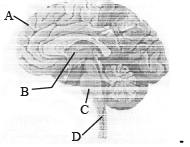
- a)A – Cerebral hemispheres; B – Cerebellum
- b)C – Mid brain; D – Cerebellum
- c)A – Cerebrum; C – Pons
- d)B – Corpus callosum; D – Medulla
Correct answer is option 'C'. Can you explain this answer?
A sagittal section of human-brain is shown here. Identify at least two labels from A-D. [NEET Kar. 2013]
a)
A – Cerebral hemispheres; B – Cerebellum
b)
C – Mid brain; D – Cerebellum
c)
A – Cerebrum; C – Pons
d)
B – Corpus callosum; D – Medulla
 | Aashna Mukherjee answered |
Cerebrum is the first and most developed part of fore brain. It makes 2/3 part of total brain. Pons is a small spherical projection, which is situated below the midbrain and upper side of the medulla oblongata. It acts as a relay centre among different parts of brain. B and D are thalamus and spinal cord respectively.
Assertion: The functions of the organs in our body must be coordinated to maintain homeostasis.
Reason: Coordination is the process where two or more organs interact and complement each other’s functions.- a)Both Assertion and Reason are correct, and Reason is the correct explanation of Assertion.
- b)Both Assertion and Reason are correct, but Reason is not the correct explanation of Assertion.
- c)Assertion is correct, but Reason is incorrect.
- d)Assertion is incorrect, but Reason is correct.
Correct answer is option 'A'. Can you explain this answer?
Assertion: The functions of the organs in our body must be coordinated to maintain homeostasis.
Reason: Coordination is the process where two or more organs interact and complement each other’s functions.
Reason: Coordination is the process where two or more organs interact and complement each other’s functions.
a)
Both Assertion and Reason are correct, and Reason is the correct explanation of Assertion.
b)
Both Assertion and Reason are correct, but Reason is not the correct explanation of Assertion.
c)
Assertion is correct, but Reason is incorrect.
d)
Assertion is incorrect, but Reason is correct.
| | Nidhi Chauhan answered |
Understanding Homeostasis
Homeostasis is the process by which living organisms maintain a stable internal environment despite external changes. This involves the regulation of various physiological parameters such as temperature, pH, and electrolyte balance.
Assertion Explanation
- The assertion states that the functions of the organs in our body must be coordinated to maintain homeostasis.
- This is correct because organs do not function in isolation. For example, the respiratory system works with the circulatory system to ensure that oxygen is delivered to tissues and carbon dioxide is removed.
Reason Explanation
- The reason provided indicates that coordination is the interaction and complementing functions of two or more organs.
- This is also a correct statement as organs often work together to perform complex tasks that no single organ could achieve alone. For example, the kidneys and the endocrine system work together to regulate blood pressure and fluid balance.
Linking Assertion and Reason
- The reason directly explains the assertion by highlighting how organs complement each other to maintain homeostasis.
- For instance, during exercise, the heart rate increases (cardiovascular system), while the lungs facilitate increased oxygen intake (respiratory system), showcasing their coordinated efforts to maintain stable conditions in the body.
Conclusion
- Since both the assertion and the reason are true, and the reason correctly explains the assertion, the correct answer is option 'A': Both Assertion and Reason are correct, and Reason is the correct explanation of Assertion.
Homeostasis is the process by which living organisms maintain a stable internal environment despite external changes. This involves the regulation of various physiological parameters such as temperature, pH, and electrolyte balance.
Assertion Explanation
- The assertion states that the functions of the organs in our body must be coordinated to maintain homeostasis.
- This is correct because organs do not function in isolation. For example, the respiratory system works with the circulatory system to ensure that oxygen is delivered to tissues and carbon dioxide is removed.
Reason Explanation
- The reason provided indicates that coordination is the interaction and complementing functions of two or more organs.
- This is also a correct statement as organs often work together to perform complex tasks that no single organ could achieve alone. For example, the kidneys and the endocrine system work together to regulate blood pressure and fluid balance.
Linking Assertion and Reason
- The reason directly explains the assertion by highlighting how organs complement each other to maintain homeostasis.
- For instance, during exercise, the heart rate increases (cardiovascular system), while the lungs facilitate increased oxygen intake (respiratory system), showcasing their coordinated efforts to maintain stable conditions in the body.
Conclusion
- Since both the assertion and the reason are true, and the reason correctly explains the assertion, the correct answer is option 'A': Both Assertion and Reason are correct, and Reason is the correct explanation of Assertion.
Which of the following systems is involved in controlling involuntary actions like heart rate and digestion?- a)Somatic neural system
- b)Autonomic neural system
- c)Sympathetic neural system
- d)Peripheral nervous system
Correct answer is option 'B'. Can you explain this answer?
Which of the following systems is involved in controlling involuntary actions like heart rate and digestion?
a)
Somatic neural system
b)
Autonomic neural system
c)
Sympathetic neural system
d)
Peripheral nervous system
| | Juhi Reddy answered |
Understanding the Autonomic Neural System
The autonomic neural system plays a crucial role in managing involuntary actions in the body, including heart rate and digestion. Here's how it works:
Components of the Autonomic Nervous System
- The autonomic nervous system (ANS) is divided into two main branches: the sympathetic and parasympathetic nervous systems.
- Sympathetic Nervous System: Prepares the body for 'fight or flight' responses, increasing heart rate and energy mobilization.
- Parasympathetic Nervous System: Promotes 'rest and digest' functions, decreasing heart rate and enhancing digestive processes.
Functions of the Autonomic Nervous System
- Heart Rate Control: The ANS regulates heart rate through the sympathetic (increases heart rate) and parasympathetic (decreases heart rate) branches, maintaining homeostasis according to the body's needs.
- Digestion Regulation: The parasympathetic system stimulates digestive activities, such as salivation, enzyme secretion, and peristalsis in the intestines.
Contrast with Other Neural Systems
- Somatic Neural System: Controls voluntary movements and skeletal muscles, allowing conscious control over actions like walking or speaking.
- Peripheral Nervous System: Encompasses both the somatic and autonomic systems, but it is not specific to involuntary functions.
In summary, the autonomic neural system (option B) is essential for regulating involuntary actions such as heart rate and digestion, distinguishing it from the somatic and peripheral nervous systems, which are involved in voluntary and broader neural activities, respectively.
The autonomic neural system plays a crucial role in managing involuntary actions in the body, including heart rate and digestion. Here's how it works:
Components of the Autonomic Nervous System
- The autonomic nervous system (ANS) is divided into two main branches: the sympathetic and parasympathetic nervous systems.
- Sympathetic Nervous System: Prepares the body for 'fight or flight' responses, increasing heart rate and energy mobilization.
- Parasympathetic Nervous System: Promotes 'rest and digest' functions, decreasing heart rate and enhancing digestive processes.
Functions of the Autonomic Nervous System
- Heart Rate Control: The ANS regulates heart rate through the sympathetic (increases heart rate) and parasympathetic (decreases heart rate) branches, maintaining homeostasis according to the body's needs.
- Digestion Regulation: The parasympathetic system stimulates digestive activities, such as salivation, enzyme secretion, and peristalsis in the intestines.
Contrast with Other Neural Systems
- Somatic Neural System: Controls voluntary movements and skeletal muscles, allowing conscious control over actions like walking or speaking.
- Peripheral Nervous System: Encompasses both the somatic and autonomic systems, but it is not specific to involuntary functions.
In summary, the autonomic neural system (option B) is essential for regulating involuntary actions such as heart rate and digestion, distinguishing it from the somatic and peripheral nervous systems, which are involved in voluntary and broader neural activities, respectively.
Which brain structure is responsible for processing visual and auditory information?- a)Midbrain
- b)Pons
- c)Medulla oblongata
- d)Limbic system
Correct answer is option 'A'. Can you explain this answer?
Which brain structure is responsible for processing visual and auditory information?
a)
Midbrain
b)
Pons
c)
Medulla oblongata
d)
Limbic system
| | Ambition Institute answered |
The midbrain plays a crucial role in processing auditory and visual sensory information.
Topic in NCERT: Midbrain
Line in NCERT: "The midbrain receives and integrates visual, tactile and auditory inputs."
Sodium-potassium pump transports- a)Na+ and K+ out of the neuron
- b)Na+ and K+ into the neuron
- c)Na+ into the neuron and K+ out of the neuron
- d)K+ into the neuron and Na+ out of the neuron
Correct answer is option 'D'. Can you explain this answer?
Sodium-potassium pump transports
a)
Na+ and K+ out of the neuron
b)
Na+ and K+ into the neuron
c)
Na+ into the neuron and K+ out of the neuron
d)
K+ into the neuron and Na+ out of the neuron
 | Gaurav Kumar answered |
Each Na+ -K+ pump expels three Na+ ions for every two K+ ions imported.
Given below are two statements: (NEET 2024)
Statement I: The cerebral hemispheres are connected by nerve tract known as corpus callosum.
Statement II: The brain stem consists of the medulla oblongata, pons and cerebrum.
In the light of the above statements, choose the most appropriate answer from the options given below:- a)Both Statement I and Statement II are correct.
- b)Both Statement I and Statement II are incorrect.
- c)Statement I is correct but Statement II is incorrect.
- d)Statement I is incorrect but Statement II is correct.
Correct answer is option 'C'. Can you explain this answer?
Given below are two statements: (NEET 2024)
Statement I: The cerebral hemispheres are connected by nerve tract known as corpus callosum.
Statement II: The brain stem consists of the medulla oblongata, pons and cerebrum.
In the light of the above statements, choose the most appropriate answer from the options given below:
Statement I: The cerebral hemispheres are connected by nerve tract known as corpus callosum.
Statement II: The brain stem consists of the medulla oblongata, pons and cerebrum.
In the light of the above statements, choose the most appropriate answer from the options given below:
a)
Both Statement I and Statement II are correct.
b)
Both Statement I and Statement II are incorrect.
c)
Statement I is correct but Statement II is incorrect.
d)
Statement I is incorrect but Statement II is correct.
| | Sagar Choudhary answered |
Explanation of Statement I
- Statement I: The cerebral hemispheres are connected by a nerve tract known as corpus callosum.
- This statement is correct. The corpus callosum is a thick band of nerve fibers that connects the left and right cerebral hemispheres, facilitating communication between them.
Explanation of Statement II
- Statement II: The brain stem consists of the medulla oblongata, pons, and cerebrum.
- This statement is incorrect. The brain stem is made up of the medulla oblongata, pons, and midbrain, not the cerebrum. The cerebrum is actually a separate structure that is responsible for higher brain functions, including thought and action.
Conclusion
- Given the evaluations of both statements:
- Statement I is correct.
- Statement II is incorrect.
Thus, the correct answer is option C: Statement I is correct but Statement II is incorrect.
- Statement I: The cerebral hemispheres are connected by a nerve tract known as corpus callosum.
- This statement is correct. The corpus callosum is a thick band of nerve fibers that connects the left and right cerebral hemispheres, facilitating communication between them.
Explanation of Statement II
- Statement II: The brain stem consists of the medulla oblongata, pons, and cerebrum.
- This statement is incorrect. The brain stem is made up of the medulla oblongata, pons, and midbrain, not the cerebrum. The cerebrum is actually a separate structure that is responsible for higher brain functions, including thought and action.
Conclusion
- Given the evaluations of both statements:
- Statement I is correct.
- Statement II is incorrect.
Thus, the correct answer is option C: Statement I is correct but Statement II is incorrect.
Match the following
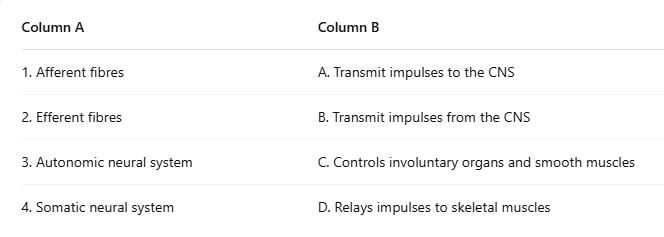
- a)1-A, 2-B, 3-D, 4-C
- b)1-B, 2-A, 3-D, 4-C
- c) 1-A, 2-B, 3-C, 4-D
- d)1-B, 2-A, 3-C, 4-D
Correct answer is option 'C'. Can you explain this answer?
Match the following
a)
1-A, 2-B, 3-D, 4-C
b)
1-B, 2-A, 3-D, 4-C
c)
1-A, 2-B, 3-C, 4-D
d)
1-B, 2-A, 3-C, 4-D
| | Bs Academy answered |
Afferent fibres transmit impulses to the CNS.
Efferent fibres transmit impulses from the CNS.
The autonomic neural system controls involuntary organs and smooth muscles.
The somatic neural system relays impulses to skeletal muscles.
Efferent fibres transmit impulses from the CNS.
The autonomic neural system controls involuntary organs and smooth muscles.
The somatic neural system relays impulses to skeletal muscles.
How does the pre-synaptic neuron transmit an impulse across the synaptic cleft to the post-synaptic neuron?- a)By electrical current flowing directly between the neurons across the synaptic cleft.
- b)By the release of neurotransmitters from synaptic vesicles into the synaptic cleft.
- c)By ion flow through the synaptic cleft without the need for neurotransmitters.
- d)By a direct connection between the axon terminal and the post-synaptic membrane.
Correct answer is option 'B'. Can you explain this answer?
a)
By electrical current flowing directly between the neurons across the synaptic cleft.
b)
By the release of neurotransmitters from synaptic vesicles into the synaptic cleft.
c)
By ion flow through the synaptic cleft without the need for neurotransmitters.
d)
By a direct connection between the axon terminal and the post-synaptic membrane.
| | Ambition Institute answered |
The pre-synaptic neuron transmits an impulse to the post-synaptic neuron by releasing neurotransmitters from synaptic vesicles into the synaptic cleft, where they bind to specific receptors on the post-synaptic membrane.
Which of the following integrates all the activities of the organs?- a)Excretory and Respiratory system
- b)The neural and digestive system
- c)Digestive and excretory system
- d)The neural and endocrine system
Correct answer is option 'D'. Can you explain this answer?
Which of the following integrates all the activities of the organs?
a)
Excretory and Respiratory system
b)
The neural and digestive system
c)
Digestive and excretory system
d)
The neural and endocrine system
 | Flembe Academy answered |
In our body, the neural and the endocrine system jointly coordinate and integrate all the activities of the organs so that they function in a synchronised fashion.
Topic in NCERT: NEURAL CONTROL AND COORDINATIONLine in NCERT: "The neural system and the endocrine system jointly coordinate and integrate all the activities of the organs so that they function in a synchronised fashion."
In Pavlov’s conditioned reflex experiment find the correct matches :
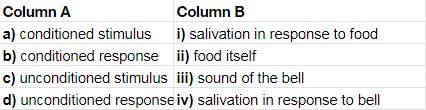
- a)a)-i, b)-iii, c)-iv, d)-ii
- b)a)-iv, b)-ii, c)-i, d)-iii
- c)a)-iii, b)-iv, c)-ii, d)-i
- d)a)-ii, b)-iii, c)-i, d)-iv
Correct answer is option 'C'. Can you explain this answer?
In Pavlov’s conditioned reflex experiment find the correct matches :
a)
a)-i, b)-iii, c)-iv, d)-ii
b)
a)-iv, b)-ii, c)-i, d)-iii
c)
a)-iii, b)-iv, c)-ii, d)-i
d)
a)-ii, b)-iii, c)-i, d)-iv
| | Wahid Khan answered |
There are different kinds of stimulus that is received by different receptors in our body. Hearing of sound of bell is conditioned stimulus and salivation in response to bell is conditioned response. Food itself is conditioned stimulus and salivation in response to food is unconditioned response.
Chapter doubts & questions for Neural Control and Coordination - Biology Class 11 2026 is part of NEET exam preparation. The chapters have been prepared according to the NEET exam syllabus. The Chapter doubts & questions, notes, tests & MCQs are made for NEET 2026 Exam. Find important definitions, questions, notes, meanings, examples, exercises, MCQs and online tests here.
Chapter doubts & questions of Neural Control and Coordination - Biology Class 11 in English & Hindi are available as part of NEET exam. Download more important topics, notes, lectures and mock test series for NEET Exam by signing up for free.
Biology Class 11142 videos|410 docs|135 tests |
