


All Exams > UPSC > Spectrum for Modern History: Summary & Tests > All Questions
All questions of Independence and After for UPSC CSE Exam
Consider the following statements about the Nehru-Liaquat Pact.1. Many Hindu Nationalists criticized it2. Hindu Nationalists believed that the refugee problem could not be solved by though a transfer of population3. Hindu Nationalists believed that this problem could be solved through the acquisition of certain territories from PakistanWhich of these statements are correct?- a)1 and 2 Only
- b)2 and 3 Only
- c)1 and 3 only
- d)All of them
Correct answer is option 'C'. Can you explain this answer?
Consider the following statements about the Nehru-Liaquat Pact.
1. Many Hindu Nationalists criticized it
2. Hindu Nationalists believed that the refugee problem could not be solved by though a transfer of population
3. Hindu Nationalists believed that this problem could be solved through the acquisition of certain territories from Pakistan
Which of these statements are correct?
a)
1 and 2 Only
b)
2 and 3 Only
c)
1 and 3 only
d)
All of them
 | Rahul Mehta answered |
Nationalists believed that the refugee problem could only be solved through a transfer of population and acquisition of certain territories from Pakistan rehabilitate the people who came into India.

Consider the following statements. 1. 53 political parties were participating in the first general elections for the Lok Sabha seats 2. More than a thousand candidates were participating in the elections Which of these statements are correct?- a)1 Only
- b)2 Only
- c)Both of them
- d)Neither of them
Correct answer is option 'C'. Can you explain this answer?
Consider the following statements.
1. 53 political parties were participating in the first general elections for the Lok Sabha seats
2. More than a thousand candidates were participating in the elections
Which of these statements are correct?
a)
1 Only
b)
2 Only
c)
Both of them
d)
Neither of them
 | Meera Singh answered |
- 53 political parties were participating in the first general elections for the Lok Sabha seats.
- These included the 14 national parties, according to the report by the Election Commission of India. Besides, there were independents. There were a total number of 1,874 candidates, including 533 independents.
Consider the following statements about the first general elections.1. In the house of the people, 50% of the seats were reserved for the candidates belonging to the scheduled castes2. Around 20% of the seats were reserved for the candidates belonging to the scheduled tribesWhich of these statements are correct?- a)1 Only
- b)2 Only
- c)Both of them
- d)Neither of them
Correct answer is option 'D'. Can you explain this answer?
Consider the following statements about the first general elections.
1. In the house of the people, 50% of the seats were reserved for the candidates belonging to the scheduled castes
2. Around 20% of the seats were reserved for the candidates belonging to the scheduled tribes
Which of these statements are correct?
a)
1 Only
b)
2 Only
c)
Both of them
d)
Neither of them
 | Bhavana Sen answered |
The correct answer is option 'D', neither of them.
Explanation:
1. In the house of the people, 50% of the seats were reserved for the candidates belonging to the scheduled castes: This statement is incorrect. In the first general elections held in India in 1951-52, there were no reserved seats for candidates belonging to the scheduled castes. The reservation of seats for scheduled castes and scheduled tribes was introduced later through constitutional amendments.
2. Around 20% of the seats were reserved for the candidates belonging to the scheduled tribes: This statement is also incorrect. In the first general elections, there were no reserved seats for candidates belonging to the scheduled tribes. The reservation of seats for scheduled tribes was introduced later through constitutional amendments.
Reservation of seats for scheduled castes and scheduled tribes:
The reservation of seats for scheduled castes and scheduled tribes was introduced to ensure representation and political empowerment of these marginalized communities. The Constitution of India, through various amendments, provided for the reservation of seats in both the Lok Sabha (House of the People) and the State Legislative Assemblies.
Reservation in the Lok Sabha:
Currently, the reservation of seats for scheduled castes and scheduled tribes in the Lok Sabha is based on their proportion to the total population. As per the Constitution, 84 seats (out of 543) are reserved for scheduled castes and 47 seats (out of 543) are reserved for scheduled tribes. These reserved seats are distributed among different states and union territories based on their population.
Reservation in the State Legislative Assemblies:
Similar to the reservation in the Lok Sabha, the Constitution also provides for the reservation of seats for scheduled castes and scheduled tribes in the State Legislative Assemblies. The number of reserved seats varies from state to state based on the proportion of the population of these communities.
Conclusion:
In summary, neither of the statements given in the question is correct. The reservation of seats for scheduled castes and scheduled tribes in the Lok Sabha and State Legislative Assemblies was introduced through constitutional amendments after the first general elections.
Explanation:
1. In the house of the people, 50% of the seats were reserved for the candidates belonging to the scheduled castes: This statement is incorrect. In the first general elections held in India in 1951-52, there were no reserved seats for candidates belonging to the scheduled castes. The reservation of seats for scheduled castes and scheduled tribes was introduced later through constitutional amendments.
2. Around 20% of the seats were reserved for the candidates belonging to the scheduled tribes: This statement is also incorrect. In the first general elections, there were no reserved seats for candidates belonging to the scheduled tribes. The reservation of seats for scheduled tribes was introduced later through constitutional amendments.
Reservation of seats for scheduled castes and scheduled tribes:
The reservation of seats for scheduled castes and scheduled tribes was introduced to ensure representation and political empowerment of these marginalized communities. The Constitution of India, through various amendments, provided for the reservation of seats in both the Lok Sabha (House of the People) and the State Legislative Assemblies.
Reservation in the Lok Sabha:
Currently, the reservation of seats for scheduled castes and scheduled tribes in the Lok Sabha is based on their proportion to the total population. As per the Constitution, 84 seats (out of 543) are reserved for scheduled castes and 47 seats (out of 543) are reserved for scheduled tribes. These reserved seats are distributed among different states and union territories based on their population.
Reservation in the State Legislative Assemblies:
Similar to the reservation in the Lok Sabha, the Constitution also provides for the reservation of seats for scheduled castes and scheduled tribes in the State Legislative Assemblies. The number of reserved seats varies from state to state based on the proportion of the population of these communities.
Conclusion:
In summary, neither of the statements given in the question is correct. The reservation of seats for scheduled castes and scheduled tribes in the Lok Sabha and State Legislative Assemblies was introduced through constitutional amendments after the first general elections.
Consider the following statements. 1. The British government appointed the boundary Commission under the chairmanship of Sir Radcliff2. The boundary commission consisted of two Muslims and two non-Muslim judges in each caseWhich of these statements are not correct?- a)1 Only
- b)2 Only
- c)Both of them
- d)Neither of them
Correct answer is option 'D'. Can you explain this answer?
Consider the following statements.
1. The British government appointed the boundary Commission under the chairmanship of Sir Radcliff
2. The boundary commission consisted of two Muslims and two non-Muslim judges in each case
Which of these statements are not correct?
a)
1 Only
b)
2 Only
c)
Both of them
d)
Neither of them
| | Kiran Sharma answered |
Understanding the Boundary Commission
The Boundary Commission was a pivotal moment during the partition of India in 1947, tasked with demarcating the borders between India and Pakistan. Let's analyze the statements regarding the Commission.
Statement 1: The British government appointed the Boundary Commission under the chairmanship of Sir Radcliffe.
- This statement is correct.
- Sir Cyril Radcliffe was indeed appointed by the British government to chair the Boundary Commission.
- His role was critical in determining the borders based on religious demographics, land use, and other factors.
Statement 2: The Boundary Commission consisted of two Muslims and two non-Muslim judges in each case.
- This statement is correct.
- The Commission included members from various communities to ensure representation.
- However, the actual composition was predominantly British judges, with Radcliffe himself being the sole British member overseeing the entire process.
Conclusion
- Since both statements are accurate, the correct answer to the question is option 'D': Neither of them is incorrect.
- The Boundary Commission's decisions had lasting impacts on the subcontinent, leading to significant demographic and political changes.
In summary, both statements about the Boundary Commission are correct, confirming that option 'D' is the right choice.
The Boundary Commission was a pivotal moment during the partition of India in 1947, tasked with demarcating the borders between India and Pakistan. Let's analyze the statements regarding the Commission.
Statement 1: The British government appointed the Boundary Commission under the chairmanship of Sir Radcliffe.
- This statement is correct.
- Sir Cyril Radcliffe was indeed appointed by the British government to chair the Boundary Commission.
- His role was critical in determining the borders based on religious demographics, land use, and other factors.
Statement 2: The Boundary Commission consisted of two Muslims and two non-Muslim judges in each case.
- This statement is correct.
- The Commission included members from various communities to ensure representation.
- However, the actual composition was predominantly British judges, with Radcliffe himself being the sole British member overseeing the entire process.
Conclusion
- Since both statements are accurate, the correct answer to the question is option 'D': Neither of them is incorrect.
- The Boundary Commission's decisions had lasting impacts on the subcontinent, leading to significant demographic and political changes.
In summary, both statements about the Boundary Commission are correct, confirming that option 'D' is the right choice.
Which of the following statements correct the linguistic province's Commission appointed by the constituent assembly in 1948?1. It opposed the demands of the linguistic reorganization of the provinces2. Consequently the constituent assembly decided to include the linguistic principle in the constitutionChoose from the following options.- a)1 Only
- b)2 Only
- c)Both of them
- d)Neither of them
Correct answer is option 'A'. Can you explain this answer?
Which of the following statements correct the linguistic province's Commission appointed by the constituent assembly in 1948?
1. It opposed the demands of the linguistic reorganization of the provinces
2. Consequently the constituent assembly decided to include the linguistic principle in the constitution
Choose from the following options.
a)
1 Only
b)
2 Only
c)
Both of them
d)
Neither of them
 | Simran Chakraborty answered |
Overview of the Linguistic Provinces Commission
The Linguistic Provinces Commission, appointed by the Constituent Assembly in 1948, played a significant role in the formation of states in India based on linguistic demographics.
Statement Analysis
1. **Opposition to Linguistic Reorganization**
- The commission indeed opposed the demands for the reorganization of provinces based on language. It held the view that such a division could lead to further fragmentation and regionalism, which might threaten national unity. Thus, this statement is correct.
2. **Inclusion of Linguistic Principle in the Constitution**
- Contrary to the first statement, the Constituent Assembly did not decide to include the linguistic principle in the Constitution due to the commission's recommendations. In fact, the linguistic principle was later implemented through the States Reorganisation Act of 1956, after considerable debate and discussion. Therefore, this statement is incorrect.
Conclusion
Given the analysis:
- Statement 1 is correct.
- Statement 2 is incorrect.
Thus, the correct answer is **option 'A': 1 Only**. The commission's reluctance towards linguistic reorganization played a pivotal role in shaping the early constitutional framework regarding state boundaries in India.
The Linguistic Provinces Commission, appointed by the Constituent Assembly in 1948, played a significant role in the formation of states in India based on linguistic demographics.
Statement Analysis
1. **Opposition to Linguistic Reorganization**
- The commission indeed opposed the demands for the reorganization of provinces based on language. It held the view that such a division could lead to further fragmentation and regionalism, which might threaten national unity. Thus, this statement is correct.
2. **Inclusion of Linguistic Principle in the Constitution**
- Contrary to the first statement, the Constituent Assembly did not decide to include the linguistic principle in the Constitution due to the commission's recommendations. In fact, the linguistic principle was later implemented through the States Reorganisation Act of 1956, after considerable debate and discussion. Therefore, this statement is incorrect.
Conclusion
Given the analysis:
- Statement 1 is correct.
- Statement 2 is incorrect.
Thus, the correct answer is **option 'A': 1 Only**. The commission's reluctance towards linguistic reorganization played a pivotal role in shaping the early constitutional framework regarding state boundaries in India.
Constitution of India bill envisaged for all citizens of India:1. Freedom of expression2. Right to inviolability of one's home3. Equality before the lawChoose from the following options- a)1 and 2 Only
- b)2 and 3 Only
- c)1 and 3 Only
- d)All of them
Correct answer is option 'D'. Can you explain this answer?
Constitution of India bill envisaged for all citizens of India:
1. Freedom of expression
2. Right to inviolability of one's home
3. Equality before the law
Choose from the following options
a)
1 and 2 Only
b)
2 and 3 Only
c)
1 and 3 Only
d)
All of them
 | Arya Das answered |
Explanation:
The correct answer is option 'D', which means that all the given options are correct. Let's understand why.
1. Freedom of expression:
- The Constitution of India guarantees the fundamental right of freedom of expression to all its citizens.
- Article 19(1)(a) of the Constitution states that all citizens have the right to freedom of speech and expression.
- This right allows citizens to express their opinions, ideas, and thoughts freely without fear of censorship or punishment.
- It is a crucial element of a democratic society as it enables citizens to participate in public discourse, criticize the government, and contribute to the development of the nation.
2. Right to inviolability of one's home:
- The Constitution of India recognizes the right to privacy and the inviolability of one's home.
- Article 21 of the Constitution guarantees the fundamental right to protection of life and personal liberty, which includes the right to privacy.
- This right ensures that individuals have control over their personal space and can live without unwarranted intrusion from the state or any other entity.
- It protects citizens from arbitrary searches, seizures, and surveillance, and establishes the importance of privacy as a fundamental human right.
3. Equality before the law:
- The Constitution of India ensures equality before the law and prohibits discrimination based on various grounds.
- Article 14 of the Constitution states that the state shall not deny any person equality before the law or equal protection of the laws.
- This principle ensures that all individuals, irrespective of their caste, religion, gender, or any other status, are treated equally by the law.
- It guarantees equal opportunities and protection to all citizens and promotes social justice and inclusivity.
In conclusion:
All the given options in the question - freedom of expression, right to inviolability of one's home, and equality before the law - are fundamental rights enshrined in the Constitution of India. These rights are essential for the functioning of a democratic society and ensure that all citizens are treated with dignity and have the freedom to express themselves, protect their privacy, and receive equal treatment under the law. Therefore, the correct answer is option 'D' - all of them.
The correct answer is option 'D', which means that all the given options are correct. Let's understand why.
1. Freedom of expression:
- The Constitution of India guarantees the fundamental right of freedom of expression to all its citizens.
- Article 19(1)(a) of the Constitution states that all citizens have the right to freedom of speech and expression.
- This right allows citizens to express their opinions, ideas, and thoughts freely without fear of censorship or punishment.
- It is a crucial element of a democratic society as it enables citizens to participate in public discourse, criticize the government, and contribute to the development of the nation.
2. Right to inviolability of one's home:
- The Constitution of India recognizes the right to privacy and the inviolability of one's home.
- Article 21 of the Constitution guarantees the fundamental right to protection of life and personal liberty, which includes the right to privacy.
- This right ensures that individuals have control over their personal space and can live without unwarranted intrusion from the state or any other entity.
- It protects citizens from arbitrary searches, seizures, and surveillance, and establishes the importance of privacy as a fundamental human right.
3. Equality before the law:
- The Constitution of India ensures equality before the law and prohibits discrimination based on various grounds.
- Article 14 of the Constitution states that the state shall not deny any person equality before the law or equal protection of the laws.
- This principle ensures that all individuals, irrespective of their caste, religion, gender, or any other status, are treated equally by the law.
- It guarantees equal opportunities and protection to all citizens and promotes social justice and inclusivity.
In conclusion:
All the given options in the question - freedom of expression, right to inviolability of one's home, and equality before the law - are fundamental rights enshrined in the Constitution of India. These rights are essential for the functioning of a democratic society and ensure that all citizens are treated with dignity and have the freedom to express themselves, protect their privacy, and receive equal treatment under the law. Therefore, the correct answer is option 'D' - all of them.
Statement 1: The Jain Commission report was related to the assassination of Rajiv Gandhi.
Statement 2: The report's findings led to the withdrawal of Congress support from I.K. Gujral's government.- a)Both statements are true
- b)Only statement 1 is true
- c)Only statement 2 is true
- d)Neither statement is true
Correct answer is option 'A'. Can you explain this answer?
Statement 1: The Jain Commission report was related to the assassination of Rajiv Gandhi.
Statement 2: The report's findings led to the withdrawal of Congress support from I.K. Gujral's government.
Statement 2: The report's findings led to the withdrawal of Congress support from I.K. Gujral's government.
a)
Both statements are true
b)
Only statement 1 is true
c)
Only statement 2 is true
d)
Neither statement is true
 | Avi Sengupta answered |
Explanation:
Statement 1: The Jain Commission report was indeed related to the assassination of Rajiv Gandhi. The commission was set up to investigate the conspiracy behind the assassination and to identify those responsible for the tragic event.
Statement 2: The findings of the Jain Commission report did lead to the withdrawal of Congress support from I.K. Gujral's government. The Congress party decided to withdraw its support as the report implicated the Dravida Munnetra Kazhagam (DMK) party, which was a part of the ruling coalition led by Gujral.
Therefore, both statements are true as the Jain Commission report was linked to Rajiv Gandhi's assassination, and its findings resulted in the Congress party withdrawing its support from I.K. Gujral's government.
Statement 1: The Jain Commission report was indeed related to the assassination of Rajiv Gandhi. The commission was set up to investigate the conspiracy behind the assassination and to identify those responsible for the tragic event.
Statement 2: The findings of the Jain Commission report did lead to the withdrawal of Congress support from I.K. Gujral's government. The Congress party decided to withdraw its support as the report implicated the Dravida Munnetra Kazhagam (DMK) party, which was a part of the ruling coalition led by Gujral.
Therefore, both statements are true as the Jain Commission report was linked to Rajiv Gandhi's assassination, and its findings resulted in the Congress party withdrawing its support from I.K. Gujral's government.
In the aftermath of the Janata Party's rule, which party did not emerge as a separate entity?- a)Bharatiya Janata Party (BJP)
- b)Janata Dal
- c)Samajwadi Party
- d)Aam Aadmi Party
Correct answer is option 'D'. Can you explain this answer?
In the aftermath of the Janata Party's rule, which party did not emerge as a separate entity?
a)
Bharatiya Janata Party (BJP)
b)
Janata Dal
c)
Samajwadi Party
d)
Aam Aadmi Party
| | Ameya Malik answered |
The correct answer is option 'D', Aam Aadmi Party (AAP).
The Janata Party was formed in 1977, following the defeat of the Congress party in the 1977 general elections. It was an amalgamation of various opposition parties and groups, including the Bharatiya Lok Dal, the Socialist Party, and the Congress (O). The Janata Party formed the government at the center with Morarji Desai as the Prime Minister.
However, due to ideological and personality clashes, the Janata Party's unity began to crumble, leading to the formation of various splinter groups and parties. Let's discuss the fate of the parties that emerged after the Janata Party's rule:
1. Bharatiya Janata Party (BJP):
The Bharatiya Janata Party (BJP) emerged as a separate entity from the Janata Party. It was formed in 1980 under the leadership of Atal Bihari Vajpayee and L.K. Advani. The BJP went on to become one of the major political parties in India and is currently the ruling party at the center.
2. Janata Dal:
The Janata Dal was formed in 1988 as a result of the merger of various political parties, including the Janata Party, the Lok Dal, and the Jan Morcha. It was led by V.P. Singh, who later became the Prime Minister of India. The Janata Dal had several factions and underwent multiple splits over the years, giving rise to parties such as Janata Dal (United), Janata Dal (Secular), and Rashtriya Janata Dal.
3. Samajwadi Party:
The Samajwadi Party was formed in 1992 by Mulayam Singh Yadav, who was a prominent leader within the Janata Dal. The party primarily focused on the interests of the backward castes and minorities and gained significant influence in the state of Uttar Pradesh. It continues to be a major political force in the state.
4. Aam Aadmi Party (AAP):
The Aam Aadmi Party (AAP) is a relatively new political party that emerged in 2012. It was formed by Arvind Kejriwal, along with several other activists and former members of the India Against Corruption movement. The AAP gained prominence for its anti-corruption stance and its focus on participatory governance. It formed the government in Delhi in 2013 and has since become a significant player in Indian politics.
In conclusion, out of the parties mentioned, the Aam Aadmi Party (AAP) is the one that did not emerge as a separate entity from the Janata Party. It was formed many years after the Janata Party's rule and has its own distinct identity and ideology.
The Janata Party was formed in 1977, following the defeat of the Congress party in the 1977 general elections. It was an amalgamation of various opposition parties and groups, including the Bharatiya Lok Dal, the Socialist Party, and the Congress (O). The Janata Party formed the government at the center with Morarji Desai as the Prime Minister.
However, due to ideological and personality clashes, the Janata Party's unity began to crumble, leading to the formation of various splinter groups and parties. Let's discuss the fate of the parties that emerged after the Janata Party's rule:
1. Bharatiya Janata Party (BJP):
The Bharatiya Janata Party (BJP) emerged as a separate entity from the Janata Party. It was formed in 1980 under the leadership of Atal Bihari Vajpayee and L.K. Advani. The BJP went on to become one of the major political parties in India and is currently the ruling party at the center.
2. Janata Dal:
The Janata Dal was formed in 1988 as a result of the merger of various political parties, including the Janata Party, the Lok Dal, and the Jan Morcha. It was led by V.P. Singh, who later became the Prime Minister of India. The Janata Dal had several factions and underwent multiple splits over the years, giving rise to parties such as Janata Dal (United), Janata Dal (Secular), and Rashtriya Janata Dal.
3. Samajwadi Party:
The Samajwadi Party was formed in 1992 by Mulayam Singh Yadav, who was a prominent leader within the Janata Dal. The party primarily focused on the interests of the backward castes and minorities and gained significant influence in the state of Uttar Pradesh. It continues to be a major political force in the state.
4. Aam Aadmi Party (AAP):
The Aam Aadmi Party (AAP) is a relatively new political party that emerged in 2012. It was formed by Arvind Kejriwal, along with several other activists and former members of the India Against Corruption movement. The AAP gained prominence for its anti-corruption stance and its focus on participatory governance. It formed the government in Delhi in 2013 and has since become a significant player in Indian politics.
In conclusion, out of the parties mentioned, the Aam Aadmi Party (AAP) is the one that did not emerge as a separate entity from the Janata Party. It was formed many years after the Janata Party's rule and has its own distinct identity and ideology.
Arrange the events chronologically.1. Formation of the Praja Socialist party2. Formation of the Swatantra party3. Formation of the socialist party4. Formation of the Bhartiya Jan SanghChoose from the following options.- a)1-2-3-4
- b)4-3-2-1
- c)2-1-3-4
- d)3-4-1-2
Correct answer is option 'D'. Can you explain this answer?
Arrange the events chronologically.
1. Formation of the Praja Socialist party
2. Formation of the Swatantra party
3. Formation of the socialist party
4. Formation of the Bhartiya Jan Sangh
Choose from the following options.
a)
1-2-3-4
b)
4-3-2-1
c)
2-1-3-4
d)
3-4-1-2
 | Sanjay Rana answered |
- The socialist party was formed in 1934 as Congress socialist party. Bharatiya Jan Sangh was founded on October 21, 1951.
- Praja socialist party was founded in September 1952 by merging the Praja socialist party and KMPP. The Swatantra Party was founded in August 1959.
Consider the following statements.1. The Congress took up the demand for a constituent assembly as a part of its official policy in 1934 after accepting the Simon Commission's recommendations2. At the Bombay session of the Congress in 1936, it was declared that "no constitution imposed by an outside authority and no constitution which curtails the sovereignty of the people" would be acceptable to the CongressWhich of these statements is/are correct?- a)1 Only
- b)2 Only
- c)Both of them
- d)Neither of them
Correct answer is option 'D'. Can you explain this answer?
Consider the following statements.
1. The Congress took up the demand for a constituent assembly as a part of its official policy in 1934 after accepting the Simon Commission's recommendations
2. At the Bombay session of the Congress in 1936, it was declared that "no constitution imposed by an outside authority and no constitution which curtails the sovereignty of the people" would be acceptable to the Congress
Which of these statements is/are correct?
a)
1 Only
b)
2 Only
c)
Both of them
d)
Neither of them
| | Krishna Kumari answered |
Ans is d is correct answer
neither of them
neither of them
Who among the following was not a part of Lal Bahadur Shastri's cabinet?- a)Indira Gandhi
- b)Morarji Desai
- c)L.K. Jha
- d)I.G. Patel
Correct answer is option 'D'. Can you explain this answer?
Who among the following was not a part of Lal Bahadur Shastri's cabinet?
a)
Indira Gandhi
b)
Morarji Desai
c)
L.K. Jha
d)
I.G. Patel
 | Sneha Kumar answered |
Explanation:
Lal Bahadur Shastri's Cabinet:
- Lal Bahadur Shastri served as the Prime Minister of India from 1964 to 1966.
- He had a talented team of ministers in his cabinet to assist him in governing the country.
- Some notable members of his cabinet included Indira Gandhi, Morarji Desai, L.K. Jha, and others.
Members of Lal Bahadur Shastri's Cabinet:
- Indira Gandhi: She was the Minister of Information and Broadcasting in Shastri's cabinet.
- Morarji Desai: He served as the Deputy Prime Minister and Minister of Finance in Shastri's cabinet.
- L.K. Jha: He was a prominent diplomat who served as the Ambassador of India to the United States and the United Nations. He also held various positions in the Government of India.
- I.G. Patel: He was not a part of Lal Bahadur Shastri's cabinet.
Therefore, the correct answer to the question is option 'D', I.G. Patel, as he was not a part of Lal Bahadur Shastri's cabinet.
Lal Bahadur Shastri's Cabinet:
- Lal Bahadur Shastri served as the Prime Minister of India from 1964 to 1966.
- He had a talented team of ministers in his cabinet to assist him in governing the country.
- Some notable members of his cabinet included Indira Gandhi, Morarji Desai, L.K. Jha, and others.
Members of Lal Bahadur Shastri's Cabinet:
- Indira Gandhi: She was the Minister of Information and Broadcasting in Shastri's cabinet.
- Morarji Desai: He served as the Deputy Prime Minister and Minister of Finance in Shastri's cabinet.
- L.K. Jha: He was a prominent diplomat who served as the Ambassador of India to the United States and the United Nations. He also held various positions in the Government of India.
- I.G. Patel: He was not a part of Lal Bahadur Shastri's cabinet.
Therefore, the correct answer to the question is option 'D', I.G. Patel, as he was not a part of Lal Bahadur Shastri's cabinet.
What was the primary focus of Operation Forward, launched in 1982?- a)Military modernization.
- b)Economic liberalization.
- c)Environmental conservation.
- d)Space exploration.
Correct answer is option 'B'. Can you explain this answer?
What was the primary focus of Operation Forward, launched in 1982?
a)
Military modernization.
b)
Economic liberalization.
c)
Environmental conservation.
d)
Space exploration.
 | Academic Studio answered |
Operation Forward, launched in 1982, was part of the cautious steps toward economic liberalization during Indira Gandhi's second tenure.
Assertion (A): Indira Gandhi was cautious about economic liberalization during her second term.
Reason (R): She feared multinational companies could undermine India's self-reliance.- a)Both A and R are true, and R is the correct explanation of A.
- b)Both A and R are true, but R is not the correct explanation of A.
- c)A is true, but R is false.
- d)A is false, but R is true.
Correct answer is option 'A'. Can you explain this answer?
Assertion (A): Indira Gandhi was cautious about economic liberalization during her second term.
Reason (R): She feared multinational companies could undermine India's self-reliance.
Reason (R): She feared multinational companies could undermine India's self-reliance.
a)
Both A and R are true, and R is the correct explanation of A.
b)
Both A and R are true, but R is not the correct explanation of A.
c)
A is true, but R is false.
d)
A is false, but R is true.
| | Milan Sengupta answered |
Explanation:
Indira Gandhi's cautious approach towards economic liberalization during her second term can be attributed to her fear that multinational companies could undermine India's self-reliance. Let's break down the assertion and reason provided:
Indira Gandhi's Caution:
- Indira Gandhi, during her second term as Prime Minister of India, was indeed cautious about economic liberalization.
- She believed that a sudden opening up of the economy to multinational companies could have negative consequences for India's self-reliance.
Fear of Multinational Companies:
- Indira Gandhi's fear of multinational companies undermining India's self-reliance was a valid concern.
- She was wary of the potential influence and control that foreign companies could exert over India's economy, resources, and decision-making processes.
Correct Explanation:
- In this context, it is evident that the reason provided (fear of multinational companies undermining India's self-reliance) is the correct explanation for Indira Gandhi's cautious approach towards economic liberalization during her second term.
- Her concerns about maintaining India's independence, sovereignty, and self-reliance in the face of globalization and foreign influence shaped her policy decisions.
Therefore, option 'A' is the correct choice: Both the assertion (A) and reason (R) are true, and the reason (R) is the correct explanation of the assertion (A).
Indira Gandhi's cautious approach towards economic liberalization during her second term can be attributed to her fear that multinational companies could undermine India's self-reliance. Let's break down the assertion and reason provided:
Indira Gandhi's Caution:
- Indira Gandhi, during her second term as Prime Minister of India, was indeed cautious about economic liberalization.
- She believed that a sudden opening up of the economy to multinational companies could have negative consequences for India's self-reliance.
Fear of Multinational Companies:
- Indira Gandhi's fear of multinational companies undermining India's self-reliance was a valid concern.
- She was wary of the potential influence and control that foreign companies could exert over India's economy, resources, and decision-making processes.
Correct Explanation:
- In this context, it is evident that the reason provided (fear of multinational companies undermining India's self-reliance) is the correct explanation for Indira Gandhi's cautious approach towards economic liberalization during her second term.
- Her concerns about maintaining India's independence, sovereignty, and self-reliance in the face of globalization and foreign influence shaped her policy decisions.
Therefore, option 'A' is the correct choice: Both the assertion (A) and reason (R) are true, and the reason (R) is the correct explanation of the assertion (A).
Arrange the following events in chronological order:- Assassination of Rajiv Gandhi
- Introduction of the National Education Policy
- Opening of the Babri Mosque gates
- IPKF deployment in Sri Lanka
- a)2, 3, 4, 1
- b)3, 4, 2, 1
- c)4, 3, 2, 1
- d)1, 2, 3, 4
Correct answer is option 'B'. Can you explain this answer?
Arrange the following events in chronological order:
- Assassination of Rajiv Gandhi
- Introduction of the National Education Policy
- Opening of the Babri Mosque gates
- IPKF deployment in Sri Lanka
a)
2, 3, 4, 1
b)
3, 4, 2, 1
c)
4, 3, 2, 1
d)
1, 2, 3, 4
 | Saranya Dasgupta answered |
The correct chronological order of the given events is:
3) Opening of the Babri Mosque gates
4) IPKF deployment in Sri Lanka
2) Introduction of the National Education Policy
1) Assassination of Rajiv Gandhi
Let's understand the sequence of events in detail:
1) Assassination of Rajiv Gandhi:
The assassination of Rajiv Gandhi, the former Prime Minister of India, took place on May 21, 1991. He was killed in a suicide bombing during an election campaign in Sriperumbudur, Tamil Nadu. This tragic event shocked the nation and had a significant impact on Indian politics.
2) Introduction of the National Education Policy:
The National Education Policy refers to a comprehensive framework for educational reforms in India. The policy is periodically revised to adapt to the changing needs of the country. The most recent version, known as the National Education Policy 2020, was introduced by the Government of India on July 29, 2020. It aims to transform the education system and promote holistic development among students.
3) Opening of the Babri Mosque gates:
The Babri Mosque was a historic mosque located in Ayodhya, Uttar Pradesh. On February 1, 1986, the locks of the mosque were opened by a court order, allowing Hindus to enter and worship inside the disputed site. This event marked a significant development in the Ayodhya dispute, which later escalated into a major political and religious issue.
4) IPKF deployment in Sri Lanka:
The Indian Peace Keeping Force (IPKF) was deployed in Sri Lanka as part of a peacekeeping mission during the Sri Lankan Civil War. The IPKF was sent to Sri Lanka in 1987 as per the Indo-Sri Lanka Accord, signed between the governments of India and Sri Lanka. The objective was to mediate between the Sri Lankan government and the Tamil militant groups in order to establish peace in the region.
In conclusion, the correct chronological order of the given events is 3, 4, 2, 1. The opening of the Babri Mosque gates occurred first, followed by the IPKF deployment in Sri Lanka. The introduction of the National Education Policy took place after that, and finally, the assassination of Rajiv Gandhi happened last.
3) Opening of the Babri Mosque gates
4) IPKF deployment in Sri Lanka
2) Introduction of the National Education Policy
1) Assassination of Rajiv Gandhi
Let's understand the sequence of events in detail:
1) Assassination of Rajiv Gandhi:
The assassination of Rajiv Gandhi, the former Prime Minister of India, took place on May 21, 1991. He was killed in a suicide bombing during an election campaign in Sriperumbudur, Tamil Nadu. This tragic event shocked the nation and had a significant impact on Indian politics.
2) Introduction of the National Education Policy:
The National Education Policy refers to a comprehensive framework for educational reforms in India. The policy is periodically revised to adapt to the changing needs of the country. The most recent version, known as the National Education Policy 2020, was introduced by the Government of India on July 29, 2020. It aims to transform the education system and promote holistic development among students.
3) Opening of the Babri Mosque gates:
The Babri Mosque was a historic mosque located in Ayodhya, Uttar Pradesh. On February 1, 1986, the locks of the mosque were opened by a court order, allowing Hindus to enter and worship inside the disputed site. This event marked a significant development in the Ayodhya dispute, which later escalated into a major political and religious issue.
4) IPKF deployment in Sri Lanka:
The Indian Peace Keeping Force (IPKF) was deployed in Sri Lanka as part of a peacekeeping mission during the Sri Lankan Civil War. The IPKF was sent to Sri Lanka in 1987 as per the Indo-Sri Lanka Accord, signed between the governments of India and Sri Lanka. The objective was to mediate between the Sri Lankan government and the Tamil militant groups in order to establish peace in the region.
In conclusion, the correct chronological order of the given events is 3, 4, 2, 1. The opening of the Babri Mosque gates occurred first, followed by the IPKF deployment in Sri Lanka. The introduction of the National Education Policy took place after that, and finally, the assassination of Rajiv Gandhi happened last.
What major event occurred in retaliation to the Babri Masjid demolition during Narasimha Rao's tenure?- a)Gujarat Riots
- b)Bombay Bomb Blasts
- c)Kargil War
- d)Operation Blue Star
Correct answer is option 'B'. Can you explain this answer?
What major event occurred in retaliation to the Babri Masjid demolition during Narasimha Rao's tenure?
a)
Gujarat Riots
b)
Bombay Bomb Blasts
c)
Kargil War
d)
Operation Blue Star
 | Lohit Matani answered |
Following the Babri Masjid demolition, retaliatory bomb blasts occurred in Bombay in 1993, which were seen as a response to the demolition and subsequent riots.
Assertion (A): The National Rural Employment Guarantee Act (NREGA) was introduced in 2006 to provide guaranteed employment to rural households.
Reason (R): The Act was aimed at addressing rural poverty and included a specific provision reserving one-third of the work for women.- a)Both A and R are true, and R is the correct explanation of A.
- b)Both A and R are true, but R is not the correct explanation of A.
- c)A is true, but R is false.
- d)A is false, but R is true.
Correct answer is option 'A'. Can you explain this answer?
Assertion (A): The National Rural Employment Guarantee Act (NREGA) was introduced in 2006 to provide guaranteed employment to rural households.
Reason (R): The Act was aimed at addressing rural poverty and included a specific provision reserving one-third of the work for women.
Reason (R): The Act was aimed at addressing rural poverty and included a specific provision reserving one-third of the work for women.
a)
Both A and R are true, and R is the correct explanation of A.
b)
Both A and R are true, but R is not the correct explanation of A.
c)
A is true, but R is false.
d)
A is false, but R is true.
 | K.L Institute answered |
NREGA, later renamed MNREGA, indeed aimed at providing guaranteed employment to combat rural poverty, with a focus on gender inclusivity by reserving work for women.
In the 2014 General Elections, the BJP secured a majority with ______ seats, and Narendra Modi was elected as the Prime Minister. The Congress party won only ______ seats.- a)282, 44
- b)261, 57
- c)300, 37
- d)275, 50
Correct answer is option 'A'. Can you explain this answer?
In the 2014 General Elections, the BJP secured a majority with ______ seats, and Narendra Modi was elected as the Prime Minister. The Congress party won only ______ seats.
a)
282, 44
b)
261, 57
c)
300, 37
d)
275, 50
| | Anirban Sengupta answered |
BJP's Victory in 2014 General Elections:
- In the 2014 General Elections, the Bharatiya Janata Party (BJP) secured a historic victory by winning 282 seats out of the 543 seats in the Lok Sabha.
- The BJP's victory marked the first time in over three decades that a single party had won a clear majority in the Indian parliament.
- This landslide victory allowed the BJP to form the government without the need for coalition partners.
Narendra Modi Elected as Prime Minister:
- Following the BJP's victory, Narendra Modi was elected as the Prime Minister of India.
- Modi's leadership and campaign focused on promises of economic development, good governance, and anti-corruption measures.
- His election as Prime Minister brought a significant shift in Indian politics, with a strong emphasis on economic reforms and infrastructure development.
Congress Party's Performance:
- In contrast to the BJP's success, the Indian National Congress, the main opposition party, faced a significant defeat in the 2014 elections.
- The Congress party only managed to win 44 seats, which was a drastic decline from its previous performance in the 2009 elections.
- The Congress party's poor showing in the elections led to a period of introspection and restructuring within the party to regain its political relevance.
Overall, the 2014 General Elections marked a significant turning point in Indian politics, with the BJP's victory under Narendra Modi's leadership reshaping the country's political landscape.
Consider the following statements about the Indian Independence Act1. Each dominion was to have a governor-general to be responsible for the effective operation of the Act2. Till a new constitution was adopted by each dominion, the two dominions' governments were to be carried on following the Indian Independence Act.Which of these statements are not correct?- a)1 Only
- b)2 Only
- c)Both of them
- d)Neither of them
Correct answer is option 'B'. Can you explain this answer?
Consider the following statements about the Indian Independence Act
1. Each dominion was to have a governor-general to be responsible for the effective operation of the Act
2. Till a new constitution was adopted by each dominion, the two dominions' governments were to be carried on following the Indian Independence Act.
Which of these statements are not correct?
a)
1 Only
b)
2 Only
c)
Both of them
d)
Neither of them
 | Deepa Iyer answered |
- The Act provided two independent dominions of India and Pakistan with effect from August 15, 1947.
- Each dominion was to have a governor-general to be responsible for the effective operation of the Act.
- The constituent assembly of each new dominion was to exercise the legislature's powers of that dominion, and the existing Central Legislative Assembly and the Council of States were to be automatically dissolved.
- For the transitional period, i.e., till a new constitution was adopted by each dominion, the two dominions' governments were to be carried on following the Government of India Act, 1935.
Consider the following statements about the Mountbatten plan.1. Two boundary commissions, one in respect of each province, were constituted to demarcate the boundaries of the new provinces2. The referendum in NWFP decided in favour of Pakistan, the provincial Congress refrained from the referendumWhich of these statements are not correct?- a)1 Only
- b)2 Only
- c)Both of them
- d)Neither of them
Correct answer is option 'D'. Can you explain this answer?
Consider the following statements about the Mountbatten plan.
1. Two boundary commissions, one in respect of each province, were constituted to demarcate the boundaries of the new provinces
2. The referendum in NWFP decided in favour of Pakistan, the provincial Congress refrained from the referendum
Which of these statements are not correct?
a)
1 Only
b)
2 Only
c)
Both of them
d)
Neither of them
| | Deepa Iyer answered |
- The referendum in Sylhet resulted in the incorporation of that district in East Bengal. Two boundary commissions, one in respect of each province, were constituted to demarcate the new provinces' boundaries.
- The referendum in NWFP decided in favour of Pakistan, the Provincial Congress refraining from the referendum. Balochistan and Sindh threw in their lot with Pakistan.
Which among the following are correct regarding the first Council of Ministers of independent India?1. Jagjivan Ram as minister of labour2. John Mathai is the minister of Food and Agriculture3. Maulana Abul Kalam Azad as minister of educationChoose from the following options.- a)1 and 2 Only
- b)2 and 3 Only
- c)1 and 3 Only
- d)All of them
Correct answer is option 'C'. Can you explain this answer?
Which among the following are correct regarding the first Council of Ministers of independent India?
1. Jagjivan Ram as minister of labour
2. John Mathai is the minister of Food and Agriculture
3. Maulana Abul Kalam Azad as minister of education
Choose from the following options.
a)
1 and 2 Only
b)
2 and 3 Only
c)
1 and 3 Only
d)
All of them
| | Sanjay Rana answered |
The first Council of Ministers of Independent India was as follows.
1. Jawaharlal Nehru: Prime Minister; Minister of External Affairs and Commonwealth Relations; Minister of Scientific Research
2. Sardar Vallabhbhai Patel: Deputy Prime Minister: Minister of Home Affairs and States, Minister of Information and Broadcasting
3. Maulana Abul Kalam Azad: Minister of Education
4. John Mathai: Minister of Railways and Transport
5. Sardar Baldev Singh: Minister of Defence
6. Jairamdas Daulatram: Minister of Food and Agriculture
7. Jagjivan Ram: Minister of Labour
8. C.H. Bhabha: Minister of Commerce
9. Amrit Kaur: Minister of Health, etc
Consider the following statements regarding Communists1. They believed that a policy of class struggle and armed insurgency against the State-run by the Congress, was necessary to shift the attention of the masses from the politics of communal hatred that shrouded the country after partition.2. At the Third-Party Congress of the CPU, it decided to withdraw the Telangana movement and forge an inclusive front of the peasants, workers and middle classes.3. Indian communists did not participate in the general election of 1951-52Which of these statements is/are correct?- a)1 and 2 Only
- b)2 and 3 Only
- c)1 and 3 Only
- d)All of them
Correct answer is option 'A'. Can you explain this answer?
Consider the following statements regarding Communists
1. They believed that a policy of class struggle and armed insurgency against the State-run by the Congress, was necessary to shift the attention of the masses from the politics of communal hatred that shrouded the country after partition.
2. At the Third-Party Congress of the CPU, it decided to withdraw the Telangana movement and forge an inclusive front of the peasants, workers and middle classes.
3. Indian communists did not participate in the general election of 1951-52
Which of these statements is/are correct?
a)
1 and 2 Only
b)
2 and 3 Only
c)
1 and 3 Only
d)
All of them
 | Saikat Ghosh answered |
Explanation:
Statement 1:
- This statement is correct. Communists believed that a policy of class struggle and armed insurgency against the State-run by the Congress was necessary to divert the attention of the masses from the politics of communal hatred that was prevalent in the country post-partition.
Statement 2:
- This statement is correct. At the Third-Party Congress of the Communist Party of India (CPI), it was decided to withdraw the Telangana movement and instead focus on forging an inclusive front of peasants, workers, and the middle classes. This decision was aimed at building a broader coalition to address the socio-political issues of the time.
Statement 3:
- This statement is incorrect. Indian communists did participate in the general election of 1951-52. In fact, the CPI contested the elections and won a few seats in the legislative bodies. Despite facing challenges and repression, the Communists actively participated in the electoral process during this period.
Therefore, the correct answer is option 'A' which includes statements 1 and 2 as correct.
Statement 1:
- This statement is correct. Communists believed that a policy of class struggle and armed insurgency against the State-run by the Congress was necessary to divert the attention of the masses from the politics of communal hatred that was prevalent in the country post-partition.
Statement 2:
- This statement is correct. At the Third-Party Congress of the Communist Party of India (CPI), it was decided to withdraw the Telangana movement and instead focus on forging an inclusive front of peasants, workers, and the middle classes. This decision was aimed at building a broader coalition to address the socio-political issues of the time.
Statement 3:
- This statement is incorrect. Indian communists did participate in the general election of 1951-52. In fact, the CPI contested the elections and won a few seats in the legislative bodies. Despite facing challenges and repression, the Communists actively participated in the electoral process during this period.
Therefore, the correct answer is option 'A' which includes statements 1 and 2 as correct.
Consider the following statements about the division of finances after the partition.1. The Indian government was not keen to release the money due to Pakistan as it was angry with Pakistan for having attempted to seize Kashmir by force2. Gandhi succeeded in pressurizing the Congress leadership to decide not to give more cash resources to PakistanWhich of these statements is/are correct?- a)1 Only
- b)2 Only
- c)Both of them
- d)Neither of them
Correct answer is option 'A'. Can you explain this answer?
Consider the following statements about the division of finances after the partition.
1. The Indian government was not keen to release the money due to Pakistan as it was angry with Pakistan for having attempted to seize Kashmir by force
2. Gandhi succeeded in pressurizing the Congress leadership to decide not to give more cash resources to Pakistan
Which of these statements is/are correct?
a)
1 Only
b)
2 Only
c)
Both of them
d)
Neither of them
| | Rahul Desai answered |
- The Indian government was not keen to release the money due to Pakistan as it was angry with Pakistan for having attempted to seize Kashmir by force.
- Gandhi saw this as being unnecessarily spiteful. He went on a fast and made the ending of the fast conditional on transferring the money owed to Pakistan. He succeeded in pressurizing the Congress leadership to decide to give more cash resources to Pakistan.
Consider the following statements.1. The Election Commission of India is a permanent constitutional body, established following the Constitution2. Under Article 324, the Election Commission of India has been vested with the power of the superintendence, direction and control of the entire process for conduct of elections to the offices of President and Vice-President of IndiaWhich of these statements are correct?- a)1 Only
- b)2 Only
- c)Both of them
- d)Neither of them
Correct answer is option 'C'. Can you explain this answer?
Consider the following statements.
1. The Election Commission of India is a permanent constitutional body, established following the Constitution
2. Under Article 324, the Election Commission of India has been vested with the power of the superintendence, direction and control of the entire process for conduct of elections to the offices of President and Vice-President of India
Which of these statements are correct?
a)
1 Only
b)
2 Only
c)
Both of them
d)
Neither of them
| | Kavita Shah answered |
- The Election Commission of India is a per constitutional body, established following the Constitution. It has been made independent of the government of the day.
- Under Article 324, the Election Commission of India has been vested with the power of the superintendence, direction and control of the entire process for conduct of elections to Parliament and legislature of every state and the offices of President Vice-President of India.
- The Election Commission had to do a lot of groundwork before the first polls were held.
Consider the following statements about the language committee of the constituent assembly.1. The Committee decided that the Hindi in Devanagari script was to be the national language, but the transition to Hindi would be gradual2. For the first fifteen years, English would continue to be used for all official purposes3. Each province could choose one of the regional languages, for official work within the province, which were to be listed in the Seventh Schedule of the ConstitutionWhich of these statements are correct?- a)1 and 2 Only
- b)1 and 3 Only
- c)2 Only
- d)1 only
Correct answer is option 'C'. Can you explain this answer?
Consider the following statements about the language committee of the constituent assembly.
1. The Committee decided that the Hindi in Devanagari script was to be the national language, but the transition to Hindi would be gradual
2. For the first fifteen years, English would continue to be used for all official purposes
3. Each province could choose one of the regional languages, for official work within the province, which were to be listed in the Seventh Schedule of the Constitution
Which of these statements are correct?
a)
1 and 2 Only
b)
1 and 3 Only
c)
2 Only
d)
1 only
| | Deepak Kapoor answered |
- In the wake of serious resistance, the Language Committee of Constituent Assembly came up with a compromise formula.
- The Committee decided that the Hindi in the Devanagari script was the 'official language, but the transition to Hindi would be gradual.
- For the first fifteen years, English would continue to be used for all official purposes.
- Each province could choose one of the regional languages for official work within the province, which were to be listed in the Constitution's Eighth Schedule.
Who was the first leader in formulating the Panchsheel principles?- a)Jawaharlal Nehru
- b)Both of (A) and (C)
- c)Zhou Enlai
- d)Neither of them
Correct answer is option 'A'. Can you explain this answer?
Who was the first leader in formulating the Panchsheel principles?
a)
Jawaharlal Nehru
b)
Both of (A) and (C)
c)
Zhou Enlai
d)
Neither of them
 | Zara Khan answered |
- Most Indians think 'Panchsheel was Jawaharlal Nehru's valuable contribution to the world.
- It received world attention when he and Zhou Enlai issued a joint statement in Delhi on June 18, 1954.
- In fact, the credit for formulating these principles should go to Zhou. While receiving the Indian delegation to the Tibetan trade talks on December 31, 1953, he enunciated them as "five principles governing China's relations with foreign countries".
- T.N. Kaul, a joint secretary in the external affairs ministry at the time or Director-General for Asian Affairs in Delhi, was impressed and conveyed his appreciation and the significance of principles to Nehru, with whom he enjoyed a close rapport.
- Nehru agreed, and Kaul took the initiative to mention them at the agreement's draft text.
Which of the following statements about the Tashkent Declaration is/are true?A) It included a no-war pact between India and Pakistan.
B) It was signed under the mediation of Soviet President Alexei Kosygin.
C) It led to immediate friendly relations between India and Pakistan.
D) Lal Bahadur Shastri died before the declaration was signed.- a)Only A
- b)Only B
- c)A and C
- d)B and C
Correct answer is option 'B'. Can you explain this answer?
Which of the following statements about the Tashkent Declaration is/are true?
A) It included a no-war pact between India and Pakistan.
B) It was signed under the mediation of Soviet President Alexei Kosygin.
C) It led to immediate friendly relations between India and Pakistan.
D) Lal Bahadur Shastri died before the declaration was signed.
B) It was signed under the mediation of Soviet President Alexei Kosygin.
C) It led to immediate friendly relations between India and Pakistan.
D) Lal Bahadur Shastri died before the declaration was signed.
a)
Only A
b)
Only B
c)
A and C
d)
B and C
 | Capstone Ias Learning answered |
The Tashkent Declaration was indeed mediated by Soviet President Alexei Kosygin. It did not include a no-war pact, and it did not immediately lead to friendly relations. Shastri died after the declaration was signed.
Assertion (A): Lal Bahadur Shastri was known for his strong stance against the caste system.
Reason (R): He adopted the title 'Shastri' from Kashi Vidyapeeth to signify his caste.- a)Both A and R are true, and R is the correct explanation of A.
- b)Both A and R are true, but R is not the correct explanation of A.
- c)A is true, but R is false.
- d)A is false, but R is true.
Correct answer is option 'C'. Can you explain this answer?
Assertion (A): Lal Bahadur Shastri was known for his strong stance against the caste system.
Reason (R): He adopted the title 'Shastri' from Kashi Vidyapeeth to signify his caste.
Reason (R): He adopted the title 'Shastri' from Kashi Vidyapeeth to signify his caste.
a)
Both A and R are true, and R is the correct explanation of A.
b)
Both A and R are true, but R is not the correct explanation of A.
c)
A is true, but R is false.
d)
A is false, but R is true.
 | EduRev UPSC answered |
Shastri was indeed against the caste system, but he adopted 'Shastri' not to signify his caste, but as an academic title reflecting his education at Kashi Vidyapeeth.
Assertion (A): The 1977 general elections in India were a referendum on the Emergency imposed by Indira Gandhi.
Reason (R): The Janata Party campaigned heavily against the Emergency, focusing on civil liberties.- a)Both A and R are true, and R is the correct explanation of A.
- b)Both A and R are true, but R is not the correct explanation of A.
- c)A is true, but R is false.
- d)A is false, but R is true.
Correct answer is option 'A'. Can you explain this answer?
Assertion (A): The 1977 general elections in India were a referendum on the Emergency imposed by Indira Gandhi.
Reason (R): The Janata Party campaigned heavily against the Emergency, focusing on civil liberties.
Reason (R): The Janata Party campaigned heavily against the Emergency, focusing on civil liberties.
a)
Both A and R are true, and R is the correct explanation of A.
b)
Both A and R are true, but R is not the correct explanation of A.
c)
A is true, but R is false.
d)
A is false, but R is true.
| | Nidhi Chakraborty answered |
Assertion (A): The 1977 general elections in India were a referendum on the Emergency imposed by Indira Gandhi.
Reason (R): The Janata Party campaigned heavily against the Emergency, focusing on civil liberties.
The correct answer is option 'A' - Both A and R are true, and R is the correct explanation of A.
Explanation:
The 1977 general elections in India were indeed a referendum on the Emergency imposed by Indira Gandhi. The Emergency, which lasted from 1975 to 1977, was a period of authoritarian rule in India where civil liberties were curtailed, political opposition was suppressed, and media censorship was widespread.
The Janata Party, which was formed as a coalition of various opposition parties, campaigned heavily against the Emergency and focused on restoring civil liberties. Their campaign resonated with the public, who were disillusioned with the autocratic rule of Indira Gandhi and the Congress party. The Janata Party's opposition to the Emergency became a rallying point for the entire opposition and a symbol of the fight for democracy.
During the election campaign, the Janata Party highlighted the abuses of power during the Emergency, including forced sterilizations, arrests without trial, and press censorship. They promised to restore democratic rights and freedoms if elected to power. This resonated with the voters, who saw the elections as an opportunity to express their discontent with the Emergency and bring about a change in the political landscape of the country.
The election results were a clear indication of the public sentiment against the Emergency. The Janata Party and its allies won a landslide victory, winning 345 out of 542 seats in the Lok Sabha, the lower house of parliament. Indira Gandhi and the Congress party were reduced to a mere 154 seats.
The defeat of the Congress party in the 1977 elections marked the end of the Emergency era and a return to democracy in India. It was a significant moment in Indian political history and a clear verdict by the people against the authoritarian rule of Indira Gandhi.
In conclusion, the 1977 general elections in India were indeed a referendum on the Emergency imposed by Indira Gandhi, and the Janata Party's campaign against the Emergency and focus on civil liberties was a crucial factor in their victory.
Reason (R): The Janata Party campaigned heavily against the Emergency, focusing on civil liberties.
The correct answer is option 'A' - Both A and R are true, and R is the correct explanation of A.
Explanation:
The 1977 general elections in India were indeed a referendum on the Emergency imposed by Indira Gandhi. The Emergency, which lasted from 1975 to 1977, was a period of authoritarian rule in India where civil liberties were curtailed, political opposition was suppressed, and media censorship was widespread.
The Janata Party, which was formed as a coalition of various opposition parties, campaigned heavily against the Emergency and focused on restoring civil liberties. Their campaign resonated with the public, who were disillusioned with the autocratic rule of Indira Gandhi and the Congress party. The Janata Party's opposition to the Emergency became a rallying point for the entire opposition and a symbol of the fight for democracy.
During the election campaign, the Janata Party highlighted the abuses of power during the Emergency, including forced sterilizations, arrests without trial, and press censorship. They promised to restore democratic rights and freedoms if elected to power. This resonated with the voters, who saw the elections as an opportunity to express their discontent with the Emergency and bring about a change in the political landscape of the country.
The election results were a clear indication of the public sentiment against the Emergency. The Janata Party and its allies won a landslide victory, winning 345 out of 542 seats in the Lok Sabha, the lower house of parliament. Indira Gandhi and the Congress party were reduced to a mere 154 seats.
The defeat of the Congress party in the 1977 elections marked the end of the Emergency era and a return to democracy in India. It was a significant moment in Indian political history and a clear verdict by the people against the authoritarian rule of Indira Gandhi.
In conclusion, the 1977 general elections in India were indeed a referendum on the Emergency imposed by Indira Gandhi, and the Janata Party's campaign against the Emergency and focus on civil liberties was a crucial factor in their victory.
Who was Jarnail Singh Bhindranwale, a central figure during the Punjab turmoil in the 1980s?- a)A political leader of the Congress Party.
- b)A Sikh militant and religious leader.
- c)The Governor of Punjab.
- d)A peace negotiator between the government and Sikh militants.
Correct answer is option 'B'. Can you explain this answer?
Who was Jarnail Singh Bhindranwale, a central figure during the Punjab turmoil in the 1980s?
a)
A political leader of the Congress Party.
b)
A Sikh militant and religious leader.
c)
The Governor of Punjab.
d)
A peace negotiator between the government and Sikh militants.
| | Isha Ahuja answered |
Overview of Jarnail Singh Bhindranwale
Jarnail Singh Bhindranwale was a prominent Sikh leader, whose influence marked a significant period in the history of Punjab during the 1980s. His actions and ideologies played a central role in the Sikh separatist movement.
Religious Leadership
- Bhindranwale was seen as a charismatic religious figure, leading the Damdami Taksal, a Sikh religious institution.
- He emphasized a return to the original teachings of Sikhism and sought to address the grievances of the Sikh community.
Sikh Militancy
- He became a symbol of Sikh militancy, advocating for the rights and autonomy of Sikhs in India.
- His rise coincided with growing discontent among Sikhs regarding perceived injustices and discrimination by the central government.
Operation Blue Star
- In June 1984, Bhindranwale and his followers took refuge in the Golden Temple complex in Amritsar.
- The Indian government launched Operation Blue Star to remove him and his armed supporters, leading to significant violence and casualties.
Legacy and Impact
- Bhindranwale's actions are often viewed as a catalyst for the Khalistan movement, which sought an independent Sikh state.
- His legacy remains controversial, with some viewing him as a martyr for Sikh rights, while others see him as a militant responsible for violence.
In summary, Jarnail Singh Bhindranwale was a Sikh militant and religious leader whose influence during the Punjab turmoil of the 1980s had lasting implications for Indian society and politics.
Jarnail Singh Bhindranwale was a prominent Sikh leader, whose influence marked a significant period in the history of Punjab during the 1980s. His actions and ideologies played a central role in the Sikh separatist movement.
Religious Leadership
- Bhindranwale was seen as a charismatic religious figure, leading the Damdami Taksal, a Sikh religious institution.
- He emphasized a return to the original teachings of Sikhism and sought to address the grievances of the Sikh community.
Sikh Militancy
- He became a symbol of Sikh militancy, advocating for the rights and autonomy of Sikhs in India.
- His rise coincided with growing discontent among Sikhs regarding perceived injustices and discrimination by the central government.
Operation Blue Star
- In June 1984, Bhindranwale and his followers took refuge in the Golden Temple complex in Amritsar.
- The Indian government launched Operation Blue Star to remove him and his armed supporters, leading to significant violence and casualties.
Legacy and Impact
- Bhindranwale's actions are often viewed as a catalyst for the Khalistan movement, which sought an independent Sikh state.
- His legacy remains controversial, with some viewing him as a martyr for Sikh rights, while others see him as a militant responsible for violence.
In summary, Jarnail Singh Bhindranwale was a Sikh militant and religious leader whose influence during the Punjab turmoil of the 1980s had lasting implications for Indian society and politics.
Assertion (A): The Environment Protection Act (EPA) was introduced in 1986.
Reasoning (R): The Bhopal Gas Tragedy of 1984 highlighted the need for environmental protection.- a)Both A and R are true, and R is the correct explanation of A
- b)Both A and R are true, but R is not the correct explanation of A
- c)A is true, but R is false
- d)A is false, and R is true
Correct answer is option 'A'. Can you explain this answer?
Assertion (A): The Environment Protection Act (EPA) was introduced in 1986.
Reasoning (R): The Bhopal Gas Tragedy of 1984 highlighted the need for environmental protection.
Reasoning (R): The Bhopal Gas Tragedy of 1984 highlighted the need for environmental protection.
a)
Both A and R are true, and R is the correct explanation of A
b)
Both A and R are true, but R is not the correct explanation of A
c)
A is true, but R is false
d)
A is false, and R is true
 | Master Training Institute answered |
Both Assertion (A) and Reasoning (R) are true, and Reasoning (R) is the correct explanation of Assertion (A). The Bhopal Gas Tragedy, which occurred in 1984, raised awareness about the potential hazards and environmental consequences of industrial activities. In response to this tragedy and recognizing the need for comprehensive environmental protection measures, the Indian government introduced the Environment Protection Act (EPA) in 1986. Therefore, the correct answer is A) Both A and R are true, and R is the correct explanation of A.
In which year did the Congress party withdraw its support from the United Front government, leading to its fall?- a)1996
- b)1997
- c)1998
- d)1999
Correct answer is option 'B'. Can you explain this answer?
In which year did the Congress party withdraw its support from the United Front government, leading to its fall?
a)
1996
b)
1997
c)
1998
d)
1999
 | Valor Academy answered |
The Congress party withdrew its support from the United Front government in April 1997, leading to its fall.
What was the main purpose of introducing the Goods and Services Tax (GST) by the Modi government?- a)To increase the direct tax base of India.
- b)To replace multiple central and state taxes with a single tax.
- c)To exclusively tax luxury goods and services.
- d)To implement a progressive tax system based on income.
Correct answer is option 'B'. Can you explain this answer?
What was the main purpose of introducing the Goods and Services Tax (GST) by the Modi government?
a)
To increase the direct tax base of India.
b)
To replace multiple central and state taxes with a single tax.
c)
To exclusively tax luxury goods and services.
d)
To implement a progressive tax system based on income.
| | Divyansh Yadav answered |
Introduction
The Goods and Services Tax (GST) was introduced by the Modi government in India with the aim of simplifying the existing tax structure and creating a unified tax system. The main purpose of implementing GST was to replace multiple central and state taxes with a single tax, bringing about a more efficient and transparent taxation system.
Explanation
1. Simplification of tax structure: One of the key objectives of introducing GST was to simplify the complex tax structure in India. Before the implementation of GST, there were multiple taxes levied by both the central and state governments, such as excise duty, service tax, value-added tax (VAT), etc. These taxes had different rates, exemptions, and procedures, leading to confusion and inefficiency. GST aimed to streamline this system by replacing all these taxes with a single tax, making compliance easier for businesses and taxpayers.
2. Creation of a unified market: Another important purpose of implementing GST was to create a unified market across the country. The previous tax structure resulted in fragmented markets due to barriers created by state borders. Different tax rates and procedures in each state made interstate trade cumbersome and increased the cost of doing business. GST aimed to eliminate these barriers by providing a uniform tax rate across the country and simplifying the compliance process. This resulted in the creation of a common market, promoting ease of doing business and fostering economic growth.
3. Transparency and accountability: GST brought about greater transparency and accountability in the tax system. The single tax rate and simplified procedures made it easier for businesses and taxpayers to understand and comply with the tax laws. The introduction of an online portal for registration, filing returns, and making payments made the entire process more transparent. This helped in reducing tax evasion and increasing tax compliance, leading to a broader tax base and improved revenue collection for the government.
4. Boost to the economy: By replacing multiple taxes with a single tax, GST eliminated the cascading effect of taxes, also known as the "tax on tax" system. This led to a reduction in the overall tax burden on businesses, making them more competitive. Lower tax costs and the ease of doing business resulting from GST implementation attracted investments and stimulated economic growth. GST also facilitated the free flow of goods and services across state borders, reducing logistics costs and improving overall efficiency in the supply chain.
Conclusion
The main purpose of introducing the Goods and Services Tax (GST) by the Modi government was to replace multiple central and state taxes with a single tax, simplifying the tax structure and creating a unified market. GST aimed to bring transparency, accountability, and efficiency to the tax system, boost the economy, and promote ease of doing business in India.
The Goods and Services Tax (GST) was introduced by the Modi government in India with the aim of simplifying the existing tax structure and creating a unified tax system. The main purpose of implementing GST was to replace multiple central and state taxes with a single tax, bringing about a more efficient and transparent taxation system.
Explanation
1. Simplification of tax structure: One of the key objectives of introducing GST was to simplify the complex tax structure in India. Before the implementation of GST, there were multiple taxes levied by both the central and state governments, such as excise duty, service tax, value-added tax (VAT), etc. These taxes had different rates, exemptions, and procedures, leading to confusion and inefficiency. GST aimed to streamline this system by replacing all these taxes with a single tax, making compliance easier for businesses and taxpayers.
2. Creation of a unified market: Another important purpose of implementing GST was to create a unified market across the country. The previous tax structure resulted in fragmented markets due to barriers created by state borders. Different tax rates and procedures in each state made interstate trade cumbersome and increased the cost of doing business. GST aimed to eliminate these barriers by providing a uniform tax rate across the country and simplifying the compliance process. This resulted in the creation of a common market, promoting ease of doing business and fostering economic growth.
3. Transparency and accountability: GST brought about greater transparency and accountability in the tax system. The single tax rate and simplified procedures made it easier for businesses and taxpayers to understand and comply with the tax laws. The introduction of an online portal for registration, filing returns, and making payments made the entire process more transparent. This helped in reducing tax evasion and increasing tax compliance, leading to a broader tax base and improved revenue collection for the government.
4. Boost to the economy: By replacing multiple taxes with a single tax, GST eliminated the cascading effect of taxes, also known as the "tax on tax" system. This led to a reduction in the overall tax burden on businesses, making them more competitive. Lower tax costs and the ease of doing business resulting from GST implementation attracted investments and stimulated economic growth. GST also facilitated the free flow of goods and services across state borders, reducing logistics costs and improving overall efficiency in the supply chain.
Conclusion
The main purpose of introducing the Goods and Services Tax (GST) by the Modi government was to replace multiple central and state taxes with a single tax, simplifying the tax structure and creating a unified market. GST aimed to bring transparency, accountability, and efficiency to the tax system, boost the economy, and promote ease of doing business in India.
Who launched the civil disobedience movement to overthrow the coalition government in Punjab?- a)Muslim League
- b)Congress
- c)Unionist party
- d)None of them
Correct answer is option 'A'. Can you explain this answer?
Who launched the civil disobedience movement to overthrow the coalition government in Punjab?
a)
Muslim League
b)
Congress
c)
Unionist party
d)
None of them
| | Deepa Iyer answered |
- But the illusory hopes of a settlement were soon shattered as the statement proved to be a prelude to the showdown.
- The League launched a civil disobedience movement to overthrow the coalition government in Punjab, as it felt emboldened by the statement.
Consider the following statements.1. India had signed the Versailles Treaty after the First World War, largely due to having contributed more than a million soldiers to that war. 2. In the 1920s, it was a founding member of the United Nations, the International Labour Organisation, and the International Court of JusticeWhich of these statements are correct?- a)1 Only
- b)2 Only
- c)Both of them
- d)Neither of them
Correct answer is option 'A'. Can you explain this answer?
Consider the following statements.
1. India had signed the Versailles Treaty after the First World War, largely due to having contributed more than a million soldiers to that war.
2. In the 1920s, it was a founding member of the United Nations, the International Labour Organisation, and the International Court of Justice
Which of these statements are correct?
a)
1 Only
b)
2 Only
c)
Both of them
d)
Neither of them
| | Suresh Reddy answered |
Maharaja Rao Ganga Singh signed the "Treaty of Versailles" on behalf of India on 28th June 1919. Maharaja Rao Ganga Singh was the youngest son of Maharaja Lal Singh. During the first world war, Maharaja Rao Ganga Singh commanded the Bikaner camel corps which served in France, Egypt, and Palestine.
so 1 st statement is true
so 1 st statement is true
The all important drafting committee had two distinguished jurist and lawyers along with the chairman Dr. B.R. Ambedkar. They were?- a) B.N Rau and Alladi Krishnaswamy Iyer
- b) B.N Rau and S.N. Mukherjee
- c) Alladi Krishnaswamy Iyer and K.M. Munshi
- d) K.M. Munshi and S.N. Mukherjee
Correct answer is option 'C'. Can you explain this answer?
The all important drafting committee had two distinguished jurist and lawyers along with the chairman Dr. B.R. Ambedkar. They were?
a)
B.N Rau and Alladi Krishnaswamy Iyer
b)
B.N Rau and S.N. Mukherjee
c)
Alladi Krishnaswamy Iyer and K.M. Munshi
d)
K.M. Munshi and S.N. Mukherjee
| | Nilesh Patel answered |
Among all the committees of the Constituent Assembly, the most important committee was the Drafting Committee set up on August 29, 1947. It was this committee that was entrusted with the task of preparing a draft of the new Constitution. It consisted of seven members. They were:
(i) Dr B R Ambedkar (Chairman)
(ii) N Gopalaswamy Ayyangar
(iii) Alladi Krishnaswamy Ayyar
(iv) Dr K M Munshi
(v) Syed Mohammad Saadullah
(vi) N Madhava Rau (He replaced B L Mitter who resigned due to ill-health)
(vii) T T Krishnamachari (He replaced D P Khaitan who died in 1948)
The Drafting Committee, after taking into consideration the proposals of the various committees, prepared the first draft of the Constitution of India, which was published in February 1948. The people of India were given eight months to discuss the draft and propose amendments. In the light of the public comments, criticisms and suggestions, the Drafting Committee prepared a second draft, which was published in October 1948.
Which of the following princely states signed a Standstill Agreement with India in November 1947?- a)Junagarh
- b)Hyderabad
- c)Kashmir
- d)Manipur
Correct answer is option 'B'. Can you explain this answer?
Which of the following princely states signed a Standstill Agreement with India in November 1947?
a)
Junagarh
b)
Hyderabad
c)
Kashmir
d)
Manipur
| | Sakshi Nair answered |
Hyderabad
Hyderabad was the princely state that signed a Standstill Agreement with India in November 1947.
Standstill Agreement
- The Standstill Agreement was a pact between the princely states and the newly independent Dominion of India.
- It aimed to maintain the status quo in terms of communication, trade, and other essential services until a formal agreement could be reached.
Significance of the Agreement
- The Standstill Agreement was crucial in preventing disruptions in essential services in the princely states during the transition period.
- It allowed for a peaceful negotiation process between India and the princely states.
Hyderabad's Situation
- Hyderabad was a princely state located in the center of India, ruled by the Nizam.
- The Nizam was hesitant to join either India or Pakistan, leading to tensions and the eventual annexation of Hyderabad by India in 1948.
Outcome
- Despite the Standstill Agreement, Hyderabad's situation escalated into a military conflict known as the "Operation Polo" which resulted in the annexation of Hyderabad by India.
- The Standstill Agreement with Hyderabad ultimately did not prevent the integration of the princely state into the Indian Union.
In conclusion, the Standstill Agreement signed by Hyderabad in November 1947 was a significant event in the process of integrating the princely states into independent India.
Hyderabad was the princely state that signed a Standstill Agreement with India in November 1947.
Standstill Agreement
- The Standstill Agreement was a pact between the princely states and the newly independent Dominion of India.
- It aimed to maintain the status quo in terms of communication, trade, and other essential services until a formal agreement could be reached.
Significance of the Agreement
- The Standstill Agreement was crucial in preventing disruptions in essential services in the princely states during the transition period.
- It allowed for a peaceful negotiation process between India and the princely states.
Hyderabad's Situation
- Hyderabad was a princely state located in the center of India, ruled by the Nizam.
- The Nizam was hesitant to join either India or Pakistan, leading to tensions and the eventual annexation of Hyderabad by India in 1948.
Outcome
- Despite the Standstill Agreement, Hyderabad's situation escalated into a military conflict known as the "Operation Polo" which resulted in the annexation of Hyderabad by India.
- The Standstill Agreement with Hyderabad ultimately did not prevent the integration of the princely state into the Indian Union.
In conclusion, the Standstill Agreement signed by Hyderabad in November 1947 was a significant event in the process of integrating the princely states into independent India.
Consider the following statements.1. After the Non-Cooperation Movement, Jawaharlal Nehru introduced in the Central Legislative Assembly a resolution that gave due regard to minority rights and interests and came to be known as the National Demand.2. a large majority in the Assembly passed it.3. For the first time, a demand for a constitution and the procedure for its adoption were expounded in clear terms.Which of these statements are correct?- a)1 and 2 Only
- b)2 and 3 Only
- c)1 and 3 Only
- d)All of them
Correct answer is option 'B'. Can you explain this answer?
Consider the following statements.
1. After the Non-Cooperation Movement, Jawaharlal Nehru introduced in the Central Legislative Assembly a resolution that gave due regard to minority rights and interests and came to be known as the National Demand.
2. a large majority in the Assembly passed it.
3. For the first time, a demand for a constitution and the procedure for its adoption were expounded in clear terms.
Which of these statements are correct?
a)
1 and 2 Only
b)
2 and 3 Only
c)
1 and 3 Only
d)
All of them
| | Suresh Reddy answered |
- After the Non-Cooperation Movement, Motilal Nehru in February 1924 introduced a resolution that gave due regard to minority rights and interests and came to be known as the National Demand.
- A large majority in the Assembly passed it. For the first time, a demand for a constitution and its adoption procedure was expounded clearly.
- In response to the National Demand, Britain appointed the all-white Simon Commission in November 1927 to recommend further constitutional changes.
The 73rd and 74th Constitutional Amendments, passed during P.V. Narasimha Rao's tenure, are associated with:- a)Economic reforms
- b)Defense modernization
- c)Local self-government
- d)Foreign policy
Correct answer is option 'C'. Can you explain this answer?
The 73rd and 74th Constitutional Amendments, passed during P.V. Narasimha Rao's tenure, are associated with:
a)
Economic reforms
b)
Defense modernization
c)
Local self-government
d)
Foreign policy
| | Hiral Singh answered |
The 73rd and 74th Constitutional Amendments
The 73rd and 74th Constitutional Amendments, enacted in 1992, are significant milestones that aimed to enhance local self-governance in India. These amendments are associated primarily with the establishment and empowerment of local self-government bodies.
Key Features of the Amendments
- Panchayati Raj System (73rd Amendment):
- Introduced a three-tier system of Panchayati Raj at the village, intermediate, and district levels.
- Provided for the direct election of members to these bodies, ensuring grassroots participation in governance.
- Empowered local bodies to prepare plans and implement programs for economic development and social justice.
- Urban Local Bodies (74th Amendment):
- Established a constitutional status for municipalities in urban areas.
- Mandated the formation of Municipalities at different levels, such as Municipal Corporations, Municipal Councils, and Nagar Panchayats.
- Focused on urban planning, infrastructure development, and provision of basic services to residents.
Significance of Local Self-Government
- Decentralization of Power:
- Enhanced the participation of citizens in the decision-making process at the local level.
- Enabled effective governance by bringing government closer to the people.
- Empowerment of Women and Marginalized Communities:
- Provisions for reserving seats for women (at least 33%) and Scheduled Castes/Scheduled Tribes in local bodies.
- Fostered inclusive governance and representation.
Conclusion
The 73rd and 74th Amendments mark a pivotal shift towards decentralized governance in India, empowering local self-governments to play an active role in the democratic process, thus directly linking them to local development and administration. This focus on local self-government underscores the importance of grassroots democracy in the Indian political landscape.
The 73rd and 74th Constitutional Amendments, enacted in 1992, are significant milestones that aimed to enhance local self-governance in India. These amendments are associated primarily with the establishment and empowerment of local self-government bodies.
Key Features of the Amendments
- Panchayati Raj System (73rd Amendment):
- Introduced a three-tier system of Panchayati Raj at the village, intermediate, and district levels.
- Provided for the direct election of members to these bodies, ensuring grassroots participation in governance.
- Empowered local bodies to prepare plans and implement programs for economic development and social justice.
- Urban Local Bodies (74th Amendment):
- Established a constitutional status for municipalities in urban areas.
- Mandated the formation of Municipalities at different levels, such as Municipal Corporations, Municipal Councils, and Nagar Panchayats.
- Focused on urban planning, infrastructure development, and provision of basic services to residents.
Significance of Local Self-Government
- Decentralization of Power:
- Enhanced the participation of citizens in the decision-making process at the local level.
- Enabled effective governance by bringing government closer to the people.
- Empowerment of Women and Marginalized Communities:
- Provisions for reserving seats for women (at least 33%) and Scheduled Castes/Scheduled Tribes in local bodies.
- Fostered inclusive governance and representation.
Conclusion
The 73rd and 74th Amendments mark a pivotal shift towards decentralized governance in India, empowering local self-governments to play an active role in the democratic process, thus directly linking them to local development and administration. This focus on local self-government underscores the importance of grassroots democracy in the Indian political landscape.
Following the disintegration of the Soviet Union in 1991, India's foreign policy under Narasimha Rao:- a)Became more aligned with the Soviet bloc
- b)Focused on strengthening ties with NATO countries
- c)Adapted to post-Cold War dynamics with diversification
- d)Became isolationist
Correct answer is option 'C'. Can you explain this answer?
Following the disintegration of the Soviet Union in 1991, India's foreign policy under Narasimha Rao:
a)
Became more aligned with the Soviet bloc
b)
Focused on strengthening ties with NATO countries
c)
Adapted to post-Cold War dynamics with diversification
d)
Became isolationist
 | Upsc Toppers answered |
After the Soviet Union's disintegration, India, under Narasimha Rao, adapted its foreign policy to the new global dynamics, diversifying relations with various countries.
Statement 1: Narendra Modi became the Prime Minister of India on May 26, 2014.
Statement 2: Modi's government focused on a development plan called "Sabka Saath, Sabka Vikas."
Which of the above statements is/are correct?- a)Only Statement 1
- b)Only Statement 2
- c)Both Statement 1 and Statement 2
- d)Neither Statement 1 nor Statement 2
Correct answer is option 'C'. Can you explain this answer?
Statement 1: Narendra Modi became the Prime Minister of India on May 26, 2014.
Statement 2: Modi's government focused on a development plan called "Sabka Saath, Sabka Vikas."
Which of the above statements is/are correct?
Statement 2: Modi's government focused on a development plan called "Sabka Saath, Sabka Vikas."
Which of the above statements is/are correct?
a)
Only Statement 1
b)
Only Statement 2
c)
Both Statement 1 and Statement 2
d)
Neither Statement 1 nor Statement 2
| | Sagnik Shah answered |
Make in India.
Both statements are correct. Narendra Modi did become the Prime Minister of India on May 26, 2014, and his government did emphasize a development plan called Make in India.
Both statements are correct. Narendra Modi did become the Prime Minister of India on May 26, 2014, and his government did emphasize a development plan called Make in India.
Arrange the following events in chronological order:- Election of Pratibha Patil as President
- Indo-US Civilian Nuclear Agreement
- Manmohan Singh's second term as Prime Minister begins
- a)2,1,3
- b)1,2,3
- c)2,3,1
- d)3,2,1
Correct answer is option 'A'. Can you explain this answer?
Arrange the following events in chronological order:
- Election of Pratibha Patil as President
- Indo-US Civilian Nuclear Agreement
- Manmohan Singh's second term as Prime Minister begins
a)
2,1,3
b)
1,2,3
c)
2,3,1
d)
3,2,1
 | Lakshya Ias answered |
The Indo-US Civilian Nuclear Agreement took place first, followed by Pratibha Patil's election as President, and then Manmohan Singh's second term.
Consider the following statements regarding the conduct of first general elections. 1. The first-past-the-post system was the mode, where voters cast for preferred candidates2. The winning candidate needs to have a majority Which of these statements are correct?- a)1 Only
- b)2 Only
- c)Both of them
- d)Neither of them
Correct answer is option 'A'. Can you explain this answer?
Consider the following statements regarding the conduct of first general elections.
1. The first-past-the-post system was the mode, where voters cast for preferred candidates
2. The winning candidate needs to have a majority
Which of these statements are correct?
a)
1 Only
b)
2 Only
c)
Both of them
d)
Neither of them
| | Swati Das answered |
Explanation:
First-Past-The-Post System:
- The first statement is correct. In the first general elections in India, the first-past-the-post system was used.
- Under this system, voters cast their vote for their preferred candidate in their constituency.
- The candidate who receives the highest number of votes, even if it is not an absolute majority, is declared the winner.
Majority Requirement:
- The second statement is incorrect. In the first-past-the-post system, the winning candidate does not necessarily need to have a majority of the votes.
- The candidate only needs to have more votes than any other candidate in the race to win the election.
- Therefore, the winning candidate could have won with a plurality of votes, not necessarily a majority.
Therefore, the correct answer is option 'A', which states that only the first statement is correct.
First-Past-The-Post System:
- The first statement is correct. In the first general elections in India, the first-past-the-post system was used.
- Under this system, voters cast their vote for their preferred candidate in their constituency.
- The candidate who receives the highest number of votes, even if it is not an absolute majority, is declared the winner.
Majority Requirement:
- The second statement is incorrect. In the first-past-the-post system, the winning candidate does not necessarily need to have a majority of the votes.
- The candidate only needs to have more votes than any other candidate in the race to win the election.
- Therefore, the winning candidate could have won with a plurality of votes, not necessarily a majority.
Therefore, the correct answer is option 'A', which states that only the first statement is correct.
Arrange the following events in chronological order:A) Lal Bahadur Shastri's death
B) Indo-Pak War 1965
C) Tashkent Declaration
D) Shastri sworn in as Prime Minister
- a)D-B-C-A
- b)B-D-C-A
- c)A-C-B-D
- d)C-A-B-D
Correct answer is option 'A'. Can you explain this answer?
Arrange the following events in chronological order:
A) Lal Bahadur Shastri's death
B) Indo-Pak War 1965
C) Tashkent Declaration
D) Shastri sworn in as Prime Minister
B) Indo-Pak War 1965
C) Tashkent Declaration
D) Shastri sworn in as Prime Minister
a)
D-B-C-A
b)
B-D-C-A
c)
A-C-B-D
d)
C-A-B-D
| | Ujwal Unni answered |
Chronological Order of Events
To understand the chronological order of the events listed, let's analyze each event in relation to the others.
1. Shastri Sworn in as Prime Minister
- Lal Bahadur Shastri was sworn in as the Prime Minister of India on June 9, 1964, following the death of Jawaharlal Nehru.
2. Indo-Pak War 1965
- The Indo-Pak War occurred from August 5 to September 23, 1965. This war was primarily over the Kashmir dispute.
3. Tashkent Declaration
- The Tashkent Declaration was signed on January 10, 1966, following the Indo-Pak War. It aimed to restore economic and diplomatic relations between India and Pakistan.
4. Lal Bahadur Shastri's Death
- Lal Bahadur Shastri died on January 11, 1966, shortly after the Tashkent Declaration was signed.
Chronological Sequence
Based on the above information, the correct chronological order of the events is:
1. Shastri sworn in as Prime Minister (D)
2. Indo-Pak War 1965 (B)
3. Tashkent Declaration (C)
4. Lal Bahadur Shastri's death (A)
Thus, the correct answer is option 'A': D-B-C-A.
Summary of Events
- Shastri became PM in June 1964.
- The Indo-Pak War took place in August-September 1965.
- The Tashkent Declaration was signed in January 1966.
- Shastri passed away shortly after the declaration.
This organized timeline clarifies the sequence of events effectively.
To understand the chronological order of the events listed, let's analyze each event in relation to the others.
1. Shastri Sworn in as Prime Minister
- Lal Bahadur Shastri was sworn in as the Prime Minister of India on June 9, 1964, following the death of Jawaharlal Nehru.
2. Indo-Pak War 1965
- The Indo-Pak War occurred from August 5 to September 23, 1965. This war was primarily over the Kashmir dispute.
3. Tashkent Declaration
- The Tashkent Declaration was signed on January 10, 1966, following the Indo-Pak War. It aimed to restore economic and diplomatic relations between India and Pakistan.
4. Lal Bahadur Shastri's Death
- Lal Bahadur Shastri died on January 11, 1966, shortly after the Tashkent Declaration was signed.
Chronological Sequence
Based on the above information, the correct chronological order of the events is:
1. Shastri sworn in as Prime Minister (D)
2. Indo-Pak War 1965 (B)
3. Tashkent Declaration (C)
4. Lal Bahadur Shastri's death (A)
Thus, the correct answer is option 'A': D-B-C-A.
Summary of Events
- Shastri became PM in June 1964.
- The Indo-Pak War took place in August-September 1965.
- The Tashkent Declaration was signed in January 1966.
- Shastri passed away shortly after the declaration.
This organized timeline clarifies the sequence of events effectively.
Consider the following statements.1. The Cripps Proposals of 1942 and the cabinet mission rejected by the Congress as unacceptable2. The Cabinet Mission recommended the forming of the Constituent Assembly and an interim governmentWhich of these statements are correct?- a)1 Only
- b)2 Only
- c)Both of them
- d)Neither of them
Correct answer is option 'B'. Can you explain this answer?
Consider the following statements.
1. The Cripps Proposals of 1942 and the cabinet mission rejected by the Congress as unacceptable
2. The Cabinet Mission recommended the forming of the Constituent Assembly and an interim government
Which of these statements are correct?
a)
1 Only
b)
2 Only
c)
Both of them
d)
Neither of them
| | Milan Sengupta answered |
Explanation:
The correct answer is option 'B' - 2 Only. Let's examine each statement individually:
1. The Cripps Proposals of 1942 and the Cabinet Mission rejected by the Congress as unacceptable:
The Cripps Proposals were put forth by Sir Stafford Cripps, a member of the British Cabinet Mission, in March 1942. These proposals aimed to address the demand for Indian self-government and the involvement of Indians in the war effort during World War II. However, the proposals fell short of Congress' expectations as they did not provide for full independence or satisfy the demand for immediate transfer of power. Therefore, Congress rejected the proposals as unacceptable.
2. The Cabinet Mission recommended the forming of the Constituent Assembly and an interim government:
The Cabinet Mission, consisting of three British Cabinet members - Lord Pethick-Lawrence, Sir Stafford Cripps, and A.V. Alexander - was sent to India in 1946 to find a solution to the Indian constitutional issue. The mission recommended the formation of a Constituent Assembly to draft a constitution for India and the establishment of an interim government. The Constituent Assembly would consist of representatives from various political parties and would be responsible for framing the constitution. The interim government would be formed during the transition period until the constitution was finalized.
Therefore, the correct statement is that the Cabinet Mission recommended the forming of the Constituent Assembly and an interim government (Statement 2). The first statement, on the other hand, is incorrect as the Congress rejected the Cripps Proposals of 1942 as unacceptable.
Key Points:
- The Cripps Proposals of 1942 were rejected by the Congress as unacceptable.
- The Cabinet Mission recommended the formation of the Constituent Assembly and an interim government.
- The Constituent Assembly was responsible for drafting the constitution for India.
- The interim government was established during the transition period until the constitution was finalized.
- The Cabinet Mission played a crucial role in the Indian constitutional process.
The correct answer is option 'B' - 2 Only. Let's examine each statement individually:
1. The Cripps Proposals of 1942 and the Cabinet Mission rejected by the Congress as unacceptable:
The Cripps Proposals were put forth by Sir Stafford Cripps, a member of the British Cabinet Mission, in March 1942. These proposals aimed to address the demand for Indian self-government and the involvement of Indians in the war effort during World War II. However, the proposals fell short of Congress' expectations as they did not provide for full independence or satisfy the demand for immediate transfer of power. Therefore, Congress rejected the proposals as unacceptable.
2. The Cabinet Mission recommended the forming of the Constituent Assembly and an interim government:
The Cabinet Mission, consisting of three British Cabinet members - Lord Pethick-Lawrence, Sir Stafford Cripps, and A.V. Alexander - was sent to India in 1946 to find a solution to the Indian constitutional issue. The mission recommended the formation of a Constituent Assembly to draft a constitution for India and the establishment of an interim government. The Constituent Assembly would consist of representatives from various political parties and would be responsible for framing the constitution. The interim government would be formed during the transition period until the constitution was finalized.
Therefore, the correct statement is that the Cabinet Mission recommended the forming of the Constituent Assembly and an interim government (Statement 2). The first statement, on the other hand, is incorrect as the Congress rejected the Cripps Proposals of 1942 as unacceptable.
Key Points:
- The Cripps Proposals of 1942 were rejected by the Congress as unacceptable.
- The Cabinet Mission recommended the formation of the Constituent Assembly and an interim government.
- The Constituent Assembly was responsible for drafting the constitution for India.
- The interim government was established during the transition period until the constitution was finalized.
- The Cabinet Mission played a crucial role in the Indian constitutional process.
Consider the following statements.1. On the Palestine issue, the Congress lent support to the Palestinians2. It condemned the Jews, but urged them that the Palestinians not be displaced3. It also opposed the partition of PalestineWhich of these statements are correct?- a)1 and 2 Only
- b)2 and 3 Only
- c)1 and 3 Only
- d)All of them
Correct answer is option 'C'. Can you explain this answer?
Consider the following statements.
1. On the Palestine issue, the Congress lent support to the Palestinians
2. It condemned the Jews, but urged them that the Palestinians not be displaced
3. It also opposed the partition of Palestine
Which of these statements are correct?
a)
1 and 2 Only
b)
2 and 3 Only
c)
1 and 3 Only
d)
All of them
 | Divey Sethi answered |
On the Palestine issue, the Congress lent support to the Palestinians. It expressed sympathy with the Jews but urged that the Palestinians not be displaced and that the issue be settled by direct dealing between the Jews and the Arabs without Western intervention. It also opposed the partition of Palestine.
Consider the following statements.1. At the time of independence, there were eleven major languages in India2. In colonial India, English was used as the official language, and Hindi was used as the national languageWhich of these statements are correct?- a)1 Only
- b)2 Only
- c)Both of them
- d)Neither of them
Correct answer is option 'A'. Can you explain this answer?
Consider the following statements.
1. At the time of independence, there were eleven major languages in India
2. In colonial India, English was used as the official language, and Hindi was used as the national language
Which of these statements are correct?
a)
1 Only
b)
2 Only
c)
Both of them
d)
Neither of them
| | Krishna Kumari answered |
Ans a ia correct
Consider the following statements1. The Commonwealth of India Bill was rejected by the executive committee of the parliamentary labour party2. It had the support of extensive sections of Indian opinionWhich of these statements are not correct?- a)1 Only
- b)2 Only
- c)Both of them
- d)Neither of them
Correct answer is option 'A'. Can you explain this answer?
Consider the following statements
1. The Commonwealth of India Bill was rejected by the executive committee of the parliamentary labour party
2. It had the support of extensive sections of Indian opinion
Which of these statements are not correct?
a)
1 Only
b)
2 Only
c)
Both of them
d)
Neither of them
| | Ashutosh Gupta answered |
The correct answer is option 'A' - 1 Only.
Explanation:
1. The Commonwealth of India Bill was rejected by the executive committee of the parliamentary labour party: This statement is correct. The Commonwealth of India Bill, also known as the Indian Statutory Commission, was introduced in 1930 by the British government to propose constitutional reforms in India. However, it faced strong opposition from various political groups, including the Indian National Congress. The executive committee of the parliamentary labour party, which consisted of members of the British Labour Party, rejected the bill due to concerns about its provisions and their impact on the rights and aspirations of the Indian people.
2. It had the support of extensive sections of Indian opinion: This statement is incorrect. The Commonwealth of India Bill did not have the support of extensive sections of Indian opinion. The bill was heavily criticized by various political parties and leaders in India, including the Indian National Congress. They argued that the proposed reforms were inadequate and did not address the demand for self-government and independence. The Congress called for the complete rejection of the bill and continued its struggle for full independence.
In conclusion, statement 1 is correct as the Commonwealth of India Bill was indeed rejected by the executive committee of the parliamentary labour party. However, statement 2 is incorrect as the bill did not have the support of extensive sections of Indian opinion.
Explanation:
1. The Commonwealth of India Bill was rejected by the executive committee of the parliamentary labour party: This statement is correct. The Commonwealth of India Bill, also known as the Indian Statutory Commission, was introduced in 1930 by the British government to propose constitutional reforms in India. However, it faced strong opposition from various political groups, including the Indian National Congress. The executive committee of the parliamentary labour party, which consisted of members of the British Labour Party, rejected the bill due to concerns about its provisions and their impact on the rights and aspirations of the Indian people.
2. It had the support of extensive sections of Indian opinion: This statement is incorrect. The Commonwealth of India Bill did not have the support of extensive sections of Indian opinion. The bill was heavily criticized by various political parties and leaders in India, including the Indian National Congress. They argued that the proposed reforms were inadequate and did not address the demand for self-government and independence. The Congress called for the complete rejection of the bill and continued its struggle for full independence.
In conclusion, statement 1 is correct as the Commonwealth of India Bill was indeed rejected by the executive committee of the parliamentary labour party. However, statement 2 is incorrect as the bill did not have the support of extensive sections of Indian opinion.
Consider the following statements regarding the states reorganization act of 1956.1. The Telangana region of Hyderabad state was merged into Andhra2. Kerala was formed by merging the Malabar district of the old Madras Presidency with Travancore-Cochin3. Bombay state was enlarged further by merging the states of Kutch and Saurashtra and the Marathi-speaking regions of Hyderabad stateWhich of these statements are correct?- a)1 and 2 Only
- b)2 and 3 Only
- c)1 and 3 Only
- d)All of them
Correct answer is option 'D'. Can you explain this answer?
Consider the following statements regarding the states reorganization act of 1956.
1. The Telangana region of Hyderabad state was merged into Andhra
2. Kerala was formed by merging the Malabar district of the old Madras Presidency with Travancore-Cochin
3. Bombay state was enlarged further by merging the states of Kutch and Saurashtra and the Marathi-speaking regions of Hyderabad state
Which of these statements are correct?
a)
1 and 2 Only
b)
2 and 3 Only
c)
1 and 3 Only
d)
All of them
 | Jaya Nair answered |
- In November 1956, the States Reorganisation Act was passed, provided for fourteen states and six centrally administered territories.
- However, many of these states still contained sizeable linguistic minorities and regional economic disparities. The Telangana region of Hyderabad state was merged into Andhra, Kerala was formed by merging the Malabar district of the old Madras Presidency with Travancore- Cochin.
- Bombay State was enlarged further by merging Kutch and Saurashtra's states and the Marathi-speaking regions of Hyderabad state.
- The Mysore State was enlarged by adding Kannada-speaking areas of adjoining states-Bombay, Madras, Hyderabad and Coorg.
Which policy of the British in India reflected in Warren Hastings' wars against the Marathas and Mysore?- a)Policy of Ring Fence
- b)Policy of Subordinate Isolation
- c)Policy of Subordinate Union
- d)Policy of Equal Federation
Correct answer is option 'A'. Can you explain this answer?
Which policy of the British in India reflected in Warren Hastings' wars against the Marathas and Mysore?
a)
Policy of Ring Fence
b)
Policy of Subordinate Isolation
c)
Policy of Subordinate Union
d)
Policy of Equal Federation
| | Valor Academy answered |
The policy of Ring Fence, reflected in Warren Hastings' wars against the Marathas and Mysore, aimed at safeguarding British interests by surrounding their territories with buffer states.
Match the Pairs Match the princely states with their respective issues during the integration process: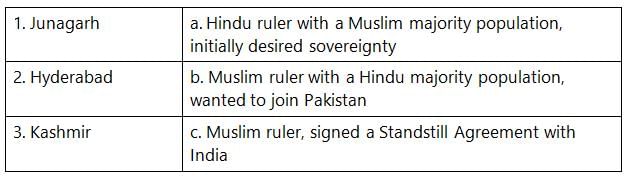
- a)1-a, 2-b, 3-c
- b)1-c, 2-a, 3-b
- c)1-b, 2-c, 3-a
- d)1-c, 2-b, 3-a
Correct answer is option 'C'. Can you explain this answer?
Match the Pairs Match the princely states with their respective issues during the integration process:
a)
1-a, 2-b, 3-c
b)
1-c, 2-a, 3-b
c)
1-b, 2-c, 3-a
d)
1-c, 2-b, 3-a
| | Master Training Institute answered |
Junagarh had a Muslim ruler wanting to join Pakistan but a Hindu majority population. Hyderabad, under its Muslim ruler, signed a Standstill Agreement with India. Kashmir had a Hindu ruler with a Muslim majority population and initially desired sovereignty.
Chapter doubts & questions for Independence and After - Spectrum for Modern History: Summary & Tests 2026 is part of UPSC CSE exam preparation. The chapters have been prepared according to the UPSC CSE exam syllabus. The Chapter doubts & questions, notes, tests & MCQs are made for UPSC CSE 2026 Exam. Find important definitions, questions, notes, meanings, examples, exercises, MCQs and online tests here.
Chapter doubts & questions of Independence and After - Spectrum for Modern History: Summary & Tests in English & Hindi are available as part of UPSC CSE exam. Download more important topics, notes, lectures and mock test series for UPSC CSE Exam by signing up for free.
Spectrum for Modern History: Summary & Tests3 videos|67 docs|48 tests |
