


All Exams > Mechanical Engineering > Theory of Machines (TOM) > All Questions
All questions of Velocity & Acceleration Analysis for Mechanical Engineering Exam

The space centrode of a circular disc rolling on a straight path is- a)a circle
- b)a parabola
- c)a straight line
- d)ellipse
Correct answer is option 'C'. Can you explain this answer?
The space centrode of a circular disc rolling on a straight path is
a)
a circle
b)
a parabola
c)
a straight line
d)
ellipse
 | Arnav Menon answered |
Explanation:
The space centrode of a circular disc rolling on a straight path is a straight line.
Definition of Space Centrode:
The space centrode is the locus of the instantaneous centers of rotation of a rolling body. It is a curve that describes the path traced by the point of contact of two bodies in rolling contact. For a disc rolling on a straight path, the space centrode is a straight line.
Derivation:
Consider a circular disc of radius r rolling on a straight path. Let O be the center of the disc, and P be the point of contact between the disc and the path. Let C be the instantaneous center of rotation of the disc, and let Q be the point of contact between the disc and its image in a plane perpendicular to the path.
Now, as the disc rolls, the point P moves along the path, and the point Q moves along a circle of radius r centered at C. Therefore, the locus of C is a straight line passing through the point of contact P.
Hence, the space centrode of a circular disc rolling on a straight path is a straight line.
Applications:
The concept of space centrode is widely used in kinematics and dynamics of machinery. It is used to analyze the motion of rolling bodies, such as gears, cams, and rollers. The knowledge of space centrode helps in designing mechanisms with desired motion characteristics, such as constant velocity, acceleration, and deceleration. It also helps in minimizing wear and tear of the contacting surfaces, by ensuring that the instantaneous centers of rotation lie on the surfaces.
The space centrode of a circular disc rolling on a straight path is a straight line.
Definition of Space Centrode:
The space centrode is the locus of the instantaneous centers of rotation of a rolling body. It is a curve that describes the path traced by the point of contact of two bodies in rolling contact. For a disc rolling on a straight path, the space centrode is a straight line.
Derivation:
Consider a circular disc of radius r rolling on a straight path. Let O be the center of the disc, and P be the point of contact between the disc and the path. Let C be the instantaneous center of rotation of the disc, and let Q be the point of contact between the disc and its image in a plane perpendicular to the path.
Now, as the disc rolls, the point P moves along the path, and the point Q moves along a circle of radius r centered at C. Therefore, the locus of C is a straight line passing through the point of contact P.
Hence, the space centrode of a circular disc rolling on a straight path is a straight line.
Applications:
The concept of space centrode is widely used in kinematics and dynamics of machinery. It is used to analyze the motion of rolling bodies, such as gears, cams, and rollers. The knowledge of space centrode helps in designing mechanisms with desired motion characteristics, such as constant velocity, acceleration, and deceleration. It also helps in minimizing wear and tear of the contacting surfaces, by ensuring that the instantaneous centers of rotation lie on the surfaces.
The locus of instantaneous center of a moving body relative to a fixed body is known as the- a)space centrode
- b)bodycentrode
- c)moving centrode
- d)none of these
Correct answer is option 'A'. Can you explain this answer?
The locus of instantaneous center of a moving body relative to a fixed body is known as the
a)
space centrode
b)
bodycentrode
c)
moving centrode
d)
none of these
 | Arnab Saini answered |
A centrode is the locus of the I-center of a plane body relative to another plane body for the range of motion specified or during a finite period of time.
Space centrode (or fixed centrode) is the locus of the I-center of the moving body relative to the fixed body.
Body centrode (or moving centrode) is the locus of the I-center of the fixed body relative to the movable body.
Space centrode (or fixed centrode) is the locus of the I-center of the moving body relative to the fixed body.
Body centrode (or moving centrode) is the locus of the I-center of the fixed body relative to the movable body.
Klein’s construction can be used when- a)Crank has a uniform angular velocity
- b)Crank has a non-uniform velocity
- c)Crank has uniform angular acceleration
- d)Crank has a uniform angular velocity and angular acceleration
Correct answer is option 'A'. Can you explain this answer?
Klein’s construction can be used when
a)
Crank has a uniform angular velocity
b)
Crank has a non-uniform velocity
c)
Crank has uniform angular acceleration
d)
Crank has a uniform angular velocity and angular acceleration
 | Nitin Joshi answered |
Klein’s construction is used to determine the acceleration of various parts and this method is used when crank has uniform angular velocity.
Examine the figure shown below wherein the numbers indicate the links:
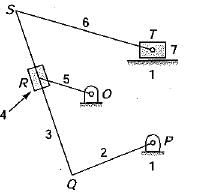 Which of the statements given below are correct?
1. I34 is at ∞, perpendicular to QS
2. I45 is at perpendicular to QS
3. I71 is at T
4. I45 is at R- a)1 and 2
- b)1 and 4
- c)2 and 3
- d)1, 3 and 4
Correct answer is option 'B'. Can you explain this answer?
Examine the figure shown below wherein the numbers indicate the links:
Which of the statements given below are correct?
1. I34 is at ∞, perpendicular to QS
2. I45 is at perpendicular to QS
3. I71 is at T
4. I45 is at R
1. I34 is at ∞, perpendicular to QS
2. I45 is at perpendicular to QS
3. I71 is at T
4. I45 is at R
a)
1 and 2
b)
1 and 4
c)
2 and 3
d)
1, 3 and 4
 | Amol Verma answered |
Links 4 and link 5 are connected by a revolute joint. in that case, the relative I-centre between those links will be the centre of the revolute joint.
The number of links in a planer mechanism with revolute joints having 10 instantaneous centre is- a)3
- b)4
- c)5
- d)6
Correct answer is option 'C'. Can you explain this answer?
The number of links in a planer mechanism with revolute joints having 10 instantaneous centre is
a)
3
b)
4
c)
5
d)
6
 | Kajal Tiwari answered |
Number of instantaneous centre

for n = 5
we get Number of instantaneous centre = 10
for n = 5
we get Number of instantaneous centre = 10


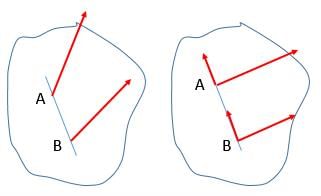
There are two points P and Q on a planar rigid body. The relative velocity between the two points- a)should always be perpendicular to PQ
- b)can be oriented along any direction
- c)should always be along PQ
- d)should be along QP when the body undergoes pure translation
Correct answer is option 'A'. Can you explain this answer?
There are two points P and Q on a planar rigid body. The relative velocity between the two points
a)
should always be perpendicular to PQ
b)
can be oriented along any direction
c)
should always be along PQ
d)
should be along QP when the body undergoes pure translation
| | Samarth Ghoshal answered |
Given any two points A and B on a rigid body, let line AB be passing through points A and B, then the components of velocity of A and B along the line AB are always equal as the distance between A and B never changes or we can say relative velocity along AB is always zero.
Hence the relative velocity of the points must be perpendicular to the line joining them.
According to Kennedy's theorem, the instantaneous centers of three bodies having relative motion lie on a- a)curved path
- b)straight line
- c)point
- d)approximate straight line
Correct answer is option 'B'. Can you explain this answer?
According to Kennedy's theorem, the instantaneous centers of three bodies having relative motion lie on a
a)
curved path
b)
straight line
c)
point
d)
approximate straight line
 | Sahana Dey answered |
If three plane bodies have relative motion among themselves, their I-center must lie on a straight line, this is known as Kennedy’s theorem.
Coriolis component of acceleration is always- a)Parallel to link
- b)Perpendicular to link
- c)Radially outward along link
- d)Coincident with the axis of link
Correct answer is option 'B'. Can you explain this answer?
Coriolis component of acceleration is always
a)
Parallel to link
b)
Perpendicular to link
c)
Radially outward along link
d)
Coincident with the axis of link
 | Isha Nambiar answered |
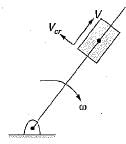
Coriolis component of acceleration appears in the direction perpendicular to the link.
The instantaneous center of a slider moving in a curved surface lies- a)infinity
- b)at the point of contact
- c)at the center of curvature
- d)all of these
Correct answer is option 'C'. Can you explain this answer?
The instantaneous center of a slider moving in a curved surface lies
a)
infinity
b)
at the point of contact
c)
at the center of curvature
d)
all of these
 | Devansh Nambiar answered |
In a sliding motion, the I-center lies at infinity in a direction perpendicular to the path of motion of the slider. The sliding motion is equivalent to a rotary motion of the links with the radius of curvature as infinity.
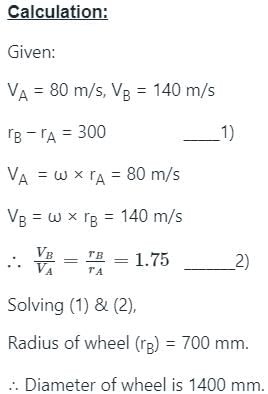
Two points A and B located along the radius of wheel as shown below, have velocities of 80m/s and 140 m/s respectively.
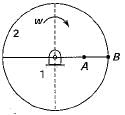
The distance between the points A and B is 300 mm. The radius of the wheel (in mm) is- a)400
- b)500
- c)600
- d)700
Correct answer is option 'D'. Can you explain this answer?
Two points A and B located along the radius of wheel as shown below, have velocities of 80m/s and 140 m/s respectively.
The distance between the points A and B is 300 mm. The radius of the wheel (in mm) is
The distance between the points A and B is 300 mm. The radius of the wheel (in mm) is
a)
400
b)
500
c)
600
d)
700
 | Crack Gate answered |
V = r × ω
r = Distance of point from axis of rotation
ω = Angular velocity
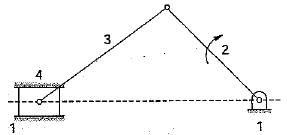
The given figure shows a slider mechanism in which link 1 is fixed. The number of instantaneous centers would be
- a)6
- b)5
- c)4
- d)12
Correct answer is option 'C'. Can you explain this answer?
The given figure shows a slider mechanism in which link 1 is fixed. The number of instantaneous centers would be
a)
6
b)
5
c)
4
d)
12
 | Constructing Careers answered |
A body has a plane motion, if all its points move in planes which are parallel to some reference plane. A body with plane motion will have only three degree of freedom. Hence the correct answer is 4.
A line drawn through an instantaneous center and perpendicular to the plane of motion is called instantaneous axis. The locus of this axis is known as- a)centrode
- b)bodycentrode
- c)space centrode
- d)axode
Correct answer is option 'D'. Can you explain this answer?
A line drawn through an instantaneous center and perpendicular to the plane of motion is called instantaneous axis. The locus of this axis is known as
a)
centrode
b)
bodycentrode
c)
space centrode
d)
axode
 | Arshiya Dasgupta answered |
The correct answer is option 'D' - axode.
Explanation:
- In kinematics, the instantaneous center is a hypothetical point around which a body is momentarily rotating at a given instant.
- When a body is in motion, every point on the body has a velocity vector associated with it. The direction of this velocity vector helps us determine the axis of rotation at that instant.
- The instantaneous center is the point where the velocity vectors of all points on the body intersect.
- The instantaneous axis is a line drawn through the instantaneous center and perpendicular to the plane of motion.
- This line represents the axis of rotation for the body at that instant.
- The locus of this instantaneous axis is known as the axode.
Importance of the axode:
- The axode helps us understand the motion of a rigid body.
- It provides information about the instantaneous rotation of the body at different points in time.
- By studying the axode, we can analyze the characteristics of the motion, such as the direction and magnitude of the angular velocity.
- The axode is particularly useful in the study of mechanisms and linkages, as it helps determine the instantaneous motion and behavior of the system.
Other options explained:
a) Centrode: The centrode is the locus of the instantaneous centers of two bodies in relative motion. It represents the path traced by the instantaneous center as the bodies move.
b) Bodycentrode: This term is not commonly used in the context of kinematics. It may be a typographical error or a specific term in a different field of study.
c) Space centrode: This term is not commonly used in the context of kinematics. It may be a typographical error or a specific term in a different field of study.
Explanation:
- In kinematics, the instantaneous center is a hypothetical point around which a body is momentarily rotating at a given instant.
- When a body is in motion, every point on the body has a velocity vector associated with it. The direction of this velocity vector helps us determine the axis of rotation at that instant.
- The instantaneous center is the point where the velocity vectors of all points on the body intersect.
- The instantaneous axis is a line drawn through the instantaneous center and perpendicular to the plane of motion.
- This line represents the axis of rotation for the body at that instant.
- The locus of this instantaneous axis is known as the axode.
Importance of the axode:
- The axode helps us understand the motion of a rigid body.
- It provides information about the instantaneous rotation of the body at different points in time.
- By studying the axode, we can analyze the characteristics of the motion, such as the direction and magnitude of the angular velocity.
- The axode is particularly useful in the study of mechanisms and linkages, as it helps determine the instantaneous motion and behavior of the system.
Other options explained:
a) Centrode: The centrode is the locus of the instantaneous centers of two bodies in relative motion. It represents the path traced by the instantaneous center as the bodies move.
b) Bodycentrode: This term is not commonly used in the context of kinematics. It may be a typographical error or a specific term in a different field of study.
c) Space centrode: This term is not commonly used in the context of kinematics. It may be a typographical error or a specific term in a different field of study.
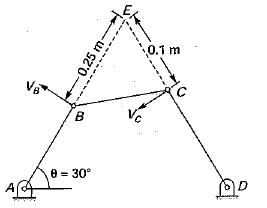
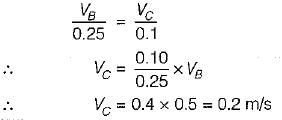
A four bar mechanism ABCD is shown in the given figure. If the linear velocity ‘VB’ of the point ‘B’ is 0.5 m/s, then the linear velocity ‘Vc’ of point ‘C’ will be
- a)1.25 m/s
- b)0.5 m/s
- c)0.4 m/s
- d)0.2 m/s
Correct answer is option 'D'. Can you explain this answer?
A four bar mechanism ABCD is shown in the given figure. If the linear velocity ‘VB’ of the point ‘B’ is 0.5 m/s, then the linear velocity ‘Vc’ of point ‘C’ will be
a)
1.25 m/s
b)
0.5 m/s
c)
0.4 m/s
d)
0.2 m/s
 | Keerthana Joshi answered |
E i s instantaneous center for the link A B and C D and angular velocity for the point B and C would be same about E
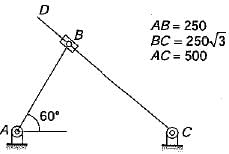
For the configuration shown, the angular velocity of link AB is 10 rad/s counter clockwise. The magnitude of the relative sliding velocity (in ms-1) of slider B with respect to rigid link CD is
- a)0
- b) 0.86
- c)1.25
- d)2.50
Correct answer is option 'D'. Can you explain this answer?
For the configuration shown, the angular velocity of link AB is 10 rad/s counter clockwise. The magnitude of the relative sliding velocity (in ms-1) of slider B with respect to rigid link CD is
a)
0
b)
0.86
c)
1.25
d)
2.50
| | Arshiya Dey answered |
As AB is perpendicular to slider for given condition, so sliding velocity of slider equals to velocity of link AB
= ω x AB = 10 x 0.25
= 2.5 m/s
= ω x AB = 10 x 0.25
= 2.5 m/s


The Coriolis acceleration component is taken into account for- a)double slider crank mechanism
- b)four link mechanism
- c)scotch yoke mechanism
- d)quick-return mechanism
Correct answer is option 'D'. Can you explain this answer?
The Coriolis acceleration component is taken into account for
a)
double slider crank mechanism
b)
four link mechanism
c)
scotch yoke mechanism
d)
quick-return mechanism
| | Rithika Kaur answered |
The Coriolis acceleration component is taken into account for the quick-return mechanism.
Quick-return Mechanism:
The quick-return mechanism is a type of mechanism commonly used in machines where a reciprocating motion is required. It consists of a crank and a slider connected by a connecting rod. The crank rotates at a constant speed, causing the slider to move back and forth.
Explanation of Coriolis Acceleration:
The Coriolis acceleration is a component of the acceleration experienced by a point on a moving body in a rotating reference frame. It arises due to the combination of the linear velocity of the point and the angular velocity of the reference frame. In the context of mechanisms, the Coriolis acceleration is taken into account when the motion involves rotating or oscillating elements.
Significance in Quick-return Mechanism:
In the quick-return mechanism, the crank rotates at a constant speed, causing the slider to move back and forth. The slider's motion is not in a straight line but rather a curved path. This curved path introduces the Coriolis acceleration component.
The Coriolis acceleration affects the velocity and acceleration of the slider as it moves along its curved path. It causes the slider's velocity to change direction and magnitude as it moves towards one end of the stroke and then towards the other end. This change in velocity results in an acceleration component known as the Coriolis acceleration.
The Coriolis acceleration component is essential to consider in the quick-return mechanism because it affects the overall performance and behavior of the mechanism. Neglecting the Coriolis acceleration can lead to inaccuracies in the analysis and design of the mechanism. By taking into account the Coriolis acceleration, engineers can accurately predict and analyze the motion, forces, and velocities involved in the quick-return mechanism.
Conclusion:
In summary, the Coriolis acceleration component is taken into account for the quick-return mechanism. It affects the velocity and acceleration of the slider as it moves along its curved path. Considering the Coriolis acceleration is crucial for accurate analysis and design of the quick-return mechanism.
Quick-return Mechanism:
The quick-return mechanism is a type of mechanism commonly used in machines where a reciprocating motion is required. It consists of a crank and a slider connected by a connecting rod. The crank rotates at a constant speed, causing the slider to move back and forth.
Explanation of Coriolis Acceleration:
The Coriolis acceleration is a component of the acceleration experienced by a point on a moving body in a rotating reference frame. It arises due to the combination of the linear velocity of the point and the angular velocity of the reference frame. In the context of mechanisms, the Coriolis acceleration is taken into account when the motion involves rotating or oscillating elements.
Significance in Quick-return Mechanism:
In the quick-return mechanism, the crank rotates at a constant speed, causing the slider to move back and forth. The slider's motion is not in a straight line but rather a curved path. This curved path introduces the Coriolis acceleration component.
The Coriolis acceleration affects the velocity and acceleration of the slider as it moves along its curved path. It causes the slider's velocity to change direction and magnitude as it moves towards one end of the stroke and then towards the other end. This change in velocity results in an acceleration component known as the Coriolis acceleration.
The Coriolis acceleration component is essential to consider in the quick-return mechanism because it affects the overall performance and behavior of the mechanism. Neglecting the Coriolis acceleration can lead to inaccuracies in the analysis and design of the mechanism. By taking into account the Coriolis acceleration, engineers can accurately predict and analyze the motion, forces, and velocities involved in the quick-return mechanism.
Conclusion:
In summary, the Coriolis acceleration component is taken into account for the quick-return mechanism. It affects the velocity and acceleration of the slider as it moves along its curved path. Considering the Coriolis acceleration is crucial for accurate analysis and design of the quick-return mechanism.
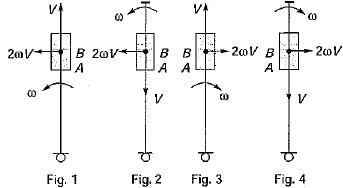
The directions of Coriolis component of acceleration, 2 ωV, of the slider A with respect to the coincident point B is shown in figure 1,2, 3 and 4. Directions shown by figures
- a)2 and 4 are wrong
- b)1 and 2 are wrong
- c)1 and 3 are wrong
- d)2 and 3 are wrong
Correct answer is option 'A'. Can you explain this answer?
The directions of Coriolis component of acceleration, 2 ωV, of the slider A with respect to the coincident point B is shown in figure 1,2, 3 and 4. Directions shown by figures
a)
2 and 4 are wrong
b)
1 and 2 are wrong
c)
1 and 3 are wrong
d)
2 and 3 are wrong
| | Sinjini Bose answered |
fcor = 2Vω
2 and 4 are wrong according to above equation. These should be as show below.
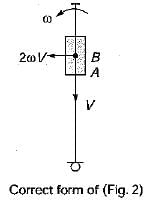
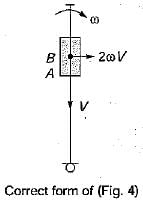
2 and 4 are wrong according to above equation. These should be as show below.
The Coriolis acceleration component- a)lags the sliding velocity by 900
- b)leads the sliding velocity by 900
- c)lags the sliding velocity by 1800
- d)leads the sliding velocity by 1800
Correct answer is option 'B'. Can you explain this answer?
The Coriolis acceleration component
a)
lags the sliding velocity by 900
b)
leads the sliding velocity by 900
c)
lags the sliding velocity by 1800
d)
leads the sliding velocity by 1800
 | Prateek Mukherjee answered |
The Coriolis Acceleration Component
Introduction
The Coriolis acceleration component is an important concept in the study of mechanics and fluid dynamics. It relates to the acceleration experienced by a particle moving in a rotating reference frame, such as the Earth. The Coriolis effect causes the motion of an object to deviate from what it would be in a non-rotating frame of reference, and the Coriolis acceleration component quantifies this deviation.
Understanding the Coriolis Effect
Before discussing the Coriolis acceleration component, it's essential to understand the Coriolis effect. The Coriolis effect occurs when an object or fluid particle moves in a rotating reference frame. It causes the object to appear to deflect to the right in the Northern Hemisphere and to the left in the Southern Hemisphere.
Coriolis Acceleration Component
The Coriolis acceleration component is the acceleration experienced by a particle due to the Coriolis effect. It is perpendicular to both the particle's velocity vector and the axis of rotation. The magnitude of the Coriolis acceleration is given by the equation:
a_c = 2 * v * Ω * sin(θ)
Where:
- a_c is the Coriolis acceleration component
- v is the velocity of the particle
- Ω is the angular velocity of the rotating reference frame
- θ is the angle between the velocity vector and the axis of rotation
Phase Relationship
The phase relationship between the Coriolis acceleration component and the sliding velocity depends on the sign of the angle θ. If θ is positive, the Coriolis acceleration component leads the sliding velocity, and if θ is negative, it lags the sliding velocity.
In the given question, it states that the Coriolis acceleration component leads the sliding velocity by 900. Therefore, the correct answer is option 'B', which states that the Coriolis acceleration component leads the sliding velocity by 900.
Conclusion
The Coriolis acceleration component is an important aspect of the Coriolis effect and quantifies the acceleration experienced by a particle in a rotating reference frame. It leads or lags the sliding velocity depending on the sign of the angle between the velocity vector and the axis of rotation. In the given question, the Coriolis acceleration component is stated to lead the sliding velocity by 900, making option 'B' the correct answer.
Introduction
The Coriolis acceleration component is an important concept in the study of mechanics and fluid dynamics. It relates to the acceleration experienced by a particle moving in a rotating reference frame, such as the Earth. The Coriolis effect causes the motion of an object to deviate from what it would be in a non-rotating frame of reference, and the Coriolis acceleration component quantifies this deviation.
Understanding the Coriolis Effect
Before discussing the Coriolis acceleration component, it's essential to understand the Coriolis effect. The Coriolis effect occurs when an object or fluid particle moves in a rotating reference frame. It causes the object to appear to deflect to the right in the Northern Hemisphere and to the left in the Southern Hemisphere.
Coriolis Acceleration Component
The Coriolis acceleration component is the acceleration experienced by a particle due to the Coriolis effect. It is perpendicular to both the particle's velocity vector and the axis of rotation. The magnitude of the Coriolis acceleration is given by the equation:
a_c = 2 * v * Ω * sin(θ)
Where:
- a_c is the Coriolis acceleration component
- v is the velocity of the particle
- Ω is the angular velocity of the rotating reference frame
- θ is the angle between the velocity vector and the axis of rotation
Phase Relationship
The phase relationship between the Coriolis acceleration component and the sliding velocity depends on the sign of the angle θ. If θ is positive, the Coriolis acceleration component leads the sliding velocity, and if θ is negative, it lags the sliding velocity.
In the given question, it states that the Coriolis acceleration component leads the sliding velocity by 900. Therefore, the correct answer is option 'B', which states that the Coriolis acceleration component leads the sliding velocity by 900.
Conclusion
The Coriolis acceleration component is an important aspect of the Coriolis effect and quantifies the acceleration experienced by a particle in a rotating reference frame. It leads or lags the sliding velocity depending on the sign of the angle between the velocity vector and the axis of rotation. In the given question, the Coriolis acceleration component is stated to lead the sliding velocity by 900, making option 'B' the correct answer.
Consider a pin jointed 4-bar mechanism as shown in the figure below.
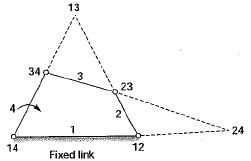
Which of the following are permanent instantaneous centers?- a)I12 and I14
- b)I23 and I34
- c)I13 and I24
- d)I14 and I23
Correct answer is option 'B'. Can you explain this answer?
Consider a pin jointed 4-bar mechanism as shown in the figure below.
Which of the following are permanent instantaneous centers?
Which of the following are permanent instantaneous centers?
a)
I12 and I14
b)
I23 and I34
c)
I13 and I24
d)
I14 and I23
| | Aman Ghosh answered |
I12 and I14 are fixed instantaneous center.
I23 and I34 are permanent instantaneous center.
I13 and I24 are movable instantaneous center.
I23 and I34 are permanent instantaneous center.
I13 and I24 are movable instantaneous center.

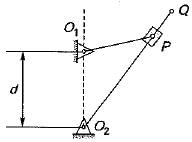
A simple quick return mechanism is shown in the figure. The forward to return ratio of the quick return mechanism is 2 : 1. If the radius of the crank O1P is 125 mm, then the distance ‘of’ (in mm) between the crank centre to lever pivot centre point should be
- a)144.3
- b)216.5
- c)240.0
- d)250.0
Correct answer is option 'D'. Can you explain this answer?
A simple quick return mechanism is shown in the figure. The forward to return ratio of the quick return mechanism is 2 : 1. If the radius of the crank O1P is 125 mm, then the distance ‘of’ (in mm) between the crank centre to lever pivot centre point should be
a)
144.3
b)
216.5
c)
240.0
d)
250.0
| | Dishani Desai answered |
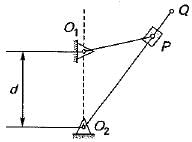
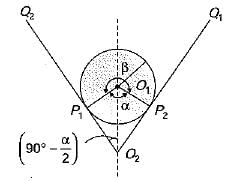
O1P = 125mm
Quick return mechanism

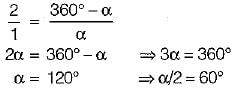
The extreme position of the crank (O1P) are shown in figure.
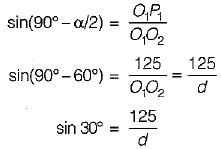
From right angle triangle O2O1P1, we find that
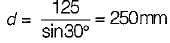
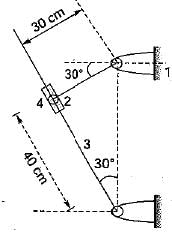
In the figure given the link 2 rotates at an angular velocity of 2 rad/s. What is the magnitude of Coriolis acceleration experienced by the link 4?
- a)0
- b)0.8 m/s2
- c)0.24 m/s2
- d)0.32 m/s2
Correct answer is option 'A'. Can you explain this answer?
In the figure given the link 2 rotates at an angular velocity of 2 rad/s. What is the magnitude of Coriolis acceleration experienced by the link 4?
a)
0
b)
0.8 m/s2
c)
0.24 m/s2
d)
0.32 m/s2
| | Keerthana Joshi answered |
Since link 2 and link 3 are perpendicular each other
ω = 0
∴ fcor = 0
ω = 0
∴ fcor = 0
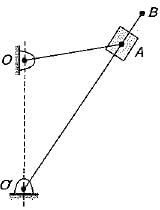

The instantaneous center of rotation of a circular disc rolling on a straight path is- a)at the center of disc
- b)at their point of contact
- c)at the center of gravity of the disc
- d)at infinity
Correct answer is option 'B'. Can you explain this answer?
The instantaneous center of rotation of a circular disc rolling on a straight path is
a)
at the center of disc
b)
at their point of contact
c)
at the center of gravity of the disc
d)
at infinity
 | Sahana Chavan answered |
The instantaneous center of rotation (ICR) is a point on a moving body that has zero velocity at a particular instant. For a circular disc rolling on a straight path, the ICR is located at the point of contact between the disc and the straight path.
Explanation:
When a circular disc rolls on a straight path, the bottommost point of the disc is in contact with the straight path, and this point is stationary at any instant. At this point, the velocity of the disc is zero, and hence it is the ICR of the disc.
To understand this concept in detail, we can consider the following points:
1. The motion of a rolling disc:
When a circular disc rolls on a straight path, its motion can be resolved into two components: translation and rotation. The center of mass of the disc moves in a straight line, while the disc rotates about its center.
2. Velocity of the ICR:
At any instant, the velocity of the ICR is zero because it is the point on the disc that is momentarily at rest. The velocity of the other points on the disc can be determined by considering the motion of the disc as a combination of translation and rotation.
3. Location of the ICR:
The location of the ICR depends on the type of motion of the rolling body. For a circular disc rolling on a straight path, the ICR is located at the point of contact between the disc and the straight path. This is because the bottommost point of the disc is stationary, and hence it has zero velocity.
Conclusion:
In conclusion, the instantaneous center of rotation of a circular disc rolling on a straight path is located at the point of contact between the disc and the straight path. This is because the bottommost point of the disc is stationary, and hence it has zero velocity. Understanding the concept of ICR is essential in the study of mechanics and is used in various applications, including robotics and vehicle dynamics.
Explanation:
When a circular disc rolls on a straight path, the bottommost point of the disc is in contact with the straight path, and this point is stationary at any instant. At this point, the velocity of the disc is zero, and hence it is the ICR of the disc.
To understand this concept in detail, we can consider the following points:
1. The motion of a rolling disc:
When a circular disc rolls on a straight path, its motion can be resolved into two components: translation and rotation. The center of mass of the disc moves in a straight line, while the disc rotates about its center.
2. Velocity of the ICR:
At any instant, the velocity of the ICR is zero because it is the point on the disc that is momentarily at rest. The velocity of the other points on the disc can be determined by considering the motion of the disc as a combination of translation and rotation.
3. Location of the ICR:
The location of the ICR depends on the type of motion of the rolling body. For a circular disc rolling on a straight path, the ICR is located at the point of contact between the disc and the straight path. This is because the bottommost point of the disc is stationary, and hence it has zero velocity.
Conclusion:
In conclusion, the instantaneous center of rotation of a circular disc rolling on a straight path is located at the point of contact between the disc and the straight path. This is because the bottommost point of the disc is stationary, and hence it has zero velocity. Understanding the concept of ICR is essential in the study of mechanics and is used in various applications, including robotics and vehicle dynamics.
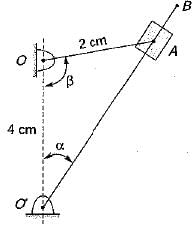
In the figure shown, the relative velocity of link 1 with respect of link 2 is 12 m/sec. Link 2 rotates at a constant speed of 120 rpm. The magnitude of Coriolis component of acceleration of link 1 is
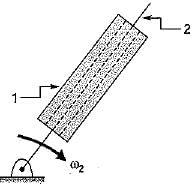
- a)302 m/s2
- b)604 m/s2
- c)906 m/s2
- d)1208 m/s2
Correct answer is option 'A'. Can you explain this answer?
In the figure shown, the relative velocity of link 1 with respect of link 2 is 12 m/sec. Link 2 rotates at a constant speed of 120 rpm. The magnitude of Coriolis component of acceleration of link 1 is
a)
302 m/s2
b)
604 m/s2
c)
906 m/s2
d)
1208 m/s2
 | Sanskriti Basu answered |
Velocity of link 1 with respect to 2
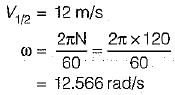
∴ Coriolis component of acceleration
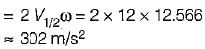
∴ Coriolis component of acceleration


Chapter doubts & questions for Velocity & Acceleration Analysis - Theory of Machines (TOM) 2026 is part of Mechanical Engineering exam preparation. The chapters have been prepared according to the Mechanical Engineering exam syllabus. The Chapter doubts & questions, notes, tests & MCQs are made for Mechanical Engineering 2026 Exam. Find important definitions, questions, notes, meanings, examples, exercises, MCQs and online tests here.
Chapter doubts & questions of Velocity & Acceleration Analysis - Theory of Machines (TOM) in English & Hindi are available as part of Mechanical Engineering exam. Download more important topics, notes, lectures and mock test series for Mechanical Engineering Exam by signing up for free.
Theory of Machines (TOM)87 videos|85 docs|29 tests |
