


All Exams > Physics > Modern Physics > All Questions
All questions of Special Theory of Relativity for Physics Exam
Which of the following statements is true?- a)The rest mass of a photon is zero and increases as it approaches the speed of light.
- b)The mass of a photon is always zero
- c)The mass of a particle always remains the same
- d)The mass of a particle moving at speeds comparable to c, is greater than its rest mass
Correct answer is option 'A,D'. Can you explain this answer?
Which of the following statements is true?
a)
The rest mass of a photon is zero and increases as it approaches the speed of light.
b)
The mass of a photon is always zero
c)
The mass of a particle always remains the same
d)
The mass of a particle moving at speeds comparable to c, is greater than its rest mass
 | Vedika Singh answered |
a)
The rest mass of a photon is zero and increases as it approaches the speed of light.
Is completely correct
b)
The mass of a photon is always zero
No, the rest mass of photon is always zero
c)
The mass of a particle always remains the same
No, the rest mass of a particle always remains same
d)
The mass of a particle moving at speeds comparable to c, is greater than its rest mass
Yes, this is correct
So, A,D are correct.
The rest mass of a photon is zero and increases as it approaches the speed of light.
Is completely correct
b)
The mass of a photon is always zero
No, the rest mass of photon is always zero
c)
The mass of a particle always remains the same
No, the rest mass of a particle always remains same
d)
The mass of a particle moving at speeds comparable to c, is greater than its rest mass
Yes, this is correct
So, A,D are correct.

According to Einsteins postulates of special theory of relativity- a)The speed of light in any medium is constant for all inertial observers, regardless of the motion of the source
- b)The speed of light in vacuum is constant for all inertial observers regardless of the motion of the source
- c)The laws of physics apply in all non accelerating reference systems.
- d)The laws of physics apply in all reference systems
Correct answer is option 'B,C'. Can you explain this answer?
According to Einsteins postulates of special theory of relativity
a)
The speed of light in any medium is constant for all inertial observers, regardless of the motion of the source
b)
The speed of light in vacuum is constant for all inertial observers regardless of the motion of the source
c)
The laws of physics apply in all non accelerating reference systems.
d)
The laws of physics apply in all reference systems
 | Bhavna Choudhury answered |
Einstein's Postulates of Special Theory of Relativity
The special theory of relativity, proposed by Albert Einstein in 1905, is based on two fundamental postulates that revolutionized our understanding of space and time.
1. The Constancy of the Speed of Light
- The speed of light in a vacuum is constant and is approximately 299,792 kilometers per second (or about 186,282 miles per second).
- This speed is the same for all inertial observers, meaning that regardless of their relative motion or the motion of the light source, they will measure the speed of light to be the same.
- This postulate challenges classical notions of speed and motion, where speeds were thought to be additive.
2. The Principle of Relativity
- The laws of physics are the same in all non-accelerating (inertial) reference frames.
- This means that experiments conducted in one inertial frame will yield the same results when performed in another inertial frame, regardless of their relative velocities.
- This principle ensures that there is no preferred inertial frame in the universe, promoting a more unified understanding of physical laws.
Conclusion
The correct options, 'B' and 'C', emphasize the key aspects of Einstein's theory. Option 'B' highlights the constancy of the speed of light in vacuum, which is a cornerstone of relativity. Option 'C' reinforces the universality of physical laws across all inertial frames. Together, these principles form the foundation of modern physics, reshaping our understanding of time, space, and the nature of reality.
The special theory of relativity, proposed by Albert Einstein in 1905, is based on two fundamental postulates that revolutionized our understanding of space and time.
1. The Constancy of the Speed of Light
- The speed of light in a vacuum is constant and is approximately 299,792 kilometers per second (or about 186,282 miles per second).
- This speed is the same for all inertial observers, meaning that regardless of their relative motion or the motion of the light source, they will measure the speed of light to be the same.
- This postulate challenges classical notions of speed and motion, where speeds were thought to be additive.
2. The Principle of Relativity
- The laws of physics are the same in all non-accelerating (inertial) reference frames.
- This means that experiments conducted in one inertial frame will yield the same results when performed in another inertial frame, regardless of their relative velocities.
- This principle ensures that there is no preferred inertial frame in the universe, promoting a more unified understanding of physical laws.
Conclusion
The correct options, 'B' and 'C', emphasize the key aspects of Einstein's theory. Option 'B' highlights the constancy of the speed of light in vacuum, which is a cornerstone of relativity. Option 'C' reinforces the universality of physical laws across all inertial frames. Together, these principles form the foundation of modern physics, reshaping our understanding of time, space, and the nature of reality.
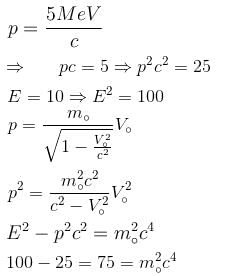
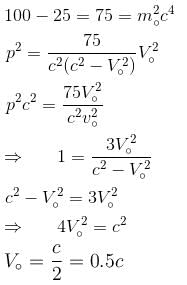
An observer O at rest midway between 2 sources of light at x = 0 and x = 10m, observes the 2 sources to flash simultaneously. According to a second observer O', moving at a constant speed parallel to the x-axis, one source flashes 13ns before the other. Find the speed of O' relatives to O (in units of c)
Correct answer is '0.363'. Can you explain this answer?
An observer O at rest midway between 2 sources of light at x = 0 and x = 10m, observes the 2 sources to flash simultaneously. According to a second observer O', moving at a constant speed parallel to the x-axis, one source flashes 13ns before the other. Find the speed of O' relatives to O (in units of c)
 | Rutuja Sengupta answered |
A → Flashing observed from first source (at x = 0)
B → Flashing observed from second source (at x = 10)
Now Event (A) occurs (at x = 0) Event B occurs (at x = 10)
For O t = 0 t = 0
For O' t = 0 t = 13 ns
For O' t = 0 t = 13 ns
Here we assumed that both observers observe event A at t = 0
Now the problem says that for O', one event occurs 13 ns before the other.
∴ O' observes event B at t = 13 ns
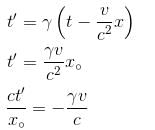
Now, applying transformation for time
∴ O' observes event B at t = 13 ns
Now, applying transformation for time

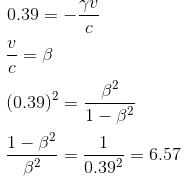
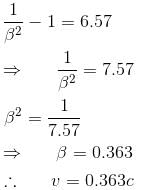
The correct answer is: 0.363
A space crew has a life support system that can last only for 1000 hours. What minimum speed would be required for safe travel of the crew between two space stations separated by a fixed distance of 1.08 x 10¹² km ?- a)c / √3
- b)c / √5
- c)c/2
- d)c / √2
Correct answer is option 'D'. Can you explain this answer?
A space crew has a life support system that can last only for 1000 hours. What minimum speed would be required for safe travel of the crew between two space stations separated by a fixed distance of 1.08 x 10¹² km ?
a)
c / √3
b)
c / √5
c)
c/2
d)
c / √2
 | Pie Academy answered |
To determine the minimum speed required for safe travel, use the formula:
Speed = Distance / Time
- Distance = 1.08 x 10¹² km
- Time = 1000 hours
Convert distance to km/h (as speed will be in km/h):
Speed = (1.08 x 10¹² km) / (1000 hours) = 1.08 x 10⁹ km/h
Now compare this to the speed of light (c = 3 x 10⁸ m/s or 1.08 x 10⁹ km/h):
- Required speed = c / √2
Thus, option D is correct.
A rocket ship leaves earth at a speed of 3/5 c.When a clock on the rocket says 1 hour has elapsed, the rocket ship sends a light signal back to earth. Choose the correct statement (s)- a)According to the earth clock the signal was sent at 75 minutes after departure of the rocket
- b)According to the earth clock, the signal reached earth 120 minutes after the rocket’s departure
- c)According to earth clock, the signal was sent 60 minutes after departure of rocket.
- d)According to the rocket observer the signal reached earth 150 minutes after the rocket left.
Correct answer is option 'A,B,D'. Can you explain this answer?
A rocket ship leaves earth at a speed of 3/5 c.When a clock on the rocket says 1 hour has elapsed, the rocket ship sends a light signal back to earth. Choose the correct statement (s)
a)
According to the earth clock the signal was sent at 75 minutes after departure of the rocket
b)
According to the earth clock, the signal reached earth 120 minutes after the rocket’s departure
c)
According to earth clock, the signal was sent 60 minutes after departure of rocket.
d)
According to the rocket observer the signal reached earth 150 minutes after the rocket left.
 | Partho Gupta answered |
Rocket runs slow so earth clock reads
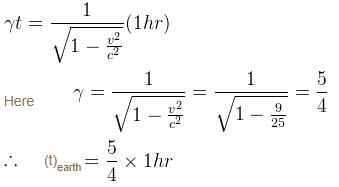
∴ Earth clock read 1 hr 15 minutes.
By the earth observer, the rocket is now at a distance of 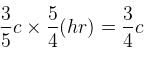 hours away.
∴
hours away.∴
light signal will take 3/4 hour to return to earth.
Since, the signal left 5/4 hr after the departure
∴ light signal reaches 5/4 + 3/4 = 2hrs later.
Earth clock runs slow (in the reference frame of the rocket)
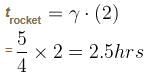
The correct answers are: According to the earth clock the signal was sent at 75 minutes after departure of the rocket, According to the rocket observer the signal reached earth 150 minutes after the rocket left., According to the earth clock, the signal reached earth 120 minutes after the rocket’s departure
The ultraviolet Lyman α line of hydrogen with wavelength 121.5 nm is emitted by an astronomical object. An observer on earth measures the wavelength of the light received from the object to be 607.5 nm. The observer can conclude that the object is moving with a radial velocity of :- a)2.8 × 10⁸ m/s away from Earth
- b)2.4 × 10⁸ m/s towards Earth
- c)2.4 × 10⁸ m/s away from Earth
- d)2.8 × 10⁸ m/s towards Earth
Correct answer is option 'A'. Can you explain this answer?
The ultraviolet Lyman α line of hydrogen with wavelength 121.5 nm is emitted by an astronomical object. An observer on earth measures the wavelength of the light received from the object to be 607.5 nm. The observer can conclude that the object is moving with a radial velocity of :
a)
2.8 × 10⁸ m/s away from Earth
b)
2.4 × 10⁸ m/s towards Earth
c)
2.4 × 10⁸ m/s away from Earth
d)
2.8 × 10⁸ m/s towards Earth
| | Milan Majumdar answered |
Since the light received has a higher wavelength than the incident wavelength, one concludes that this is a red shift, that the object is moving away from the Earth.
where λ0 is the wavelength of the source.
The doppler effect equation gives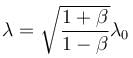
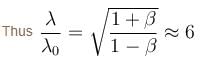
Solving this one gets β = 35/37
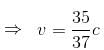
v = 2.8 × 10⁸ m/s
away from the Earth.
The doppler effect equation gives
Solving this one gets β = 35/37
v = 2.8 × 10⁸ m/s
away from the Earth.
The correct answer is: 2.8 × 10⁸ m/s away from Earth
Which is an example of PN junction diode?- a)Light Emitting Diode
- b)Light dependent resistor
- c)Photo Voltaic cell
- d)Capacitor
Correct answer is option 'A'. Can you explain this answer?
Which is an example of PN junction diode?
a)
Light Emitting Diode
b)
Light dependent resistor
c)
Photo Voltaic cell
d)
Capacitor
| | Akash Kulkarni answered |
PN Junction Diode
The correct example of a PN junction diode is a Light Emitting Diode (LED). Let's understand why LED fits the criteria of a PN junction diode:
What is a PN Junction Diode?
A PN junction diode is a semiconductor device that allows the flow of electric current in one direction while blocking it in the opposite direction. It is formed by joining a P-type semiconductor with an N-type semiconductor.
Light Emitting Diode (LED)
- An LED is a semiconductor device that emits light when an electric current passes through it.
- It consists of a PN junction, where the P-type and N-type semiconductors are brought together to create a depletion region.
- When a forward bias voltage is applied to the LED, electrons and holes recombine in the depletion region, releasing energy in the form of light.
- LED is a common example of a PN junction diode as it exhibits the characteristic behavior of allowing current flow in one direction while emitting light.
In conclusion, a Light Emitting Diode (LED) is a prime example of a PN junction diode due to its construction and functionality in emitting light when current flows through it in the forward bias direction.
What is the length of a metre stick moving parallel to its length when its mass is 3/2 times of its rest mass.- a)0.67 m
- b)0.4 m
- c)0.9 m
- d)0.1 m
Correct answer is option 'A'. Can you explain this answer?
What is the length of a metre stick moving parallel to its length when its mass is 3/2 times of its rest mass.
a)
0.67 m
b)
0.4 m
c)
0.9 m
d)
0.1 m
| | Sparsh Menon answered |
The mass of the rod is 3/2 times its rest mass, that is
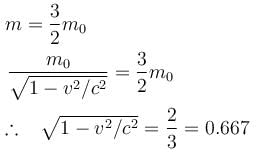
The length of meter stick moving parallel to its length, according to length contraction formula.
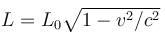
L0 = 1m
L = 1 × 0.667 = 0.67m
The correct answer is: 0.67 m
The length of meter stick moving parallel to its length, according to length contraction formula.
L0 = 1m
L = 1 × 0.667 = 0.67m
The correct answer is: 0.67 m
A positive kaon (k+) has a rest mass of 494 MeV/c2 whereas a proton has a rest mass of 938 MeV/c2. If a koan has a total energy that is equal to the proton rest energy, speed of the kaon is most nearly :- a)0.4 c
- b)0.55 c
- c)0.25 c
- d)0.85 c
Correct answer is option 'D'. Can you explain this answer?
A positive kaon (k+) has a rest mass of 494 MeV/c2 whereas a proton has a rest mass of 938 MeV/c2. If a koan has a total energy that is equal to the proton rest energy, speed of the kaon is most nearly :
a)
0.4 c
b)
0.55 c
c)
0.25 c
d)
0.85 c
| | Tanishq Goyal answered |
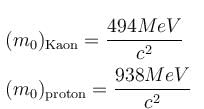

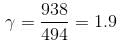
On solving
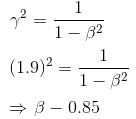
The correct answer is: 0.85 c
Two space ships approach Earth with equal speeds as measured by an observer on Earth, but from opposite directions. A meter stick on one spaceship is measured to be 60 cm long by an occupant of the other ship. What is the speed of each spaceship as measured from earth. (in units of c)?
Correct answer is '0.5'. Can you explain this answer?
Two space ships approach Earth with equal speeds as measured by an observer on Earth, but from opposite directions. A meter stick on one spaceship is measured to be 60 cm long by an occupant of the other ship. What is the speed of each spaceship as measured from earth. (in units of c)?
| | Niharika Choudhary answered |
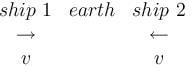
length of stick on ship 1 measured by ship 2 = 60 cm

Now, since each ship is moving with velocity v.
∴ Velocity of ship 2 wrt ship 1 = 2v

l0 = 1m (meter stick)
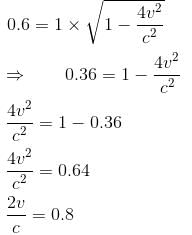
v = 0.4c
Speed of each ship = 0.4c
The correct answer is: 0.4
v = 0.4c
Speed of each ship = 0.4c
The correct answer is: 0.4
The half life of a π+ meson at rest is 2.5 × 10⁻⁸ s. A beam of π+ mesons is generated at a point 15m from a detector. Only half of the π+ mesons live to reach the detector. What is the speed of the π+ mesons? (in terms of c)
Correct answer is '0.89'. Can you explain this answer?
The half life of a π+ meson at rest is 2.5 × 10⁻⁸ s. A beam of π+ mesons is generated at a point 15m from a detector. Only half of the π+ mesons live to reach the detector. What is the speed of the π+ mesons? (in terms of c)
| | Maitri Sen answered |
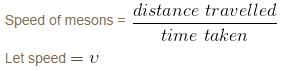
In the rest frame of mesons,
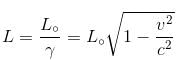
Life time (in rest frame of mesons) = 2.5 × 10⁻⁸ s
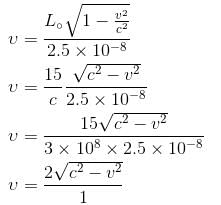
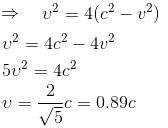
= 0.89
The correct answer is: 0.89
= 0.89
The correct answer is: 0.89
Choose the correct statement- a)The life time of particles remains the same in all cases
- b)Particles traveling at speeds close to the speed of light disintegrate slower than when they are at rest.
- c)Particles traveling at speeds close to the speed of light disintegrate faster than when they are at rest.
- d)The life time of particles is greater when they are moving at speeds comparable to c.
Correct answer is option 'B'. Can you explain this answer?
Choose the correct statement
a)
The life time of particles remains the same in all cases
b)
Particles traveling at speeds close to the speed of light disintegrate slower than when they are at rest.
c)
Particles traveling at speeds close to the speed of light disintegrate faster than when they are at rest.
d)
The life time of particles is greater when they are moving at speeds comparable to c.
 | Urvi Malhotra answered |
Explanation:
Particles traveling at speeds close to the speed of light disintegrate slower than when they are at rest. This phenomenon is known as time dilation and is a consequence of Einstein's theory of special relativity.
Time Dilation:
According to special relativity, the passage of time is not absolute but is relative to the observer's frame of reference. When an object is moving at a high velocity, time appears to pass slower for that object compared to a stationary observer. This effect is called time dilation.
Relativistic Time Dilation:
When particles travel at speeds close to the speed of light, they experience relativistic effects, including time dilation. As the speed of an object approaches the speed of light, its relative time slows down compared to a stationary observer. This means that the particles traveling at high speeds have a longer perceived lifetime compared to when they are at rest.
Explanation of Option B:
Option B states that particles traveling at speeds close to the speed of light disintegrate slower than when they are at rest. This statement is correct because of the phenomenon of time dilation. As particles move closer to the speed of light, their perceived time slows down, resulting in a longer lifetime.
Importance of Special Relativity:
Special relativity is a fundamental theory in physics that explains how time, space, and motion are interconnected. It has been experimentally verified in numerous experiments, including particle accelerators, where particles are accelerated to high speeds.
Conclusion:
Particles traveling at speeds close to the speed of light experience time dilation, causing their perceived lifetime to slow down compared to when they are at rest. This phenomenon is a consequence of Einstein's theory of special relativity and has been confirmed by experimental evidence. Thus, option B is the correct statement.
Particles traveling at speeds close to the speed of light disintegrate slower than when they are at rest. This phenomenon is known as time dilation and is a consequence of Einstein's theory of special relativity.
Time Dilation:
According to special relativity, the passage of time is not absolute but is relative to the observer's frame of reference. When an object is moving at a high velocity, time appears to pass slower for that object compared to a stationary observer. This effect is called time dilation.
Relativistic Time Dilation:
When particles travel at speeds close to the speed of light, they experience relativistic effects, including time dilation. As the speed of an object approaches the speed of light, its relative time slows down compared to a stationary observer. This means that the particles traveling at high speeds have a longer perceived lifetime compared to when they are at rest.
Explanation of Option B:
Option B states that particles traveling at speeds close to the speed of light disintegrate slower than when they are at rest. This statement is correct because of the phenomenon of time dilation. As particles move closer to the speed of light, their perceived time slows down, resulting in a longer lifetime.
Importance of Special Relativity:
Special relativity is a fundamental theory in physics that explains how time, space, and motion are interconnected. It has been experimentally verified in numerous experiments, including particle accelerators, where particles are accelerated to high speeds.
Conclusion:
Particles traveling at speeds close to the speed of light experience time dilation, causing their perceived lifetime to slow down compared to when they are at rest. This phenomenon is a consequence of Einstein's theory of special relativity and has been confirmed by experimental evidence. Thus, option B is the correct statement.
The increased life times of the moving particles is a manifestation of- a)Simultaneity
- b)Time contraction
- c)Time dilation
- d)Constant speed of light
Correct answer is option 'C'. Can you explain this answer?
The increased life times of the moving particles is a manifestation of
a)
Simultaneity
b)
Time contraction
c)
Time dilation
d)
Constant speed of light
| | Anirban Kapoor answered |
Time dilation results in the clock of moving particle running slow increased life time.
The correct answer is: Time dilation
The Lyman α spectral line of hydrogen (λ = 122nm) differs by 1.8 × 10⁻¹² m in spectra taken at the opposite ends of the sun’s equator. What is the speed of a particle on the equator due to the sun’s rotation, (in km/s)
Correct answer is '2.2'. Can you explain this answer?
The Lyman α spectral line of hydrogen (λ = 122nm) differs by 1.8 × 10⁻¹² m in spectra taken at the opposite ends of the sun’s equator. What is the speed of a particle on the equator due to the sun’s rotation, (in km/s)
| | Mahi Dasgupta answered |
When the sun rotates, one end of the equator moves towards us & the other moves away from us.
So, the difference given is basically the difference between the red & blue shift
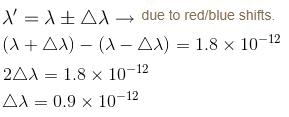
Now, using the non relativisitic doppler effect (since the speed of sun is much less than C)
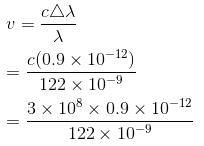
v = 2.2 km/s
The correct answer is: 2.2
The correct answer is: 2.2
According to Einstein’s Special Theory of Relativity, laws of physics can be formulated based on ____________ - a)Non-Inertial Frame of Reference
- b)Both Inertial and Non-Inertial Frame of Reference
- c)Inertial Frame of Reference
- d)Quantum State
Correct answer is option 'C'. Can you explain this answer?
According to Einstein’s Special Theory of Relativity, laws of physics can be formulated based on ____________
a)
Non-Inertial Frame of Reference
b)
Both Inertial and Non-Inertial Frame of Reference
c)
Inertial Frame of Reference
d)
Quantum State
| | Vedika Singh answered |
One of the postulates of Einstein’s Special Theory of Relativity states that all the inertial frames are equivalent to the formulation of laws of physics. Thus, it is suitable for all the inertial frames.
Choose the correct statement- a)Classical mechanics obeys theory of relativity
- b)Classical mechanics and Electrodynamics do not obey theory of relativity
- c)Electrodynamics obeys theory of relativity
- d)Classical mechanics does not obey theory of relativity
Correct answer is option 'A,C'. Can you explain this answer?
Choose the correct statement
a)
Classical mechanics obeys theory of relativity
b)
Classical mechanics and Electrodynamics do not obey theory of relativity
c)
Electrodynamics obeys theory of relativity
d)
Classical mechanics does not obey theory of relativity
| | Shreya Chauhan answered |
Both classical mechanics & Electrodynamics obey theory of relativity.
The correct answers are: Classical mechanics obeys theory of relativity, Electrodynamics obeys theory of relativity
A car of rest length 5 meters passes through a garage rest length 4 meters. Due to the relativistic Lorentz contraction, the car is only 3 meters long in the garage’s rest frame. There are doors on both ends of the garage, which open automatically when the front of the car reaches them and close automatically when the rear passes them. The opening or closing of each door requires a negligible amount of time.
The velocity of the car in the garage’s rest frame is- a)0.4c
- b)0.6c
- c)0.8c
- d)Greater than c
Correct answer is option 'C'. Can you explain this answer?
A car of rest length 5 meters passes through a garage rest length 4 meters. Due to the relativistic Lorentz contraction, the car is only 3 meters long in the garage’s rest frame. There are doors on both ends of the garage, which open automatically when the front of the car reaches them and close automatically when the rear passes them. The opening or closing of each door requires a negligible amount of time.
The velocity of the car in the garage’s rest frame is
a)
0.4c
b)
0.6c
c)
0.8c
d)
Greater than c
 | Jayant Mishra answered |
Length contraction: L = L0/γ
with γ = 1/(1 − v2/c2)½
Given for the car, L0 = 5 m and L = 3 m
γ = L0/L = 5/3 = 1/(1 − v2/c2)½
γ² = 25/9 = 1/(1 − v2/c2)
1 − v²/c² = 9/25
v²/c² = 1 − 9/25 = 16/25
v = 4/5 c = 0.8c
with γ = 1/(1 − v2/c2)½
Given for the car, L0 = 5 m and L = 3 m
γ = L0/L = 5/3 = 1/(1 − v2/c2)½
γ² = 25/9 = 1/(1 − v2/c2)
1 − v²/c² = 9/25
v²/c² = 1 − 9/25 = 16/25
v = 4/5 c = 0.8c
Consider two observers. One on the ground and another on a moving train. Both of them have clocks.
Choose the correct statements.- a)The ground clock runs faster than the train clock.
- b)The ground observer finds the train clock run slow.
- c)The train clock runs slow because it is the clock in motion.
- d)The train observer finds the ground clock run slow.
Correct answer is option 'B,D'. Can you explain this answer?
Consider two observers. One on the ground and another on a moving train. Both of them have clocks.
Choose the correct statements.
Choose the correct statements.
a)
The ground clock runs faster than the train clock.
b)
The ground observer finds the train clock run slow.
c)
The train clock runs slow because it is the clock in motion.
d)
The train observer finds the ground clock run slow.
| | Anirban Kapoor answered |
From the rest frame of the ground observer the clock in the train is moving. The train clock runs slow from the point of view of the ground observer. From the rest frame of the train observer, the ground clock appears to be moving
∴ From the reference frame of the train, the ground clock runs slow
∴ From the reference frame of the train, the ground clock runs slow
The correct answers are: The ground observer finds the train clock run slow., The train observer finds the ground clock run slow.
Two observers O and O' observe 2 events, A and B. The observers have a constant relative speed of 0.8c. In the units such that the speed of light is 1, observer O obtained the following coordinates. What is the length of the space time interval between these 2 events, as measured by O' ?
- a)2√3
- b)√2
- c)1
- d)2
Correct answer is option 'D'. Can you explain this answer?
Two observers O and O' observe 2 events, A and B. The observers have a constant relative speed of 0.8c. In the units such that the speed of light is 1, observer O obtained the following coordinates.
What is the length of the space time interval between these 2 events, as measured by O' ?
a)
2√3
b)
√2
c)
1
d)
2
| | Shail Ghoshal answered |
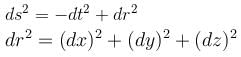
= 4 + 0 + 4 = 8
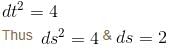
The correct answer is: 2
A photon strikes an electron of mass m that is initially at rest, creating an electron positron pair. The photon is destroyed and the positron and 2 electrons move off at equal speeds along the initial direction of the photon. Find energy of the photon (in units of mc2).
Correct answer is '4'. Can you explain this answer?
A photon strikes an electron of mass m that is initially at rest, creating an electron positron pair. The photon is destroyed and the positron and 2 electrons move off at equal speeds along the initial direction of the photon. Find energy of the photon (in units of mc2).
| | Preethi Joshi answered |
Let us work in the system of units in which c = 1
Now since E2 – p2 is an invariant quantity, we equate this in the initial laboratory frame and in the final frame of particles
In lab frame, the electron is at rest.
∴ Eelectron = m(c = 1) (Take m to be the mass of electron)
∴ Eelectron = m(c = 1) (Take m to be the mass of electron)
∴ Total Energy of the system is E + m = Energy of photon + Energy of electron
E, p are the total energy and momentum of the photon.
E, p are the total energy and momentum of the photon.
∴ 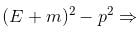 Laboratory frame ...(1)
Laboratory frame ...(1)In the final state of particles

E2 – p2 = (m + m + m)2
= (3m)2
= 9m2 ...(2)
= (3m)2
= 9m2 ...(2)
Equating for the 2 frames (1) = (2)
∴ (E + m)2 – p2 = 9m2
E2 + m2 + 2Em – p2 = 9m2
since a photon is massless
∴ (E + m)2 – p2 = 9m2
E2 + m2 + 2Em – p2 = 9m2
since a photon is massless
∴ E = p
∴ m2 + 2Em = 9m2
2Em = 8m2
E = 4m
Now in SI units
E = 4mc2
∴ m2 + 2Em = 9m2
2Em = 8m2
E = 4m
Now in SI units
E = 4mc2
The correct answer is: 4
A tube of water is travelling at c/2 relative to the lab frame when a beam of light travelling in the same direction as the tube enters it. What is the speed of light in the water relative to the lab frame? (The index of water is 4/3)
Correct answer is '0.909'. Can you explain this answer?
A tube of water is travelling at c/2 relative to the lab frame when a beam of light travelling in the same direction as the tube enters it. What is the speed of light in the water relative to the lab frame? (The index of water is 4/3)
| | Sanaya Kulkarni answered |
The beam of light travels through the water at a speed  while the tube itself is travelling at a speed c/2.
while the tube itself is travelling at a speed c/2.Using the addition of relativistic velocities
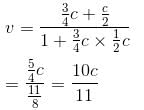
= 0.909 c
The correct answer is: 0.909
In inertial frame S1 two events occur at the same time and 3c minutes aparts in space. In the inertial frame S', the same events occur at 5c minutes apart. What is the time interval between the events in S' ? (in mins)
Correct answer is '4'. Can you explain this answer?
In inertial frame S1 two events occur at the same time and 3c minutes aparts in space. In the inertial frame S', the same events occur at 5c minutes apart. What is the time interval between the events in S' ? (in mins)
| | Arnab Pillai answered |
In frame 
In frame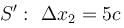
In frame
Since  is an invariant quantity

= 25c2 – 9c2
= 16c2
is an invariant quantity= 25c2 – 9c2
= 16c2
Δt2 = 4c In frame S'
The correct answer is: 4
In electrodynamics, the set of transformation rules for components of E and B are given as follows :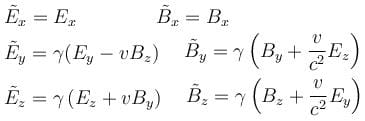 Here ' ~' denotes the components of E and B in a reference frame moving along the x-axis with speed vChoose the correct statement.
- a)E2 - B2c2 is a relativistically invariant quantity
- b)
 is a relativistically invariant quantity
 - c)
 is not a relativistically invariant quantity
 - d)E2 - B2c2 is not a relativistically invariant quantity
Correct answer is option 'A,B'. Can you explain this answer?
In electrodynamics, the set of transformation rules for components of E and B are given as follows :
Here ' ~' denotes the components of E and B in a reference frame moving along the x-axis with speed v
Choose the correct statement.
a)
E2 - B2c2 is a relativistically invariant quantity
b)
is a relativistically invariant quantity c)
is not a relativistically invariant quantity d)
E2 - B2c2 is not a relativistically invariant quantity
| | Rashi Choudhury answered |
Consider the dot product 
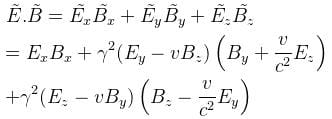
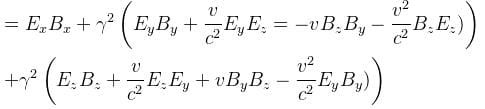
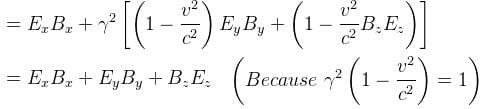
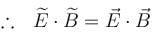
∴ E.B is relativistically in invariant
∴ E.B is relativistically in invariant
Consider the quantity 

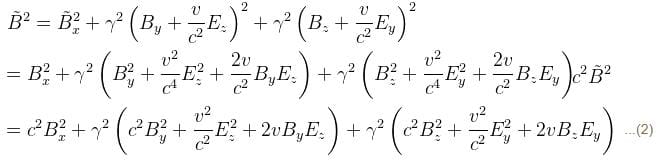
Now (1) – (2)
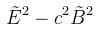
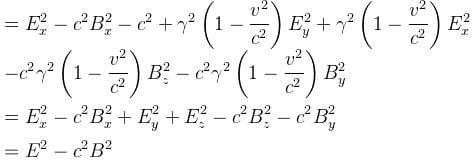
Invariant !
The correct answers are: is a relativistically invariant quantity, E2 - B2c2 is a relativistically invariant quantity
Now (1) – (2)
Invariant !
The correct answers are:
is a relativistically invariant quantity, E2 - B2c2 is a relativistically invariant quantityA particle leaving a cyclotron has a total relativistic energy of 10 GeV and a relativistic momentum of 8 GeV/c. What is the rest mass of this particle?- a)1.20 GeV/c2
- b)0.25 GeV/c2
- c)6 GeV/c2
- d)2.00 GeV/c2
Correct answer is option 'C'. Can you explain this answer?
A particle leaving a cyclotron has a total relativistic energy of 10 GeV and a relativistic momentum of 8 GeV/c. What is the rest mass of this particle?
a)
1.20 GeV/c2
b)
0.25 GeV/c2
c)
6 GeV/c2
d)
2.00 GeV/c2
| | Pie Academy answered |
Total energy = 10 GeV
p = 8 GeV / c
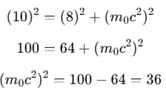
p = 8 GeV / c

A particle of mass M decays from rest into 2 particles. One particle has mass m and the other particle is massless. Find the momentum of the massless particle (in units of 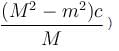
Correct answer is '0.5'. Can you explain this answer?
A particle of mass M decays from rest into 2 particles. One particle has mass m and the other particle is massless. Find the momentum of the massless particle (in units of
| | Niharika Choudhary answered |
Momentum conservation
Pinitial = 0
Pfinal = mv + p is (Here ‘p’ is momentum of the massless particle)
Pfinal = mv + p is (Here ‘p’ is momentum of the massless particle)
mv + p = 0
p = –mv
p = –mv
Now, for the masses particle E = p. For the particle of mass 
from conservation of energy, [Take c = 1]
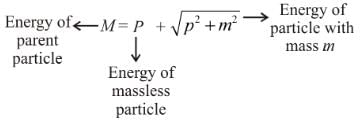

∴ momentum of masses particle is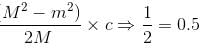
The correct answer is: 0.5
∴ momentum of masses particle is
The correct answer is: 0.5
The mean life of a meson is 2 x 10⁻⁸ sec. Calculate the mean life of a meson moving with a velocity 0.8c.- a)
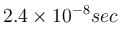
- b)
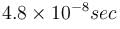
- c)

- d)
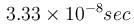
Correct answer is option 'D'. Can you explain this answer?
The mean life of a meson is 2 x 10⁻⁸ sec. Calculate the mean life of a meson moving with a velocity 0.8c.
a)
b)
c)
d)
| | Pie Academy answered |
∆t = t / √(1-v²/c²)
∆t = 2 × 10⁻⁸/√(1-(0.8)²)
∆t = 2 × 10⁻⁸ / 0.6
∆t = 3.3 × 10⁻⁸ s
Tau leptons are observed to have an average half life of Δt1 in the frame S1 in which the leptons are at rest. In an inertial frame S2 which is moving at a speed V12 relative to S1, the leptons are observed to have an average half life of Δt2. In another inertial reference frame S3, which is moving at a speed V13 relative to S1 and at a speed V23 relative to S2, the leptons have an observed half life of Δt3. Which of the following is true?- a)
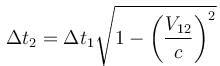
- b)
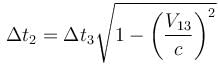
- c)
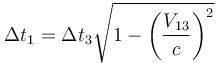
- d)
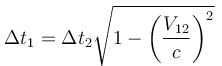
Correct answer is option 'C,D'. Can you explain this answer?
Tau leptons are observed to have an average half life of Δt1 in the frame S1 in which the leptons are at rest. In an inertial frame S2 which is moving at a speed V12 relative to S1, the leptons are observed to have an average half life of Δt2. In another inertial reference frame S3, which is moving at a speed V13 relative to S1 and at a speed V23 relative to S2, the leptons have an observed half life of Δt3. Which of the following is true?
a)
b)
c)
d)
| | Partho Gupta answered |
S1 is at rest
∴ lifetime is least in this frame
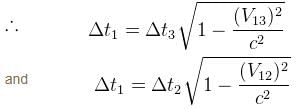
The correct answers are:
∴ lifetime is least in this frame
The correct answers are:
A distant galaxy is observed to have its hydrogen β line shifted to a wavelength of 580nm, away from the lab value of 434nm. Find the approximate velocity of the recession of the distant galaxy (in terms of c) 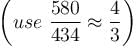
Correct answer is '0.28'. Can you explain this answer?
A distant galaxy is observed to have its hydrogen β line shifted to a wavelength of 580nm, away from the lab value of 434nm. Find the approximate velocity of the recession of the distant galaxy (in terms of c)
| | Maitri Sen answered |
Original wavelength = 434 nm
shifted λ = 580 nm
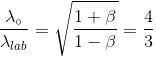 (given in the problem)
(given in the problem)Relativistic dopper effect formulae.
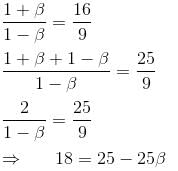
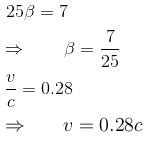
= 0.28
The correct answer is: 0.28
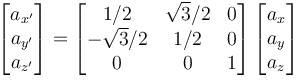 The matrix shown above transforms the components of a vector in one coordinate frame S to the components of the same vector in a second coordinate frame S'. This matrix represents a rotation of the reference frame S by :
- a)45° clockwise about the y axis
- b)30° counter clockwise about the z axis
- c)30° clockwise about the x axis
- d)60° counter clockwise about the z axis
Correct answer is option 'D'. Can you explain this answer?
The matrix shown above transforms the components of a vector in one coordinate frame S to the components of the same vector in a second coordinate frame S'. This matrix represents a rotation of the reference frame S by :
a)
45° clockwise about the y axis
b)
30° counter clockwise about the z axis
c)
30° clockwise about the x axis
d)
60° counter clockwise about the z axis
| | Ipsita Chopra answered |
The form of the matrix show that the rotation is about the z-axis
since 

since the z component does not change
∴ rotation about the z axis
Now, the standard from of the rotation matrix about z axis is
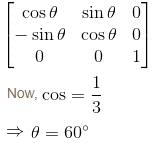
The correct answer is: 60° counter clockwise about the z axis
The correct answer is: 60° counter clockwise about the z axis
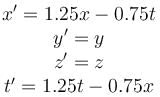
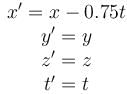
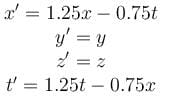
Which of the following are lorentz transformations?- a)
- b)

- c)
- d)
Correct answer is option 'C'. Can you explain this answer?
Which of the following are lorentz transformations?
a)
b)
c)
d)
| | Shreya Chauhan answered |
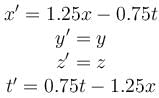
Lorentz transformation are given by
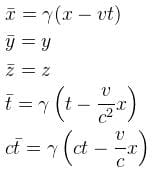
In the transformation for x and t, the coefficient of x and t, is the same!
The correct answer is:
A car of rest length 5m passes through a garage of rest length 4m. Due to the relativistic lorentz contraction, the car is only 3m long in length in the garage’s rest frame. There are doors on both ends of the garage, which open automatically when the front of the car reaches them and close automatically when the rear passes them. The opening or closing of the doors requires a negligible amount of time.Which of the following is the best response to the question : “was the car ever inside the closed garage”- a)No, because the car is longer than the garage in all reference frames
- b)Yes, because the car is shorter than the garage in all frames.
- c)No, because the lorentz contraction is not a “real” effect
- d)There is no unique answer, as the order of door openings and closings depends on the reference frame
Correct answer is option 'D'. Can you explain this answer?
A car of rest length 5m passes through a garage of rest length 4m. Due to the relativistic lorentz contraction, the car is only 3m long in length in the garage’s rest frame. There are doors on both ends of the garage, which open automatically when the front of the car reaches them and close automatically when the rear passes them. The opening or closing of the doors requires a negligible amount of time.
Which of the following is the best response to the question : “was the car ever inside the closed garage”
a)
No, because the car is longer than the garage in all reference frames
b)
Yes, because the car is shorter than the garage in all frames.
c)
No, because the lorentz contraction is not a “real” effect
d)
There is no unique answer, as the order of door openings and closings depends on the reference frame
| | Shail Ghoshal answered |
The order of the door opening depends on which reference frame one is in
own frame other’s frame
Length of car 5m 3m
length of garage 4m 2.4m
Length of car 5m 3m
length of garage 4m 2.4m
So, the car fits in the garage’s frame (the car is 3m and the garage is 4m). But in its own frame, the car is much longer to fit in the garage (car is 5m and the garage is only 2.4m)
Both the frames give different answers.
The correct answer is: There is no unique answer, as the order of door openings and closings depends on the reference frame
Chapter doubts & questions for Special Theory of Relativity - Modern Physics 2026 is part of Physics exam preparation. The chapters have been prepared according to the Physics exam syllabus. The Chapter doubts & questions, notes, tests & MCQs are made for Physics 2026 Exam. Find important definitions, questions, notes, meanings, examples, exercises, MCQs and online tests here.
Chapter doubts & questions of Special Theory of Relativity - Modern Physics in English & Hindi are available as part of Physics exam. Download more important topics, notes, lectures and mock test series for Physics Exam by signing up for free.
Modern Physics37 videos|21 docs|19 tests |
