


All Exams > Class 8 > Science Class 8 > All Questions
All questions of Friction for Class 8 Exam
The shape of an aeroplane is like a- a)Bird
- b)Car
- c)Dog
- d)All.
Correct answer is option 'A'. Can you explain this answer?
The shape of an aeroplane is like a
a)
Bird
b)
Car
c)
Dog
d)
All.
 | Vivek Rana answered |
Airplanes have wings, just like birds. They also have a light Skelton to decrease their weight, and they have a streamlined shape to decrease drag. Airplanes wings are designed to create lift by changing the pressure, rather than by flapping them up and down.

Fluids are only liquids.- a)True
- b)False
Correct answer is option 'B'. Can you explain this answer?
Fluids are only liquids.
a)
True
b)
False
 | Kavya Saxena answered |
A fluid is a substance that continually flows under an applied shear stress, or external force. Fluids are a phase of matter and include liquids, gases and plasmas.
Sliding friction is ______________ than static friction.- a)More
- b)Equal
- c)Greater
- d)Less
Correct answer is option 'D'. Can you explain this answer?
Sliding friction is ______________ than static friction.
a)
More
b)
Equal
c)
Greater
d)
Less
 | Gunjan Lakhani answered |
- Friction comes into play when irregularities present in the surfaces of two objects in contact get interlocked with each other.
- In sliding, the time given for interlocking is very small. Hence, the interlocking is not strong.
- Therefore, less force is required to overcome this interlocking. Because of this reason, sliding friction is less than static friction.
Rolling friction is smaller than- a)Sliding friction
- b)Static friction
- c)Fluid friction
- d)All of the above.
Correct answer is option 'D'. Can you explain this answer?
Rolling friction is smaller than
a)
Sliding friction
b)
Static friction
c)
Fluid friction
d)
All of the above.
 | Malavika Basu answered |
No the correct answer is
(a) Sliding friction
Explanation: Friction is the force which resists the relative motion between two surfaces in contact.
Now, rolling friction comes into play between two surfaces, when one body rolls over the other and sliding friction comes into play when when one body slides or tends to slide over the surface of another body; it tends to reduce the relative velocity between the two surfaces during sliding. Now, if the area of contact between the two surfaces can somehow be reduced, then the effect of friction between the two surfaces will be drastically reduced.
When an object slides across the ground, it has much more surface area in direct contact with the ground, which means that the amount of friction is significantly higher. When an object rolls along the ground, only a minuscule point on the object contacts the ground at any point in time, making the stopping force much weaker.
Moreover, in sliding motion, the heights of cavities (irregularities) are to climb up which introduces the friction, while rolling friction, the heights of cavitites are to cross over which avoid the friction.
A toy car released with the same initial speed will travel farthest on- a)Muddy surface
- b)Cemented surface
- c)Brick surface
- d)Polished marble surface
Correct answer is option 'D'. Can you explain this answer?
A toy car released with the same initial speed will travel farthest on
a)
Muddy surface
b)
Cemented surface
c)
Brick surface
d)
Polished marble surface
| | Kavya Saxena answered |
A polished marble surface has the least frictional force, hence a car will travel farther on a marble floor.
Fluid friction can be minimized by:- a)Adding salts to fluid
- b)Increasing volume
- c)Giving suitable shape
- d)Decreasing volume
Correct answer is option 'C'. Can you explain this answer?
Fluid friction can be minimized by:
a)
Adding salts to fluid
b)
Increasing volume
c)
Giving suitable shape
d)
Decreasing volume
 | Aniket Choudhary answered |
Fluid friction can be minimized by giving suitable shapes to the objects moving in the fluids.
The frictional force exerted by fluids is also called- a)Drag
- b)Rung
- c)Smug
- d)Slag
Correct answer is option 'A'. Can you explain this answer?
The frictional force exerted by fluids is also called
a)
Drag
b)
Rung
c)
Smug
d)
Slag
 | Shraddha Menon answered |
The frictional force exerted by fluids is also called as drag. This kinds of frictional force can be reduced by changing the shape of the moving body.
Smooth surface has less frictional force.- a)True
- b)False
Correct answer is option 'A'. Can you explain this answer?
Smooth surface has less frictional force.
a)
True
b)
False
 | Rajat Malik answered |
Explanation:
Introduction:
Frictional force is a force that opposes the motion of an object when it is in contact with a surface. It acts parallel to the surface and depends on the nature of the surfaces in contact and the force pressing them together.
Smooth Surface:
A smooth surface is one that is even, polished, and free from roughness or unevenness. It has a low coefficient of friction, which means that there is less resistance to motion when an object moves across it.
Frictional Force:
Frictional force is the force that opposes the motion of an object. It arises due to the interaction between the surfaces in contact. The magnitude of the frictional force depends on two factors: the nature of the surfaces in contact and the force pressing them together.
Less Frictional Force:
When the surface is smooth, there are fewer irregularities or roughness on the surface, which reduces the points of contact between the two surfaces. This results in a smaller surface area in contact, reducing the frictional force. Additionally, the smooth surface allows objects to slide or move more easily, further reducing the frictional force.
Explanation:
The statement "Smooth surface has less frictional force" is true. A smooth surface has less frictional force compared to a rough surface. This is because the smooth surface has fewer irregularities or roughness, which reduces the points of contact and the surface area in contact between the two surfaces. As a result, there is less resistance to motion, and the frictional force is reduced.
When objects slide or move on a smooth surface, there is less frictional force acting against the motion. This allows objects to move more easily and smoothly. For example, if you try to slide a heavy object on a rough surface, it would require more force compared to sliding the same object on a smooth surface.
In everyday life, we can observe this phenomenon when we use lubricants like oil or grease on surfaces to reduce friction. The lubricants fill in the gaps and irregularities on the surface, making it smoother and reducing the frictional force.
In conclusion, a smooth surface has less frictional force due to its reduced points of contact and surface area in contact. This allows objects to move more easily and smoothly on a smooth surface compared to a rough surface.
Introduction:
Frictional force is a force that opposes the motion of an object when it is in contact with a surface. It acts parallel to the surface and depends on the nature of the surfaces in contact and the force pressing them together.
Smooth Surface:
A smooth surface is one that is even, polished, and free from roughness or unevenness. It has a low coefficient of friction, which means that there is less resistance to motion when an object moves across it.
Frictional Force:
Frictional force is the force that opposes the motion of an object. It arises due to the interaction between the surfaces in contact. The magnitude of the frictional force depends on two factors: the nature of the surfaces in contact and the force pressing them together.
Less Frictional Force:
When the surface is smooth, there are fewer irregularities or roughness on the surface, which reduces the points of contact between the two surfaces. This results in a smaller surface area in contact, reducing the frictional force. Additionally, the smooth surface allows objects to slide or move more easily, further reducing the frictional force.
Explanation:
The statement "Smooth surface has less frictional force" is true. A smooth surface has less frictional force compared to a rough surface. This is because the smooth surface has fewer irregularities or roughness, which reduces the points of contact and the surface area in contact between the two surfaces. As a result, there is less resistance to motion, and the frictional force is reduced.
When objects slide or move on a smooth surface, there is less frictional force acting against the motion. This allows objects to move more easily and smoothly. For example, if you try to slide a heavy object on a rough surface, it would require more force compared to sliding the same object on a smooth surface.
In everyday life, we can observe this phenomenon when we use lubricants like oil or grease on surfaces to reduce friction. The lubricants fill in the gaps and irregularities on the surface, making it smoother and reducing the frictional force.
In conclusion, a smooth surface has less frictional force due to its reduced points of contact and surface area in contact. This allows objects to move more easily and smoothly on a smooth surface compared to a rough surface.
Soapy floor is slippery due to increased friction.- a)True
- b)False
Correct answer is option 'B'. Can you explain this answer?
Soapy floor is slippery due to increased friction.
a)
True
b)
False
 | Geetika Shah answered |
Soapy floor is slippery due to decreased friction. The soap covers the roughness of floor and makes it smooth, which restricts our walk on the floor.
So, the given statement is false.
So, the given statement is false.
Force of friction depends on- a)Smoothness of surface
- b)Roughness of surface
- c)Inclination of surface
- d)All of above.
Correct answer is option 'D'. Can you explain this answer?
Force of friction depends on
a)
Smoothness of surface
b)
Roughness of surface
c)
Inclination of surface
d)
All of above.
 | Sanjana Bose answered |
Friction is the name given to the force that opposes the motion of one body sliding over another. It is called friction when the objects are solid, viscosity in liquids but it always opposes the motion of an object.
The first mathematical description was made by Charles Augustine de Coloumb in 1764. He proposed that friction could be classed as static or dynamic and proposed that the frictional force was frictional force dependent on the materials in contact.
Surface Contact
At an interface between two objects, the surfaces may appear to be smooth, however on a microscopic scale the surfaces are pitted and jagged.
The friction force depends on two factors:
a) The materials that are in contact. The two materials and the nature of their surfaces. Rougher surfaces have higher coefficient of frictions but to slide apart. This makes sense in terms of a model in which friction is described as arising from chemical bonds between the atoms of the two surfaces at their points of contact: very flat surfaces allow more atoms to come in contact
b) The force pushing the two surfaces together. Pushing the surfaces together causes the more of the asperities to come together and increases the surface area in contact with each other.
In machine, friction between moving part is reduced by- a)Heating machine
- b)Using powder
- c)Using lubricants
- d)Using paints
Correct answer is option 'C'. Can you explain this answer?
In machine, friction between moving part is reduced by
a)
Heating machine
b)
Using powder
c)
Using lubricants
d)
Using paints
 | Ananya Das answered |
In machine, friction between moving parts is reduced by using lubricants. These lubricants stick with machine parts to make them smoother that leads to reduction in friction.
Friction is a- a)contact force
- b)non-contact force
- c)magnetic force
- d)none of these.
Correct answer is option 'A'. Can you explain this answer?
Friction is a
a)
contact force
b)
non-contact force
c)
magnetic force
d)
none of these.
| | Riya answered |
Friction is a contact force that acts when two surfaces interact.
Sprinkling of powder on the carrom board- a)Reduce friction
- b)Make the board durable
- c)Increase friction
- d)Maintain the friction
Correct answer is option 'A'. Can you explain this answer?
Sprinkling of powder on the carrom board
a)
Reduce friction
b)
Make the board durable
c)
Increase friction
d)
Maintain the friction
 | Siddharth Mukherjee answered |
Sliding friction is less than static friction. It is easier to move a heavy object by sliding in comparison to rotating on surface.
Spring balance is a device used for measuring the force.- a)True
- b)False
Correct answer is option 'A'. Can you explain this answer?
Spring balance is a device used for measuring the force.
a)
True
b)
False
 | Manisha Shah answered |
Explanation:
A spring balance is a device that is used to measure the force exerted on an object. It consists of a spring fixed at one end and a hook at the other end. When a force is applied to the hook, the spring stretches and the amount of stretch is measured using a calibrated scale attached to the spring. The scale is usually marked in units of weight, such as pounds or kilograms.
How does it work?
The spring balance works on the principle of Hooke's Law, which states that the extension of a spring is proportional to the force applied to it. When a force is applied to the hook of the spring balance, the spring stretches and the amount of stretch is proportional to the force applied. This stretch is measured using a calibrated scale attached to the spring.
Uses of spring balance:
Spring balances are used in a variety of applications, including:
- Measuring the weight of an object
- Measuring the force required to compress or stretch a spring
- Measuring the force required to move an object
- Measuring the force required to pull or push an object
- Measuring the force required to lift an object
Advantages of spring balance:
- It is easy to use and does not require any complex setup or calibration
- It is relatively inexpensive compared to other types of force measuring devices
- It is portable and can be used in the field or in remote locations
- It is a non-destructive testing method and does not damage the object being tested
Conclusion:
Therefore, it can be concluded that the given statement "Spring balance is a device used for measuring the force" is true.
A spring balance is a device that is used to measure the force exerted on an object. It consists of a spring fixed at one end and a hook at the other end. When a force is applied to the hook, the spring stretches and the amount of stretch is measured using a calibrated scale attached to the spring. The scale is usually marked in units of weight, such as pounds or kilograms.
How does it work?
The spring balance works on the principle of Hooke's Law, which states that the extension of a spring is proportional to the force applied to it. When a force is applied to the hook of the spring balance, the spring stretches and the amount of stretch is proportional to the force applied. This stretch is measured using a calibrated scale attached to the spring.
Uses of spring balance:
Spring balances are used in a variety of applications, including:
- Measuring the weight of an object
- Measuring the force required to compress or stretch a spring
- Measuring the force required to move an object
- Measuring the force required to pull or push an object
- Measuring the force required to lift an object
Advantages of spring balance:
- It is easy to use and does not require any complex setup or calibration
- It is relatively inexpensive compared to other types of force measuring devices
- It is portable and can be used in the field or in remote locations
- It is a non-destructive testing method and does not damage the object being tested
Conclusion:
Therefore, it can be concluded that the given statement "Spring balance is a device used for measuring the force" is true.
Fluids are only liquids.- a)True
- b)False
Correct answer is option 'B'. Can you explain this answer?
Fluids are only liquids.
a)
True
b)
False
| | Shubham Sharma answered |
A fluid is a substance that continually flows under an applied shear stress, or external force. Fluids are a phase of matter and include liquids, gases, and plasmas.
So, the given statement is false.
So, the given statement is false.
Friction opposes the __________ between two surfaces in contact.- a)Reflective motion
- b)Relative motion
- c)Rotary motion
- d)Refractive motion
Correct answer is option 'B'. Can you explain this answer?
Friction opposes the __________ between two surfaces in contact.
a)
Reflective motion
b)
Relative motion
c)
Rotary motion
d)
Refractive motion
 | Tejas Iyer answered |
Friction opposes the relative motion between two surfaces in contact. Frictional force acts in opposite direction of motion to slow down the speed of moving body.

What do ball bearings replace in most machines to reduce friction?- a)Sliding friction
- b)Static friction
- c)Fluid friction
- d)Rolling friction
Correct answer is option 'A'. Can you explain this answer?
What do ball bearings replace in most machines to reduce friction?
a)
Sliding friction
b)
Static friction
c)
Fluid friction
d)
Rolling friction
 | Valor Academy answered |
Ball bearings replace sliding friction with rolling friction in most machines, which significantly reduces resistance and wear.
Irregularities between two surfaces interlock to produce friction.- a)True
- b)False
Correct answer is option 'A'. Can you explain this answer?
Irregularities between two surfaces interlock to produce friction.
a)
True
b)
False
 | Dipanjan Chaudhary answered |
Irregularities between two surfaces interlock to produce friction.
Explanation:
Friction is the force that opposes the relative motion or tendency of motion between two surfaces in contact. It is a result of the interlocking of irregularities between the surfaces. The irregularities or roughness on the surfaces create resistance, leading to the generation of frictional force. This statement is true and can be explained as follows:
1. Interlocking of irregularities:
When two surfaces come in contact, they may appear smooth at a macroscopic level, but at a microscopic level, they have irregularities or roughness. These irregularities can be in the form of bumps, ridges, or valleys on the surface. When the two surfaces are pressed together, these irregularities interlock with each other.
2. Contact points and friction:
The interlocking of irregularities creates contact points between the surfaces. These contact points are the areas where the surfaces are in direct contact with each other. Friction occurs at these contact points due to the resistance caused by the interlocking irregularities.
3. Resistance and frictional force:
As one surface attempts to slide or move relative to the other, the interlocking irregularities resist this motion. The irregularities act like tiny obstacles that need to be overcome. This resistance results in the generation of frictional force. The greater the irregularities and interlocking, the higher the frictional force.
4. Importance of friction:
Friction is an essential force in our daily lives. It allows us to walk, drive vehicles, grip objects, and perform various tasks. Without friction, objects would slide or slip uncontrollably. The interlocking of irregularities between surfaces provides the necessary grip and stability.
Therefore, the statement "Irregularities between two surfaces interlock to produce friction" is true. The interlocking of irregularities creates contact points and resistance, leading to the generation of frictional force.
Explanation:
Friction is the force that opposes the relative motion or tendency of motion between two surfaces in contact. It is a result of the interlocking of irregularities between the surfaces. The irregularities or roughness on the surfaces create resistance, leading to the generation of frictional force. This statement is true and can be explained as follows:
1. Interlocking of irregularities:
When two surfaces come in contact, they may appear smooth at a macroscopic level, but at a microscopic level, they have irregularities or roughness. These irregularities can be in the form of bumps, ridges, or valleys on the surface. When the two surfaces are pressed together, these irregularities interlock with each other.
2. Contact points and friction:
The interlocking of irregularities creates contact points between the surfaces. These contact points are the areas where the surfaces are in direct contact with each other. Friction occurs at these contact points due to the resistance caused by the interlocking irregularities.
3. Resistance and frictional force:
As one surface attempts to slide or move relative to the other, the interlocking irregularities resist this motion. The irregularities act like tiny obstacles that need to be overcome. This resistance results in the generation of frictional force. The greater the irregularities and interlocking, the higher the frictional force.
4. Importance of friction:
Friction is an essential force in our daily lives. It allows us to walk, drive vehicles, grip objects, and perform various tasks. Without friction, objects would slide or slip uncontrollably. The interlocking of irregularities between surfaces provides the necessary grip and stability.
Therefore, the statement "Irregularities between two surfaces interlock to produce friction" is true. The interlocking of irregularities creates contact points and resistance, leading to the generation of frictional force.
Fluids are- a)gases
- b)liquids
- c)gases and liquids both
- d)none of these.
Correct answer is option 'C'. Can you explain this answer?
Fluids are
a)
gases
b)
liquids
c)
gases and liquids both
d)
none of these.
| | Gargi Nambiar answered |
Introduction:
Fluids are substances that can flow and take the shape of the container they are placed in. They are a state of matter and can exist as gases and liquids. In this question, we need to determine which of the given options correctly identify fluids. The correct answer is option C, which states that fluids are both gases and liquids.
Explanation:
1. Gases:
Gases are one of the states of matter and can be considered as fluids. They have particles that are in constant motion and are not held together by strong intermolecular forces. Gases can be compressed and they fill the entire volume of the container they are placed in. Examples of gases include oxygen, nitrogen, carbon dioxide, and helium.
2. Liquids:
Liquids are also a state of matter and are considered fluids. Unlike gases, liquids have particles that are closer together and are held together by intermolecular forces. Liquids have a definite volume but do not have a definite shape. They take the shape of the container they are placed in. Examples of liquids include water, milk, oil, and juice.
3. Fluids are Gases and Liquids:
Fluids encompass both gases and liquids. They share the common property of being able to flow and take the shape of their containers. While gases and liquids have differences in their particle arrangement and intermolecular forces, they both exhibit fluidity. The ability to flow is what defines fluids.
Conclusion:
In conclusion, fluids include both gases and liquids. Gases are characterized by particles that are far apart and can be compressed, while liquids have particles that are closer together and have a definite volume. Both gases and liquids exhibit fluidity, which is the ability to flow and take the shape of the container they are placed in.
Fluids are substances that can flow and take the shape of the container they are placed in. They are a state of matter and can exist as gases and liquids. In this question, we need to determine which of the given options correctly identify fluids. The correct answer is option C, which states that fluids are both gases and liquids.
Explanation:
1. Gases:
Gases are one of the states of matter and can be considered as fluids. They have particles that are in constant motion and are not held together by strong intermolecular forces. Gases can be compressed and they fill the entire volume of the container they are placed in. Examples of gases include oxygen, nitrogen, carbon dioxide, and helium.
2. Liquids:
Liquids are also a state of matter and are considered fluids. Unlike gases, liquids have particles that are closer together and are held together by intermolecular forces. Liquids have a definite volume but do not have a definite shape. They take the shape of the container they are placed in. Examples of liquids include water, milk, oil, and juice.
3. Fluids are Gases and Liquids:
Fluids encompass both gases and liquids. They share the common property of being able to flow and take the shape of their containers. While gases and liquids have differences in their particle arrangement and intermolecular forces, they both exhibit fluidity. The ability to flow is what defines fluids.
Conclusion:
In conclusion, fluids include both gases and liquids. Gases are characterized by particles that are far apart and can be compressed, while liquids have particles that are closer together and have a definite volume. Both gases and liquids exhibit fluidity, which is the ability to flow and take the shape of the container they are placed in.
Friction is a necessary evil.- a)True
- b)False
Correct answer is option 'A'. Can you explain this answer?
Friction is a necessary evil.
a)
True
b)
False
 | M Gj answered |
Friction is a necessary evil because there are many uses of friction in our lives but also there are some disadvantages like wearing out of tires.
So the answer is true.
The shape of fish is streamlined to- a)Change the direction
- b)Increase fluid friction
- c)Facilitate breathing
- d)Decrease fluid friction
Correct answer is option 'D'. Can you explain this answer?
The shape of fish is streamlined to
a)
Change the direction
b)
Increase fluid friction
c)
Facilitate breathing
d)
Decrease fluid friction
 | Maitri Chopra answered |
The shape of fish is streamlined that help in decreasing fluid friction. The narrower part of streamlined shape offer less resistance due to friction.

The substance which reduce friction are called- a)Lubricants
- b)Wheels
- c)Powder
- d)Graphite
Correct answer is option 'A'. Can you explain this answer?
The substance which reduce friction are called
a)
Lubricants
b)
Wheels
c)
Powder
d)
Graphite
| | Ananya Das answered |
The substances which reduce friction are called lubricants. Lubricants include graphite, oils and greases. Lubricant stick with moving part to reduce friction.
Substances are called lubricants which are used to- a)increase friction
- b)decrease friction
- c)increase or decrease friction
- d)none of these.
Correct answer is option 'B'. Can you explain this answer?
Substances are called lubricants which are used to
a)
increase friction
b)
decrease friction
c)
increase or decrease friction
d)
none of these.
| | Ananya Das answered |
A lubricant is a substance, usually organic, introduced to reduce friction between surfaces in mutual contact, which ultimately reduces the heat generated when the surfaces move. It may also have the function of transmitting forces, transporting foreign particles, or heating or cooling the surfaces.
The threaded tyres of cars, trucks and bus- a)Decrease friction of ground
- b)Increase the velocity of vehicles
- c)Increase the diameter
- d)To increase friction and to give a better grip to them on the road
Correct answer is option 'D'. Can you explain this answer?
The threaded tyres of cars, trucks and bus
a)
Decrease friction of ground
b)
Increase the velocity of vehicles
c)
Increase the diameter
d)
To increase friction and to give a better grip to them on the road
 | Pooja Shah answered |
The treaded tyres of cars, trucks and bulldozers increase friction force between road and tyres and provide a better grip with the ground.
Friction is the resistance to motion of one object moving relative to another.
Friction is a resultant force not a fundamental one like the electromagnetic force.
Friction is the resistance to motion of one object moving relative to another.
Friction is a resultant force not a fundamental one like the electromagnetic force.
Smooth surface has- a)less frictional force
- b)more frictional force
- c)sometimes less and sometimes more force
- d)all the above.
Correct answer is option 'A'. Can you explain this answer?
Smooth surface has
a)
less frictional force
b)
more frictional force
c)
sometimes less and sometimes more force
d)
all the above.
 | Shruti Choudhury answered |
**Explanation:**
**Friction** is the force that opposes the relative motion between two surfaces in contact. It acts tangentially to the surface and has two types: static friction and kinetic friction.
**Static friction** is the force that prevents a stationary object from moving when a force is applied to it. It is directly proportional to the force applied and can vary in magnitude. The maximum static friction force that can be exerted is given by the equation:
**fs ≤ µsN**
where fs is the static friction force, µs is the coefficient of static friction, and N is the normal force exerted on the object.
**Kinetic friction** is the force that opposes the sliding motion between two surfaces in contact. It is generally smaller than the maximum static friction force and is given by the equation:
**fk = µkN**
where fk is the kinetic friction force, µk is the coefficient of kinetic friction, and N is the normal force exerted on the object.
**Smooth surfaces** have a low coefficient of friction, meaning they have less resistance to motion and therefore experience less frictional force compared to rough surfaces.
Now, let's consider the options given:
**a) Less frictional force:** Smooth surfaces have less frictional force because their coefficients of friction (both static and kinetic) are low. This means that it is easier for objects to slide or move on smooth surfaces with less resistance.
**b) More frictional force:** This option is incorrect because, as mentioned above, smooth surfaces have less frictional force due to their low coefficients of friction.
**c) Sometimes less and sometimes more force:** This option is incorrect because smooth surfaces consistently have less frictional force compared to rough surfaces.
**d) All of the above:** This option is incorrect as well because only option 'a' is correct.
Therefore, the correct answer is option 'A', smooth surfaces have less frictional force.
**Friction** is the force that opposes the relative motion between two surfaces in contact. It acts tangentially to the surface and has two types: static friction and kinetic friction.
**Static friction** is the force that prevents a stationary object from moving when a force is applied to it. It is directly proportional to the force applied and can vary in magnitude. The maximum static friction force that can be exerted is given by the equation:
**fs ≤ µsN**
where fs is the static friction force, µs is the coefficient of static friction, and N is the normal force exerted on the object.
**Kinetic friction** is the force that opposes the sliding motion between two surfaces in contact. It is generally smaller than the maximum static friction force and is given by the equation:
**fk = µkN**
where fk is the kinetic friction force, µk is the coefficient of kinetic friction, and N is the normal force exerted on the object.
**Smooth surfaces** have a low coefficient of friction, meaning they have less resistance to motion and therefore experience less frictional force compared to rough surfaces.
Now, let's consider the options given:
**a) Less frictional force:** Smooth surfaces have less frictional force because their coefficients of friction (both static and kinetic) are low. This means that it is easier for objects to slide or move on smooth surfaces with less resistance.
**b) More frictional force:** This option is incorrect because, as mentioned above, smooth surfaces have less frictional force due to their low coefficients of friction.
**c) Sometimes less and sometimes more force:** This option is incorrect because smooth surfaces consistently have less frictional force compared to rough surfaces.
**d) All of the above:** This option is incorrect as well because only option 'a' is correct.
Therefore, the correct answer is option 'A', smooth surfaces have less frictional force.
What happens to the contact points on a surface when an object starts sliding?- a)They interlock more
- b)They do not get enough time to interlock
- c)They become magnetic
- d)They disappear
Correct answer is option 'B'. Can you explain this answer?
a)
They interlock more
b)
They do not get enough time to interlock
c)
They become magnetic
d)
They disappear
| | Pankaj Pillai answered |
Understanding Contact Points During Sliding
When an object begins to slide across a surface, the behavior of contact points between the two surfaces changes significantly. The correct answer, option 'B', highlights the fact that these contact points do not get enough time to interlock.
Mechanics of Sliding
- Contact Points: When two surfaces are in contact, there are microscopic irregularities that create contact points. These points determine the frictional forces acting between the surfaces.
- Interlocking Mechanism: In a stationary state, these irregularities can interlock, providing resistance against motion. This interlocking is crucial for static friction, which is generally higher than kinetic friction.
Effect of Sliding
- Rapid Movement: As the object starts to slide, the movement occurs quickly, not allowing enough time for the contact points to fully interlock.
- Reduced Friction: This lack of interlocking leads to a decrease in frictional force, which is why sliding objects often move more easily than those that are stationary.
- Dynamic Friction: Once sliding begins, the friction experienced is kinetic friction, which is typically lower than static friction. This is due to the fact that the surfaces are not in prolonged contact to establish a strong interlocking effect.
Conclusion
In summary, when an object transitions from rest to sliding, the rapid movement prevents sufficient time for contact points to interlock effectively. This dynamic significantly reduces the frictional forces at play, allowing the object to slide more freely across the surface. Understanding this mechanism is crucial in fields such as physics and engineering, particularly in the study of motion and forces.
When an object begins to slide across a surface, the behavior of contact points between the two surfaces changes significantly. The correct answer, option 'B', highlights the fact that these contact points do not get enough time to interlock.
Mechanics of Sliding
- Contact Points: When two surfaces are in contact, there are microscopic irregularities that create contact points. These points determine the frictional forces acting between the surfaces.
- Interlocking Mechanism: In a stationary state, these irregularities can interlock, providing resistance against motion. This interlocking is crucial for static friction, which is generally higher than kinetic friction.
Effect of Sliding
- Rapid Movement: As the object starts to slide, the movement occurs quickly, not allowing enough time for the contact points to fully interlock.
- Reduced Friction: This lack of interlocking leads to a decrease in frictional force, which is why sliding objects often move more easily than those that are stationary.
- Dynamic Friction: Once sliding begins, the friction experienced is kinetic friction, which is typically lower than static friction. This is due to the fact that the surfaces are not in prolonged contact to establish a strong interlocking effect.
Conclusion
In summary, when an object transitions from rest to sliding, the rapid movement prevents sufficient time for contact points to interlock effectively. This dynamic significantly reduces the frictional forces at play, allowing the object to slide more freely across the surface. Understanding this mechanism is crucial in fields such as physics and engineering, particularly in the study of motion and forces.
Friction always- a)helps the motion
- b)opposes the motion
- c)both of these
- d)none of these.
Correct answer is option 'B'. Can you explain this answer?
Friction always
a)
helps the motion
b)
opposes the motion
c)
both of these
d)
none of these.
 | Deebyajyoti answered |
The force which opposes the motion of an object is called frictional force and frictional force always act in a direction opposite to the direction of motion of the object.
Why is it easier to move a box already in motion than to start moving it?- a)Less gravitational force
- b)Less static friction
- c)More kinetic energy
- d)Less air resistance
Correct answer is option 'B'. Can you explain this answer?
a)
Less gravitational force
b)
Less static friction
c)
More kinetic energy
d)
Less air resistance
 | Upsc Toppers answered |
The force required to overcome static friction (to start moving) is greater than the force required to overcome sliding friction (to keep it moving).
What is a spring balance used for?- a)Measuring weight
- b)Measuring mass
- c)Measuring force
- d)Measuring speed
Correct answer is option 'C'. Can you explain this answer?
What is a spring balance used for?
a)
Measuring weight
b)
Measuring mass
c)
Measuring force
d)
Measuring speed
 | EduRev Class 8 answered |
A spring balance is used for measuring force.
- Working Principle: It operates on Hooke's Law, which states that the force exerted by a spring is directly proportional to the displacement of the spring.
- Usage: When an object is attached, the spring stretches, and the amount of stretch correlates with the force applied, which is often related to the object's weight.
- Units: Typically measures force in newtons (N).
Hence, the correct answer is C: Measuring force.
- Working Principle: It operates on Hooke's Law, which states that the force exerted by a spring is directly proportional to the displacement of the spring.
- Usage: When an object is attached, the spring stretches, and the amount of stretch correlates with the force applied, which is often related to the object's weight.
- Units: Typically measures force in newtons (N).
Hence, the correct answer is C: Measuring force.
Friction is a/an- a)Friend
- b)Foe
- c)Both (a) and (b)
- d)None.
Correct answer is option 'C'. Can you explain this answer?
Friction is a/an
a)
Friend
b)
Foe
c)
Both (a) and (b)
d)
None.
 | Meera Basu answered |
Friction is both friend as well as foe.
Friend:- as friction helps us to write, walk to control our speed .
Foe:- as it cause wear and tear in object.
So, friction is both Friend and foe.
Friend:- as friction helps us to write, walk to control our speed .
Foe:- as it cause wear and tear in object.
So, friction is both Friend and foe.
What is the effect of friction when a jar of a mixer is operated?- a)It increases speed
- b)It reduces efficiency
- c)It generates heat
- d)It decreases weight
Correct answer is option 'C'. Can you explain this answer?
a)
It increases speed
b)
It reduces efficiency
c)
It generates heat
d)
It decreases weight
 | Lohit Matani answered |
Friction between the moving parts generates heat, causing the jar of the mixer to become hot.
Objects moving through fluids experience _______ force.- a)Magnetic
- b)Gravitational
- c)Frictional
- d)Elastic
Correct answer is option 'C'. Can you explain this answer?
Objects moving through fluids experience _______ force.
a)
Magnetic
b)
Gravitational
c)
Frictional
d)
Elastic
| | Ruchi Sarkar answered |
Understanding Fluid Dynamics and Frictional Forces
When objects move through fluids, they encounter various forces that can affect their motion. Among these forces, frictional force plays a significant role.
What is Frictional Force?
- Frictional force is the resistance encountered when an object slides or moves through a fluid, such as air or water.
- It arises due to the interaction between the surface of the object and the fluid particles.
How Does it Work?
- As an object moves, it displaces fluid particles in its path, creating a drag force that opposes its motion.
- This drag is a type of frictional force that can vary based on factors such as the shape of the object, the speed of movement, and the viscosity of the fluid.
Importance in Different Scenarios
- In aerodynamics, the design of vehicles, airplanes, and even sports equipment considers frictional forces to minimize drag and improve efficiency.
- In hydrodynamics, boats and submarines are designed to reduce frictional forces for better speed and fuel efficiency.
Conclusion
Frictional force is crucial in understanding how objects behave when they move through fluids. It determines the energy required to maintain motion and influences the overall performance of various systems. Recognizing this force is essential for engineers and scientists to optimize designs across multiple applications.
When objects move through fluids, they encounter various forces that can affect their motion. Among these forces, frictional force plays a significant role.
What is Frictional Force?
- Frictional force is the resistance encountered when an object slides or moves through a fluid, such as air or water.
- It arises due to the interaction between the surface of the object and the fluid particles.
How Does it Work?
- As an object moves, it displaces fluid particles in its path, creating a drag force that opposes its motion.
- This drag is a type of frictional force that can vary based on factors such as the shape of the object, the speed of movement, and the viscosity of the fluid.
Importance in Different Scenarios
- In aerodynamics, the design of vehicles, airplanes, and even sports equipment considers frictional forces to minimize drag and improve efficiency.
- In hydrodynamics, boats and submarines are designed to reduce frictional forces for better speed and fuel efficiency.
Conclusion
Frictional force is crucial in understanding how objects behave when they move through fluids. It determines the energy required to maintain motion and influences the overall performance of various systems. Recognizing this force is essential for engineers and scientists to optimize designs across multiple applications.
What increases the force of friction between two surfaces?- a)Decreasing pressure
- b)Increasing pressure
- c)Reducing contact area
- d)Reducing surface area
Correct answer is option 'B'. Can you explain this answer?
a)
Decreasing pressure
b)
Increasing pressure
c)
Reducing contact area
d)
Reducing surface area
 | Master Training Institute answered |
Increasing the pressure between two surfaces increases the interlocking of irregularities, thereby increasing friction.
Why do we slip when we step on a banana peel?- a)Increased gravitational pull
- b)Reduced friction
- c)Increased air resistance
- d)Reduced weight
Correct answer is option 'B'. Can you explain this answer?
a)
Increased gravitational pull
b)
Reduced friction
c)
Increased air resistance
d)
Reduced weight
 | Academic Studio answered |
The banana peel reduces the friction between our feet and the ground, making it easier to slip.
What helps increase the grip of a shoe on the floor?- a)Smooth soles
- b)Grooved soles
- c)Thin soles
- d)Heavy soles
Correct answer is option 'B'. Can you explain this answer?
a)
Smooth soles
b)
Grooved soles
c)
Thin soles
d)
Heavy soles
 | T.S Academy answered |
Grooved soles provide better grip on the floor by increasing friction.
We slip while walking on a path having pond scum or green algae because: - a)The inertia of motion
- b)The friction is zero
- c)The friction between the feet and the path is increased.
- d)The friction between the feet and the path is reduced.
Correct answer is option 'D'. Can you explain this answer?
We slip while walking on a path having pond scum or green algae because:
a)
The inertia of motion
b)
The friction is zero
c)
The friction between the feet and the path is increased.
d)
The friction between the feet and the path is reduced.
| | Kiran Reddy answered |
The correct answer is The friction between the feet and the path is reduced.
Important Points
- Friction is a force between two surfaces that are sliding, or trying to slide, across each other.
- For example, when you try to push or pull luggage along the floor, friction makes this difficult.
- Friction always works in the opposite of the direction in which the object is moving or trying to move.
There are four types of friction:
- Static Friction: Static friction acts on objects when they are resting on a surface.
- For example, hiking in the woods, there is static friction between shoes and the trail each time put down the foot.
- Without this static friction, feet would slip out and making it difficult to walk.
- Sliding Friction: Sliding friction is friction that acts on objects when they are sliding over a surface.
Note: Sliding friction is weaker than static friction.
- Rolling Friction: Rolling friction is friction that acts on objects when they are rolling over a surface.
- Rolling friction is much weaker than sliding friction or static friction.
- For example, ground transportation use wheels, including bicycles, cars, 4-wheelers, roller skates, scooters, skateboards, Ball bearings.
- Fluid Friction: Fluid friction is friction that acts on objects that are moving through a fluid.
- A fluid is a substance that can flow and take the shape of its container. Fluids include liquids and gases.
What does the reading on a spring balance indicate when a brick begins to move?- a)Weight of the brick
- b)Force of friction
- c)Mass of the brick
- d)Gravitational force
Correct answer is option 'B'. Can you explain this answer?
a)
Weight of the brick
b)
Force of friction
c)
Mass of the brick
d)
Gravitational force
| | Srestha Saha answered |
Explanation:
The reading on a spring balance indicates the force of friction when a brick begins to move. This is because when an object is at rest, the force of static friction between the object and the surface it is resting on is equal and opposite to the applied force. However, once the applied force exceeds the maximum static frictional force, the object starts moving. At this point, the spring balance reading indicates the force of kinetic friction acting on the object.
Key Points:
- When the brick begins to move, the force of static friction is overcome by the applied force.
- The force of kinetic friction comes into play once the object starts moving.
- The reading on the spring balance at this point reflects the force of kinetic friction acting on the brick.
The reading on a spring balance indicates the force of friction when a brick begins to move. This is because when an object is at rest, the force of static friction between the object and the surface it is resting on is equal and opposite to the applied force. However, once the applied force exceeds the maximum static frictional force, the object starts moving. At this point, the spring balance reading indicates the force of kinetic friction acting on the object.
Key Points:
- When the brick begins to move, the force of static friction is overcome by the applied force.
- The force of kinetic friction comes into play once the object starts moving.
- The reading on the spring balance at this point reflects the force of kinetic friction acting on the brick.
Friction increases with increase in the smoothness of the surface.- a)True
- b)False
Correct answer is option 'B'. Can you explain this answer?
Friction increases with increase in the smoothness of the surface.
a)
True
b)
False
 | Nancy yadav answered |
It's answer is false because as the smoothness increases friction decreases
State whether the following statement is True or FalseFriction always acts in the same direction as the applied force.- a)True
- b)False
Correct answer is option 'B'. Can you explain this answer?
State whether the following statement is True or False
Friction always acts in the same direction as the applied force.
a)
True
b)
False
 | Future Foundation Institute answered |
- When we push or pull an object, friction acts in the opposite direction to the motion. So, if we push a book to the right, friction acts to the left, and if we push it to the left, friction acts to the right. This means friction opposes the motion, trying to stop the object from moving. So, the statement is False.
- Imagine you are playing with your toy car. If you give it a push, it moves forward, but if you push it backward, it moves in that direction instead. Friction works in a way that always tries to slow down or stop things from moving too easily.
Friction is caused by the irregularities on the two __________ in contact.- a)Different
- b)Surfaces
- c)Smooth
- d)Heavy
Correct answer is option 'B'. Can you explain this answer?
Friction is caused by the irregularities on the two __________ in contact.
a)
Different
b)
Surfaces
c)
Smooth
d)
Heavy
 | Nishanth Desai answered |
Understanding Friction
Friction is a force that opposes the relative motion of two surfaces in contact. The correct answer to the question about the cause of friction is option 'B', which refers to the irregularities on the two surfaces in contact. Let’s break down the concept further:
Nature of Surfaces
- Irregularities: Every surface, no matter how smooth it appears, has microscopic irregularities. These can be tiny bumps, grooves, and pits.
- Interlocking: When two surfaces come into contact, these irregularities can interlock, making it difficult for one surface to slide over the other.
Types of Friction
- Static Friction: This is the frictional force that prevents an object from starting to move. It is higher when surfaces are rough due to more interlocking.
- Kinetic Friction: Once an object is in motion, kinetic friction acts, which is generally lower than static friction but still depends on surface roughness.
Factors Affecting Friction
- Surface Texture: Rougher surfaces increase friction due to more significant interlocking, while smoother surfaces reduce it.
- Normal Force: The amount of force pressing the two surfaces together also affects friction; more force usually results in greater friction.
Conclusion
In summary, the irregularities on the two surfaces in contact play a crucial role in determining the amount of friction generated. Understanding how these surface interactions work is essential in fields like physics and engineering, especially when designing systems that rely on friction for operation or safety.
Friction is a force that opposes the relative motion of two surfaces in contact. The correct answer to the question about the cause of friction is option 'B', which refers to the irregularities on the two surfaces in contact. Let’s break down the concept further:
Nature of Surfaces
- Irregularities: Every surface, no matter how smooth it appears, has microscopic irregularities. These can be tiny bumps, grooves, and pits.
- Interlocking: When two surfaces come into contact, these irregularities can interlock, making it difficult for one surface to slide over the other.
Types of Friction
- Static Friction: This is the frictional force that prevents an object from starting to move. It is higher when surfaces are rough due to more interlocking.
- Kinetic Friction: Once an object is in motion, kinetic friction acts, which is generally lower than static friction but still depends on surface roughness.
Factors Affecting Friction
- Surface Texture: Rougher surfaces increase friction due to more significant interlocking, while smoother surfaces reduce it.
- Normal Force: The amount of force pressing the two surfaces together also affects friction; more force usually results in greater friction.
Conclusion
In summary, the irregularities on the two surfaces in contact play a crucial role in determining the amount of friction generated. Understanding how these surface interactions work is essential in fields like physics and engineering, especially when designing systems that rely on friction for operation or safety.
How does the smoothness of surfaces affect friction?- a)It has no effect
- b)Smoother surfaces increase friction
- c)Smoother surfaces decrease friction
- d)It depends on the material
Correct answer is option 'C'. Can you explain this answer?
a)
It has no effect
b)
Smoother surfaces increase friction
c)
Smoother surfaces decrease friction
d)
It depends on the material
 | Abhijeet Kumar answered |
Impact of Surface Smoothness on Friction:
Friction is the force that resists the motion of one surface over another. The smoothness of surfaces plays a crucial role in determining the amount of friction generated between them.
Effect of Smoother Surfaces on Friction:
- Smoother surfaces generally decrease friction between them.
- This is because smoother surfaces have fewer irregularities or rough patches that could create resistance when sliding over each other.
- The contact between two smooth surfaces is more uniform, resulting in less frictional force.
Explanation:
- When two surfaces are rough, the irregularities on the surfaces interlock with each other, creating more friction and making it harder for the surfaces to slide past each other.
- On the other hand, smooth surfaces have fewer points of contact, reducing the frictional force between them.
- This is why smoother surfaces typically experience less friction compared to rough surfaces.
Material Dependency:
- It is important to note that the impact of surface smoothness on friction can also depend on the materials involved.
- For example, even if two surfaces are smooth, certain materials may still exhibit high levels of friction due to their inherent properties.
- Therefore, while smoother surfaces generally decrease friction, the specific material properties must also be considered when analyzing the overall frictional behavior.
In conclusion, smoother surfaces tend to decrease friction between them by promoting more uniform contact and reducing surface irregularities that could create resistance. However, material properties can also influence the overall frictional behavior, highlighting the complex nature of friction in different scenarios.
Friction is the force that resists the motion of one surface over another. The smoothness of surfaces plays a crucial role in determining the amount of friction generated between them.
Effect of Smoother Surfaces on Friction:
- Smoother surfaces generally decrease friction between them.
- This is because smoother surfaces have fewer irregularities or rough patches that could create resistance when sliding over each other.
- The contact between two smooth surfaces is more uniform, resulting in less frictional force.
Explanation:
- When two surfaces are rough, the irregularities on the surfaces interlock with each other, creating more friction and making it harder for the surfaces to slide past each other.
- On the other hand, smooth surfaces have fewer points of contact, reducing the frictional force between them.
- This is why smoother surfaces typically experience less friction compared to rough surfaces.
Material Dependency:
- It is important to note that the impact of surface smoothness on friction can also depend on the materials involved.
- For example, even if two surfaces are smooth, certain materials may still exhibit high levels of friction due to their inherent properties.
- Therefore, while smoother surfaces generally decrease friction, the specific material properties must also be considered when analyzing the overall frictional behavior.
In conclusion, smoother surfaces tend to decrease friction between them by promoting more uniform contact and reducing surface irregularities that could create resistance. However, material properties can also influence the overall frictional behavior, highlighting the complex nature of friction in different scenarios.
Which substance is commonly sprinkled on a carrom board to reduce friction?- a)Water
- b)Oil
- c)Powder
- d)Sand
Correct answer is option 'C'. Can you explain this answer?
Which substance is commonly sprinkled on a carrom board to reduce friction?
a)
Water
b)
Oil
c)
Powder
d)
Sand
 | Trisha Vashisht answered |
Powder is sprinkled on the surface of a carrom board to reduce friction, allowing smoother and faster movement of the striker and carrom men.
Which of the following is used to measure the force of friction between two surfaces?- a)Thermometer
- b)Barometer
- c)Spring balance
- d)Speedometer
Correct answer is option 'C'. Can you explain this answer?
Which of the following is used to measure the force of friction between two surfaces?
a)
Thermometer
b)
Barometer
c)
Spring balance
d)
Speedometer
| | EduRev Class 8 answered |
A spring balance is used to measure the force of friction by indicating the force required to start moving an object or keep it moving.
What is the primary role of friction in the context of moving objects?- a)It accelerates the objects
- b)It opposes the motion of the objects
- c)It changes the direction of motion
- d)It has no effect on the objects
Correct answer is option 'B'. Can you explain this answer?
What is the primary role of friction in the context of moving objects?
a)
It accelerates the objects
b)
It opposes the motion of the objects
c)
It changes the direction of motion
d)
It has no effect on the objects
| | EduRev Class 8 answered |
Friction always acts to oppose the relative motion between two surfaces in contact, slowing down moving objects.
Why is it difficult to walk on a wet floor without slipping?- a)Increased gravitational pull
- b)Reduced friction
- c)Increased air resistance
- d)Reduced weight
Correct answer is option 'B'. Can you explain this answer?
Why is it difficult to walk on a wet floor without slipping?
a)
Increased gravitational pull
b)
Reduced friction
c)
Increased air resistance
d)
Reduced weight
 | Coders Trust answered |
- When a floor is wet, water creates a thin layer between your shoes and the surface.
- This layer reduces the contact area, which is essential for grip.
- Friction is the force that helps our feet push against the ground to maintain balance.
- With decreased friction on a wet surface, it’s easier to slip, making walking more difficult and potentially dangerous.
- Thus, the primary reason for difficulty is reduced friction, not changes in weight or gravitational pull.
- This layer reduces the contact area, which is essential for grip.
- Friction is the force that helps our feet push against the ground to maintain balance.
- With decreased friction on a wet surface, it’s easier to slip, making walking more difficult and potentially dangerous.
- Thus, the primary reason for difficulty is reduced friction, not changes in weight or gravitational pull.
What type of friction occurs when one body rolls over the surface of another body?- a)Static friction
- b)Kinetic friction
- c)Rolling friction
- d)Fluid friction
Correct answer is option 'C'. Can you explain this answer?
a)
Static friction
b)
Kinetic friction
c)
Rolling friction
d)
Fluid friction
| | Lohit Matani answered |
Rolling friction occurs when one body rolls over the surface of another body, reducing the resistance compared to sliding friction.
If a body moves on the sandy surface, its motion will- a)Increase
- b)Decrease
- c)Neither increase nor decrease
- d)None of these
Correct answer is option 'B'. Can you explain this answer?
If a body moves on the sandy surface, its motion will
a)
Increase
b)
Decrease
c)
Neither increase nor decrease
d)
None of these
| | Trisha Vashisht answered |
If a body moves on a sandy surface, its motion will generally decrease (option b).
This is because the sandy surface creates more friction and resistance compared to smoother surfaces, making it harder for the body to move. The increased friction slows down the body's motion.
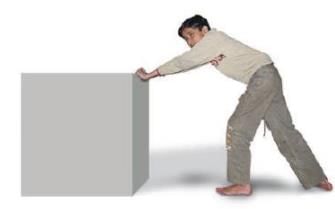
In the figure below, a boy is shown pushing the box from right to left. The force of friction will act on the box ______.
- a)from right to left (←).
- b)from left to right (→).
- c) vertically downwards (↓).
- d)vertically upwards (↑).
Correct answer is option 'B'. Can you explain this answer?
In the figure below, a boy is shown pushing the box from right to left. The force of friction will act on the box ______.
a)
from right to left (←).
b)
from left to right (→).
c)
vertically downwards (↓).
d)
vertically upwards (↑).
| | Coders Trust answered |
Let’s carefully look at the situation.
The boy is pushing the box from right to left.
- This means the applied force is directed towards the left (→ box moves left).
- Friction is a force that always opposes motion (or the tendency of motion).
So, if the push is from right to left, then the frictional force must act opposite to it, i.e. from left to right.
Why not other options?
- Option a (right to left): That’s the direction of the applied force, not friction.
- Option c (downwards): That’s the direction of weight (gravity), not friction.
- Option d (upwards): That’s the direction of normal reaction from the floor, not friction.
Correct Answer:
b) from left to right (→)
Chapter doubts & questions for Friction - Science Class 8 2026 is part of Class 8 exam preparation. The chapters have been prepared according to the Class 8 exam syllabus. The Chapter doubts & questions, notes, tests & MCQs are made for Class 8 2026 Exam. Find important definitions, questions, notes, meanings, examples, exercises, MCQs and online tests here.
Chapter doubts & questions of Friction - Science Class 8 in English & Hindi are available as part of Class 8 exam. Download more important topics, notes, lectures and mock test series for Class 8 Exam by signing up for free.
Science Class 8136 videos|531 docs|57 tests |
